______________

‘Tracy Lynne Oliver’s vibrant, wrenching, and fantastical horror novel Magician follows the coming-of-age of a gifted boy born and raised in the absence of love and light.
‘The magician’s mother grew up steeped in hate, educated in vile seductions by a mother who knew how to manipulate her beauty to get what she wanted. Though she tried to rid herself of her pregnancy through violence, the magician made it into the world nonetheless. His childhood was still shaped by his mother’s sadistic ire, though, its privations and abuses so sharp that intangible qualities became akin to objects, among which the magician was “a plant she didn’t want to allow to grow.”
‘The magician survived into adulthood by finding wonders in minutiae and by holding evil back by nurturing his innate kindness, which pulsed even in the absence of nearby human examples. He also benefited from the occasional deployment of a gift discovered in the cradle, by which “his monster [bent] the world to his needs”—warming him with scarves, delivering him baubles, even animating dust and dirt to form semblances of friends. After escaping his mother, he found temporary respite in networks of older women, then carnival life, and then love, though the darkness of his youth remained prone to creeping in to ruin each fragile instance of happiness.
‘Narrated in disquieting prose poetry, the book is made up of haunting partial sentences, their syntax twisted and their implications often brutal. There is intentional nonmusicality to their shrieking internal rhymes too, mimicking the discordance of the boy magician’s life, which is marked by “dreams dust-fire in his throat burning crisp his water prayers” and encounters with defender-bees, sentient forests, and lunar-evocative-orb-traveling performers.
‘Horrors hum behind instances of impossible beauty in Magician, a weird and wonderful novel about the alchemistic power of cultivating decency in defiance of cruelty.’ — Michelle Anne Schingler
Tracy Lynne Oliver Site
TLO @ goodreads
‘Magician’ @ Foreword Reviews
xTx is not a nun.
Buy ‘Magician’
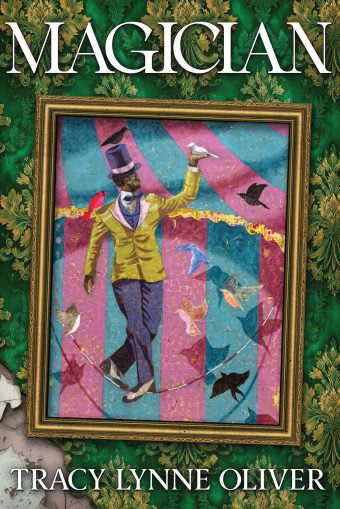 Tracy Lynne Oliver Magician
Roxanne Gay Books
‘First, he is a Boy, born to a Mother who cannot abide his existence. Despite her torments, the Boy finds a way to survive and create a small space for himself in the world. In lyrical, songlike language, Tracy Lynne Oliver lures readers into an epic tale that will appeal to fans of Our Share of Night and The Changeling.
‘The Boy endures unspeakable cruelties, saved only by a mysterious magic that intervenes in moments of need: magic he learns is his to command. When he finally escapes the Mother, a beguiling circus troupe welcomes him into their family and the Boy begins to imagine a life beyond survival, one where circus lions roar and enchanted forests spiral far into the distance. For the first time, he discovers chosen family, community, and love. He eagerly apprentices under the circus’s conjurer—only to realize his gifts far outstrip his mentor’s. Thus the Boy becomes the Magician. But as ambition bends his power, a primal threat stalks, determined to destroy not just the Magician, but all he holds dear.
‘Echoing the fairytale cadence of Helen Oyeyemi and Gerardo Sámano Córdova’s disquieting excavation of grief and trauma, Tracy Lynne Oliver has created a spellbinding world of twisted patriarchal darkness and a powerful magic that threatens to consume everyone, including its wielder. A debut novel of uncommon accomplishment, Magician establishes its author as a new voice that will hold readers rapt.’ — RGB
Excerpt
1
The Mother held a darkness. The way one harbors cancer, the way
organs are stored, how breath is contained within lungs, how pores are
stuck through with hairs, how teeth are fused with jaw; this is how it
stayed. A permanence. It had been with her always, growing from some-
thing small and hinting, then fusing into the way she became, eventually
progressing to something overgrown and rampaging. A taking over. It
weaved through every part of her, staining. Any brightness she might’ve
had whittled away.
—- As if it ever had a chance.
—- The contaminant infected not just her, but everyone she shared with.
The Mother did not share with many, but enough to damage; bits and
pieces scattered about the lawn, holes blown through walls, shredded
remnants of used-to-be-wholes hooked onto the barbed branches of
leafless trees, left to blow like ghosts in the wind.
—- She left a wake.
—- Even in the beginning. Although, smaller. A paving way.
—- The beginning:
—- Dead kittens.
—- All these dead kittens.
—- All these fucking dead kittens.
He’d pick them up, the broken bodies slowly drying under the sun. Like
dried turds lying in the road. Stiff-furred bundles, ready to be snapped,
cracked. He’d stack them in a pile behind the mailbox—not just thrown,
stacked. Her father was a meticulous man.
—- A rotting mound to offend the mailman who he knew would have to
visit the swill once a day, every day, save one. She’d see her father grin
after he’d place a new body. The way he would step back, admire his
work, glance back and forth from the mailbox to the mass, so satisfied.
—- Her father hated the mailman. Her father hated most everyone.
Her father hated.
—- She did not like most things about her father—but his cruelty to
others, other things—drew inside of her a feeling of warm connection
that overwhelmed and contradicted all else. Like the way instinct urged
the fox to chew off its own leg when caught in a trap—it was not some-
thing she wanted but it was not her choice. It was a resonance inside
of her she did not control. Later, she would recognize this as the only
bond that tied her to her father. But now, in her youth, it was a confusion
she tried to fight against. She did not want to feel anything resembling
closeness to someone she wanted so much distance from.
The furred bodies would pile up. Like kindling. The dead kittens. Black,
matted, misshapen. She wanted the pile to bury the mailbox, wanted it to
meet the moon, cover the driveway, the house, her father, her brothers.
Smothering all things she could not.
—- Yet.
—- The other ones she scraped. The ones that met the tires. Peeled
them from the dirt, the pulpy messes dimpled with pebbles, fused with
grit. Added them secretly to the stack like mortar. Pressed their slick
guts until they were smooth against the build. She too, could be careful.
—- All her fingers stuck with death, she’d hold them under her nose,
taking in the smell from their tips until it began to mean everything.
Until it became something craved.
—- Her father didn’t know. Or didn’t let himself. All these kittens. How
she was the one. Her. In her pretty dresses and pretty shoes. Always rib-
bons. Always lace. (“A little lady,” her father would say, after he’d dressed
her, after he’d bathed her, after he’d pushed her naked-asleep out of hismagician 7
bed. “Just like your goddamned mother.”) How she would take them,
mewling and new. The wild ones in the barn, behind the woodshed, still
warm from under their mothers, the mothers that would hiss at her,
knowing she was to be protected against. Darkness has a certain smell.
Even through lace, even behind ribbons.
—- When the mothers went to hunt, she would do the same.
—- Oh, pretty babies, oh pretty baby, lifting the luckiest one. Today is
your day!
—- A sweet song.
—- Her clasp, their squirm.
—- Together.
—- Both of them.
—- Feral.
—- The walk to the road was a looking forward to. The days leading to
Christmas. The tingling in her veins, the way her belly bristled with an
excitement she’d continue to yearn for. A way to pay back. Her singular
outlet.
—- Never mind any rain. Never mind any fog. It was always a sunny
walk to the road with the kittens.
—- Making sure to take the longest way, she’d drop the kitten thirty-
three times. A counting. To make sure. Little drops little drops little
drops big. So many ways to drop a kitten. So many surfaces to have
it land upon. Against. Underneath. So many noises kittens can make,
choke on, gurgle with. They needed to be broken just enough before
she got there. That was the only way they would not move. She found
that out during the learning. Their little rolling guts, swilled with bones,
made them stay.
—- Along the way, her song. Always the same sunshine melody, high and
lilting. Its jubilant bounce and clasp an intoxicating promise of joyous
things. She knew where it came from and so she did not question. The
song built from within her and carried itself out like breath. It found its
freedom during her darkest moments, blessing the actions with its mirth.
—- Placing them within the shallow tire tracks was critical. This she
knew. Again, the learning. Tires stayed true to where tires have gone
before. A going over, over a going over, over a going over. The road was
narrow, dusty, gravel and dirt, bordered by weeds, brush. Not enough
space to make a new way. Placing them in the middle would be stupid.
A waste. This road was a lonely one. This road was only driven with
need, not chance, nor luxury. She could not waste the kitten. She could
not squander.
—- Mornings were best. After her father had gone to town, after her
brothers had gone to school. Roads see lots of use in the mornings.
People needing to get to places where they would start their day a
second time.
—- She had no place to be. Her place to be was waiting. On the side of
the road, back far enough so she wasn’t seen, but close enough so she
could. The thrill of it thrived her. As each car drove past, she braced
herself wondering if there would be a pop or if it would be a quiet con-
version; the lump of it becoming one with the road in an instant like a
magic trick. An alive thing becoming a dead thing in less than a breath,
the power she held, the control. And when it happened, the feeling filled
inside her with a radiance.
—- In the beginning, this was how her darkness manifested. In the
beginning, the kittens. In the beginning they were enough. Later, she
grew new ways. Larger and intricate the way a symphony was, but void
of any intent of beauty.
2
The Mother’s mother left, but the Mother’s mother left her with lessons.
Yes, young when she was discarded, alongside her brothers, underneath
her father, the Mother’s recollections of her own mother held fogged
yet every lesson she was given was blade sharp. Elbows and ribs pok-
ing through the soft flesh of memory. The Mother had these marble
glimpses and held on to them as scripture. It watered and fertilized her
darkness. Daughters needed their mothers, and this fragile stockpile was
what she pulled from when she wanted to remember that need.
—- The Mother prided herself on not needing. However, she was
human, and when wistful and weak, her mind sometimes wandered back
untethered and bareback, hunting a comfort she rarely allowed herself
or would ever admit to. But animal she was, and the glimpses came:
flashes of golden hair, pale pink lipstick, soft white skin, perfume, dresses,
purses, shoes and over everything, her song. One the Mother now sang.
Still, the strongest glimpse a captivating beauty that her daughter-self
saw and bold-witnessed in the eyes of men. Holding her mother’s hand
on a sidewalk stroll watching as women slapped and yelled as their men
gaped and swooned, unmoored with what she evoked. The Mother-
daughter remembered the cloak of that power, her mother laughing as
the men fell and stuttered, as the women glared and harrumphed, all of
it a wonderful wake—hers.
—- The glimpses were lesser than the lessons. The Mother’s mother’s
lessons had been well learned. Permeated into her pulse and fused into
her soul. Wherever her mother was, if she knew how apt a pupil she’d
been, how she had mirrored, she would be proud. How she raised a
daughter that sung her song while men collapsed, how she created her
own wake as she walked.
—- One lesson taught many times was how her mother broke her broth-
ers. An easy sport played over and over, causing them to turn against
the other for what all males coveted from her—love.
—- It began with being summoned. Her mother patted whatever space
was next to her: a chair, a couch, a front porch, a park bench, sometimes
even a lap. The at-that-time-daughter, now Mother, sat wherever the
pat prompted, obedient and excited. She longed for these lessons. To
have this bond that her brothers and her father would never have with
her mother set her above. Which was exactly where her mother wanted
her to be.
—- Her mother placed a kiss on her forehead and got giddy. “Ready,
little sister?” She always called her that, never daughter.
—- “Yes, mother. I’m ready.”
—- There was some tickling then, or a cuddle, some affectionate back-
and-forth between them before the song started.
—- “Watch and learn.”
—- The daughter, now Mother, was always excited to see which game
would be played. How stupid the brothers would be to play it again, its
different shape or form or manner ignored, dazzled as they were by her
maternity swathed in such beauty.
—- “Boys!”
—- The summoning. Pigs to slaughter they came. Always.
—- Pink-painted fingernails pinched a red-foil-wrapped chocolate bar.
Their eyes grew wide with want. Treats were forbidden fruit in the
house. Nothing was allowed to be sweeter than her.
—- “Want?”
—- They nodded. Sheep.
—- The mother reached and clenched the daughter’s hand, glanced
and met eyes, grinned, giddy again. The daughter-Mother’s favorite
part then,
—- “Fight.”
—- The Mother-daughter always tried to see what started first, the fists
or the song. She could never tell. It seemed simultaneous.
—- The twins blurred. Their bodies careened and crushed. Knees jabbed
into guts, elbows smashed into nuts, hands gripped and strangled. The
sun baked the both of them as they battled, sweat coupling blood and
tears. Sprays of dust kicked up like water, doused the mother and the
daughter-Mother and made them choke-laugh. The Mother’s mother’s
song became jazz, smoothed in the places when the boys screamed,
pierced in the places they whimpered. It wound its hymn through the
warfare, twisted and accelerated the assault, a brutal music.
—- The lilt of the mother’s laughter as her sons fought hot in the yard’s
dirt for the chance to win a candy bar. How they grunted and
growled, punched and kicked while she chorused for more cruelty. The
daughter-now-Mother awed at the display. The mother paused her song
only to taunt.
—- “It’s melting.”
—- “I can see you boys don’t really want this.”
—- “Somebody better lay down or little sister’s gonna have somethin’
sweet!”
—- The barbs brought more brutality, which brought more song.
—- One twin grabbed a stone and the lesson ended.
—- How she kissed the victor while the defeated barely-writhed, blood-
smeared at her feet.
—- “See that, little sister?” She grinned at the daughter-Mother, then
nodded at the boys: one stuffing his maw with chocolate, the other curled
and crying. “Control is an easy game with the masculine. Remember
that. Know your power and anything can be yours.”
—- The now-Mother learned and, later, lived that learning.
Extra
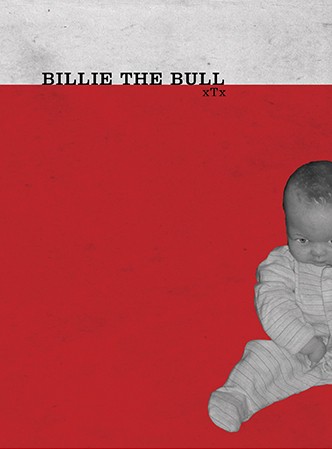
xTx (Tracy Lynne Oliver) ‘Billie the Bull’ (2013)
_______________
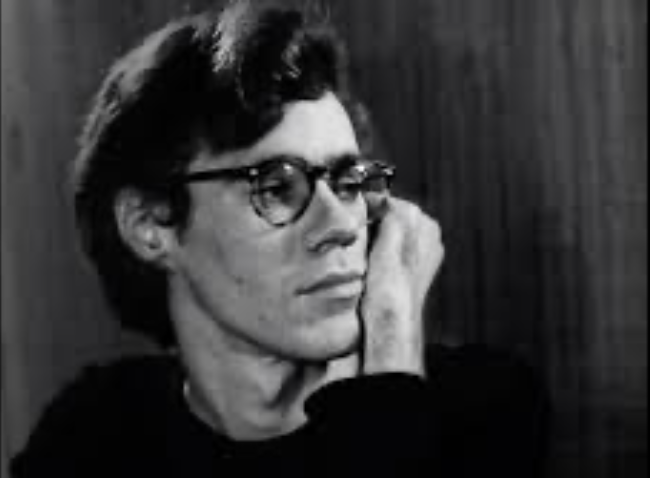
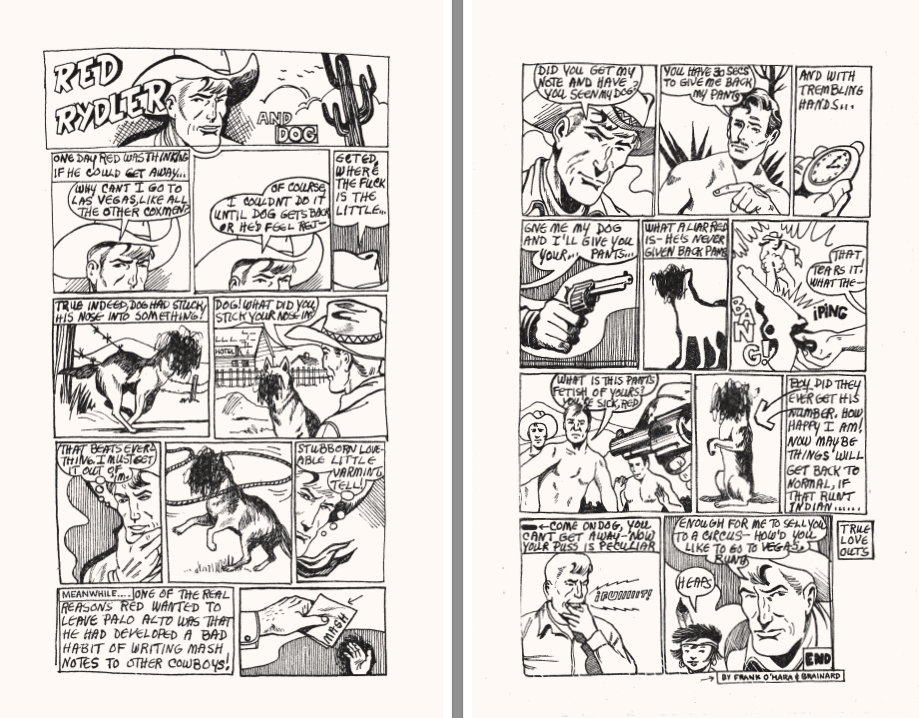
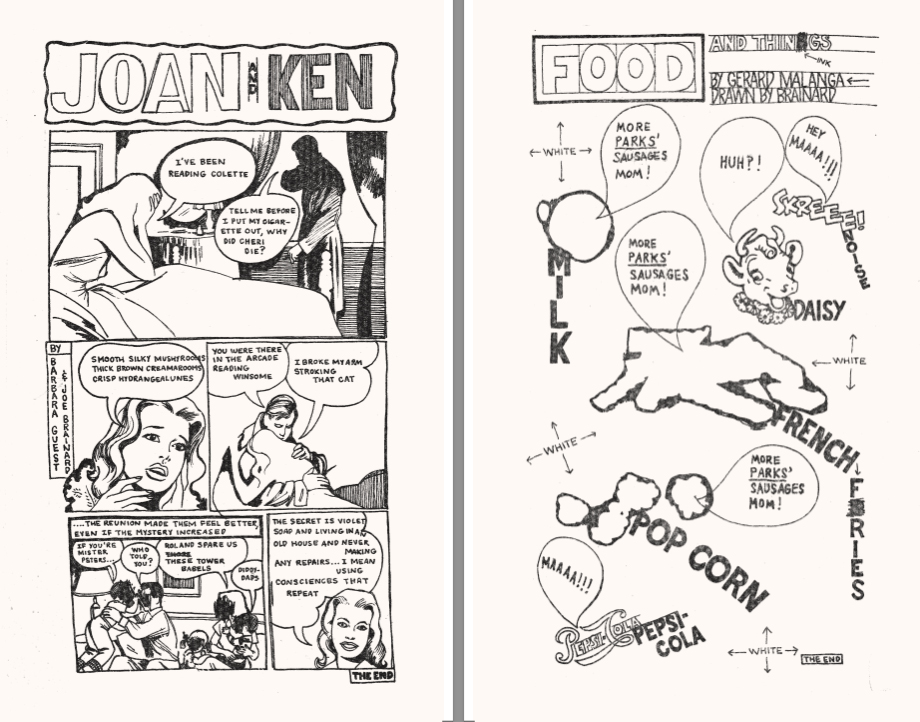
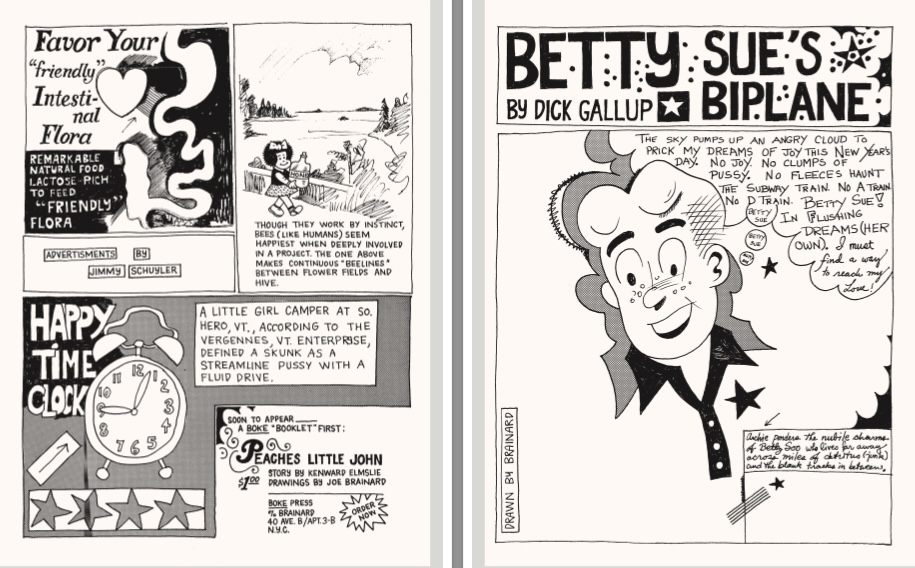
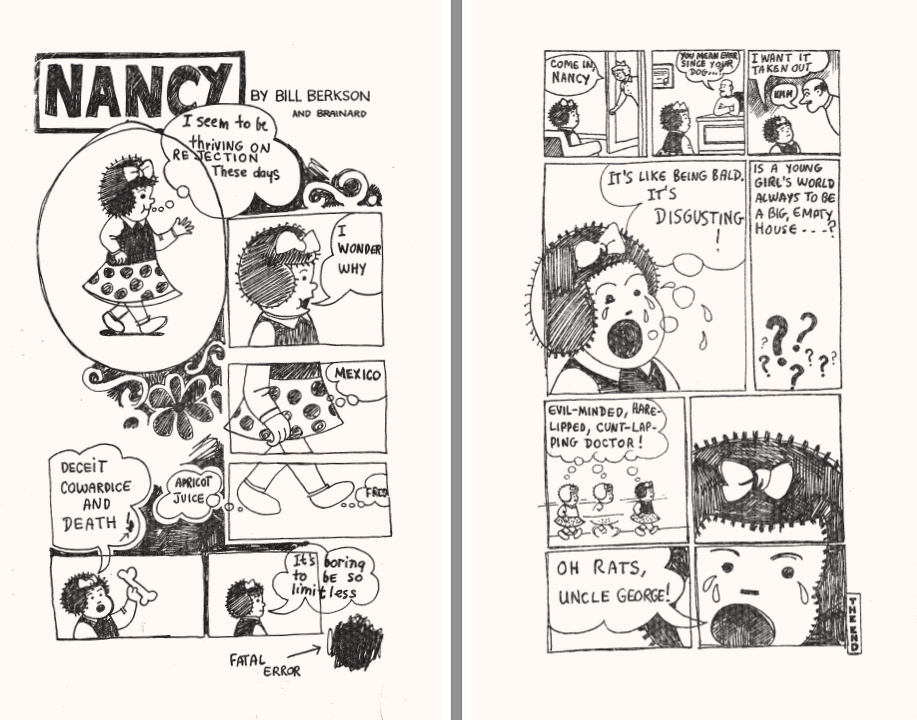
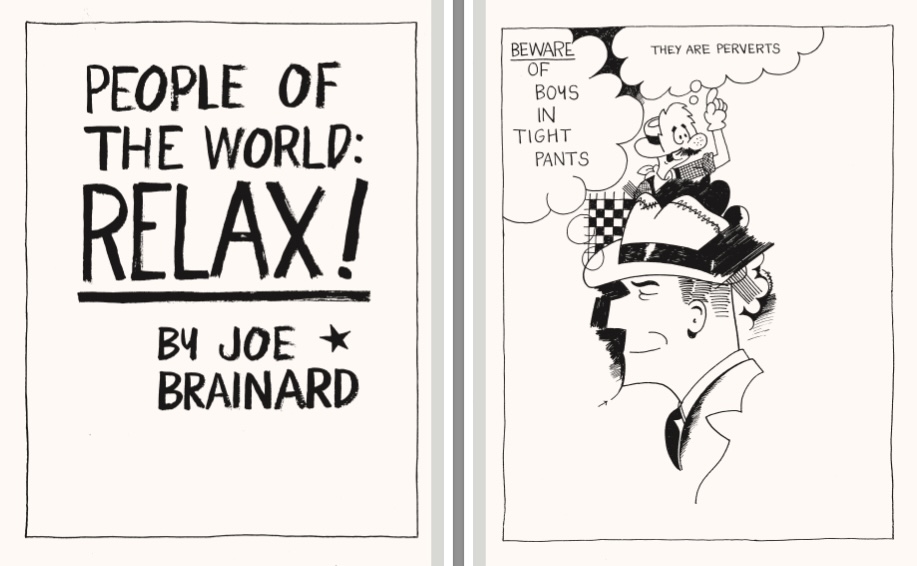
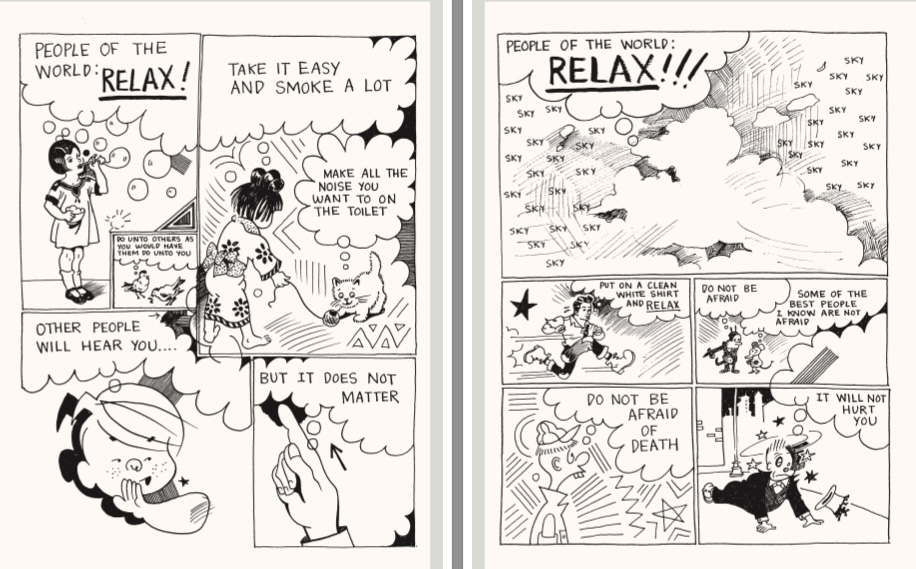
‘Not long out of high school in Tulsa, Oklahoma, in 1960 Joe Brainard arrived on New York’s Lower East Side, where he began an ambitious project of making art across many forms—collage, drawing, and painting—and writing poems. Joining him in this vibrant downtown culture were fellow Oklahomans Ron Padgett, Dick Gallup, and Ted Berrigan, along with sundry other poets, a list including Frank O’Hara, John Ashbery, and James Schuyler. This loose confederation would come to be dubbed the New York School, a term its members would disavow, but which nonetheless serves as a convenient moniker to characterize work that prized urbane wit, pop culture, and a penchant for disjuncture. …
‘That persona, sometimes campy, often profound, can be seen taking shape in The Complete C Comics, a volume featuring an informative essay by comics critic Bill Kartalopoulos and a foreword by Padgett, which presents the only two issues of the comics Brainard produced between 1964 and 1966. The book’s oversize format accommodates the black-and-white legal-size pages from the first issue; the second was the more standard 8 ½” by 11”. Any diminishment in trim size would have been unfortunate: the genre-appropriate boldness of the drawings and energetic design require the full original space.
‘This kind of deadpan, absurdist comedy would gain popularity in the next decade, but in 1966 it appealed principally to a coterie of downtown sophisticates; the second and final issue of C Comics sold a total of seventy-five copies at two West Village bookstores. But Brainard’s art now hangs in many museums, and the canon-making Library of America issued his Collected Writings. For a long time, we’ve taken for granted the permeability between high and low culture. The Complete C Comics documents an instance when those barriers began dissolving, a bellwether moment when poets who weren’t supposed to versify on cartoons—and artists who weren’t expected to draw inspiration from Jughead, but Masaccio—did just that.’ — Albert Mobilio
‘A Cartoon Revival’ by Lucy Sante
The Complete C Comics @ Brooklyn Rail
The Complete C Comics @ 4columns
The Complete C Comics @ The Comics Journal
Buy ‘The Complete C Comics’
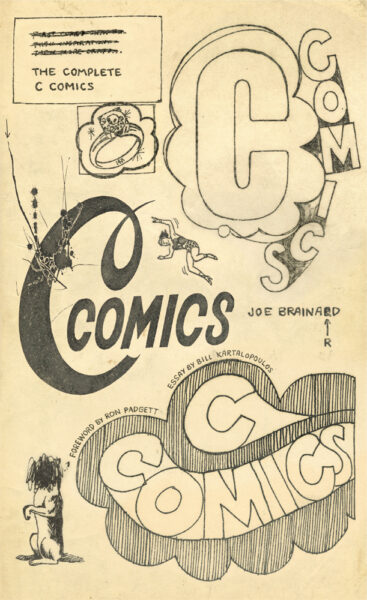 Joe Brainard, foreword by Ron Padgett The Complete C Comics
New York Review Books
‘In the creative hotbed of 1960s New York, Joe Brainard was a whirlwind. He was a maker of paintings, assemblages, collages, book covers, poetry-reading flyers, and more. But some of his most exciting work was done with his friends. In 1964, the twenty-two-year-old Brainard turned his talents to rewiring the lowly comic book form into something new and surprising. He invited his friends Frank O’Hara, Ted Berrigan, John Ashbery, Kenneth Koch, Peter Schjeldahl, Barbara Guest, Ron Padgett, and others—all of them New York School poets—to collaborate with him on comics that they would write and he would draw.
‘The results were unlike any comics seen before. Previously available only on the rare-book market (at very high prices) but available here under one cover for the first time, the two issues of C Comics still feel as fresh as when the first page rolled off the mimeograph machine more than sixty years ago. Brainard’s energetic line and joyful humor charge across every page, illustrating O’Hara’s recasting of a cowboy as a mash-note-writing lover, Padgett’s experiments with traditional cartoon sound effects (ROAR! GRRR! SKREE!), cameos by Ernie Bushmiller’s Nancy, and heaps of Dadaesque delights.’ — NYRB
Excerpts

Extra
Panel Discussion on Joe Brainard and C Comics | New York Studio School
_______________
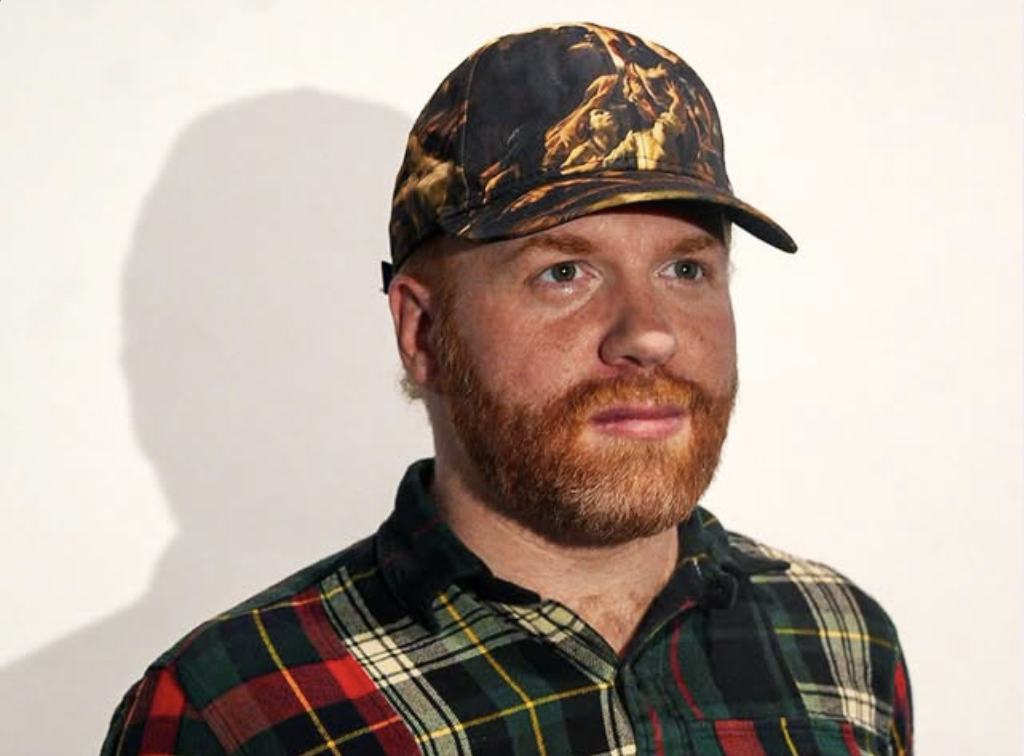
‘In The Sapsuckers, Sam Farhi writes with a tactile intelligence that makes environment inseparable from thought. This is prose that does not merely describe place but saturates the reader in it, the slow creep of decay becomes felt conditions rather than metaphors. Farhi’s sentences move with a deliberate, unsettling grace. His work is oddly tender, bracingly unsentimental yet deeply alive. The Sapsuckers announces a writer unafraid of discomfort, one who understands that the richest truths often lie in the less obvious moments. A novel to be admired, which will still be with you long after you put it down.’ — Thomas Moore
‘A riveting, disquieting portrait of grief, alienation, brotherhood, and the particular strangeness of coming of age in an American college town at the dawn of this millennium. A world unto itself that is also, unmistakably, our world. I loved every sentence.’ — David Leo Rice
‘Sam Farhi’s The Sapsuckers is so stylistically inventive one is almost surprised by the depths of its emotional resonance. From the outset, young Peter Dixon’s intimate recounting enmeshes the reader in his world of precarity, betrayal and pervasive threat. Close observation and keenly attuned dialogue give us characters who feel fully dimensional, yet their interactions play out in often unexpected ways. Throughout, the rupturing of linear narrative is sustained, intensified, and lent cohesion by the candor and unflinching honesty of Pete’s voice. This is an exceptionally well-conceived and finely crafted debut novel.’ — Eric Darton
Sam Farhi Site
Sam Farhi @ instagram
‘The Underground’
Sam Farhi @ IMDb
Preorder ‘The Sapsuckers’ here
 Sam Farhi The Sapsuckers
Spuyten Devil
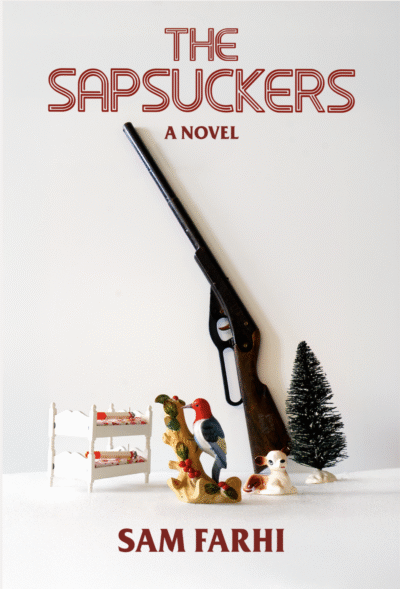
‘“Don’t tell mom.” Those were the last words Rem ever told his little brother Pete in the summer of 2004 before slipping out the door of their trailer with a half-filled backpack, disappearing into the night forever. Words that haunt Pete almost as much as the ones scrawled over Rem’s lifeless body when the police found him later, hanging by a gorge in the sleepy upstate college town of Ithaca, New York. The police declared it a suicide, but for Pete and his mother Peg, the truth is something both more complicated and more simple than that. The Sapsuckers is a literary anti-mystery suffused with slow dread, a compelling exploration of our obsession with true-crime, and a mesmerizing debut that probes the tenuous connection of bonds that are forged in trauma.’ — S.D.
Excerpt
Extra
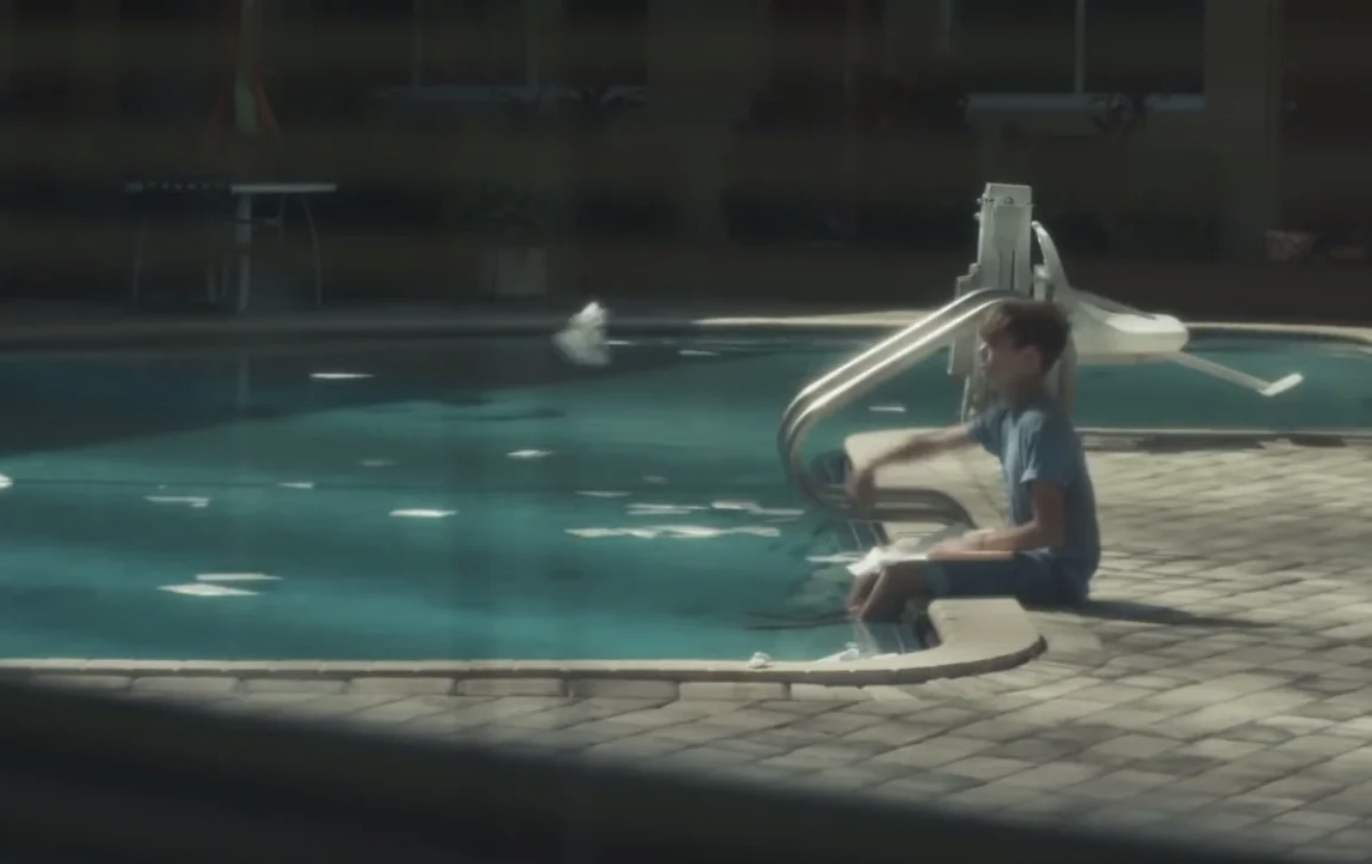
Still from Sam Farhi’s film ‘The Hourglass’
______________
‘Circuitous then straight-forward, one-time self-contradicting, this book is a little Beckett, a little Gertrude Stein. It’s a sort of self-reflective manual for how to consciously write fiction. It’s a sort of autodidactic science for how the body writes. It is an exploration of the underlining storytelling of Gladman’s Ravicka novels. It “is a book of lectures about living in and as invisible structures; it’s about fictional knowing, and about gestures that electrify our spaces of wander—where we breathe and where we glow, where we think and what we produce from out thinking”.
‘I want to call this book a collection of essays, but perhaps they are prose poems, or something between these two spaces. The book has two parts—the first is described above as a manual for writing (and understanding) the project of Gladman’s fictional work. The second part—These are the Grasses of Ravicka—is an enactment of the principles of this theory, a continuation of the Ravicka novels. Gladman describes this part of the book as drawing in language.
‘This is an interesting book. For me, it teaches something about how language can enact a belief in the world, it can make the rules of its own storytelling. Gladman is a master writer, writing out the belief of how creativity operates in her mind and through her body. It is a guide to any creative person trying to capture how the body makes the thing.
‘This book also teaching me something about how to tell stories which are true to the characters, through their phycology, and how language necessitates a referential domain. As writers, we can choose to understand this, and write into that space, as Gladman always does.’ — rex inc.
Renee Gladman Site
Podcast: 11.1 Renee Gladman: “Theory for Moving Houses”
Renee Gladman in Conversation with Miriam Karraker
Renee Gladman @ instagram
Buy ‘Theory for Moving Houses’
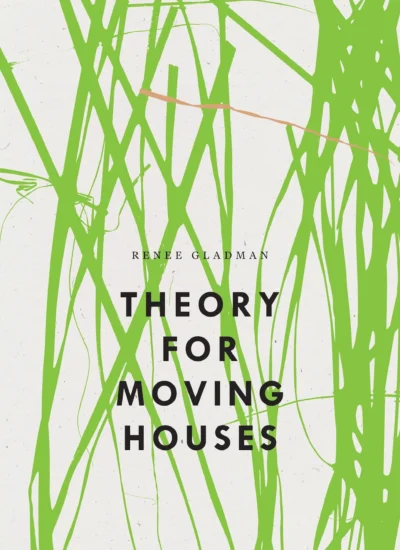 Renee Gladman Theory for Moving Houses
Wave Books
‘You are asking me where I live and it’s making me think all these things about space, where I start and end in space and where space starts and ends in me and when, in space, I am a body and when I’m a book, in space.
‘So begins Renee Gladman’s Theory for Moving Houses, and with these lines we are invited into a liminal space of imagination and investigation, as Gladman guides us through the architectures of her poetics. Foundational here is a sense of fluidity, a slippage of time, a devotion to “non-linear and hyper gestural movement,” a communal spirit. Gladman’s inquiry into her intersecting practices of writing and drawing reveals a deep commitment to uncertainty and “fictional knowing.” Yet again, Gladman upends traditional expectations of prose, as she leads us through landscape of her Ravicka series novels, ultimately surprising us with a novel within nonfiction. The latest volume in Wave’s Bagley Wright Lecture Series, Theory for Moving Houses is not only visionary in its contemplations but also is a virtuosic example of the ways in which language can shape utopian sites of possibility.’ — Wave Books
Excerpt
For all my writing life I have been fascinated with notions of origin and passage, though rarely in terms of ancestry—since I don’t know where I’m from. I don’t know the languages or landscapes that preceded the incursion of English and what is now the United States into my lineage. Yet, the violence of that erasure—all the inheritances interrupted—is as foundational to my relationship to language and subjectivity as is grammar. There remains some aspect of my speaking that expects a different mode of expression than English provides. I know this because of my tendency to encode as I write, also to invent languages as I’ve done in half of my books. I open my mouth in my own life and I want to distort, rearrange, mispronounce the available vocabulary. This comes from a desire to resist assimilation, but equally, it arises out of a sense of exploration or adventure, a sense of puzzlement: as if something has happened to my occupation of the language, where a kind of split occurs. I move through it and see myself moving at the same time. It’s a double consciousness, a questioning that simultanates my rendering of experience. (I know that’s not a word—simultanates—but I needed a verb that would indicate one thing causing something else to run parallel to it). I say “I” in my language, and whatever I was setting out to describe or place in time undergoes an immediate complexity. This points to a displacement, which I believe is at the heart of any narrative I write—the displacement indicates what I call “the problem of the person,” where articulating one’s experiences in time—that is to say, describing the origins of one’s acts, the chronology of events of a day in the life of, something which would seem to suit language very well, which would seem to be the purpose of language, is in fact one of its foremost struggles. Narrative language seems baffled by both time and memory. And yet, these are its main source materials for world-building.
So, to return to the predicament of my displaced origins, that unmappable first land and unutterable first language, rather than comb my mind for their traces I have found myself more taken by the structural and philosophical implications of their absence. How these ghosts make voids and reflective surfaces within language, the very means of one’s self-determination. In 1997 or ’98, I wrote a sentence that would be the beginning of a two- decades long investigation of what comes after absence. I wrote: “About the body I know very little though I am steadily trying to improve myself, in the way animals improve themselves by licking. I have always wanted to be sharp and clean.” This grouping of sentences, which opens the first story of my first book, has stayed intact in my memory, because it exemplifies perfectly my predicament as a subject in language, place, and time. The voice announces itself through a declaration of what it doesn’t know “about the body,” but it turns itself toward knowing. Though, not toward a countable knowledge—something that will attenuate this lack with regard to the body—rather, toward a better disposition, in a sense a better vantage point for viewing the unknown. The voice wants a lighter constitution, to be highly functioning, “winning,” so it looks out into the world for behavior to emulate: “in the way animals improve themselves by licking,” and finds a gesture that encompasses both the insistence and absurdity of trying. If there is anything my narrators do it is to try. To try and try. Which results in an arrival: “I have always wanted to be sharp and clean.” A statement that at once sets a standard—to be sharp and clean— but looks at that desire with nostalgia, with detachment: “I have always wanted.” With these sentences I sought to establish the conditions through which I would investigate the nature of experience, which, at that time, would be understood as something originating from a feeling of being “without”—of being foreign or disoriented—but, at once, moving forward, moving through itself, because the language or the street says so. We move through language because we place it between our selves and the world, we agree on it as the means by which we represent thought and emotion. We use it as a repository for most of our facts and observations and wonderings. But, what does language have to do with the street?
For me, the two are inextricable, and the one makes the other phenomenally more interesting through this link. In 1994 I moved to San Francisco to study poetics at a college that no longer exists but which, at the time, was very centrally located. The neighborhood, where I studied and where I lived and walked my dog, provided a ground (a staging, even) that laid out not only a trajectory of arts venues, bookstores, coffee shops, taquerias, etc., but also made evident the tension and sometime collaboration between the Mexican and Central American residents of that part of the city and their mostly white, young hipster neighbors. There were demarcations of space that you processed through your urbanized body, that presented you with a set of ever evolving questions regarding your itinerary—the streets you habituated, the streets you avoided, where you felt safe, felt central, where you sought refuge, difference, etc. By contrast, I grew up in a city where one experienced passage from one place to another by car or bus. You walked only if you were poor, and you didn’t get very far before your course was interrupted by expressways. Thus, that city was always held away. It felt un-enterable and evacuated as a space of cultural exchange. Living in San Francisco, however, a place where my primary mode of passage was walking, dramatically altered what was visible and what could be experienced. To repeat, foremost, it was the fact of the body—this body turning corners, passing other bodies, being seen and read by other bodies, climbing hills, touching the sides of buildings—it was the fact of this body, following lines, making new lines, resting, moving that gave the city a sense of syntax; the day was divided into intervals, like clauses. Walking became a way of reading the city, of writing one’s subjectivity and thinking into it. My walking became a story of movement, of crossing in and out of different modes of being, and fragmenting place and time. And, it did not take me long to understand this also as the very character of the sentence: movement, crossing in and out of different modes of being, fragmenting place and time.
Extra
Mauricio Pauly, “Theory for Moving Houses”
_____________

‘This one’s different, honestly. This is postapocalyptica via Kafka, Švankmajer, and the Brothers Grimm … I had to stop and come up for air several times.’ — CD Rose
‘Writing the book was something really unexpected for me. I’d never seen myself as someone who would write a novel—I wanted to write plays and make films. But I started writing The Doloriad after two events that distanced me from my everyday reality and speech. First, I moved to a new city with a new language, and began to learn it at once. I worked in a cafe and could only say simple sentences. I spent a lot of time getting orders wrong, being reprimanded without quite understanding why. It was useful to feel so stupid. It made me more humble. The second thing that happened was that I began to have seizures and was diagnosed with epilepsy. It felt as if they’d wrecked my brain. I forgot words, said sentences backwards. Everything suggested everything else in the strangest of ways. I couldn’t seem to hold onto my thoughts, and I suddenly understood how provisional my relationship to language was, how little control I had over my mind and memories. For me, The Doloriad is a reflection of that uncertainty: the way the sentences fit together and follow on from one another is both an aggressive mirroring of and a response to doubt, extreme doubt. Everyone is constantly trying to fix things in place while questioning them at the same time. I feel a lot of kinship to writers like Krasznahorkai for that reason—I don’t think he takes anything for granted and the way he writes belongs to that, everything is a kind of relentless circling. I’m a real fan of Bernhard too. But the thinker I am most drawn to is and has always been Descartes. I feel as if doubt and skepticism inform every single thing I do. I was obsessive even before I started having seizures, but those traits became more intense afterwards. When I tried to write again, it was like The Doloriad was a thing waiting to be discovered. My style felt fully formed. I think all style arises out of a condition of being.’ — Missouri Williams
Aggressive Mirroring: An Interview with Missouri Williams
Ian Mond Reviews The Doloriad
Missouri Willians @ goodreads
A Cartoon Hell
Buy ‘The Doloriad’
 Missouri Williams The Doloriad
FSG Originals
‘In the wake of a mysterious environmental cataclysm that has wiped out the rest of humankind, the Matriarch, her brother, and the family descended from their incest cling to existence on the edges of a deserted city. The Matriarch, ruling with fear and force, dreams of starting humanity over again, though her children are not so certain. Together the family scavenges supplies and attempts to cultivate the poisoned earth. For entertainment, they watch old VHS tapes of a TV show in which a problem-solving medieval saint faces down a sequence of logical and ethical dilemmas. But one day the Matriarch dreams of another group of survivors and sends away one of her daughters, the legless Dolores, as a marriage offering. When Dolores returns the next day, her reappearance triggers the breakdown of the Matriarch’s fragile order, and the control she wields over their sprawling family begins to weaken.
‘Told in extraordinary, intricate prose that moves with a life of its own, and at times striking with the power of physical force, Missouri Williams’s debut novel is a blazingly original document of depravity and salvation. Gothic and strange, moving and disquieting, and often hilarious, The Doloriad stares down, with narrowed eyes, humanity’s unbreakable commitment to life.’ — FSG
Excerpt
When she’d first arrived in the city, she’d been all alone except for him, and it was he who had looked after her when she’d wept and screamed and thrown herself against the walls of the small bedroom that they shared, brother and sister. And though it was rumoured that they shared a bed, this had not been true because in this city they shared nothing apart from the grim white fact of the room and her misery, which belonged to the past and was also their misery, a family misery, and as it would follow them wherever they went his sympathy was predicated on the simple understanding that if not her, him. But they were also joined by something beyond sadness, and when he reflected on it further it struck him that what pulled them together was nothing other than an immense vanity, because they were so similar, as if her face were the proof of his. Despite the fact that they were only siblings and not twins, it was true that even in the sprawl of their family people often forgot this distinction as a result of this incredible similarity of feature and gesture. They had been lumped together since birth, only a single year to separate them, and had grown up in unison, though she had always been in charge. All this had meant that when she had announced her intention to forsake their city for another it had only been natural that he’d follow her lead, being the younger and more docile of the pair. It had been essential for her to escape their fat-fingered mother (although even then he had known that it was inevitable she’d become a fat-fingered mother of her own) and in the first burst of their freedom she had been happy and unencumbered. Only before long the past drew even with her. The stemma of the family! The whole sick mess of it! He wasn’t sure where to assign responsibility. It was clear that something was tormenting her, and as she tossed and turned on the white bed she gritted out that whatever it was was in her head, that a bright pink worm with their mother’s face was there, deep inside her brain, chewing away and giving her no peace. It had wriggled in through her ear while she slept in her childhood bed on the tense, excited night before their departure for the city and the strange future it embodied, because the worm, too, had sensed the possibility of escape. It was this worm that ate away at her now, riddling her with loneliness and preventing her from catching the trick of it, the language of the new city, while her brother could already manage a few words, was already caught up in its strange and guttural rhythms, though he hid it, didn’t want to admit that he was capable of leaving her behind. But he’d had his problems with the way she never called anything by its name and in doing so lost herself in a web of symbols that possessed only a glancing association with what was real and tangible, and so he couldn’t do anything about the worm, and neither could he talk her back to the past and the world that had been theirs; and he thought it had something to do with language, with the fact that the language of the city was not their own and so she had had nothing to break the fall into the receptacle of herself, the miswired circuitry of her head, with its heaping, grasping associations. The worm! The wolves! The poison in the water! She was tired, exhausted by the drama of life in the alien city. She wanted to go back but didn’t know how. Their family, the stink of failure—these things frightened her more than the timeless grey present into which she had slipped without knowing why. It hadn’t been clear to him that they were different, that the similarity of their faces and their shared history did not, after all, mean everything, but once in the new city he understood, suddenly, that she was not him and he was not her. When he went to the university and started to study the distance between them grew. It was at the university that he had met his wife. His sister had been glad when the city died and even gladder when eleven years later his wife did too. She had taken their survival as a sign of something greater and his wife had been in the way of her mission. But the truth was that she had always been jealous of his wife, who belonged to the city and the new life that had never welcomed her the way she’d expected to be welcomed. She didn’t want to make a place for her in her new image of the world. His wife’s city—the city that his sister had come to hate—was dead. The abandoned skyscrapers were humbled at last. The parks with their shady paths would burn and one day the great river would dry up. His sister was new, alive, invigorated by the change. Until the discovery of the old schoolmaster, it had just been the three of them and she had been the one to find them food and shelter, to lead them through the contaminated areas and to force them to survive. She had pushed them to keep on living with the same mad ferocity that he had seen in her as a child, and she had hated his wife for her willingness to let it end. His wife had looked at the dead earth and seen nothing to redeem them. She was ashamed of the vanished animals, the poisoned rivers, and the barren fields. And even from the beginning of their relationship she had let him know that she was infertile. She hadn’t cared—she had known long before the cataclysm that the city was going in a bad direction and the last thing she had wanted to do was to add to the misery she saw around her. His wife had never wanted to inflict the spectacle of the world on anyone else, but his sister wanted a baby. For them to be the last humans ever, eking it out in the ruins of the old city, waiting for death—his sister had hated the idea! She had pleaded with him; he hadn’t given in. Eventually she had swallowed her pride and asked his wife. Until that moment he had never realised how strong her sense of purpose was. Her visioning—the ark, renewal, time’s beginning again—had taken him unawares. Who could have guessed that she felt it so strongly, the future coiled up in her? But his wife had relented to his sister’s desire for continuity, despite her own love of endings. She had seen her suffering and couldn’t bear it. And so the very qualities he’d admired most about his wife were what pushed him into sleeping with his sister. It wasn’t wrong, she had said to him, to want to make a go of it. If they couldn’t find others, they could make them. Once he’d gotten over his initial disgust and admitted the attraction that had always been present in their too-closeness, sex with his sister acquired the kind of sick, solipsistic pleasure that he associated with masturbation. It wasn’t wrong, his wife had said, to give her what she wanted, which she had the decency to pretend was only children and nothing to do with the taboo of his body; the desecration of the last remaining familial bond. The names of their surviving children were a prayer to life, an offering made to a god who he suspected was no longer there. Jan, Bara, Katka, Adela… It never stopped bothering him that she’d given them the names of the city, as if this were her final joke on it, and he’d never been won over by the project—which remained, sullenly, her project—just as how in the life before he had never been won over by children and the futurity they embodied because his wife’s passivity was his own, and all he had wanted was to let the world drift past him. After the conquest of her brother and his wife, his sister had flourished. She grew bigger and stronger, while it seemed to him that his own wife weakened, as if the life his sister was brimming with had been siphoned off her. The significance of their survival, the idea that there had to be a reason behind their solitary existence in the empty world, sustained her, gave her strength. Even the later appearance of the fat schoolmaster did nothing to dent her faith. The cataclysm had confirmed everything that his sister believed about their world. In time he came to understand that the expression he’d caught on her face when the three of them had emerged from the faculty basement and encountered the deserted streets, the silent city and the blasted countryside, had, if anything, been gloating, as if now that reality mirrored what had always been her idea of it, she could finally let go of her sadness and be free. But everything that he had loved was dead. His sister’s sadness, their sadness, had leapt from her heart to his, and the burden of life weighed him down like a rock. His sister could make the world in her image and there was nothing to stop her. He didn’t care, couldn’t care. Someday he would end it, but it had always been hard to end things and now their uncle saw that it was harder than ever. He put his head in his hands and wailed. The Matriarch gave no sign that she had heard him. The lights went out, the spectators sighed, and then nothing was heard save for the quiet, regular breathing of the little white sheep, a pale glimmer in the void. The audience waited.
Extra
Blue Tomorrows – A Symposium with Corina Copp & Missouri Williams
*
p.s. Hey. Tomorrow I’m going to Berlin for a screening of ‘Room Temperature’ there on Tuesday, so the blog will be taking a little vacation while I’m away. It will return to action on Thursday. ** Dominik, Hi!!! I know, me too. I guess I could walk around asking cute boys and girls on the street what they’re wearing, but, no, I seem to want to make films that aren’t shaped like tall, skinny rectangles, alas. Have a super swell next several days, pal. There is one very wealthy man on here who love wants to do it with and he knows who he is, G. ** Carsten, Sadly I didn’t see John Lee Hooker or Howlin’ Wolf. Now that would have been something. I started going to music gigs constantly when I was in my mid-teens, and, yes, fortunate me. Sure, I’m into Blank. In fact you’ve inspired me to go find one I haven’t seen yet. Thanks, enjoy life until I’m post-Berlin. ** jay, I strongly suspect that said ‘straight’ guys are just working what appears to be an appealing angle. I always think of queer guys lusting after straight guys as being very high school, although that lure obviously transcends its starting point. Haha, that’s crazy about my ‘TMS’ voice, but thank you very kindly. Oh, yeah, Mannerism. I should try to do a Mannerist post and see what comes up. ** _Black_Acrylic, Yes, that was even news here in France, I think partly because of some controversial call by the referees? I assume you know of that I speak. Dude, I’m projectile vomiting all the luck I have at you and your team today. ** Adem Berbic, Hey. I understand how all of that can linger in you. I have my longterm shit too. I just try to recognise its hangover influence when I feel it as soon as I can and embrace logic as a way to write it off. But I have this in-built structuring system of anarchism I can access, and it’s inherently hope directed and self-disempowering, and that helps a lot. I also have a deep seated fear of giving the past too much credit. I don’t know. Anyway, your attitude/thinking isn’t ugly out here by any means, if that matters. ** Jack Skelley, Jacky!!! London so soon. Crazy. Yes, keep me up on your stuff, European and otherwise. And if you want any Efteling must-rides let me know. Love and luv back. Brightness galore. ** Tosh Berman, That is such unbelievably great news! I somehow knew you’d come out the other side with your impeccableness intact, but still. Amazing!!! All the love and strength building wishes in the world! xoxo. ** Vincent, Hi. Oh, great, you’re coming to see RT. Awesome, thank you! ** julian, There hasn’t been an insane upswing in blog hits so far, so I guess Patel’s secret is safe for now. That’s so true that if you worry/think your work is derivative, you don’t let it be and it isn’t. No worries. Congrats on being post-school for a bit, and obviously it would be a boon to get to commune with you more. ** Laura, They would certainly at least strongly consider doing so in their imaginations. Cuter than usual? I don’t know, wouldn’t shock me. Yes, and no squinting necessary. We’re pretty absolutely determined to shoot the new film in English. I don’t think it would work in French. I have a washer in the apartment, so laundry is pretty easy. And I like the sound. And I hardly have any clothes. Yesterday? Um, it went through my mind that the swing-set is a beautiful contraption. May your next several days make Terrence Malick’s eyes water. ** HaRpEr //, That was a pretty good sentence. Technically, at least. Yes, there have been times when I was strongly urged by agents and publishers to write a memoir concentrating on my upbringing. At one point I got this idea that I would do it if the memoir could be ghost written like famous sports figures’ memoirs. But no one liked that idea. I didn’t read or rather try to read ‘A Clockwork Orange’ until after I’d seen and loved the film, and I couldn’t get through it. No one talks about Anthony Burgess anymore. It’s interesting. I wonder how his stuff would read now. Maybe I’ll try it. Very true about seeing ‘porn’ in an artistic context. Same for me. ** kenley, Hi! Nice picks. Whoa, from sort of liking certain things about Montreal to actually moving there! Congrats and that’s crazy cool. I’m guessing people there speak fluent English without getting too pissed off about doing that? Prayers as you need them albeit atheist prayers. Yep, a few days in Berlin. Should be okay. I’ll fill you in, and you fill me too. Sounds fun! Have a great at the very least weekend and just beyond. ** Bill, I wouldn’t expect anything Slava has to do with to be very surprising, oops. The new Jane Schoenbrun just premiered at Cannes. And I’m obviously very intrigued. Quite a coup there for Frameline, I think? It seemed to have gone down with at least a bit of a storm in Cannes. Luck with your project progress, obviously! ** Okay. I recommend all of those books up there to you, and especially ‘Magician’ by Tracy Lynne Oliver, who some of you Alt Lit veterans might remember from her former nom de plume xTx. It’s the most exciting novel I’ve read in quite a while. Anyway, have a look, and I will see you back here on Thursday.



 Now available in North America
Thank you. Yeah, it’s weird. I mean to a degree I’d like to mine that viewpoint creatively, but I know it needs to be done carefully and with a critical eye, because otherwise it’s just bile, and bile can’t hold my interest for more than a couple of pages. There always has to be a counterweight. Maybe I have some hope that interrogating it on the page is a means of better seeing and stepping back from it in my brain — not in a writing-as-therapy way, more as an added bonus. But it’s tricky because it also informs a pretty indulgently pessimistic view of how literature writ large functions — I tend to keep that to myself for fear of it sounding, well, indulgently pessimistic. So yeah, there’s a bunch of weird quasi-articulable conflicts in my skull and I don’t know which bits are productive and which should just get shaken off.
The prose style in the ‘Magician’ excerpt is doing a number on me. Even with the weird syntax there’s also something sort of contemporary and casual about it to my ear but I can’t identify which features cause which effect. And the dead kittens stuff and repetition and, hmm, dollhouse quality of it remind me a little of ‘Babyfucker’ from a few weeks ago. It’s also a little odd in that I added a snippet about dropping a kitten from a height to what I’m writing now. But I pilfered that from somewhere else, and I might end up cutting it out.
But whoa, the Gladman, something about how she makes her connections there and lines things up in the extract is doing a lot for me. The dredging-up of that first sentence (‘About the body I know very little…’) is Blanchot-y but also not. Do you know what book of hers that line comes from? Google isn’t being super-stunningly helpful.
Happy Berlin-ing, by the way. Another city for which you’ll have to give me the scoop in lieu of my ever having actually been (yep, I know). I’m still Paris-bound for Thursday evening, returning Sunday afternoon and with minimal plans in between. Let me know if you & Z are still game to caffeinate — I may drop you an email sooner than Thursday to see what’s what, so fingers crossed it clears German border control if I do.
Dennis — Oh, the Magician is def on my list since u first “hepped” us to it. My London appearance is Sat May 23 at Star & Garter pup in Soho. It’s the “Deleted Scenes” series produced by Paul Johnathan. Also appearing: fave writers & bright personalities Lotte Latham and Mary Morgan. I’ll reconnect with you apre-your Berlin screening and break legs!! So happy about Tosh !!!
xoxo
Hey Dennis,
I think I overdid it with the socializing, as I developed a cold and also a terrible anxiety ala agoraphobia. Couldn’t leave my house for a bit and just didn’t show up to work, although I eventually let them know. Somewhat past the anxiety, and stunted my cold’s progress by continually smoking, but it’ll get better.
I’m constantly making big decisions and then falling back on them after a few days or weeks, and right now that one is the idea of being sober. I think that alcohol really exacerbated my anxiety due to most of my hangouts being bar-centered — I have minimal alcohol (1-2 drinks over hours), but that last night had about 3 or 4, and had me deflated and depressed. I think that with ADHD and whatever else is potentially up with me (I’m trying to give up on pathologizing everything about me), alcohol is perhaps not suited for how my brain works — I’ve read a lot of studies and anecdotal research about alcohol making ADHD symptoms worse, and my own experiences confirms it. I haven’t been terribly obnoxious in years since getting on ritalin properly around 2022/3 as it seemed to make me not interested in excessive drinking, but I still just want to avoid ever getting badly drunk, and the anxiety it gives me is not worth the alleged fun of being drunk.
I had this dream today that was somewhat wish fulfillment regarding my past, and I’ve been experiencing a lot of serendipitous moments and prophetic-esque dreams and thoughts, that I found myself reading up about Neville Goddard and that whole manifestation stuff. The realist part of me doesn’t really take it too seriously, but the other part of me is getting a bit deluded with how it all seems to fit what I’ve been experiencing; the idea that the ‘3D’ world of reality is influenced by the internal, and that “God” is really just the power of thought… Trying to keep up good thoughts or whatever so that I can see the potential benefits.
I started reading Lunar Park by Ellis, I think you said it’s your favourite by him? I knew it was semi based on his real life, but nothing else, and though I’m only a 3rd of the way through, I’m loving it. That whole thing of blurring the lines between real autobiography and dark fantasy is something I adore, and wrote about in regards to some of the George Miles books in my dissertation. I originally had an idea to compare 3 of your books with Ellis and maybe Palahniuk when I was starting my dissertation, and while I’m happy with what I did with my dissertation, I imagine I would have had a blast comparing Lunar Park to I Wished or Guide!
I saw you mention A Clockwork Orange and I agree that Burgess seems to be forgotten nowadays. In my head I would have put him in the same part of my brain as Orwell, but Orwell seems to have really cemented himself in popculture. Probably due to the incessant use of Orwellian or 1984 as an adjective, partly due to the American school system apparently using Animal Farm as a common book in school? I also think that the lack of iconic film adaptations has kept the ownership of those stories to Orwell; A Clockwork Orange is considered more of a Kubrick story nowadays, same kind of with The Shining. I think Burgess really only having one iconic work doesn’t help him too (I had to look up by I guess you can include Cyrano, at a stretch? Definitely not on the same caliber though). I read A Clockwork Orange a few years back, and haven’t watched the film yet. I found it frustrating for the first 50 pages or so, but eventually fell into the rhythm of the made up dialect. The discourse it creates about whether it’s better to have free will or forced ‘goodness’ at the cost of the soul is fascinating and pretty current, but once again that conversation gets swept up by Big Brother and Orwell…
Have a great Berlin trip, Dennis and Zac! I’ll be there in a couple weeks, really looking forward to it.
New Renee Gladman, wow. Will try to hunt down a copy ASAP. Likewise with the Brainard C Comics. I loved Billie the Bull, though Magician seems to be a rather different animal.
Caught Philip Hartman’s No Picnic. I enjoyed the glimpses of ’80s downtown NY, but the voiceover is over everything and just too much.
Bill
Hi!!
Have the best time in Berlin, Dennis! How did the screening go?
Love lives in the countryside, spends a load of time with his parents’ horses..no do’nt even ask.. the answere is NO, Od.
I hope you and Zac had a good time in Berlin. How did the audience respond to ROOM TEMPERATURE?
Have you heard from anyone attending Cannes?
Lincoln Center kicked off a series of ’70s South Korean films on Friday, running through the 26th. I saw Ha Gil-jong’s THE POLLEN OF FLOWERS today, which was very strong. It feels like a mix of TEOREMA and Buñuel, in which a rich businessman brings home his male lover and everyone’s id goes nuts. Surprising that it was made under a dictatorship, because it’s as scathing as Pasolini about the wealthy abusing their power.
I posted a new “Radio Not Radio” episode this weekend. It features the Hobknobs, the Tubs, Miaow, My Best Unbeaten Brother, Paloma Morphy, Nwakke, Serebii, PS Hitsquad, Khmeii, Miharu Koshi, Moderator, Isaiah Rashad, Kehlani, Cypress Hill, Leak Bros, U. S. Steel Cello Ensemble, Onna Kodomo, Delphine Dora & Jérome Bouvet, the Sea Plus, Boards of Canada, Alabaster De Plume, Vic Bang, Tyler Friedman, Cabaret Voltaire and Mahavishnu Orchestra. Here’s the link: https://www.mixcloud.com/callinamagician/5162026-radio-not-radio/
hi hi!
ouuu…fun recs. particularly intrigued by the oliver and farhi. just at first brush, that hyphen dialogue thing in the farhi excerpt is such a genius little stylization quirk that it made me angry i never thought of something like that myself, haha
english situation isnt too bad here! probably buoyed by the fact that i sort of speak french. emphasis on sort of. getting my new friends to help me practice too, cuz quebec french is a whole different ballgame. you dont really speak french, right?
and yeah…there are parts of mtl that im not obsessed with, but i figured i should give it a shot cuz i do like the place overall. worst case i cant find my footing and try my luck elsewhere. in any case the bookstores are waaaaaaay better here, which is funny considering the city runs in a different language.
hmm…idk if ive ever asked. whats the story on you moving to paris? like, was it in the works for a while, was it just something that sorta happened? curious to know, cuz it seems like youve carved out a happy niche for yourself there
but yeah, let us know how berlin is! safe travels and adventures and writing!
Hey Dennis. The Sapsuckers and Magician are added to my to-read list, those look great. My weekend’s been great, I spent a lot of time tidying up my room, getting rid of bulky objects I don’t need anymore. My flatmates are sometimes kind of messy, but it does mean that my room feels even more calm and sedate than usual. It’s hard not to sound a bit A Little Life when I say things like this, but it’s really amazing to just have my own space that I can keep completely secure and to my own tastes. It’s sort of the first time I’ve had a space like that, but the novelty of it hasn’t really worn off yet.
A Mannerism day sounds great. I guess Arcimboldo, El Greco… I think all the other famous Mannerists only really do weird things that Renaissance art experts would be able to pick out. Oh, and my piano is continuing nicely, I’m on a Mozart piece that’s got my hands flitting over one another every half second or so, which is fun. It’s probably a fun party trick if you’re good at it, but I pull worried looking faces when I’m concentrating, so it just makes me look a bit mad. Hope you’re well, lots of love from here, enjoy your trip!
Will keep an eye out for the Tracy Lynne Oliver. Right now no UK sellers seem to have that in stock, but hopefully soon.
The Scottish football finale ended in bad news for Hearts, sadly. Celtic triumphed on the day sparking scenes of violence and it seems all is now back to normal up there.
The good news here is that Leeds United scored a last minute winner yesterday and our Premier League safety is further assured. See, sometimes good things can happen in football on occasion.
Enjoyed Berlin? I take it you had time to do other things besides the screening. Do tell what stood out.
Re. your concert-going & having missed Hooker & Wolf: So you’re into the blues a fair bit? For some reason I thought it wasn’t your thing.
Followed up my Les Blank mini-retro with a rewatch of “Touki Bouki”, & man, what a glorious trip it is. Folks grasp at straws trying to describe it, & some compare it to Godard, which is both superficial & misleading. It’s one of the few truly unique films, captured raw as if sprung directly from Mambety’s dream-drunk head. Films like this & “Yeelen” prove that what people call magical realism or surrealism flourishes most naturally in cultures that kept close to their pagan roots. Nudge nudge on both, if you haven’t decided on your next Zoom club film yet…
omg, new xtx !!
that’s so exciting ! i just copped the book & i’m gonna try to help spread the word
i have fond memories of reading all her online short stories one after another & feeling very inspired, she’s such a good writer…thank u for sharing that on the blog, it made my day
it sounds like it’s sort of a dark, heavy book — which i always thought was one of her sweet spots. i’m excited to dig into it soon !
i hope that yr trip & the film rollout is going well, & u had fun 🙂 take care, dennis !
Hi Dennis! Long time no comment. What’s up? Hope Berlin treats you well.
My book came out the other week, so just sharing. https://www.organ.fail/product/you-are-cursed/
Hey! I hope Berlin treated you well and that you all had a great time.
I own the Brainard ‘C Comics’ book and have flicked through it. It’s huge. I haven’t gotten to the whole thing yet but it looks so amazing. ‘Magician’ looks very up my alley. I’m itching for it.
I’ve seen a lot of people recommend ‘The Deloriad’ but none of those people were necessarily readers I trust, so now I think I might check it out.
RE: publishers wanting you to do a memoir. I’m imagining a book cover with a scrapbook photo of you as a kid on the beach with a title like ‘Closer to You’, or ‘Frisk Me For Free’, ‘Try Me For Size’. Alternatively, you could have gotten a budding new narrative writer to name their novel ‘The Dennis Cooper Story’, no matter the content, but maybe just change the name of the title character to Dennis, and sell it as your biography.
This past week I printed and bound the current draft of my novel into a binder and am now reading it from start to finish, crossing things out and tweaking things as I go. Errors and strengths are a lot clearer to me now, and it’s really bizarre to realize that the words I’ve written are actually real. This is a really productive moment for me, and things really seem to be coming together. Anyway, I regrettably have to get up early for a blood test tomorrow so I’ll stop here. Hopefully you’re not wiped out after your trip!
hi Dennis!
sweet how i might pull it off in the intended audience’s imagination, i like the imagination a lot. great starter home. <3
new books! ty ^_^ i’ll def read Magician, was rolling my eyes a bit at the excerpt like kittens this kittens that, but then ‘Fight’ and i came v alive, like that’s my stuff lol. the other one i’ll try to pick up is Doloriad, bc i’m p curious what she’s getting at and also what the brain may do post-trauma, literarily speaking. i too started writing hopefully serious prose (you believe in me, Dennis! ugh, might be a bit crazy about you) after a major neurological event — luckily i didn’t lose English or Spanish which are my best languages, but my Arabic was completely backpedalled and i haven’t got it back nearly two years later. so that’s it. i was never native-level or anything, but close to C2 which isn’t terrible — now there’s just this weird shadow of my natural language i’ll have to fatten up again one day but rn it’s still all too sad and freakish to go anywhere near. don’t ever get hypokalemia, my friend, habibi elbi, etc. major psychedelic experience but such a fucking arsehole also.
but i too love the sound of the washing machine… makes me feel sort of like a kid again, in this vaguely sad way w nothing actually bad attached to it, which imo counts as a p good memory. is it like that for you or are we talking uncommercial EDM territory…? might have to put in a load this week just to have a listen now you’ve foregrounded the stuff lol. problem is i lack a charismatic clothesline setup so i’ve got this washer/dryer and neglecting to collect any laundry whatsoever the second that it’s ready means hours spent steaming and ironing. which, like, zen enough, right, but meh. not for me yet.
i respect your capsule closet v much, Nature’s Son! ^_^ but uh listen… if i wind up in Paris and stuff i might pester you w dark unbearable requests (for you) to become my sugar baby for an hour or two and go shopping. i’m a Pisces, it’s not my fault etc.
swing sets are beautiful, obvi! they’re collaborative, they’re competitive and you can forget the poor bastard doing the pushing behind you and psyche yourself that you’re kicking the sky to all fuck. or you can just like converse, i mean late at night when it’s a total trespass. think a few of my best conversations have in fact included swing sets, they’re like cars lol you’re in public but that shit’s abstracted.
hope my past few days have had enough golden hour in them to make Malick at least a bit emo! had your kaboom thing on my mind the other day, actually, ended up writing a song.
now you say smth about Berlin! hope you guys went over the biggest.
quite want to watch the next film in English, yes. <3 also man on bus, remember. or smth else lol, whatever, but thus i make my idk teleonomical offer. =D
much love!
I enjoyed doing a little research on these favorite books of yours, friend.
SoooooOooo…
Hello friend. Hope youve been having a good week so far.
Have I told you I moved my piano yet? I did. I am very much enjoying it. I have this thing where im so eager to learn so many songs but I have to work on perfecting and timing correctly the r ythm and pace of the songs im already learning. So for example I learned Avril 14th on piano, still working on my timing and rythm with that, but then I wanted to relearn Sea Swallow me and today I picked up the first part of Laura Paulmer’s theme. My fervid brain needs to practice common sense and schemezination.
Tommorow( Or technically today) My classes start and I go to the first class of my music fundamentals class. I hope I can learn from the people aorund me, to talk eloquently like a normal person from the people I meet.
Something very beuatiful happened last night with that person I adore I was talking about because by now I think they like me too, ahhhh, beautiful! They bought me icecream which was very sweet. but oh my fear of being stupid when I realize the people around me are more put together and pragmatic have a better way of explaining and understanding things whereas I feel they (in terms of this person) might possibly get anoyed by me because of this…my “childlikeness/naievity” which I try every day to counteract. but I know that is my silliness talking, and pointless insecurity…maybe. I must learn to articulate and grasp ideas so peopel dont think im just too spacey or a lost cause and crazy and irritable once they get to know me. Oh how this idea never works sometimes it feels.
Bsck to that human I was talking about that I adore, ya know…oh!!
They know how to play piano of course, so I let them in a bit to to do a little playing but the whole time instead of absorbing their intelligent information on chords and intervals I was admiring them…but also mostly hoping they didnt see the coiled dollar bill and resiude of powder resting beneath the piaano frmame. I doiubt they’d care….wont elaborate on that or else i’ll ramble.
We did a little exploring near this stage called Live Oak pavillion where Bob Dylan is playing in twoish months. My sister works there and so does this very sweet human I love. Oh gosh, the word love. Anyways So Earth Wind and Fire was playing so we walked to the boardwalk and listened to the music in the distance while admiring the house boats-gasp- fucking house boats is so goddamn bourgoiuse dystopian Wilmington-christ—it felt almost cyberpunk, but that could be because im reading Neurocmancer. Well they pointed it out aswell, and to be fair, it was a accurate description consdiering the neon sign lights illuminating upon the celadon water, which I didnt even know existed, the house boats I mean but I think its the rich coastal people property. Very beautifull. They were very beautiful, sometimes I fear my
I hope that the post I sent of fairground ride art was a positive towards your day like a charged atom, im taking biology now aswell, haha gossh I’ll depart now.
They are very beautiful but I will wait, until I explain how so
hey dennis! love your book recommendations, as usual- in fact, you’re the only person whose blurbs i trust implicitly (i may be the only person who was persuaded to pick up crush by richard siken because i saw your blurb on the back lol).
so excited for the magician since i first saw you mention it!! i also have to say, i read the notebook earlier this year because of your recommendation and it’s now a favorite book ever. have you read marie redonnet? her books have a similiar vibe to them, i think…
btw- i saw the rerelease covers for closer and frisk on the grove atlantic website and… is it wrong that i like the originals better?
hope you’re having a great time in berlin!
Dear Tracy Lynne Oliver,
Magician immediately stood out to our community because of its haunting atmosphere, emotionally charged storytelling, and powerful blend of dark fantasy, horror, survival, and mythic transformation. The novel creates the kind of immersive and deeply unsettling reading experience that readers of literary dark fantasy and psychologically layered horror gravitate toward balancing cruelty, wonder, ambition, trauma, and magic with extraordinary emotional intensity.
What especially captured our attention was the evolution of the unnamed Boy into the Magician himself. The contrast between brutal survival and the fragile possibility of belonging within the circus troupe creates an emotionally compelling foundation that makes the story feel both devastating and deeply human. The idea of magic emerging first as protection and later transforming into something dangerous, consuming, and tied to ambition gives the novel remarkable psychological depth and tension.
The circus setting, chosen-family dynamics, twisted patriarchal darkness, and looming primal threat all contribute to a world that feels simultaneously dreamlike and terrifying. The fairytale cadence woven through such visceral emotional and physical danger creates exactly the kind of literary fantasy-horror experience that sparks intense reader engagement and meaningful discussion. The novel’s exploration of power, identity, survival, and the cost of transformation feels especially resonant and unforgettable.
At Nothing But Reading Challenges, we are highly intentional about the books we feature. We do not send mass outreach or contact authors randomly. Every invitation is carefully selected based on the kinds of emotionally immersive, genre-defying, and discussion-worthy stories our Goodreads-based reading community genuinely connects with. Magician stood out because we believe its blend of literary horror, dark magic, emotional vulnerability, and mythic storytelling would resonate exceptionally well with readers who appreciate dark fantasy with emotional and psychological depth.
We are currently organizing our Dark Fantasy & Literary Horror Feature, highlighting novels that explore transformation, trauma, survival, twisted power structures, magical realism, psychological horror, and emotionally layered speculative storytelling. We would love to feature Magician as part of this ongoing event and introduce it to readers actively searching for dark, imaginative fiction that is both emotionally profound and impossible to look away from.
As part of the feature, your novel would receive focused attention from highly engaged readers who actively review, discuss, recommend, and promote the books they genuinely connect with. This includes organic Goodreads reviews and ratings, themed discussion engagement, increased shelf activity, reader recommendations, and opportunities for meaningful conversation surrounding the novel’s themes, symbolism, and emotional impact.
Because this month’s feature is already underway and we are currently finalizing a limited number of remaining selections, we wanted to personally reach out before the final feature spots are filled. We genuinely believe Magician possesses the kind of emotional power, atmospheric storytelling, and unforgettable imagination that deserves stronger visibility among readers searching for literary dark fantasy and horror that challenges, devastates, and mesmerizes in equal measure.
Our goal with this feature is not only to help readers discover unforgettable speculative fiction, but also to help spotlight stories that encourage emotional reflection, literary discussion, and lasting reader connection.
If this sounds like something you may be interested in, we would be happy to share additional details and explore whether this opportunity could be a strong fit for you before the remaining feature selections are finalized.
Warm regards,
Sandra
Nothing But Reading Challenges