* (restored)
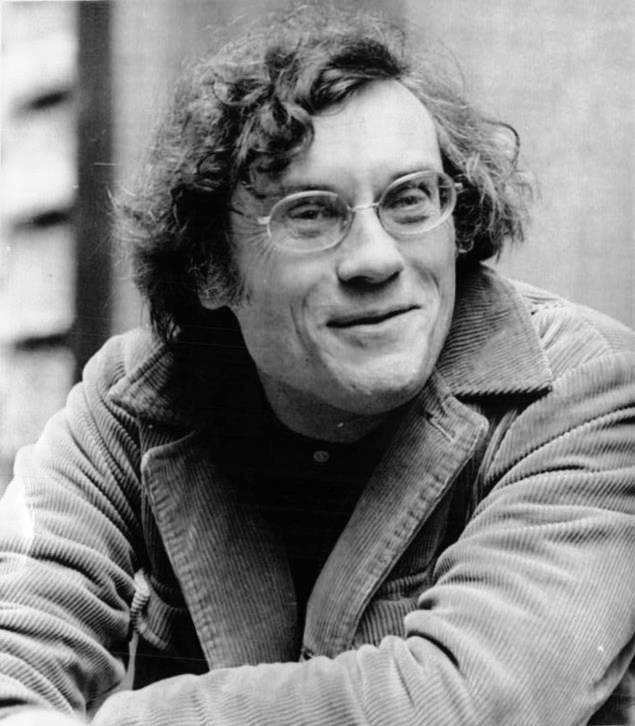

‘I just wanted to throw out there that I have finished the bulk of translating Guattari’s The Machinic Unconscious: Essays in Schizoanalysis. Now begins the revision stage of my project, and a few interpolations of quotes from Proust’s In Search of Lost Time (I’m using the new Penguin editions, which are fabulous translations btw).
‘I hope this excites some people. I, too, am pretty thrilled about this work appearing in English. It has been a difficult work for me to translate, let alone read, but I feel that it is infinitely more valuable to me for all the efforts I have put into it. This book wasn’t necessarily received well in France (one of his interviewers mentions the obscurity and difficulty of this work specifically), perhaps because it is so closely tied to A Thousand Plateaus in scope and timeframe (it was published about 6 months before the latter, being a sort of work book for A Thousand Plateaus, as Gary Genosko puts it). But I hope that this is different for the English, especially with all the work that has gone into translating much of Guattari’s work already, and the Deleuze phenomenon, etc.
‘Let me just note in passing that this work has helped me overcome one of my own crises. As an English graduate student-dropout, I sort of rebelled against literary criticism, rebaptizing my field of research as philosophy. I gave up on its uses to evoke radical political change, and I felt like it played with the binary oppositions of established culture, not to truly dismantle the phenomena, but to reify them and sediment them more thoroughly.
‘I can only note with great fervor that the second part of the Machinic Unconscious, which is dedicated to a reading of Proust’s novel, is really something extraordinary, because it takes the obscure theoretical conceptualizations of the first half and propels them into concrete situations, deducing the abstract relations from this reading. But it goes further because it is not just an intellectual exercise: Guattari’s thought, if anything, is so radically enrooted in the outside that every phrase has a rhetorical-micropolitical bent to it. He proves the validity of literary criticism to really illuminate the inner machinisms of reality, bearing out its political potential in a systematic and pragmatic way.
‘This book has changed my life. I hope you get a chance to read it.’ — Taylor Adkins

_____
Further
Félix Guattari @ Wikipedia
Félix Guattari @ Semiotext(e)
Transdisciplinarity Must Become Transversality
Guattari’s Machinic Unconscious and Proust as Schizoanalyst
Assemblages: Félix Guattari and Machinic Animism
PRAGMATIC/MACHINIC: DISCUSSION WITH FÉLIX GUATTARI [BY CHARLES J. STIVALE]
Micropolitics of a Recommender System – Machine Learning and the Machinic Unconscious
Une intuition de Félix Guattari
Félix Guattari and Post-Media Arrangements
A Reflection with Miguel D. Norambuena on Félix Guattari’s Trip to Chile
Assemblages: Félix Guattari and Machinic Animism
Book: Schizoanalytic Cartographies
Félix Guattari @ goodreads
MACHINE AND REALITY: CYBERNETICS, AUTOPOIESIS AND PRODUCTION OF SUBJECTIVITY IN FÉLIX GUATTARI
Book: Félix Guattari, A Critical Introduction
Felix Guattari: An Aberrant Introduction
Two’s a crowd
Tactical Media
Buy ‘The Machinic Unconscious’
____
Extras
Félix Guattari – Université de Vincennes 1975
Félix Guattari (1986) by Gérard Courant
Félix Guattari – O Divã (1985)
Félix Guattari on Drugs
Joséphine Guattari et Félix Guattari (1986)
_____________
Graeme Thomson & Silvia Maglioni In search of UIQ (2013)

‘The opening sequence of Graeme Thomson and Silvia Maglioni’s new film, In Search of UIQ, looks out from a hidden bunker onto a desolate, terracotta beachhead, below which a plane of azure sea stretches toward the horizon, while a lithe, raven-haired woman – the only visible human presence – strolls, Monica Vitti-like, across the frame. A voice-over reads from a letter Félix Guattari wrote to Italian film director Michelangelo Antonioni in the early 1980s, on the then-current status of his new film treatment: ‘[I want] to give you the outline of a science-fiction screenplay I’ve written, Un amour d’UIQ … it would be a great joy for me if you should be interested in becoming involved.’ The sequence mimes the oceanic imagery of Antonioni’s classic film L’avventura (The Adventure, 1960), but also establishes the fascinating conundrum inherent in Guattari’s great cinematic adventure: if the philosopher was requesting Antonioni’s collaboration on a science-fiction film, its unconventional aspirations can be assumed.
‘Despite UIQ’s sci-fi trappings, its speculative focus resides in its analysis of modern epistemology, at the moment when the collective screen of the counterculture was being replaced by the shrinking interfacial screen of the digital (i.e. the computer), the laptop and the pda. A rupture was clearly visible by the conclusion of the 1980s. As Guattari writes in the script’s initial treatment: ‘The drama evoked here runs parallel to the one our societies are currently undergoing, where […] the digitalization of a growing number of material and mental operations is not always easy to reconcile with the existential territories that mark our finitude and desire to exist.’ While the character of UIQ is not human, its desire to access and embody human subjectivity mirrored the evaporating gradient between technology and ecology in the post-human world.
‘‘UIQ’s tragedy is that it wants to be recognized, individuated,’ explain Thomson and Maglioni, in a recent email exchange from Paris. ‘It wants a face and then a body. Power needs to facialize everything […] The question of whether one is a one or a zero in any given social field. It’s one of the core elements of the binary system that structures our access to reality.’
‘In the absence of any extant film footage, In Search of UIQ endeavours to not only reconstruct Guattari’s aborted attempt at filmmaking – with voice-overs from the script and Guattari himself, protracted sequences on computer screens and a noir-ish procedural on other recent UIQ-inspired productions – but to meditate on the political, social and cinematic milieu of the late 1970s through the mid-80s, when the possibilities of financing and realizing such an abstruse film on an international level were deemed feasible.’ — Erik Morse, Frieze
Excerpt
_____
Interview
from Blackout

CHARLES J. STIVALE: In terms of capitalism in the world, I’d like to consider the question of the Americanization that penetrates everywhere, for example, the “Dallas” effect. There is even a French “Dallas”, “Chateauvallon” . . .
FÉLIX GUATTARI: It’s not bad either. It’s better than “Dallas,” I find.
CS: Of course, for the French. But when you like J.R. . . .
FG: That’s true. J.R. is a great character, quite formidable.
CS: But what strikes me in your writing, especially in Rhizome, is the impression of a kind of romanticism about America, references to the American nomadism, the country of continuous displacement, deterritorialization . . .
FG: Burroughs, Ginsberg . . .
CS: Right, and one gets the impression of a special America, and we Americans who read your texts, we know our America, and here in France, as a tourist this time, I see the changes, the penetration of our culture that has occurred over the last few years, the plastification, the fast food restaurants everywhere . . .
FG: Ah, it’s incredible. And in the popular social strata, among the youth, they babble this kind of slang, they’ve completely identified with it, it’s incredible. It’s all over Europe, everywhere, the linguistic phenomenon of the incorporation of American rock. It’s really surprising.
CS: So there are two conceptions of America: this nomadic conception which you present in your works, but that is finally a romantic conception in light of the practice of Americanization, the penetration of America and, of course, of capitalism. It seems that one does not go with the other, so how do you explain this difference? It’s not really a contradiction, but simply a distance between two conceptions of America.
FG: Well, that’s complicated. I’m not very clear about that because . . . I went to America occasionally, especially during the ’70s, and then afterwards, during the ’80s, I’ve gone to Japan, to Brazil, and to Mexico a lot, and I’ve no longer wanted to go to the United States. I haven’t considered it well, I haven’t understood why.
You know, it’s not certain that this is a romantic vision. Americans are often jerks; they have a pragmatic relationship with things; they are dumb, and sometimes, this is great because they don’t have any background as compared to Europeans, Italians, but there is an American functionalism that makes us pass into this a-signifying register, that transports a fabulous creationism, fabulous anyhow in the technical-scientific domain, because they are really a scientific people; they don’t look for complications, it works or it doesn’t, they move on to something else.
I met an American last summer, I was in California, at Stanford, I don’t know where. I was on a tour to study the problems of mental health, a mission for the Ministry of Exterior Affairs. Americans are people who receive you very well, who take time to talk, which isn’t the case here, not the same kind of welcome. So, each person that I met gave me an hour for discussion, and there, this young psychiatrist explained what had happened after the Kennedy Act, the liquidation of the big psychiatric hospitals and the establishment in his sector of half-way houses, a kind of day hospital to replace the big hospitals. He made a diagram chart, I remember, there was a graph with double entries, there were all the dimensions of these establishments, a remarkable organization of what had been developed. So, he finished presenting all that to me, and then the conversation finally ended, but there still remained ten minutes because we had an hour for our discussion, so there was no reason to leave. And I asked him a final question: “And so, how did all that work? What was the result?” He broke out laughing: “Nil. Zero. It didn’t work at all!” I said: “Oh, really?” He said: “Yes, it’s just a program we made, but it didn’t work at all!” That was like a thunderbolt for me that this guy had made this entire development, and then it didn’t work, so let’s do something else. We see this well in Bateson’s work: he makes a program on something, it works, but that doesn’t matter, they move on to something else because they were on contract.\20 That’s what I find to be the marvelous a-signifying freedom, going on to something else, going on to something else. They massacre Vietnamese for years, then afterwards, oh, well, no, that was stupid, let’s go on to something else.
So I wonder if that isn’t the rather invading, yankee side of Americans that makes us ask what they’re up to, what they’re looking for. But one shouldn’t try too hard to discover what they’re looking for or what they’re up to. It’s the same for the Japanese, but with an entire background of mysticism, of religiosity, that also exists in the United States, but without being structured the same way.
CS: But where could we insert this question of nomadism? We have this “go on to something else” nomadism, so perhaps that’s it, Kerouac, going on to something else . . .
FG: And next, and next, and next, constantly, constantly, and now, and now.
CS: . . . but his kind of incessant deterritorialization only exists in extreme cases, so to speak.
FG: But, no, that’s not true. Jean-Paul Sartre, when he made his trip to America — that must have been in 1947 or thereabouts — wrote a magnificent article about American cities. He explained that American cities aren’t cities in the European sense, i.e. they have no contours. They are crisscrossed by avenues, they have no limit. In my terminology, this means that these are deterritorialized cities. America is entirely deterritorialized. “Deterritorialized” means that instead of having obstacles or having land, things, curves, there are lines, trains, planes, everything crossing, everything sliding, demographic flows sliding everywhere, and on top of that, there are extraordinary reterritorializations. Henry Miller in Brooklyn, Faulkner in a certain sense, because for Faulkner, to what extent isn’t it a misreading to situate him as an archaic writer of American life? Isn’t he rather a mythical reterritorialization about deterritorialized America? We’d need to debate that; I’m not able to undertake it about Faulkner. Anyway, how does one make oneself a body without organs, how does one make oneself a little territory, a life, a warmth, a childhood, in this American mess, in this whole mishmash spread out all over? Look at the extraordinary poetry of shop windows in New York! You know the shop windows in France or in Italy. But there, in New York, most of the windows speak, even on the main streets where you have side by side expensive windows and then places where you find piles of any old thing; one finds there a kind of accumulation of vistas like that, where there are marvelously beautiful things from an architectural perspective, and then there is a dump, a maximum and then a mess.
CS: I do understand the difference between cities, the constant sliding across territorialities between city and suburb. But quite simply, this invasion, the body snatchers, America as body snatcher, the grip of capitalism in other countries, for me . . . well, perhaps that all belongs to the same process of deterritorialization: there is no territory, either in individual existence or in capitalistic flows: they invade everything, everywhere, everybody, everywhere in the world, without limits, without borders, crossing and invading France.
FG: But don’t you think that this deterritorialization, catastrophic from many perspectives, is precisely the occasion for extraordinary reterritorializations? That is, it’s difficult to make oneself a territory on the moon, really; it’s more complicated than going out to the French countryside. America is a bit like the moon, it’s very complicated, and precisely these traits create a difference from the Japanese as well because the Japanese have means of reterritorialization, a very ancient civilization, they have insignia, emblems of this reterritorialization, corporal techniques, etc. Whereas there, in America, they are forced to re-invent everything, these kinds of continental Galeries Lafayette, anything. So that becomes a formidable exercise: to create music with a tradition of religious music is difficult, but creating music with just anything, like that, with these piles of metal, it’s something else altogether. And when they succeed, it’s fantastic. But look: take the American mystery novel whose basic material is all this deterritorializing trivia, and look at what warmth of intimacy, of suspense, of subjectivity that you grab to stay warm, to sleep, to feel good, to feel sheltered; it’s really something. With what do they create that? What are they talking about? These aren’t tales of chivalry. American cinema as well has a lot of that: look at the power of American culture to produce a more than tolerable and comfortable subjectivity, warm, passionate, exciting, in this pile of metal, this heap of shit, this load of stupidities, as I said earlier. Isn’t that really quite a feat? It’s nonetheless a civilization that has created some extraordinary forms of subjectivation. Jazz … do you realize? Jazz has a great impact on the level of world culture. Line up cinema, jazz, the mystery novel. I’ll leave painting aside because I find that, in the long run, it’s not a very noticeable success because it really belongs to capitalistic deterritorialization, seriously, with some exceptions, but for me, it’s really a lot less convincing.
CS: I think that the problem for me is that I’m too close to daily life in the States, and I see so much stupidity in all these areas. In cinema, one constantly sees exploitation of the body, of the individual. In music, there is so much shit . . .
FG: That’s true; when one hears the classical music that people listen to in the United States, it’s overwhelming. Won’t you ever get fed up with Rachmaninoff, Tchaikovsky, and all that . . .?
CS: I was really thinking about popular music, where all that might happen, where changes did occur during the ’70s. But what always strikes me is that the music comes from England to invade America, and then America reterritorializes what the English do, and they lose everything. That began with the colonies and continues today. But, perhaps its my own problem, being too close to this daily life, and not being able to see this abstract machine which you are outlining. But, on the other hand, the reproach made by friends who read A Thousand Plateaus and other works is really that in regards to American nomadism, this deterritorialization, they’d like to believe in it, but isn’t the general schizoanalytic enterprise in the long run a utopic dream without any future?
FG: I’m sorry to interrupt you, but in any case, the idea of a utopic dream just doesn’t hold water. A dream is necessarily utopic, in any case. We participated a little in that America, that kind of New West. It was our dream, our very own America. You are telling me that it’s not yours! I find that fascinating, but you aren’t going to reproach me for having dreamt my dream! You have a whole generation of American writers who created a dream about Europe, about Greece, who landed here like these were colonies, but I’m not going to reproach them for having perceived in their own way, “what is this Europe you saw here?”, that’s just not possible! What one has to know is: has it been useful for you that we had that dream? has it been useful for us that you had that dream, that some American writers had a particular dream about Europe before the war? For me, yes, that certainly was useful. I haven’t looked at Europe in the same way because there is this deterritorialized vision by relay from American writers. Miller’s vision of Paris, for me, is enormous, is fundamental! I’m sorry that Deleuze and Guattari’s vision of the United States hasn’t been at all useful for you, but we can’t all have the same talent as Miller! (Laughter)
___
Book
 Félix Guattari The Machinic Unconscious
Semiotext(e)
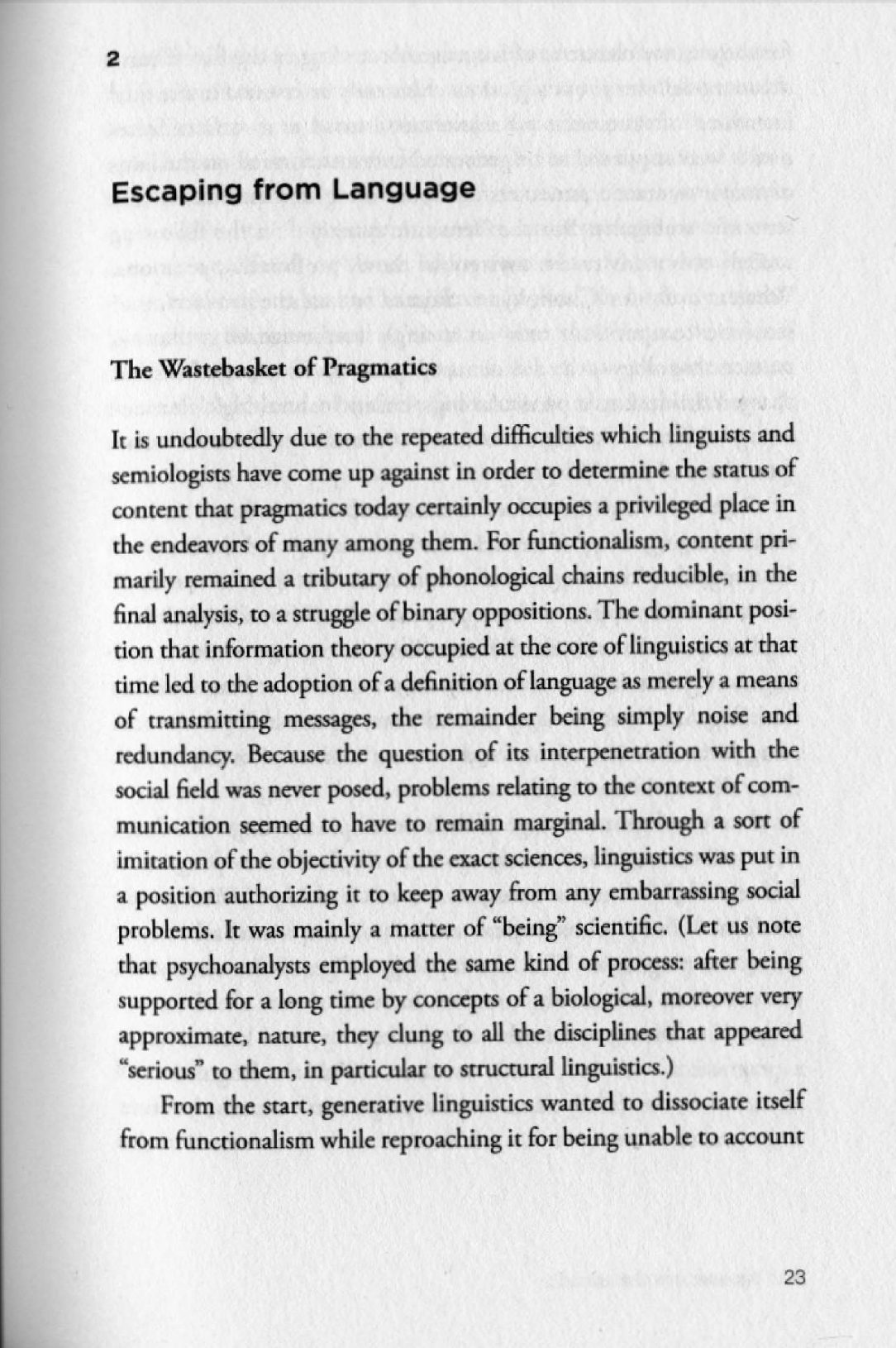
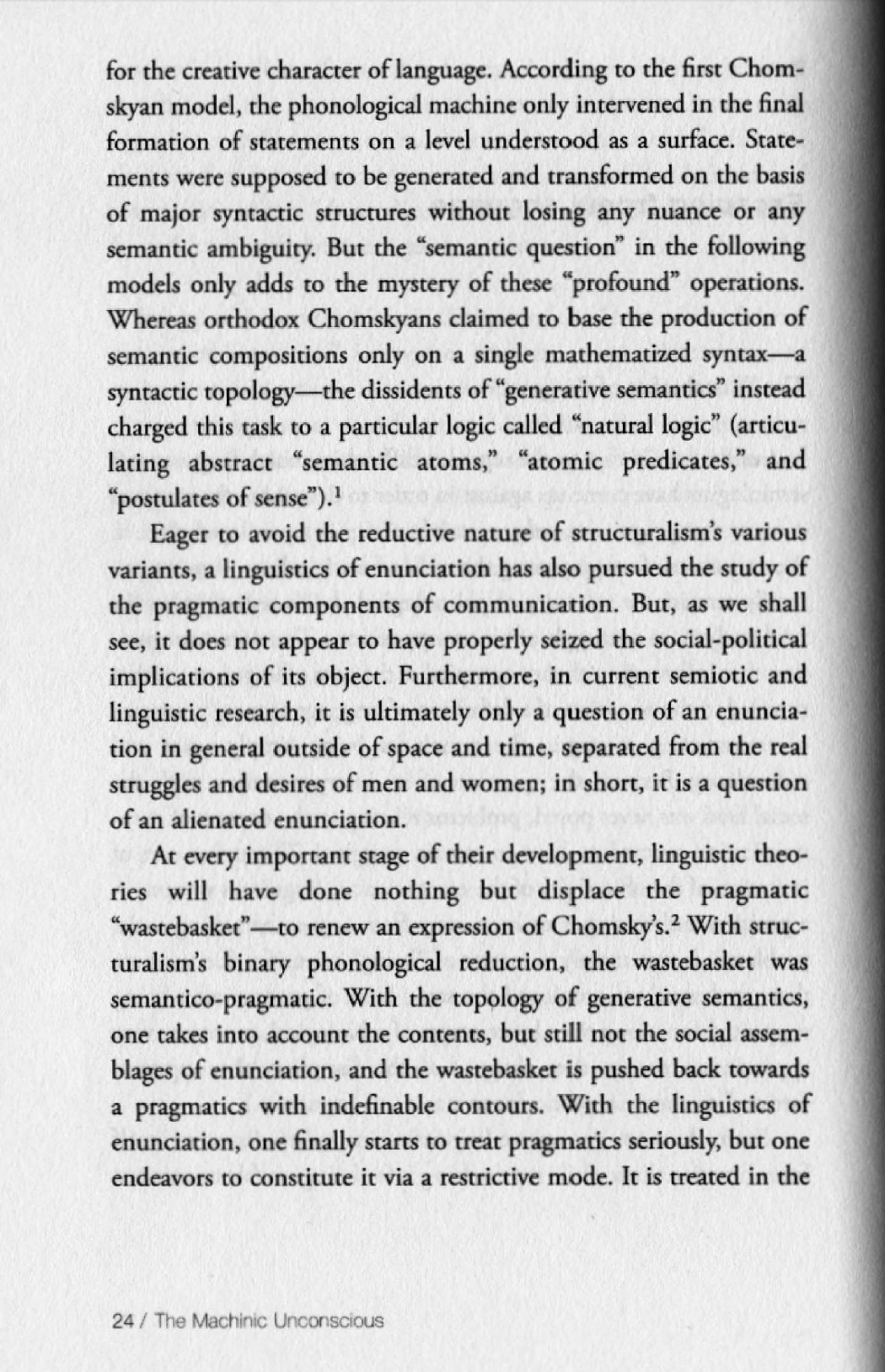
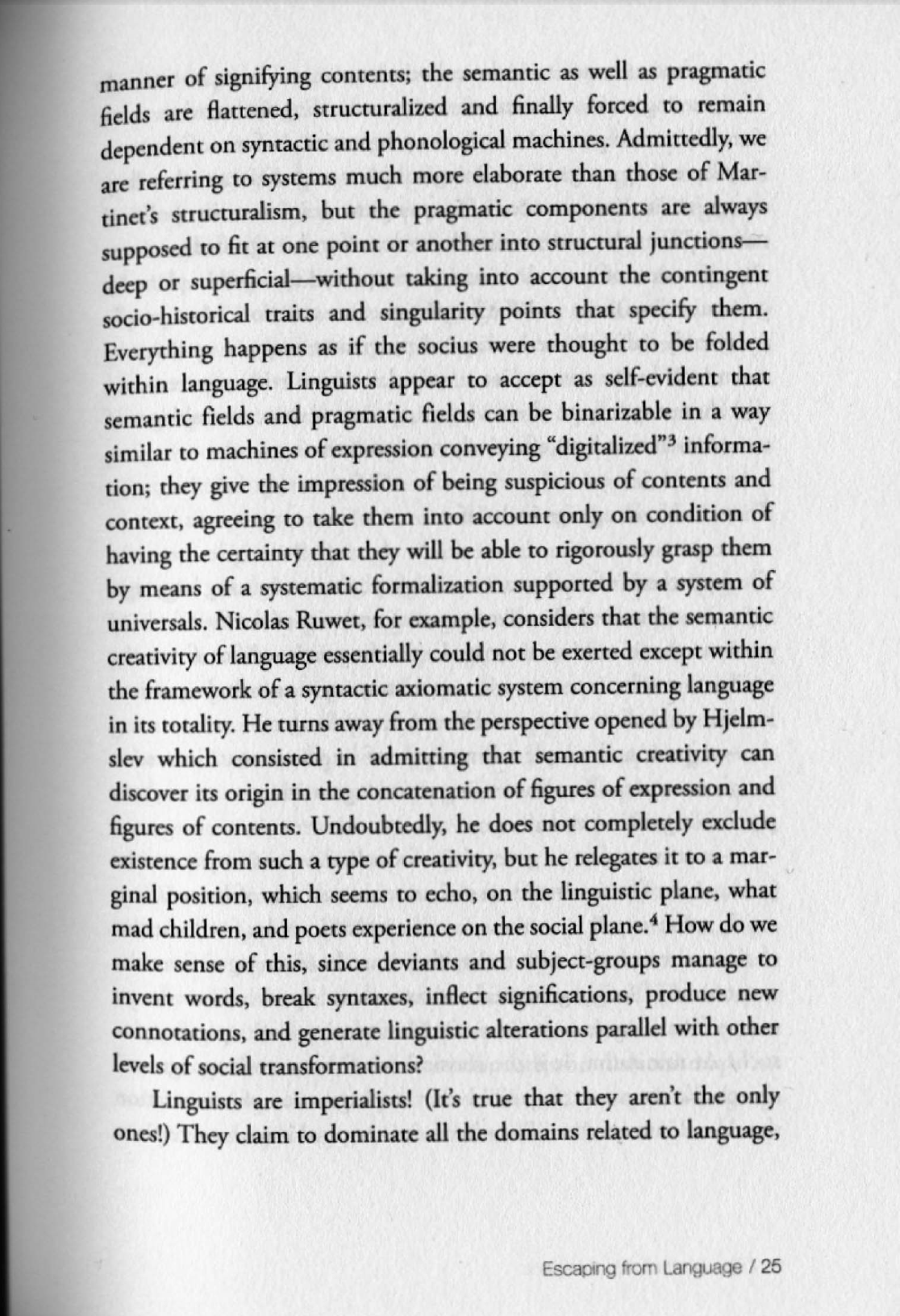
‘In his seminal solo-authored work The Machinic Unconscious (originally published in French in 1979), Félix Guattari lays the groundwork for a general pragmatics capable of resisting the semiotic enslavement of subjectivity. Concluding that psychoanalytic theory had become part and parcel of a repressive, capitalist social order, Guattari here outlines a schizoanalytic theory to undo its capitalist structure and set the discipline back on its feet. Combining theoretical research from fields as diverse as cybernetics, semiotics, ethnology, and ethology, Guattari reintroduces into psychoanalysis a “polemical” dimension, at once transhuman, transsexual, and transcosmic, that brings out the social and political—the “machinic”—potential of the unconscious.
‘To illustrate his theory, Guattari turns to literature and analyzes the various modes of subjectivization and semiotization at work in Proust’s In Search of Lost Time, examining the novel as if he were undertaking a scientific exploration in the style of Freud or Newton. Casting Proust’s figures as abstract (“hyper-deterritorialized”) mental objects, Guattari maps the separation between literature and science, elaborating along the way such major Deleuze-Guattarian concepts as “faciality” and “refrain,” which would be unpacked in their subsequent A Thousand Plateaus: Capitalism and Schizophrenia.
‘Never before available in English, The Machinic Unconscious has for too long been the missing chapter from Deleuze and Guattari’s Anti-Oedipus project: the most important political extension of May 1968 and one of the most important philosophical contributions of the twentieth century.’ — Semiotext(e)
Excerpt
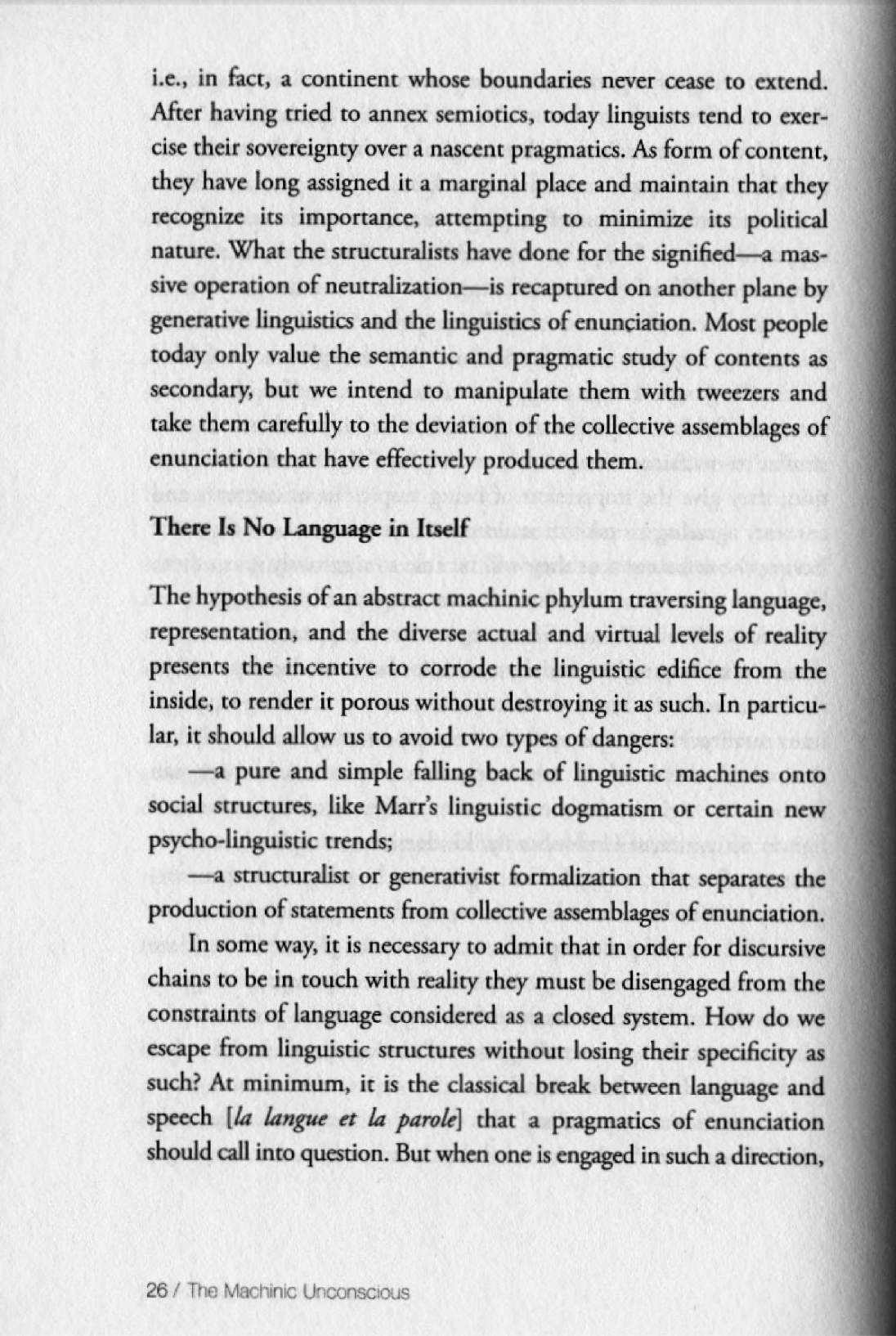
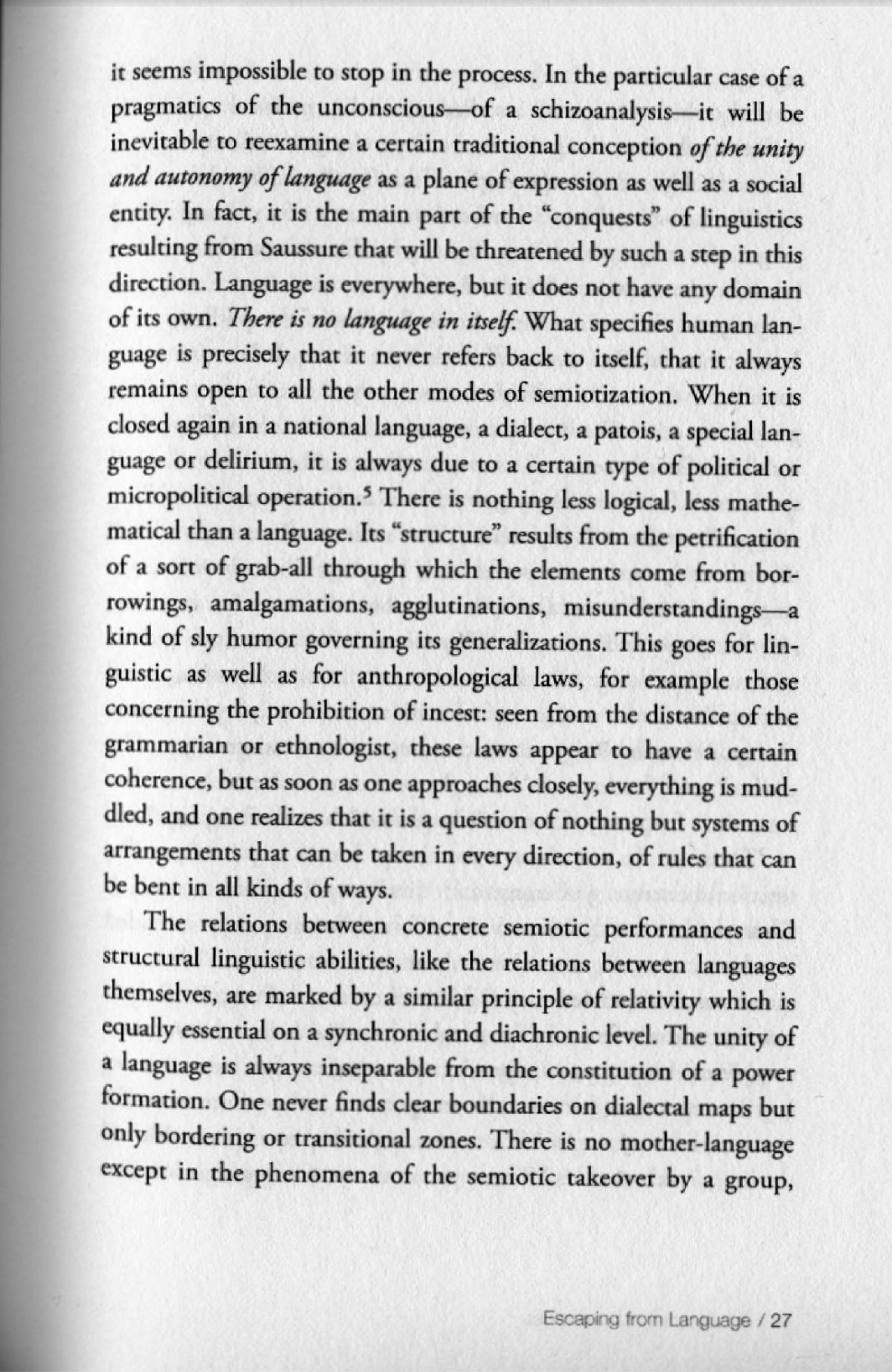
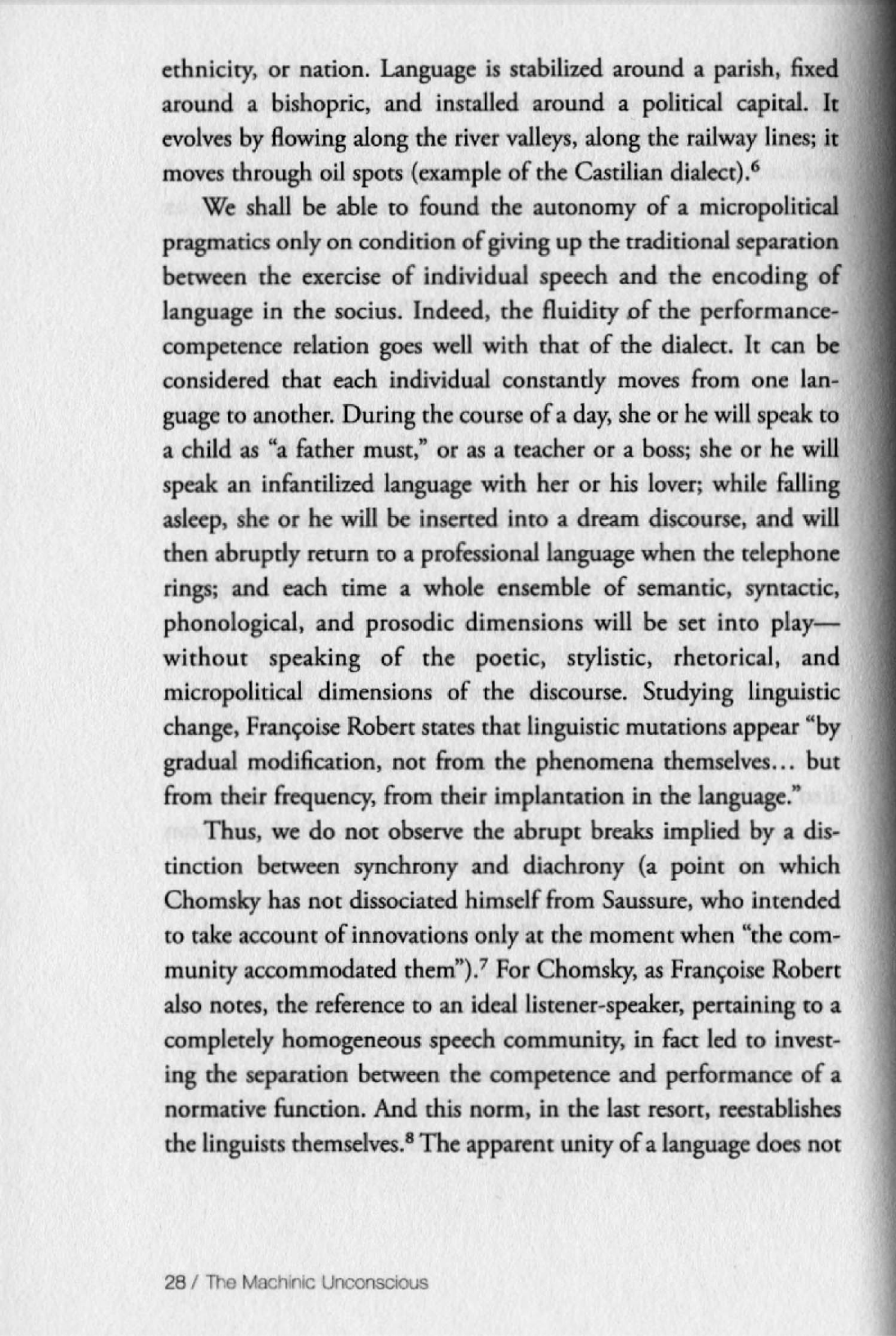
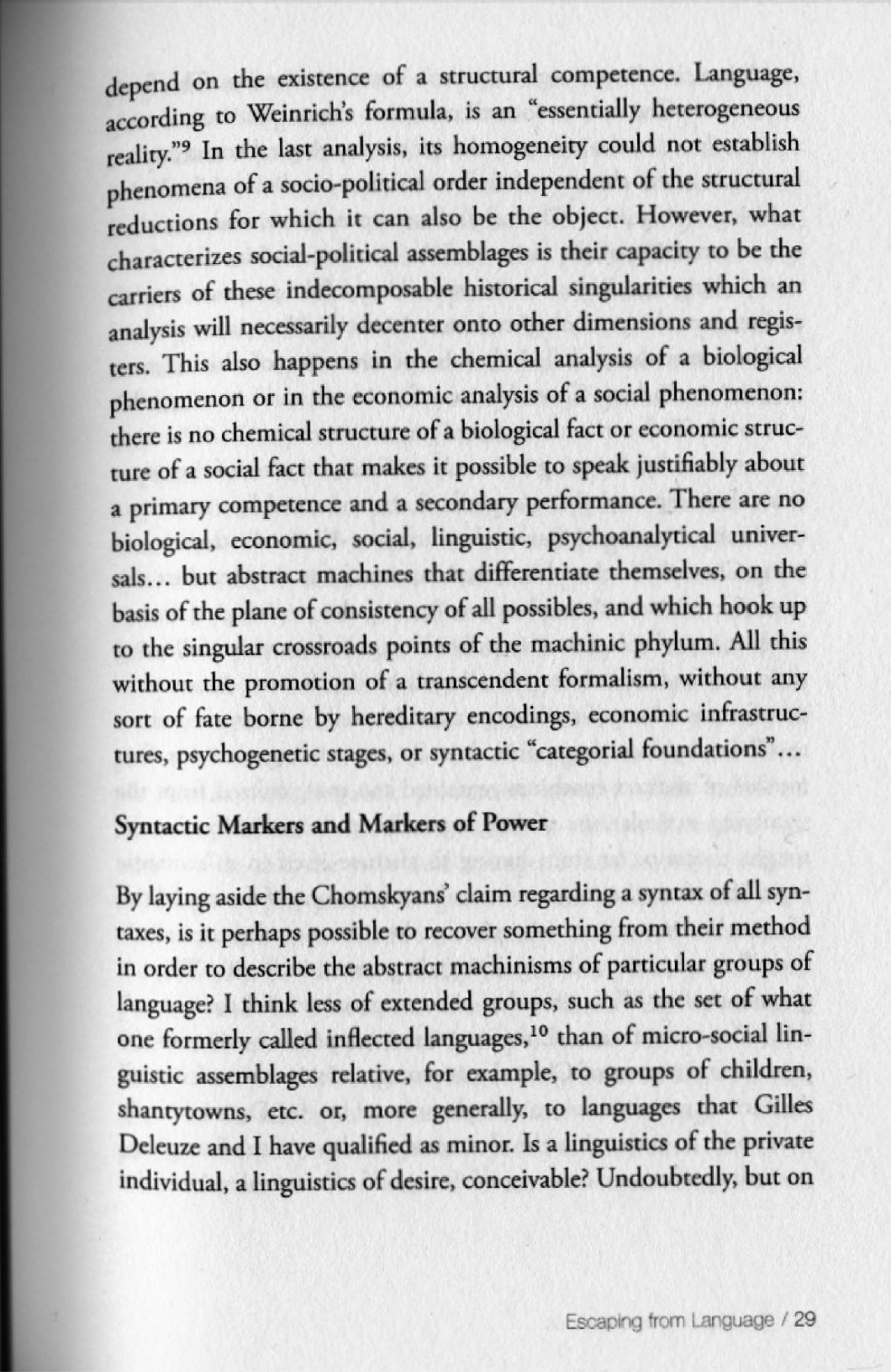
*
p.s. Hey. ** jay, Hey, jay. Cool that so many doomsayers spoke to you. Makes sense that ‘Equus’s’ gayness is being forefronted. I only saw the movie way back but even there it wasn’t very successfully closeted. I hope you’re sharing our kind of perfect current weather. ** Dominik, Hi!!! If you mean which would I want to own I think either the talking crow sculpture or, hard to resist, ‘Lost and Sick’. I just cued up that BMtH track, and … doomy!! Love realising that doom is mood spelled backwards and somehow convincing himself that that’s an interesting observation, G. ** Bill, Coolness. Warmoestraat is even more gentrified than Spuistraat. In current day Amsterdam, a cafe with a rainbow flag hanging over its entrance seems to be a wild as things get. When I was in Berlin you could barely walk ten feet without seeing posters advertising that Anton Corbijn show. Enjoy, pal. ** Jack Skelley, That you could even type that comment after such a time change is impressive to me. Wake up in time for Thursday, whoa. Or at least by Sunday. No pressure. xo. ** voskat, Hi. Thanks a lot for letting us know, and all wishes that Laura exits the flare up rapidly and completely. You take care too. ** _Black_Acrylic, The Anna Orton print looks good even from a distance. Nothing does slop as pleasurably as True Crime. Paranormal investigation slop is pretty tolerable too. ** Hugo, Hi. Turns out ‘Backrooms’ doesn’t open here until the 17th, so it’ll be a bit. But yes. The publisher of said collection is still in the works. It’ll be a long time ’til it’s out though in any case. Usually takes a year post-contract signing. Thanks for your best. I seem to be making it through. And take my best. ** politekid, Hi, O, old buddy! 1) I’m good. Not much news, just film screening stuff, but that’s been tops. 2) Amazing if you can make the Leeds screening. I’ll share the specifics when there are some. Like I think I said, tentatively July 31st. 3) Thank you, and my personal guess is that, yes, she just bisected it with her scissors, but I don’t know why that’s my guess. A relatively rare bit of cynicism creeping out? Catch me up on you and yours as soon as typing personally enlightening text here becomes an enticing thing. xo. ** laura w, Excellent! ‘Lancelot du lac’ is the film that introduced me to Bresson and consequently changed my life. And it’s still tied for my favorite of his. Hm, I’m a bit suspicious of ‘The Green Knight’s’ supposed Bressonianism. But I should peek. Maybe. Yes, year of the Youtubers coming to save mainstream movies possibly. I still haven’t seen ‘Iron Lung’, and I still want to. Like I said, ‘Backrooms’ isn’t hitting theaters here until the 17th, so I have to be patient. Biggest up to you! ** HaRpEr //, Hi. Is it possible to go too far? Hm. I guess it must be, but I can’t think of an example. I guess I think one should probably keep an eye on the presentation itself and ways to measure that without neutering the extravagance. My guess is that you are/will inherently ace the borderline. I’m going to give ‘Lifeforms’ a listen. I tried it some years ago and felt like maybe its romanticism dated it, but things weren’t as generally horrible then as they are now, so that quality could be a total rush now. No, I haven’t heard the Iceage yet. I’m stuck on the new GbV, but that’ll wane. Just listening to Elias’s voice is always a real pleasure, so there’ll be that at least. ** Steve, Luck with the legs, obviously. Are said senior citizens veterans of youthful bands? What do they play? Your cousin will be their sex symbol by default. ** Uday, Where or what is your grad school? Sorry if you said and I forgot. ‘Crawlspace of the Pantheon’ is really good. It’s kind of all over the place, and for me that’s when GbV are at their best. Enjoy whatever today is constructing around you. ** Okay. I haven’t spotlit a theory book in a while, and that’s a fault in my book, so I brought back the spotlight that fell/falls on one of Guattari’s biggies. Please make it count. See you tomorrow.



 Now available in North America
Darn, my reply yesterday got eaten. I was on a hot streak of avoiding the blog’s oesophagus, but all good things. Luckily my notes app retained part of the draft, so excuse the jumbo-comment.
—
So this was the original Stig Larsson who got Sweden-book-famous but no greater. He was friends with Stig Larsson #2, who decided to change his first name to Stieg so they wouldn’t get mixed up, and then Larsson #2 Tattooed the Dragon and got actual famous and no one seems to know who Larsson #1 is now. Neither do I, really, but I like the book. The second comment is my attempt at translating the French translation of the opening of Larsson #1’s book, and probably not doing a swell job of capturing the vibe. In the French (and presumably Swedish), even the more extravagant formulations still read like they’re wrapped in cellophane.
True point, but hopefully I can make a virtue of naïveté. Maybe in part I take from all the people translating German philosophy into French in the early 20th century — i.e., the translations were all uniformly terrible and inaccurate, but they were terrible in a generative way [N.B. and my pet theory is still that your man Guattari and his chums all got their start critiquing the straw-man, misread, Frenchified versions of Hegel and Heidegger].
—
Returning to immediacy, I did get a chuckle out of “Anyway, how does one make oneself a body without organs.” I feel like that’s the “anyway, here’s Wonderwall” of critical theory, and I say that as an admirer of G (whether in the D& configuration or flying solo). His/their core ideas are things I can only really properly hold in my head for a few seconds at a time — difference over identity, etc. — but they’re usually some electrifying seconds. Although I also feel they’re a lot finer than even they often make them out to be with all the bumper sticker-like concepts they bandy about.
We were very tickled by Monaco’s weirdness, but God help anyone stuck there for more than a few hours. It’s like a gaudy, Guccified version of what I assume Hong Kong is like spatially — dense and hyper-vertical with everything sort of looming over you from out of the mountain, and yesterday it also looked like it was getting eaten by apocalyptic stormclouds in a cool way. Plus it’s F1 season, so we were ducking between fencing and pit crew and half-built stands.
Presently I’m waiting for my plane back, and actually really annoyed at myself for cutting my holiday shorter than Tadhg’s. Merzbow, yes, live by the noise, but I’m feeling a surprising swell of melancholy and some other things besides. Long live the Riviera. How is the non-coastal but possibly still azure part of the country?
Hello, Dennis! Yay, I love this book, Proust is a great text to analyse, I think. I finished it recently, and the last volume was quite spectacular. It’s very Freudian, inasmuch as a (quote-unquote patient’s) narrative is given, but a more unwieldy “true” narrative is moving under the surface and animating all of the events and reactions, to the degree that sometimes the given narrative struggles to keep up. “Swann’s Way” and “The Prisoner” are my favourites for this reason – Proust is amazing at writing people with no self-knowledge or awareness. Guattari has so many interesting things to say about Proust that I almost think Proust is worth reading just to appreciate his commentary, but I would say that, wouldn’t I…
Hmm, yeah, I did see they made a movie of Equus. It’s crazy they used real horses, that feels like it would make the play so unapproachable. I think the horse sort of needs to be a very opaque mystical symbol, like a silent actor or a prop, or the patient probably just comes off as a bestialist trying to ornament his abuses with a facade of mumbo-jumbo. It just seems likely, to me at least, likely to come off as Visconti’s Death in Venice vs Mann’s Death in Venice, inasmuch as some emotions and feelings are impossible to put on the realist screen without making them seem ridiculous and aberrant. Anyway, amazing day today, thank you! See you!
P.S., best of luck to Laura for a quick convalescence!
Guattari is a new name to me and I will try not to let the obscure and difficult tag ward me off
Backrooms is showing at my local Odeon so will probs go check that next week. Seems the new social media cinematic revolution is taking hold. Saw Milk & Cereal last week via YouTube and it’s quite something, so looking forward to Curry Barker’s followup Obsession if that arrives here too.
Milk & Serial, that should say.
Backrooms opens in Berlin after I leave. Ah well.
I think I’m too old for French philosophy these days. But that’s a very cute sweatshirt in the second pic. Is that Taylor Adkins? I googled the name, and I got a bunch of videos made by a woman who had a baby in prison. Yow.
My concert calendar starts in earnest tonight with a concert on a barge docked on a canal. Obviously a favorite venue, they often have very interesting programs, including tonight’s.
Bill
p.s.: I’ve seen The Green Knight. Good fun, but Bresson-ian?
Bill
Hi!!
I wonder why we never learned about schizoanalysis at uni (I studied psychology). We had philosophy classes, too, so it would’ve made sense. This is fascinating. Thank you so much!
It *is* an interesting observation, re: doom-mood. I never realized that.
Love wondering why everyone seems to love Project Hail Mary so much, Od.
Hey man, been busy wrapping things up here with the pad transition which explains my sporadic visits to the comments section. The current lease expires at the end of the month but I secured a guest apartment to rent for July & August. Belongs to a Swiss friend & neighbor who’s just down the road. She lives in the main house, but the guest apartment is totally independent. I get to use her pool, so that’s a big plus in this climate.
My family is going back to Germany for the summer but returning in September. We have a couple of options up in the air from September on, but nothing fixed yet. That’s been keeping us busy too.
Ariel Resnikoff got back to me, saying he’d be happy to blurb my chapbook, so that made my day. Feels like entering the Rothenberg spirit-family a bit, which as you can imagine means the world to me.
Paris treating you well at lower temperatures again I hope? Has the hunt for a producer officially started yet?
hi Dennis
didn’t think I’d ever comment on your blog but seems I’m doing that. I want to see your film but I suppose it’ll take a while considering where I live (a bit more nowhere than nowhere)
I read Assisted Living because of you. It’s a fun book. I can really feel the Lautréamont influence, but that’s not a bad thing.
I like Deleuze’s book about Sacher-Masoch.
anyway I’ll keep reading your blog
see you
CS
Hey. Ah, I should definitely read this. I read ‘Anti-Oedipus’ earlier than this year and it had a big effect on me. Adem is completely right about how it’s only possible to hold those ideas in your mind for a few seconds at a time. I like using it as some sort of oblique creative tool. I actually saw on instagram the other day that someone translated these short Guattari essays called ‘I Have Even Met Happy Trannies’ and ‘Woman Becoming’ and put them online for free. Very interesting, seeable here if anyone is interested:
https://readthis.wtf/
There’s so much more of Deleuze I also want to get to. Side note: did you know that Deleuze had very long fingernails because he claimed that his fingertips were so sensitive that it was painful to pick things up? Look at any photo of him where his hands are visible and you’ll see.
Perhaps things don’t ever go too far but in certain cases the project is so ambitious that it’s nearly impossible to stop the whole building from falling down. That’s what happened with my last book. I actually got a rejection for it today which was funny because I submitted it a year ago and it already feels so distant to me. Maybe it’s not all that bad but it’s a product of a very bad time during the end of my time at uni which makes it difficult to think about. Back then I was always making lecturers uneasy with my expression. I learnt the hard way that if you’re trans and writing weird stuff then you’re a sexual deviant in the court of public opinion. I had to be pulled aside for my content one time, that was humiliating. That whole experience drew me to coupling awkwardness with extravagance I think, so I guess you learn from the bad times more than anything. ‘Take what people make fun of you for and turn it into a style’ as John Waters says.
Just listened to Crawlspace! There’s something a bit PC Music about the structure of the album? Not quite sure how else to put it. Maybe I’ve been listening to too much of the PC Music stuff…
Guattari! This really takes me back to scouring the Semiotext(e) website well before I knew what Semiotext(e) was or really had much of a systematised understanding of anything, and recognising the name because my middle school library had a copy of Capitalism and Schizophrenia which I’d skimmed and then checked out and read properly in junior high. I don’t know how far I’d take D&G for political theory, but I like them for their style of mind, the physical abstraction of their thinking. It’s one of the things
My grandfather came in to my room to talk to me and now I’ve forgotten where I was going with that comment. At first, when he knocked, I thought it was one of the dogs because she’s gotten into this habit of scratching herself right next to doors so that her little leg goes thwack thwack thwack rhythmically against it and then you open it to see who’s there and she looks at you, betrayed by your taking away her leg support.