The blog of author Dennis Cooper

Author: DC (Page 1 of 1123)

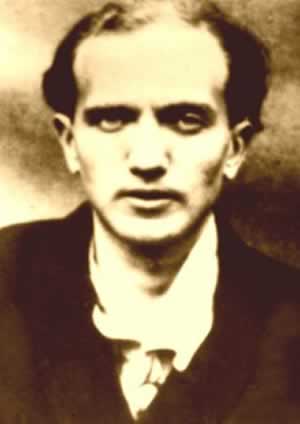
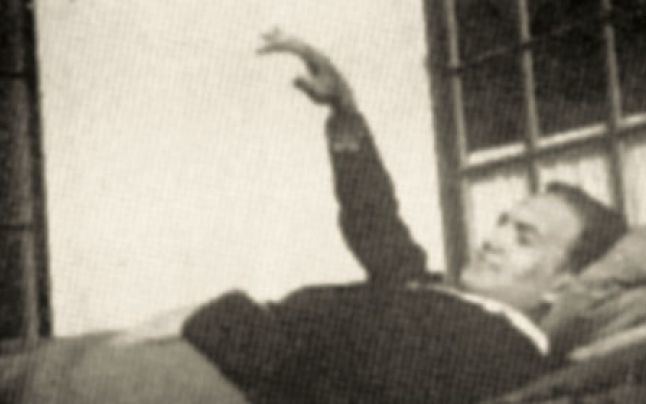
Spotlight on … Pierre Guyotat Tomb for 500,000 Soldiers (1967) *

* (restored)


Buy me, buy me, or I will die torn to pieces, yesterday they seized me and sewed me inside the horsehair of a mattress, cutting a hole in the cloth at the place of my thighs and everyone could then fuck me choking inside the horsehair, eyes pricked by the sweat, and the cloth, around the hole, blackens and sticks to my belly; I can’t see them, I recognize them only by their cocks. Set me free, I’ll work for your living. — P.G., Tomb for 500,000 Soldiers

‘Most books demand solitude, this one screams for solitude, for you to take yourself away from any still pulsing, breathing encumbrance; so as to exist, in single file, as a witness to the death of humanity across turned pages.

‘No more than one witness at a time is necessary, efficacious.

‘Otherwise there’ll be a lack of continuation, propagation.

‘Like Marx, this book is an anti-aphrodisiac – a stark reminder that all was, in fact, has been, lost.

‘Not least paradise, space, place, corridors of even a bureaucratic beauty.

‘Converted too late, we defend symbols to then be symbolised.

‘Start again. The post-human rings out in its own absence.

‘The overman, or something more abstractly sexed, is here to be built-up from the miniscule moments of bleak poetic relief:

“dust runs in the folds of the curtains”

“a pink cloud passess in the frozen lake”

“a flock of cranes flees towards the border; the sun irradiates the radio antenna”

‘The edge extended turns into a ledge.

‘A membrane defended, a de-cathexis.

‘If de Sade was a forecalling for the dismemberment of God – as unifying principle, as psychic sop, as creative alienation – then this book reminds us, one at a time, to keep more than god dead: heads, civilization, culture, ever-declarative mouths, mirrors.

‘Apocalypse always.

‘Organised into seven chants across 378 pages the book charts the colonial wars within colonial wars within the interior of archipelago’d people colonised.

‘Only sphincters move. Shit on this.

‘Read it aloud? There would be a risk, in voicing the force of primordial massacres, in mouthing the ur-brutalities done to children and horses, of taking it on, in to some affectible inside, becoming it, being overheard, in single file, alone; becoming an emissary of more than auto-destruction: willing will-lessness overdetermined becomes a reflex of urge appeasement minus the pleasure.

‘Desire dies, is replaced by ash-grey doves and mouth foam.

‘Solidarity breaks-out via incest, pimp deals, slaver alliances.

‘Soldier vampires loll, fuck, prod, rape, shoot, sever, cut, burn, bleach, turn tail, ring noses, vultch, displace populations, wait for furniture…

‘Soldiers captured in their own barrack-blocks like boxed goods, free now but for the wire.

‘The overflow of horror, the Boschdom without narrational context, has left each and everyone on the verge of extinction: enter a character/exit a character, enter tenderness/murder tenderness. For now, in an excess of present unaccessible to hope, expecting, almost willing, the expenditure of the cheapest of all the economic variables, there is a kind of living hysteria, as if the permanent time here, throughout the centuries, is seven or less minutes to midnight.

‘It is this hysteria, its animal energy and, also, the fallback onto psychosis that spares the book the mass suicides that would end it *.

‘At this pitch of survival (“beyond the barrier of terror”) there can be no fear.

‘Fucking, a loveless valve. A time beating, a little prepatory death.

‘The human generates no affect. The affect always from outside, crossing in, as a vaguely veiled romanticism:

“over them hover large white and violet butterflies. The dust from their wings falls on the sentries’ dry lips”

‘Respite for the author? Recipes for the readers?’ — datacide


___
Further

Pierre Guyotat @ Wikipedia
The Multiplying Hells of Pierre Guyotat
Pierre Guyotat – His books stink of sperm and killing
into the zone: guyotat & film
A History of Reason
A Vital Aberration: Writings On Pierre Guyotat 1994-2010
Pierre Guyotat Reading Matter Pt. 1
Alain Badiou: Pierre Guyotat, Prince of Prose
Why Pierre Guyotat’s Work Is More Relevant Now Than Ever
PG interviewed @ BOMB
PG @ Semiotext(e)/MIT Press
PG interviewed @ Purple
‘Pornographic’ French writer Pierre Guyotat dies aged 80
Donatien Grau’s Homage to Pierre Guyotat’s Eden, Eden, Eden
;*)%,”””!@;,: Pierre Guyotat
PG @ Goodreads
2 X PIERRE GUYOTAT
Disparition: Pierre Guyotat, éternel éden
« JE NE PEUX PAS VOIR CE MONDE COMME UN MONDE INFERNAL, PARCE QUE J’Y SERAIS DÉJÀ RÔTI »
« Je suis un musicien, je suis un alphabétiseur. »
“Pierre Guyotat, la matière de nos oeuvres”
Read/download ‘Tomb for 500,000 Soldiers’ @ Internet Archive


____
Gallery

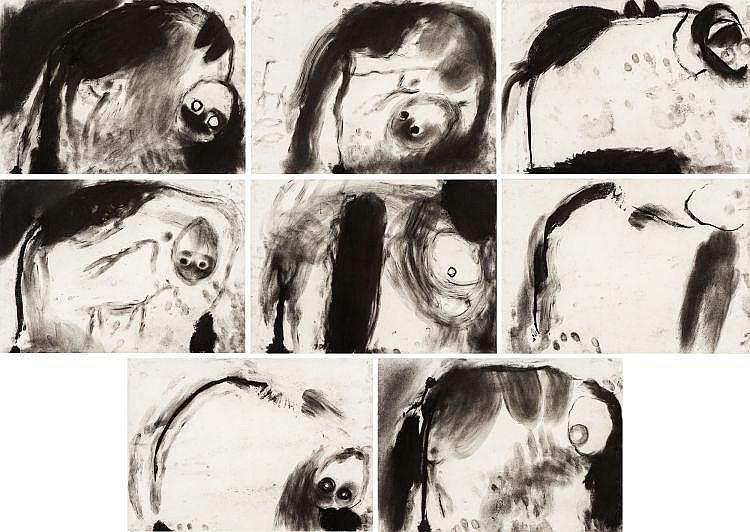
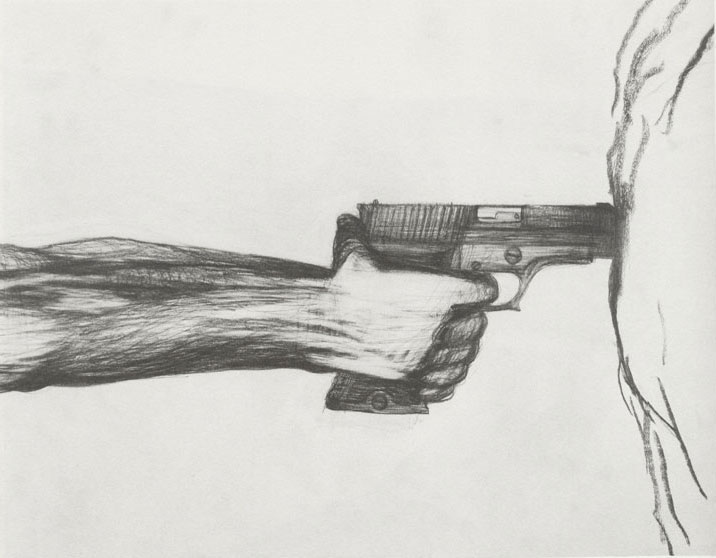
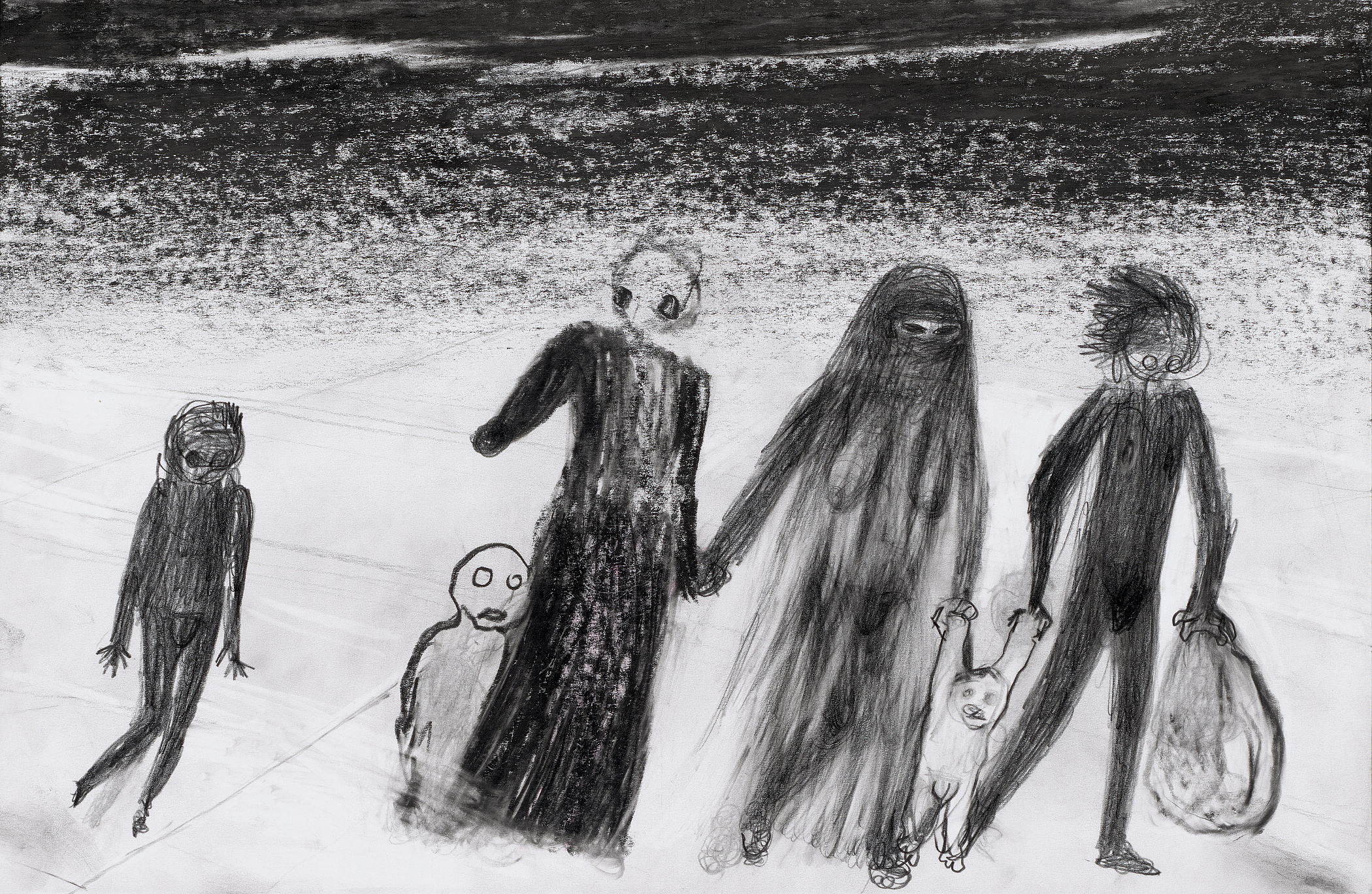
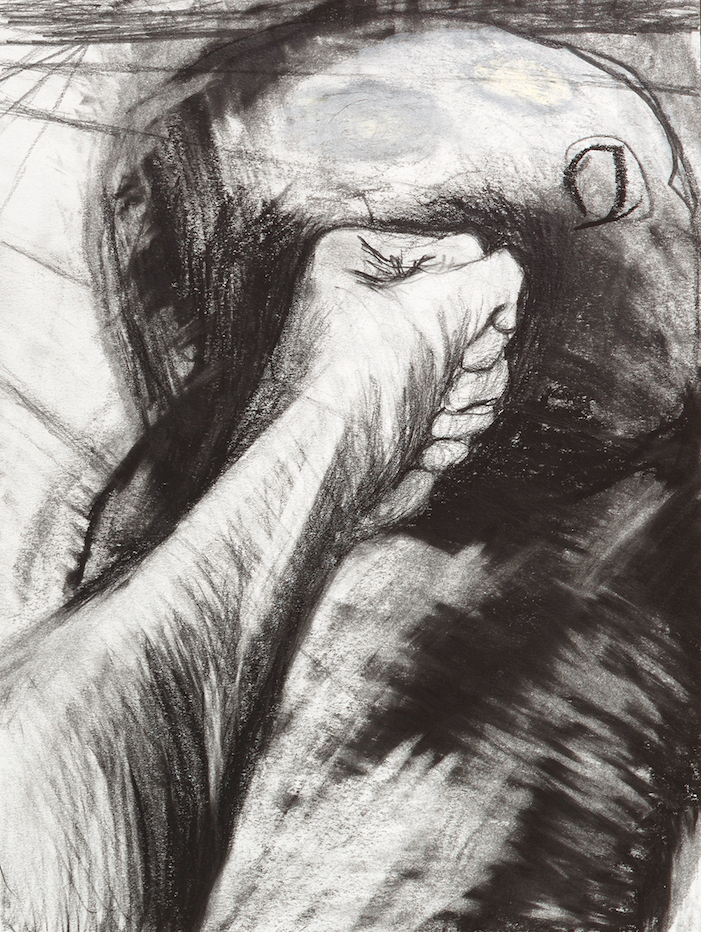
‘Pierre Guyotat’s experiences as a French soldier in the Algerian War of Independence led him to develop an entirely new kind of writing. The brutality he witnessed in North Africa compelled Guyotat to refuse the conflation of literature with civilisation. Instead, he treated language as physical matter through deformed words, verbal onslaughts and obscene imagery. This led him to the concept of the matière écrite, a sort of ‘secretion’ to be perceived orally, visually and architecturally. Of Le Livre, for example, he once explained: ‘I am aware that what I do in Le Livre cannot be readily understood without me speaking the text, pronouncing it publicly.’

‘But perhaps the most famous expression of Guyotat’s approach was the book Eden, Eden, Eden – a hallucinatory evocation of the horrors of sexual violence under colonialism – which was banned in France the same year it was published. For Guyotat, even the manuscript itself was a piece of visual art, and he did a special painting for the cover. Guyotat gave up drawing after a breakdown in the early 1980s and would only resume the practice in 2015. The artworks on view demonstrate his extremely complex yet direct language, which stems from memory and symbolism while presenting scenes of sexuality, freedom, joy and exploitation.’ — Manifesta 13


____
Extras


Pierre Guyotat, écrivain radical


Pierre Guyotat – “In bed” by Henri de Toulouse-Lautrec


Pierre Guyotat – Rencontre à la Librairie Les Cahiers de Colette


Life of Pierre Guyotat: New Social Environment #43


____
Interview


THE WHITE REVIEW — In 1960, at the age of 20, you were sent to Algeria with the French army, where you stayed for two years. In 1962, you were found guilty of encouraging desertion and possessing forbidden material and were imprisoned for three months.

PIERRE GUYOTAT — I went back to Algeria frequently after independence, particularly to the Sahara. Since then, I’ve only returned through my fictional characters, or at least those that can recognisably be identified as ‘Algerian’. As a soldier over there, and immediately afterwards, I’d reached saturation point with France. I was very anti-Europe and anti-West. It was the great era of thirdworldism and ethnology, a period that is very controversial today because some see it as an avatar of colonialism. One can read very surprising things about this period nowadays. Everything becomes neo-colonialism and it has become impossible to consider nations that were colonised as free – free to reject their dictators – and proud. Every time something bad happens to them, we see the hand of the ex-coloniser behind it and we continue to treat them like children.

No one is perfect: it’s worrying that there is today this desire for everything to be perfect. The fewer things that happen, the fewer things are possible – and still we want even more perfection. To be politically perfect, which means that you can no longer be anything. Someone taking an interest in an African tribe will be seen as a colonialist. No one knows what to do any longer. There are committees, charities, councils representing who knows what… it’s astonishing. All of these entities would be interesting if they had no vested interests, but the charities are generally supported by the state, which means they are accountable for their actions. A certain number of scandals and controversies justify this state support, just as policemen have to hand out a certain number of traffic fines.

I understand very well, I’ve always supported the idea that slavery should be recognised as a crime against humanity – and, as we know, the West is not the only guilty party with regards to this abomination. I’m not saying there should necessarily be legal recognition of this fact, but we should agree that it was a crime that was perpetrated continuously over the course of 300 years. Involving the law in something like this is very complex, but when people’s desire for publicity leads them to speak lies…

It is unbearable to live in this kind of environment. Someone trying to live an honest life can no longer live. He can be honest, he can watch everything he says, everything he thinks even – but he will be dead. One cannot live when one is constantly ordered. There is a contradiction at play here: people always talk about multiculturalism in France but at the same time you have to stay politically correct on every single topic… We have to accept some form of disorder. It’s impossible to control a population through interdiction, it’s impossible. On building sites, for instance, you sometimes hear terrible things and often people shout at each other in an incredibly rude but also funny manner, and things are settled in good humour. Things can go very well. We have to let people express themselves. Otherwise, they die. We are always facing language barriers built by ignorant people. We cannot let some societies make laws and create interdictions: there are enough interdictions as it is. It’s strange that people are so infantilised. We have to let them speak for themselves, to let them learn for themselves what not to say because it hurts others, history, a History, the honour of man. And we can say certain things and laugh at them up to a certain point, which time will decide.

THE WHITE REVIEW — In CARNETS DE BORD you wrote: ‘Great works (or great men) are those which bear the mark of the brutality of the world. Not those which conquer their serenity and gentleness on the most profound chaos and the most acute solitude. Otherwise, one does not feel civilisation (the moment of conquest) but already decadence (i.e. the habit of benefits conquered in the past).’ This idea still applies to your work, in which violence and gentleness are both present.

PIERRE GUYOTAT — I’ve always said that. The premise of my work is brutal, but it does become gentler.

THE WHITE REVIEW — But is cruelty its fundamental reality?

PIERRE GUYOTAT — It is one of its realities. Cruel acts don’t need to be shown explicitly. There are also implicit cruelties. Inequality is an implicit cruelty, the most terrible, the most violent cruelty. One might wish to abolish it, to abolish what makes a man not know he can do anything. One has to seize what lies close at hand, what is urgent. The transformation of humanity into ‘strata’ or ‘masses’ – an avatar of scientism that has done so much harm – can only inspire disgust. I’ve long thought that in every human being there is a sleeping genius and I endeavour to continue to believe this. I wrote something, long ago, along these lines: ‘So long as man has five fingers on each hand, we cannot do anything about it.’ Unless a great organic and bodily mutation occurred. Man isn’t everything, either. We need to look beyond the human too. It’s a necessity. I do it a lot. I force man outside of his humanity.

THE WHITE REVIEW — How important is working as a collective to your work? Does collective work have as much value as the work of an individual? You were part of the Tel Quel movement at one stage.

PIERRE GUYOTAT — Yes, Tel Quel was my generation’s collective. It remains the only time I have been part of a collective. It fitted me quite well at the time, especially in terms of the movement’s discourse. From an artistic standpoint, it was quite different. The overall discourse suited me at the time – that’s clear – and I think I suited them, too. Later, things changed, quite quickly. As always in the history of literature.

THE WHITE REVIEW — Was it an alliance of sorts?

PIERRE GUYOTAT — Yes, it was during the brief moment when – this was the high point of Tel Quel – there was a division between two sides, broadly speaking: those favouring convention, and fiction, and the avant-garde, who favoured anti-fiction. I was very much in the fiction camp, full of characters, places, and scenes. I was more aware of the constructive aspects of the movement: the future, a more material fiction which would be open to the world, a transformation of language to be effected immediately rather than to be vainly wished for…

As I have often said, I read very few nouveau roman books. I knew their authors, but I didn’t read them much. The important thing was to know that these books existed. That was enough. It was a kind of tabula rasa, a fresh beginning. That, I knew, but I almost felt like there was no need for me to actually go out and read the books. I got a sense of those books instantly by just looking at them. I’ve always had the eye of an illustrator, I can tell immediately whether something is right or not. If it’s not good enough, I can tell straight away. I should have read a lot more, as I had as a child and adolescent, before really starting to write like I do now. I read a lot of British and American authors, like everyone else. But I read the authors people like to match me with much, much later.

THE WHITE REVIEW — Do you see any proximity between your work and that of writers like Bernard Noël or Jean Genet?

PIERRE GUYOTAT — With Bernard Noël, none whatsoever. As for Genet, we’d known each other for a long time. I met him in the Gallimard offices on the day I met Antoine Gallimard for the first time, forty years ago. It was a very open first meeting, we laughed a lot. I met Genet several times afterwards, I ‘loaded’ him in the Volkswagen I had at the time. I felt very free with him, and I also witnessed his ordinary human suffering. But, you know – and I’ve explained this often – I read most of his work later. I read a lot of the books that were compared to my work after I had already produced a consistent oeuvre. I first read LEIRIS AND GENET only then, and SADE, much later. I would read someone’s work after I met them. For example, Leiris himself gave me his AFRIQUE FANTÔME, in the beautiful blue Gallimard edition of the time. When someone gave me their book, I would read it. Mascolo gave me his COMMUNISME, which I maybe would not have read otherwise. It doesn’t always work out like that, only sometimes. I like it when people give me their own works.

THE WHITE REVIEW — In terms of English-language authors, were you into Faulkner and Joyce?

PIERRE GUYOTAT — Yes, among others. DOS PASSOS was formally very interesting. In Faulkner’s work, there is a kind of matter, a kind of idiocy, it’s wonderful. His is a world that suits me perfectly. Joyce too, especially FINNEGANS WAKE, a wonderful book which bears little relation to what I do, but which has such freedom, such visual language! I’ve always felt a greater affinity for that kind of literature to modern French literature, where language is a matter of state. Shakespeare and Molière are the couple who educated me.

THE WHITE REVIEW — How attentive are your readers? Do you have any contact with them?

PIERRE GUYOTAT — Sometimes I bump into them on the street or on the metro. Some recognise me but don’t say anything. I also receive letters, from readers who have really read me properly. I trust that these readers exist – I think that an illusion is created in this regard by a certain section of the media. Beyond that, there are still readers, of course. There is no reason for that to change because there is this desire for fiction, for language. I saw this when I used to give readings. People would come without preconceptions. Preconceptions are a problem. People with preconceptions say: ‘It’s too complex for you.’ Those in the universities say that to their students. The press also plays a part in this – even if it is almost entirely discredited — because the printed form still has a little bit of prestige. The ‘illegibility’ reproach is an old classic, which reflects only consumers’ inability to read anything.

THE WHITE REVIEW — What is more important in your relationship to your work: your control over it, or its independence from you?

PIERRE GUYOTAT — One’s work, everything one does in life – it all overtakes you in the end. It’s particularly true of politics, for example. A lot of people, a lot of politicians, practically acted in total emptiness. Nowadays it’s not really the case anymore. Before people stepped out into the abyss without really knowing what would happen. Nowadays nothing like that happens because speech is so weak, so miserable, so controlled that it annihilates itself, and no one takes risks any more. Without being conscious of urgency, speech can no longer have the same strength. Acts have practically disappeared. Apart from in the civilised world where, day to day, those left behind by politics have to act day to day to survive. We are no longer ‘children of God’, but voters.


___
Book

Pierre Guyotat Tomb for 500,000 Soldiers
Creation Books

‘This is the first English translation of French writer, Pierre Guyotat’s legendary novel, which was recently included in Le Monde’s “100 Greatest Novels of the 20th Century.” A violent collision of brutal warfare and sexual ecstasy, Guyotat is said to have hallucinated the subject matter as a young soldier during the Algerian war, where the novel is set.’ — Creation Books


___
Excerpt


*

p.s. Hey. ** Adem Berbic, Hi. Parc Asterix has a designated bus that takes you there and back from/to Paris. Or you drive if you have a car. There might be other ways, but no metro or RER access, no. Happy that his films his films are penetrable and tweaked you. Give translating his methodology a shot, for sure, why not. ** _Black_Acrylic, My only problem with the Haynes VU doc is that it acts like Cale leaving was the end of their great period whereas the 3rd, post-Cale album is also great. But yeah, it’s nice. Ah, shit, the dreaded summer breaks. We’re about to go half-mast until September here culturally too. Grr. ** Dominik, Hi!!! I rode all the coasters at Fuji-Q, which were about 6 of them, and the ones in Tokyo and Osaka. That is curious: the Manson audience’s warmth. Theoretically he would hate that, I suppose, but he’s essentially a legacy act now, so I suppose love is all he really wants. Haha, I would guess love’s speculation is right? I’ll go take a look at him. Love vaguely wondering what people who are jogging imagine that people who are watching them jog think about them, G. ** Tosh Berman, Hi, Tosh. I have a few issues of ‘Film Culture’ amongst my stuff back in LA. It was a great magazine, yes, needless to say. Strange that some university press or somewhere haven’t gathered the issues and published them as a book, ideally in facsimile, no? ** DonW, Thanks, I love filling in blanks. As you probably know, Mark E Smith hated Pavement and thought they were just a rip-off of The Fall. When I interviewed Malkmus years ago, he was quite hurt by that while semi-acknowledging that that might be true. Yes, the Jardin d’Acclimatation is worth visiting, especially if you have kids young enough to want to do rides but not scary ones. It’s very charming. And it’s near the Louis Vuitton Foundation, so you can look at art while you’re over there. If your kiddo is an actual thrill seeker, Parc Asterix is highly recommended. Yeah, it’s the anticipation that’s the problem. In reality, going straight up isn’t as big a deal as it looks like from a distance. But then I like when my adrenaline wakes up. ** Carsten, You’re most welcome. Having been very disappointed by Denis’s most recent films, that new one is on my back burner. But not as far back on the burner as ‘The Odyssey’, obviously. ** HaRpEr //, I have quite a number of friends, all writers, who earn money by teaching kids English online, often kids in China for some reason. I’m not sure how one sets that up, but I could ask. I didn’t know Schoenbrun wrote. Huh. I’ll look for that. Well, the person who said that about Schoenbrun is just one person with their own possibly slanted viewpoint, so I wouldn’t take it too seriously. But, yeah, doing something for Netflix is a bit of a red flag, no? ** laura w, Libraries are among the rare places where you can actually see films like Emshwiller’s unless you live in a city with a film series that concentrates on experimental films, which I very luckily do. ‘Four Nights of a Dreamer’! Do cue that one up when the right time arrives. And the Errol Morris pet cemetery film is terrific. And the Darger one is mostly quite good. Yeah, fuck that guy with terrible taste in humans. He’ll burn in hell or something eventually. I’ll know the streaming platforms soon, but there be at least one big, easily accessible one. And speaking of libraries, it’ll definitely be on Kanopy. Norway is the last scheduled screening right now, but we’re open, and we’ll probably keep screening it once in a while in Europe. There are a handful of festivals we’re waiting to hear from, but the film is getting a little ‘old’ for festivals, so not much chance there. But mostly, hopefully, full speed towards finding a producer and making the next film. See you tomorrow too! What a coincidence! ** Bill, Glad you know his work. Living in San Francisco does help on the experimental film accessing front. Are you buffeting yourself against a monsoon? ** Okay. Today I have turned back on the spotlight that once fell upon the biggie amongst Pierre Guyotat’s early novels. See you tomorrow.

Ed Emshwiller’s Day


‘In 1951, Ed Emshwiller (1925–1990), a World War II veteran and fledgling commercial illustrator from Michigan who had studied in Paris and at the Art Students League of New York, bought a house with his wife, Carol, in Levittown, a newly built community on Long Island that offered lines of credit to GIs. A prime midcentury symbol of cookie-cutter conformity, middle-class anxiety, and real-estate redlining, Levittown provided the Emshwillers with a secure base from which to launch their careers, Ed as an artist, Carol as a writer. The Emshwillers were perhaps the sole residents who fully dedicated themselves to the postwar American project of self-fulfillment and integrated personality (in a segregated community). “They were the only beatniks in Levittown,” recalled their then-teenage neighbor Bill Griffith, who went on to create the Zippy the Pinhead comics. His father, Griffith maintains, envied the Emshwillers. They didn’t commute to Manhattan every day.

‘Instead, Ed Emshwiller worked in his second-floor home studio, painting illustrations for the covers of sci-fi magazines, including Galaxy, Infinity, and Astounding Science Fiction, and cheap novels by Philip K. Dick, Leigh Brackett, and Samuel R. Delaney. Emshwiller was good at this, and successful. He won five Hugo Awards. He supported his growing family. Some months, his illustrations accounted for a third of all those published in the sci-fi pulps. He drew aliens on other planets, spacemen in cockpits zipping through the cosmos, and rats controlling men’s brains. He painted women in crazed poses with defiant looks in their eyes. A 1957 illustration titled Disintegration of a Field-Force features a blast of light behind a body-suited woman twisting and reaching in space, and it predicts the dance films he would make.

‘By the 1960s, Emshwiller, like Andy Warhol, had turned from commercial illustration to 16-mm filmmaking, blacking out the windows in his studio so he could make movies, Factory style, in Levittown. His singular body of work experimented with form, dance, narrative, and social psychology; he mixed them together, sometimes uneasily. “Dream Dance: The Art of Ed Emshwiller,” a film series and exhibition curated by Jesse Pires at Lightbox Film Center and the Rosenwald-Wolf Gallery at the University of the Arts in Philadelphia, celebrated Emshwiller’s lifework across the popular and the experimental, combining his genre illustrations with his films, videos, and computer animations. Shown together, they reveal Emshwiller as a voracious bohemian workaholic.

‘Self-taught, he first experimented by photographing close-ups of paint, rewinding the film in the camera, then filming dancers so they would move around the brushstrokes. He debuted Dance Chromatic in 1959 at Amos Vogel’s Cinema 16 in Manhattan and promptly won an award. Soon he was part of the New York avant-garde. Jonas and Adolfas Mekas modeled for one of his illustrations, appearing as a space pilot and an emaciated wraith, respectively, on the cover of the Magazine of Fantasy and Science Fiction. Emshwiller returned the favor by acting in Adolfas’s Hallelujah the Hills (1963).

‘Emshwiller was as prolific a filmmaker as he was an illustrator, working on more than seven dozen films and videos in his lifetime. He also became a cinematographer, shooting Jonas Mekas’s The Brig (1964) and several documentaries. He shot black-voter-registration drives in Mississippi, cinema vérité style, and Resnais-like hallways filled with banks of data-crunching computers for a PBS film on mind control. He worked for the United States Information Agency as a director-cinematographer and made Project Apollo in 1968, a stunningly original spaceflight film. Alfred Hitchcock and Stanley Kubrick both came to visit him in Levittown. It seems like they were the only filmmakers he ever turned down. While he was a dean at CalArts in the 1970s, he worked on primitive computer animations with Alvy Ray Smith, one of the guys who would go on to start Pixar.

“It’s Emshwiller’s body that is vomiting out its existential memories and suspicions,” Jonas Mekas wrote in the Village Voice in 1970. Emshwiller’s busyness, his constant Brownian motion, takes away from his most lasting achievement as a film artist. Post–Maya Deren and pre–Yvonne Rainer, he is the best director of dance films in experimental and expanded cinema. The two dozen or so he made, including Chrysalis (1973) and Film with Three Dancers (1970), surpass his earlier, knottier film work with an otherworldly beauty absent from death-haunted cascades of images like Thanatopsis (1962) and Relativity (1966).

‘His dance films take place “in space”; Film with Three Dancers features Creation of the Humanoids–esque performers in monochrome leotards and silver bathing caps who are lit with colored lights similar to those in Italian space flicks and horror movies. Made with the Alwin Nikolais Dance Company and often featuring the choreographer-dancer Carolyn Carlson, three movement studies connect Emshwiller’s view of natural landscapes and space flight to the human body. In other videos, like Scape-Mates (1972) and Pilobolus and Joan (1973), which was written by Carol, Emshwiller took dance from his homemade stage into the laboratory, where the real world met a virtual one inside his computer.

‘In the latter film, members of the dance troupe Pilobolus crawl in centipede-like formation against a chroma-key backdrop of the twin towers, serenaded at times by a folk singer. In the former, dance figures blip out of colorful grids and blocks. Both films are trippy, complex, and not a little nuts. A final work, Hungers (1988), an avant-garde space opera worthy of Sun Ra, with music by Morton Subotnick sung on-screen by Joan La Barbara, expresses the human soul flying free from corporeality, free from Levittown and any known planet.’ — A. S. Hamrah, Artforum


____
Stills


___
Further

Ed Emshwiller @ Wikipedia
SCIENCE-FICTION VISIONARY ED EMSHWILLER GETS RECOGNITION AS AN EXPERIMENTAL FILMMAKER
Ed Emshwiller @ Electronic Arts Intermix
Ed Emshwiller @ IMDb
Dream Dance: The Art of Ed Emshwiller
EE @ Video Data Bank
9.8 Ed Emshwiller
Book: Emshwiller: Infinity x Two: The Art & Life of Ed & Carol Emshwiller
EE @ Canadian Filmmakers Distribution Centre
The Films of Ed Emshwiller
EE @ Underground Film Journal
EE @ letterboxd
The Body and the Cosmos
The art of Ed Emshwiller, 1925–1990


____
Extras


Screening Room with Ed Emshwiller (Excerpt)


Pulp Art – Ed Emshwiller


Ed Emshwiller on the Dick Cavett show, May 1978


Art of Ed Emshwiller Panel


_______
“Later That Same Life”


Peter “Stoney” Emshwiller, is the son of experimental filmmaker and sf artist Ed Emshwiller and sf writer Carol Emshwiller.

When he was 18 years old, his father Ed shot footage of Peter interviewing his future self.

I sat in a well-lit chair in a completely black studio and, like some teenaged Johnny Carson, chatted with an invisible older me. During this one-way conversation, I asked my older self tons of questions about my future – from career to family to art to friendships to sex. Then I recorded many different reactions to each possible answer, ranging from polite nods, to joy, sadness, annoyance, surprise, and outright horror….

My filmmaker father, Ed Emshwiller, ran the camera for me and covered the first half of this interview in various ways – with close ups, wide shots, “two shots” (but with one person), over-the-shoulder foreground shots (with no one in the background), etc. And for 38 years, I waited to edit in my older self’s responses.

He writes, “A recent health scare (happily a false alarm) made me realize I ain’t gonna live forever, and that it’s time to finish this project. So I’m finally going to (gulp) face my younger self and record the other half of the conversation.”

The result is “Later That Same Life,” and he’s looking for crowdsourced funding to put it all together. Toward that end, he’s released a few minutes of highlights. The Emshwillers’ “conversation” is by turns combative, sweet and funny. Be warned that there’s some R-rated language here; on the other hand, those are some of the funniest parts:

At one point, the 56-year-old Emshwiller tells the teenager, “I’m old; I’m fat, and in your mind I’m a failure.” On the other hand, the question “Are you exceedingly rich?” elicits laughter from them both.

Asked whether he marries, the older Emshwiller begins to rhapsodize about his wife. Then, when he realizes whom he’s “talking” to, he turns stern: “Oh my God, she’s 12 years old now. Stay away from her.”

The most affecting part comes when the younger Emshwiller asks, “What’s happened to the family?” The elder version replies, “I don’t know what I should tell you.” After a long pause, he says quietly, “You should spend as much time as you can with them. Spend more time with Dad.” The teenage version stops, wipes his eyes and asks for the camera to be stopped.

On his Rockethub page, Emshwiller writes of some of the questions tackled in the film: “What is success? What is failure? Who decides how to judge a life? … And, while (we’re) chatting, what’s the deal with that beard, dude?”

Valid questions, each one.


________________
11 of Ed Emshwiller’s 23 films

________________
Dance Chromatic (1959)
‘Integrating film and painting, “Dance Chromatic” reveals that the contradiction between the desire to convey the organic growth of form and painting’s lack of temporal extension led Emshwiller into filmmaking.’ — Letterboxd

Watch the film here


________________
Thanatopsis (1962)
‘An expression of internal anguish. The confrontation of a man and his torment. Juxtaposed against his external composure are images of a woman and lights in distortion, with tension heightened by the sounds of power saws and a heartbeat.’ — film-makers coop


the entirety


__________
Totem (1963)
‘Ed Emshwiller described this collaboration with composer-choreographer Alwin Nikolais: “A filmic interpretation of a modern dance ballet by Alwin Nikolais. Earth, fire, water and primordial mysteries in a cine-dance.”‘ — IMDb

Watch the film here


____________
Scrambles (1964)
‘This biker documentary was selected for screening at the 1964 Flaherty Film Seminar. Emshwiller described it as “a roaring picture of motorcyclists in action. Modern Lancelots and their ladies-in-waiting go wide open for a day at the races. An impressionistic film of guys and gals who get their kicks in direct physical action.”’ — letterboxd


______________
Relativity (1966)
‘A man wonders, measures, views relationships, people, places, things, time, himself. A sensual journey through a series of subjective reflections. “[A] beautifully photographed color montage of shots; insect, animal, man and galaxy; a sobering antidote to the orgy of subjectivism going on elsewhere.” — Vincent Canby, The New York Times. “The artist’s search for the meaning of his own existence is never-ending and takes many forms. Ed Emshwiller’s remarkable epic, RELATIVITY, continues this exploration with extraordinary frankness and rare technical skill. The sequence which symbolically portrays a woman at the moment of sexual climax is one of the most beautiful in the literature of film.” — Willard Van Dyke. “RELATIVITY is a marvelously sensual film … it is, I have no doubt, a masterpiece.”‘ — Richard Whitehall


Excerpt


the entirety


____________
Project Apollo (1968)
‘Americans were largely unable to see Emshwiller’s masterful and unconventional documentary PROJECT APOLLO, made for the United States Information Agency in 1968. USIA productions were made to promote American interests to viewers in other countries; until 1990, federal law made it illegal (with some exceptions) to show such ideologically conceived material inside U.S. borders. With its modernist minimalist score, cool technical precision, and formal­ist design, PROJECT APOLLO was distinctive from most USIA films (of which there were thousands throughout the Cold War).’ — NYU Cinema Studies

Watch the film here


__________
Carol (1970)
‘Off and on, Carol and I spent a few days in the woods filming. We got some images of her, some of trees, leaves, twigs and logs. These I combined with sounds from a thumb piano, which were sometimes modified electronically. The results: what seems to me to be a gentle, lyrical film.’ — EE

Watch the film here


______________
Scape Mates (1972)
‘In one of his first experiments in video, Emshwiller creates an electronic landscape of both abstract and figurative elements, where colorized dancers are chroma-keyed into a mutable, computer-animated environment. Working with the “Scan-i-mate,” an early analog video synthesizer, Emshwiller choreographs an architectural, illusory video space, in which frames proliferate within frames, disembodied heads and hands move within a collage of animated forms, and the dancers and their environment are subjected to constant transformations through image processing. With its witty interplay of the “real” and the “unreal” in an electronically rendered videospace, and the skillful manipulation and articulation of a sculptural illusion of three-dimensionality, Scape-mates introduced a new vocabulary of video image-making.’ — Electronic Arts Intermix


Excerpt

Watch the film here


______________
Crossings and Meetings (1974)
‘Before CGI was standard, Ed Emshwiller was already making computer-generated films. in Crossings and Meetings (1974), he used analog video layering to multiply human figures into ghost-like repetitions.’ — Anthology Recordings


Excerpt


______________
Sunstone (1979)
Sunstone is a landmark tape. Symbolic and poetic, it is a pivotal work in the development of an electronic language to articulate three-dimensional space. The opening image is an iconic face, which appears to be electronically “carved” from stone. A mystical third eye, brilliantly crafted from a digital palette, radiates with vibrant transformations of color and texture. Sculpting electronically, Emshwiller then transforms perspectival representation: the archetypal “sunstone” is revealed to be one facet of an open, revolving cube, each side of which holds a simultaneously visible, moving video image. Created with what was then complex technology over an eight-month period, this emblematic spinning cube metaphorically describes a three-dimensional, temporal space, both hyperreal and simulated. Emshwiller’s humanistic approach to technology ushered in the 1980s with a new electronic vocabulary for conceptualizing and visualizing images in space and time. Reflecting an image-saturated world, Sunstone marked a new stage in electronic art.’ — Electronic Arts Intermix


the entirety


_______________
Skin Matrix (1984)
‘Emshwiller writes that the visually complex and densely textured Skin Matrix is a “video tapestry… a layering of different manifestations of energy: electronic (light, video, computer), inorganic (dunes, rocks, mud), organic (wood, plants), human (skin, hair), individual (faces, eyes), imagination (sculpture, robot).” His intricate electronic transformations of tactile surfaces, landscapes and human faces signify a metaphysical process that simultaneously masks and reveals; he achieves an uncanny spatial illusion of depth through layering and movement. Creating sophisticated image patterns and structures with the simple Bally Arcade computer (used for playing video games), Emshwiller weaves together the lush textures and kinetic energy of the organic and the technological.’ — Electronic Arts Intermix


the entirety


*

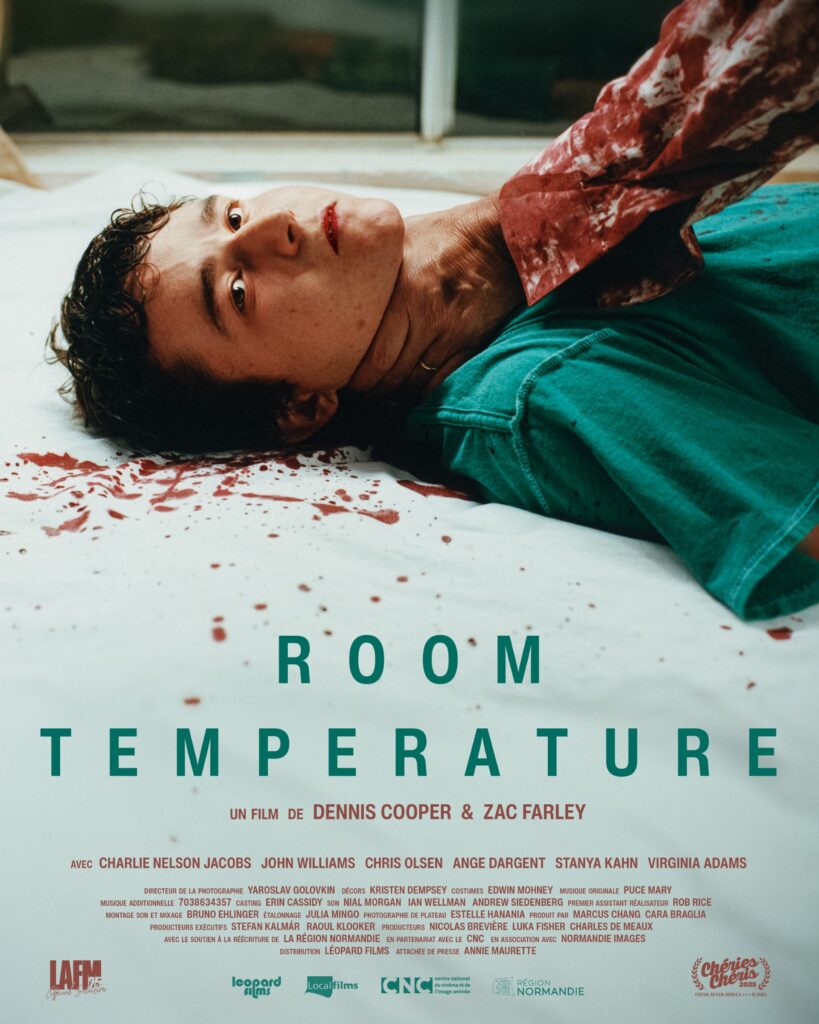
p.s. Hey. ** Dominik, Hi!!! I’ve been lucky enough to ride some of those coasters on my Japan trips, but the one I’m most determined to ride next time is Hakugei, which in Japan has been nicknamed ‘The Ghost’, which is part of the allure. France is pretty good with cookies for some reason, and they’re getting better at donuts, but cakes flummox them. I’m glad you enjoyed the Manson show. Weird when ‘scary’ acts do that ‘How’s it going, Vienna?’ stuff. That was the same thing with Black Sabbath. They’d be laying down great, gloomed out rips, and Ozzy, god rest his soul, would be running around flashing victory signs like a cheerleader. Very disconcerting. I wonder if Dildo is some old Native American word or something. Love wondering why films made in France run at 25 fps whereas films made in the US run at 24 fps, and why ‘Room Temperature’ runs at 25 fps, and why that extra 1 fps is such a problem that we have to pay some technician biggish money to tighten the film to 24 fps in order to release it on a US Blu-ray, G. ** Adem Berbic, I’ve only read Dustan in English obviously, but his prose does not seem special to me. My loss. Cool and luck and encouragement on your new thing. If your next thing isn’t harder to write, you’re doing something wrong. That’s my motto. Then we should hit Parc Asterix one of the times you’re over. ** _Black_Acrylic, Jupiter looks good, agreed. I like wooden coasters, but they’re so fucking bumpy. Being in pain on a coaster is a bit counter-productive. ** Thom, Hi, Thom! I think if I had to choose my favorite Suzuki is kind of the predictable aka best known one, ‘Tokyo Drifter’. I hate when that happens. With you on the big white coaster. That’s the siren to me too. All the luck with the guitar-less gig. I love guitars, but it’s great when they’re superfluous. You got the smoke even in Oregon? That stuff just won’t quit. Maybe it’ll end up over here. Best of everything until next time. ** Ezra, Hi, Ezra. There is something to be said for observing coasters without riding them. What you imagine riding them will feel like can be voluminous whereas riding them gives you slight variations on the same thrill/adrenaline rush no matter how they’re built. Hope you aced that lecture. Did you? Oh, I do miss cocaine, sigh. Since I did not do cocaine, my Wednesday was surely less enjoyable than yours, but I’m a romantic. ** Travis (fka Cal), Hi. No problem, time is very flexible here on the blog. Well, unless you’re in charging of making it. I’m so sorry that you’ve been dealing with deaths. But, I hesitate to say, they are or can be very good for the writing. That sounds awful, but there you go. Do you submit your work to sites and journals and stuff? Having writer friends with whom you all share your works can be an actual trigger to going public. I guess that’s obvious. I’m very glad I’m not in Texas even when Paris is boiling. Although I went to Houston last year to show our film, and I liked it. It reminded me of LA even. Anyway, make sure to hit some AC pit stops as often as possible. Love back. ** HaRpEr //, Now that they’re converting a lot of the wooden coasters into hybrid steel/wood coasters, they can have pretty decently long lives. And they’re actually fun to ride while still giving you the remaining frame of a building beauty. I do think knowing when to take a break from a novel is important. You think your inspiration and impetus will die, but that very rarely happens, in my experience. Sometimes it’s time to let your brain play with the novel without your antsy fingers being involved. ** Bill, I loved it: ‘Flue’! Haha, see, the Skycycle is the only one that scares me too much to try. My heights fear only really kicks in when the world below isn’t whizzing by. Well, I’d hate for you to lose the little new music festival. What a dilemma. ** laura w, Give me a great dark ride over a great coaster any day, but they can be pretty uplifting. That coworker is a fucking snake. Insecure men in positions of power are the world’s biggest problem. Need I even name them. What’s cool is that what I write about scares me until I start writing about it, and then it doesn’t. Strange. Yay, confusing folks! Victoire! My day might have been better than yours, but your day today is probably going to make mine seem very blah. ** Right. I’m guessing that a lot of you don’t know the work of Ed Emshwiller because of the ultra-limited way in which experimental films reach the public these days due to the movie world’s gutlessness and hyper-capitalist aims, so I thought I would do my part to let you know that his very interesting films exist and give you the chance to partake or not. See you tomorrow.

« Older posts

© 2026 DC's

Theme by Anders NorénUp ↑