
‘Every text takes shape as a mosaic of citations, every text is the absorption and transformation of other texts’ — Julia Kristeva
‘… an insistent previousness evading each and every natal occasion …’ — Nathaniel Mackey
‘Memory is not an instrument for surveying the past but its theater. It is the medium of past experience, just as the earth is the medium in which dead cities lie buried.’ — Walter Benjamin
‘A palimpsest is “a parchment or other writing surface on which the original text has been effaced or partially erased, and then overwritten by another; a manuscript in which later writing has been superimposed on earlier (effaced) writing.” In other words, a palimpsest is a “multi-layered record.” In the Middle Ages, these parchments were created from vellum, which was then recycled due to scarcity. Chemical agents were used in the recycling process to erase the existing text; the new text was subsequently superimposed onto the clean sheet. With time however the traces of old writing reappeared, leading to the creation of a palimpsest. Palimpsests are there therefore the product of a layering of texts over a period of time.

‘In his 1845 essay titled ‘The Palimpsest’ *, Thomas De Quincey refers to the structure as an “involuted” phenomenon where otherwise unrelated texts are interwoven, competing with, and infiltrating each other. As scholar an author Sarah Dillon notes, this idea, along with the coupling of the word with a definite article for the first time, transformed the palimpsest into a figurative entity, investing with metaphorical value that extended beyond its status as a palaeographic object. The nature of the palimpsest is two-fold; it preserves the distinctness of individual texts, while exposing the contamination of one by the other. Therefore, even though the process of layering which creates a palimpsest was born out of a need to erase and destroy previous texts, the re-emergence of those destroyed texts renders a structure that privileges heterogeneity and diversity.

* ‘”What else than a natural and mighty palimpsest is the human brain? Such a palimpsest is my brain; such a palimpsest, oh reader! is yours. Everlasting layers of ideas, images, feelings, have fallen upon your brain softly as light. Each succession has seemed to bury all that went before. And yet, in reality, not one has been extinguished. And if, in the vellum palimpsest, lying amongst the other diplomata of human archives or libraries, there is anything fantastic or which moves to laughter, as oftentimes there is in the grotesque collisions of those successive themes, having no natural connection, which by pure accident have consecutively occupied the roll, yet, in our own heaven-created palimpsest, the deep memorial palimpsest of the brain, there are not and cannot be such incoherencies. The fleeting accidents of a man’s life, and its external shows, may indeed be irrelate and incongruous; but the organizing principles which fuse into harmony, and gather about fixed predetermined centres, whatever heterogeneous elements life may have accumulated from without, will not permit the grandeur of human unity greatly to be violated, or its ultimate repose to be troubled, in the retrospect from dying moments, or from other great convulsions.” — Thomas De Quincey
‘Although the palimpsest does not seek to illuminate the relation between a text and its context, there is a constructive relation that could be drawn between the concept of the palimpsest and that of intertextuality. Kristeva describes the text as a “permutation of texts, an intertextuality,” and by doing so gestures to the idea that “in the space of a given text, several utterances, taken from other texts, intersect and neutralize one another.” Differently put, a text is not merely comprised of other texts, but of ‘utterances’, a product of “the productive violence of the involvement, entanglement, interruption and inhibition of disciplines [and texts] in and on each other.” This notion of a “productive violence” mirrors both, the destructive and the accommodative nature of the palimpsest.

‘Sigmund Freud alludes to the idea of the palimpsest as a metaphor for the perceptual and memory apparatus in his 1925 essay “A Note Upon the ‘Mystic Writing-Pad.'” This article is a brief meditation on a toy writing instrument that contains a “slab of dark brown resin or wax” underneath a thin sheet of waxed paper and a transparent celluloid sheet. The children’s toy allows writing as “a pointed stilus scratches the surface” and ‘magically’ enables re-use of the writing sheet when one severs the contact between paper and slab. Thus, the mystic writing-pad, like memory, “provides not only a receptive surface that can be used over and over again, like a slate, but also permanent traces of what has been written” upon the wax slab, “legible in suitable lights”. For post-structuralist theorists, the palimpsest acts as a useful model of intertextuality, the emergence of texts within a field of other texts, much like the emergence of the fragmented and decentered speaking subject from pre-existing overlapping fields and vectors of language and intersubjectivity. Linguistic enunciation partially overwrites pre-existing language within arbitrary and unstable chains of signification and is, in turn, overwritten. This fluid process thus layers discourse in infinite ways, thereby subverting notions of singular and autonomous authorial control.

‘In “Freud and the Scene of Writing,” Jacques Derrida remarks that “the depth of the Mystic Pad is simultaneously a depth without bottom, an infinite allusion, and a perfectly superficial exteriority: a stratification of surfaces each of whose relation to itself, each of whose interior, is but the implication of another similarly exposed surface. It joins the two empirical certainties by which we are constituted: infinite depth in the implication of meaning, in the unlimited envelopment of the present, and, simultaneously, the pellicular essence of being, the absolute absence of any foundation.” Derrida posits that Freud’s frequent use of writing as a metaphor for the psyche bolsters Derrida’s own deconstruction of phonologocentrism. According to Derrida, Freud’s “Mystic Writing-Pad” reveals not only the primacy of writing but also how humans experience the world retrospectively “through the traces of previous experiences and through the signifiers which are in effect the condition of being”.
‘In postcolonial discourse, the trope of the palimpsest emblematizes colonial history and its series of writings, overwritings, and erasures. The palimpsest implies that colonial trauma is not just singular and discrete events, but an encompassing and long-lasting pattern of writings and erasures on land, colonial bodies, and colonized minds. One can also relate the trope of the palimpsest and postcolonial interrogations to the genre of memoir, especially its connection to memory (both individual and collective), as well as through the mediums of history and power. Patricia Hampl speculates that the “real job of memoir” is to seek the “congruence between stored image and hidden emotion”. More significantly, Hampl notes the political ramifications of the memoir genre: “Memoir must be written because each of us must have a created version of the past. Created: that is, real, tangible, made of the stuff of a life lived in place and in history. And the down side of any created thing as well: we must live with a version that attaches us to our limitations, to the inevitable subjectivity, of our points of view. We must acquiesce to our experience and our gift to transform experience into meaning and value. You tell me your story, I’ll tell you my story. If we refuse to do the work of creating this personal version of the past, someone else will do it for us. That is a scary political fact.”

‘The multifarious and diverse vision projected by the palimpsest, despite being the product of an attempt of destruction and erasure, demands a revision of conceptual systems based on the notions of fixity, linearity, centre and hierarchy. It impels us to replace these systems with new foundations that privilege the conceptions of “multi-linearity, nodes, links and networks.” Roland Barthes’s description of the slippery nature of an “ideal textuality” matches that of the palimpsest: “In this ideal text, the networks are many and interact, without any one of them being able to surpass the rest; this text is a galaxy of signifiers, not a structure of signifieds; it has no beginning; it is reversible; we gain access to it by several entrances, none of which can be authoritatively declared to be the main one; the codes it mobilizes extend as far as the eye can reach, they are indeterminable […] the systems of meaning can take over this absolutely plural text, but their number is never closed, based as it is on the infinity of language.”

‘The internet, in its obsession with being current, projects itself as a virtual palimpsest. Like webpages, the parchments of vellum constantly get refreshed to reflect current trends, practices and preoccupations. Though many elements of structure and content remain unchanged, there is still an emphasis that the internet places on immediacy, or on the current. The old pages that are written over can consequently, at best, be archived. Webpages are also loaded with hypertext or hyperlinks which ascribe a sense of multi-linearity, characteristic of the palimpsest, to our viewing experience. On a single webpage, it is not uncommon to find several hyperlinks contesting with each other, much like the texts on a parchment of vellum. Furthermore, the constant slippages which are produced as the viewer navigates these hyperlinks resemble the ambivalence engendered by the palimpsest.
‘Hip Hop is another clear and dominant example of a contemporaneous palimpsest. In the words of DJ and ‘Underground Railroad’ founder Jay Smooth: “You can go back to, throughout the history of music, back to the first –-in Western music–-the first polyphonic music was based on taking a Gregorian chant in a lower register and then singing a new Gregorian chant–-singing a new melody on top of that, in a higher register. You’re basically taking a song and then adding something new on top of it–-that’s the same creative process as hip-hop. The only difference is that in the mid-Nineties we had samplers that let us actually manipulate the recordings, and do it that way instead of other ways. You can look at jazz standards, you can look at what Led Zeppelin did with blues tracks—there are parallels to that all throughout music, but people get caught up in the fact that we’re using the actual recordings. They see it as lazy, but if you’ve ever tried to make a beat as hot as what the Bomb Squad made, or try to make a beat like Just Blaze made, or even the beats that we see as really simplistic, like the beats that Diddy made. If you tried to make a beat that sounded that good you’d find that it’s much harder than you think it is, and I think the amount of creativity and innovation that goes into sample-based hip-hop is very underrated.”

‘The palimpsest is also often likened to the human brain and to memory. In comparing the palimpsest with human memory, De Quincey emphasized its propensity to preserve over its intention to destroy. The palimpsest is therefore presents a utopian possibility of eternal preservation. Sarah Dillon asserts that this “fantasy” of the palimpsest of the mind results in a “spectralization of the self” which inevitably leads to a “spectralization of temporality”. She further notes that the palimpsest represents what Derrida describes as a “non-contemporaneity with itself of the living present”: The present that the palimpsest projects, is constructed by the unintended presence of texts from the past and the possibility of the inscription of future texts. Therefore, the palimpsest “evidences the spectrality of any present moment which already contains with it (elements of) ‘past’, ‘present’ and ‘future’.”

‘The emergence of the disunified, spectralized subject mirrors the unruly and fractious nature of the palimpsest, which eventually leads to a descent into the utopian realm of the carnival. The carnival due to its propensity to plunge certainty into ambivalence relies on the mask, which enables fluid identities. It is however important to recognize that just as the carnival must always give way for order, and all masks are eventually discarded, the palimpsest, due to its inherent unruly nature, will also make way for a structure that privileges an ordered heterogeneity. Although this new structure could be perceived of as a favourable departure from the chaos rendered by the palimpsest, it would certainly lack the charm of its predecessor, which through its fluidity, endorses the reveries of the carnival and its lack of order.’ — Chicago School of Media Theory
Continued
Turning Pages of the Archimedes Palimpsest
Wugazi ‘Sweet Release’
52 secrets in Google Earth
Showgirls – Black Swan : Trailer Mash-Up
Iannis Xenakis’ ‘Palimpsest’
Ray of Gob
Stan Brakhage ‘Moth Light’
X-ray demonstration with Van Gogh Painting
‘Faint But It’s I’m Gonna Be (500 Miles)’
Three short video collage vignettes of the Milwaukee Noise Festival 2007
3d video mapping in the Jerusalem Light Festival 2010
Bruce Lee’s Kung Fu Ping-Pong
Tim Hecker’s ‘Palimpsest 2’ co opted by Christian zealot
—-
*
p.s. Hey. ** Carsten, Hey. No, I love Eggelston’s photographs, but I don’t know that film. And since I also don’t have anything to play DVDs on, I guess I’ll keep my eyes peeled when I’m in the shadowy realms. I have a couple of other friends who did the Vegas marriage thing. I think they’re all divorced now. Coincidence? I hope ‘Elvis’ showed up. I think I don’t know how to relax and unwind. When I’ve tried the standard methods of dawdling and spacing and ‘taking it easy’, I get antsy and bored in a flash. But I fear we’re the weirdos in that equation and always will be. ** Noah Falcus, Hi, Noah. Greetings and a warm welcome. Yes, I actually did a post about Yoshihiro Nishimura a few months ago. Let me see if I can find it. … It’s here. So, yes, I’m a fan too. Who else do you like and recommend? I’m always hungry. Take care, and great to meet you. ** Tosh Berman, Hi, Tosh. Are you made thinking of Ronald Tavel? He wrote the scripts for some of Warhol’s best films. I don’t think Sonbert wrote for Warhol, but I’m not completely sure? ** Fionn, Hi. What is it that you don’t like about older films? Is it because they’re shot on film, and you don’t like that look/quality, or … ? Nice about Stockholm. Cool city. I quite liked ‘Nocturama’. See what you think. Bonelo’s work is kind of uneven, yeah, I think. ** Laura, All thanks to the cat. I’m so sorry about your shitty day. Surely you must have had your quota of shitty days by now. Brains are so weird, indeed, and god love them. Or some of them. I would say avoid screenwriting instruction books like the plague. Just write a poem in script form. Thanks, obvs, about the sentence. Yeah, it’s not bad, is it, haha. Oh, it’s Dead Kid’s Ass, no gender. I think that’s the key. I’m good because it’s seemingly fall here finally, and that’s delicious, and otherwise just beginning the new film and doing some last escorting for the current one, usual business. Rev up and come back soon! ** Steve, I’ve never heard of Predator Pee. Hm, I feel suspicion. Let me know if that functions. Everyone, Here’s Steve with an important announcement: ‘On my latest “Radio Not Radio” show, take off to library music, field recordings, dub, prog and more! The show features John Cameron, Ichiko Aoba, John Cage, Phoebe Bridgers, Robert Wyatt, Ysa C, Mad Professor, Kofi, Dawn Richard, Ayra Starr, Moving Gelatine Plates, Roy Montgomery & Martha Skye Murphy, Dis Fig, Original Koffee, Kinact, Saul Williams, The B-52’s, L’Rain, Sam Kidel, Kate Carr, Arca, Waakya, Kinact & Team Work. Here’s the link.’ Well, there’s the crazy architecture of the Strip hotel buildings, which is probably the big draw. And all the flashy, retro entertainment stuff, and the Sphere and all of that. And how was ‘Apaches’? ** Adem Berbic, Thanks. It can’t possibly go even remotely as badly as the last experience. It was more like the Iran war than like ‘Apocalypse Now’. I just found a stream of ‘Camp Miasma’ so I’ll be watching it and will report my findings and see how they meet with yours. I like ‘Castration Movie’ and I think a few other people here do too. ** Dominik, Hi!!! You’re back in the saddle! Yay! I guess the degree to which you found Hungary nominally improved makes sense. The coming change does seem like it’ll take a while to blanket the place. So, good news. Paris has finally admitted the fall into its realms, knock on wood, and it feels even more glorious than it probably is. Surely Vienna will get its portion any second now. I’m good, just doing the usual stuff. It seems we have a producer for our new film, and I feel at least tentatively over the moon about that. Sadly, I’m fearing we won’t get to Kongeparken because we’ll be in and out Stavanger so quickly and with festival duties while we’re there. But we’re kind of hoping we’ll meet someone with a car who’ll want to drive with us to it for at least a few hours. Sure hope so. I hope love’s reading experience is suiting someone with the name of love. Love wondering why ‘The End of Oak Street’ appeared to have the makings of being fun but wasn’t, G. ** _Black_Acrylic, I have never wrapped my mind around the apparent greatness of opera. But that might be mostly because they’re very long and I smoke cigarettes. Congrats on the win! And on the money well spent assuming that will continue to seem to be the case. ** laura w, Vegas is great by default because there is no place on earth like it. And thank goodness. I guess it’s like an amusement park without the rides, or I guess just walk-through rides since the theme hotels might count. And they do keep adding ludicrous shit like that new huge guitar-shaped Hard Rock Hotel. Nice on the book scores. I adore ‘The Past and the Present’ to death. See what you think. Helped or hurt … I don’t know. I guess ultimately I don’t think it has hurt my work? I think my readers are maybe even less queer than not at this point? It doesn’t interest me because I don’t categorize things in that way, but I can’t do anything about it. I do get irritated when my books are in the ‘gay’ section in bookstores. But ‘queer’ is such a better and more apt term than ‘gay’. That just seems kneejerk and dumb. I guess that’s how I feel? ** HaRpEr //, I try to do my little part in helping experimental filmmakers meet and greet people who don’t think to go shopping in that realm. And seeing experimental films when I was teen kind of made me whatever I am. I wish I could see that Mendieta retrospective, partly because, and I know it’s kind of blasphemous to say, but I’ve never found her work interesting. But seeing a bunch can make all the difference. That doesn’t sound like masochism, no, perhaps even the opposite. ** Uday, There are no Sonbert gifs. Trust me, I looked. There are a few today? I’m doing a post on Andy Warhol’s films soon, and I think there will be a lot in there. The person with the robot soldier making dreams is inherently interesting, no? Every once in a while I’ll see an Antoine Monnier doppelganger here in Paris. Usually from afar. It’s always a rush. So gotcha. ** Thom, I like what you sound like you’re up to with the new writing. It sounds highly worth making a sincere effort at nailing. The best fiction writers often use poetry as their fiction’s circulatory system. Curious what effect ‘LotF’ has on an adult. Probably not the same because you’re not a kid like the kids in it, but worth a try. Yes, Holobiosis did arrive, and I’ve been enjoying it thoroughly, and I’ve been forgetting to tell you that. Great! The temperature here is remaining so kind and friendly. Wow. Yours? ** Okay. Have a palimpsest or several, why don’t you? See you tomorrow.



 Now available in North America
Great post! I think one of my favorite examples is “Third Reich N Roll” by The Residents, where they recorded their own tracks over pop songs, then removed the original pop backing track to reveal all new warped songs of their own. Hope all is well!
Hi!!
Yes, definitely. It’ll take a really long time to heal after 16 years of Orbán, in every sense and on every level, but the small shifts and tweaks that are already noticeable make me feel cautiously hopeful. I don’t think we can realistically expect anything more after just a few months.
You already have a producer for your new film?! That sounds wonderful! Congratulations!
Oh no—that’d be such a pity about Kongeparken! I’m keeping my fingers crossed that you get to spend a few hours there at the very least!
I’m enjoying the new Irvine Welsh book so far. It’s not part of the Trainspotting universe, and it’s nice for a change.
The End of Oak Street sucks? That’s sad news because we’re also planning to watch it. We must because a) dinosaurs and b) Ewan McGregor.
Love asking flies how they always seem to find their way so easily into apartments but never out, Od.
Yes, Ronald Tavel! Sorry for the confusion.
Hi Dennis! Thank you! I read your blog on Nishimura, which I thought was very good and quite hilarious. I think most people only dream of living as crazily and surrealist as he did. I also like Park Chan Wook and Miike’s films, and Sion Sono. Also; the life of Toru Muranishi is a good read, if you’re ever looking for people who lived insanely eventful and bizarre lives.
Best wishes!
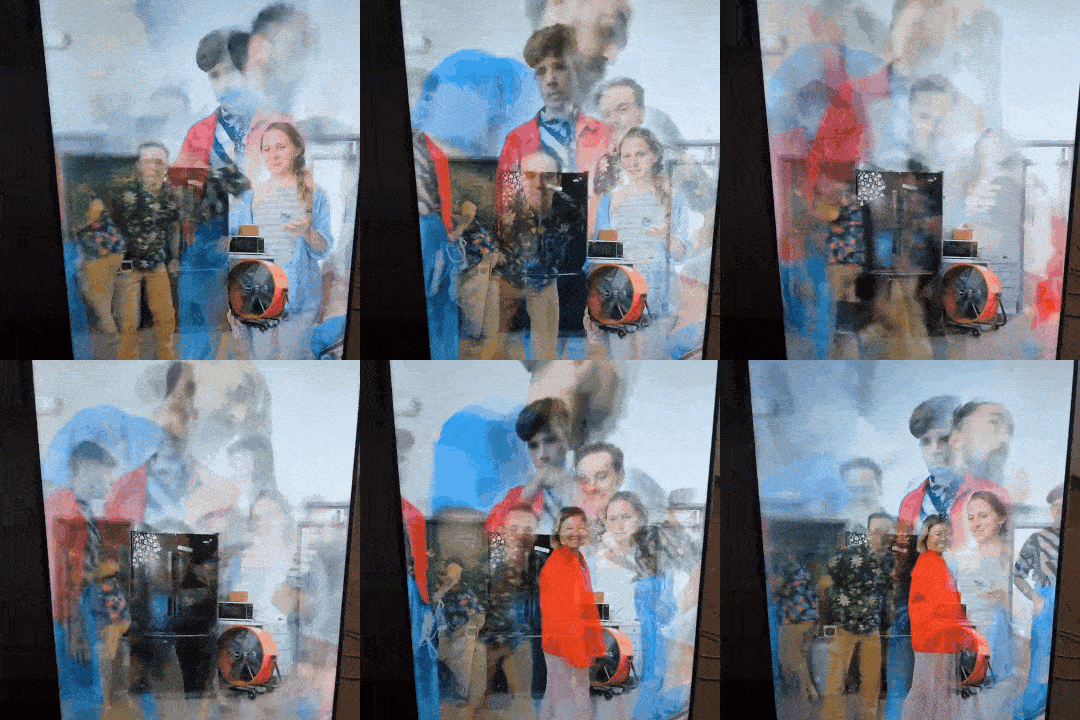
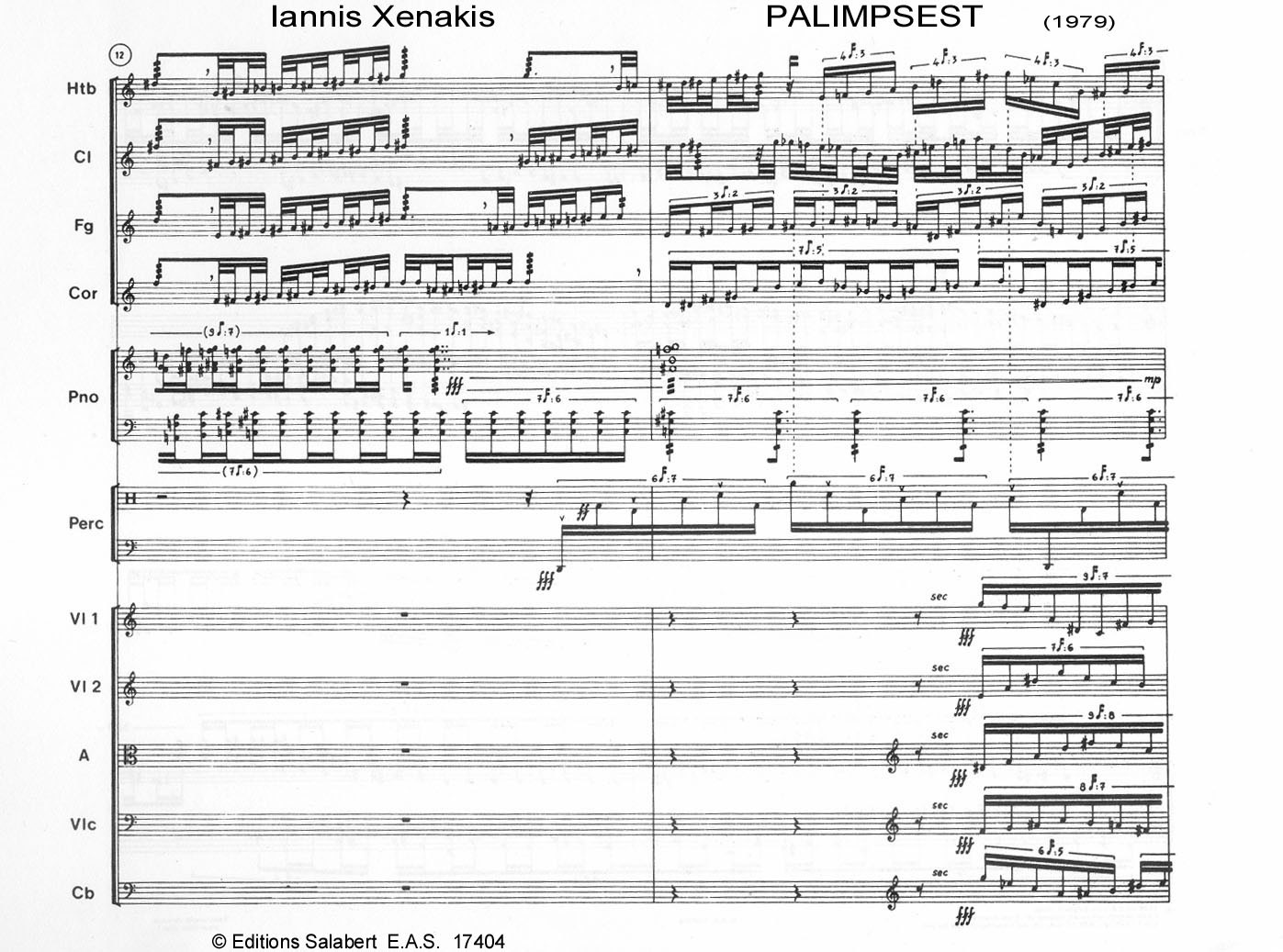
Nice palimpsest day, Dennis. I’m a fan of the concept, and that Xenakis piece in particular. What’s the gif after the Verizon, with the figures fading in and out?
I’m in Philadelphia for a few more days. It’s the late summer lull, haven’t gone to any live events. I did check out the small but legendary Brickbat Books. They have sections labelled Atlas Press, Dorothy, Wakefield, Twisted Spoon etc! They also host occasional new music gigs; Aaron Dilloway played there last year.
Visited Magic Gardens finally. Their current folk art residency artist is Ivette Chaires, some really nice contemporary takes on Mexican traditions. The facility is of course lovely as well.
Bill
I await the comparison of your notes with mine. And gotcha on ’Castration Movie,’ I might make an evening of it with the friend of mine who did that short. I suspect it’ll be up her alley.
A whole damn producer, already? Big, big congrats. Here’s to them being able to stump up for everything up to and including an on-set masseuse. The next question is working on French funding given the film being in English is non-negotiable, right? Or does landing the producer change the calculus? Or is everything confidential from here on out?
Sam F.’s book has just arrived, so that can be my masseuse tonight. A necessary exception to the de-cis male brain-ing of my reading habits.
The Mickey Rourke photo made me chortle. I can’t remember a more Family Guy-like tic from the blog. I mean that in a good way. But, I like today’s theory-ness. Besides the little bits of Lacan, I haven’t really dug into theory for years. I’d like to, but I think it takes some immersion to get at its sugar rush quality. I lapped Derrida up around 17 or 18 and quickly came to a point of sort of seeing his key points as self-evidently true. Getting assigned ’Before the Law’ and ‘The Law of Genre’ and a few other of his essays at the start of my undergrad really felt very mind-expanding. I wonder whether I often struggle to sustain interest in ‘fragmentary’ texts because I take writing as fragmentary already, so the extra formal fragmentation often strikes me as sort of disingenuous, or like window dressing.
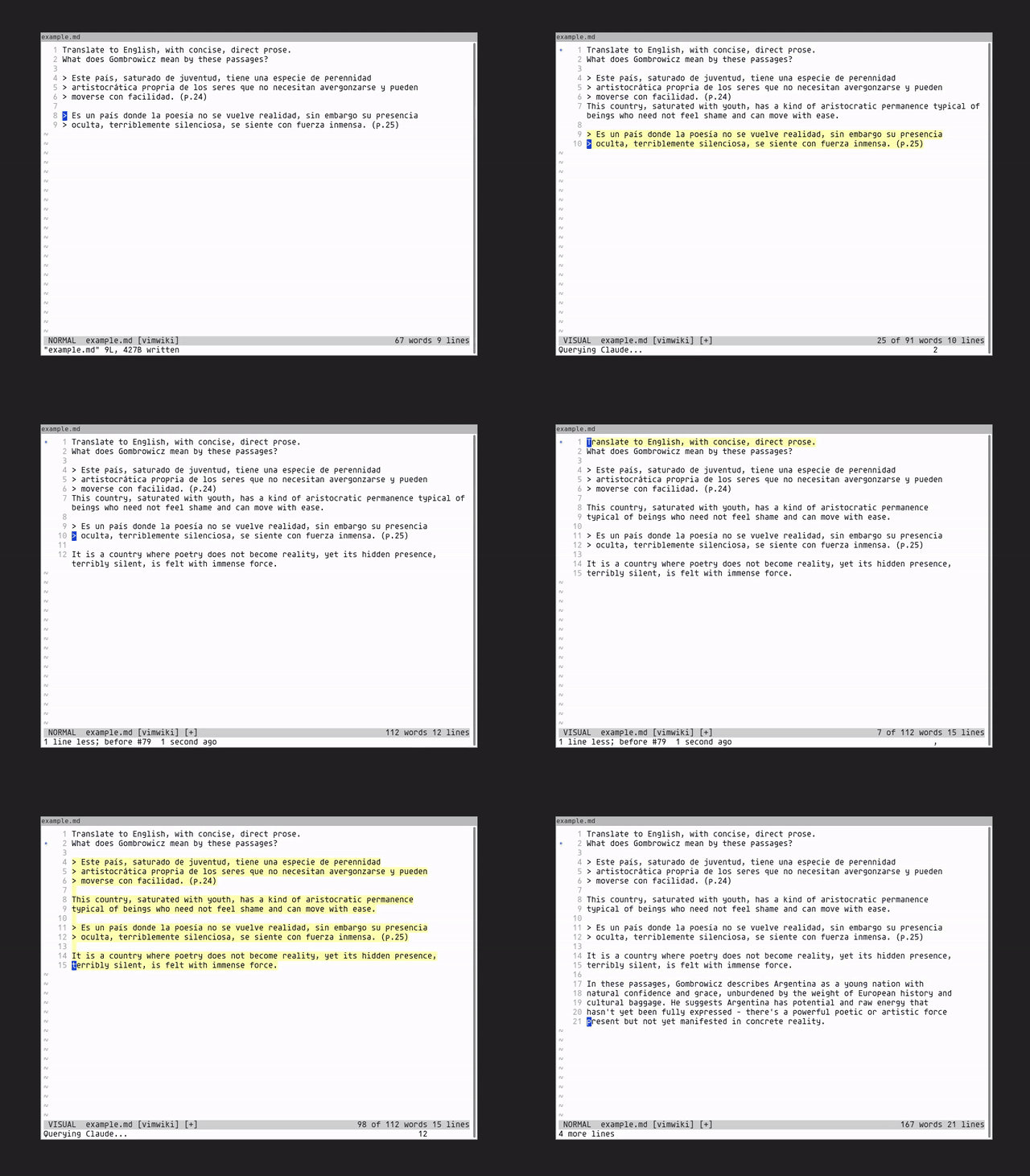
The program in the GIF above Mickey is called Vim. It’s an old-style text editor which you can hot-wire to do more or less anything, and which has a special sort of language for making it do complex things by pressing specific keys. The end result is you can zip around and feel like an 80s hacker and sort of make it work the way you think. It’s neat, I think.
Very interesting concept & collage-like treatment there.
Very happy to hear that things are looking good with the producer. Fingers crossed that all goes smoothly until you know for sure!
Yeah I’m a fan of Eggleston’s photography too & his film sounds right up my alley. I think the internet has spoiled me, because I was genuinely surprised at not being able to find it.
Elvis not only showed up at my wedding, he officiated it. We did it at the Graceland Chapel. Then our hotel upgraded us to a luxury suite free of charge, where we partied accordingly. Makes sense that many marriages that started there don’t last, but I for one can’t blame my divorce on Vegas. That one’s on us lunatics.
Sounds like unwinding is a lot easier for me than it is for you. In fact, my temperament requires it, as my past has taught me. I get worked up easily & then need to come down. But to me “taking it easy” means reducing the noise, in a meditative sort of way. That can mean just sitting outside with a smoke staring off into space or nature, or a walk, or a swim. I can’t imagine anything less relaxing than a “loud” conventional movie or book. So yes I agree, we’re fated to remain weirdos on that front. But that’s where life’s really popping, after all, on the weirdo fringe.
I have no palimpsest experience myself but am happy to be introduced to the form.
Booked in for an induction at Leeds Print Workshop on Sunday 2pm so things are finally moving!
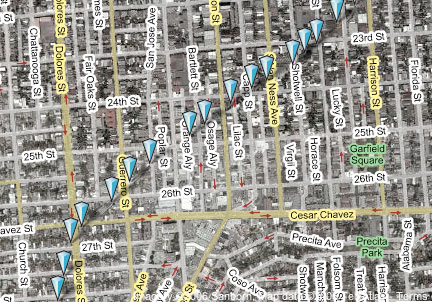
Hi Dennis, Love this. Your inclusion of Mickey Rourke? I guess cheeky is the right word? I do like superimposed words on old buildings, if it’s done well. That first image, for example. And I suppose the positioning of one thing upon another is, I guess, how it’s always been? Maybe that’s why I’m a fan of strange architecture in places like Romania. Some true layering going on there. What’s the map supposed to show in terms of layering and / or hidden text? That shows, btw, my old neighborhood in SF, right where Capp dips into Cesar Chavez. Anyway! Looking forward to the Warhol films and wondering about your interest in Vegas? The buildings? Did you go (often, at all, infrequently) when you were in LA? Take care, Don
you’re taking me back to my masters with this one! next you’re going to do something about heterotopias and i’ll feel back at home in archival theory.
there’s a game series i love, submachine by mateuz skutnik that has a lot of interesting puzzles that involve different layers of the world on top of each other, if that makes sense, like a multiverse but the prior to the lame marvel-ification of the concept. anyway. the concept always reminded me of those games.
that make sense! that specific category has always been a case of strange bedfellows, anyway, you getting paired with like alan hollinghurst et al. i’m mildly convinced it was held together solely by edmund white (when bookstores put up their pride displays you could make a game out of spotting edmund white blurbs). very excited to hear about your producer! smooth sailing this week? hopefully?
Huh, the concept of Palimpsest is quite engrossing in all its multifaceted meaning. I am intrigued by concepts involving decay, gradual deterioration or distortion of a subject until the frameworks that made up its authenticity or “pureness” becomes a hazy ghost erased by the force holding power over its essence, leaving you no idea what “real” is . Im sure ive worded this before, and alas, of course I know, unequivocally this is also an interest of yours.
I suppose there is also some themes evoking mental illness and resulting mental deterioration prevalent in the idea of palimpsest
Oooh! Or like a book written in palimpsest structure telling a story of someone in mental deterioration. Yes I suppose in a way erasure rather than “overwriting/obfuscating” is also a form of palimpsest aswell. I think the comparing palimpsest with the internet is interesting! The concept of the ephemeral yet everlasting net ,with omniscience like a god is something I would like to dedicate project to, although as of now im uncertain wether it’ll be a art project or writing, and regardless, I have list of projects, hah. oh I suppose I’ll keep exploring such ideas in writing until im able to aquire equipment/ time for it!
This stems from my interest in “The Divine Machinery” I cant explain concisely atm but im sure if you look it up you’ll t get a good idea what it pertains to. Anyways the artist Stan Jagodic did this collection ” Digital Constructivism”
Which is definitely in theme with “the Divine Machinery” If you look at the one titled “Contemporary Golgotha” with Christ in a crucifixion pose splayed over a city of computer circuits, that one is just so transcending to look at.
https://www.stane-jagodic.com/Digital-Constructivism
Do you know this artist?
Been schooling and stuff, working on book, the magazine editing club will open soon which im hopeful for. Outside of that I should look into ideas of how to get my written stuff in action or at least in terms of local networking. A friend of mine has this script their working on which (Hopefully, im not sure if they said it was confirmed but it seems pretty confirmed, I hope)they were working on with someone who I think would get it in action. I think I will try to find ways to search out that kind of stuff…it would be a nice side project while im still editing my book. I never really know where to look and im still looking, though I know this magazine editing club could be a good start in terms of progress of editing/pragmatic writing skill learning experience.I suppose I could ask this friend for advice on how they do such beautiful networking. I want to learn from people, not just delusions.
I really liked listening to Phaedra by Tangerine Dream during my writing session. Has that early seventies inspired cosmic loop sound I enjoy prevalent in alot of 70s moog artist.
Are you a fan of Tangerine dream?
This is super fascinating. Beautiful destruction. I wonder if a human body can be a palimpsest, because I think I may be a contender with all of the things I’ve done to myself.
Honestly, I didn’t know what to make of Mendieta’s work either until I saw the exhibition. Just looking online at her stuff doesn’t make much of an impression, but the show did a good job of showing her progression, and it definitely made me come around. I do think her later works are pretty strong. There’s a great installation near the end where there are all of these films on different screens hanging from the ceiling, all lined up so you walk from one to the other or wander around. If it makes it to somewhere you end up being I recommend it.
I’m very into the new Prairie Princess album, ‘Jewish American Prairie Princess’, which I guess is lo-fi alt-country or something with added baroque flourishes. I didn’t know whether I would be into it at first because I think the vocals are in the love them or hate them territory, but I’ve come around and the songs are very detailed and delivered in these short bursts.
I hope that by writing more poetry, whether or not its good/sharable, and reading more I will wrap my head around it. I wonder if my years as a songwriter have informed by prose fiction… hard to say but I think I had a pretty good grasp on songwriting. Not enough where it defines me tho, usually structure and areangements are my focus with music. Like, someone like John Darnielle had SUCH a lock on his songwriting/lyricsl style and identity, whereas his prose is kinda just servicable…
I think Jenny Hval is a great songwriter turned novelist tho… have you read her stuff? She has a couple short novels available in english, and she keeps a sorta pop experimental balance decently enough in the prose…
Hell yeah, thanks for checking out Holobiosis, glad it made it over OK, I know the French mail system can be… finnicky?
Got hot again over here (by my standards) so it was kinda a tiring weekend, but exciting things this week, so cant complain too much!
Interested to see what you’ve got cooking for us on the blog, and hope the week is looking good on your end? k bye!
Hopefully that comment went through l; third attempt.
I’ve just tried to comment twice and failed. Guess I don’t know the right people.
As a pope of Discordia, my name is Palimpsest the Pointillist aka the Pointless. Thanks for the layers of thought and Hail, Eris!
As a pope of Discordia, my name is Palimpsest the Pointillist aka the Pointless. Thanks for the layers of thought and Hail, Eris!