______________
Chris Burden Through The Night Softly, 1973
‘The action of the poetically and ironically titled Through the Night Softly consisted of Burden slithering across broken glass in his underwear with his hands bound behind his back. This raw performance put the audience in discomfort by having to view the pain felt by Burden as shards of glass shredded the bloodied front of his body. Burden wanted it to be clear to the viewers how real pain is, and emphasized this by performing live so that the audience had to experience it in person. In contrast to the use of commercials to advertise for upcoming events, Burden purchased late night commercial spots on a local television station, running a ten-second clip of this piece so viewers would get to see it in the detached setting of their homes, thus placing the artwork on the level of our increasingly detached reception of horrific events.’
______________
Daniel Charkow Auto Destructive Shoe, 2020
‘Handmade shoe. Material: fabric and zippers.’

______________
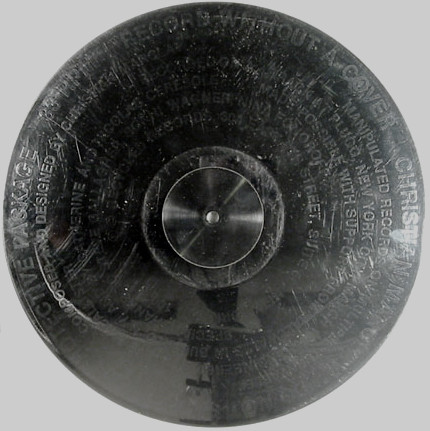
Christian Marclay Record Without a Cover, 1985
‘Record Without a Cover was sold without any packaging, such that the wear and tear on it gradually transformed the sound of each copy. The record’s reverse side is printed with instructions not to “store in a protective package”, which gradually becomes less legible as the record is played repeatedly. The record’s transformation can be interpreted as a form of spontaneous composition, with each copy becoming a distinct performance. Marclay wanted to ensure that “you can’t ignore the medium”, and the evolving sound of the record blurs what he originally recorded with the way in which the record has physically changed.’
______________
Liz Larner Corner Basher, 1988
Steel, stainless steel, electric motor with speed-control mechanism 306 × 94 cm
______________
Janine Antoni Lick and Lather, 1993
‘7 chocolate and 7 soap self-portrait busts. The artist created the sculptures from molds of her own head. Then she licked the chocolate bust until it’s feature becomes blurred, and she took the soap bust into the shower with her, letting the water worn away the feature of the sculpture. Hence the artworks name is Lick and Lather.’

______________
Kurt Kren Self-Mutilation, 1965
‘The theme of Self-Mutilation (also referred to as Self-Destruction) is self-explanatory. Kren’s 10th film of 1965 depicts a man covered in white plaster and dough inflicting pain or attempting to operate on himself. The whole thing is very graphic and deeply unpleasant to watch. That, of course, is the intention; to shock the viewer and challenge perceptions.’
______________
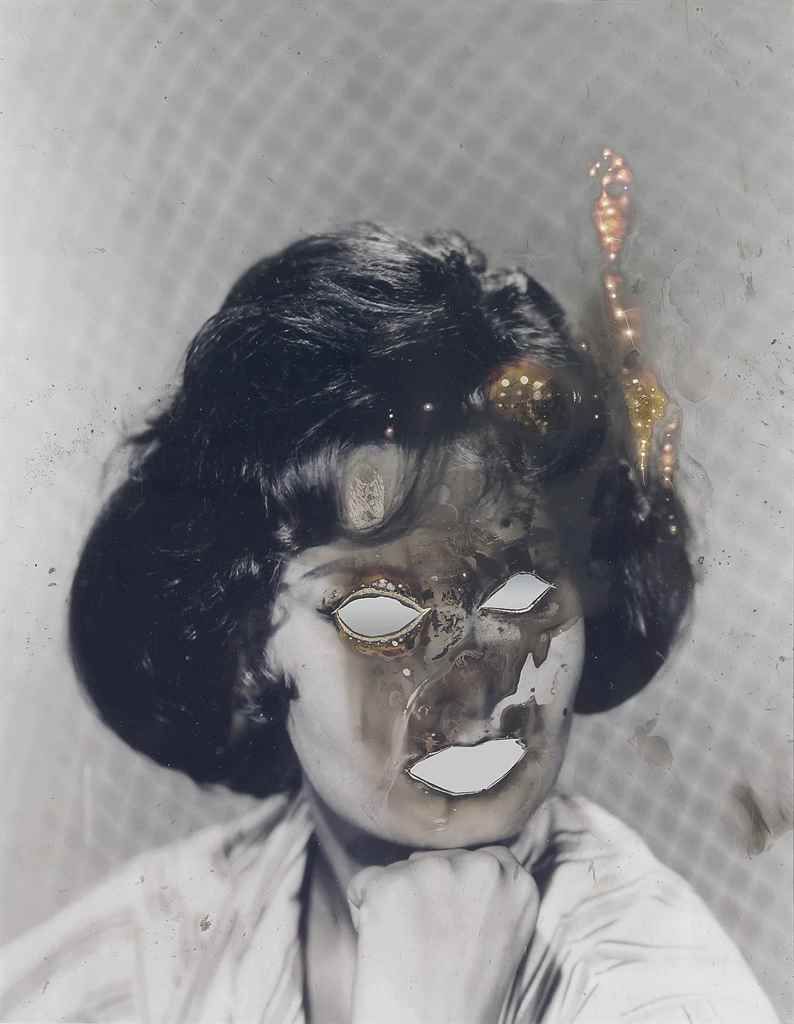
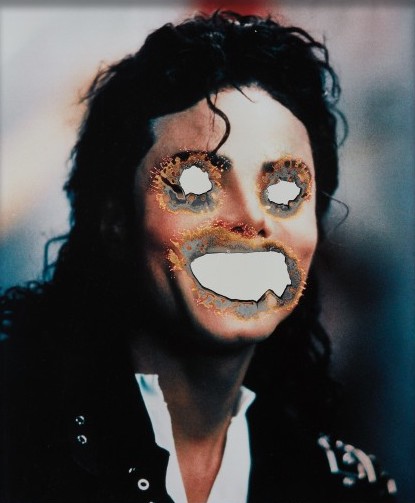
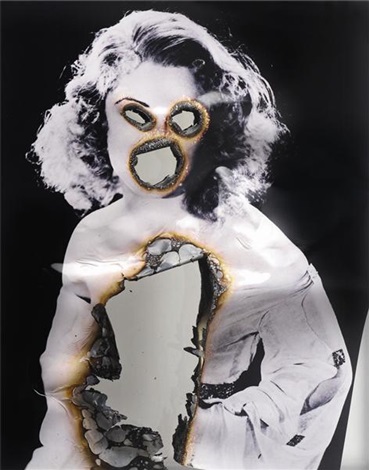
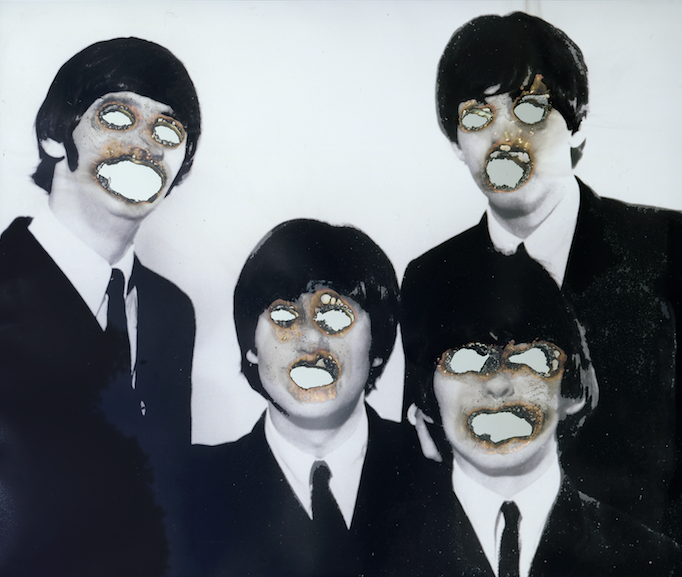
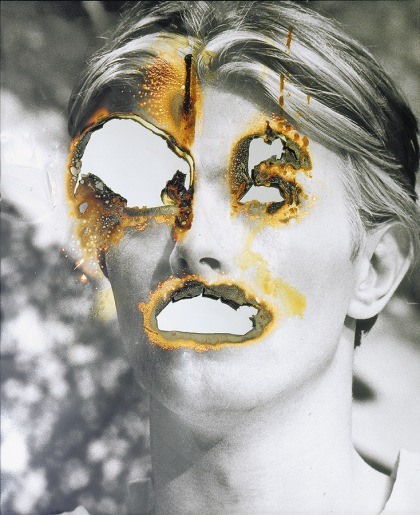
Douglas Gordon Self-Portraits of You + Me, 2006
‘With ‘Self Portraits of You and Me´ by Douglas Gordon, the viewer is denied engagement with the subject (celebrities) because all discriminating facial features have been removed by burning. Frames backed with mirrors were constructed so that the viewer’s gaze is quite literally reflected back out of the photographs through the holes in the images.’

_______________
Jonathan Schipper Slow Motion Car Crash, 2012
‘In his 2012 performative work staged over the course of a month, Jonathan Schipper’s Slow Motion Car Crash sees a white Volkswagen destroy itself by slowly crashing into a wall—propelled forward by a pneumatic mechanism beneath the vehicle that moves at a rate of seven millimeters per hour. The car’s movement is almost undetectable to the human eye, and barely evidenced in a time-lapse video of the event. But the car’s form gradually degrades.’
_______________
Teresa Margolles Tongue, 2000
‘perforated human tongue with a piercing of a teenager murdered in a street fight, 70 x 20 x 90 mm’

_______________
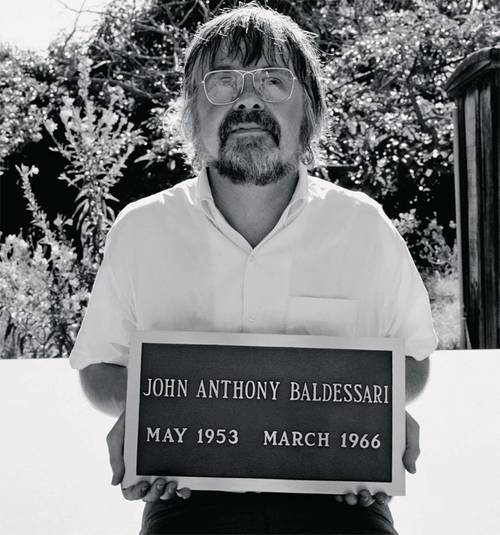
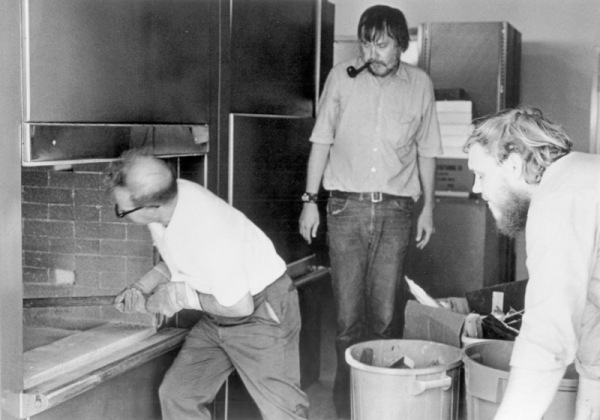
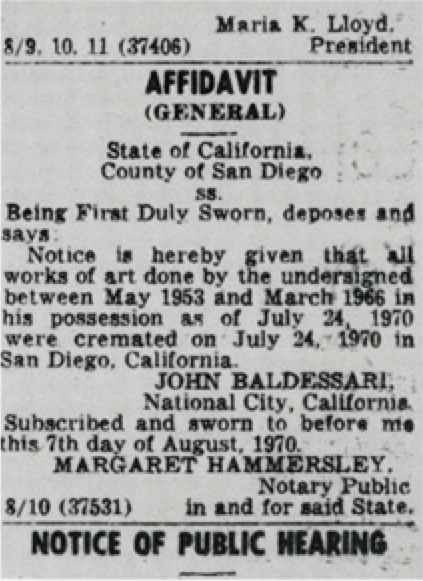
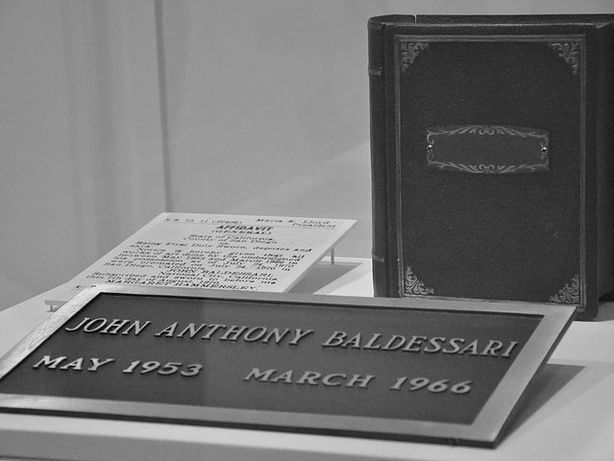
John Baldessari Cremation Project, 1970
‘In 1970, conceptual artist Baldessari rounded up all of his unsold paintings from May 1953 to March 1966, took them to a crematorium, and reduced them to ashes. In what he would later title Cremation Project (complete with documentary film and photos of he and his assistants burning his works), Baldessari effectively destroyed the abstract stage of his career. Having turned to more conceptual works involving text and photography, Baldessari ritualistically closed the door on one style to make way for the next. The artist had a bronze commemorative plaque made for the works’ “burial.”’
_______________
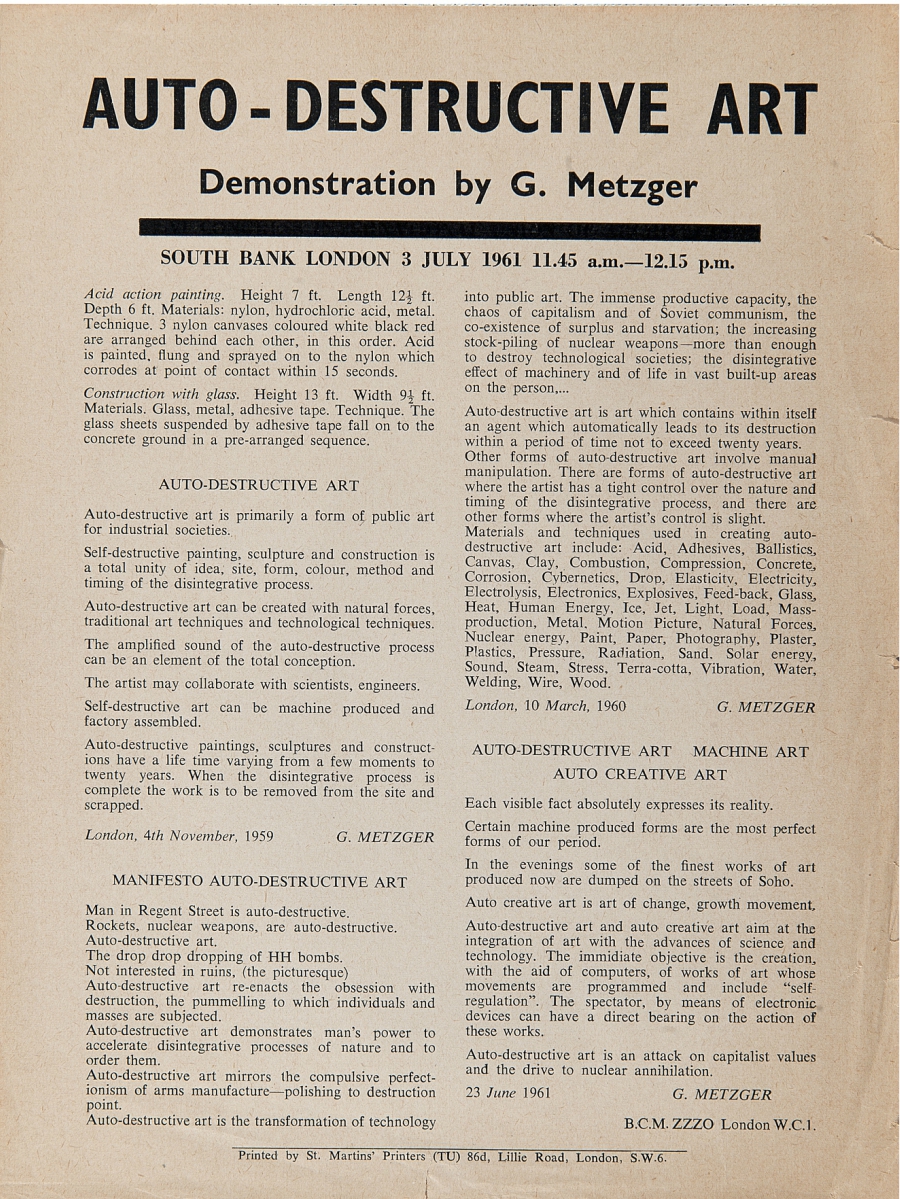
Gustav Metzger Various, 1965 – 1992
‘Auto-Destructive Art (ADA) is a form of art coined by Gustav Metzger, an artist born in Bavaria who moved to Britain in 1939. Taking place after World War II, Metzger wanted to showcase the destruction created from the war through his artwork. This movement took place in England and was launched by Metzger in 1959. This term was invented in the early 1960s and put into circulation by his article “Machine, Auto-Creative and Auto-Destructive Art” in the summer 1962 issue of the journal Ark.’
________________
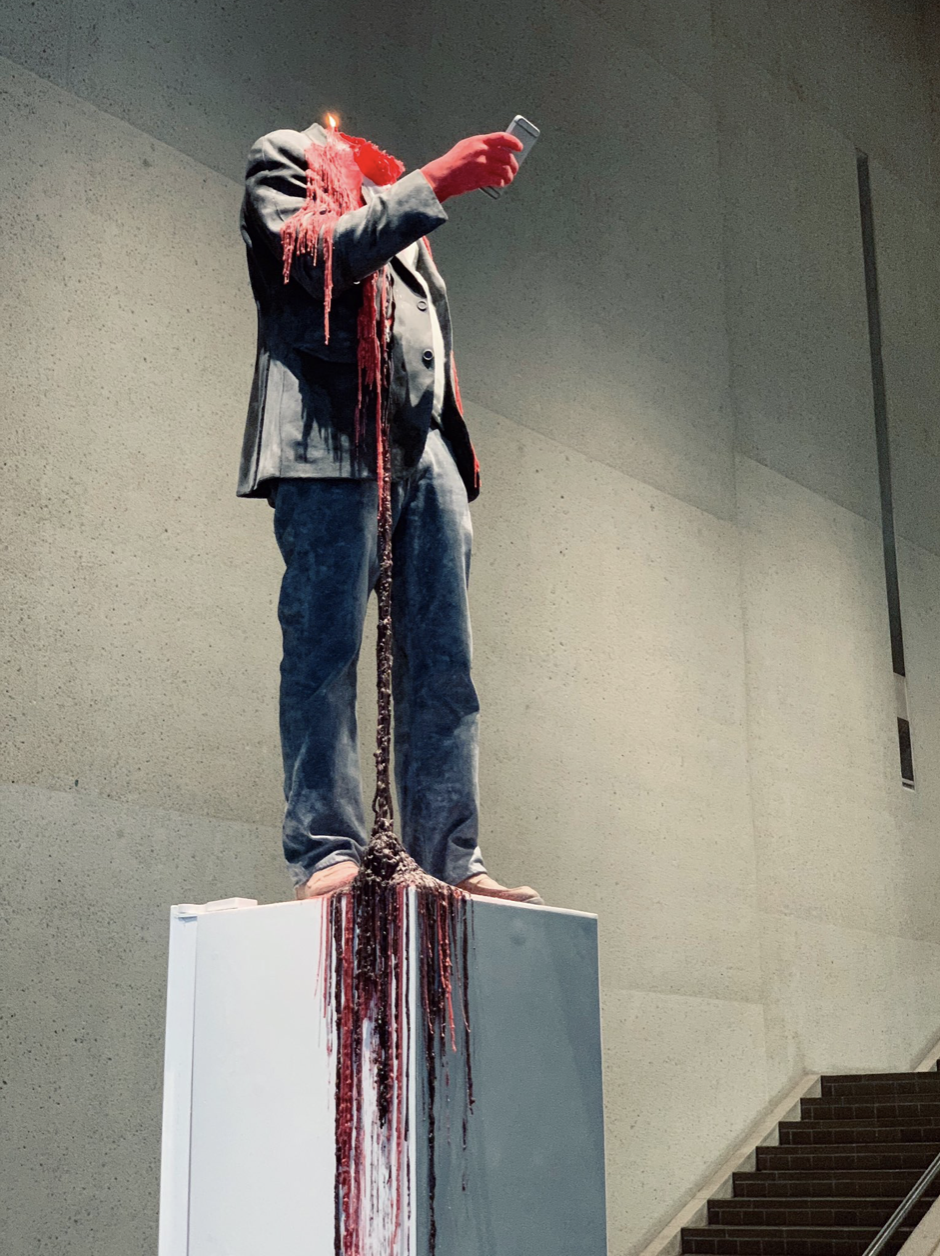
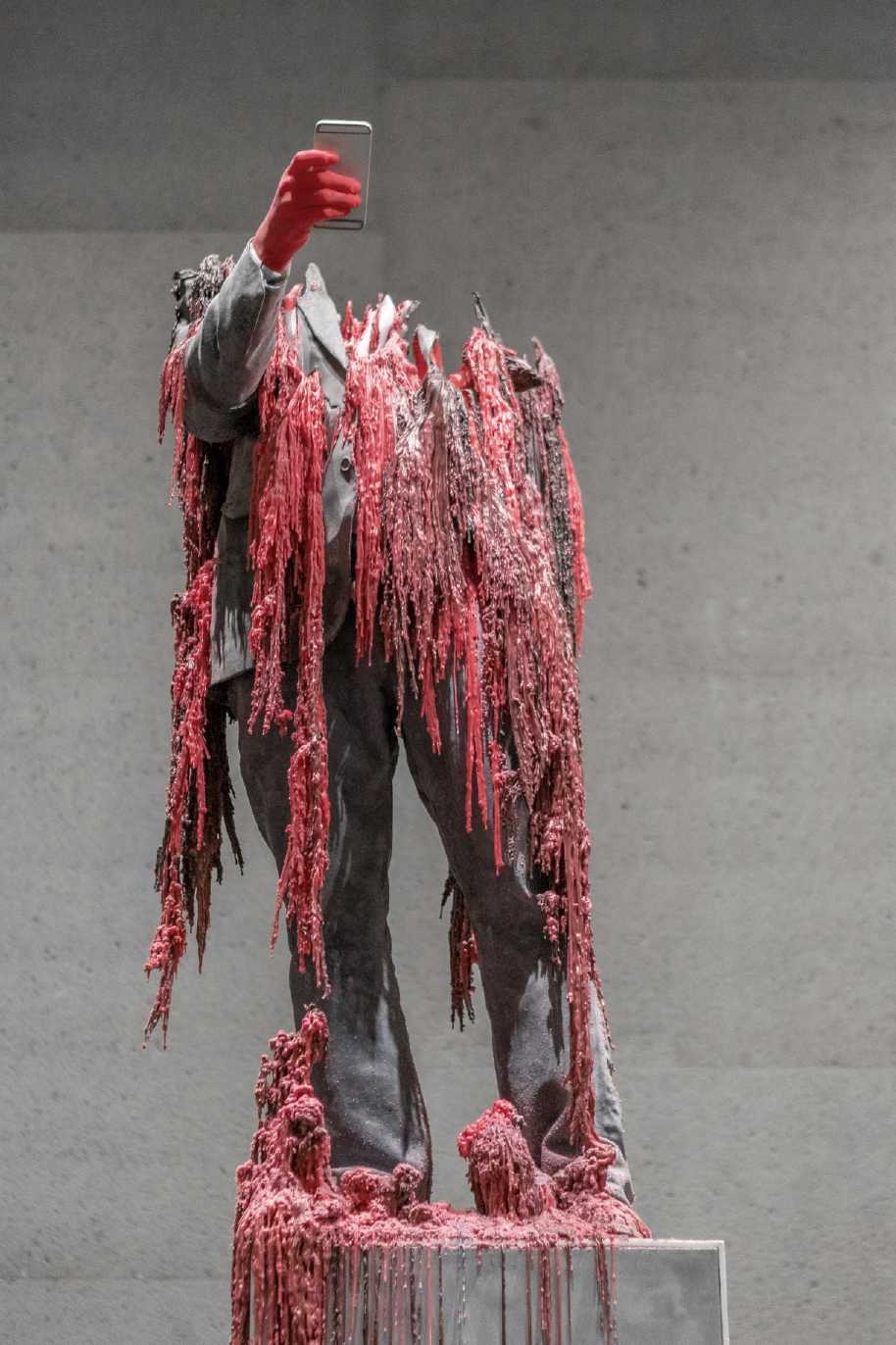
Urs Fischer Francesco, 2017
‘Swiss artist Urs Fischer captures the passage of time in his remarkably life-like candle portraits. Made from 3D body scans, Fischer’s sculptures closely resemble their muses: He has crafted candles of artist Julian Schnabel, restaurateur Mr. Chow, and art collectors Bruno and Yoyo Bischofberger, among other figures, carving out their features and rendering their clothing in colored wax. Fischer’s candles burn progressively over the course of a few months, prompting the viewer to confront life’s slow decay and the march towards mortality. As the sculptures burn from the head down, they become disfigured, parts of their physical form dripping down in long, thin strips of wax—until all that is left is a puddle on the floor.’


________________
Nam June Paik One for Violin (Solo), 1962
‘Nam June Paik’s 1962 work One for Violin (Solo) predated what the Who did by two years.’
________________
Tom Laduke Various, 2009 – 2010
‘In Auto Destruct, LaDuke’s dark, narrative paintings present layered scenes in which imagery surfaces and materializes briefly as we direct attention to it, only to become subliminal again when we focus elsewhere.1 In each canvas are at least three layers, one superimposed upon the other. LaDuke brings together appropriated film stills with images of his studio and art historical masterpieces. Both the filmic “ground” and the intermediate layers, derived from photographs taken of his studio, are laid down in muted hues of transparent, airbrushed acrylic. Optically, the filmic and studio layers intermingle yet vie for preferential treatment, although typically the filmic wins out. Perhaps this is because the ratios of the paintings approximate those of film and television screens and so we see them more readily. Or more likely, we have viewed these images before, either in the films themselves or reproduced as stills. Because they are already lodged in our memory, the filmic imagery passes a kind of “truthfulness” test. Meanwhile, the art historical source material sits heavily on top of the paintings’ surfaces, rendered piecemeal in thickly applied oil paint. Almost utterly reduced to scattered, expressionistic blobs that for the most part refuse to coalesce into a recognizable image, the masterpieces passively nag at us to “re-member” them.’
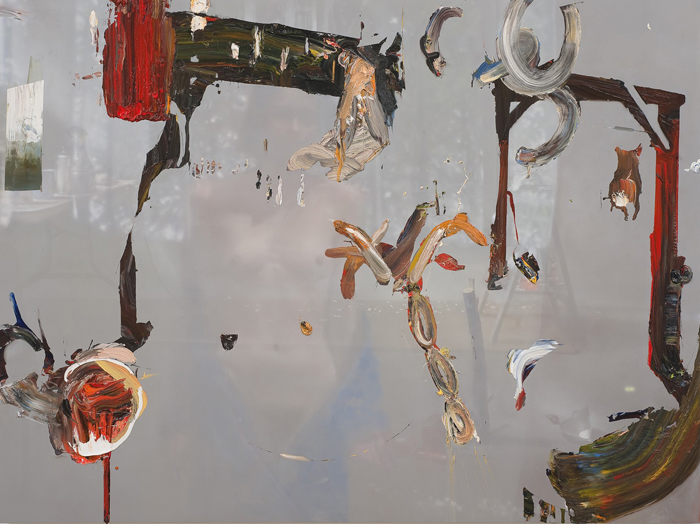
Auto Destruct 1
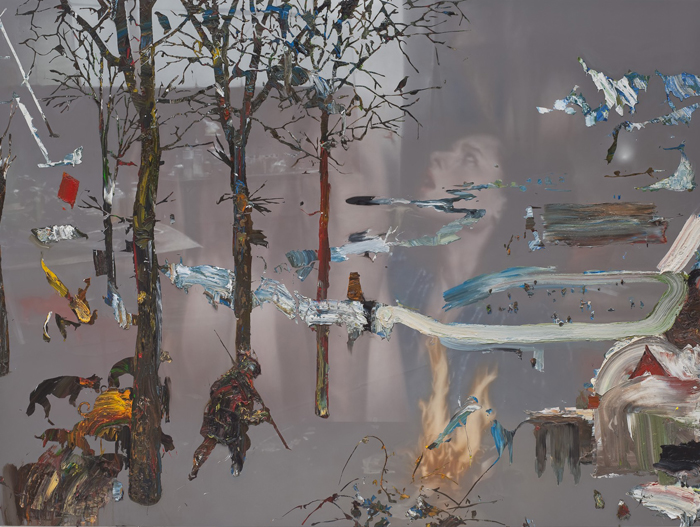
Auto Destruct 2
________________
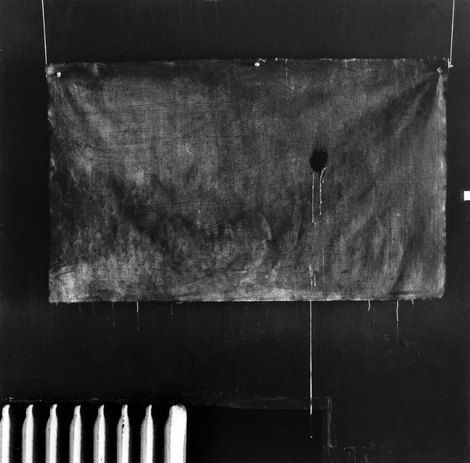
Yoko Ono Smoke Painting, 1961
‘To make the painting, Ono would take a blank canvas made of cloth and place a fire near the canvas, until the canvas slowly burned away. In her first showing of the painting, she used a candle to burn away the canvas, but her original conceptualization of the work suggests using a lit cigarette.’
________________
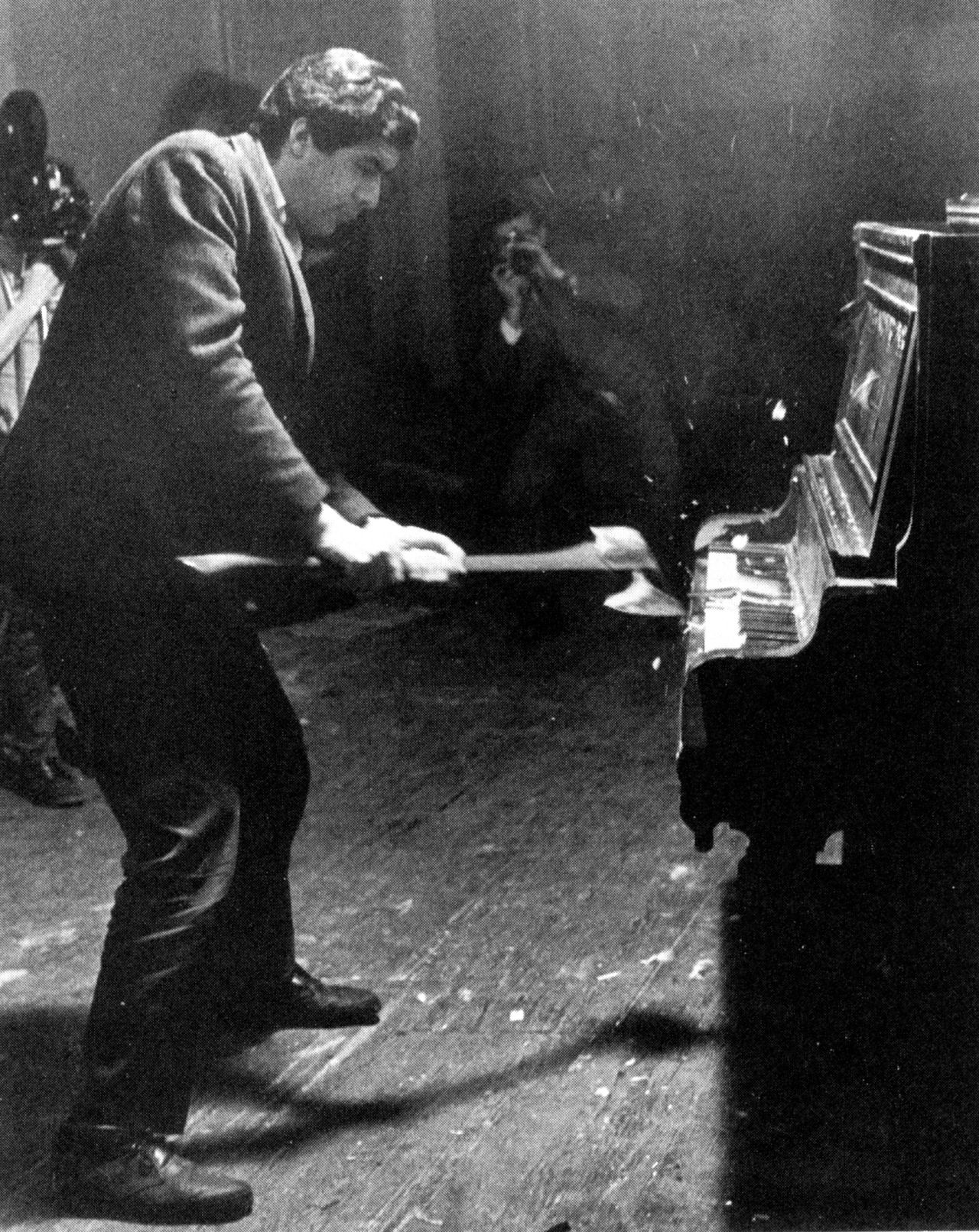
Raphael Montahez Ortiz De-Struction Ritual: Henny Penny-Piano-. Sacrifice- Concert, 1967 (2014)
‘In 1960 the New York destructivist Raphael Montañez Ortiz first took a sledge hammer to a piano; the preferred object of his ritualistic wrath (as of 2007, the still-living artist has destroyed around 80 more). For Ortiz, who penned a manifesto in 1961, destruction is a much more metaphysical matter, motivated by a protest against death and steeped in a kind of Bataillian rhetoric of sacrifice and transcendence.’
________________
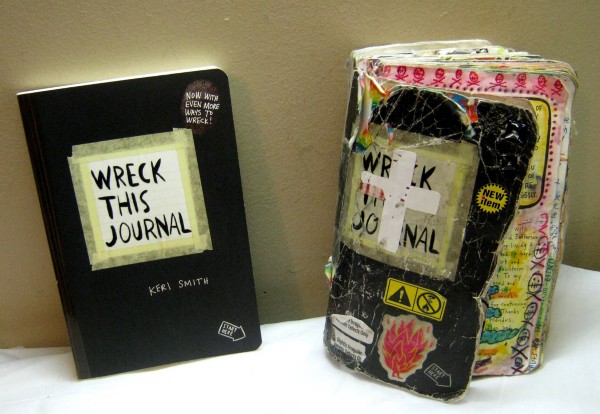
Keri Smith Wreck This Journal, 2007
‘This is a book that is designed to be ruined by the owner. I know it doesn’t technically destroy itself, the book is basically a set of instructions which asks the reader to inflict damage, so it’s participatory.’
________________
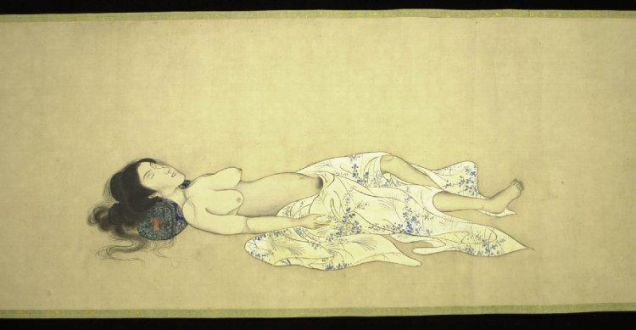
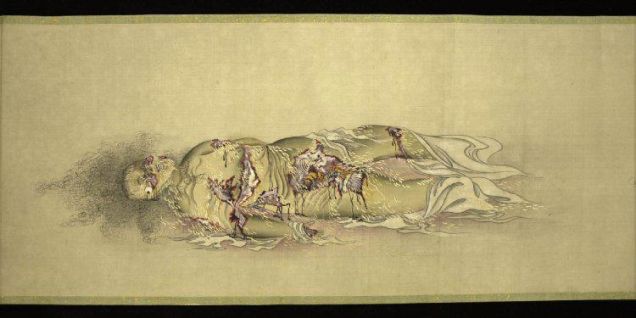
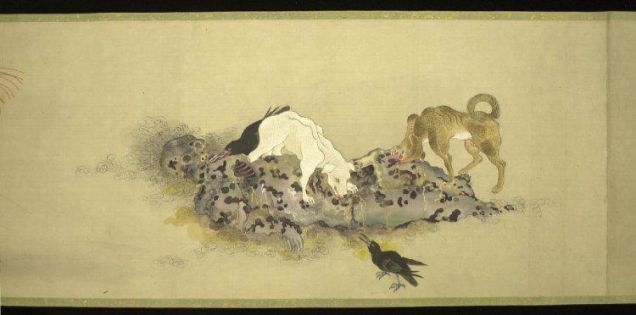
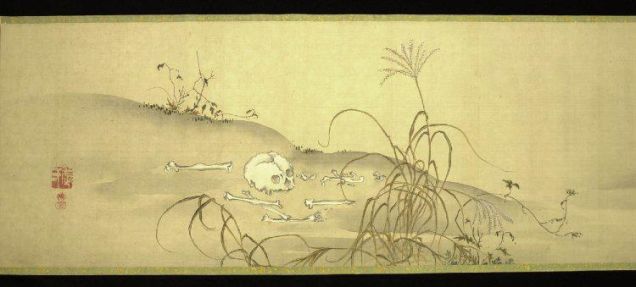
Kobayashi Eitaku Body of a Courtesan in Nine Stages, 1870s
‘“Body of a Courtesan in Nine Stages” is an example of kusozu, the illustration of a decomposing corpse, that was popular in Japanese art from about the 13th to 19th centuries. Kusozu was inspired by Buddhist beliefs that urged followers to meditate on the temporary nature of life and the physical world by contemplating postmortem changes. The below panels illustrate nine stages of death that include: (1) dying; (2) newly deceased or fresh; (3) skin discoloration and bloat during early decomposition; (4) leakage of blood in early decomposition; (5) skin slippage, marbling, and leakage of purge fluid during early decomposition; (6) caving of abdominal cavity and exposure of internal organs during advanced decomposition; (7) animal scavenging during advanced decomposition; (8) skeletonization; and (9) extreme decomposition. Though the painting maybe religious and/or scientific in nature, according to the British Museum it also has erotic themes. Because the subject matter is a courtesan, the curator notes for this piece at the British Museum say that this handscroll also falls into the genre of erotic art, or shunga. The word shunga means picture of spring in Japanese. The word “spring” is a common synonym for sex.’





________________
Man Ray Object to be Destroyed, 1923
‘The earliest intentionally self-destructive artwork may be Man Ray’s Object to Be Destroyed, which was made in 1923. The original version of the artwork lasted until 1957, when the poet Jean-Pierre Rosnay led a student mob called the Jarivistes into an art gallery, stole Object to Be Destroyed, and shot it with a pistol. Man Ray objected to the destruction, saying that the Jarivistes were futilely protesting against art history, but Ray could not stop the title of his work from turning into a self-fulfilling prophecy. Ray would later make multiple copies of the original work, but retitle it Indestructible Object.’
_______________
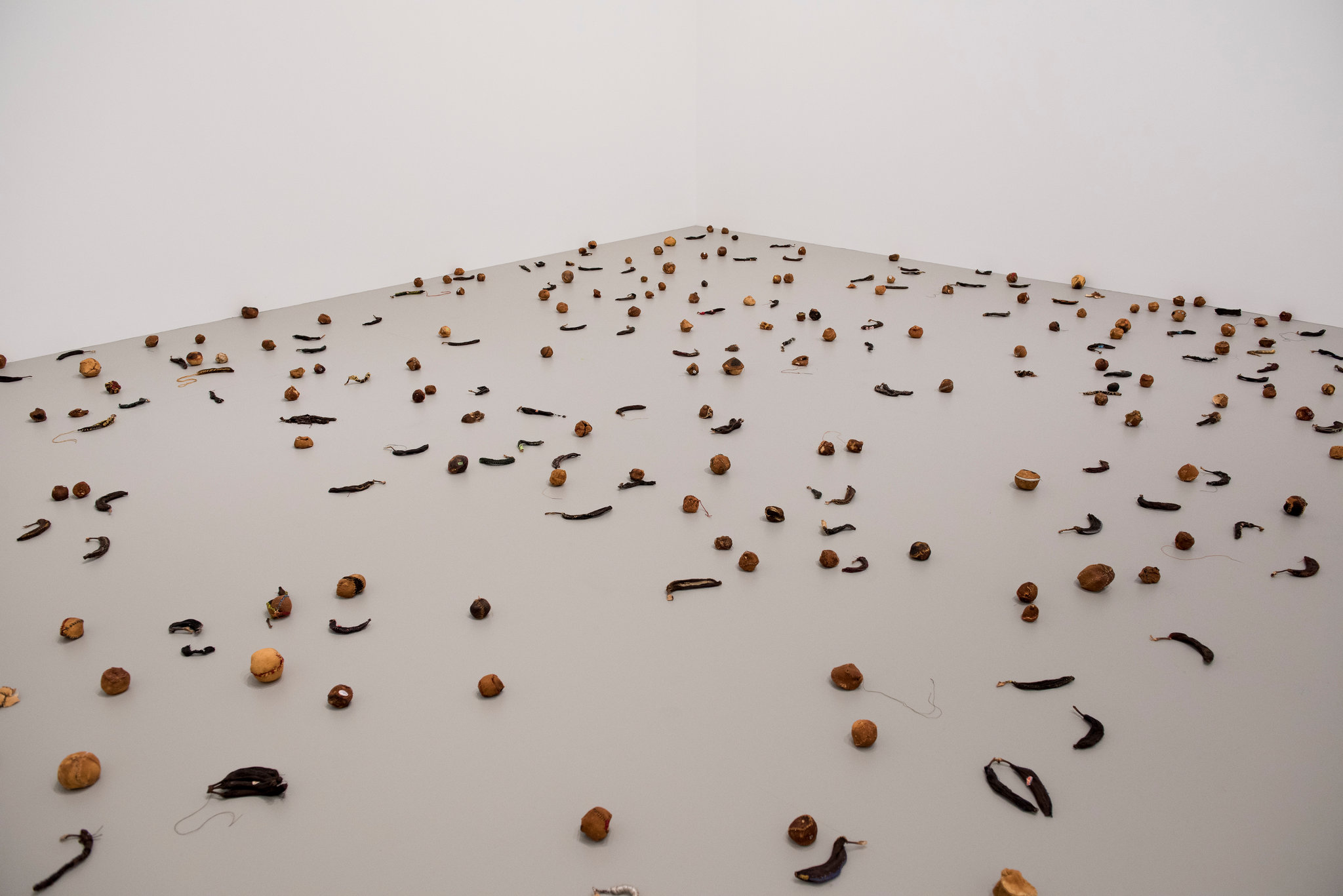
Zoe Leonard Strange Fruit (For David), 1997
‘Leonard was a vocal AIDS activist in New York during the 1980s and 1990s, an era that witnessed the loss of many in the art world. In Strange Fruit (For David) (1997), Leonard poignantly responds to this tragic history through an installation composed of dried fruit skins discarded seemingly at random on the gallery floor. The title of the work references the iconic anti-lynching song, written by Abel Meeropol in 1937 and whose most famous recording features Billie Holiday, and the installation’s dedication to the artist David Wojnarowicz who died of AIDS in 1992 reveals this strange fruit to be haunting symbols of those victimized by the virus and society at large. The decaying fruit also alludes to the art-historical tradition of the vanitas still-life, a genre of painting in which ephemeral objects such as flowers, flickering candles, and skulls were depicted to symbolize human mortality. Yet, closer inspection reveals that Leonard has sutured the fruit back together with needle and thread, suggesting art’s potential to heal.’

_______________
Arcangelo Sassolino Various, 2006 – 2012
‘Arcangelo Sassolino was born in Vicenza, Italy in 1967 where he still lives and works. His works and installations explore mechanical behavior in machines and materials as well as the physical properties and results of forces. Sassolino’s studio location, in the industrial north of Italy where the landscape has given way to industrial factories and an urban landscape, provides an endless resource in mechanical and industrial production. By applying to materials physical natural phenomena such as gravity, speed or pressure, a new potential is unlocked and allows a manipulation in the solidity of certain constituents. The functionality of the machinery used to exert these forces becomes an aesthetic of its own.’
________________
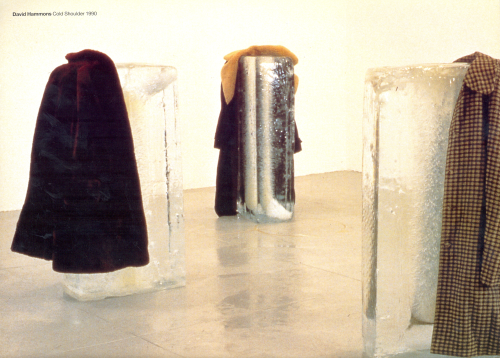
David Hammons Cold Shoulder (1990)
‘Cold Shoulder (1990) comes to mind as one of David Hammons’ more flippant – the work consisting of pimp-style fur coats, shoulder-slung across blocks of ice. Yet the title’s flagrancy, its sheer obviousness, constitutes a large part of the work’s effect, serving as a reminder of how inescapable, how painfully blatant, issues of race and class are in America. So much so, indeed, that the risk is they become almost invisible.’
________________
Pope L. Claim, 2017
‘Art critics noted the stink as soon as the elevator opened. Indeed, the morning of the Whitney Museum of American Art’s Biennial preview, Pope L.’s contribution smelled like rotten lunch. For good reason: Claim consists of 2,755 bologna slices nailed in grid formation on the walls of a small, freestanding room within the exhibition. Plastic basins catch the grease run-off along the museum floor. By early April, nearly a month later, the stench had faded considerably and in May, it seemed gone, as the bologna dried—or “cured” per ArtNews—into something probably more akin to beef jerky now. Claim considers the usefulness of race as a social category: Affixed to each piece of meat is a photocopy of someone who may or may not be Jewish. According to the Whitney’s label, the number of slices reflects 1 percent of the Jewish population in New York. Or not. The math, we’re told, is a “bit off”— a deliberate misrepresentation that doesn’t actually correspond to census data, the pictures taken at random. But among the questions it presents, Claim, more than other artwork in the Biennial, stresses the unique problems museums and collectors face as contemporary art grows more ambitious in its materials: how to conserve works made of substances meant to last for several days or weeks. After all, it’s difficult to imagine bologna portraits transcending millennia like a classical marble bust or centuries like a Rembrandt. Getting a sculpture made of deli meat to survive the decade could even be a stretch.’


________________
Michelangelo Pistoletto Respect, 2016 – 2018
‘In October 20th 2016, Pistoletto staged a spectacular performance in Paris, where the artist used a wooden hammer to smash mirrors and invited the audience to participate in exposing the hidden message behind each mirror.’
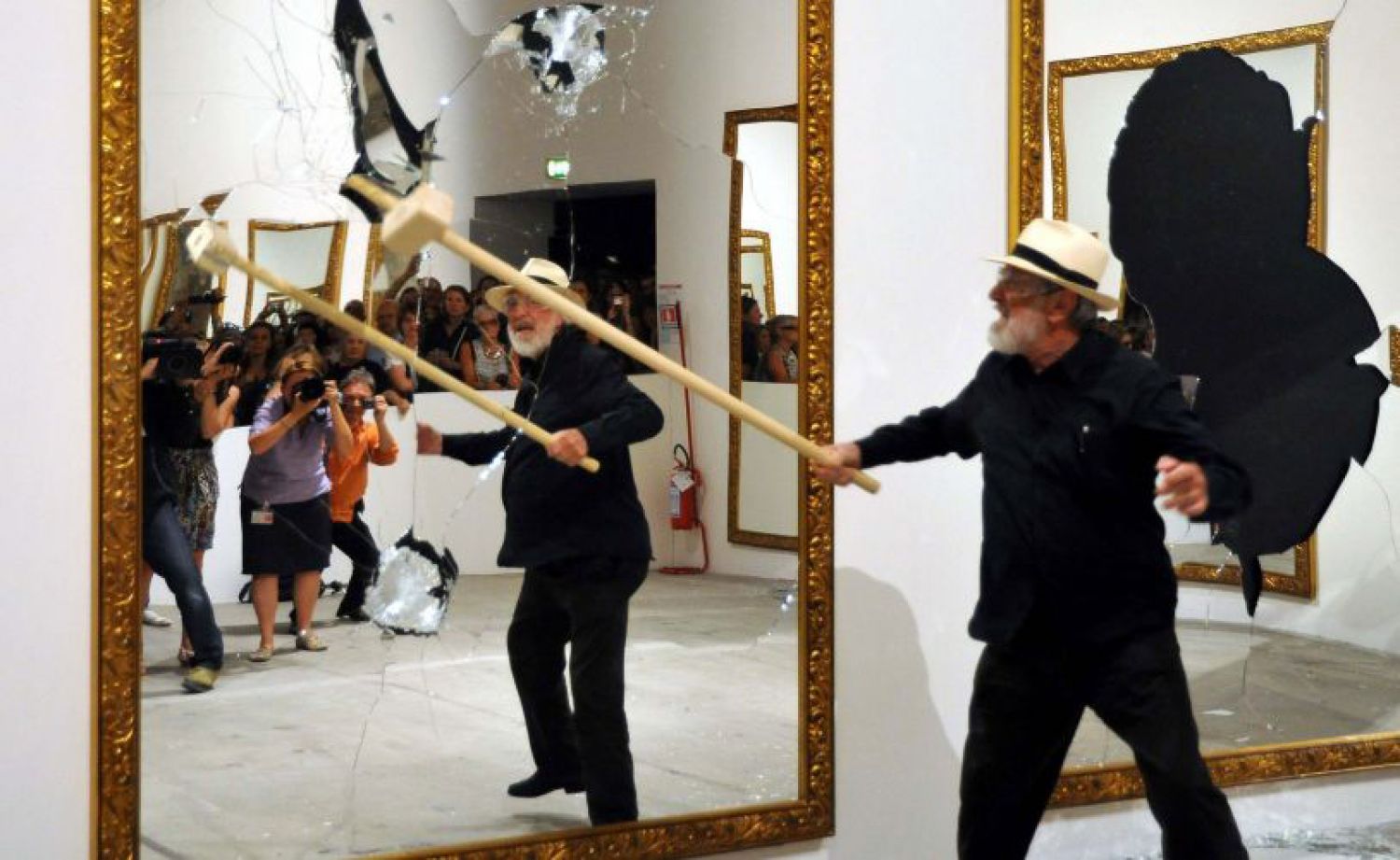
360 video of Pistoletto mirror smashing art performance
________________
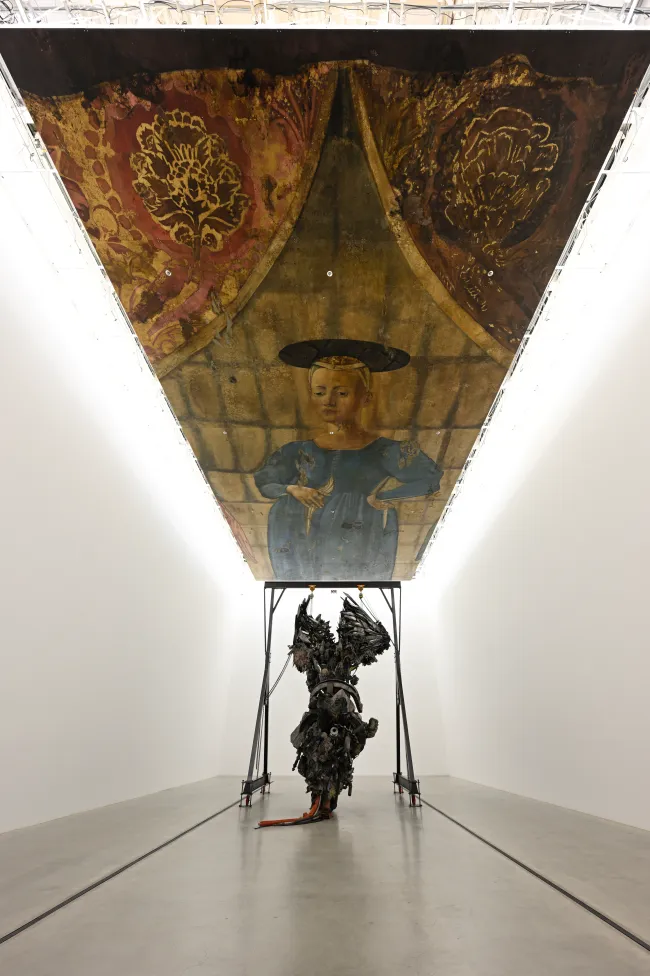
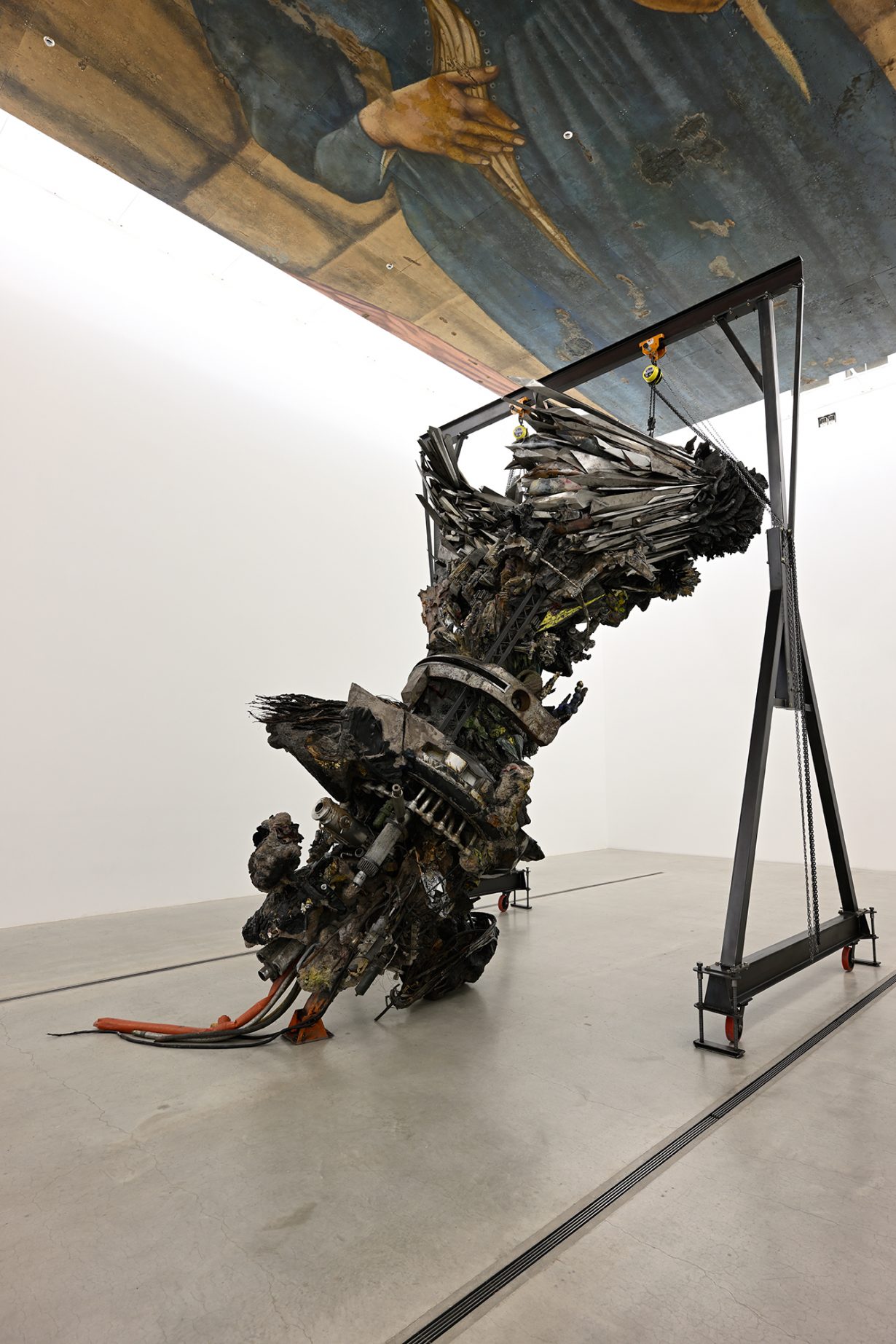
Adrián Villar Rojas The End of Imagination I (2022)
‘A chaotic, multi-textured, debris-like structure created using his “Time Engine” software—an AI and digital world-building process that simulates environmental evolution over millennia before physical realization using concrete, soil, and recycled plastics.’
________________
Charwei Tsai Love Until I Rot, 2007
‘Love Until I Rot was a project where I was approached with the curatorial question: “How far would you go for love?” I responded by making a foot out of cheese, using a mould of my own foot, then tattooed on the ankle the text, “Love until I rot”. The work was to question the concept of everlasting love. In this work, I captured the transformation of the material by filming the cheese foot rotting from heat, as well as the changes to the text.’
________________
Adriano Cecioni Il Suicida, 1865
‘Meaning in Il Suicida is constructed primarily through bodily rhetoric. The right hand firmly grips the knife while the left draws the garment toward the chin, creating a defensive posture of profound withdrawal. The contraction of the upper body, coupled with visible facial tension, conveys a state of hesitation and inner recoil. This juxtaposition of a physically robust, athletic frame contrasted with a vulnerable, defensive stance reveals an internal dissolution that stands in stark opposition to the heroic resolve seen in classical antiquity.’

________________
Bas Jan Ader Fall 2, Amsterdam (1970)
‘This work sees artist Bas Jan Ader vanish beneath the water after he and his bicycle tumble into a canal.’
________________
Jean Tinguely Homage to New York, 1960
‘In 1960, Swiss artist Jean Tinguely was commissioned to create a performative work in the sculpture garden at New York’s MoMA. He produced a 27-foot-tall towering tangle of discarded iron fragments; remnants of a piano, go-kart, and bathtub; motors; wheels. Titled Homage to New York, the work was intended to transfer kinetic energy from one part to the next before destroying itself entirely. But an errant spark foiled Tinguely’s plans: The sculpture caught fire and was ended preemptively by the New York Fire Department a mere 27 minutes into the performance.’

*
p.s. Hey. ** Alex Osman, Hi, Alex! It’s very nice to see you, and thanks about the post. That Residents album is an amazing example, yeah. If I’d only thought of it. I hope everything is great with you. ** Dominik, Hi!!! I can only imagine because I can’t imagine how long it will take for the US to recover from you-know-who. These fucking monsters. And those who believe in them. I know, fingers heavily crossed that we’ll be able to at least slip in and out of Kongeparken, sigh. ‘TEoOS’ doesn’t suck, it’s just … maybe I just wasn’t in the right mood. I will forewarn you that Ewan McGregor gives maybe his laziest ever performance in it. Love also wondering why mosquitos are so passionately in love with his bedroom. When he opened his eyes this morning, there were 15 of them clinging to the walls and ceiling (!), G. ** Tosh Berman, I love confusion, as you know, so no problem. ** Noah Falcus, Hi, Noah! Oh, thank you. I like Park Chan Wook and Miike too, of course. Do you like Nobuhiko Ōbayashi? I do, even though I’m not sure he ever topped ‘House’. I’ll seek the life of Toru Muranishi, thank you. Best Tuesday! ** Bill, Yeah, the Xenakis piece is amazing. I don’t know where that gif came from. I just googled palimpsest + gif, and it was one of the handful that popped up. I read somewhere that the Mutter Museum is doing some big event, but I don’t remember what or when? ** Adem Berbic, Hey. I don’t want to say much about the current film situation yet probably because things went so nightmarish last time, but I will say there probably won’t be French funding. I’ve never watched ‘Family Guy’. Something about it warded me off, but I don’t remember what. My theory absorption has mostly made a beeline around Lacan and Derrida. Why? You got me. Vim, okay? I’ll … whatever you do … scrounge. ** Carsten, You guys did the whole Elvis shebang, eh? I wonder why they don’t have Jerry Lee Lewis or Little Richard officiated weddings. Well, I guess I know why. Yeah, I just like never get physically worked up, so that may be why relaxing in the classic sense has no balm in its arsenal. My angry body retains its reticent form and just gets stressed inside. My eyes probably look a little weird. ** _Black_Acrylic, Yay! This coming Sunday? Fantastic. Do you need to prep for that in any way, or do you just go in cold? ** DonW, Hi! Including Rourke was kind of a ‘duh’, no? Or a cheeky duh. I don’t think Cher or Madonna or Nicole Kidman would have worked as well. I don’t know what that map is trying to say. I guess that’s why I liked it. Uh, I didn’t go to Vegas very often, no. Maybe once a year or once every couple of years? I’m so happy you guys had such beautiful weather on this portion of your Paris visit, and it seems like you had the requisite fun. Smooth, movie-filled flight back if you’re not already home and fighting the jet lag. ** laura w., I hope coaxing your Masters back into your brain was a positive thing. ‘Submachine’: I’ll go see what that is. It will be interesting to see what happens to whatever’s left of ‘gay literature’ now that Edmund White isn’t around to put his stamp of approval on the newbies. Smoothness on both our ends ideally. ** ⋆˚꩜。darbbzz⋆˚꩜。, Hi. I agree, and you put it very well. I feel like a palimpsest most of the time, don’t you? I don’t know what The Divine Machinery is, but, yes, I’ll look it up. And the Stan Jagodic collection. Thanks. Those photos you linked me to definitely intrigue. Luck on the magazine editing club. That’s an exciting prospect. Really helpful writing/editing instruction and feedback can come from even the most unlikely sources. I like the early Tangerine Dream. Early 70s, yeah. I remember they got little too soft and warm later, if memory serves? ** HaRpEr //, I think a human body can definitely be a palimpsest. The human face is a big one even without external factors. It seems like that Mendieta retro will come here, but I’ve assumed that many times before with London exhibitions fruitlessly. I was just reading about that Prairie Princess album, and I wasn’t sure. Hm, okay. ** Thom, Poetry is a great source, or in its best examples. I still read it a lot, and it still fires me up vis-a-vis my fiction. I would think your songwriting definitely informs your fiction. My fiction abilities/interests definitely inform my filmmaking bigly, for instance. I do like Jenny Hval, yes. Books-wise, I quite liked ‘Paradise Rot’. And ‘Girls Against God’. Yeah, she has the gift in both areas. It took ages for Holobiosis to get into my mailbox, but it did! And that is a rare victory for the French postal system. May your heat wither, presto change-o. ** Uday, Only your third, brief attempt made it through. Fucking blog. Sorry. ** Okay. Well, yeah, let things destroy themselves here today so you don’t have to. See you tomorrow.



 Now available in North America
Hi!!
Thrilling post today! Thank you!!
Yeah, and since recovery is so slow-going and barely visible at first, there’s always a danger of them saying, “See? Things aren’t any better, are they? We can fix that if you only vote right,” and people believing them. I’d like to believe they’re done for good, but my hopes are fragile at best. I guess that’s also something that’ll need a lot of time to heal.
Oh no, even Ewan McGregor… Thanks for the heads-up! I’ll adjust my expectations accordingly…
Shit! We barely have any mosquitoes here, but they were eating us alive in Hungary, so I feel love’s/your pain. Maybe now that the weather is more fall-like, they’ll also take their cue and disappear.
Love stealing Teresa Margolles’ Tongue and exhibiting it in his living room, Od.
I love those Douglas Gordon pieces, and obviously the classic Teresa Margolles one. Things have been great! It’s been exciting to see the reactions to my new book. Definitely something I needed after feeling like a total failure for a while. I just started reading the Bruised Summer zine by Daniel Sheen, which is absolutely amazing if you haven’t checked it out. Very “kiddiepunk”.
Speaking of “Daniel”, did Daniel Johns of Silverchair ever read Guide? That part is so funny to me, and I find myself singing the “Tomorrow” parody lyrics often haha. Have a great week!
great post!
made me think of the georges perec character from ‘life a users manual’ who spent his life painting watercolors of seaports, turning them into wooden jigsaw puzzles, assembling them, and then submerging them in sea water so the paint would wash away
Quite a few favorite classics today, Dennis. Also love the cheese foot, and the auto-destructive shoe. Once I’d put on some boots that I hadn’t worn for a few years, walked out of the house, and it started falling apart. Oops.
The Mutter has some events coming up, but after I leave. I might still stop by to see if they have new merch. Also planning to check out the recently opened Calder Gardens.
Bill
I suppose I like weird, arcane systems.
Got it re: financing. Well, my hope persists regardless.
On those two, I’ll grant that Derrida is less showy than, say, Deleuze. I actually think Derrida’s more interesting when his argumentation and presentation are (relatively speaking) more conventional — he’s a very fine and subtle reader of other writers. Case in point with his close reading of Blanchot in ‘The Law of Genre.’ Whereas Lacan is definitely showy, but I think it’s impossible to read him without heavy recourse to secondary literature, by design — he sort of demands that you make understanding him into a project, or an act of immersion, which I think is an achievement of sorts?
I inhaled Sam F.’s book. Like, I can’t remember the last time I read a novel of seemingly (heavy emphasis on that word) conventional form and length in a single evening. I thought it was very, very impressively measured.
I tend to scroll galerie-style posts bottom to top, so I see the images/embeds first and then the blurbs, and that served me very well today. Especially for the waxworks and the Japanese decomposition. Unless I just perverted everything. Or created some self-creators. Maybe a less niche example, but ‘The Disintegration Loops’ has always been a very prominent album (or, I guess, series?) for me.
Hey! Oh, that’s great news about Brigitte Fontaine! She’s truly one of a kind and brings something really refreshing to the current French-speaking music scene.
Thank you for these last two posts! The perspective on the practice of palimpsest is a particularly stimulating source of inspiration. I became interested in this process when I was studying the work of the Swiss artist Rémy Zaugg. He was fascinated by the idea of making the visible tangible through words, while also questioning disappearance, as the illness he suffered from meant that he risked becoming blind.
The post about “Self-destroyers” also immediately resonated with me in relation to the work of Berlinde De Bruyckere (she had an exhibition at BOZAR in Brussels). She creates sculptures that resemble carcasses, which are sometimes representations of saints or celestial figures.
Kader Attia’s “Flying Rats” also made a strong impression on me, even though I haven’t seen it in person. The work featured birds living in a large aviary alongside sculptures of children who seemed to be at the beach. The sculptures were made from edible seeds, and the pigeons gradually attacked the children, much like in Hitchcock’s The Birds.
Have a great day, and I look forward to discovering tomorrow’s post!
Great to see those DG mirrored portraits today, saw a couple of those at the DCA a few years ago. He was the original Scottish conceptual person and is therefore quite the legend.
Happy to receive the money today from decades of benefits underpayment. Not spending any of it on CDG hats, not yet anyway.
Little Richard actually was a minister, so he would’ve been a great wedding host.
Tonight, I’m watching CASTRATION MOVIE CHAPTER III and writing a review. I can’t wait.
How far along are you and Zac with pre-production?
getting myself back into a “theory” mood is nice, especially because the actual day to day work is so totally unlike that. which is usually how it for practical masters, though.
submachine is another one of my beloved flash era point and clicks, and pretty high concept for one, in that there’s a very small and unobtrusive overarching plot and is breadcrumbed to the player rather than told through a traditional narrative. one of the jewels of that particular subgenre, i think at least.
i think what will probably happen is that gay fiction will continue to be absorbed in general fiction, which was admittedly probably the end goal of the whole thing in the first place. i mean, andrew sean greer won the pulitzer a few years ago. so. i keep meaning to ask: do you have strong opinions about ben lerner? i’m trying to figure out why so many people hate him. i’ve read a little tiny bit of his work and didn’t find it offensive. he’s just a standard issue straight male writer, i don’t know.
i liked too many things to highlight but the violin one got me thinking about guitar smashing and how it did originate as this punk act of musical self-destruction- this set will never be done again as it was, etc- but has since become totally co-opted by the mainstream, and now when it’s done it feels cheesy and hollow and people get mad about the intentional destruction of property and wastefulness etc. have a wonderful day!!
Hey Dennis,
The blog seems to have eaten my comment from yesterday, which is frustrating as I typed out a lot. Mostly about The Odyssey and Nolan and A Streetcar Named Desire and this one video about a Doom map called “My House .wad” that fit the palimpsest day post.
Went to see Camp Miasma today, I really enjoyed it. I went in expecting some sort of commentary about slasher films and the nature of modern horror, and was pleasantly surprised with how it did that yet not in a way I expected. I don’t want to say too much about themes or why I liked the film, as it would get too spoiler-y and frame the film in a certain lens that would suppress others’ ability to view the film with fresh eyes, but I do think it had a lot to say about Gen Z’s discomfort with sex, both in film and in reality. Which probably sounds boring or preachy, but I want to avoid saying too much for others who have yet to watch it.
Hope this comment doesn’t get sucked into the void
Hey. Yeah, any face can be a palimpsest for sure. I have an open minded take on plastic surgery being trans and wanting surgeries, and it feels hypocritical to be against it for cis people too. Like, are procedures I have medicine or something but what Mickey Rourke has is a mental disorder? No, because I think it’s all gendered in a way. But rich cis people get addicted in ways broke transsexuals don’t. And I like re-invention for everyone, you know?
Ooh, a very interesting idea today. My mind goes to ‘The Disintegration Loops’ as Adem said, but also that Guy Debord book with the sandpaper cover intended to erase the covers of the books around it, an idea Tony Wilson used for that Durutti Column album too. I also remember hearing about the artist Michael Landy who destroyed everything he owned, including even his passport.
RE: my liking the Prairie Princess album. Sometimes you come across music that feels like some embarrassing facet of yourself that you don’t want to think about but eventually can’t help but give into, and that can be freeing. Forcing myself not to like something is stupid.
And oh, RIP Dolly!
Hey! Very cool post today. Really like the Adrian Villar Rojas piece and the Kobayashi one.
Since I last commented I have actually read Blanchot’s Death Sentence! It was disorienting and deliberately unsatisfying in a really interesting way. I felt like Blanchot was constantly dangling the information I needed to form a clear picture of the narrator’s behavior just out of reach. Persistently sinister in tone, in a way that was difficult to pin down. But also funny. Loved the liminality and unreality of the physical spaces in the story, like the apartments he’s somehow always entering uninvited. Definitely begs to be reread. The experience of reading it kind of reminded me of when I first read The Blind Owl as a teenager, very mind-bending. Curious if there’s any particular reason it’s a favorite for you, but of course there doesn’t need to be.
Dolly Parton died today which has made me sad. My daughter had just recently gotten into her music and always asks to see videos of her playing the guitar. 🙁
Hey, Dennis, Departing today from London. What a schlep. Really interested in the Douglas Gordon and Urs Fischer wax dripper. Indeed, cued up some movies for the flight: Inland Empire, House of Games, and Sisters (De Palma). We will see if I can watch them. Last flight, it took me 9 hours to get through Picnic at Hanging Rock. Too many distractions re: kids. Great weather on this last leg! Take care, Don
Yeah, wow, great post and concept. That Chris Burned piece is one of those works of art that I can split my life into before and after discovering it. I guess part of it was the age, I was 13 or 14 when I saw it, but it really really did something to me. I immediately understood the piece, but anyone I explained it to was like “eww why would you do that?” so def… formative to say the least!
Also, the way you referenced that piece in Closer is super cool, like reading that was the exact moment I knew your work resonated with me. I love the idea of referencing a work, but the actual character cant/doesnt specifically place the reference by name, just that there was something powerful there. I think that super direct references really have to work in context, and sometimes it just feels like the author is listing things they like, which doesnt always work. So props! Kinda funny how Letters of Mina Harker (current read) has lots of super specific references, and it totally fits with the social world that Dodie is clearly exploring, like of course these people would constantly be discussing these things… I’ve been toying around with the vague/half-remembered reference thing lots, often its stuff that doesnt exist but my characters/narrators offhand refer to it as if its well known or whatever. Its fun stuff.
RE: poetry I have lots on my shelf I like to look through to try and understand, but I gotta hunker down more with some of it. Are there poets off the top of your head that you have conciously let inform your prose fiction over the years? Or any poets that have come to influence you in surprising ways as you age?
I think Jenny Hval is my favourite modern songwriter, but I havent heard the last couple full-lengths, so I need to get on that! I want more translated prose too… one day…
Your cooling spell didnt take hold today, but it looks as though the week will chill out a bit over here, so… a delayed effect? Thanks. Got another 12-13 hour work day on Thursday, so at least its not gonna be 90+ and sunny… Take it easy over there, and I hope stuff is brewin in your own pot, and in the pots you are peeking into… k bye!
wow nice Chris Burden typo on my end… love typos and misheard things…