—-
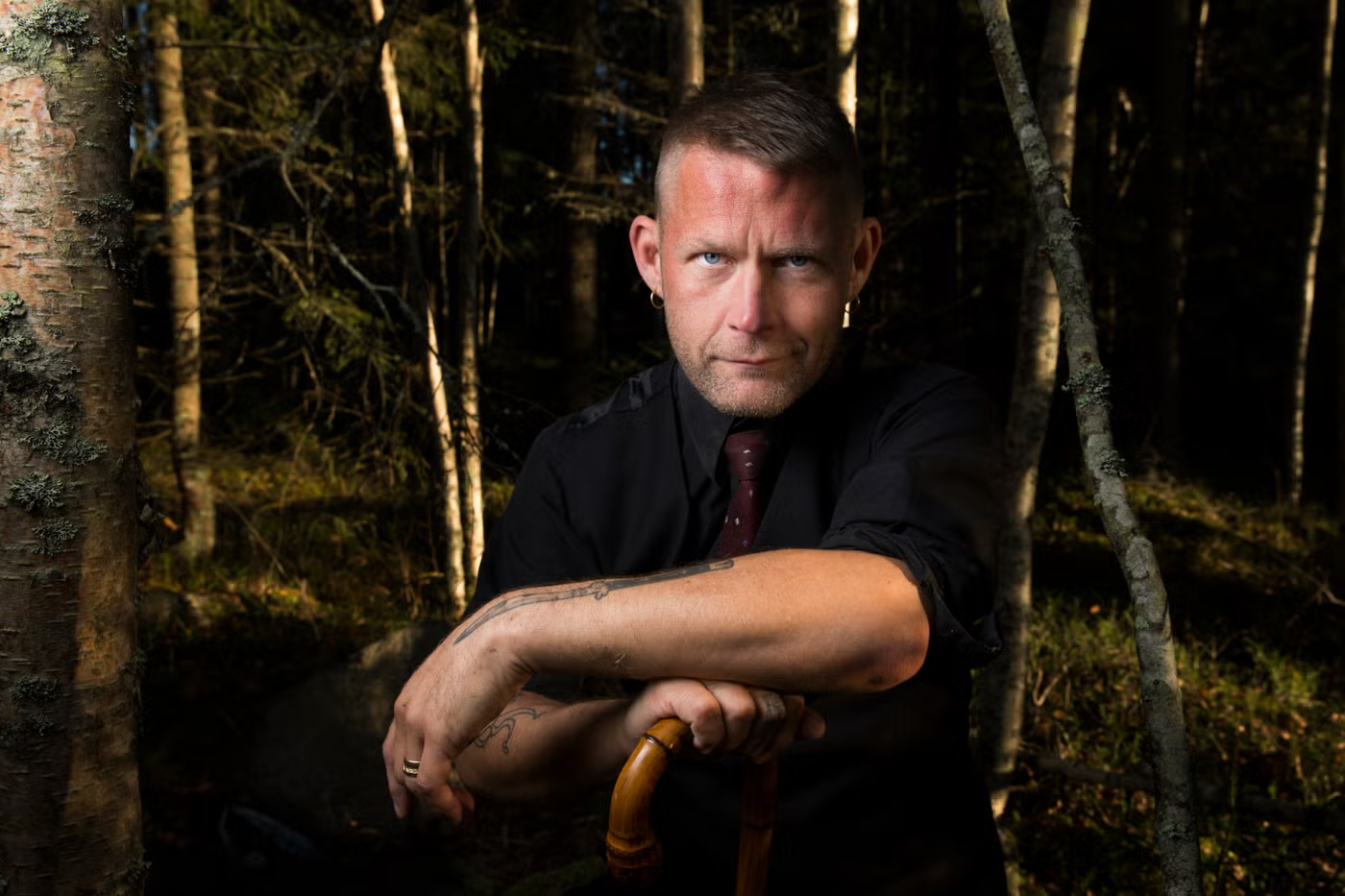
‘An indescribable joy always rushes out of great books, even when they speak of ugly, hopeless, or terrifying things.’ — Gilles Deleuze, quoted in ‘Assisted Living’
‘Assisted Living, by Nikanor Teratologen, was originally released in Sweden in 1991 under the title Äldreomsorgen i Övre Kågedalen (roughly translated: Caring for the Elderly in Upper Kage Valley). The book immediately caused an uproar, due in part to the book’s endless “Satanic” parade of rape, murder, sacrilege, bigotry, pedophilia, etc., but also the author’s use of a pseudonym, which led critics to accuse a wide array of major Swedish authors as the creator, including the now goofily popular Stieg Larsson. The result was not only instant-cult-classic and controversial bestselling status for the book, which later would be credited to the novelist Niclas Lundkvist, but also a slew of varying takes on the book’s content, both praising its wild innovations in the way of language and stylizing, and predictably defaming it for its utter lack of reverence, apology, or “humanity.”
‘But that kind of hype can be a load of bullshit in a world where anything that is remotely taboo without redemption can stir the whining not only of religious moralists, but also of those who think the novel, as a form, must wear its redemptive qualities on its face. Upon receiving a copy of the frequently compelling Dalkey Archive edition of an English translation of the novel, I was both excited at the possibilities and dismissive of anything referred to as “not for the faint of heart.” But indeed, if anyone is capable of using these taxonomies not only for their immediate prowess but for changing language and image at once in how they get invoked, it is the Swedes, as I’ve learned from many of their authors who have recently been translated to English, including Aase Berg, Johan Jönsson, and Johannes Göransson.
‘Teratologen’s particular manner in manipulating revulsive fields feels different, though, than even those. The book begins with two installed frameworks to give the book a clandestine, contraband-like feel, with both a preface from the author revealing his usage of the pseudonym as a mechanism rather than a shield (“A dear friend with exquisitely cruel tastes entrusted me with the text you now hold in your hands.”), followed by another foreword from said “dear friend,” who proceeds to explain how the body of the book to come had been derived from a child: a child the dear friend kidnapped, tortured, and killed before finding a stack of wallpaper samples in the boy’s belongings that detail a series of acts between the boy himself and a character known only as “Grandpa.” The opening structure evokes the feeling of the cloaked narrative tunnels of Dennis Cooper, arranging other screens around the reader always floating even as we proceed into the book’s primary body, where the true trauma begins.
‘Basically what happens hereafter is a nonstop stream of human cruelty. In scenes that span a single page to more than 30, we are held in the skull of the child as subject to Grandpa, who is one of the more memorably repugnant characters put on paper. He actually kind of makes the Judge from Blood Meridian look like a sweetheart in comparison. Grandpa fucks the kid incessantly, rants in endless streams of hate jargon meant to demean anything and everything at all, rapes and kills animals and children for fun, and so on. What makes this onslaught even sicker is the way it is related, in a playful, blown-up way, almost like a serial cartoon. The language rams together its subjects with the same impious banging as the described acts themselves.
‘A short list of the ilk of what can be found on pretty much every single page in Assisted Living:
1. On Grandpa having abducted two boys who’ve come by selling gingerbread: “When he was finished with their mouths, he told me to get him a fistful of steel wool. Then he started playing Open the Locked Door with the first kid. The other one curtsied and bowed to Hilding, but a knee to the face took his breath away. After that, Royal showed him how to smoke Sumatra cigarillos and Hilding forced the kid to kiss him down there.”
2. Grandpa fondly reminiscing about his Nazi lifestyle for a kid at the bus stop: “It was a raw February morning in the Whoregod’s year of 1945, and me and Dirlewanger were partying in the orphanage’s ruins. ‘You know that Himmer’s balls taste like Apricots, right?’ he asked.”
3. Grandpa asks the boy to say a prayer for his own “old Grandpa in hell”: “He who knows what a child is, fuck me because I’m small, wherever I go in this world, fill my hands with shit, Satan comes, Satan goes, he loves sheepdick, that’s all, I recited.”
4. Not all of the book is pure onslaught or sick jokes, however. The moments sometimes fold briefly to reveal an underside, though only crammed between the mass, such as here, where we find the central child left alone without Grandpa for a while: “Sometimes I play the quiet game… sometimes I play dead… sometimes I draw old geezers I’ve met and then I pretend I’m them… sometimes I lay on my back in a September field and listen to the earth hurtling though space… to victims shrieking at all the evil deed wrought upon them… then I try to sink into the light, soft, fluid grass and become a part of its mystery…”
‘It goes on and on like this, taking a historical and cultural shit and wallowing in it and spasming around in the most costume-party no-blinking parade of ways. The imagined last words of Jesus, fake literary histories appended with real ones, Axl Rose jokes, destroyed anatomies, gross contortions, confabulated smut literatures: it accrues such a mass so fast it doesn’t even feel like reading. One after another the blows come and before you have a chance to even think about the context the next idea is in your throat. It’s somehow almost… refreshing, in how it comes on. The pages of images and juxtaposing sounds are addictive in their composition and how they fold together, and the burning of the sentences is fun, which in some way masks the true filth of the scenes. It’s not an atrocity meant to be wallowed in, but somehow vacuumed of its own judgment in the presence of itself, which, stepped away from, makes it even more dangerous and deforming. And in its current, you are not released but almost mocked for how smoothly it unscrolls.
‘“He’s the world’s best Grandpa,” the boy tells us right at the beginning. No matter what Grandpa does or says to him, the boy remains faithful, ready, in love. The flapless stream of shit matched by the unjudged eye of both the boy and the decided tone soon take on a feeling much like some kind of hyper newsroom running through the reams of blinkless horror. There is no apology for what humans do, have done, will do. That power, and how it flows past, held in the pages of a book, makes Assisted Living much more than a shock totem or even a vicious catalog. It is, instead, an object both aware of its world and its own work, less like a mirror or a mural than the shitty part of the skin that itches when you want to sleep.’ — Blake Butler, Vice
_____
Further
Nikanor Teratologen @ Wikipedia
‘Assisted Living’ reviewed @ Publishers Weekly
Nikanor Teratologen @ Vertigo Press (Sweden)
‘Nikanor Teratologen – Att hata allt mänskligt liv’ @ NY Moral
Nikanor Teratologen page @ Facebook
Loyal Magazine #6, featuring work by NT
Buy ‘Assisted Living’ @ Dalkey Archive
_______
Extras 1
A short documentary about Nikanor Teratologen (in Swedish)
Ny Moral Radio: Teratologen
Tretton scener ur Nikanor Teratologens roman Äldreomsorgen i Övre Kågedalen.
_____
Extras 2

‘“Morfar suger Gud”. If you haven’t read Nikanor Teratologen’s Äldreomsorgen i övre Kågedalen, this will probably seem like an odd shirt to you. Then again, even if you have read it, it may still seem weird. Teratologen is very much the odd one out of Swedish authors, too weird for me even, I’ve only read Äldreomsorgen and left it at that. Others, like Indy (pictured here) hold him in very high regard. Maybe it’s just me not being intellectual enough, that wouldn’t surprise me much. Great shirt though, the way you need prior knowledge to understand it and even if you don’t, it’s still provocative. The design… well, we’ll let that slip for now.’ — Shirts of Satan
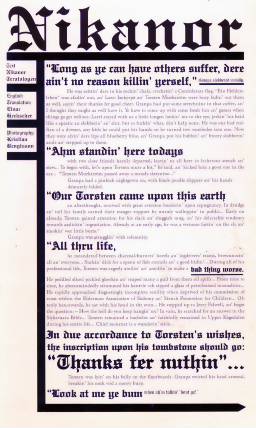
‘Long as ye can have others suffer, dere ain’t no reason killin’ yerself, Grandpa slobbered jovially. He was asittin’ dere in his rockin’ chair, crochetin’ a Confderence flag. ‘Ein Heldenleben’ was afadin’ out, an’ Larri Isokyrpä an’ Torsten Murkström were busy fadin’ out them as well, sayin’ their thanks for a good cheer. Grandpa had put som strychnine in that coffee, an’ I thought they might as well have it. Ye have to come up with some fresh fun’ an’ games when things go get tedious. Larri stayed with us a little longer, lookin’ me in the eye, jerkin’ his heid like a spastic and slobberin’ an’ shit, but so fuckin’ what, din’t help none. He was one bad ruffian of a dowser, any kids he could put his hands on he turned two noseholes into one. Now they were alyin’ dere lips all blueberry blue, an’ Grandpa put his bobbin’ an’ breezy slobberin’ aside an’ stepped up to them …’ — trans. Einar Heckscher, Strikte Observanz

Nikanor TERATOLOGEN is famous in Sweden for the much hated and much loved Äldreomsorgen i Övre Kågedalen book and other classics.
SIEBENSÜNDEN equals very obscure Swedish Sludge Core with members of WARCOLLAPSE, FARCIAL, DOM DÄR, COUNTERBLAST and TOLSHOCK. The band has been more or less (more less than more though, ehr…) active for over ten years and have released two full length albums up till the present day.
GLÄD DIG DU KRISTI LUDER / HERRENS DJURISKA NJUTNING with TERATOLOGEN’s acid-dripping and poignant lyrics accompanying the miserable audible sloth of SIEBENSÜNDEN’s can be seen as an answer to the “righteous” fanatic Christians new morality movement. Put simple it is guaranteed to give you a new angle on the subject of Christian sects and religious indoctrination. That is, if you know Swedish…if not you will still be able to lap up the slowly flowing audible bile which should be a feast for Sludge maniacs, Doomsters, miserable punks, Black Metal misfits and industrial psycho’s alike. The later listener category is also likely to be the ones most fascinated by the sound of SIEBENSUNDEN’s own home made instruments, while the BM aficionados will appreciate the extremely blasphemous message.

____
Book
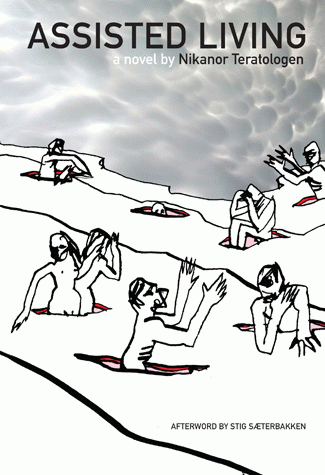 Nikanor Teratologen Assisted Living
Dalkey Archive
‘The Marquis de Sade is alive and well and living in Sweden — or perhaps author Nikanor Teratologen is the devil himself, sending the English-speaking world a Scandinavian squib to remind readers that such reassuring figures as vampires and serial killers are no more frightening than pixies or unicorns in light of the depravity contained in one quiet suburb. Reading like a deranged hybrid of Deliverance, Naked Lunch, and Tuesdays with Morrie, and rivaling The 120 Days of Sodom in its challenge to our assumptions as to what is acceptable (or not) in literature, Assisted Living presents us with a series of queasy anecdotes concerning an eleven-year-old boy and his grandfather, a monster for whom murder, violence, incest, drunkenness, and philosophy all pass as equally valid ways to spend one’s time. Whether it’s a study in excess, a parody of provincial proto-fascism, a clear-eyed look at evil, or simply a prodigious literary dare, Assisted Living is unlikely to leave you indifferent.’ — Dalkey Archive
Excerpt
Last summer I murdered an eleven year-old boy. He said his name was Helge Holmlund from Hebberhshålet in Upper Kågedalen, north Västerbotten. We met at an urinal in Tivoli just as Men’s Night was closing in on Children’s Day. He struck me as the quiet, frail type – and it was love at first sight. I took him home, and after he’d performed certain choice services, I tied him up and locked him in the soundproof cellar I use for these occasions.
—-For six whole days he gave me exquisite pleasure. After that, I hacked his body into small pieces, wrapped the meat in plastic, priced it and distributed the packages to a number of different display cases in and around Skellefteå.
—-I kept his head for my little collection.
While I was burning the boy’s clothes and other things, I found a hefty stack of old wallpaper samples tucked in his ratty leather backpack. Each sample was covered with a child’s erratic, immature hand, and the words were written with different colored pencils. As I made my way through a few of these fragments, words utterly failed me. A brave new world opened before my eyes – one of vile pleasures and terrifying abominations – with the power to touch me in ways I no longer thought possible. Chuckling at his impudence, weeping at his tender sentiment, trembling with sorrow, paralyzed by hate – I sorted these rough fragments and organized them into offensively seductive stories, each one presumably written by the dead boy.
—-My philological training proved extremely useful in tackling the difficulties posed by these unusually precocious recollections, which the boy had misleadingly entitled, In the Winter of Life. I also made discrete inquiries into the poor boy’s past, a quest that took me far off the beaten path and into the dark and looming Norrland woods, home to more terrifying legends than any one person can take in. I wandered on muddy paths through a rough landscape. On both sides of the Kågeälven, the dark river, the earth is fertile and the view open. I could see dirty gold barley fields, resilient swaths of hay pasture, run-down farms and hopeful new patches of almond potatoes, all stretching away before me; there were graying Västerbotten farmhouses in various states of decay, though clumps of willow trees and stands of birches tried to hide the worst of it. Each of these farmhouses is set well back from the road and has a long approach leading up to it. It’s obvious the folk in these parts want to know who’s coming; they keep to their own. Nonetheless, you can still find a few beautiful old Västerbotten farms scattered here and there: dark red timber buildings with white doors, small porches and shingled roofs. For the most part, though, faded brukshusen – practical farmhouses, each one identical to its neighbor – have taken over. The empty cow barns (which the locals call fusen) have long since been abandoned. Now they use silos. Around these parts, there’s a church for every ten homes. In short, everything’s so modest and respectable you just want to shout “Celebrate cruelty and cunning!” to the heavens. It’s only the old folks who are left out in the country, though in the loosely populated regions of Ersmark and Kusmark a few communities still try to scrape by: making condoms for Skega and crying buckets of tears outside the barred churches. Mystery has been driven from the forests surrounding the riverbeds. Winter in these parts is hard. Blizzards numb all human feelings; thought turns inward. During the long winter, people do their best to forget. Distance leeches all color from the valleys; it’s here the atmosphere changes. Spruces and pines cover both slopes and sorrows. A spiderweb of paths (leading nowhere) spreads throughout the forest. Everything’s condemned to be cut down and carted away. The trees are taller and darker here; their melancholy is stronger than life. The fact that the valley has no visible borders makes escape impossible.
—-Farther up, the scene remains unchanged. In fact, the character of the dell becomes even more pronounced where Kågedalen nears its end — until, finally, it becomes transcendental. A large power line running from Svartbyn in Norrbotten to Jälta in Ångermanland splits the countryside in half. The forest here draws close to the rugged dirt road; the same is true of the humble homes in the small villages. Every now and then you catch a glimpse of cultivated land: forest-clad ridges crisscrossed by brown swaths of clear-cutting; forgotten, outworn meadows — once worked, now overgrown — boldly marching down toward Hebbersbäcken’s shallow watercourse. At Slyberget this creek joins the northward-bound Kågeälven, before proceeding alongside the road to Bottenviken. In short, the landscape in Upper Kågedalen is nerve-wracking, bewitching, and pristine. People here aren’t too concerned with planting and harvest time; something else fills their minds. The observer is overwhelmed by the mood of sorrow, severity, and loneliness that pervades the atmosphere. The air here is clear, you see all too clearly, but the forest holds an eternal darkness. Human hands could never rob the countryside of its austere grandeur. The old people in these parts are cut from the same cloth. When the time comes, they hang themselves— silently, calmly, expertly — from the rafters of the abandoned cow barns. Grand gestures have no place here. No one even talks about it. What would be the point?
—-Naturally, I questioned the people in the villages of Upper Kågedalen under false pretenses. Still, they met this polite and scholarly stranger with silent gestures meant to ward him off; and, more often than not, with curses or the evil eye. I preferred concentrating on the shier old men — frail and soft, infant-voiced and doe-eyed— who, after a litany of stops and starts, would finally start rooting around in their own overwhelming oblivion and return with what they found there, which they would pronounce in voices like the newly weaned. Hebbersfors, Hebbersliden, Hebbersholm were all familiar. However, no one knew anything about Hebbershålet. People insisted they’d never heard of, much less met, an old man with a little grandson. It seemed Holger Holmlund was an unknown party. The same was true of Helge. Names from their circle of acquaintance likewise turned up nothing. In the end, banal reality threatened to bury myself and my fantasies beneath its everyday offal.
—-
*
p.s. Hey. ** jay, Hi, j. Interesting. In the States he’s way over the heads of conventional, boring types of readers. I have yet to find sufficient charm in the concept of EW’s last book to begin to think about trying it. Let me know. ‘Ada or Ardor’ is excellent. You’ve read Nabokov? That wouldn’t be the best place to start with him maybe. Screening went very well, thank you. May your week continue to proceed exhilaratingly. ** Dominik, Hi!!! The screening went really well, and the short trip was good. I finally decided I like Brussels after being kind of meh about it previously. And I did remember my bodily accoutrement. So, so, so nice to know that Hungary is free of that horrible fuck. It makes me want to dream for the US, but I fear it’ll be a while yet there. Do you have any thoughts of moving back there, or are you plenty happy enough in Vienna? Love not letting me run out of cigarettes before I finish the p.s., G. ** _Black_Acrylic, Thrills galore about and for Leeds! How about dem apples? Ah, you managed to score the Sotos. I did not. Curses that it was made so briefly available while I was running around in Brussels. Sweet! ** Bill, Dorsky’s stuff is pretty dreamy. It seems like SF Cinematheque must screen his films sometimes. They’re best (and want to be seen) projected. “Paper films”, how interesting. I’ll definitely look into those. Thanks, Bill. ** ⋆˚꩜。darbbzz⋆˚꩜。, I had a piano in my bedroom when I was growing up. But it basically just sat there, and I used it as an eccentric looking table. If you haven’t seen the documentary ‘Sisters with Transistors’, I highly recommend it. Your studio transformation plans get a very bright green light from me. Is that enough time re: the guy? Yes, sure, absolutely. That’s a lot of time, I think. Wow, all the luck. I liked that video, but I want to look at it again when I’m not traveling, meaning asap. Fire hazard … well, you should be careful with your fires, yes. Nope, my curtains are tied open and I’ve never gotten close to them. ** Adem Berbic, I guess I’m lucky because I’m never tempted by very non-filter cigarettes. Brussels was nice. The architecture has this curious blend of French and Flemish, which I kind of got into. Good news about the dialogue acing. It’s a good skill. ** Laura, Hi. My pleasure on the Dorsky. I don’t know re: festivals’ resistance, but it’s certainly not uncommon. I think a lot of festival curators just watch the first 10 minutes or whatever of a film and decide, and our film doesn’t work that way at all. You don’t really know what it’s doing for about a half-hour minimum. Iow, it’s not just Spain. I never show anyone anything of mine until I’ve spent a lot of time finessing and refining it. If I didn’t, I’m sure my things would get blanks too. Trip was good. Screening went great. Saw a fantastic retrospective by the artist Lutz Bacher. Etc. I don’t know, you could read that biography of me, just know there are a number of inaccuracies. But there are more things I like about it than not. ** beaujolais, Hi. Okay, I should be here then. I mean on those July days. Yes, I know Connie. I met her in Chicago, and she commented here a few times. Yes, you could send me the manuscripts. I’m very slow though, but I will endeavour to read them before you’re there. There’s time. Cool. Enjoy the rest of your week for now. ** Steve, Mothers Days is definitely a melancholy occasion. Ha, no, but that activity in the walls would have made childhood even weirder. The Brussels screening went very well, thank you. ** Carsten, Brussels was a goodie, and the trip to and fro was swift. It looks like maybe your blog curse has lifted now? Hope so. Definitely give it the old college try. ** HaRpEr //, Hi. The screening was a really good one. There’s suddenly a new possibility for RT in London, but I’m not going to hope yet what with our luck’s track record. It’s nice once you have a publisher because it’s up to them to figure out how to ‘sell’ the work to the public, even though what they come up with can be mortifying. Well, yeah, the identity thing. Like with Zac’s and my films, we get rejected by the vast majority of queer festivals due the films’ not making queerness the films’ overarching theme, and, when they do program a film, the films tend to get their worst reactions there. Literally like people hating it because the cast were ‘cute’ but never even took off their shirts, which they found infuriating. ** Nicholas., If I remember right, most people are born in the morning. I wonder why that is. Great gifts! Keep them coming. ** Okay. Today: here’s a novel that’s pretty terrific and wild if you don’t already know it. See you tomorrow.



 Now available in North America
Hey Dennis! Wow, heavy stuff. Dalkey Archive Press are great, I really admire them for publishing some really nasty writing without getting into the slightly self-mythologising territory of some other presses who do the same. Wow, what a good opening, I normally sort of skim over the extracts on days like this, but the style in this one was hypnotic. Unfortunate that the protagonist changes voice for the bulk of the novel!
Yes, I really like Nabokov! Pale Fire is probably my favourite book ever, I’d maybe consider it completely perfect. I’ve read most of his other work too, but I’ve always been slightly put off by the scale of Ada or Ardor. Thanks for the all-clear! I’ve got this miserable work dinner tonight, so it’s nice to know that there’s a fictional Swedish boy having a much worse time than me. Hope you’re well, lots of love from here, and good news about the movie!
Lucky for sure. That said, I am still smoking less now than before, so maybe I’ll throw up as soon as one touches my lips. Shutting that door probably wouldn’t be a bad thing on balance. I don’t actually know what Flemish architecture looks like (except for all the windmills), but I guess I can make arrangements to find out. Thank you. I guess in part it depends whether I’m ‘in the zone’ of whatever I’m writing. But last weekend was very zoned, and I have a pretty good feeling for the coming one as well.
Consider me curious as regards ‘Assisted Living.’ As far as Swedish literature goes, I’ve always wanted to read ‘The Autists’ by Stig Larsson, based on a one-sentence description I read somewhere once and no longer remember. I don’t think it’s ever been translated to English, but on re-Googling it looks like there’s a French edition, naturally, which can be made to work. (Mild and possibly-known fun fact, he was friends with the Dragon Tattoo guy, who had the same name – Stig #2 changed his name to Stieg so they wouldn’t get mixed up, back before he was infinity famous.)
Hi!!
Hm, how curious that I’m not familiar with Assisted Living. Thank you ever so much for the introduction!
That sounds very lovely – I’m glad both the screening and the trip itself went well!
For now, we’re definitely staying in Vienna, both because we love it here and because Hungary has so much catching up to do (re: salaries, health care, etc.) that, from a practical point of view, it’s just not worth it. That said, we both agree that it’d be really nice to be able to move back if/when the circumstances are more ideal. Fingers tightly crossed – and for major changes in the US as well!
I hope love made sure you could get through the p.s. with a steady cigarette supply! Love becoming a professional cuddler, Od.
hi Dennis!
how hadn’t i heard of neither book nor author? quite intrigued. a priori i’m thinking Don Quixote enduring way more targeted misfortunes, what w the pseudobiblia trope lol.
Brussels is cool! sort of exactly what it’s particular situation demands, right. glad your trip went super well! what was the most fun?
oh no i couldn’t have possibly polished the thing, it was a ‘would would you do w this? 3,2,1’ situation lol. think it was just the content that ppl were like ‘bitch why are you writing about kids like this’. but since it ended up so far removed from the original idk, i might yet tweak it some, like for me.
idt i can read a biography of you lol, at least not as of now.
rn i’m finishing The Critique Of Pure Reason bc i like to be annoyed, but honestly way to both make God irrelevant and also cemented up there w The Thing In Itself and whatnot, such thin ice but i keep coming back so it must be cool somewhere in there underneath it all lol.
also reading June Gibbons’ The Pepsi Cola Addict which i like to do from time to time bc it’s pure gold lol.
guess i already know what my next read will be! srsly the book was from like 1991? and only now do i discover it. smh.
anyway may today treat you special; much love!
omg i said ‘it’s situation’ lmao harakiri time i’m done ^_^
If you see this comment, it means the blog curse has fizzled out.
Overheard/-read your festival talk with Laura & feel the need to chime in: one may not know exactly where your film is headed for 30-odd-minutes, but to me that’s a great boon in this age of the predictable & formulaic. Same for the first ten minutes: those who aren’t sucked in by that unique image-&-soundscape shouldn’t complain about a lack of originality in film today. And I’m not saying that cause I’m your friend, but because I’m frustrated with the lack of support truly original work gets these days.
In earlier, lost comments I asked what you thought of your visa process start to finish. Curious to see how it compares to the reverse I experienced: when I applied for a U.S. student visa & later a green card as a European, I found the paperwork rather manageable. Certainly not as overwhelming as some of my immigrant-friends made it out to be. Unlike most of them, I never felt the need to hire an immigration lawyer. I imagine your situation was a bit tougher, what with the language barrier, no?
To pick up where we left off re. my film ideas being easy to realize: yes they are, though I’m not rushing things, because finding the right collaborators is key to the whole thing. Especially those in front of the camera. The last thing I want to do is a makeshift casting call or anything. I feel I’ll know instantly when I meet the right person. There’s one piece with a character who’s Yoruba but also speaks Bamana—which I later found out is true of Isaach de Bankolé. Ever since I can’t help but picture him & Alex Descas in that two-hander. But I’m sure that finding other folks who are “just right” will dispel that fantasy.
New script process going well? You’re in the polishing phase now, no?
The good news here is that I got the results back from my recent MRI test. There is no progression in my MS and that really does come as a big relief. Better news than the Leeds United results or even a Peter Sotos book purchase!
Hey Dennis.
Thought I’d pop in to say hi, after having some panic at being unable to access the blog this morning. I get really worried when the blog is inaccessible after the Google shutdown a few years back. But I’m here and the blog’s here, so yay.
How have you been? I’m sad I missed you, Zac and RT in Brussels, but I’m in LA for a couple of months. I’m glad Brussels was a good experience for you. It’s a funny place but it’s my home now. LA is also a funny place, in its own way, but very enjoyable to spend some time here.
My copy of Assisted Living is one of my prize book possessions. I found it really really funny once I got into it. For some reason, it inhabits a similar place in my psyche as Pornografia, but like a vastly blown out version.
Anyway, love to you and I hope things are good.
Jamie
Did Dalkey Archive also publish Alain Robbe-Grillet’s last novel? This sounds like a brother to it.
Lately, I’ve been watching a lot of YouTube clips of local TV from the ’80s or ’90s. I remember the Boston station TV-38 well. They had a strange program, “Ask The Manger,” where the manager and other staff responded to viewer mail about their programs but mostly just joked and fooled around. At that point, a lot of TV stations were still owned by one person rather than a corporation. I’ve never lived in Toronto, but the Retrontario channel, which collects old TV from the city, fascinates me. I signed up for Night Flight Plus, a streaming service which is an offshoot of the ’80s show, over the weekend. There’s a very specific longing this stuff satisfies – TV feels blander and tamer than any other medium, especially at that time, so introducing quirks and personality into its corners feels meaningful . Can you picture Netflix’s CEO doing a show where he answers E-mail? If it existed, it would be a self-serving monstrosity.
Hi Dennis
Was nice seeing you in Brussels, and it was nice to see Zac as well (he was right that I should make my own screenplay sometime) —
Dalkey Archive has so many great books on it; it’s a shame that their proofreading has gone down in quality. I counted loads of typos in my recent copy of “Wittgenstein’s Mistress” – Whatever scanning thing they’re using corrects “Burn” to “Bum” – and the first batch of “Sot weed factor” reprints had “weed” spelt “Weet” on the spine.
Anyway, hugs again from me!
This book is really intriguing. Thanks for the introduction! I haven’t read many Swedish books now that I think about it.
There’s a number of books I hope Dalkey Archive give a second life to now that they’re back. I bought Leve’s ‘Suicide’ the other day but should am waiting for a moment where I’m more receptive to something confrontational.
The prospect of a London screening has gotten me excited but I’m not going to get my hopes up. But suffice to say, fuck the gatekeepers who have kept it from London so far and my fingers are crossed.
My personal philosophy is that since I’m very against assimilation like you, I think that the ‘gay novel’ or ‘trans novel’ attempts to make everything normal and familiar which I’m not interested in. Plus, I’m not interested in painting with broad brushes or the idea that everything confusing or strange that I feel can come down to being trans. I’m more generally interested in the idea of having a body and the weirdness of that.
I had this eccentric film teacher back when I studied film for a year before transferring to creative writing, and she was very forceful about trying to make everyone’s films representational of a particular experience. To her, style and form was just a slight, tidying flourish that could be learnt in a day. And I was like ‘I’m queer, if you care so much about supporting queer artists then you shouldn’t place those kinds of restrictions on our expression’. That sort of radicalised me in a way.
Hi Dennis, it’s good to be back! How are you doing?
That Einar Heckscher translation into cockney English intrigues me. So I guess “Strikte Observanz” is written in cockney Swedish? I wonder what cockney Swedish sounds like? Would I hear the difference between it and, say, Ingmar Bergman characters?
I’ve been a good kind of busy. Jonas Mekas has become my new role model. His diary resonates with me. I started a cinema on my roof. I met my partner in endeavor in a bomb shelter. Our programming is all over the place and we get a varied crowd. I also started doing Butoh as a continuation of my dance obsession. This a promo video of one of my teacher’s performances:
https://youtu.be/uAXq8UaSKk0?si=i0qG9zg2ZIUHm-RI
The alternative culture magazine is still going well. The other editors are starting to come around to the idea of printing the magazine, which I’ve wanted to do since the beginning. I also have my own zine and video projects. And I’m learning to cut things out or scale them down, like I stopped doing my comprehensive underground events calendar because it took too much time and there wasn’t as much demand for it as I’d hoped.
I generally feel at home in Tel Aviv for the first time, eight and half years after moving here. It’s a small city so I’m constantly running into people, always seem to have one point of connection with strangers in the neighborhood, am involved with or adjacent to my share of interpersonal drama.
I hope to pass through Paris for a weekend in early October. My French is coming along but I need to immerse myself to get to the next level. Maybe I can spend longer in France next year.