* (restored)
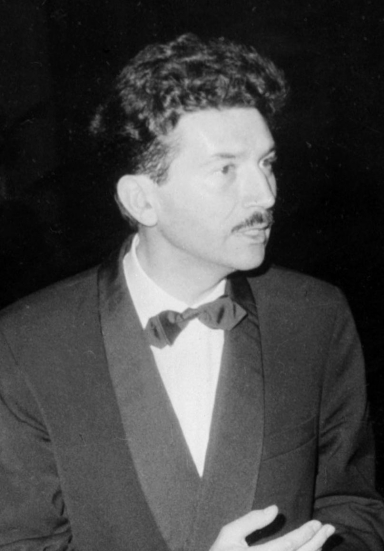
‘David Shields recently dismissed most contemporary novels as “antediluvian texts” that “could have been written by Flaubert 150 years ago”. “In no way,” claimed the author of Reality Hunger, “do they convey what it feels like to live in the 21st century.”
‘He has a point – albeit one that Alain Robbe-Grillet had already made in 1965 when he deplored the fact that young French novelists were praised for writing “like Stendhal” but castigated as soon as they refused to abide by the “dead rules” of a bygone age. Along with Michel Butor, Nathalie Sarraute and Claude Simon – the main proponents of the new novel (nouveau roman) – Robbe-Grillet stood resolutely in the second camp. In his essays, he returns time and again to the notion that the novel, from Stendhal to Joyce, has constantly evolved – hence the absurdity of using “the norms of the past” to judge the fiction of today. Far from representing a rejection of the past, the quest for a new novel was thus very much in keeping with the history of a genre which, by definition, must always be renewed.
‘Feeling that his work was too often misrepresented by the critical establishment (with a few notable exceptions including Barthes, Blanchot and Nabokov), Robbe-Grillet published a series of articles to set the record straight. In 1963 they were collected in Towards a New Novel – for my money, one of the most important works of postwar literary criticism. However, these “critical reflections” were never meant to constitute a manifesto. Every novel, according to Robbe-Grillet, is a self-sufficient work of art which cannot be reduced to some external meaning or truth that is “known in advance”. “The New Novel,” as he put it, “is not a theory, it is an exploration.” Why bother writing a book that illustrates a rule when “the statement of the rule would suffice”?
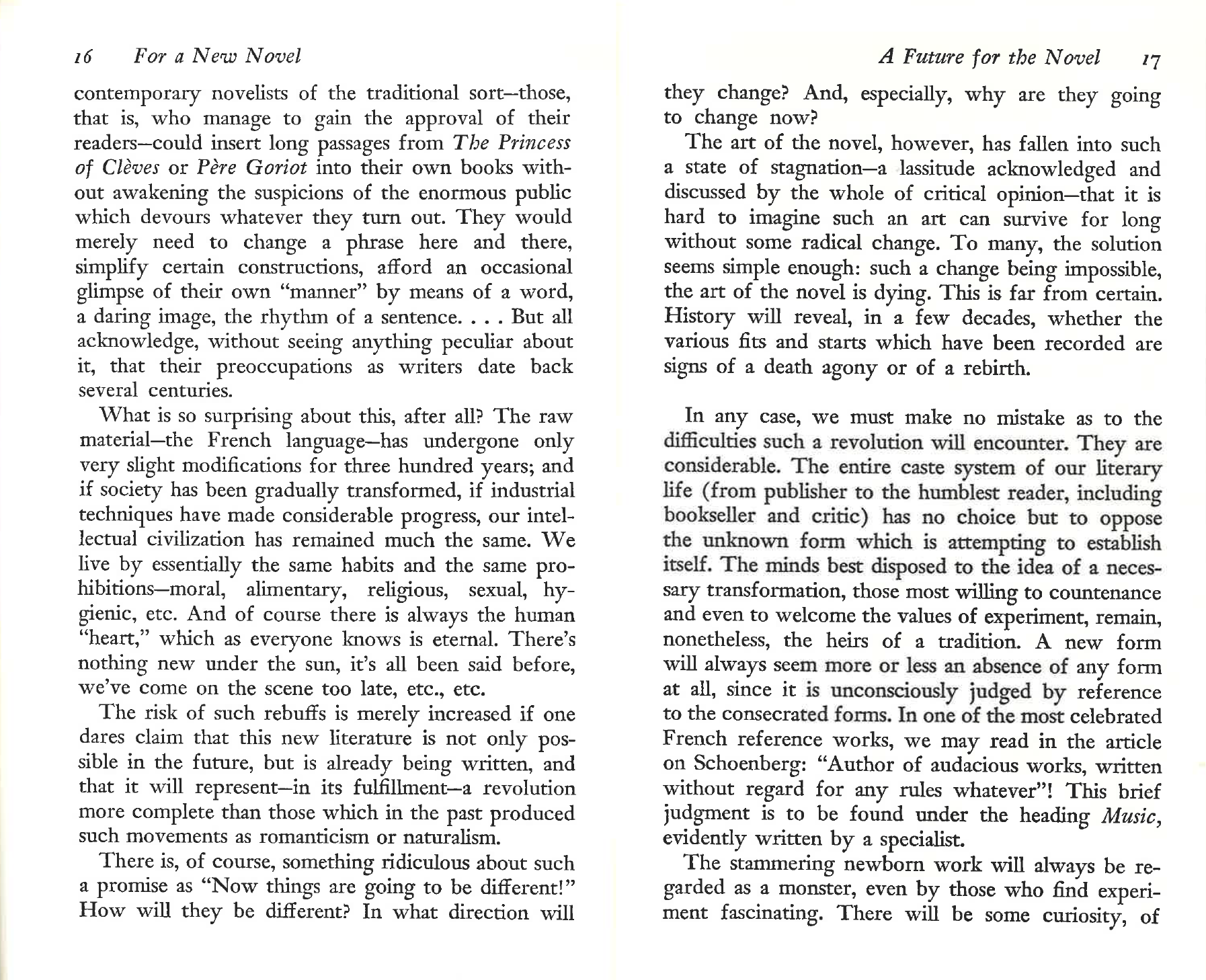
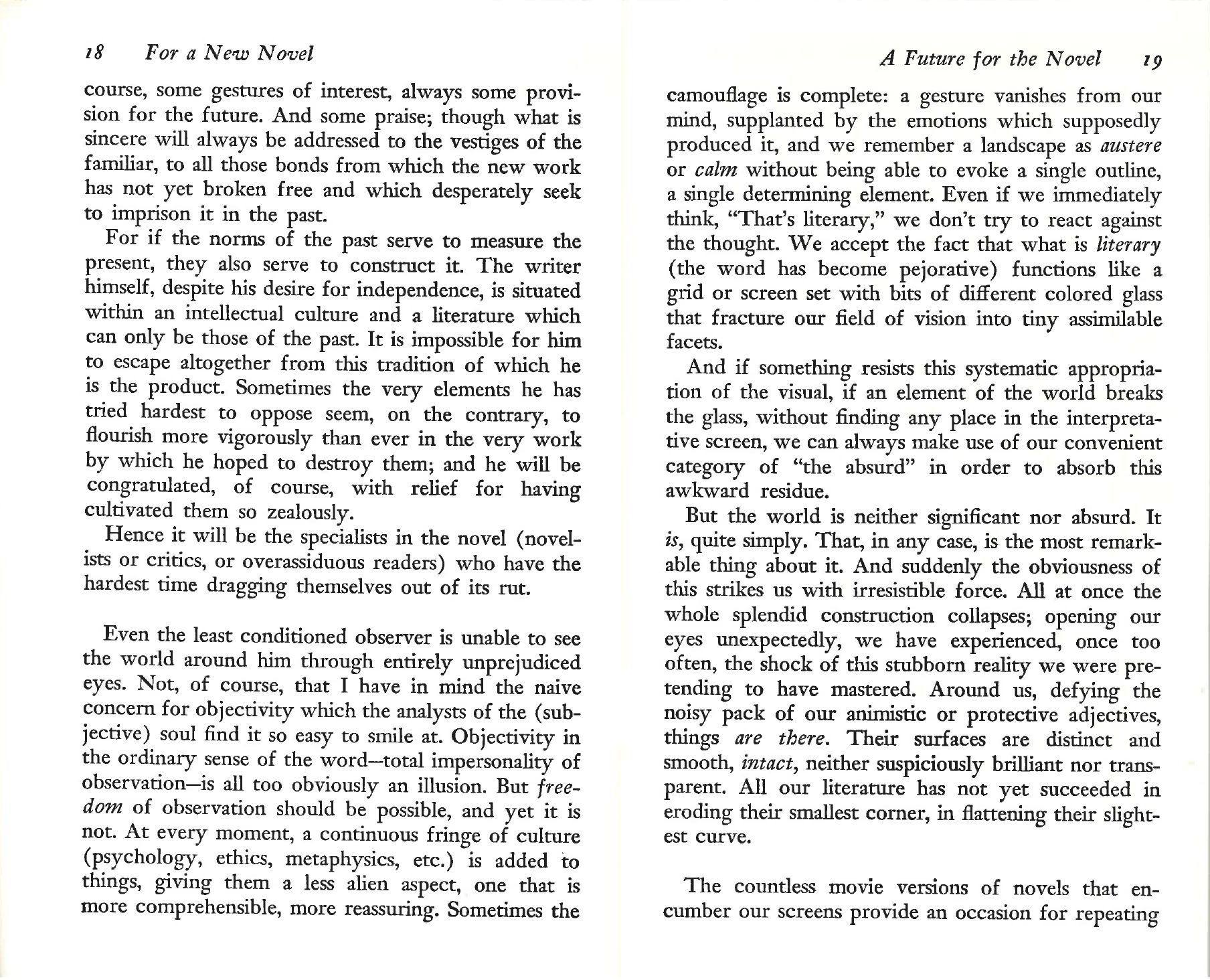
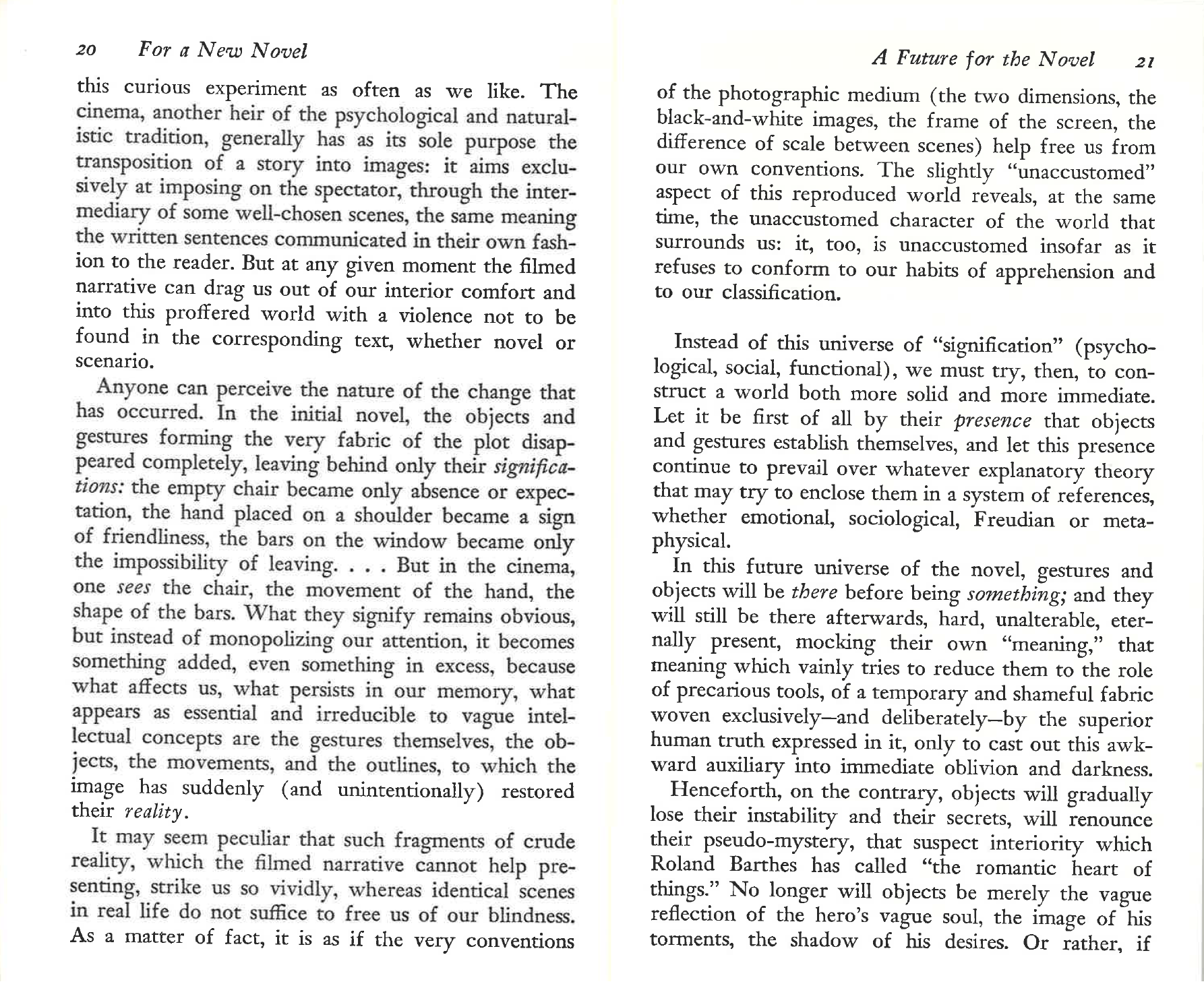
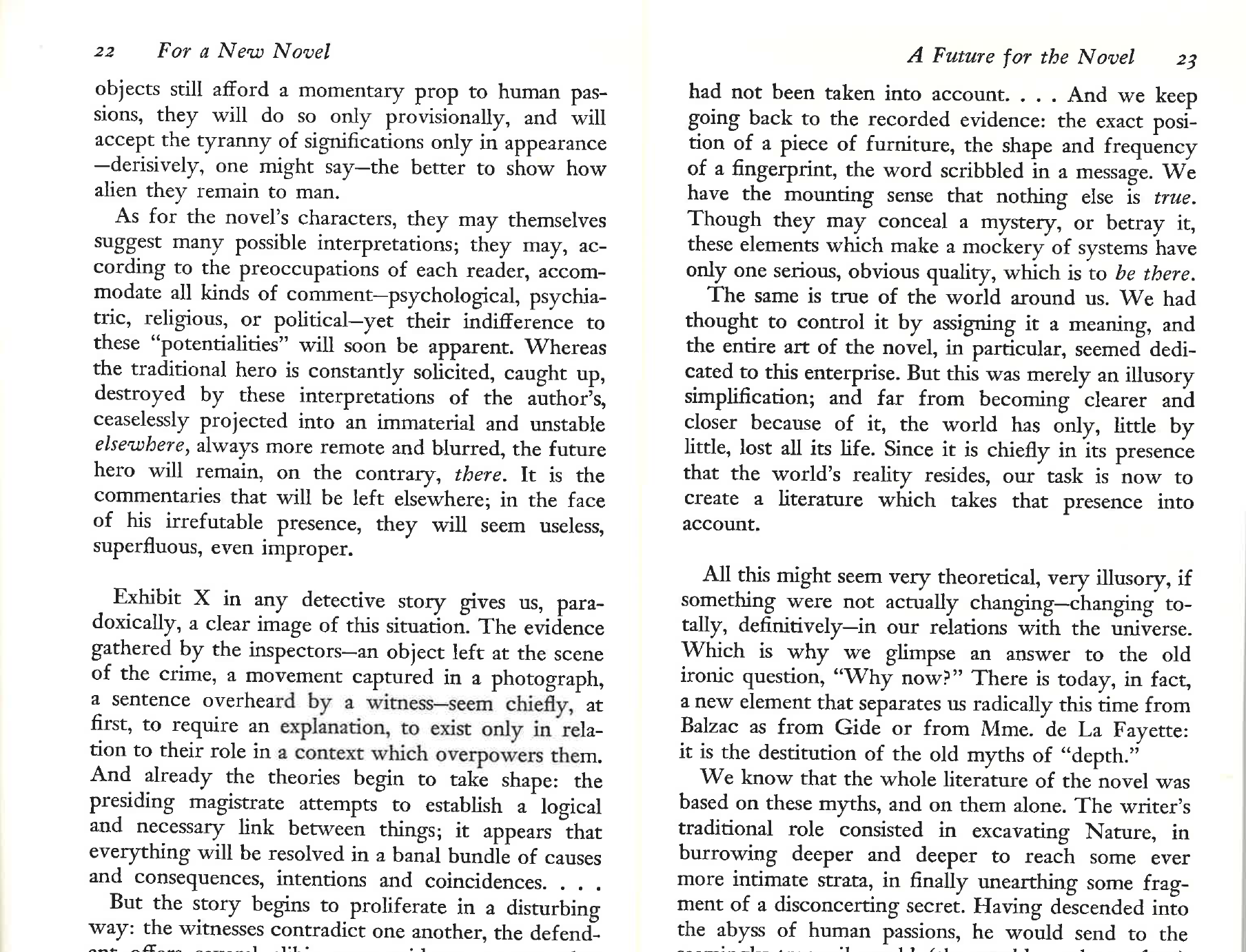
‘Quoting Heidegger at the beginning of an essay on Waiting For Godot, Robbe-Grillet writes that the human condition is “to be there”. In another essay, he states that it is “chiefly in its presence that the world’s reality resides”. So there you have it. Man is here, the world is there and the distance between the two lies at the heart of the new novel project. We endow the world with meaning (or meaninglessness) in order to control it. From this point of view, the writer’s traditional role was to excavate nature in order to unearth the “hidden soul of things”. Robbe-Grillet calls for the creation of a new form of fiction that reflects the “more modest, less anthropomorphic world” we live in today – one which is “neither significant nor absurd,” but simply is.
‘This seemingly anodyne observation has serious literary ramifications. Gone is the traditional hero of yore who believed the world was there to be conquered and whose hour of glory coincided with the triumph of individualism. Gone is the humanist “communion” between people and things: “Things are things, and man is only man.” Gone is the notion of tragedy, which Robbe-Grillet sees as a twisted ploy to reaffirm this solidarity: “I call out. No one answers. Instead of concluding that there is no one there (…) I decide to act as if someone were there, but someone who, for some reason or other, will not answer”. In the new novel, “Man looks at the world” but “the world does not look back,” which precludes any symbolism or transcendence. The novelist’s task now is to describe the material world, not to appropriate it or project himself onto it; to record the distance between human beings and things without interpreting this distance as a painful division. All this implies that the “entire literary language” be reformed. Similes and metaphors, which are often used gratuitously to confer literary status upon a text, are seldom innocent since they tend to anthropomorphise the world.
‘The new novel is routinely attacked for being inhuman and coldly descriptive. Robbe-Grillet responds that his work is in fact far less objective than the godlike, omniscient narrator who presides over so many traditional novels. Description here is purely subjective and takes centre stage, whereas in Balzac, for instance, it simply sets the scene by lending the plot an air of authenticity. Instead of referring to an external, pre-existing reality, Robbe-Grillet’s descriptions seem to create their own objects, their own hallucinatory reality. “Nothing,” he explains, “is more fantastic, ultimately, than precision.”
‘The reality of any work of art is its form, and to separate style from substance is to “remove the novel from the realm of art”. Art, Robbe-Grillet reminds us, is not just a pretty way of presenting a message: it is the message. Like the world out there, a novel is self-sufficient and “expresses nothing but itself”. Its “necessity” has nothing to do with its “utility”. Whenever an author envisages a future book, “it is always a way of writing which first of all occupies his mind,” which leads Robbe-Grillet to state – provocatively – that “the genuine writer has nothing to say. He has only a way of speaking”. Creative writing classes should always start and end on that note.’ — Andrew Gallix
___
Further
Alain Robbe-Grillet, The Art of Fiction
AR-G @ Editions de Minuit
AR-G @ goodreads
POUR UN NOUVEAU ROMAN, d’Alain Robbe-Grillet
L’INFLUENCE DE LA NAZISPLOITATION DANS L’ŒUVRE D’ALAIN ROBBE-GRILLET
Video: Soirée en l’honneur d’Alain Robbe-Grillet
Alain Robbe-Grillet, The Way Back
Obituary: AR-G
Alain Robbe-Grillet: Bucketfuls of semen
Video: Blow up – Vous connaissez “Les gommes”, d’après Alain Robbe-Grillet ?
Alain Robbe-Grillet se reflète à l’infini
Alain Robbe-Grillet, vous connaissez ?
ALAIN ROBBE-GRILLET, PÈRE DU NOUVEAU ROMAN
Buy ‘For a New Novel’
___
Extras
Tom McCarthy on Alain Robbe-Grillet
Robbe Grillet, Experimental Fiction & Myth
Alain Robbe-Grillet Exhibition at the Cafesjian Center for the Arts
Apostrophes : Alain Robbe-Grillet et Robert Kanters “La création littéraire”
____
Interview
from Senses of Cinema
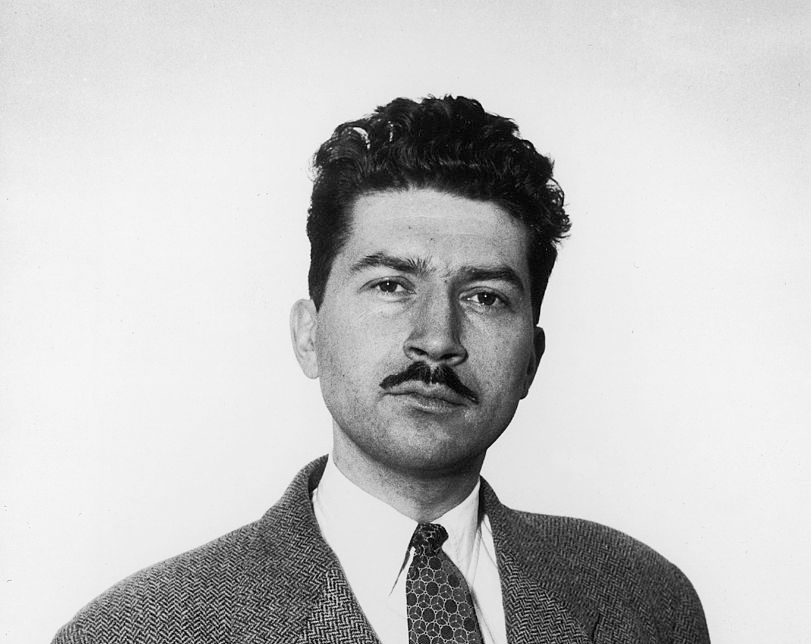
Back in 1958 Roland Barthes wrote that “there is no Robbe-Grillet school”. Decades on, aside from the nouveau roman, can you see a traceable influence of your work on the contemporary novel?
There is no such thing as a Robbe-Grillet school of thought! Barthes, in his articles on me, reduced my first two novels into something fascinating, but something which was closer to his train of thought than to mine. In his articles, one on The Erasers and the other on The Voyeur, he emphasised the projection onto the object, thus creating a paradox around the concept of objectivity. In this way he completely ignored the phantasms which were already playing such an important part in the works, and thus he ignored the projection onto the outside world of the personal inner world. He interpreted these two novels as representative of a literary statement, where objects were viewed purely as they were and nothing else. Barthes viewed my work from a very subjective point of view and projected his own value system in his interpretation, which, when all is said and done, he was perfectly entitled to do as a critic.
From my point of view, there never was a school; when I gathered around me a number of writers like Claude Simon, Nathalie Sarraute, and later Marguerite Duras, there was never any intention of gathering people whose outlook was the same, and whose research aimed at the same objective. What in fact brought us together was that the same criticism was leveled at all of us, namely that we did not write like Balzac. Consequently, sharing the same criticism, we all made up the nouveau roman, or New Novel, as compared to the traditional style of writing. Each one of us had to strive in the direction each of us had chosen for himself or herself. I have always fought against the normalisation, the standardisation, of the New Novel — this is one of the reasons why I found myself in opposition to a younger generation of theoreticians who tried to structure the concept of the New Novel and excluded Marguerite Duras from the movement, for instance.
When we meet we are aware of a certain solidarity amongst ourselves, a type of brotherhood. During the last big gathering in New York we realized that we had a common language. For instance, when we talk about the notion of consciousness — the ‘Balzacian Conscience’, the 19th century concept of writing is a totalitarian concept, it is all comprehensive, inside man, it englobes everything, it is whole and stable, whereas in the New Novel we deal with a consciousness which is outward looking, as defined by the philosopher Edmund Husserl, in other words, a consciousness of something — a fragmented mobile consciousness.
Because the outside world is fragmented, consciousness must also be so, and this way it looses the overall coherence which it had a hundred and fifty years ago, and at the same time this consciousness is constantly changing, constantly struggling against itself, forever creating new images — Sartre called it “freedom”.
In its earlier development the nouveau roman was called many things — objective literature, école du regard, phenomenological novel, etc. — in hindsight do any of these descriptions seem more accurate than others?
When critics used the term “phenomenology”, they had no idea of what it could be. They liked the word, but when one looks closely at what they wrote one gets the impression that phenomena are external to man, fulfilling its own life independently from man — this is not what Husserl meant by phenomenology. He meant a moving consciousness, projected outward towards the phenomenon, this very phenomenon exists because of this projection outside myself. It is in this movement outside of me towards an object that the phenomenon appears. Phenomenology does not exclude man, as critics seem to imply. Already, you can see a different sort of consciousness appear in Albert Camus’ The Outsider, particularly in the first part of the novel.
Critical analysis has emphasised the role played by “the eye” in my novel Jealousy, but I would say that “the ear” plays an equally important part in it. As for the word “objectif” critics have made numerous mistakes. Barthes launched the concept but gave it a thwarted meaning. Barthes always liked controversy and enjoyed using words in a context other than the one usually used or understood. In his article on The Erasers he described the work as “objective literature”, and he immediately defined this adjective by referring to the dictionary and thus giving it the meaning of “projection towards the object”. As for the traditional school of criticism, they stupidly omitted Barthes’ definition of “objective” and described my work as objective in the sense of meaning that the subject had completely disappeared.
I would describe the type of literature I write as a subjective type of writing, but geared to the idea of “projected towards the object”.
When critics looked at what I was writing, which emphasized the subject, the subjectivity of a theme, they said that I was attempting to be objective but failed. They ended up with a complete contradiction of the original intention.
From the period of the film Last Year at Marienbad critics started to speak about the concept of surrealism, of phantasmagory. They spoke about the cinema of phantasms. There had been no change in my work, but the approaches to my work were divided, sometimes emphasising the subjective element, and at other times the objective element. Barthes even speaks about Robbe-Grillet No. 1, No. 2, No. 3; yet when one becomes aware of the symbols of Last Year at Marienbad, one should re-read my earlier novels and one would realize that the symbols were already there.
What do you think is the current state of the nouveau roman?
To understand a new form of literature is a difficult thing for people. For instance, I would say that Flaubert is better understood today than he was in his own time, during the period he was writing Madame Bovary. There have been profound changes in the world, and consequently in the outlook of readers.
The New Novel is doing well, better than ever, because now it has a lot of readers. Not only do books sell, but they are better read and understood. For instance, with the last of Marguerite Duras’ books, The Lover, I had the impression that the book had become “visible” (popular) yet it is as complex as her previous work. But it was better understood because these concepts had made their way.
Given the gradual dissemination of Barthes’ idea of “ecriture” over the course of time, do you think that the nouveau roman has lost some of its autonomy from other kinds of novelistic practices? Has it become more elusive to define or recognize?
No, I don’t think so, because Barthes has disappeared from the New Novel. He was connected to the idea of the New Novel, but during the fifties and sixties. Since Jealousy, In the Labyrinth and Last Year atMarienbad, Barthes distanced himself from the movement.
Barthes really has not had much effect on the New Novel. There were moments when our outlooks coincided and other moments when they did not. What harmed the New Novel was not Barthes’ views, but the simplification of what he had said, which reduced the whole impact to a bland, neutral, factual type of writing.
I address these questions in my latest book, Le miroir qui revient.
Could you comment on this quotation from Umberto Eco: “But the moment comes when the avant-garde (the modern) can go no further, because it has produced a metalanguage that speaks of its impossible texts (conceptual art). The postmodern reply to the modern consists of recognizing the past, since it cannot really be destroyed, because its destruction leads to silence, must be revisited; but with irony, not innocently.’
I am interested in your thoughts on the debate between modernism and postmodernism, and their relation to your work.
I never spoke of destroying the past. Flaubert has been my inspiration. As for Umberto Eco, he is a dual character. He was at the vanguard of the modernist movement, but he is now writing populist novels. He was the theoretician of the avant-garde movement, but he has come back to the past. He speaks in this quotation about himself.
The idea that the avant-garde has failed and that one must back track is absurd. The avant-garde must by definition fail, because each writer must go to the ultimate conclusion of his or her ideas. Each writer must continue to progress in his/her chosen direction.
As for Postmodernism, it is a bad description. It was created as a specific concept, situated in a precise context — that of German architecture. It means a reaction against the utilitarianism of the Bauhaus type of architecture. It was used in literature in the seventies, especially in American criticism. It was misunderstood and misapplied. I have not understood either, all the more that in some articles I was viewed as a postmodernist and in others I was viewed as a modernist. I do not like this word as its use is pretty much impossible.
You seem to share an interest with the Pop artists in the signs/images of popular culture and, like them, there is an ironic position taken in your work.
I like popular images when they are taken up by art. For instance, a tin of Campbell’s soup is not a work of art, it becomes so when Warhol has been inspired by it. Marcel Duchamp was the first to have taken ordinary objects and to have transformed them in his work.
The American School of painting, like the work of Robert Rauschenberg, is in fact a perfect example of the way Pop Art has been inspired by everyday objects.
In literature a book like La maison de rendez-vous, or Project For a Revolution in New York, are also inspired by popular imagery, but this imagery is completely transformed in the writing process. I don’t believe in naïve pop culture, the filtering process of art is essential to make it an artistic work.
When I deal with popular imagery as a source of influence in my work, I use it as a critically distancing process. I don’t use the word irony when I speak of my work, I’d rather use the word humour. Irony, in the French language, is a value judgement, whereas humour means that you stand back and it does not automatically imply a value judgement.
The humour in my work was understood only of late. For a very long time I was viewed as a novelist and film director lacking in humour. With Last Year in Marienbad very few people saw humour in it.
What of the erotic imagery in your novels and films?
The erotic imagery in my books and films are just that, materials drawn from the influence of pop images which I use. In Roland Barthes’ terms, I pick out certain elements which I simplify to the level of significant objects. I transform them, purify them and create a new semiotic system out of them, to communicate and create something else. It is true for all of my imagery. I use the pop art imagery as creative material to produce something else, to communicate another message.
Was there any relation between the French New Wave movement in the cinema and the nouveau roman?
The New Wave is even more difficult to delineate than the New Novel, because in the case of the New Novel we are dealing with innovators, whereas in the New Wave there have been remarkably academic filmmakers like Claude Chabrol, or others who are middle-of-the-road intellectuals, like François Truffaut; they were very successful immediately because they were intellectual in their approach. However, there have been pure innovators like Jacques Rivette and Jean-Luc Godard. Therefore a certain parallel can be drawn with the New Novel from only a section of the New Wave directors. We do feel a certain common interest with the innovators in their field. Cahiers du cinéma have criticised Rene Clair, but he is much more innovative than Truffaut or Chabrol.
Finally, what novels do you like of late?
The New Novel of course! Everything which interests me I call a New Novel. To me it is not a closed shop or world, new people come in all the time.
__
Book
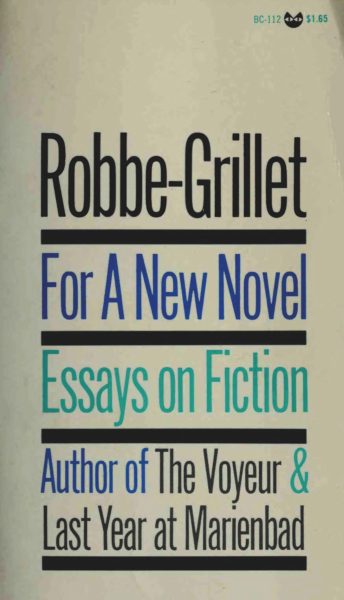 Alain Robbe-Grillet For a New Novel
Northwestern University Press
‘Alain Robbe-Grillet, one of the leaders of the new French literary movement of the sixties, has long been regarded as the outstanding writer of the nouveau roman, as well as its major spokesman. For a New Novel reevaluates the techniques, ethos, and limits of contemporary fiction. This is a work of immense importance for any discussions of the history of the novel and for contemporary thinking about the future of fiction.’ — Northwestern University Press
‘Far from being a manifesto, For a New Novel is a releasing book, releasing in the fullest sense. It shows the possibilities of the novel, and possible ways of thinking about the novel; and it shows how little most of us . . . have dared to think, and why. Amazing. As for importance, I doubt that fiction as an art can any longer seriously be discussed without reference to Robbe-Grillet.’ –Eliot Fremont-Smith, New York Times
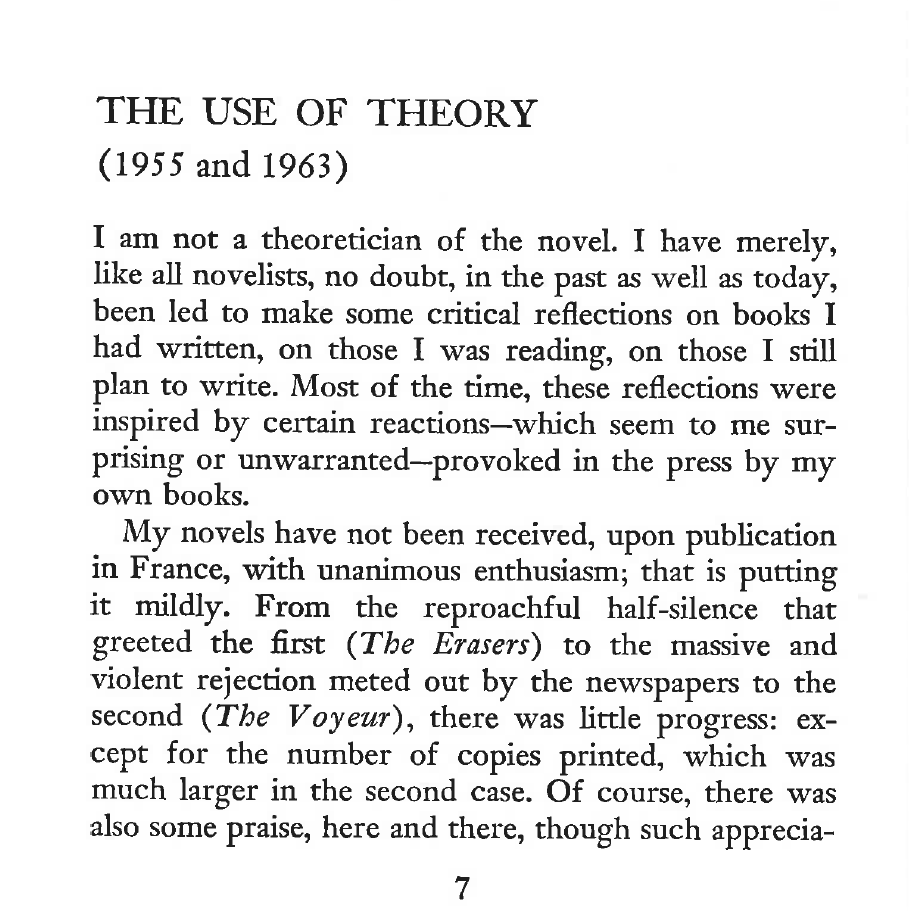
Excerpt
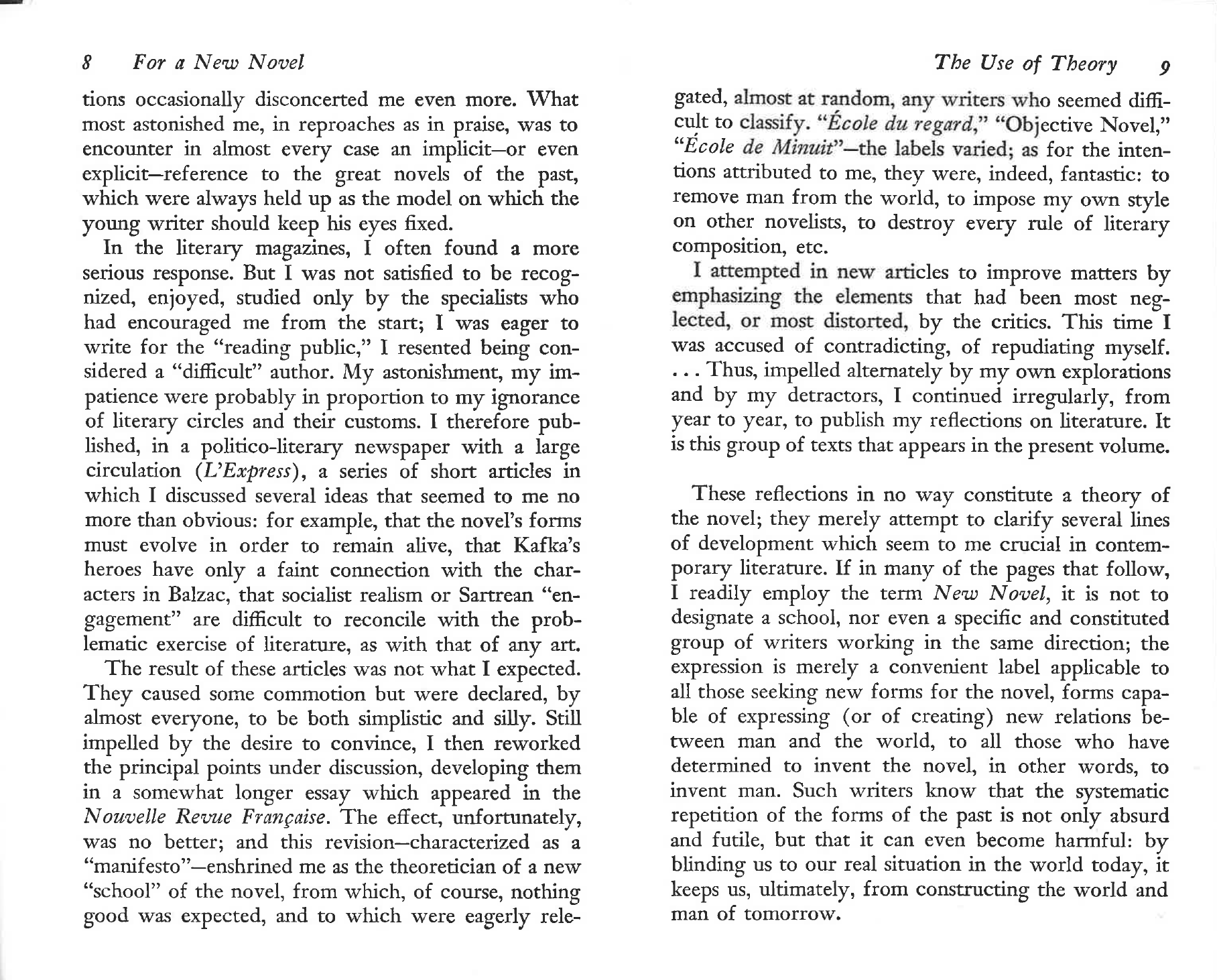
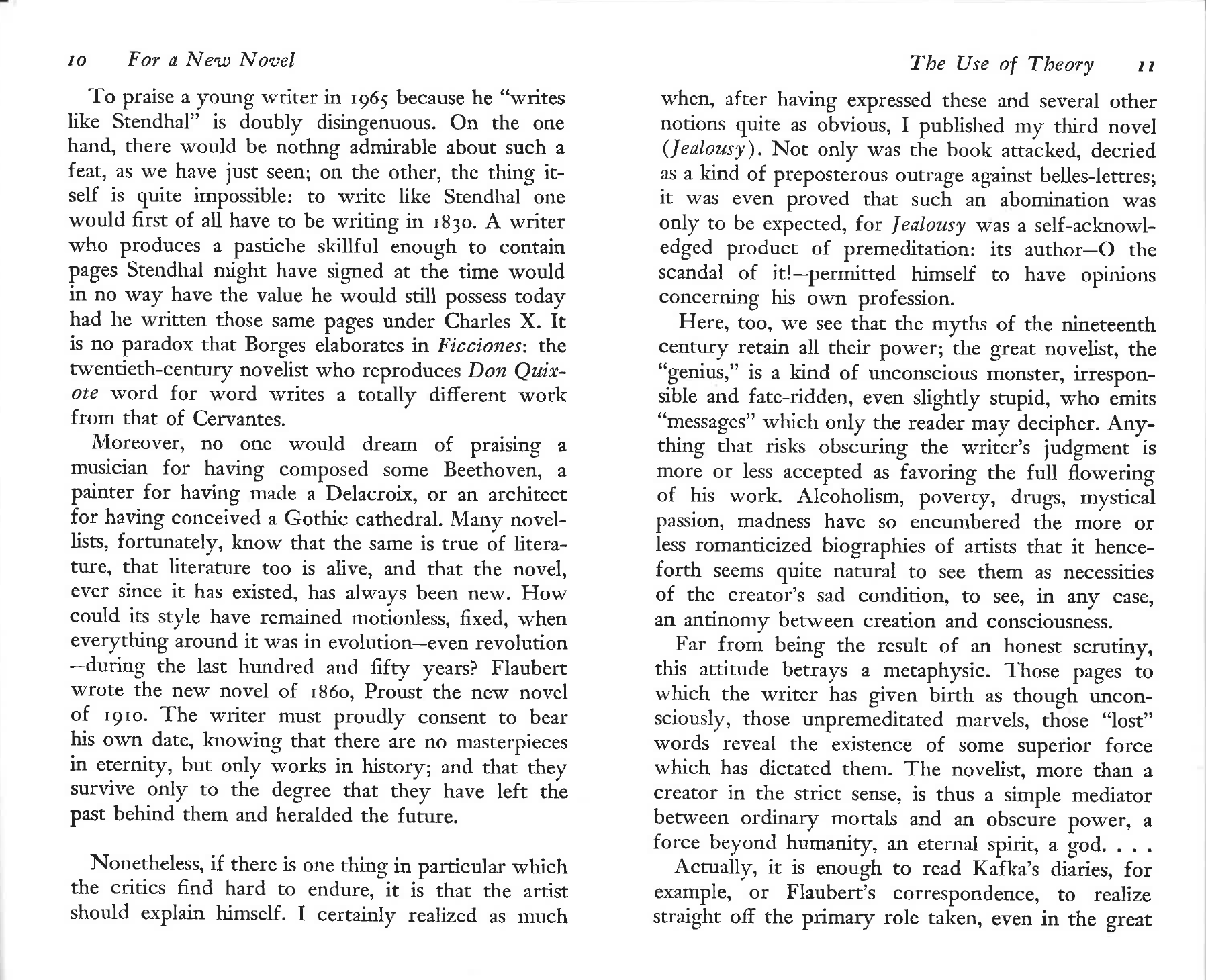
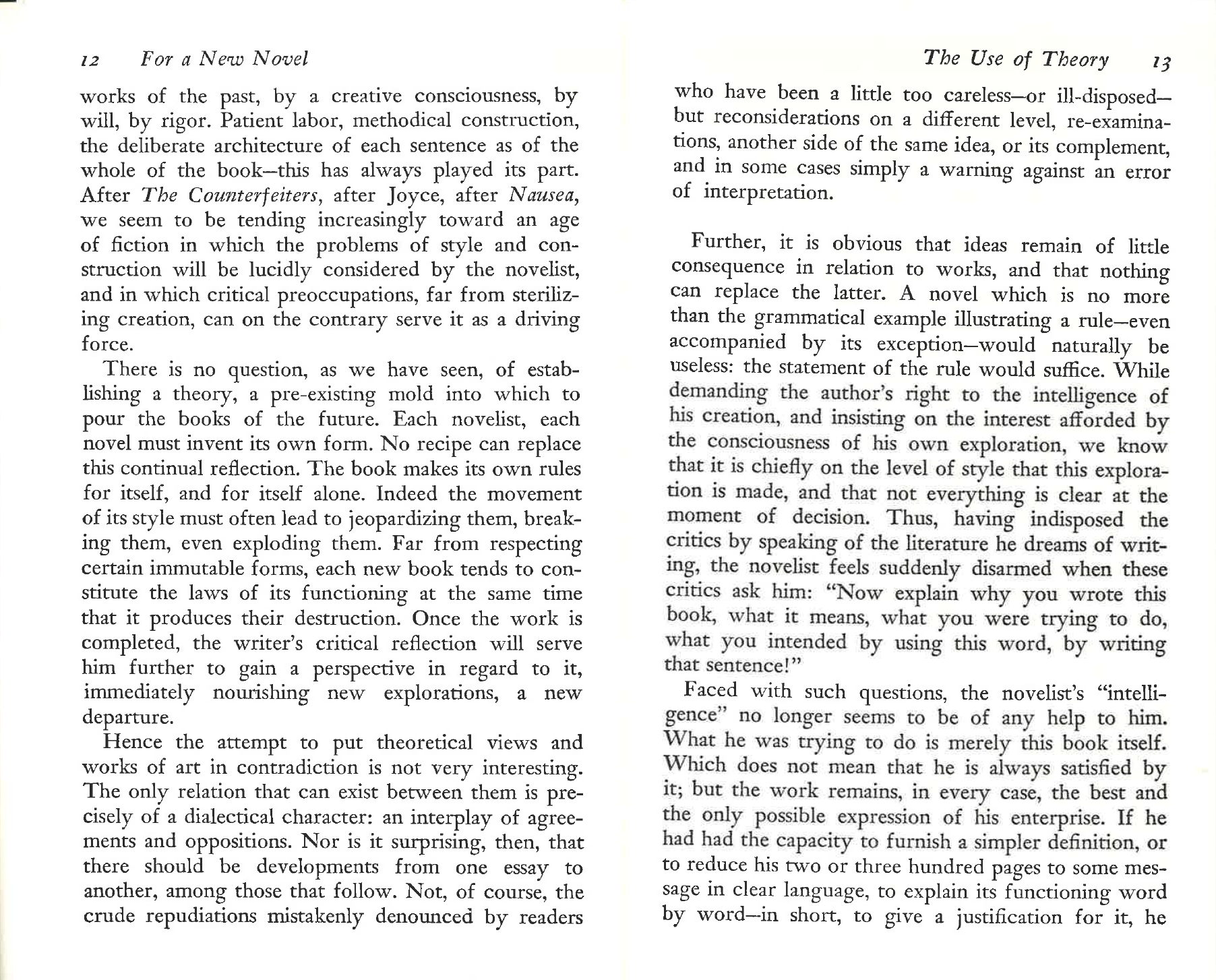
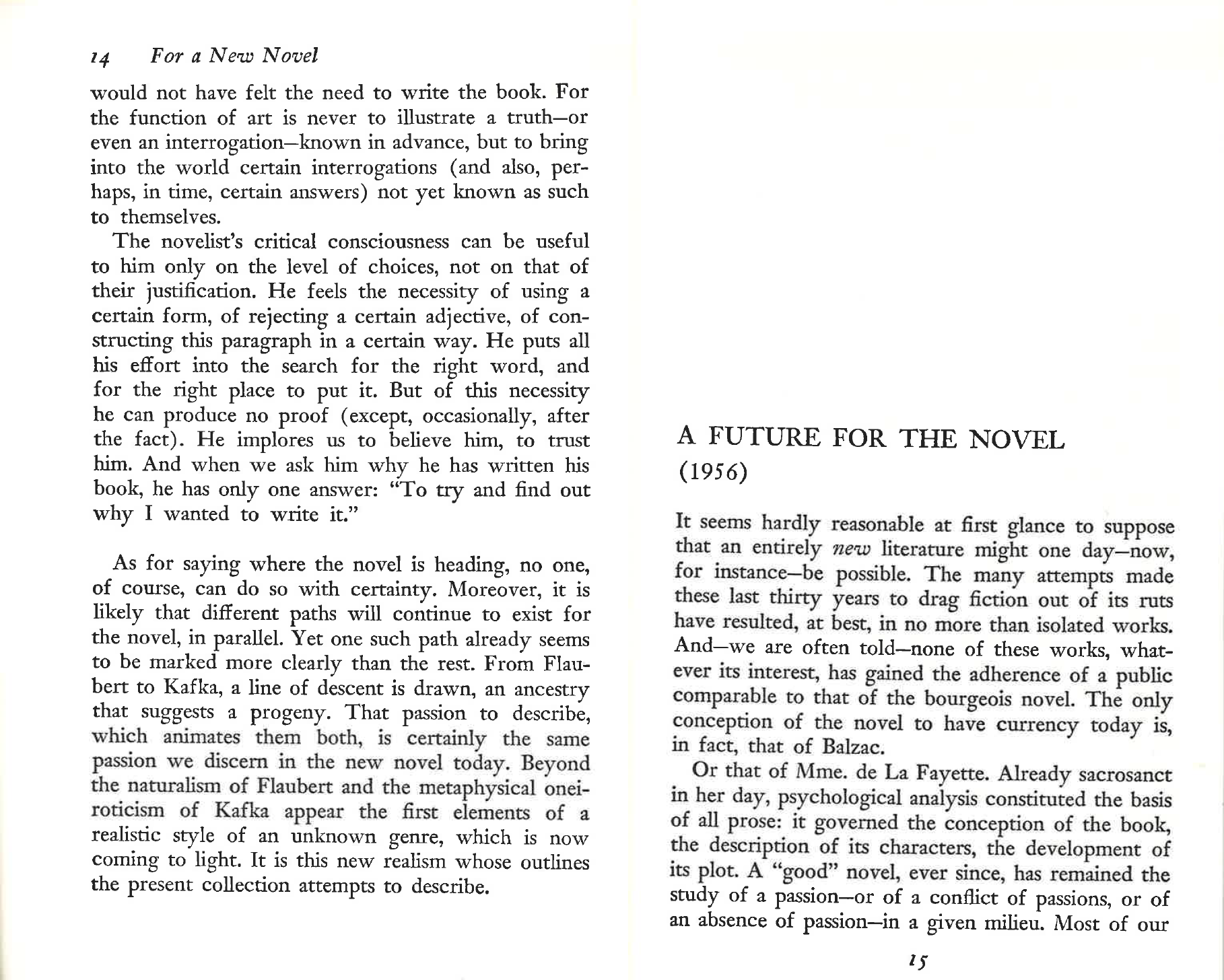
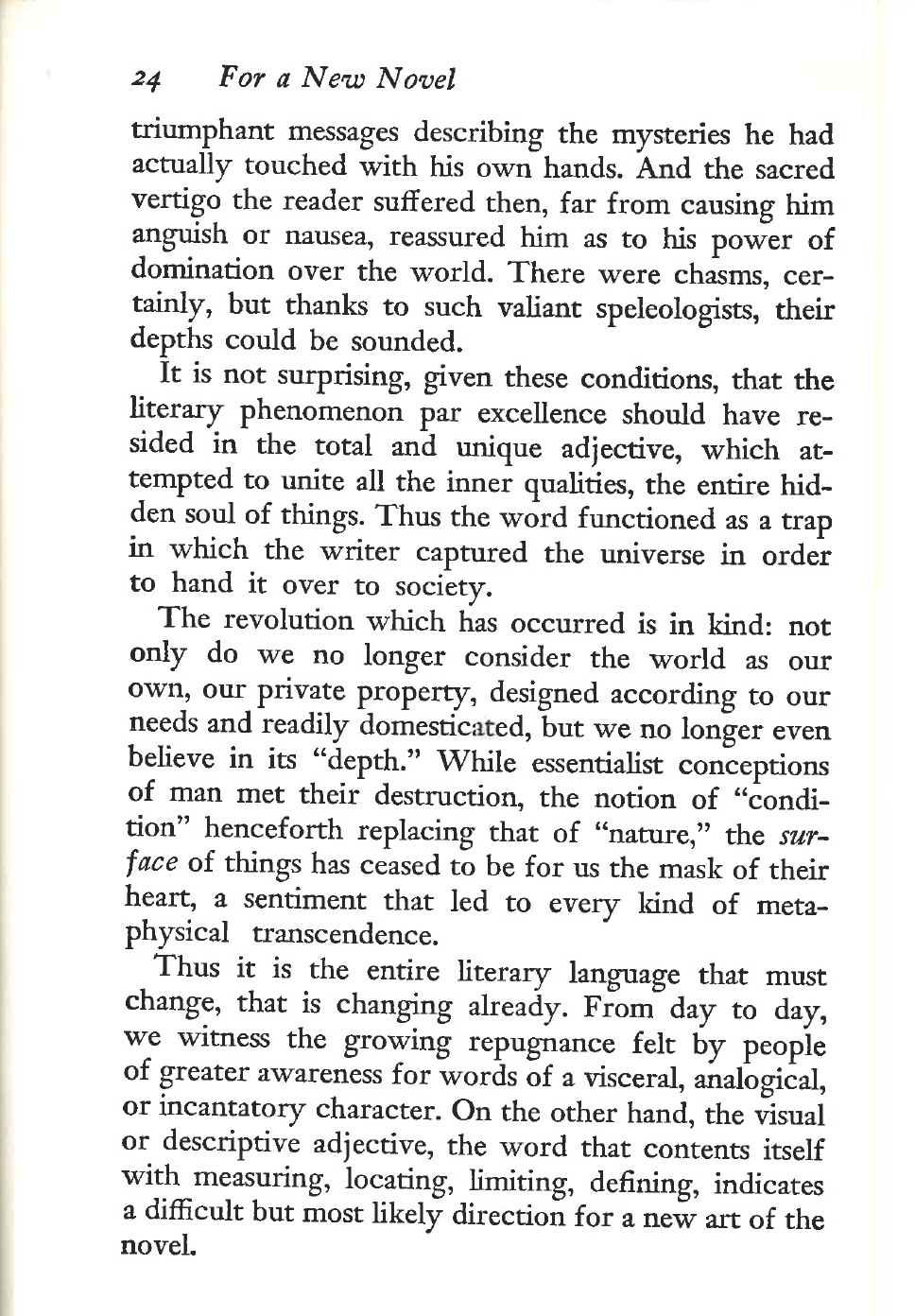
*
p.s. Hey. ** charalampos, First indeed. ‘Pavement Butterfly’ is a somewhat interesting silent film, but I wouldn’t necessarily think you need to watch it. The title is a metaphor. No butterflies. Love from the latest Paris heatwave. ** _Black_Acrylic, Yay, I’m so happy you guys made it to the screening and liked the film. Its rhythm is pretty particular and kind of demanding, I guess, but I’m glad it settled with you. The proprietor is supposed to send me pix, and I’m excited to see the costumed horde. Thanks so much, Ben. ** magkneesiumm, Hey! Astute observation, and thank you. Oh, an email? I’m fairly terrible with email, but I’ll go hunt for it. Sorry for the slowness. How are you? ** Adem Berbic, One hears. ‘Prayers’ that it isn’t a meds situation then. Not being able to write … that’s about 90% of why I don’t quit smoking. Both times I quit I couldn’t write or do much of anything that required concentration for months and months. Blip it surely must be. ** Bill, Thanks, Bill. No, no ebook sales, and I don’t think VPN would help if it’s just not available. I guess hopefully someone will upload a pdf of the German edition somewhere where people can download it? So strange. No, I don’t know ‘Jiu Bobo’ or their work. It looks most curious. I’ll hunt the ether and see what I can haul in. ** laura w, Hi. Agreed. Some of the most interesting animation I see these is organised into weird indie video games. Yeah, it’s too bad that literature’s current chic status doesn’t seem to extend much further into the wildness than Vuong and Greenwell and so on. It all seems to depend on whether some character in some viral TV series signals their coolness by being glimpsed in a shot reading something ‘cool’. Your August is surely going to be a huge relief, I command it! Yeah, I have friends in Spokane I’m worried about. LA has always been a place where it never gets actually cold, but the constant, slightly modulating heat all yearlong thing pretty much started after I came over here. But growing up in LA is surely why I’m so romantic about cold weather and winter. Hang way in there, pal. ** Carsten, I’m sure you know that Bertolucci originally intended for Maria Schneider’s character to be a boy, but the powers that be wouldn’t let him. I’m a fan of Brando. I like acting when it’s volatile and unpredictable. I just don’t like acting when an actor is fulfilling the requirements of the role with admirable finesse. For the same reason that I don’t like so-called ‘literary’ fiction. I want to feel like I don’t know what’s going to happen. And Brando was a master of creating that sensation. Weekend was fine, no real big. We’re entering another but supposedly brief big heatwave today, so I mostly was enjoying the spoils of the countdown. ** HaRpEr //, I have a strong pragmatic streak about life and everything, and that has saved me many times. I don’t know you create that pragmatism though. Right, ‘Despair’, I haven’t seen that in ages. I remember it being an oddball in Fassbinder’s universe. And, yeah, Bogarde is always great. You’ve seen Resnais’s ‘Providence’, right? A great film and a top example of Bogarde’s late period wonderfulness. Happy you imbibed ‘My Life’. There are fantastic things in amongst the Language Poets’ work, but you have to hunt around a bit. ** Uday, Your life is so exotic and adventurous right now, at least to chair potato me. Retroactive happy birthday. What is the scariest or most daunting thing that this week seems to hold in store for you? ** Thom, I loved the psychedelic days. I’m so grateful to have been a young teen in LA with enough money in my pockets (or my patents’ pockets more like) to go see bands all the time back then. Cool about your psych folk band. I had not only the psych folk band I mentioned but also a psych rock band at another point too wherein George Miles was the keyboardist. Never recorded anything, probably a good thing. I’m glad you liked ‘Crusade’ especially. Eddo Stern’s work is great in general. Your ‘Witches Hat’ is beautiful. I listened to it twice. Very cool. Oh, how about that: Mr. R-G coincidentally is back in your face today. ‘Sentimental Novel’ isn’t his best, for sure, but it’s interesting to see where he was at the end of his life. Okay, later! ** Okay. I have relit the spotlight that previously fell on a book that was very, very important to me as a writer when I was developing my George Miles Cycle novels and beyond. I don’t anticipate it receiving that big of a welcome from you, but I do think you should have a chance to test it. See you tomorrow.


 Now available in North America
Hi!!
Here I am, back after our friend’s visit, which was really nice, a little exhausting, and mostly confined to the four walls of our apartment because of the heat. How have you been?
For a New Novel is a Robbe-Grillet I haven’t read. Thank you for this post, especially the excerpt!
What bullshit about the ban on The Sluts! This obsession with censoring and canceling is fucking infuriating. Of course, it’s way easier and flashier to ban books than to actually enforce laws that protect children. I’m really sorry.
About Leviticus—while I certainly wouldn’t say it’s an absolute must-see, I enjoyed it, and I think it’s worth a watch when you find yourself in the mood for a horror movie starring two gay teenage boys.
Unless you have DNA proof don’t expect love to call you daddy, Od.
One’s hearing is heard gratefully. In part it feels a little like a withdrawal into a weird literalised version of that Blanchot essay I always drone on about, which I realise probably sounds either obnoxious or insane. But I funnelled it into some initial dollop of writing, maybe to be whittled into something a little less sloppenheimer down the line. Not much to report otherwise. I saw T read at an event which didn’t deserve him – his poetic practice seems to be maturing at an almost alarming rate, and I wouldn’t have called it immature in the first place.
I never realised ARG smelled so much like Heidegger, but now that feels very ‘duh.’ I think the thing for me is to double the ‘thereness’ of the novel-world into the ‘thereness’ of the novel vis-a-vis the reader’s point of view. I dream of being able to write something which is what it is. So much so that it’s like a piercing light, but it doesn’t illuminate anything for the reader, just make them realise how much else is in the dark.
I have this Croatia trip tomorrow. Either it’ll help everything, or it really won’t. See you on the beach, don’t forget your speedos.
Hey Dennis,
Nice to see a spotlight on this. I’ve been thinking a lot about associated questions these last few months, as part of trying to feel my way into a new piece of fiction.
It’s good to hear somebody standing up for, and even championing “having nothing to say.” I often feel like I have nothing to say when I’m writing. But maybe that’s not quite it. It’s more like my ambition/desire for finding a thing in the way of saying it makes me go dumb. I have no interest in “psychology” or “people,” and certainly not in ones that aren’t real.
You’ve often spoken about your characters and plots just being there as devices, enticements, tricks etc. Did you ever rail against the necessity of making these concessions to the reader? Did you ever feel a strong pull to take things in the more abstract/anonymised direction of someone like A.R-G? Because I often do… it seems so tempting and pure, but it never really comes alive on the page when I try it out. Sometimes I wonder if it’s a historical thing, like for some reason the post-WW2 moment was a hotbed of non-narrative possibility, and then most culture reverted to type?
I think I’m coming around to a place where I can simultaneously be in touch with my disregard for character etc. as well as my empathy with the desire for it, where I can submit to the need for trickery (as long as it’s on my own terms) without getting angry. I can probably even learn to enjoy it, which might actually be necessary? How do you maintain your interest/enthusiasm when you’re writing plots and characters for purely technical purposes?
Other than that… I am so over this heat, as I know you have been for ages. I just want to wear a jumper and not feel like a slow-mo dopey version of myself. Apartment hunt continues apace and is making me want to dust off the guillotines (they must be in storage somewhere). If you hear of anything through friends please let me know!
bisous, moi
PS: Bob Gluck’s book is sold out and I’m reprinting it, which is great. It’s been doing really well at After8 and Les Mots à la Bouche.
Hi Dennis. I really like Robbe-Grillet, if I was a writer I’m sure this book would be one of my bibles. I’m currently reading “Arturo’s Island” by Elsa Morante, and really enjoying it; I am always interested in child narrators, and this one has a very interesting and opaque one. He describes himself as unemotional, but constantly puts very needy and vulnerable feelings on things in the world around him; flowers, the sea, his dog, the sky. It is strangely moving, his feigned remoteness combined with the world being anthropomorphised into a world composed almost entirely of yearning and neglected forms are a really intoxicating combination.
I saw my friend yesterday, and generally had a good time, we spent an hour or so in a bookshop picking out things for him to read and for me to bankroll, which was really lovely, I rarely get the opportunity to be generous. I am also about to start Chopin’s Concerto in C Minor, No. 13, which I’ve wanted to play for ages and ages. Hope you’re well, thanks for today, bye!
ARG really does point out so astutely how arbitrary and pointless a lot of of those conventions of the trad novel were. Doubtless those New Novelists must have been the Punks (or Acid House producers) of their day.
Ah so we’re on the same page regarding Brando after all. Yes exactly, about acting that is volatile & unpredictable. At his best Brando was always larger & more interesting than the film he was in. And his irreverence was the extra spice on top. I’ve always been in the minority on this, but to me the supposedly indulgent last half hour of “Apocalypse Now” is the best part of the movie. Where any remnants of plot crumble to bits in that underlit hut with Brando riffing his way to his own ritual slaughter. He was the poet’s actor, or the poet among actors. And in “Last Tango” there are a couple of scenes where he breaks through the melodramatics of Bertolucci’s conceit & takes over, where you’re just riding the wave of wild impulse. Damn rare in a movie. In a way I think a wide-open structure like Warhol’s in “Chelsea Girls” would’ve suited him best.
Nice spotlight on Robbe-Grillet. Though I sometimes feel that when lit folks are discussing the revolution of the nouveau roman, they overlook Céline’s makeover just a few decades prior of both the novel & the language. Which is surely due to his odious personality, but I think also because he never wrapped his particular revolution of the word into any theoretical framework or manifesto. Kind of like why Benjamin Péret isn’t as well known as André Breton.
How’s the producer-hunt going? Probably slow in the summer, no?
I’ve never read anything by ARG, but this excerpt is great. I often find myself more amazed by “new novels” that break the conventions of traditional storytelling, as much as I love the traditional stuff, as well. A perfect example, Castle Faggot by Derek McCormack is such a short book, but somehow so full and vast and new. I haven’t been INSIDE a book in so long. Trying to recommend it almost feels like pulling teeth, because a lot of people I talk to are looking for more standard novels. Which I can understand. But damn if I won’t still try to convince everyone to check it out.
And no worries at all! I’ve been well. Trying to set up my release party this coming weekend while juggling my work schedule has been stressful, but everything’s on its way to being finalized. How are you?
Has anyone uploaded the German translation of THE SLUTS to Anna’s Archive or the Internet Archive?
Speaking of the latter, I also posted Paul Vecchiali’s 2018 TRAIN DE VIES there: https://archive.org/details/train-de-vies-paul-vecchiali-2018-eng-subs. For the first time, English subtitles became available for it last week.
robbie-grillet day! i haven’t delved much into him or any of the nouveau romans beyond my beloved duras (who i agree is too frequently unfairly left out of that specific canon), but i did read the voyeur earlier this year and found it a near perfect seaside thriller, on par with ann quin’s berg, if you could call either of them thrillers (which i think you could, going down to their bare bones as novels). he’s frustratingly hard to find in translation and when i do it’s always these musty old mass market paperbacks that make me imagine the former owners chain smoking and reading them in some hopper-esque diner. none of this is a bad thing i just would rather not strain my eyes and hands reading them.
i do give the internet reluctant credit for the rediscovery of jacqueline harpman- i did enjoy i who have never known men, but i also have a massive thing for lonely woman novels (if you couldn’t tell). of course, i also give her fantastic american publisher, transit books, more credit than the internet. i hope your friends in spokane are doing okay- mine is by the coast/in the seattle area so he’s getting smoked out but is fine at least for now. this truly is the summer of smog in america. i also imagine the heat in la is a little more bearable because it’s so dry out there and also central air and swimming pools. my office ceiling tiles sprung a leak and i could not be held responsible for my actions today because the entire day i had to listen to it dripping. dripdripdrip. sent the world’s bitchiest email to a colleague and then had to beg for forgiveness. so. i hope your day was less tormented.
I try to be pragmatic but I’m too impulsive, and that gets me in hot water a lot, but the other 50% of the time something great happens, so I find it difficult to stop.
This book is of course a big deal to me. I admire its openness and that R-G’s core focus is not in trying to convince the reader to take a particular approach, but instead invites them to challenge certain aspects of the 20th century novel taken for granted whilst scrutinising works like Roussel and Beckett that see beyond them. It has real lasting power because it’s not a manual but a mind expander.
Of course, ‘Providence’ is brilliant, and was an influence on ‘I Wished’ right? I was just thinking the other day about seeing it again. It’s very intricate in how it goes about trying to set up something fictional which the Gielgud character only has a loose hold on. And how all of the dialogue is self-consciously stilted and corny inside the novel parts but it still works. Yeah, I love labyrinthine kinds of structures like that a lot. The set designs are really great too.
A couple of months ago I watched ‘Artists Under the Big Top: Perplexed’. I’m curious now I’m thinking about it, whether how that film focuses on the similar idea of trying to realize something very difficult or near impossible influenced either ‘I Wished’ or something else you’ve worked on?
I still come back to this book when I need a zap of inspiration. Always reliable. What an important piece of work. Very enjoyable seeing the tribute here again.
Love
Thomas xoxo
Hopefully under and not over the wire with this one but I recently made a joke referencing R-G and like none of my friends found it funny, or knew who he was. For some reason it’s easier to convince them to watch movies or listen to music than to read, even where reading would take less time. I suppose my life sounds exotic and adventurous but when you’re in it it’s sort of just the same, with small exceptions. Nothing super scary this week, except leaving which is hard, and not leaving for a familiar place which is harder. Ah well. What’s scary for you in the next few?
Yeah wow, perfect timing on my end with this spotlight hehe. I have known about this collection of essays for longer than I’ve known about any of ARGs novels… and I STILL havent read it! I always would scour Half Price Books (god I miss that place, found Flunker there, surprisingly enough, for 5 bucks?) and Powells for it, but I dont think its very common to find in big places like that. I’m sure if Grove was currently printing it it’d be a touch easier to find. Oh well, I think the modern Grove covers for ARGs stuff arent great anyway haha. I know someone has it in print, and I just need to order the book next time I have spending money… maybe in 2 paychecks… stuff is tight!!! It’s one I wanna have around physically tho, and, if I like it as much as I anticipate, one I wanna make writer friends read. I love his whole thing of NOT giving a ruleset and NOT making a specific manifesto for a style or scene. I always see people, very young people, trying to make manifestos and things for certain genres etc, and I know they’re having fun, but my approach to art doesnt gel with that kinda thing usually. I do like specific rulesets for the sake of challenge or unique results (like Dogme 95 or something like that) but the new novel seems like such a vast thing, and I love that. His interplay between subjectivity and objectivity really knocked my socks off when I read Jealousy… I’m sure when I get my hands on the book and start reading, you will be the first to know, as people around me seem decidedly uninterested in this stuff… anyway back to work tommorow, have more Fleur Jaeggy (you really gotta give her stuff a try) and some Duras on the menu this week. Later!!
Re: “We endow the world with meaning (or meaninglessness) in order to control it.”
Those meanings are primarily delusions and deceptions that help “advanced” people to control the world, logically to largely most destructive effects — read “The 2 Married Pink Elephants In The Historical Room” at https://www.rolf-hefti.com/covid-19-coronavirus.html
For the masses to get out of the big horrible mess we’re in means…
First, virtually everyone has to DEprogram themselves from the programing (“official education” or official brainwashing) they’ve received since they were a child. It starts with seeing that YOU HAVE BEEN PROGRAMED ALL ALONG.
Second, constantly analyzing and debating current events is a waste of time. Because it’s not enough to describe over and over the prison cell (and its guards) — the ruling pack of psychopaths AND its many loyal minions — but explain how we got into it and how to get out of it, potentially. Of course, the psychopathic ruling authorities WANT you and everyone to waste your energy and time doing this “clever” analyzing and “figuring out” (and 99% of all “alternative media” is doing this too!) as they had freely told everyone:
“[Reality-based people ] believe that solutions emerge from your judicious study of discernible reality. That’s not the way the world really works anymore. WE’RE AN EMPIRE NOW, AND WHEN WE ACT, WE CREATE OR OWN REALITY. And while you’re studying that reality – judiciously, as you will – we’ll act again, creating other new realities, which you can study too, and that’s how things will sort out. We’re history’s actors . . . and you, ALL OF YOU, WILL BE LEFT TO JUST STUDY WHAT WE DO.” — Former Senior Adviser of the US Empire/Regime, in 2002 (https://archive.is/8wG4Y)
Third, how we got into this deep mess is the clue on how we can get out of it (and create justice, freedom and peace for all) — by learning what TRUE morality is —99% of people don’t know what it is because (1) it’s NOT taught in the official indoctrination system, better know as the “education system,” and (2) it’s NOT the same as religious morality: https://odysee.com/@woeih:e/Mark-Passio-Government-Is-Slavery:a
Because if you don’t know what TRUE morality is you will not stop doing, unwittingly or wittingly, evil things…
“The solution is NOT to create something new (eg, new systems of organization, new technologies, etc). The solution is to STOP being complicit with evil. To STOP doing things that are not moral for a reward. To STOP being complicit with anything the control system tells us we must do.” — Mark Passio, Spiritual Teacher
“As financial access, employment, and administration become conditional on algorithmic systems, freedom does not disappear through overt coercion, but through participation that is scored, filtered, and managed.” — Mark Keenan, Dec 2025 [https://www.globalresearch.ca/ai-operating-system-digital-totalitarianism/5909796]
Fourth, commit yourself to ACT on the principles of real morality (see first url at third point).
Fifth, spread and teach these principles far and wide..
“Ignorance is the root cause of all Evil. Since only Knowledge eradicates ignorance, it is our duty and moral obligation to educate ourselves, as well as the masses around us.” — Anonymous
David Shields’ critique really resonates, especially in how it challenges the traditional novel’s relevance in today’s world. The sense of urgency and the need to capture contemporary experience is so vital for novelists now, and it’s interesting to see how Robbe-Grillet’s innovative techniques paved the way for that. I often find myself exploring different literary styles to get inspired and one helpful resource I use for this is a digital library of experimental narratives.
This is one of the better articles I’ve read on this topic. recommended
David Shields’ critique really strikes a chord here, especially in the way it challenges the traditional narrative structures that feel increasingly out of touch. It’s fascinating to consider how Robbe-Grillet and his contemporaries pushed the boundaries of what a novel could be. That sense of urgency and the need to capture the essence of modern living resonates strongly even today. For anyone grappling with these ideas, I often refer back to various literary theory podcasts.
David Shields’ dismissal of contemporary novels as “antediluvian texts” captures a significant tension in the literary world today. It’s fascinating to consider how the New Novelists like Robbe-Grillet responded to the constraints of traditional narratives, pushing the envelope of what storytelling can be. This conversation about relevance in literature is ever-pertinent. I often explore similar themes in a helpful free resource I use for this: literary critique forums.