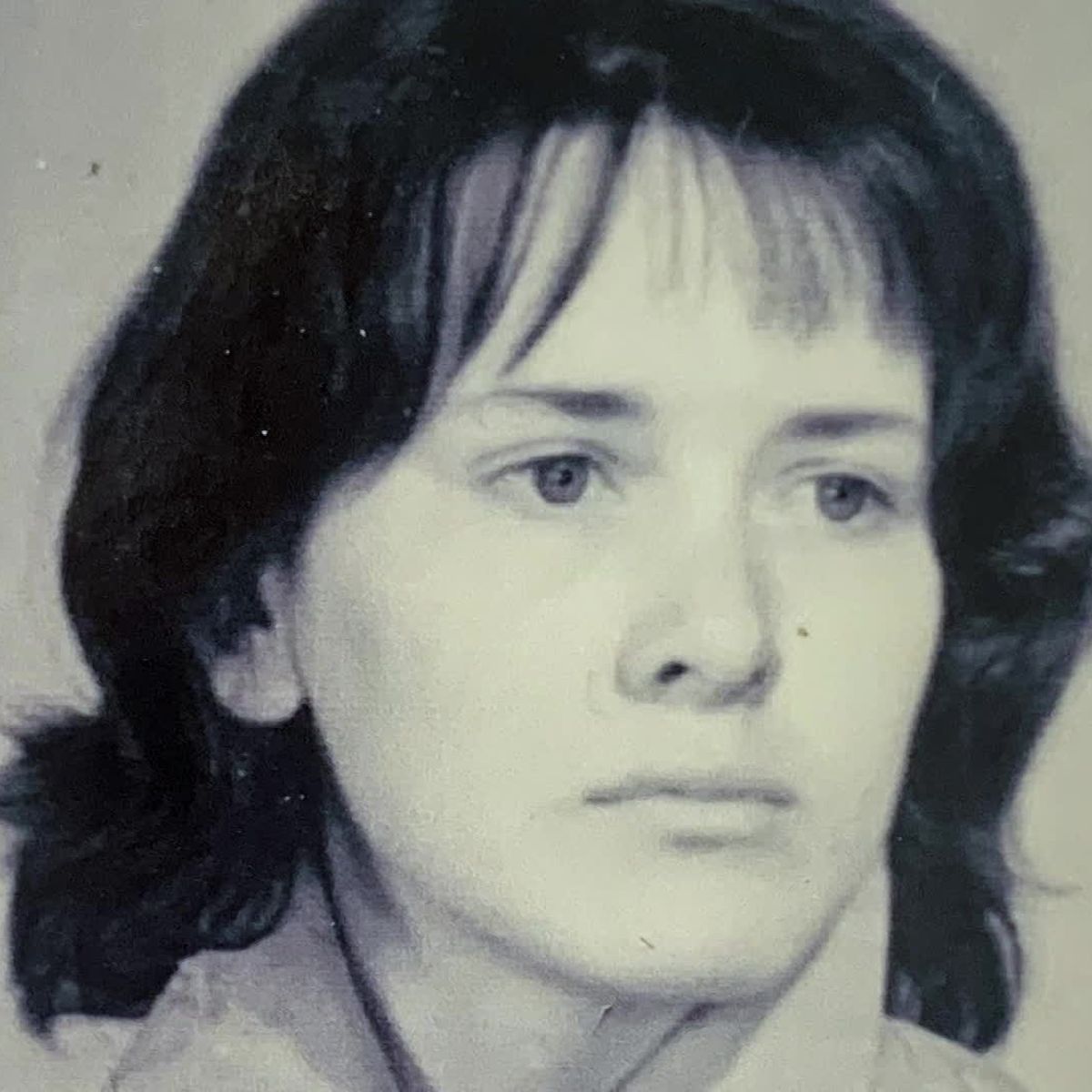
‘For decades, Annie Ernaux has traced an umbilicus between sexual release and the act of writing. Beginning with 1991’s Simple Passion and continuing through Getting Lost (2001) and The Possession (2008), the author has meticulously dissected the ways sexual and aesthetic creation summon experiential elsewheres in which we become provisionally absented from time. (These states are also for her companions to death—time’s inverse.) Orgasm itself, though, proves a malleable condition across Ernaux’s corpus, the place where her ongoing projects of self-making and writing become knotted together (she has termed this a “total novel” of life).
‘Like Proust (whose In Search of Lost Time haunts her erotic writing), Ernaux sees time not as chronological but palimpsestic: in the existing moment, traces of the past remain, nearly illegible but inextricable from it. Thus the past may intercede at any point. In the most recognizable passage from Proust, this is signified by the madeleine, which harbors his philosophy of “involuntary memory,” disentangling fictions of linear progress, rendering time an irrevocably permeable condition of being. In my diary eight years after that French class crush, I wrote of a man I’d been fucking that “I want to melt into him, to have a single body, to have him inside me entirely and forever.” In the time of those men, I had been overcome—seized—by longing. But in transcribing these events with relative consecutiveness, the memories become shorn of singularity, divested of their strange psychic pull. Almost a decade after that first need, could I hear the distant ringing of my previous language? My teenage past hummed beneath the skin of my grad-school heartbreak. “Proust suggests,” Ernaux reminds us in Shame, “that our memory is separate from us, residing in the ocean breeze or the smells of early autumn . . . that recur periodically, confirming the permanence of mankind.” But Proust, crucially, also sees memory as having a kind of alchemical relation to the present—it metamorphoses and reorders us in our recollections. In this sense, the truer descriptor for Proust might be anamnesis, an innate knowledge that lives inside, precedes, and exceeds the particular histories and life span of the individual; a remainder that now and then appears above the waves, a “souvenir” (from the French, “to come from beneath”), something like the “soul” of time.
‘Ernaux, in turn, intermixes these ensouled sediments with the specters of the personal—her memories, the stuff of one woman’s experience—which “confirm the fragmented nature of my life and the belief that I belong to history.”‘ — Jamie Hood
Further
Annie Ernaux Site
‘DWTSoE’ @ goodreads
annie ernaux fixed my disintegrating attention span
Writing feminist philosophy: Annie Ernaux and Simone de Beauvoir
The scrupulous objectivity of Annie Ernaux
Annie Ernaux, ethnographer of symbolic violence
Annie Ernaux and the Literature of Experience
Annie Ernaux and writing from experience
‘DWTSoE’ @ anna’s archive
Buy ‘DWTSoE’
Extras
Annie Ernaux: “I carry the memory of the stigmatized”
Interview with Annie Ernaux
Annie Ernaux : Dénoncer le génocide à Gaza
Interview
from The Walrus
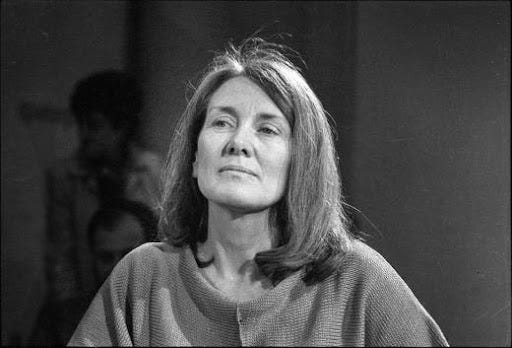
In your article from 1994 in which you consider the reception to Simple Passion, you say that critics and journalists are typically “unable to grasp the true reading experience or perceive how readers inhabit a book and draw from it.” You believe that in order to somewhat assess this true reading or rendering of their work, writers must “converse with their readers and, most particularly, read the letters they send.” For you, these letters are extremely important since they reveal how your books are being received.
If readers take the time to write, I owe them something in return. For me, answering letters is my duty but also a task I truly enjoy. I have such an emotional response to the letters, especially those that are more personal and sensitive. Readers don’t simply recount their own stories but rather react to my work based on their life experiences.
When you say that some letters are personal and sensitive, do you mean that your readers point out what resonates with them in your books?
“Resonate” is an apt term to describe how a book touches something in a reader’s life. The letters that mention this resonance give me an unexpected window into how my work reflects a reader’s own experiences and journey. I might then notice certain things I didn’t originally consider important in a book. I cherish these letters. I store them in cardboard boxes or shoeboxes, and already before the Nobel Prize, I could fill two or three boxes a year.
Do you also keep emails?
Yes, but I don’t print them out. Because I’ve had the same email address for years, I can dig up old messages I exchanged with people who are now gone. I’ll never want to delete these messages.
Whether it’s a letter or an email, correspondence from readers is proof that my books are, that they exist for people other than me. When I finish a book, that is to say, when I emerge from writing, I don’t know what the book is. It’s readers who let me know, in a way. The letters themselves are tangible evidence that my books are reaching an audience. Hanging on to this proof is important to me. If I were to donate these letters, as some writers do, to libraries or universities, they would become something else—something to be studied and analyzed, for example. They would lose their emotional connection to me.
Are readers sometimes willing to confide in you in their letters?
I sometimes feel that readers write to me about things they’re unable to say aloud—in other words, the unspeakable. I’ve confronted the unspeakable myself, as my first book, Cleaned Out, certainly reveals in its look at social stigma and illegal abortions. The same can be said of A Girl’s Story.
We don’t always know how to approach writing about the unspeakable. For me, it becomes a true writing challenge. I’m thinking, for example, of a man who wrote letters to me for over ten years and eventually disclosed a terrible secret in a letter. He revealed everything in this letter. In his case, he had been censoring himself. He then asked me to write his story for him, but I could not, of course, do that.
This isn’t an isolated incident. To paraphrase André Breton, the stories of women and men “have followed me everywhere.” I remember that, back in the summer of 1976, I was writing my second book [Do What They Say or Else] alone in a studio in the mountains. An anaesthesiologist, who’d performed abortions using the Karman method when it was still illegal, came to see me one Sunday with her partner and her daughter. She told me a great deal about her life and asked me to write about her liberation as a feminist. I never did so directly, but I thought of her with sadness and pain when, upon finishing A Frozen Woman, I learned the news that she’d taken her life [in 1980].
In an interview with Pierre-Louis Fort for Ernaux [2022], an issue of Cahiers de L’Herne devoted to your work, you say you were surprised that you were able to see through to the end a long-term book project—The Years—in which you were convinced there would be little interest but that, in the end, has been read by thousands. You say, “I was pleased with this collective living appropriation.” Can you expand on this notion of “living appropriation”?
This expression reflects what I often hear in the letters I receive: “Everything you write, I share and feel.” Similarly, when I offer up material from my archives, I share it. For example, when a publisher decided to reprint Retour à Yvetot [in 2022], I added a foreword and excerpts from my diary and included additional photographs and letters I wrote to Marie-Claude, the childhood friend I speak about in A Girl’s Story. These letters are a glimpse into my life at the time. I reread what I’d written and decided not to change a word since the letters express what I felt then and what I still feel today.
When you entrusted some of your letters to Anne Strasser, a researcher interested in how The Years and A Girl’s Story were each received at the time of their publication, you had said: “Some are from loyal readers, but there are no friends, loved ones, writers, journalists or literary critics among them: I would call them ‘lambda’ readers.” Were you describing readers who have been reading your work for a long time?
My loyal readers are people who have written to me since my first books came out. Some of them are now in retirement homes. Some still write to me. Occasionally, the children of the people who used to write to me will take over, or at least reach out to me, after their parent has died. It’s very touching.
In your latest book, The Young Man, you write, “Five years ago, I spent an awkward night with a student who had been writing to me for a year.” An earlier book, L’usage de la photo [2005], co-written with the photographer Marc Marie, also refers to a letter that leads to a love affair. What place do you feel readers’ letters have in your work?
My relationship with Marc Marie developed at a time when letters were no longer enough, at which point we met in person. But our relationship did start with letters, and even after it ended, we kept up our correspondence, no doubt because we lived neither together nor in the same city. (Marc Marie has since died; I was notified of his death by a letter sent to me by his cardiologist.)
Around the time when Happening was first published [in 2000], you wrote, “What is remarkable in the letters from women who have had either an illegal or an elective abortion is that, for these women also, this is clearly still a ‘happening’ in their life. But unlike the mail I received when Simple Passion [Passion Simple, 1991] was first published, these letters tend to convey little detail. Readers do not expand much on their experience.” Might things have changed since then? What do letters from women in the past few years say?
I said, then, that letters from women usually didn’t include detailed stories or descriptions of their own experiences. There has been a change in the past twenty years, probably because of #MeToo but also because the film adaptation of Happening [released in 2021] shows the reality [of abortion]. Women who would have felt unable to tell their story are perhaps more willing to do so now.
In an unpublished interview from 1992, you say, “By the time people read my work, I’m no longer the same person who wrote it . . . For me, the past is a dead letter.” What do you mean by “a dead letter” in this case?
My past seems to me like a bygone era captured on film. I feel I’m moving forward and seeing my life experiences as images left behind, becoming like palimpsests.
This same notion also comes up in The Young Man. About your relationship with this young man, you say you aren’t repeating or duplicating your past but rather rewriting it, as though your life were a “strange and never-ending palimpsest.”
Yes, like a rewriting of the past. Even though I’m not sure this is an ideal approach, I do feel that I am living my books and writing my life. I probably also express this same sentiment in my diary, which hasn’t yet been published. I won’t publish it during my lifetime, but I won’t place any restrictions on publishing it—or even on publishing my early drafts, papers, and notes, some of which can now be consulted at the Bibliothèque nationale de France. In my diary, I always try to stay true to my original goal: to write down what I feel with no attempt to create a perfect journal. Unlike some people, I don’t view a diary as a place for moral, philosophical, or intellectual thought. I aim for total spontaneity.
I imagine you can’t allow yourself total spontaneity in your email nowadays, particularly after receiving the Nobel Prize.
I don’t have the same freedom in writing letters or emails [to others, whoever they be] that I have in composing diary entries [for myself]. I follow certain rules, and the Nobel didn’t change that. But now that I receive many more emails, responding to them is much more time consuming, and my responses tend to be brief and delayed. That said, I don’t like leaving emails unanswered. Knowing, today, that a considerable number of emails remain unopened in my inbox leaves me feeling terribly guilty.
Book
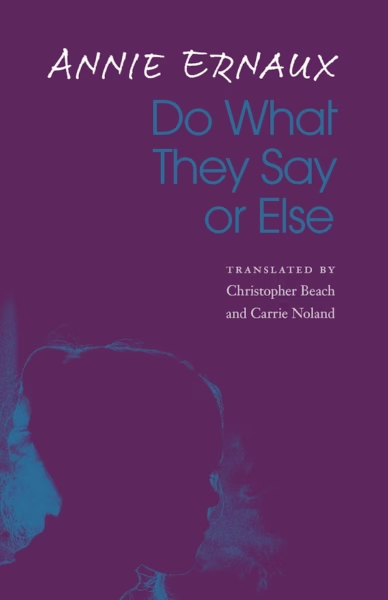 Annie Ernaux Do What They Say or Else
University of Nebraska Press
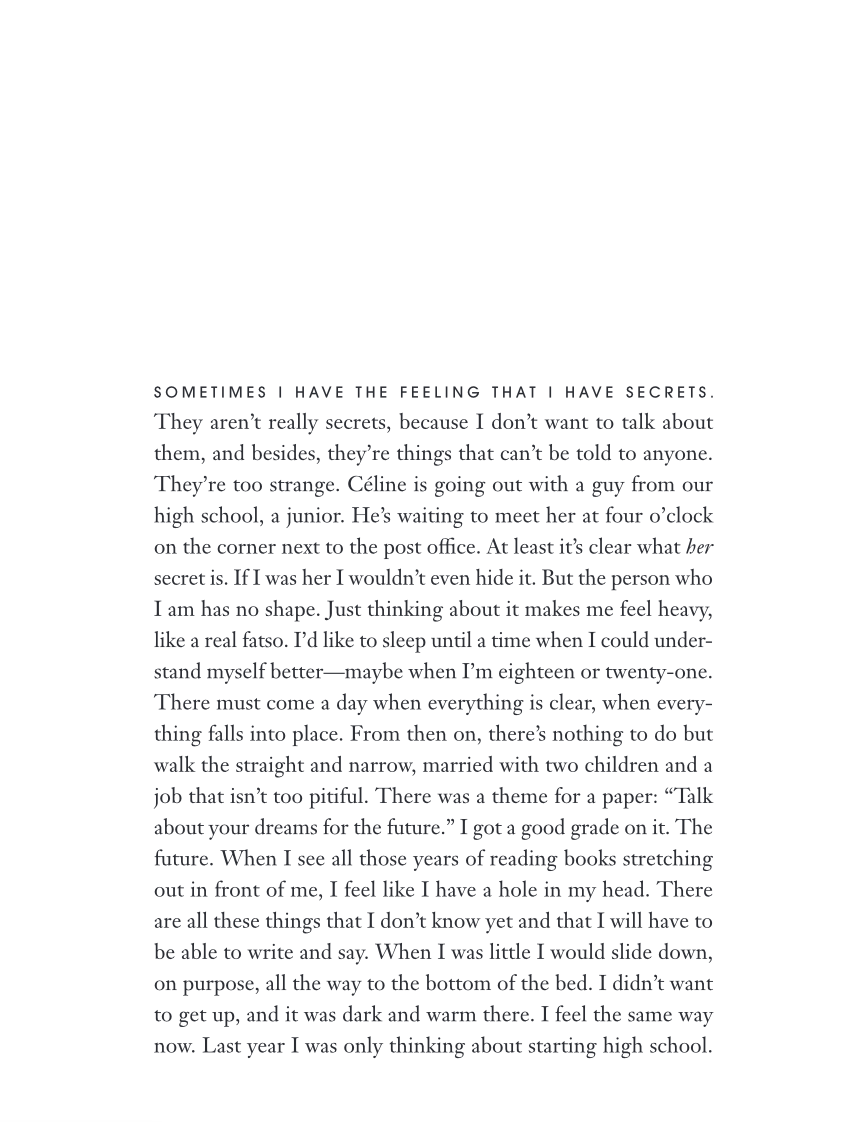
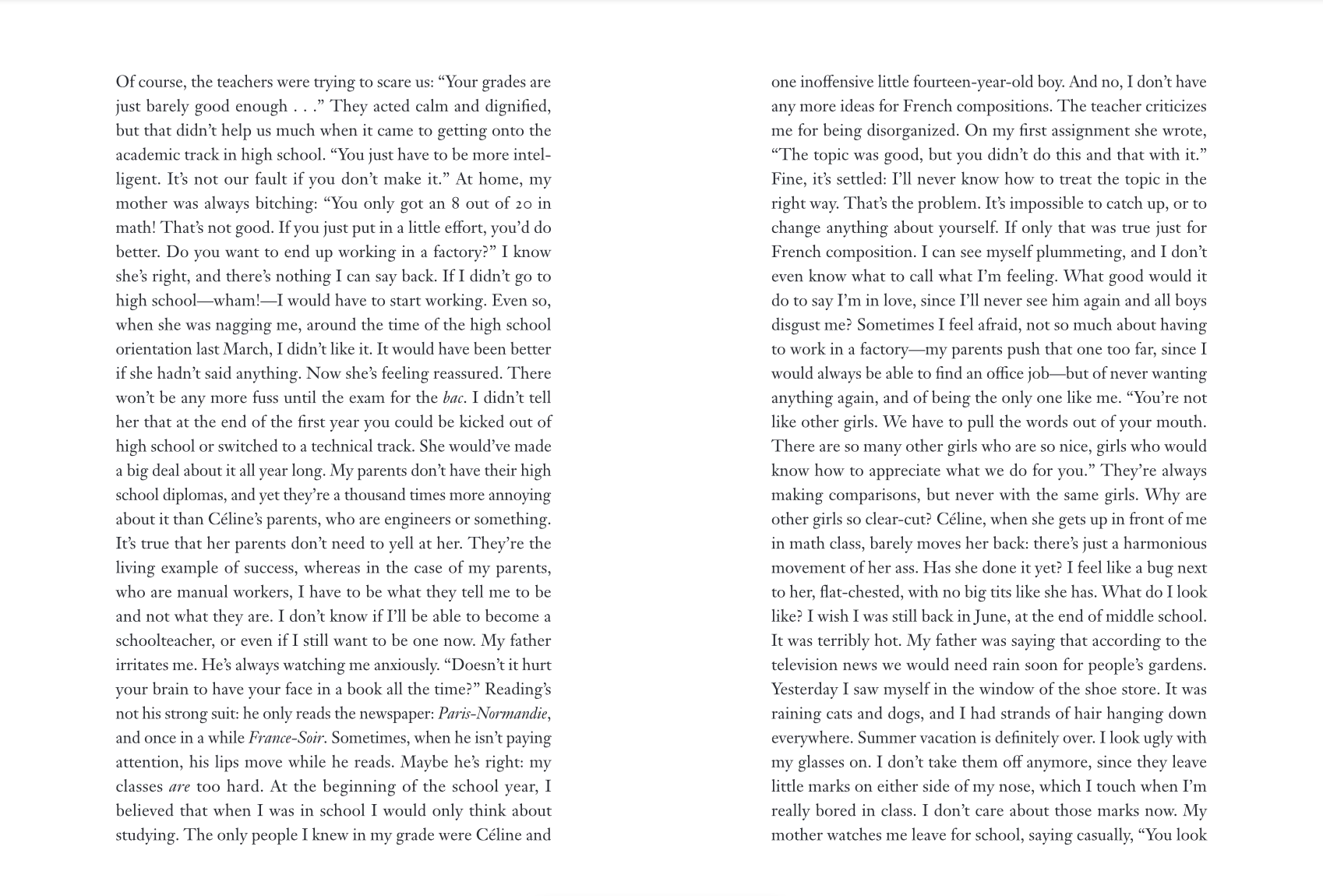
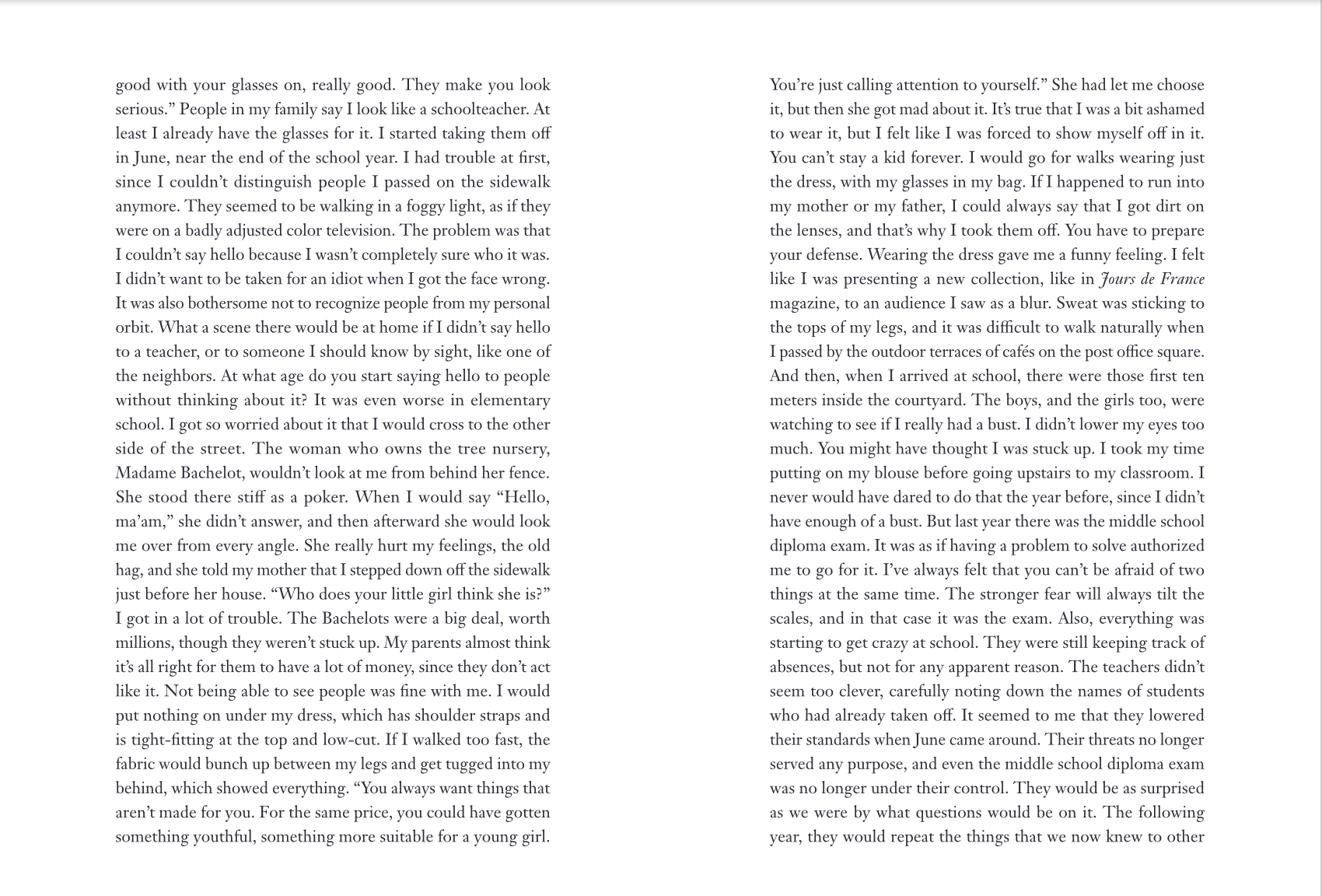
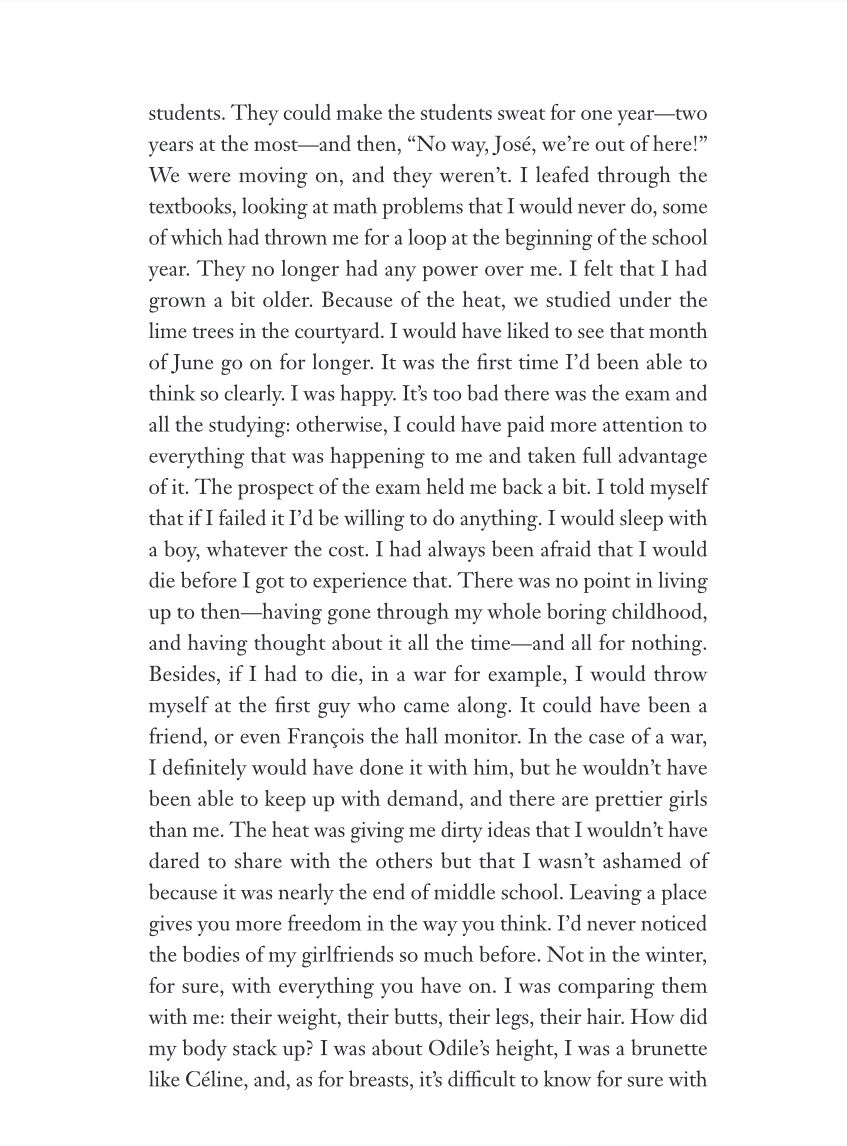
‘Originally published in 1977, Do What They Say or Else is the second novel by French author Annie Ernaux. Set in a small town in Normandy, France, the novel tells the story of a fifteen-year-old girl named Anne, who lives with her working-class parents. The story, which takes place during the summer and fall of Anne’s transition from middle school to high school, is narrated in a stream-of-consciousness style from her point of view. Ernaux captures Anne’s adolescent voice, through which she expresses her keen observations in a highly colloquial style.
‘As the novel progresses and Anne’s feelings about her parents, her education, and her sexual encounters evolve, she grows into a more mature but also more conflicted and unhappy character, leaving behind the innocence of her middle school years. Not only must she navigate the often-confusing signals she receives from boys, but she also finds herself moving further and further away from her parents as she surpasses their educational level and worldview.’ — UoNP
Excerpt
*
p.s. Hey. ** jay, Hi, jay. Yeah, Tati is otherworldly great. What a nice name, ‘Raindrop Prelude’. And you make it sound like one would hope. I’ll go find it and see if I know it. Happy early birthday! Oh, birthdays are kind of a mixed blessing at my point in life, so I’m pretty lowkey about them. Until it went out of business, friends and I would always celebrate by eating huge plates of nachos at Hard Rock Cafe. Taking the day off is the least you should do. Let or hopeful not have to make your friends shower you with stuff. ** scunnard, For the first few years I lived here in Paris I watched a lot of French TV and tried to catch up on all the legendary French singers, and there are thousands, and examples of French humor that I still don’t fully get. If you want to put together that post about that writer, yes, I’m totally interested. Absolutely. Sounds super intriguing. Thanks for the offer, man. My weekend wasn’t bad. Saw Nate Lippens read at After8 and met Rich who runs the great press Pilot. Had my occasional Movie Club with Zac and other friends where we watch a film and blab about it. Woody Allen’s ‘Interiors’, in this case. And I finally saw the new ‘Resident Evil’ movie, which was really fun. Like watching someone play the video game. Pretty terrific. Have a sweet week. ** Adem Berbic, I hope he escaped you from that. Cool about James’s solid advice. I bumped into him at a reading on Friday. Urgh on the current Test Dept. Yikes. I think Ramleh should still be holding their own. Their records are still good. ** Tosh Berman, Hi, Tosh. Yeah, Tati is on a level all his own. I didn’t know that about the Vian liner notes. Huh. They must be in storage somewhere online. I’ll look. ** Carsten, Well, yeah, I assume a lot of us wish that the things we’re passionate about would get official credit and the chance to leak into the interests of the wider public. One of my passions is original, unique writing wherever it may come from and whatever it’s about, and with Nobel/Carson I got lucky. ** Steve, Cool, enjoy the cousin-centric Thanksgiving. Hm, interesting about ‘Digger’. I need to get on seeing it because while it’s more liked here in France it’s not enough of a hit to stay in theatres for very long. I doubt it’s your thing but the new ‘Resident Evil’ film is quite terrific. ** _Black_Acrylic, All respect to your mom’s taste, but I do think she missed the boat on ‘Playtime’. ** ⋆˚꩜。darbbzz⋆˚꩜。, Hi! Oh no, you should only come as often as it feels right. Our friendship will hang in there no matter what. Thanks re: ‘Closer’. Of course you have my permission, it would be only an honor. Sorry about the kind of mess and confusion with Marty, but you said your bond is stronger so maybe it was just a development that didn’t feel like one. Communicating emotion in language is always so tricky and such a crapshoot. Sadly, I think simplicity is a state of mind. But then complexity is also a state of mind. How confusing. Sure, send me the post. That would be awesome. I hope your Monday is like a gilded frame. ** caro, Hey! Oh no, no problem. And thanks your e-address. I’ll write to you today. Thank you. Well, as you can gather, endless Halloween sounds like utopia to me. But then it also sounds like the premise of a scary ‘Twilight Zone’ episode too. Happy day! ** laura w, Yeah, one shouldn’t approach Tati expecting a conventional form of substance. Oh, god, the Renaissance Faire. I think I’ve mentioned that I actually worked at a Renaissance Faire when I was a teen. I was in a recorder consort, all dressed up in period drag, tooting our little horns, and we had to talk in fake Medieval speak. It was horrible. I just shuddered remembering that. My visit to the haunted park is a week from tomorrow. I hope the appointment-making is easy. It’s probably just you talking to an AI bot? My weekend was nice. I laid it out up above somewhere. Luck with everything this week. ** HaRpEr //, I agree! Oh, I know, that Sparks/Tati thing not happening is one of the great cultural losses of our time. See, I find the depths and labyrinthine build of British humour so interesting. American humour is very, I don’t know, transparent, I guess. Working with that does sound really fruitful and exciting. ** Dev, Hi, Dev! Oh, how great to have a kid you can introduce Tati to. I wonder what age a kid would need to be to lock into Tati’s humor and grace. I guess that’s fluid like everything else. Wow, a blog! And on my long lost home blogspot. Cool, I’ll go start keeping up with it. That’s so nice. Everyone, Dev has just started a blog called ‘Control Blog’ and it looks pretty cool so far, so obviously I recommend you go visit it, which is easily done by pressing down on this. Thanks, pal. ** Uday, Hey. Yeah, I totally imagine about how consuming that situation is. The future does make even the worst things into memories eventually, or at least mutations. Hugs. ** Okay. I recently read the novel situated up above and loved it, so I thought I should turn the blog’s spotlight onto it, and I have. See you tomorrow.



 Now available in North America
Leave a Reply