‘Born in Plymouth in 1940, Malcolm LeGrice is probably the most influential modernist filmmaker in British cinema. LeGrice’s work has explored the complex relationships between the filmmaking, projecting and viewing processes which constitute cinema as a medium, and shows an intense interest in the processes enabled by optical printers and by the combination of different types and gauges of film stock.
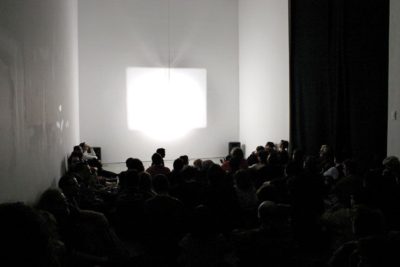
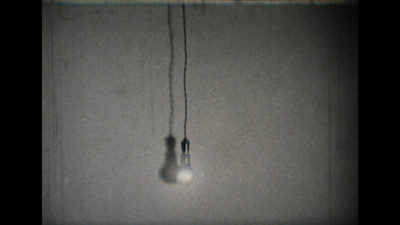
‘He started out as a painter in London in the early 1960s and turned to filmmaking in the middle of the decade with the Super-8 film China Tea (1965), which he followed with Castle 1 and Little Dog For Roger (both 1966), made mostly from re-worked found footage. Castle 1 can be seen as prophetic: for screenings of the film in 1968, LeGrice hung a light bulb next to the screen, flashing on and off at regular intervals and, when on, obliterating the screen image, a practice used in Martin Creed’s Turner-prize winning installation some 35 years later.
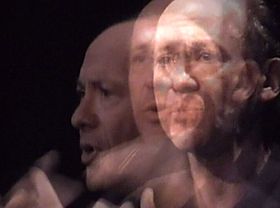
‘In the ’60s his work was informed by the radical politics of the period in opposition to the Vietnam War and US cultural imperialism, and extended to a deep hostility towards the ‘illusionism’ of Hollywood and other commercial cinemas. This tendency was particularly manifest in Spot the Microdot or How to Screw the CIA (1969), which includes found footage of GIs in battle. But LeGrice’s approach to cinema was also animated by a modernist impulse to put the central focus on the properties of the medium itself, turning them into the ‘content’ of the work. For instance, in White Field Duration (1972-73), a white screen marked only by a scratch running across clear celluloid, activates an intense perception of projection time. This film was also performed as a two-screen event and LeGrice’s installations at times extended to four or even six screens. From the late-sixties onwards, his multiple screen work was often accompanied by live performances interacting with the projection event (Horror Film 1 (1971) and Horror Film 2, (1972)).
‘LeGrice’s best and most complex work was done in the ’70s when, in the face of an intense hostility towards narrative cinema manifested by some of his avant-garde colleagues, he made a trilogy – Blackbird Descending (1977), Emily (1978), and Finnegans Chin (1981) – which elaborated a critical kind of storytelling in which both the formal aspects of cinema and the very structures of narrative are explored in relation to each other: The films are set in the film-maker’s own domestic environment and achieve a combination of intellectual and aesthetic intensity rarely seen in any kind of British cinema. LeGrice also engaged with art history (After Manet (1975), After Leonardo (1973)) and with the pioneers of cinema (After Lumière (1974) and Berlin Horse (1970) – in which he included a re-filmed Hepworth film of 1900, The Burning Barn).
‘In addition to being a prolific filmmaker, LeGrice played an influential role in the critical and institutional promotion of avant-garde cinema in Britain. He was a prominent activist in the Drury Lane Arts Lab, where he formed Filmaktion with William Raban, Annabel Nicolson, Gill Eatherley, Mike Dunford and David Crosswaite, and organised mixed-media shows. He was also a pioneer in the educational domain, initiating the trend towards establishing filmmaking sections in art colleges, a policy that bore fruit in the 1980s as new generations of filmmakers emerged from these courses. He is also an inveterate polemicist: his book, Abstract Film and Beyond, provides both a historical and a philosophical context for the British and European avant-garde cinemas, and he has contributed regularly to the journal Studio International.
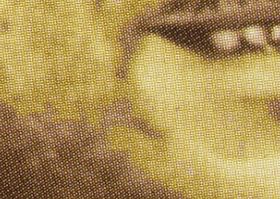
‘LeGrice carried out the first experiments with computer-based film making in Britain (Your Lips 1 (1970)), and though it was a preoccupation that he laid aside after 1971, it came to dominate his media practice (along with research into digital art) from the 1980s onwards. Since 1997 he has headed the media research programme at Central St Martin’s art college in London, accompanying his activities with critical-historical reflections.’ — Paul Willemen
____
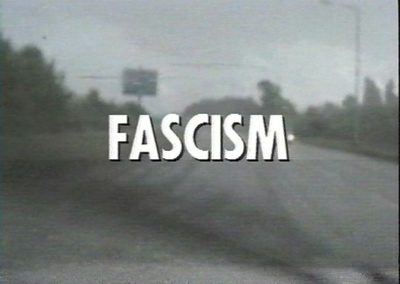
Stills

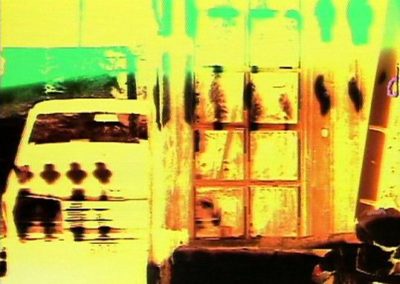
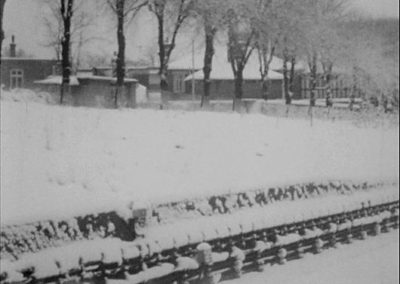

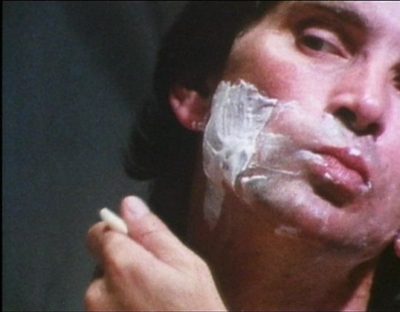
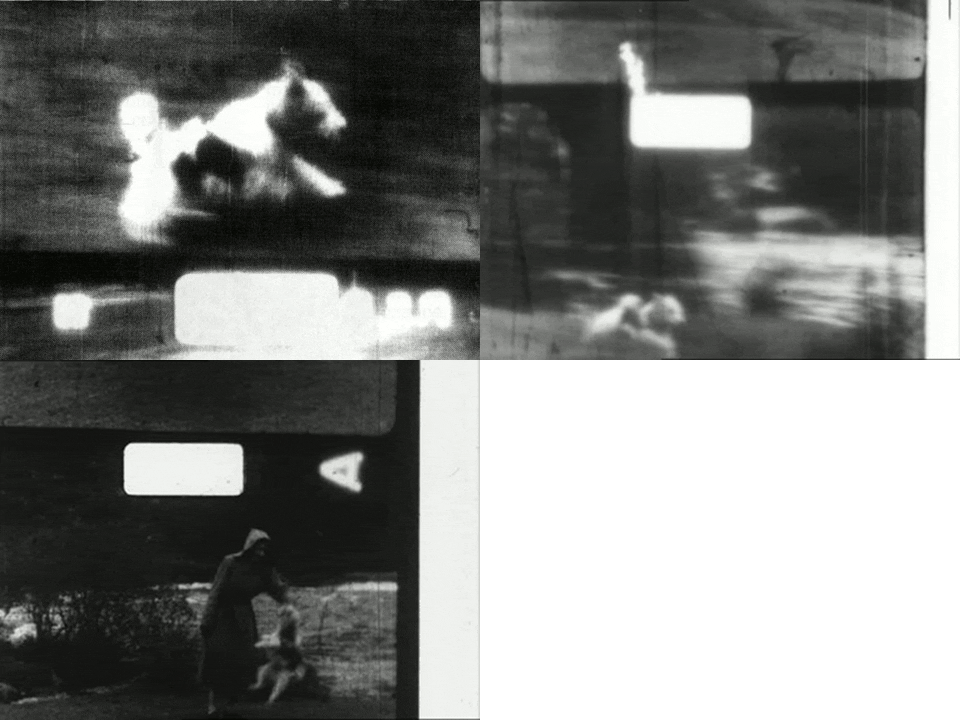
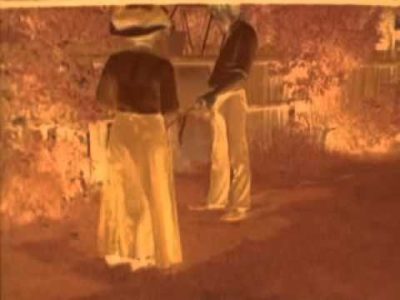
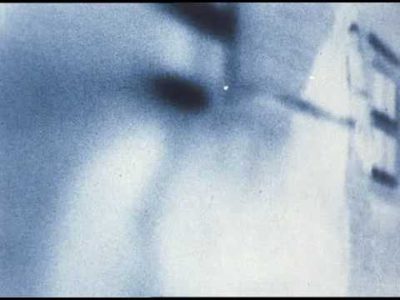

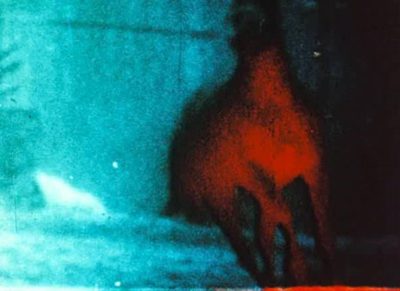

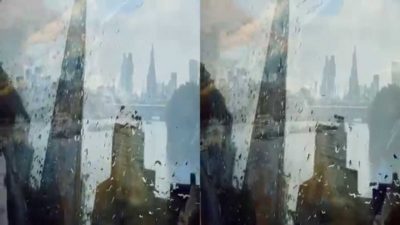
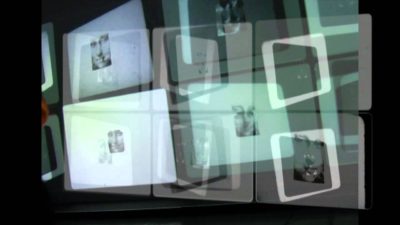
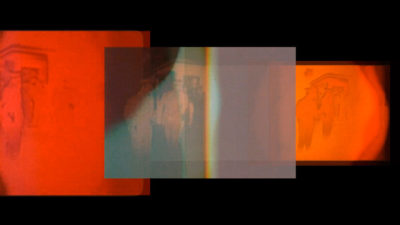
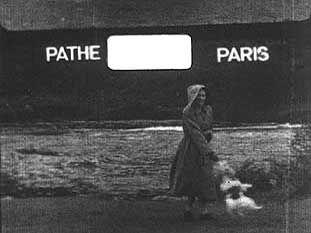
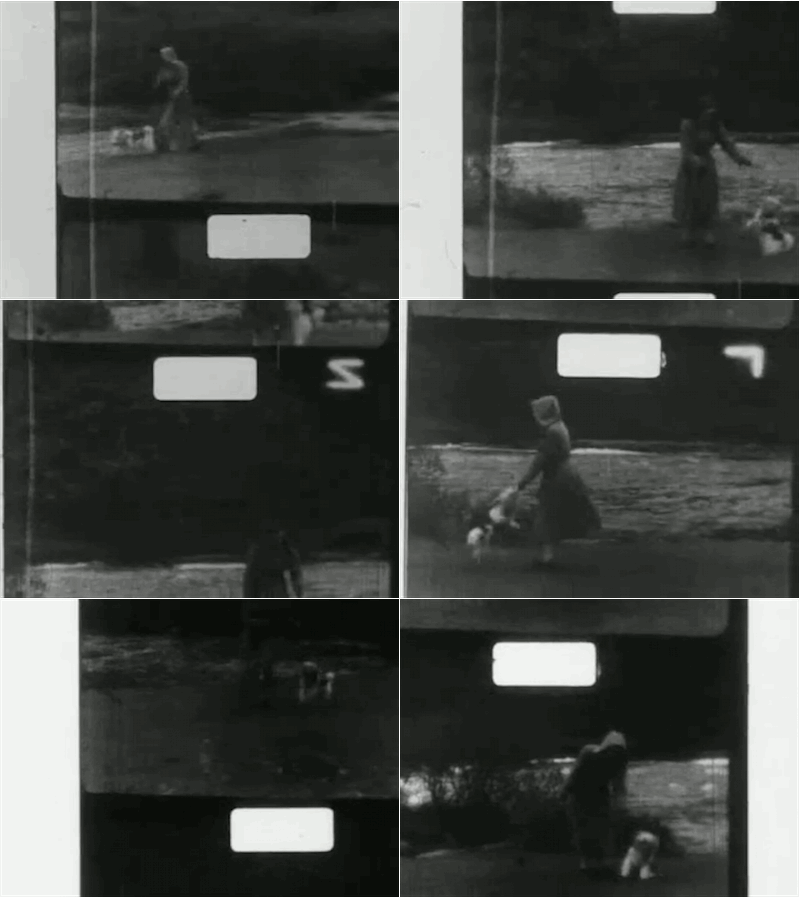
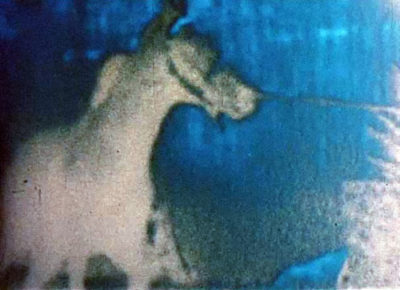

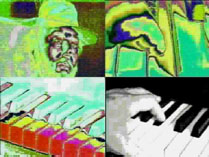
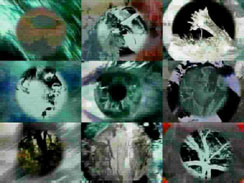
_____
Further
Malcolm Le Grice Site
MLG @ Lightcone
MLG @ Richard Saltoun Gallery
Malcolm Le Grice: In the Cinema
Multi Screen Improvisation Performed by Malcolm Le Grice and Keith Rowe
Malcolm Le Grice: Present Moments and Passing Time
MALCOLM LE GRICE’S ‘BERLIN HORSE’ @ desistfilm
MLG @IMDb
Muybridgean Motion/Materialist Film: Malcolm Le Grice’s Berlin Horse
“Discourse” versus “Medium”. Interview with Malcolm Le Grice
Beyond Abstract Film, on Malcolm Le Grice
MLG’s books @ goodreads
DVD: Afterimages 1: Malcolm Le Grice Volume 1
‘Abstract Film and Beyond’, by Malcolm Le Grice
After Le Grice: on inciting a new culture and infiltrating institutions
Malcolm Le Grice @ letterboxd
MLG @ MUBI
An Analysis of the Soundtrack in the Work of Malcolm Le Grice
_____
Extras
Malcolm Le Grice February 11, 2019, LA Filmforum
Horror Film (Malcolm Le Grice, 1972/2014)
Arts/Sciences#14: Malcolm Le Grice – Spectator, Presence and Encounter
_______
Interview
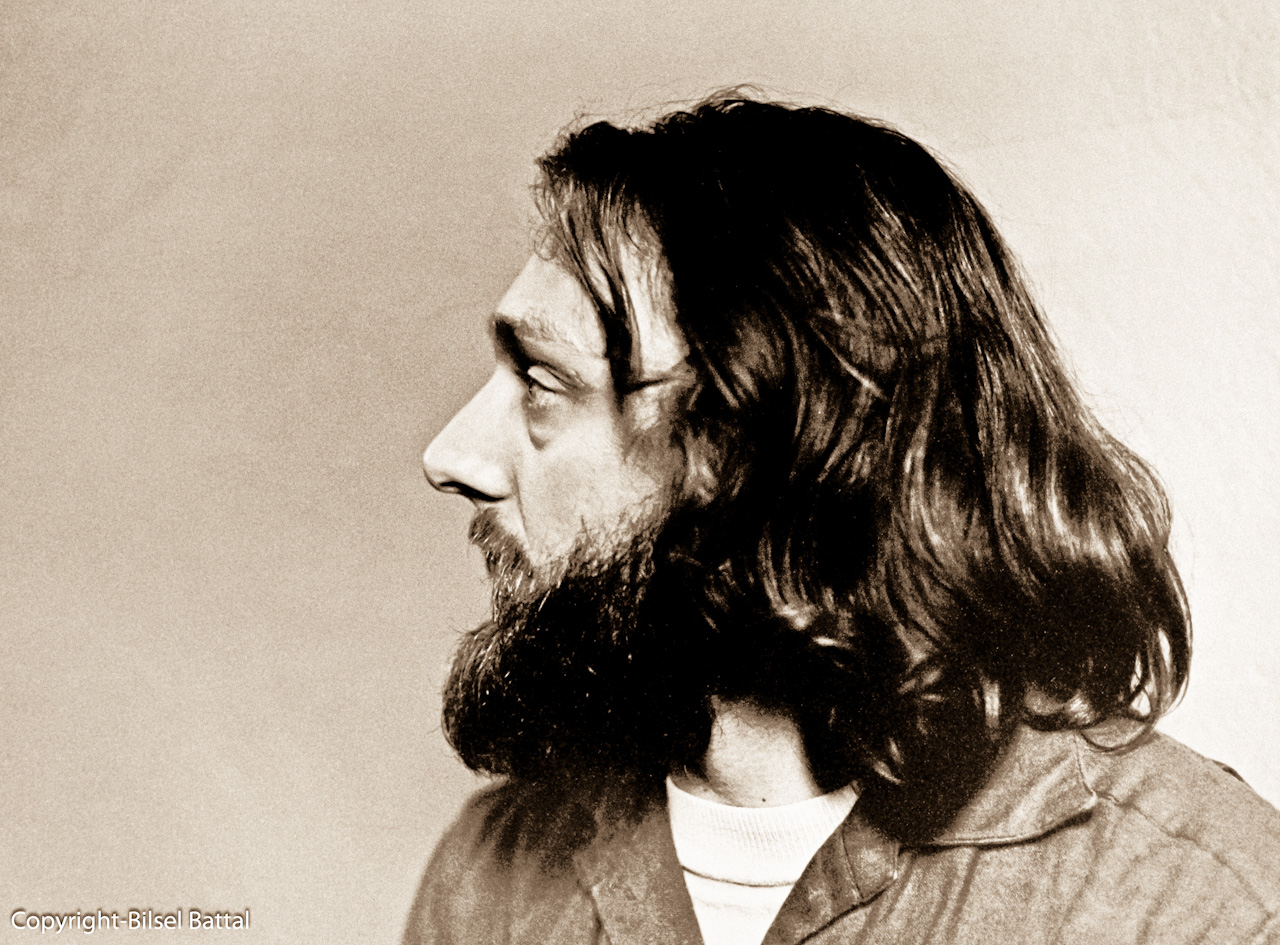
D: You were actively involved in the film cooperative movement in the sixties. Could you describe your relationships to the London Film Coop, founded in 1966, and how it interacted with your own practice of expanded cinema?
MLG : Your simple question is not really so simple.
I had started making films just before the London Film Makers Cooperative (LFMC) was formed. I began making films as one part of my movement from painting into other art media – including electronic technology and computers. When I made my earliest 8mm films in 1965 I did not know about the Underground cinema in the USA nor the New York Co-op. At that time I also did not know of the early avant-garde cinema – I only started to research that after making my first films.
The origins of an experimental film scene in London in the late 1960’s were also complicated. My first and main contact was not with the LFMC but with the first Arts Laboratory in Drury Lane, London set up by Jim Haynes, and where an old artist friend, David Curtis, had started a basement cinema. From 1967 I showed my work there and quickly, helped by Curtis’s programme, learned about the American and European experimental cinema. At the same time a group of people who wanted to be film- makers began the LFMC. But at that time it was only a distribution organization, showing occasionally at Better Books, a radical bookshop run by Bob Cobbing.
At the Arts Lab, responding to a situation where there were almost no experimental film-makers working in London – partly because of the cost of making 16mm films – Curtis and I developed the idea of establishing a film-makers workshop. I started to put this into practice by making home-made film printing and developing equipment. Though this worked for me and I made almost all my earliest 16mm films on it, it was too fragile and temperamental for other film-makers to use.
During 1968 it became clear to a number of people that it was crazy to have two organizations for experimental film in London when there were so few film makers – so we set up a series of meetings where Simon Hartog from the LFMC and myself from the Arts Lab were asked to make a plan for merging the Co-op and Arts Lab film area. Hartog and I then made a plan and constitution for a new LFMC that would have a workshop and cinema as well as distribution.
Through a contact made by Curtis at the Arts Lab, we were given £3,000 by an American art enthusiast, Victor Herbert, and I bought some used but very good professional film laboratory equipment. The workshop was mainly based on a 16mm Debrie ‘step’ contact printer that we installed at the second Arts Lab incarnation. Though this Debrie was not strictly an ‘optical’ printer, it allowed all sorts of inventive ‘mis-use’ – printing loops, pulling film through the gate by hand, re-colouring with filters or making multiple exposures. This led me and others to explore a range of methods for transforming the film image. The workshop, together with a cinema in the same building, meant the LFMC really took off and became the main centre in London for experimental film screening and production.
D: So what about your own work and expanded cinema?
My expanded cinema direction really started at the first Arts Lab cinema in Drury Lane in ’67 and ‘68. Curtis had designed the space with a very wide screen – a plain large white wall -, a floor with no seats, but a carpet on soft foam and two 16mm projectors. I started to make double projection films partly because the space and two projectors were available there. A little later, the LFMC workshop meant we could produce films very cheaply using black and white Orwo film brought in from East Germany – made at the old Agfa factory under the communists long before the re-unification. This film material had a characteristic high contrast – an old newsreel quality that suited the political environment of London in the politically active period of 1968. The egalitarian core and lack of censorship of the film-coop movement that started with the NY coop also appealed to my ideological position. The London coop quickly developed not just as a centre of experimental film making but also a very active centre of debate about film, culture and its relationship to politics and ideology. In particular I was frequently in discussion with Peter Gidal, who established a definition of Structural Materialist Film – some of these were public debates and we both published theoretical and critical essays.
So – the coop was a major influence on the development of my practice as a film-maker. It provided a very active, energetic intellectual context as well as facilities for production, and in each new temporary building – moving frequently into low rent but short life buildings – the projection space was suitable for experimental forms of projection, shadow and other forms of performance, live music and improvisation.
If the co-op was a major influence, it would be wrong to see it as the only influence. As is well known, London in the 60’s was a hot bed of artistic and ‘life-style’ experiments coupled with politics and protest. There was an eager audience for the ‘underground’ and new forms of art and art fusions. In this environment I was not only involved with film but also experimenting with early, primitive video and particularly seriously with computers. I made various performances including a 3D shadow play and continued my link with experimental music and sound through occasional light and sound performance with the experimental music group AMM.
Tracing specific influences in such a multi faceted environment and historical period is not an easy task.
D: In a sense, it is this idea of a “multi-faceted environment” that offers an entry into your work with film, early video, performance, shadow plays and experimental sound. We would thus like to ask you how “expanded cinema”, the political atmosphere of the time and forms of “intermedia” work interacted with each other? Also, how this set of relationships can be found in your own early experiments with the moving image and sound?
MLG: It is very important to understand that in the late 1960’s many artists were breaking away from the constraints of a single traditional medium – Painting, Sculpture, Music for example. They were experimenting with other media and also with combining media. I now like to talk of this as combining ‘artistic discourses’ rather than media – particularly as almost everything in art production and art viewing is now mediated or re-mediated through a digital process – so what is significant is the combination of historical contexts of ‘language’ rather than the physicality of the ‘medium’.
As a painter and a student at the Slade School in London in 1964 I also became dissatisfied with the limits of painting and started to make work where the painting was only a surface linking to the reality in front of it – with flexible physical attachments and objects hanging in front from clips that could be changed and with microphones and flashing lights – the paintings became time works where the meaning happened subsequent to the work rather than through interpretation of the artist’s intention. So – it was more concerned with a philosophy about the spectator, presence and ethics than about representation, expression and aesthetics. Shifts in medium were not in themselves my main motivation – though Film became the main focus when I started to treat it as a live-performance and not a retrospective narrative. As so little work had been done historically using film in this way a big field of experiment opened up for me, and with the added advantage that it allowed me to combine my earlier involvement with improvised music with my visual (painterly) engagement.
During my period as an art student from about 1959 to 1964 I had also become ‘politicised’ but in a very particular way. In that period Britain was a very closed and hierarchical society – a condition that sadly seems to be rapidly returning now. The aristocracy and wealthy establishment working through public schools and closed Universities seriously inhibited social mobility and meritocracy. Reaction to this came at a number of levels. Changes in dress and life style hit a peak in the late 60’s side by side with the rise in a youth culture of rock music – these were revolutionary if only at the symbolic surface. More fundamental was the rise in left-wing politics pressing for working class equality that was intellectually Marxist but at the grass roots led to increasingly militant workers union activity. This itself was fuelled by the rift with an often incompetent managerial class who had achieved their positions through class contact rather than merit.
I had come into this from a curious provincial sub-working class background. Mine was a family without wealth or education but who were able to live from their wits and energy sometimes near legal borderlines. However they went frequently, and took me, to the theatre and played music. So when later I found myself in the context of the London melting pot of the ‘swinging sixties’, I shared a radicalized political position with a desire for artistic expression. But – and it is a major ‘but’ – these two aspects were never linked directly. I certainly never led my artistic production by any didactic political idea. The two things ran in parallel – an anti establishment politics and a radically experimental approach to art. If they came together it was in the development of an art theory gradually clarifying a spectator-based concept applied mainly in film. This theoretical development was strongly connected to the ideas being developed at the time by Peter Gidal that he called ‘Structural Materialism’. Again I should stress that when I made and showed work I did this from improvised ‘instinct’ within the discourse of the visual, rhythmic, durational, colour, time image. The works were never led by theory. If they linked to the theory it was through a common psycho-philosophical-ethical sub-structure that is the complex core of artistic practice. My theory and that of Gidal were never a manifesto – they were not belief systems.
I always argued that any political stance that I took should be realized through work on the artistic context rather than artistic content. This was the basis of the work I did with the London Film Co-op, in Art Education and on various committees of the British Film Institute and the Arts Council. Here I was motivated by an attempt to shift awareness but also the economic basis of radical art production.
So what of ‘Expanded Cinema’. Curiously I don’t think we talked about the work as ‘Expanded Cinema” until after the Youngblood book was published in 1970. From my recollection I talked about Multi-projection, Performance and after 1973 with the Gallery House show, Installation. In my work a large proportion of my early films were for a comparative two or three screen projections – not randomized multi-media – but, like ‘Castle 2’ (1968), were tightly edited and synchronized focussed on the spectator experience of making their own sense from a ‘present’ duration. The performances related to film were mainly shadow plays like ‘Horror Film 1’ (1971), tape/slide/film improvisations like ‘Wharf’ (1968), moving projector works like ‘Matrix’ (1973) or reading works like ‘Pre-Production’ (1973). But there were other non-film performances at the time. I did a series of live Video performances at the two week ‘Drama in a Wide Media Environment’ show at the London Arts Lab in August 1968, one including an improvised ‘happening’ with news-feed from the Czechoslovakia Russian intervention.
The performances also included audio and light elements in performances by AMM at 26 Kingly Street and a computer generate ‘Typo Drama’ at Event One of the Computer Arts Society in 1969. My installations began with multi-screen loops – mostly abstract colour fields – with audiotape like ‘Gross Fog’ and ‘Josephs Coat’ in 1973.
Returning to the idea of ‘discourse’ rather than ‘medium’. Yes, my work explored cross-media in the physical sense, film-material, the screen as a picture surface, the re-construction of the image through printing treatments, some (primitive) electronic technology in feeding sound to control lights, computers to generate text or film-image (‘Your Lips’ 1969/71). But even within this material concept, the definition of what constituted the ‘medium’ went beyond the established boundaries of ‘medium’. Here, electricity is treated as both medium and content, generated in a socio-political context, enabling the light bulb itself in ‘Castle 1’ (1966). Here an actual flashing light is both an interruption in front of the screen and also represented in the film, and by implication draws attention to the projector light as integral to the medium. This work, drawing attention to the audience space before the screen also extends the concept of medium to the space and time of the projection itself – a kind of temporal sculpture. So, these extensions of the physical understanding of medium are also extensions in the discourses between media and the social forms creating the context for artistic experience – and technology is no longer the carrier of meaning but part of the language itself.
If there is a central consistency in this (which of course there may not be), it is the change of focus from the condition of the artist as the ‘maker of meaning’ to the spectator as the ‘constructor of meaning’. This is an ethical shift that is achieved (if it is achieved) by the aesthetic means of the work. It implies that the artistic experience is not one of retrospective interpretation – interpretation of the meaning put into the work by the artist – but of subsequence, the effect of the experience as it enters the life of the spectator.
Though I may have had political intentions in my work of this early period, few of the works attempted to engage these directly. ‘Castle 1’ and ‘Castle 2’ emerged from a loose, psychological, political interpretation influenced by Kafka (thus the Castle reference). Perhaps the most directly ‘political’ work was ‘Reign of the Vampire or How to Screw the CIA?’ (1970), that used heavily treated military images. However, I was already aware that the representational aspect of ‘political’ content was ineffectual in the social discourse of politics (thus the question mark in the title). Its effective context was the symbolic discourse of art and, in an attempt to square my political motivation with my more intuitive, subjective artistic work, I began to talk of the ‘Politics of Perception’. My interest shifted more clearly to the conceptual behaviour of the spectator. And this attitude broadly remains – not taking up political issues but attempting to make works that require the spectator to think in a different way outside dominant ideologies refusing fixity of meaning or systems of belief.
_____________
18 of Malcolm Le Grice’s 88 films
_____________
Castle 1 (1966)
‘A film made with found newsreel footage combined with sequences of a flashing light bulb. It is projected with a real flashing bulb hanging in front of the screen. It is available as a 16mm film with the flasher unit or as a digital video version for repeating installation.’ — MLG
Excerpt
____________
Little Dog for Roger (1967)
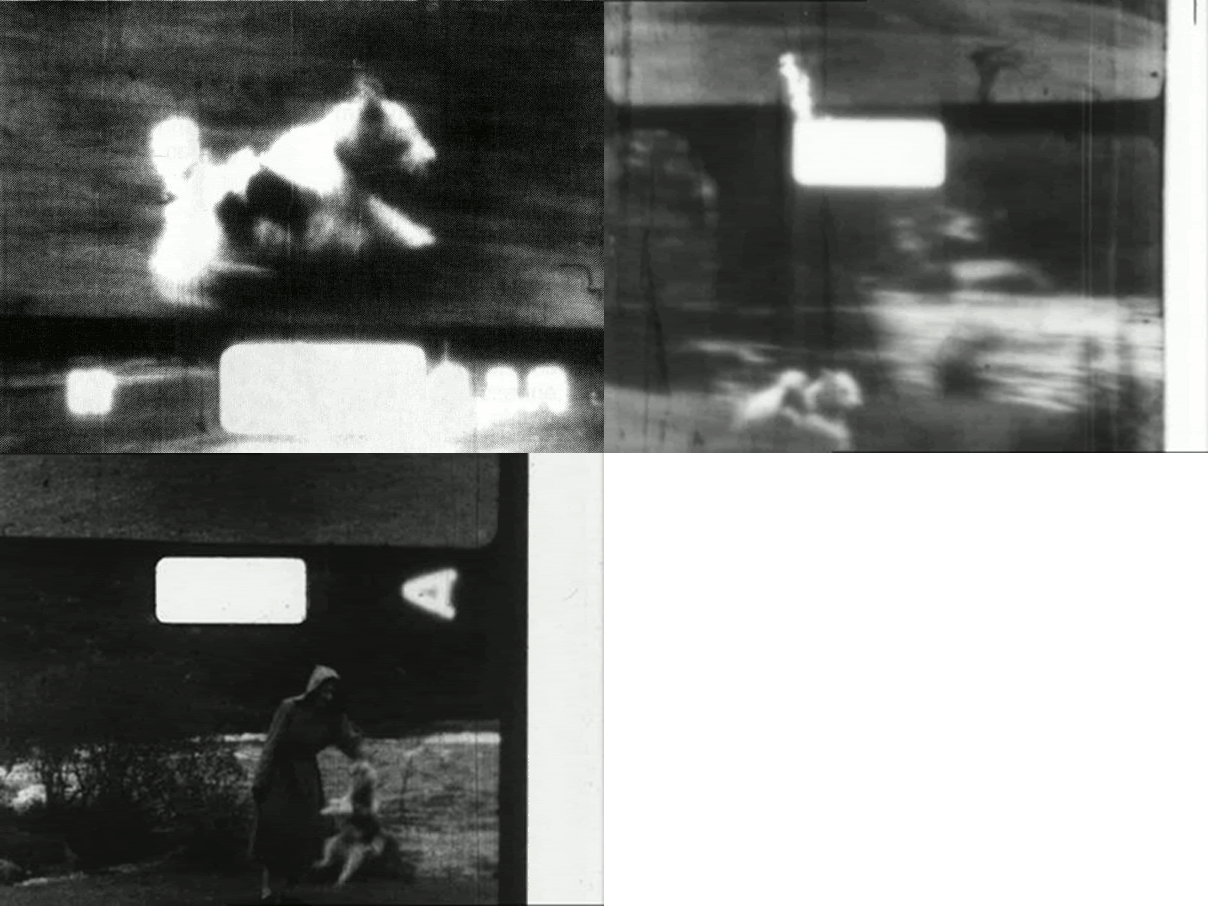
‘I thought it was about film as a medium and material – scratches, sprocket holes, dirt, slippage in the projector, blank screen, gaps in the sound-track – I forgot that one of the boys was me, the other was my brother, the young woman was my mother – now dead – and behind the camera in 1952 was my father – the dog was mine – nothing to do with Roger – that’s another story.’ — MLG
Excerpt
______________
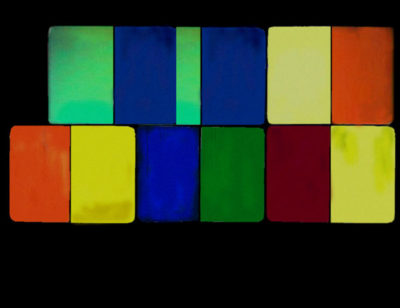
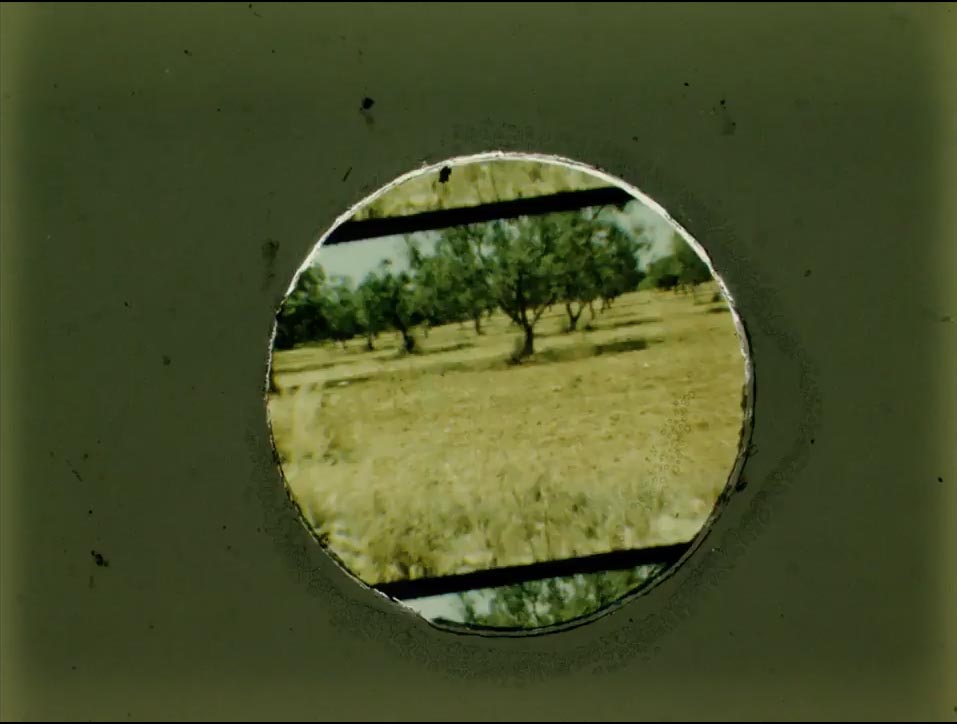
Spot the Microdot (1969)
‘This film was made by punching circular holes into fully opaque film stock and laying discs of colour film into some of the punched holes. Only the original copy of this film exists – it cannot be printed and is therefore projected only on rare occasions. As with other Le Grice films from the late 1960s, Spot the Microdot is marked by a radical rejection of ‘illusionism’, choosing to focus instead on the material properties of the film medium itself.’ — Mark Renton
______________
Berlin Horse (1970)
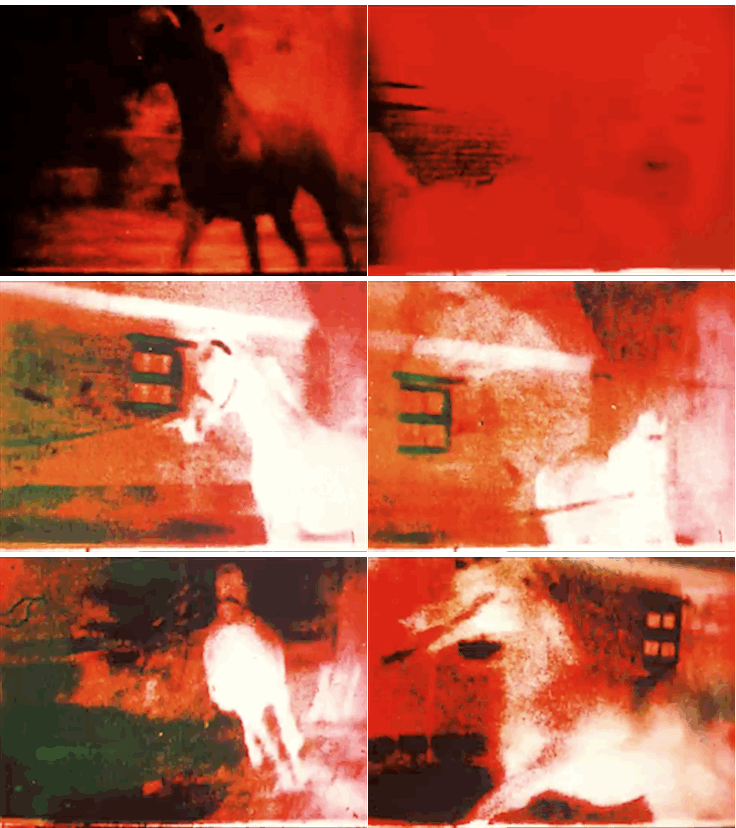
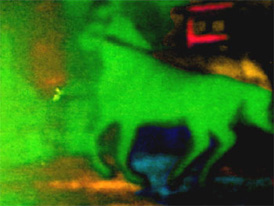
‘Umberto Boccioni’s fascination with “the dynamic problems of speed, change and fragmentation themselves,” specifically as they related to his volumetric analyses of horses galloping in splintered thunder in paintings like The City Rises (1910) and Charge of the Lancers (1915), could well be seen as having laid a framework for Le Grice’s own slow-burning 1970 film/video/multimedia recording/double projection event, Berlin Horse. In that six-and-a-half minute masterpiece of cinematic serialism, someone’s four-legged friend runs round and round a small corral in a village near Hamburg called Berlin (not the city) until time slips a gear and the world bursts into flame. Horse becomes horses, white horse, black horses, shadows and negatives, looping and layered. A zoetrope, a merry-go-round, then the colours kick in: Muybridge on mushrooms. Le Grice fans the flames. Brian Eno made the soundtrack: the plinky, refracted cascade of a waltz cadence, spinning in upon itself forever, “repetition is form of change.” (No horseyfooting.)’ — Chuck Stephens
the entirety
_____________
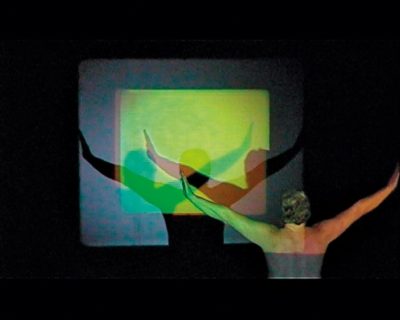
Horror Film 1 (1971)
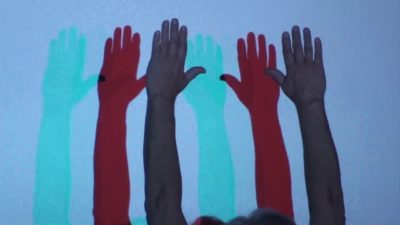
‘First presented in 1971 using three 16mm projectors each with a short loop of changing colour. Projected onto the same screen – the centre image large and the two side images smaller and superimposed into the centre of the larger screen. The performing body casts complex colour shadow. The action begins touching the screen and – passing through the space of the audience – it ends at the projectors. The actions are timed to an audio tape of breathing. Though improvised in detail to fit the particular time and place, the action follows a consistent pattern that has changed little since the first performance.’ — MLG
Excerpt
the entirety
______________
Threshold (1972)
‘…Le Grice no longer simply uses the printer as a reflexive mechanism, but utilises the possibilities of colour-shift and permutation of imagery as the film progresses from simplicity to complexity. The initial use of pure red and green filters gives way to a broad variety of colours and the introduction of strips of coloured/celluloid which are drawn through the printer begins to build an image which becomes graphically and spatially complex – if still abstract – and which evokes the paintings of, say, Clifford Still or Morris Louis. With the film’s culmination in representational, photographic imagery, one would anticipate a culminating ‘richness’ of image; yet the insistent evidence of splice bars and the loop and repetition of the short piece of found footage and the conflicting superimposition of filtered loops all reiterate the work which is necessary to decipher that cinematic image.’ — Deke Dusinberre
the entirety
______________
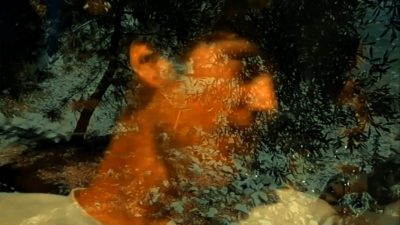
Whitchurch Down (1972)
‘This film is the beginning of an examination of the perceptual and conceptual structures which can be dealt with using pure colour sequences in loop forms with pictorial material. In this case the pictorial material is confined to three landscape locations, and the structure is not mathematically rigorous.
‘Witchurch Down is an area of open common land, situated on the edge of Tavistock, Devon, which in total covers over 460 Acres. I particularly like how Le Grice’s abstraction process lends an ‘alien’ and disorienting quality to an otherwise familiar, bucolic view.’ — dovic
the entirety
______________
After Leonardo (1974)
‘In my six-screen film After Leonardo, an old crumpled, black and white detail reproduction of the Mona Lisa is attached, during the projection, to a blank white screen.On the other screens are various filmed images of the same reproduction shot at difference distances and also images, a further refilming of the film from the screen. One interpretation of the juxtaposition of a real object (albeit a reproduction of a cultural icon) alongside its cinematic representation is that it highlights the reality of the cinematic in the context of an object we assume to be part of the real physical universe. By ‘reflection’ it reinforces a reading of the cinematic as similarly composed of physical substance and the product of material processes.’ — Malcolm Le Grice
Excerpt
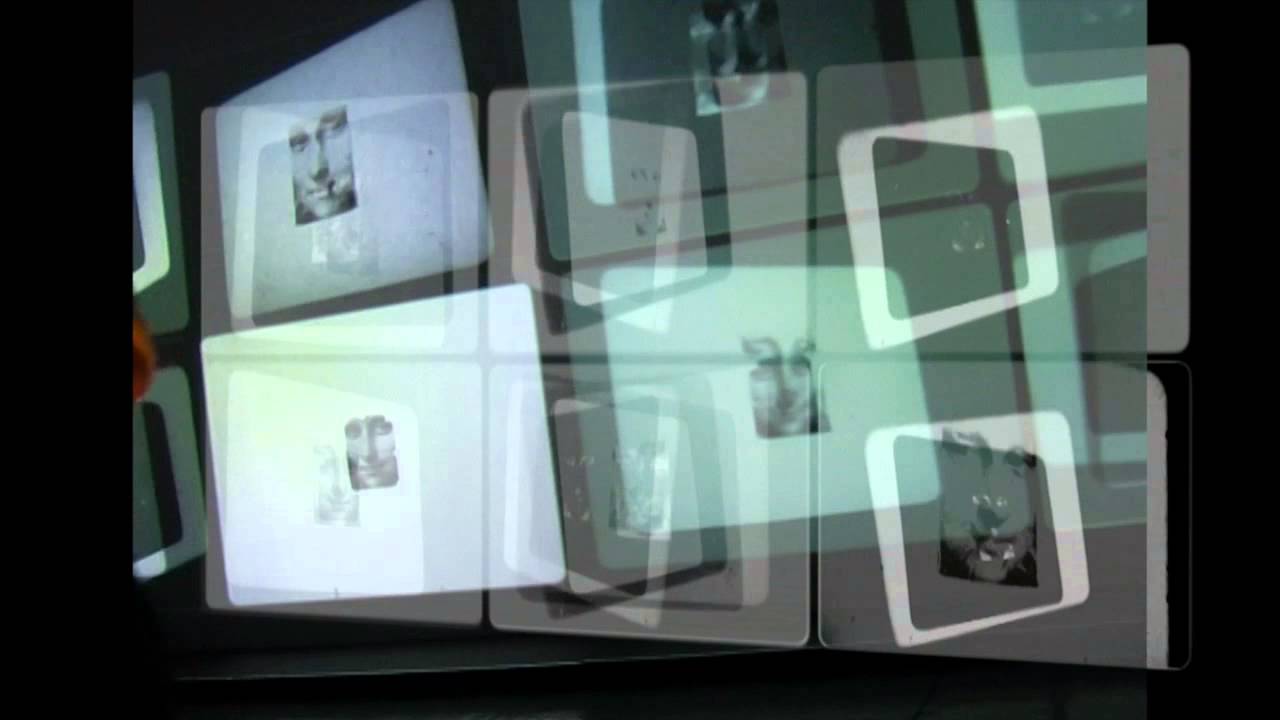
Watch ‘Eighteen fragments from Malcolm Le Grice’s After Leonardo’ here
_____________
L’Arroseur Arrose (1974)
‘The films of early cinema are almost like legends or myths now, and its methods and symbols have seeped into our unconscious. After Lumière – L’Arroseur Arrose (1974) by Le Grice picks apart one of early cinema’s classic and frequently re-made works. In Le Grice’s version the act of the gardener being distracted by his lady mistress and then getting soaked by his hose and a young urchin is re-formatted and repeated four times. Early cinema and experimental film can be remarkably similar, a point not lost on people when early films began to shown more frequently towards the end of the 1970s. Here Le Grice highlights film language by emphasizing the film format, the spatial dynamics of the narrative and curiously the class relationships here too.’ — The Quietus
the entirety
_____________
Gross Fog (1973)
‘A four screen film projection onto four vertically placed screens, which span the gallery space from floor to ceiling. The wall surface is transformed into a rippling column of colour, accompanied by a soundtrack of running water.’ — luxonline
Excerpt
________
Weir (1993)
‘An encounter with a small man-made waterfall, firstly seen as a sculptural form then in ultra close-up and slow motion of the movement of falling water.’ — luxonline
the entirety
__________
Autumn Horizon number 3 (2005)
‘The last in a series of three screen works exploring alignment of the horizontal. Initially the work was dedicated to Felicity Sparrow on the death of her partner, artist, Ian Breakwell. New, HD multi camera versions may continue to be made.’ — MLG
Excerpt
__________
DENISINED – SINEDENIS (2006)
‘I sat with Dennis Oppenheim in Kassel and he gave me a working photograph of a drawing for his installation Mind-Twist-Wandering – I asked him to sign it for me – now in a little clip frame in my studio. While we talked I took four photographs on a very low resolution Palm organizer. I liked the pictures and made them into a repeating sequence 1-2-3-4-3-2-1-2…. and so on – a first level palindrome – then I copied the sequence at different levels of increasing speed until they animated – next I copied the whole sequence, reversed it to a second level palindrome. In a reference to Duchamp’s ANEMIC CINEMA – a partial palindromatic title – I devised the palindromatic front and end title (losing an N as there were too many! Sorry Dennis).
‘I wanted a sound track and liked a Bach sonata – I put this on and treated the speed in the same way as the picture (holding the pitch level) – also I treated this as a palindrome – reversing it for the second part of the video. When I showed this to Steven Devleminck and discussed the palindrome he told me that Bach had written a palindromatic work known as the ‘Crab Cannon’. I then decided I would re-make the piece using this music which I located with the help of Al Rees and Nicky Hamlyn (who sent me a copy of the sheet music). I keyed the piece into my computer MIDI programme – and voiced it for strings – then treated it in the same way of speed changes and reverse repeats. The current version of the video has this constructed track. Another reference point is Forwards Backwards Minute Waltz by Ladislav Galeta.’ — MLG
Excerpt
____________
Self Portrait after Raban Take Measure (2008)
‘Self Portrait looks for an approach to a specific relationship between the duration of a work and material conditions in the projection as did William Raban in the film-performance Take Measure. The main difference is that Raban’s work was made when cinematic media had distinct physical properties linking medium directly to image – this self portrait recognizes that there is no such simple materiality for cinema following the emergence of digital processes. Instead the work takes a conceptual base – the speed of light and the time taken for light to travel from the sun to illuminate objects on earth –thus the duration of 8 minutes 20 seconds.’ — LA Filmforum
Excerpt
___________
Water Lilies after Monet (2008)
‘My experience of Monet’s large scale panoramic paintings of his water lily garden when I was about 14 years old became a crucial artistic memory. There have been a number of versions of the material I shot in about 1984 of water lilies and reeds in a pond. This sketch is part of a larger project ‘Finiti’. The sound was made by AMM for an earlier video work but has been re-mixed for this version.’ — MLG
Excerpt
____________
Finiti (2011)
40 minutes, multiscreen video
Excerpts
___________
Where When (2015)
‘3D has been used by commercial cinema as a means of re-engaging audience with the spectacle of cinema, doing something TV and now the internet cannot easily replicate. It’s a current phenomenon but not a new one. Similarly, Le Grice explored it in the early 1970s and then again late last year, with Where When (2015) creating floating pools of diaristic images that fill out the screen and immerse the viewer in the elemental forces of nature – bright sun, rain, lapping water. The warm colours are rich and the images involving, feeling both present and yet abstracted through the mixing of different locations within the same visual field. The images are shot 2D but then placed in a virtual 3D space.’ — The Quietus
Excerpt
___________
Marking Time (2015)
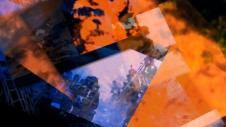
‘Marking Time (2015) meanwhile staggered deep layers of colour, sending the viewer into a vortex of electric blues and oranges, evoking both the paintings of Rothko and Le Grice’s on-going interest/fascination/obsession with the spatial and emotional resonances of different hues. Le Grice has been critical of mainstream cinema, with its emotional manipulations, but not spectacle in its rawest, most open of forms.’ — The Quietus
the entirety
*
p.s. Hey. ** Adem Berbic, And same back from Madeleine. There’s a piñata store in the 10th near the canal where we got most of the pinatas for ‘PGL’, and it’s great but I don’t think you can smash them there. If the venue is locked in, fate’s in charge. I’m sure it’ll be festive even through your nerves. See you where art goes to die in a mere several. ** Dominik, Hi!!! No big. I’ve never been to Palermo, so that would’ve been interesting, but it’s also nice to have a rest between gigs too. Fave pinata? Mm, it’s true the horror movie ones are hard to resist. Maybe one of those life-size muscle car ones, but I have no room. The Bat Woman one is kind of rote, but it charms me. Love murdering our sudden heatwave at the count of 3 … 2… 1, G. ** jay, I grew up going to kids’ birthday parties that usually centred around piñata whacking, so there’s some kind of resonance there. I have a little donkey piñata near my left shoulder that Ange Dargeant, ‘RT’ star, gave me for my birthday, and I want to smash it, but it’s empty and I can’t figure out what to fill it with. We just got the heatwave here too, urgh. It’s not hell on earth yet, but I think it’s supposed to be by this afternoon. Your flatmates think of you as super stuffy? What, are they wild bohemians or something? I wish I had a basement today. Our building does, but it smells overwhelmingly like a basement, and I’d have to break the lock to get inside it. We’ll see how bad it gets. Enjoy yours for both of us. Yeah, that dull as dishwater washed out image of some guy or whatever on ‘MLT’. It’s especially annoying because the ‘MLT’ hardcover was one of my very favorite covers. But the press decided it was too disturbing. Wusses. ‘The Sluts’ cover just looks like someone grabbed the first softcore homoerotic, ‘edgy’ photo they could find or something. Ugh. French book covers are great, especially the books of my publisher POL, because they’re just blank white with the title and author on the front in a pretty but simple blue font. Let’s reassemble once the scalding weekend has gotten sadism out of its system. ** _Black_Acrylic, Precisely! That is one destroyed, gloomy looking former piñata there, pal. Nice! Cheers back. I hope it’s not too hot there. ** Carsten, I’ve had pinatas on the blog before, but not that post. I have a thing for them. They’re even a biggish component of our film ‘PGL’. Nice poem piece. Those poor kids! ** HaRpEr //, Yeah, we just got the heat too. Wtf! It’s fucking May. Crank a fan (like me)? Flow, okay. But crazy flows are the best. But then I’m not on the Booker Prize committee, obviously. Yeah, ‘Suicide’ is great. They recently published an unfinished novel by Leve here, but I’m doubting it’ll get translated. ** Laura, Can inanimate objects be sadistic? I’ll need to dwell on that. Huh. I lost my Dutch because I moved to NYC and then LA where virtually nobody spoke it, and it just faded out. Sometimes when there are Dutch tourists on the metro here, I do kind of understand what they’re saying, which is nice because they’re safely assuming no one around them will understand. The axe went just barely through the skull. Otherwise … kaput. I ordered Sarah’s book yesterday too. Those people you conversed with haven’t actually read very much serious literature apparently. Or what they think is ‘serious’ is too boring to think about. I don’t have Paypal. xo. ** Okay, This weekend I invite you to trawl through the works of arguably the big dog of UK experimental filmmaking, the late and inspiring Malcom Le Grice. See what you think if you’re lured into seeing. See you on Monday.


 Now available in North America
Dennis — Good Pinatas yesterday. I screen-grabbed the LA MIGRA PINCHE one! My Londumb appearance is tonite. Thanks for alerting your good peeps here!! Last nite I saw Super Furry Animals at O2 Academy. Crowd fans went crazy… I guess SFA haven’t performed in a while? Do they reprsent the “furry community”? Tomorrow i’m off to Scamsterdam then on to Milan where I appear 30 May. Deets later… hang in there, heatwise xoxox Jack
Hey there Dennis! Hope all is well
Today’s post shook me a bit because of the mention of Plymouth. It’s the town I live in, and I don’t usually associate it with experimentation in the field of film, so this was a nice surprise to read. I’m actually in the university that is right next to the one that Le Grice studied in.
Lately I’ve been keeping to my own self, working on some aspects in my life that I’ve been struggling with such as work. Actually, as I write this, I just got offered a job at a local arcade. I’m really happy that it came my way, and my friends are already asking me about ways we could celebrate it. I know I’ve talked on here a few times about my frustation finding something, so I’m joyous to report that I’ve finally found something. We’ll see how it goes from here.
An interest of mine that’s come back to me recently is to do with theme parks of the past, or ones that are currently abandoned. I remember this interest capturing my attention when I was in my early teens going through a sort of “lost media” fixation. The idea of an ambiguous entity in the form of a public attraction having elements of its past self leaking into the present is fascinating to me. An example that reignited this interest of mine was reading about Disney World’s 20,000 Leagues ride. There’s this great website ran by a fan of the ride which collects all sorts of information about its history, from construction, abandonment, and desecration. I saw these videos of the animatronics like the serpents and the giant squid active during its opening, and the appearance of them really fascinated me. Honestly, I’ve not had much experience going to attractions that host animatronics, so seeing them in action tends to capture my attention for that reason. It closed some time in the mid 90s, and whilst the submarines were collected, the tunnel entrance was left abandoned for a decade. All of the inside sets were left to decay, including the animatronics, where they held this distorted impression on them in those final years. It no longer exists, but the spectacle of its closure fascinates me, especially as it was just hidden for no one to see. Areas like Discovery Island in the park also hold that interest for me. I was talking with my partner about the essence of public spaces like these, particularly how they stir creativity within the mind as to how they exist on their own terms in this decaying state. I wondered if you have an interest in this, and if so, are there any attractions or even theme parks that you remember visiting that aren’t open anymore?
I’ve also been focusing on my music efforts. The one thing that’s remained consistent this year has been my motivation to check out things I’ve never heard. Lately I’ve been doing my first deep dive into Prince, and I’ve really enjoyed what I’ve listened to. His album Around the World in a Day is probably my favorite of his. I’m also focusing on the DJ side of things. I’ve been talking with a friend about the potential in playing somewhere, and I was told that an open deck event is being organised. When that gets announced, I’m going to attend it. Right now I’ve been curating a list of songs for myself to see what mix I would like to make next. When that gets released, I’ll let you know : )
Take care Dennis! Wish you a nice week :3
just wanna chime in and say that Prince is about the only thing I can listen to these days… he was like a God, at least in the 80s. 1999 is prolly my personal fave, as it is surprisingly strange and super cohesive, but I also recognize Sign O The Times as containing his best work (and my fave song, If I Was Your Girlfriend). My fave off Around The World In A Day is definitely Tambourine… his scream vocals on the last verse kill me…
Hi, Dennis!! How are you doing? Sorry for my absence. Lots of things going on at the moment and I haven’t had much time. I see you and Zac are doing plenty of screenings. That’s great! Any news about the Barcelona festivals? Lots of love to you,
hey dennis!
it’s really no big deal at all.
the mentions of amsterdam have successfully stuck that guster song in my head. not the biggest guster fan but i did see them last year with the mountain goats (who i do actually really love).
we just got over our own heatwave here and now it’s rainy and cold. i just want one 70 degree and breezy day…
i saw a mention of suicide (the book)! i really loved that one and to a lesser extent autoportrait, both published in english by… dalkey archive? of all the big indie publishers, dalkey archive has my favorite catalog, i think. they publish so much interesting stuff!
the sluts is having a bit of a moment on social media rn (at least from what i’ve seen) and i’ve been seeing a lot of sticky notes over the dick on the cover- and also the title being written as “the sl*ts”. fucking instagram/tiktok lol.
my thoughts on pinatas (i meant to comment yesterday but i had dnd last night and crashed once i got home- i don’t really love fantasy and play mostly just for the people who play it with me so it requires a lot of mental energy from me): whenever i would go to a birthday party with a pinata i would get really sad because it had a face and thus i felt like i was killing it. also, viva pinata was a great game and rare should come back from the grave and remaster it.
have a good weekend!!
@Laura: Thanks! Glad you liked that bit from my poem. As for “Ramón”: yeah the lack of an accent was intentional. “Gringo by choice” pretty much. My Ramon’s a Florida swamp pirate redneck.
@DC: Sent you an email today re. something that’s better discussed in private.
Oh I remember the piñata from “Permanent Green Light” well. That was a cool touch.
Just saw the temperatures you guys are getting: damn! Central European heatwave in full effect. Munich too I heard. Seville is already frying at 37 degrees Celsius (98 Fahrenheit), & I’ve been noticing that many of the folks on our local beach are Spaniards from farther north fleeing the heat (rather than the usual pasty Anglo-German crowd). The Costa del Sol here (which has Malaga as its central pivot) really does have the best weather in Europe. We’re at a comfortable 25 C (77 F), plus you get the cooling effect of the ocean & nice breezes. So we’re usually spared both extremes, hot & cold, for a year-round mild climate. Been hitting the pool again daily, which feels extra nice after the long sinusitis.
What did you do to escape the heat this weekend?
I originally posted this on the wrong day, but after your praise of YEELEN & TOUKI BOUKI, I was curious what other African films you admire?
@Steve: Those two are the standouts for me. But I’m by no means an expert on African film. Last year I saw the restoration of Idrissa Ouédraogo’s “Samba Traoré”, which I absolutely loved. Still need to track down his “Tilaï”.
I know Sembène is one of the big guys, but his work’s a bit too social-realist for my tastes.
Of the ones you mentioned in your previous comment “This Is Not a Burial, It’s a Resurrection” has been very much on my radar, & the other one (“Neptune Frost”) I’ve made a note of.
well may he… ram on to your heart’s content!
Hey, Dennis. Yep, agreed about the Sue de Beer (?) cover of My Loose Thread, it’s really lovely. I kind of am curious about whether or not the other books in the Cycle are going to be republished, but I’m guessing that’s all under wraps for now? Anyway, I remember you once said you felt the Cycle would only be republished after you died, so I’m glad that’s not the case.
Haha, re: my flatmates finding me stuffy, I think I actually do act sort of stuffy. From the outside, without really understanding my motivations, I probably just seem like a guy who refuses to read any 21st century literature, and plays technically complicated pieces on the piano, which is most definitely a very common type of stuffy person. Yeah, my flat’s basement is basement-ish too, with a badly water damaged wooden floor that’s buckled in a very uneven way, to the point that it kind of looks like the soil/gravestone mix of those old churchyards with a tree whose roots have disinterred the soil. It’s a super atmospheric room though, which is nice.
Also, you don’t have to answer any of this question, as I know you’re more into guiding than answering queries from your readers, but I’ve been re-reading the Marbled Swarm and loved it way more the second time around. Is the novel written in a sort of descending sequence of fantasy, like the collapsed theme park – “Since God was the greatest of magicians, the stack would not be crushed into debris. Instead, the highest ride would wondrously merge into the one below[…]” -, wherein the top (Chapter 1) is sort of the end result of the bottom (Chapter 7) after being smushed through all the other fantasising from the protagonist of Chapter 7? It sort of feels that way, with all of the stimulus in Chapter 7 causing a rich fantasy world that ends in the incestuous power fantasy in Chapter 1. Again, zero pressure at all to answer this query, the mystery of the whole structure of that novel is pretty amazing, even if it doesn’t have a clear answer. Lots of love, sorry for the long message, hope you’re surviving the heatwave, see you!
Hi, Dennis! Always like to see your recommendations for films, books, art in general; they’re always very interesting. De Grice’s films are really striking, and I can already feel that they’re about to be a heavy influence on my photography. I just got a new camera (a Konica Minolta DiMAGE x50 that is in shockingly good condition), so I’ve already got that surge of inspiration that comes with getting a shiny new toy, haha. Selfishly, I also enjoy that a lot of the films you shared were short. I never had that great of an attention span, if I’m being honest with myself. I never got into books people my age really enjoy (Harry Potter, Lord of the Rings, etc.) because they were much too long.
I’m surprised you don’t really like the cover for The Sluts– I think it’s sort of stylish, I like the blurring. I feel like it sort of reflects the nature of the book. Otherwise, I agree that the cover for MLT is a shame, especially since it’s one of my favorite novels of yours. The hardcover is much more interesting. I do think the types of covers you described with just a blank background and text are much better overall, though. Even though there’s a whole saying advising against thinking this way, it’s just unfortunate when a great read has a less-than-great cover.
The book I’ve been reading, Rejection by Tony Tulathimutte, has that “plain” type of cover. It’s been an amazing read so far. I only got the book about a week ago and I’m already more than halfway through. Tulathimutte has a way of phrasing his characters’ personalities in such a “modern” way (if that makes any sense) that is very fun to read and gives them an air of relatability even though all of them are absolutely insufferable in various different ways.
Hope you’ll be fairing alright in the heat. Where I live in SoCal, the weather has actually been quite pleasant. Looking forward to your next post! Have a swell weekend 🙂
How bad was the heatwave? As climate change worsens, has air conditioning become more common in Paris? This holiday weekend, New York’s going through cold rain instead.
I’m thinking of visiting Toronto in October or November, rather than the summer.
I canceled Netflix and signed up for Night Flight Plus 2 weeks ago. They have an excellent selection of cult and horror films, as well as music documentaries. It’s an offshoot of the ’80s cable show, which I would stay up till 1 or 2 AM to watch when I was in high school. (I can see now that it was trying to bring the midnight movie experience to TV.) I’ve also been going through their themed “Take Off” programs of music videos, shown back in the ’80s. They were a lot more eclectic than MTV – the introducer would say “the latest hits by Duran Duran and Culture Club…plus clips of Cab Calloway, a salute to reggae and live footage from B. B. King.” It’s also amusing to see how tame “controversial” videos of the ’80s were or hear “Def Leppard, the masters of metal.” (On the other hand, a Golden Earring video in which their singer rapes a nun was the only part of the controversy episode that would offend more people now.) They’re also streaming episodes of SNUB, which was sort of the UK equivalent of 120 MINUTES, but a lot more genuinely indie, with videos from Savage Republic and Bongwater and an episode dedicated to Adrian Sherwood and On-U Sound.
The biggest curio I’ve come across among their music videos was Jim and Tammy Faye Baker’s “The Ballad Of Jim and Tammy,” a dis of Swaggart and Falwell sung to the tune of “Harper Valley PTA.”
Hi!!
Malcolm Le Grice is a new name to me. Thank you for the introduction!
I’ve just finished Jarmusch’s newest – Father Mother Sister Brother. Have you seen it?
Ugh, yes, please. If love successfully committed murder over there, please send him our way! Love wondering whether he should have pizza for lunch, Od.
@Dominik i’m a bit sat for FMSB, how did you like it?
Surprising that Le Grice is a hitherto unknown quantity to me. Really should be taught in schools over here from day 1. Will use this weekend as a catch up.
The heat wave has firmly settled on us over the weekend. I’m staying inside, having opened the front door and will be watching the final day of the football season. Zero jeopardy in this for Leeds, which we can count as a resounding success.
Hey Dennis, thanks for the incredibly sweet response! Happy to finally be here 🙂
In theory, I feel those meet-and-greet moments seem like they should be guided by their own framework, but in practice, it’s more like a barely visible overlay that just clouds normal social interaction LOL I would’ve also loved to hear some audience questions, something on a different wavelength entirely, but feel I ate good nonetheless. And hey, if it was still enjoyable for you guys despite some drawbacks… something about gift horses. Thanks for the kind words about my mom, too. I believe she’ll come out on top, just a hurdle in a long game.
As for Berlin, I guess I’m here for an unforeseeable amount of time, though who knows about forever. I only really got on stable footing here in the last 4 years, so there’s a still a high sense of “it’s just getting good” in many respects. I’m aiming for EU citizenship next, in the hope of maybe someday utilizing Freedom of Movement (should it last). Right now, I’m preparing to start the next level of my German courses (B2, baby!) and finally setting up a sewing machine my friends got me for my birthday. Otherwise, I’m trying to wrap up a few too many music projects with some friends, as well as my first experimental poetry novella/CD project that I’m really trying to push myself to see through at the moment. Waiting for one of my closest writer friends to give me their feedback on the final draft, both excited and scared shitless about that haha
I’m also still working my way through all of the Malcolm Le Grice stuff. I’d never checked out his work before, and there’s so much to dig into here. I’m enjoying the bath. Also, the variety of the work is so crazy to chart over so much time like that! I especially loved his comment in one of the interviews about seeing the work’s politics as being expressed through its context not necessarily its content. That idea really resonates with me a lot
How are you holding up in the space between screenings?
Hey Dennis, greetings from the good train in the bad direction. I can confirm I got back to my friend’s without spontaneously combusting yesterday — not before I walked onto the Seine and saw the inflated cave thing on the Pont Neuf and thought, wait, I thought Christo died already? In the end I didn’t go to Mac Val last night, and I didn’t get to see any of the new chunks of metro or RER either, nor this piñata store in the 10e — I guess that’s my July todo list now. Thank you for the items. Cool, I have 2.5 hours to kill in a high-speed tube with a notebook, two pens, and enough nicotine gum to kill a small animal. Wish me luck. And give Zac the best of my best with sprinkles on top.
I’ll just add, I didn’t think you could go into the cave, but when I got to my friend’s, he had some magazine from the new mayor in his letterbox which said Thomas Bangalter did some kind of soundscape for the interior. So, whoops, I guess I won’t get to stand inside a fabric tent and try to delude myself into thinking I’m witnessing a Daft Punk reunion. At least not this time.
Hey Dennis! Reeeeaaaal long time no see!
Haven’t been active on here since we met in person due to a ginormous amount of schoolwork, so it’s nice to be back. I haven’t been able to do much of the things I love lately since I’m drowned in exams, but after four more tests in the coming two weeks I’m done for the year and can become myself again. How’s life been treating you?
Still a bit shook up from the whole viewing and hanging out with you and Zac, it was an immense pleasure. I read the copy of ‘The Weaklings (XL)’ you gave me too, and absolutely loved it. I also read a book by that Elis Monteverde Burrau that I told you about and in one part he actually writes that he IS you, signing copies of your (his) books in a big mall in Sweden. He referenced Kathy Acker quite much too. What are you reading as of lately?
Hope everything’s lovely where you’re at and I’ll be sure to be back on here. Now I got to get back to study for my exam on Israel/Palestine tomorrow!
XOXO, Måns
Hey. I know Malcolm Le Grice but I had never done a deep dive so thanks! I think I like ‘Threshold’ the most out of the ones I’ve sat through here.
Crazy flows in novels are the best, yeah. I really like books where what is happening structurally can only really be understood from a distance. Or something that seems sort of simple that turns out to be extremely complicated. Anyway, after a lot of past rejection I’m just extremely paranoid about fucking this book up so I’ve thrown myself into it in what I hope is a better process than my past efforts. I err about stuff, but when it comes down to it, I’m pretty happy with where it currently stands structurally.
Yep, I’ve got a fan. That’s what’s getting me through this. It’s not a good fan, and the air is not particularly cool, but it does the job. This room is crazy. It used to be an attic. There are always weird sounds in the walls, like the ghosts of people who lived here before me trying to scratch their way out. In the winter the condensation starts and the paint on the walls cracks and falls apart. It kind of looks like a very clean squat, but I have my teenage posters of Marilyn Monroe and various bands to conceal the damage.
Being smothered by the heat, I’m finding relief in reading more Bernhard. This time ‘Old Masters’. It’s a relief to have a voice for my venting. I love how his novels explore rhetoric and take a point of view to its extreme and expose its inherent hypocrisy. So funny and smart, and the repetition is so hypnotic. Like listening to The Fall, in a way. I’m probably the first person to make that comparison but anyway, We dig repetition.
I’m only familiar with Berlin Horse. I really should try to catch it on a big screen, with all the intense reds and whites. Funny to see it now, with your recent Berlin visit and my upcoming one.
I knocked out the dark animation post, should be in your mailbox. Let me know if it looks ok.
Bill
hi Dennis!
piñata-ing is probably closer to what i was going for there lol
my husband and i always seem to know when there’s someone Dutch in the midst — so mean to generalise like this but sightings are often followed by smth random being ‘te duur’, which is fairly confirming.
(if we wanted to do a horrible thing to each other, you and i should try to speak Dutch together, would slap to be linguistically decimated as language ppl weet je wel)
got a bit of a thorn in my side re: everything structural materialism, idt it can escape politicisation once it’s entered the convo and basically i find it a weird artistic choice to be like audiences are baseline manipulable by the artifice of… art, while somehow the totally subjective, proposed systemic relationships amongst carefully exposed objects are inherently neutral… mmh no.
i take better to the stuff when it isn’t cinema-shaped, like structuralist poetry is good even if it took me a while to get there, but maybe words are just more rebellious than images or whatever. uh… if we want to reduce them to smth material as well structural, they’re still more mysterious and generative than the exposed medium of film (Spot the Microdot, ugh, sorry). which i def think Le Grice knew (Little Dog for Roger!), so i should probably watch his stuff more and w a more open mind.
i do love Berlin Horse, it’s almost Illumination-ish, right? i mean we stay way more on topic but the rejection of narrative progression works super well. like images all succumbing to and generating new images, which i’m super into as a concept. ^_^
i do get to talk to a lot of ppl outside of family whose take on literature is either v pearl-clutching or sort of transgressive but just to provoke the right wing and ultimately super didactic. also i seem to know many women currently reading smth called The Song Of Achilles wherein Patroclus is both a twink and a wuss lol. it’s almost Beatle-mania. idk. takes all kinds. but fr i think we’re evolving weird (normal)… i mean prose-wise at least it’s probably way easier than it used to, being a bit fucked up and published, but the culture is totally doing the opposite thing.
ugh no RT for me, then? why don’t you have paypal, my man? you’re making this tough =D
so glad you didn’t get fatally axed way back when Dennis, would have fucked me up somehow =(
and anyway, how’s the heatwave? starting to get promising over here (used to love the hardcore heat almost more than anything, but long covid sucks and has diminished me)
btw! wanted to re-read My Loose Thread while waiting for new books but i just can’t find it. and i looked everywhere =/
ended up ordering Sam Farhi’s thing too as per your hyping, v interesting prose esp after having digested the fragment in question for a couple of days and stuff.
what presses do you think are especially worth keeping an eye on of late? i want to discover lol.
<33
Very interesting to see this kind of stuff. I like really cool visuals and people who do them.
: O
Its very fun, ah yes, to be, like, very stoned at like 2am and then, see a crowd of roaches come out of every crevice and look right at you.
No it was this one big fucker who came out with, istg, baby flies and roaches on its back and I felt like, I dunno, Sigourney Weaver in Alien or I guess Jurassic Park eh, where this terrifying eldritch mother creature is staring right at me, I got rain/creaking building ambience on so it sounded very intense too, and it’s staring at me, and eventually I get t and it do it quickly because I did not want to so a bunch of flying babies coming out of every direction. I dont even know what they were, bbies or not. Jesusss, im not even scared or intimidated by roaches but these fuckers are giving me ptsd.
The positive tho is I think I finally know where they are coming fro–AHahd omg I feel crazy bcuz I swear im seeing them roaches as I type.
Anyways–Its likely the crack between my stove and counter where food will occasionally fall and I know ive been needing to clean it but ive been busy and hadnt made the time but definitely tommorow…or today actually now.
there is this girl in my piano class who is very knowledgable of things pertaining to piano music and frequencies to be specific, she knew quite a bit about music sheets already, and insisted on the teacher giving her more harder questions. Also a voccolode music producer which is interesting because I didn’t know much about the genre till recently, and she told me she had a djing gig coming up, what a coincidence right? and So it makes sense to be fair. I dont really understand why you’d want to feel jealous over a person like that. I just feel like this fiery inspiration exuding from her unyeilding confidence and subtle smugness. Inspired me to distinguish each piano key by hearing the pitch because that sounds very delighting.
Hope ur doing well friend!
Have a good one!
Dont forget the daily intake of jazz….or weekly..I guess its up to you…
OH! Almost forgot. So ya know how I usually get light blue spirits, right? We’ll im trying out a new cigarette pack and so a coworker recommended me blue camels and I think I do enjoy them, yes.