
‘I do not want an impenetrable style but prize compression and music. I abhor quotidian easy speak, psychobabble, brands, news and slogans—a “writer’s prose” as Gordon Lish once described it. Mine calls for close, hard readers of fiction. This year in reviews of Prosperous Friends, I was bumped up from being a writer’s writer to being a writer’s writer’s writer; either way, it cautions challenging prose ahead. A lot is left unsaid and must be inferred simply because I want to avoid the dulling effect of belated language.’ — Christine Schutt
‘What do we make of the adjective poetic when applied to prose fiction? While meant as praise, the modifier often sways backhandedly—as eclectic does for a menu—warning that what’s ahead may prove puzzling at best or downright indigestible at worst. Certainly the description indicates the presence of typical techniques—rhythm, alliteration, figurative language, and the like—as well as a density of both locution and imagery. But when used to characterize prose, on book jackets or in reviews, there’s an abiding sense the word also signals effeteness and self-indulgence.
‘Christine Schutt has been tagged with this adjective throughout her career. Indeed, quotes from John Ashbery, who selected Nightwork as a best book of the year for the Times Literary Supplement in 1996, can be found among her blurbs. And the much-lauded author (National Book Award nomination, recipient of a Pushcart Prize and a Guggenheim, and a finalist for a Pulitzer) has done rather nicely despite the designation’s ambiguities. Still, it bears pondering, just what is this hybrid blossom, poetic prose, and how is Schutt’s fiction—rather commonly themed around incest, emotional disturbance, marital dissolution—particularly different for its presence in her pages?
‘Schutt works surprise and dislocation into the midst of efficient description to piercing effect: The plaintive “I wanted it” in the wake of the elegantly turned “smoke-thin nightgown,” or the aptly architectural “crooked roof of her arm” preceding the guttural “gagged and heaving sorrow”—these micro-contrasts in tone and imagery ably mimic consciousness at its most alert, most mutable, in short, most transcendent. The shifts set off tiny detonations that build in much the way that, say, a sonnet assembles revelations toward its clinching couplet. In Schutt, the poetic in her prose is not the obvious lyricism and compression, but their relation to the mundane and the broadness of plainspoken expression. When these juxtapositions succeed, she performs what Baudelaire, in the preface to Paris Spleen, calls the “miracle of a poetic prose,” writing that’s “musical though rhythmless and rhymeless, flexible yet rugged enough to identify with the lyrical impulses of the soul, the ebbs and flow of reverie, the pangs of conscience.”
‘Schutt may treat Fitzgeraldian themes of marriage, money, and thwarted affection (Isabel even quotes Nick Carraway’s famous line about being “both enchanted and repelled by the inexhaustible variety of life”), yet her style is stately, more Jamesian, although her elliptical tack is James on a severe diet. This concision and its consequent rhythm—the narrator’s perceptions and the characters’ thoughts register in quick bursts of sharply struck notes—excite us; in their brevity and elevated pitch, her sentences sound ready to pounce upon intimate disclosure. Like James, Schutt penetrates to the core energies of human drama with a pointillist’s touch; feeling is lent graceful shape, less readily apprehensible, but ultimately more incisive. The poetic devices, however, can sometimes prove more compelling than the discovered content. But such instances only throw into relief the overall risk Schutt takes. Prosperous Friends presses adventurously against mere telling’s quotidian restrictions and attempts to enact “the lyrical impulses of the soul.”’ — Albert Mobilio, Bookforum
___
Further
Christine Schutt
Christine Schutt @ goodreads
A Conversation Between Christine Schutt and Diane Williams
Podcast: Christine Schutt on Bookworm
Correspondence with Christine Schutt
The Crass Class in Christine Schutt’s “Pure Hollywood”
Pure Hollywood – stories to take you out of your comfort zone
ISSUE 4 An Interview with Christine Schutt
Christine Schutt: Learning What You Do Well
Podcast: Between the Covers: Christine Schutt: Pure Hollywood
‘The Blood Jet’, by Christine Schutt
“Remembered Landscapes,” an Interview with Christine Schutt
‘The Dot Sisters’, by Christine Schutt
Uncomfortable Places
Glitz & Infidelity: On Christine Schutt’s ‘Pure Hollywood’
“something else, with it, in the sky”
the garden of earthly delights: christine schutt’s pure hollywood
Atmospheric Disturbances
Hanging Out With Christine Schutt
The Graduate
Matt Bell on Christine Schutt
Buy ‘Pure Hollywood’
___
Extras
Christine Schutt’s First Time
Christine Schutt Fiction Craft Lecture
Christine Schutt: The Writers Studio Reading Series
____
Interview

Michelle Y. Burke: One of the things I admire most about your writing is how it sounds. Your sentences are so rich and lyrical. To what extent are you thinking about sound when you’re writing?
Christine Schutt: I do think about sound. What I want to do is wed sound to scene. What comes first is a picture. I’m thinking of the way my new book, Prosperous Friends, begins. I had this idea that there would be a couple in their mid-thirties outside of London, maybe in the Fens, near a priory or a church. I was remembering my own experience at that age, being in those sorts of churches, and the stones, and the moss on the stones, and the coldness of it. I thought about that a lot, and I thought about what the couple was doing. They’re alone. He wants to surprise her and be sexually risky. I wanted to get a sound that would call up or be right for those stones and that place.
Burke: Is that how you start a new novel or story—an image catches your attention and you find the sound from there?
Schutt: Sometimes there’s an image, yes, and the language comes so fast on it. I look at something for a long time and roll over words right to the occasion.
Burke: Is that also true when you’re creating a character? Does the character come from an imagined scene or image?
Schutt: When I was creating one of the characters in Prosperous Friends, I looked at a postcard picture of Dante Gabriel Rossetti. I bought it at the National Portrait Gallery. Then there was this quality my younger son had when his hair was long, and then there was someone I was making up: a handsome young man with a side-part. I liked this character so well I gave him some success.
Burke: Your story collections are like catalogues of compelling first sentences. The first sentence of “Teachers” in Nightwork—“She told her daughter as she might a love such things her lover said were best kept secret from a girl”—does amazing work at the syntactical level. What do you expect from a good first sentence, and how do you move forward from there?
Schutt: When I was an MFA student at Columbia, I was in class with people who even then were able to tell a story. I could not. What I could do, and what I was praised for doing, was write a great sentence. It was my only pride. When I tried to write a story, I thought what I was good at had to be put aside in favor of advancing the narrative. I would have a nice, rich opening, and then suddenly, I’d think about how I had to move the character across the room. The character had to say something, do something. Dreaded dialogue. I still have to work hard on it. Now I often take out every other line of dialogue. Then it actually sounds like human speech. Then you get something interesting.
Any success I had early on had to do with the fact that people would say, “Wow, you can really write a sentence.” Gordon Lish taught me how to use what I was good at to tell a story.
Burke: Has your writing changed on the sentence level?
Schutt: Yes. I’m not packing every sentence anymore. I’m not indulging that tendency as much. When I was writing Nightwork, I loaded the sentences because I could; I hyphenated a lot to make adjectives, very self-indulgent. I did that to a lesser degree in the second collection of stories, Day and Night. I have been looking for other sources of interest, along with interest in language and finding different ways of getting drama. So, yes, Prosperous Friends is different. I mean, there are descriptions of houses and barns I am proud of. I love dying barns. I love to look at them, but the characters and their movement take precedence; the exchanges between characters are sharper.
I was very confident about Prosperous Friends for a long time. I went around bragging about it, saying this is it, this is the best thing I’ve done. I surprised myself by saying such things. I’m a little superstitious. I thought I should stop bragging. The first time I turned it in, my agent said the novel was too difficult, too elliptical. Who are these people? How old are they? Where are they? The kinds of questions I’ve always been asked.
Then I had a younger reader weigh in on the sexual dysfunctions the book explores. She said, no, these kinds of dysfunctions don’t exist anymore. They’ve gone away. I was devastated when she said that. I thought, my god, they’ve really advanced, but I decided to keep all of the sexual dysfunction in, because they can’t be all cleared up, right? Not for everyone. It really threw me for a loop. Here I was writing about people in their late 30s and 40s, and I suddenly thought that perhaps I really missed the boat. Perhaps young people today are entirely liberated, at ease with their sexuality, and women are having orgasms left and right. In the end, I decided that can’t be the case, but it really caused me to have a crisis of confidence. A real crisis.
I wrote a new beginning to the book at one point. It was very clunky, but it came very easily, and I thought, all right, maybe this is the way to go, but I ended up throwing it out. When I came back from teaching in California, I got rid of it. But I inserted other things, clarifying things, and the book is finished, but I have not felt that initial certainty of its worth.
Burke: Do you think of your work as challenging? Difficult?
Schutt: No, I don’t. I haven’t. That’s why it unsettled me to have what I’d thought was finished returned with questions. My agent said all of the things that people said when I was doing my MFA: The writing is great, but where are we? How old are these characters? In the last draft of Prosperous Friends I changed the chapter titles to place names and the year.
Overall, I don’t think my work is difficult. I don’t write jolly stories, so maybe that’s hard for some readers.
___
Book
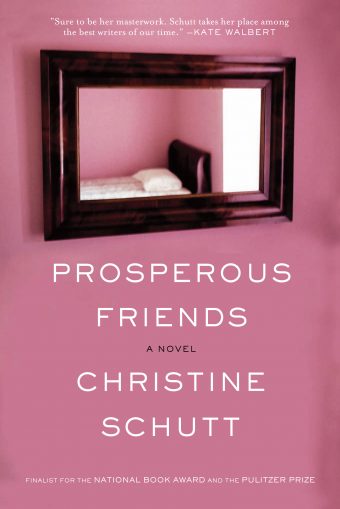 Christine Schutt Prosperous Friends
Grove Atlantic
‘Described by John Ashbery as “pared down but rich, dense, fevered, exactly right and even eerily beautiful,” Christine Schutt’s prose has earned her comparisons to Emily Dickinson and Eudora Welty. The New York Times Book Review described Schutt’s All Souls as “shot through with [Virginia] Woolf’s lyrical, restless spirit.” In her new novel, Schutt delivers a pitch-perfect, timeless, and original work on the spectacle of love.
‘Prosperous Friends follows the evolution of a young couple’s marriage as it is challenged by the quandaries of longing and sexual self-discovery. The glamorous and gifted Ned Bourne and his pretty wife, Isabel, travel to London, New York, and Maine in hopes of realizing their artistic promise, but their quest for sexual fulfillment is less assured. Past lovers and new infatuations, doubt and indifference threaten to bankrupt the marriage. The Bournes’ fantasies for their future finally give way to a deepened perspective in the company of an older, celebrated artist, Clive Harris, and his wife, a poet, Dinah Harris. With compassionate insight, Schutt explores the divide between those like Clive and Dinah who seem to prosper in love and those like Ned and Isabel who feel themselves condemned to yearn for it.’ — Grove Atlantic
____
Excerpt
Such exorbitant crying! Just when the old woman thought she had stopped crying, the girl would start again. The sound raised in the old woman gladness and amazement, and she lay awake to listen, but all she heard was crying; the rest she made up.
Infidelity? Boredom?
The old woman went downstairs to turn off the lights left on for the young couple now upstairs. She went close to the registry to see their names, but decided not to look.
What else did the old woman let herself know?
Their car was like everyone’s car. New York plates. They were a couple; they had signed in under the same name. The girl’s name started with a large and upright I, but she was not wearing a ring and the boy stood apart as if he were single. They were traveling to East Blue Hill but for how long was a question they had answered differently. The girl said maybe six weeks; the boy said three.
The boy, the old woman thought, was very pretty. A girl would cry over losing him, but this much?
The girl’s kind of crying was at a pitch that befitted a graver occasion. The girl’s crying was wholehearted, a baby’s kind, in no way self-conscious; but unlike a baby’s crying, the girl’s had nothing to do with discomfort or hunger. Hers was purely announced sorrow.
The old woman had heard and so had the old man.
The old man, the next morning, looking at the ceiling, asked, “What was that last night?”
The old woman shook her head and said, “Wasn’t it terrible?”
“So she wasn’t moaning?”
“Honestly,” the old woman said, and she looked back at where he lay with his hands behind his head. This was crying, the sound of which made the old woman believe that she, the girl, was in the right. Whatever cause was being fought, the girl deserved to win for her sincerity. Her swept, stripped crying was like an empty room, the boxy shadows on the walls, the unfaded parts against which beds and desks had pressed. Whoever had lived there, slept there, adjusted in front of a mirror there, was dead.
The rooms left by the old woman’s dead are all yet unused. The closets are full; in a laundry basket still are her father’s best shoes in shoe trees, a box, tissue paper.
Spendthrift mourner.
Ten years come August. She should clear out Daddy’s room to add a room to the Wax Hill B&B.
Ed and Aura’s is a farmhouse laddered with additions and trellises of clematis and roses; the inside walls are thin; the floors, slant. The rooms the Kyles let are low-ceilinged in the way of farmhouses, but the best of these, with the morning light, Aura gave to this couple. Aura gave the couple the whitest room because of the girl but also because of the boy. Aura had looked at the two when they were reading the brochures Aura always gives to guests. Aura considered their faces — they were probably not so young, not a girl and a boy, though she was of an age that turned everyone under forty into girls and boys, and so, too, these guests. The girl’s straight eyebrows, her wide-open expression, the girl’s face and the boy’s face — she would not tire of looking at them.
No matter. The couple left the next morning. They left before breakfast, which Aura thought was wasteful.
Age is some of the story. Aura has a spot on her hand that she is watching grow. Halved in a fold of skin for a time, it has looked like shadow, but now the spot is larger and outstandingly itself; nevertheless, Aura believes only she knows the brown declivity for what it is.
Ed is eighty-two and proud of it.
*
p.s. Hey. ** Adem Berbic, Hm, Seeing a car explode doesn’t seem that out of the ordinary to me, but I did grow up in car central. ‘Vengeance is Mine’, I can’t remember if I’ve seen it off the top of my head. This weekend I watched ‘Ice Cream Man’, which all the critics are excoriating at the moment, but I thought it was simple, gory fun. I think your fear is just a paranoia thing, or that’s the only way I can explain it. ** _Black_Acrylic, I would be literally shocked if that Jorvik Viking Centre dark ride is even remotely scary. Well, I hugely hope that this time enough people are smart and non-lazy enough to cause that Zoom writing class to happen. I and many others need to feel the heat from your Renaissance! Having a deep aversion to nostalgia for whatever reason, I’ll continue to watch for your ‘Shards’ reports. ** voskat, Hi. I’m safe, as far I can tell, and reasonably swell, thank you. Laura’s summer is the enemy. I pray that it’s only being kept alive by the heat, which would seem to be in its death throes, although you wouldn’t know it over here where we’re about to slide into yet another fucking heatwave. I will say hi to L. on Insta. Least I can do. I haven’t hunted for that post yet. Thanks for the reminder. xo. ** Steve, We’re apparently heading into another awful several days-long heatwave starting tomorrow or possibly even later today. Luck with yours. My weekend was mostly catching up on stuff. As I said above, I did watch ‘Ice Cream Man’. I really don’t get the critical vendetta against that film. It’s simple old school gory fun. What, critics want Eli Roth to turn into Christopher Nolan or something? New show! Everyone, The latest episode of Steve’s ‘Radio Not Radio’ is alive and on the move here. Steve: ‘Get up close and personal with a xenomorph to Icelandic industrial punk, go-go, musique concrete, church organs and more! This one features ROHT, Portraits Of Tracy, Charli XCX, Madamloss, The Need, The Tubs, Gentles, Worldpeace DMT, Odor Eater, Zoh Amba, Bill Hsu, Terry Riley/Claire Chase/JACK Quartet, Pino Donaggio, Midori Hirano, Beatriz Ferreyra, Michael Cloud Duguay, Cinna Peygahmy, Toru Takemitsu, Babal, wit., haru matsui, Sayf, Leo, NTFL & PVSSY, Sarah Sampp, Akiid and Trouble Funk.’ Nice line-up. Bill Hsu is in the house! Whoop! Thanks. Scurry through the heat as best you can. ** Rentedrooms, The Thriller dark ride was fun the first two times I rode it, but they really need to fork out the money for a new one. OC Fair, nice. My favorite things about the Pomona fair are the old school things like the ‘dinner place setting’ contest winners display, the creative cake making winners display, the pig races, and so on. And the stomach curdling food, of course. I don’t think I’ve seen that Manson movie, but I’ll check. Seems like I must’ve though. Weekend mostly passed the time, but at least we were still in between heat waves. Yours? Big up! ** Alice, Hi to you, Alice! Improved income is the Zeus head! Congrats! I like the Beach Boys, of course. Favorite … well, after ‘Smile’, their masterpiece, I’m very fond of the trio of albums that followed it — ‘Wild Honey’, ‘Friends’, and ’20/20′. I watched ‘Adieu au language’ again recently, and it really does make 95% of the films that have been released since it seem little more than timid and conservative. I’ll remember to follow _.hurryupandspinmeee._. Wait, hold on … I just did. Very happy to learn that you’re excited. Have a blast-plus in London if I don’t confer with you again before then. ** laura w, Hi. Yes, I played the first two ‘Luigi’s Mansion’ games. In the second one I reached a boss who was impossible for me to beat, so I quit, and now I’m wary of the third one. But I liked them while they were friendly to me. My tabac hasn’t closed for vacation yet strangely. Maybe it won’t go on vacation! My criteria for plane films is Blockbusters that I haven’t watched yet, which happily is most of them. That’s basically all I want on planes. And mainstream horror movies, although planes are pretty stingy with them. My weekend, as stated above, was fairly whatever but okay. It wasn’t too hot, which it is starting to be again today, so just not sweating and having to glare angrily at the sky made the two days okay. ** Steeqhen, I’m so sorry about your dog. Nature fucked up when it gave dogs shorter than human lives. It seems possible that ‘Castration Movie’ is on ok.ru or rarefilmm by now. Yep, I get a namecheck in ‘Totally Fucked Up’. Gregg and I used to know each other in LA back in the day. He wanted me to play a role in one of his films — ‘The Living End’ — but I declined. No regrets. ** HaRpEr //, Haha, Franzen as The National of contemporary lit. I think if he got called the Arcade Fire of contemporary lit, he’d think that was the coolest thing ever, haha. Well, you know how I feel about book tightening. Within reason. ‘Ingrid Caven’, excellent! I think Schuhl’s first novel is finally going to be translated and published by Semiotext(e) one of these years. ** Uday, I don’t think I’ve ever been scared by a horror movie. Or not since I was 6 years old or something. You’re almost out of there. Yeah, enjoy the tail end. Why does veganism have fascist connotations there? If you can say. Odd. Although I guess a lot of Americans probably think so too. ** Right. Today I spotlight a book by one of American fiction’s very best sentence writers, Christine Schutt. Have a look. See you tomorrow.



 Now available in North America
I think if I saw a car explode it would feel like a rupture in something, I don’t mean the car.
It’s ironic because that paranoia feels omnipresent, but to my knowledge I’ve never had any kind of properly psychotic symptoms, in spite of my past dalliances with stimulants. Although that sounds like the kind of thing a psychotic would say.
I’ve a circulatable draft of the slop, although more work needs a-doing. It’s reading-unfriendly and quasi-unpublishable, at least in the local context, which is fine. I think my general sort of aim here is grabbing onto some very fine spectral undergirding affect and stretching it out and manipulating it. But it’s more twisty than just being mimetic, I promise. And trying to construct a sort of reverse-fractal out of it being inarticulable. Like a version of Blanchot’s, let’s say, slightness or delicateness, that’s hopefully perhaps slightly less located within the bounds of the text itself — not that MB is such a closed system. File this under ‘hysterical Blanchot’ for sure.
I think one of the most golden nuggetish chunks of Lacan is about what’s supposedly internal being external (the unconscious is the discourse of the Other and blah blah), and one’s received sense of the familiar being extremely misplaced. If I could make someone intuit that I’d hit the jackpot.
Thanks for today’s blog. I’ll track down her novel. I never heard of her until now.
Today would be my introduction to Christine Schutt and I’m happy to get to know her. Writing an elegant sentence is a remarkable gift, one that I fully respect.
Seems my friends, family and carers are all too busy to watch The Shards. Reddit users all hate it and even Sypha won’t stump up for the TV subscription. Despite all this, I’m happy to be your sole correspondent for the new pop culture phenomenon.
Thanks for the info about After8 the other day. Glad to hear they’re about to move into bigger digs. I will email them once my book has a release date.
Watched this new HBO 4-part documentary “The Man Will Burn” about Burning Man over the weekend. It’s quite good. Very balanced, as in neither hit job nor love letter. I never had any desire to attend it myself, but still it fascinates me. The Cacophony Society especially, out of which it grew, always struck me as a movement to revive the sacred event/ritual for modern times. The doc goes into that history, the inevitable clash between the original renegade underground & the later commercialization & so on. I mean a lot of what I see happening at Burning Man strikes me as the worst kind of white hipsterism, but it’s nice to see how much that community means to some people—especially the ones who struggle to find a home & tribe in the outside world, which I can certainly relate to. There’s a Hawaiian term for extended family (as in chosen soulmates etc.) called ʻohana. And BM seems to give some people that, which is beautiful. That it also attracts rich poser assholes & selfie-posting influencers is inevitable. And of course, given their ticket prices, it’s an inherently elitist gig. But still, as a sociocultural phenomenon, interesting on a number of levels.
Hi again DC; sorry for the long delay in responding. I’ve been doing horrifically boring quantitative analysis so I can try and produce an article of economic history. It’s basically glorified data entry. I honestly wish I was halfway decent at writing so I could get out of being doomed to this as a lifestyle. I figure I have enough to talk about; I had something very recently happen to me actually. I can’t speak too deeply on it, but imagine finding out something transformative on an old friend-lover-thing.
I hope you’re well too! I’ve been constantly badgering my friend to just start with The Sluts already, but she keeps putting it off. Just know I’m fighting for your talent in my personal life. Prosperous Friends looks good as per this post; if I commit to reading it I’ll tell you so.
John Ashbery recommending her makes sense. I always call my current look my young Ashbery moustache and nobody ever gets it so I’ve resorted to sending poetry, which works sometimes but not always. The other day the word déconfit entered my head for no reason and eventually I realised that my brain was pulling it from Daffy Duck in Hollywood. UBU has a recording of him reading it, I believe. Veganism here is sort of adopted as the project of the Hindu right, because Muslims and Dalits are involved in the meat industry, and a minority of upper-caste Hindus use it as a proxy for ritual purity. Very gross stuff. I’m always more inclined to be more vegetarian in the United States, where it’s declaring a different allegiance.
*so-called upper caste
Did the heat wave begin today?
About 15 years ago, one of my co-workers pointed out that there was a car on fire down the street. I went outside to look at it, and while I was doing so, it exploded. Luckily, the driver wasn’t inside. Pieces of the car flew so high they landed on the roofs of nearby buildings.
Roth’s never been a critical favorite, but even fans of his work seem unhappy with his use of AI in ICE CREAM MAN.
Do you know the Marshall McLuhan album THE MEDIUM IS THE MASSAGE? It’s musique concrete featuring samples of him reading from that book. I was thinking of playing an excerpt from it on “Radio Not Radio,” but it’s not particularly listenable. (Frank Zappa or Faust would’ve had a better ear for editing it all together.) Only in the late ’60s or early ’70s would a major label release something like this.
luigi’s mansion 3 is i would describe as easy to the point purists dislike it, but i like easy video games. i have friends who are serious gamers and play, like, dark souls et al and i think i simply am lacking in masochism. i enjoy intentionally difficult things, but the repetition of a boss fight is not as enjoyable or satisfying to me as a puzzle, even if the solution is actually stupid.
oh! i watched four nights of a dreamer last night! gorgeous, gorgeous movie. there’s something incredibly intoxicating about his films, i think, it’s too easy to dismiss his schtick as being “sad and also pretty french boys reciting lines emotionlessly to a waifish woman” but when you see it on screen it’s hypnotizing to watch. also, it was funny. i’m going to say right now it’s third after the devil probably and lancelot du lac but it’s definitely above un femme douce, which i think i might like more upon rewatch? it should be my favorite because it has a lot of my pet themes but i might have been in a bad mood when i watched it or something.
i also liked it way more than white nights but beyond notes from underground dostoyevsky doesn’t really do it for me.
another heat wave! summer will be over soon, hopefully. great post today, i’ve never heard of this author but will be sure to add her to the list.
Hey, I’m desperate to get around to reading Schutt, I think ‘Nightwork’ will be the one I start with though. I want to see how her stories work.
Lately I’ve been reading Gordon Lish’s lecture notes which someone got in trouble for putting on the internet without his permission, but they’re luminary nevertheless, and a great help. I love and am fascinated by the Lishian type of sentence. There’s an almost esoteric aura coming from them, but laid out in a deft precision, and I’m eager to read more of his students. Mary Robison is another I need to get to.
That’s great to hear about Schuhl’s first novel! Is that ‘Télex n° 1’, if you can remember? ‘Dusty Pink’ really impressed me with the precision of detailing the glossy surfaces, and he wrote about cultural artefacts of the 60s very enigmatically. Focusing on what the surface/persona presents as a product, sexually, politically, and so on. And of course the structure is just crazy and unpredictable.
RE: Brevity. I always had this idea that one day I’d write this really long book. Maybe it’ll happen, but these days so many of my favourite writers have an oeuvre of lots of small, distinct books, and that’s just as appealing if one has the ability to see the bigger picture.
Yeah I think I’ll just jump right in and read this book, see what you mean about being a great sentence writer… never heard of her!
RE: Dark Ride music, yeah I’m just gonna compose stuff to ride thru videos for now. try and use the visuals as a “score” somehow? could be fun. that would also be suuuuper fun to get good field recordings of dark rides… if I drove and had the free time I’d check a bunch out … yeah I’d love to try at least once. I remember hearing an album of casino machine field recordings and it was very captivating… hope the week is lookin good over there!
I appreciate Schutt’s emphasis on compression and music in her writing. It’s a refreshing perspective in today’s literary landscape. REPLY useful tool
Schutt’s rejection of ‘easy speak’ resonates with me. It’s true that writers today often lean too heavily on familiar phrases instead of pushing for depth and clarity. REPLY related tool
I find Schutt’s call for ‘close, hard readers’ particularly compelling. It challenges us to engage more deeply with the text rather than skimming through. REPLY see here
I’m intrigued by Schutt’s assertion that she prizes compression and musicality over ‘easy speak.’ It feels like a necessary pushback against the trends in contemporary writing. I’m curious how that manifests in her work. REPLY helpful site