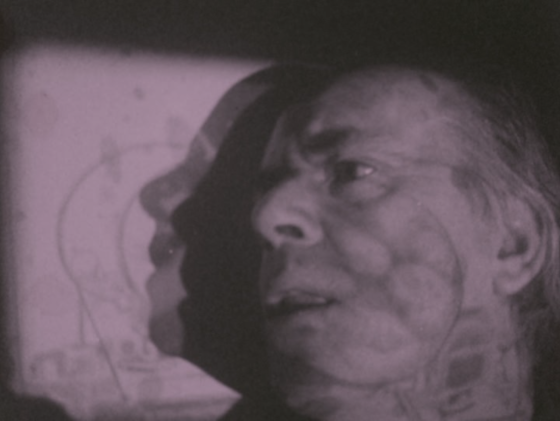
‘The fiercely original film-maker, poet and artist Jeff Keen, who has died aged 88, defied categorisation. He produced a vast body of paintings, drawings, sculpture and punchy Beat poetry, but is best known for his films, which incorporated collage, animation, found footage and live action – often all in one work. Keen used highly innovative techniques of superimposition and editing, and frequently etched and degraded the film surface. Works such as Marvo Movie (1967), Rayday Film (1968-75) and Mad Love (1972-78) were shot with his friends and family either at home, on the streets of Brighton or at the local tip; their fantastical, DIY countercultural qualities evoked the spirit of Andy Warhol’s Factory and the early cinema pioneers of Brighton, where Keen lived. Despite making his first film in his late 30s, he completed more than 70 films and videos throughout his life.
‘Keen was born in Trowbridge, Wiltshire, and had a love of wildlife, art and books as a child. He attended grammar school and gained an Oxford scholarship, but this was thwarted by his national service in 1942. Keen was given experimental tanks and aeroplane engines to trial during the war, and would frequently refer back to this period in films such as Meatdaze (1968), which included bombers and sirens on its soundtrack, and Artwar (1993).
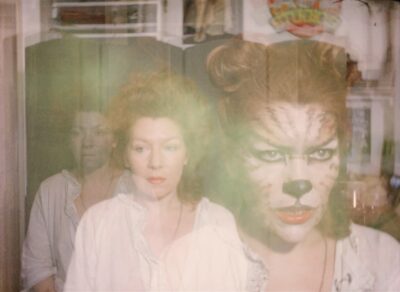
‘After the war, Keen developed a love of movies and comics and attended a small art college in Chelsea. London life encouraged his love of the arts, especially surrealism, Picasso and Dubuffet. When he moved to Brighton, Keen took up work as a landscape gardener for the local council. In 1956, he married Jackie Foulds, who was the muse for his films in the 1960s and 70s, playing the characters Vulvana, The Catwoman and Nadine. Keen himself had a B-movie-style “mad scientist” alter ego named Dr Gaz.
‘One of his early films, The Autumn Feast (1961), was made with the poet Piero Heliczer, who was part of the Warhol set. From the early 1960s, Keen experimented with “expanded cinema” (film events that exceed the normal modes of cinema projection), combining multiple projections and live art performance. A regular contributor to the “happenings” scene of 1960s London, at the Better Books shop in Charing Cross Road and elsewhere, he also participated in the International Underground Film festival at the National Film Theatre in 1970 and continued to make expansive, surrealist-informed 16mm epics such as White Dust (1970-72) and The Cartoon Theatre of Dr Gaz (1976-79), as well as 8mm diary films. He painted throughout the 60s and 70s and made artist books inspired by his films.
‘After Keen temporarily separated from Jackie in the early 1980s, his films became more abstract and introspective. He worked in front of the camera more, sometimes donning absurdist paper disguises, almost as if life had not only merged with art but fully collapsed into it. In Blatzom (1986), he became a moving sculpture/drawing hybrid. His friends and family were still involved: his daughter, Stella, operated a second camera and the editor Damian Toal came on board to help with violent, industrial-style videos such as Plasticator (1990s). Artwar was commissioned and broadcast by Channel 4.
‘Keen’s interest in myth, surrealism and romantic painting complemented his love of movies and comics, and he continually absorbed new references into his work. His highly frenetic videos of the 1990s included homages to Apocalypse Now, Rambo and Predator as well as Budd Boetticher westerns. Although his work has always been featured in historical surveys of British experimental and avant-garde cinema, these qualities distinguished his films from more purely formalist works made at the London Filmmakers’ Co-Operative, an organisation he helped to found in 1966. It meant his work was often more appreciated by skaters and punks than followers of the canonical avant garde. The extreme, short edits in his playful, visceral films have helped to keep his work fresh and alive; they still zap with energy decades later.
‘I worked with Keen throughout 2008 on a series of restorations, a film season and a BFI DVD boxset, GAZWRX: The Films of Jeff Keen. The process was undertaken at great speed, much like the pace of his films. We discussed everything from B-movies to Wagner to William Blake. I followed his instructions diligently along the way, but discovered that in speeding up some electronic drawings made on a children’s toy, and turning them into a two-channel video, we had made a new piece of work, Omozap Terribelis + Afterblatz 2. He grew excited and wanted to make more new things, despite his declining health. It was typical of what had been his persistent desire, even need, to make art. As he said in the early 1960s: “If words fail, use your teeth. If teeth fail, draw in the sand.” Whatever it takes, art must happen.’ — William Fowler
____
Stills



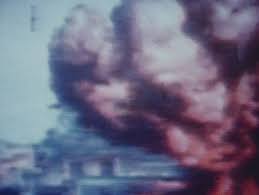

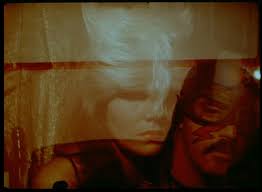
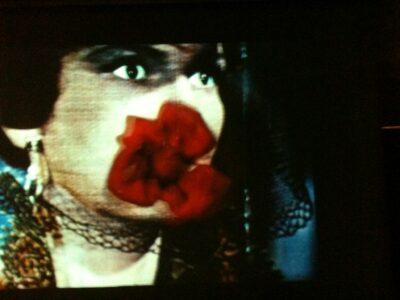

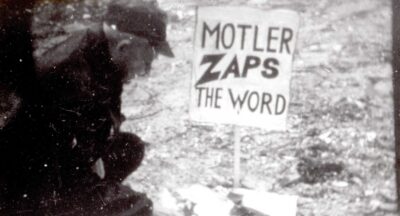


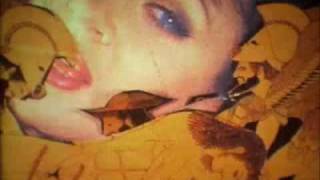

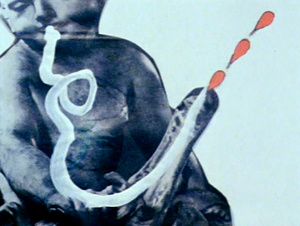






____
Further
Jeff Keen Website
Jeff Keen @ IMDb
Jeff Keen @ Experimental Cinema
Jeff Keen @ Hales Gallery
The Estate of JEFF KEEN
GAZWRX: the films of Jeff Keen
Jeff Keen – Noise Art
“When words fail, use your teeth!”
Shoot the Wrx, Artist and Film-maker Jeff Keen
Jeff Keen: Artist and film-maker celebrated for his playful approach
Jeff Keen @ letterboxd
DR GAZ
R.I.P Jeff Keen
ART WAR! An Appreciation Of The Films Of Jeff Keen
Stewart Home on the films of Jeff Keen
____
Extras
Jeff Keen’s Noise Art
Jeff Keen in drawings, paintings and film
A brief rummage through the Keen studio.
(Jeff Keen) Shoot the Wrx! exhibition walkthrough
______
Interview
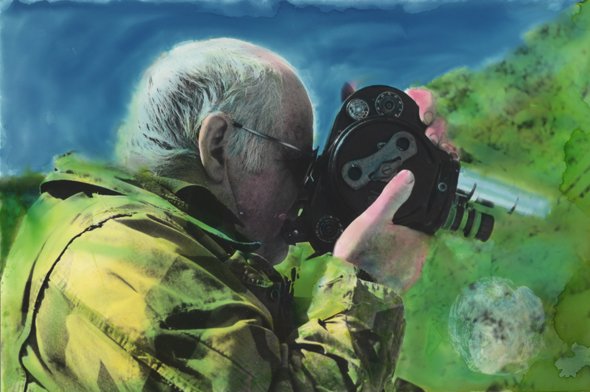
WONDERLAND: Why are people finally taking notice of your films?
JACKIE KEEN: A year ago I wrote to the BFI saying that it was disgusting that my husband had been sidelined. I explained that I had seen him devoted to making movies for decades working on a shoestring, doing the whole thing by himself, and never stopping –
JEFF KEEN: Well, I’ve stopped now. [Laughs]
WONDERLAND: Why have you been ignored for so long?
JACKIE: Partly it’s his fault, because he’s not interested in chatting people up. He’s too shy. In fact, I said in the email to the BFI that if Jeff knew I was writing at all, he’d be cross with me.
JEFF: Oh well. It’s old stuff, that is, Jackie. I’ve given up film now.
JACKIE: Yes. But it hasn’t given you up.
JEFF: Well, it has in a way, I think.
WONDERLAND: How do you mean?
JEFF: I’ve kicked the film habit.
JACKIE: But you haven’t kicked the drawing habit.
JEFF: No. I can’t kick that. I fall back on that. I’m still drawing all the time.
[Jackie goes into the next room and comes back with her arms full of boxes, plastic wallets and folders. She hands over the sketchbooks]
WONDERLAND: These are incredible.
JEFF: These are just from the top of the pile… It’s all part of it. It’s all part of the story.
JACKIE: He was never //not// drawing, were you Jeff?
JEFF: No, love. [Little laugh] I used to sit in my flat; I have a chair that’s convenient, and I used to sit there until it got too dark, every night. So I’ve got quite a lot of books lying about.
WONDERLAND: These are the contents of your mind, Jeff!
JEFF: Pouring out. But they don’t want to see them, that’s the damn trouble. The BFI obviously are just thinking in terms of film and I understand that but… I have been bored by it. To be honest, I am exhausted by it. And I don’t want to talk about it.
JACKIE: Now, don’t say that.
JEFF: Anyway, a lot of my stuff was outdoors. It’s gone.
WONDERLAND: Did you used to go around Brighton graffiti-ing?
JEFF: I started doing graffiti in the 60s. I remember the first time, it was the other end of town, the road running underneath the railway bridge where the London trains go over.
JACKIE: I was keeping watch to see nobody came to arrest him. And you were spray-painting ‘Deep War Hurts Says Doctor Gaz’
WONDERLAND: Why did you first move here?
JEFF: I came on a chance a few years after the war. It was a very different place then, almost like life on another planet. I got a summer job working in parks and gardens and stayed on for 12 years. That job came to an end in ’63: we had a very bad winter, and I remember going along the seafront scraping up sludge and snow, throwing it into the road for cars to spin it back at me again as I walked along the road, and that was the end for me.
WONDERLAND: And how did you get into film?
JEFF: I wasn’t thinking about film at all when I was younger. I was an artist, really, from the start. It was only much later that filmmaking was thrust upon me, when Jackie was at the art college.
JACKIE: There was no film society, so Jeff did everything, behind the scenes. It was ostensibly me, but it was all Jeff: he was the backroom boy.
JEFF: I found I liked getting behind a camera. I was the only person with spare time, so I finished up making the films to show.
WONDERLAND: Did you teach yourself?
JEFF: Yeah. Nothing in it really. [Laughs] You can learn to use a camera in a few days, and the rest follows.
WONDERLAND: Do you think in pictures?
JEFF: I suppose I do.
JACKIE: That was one of your slogans, ‘Kill The Word’ –
JEFF: ‘Don’t Let It Kill You!’
WONDERLAND: How did you meet?
JEFF: In a coffee bar called Tinkie’s.
JACKIE: Jeff saw me in the street first.
JEFF: Oh yes, actually, when I first saw her, it was rather terrific. She was walking down from the Clocktower, all in green: green hat, green coat, green shoes. And I thought, ‘God, there’s someone with style.’ [Laughs] She was being chased by a loping man.
JACKIE: Oh Jeff you make it sound –
JEFF: No, it’s true. [Laughs]
WONDERLAND: Have you always felt like an outsider?
JEFF: Living here in Brighton I’d always been outside the mainstream. From the very outset I never really fitted in, even as a filmmaker. Not that it mattered much, you know, I didn’t mind. I just carried on filming.
WONDERLAND: Did you want to be accepted?
JEFF:No. Not really. I never really tried for it.
WONDERLAND: Let’s talk a bit about your childhood. Where were you born?
JEFF: Trowbridge, Wilts. I remember the road. I don’t remember the house. It was a bad birth. My mother was quite old, forty-something. And I was the first one. And it was November and from then on it has been a difficult road!
WONDERLAND: What did your parents do?
JEFF: My mother took on local nursing. And my father didn’t do anything really. He was out of the war, the First World War, where he’d been in a minesweeper off the coast of Ireland, rescuing bodies from the Lusitania, when it sank in 1915, all that sort of thing. Over a thousand people died, a hundred children. And he didn’t want anything more to do with that.
JACKIE: Jeff’s father was amazing. [Jackie goes to the shelf and brings down a photo album] He had the most fantastic sense of humour, and he used to love dressing up.
JEFF: Actually these photographs say far more than words. They need sticking back in again, Jackie.
JACKIE: [Takes one out, a headshot of Jeff in soldier’s uniform] I love this one of him as a soldier. His face radiates warmth, intelligence and his poetic nature.
WONDERLAND: Did you do a lot of destroying things when you were a kid?
JEFF: No I don’t think I did. I was very mild-mannered. [Laughs] I didn’t like the destruction of birds’ eggs, all that. The things I destroy in my films don’t answer back! I remember my cousin, who lived next door, he had this habit of shooting little birds, he got a Diana air pistol for Christmas. He had these starlings down from the nest, on a little table and he put them out on there and shot them and it was a bit of a shock. That night I felt this irritation in the throat, and that was the Scarlet Fever starting.
WONDERLAND: What did you want to be when you grew up?
JEFF: I think I always wanted to draw. I used to draw birds, natural history. My first job was at the local store in Trowbridge just before WW2. Sainsburys, actually, and I remember drawing aeroplanes there. Bombers and things like that. Everyone was talking about war. It was in the air.
WONDERLAND: Comics are obviously crucial to your art. Did you read them when you were a boy?
JEFF: I discovered comics when they started to become popular in this country in the late 50s. They were quite sensational: you could buy them in corner shops, you’d get a collection of comics down beside the door as you went in, mostly national comics, not Marvel then. But I don’t draw like comics. I love them, but I don’t set out to imitate them, you know?
WONDERLAND: Do you remember your first trip to the cinema?
JEFF: My mother took me. It was Chaplin’s film about the circus, I was less than five and I remember screaming out: I was upset when the horse goes on the loose, and everything started to fall about. I was frightened… It’s difficult to imagine really how important the cinema was to us. During the war, of course, it became even more important. People would just flock to them, it was the only entertainment… and the smoke from all the cigarettes used to rise.
WONDERLAND: What did you do in WW2?
JEFF: Nothing much! I was at a secret location about ten miles inland from Great Yarmouth, fitting reject flying fortress engines into Sherman tanks for D-Day.
WONDERLAND: You said earlier that you’ve given up film –
JEFF: I haven’t been making films for some time. And I feel now I’m too weak. [Laughs] You’ve got to be strong, I think, to make films. Unless you’ve got other people to help you. I work in that precarious place of being without money most of the time… It’s strange, you know. I was always happier making films than trying to explain them. Now it’s come to an end, I should be stopping and thinking, but I’m not really. I’m trying to forget.
_____________
13 of Jeff Keen’s 49 films
_________
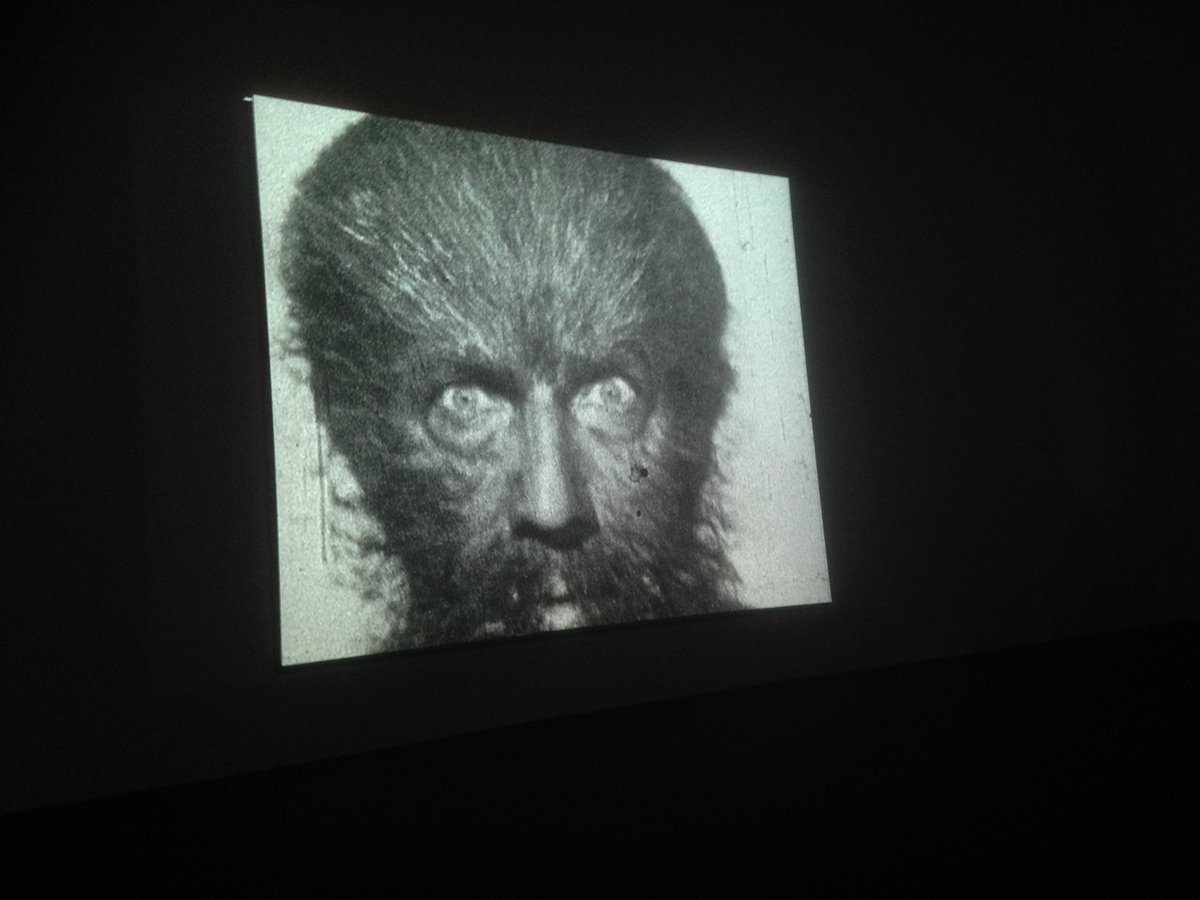
Wail (1961)
‘The realities of brutal gang violence collide with war paintings and a horror movie werewolf in this extraordinary action and animation mix. Keen recognises the dynamic links between different cultural forms plus popular culture’s potential for violence and subversion.’ — Lux
______________
Instant Cinema (1962)
‘This early quick-fire cut-up animation melds machine gunfire with scratched film. The soundtrack was made by Keen in 2007 with a wasp synthesizer and a shortwave radio.’ — letterboxd
Excerpt
_______________
Flik Flak (1965)
‘Comics, monsters and a zombified Keen are gently desecrated in this paint-flecked film that also features a picture of Jackie Keen crying heart-shaped tears.’ — letterboxd
Excerpt
_______________
Cineblatz (1967)
‘In Cineblatz, the viewer is subjected to a high-impact barrage of evolving images, at once comic and terrifying. Glossy magazines are cut up and reconfigured, newspaper pages are defaced with animated squiggles, comic-book superheroes fly out, over and through at superspeed. Pictures appear only to burn up or be torn apart, toys dance in ferocious stop-motion before melting into pools of plastic decay, a hammer plunges down on an image of the assembled House of Commons – all to a crackly soundtrack of treated shortwave static. It is a hyperkinetic panorama of 1960s popular culture in meltdown, where seemingly nothing stays still for more than a single frame, as the artist ejaculates ideas onto the screen faster than the eye can properly register. Lasting just three minutes, Cineblatz is exhilarating, orgasmic even–but also thoroughly exhausting.’ — letterboxd
Excerpt
_____________
White Lite (1968)
‘White Lite is something of a mystical film. It feels like we’ve gone through the looking glass and entered another world, despite the fact it was largely shot in the flat of its director, Jeff Keen. The film greets us with the invitation “meet anti-matter and the bride of the monster”, pointing to Keen’s love of B movies and a reference to The Bride of the Atom (US, 1955) or The Bride of the Monster as it was later known, a film by Ed D. Wood Jr. The homage comes some 12 years before Wood achieved considerable notoriety as winner of a Worst Director of All Time Award in 1980 (and 26 years before he was immortalised in Tim Burton’s affectionate tribute Ed Wood).’ — autohystoria
the entire film
______________
Rayday Film (1968-76)
‘‘Rayday Film’ (1968-76) is a sort of crazed homage to comic book superheroes (the title comes from a comic-book Keen himself produced). Sped-up, multi-exposure footage shows Keen’s wife and friends acting the role of various masked or costumed characters, and performing weird, cultish rituals in various locations around Brighton, where they all lived. Thrown into the mad mix are images of toys and dolls being melted, sections of damaged film stock, fragments of stop-motion animation, and a montage of TV clips showing wartime atrocities. Oh, and the soundtrack is a near-constant cacophony of overlaid tracks, forming a pulsing, shrieking vortex of white noise. Needless to say, there isn’t much in the way of a coherent plot. And yet, amidst the sensory assault, certain themes can be picked out: war, and media representations, and the dark mythological energies that lurk beneath the surface of civilised existence.’ — Time Out (London)
the entire film
______________
The Dreams and Past Crimes of the Archduke (1984)
‘The 16mm work is made up of three parts: out-of-date film stock accompanied by evocative piano, a noir style photo-drama set at Brighton train station and – the main piece of the film – a gorgeous blue- and red-dominated poetic psychodrama. The use of old film stock is not untypical for Keen; he would regularly use whatever material was at hand, often using different types of film stock within the same title, as here. As a low-/no-budget filmmaker, he frequently had little choice, but he often exploits the poetics of low-grade material as part of the process. Keen cut his images in the main section to a soundtrack provided by his daughter, Stella Starr, who recorded the cut-up of music and sound effects during a film show at the local cinema. Although not always credited, Stella has provided regular assistance to her father, beginning in the late ’60s and usually as camera operator. She also features as the blind-folded artist painting with a paper brush, a particularly dynamic image. The red- and blue-painted figures look partly to the new romantic art that was happening at the time but also look like ghosts of the people who’d appeared in Keen’s films for the last 20 years. The double-exposure of the ghostly figures, the slow-paced action, colour dominance and interplay between sound and image make this one of his most reflective films.’ — bfi
Keen’s sketchbook for the film
______________
Plasticator (1990)
‘Treating apocalyptic and aggressive imagery with silence and slow washes of colour, Jeff Keen exhibits and works against his usual tropes.’ — letterboxd
Behind the scenes
_______________
Plazmatic Blatz (1991)
‘Stealth bombers hover like vultures over crashing waves and a ruined land. Using found footage and several thick layers of video, Keen presents a very visceral version of Armageddon.’ — LUX
____________
Omozap2 (1991)
‘Jeff Keen stands in overalls, poised with his tools before him. Then he lights a roaring gas-fueled torch, smashes a plate with a hammer, paints a giant esoteric symbol on the wall and starts up his film projector. This snappy one minute video provides a neat evocation of the Jeff Keen live experience and throws us right into the inspired montages to come.’ — LUX
the entire film
_________
ARTWAR! (1993)
‘As its title suggests, the violence in Artwar is more pronounced than in Keen’s earlier work, but the wit, humour and references remain. One section, ‘Draw He Said’, is built on a punning reference to drawing as an art and the action of drawing a gun – guns and cowboys have been referenced by Keen from as early as 1960. Wail from that year features a short animation of blasting cowboys.
‘Artwar was made when the so-called YBAs, a new generation of Young British Artists, centred around Damien Hirst, were developing their reputations and in some instances making works on video. The film’s playfulness and references to popular culture, as well as its darkness, make some connection with the YBAs’ work, but culturally it comes from a different position. Keen’s work is more direct and while it contains much humour cannot be said to be ironic. His articulations come not from being brought up in a culture that is obsessed with war and violence but from experiencing these things first hand. This is why Artwar is so important to him. Keen is also uncertain about the contemporary art world and his work has found little acceptance within it. Despite the fact that he draws and paints, his work has almost always been screened in the context of experimental film.’ — INFECTED SENSES
the entire film
____________
Irresistible Attack (1995)
‘In Irresistible Attack (1995) art is under an “irresistible attack”, more plastic, materialist and malleable than ever, by “a prisoner of art”.’ — Experimental Film Club
Excerpt
__________
Gazapocalypse (2012)
‘Jeff Keen was a pioneer of experimental film, using multi-screen projections, collages, animations and performances to transform cinema into an intense, kaleidoscopic experience. A veteran of the Second World War, Jeff Keen’s work powerfully evokes the violence, colour, speed and noise of the 20th century, incorporating raucous collages of comics, drawings, B-movie posters, plastic toys, burning props and extravagant costumes. His installation at the Tanks, Gazapocalypse – Return to the Golden Age, showcases his radical development of multiple screen projection, cut-up soundtracks and unruly live action, and features a special performance by some of Keen’s collaborators, including his daughter Stella Starr.’ — Tate
Excerpt
*
p.s. Hey. Heads up that, starting tomorrow, the blog will be going on a short vacation — Tuesday, Wednesday, Thursday — while I’m in Stockholm for a screening of ‘Room Temperature’. It will return to normal life on Friday. ** jay, Hi. TheFantasyArchitect won the weekend, clearly. Your masochism is a very trusty companion. I wonder how many masochists can say that? Well, probably quite a few when I think about it. Have increasing fun until our next visit. ** _Black_Acrylic, Thanks for the argument audio peek. I’ll luxuriate in it in a bit. ** Malik, Obvious example, but whenever I see videos of Keith Moon drumming, I usually think, ‘How much would I pay to feel whatever he’s feeling’. Renaissance Faires were and probably still are a kind of nightmare. To work/play there, we had to take lessons to talk like fake Renaissance people. ‘Forsooth, my lady’ and so on. But that was when I dropping acid a lot, and it wasn’t a good combination. As you can imagine, your play being set at a Disney park has my eyes sparkling. Wow. One of Zac’s and my dreams is to set a film at a Disney park, but we will never ever have the millions it would take to rent that location. Anyway, that’s super exciting! ** Thom, Gotcha on the logistical time hampering. Lay some bones down, that’s my vote. You’re going to read Pinget! I bow to or with you. ‘Fable’ is on Internet Archive, but it’s in ugly typewriter script, which might be a little hurtful to it. Steinbeck … I haven’t read him or tried since, I think, high school, so I don’t even know. What’s your take? Landing stuck, per chance? Awesome next few days! ** Bill, Could have been. The lengthy process by which I gather the profiles can make it hard for me to see them in an overall way. Art Basel! You’re in Basel? What’s going on? ** Dominik, Haha, no, though I did check to see if the book was real and really there. Visa: I’m waiting for the required birth certificate to arrive and hoping it’ll get here before the final deadline. So I’m just watching the mailbox nervously. SCAB is real!!!!!! Cannot wait to read it. Probably on the plane to Stockholm. Everyone, High alert! The new issue of Dominik’s legendary and utterly crucial zine SCAB is newly in the world, and it has work by some people from these parts — Dominic Lyne, Harper Stringer, Ellie Chou, lotus eater machine, etc. — amongst the generally gifted horde. Get it. I don’t even need to suggest that. It’s here! So excited! As you can probably tell, Love is into corduroy pants, G. ** Måns BT, Strange, the unusually demure escorts … what can it mean? Zac is down for the ABBA Museum if you’re down. We’ll need to do that on Wednesday, the screening day, because we head back to Paris on Thursday morning. Too quick a trip, but money is the evil curtailer. No other plans yet other than dinner with the great music artist Klara Lewis on Tuesday after we get in. Oh, maybe find that amazing ramen place? I don’t think I’ve read anything by him unless I’m spacing. I am in-between books. Right, I’ll go look for a copy of ‘The Weaklings XL’, and, if I can find one, which I think I can, I’ll bring it for you. Cool! Let’s check in by phone or email or something and make a plan. Can’t wait to meet you. xo. ** Carsten, Peanut butter on almost anything creates a vast improvement. I love Don Cheadle. He should be in so many more movies than he is. I saw the guest-post in my mail, thank you! I’ll set it up and get back to you once I know when it’s going to launch. Pleasant here too, weather-wise. ** Adem Berbic, I’m always amazed by social smokers and always wonder if they’re lying about that. I’m super interested to read Tadhg’s SCAB entry, most naturally. Nice visit with James, yes, of course. ** Laura, Hi! Oh, I’m so, so sorry about the migraine. I have friends who are beset with them, and when they have them they look terrified and dead at the same time. I hope you don’t. I’m trusting or at least extremely hoping that by the time I’m back here again being myself on Friday that you’ll be floating energetically again. xo. ** Steve, Tomorrow morning. Ouch! I really disliked ‘Titane’ so I’ve been meh about seeing ‘Alpha’, but, okay, I think you’ve swayed me. ** kenley, Ha, the ramadhan one was a fave for me too. I guess running Hot Wheels on someone who wants to be tickled is kind of a possibly VIP way to tickle them or something? You got me. No, no favorite actors. Like I said, I don’t really respond to ‘good acting’. Once in a while some actor will give a performance where I think, ‘Okay that was pretty convincing’, but it’s a random thing for me. My weekend wasn’t very oodles of anything, it just kind of did the trick. This and that. Mostly working on a new draft of our new film script. That’s good pleasure for me. I hope your Tuesday through Thursday simultaneously fly by and stir your pot. ** HaRpEr //, I hope you’re further upswinging as I type. ‘The Rainbow Stories’ is my favorite Vollman. You’re like the fourth person to, in so many words, tell me to avoid ‘Sentimental Values’ whatever that takes. I’m dying to get my eyes on the new SCAB and your part in it in particular! Thanks for the backgrounding. ** ⋆˚꩜。darbbzz⋆˚꩜。, Hey, buddy. I’ve been somewhere between busy and not busy enough, I guess. Great to hear you sound so up about the pizza employment. Yay. Oh, right, gosh, the misgendering, you are in the South, aren’t you. I’m sure your instincts will lead you to do the proper thing. And I’m sure your performance as a seeming female has been top notch. Have fun with whatever you decide. My coffee is now entirely in my stomach and doing a minimum wage-level job. ** Okay. The fine, imaginative, outgoing filmmaker Jeff Keen is providing your entrainment and more for the next few days. See you on Friday.


 Now available in North America
Hi!!
Have a lovely time in Stockholm!!
I hope the birth certificate arrives before the deadline and everything will be settled with your visa ASAP.
And I also hope you’ll enjoy the new SCAB! Thank you so, so much for the shoutout, as always!
Love making sure everything goes exactly as planned during your trip, Od.
Missed commenting directly on the escorts post, but I think I don’t quite understand what the deal with that is. Where do you find these pictures? Is all the text written by you? Either way, it’s interesting. I’ve never spent much time on places where posts like that are made.
Hope the trip goes well. I’m in an overall downer of a mood recently but earlier a friend told me they had a dream about me where I made them watch a movie full of “eroticized gore”, which makes me happy as a sort of psychic effect to have on others.
hi dennis!
ah! fair enough. i suppose the idea of having favourite actors is odd anyway…we only see them as characters. or at least, we ought to. idk. just read stokoe’s high life and my head is abuzz with bits of 90s celeb gossip (among the many…other things…on display in that book, lol)
enjoy stockholm! i hope many knäckebröd and kardemummabullar await you!
Thesis deadline coming up so totally warped into that. Relieved the blog will be on vacation; one less thing that I want to do more than write; I really might be the worst student of all time. Enjoy Stockholm!
Good luck with the thesis! Luckily for me, my thesis was actually focused on Dennis and the George Miles Cycle so I could write away checking the blog daily as “research”!
Hope you’re enjoying Stockholm as we’re enjoying the Jeff Keens showcase. I’m not familiar with Keens; what a frenetic and inventive body of work.
I’m not in Basel sadly, just Hong Kong with their local Art Basel offshoot. It was mostly pretty boring last year, not much catching my eye this year either. But there are a few little new music events next week that might be amusing.
Bill
Jeff Keen – Rayday Readings was the tune that kicked off this 2013 Outsider Mix that I played in a Dundee pub for Valerie Norris and Steven Myles’ I Like Yellow Things zine launch back in the day. The tune forms part of his Rayday Film soundtrack so it’s good to learn where that came from.
Went out to the empty Odeon cinema today to see One Last Deal, which stars the UK celeb Danny Dyer. This guy has a reputation as being a bit of a Cockney wideboy but I do admire his acting prowess and the film is a solo vehicle for his talents. DD was mentored by the mighty Harold Pinter and featured in 3 plays written by the great man. This film certainly lived up to its promise and comes recommended as a lean 1-man theatrical piece.
Danny Dyer! He’s one of the people I associate most with Eastenders (the British soap opera) despite never watching it whilst he was a cast member. I‘ve gone back and watched clips, and I find his scene with his son coming out to him to be so sweet, and his support of the gay and working class communities is something I respect. I’ve been meaning to watch that 2006 horror movie Severance (not the famous tv series) that he stars in, as I’ve heard that it’s interesting (though perhaps not good?)…
DD is a good actor I reckon! In this film he’s a sweary football agent so not really stretching himself, but it’s just 1 man at a computer for the whole thing. Quite radical in its way.
Oh wow! Sounds like it could have been a stage production, but I have a fondness for films that are like that (one room, few characters, character studies). Might have to check it out!
Not familiar with Jeff Keen until this post. Reminds me very much of things my dad would tape off late-night TV for my brother and I when we were kids – Stan Brakhage, Terry Gilliam animations, old trippy Soviet cartoons – all things he considered appropriate entertainment for elementary school kids, and honestly, I’m not mad. Hope your week went well; the US SE is starting to come into bloom in a beautiful way.
How’d the Stockholm screening go? Were you able to see much of the city, beyond your duties with the festival? Do the questions you and Zac get asked vary much from country to country?
HEY DENNIS! I hope Stockholm was nice, did you see the ABBA museum? So excited to see your movie, whenever it’s available. I’ve been trying to do a bit of a digital detox, so I haven’t been super active here. A physical dictionary has made reading challenging books a lot less screen-heavy, given that that’s like 90% of what I use my phone for. Proust is still so, so amazing, haha, I’m near the end sadly. It’s kind of funny to read an old fashioned gay novel where the love interest isn’t, like, wildly unsuitable a la Mann, haha.
Oh, and a few manga I like are finishing up – “Chainsawman”, which I’m sure you’ve heard of (I think a doujin panel was in one of your slave posts recently) seems to be crashing and burning a bit, in a “maybe in a decade people will reappraise it” way. And “Famiresu Iko”, which is about a teenage boy who falls in love with a really unsuitable, (presumably) heterosexual mafioso, and then meets him again a decade in the future just finished this week. It’s pretty funny, but it had a really miserable ending (in a great way).
Again, hopefully Stockholm was nice! Lots of love from here, adios!
I hope Stockholm treated you well. Curious to hear how it went, compared to the other screenings. Do you guys have to pay your own flights & expenses each time or does that vary from place to place?
Jeff Keen was unknown to me until this introduction. You know what? Your blog really deserves some kind of cultural grant. I mean for fuck’s sake you’re running a digital art/lit/poetry/film/music show here & expanding horizons on a daily basis. Just for that you should never have money problems…
Saw what you said there about not really being into “acting”. Same here, in a way. Non-actors are often infinitely more expressive. That being said, I do like certain actors as people, & with them the fun for me is watching them be rather than “disappearing” into their roles. Just watched Soderbergh’s “No Sudden Move” for that reason, just because it stars Don Cheadle & Benicio del Toro. The film’s alright, but my enjoyment mainly comes from watching those two play. So in that sense I’d call them favorite actors, along with Isaach De Bankolé, Alex Descas, Denis Lavant, Matt Dillon, Asia Argento, Pam Grier & Kristen Stewart. If I were to direct them, I’d say “just be yourself & say my dialogue”. Basically did that the one time I directed (student short at LACC).
Like I wrote in my email, there’s a bit toward the end of my guest post that’s unusually formatted. Just want to make sure that doesn’t get scrambled up.
Hey Dennis,
Hope Sweden was nice. I’ve never been to Stockholm but I have been to Malmo, and I found the culture very different; obviously some stuff that was strange to me like the prices and coldness, and stuff I liked like the flatness, easy transport and public bikes/scooters. My friend who lived there for 2 years is basically the expert on Swedish vs Irish cultural differences, and she told me that people there rarely drink, but if they do they drink to get drunk; in Ireland, drinking is such a casual thing (as you’d probably assume), with obvious alcoholism issues, but there is also a culture of being able to handle yourself and openness to strangers. But this is all secondary sourced info and not my own experience that I’m recounting.
My appointment is in less than a week, and I’m really anticipating having some sort of support/person to talk to. Though I have been doing a bit better, albeit with the intrusive thoughts that have been tormenting me. Without disclosing the intricacies of my brain and its issues, I’ve realized that my brain takes what should be healthy guilt and turns it into earth-shattering shame, and my brain fluctuates between a secure and strong sense of self, and a deep lack of faith and trust in myself. I tend to pathologize everything, which can be good to understand myself, but I forget to actually do things to help. Trying to change that. Not much of an achievement, but I spent about an hour and a half making my lunch/dinner (a burrito bowl), following a new recipe, and it turned out incredible! Had the most beautiful post-dinner nap and feel completely refreshed. Work has been great too — my work and worth has been valued by everyone, and I enjoy how much I learn every day just from skimming the books.
I’ve been working on a pitch for this one book series that are looking for submission; it’s basically writing about an album, its process and background, the songs, the artist themselves. There’s this one Charli album (not brat) that I think is interesting enough to be focused on, and I was not only around and tuned in to the album’s process, but was once quote tweeted by Charli when I made a tweet about the album, where she said that I was “so right”… so I think I have good credibility to be the author of its biography. It’s a good project to be working on too, as I have a month and a bit to work on the pitch, and then if I get selected I have 6-12 months to then finish it. Trying not to speak too much about it all as I have this superstitious belief about saying things before they happen, and a paranoia that someone may come across this and do it but better!
Keith Moon is an absolute beast. Most of my favorites are free jazz/free improv drummers like Max Roach, Rasheed Ali, Milton Graves, Ted Byrnes, and Han Bennink. I’m also into Zach Hill and Dave Grohl’s work with Queens of the Stone Age.
It would take a lot of backers and some smooth talking to get even within an inch of filming in the Disney Parks, lol. It would make a fascinating screenplay to publish though.
There is always the guerilla route like they did with Escape from Tomorrow. I still commend the director for even being so bold as to go to both of the parks and shoot around everything so cleverly, even if that movie was garbage. It was one of those things that felt like it was mocking the people who attended those parks, and I’m trying not to come off that way. Apparently, he’s got a follow-up/soft remake coming out at the Miami Film Fest. Hopefully that’s decent.
Hello! I hope Stockholm went great and the reception to the film was even greater.
I’ve been really sick all week but am over the hump now and getting better. There’s actually a meningitis outbreak in and around London at the moment and I was paranoid for a bit that I had it since I have a lot of the symptoms, but since I’m getting better now it’s less of a worry. I’m still disorientated and feeling generally shitty but hopefully tomorrow I’ll be feeling significantly better. I haven’t been this sick since I got covid a couple of years ago. That time I woke up at 3pm after dropping acid the previous day and was up for 24 hours or so. The next day I was having what I thought was the worst come down ever and realized it was covid. And I WAS still coming down so I had a terrible week praying to be put out of my misery.
I didn’t stop working on the novel because I’m sort of drawn to working on something no matter what. I actually finished draft two. Now I’m in a weird place where I’m sort of just picking at it. I’ve reached the point where what I’ve done looks ostensibly like a novel but I’m calling everything into question. Namely, do I try to maintain my original vision (whatever that is), or instead try to investigate new approaches? I don’t know if I should leave it for a while since I’m very divided about it, but I don’t want to. I’m just sort of finicky and indecisive.