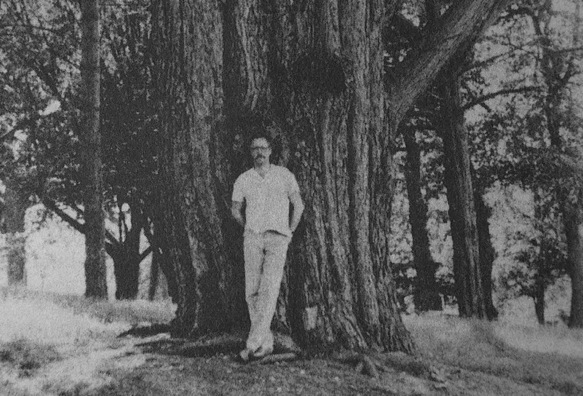
There is no antidote against the opium of time. The winter sun shows how soon the light fades from the ash, how soon night enfolds us. Hour upon hour is added to the sum. Time itself grows old. Pyramids, arches and obelisks are melting pillars of snow. Not even those who have found a place amidst the heavenly constellations have perpetuated their names: Nimrod is lost in Orion, and Osiris in the Dog Star. Indeed, old families last not three oaks. To set ones name to a work gives no one a title to be remembered, for who knows how many of the best of men have gone without a trace? The iniquity of oblivion blindly scatters her poppyseed and when wretchedness falls upon us one summer’s day like snow, all we wish for is to be forgotten. — W.G. Sebald, The Rings of Saturn
______________
W. G. Sebald was born in Wertach im Allgäu, Germany, in 1944. He studied German language and literature in Freiburg, Switzerland, and Manchester. He taught at the University of East Anglia in Norwich, England, for thirty years, becoming professor of European literature in 1987, and from 1989 to 1994 was the first director of the British Centre for Literary Translation. His four novels — The Rings of Saturn, The Emigrants, Vertigo, and Austerlitz — have won a number of international awards, including the National Book Critics Circle Award, the Los Angeles Times Book Award, the Berlin Literature Prize, and the Literatur Nord Prize. He died in an automobile accident in December 2001. In a 2007 interview the secretary of the Swedish Academy, Horace Engdahl, stated Sebald as one of three newly deceased writers who would have been worthy Nobel Prize laureates along with Ryszard Kapuściński and Jacques Derrida.
_____________
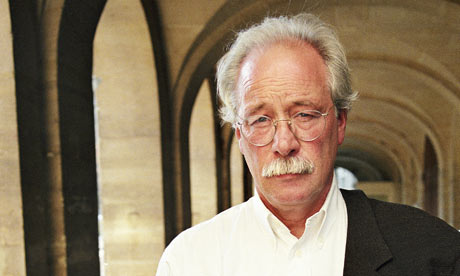
Sebald’s death was as unsettling and anomalous as his work. Here was a writer struck down at the height of his powers, at the age of fifty-seven, when he had just begun to achieve wide recognition. Each of these statements would typically be incompatible with at least one—often both—of the others. He was one of the most innovative and original contemporary writers in the world, and yet part of this originality derived from the way his prose felt as if it had been exhumed from the past, as if the spirit of ruined Europe were speaking through him. Perhaps this is why it was said, in Germany, that he wrote like a ghost. There was always something weirdly posthumous about his writing, but this only makes his physical death more shocking. — Geoff Dyer
______________
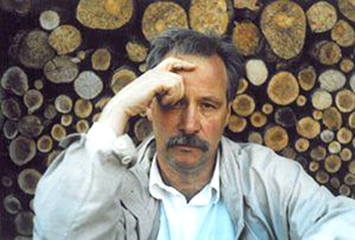
The loss feels unbearable. Premature death has brutally imposed a retroactive shape on Max Sebald’s life and work, turning early or middle things into last things. Perhaps in the future it may come to seem inevitable that the elegiac intensities inscribed by Sebald in literature do not result in a large body of work. That, instead, we have the imperishable gift of just a few books written once he found the voice in which to deliver his commanding, exquisite prose arias. But, for the moment, the loss simply feels…devastating. Unacceptable. Difficult to take in. He had an exemplary sense of vocation, full of scruples and self-doubts. The work is recklessly literary and inspired by a thrilling variety of models. These writers—from Adalbert Stifter and Jean Henri Fabre to Virginia Woolf and Thomas Bernhard—illustrate Sebald’s connection to several kinds of moral seriousness, luminousness of description, and purity of motive. He was one who demonstrates that literature can be, literally, indispensable. He was one by whom literature continues to live. — Susan Sontag
_____________
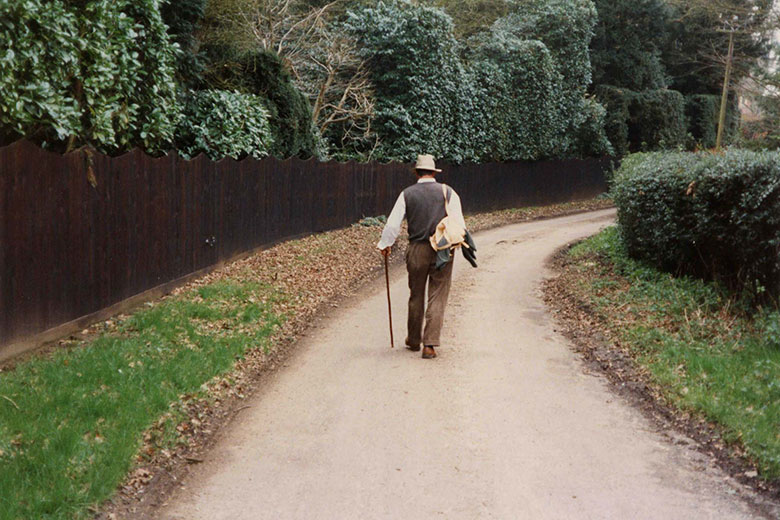
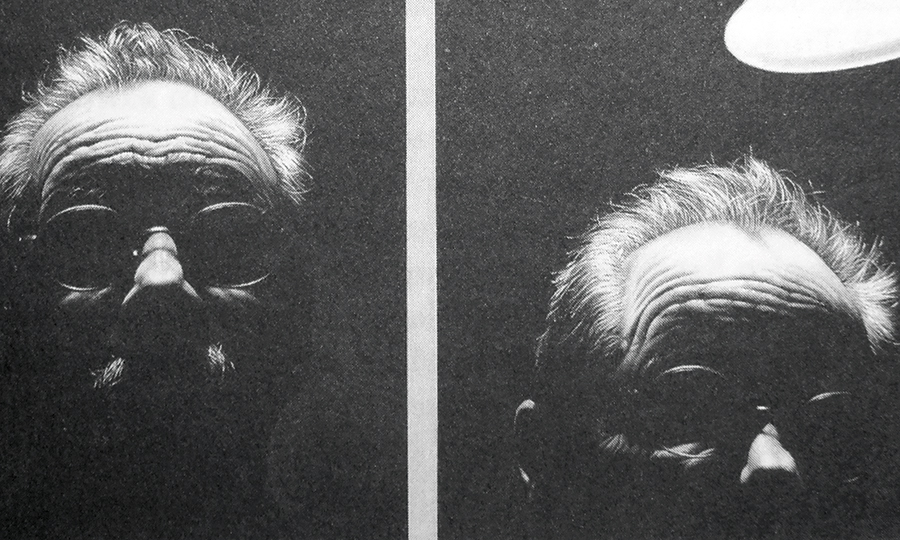
Sebald wanted to find a literary form responsive to the waves and echoes of human tragedy which spread out, across generations and nations, yet which began in his childhood. Silence and forgetting were conditions of his early life. Sebald doubted whether those who had never experienced Theresienstadt or Auschwitz could simply describe what occurred there. That would have been presumptuous, an appropriation of others’ sufferings. Like a Medusa’s head, he felt that the attempts to look directly at the horror would turn a writer into stone, or sentimentality. It was necessary, he found, to approach this subject obliquely, and to invent a new literary form, part hybrid novel, part memoir and part travelogue, often involving the experiences of one “WG Sebald”, a German writer long settled in East Anglia. He was reluctant to call his books “novels”, because he had little interest in the way contemporary writers seemed to find all meaning in personal relationships, and out of a comic but heartfelt disdain for the “grinding noises” which heavily plotted novels demanded. — Peter Handke
____________
Excerpt: The Emigrants (1990)
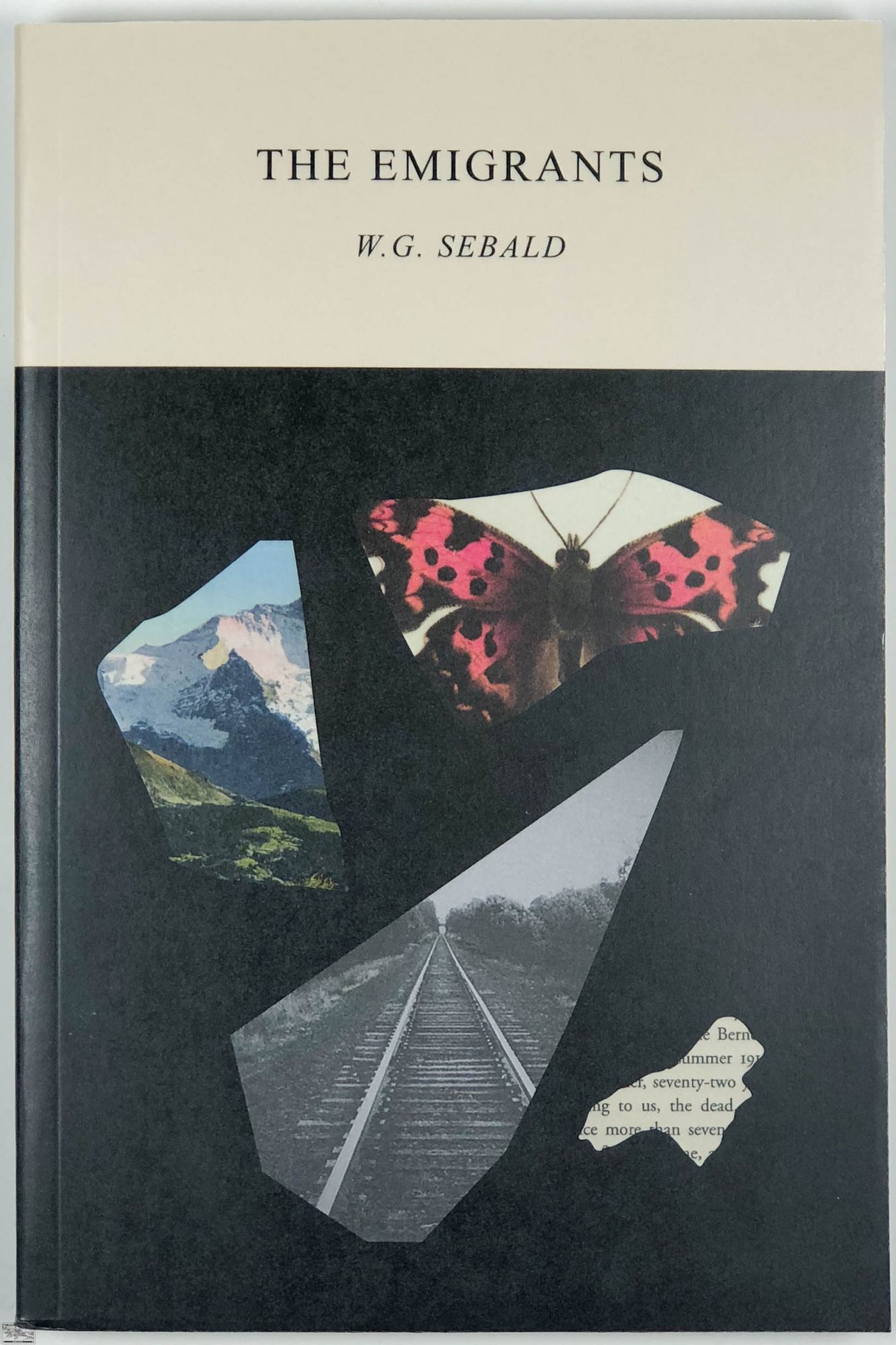
A meditation on memory and loss. Sebald re-creates the lives of four exiles–five if you include his oblique self-portrait–through their own accounts, others’ recollections, and pictures and found objects. But he brings these men before our eyes only to make them fade away, “longing for extinction.” Two were eventual suicides, another died in an asylum, the fourth still lived under a “poisonous canopy” more than 40 years after his parents’ death in Nazi Germany.
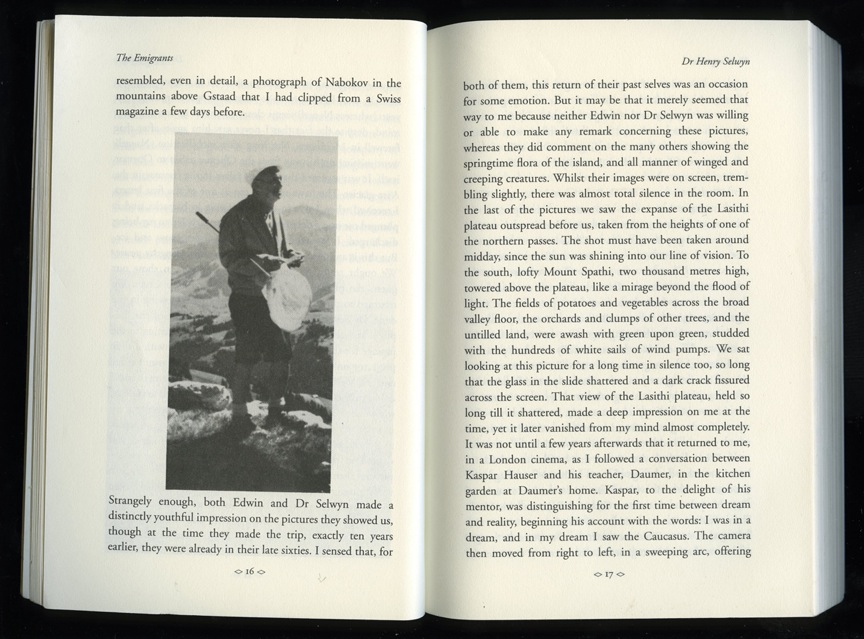
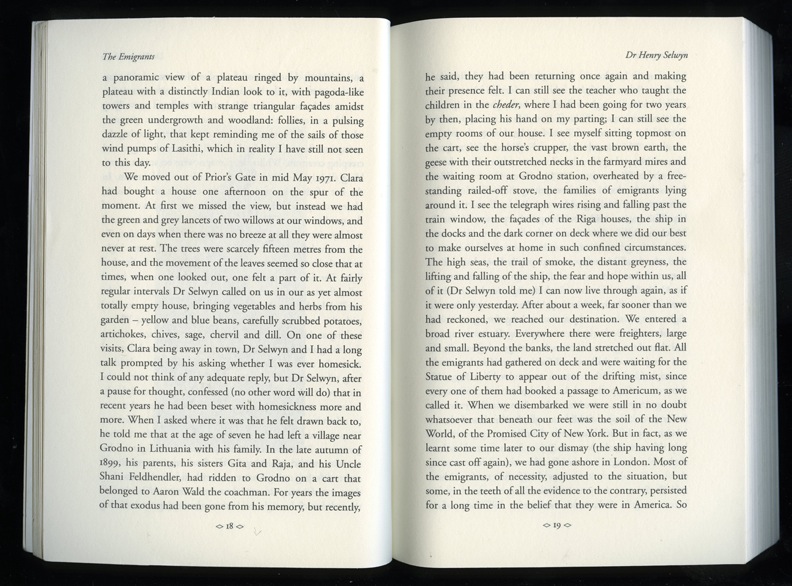
At the end of september 1970, shortly before I took up my position in Norwich, I drove out to Hingham with Clara in search of somewhere to live. For some 25 kilometres the road runs amidst fields and hedgerows, beneath spreading oak trees, past a few scattered hamlets, till at length Hingham appears, its asymmetrical gables, church tower and treetops barely rising above the flatland. The market place, broad and lined with silent facades, was deserted, but still it did not take us long to find the house the agents had described. One of the largest in the village, it stood a short distance from the church with its grassy graveyard, Scots pines and yews, up a quiet side street. The house was hidden behind a two-metre wall and a thick shrubbery of hollies and Portuguese laurel. We walked down the gentle slope of the broad driveway and across the evenly gravelled forecourt. To the right, beyond the stables and out buildings, a stand of beeches rose high into the clear autumn sky, its rookery deserted in the early afternoon, the nests dark patches in a canopy of foliage that was only occasionally disturbed. The front of the large, neoclassical house was overgrown with Virginia creeper. The door was painted black and on it was a brass knocker in the shape of afish. We knocked several times, but there was no sign of life inside the house. We stepped back a little. The sash windows, each divided into twelves panes, glinted blindly, seeming to be made of dark mirror glass. The house gave the impression that no one lived there. And I recalled the chateau in the Charente that I had once visited from Angouleme. In front of it, two crazy brothers — one a parliamentarian, the other an architect — had built a replica of the facade of the palace of Versailles, an utterly pointless counterfeit, though one which made a powerful impression from a distance. The windows of that house had been just as gleaming and blind as those of the house we now stood before. Doubtless we should have driven on without accomplishing a thing, if we had not summoned up the nerve, exchanging one of those swift glances, to at least take a look at the garden. Warily we walked round the house. On the north side, where the brick work was green with dampand variegated ivy partly covered the walls, a mossy path led past the servants’ entrance, past a woodshed, on through deep shadows, to emerge, as if upon a stage, onto a terrace with a stone balustrade overlooking a broad, square lawn bordered by flower beds, shrubs and trees. Beyond the lawn, to the west, the grounds opened out into a park landscape studded with lone lime trees, elms and holm oaks, and beyond that lay the gentle undulations of arable land and the white mountains of cloud on the horizon. In silence we gazed at this view, which drew the eye into the distance as it fell and rose in stages, and we looked for a long time, supposing ourselves quite alone, till we noticed a motionless figure lying in the shade cast on the lawn by a lofty cedar in the southwest corner of the garden. It was an old man, his head propped on his arm, and he seemed altogether absorbed in contemplation of the patch of earth immediately before his eyes. We crossed the lawn towards him, every step wonderfully light on the grass.
_____________
Excerpt: The Rings of Saturn (1995)
As he did so brilliantly in The Emigrants, German author Sebald once again blurs the boundaries between fact and fiction in this meditative work. Sebald’s unnamed, traveling narrator is making his way through the county of Suffolk, England, and from there back in time. We learn that he has recently been hospitalized, an event that “marked the beginning of a fissure that has since riven my life.” Sunk in his own thoughts, he becomes obsessed with the ubiquitous evidence of disintegration he views in the landscape and history of the small coastal towns.
In August 1992, when the dog days were drawing to an end, I set off to walk the county of Suffolk, in the hope of dispelling the emptiness that takes hold of me whenever I have completed a long stint of work. And in fact my hope was realized, up to a point; for I have seldom felt so carefree as I did then, walking for hours in the day through the thinly populated countryside, which stretches inland from the coast. I wonder now, however, whether there might be something in the old superstition that certain ailments of the spirit and of the body are particularly likely to beset us under the sign of the Dog Star. At all events, in retrospect I became preoccupied not only with the unaccustomed sense of freedom but also with the paralysing horror that had come over me at various times when confronted with the traces of destruction, reaching far back into the past, that were evident even in that remote place. Perhaps it was because of this that, a year to the day after I began my tour, I was taken into hospital in Norwich in a state of almost total immobility. It was then that I began in my thoughts to write these pages. I can remember precisely how, upon being admitted to that room on the eighth floor, I became overwhelmed by the feeling that the Suffolk expanses I had walked the previous summer had now shrunk once and for all to a single, blind, insensate spot. Indeed, all that could be seen of the world from my bed was the colourless patch of sky framed in the window. Several times during the day I felt a desire to assure myself of a reality I feared had vanished forever by looking out of that hospital window, which, for some strange reason, was draped with black netting, and as dusk fell the wish became so strong that, contriving to slip over the edge of the bed to the floor, half on my belly and half sideways, and then to reach the wall on all fours, I dragged myself, despite the pain, up to the window sill. In the tortured posture of a creature that has raised itself erect for the first time I stood leaning against the glass. I could not help thinking of the scene in which poor Gregor Samsa, his little legs trembling, climbs the armchair and looks out of his room, no longer remembering (so Kafka’s narrative goes) the sense of liberation that gazing out of the window had formerly given him. And just as Gregor’s dimmed eyes failed to recognize the quiet street where he and his family had lived for years, taking CharlottenstraBe for a grey wasteland, so I too found the familiar city, extending from the hospital courtyards to the far horizon, an utterly alien place. I could not believe that anything might still be alive in that maze of buildings down there; rather, it was as if I were looking down from a cliff upon a sea of stone or a field of rubble, from which the tenebrous masses of multi-storey carparks rose up like immense boulders. At that twilit hour there were no passers-by to be seen in the immediate vicinity, but for a nurse crossing the cheerless gardens outside the hospital entrance on the way to her night shift. An ambulance with its light flashing was negotiating a number of turns on its way from the city centre to Casualty. I could not hear its siren; at that height I was cocooned in an almost complete and, as it were, artificial silence. All I could hear was the wind sweeping in from the country and buffeting the window; and in between, when the sound subsided, there was the never entirely ceasing murmur in my own ears.
_____________
Excerpt: Vertigo (1999)
Sebald begins with Marie Henri Beyle (better known as Stendhal), cruising through the French author’s painful and unreliable recollections of his military career. Then he splices in his own voyage through Italy, allowing these historical and personal perspectives to intersect when we least expect them to. As the book develops, it returns to the same locations: Milan, Verona, Venice, and the Alps. And in the course of this fractured meandering, the reader cohabits with a haunted Franz Kafka, admires the serene beauty of the stars above Lake Garda, and ultimately returns to Sebald’s home in Bavaria, where the author confronts his childhood memories.
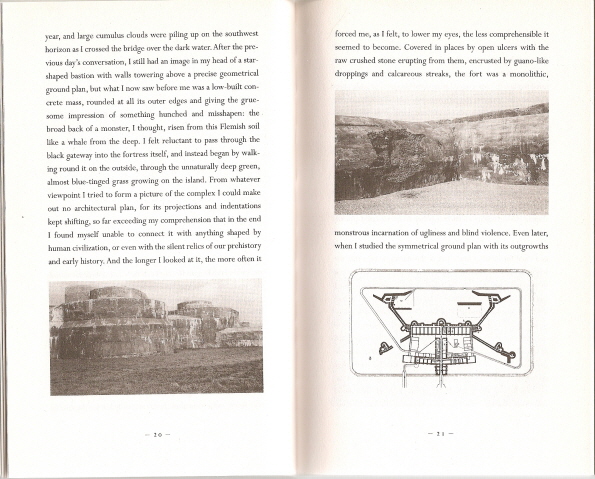
In mid-May of the year 1800 Napoleon and a force of 36,000 men crossed the Great St Bernard pass, an undertaking that had been regarded until that time as next to impossible. For almost a fortnight, an interminable column of men, animals and equipment proceeded from Martigny via Orsières through the Entremont valley and from there moved, in a seemingly never-ending serpentine, up to the pass two and a half thousand metres above sea level, the heavy barrels of the cannon having to be dragged by the soldiery, in hollowed-out tree trunks, now across snow and ice and now over bare outcrops and rocky escarpments.
—-Among those who took part in that legendary transalpine march, and who were not lost in nameless oblivion, was one Marie Henri Beyle. Seventeen years old at the time, he could now see before him the end of his profoundly detested and, with some enthusiasm, was embarking on a career in the armed services which was to take him the length and breadth of Europe. The notes in which the 53-year-old Beyle, writing during a sojourn at Civitavecchia, attempted to relive the tribulations of those days afford eloquent proof of the various difficulties entailed in the act of recollection. At times his view of the past consists of nothing but grey patches, then at others images appear of such extraordinary clarity he feels he can scarce credit them — such as that of General Marmont, whom he believes he saw at Martigny to the left of the track along which the column was moving, clad in the royal- and sky-blue robes of a Councillor of State, an image which he still beholds precisely thus, Beyle assures us, whenever he closes his eyes and pictures that scene, although he is well aware that at that time Marmont must have been wearing his general’s uniform and not the blue robes of state.
_____________
Excerpt: Austerlitz (2001)
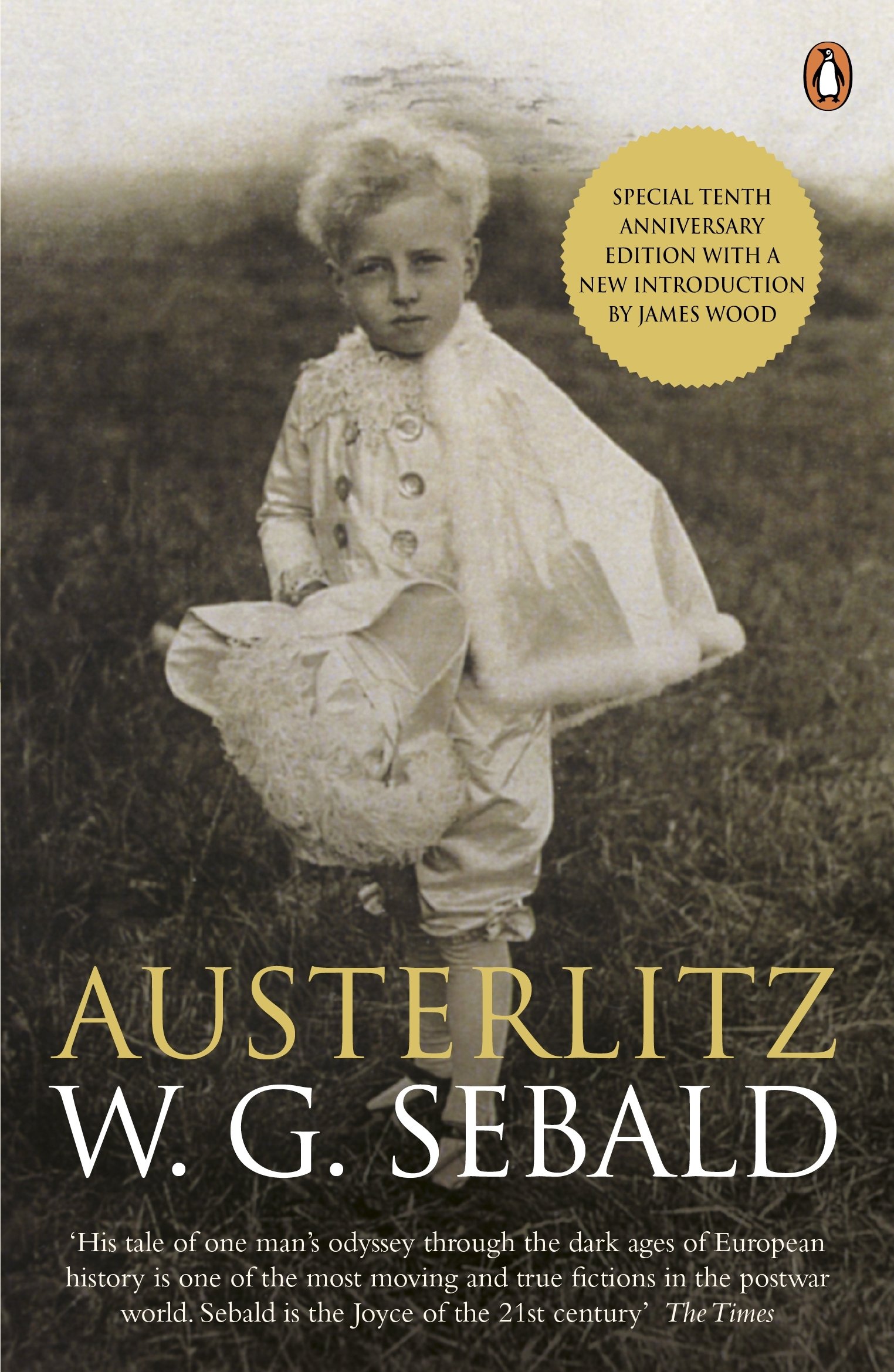
If the mark of a great novel is that it creates its own world, drawing in the reader with its distinctive rhythms and reverberations, then W.G. Sebald’s Austerlitz may be the first great novel of the new century. An unnamed narrator, resting in a waiting room of the Antwerp rail station in the late 1960s, strikes up a conversation with a student of architecture named Austerlitz, about whom he knows almost nothing. Over the next several years, the narrator often runs into his odd, engaging acquaintance by chance on his travels, until finally, after a gap of two decades, Austerlitz decides to tell the narrator the story of his life and of his search for his origins in wartime Europe.
In the second half of the 1960s I traveled repeatedly from England to Belgium, partly for study purposes, partly for other reasons which were never entirely clear to me, staying sometimes for just one or two days, sometimes for several weeks. On one of these Belgian excursions which, as it seemed to me, always took me further and further abroad, I came on a glorious early summer’s day to the city of Antwerp, known to me previously only by name. Even on my arrival, as the train rolled slowly over the viaduct with its curious pointed turrets on both sides and into the dark station concourse, I had begun to feel unwell, and this sense of indisposition persisted for the whole of my visit to Belgium on that occasion. I still remember the uncertainty of my footsteps as I walked all round the inner city, down Jeruzalemstraat, Nachtegaalstraat, Pelikaanstraat, Paradijsstraat, Immerseelstraat, and many other streets and alleyways, until at last, plagued by a headache and my uneasy thoughts, I took refuge in the zoo by the Astridplein, next to the Centraal Station, waiting for the pain to subside. I sat there on a bench in dappled shade, beside an aviary full of brightly feathered finches and siskins fluttering about. As the afternoon drew to a close I walked through the park, and finally went to see the Nocturama, which had first been opened only a few months earlier. It was some time before my eyes became used to its artificial dusk and I could make out different animals leading their sombrous lives behind the glass by the light of a pale moon. I cannot now recall exactly what creatures I saw on that visit to the Antwerp Nocturama, but there were probably bats and jerboas from Egypt and the Gobi Desert, native European hedgehogs and owls, Australian opossums, pine martens, dormice, and lemurs, leaping from branch to branch, darting back and forth over the grayish-yellow sandy ground, or disappearing into a bamboo thicket. The only animal which has remained lingering in my memory is the raccoon. I watched it for a long time as it sat beside a little stream with a serious expression on its face, washing the same piece of apple over and over again, as if it hoped that all this washing, which went far beyond any reasonable thoroughness, would help it to escape the unreal world in which it had arrived, so to speak, through no fault of its own. Otherwise, all I remember of the denizens of the Nocturama is that several of them had strikingly large eyes, and the fixed, inquiring gaze found in certain painters and philosophers who seek to penetrate the darkness which surrounds us purely by means of looking and thinking.
_____________
_____________
Unrecounted: Text and Image in W.G. Sebald
by Nikolai Preuschoff
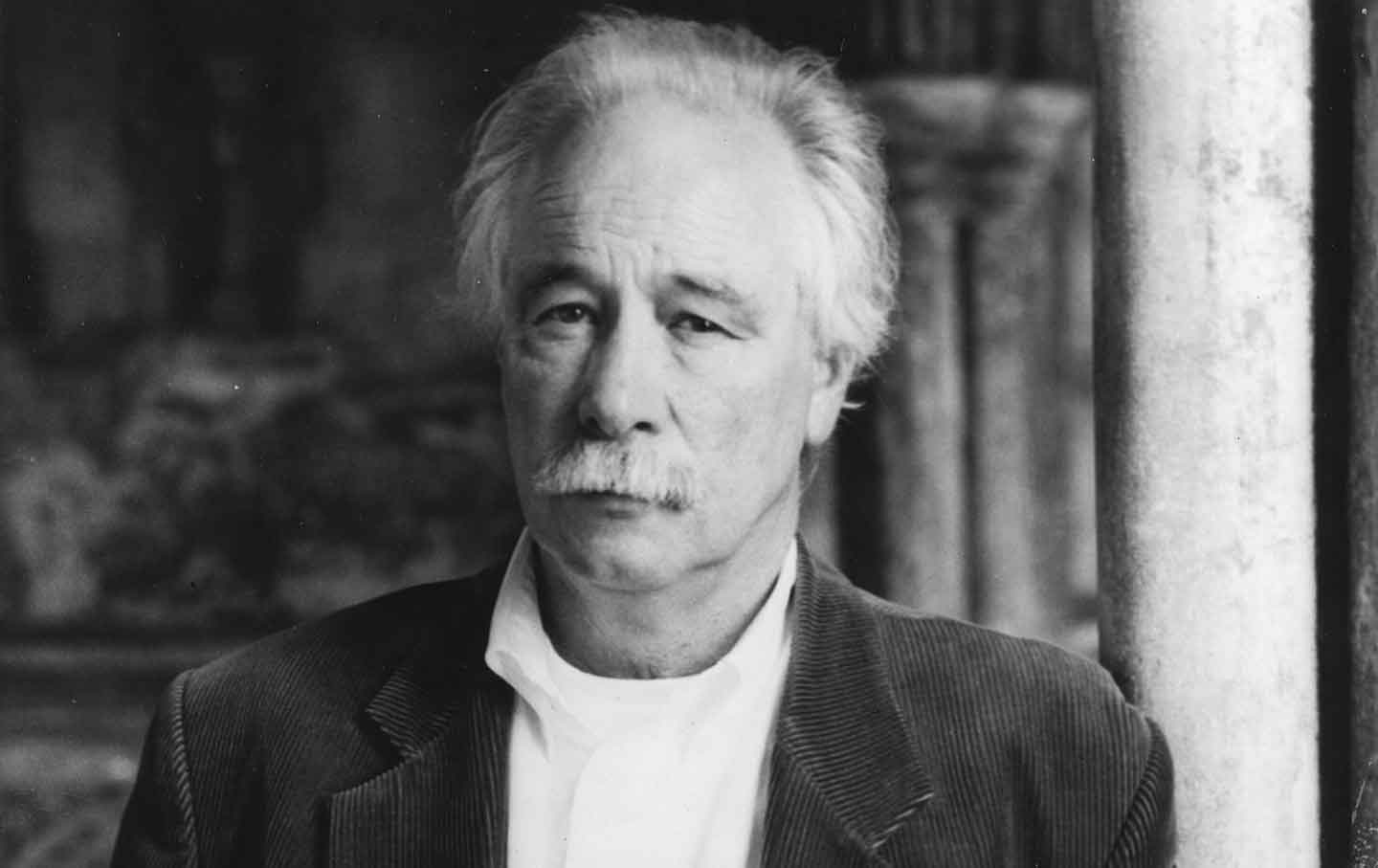
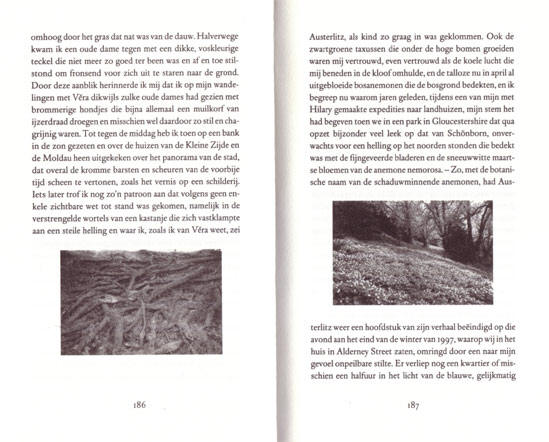
Sebald, who would have celebrated his 70th birthday this year, didn’t publish any literary texts until he was 40. There was a novel he wrote when he was still in secondary school, but it was never published and neither were the small poems he wrote, often when travelling. Things changed in the mid-80s, when Sebald, by then professor of German at the University of East Anglia, wrote a long poem after a visit to the British Museum about the German botanist and explorer Georg Willem Steller. The poem was accepted by the Austrian magazine Manuskripte, and so were the two poems that followed, portraying the medieval painter Matthias Grünewald and the author’s own alter ego. In 1988, all three poems were published by the small Bavarian publishing house Greno under the title Nach der Natur (and as After Nature [2002] by Hamish Hamilton). The edition included six black and white photographs by the photographer Thomas Becker showing half-drowned black trees and trunks in flooded fields, beautifully printed on plates that separate the images from the text.
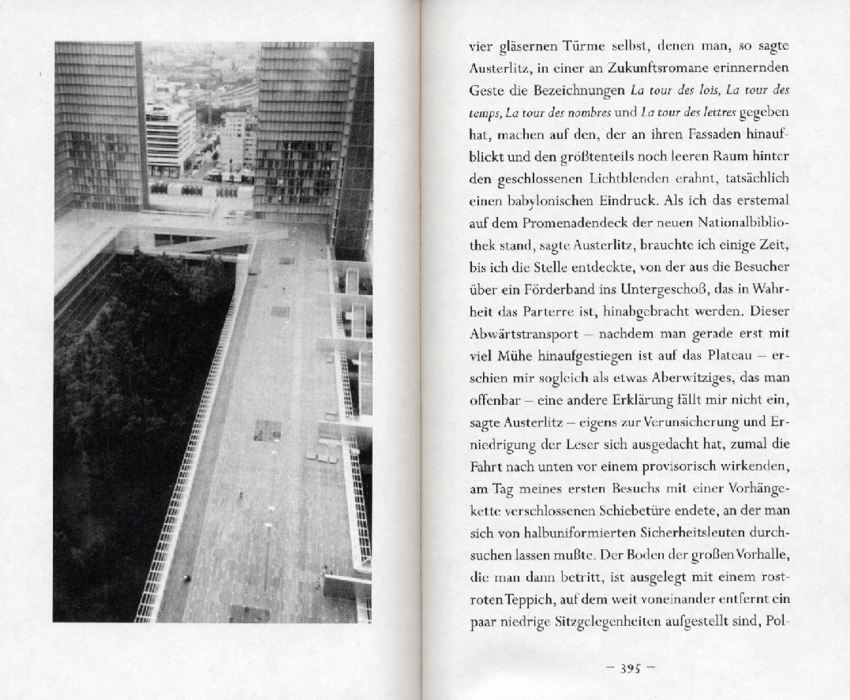
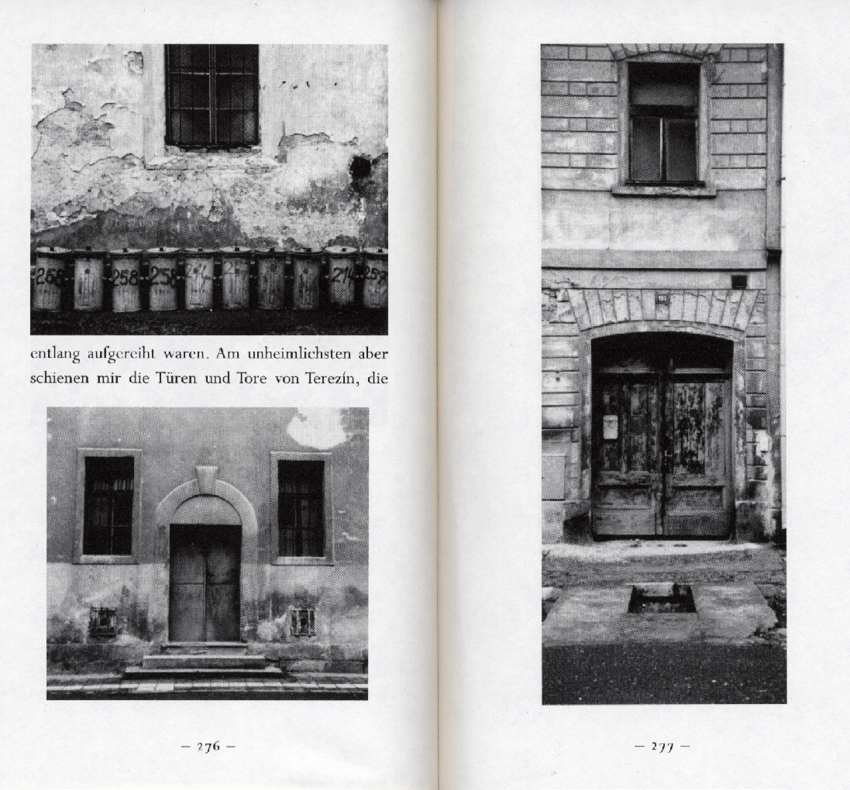
Becker’s skillfully composed, high-resolution photographs are in stark contrast to the images Sebald would include in his later prose fiction writings, published mostly throughout the ’90s: neither Vertigo (1990) nor The Emigrants (1992) use plates any more, and many of the reproduced photographs are now taken from newspapers, postcards or family albums found at flea markets. Other images the author took himself, many of them with a small point and shoot camera, a Canon Ixus L1, using colour negative film.
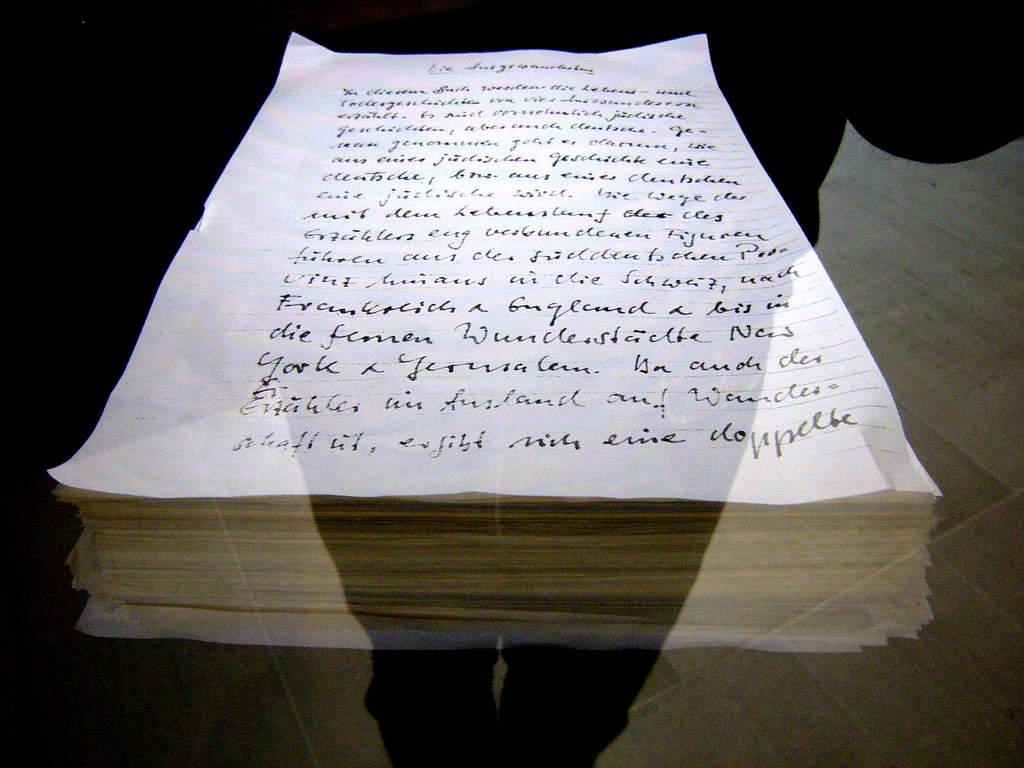
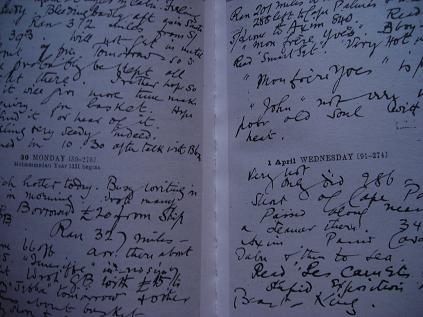
the manuscript of The Emigrants
Sebald’s literary work is exceptionally visual, and his writing from and with images demonstrates an approach to literature not in competition with (or afraid of) the visual, but in dialogue with it, knowing that for both description and photo or drawing there first needs to be careful observation and study. It is in this regard quite significant that Sebald wrote his first published literary text about a botanist who travelled with Vitus Bering’s second expedition to Kamchatka.
Born in Bavaria, Sebald studied German literature in Freiburg im Breisgau and later in Switzerland. Soon afterwards, he moved to Manchester where he received a PhD for a study on Döblin and started to pursue an academic career that brought him to Norwich. As a writer, a bit like the Arctic-explorer Steller, Sebald was drawn to unknown regions and forgotten stories, although the landscapes of his writing proved not to be too far from his home: the world of recent German and European history newly revealed to his expatriate eyes. His prose fiction writings can be described as unique and, apart from their visual component, relatively conservative: all his writings are concerned with the past, particularly the German past and the Shoah, which has been described as a centre that his writings circle around. In particular they are concerned with the broader history of modernity in its multiple, but mostly destructive aspects – imperialism and colonialism, industrialisation and exploitation.
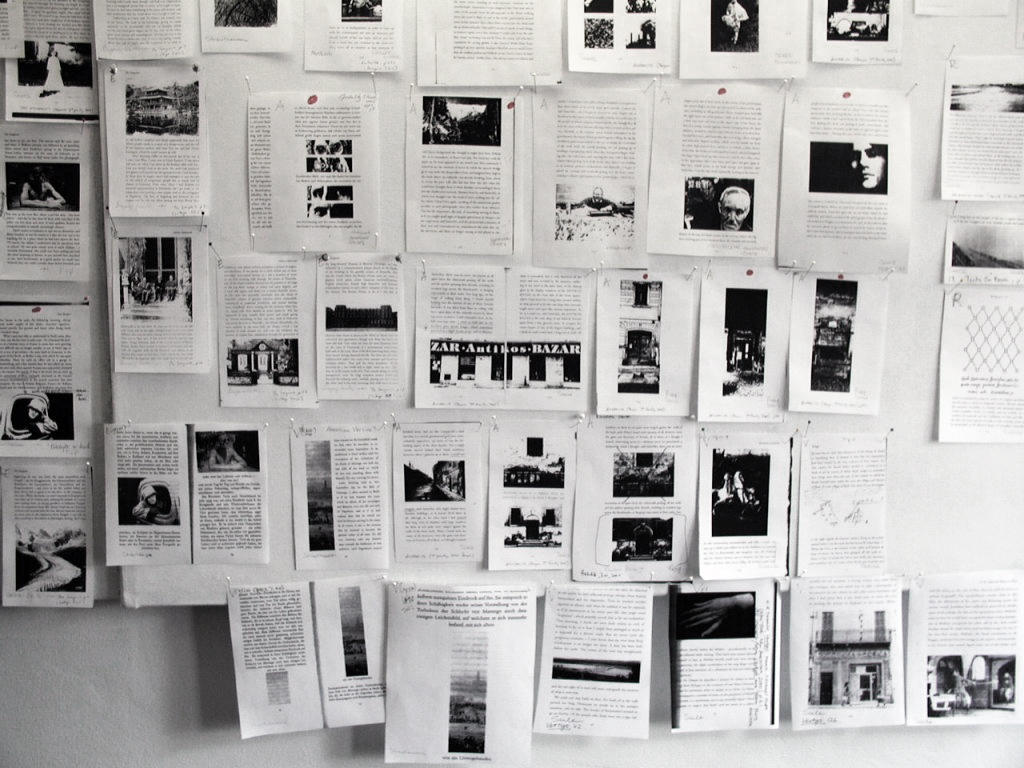
Sebald’s writing style, at once melodic and melancholic, is oriented to 19th and early 20th century literature: he praised the work of Austrian and Swiss writers such as Keller and Stifter, and his language, even in his interviews, has something old fashioned about it (most likely due to the fact that he left southern Germany, where he grew up and studied, in the 60s, and preserved his Bavarian German though all the years he lived in southeast England). What makes Sebald’s prose unique and sets it apart from both his 19th and early 20th century patron saints and other contemporary German writers is a technique of montage, of which the included images are only the most visible expression: the extensive use of quotations and references taken from all kinds of sources, sometimes marked and exposed in the text, sometimes hidden and included like little academic riddles for intertextual research. But because Sebald’s images are the most obvious among the various montaged elements, and because they not only illustrate but influence the narrative, it makes sense to talk about ‘intermedial’ rather than ‘intertextual’ texts. …
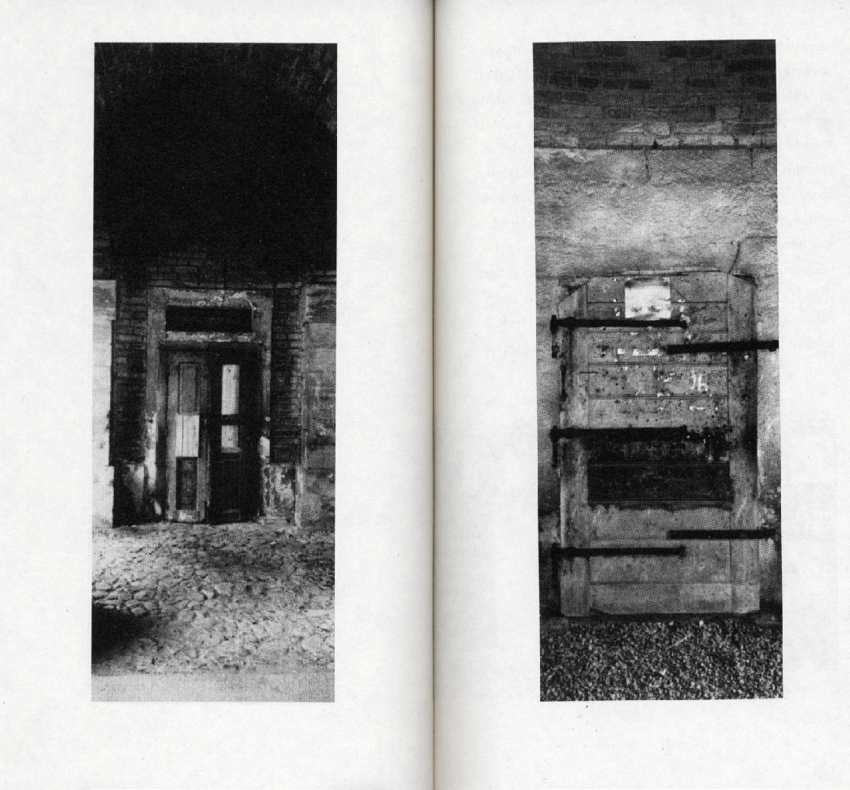
However, in Sebald’s work the text still dominates the images: the text would be changed by the omission of the images, but it would still be readable; the images on their own rarely serve the narrative function. Sebald was a long-time amateur photographer, but it would be an exaggeration to call his work exceptionally ambitious. Travelling with a small film camera, many of his pictures can safely be called snapshots. As a writer though, he takes images quite seriously. His habit of collecting photographs and postcards from flea markets and charity shops inspired Tacita Dean’s fourth artist’s book, FLOH, in 2001. And while it seems remarkable that Dean composes a book exclusively out of portraits, holiday snapshots and other documents of banal occurrences, Sebald, too, is not eager to exhibit his own photographic work, but prefers to use not only different sources (the lack of clarity regarding the pictures’ origins has drawn criticism) but also different media, combined, reflected upon and given a new existence in his narratives.
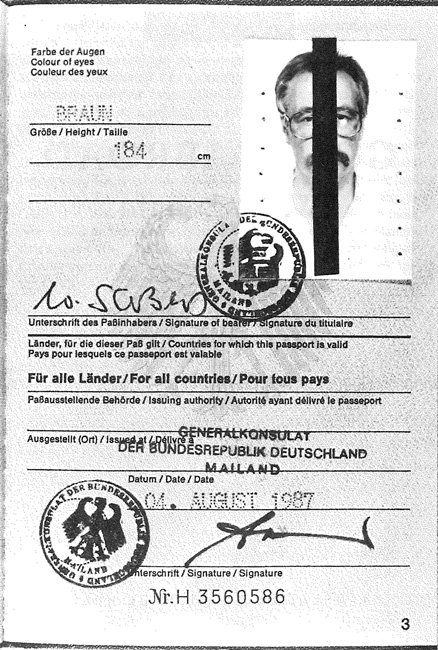
In post-war German literature there are surprisingly few writers who experimented with images. The almost-forgotten Rolf Dieter Brinkmann (1940-1975) combined text and image in his wildly collaged scrapbooks, and the renowned filmmaker and author Alexander Kluge (b.1932) has used text and image in his literary work since the ’90s to challenge discursive and narrative constructions.5 While Sebald knew of both authors and while his admiration for Kluge and his historical narratives is known, his interest in the combination of text and image or, more precisely, the principle of montage, can be traced back to his PhD thesis on Alfred Döblin. The crossing of different art forms, genres and media has always been the territory of avant- garde movements. Philippe Soupault’s La Fuite in La Révolution Surrealiste (1926) is often considered the first example of a narrative text with images included for more than just illustrative purposes. Breton’s Nadja was published in 1928, but the introduction of textual montage to the German literary tradition by Döblin in Berlin Alexanderplatz (1929) was so revolutionary that Walter Benjamin saw it in explosive terms, blowing up the framework and style of the bourgeois novel. Döblin assembles his montaged fragments so densely, Benjamin writes, that the author underneath ‘barely gets a word in edgeways’.6 This is a pretty accurate description of Sebald’s own style of montage and the multiple voices of different narrators in his texts – the only difference being that Sebald adopted the technique of montage so that images, too, are included in the narrative assemblage.
Benjamin not only wrote about montage in Döblin’s work, but adapted its technique for his own theoretical writings. Montage, with its play of distances, transitions and intersections, its perpetually shifting contexts and ironic juxtaposition, had already become a favorite device for him before Döblin wrote his novel. For the Arcades Project, the unfinished major philosophical work Benjamin began in the late 1920s, he planned ‘to carry over the principle of montage into history’.8 And, interestingly, he also planned to include images. While for Sebald images are a natural part of the writing process, they are essential for Benjamin’s concept of history. For him, history is not about textbooks and grand narratives, but about images: it is only in an image, in the brief flash of a moment, that we can recognize historical truth – the rest is the long thunder of the following text. When thinking about the past is determined by images, these images merge with our understanding of the present. In other words, there can’t be an image of the past independent from our present world views, and altogether it is hard to grasp an image of the past anyway: Benjamin describes what can be grasped as a brief flash of the past that amalgamates with the present. He calls this flash-like image, preserved or frozen as a still, the dialectical image: ‘it’s not that what is past casts its light on what is present, or what is present its light on what is past; rather, image is that wherein what has been comes together in a flash with the now to form a constellation.’9 ‘For while’, he goes on, ‘the relation of the present to the past is a purely temporal, continuous one, the relation of what-has-been to the now is dialectical: is not progression but image, suddenly emergent. – Only dialectical images are genuine images […] and the place where one encounters them is language.”
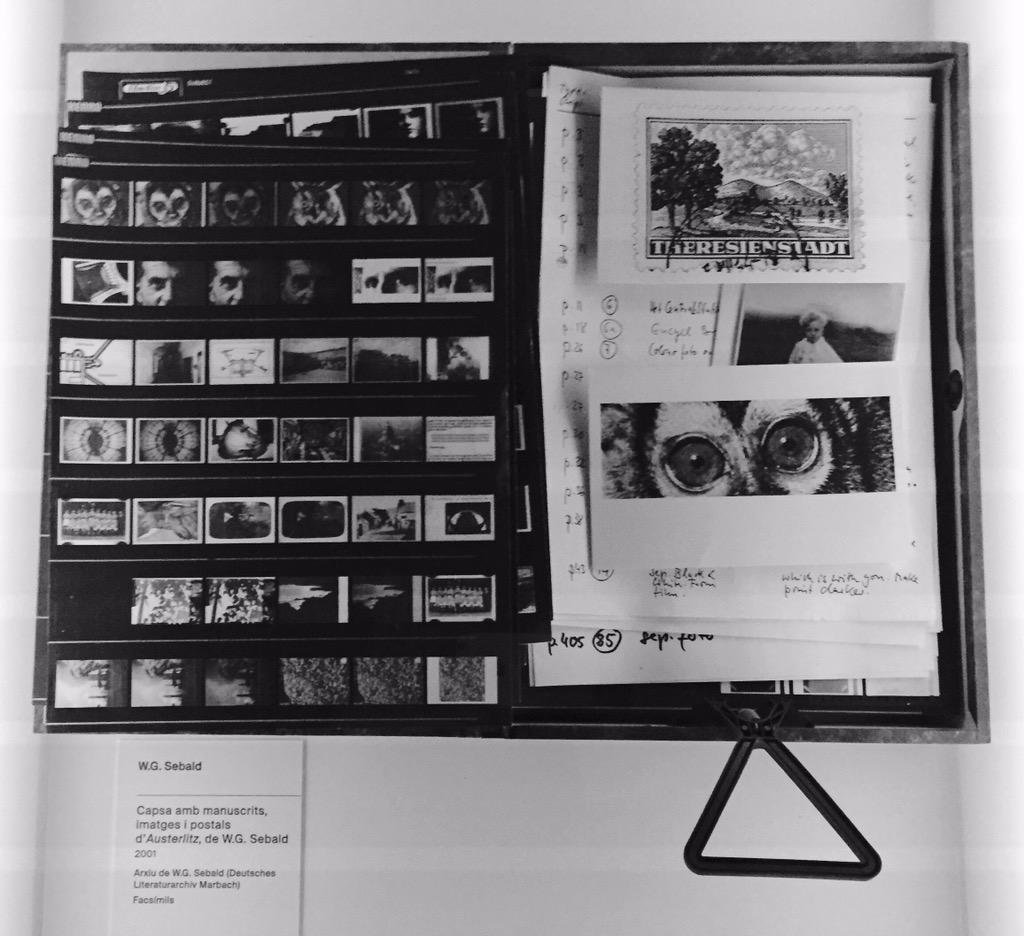
By including images in his texts – paintings, photographs and reproduced receipts, diaries or diagrams – Sebald reminds his readers of this: first, that the narrative cannot be reduced to pure imagination. The included research and its documents (as well as quotations and even, though rarely, footnotes) bear witness to biographical events and therefore to historical truth. And second, that neither the text nor the images can be fully trusted, since they only create a fictional narrative ‘based on true stories’ and that the readers need to put on an ‘inquiring gaze […] to penetrate the darkness’. The inclusion of images thus not only adds visually to the text and its ‘authenticity’, but at the same time challenges the reader to question the authenticity or, more precisely, to seek further for it.
This modesty of the author is also expressed in one of Sebald’s last books, the posthumously published Unerzählt (Unrecounted): a collection of 33 Haiku-like poems combined with drawings of pairs of eyes, of renowned or less renowned people, made in a photorealistic style by Jan Peter Tripp. Both text and image here are reduced to a minimum of expression: a small section of the head, three lines, five lines of text, a few syllables per line. In a way, this can be regarded as Sebald’s approach to writing: the text begins with an image; realism is combined with invention; and in an attempt to gesture at an untold story they come together, piece by piece.
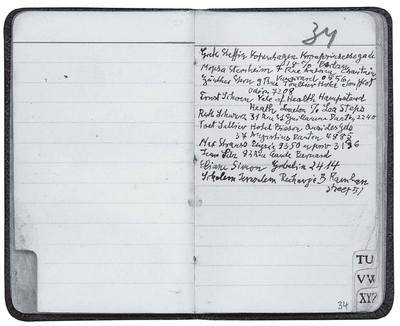
Walter Benjamin datebook
—-
*
p.s. Hey. ** jay, Hey, Jay! Cool re: your GS love. Me too for very similar reasons no surprise. I grew up in this kind of big mansion and, to this day, I feel sure there were secret passages and/or hidden rooms all over the place even though I spent years and years fruitlessly going over the walls and lattice work and etc. with a fine toothed comb. So, yeah. Have an overactive weekend, pal. ** Carsten, Having to explain/ describe the home haunt took some space as did laying out how the ghost would work and manifest itself filmically, and we did cut quite a bit out along the way like I said. The script for the next film, which is proposing something much simpler, is only about 40 pages. That plan for your films sounds infinitely easier. In that case, there’s not much stopping you, no? Just finding some collaborators with needed skills? Sorry for the blog’s weirdness yesterday. Ideally a brief mood on its part. Thanks, yes, having the visa is reassuring. ** Dominik, EW’s work is important to a lot of gay guys who want to read fiction they can personally relate to as gay guys and that is written in a high literary way that they feel is legitimising. Not my thing, obviously, but more power to him. I was recently interviewed for a documentary film being made about him, I think probably because they wanted one gay writer who didn’t talk about him like he was a god. I liked him personally though. And he was publicly supportive of my work when I was first starting out, and that did help a lot. No, I’m not someone who looks at my phone when I’m out and about, so I just looked at the other people in line and thought about them mostly. Haha, ‘the ones who smell like incense’, that’s funny. Might make for a nice first sentence in a novel. Love wondering why he keeps issues of magazines that he’s already read, G. ** _Black_Acrylic, Oh, really, I didn’t know that about the Schneider labyrinth entrance. Another reason why I wish I’d been in London then. Ever since I had bad acid reflux in my early 20s I haven’t been able to eat spicy foods. My stomach rebels. If I even put pesto sauce on my pasta, I pay for it. Me who used to eat huge amounts of onion rings in my youth. Sigh. I’ll tell Zac about Naga chilli. Nothing’s too spicy for him. Enjoy your chillis and be grateful for your iron stomach, trust me. ** ⋆˚꩜。darbbzz⋆˚꩜。, Hi, pal. I’m happy the Kane and Schneider posts got to you. I get you about those rooms and their compelling resonance. Totally. ‘The Ape Of Naples’ album by Coil? Sure, I know it. Coil’s excellent in general. They composed the score for the unfortunately awful film that was made of my novel ‘Frisk’. And I knew Peter, the other Coil member. He was cool. Of course I’d be up for you making a stop here in Paris near me. Of course! I’ll show you Paris at its best. What you said does make sense to me, I’m pretty sure, and how great that the therapist seems like they’ll be a keeper. Bon weekend! ** Laura, Schneider is a great discovery, I think. In Zac’s and my next film there’s one scene that takes place in a secret room inside a home’s walls, so there you go. Technically, the LCTG stuff ended up in ‘Ugly Man’ because I wrote a early, different version of the script years before we made it, and I didn’t think the film would ever get made so I raided it for the good stuff and built little fiction things out of that. I don’t think I’ll break my no TV habit, but that’s good to know about ‘Half Man’. Party? Did I say I was going to a party? Huh, not as far as I can tell, but … ? ** Adem Berbic, Korine’s films are all worth watching except for ‘The Beach Bum’, which is terrible. Croatian coast, fun. Well, presumably since I don’t know anything about it. Maybe the Pharmakon crowd was stunned and roiling wildly inside? I’m trying to imagine a way that the coding is subconsciously informing your writing practice but that’s optimistic me in a nutshell. ** HaRpEr //, Well, yeah, no surprise whatsoever, right? That novel about that kid and his bedroom is enormously tasty and the exact opposite of stupid, my friend. No surprise there either, I would imagine. Very cool. It is so nice to be in country that isn’t terrifying at the moment. ** Nicholas., Hey. I think my brain really came into its own in my 30s for some reason. I just don’t want to go there: TV. My loss, what can you do. I used to like TV a lot, but I don’t know what happened. Sounds like an excellent start to me. ** Okay. I seem to have decided that you should spend the weekend wth the great W.G. Sebald, so I hope that suits your purposes. See you on Monday.



 Now available in North America
Fantastic. Huge influence on the way I write and read and walk. I can return to his books endlessly, take different paths of research, circle back, begin again, take a differnet route through the passages to a different destination that changes as soon as I reach its outskirts. Great post, Dennis.
I really ought to resuscitate my by-this-point-nonexistent high school German because I really want to read Sebald in the original. Once I went to a talk by an author you don’t like on Sebald, and he mentioned how for ages the German literary world had no idea what to do with him because, to German readers, his prose came off weirdly twee and stuffy, although obviously in a calculated way that was meant to disorient. I guess it comes through to a degree in the translations.
In the British cultural context, it’s also pretty hilarious that he lived in Norwich. I dunno how I’d convey the energy Norwich has, but let’s say that it’s simultaneously a bizarre place for a globally renowned author to have lived, and the only possible place in which Sebald could have lived. I should also add that I like Norwich as a place, the image of it here just has a specific vibe.
The Croatian coast is luscious, and I could definitely use luscious, so I think I can allow myself to be uncritically lush for a week. Perhaps the coding could teach me a lesson in working systematically, but at least at present my writing is quite diametrically opposed to that, and I dunno if that’s a discipline thing or a ‘just the way my brain works’ thing. Or, I could take it more literally and start writing books in computer code like Kenji Siratori does.
My not-smoking crusade has hit the skids a little bit, and the worst part is that more-or-less not smoking for a bit has ruined smoking. As in, I’m still doing it, but all I can think about is how my lungs feel like a furnace and my mouth tastes like an ashtray. Oh well. What’s on your weekend agenda?
Hey Dennis,
I meant to comment yesterday, but I was so tired I didn’t even realize I fell asleep whilst watching something on my phone. But I was getting onto my friend and he told me about how some of his friends did that type of therapy in Brighton, so if/when I move to London, it’ll only be a potential train ride away. I’ve been so active with seeing people these past few days that I’ve started to recognize that I do need to be around people, just because I seem to lack emotional permanence, if that makes sense? Like when away from someone for a bit I start to imagine and assume how they feel about me, negatively. One of the type of things I hope that psychedelic based therapy would help with, but for now I just need to keep up with people, but not overstep and annoy them which i have done in the past.
I was with my friend yesterday, we were talking about her last exam which involved a question on Blasted by Sarah Kane; she said to me that some of the stuff she was studying on Kane reminded her of some of the stuff I had spoken about when talking about your work to her. She decided to search both your names to see any connection, and it just so happened to be the day where you posted the Sarah Kane post hahah. Serendipitous, and I’ve been experiencing a lot of those odd coincidences, like thinking about my friend in an exam only to get a text from her that very second saying she would be visiting me at work. Makes the delusional part of my brain start to believe in some mysticism or karma or power like that.
hey Dennis,
Think I’ll be able to join you this summer for that coffee in Paris to discuss 6-7 among other very serious literary topics. With that meme’s tenacious semiotic implications aside, I find a lot of value in your work as a trans woman, especially in terms of a doomed boyhood, a theme which I’m trying to import on some level into my writing. I’m doing the Disquiet writer’s workshop in Portugal from late June to early July and believe I should have the time to head Seine-wards on a spare weekend unless you can meet me in Lisbon — email me if you want to set something up.
Cheers,
Beaujolais
hey Dennis,
I might take you up on that offer for coffee! I’m visiting Portugal for the Disquiet conference between late June and early July and might be able to take a detour Seinewards to chat about 6-7 and other important literary topics. I find your work really valuable as a trans woman, especially the theme of a doomed boyhood which I’m trying to import into my own writing. Hit me up if you’re available!
Cheers, beaujolais
Sorry for the double-comment, my previous one failed to load for me and I thought it was caught by a filter or something 😛
Gotta say W.G. Sebald has never been on my radar. Always discounted the guy as being somehow too old and square. Evidently time to revise my opinions, and will give this weekend’s post a good look over.
Hi!!
Oh, I didn’t know that. That you knew him – and that he was supportive of your work. Do you know when the documentary is scheduled to come out? I tried to look it up but couldn’t find any information.
Sometimes I listen to music when I’m out, but nothing beats people-watching, really.
I very rarely buy magazines, but when I do, I keep them too, even after reading them from cover to cover, so I relate to love. They aren’t like books, but somehow it still feels weird to just throw them away. I don’t know.
Love asking TripHound why it started sending him at least four spam emails a day about deals on trips when he never travels anywhere – and his search history probably proves that, Od.
Hey Dennis. Agreed with Black_Acrylic on this one, I’ve never really considered Sebald as someone who might be on your blog. Austerlitz was next up after Proust though, so I’ll maybe pick that up as soon as I’m done commenting. I never knew Edmund White liked your writing, that’s interesting. I don’t really like his writing, but he seemed like a really nice person, and I suppose in an identity politics way it’s good to have well adjusted albeit uninteresting gay guy writers.
I’ve been having an interesting weekend. Work’s been really light, so I’ve sort of tried to embark on an ill-advised Proustian adventure of my own, inasmuch as I’m seeing paintings we had prints of in the house, and having store-bought exact replicas of food I had as a child, which has been fun. It’s mostly just something to idly amuse myself, but it’s sort of interesting. Not having any big revelations of memory though, sadly. Hope you’re well, lots of love from here.
Hey Jay! If you like Proust’s sentences that include about 100 clauses and contain multitudes but somehow manage to end the place that they started, then I think Sebald will really do it for you. Proust for sure has a delicacy to his sentences that hide an unmistakable anguish, and Sebald does something somewhat similar, but very differently.
Hi HaRpEr //! Oh wow, that sounds excellent, you’ve really sold me on him. Thank you!
hi Dennis!
i’ve only read Sebald’s Rings of Saturn and quite a while ago at that, but i like him. his visual style is my thing, and his fear of sentimentality almost triggers me lol, i’m so sensitive to that. i’m in between reads now, so maybe i’ll pick him back up. thanks for bringing him back to mind!
yes you said you were attending a thing, you did! 😀
and oh, room within a room, how do i make RT mine right the fuck now ^_^
i’m happy LCTG was made obvi. big appreciation for that film. totally cringe to call anything pure cinema these days lol, but that scene w the musician sort of chaotically getting it from a bunch of ppl then finally going ‘thank you!’ all media-trained? that was great. i’m even a bit jel of the actor lol, wish i’d do smth as cool ^_^
today i ended up remixing this thing someone else wrote v badly and now i’m slightly bummed out bc i obvi can’t use it even tho i like it enough to use it. meh. =D
pleaaaase give me a random prompt sometime so i can write smth quick and dirty i can actually do smth w lol
i’m so randomly shagged out tonight i feel like i’m high. weird, but welcome. think i’ll just fall face first into bed now and sleep for like 20 hours. and then the novel, which is quickly taking shape lately, even if more in my head than on the page yet. so much to write. ^_^
hope the night is good to you! think i dreamt of you at some point last night, but i woke up only to vibes and confusion.
<3
I started tapering down on Lexapro a few days ago because I think it’s making me depressed – ironically enough – but I feel worse today, mentally and physically. It didn’t help that my laptop crashed and erased most of the setlist for my next “Radio Not Radio” show, although the files themselves are fine.
Do you suspect anything was going on in the hidden passages and rooms of your parents’ mansion?
How was your weekend? If I’m feeling better tomorrow, I’ll be attending a press screening of Boots Riley’s I LOVE BOOSTERS.
Hey. I love Sebald. He sort of invented a certain form of wandering, scenic non-fiction which has been oft imitated in recent years but never matched. There is a real strangeness to his sentences. Like some of my favourite writers, there is a peculiar sort of stuffiness, maybe even twee quality on the surface which creates the effect of hiding something huge and unbearably devastating. It’s very English seeming in a way, though that quality can also be traced back to Walser and other German language writers.
Thank you about the novel. I started writing it after creating some sort of vague structural map but wrote very impulsively to begin with. What ended up coming out onto the page is stuff that I don’t really know how to fully verbalize. It’s strange that ideas can feel right or wrong when I’m writing but what I can actually say about it is very limited. I suppose I have these constraints which have become a second tongue that I can slip in and out of at will, and that’s all I really know. Do you ever find that people think you’re being pretentious by having difficulty in talking about your work? Because that happens to me a lot. A professor once advised me to lie about my work when pitching it to publishers and heavily implied I should lean into the trans thing.
Alright birthday week has begun and gosh J feel great! That makes sense I could actually feel the fluid in my brain for a bit at 21 and then 25 and it was denser for sure. Now its more like wiring and software updates to match the hardware like if I didn’t do all this leisurely daily high walking I wouldn’t have been able to handle it all? I feel crystal almost and im turning emerald haha green really is my color. Ugh ya know being a whack job and talent are so entwined it makes both worth it. What else Oh do you actually think genius minds would get tested by mensa or whatever it doesn’t seem smart to be tested and cataloged for arguably a very easy to hide asset. Just like how all the real generation genius’s geniui? are called weirdo’s until the future kids pick up what they put down ect. Time its for kids get it? Haha TTYLXOXO