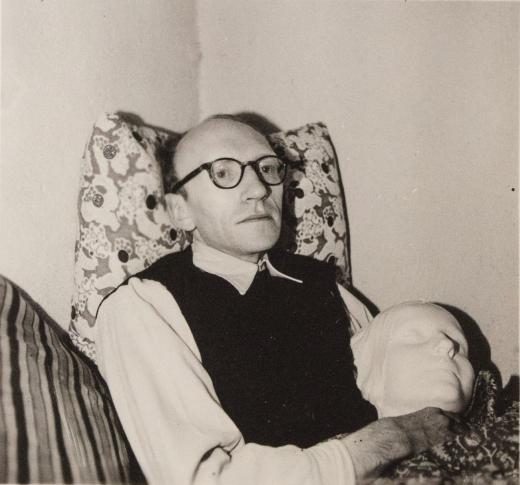
‘Le Dernier homme is a trial of the limits of dissolution of both the character and language,the ability to dwell in the present is a feature of not only the last man but also the story about him. As a narrative, Le Dernier homme is not very eventful. Striking with a low dramatic voltage, lack of chronological order and only scattered pieces of information, this re´cit about the relationships between three nameless characters residing in a non-specified house presents lengthy, carefully constructed passages where nothing happens. With the characters never doing anything except spending extended stretches of time together, they are simply there with each other, in the atmosphere of time and action coming to a standstill. As Hans-Jost Frey observes, on the level of communicating meaning Le Dernier homme does not say anything and does not try to. Instead, its stylistic devices are employed in such a way that they allow it to say nothing; or, as Frey fittingly puts it, “to say what cannot be said without losing it as unsayable by saying it”. It is by trying to say nothing that the language and style of this narrative manage to exert an unprecedented pressure on the partitions between the characters – something Nathalie Sarraute announced as a goal for contemporary fiction several years earlier.
‘With its tired characters and exhausted language, everything in Le Dernier homme is “just there”, plainly and without attributes. The most manifest linguistic and stylistic elements that contribute to the impression of unadorned presence and the absence of reported events are, on the one hand, an excessive use of certain words (especially adverbs presque and peut-eˆ tre; verbs mettre a` nu, blanchir and effacer, and nouns le vide, le silence, l’immobilite´, la le´ge`rete´ and la faiblesse), and, on the other, a very unconventional syntax. Imitating the narrator’s inability to place himself firmly in his rapport to the last man, Blanchot’s sentences often oscillate among “je”, “il” and “nous” in a single long sentence. This tendency, which makes sentences develop only by diverging from the course that was grammatically determined by their beginnings, allows for the adding of often disparate segments to the endlessly ramifying compositions. The following passage, in which the narrator describes the way the last man talks, can serve asan example here:
Ce qu’il disait changeait de sens, se dirigeait non plus vers nous, mais vers lui, vers unautre que lui, un autre espace, l’intimite´ de sa faiblesse, le mur, comme je le disais a` la jeune femme, “il a touche´ le mur”, et le plus frappant e´tait alors la menace que sesparoles, si ordinaires, semblaient repre´senter pour lui, comme si elles avaient risque´ de lemettre a` nu devant le mur, ce qui se traduisait par un effacement qui blanchissait cequ’il disait au fur et a` mesure qu’il se pre´parait a` le dire.
‘Along with exemplifying the syntax of this re´cit, this sentence also explains – and performs – the speech of the last man. Here, the narrator already shows signs of speaking the same way as the last man. The last man’s speech does not only efface whatever it says; nor does it merely postpone denotation by means of constantly modifying the meaning of the sentence. It is rather that when the last man finally gets to speak, his speech, at every moment, shows his reluctance to talk about things. With his slow and heavy rhythm, what becomes more important than words is the very act of speaking. Addressing neither himself nor the narrator, and saying nothing definite, his speech only marks the fact that these two characters are together.
‘Not unlike the sparse speech of the last man, Le Dernier homme, with its static syntax and mono-semantic vocabulary, itself serves as a medium of exhausted talk. What we get in both cases is a slow and careful preparation for talking, but not the message-transmitting speech. By the time this preparation crystallises into a fully formed language, it has already started effacing itself. With nothing hard and stable remaining in the narrative, what is left is an extreme level of linguistic thinness which, as Paul de Man argues is the case with all Blanchot’s stories, is as close as one gets to an entirely “unpunctuated [form of] temporality”. This thinness is not only intricate to create – especially within the genre of narrative literature, with its tendency towards denotative language – but also difficult to undergo for a reader. Many readers undoubtedly struggle with the exhausted language of Le Dernier homme. However, even though the unusually desolate space of this narrative does not immediately make one submit to it, the reader’s uneasiness is not left unaided. From the very start, the reader is constantly reminded of a similar resistance displayed by the narrator when facing the speech of the last man. In fact, the reader experiences discomfort precisely by means of reading about the narrator’s discomfort – that is, by means of being exposed to the effect that the last man’s speech left on the narrator’s own way of telling the story.
‘As a structurally inherent part of the re´cit, the reader resembles the narrator. Since the narrative structure of Le Dernier homme comprises the homological relation between “le dernier homme” as a book and as a character of this book (the book says what it says in the same way as the last man speaks), the reader enters into another functional homology – one between the last man and the narrator. The reader, while reading about the narrator’s difficulty to adapt to the last man’s speech, doubles the narrator’s attempt to come to terms with exhaustion and emptiness because s/he has to withstand the narrator’s language that itself already resembles the one of the last man. The reader and the narrator thus form yet another functional homology of this narrative. Although thereader cannot be forced as far as to comply with the narrator’s self-expropriation, the weariness that Le Dernier homme exerts via the reader’s enacting of the narrator’s enacting of the last man’s speech demands an exhausted reader. The reader who complies with this demand, then, carries out the very fatigue that defines the last man.’ — Daniel Just
___
Further
Espace Maurice Blanchot
‘The Space of Literature’ @ goodreads
Contradictory Passion: Inspiration in Blanchot’s “The Space of Literature”
‘Everything and Nothing’: Blanchot in the Space of Shakespeare”
Introduction: Blanchot’s Spaces
Analysis of the Space of Literature by Maurice Blanchot
Blanchot on the analogy between writing and suicide
I’m too dead to tell you: withdrawing rooms and other breathing spaces.
BLANCHOT AND THE RESONANT SPACES OF LITERATURE, SOUND, ART AND THOUGHT
Reading The Space of Literature (iii)
Nothing doing: Maurice Blanchot and the irreal
Introduction: Against Praise of Maurice Blanchot
(Re)Writing, (Re)Reading: Maurice Blanchot and The Space of Literature
The Negative Eschatology of Maurice Blanchot
Read the entirety for free online
Download ‘The Last Man’ here
_______
Handwritten
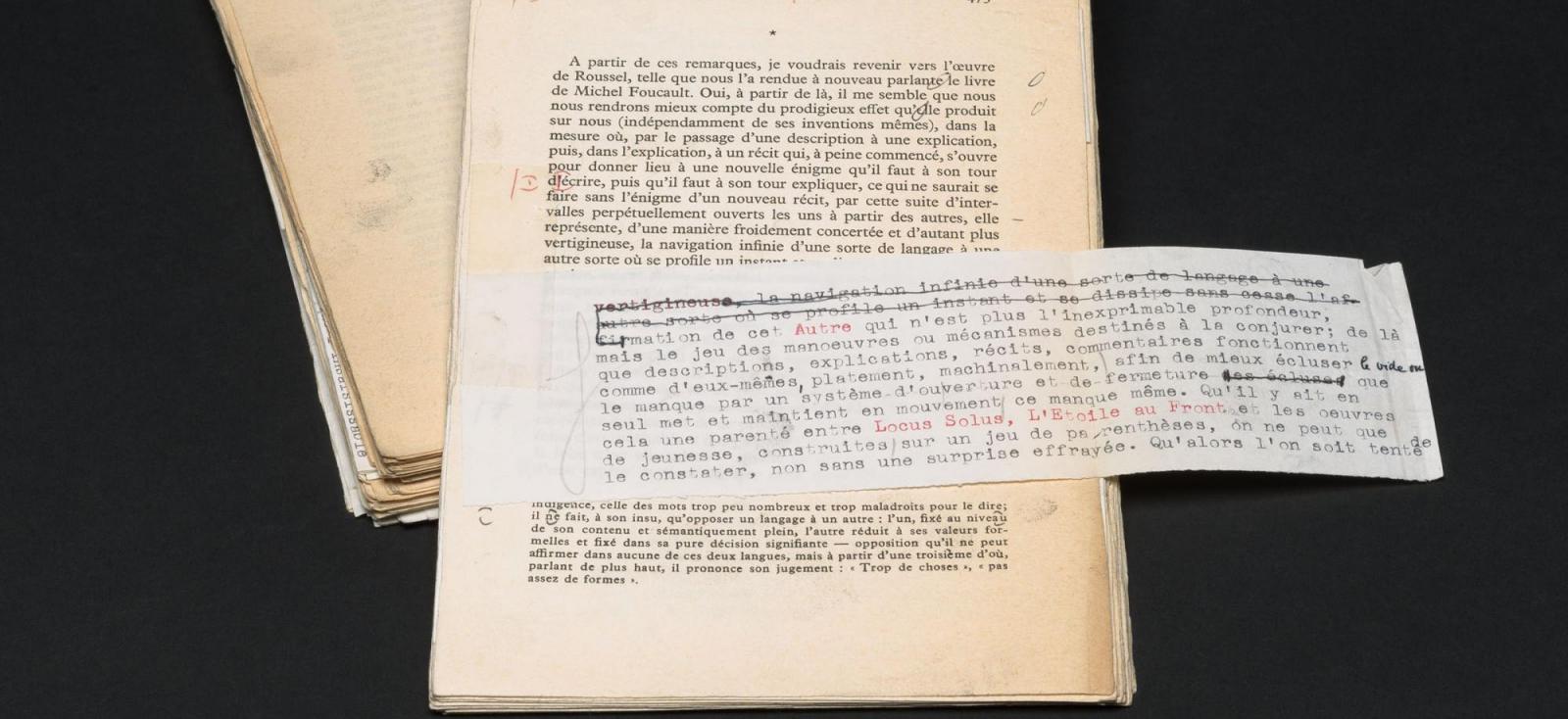
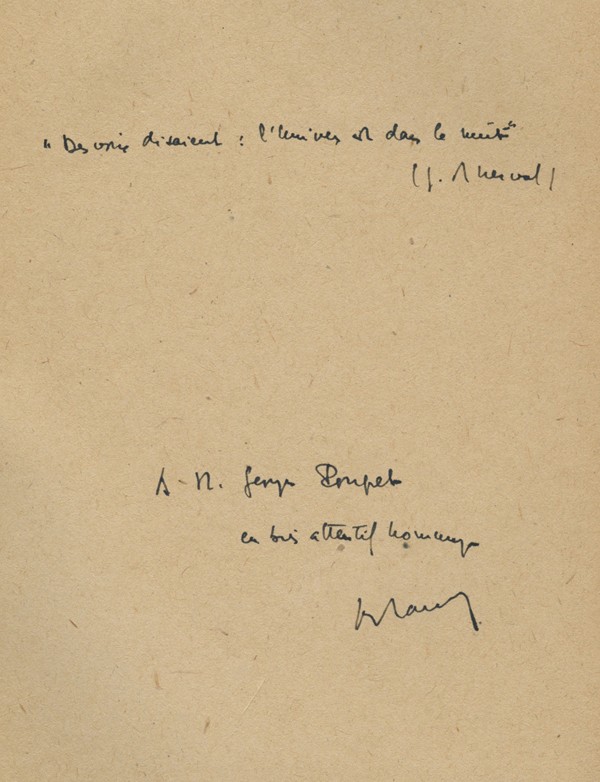
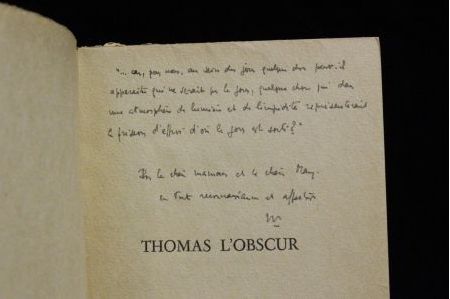
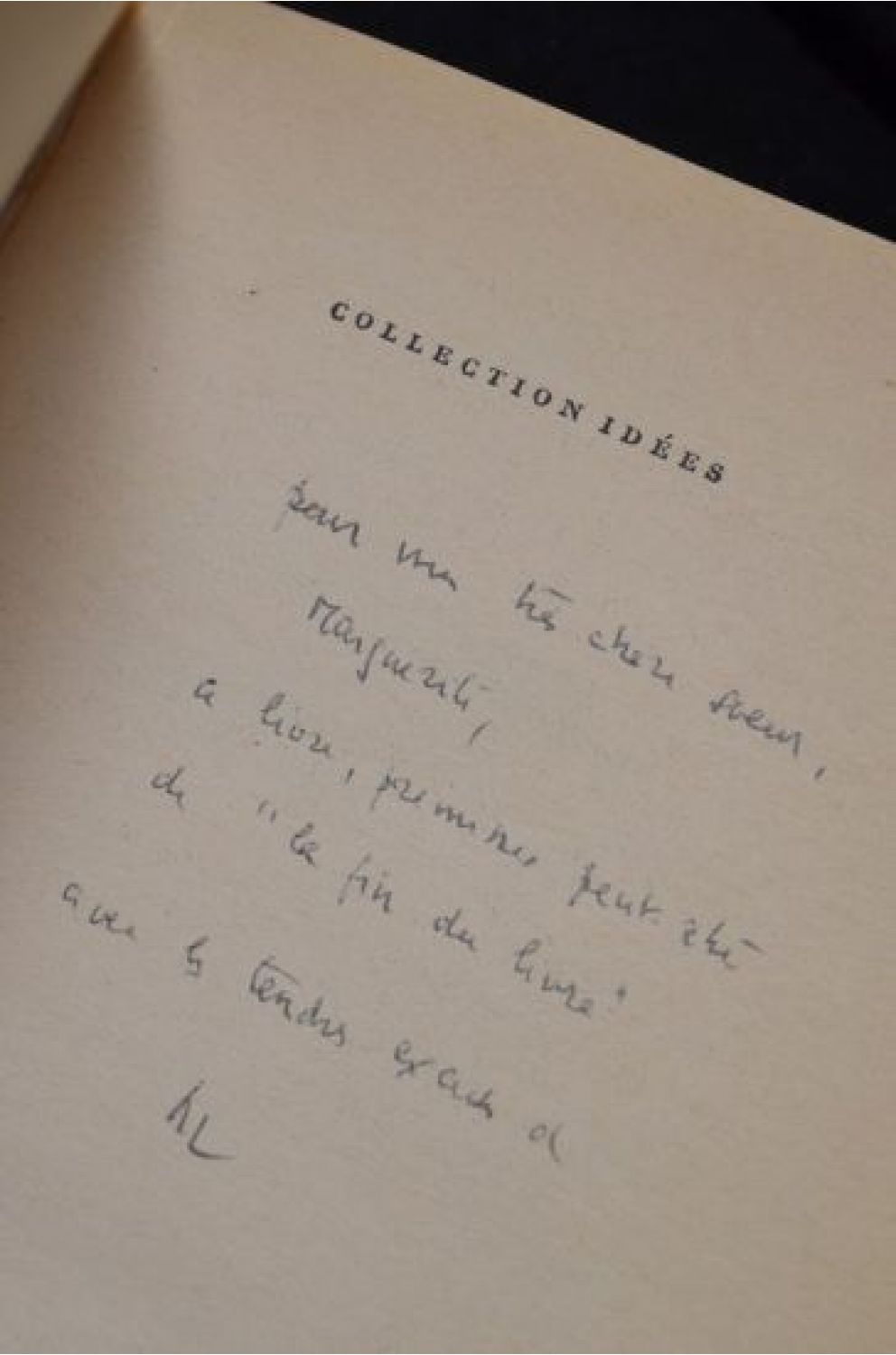
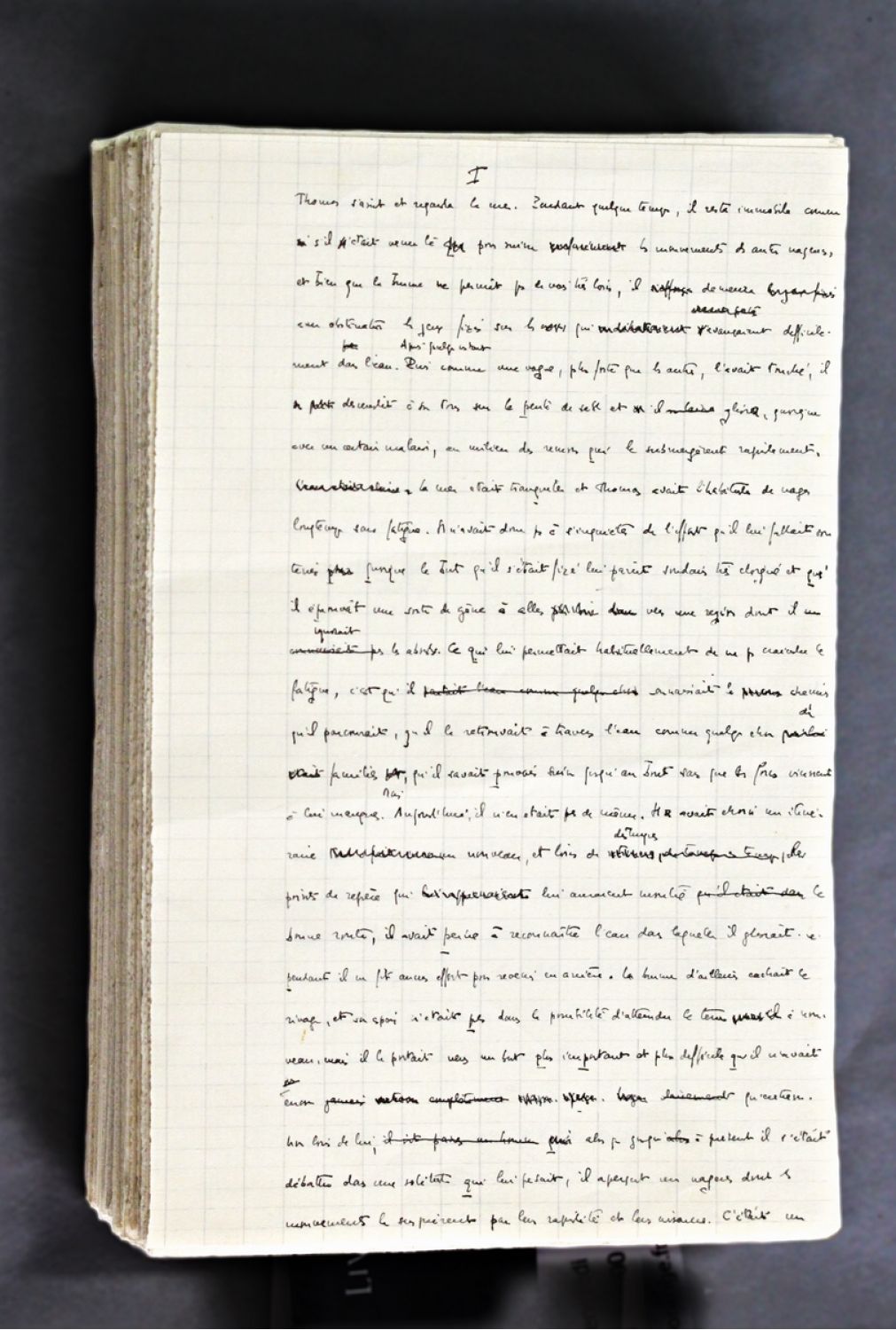
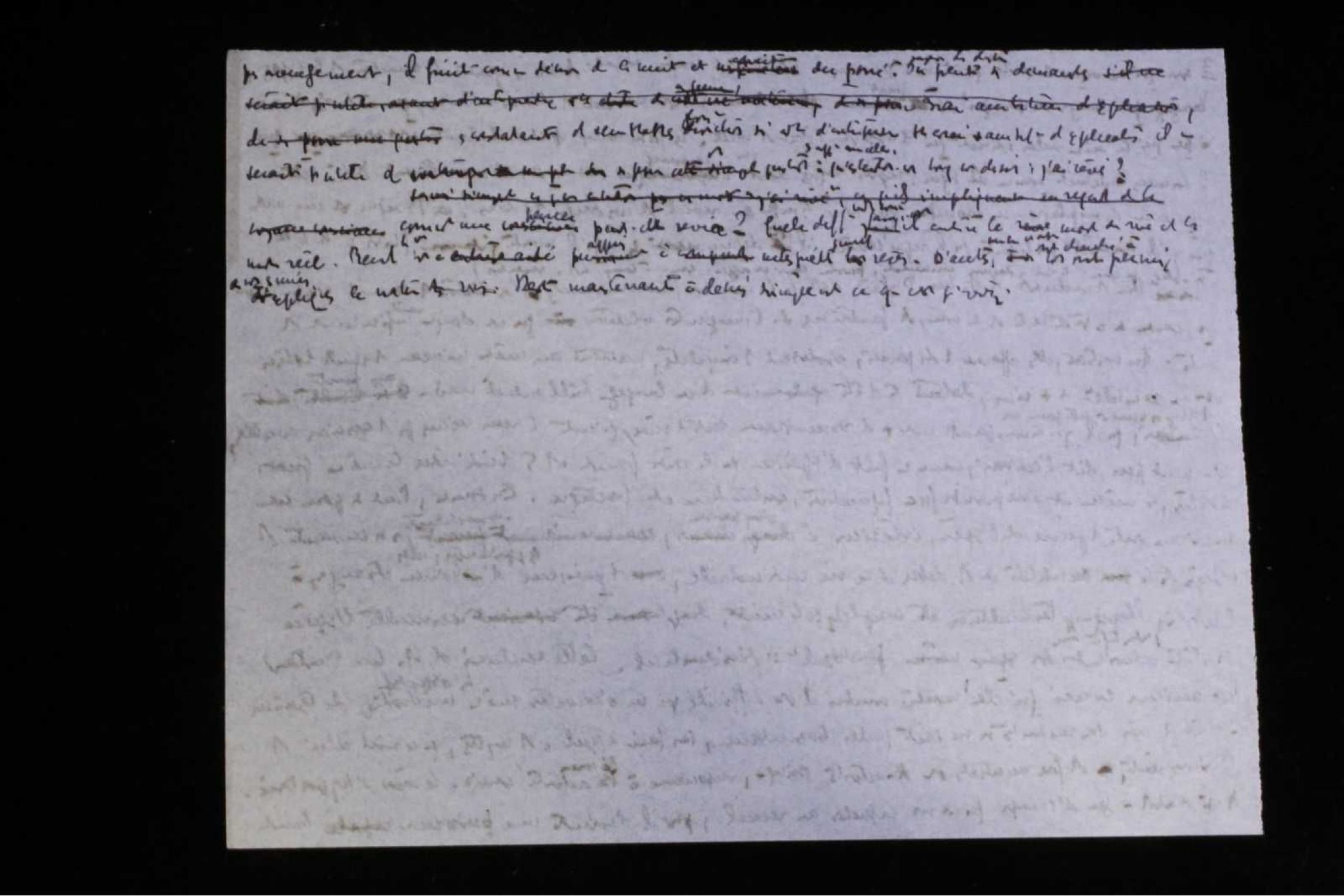
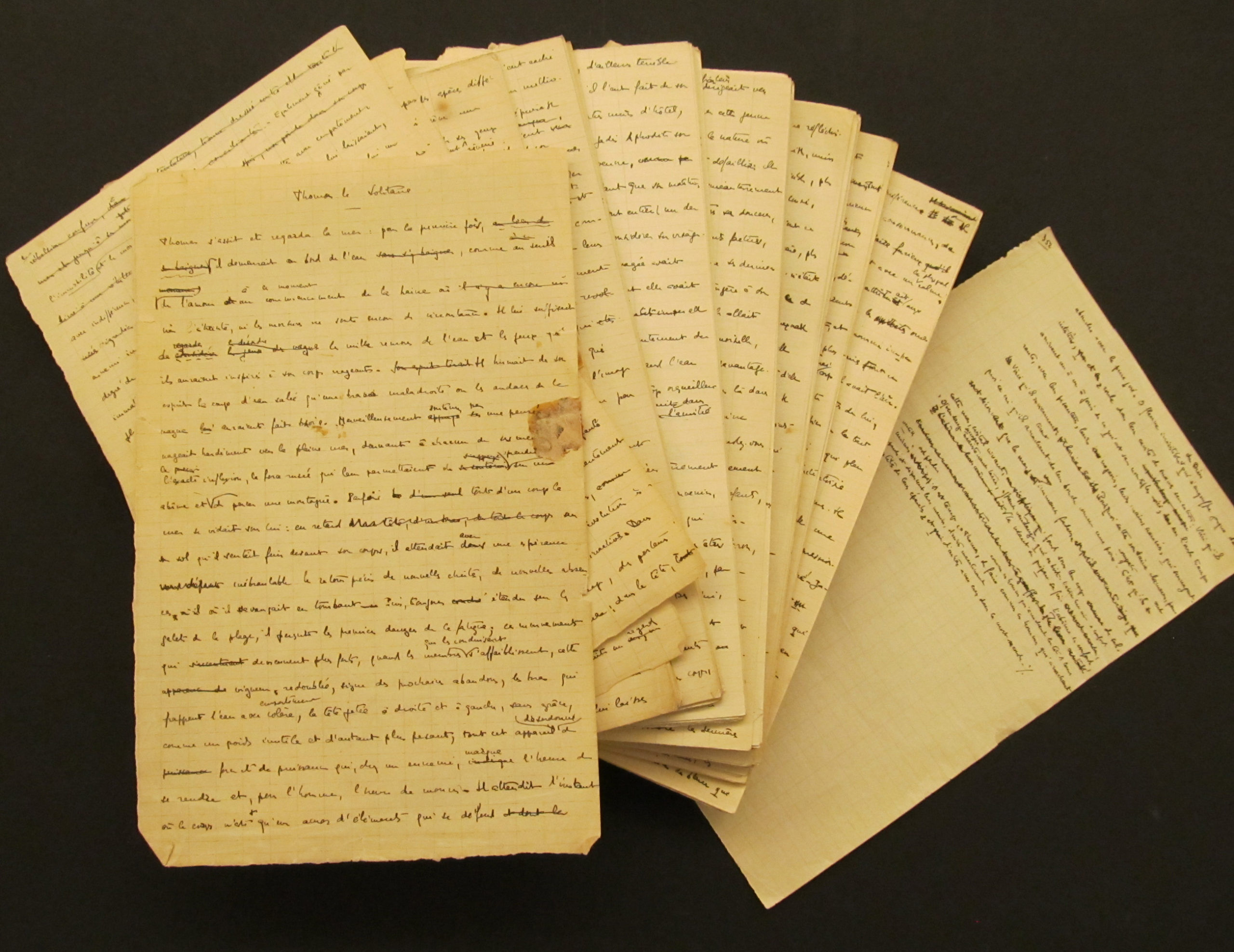
___
Extras
Derrida on Blanchot
Levinas on Maurice Blanchot
Blanchot’s Nietzschean Inspiration
Christopher Fynsk. The Relation Between Bataille and Blanchot, Speech and The Alterity.
_____
beirut 12 / 11: maurice blanchot and georges bataille
By Richard Marshall
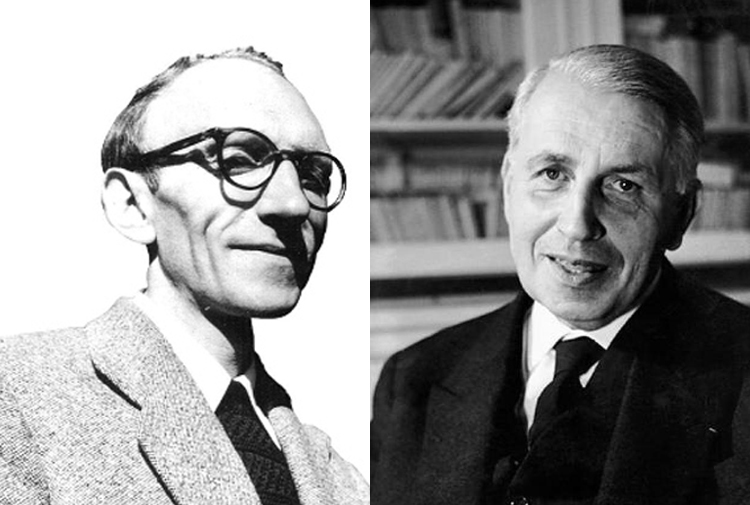
Maurice Blanchot: As the German expression has it, the last judgement is the youngest day, and it is a day surpassing all days. Not that judgement is reserved for the end of time. On the contrary, justice won’t wait; it is to be done at every instant, to be realized all the time, and studied also (it is to be learned). Every just act (are there any?) makes of its day the last day or – as Kafka said – the very last: a day no longer situated in the ordinary succession of days but one that makes of the most commonplace ordinary, the extraordinary. He who has been the contemporary of the camps is forever a survivor: death will not make him die.
Georges Bataille: To others, the universe seems decent because decent people have gelded eyes. That is why they fear lewdness. They are never frightened by the crowing of a rooster or when strolling under a starry heaven. In general, people savor the “pleasures of the flesh” only on condition that they be insipid.
But as of then, no doubt existed for me: I did not care for what is known as “pleasures of the flesh” because they really are insipid; I cared only for what is classified as “dirty.” On the other hand, I was not even satisfied with the usual debauchery, because the only thing it dirties is debauchery itself, while, in some way or other, anything sublime and perfectly pure is left intact by it. My kind of debauchery soils not only my body and my thoughts, but also anything I may conceive in its course, that is to say, the vast starry universe, which merely serves as a backdrop.
MB: Intellectual despair results in neither weakness nor dreams, but in violence. It is only a matter of knowing how to give vent to one’s rage; whether one only wants to wander like madmen around prisons, or whether one wants to overturn them.
GB: I think that knowledge enslaves us, that at the base of all knowledge there is a servility, the acceptation of a way of life wherein each moment has meaning only in relation to another or others that will follow it.
MB: To see was terrifying, and to stop seeing tore me apart from my forehead to my throat.
GB: The fact is, that what de Sade was trying to bring to the surface of the conscious mind was precisely the thing that revolted that mind . . . From the very first he set before the consciousness things which it could not tolerate. The road to the kingdom of childhood, governed by ingenuousness and innocence, is thus regained in the horror of atonement. The purity of love is regained in its intimate truth which, as I said, is that of death. Death and the instant of divine intoxication merge when they both oppose those intentions of Good which are based on rational calculation. And death indicates the instant which, in so far as it is instantaneous, renounces the calculated quest for survival. The instant of the new individual being depended on the death of other beings. Had they not died there would have been no room for new ones. Reproduction and death condition the immortal renewal of life; they condition the instant which is always new. That is why we can only have a tragic view of the enchantment of life, but that is also why tragedy is the symbol of enchantment.
MB: When Kafka allows a friend to understand that he writes because otherwise he would go mad, he knows that writing is madness already, his madness, a kind of vigilence, unrelated to any wakefulness save sleep’s: insomnia. Madness against madness, then. But he believes that he masters the one by abandoning himself to it; the other frightens him, and is his fear; it tears through him, wounds and exalts him. It is as if he had to undergo all the force of an uninterruptable continuity, a tension at the edge of the insupportable which he speaks of with fear and not without a feeling of glory. For glory is the disaster.
GB: Extreme seductiveness is at the boundary of horror.
MB: And there is no question that we are preoccupied by dying. But why? It is because when we die, we leave behind not only the world but also death. That is the paradox of the last hour. Death works with us in the world; it is a power that humanizes nature, that raises existence to being, and it is within each one of us as our most human quality; it is death only in the world – man only knows death because he is man, and he is only man because he is death in the process of becoming. But to die is to shatter the world; it is the loss of person, the annihilation of the being; and so it is also the loss of death, the loss of what in it and for me made it death. As long as I live, I am a mortal man, but when I die, by ceasing to be man I also cease to be mortal, I am no longer capable of dying, and my impending death horrifies me because I see it as it is: no longer death, but the impossibility of dying.
GB: There is always some limit which the individual accepts. He identifies this limit with himself. Horror seizes him at the thought that this limit may cease to be. But we are wrong to take this limit and the individual’s acceptance of it seriously. The limit is only there to be overreached. Fear and horror are not the real and final reaction; on the contrary, they are a temptation to overstep the bounds.
MB: The disaster… is what escapes the very possibility of experience—it is the limit of writing. This must be repeated: the disaster de-scribes.
GB: I remember that one day, when we were in a car tooling along at top speed,we crashed into a cyclist, an apparently very young and very pretty girl. Her head was almost totally ripped off by the wheels. For a long time, we were parked a few yards beyond without getting out, fully absorbed in the sight of the corpse. The horror and despair at so much bloody flesh, nauseating in part, and in part very beautiful, was fairly equivalent to our usual impression upon seeing one another.
MB: “A child is being killed.” This silent passive, this dead eternity to which a temporal form of life must be given in order that we might separate ourselves from it by a murder–this companion, but of no one, whom we seek to particularise as an absence, that we might live upon his banishment, desire with the desire he has not, and speak through and against the world he does not utter–nothing (neither knowledge nor un-knowledge) can designate him, even if the simplest of sentences seems, in four or five words, to divulge him (a child is being killed.)
GB: Realism gives me the impression of a mistake. Violence alone escapes the feeling of poverty of those realistic experiences. Only death and desire have the force that oppresses, that takes one’s breath away. Only the extremism of desire and death enable one to attain the truth.
MB: Whoever digs at verse must renounce all idols; he has to break with everything. He cannot have truth for his horizon, or the future as his element, for he has no right to hope. He has, on the contrary, to despair. Whoever delves into verse dies; he encounters his death as an abyss. We can never put enough distance between ourselves and what we love. To think that God is, is still to think of him as present; this is a thought according to our measure, destined only to console us. It is much more fitting to think that God is not, just as we must love him purely enough that we could be indifferent to the fact that he should not be. It is for this reason that the atheist is closer to God than the believer.
GB: Laughing at the universe liberated my life. I escape its weight by laughing. I refuse any intellectual translations of this laughter, since my slavery would commence from that point on. …out of despair I decided to follow this horror through. Literature is either the essential or nothing. I believe that the Evil—an acute form of Evil—which it expresses, has a sovereign value for us. But this concept does not exclude morality: on the contrary, it demands a ‘hypermorality.’ Literature is communication. Communication requires loyalty. A rigorous morality results from complicity in the knowledge of Evil, which is the basis of intense communication.
MB: I cannot forgive — forgiveness comes from others — but I cannot be forgiven either, if forgiveness is what calls the “I” into question and demands that I give myself, that I subject myself to the lack of subjectivity. And if forgiveness comes from others, it only comes; there is never any certitude that it can arrive, because in it there is nothing of the (sacramental) power to determine. It can only delay in the element of indecision. In The Trial, one might think that the death scene constitutes the pardon, the end of the interminable; but there is no end, since Kafka specifies that shame survives, which is to say, the infinite itself, a mockery of life as life’s beyond.
GB: Eroticism is the brink of the abyss. I’m leaning out over deranged horror (at this point my eyes roll back in my head). The abyss is the foundation of the possible. We’re brought to the edge of the same abyss by uncontrolled laughter or ecstasy. From this comes a “questioning” of everything possible. This is the stage of rupture, of letting go of things, of looking forward to death.
MB: The central point of the work of art is the work as origin, the point which cannot be reached, yet the only one which is worth reaching. The authentic answer is always the question’s vitality. It can close in around the question, but it does so in order to preserve the question by keeping it open. The disaster… is what escapes the very possibility of experience—it is the limit of writing. This must be repeated: the disaster de-scribes.
GB: To put it more precisely, since language is by definition the expression of civilised man, violence is silent. Civilisation and language grew as though violence was something outside. But silence cannot do away with things that language cannot state. Violence is as stubbornly there just as much as death, and if language cheats to conceal universal annihilation, the placid work of time, language alone suffers, language is the poorer, not time and not violence.
___
Book
 Maurice Blanchot The Last Man (1957)
/ubu editions
‘We can dream about the last writer, with whom would disappear, without anyone noticing it, the little mystery of writing. A dense, dream-like exploration of the extreme limits of this mystery, written some ten years prior to the Death of the Author, (though unpublished in English until thirty years later) Maurice Blanchot’s The Last Man (Le Dernier Homme, 1957) could be considered a narrative follow-up to The Space of Literature (L’Espace littéraire, 1955) or a fictional companion to the critical essays composing The Book to Come (Le Livre à venir, 1959). One can imagine an infinite conversation between these works: drifting wearily across abyssal alterities—the echo, in advance, of what has not been said and will never be said. But this sumptuous récit alone demands the reader’s full attention—marvelously, Blanchot writes what cannot be written without losing it as un-writable by writing it (Hans-Yost Frey, YFS, 1998). Narrating at the threshold of this impossible writing, The Last Man weaves a blurring of several prosopopetic characters towards a radical revision of the subject and the text. The prose itself never crystallizes into an unambiguous statement—Blanchot’s trangressive philosophy peculiar in the tantalizingly pleasurable suspension of the never-fulfilled promise of understanding. Reading happens in this continual absence of comprehension: instead, dense knots of delightfully paradoxical propositions and stupefying catachreses drive the reader on in the unconditional acceptance of the text that pierces, like a look that is too direct, the indeterminate prose, and makes all relations, and especially our relationship to time, absolutely precarious.’ — /ubu editions
___
Excerpt
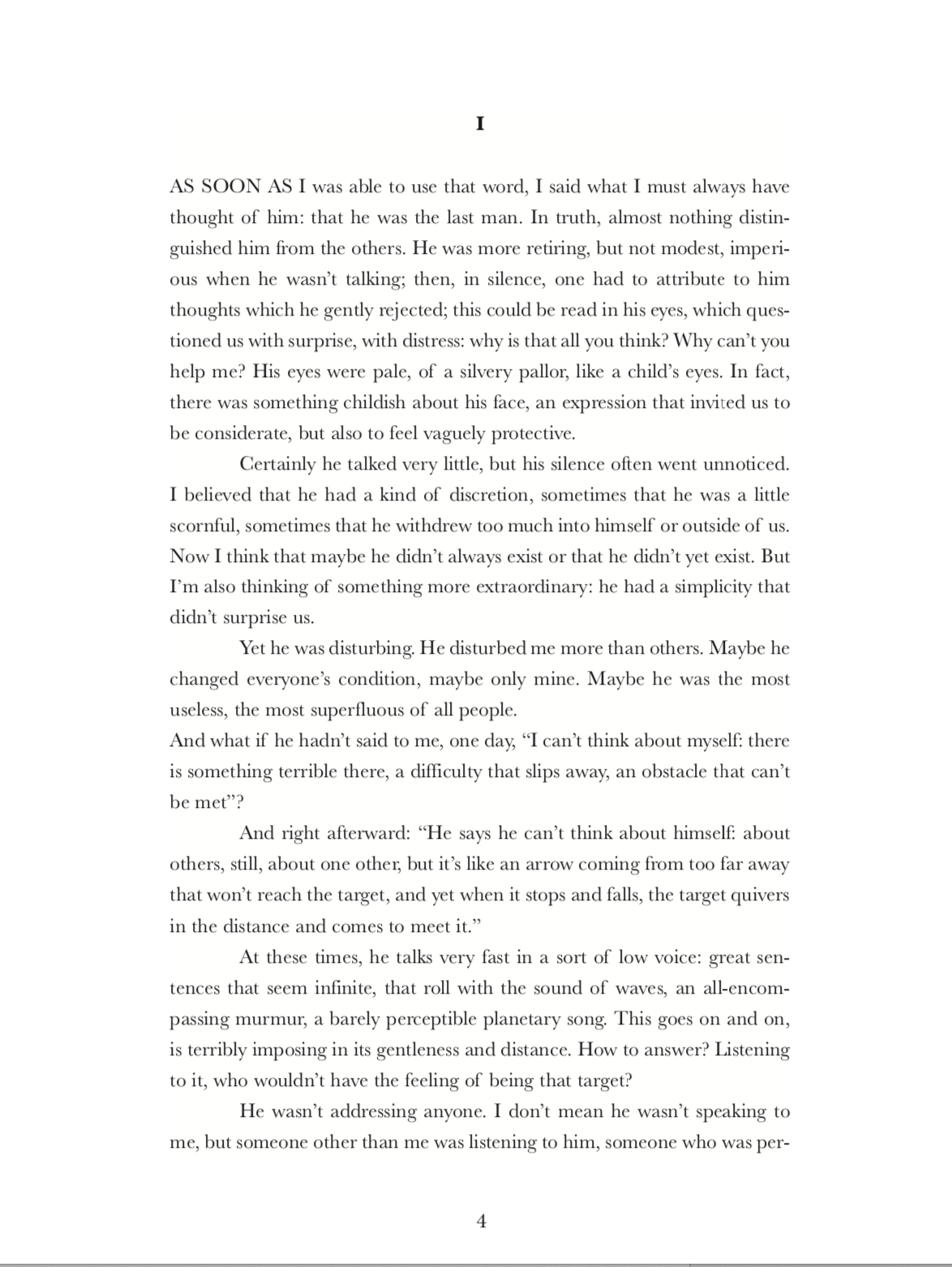
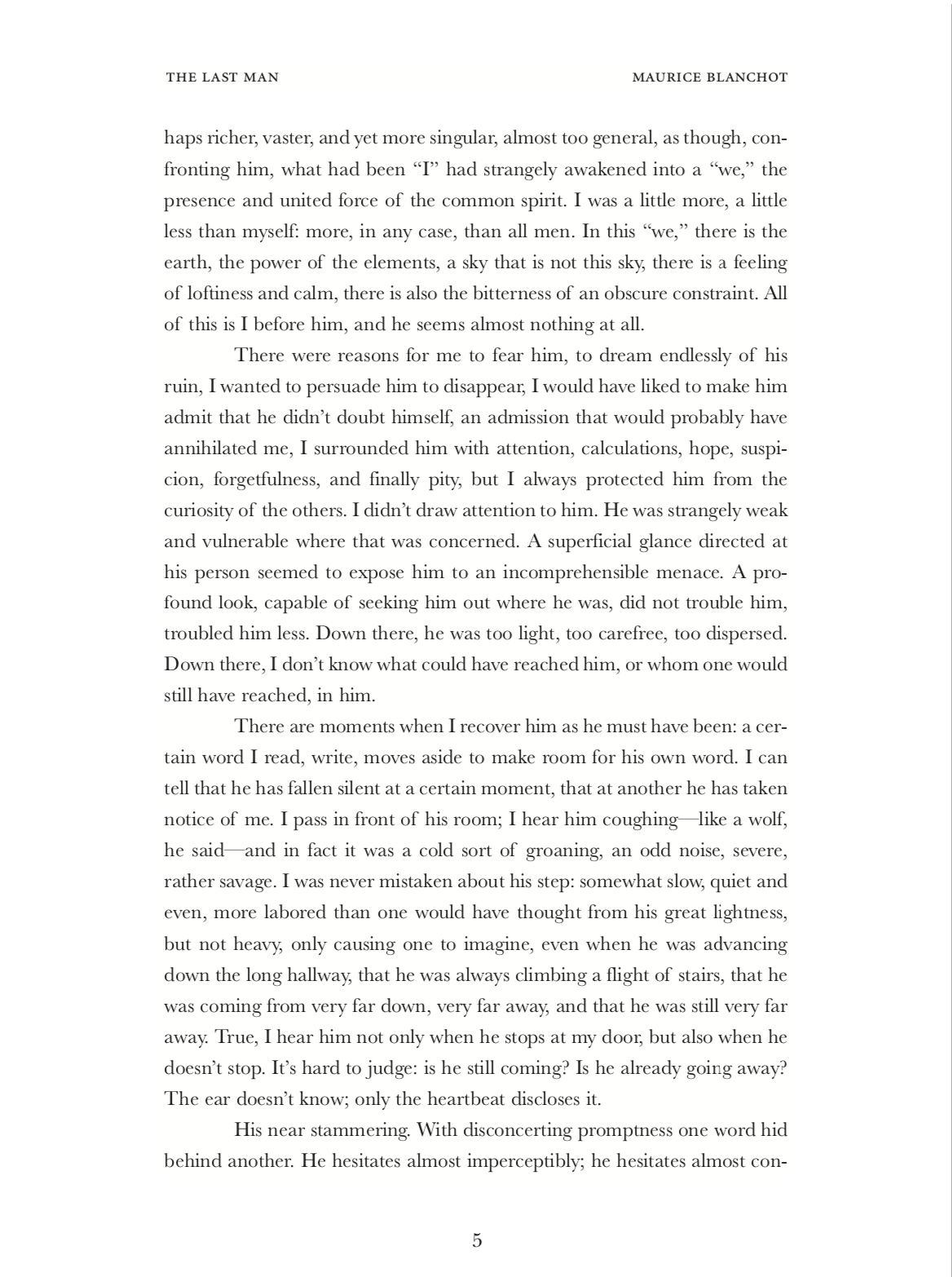
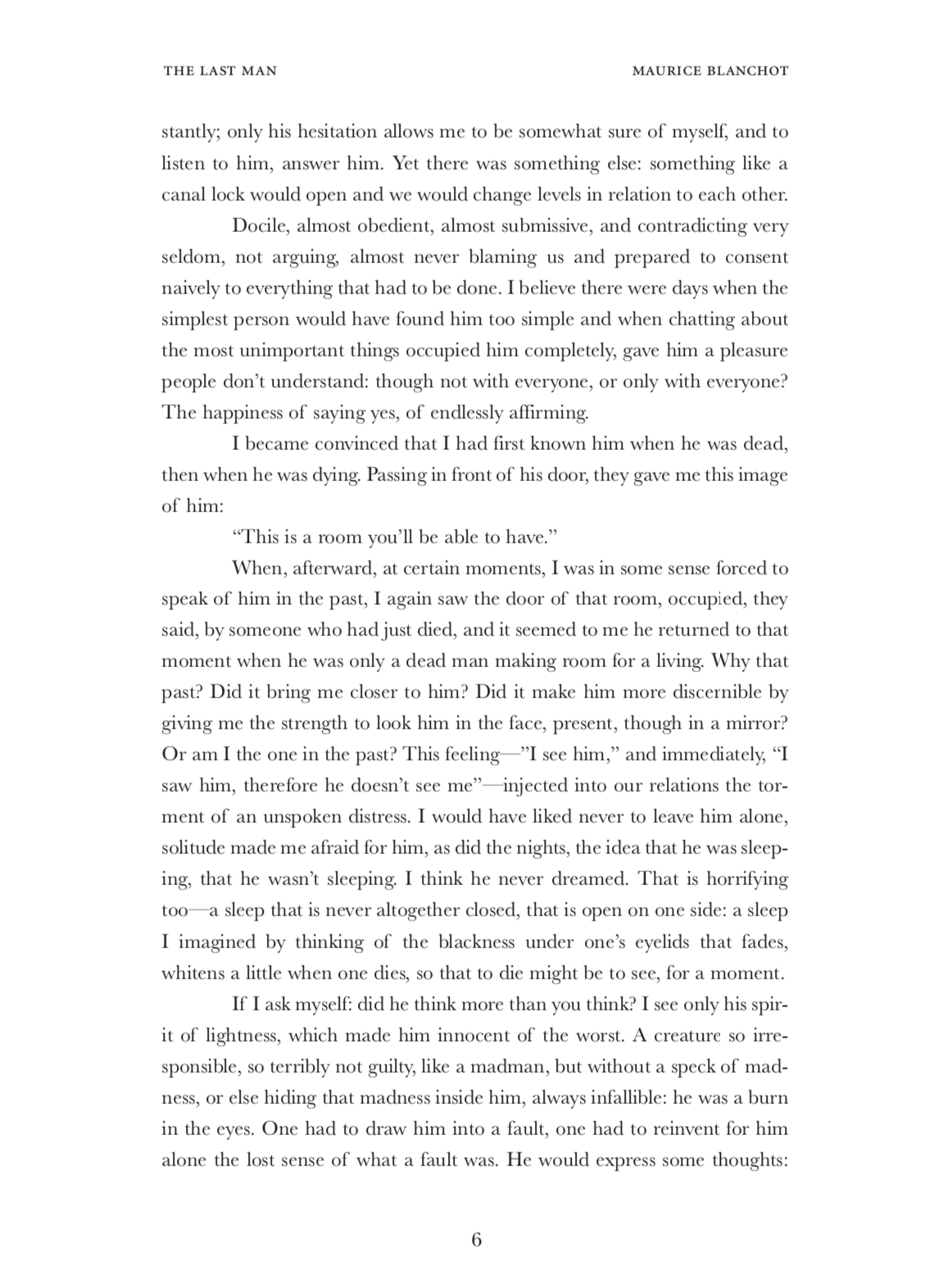
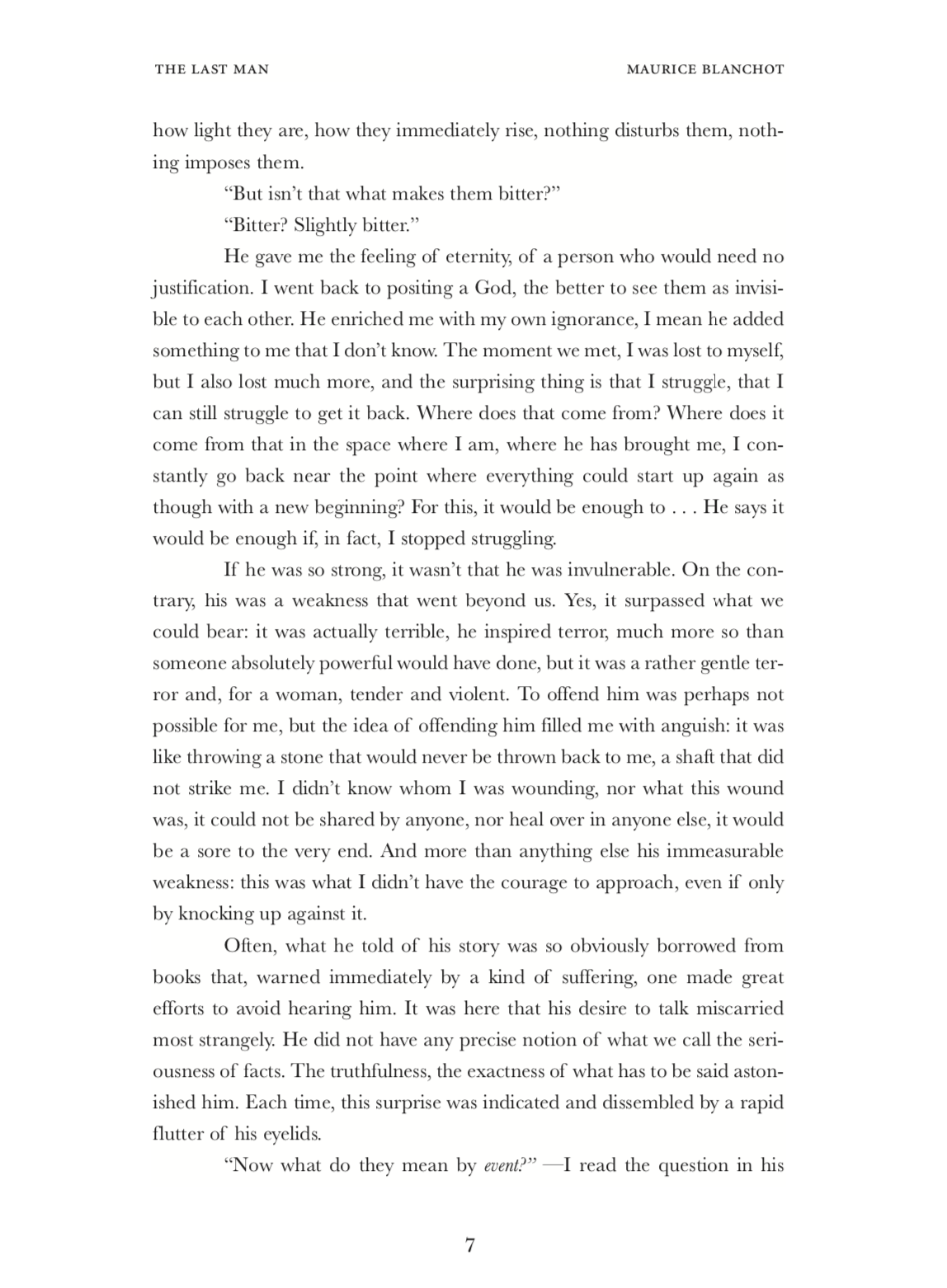
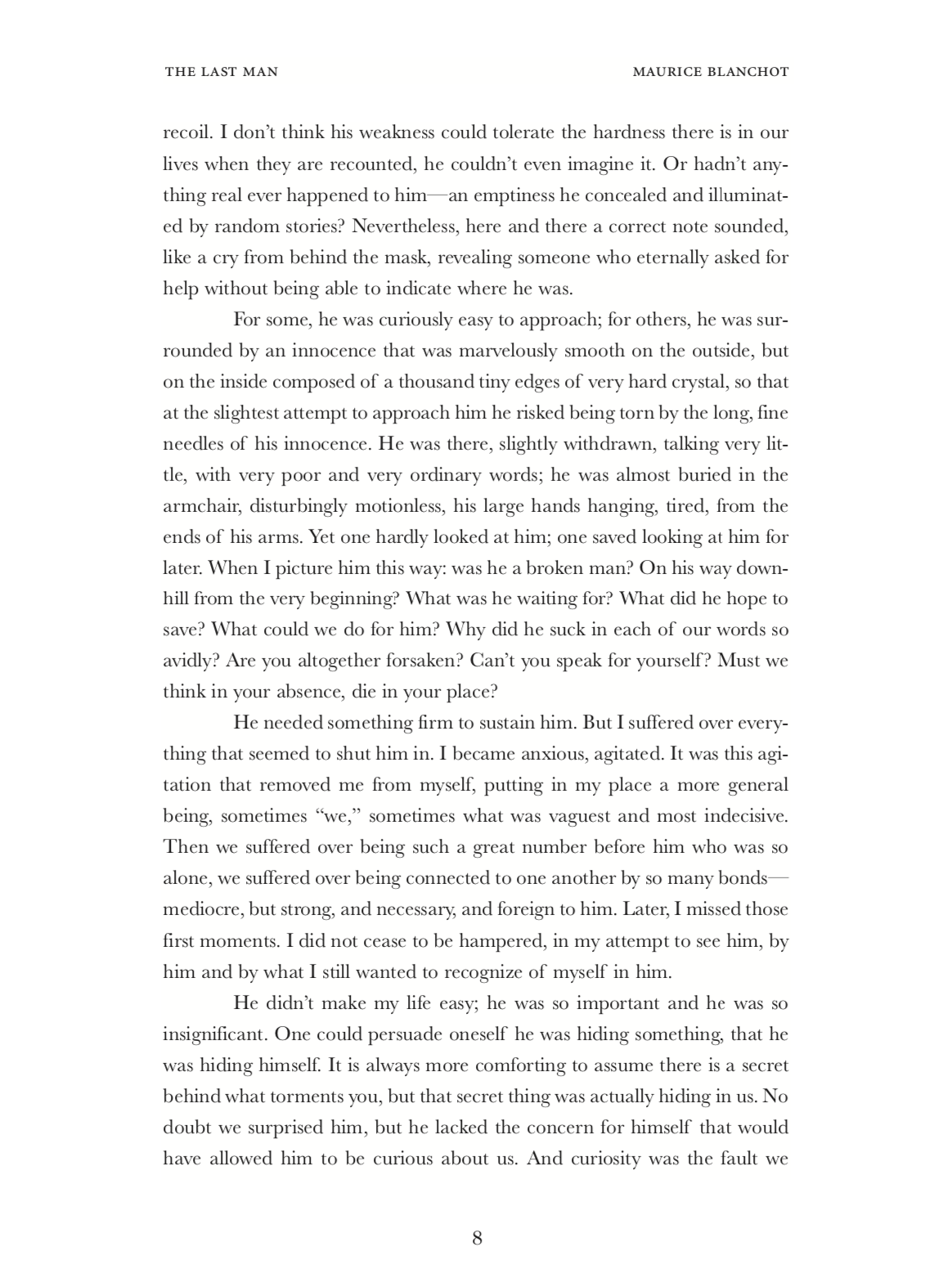
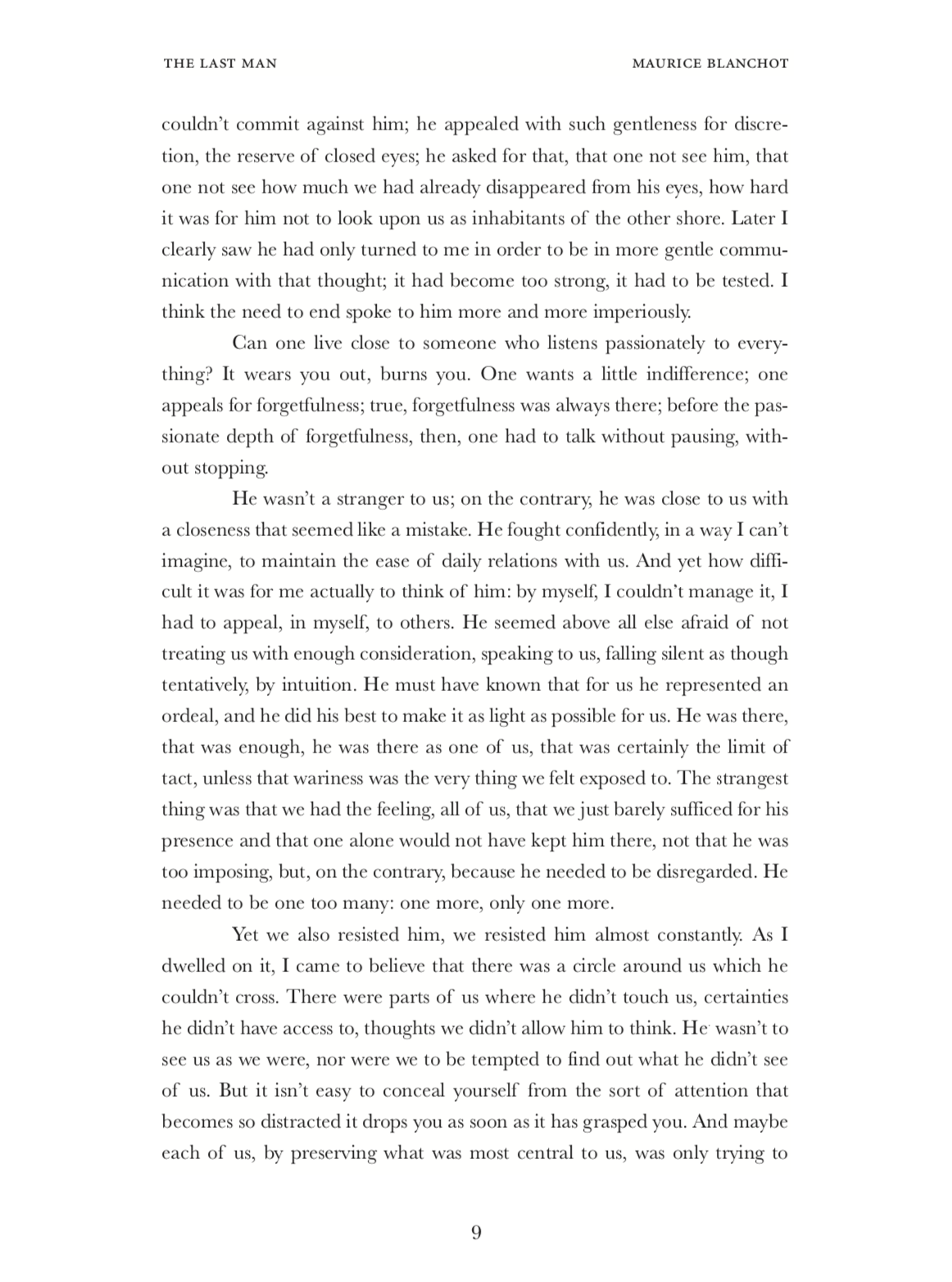
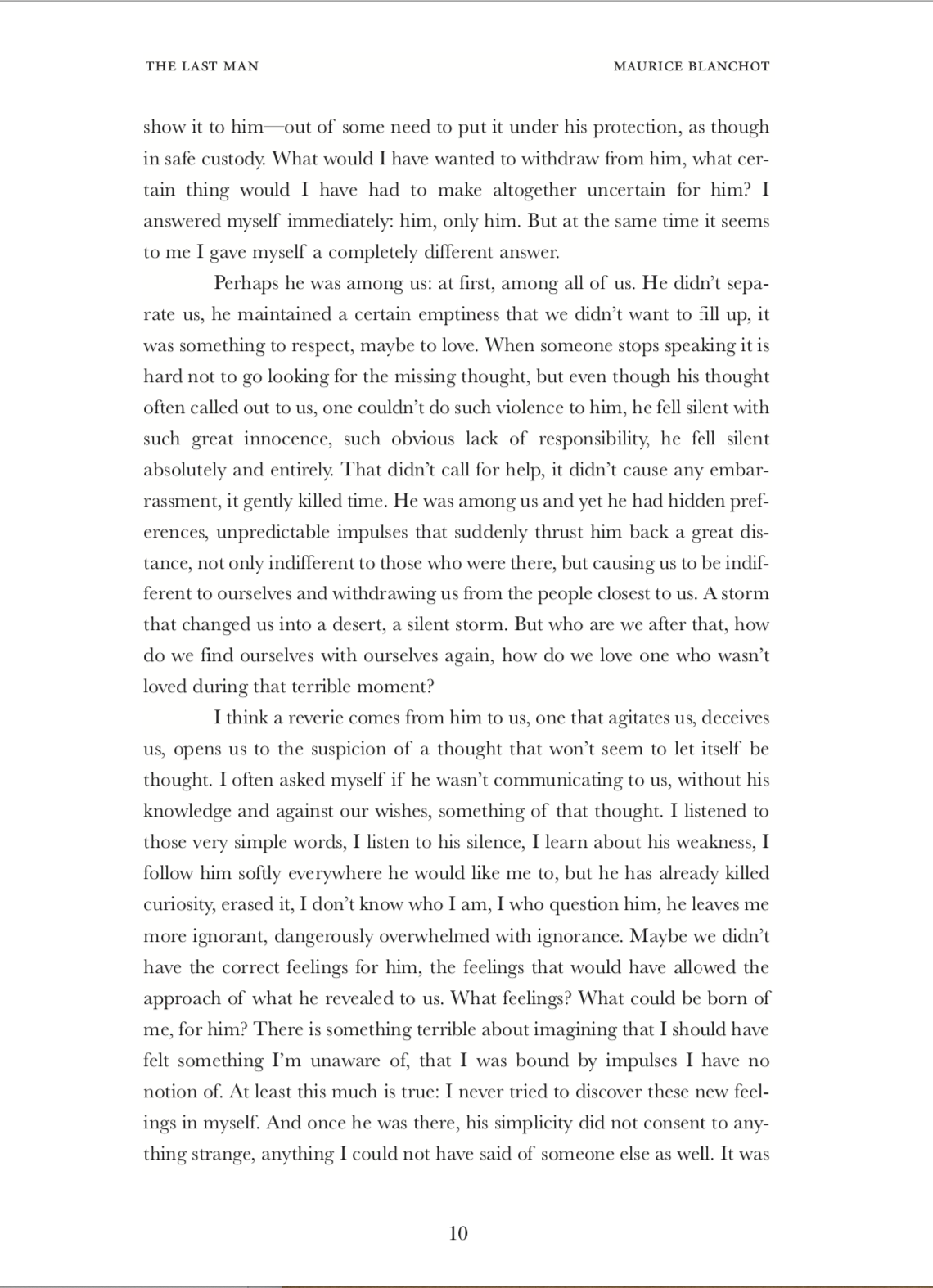
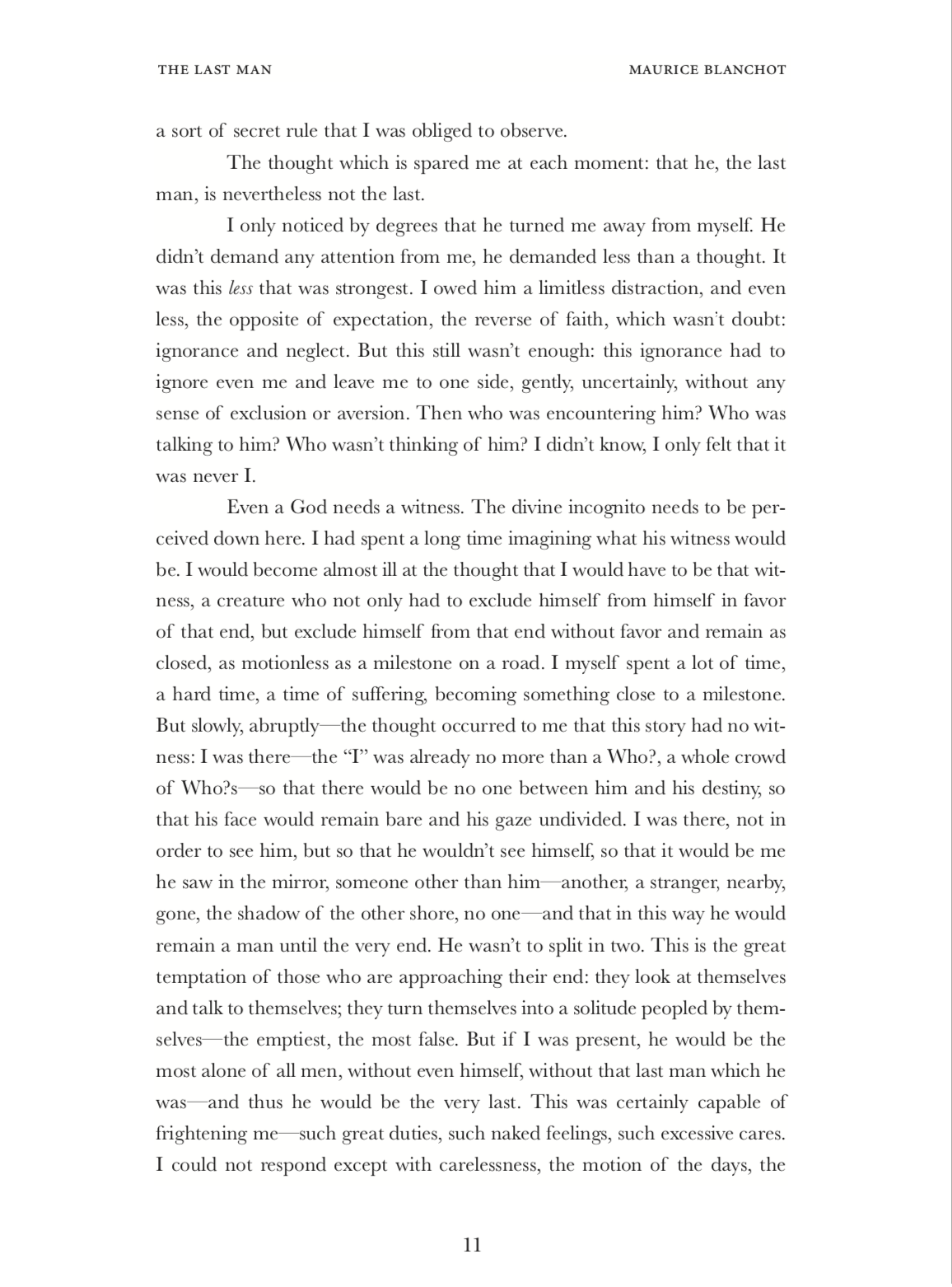
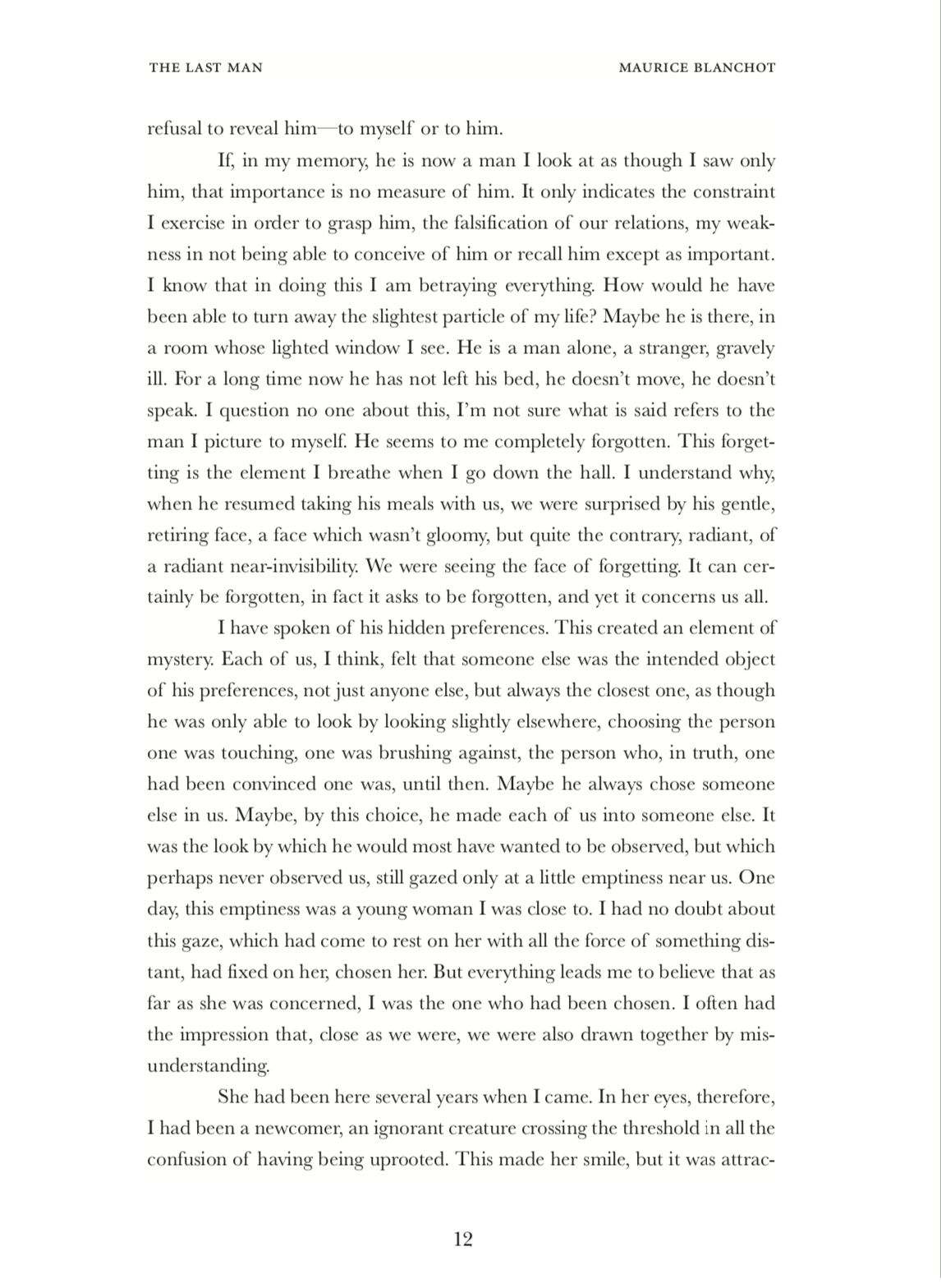
*
p.s. Hey. ** Adem Berbic, Follow your heart. The film is presumably eternal. The Leeds hosts are encouraging the audience to wear Halloween-style costumes, which may or may not put some weight on that end of the scale. Thanks for the video link. I’ll hit it later. We’re heading up to 38 degrees today or tomorrow. You don’t want to be here. The power is back on, for how long who can say, but whew. The screening was nice. It was at a terrible time — 2 pm on Monday — so the audience was modest but seemed to have been engaged when they weren’t completely confused. Every performer who appeared in ‘Like Cattle Towards Glow’ and used a pseudonym because they were nervous about appearing in a sex-filled film regret having hidden their true identity now. Just sayin’. ** _Black_Acrylic, Thanks, B. I’m so sorry to hear about your inner struggles, my pal. The internet will do that, these days at least. And you won’t be missing all that much if you back off. Yes, great timing on the print studio visit! How was that? ** Steeqhen, Hi. I think the SSJ stuff totally holds up. There aren’t enough artists doing work like that now. Ryan Trecartin, who was very influenced by SSJ, is the great exception. I’m so sorry you’re feeling rough inside, but time is not running out, trust me. Doing a masters makes perfect sense in theory. Chin up, man. ** jay, Thanks, yeah, about the 31st. I wish we could be there, but alas. Super technical is a siren call to me. You’re making it sound more and more crucial. Best day you can forge from the summer outside. ** Dominik, Hi!!! Oh, it was just odd because the screening was at such an inconvenient time, and most of the audience seemed like people who normally either don’t go see films or watch very normal films, so most of them seemed very flummoxed by what we were doing. Otherwise, everything was okay. Amsterdam is friendly on a short term basis. I probably won’t watch ‘Blue Film’, so go ahead and fuck it up for me. And I never care about plot and plot twists anyway. Love wonderfully restored my power finally yesterday afternoon, thanks to him. I may need him to help turn on our shitty air conditioner today, I can’t tell yet. Also, love making sure the building where my friend Ange (who plays Extra in ‘Room Temperature’) is getting married today in my and others’ presence very chilly, G. ** Carsten, Power’s back, at least for now, and in the nick of time. That is some kind of welcome you got there. Hopefully some kind of omen. Or, well, maybe not. Yes, I’m off again today to my friend’s wedding. Amsterdam was chill and potent, which is probably the best it can do. ** Dev, Hi. I could very well be there on the 17th/18th because we try to go early enough that we can spend at least a couple of weeks going to home haunts and haunted attractions before they vaporise on the 31st. Fingers crossed! ** HaRpEr //, You would make hella interesting video content, that’s for certain. Your process on your new works sounds both exciting and possibly familiar. Nice. Nirosta Steel is Steven Hall. He’s an old friend of mine, although I haven’t seen him in decades. I was going to publish a book of poems by him with my Little Caesar Press but then the funding got pulled and it never happened. I’m excited to get his record. He’s super talented. ** laura w, The summer has definitely been a rough-y so far. Paris used to have these wonderfully short summers that started fading away in early August, but the old patterns are completely distorted now. Ugh. I don’t know Kanae Minato, but I’ll take a peek at what they do at least. I need to pull a book off my to-be-read stack and start reading. But it’s so hot. I don’t know why Bret keeps letting these utter mediocrities adapt his books. He’s a smart guy, so it’s a bit of a mystery. I’ll be here tomorrow unless Paris fails me again. I think I will. You too? ** Uday, Our power is back, thank god, because today is the day hell restarts here. Mei Nu, huh, interesting. I’ll investigate. How long are still there for? You seem like you’re holding up very well. ** Right. I haven’t turned the spotlight on my main man Blanchot in a while, so I have rectified that recent neglect today. See you tomorrow.



 Now available in North America
hi Dennis!
so i’m sneaking about rn bc i’m still totally benched =( sucks that some random new hurdle seems to materialise every time i’m on the edge of a breakthrough, like by now i even feel bad about coming on here once i’m cleared blah blah blah… just to be such a downer i mean. not that anyone else reading this should feel bad about potentially falling ill in my vicinity lol. i hope i’d be v caring. i just have weird standards for myself and i’m unfond of disappointing.
so, do i somehow give more than i take when i’m weirding up the vibes on here like this? did you miss me? =D
i missed you! and since it’s our man Blanchot on here today i thought i’d show face and like 6-7 words too. i’m only good for short exchanges rn, can you imagine what with the way i love to talk shit =)
so. The Last Man is v romantic! characters, narrator, reader, all pulled into such a together-y polycule by means of speaking ourselves poorly, and/or way too ambitiously. it’s the anti-self help book. the anti-relationship manual. ^_^
it also has a super nervous disposition, this story, doesn’t it? like go east and ppl will be shrugging a bit like duh, everything we are must make space for what we’re not. sort of like God! i mean existence vs inexistence are totally petty antonyms, they should only ever yes-and each other instead. and then get generative proper like you know, Nirvana is Samsara but Nirvana isn’t Samsara, but Nirvana isn’t the opposite of Samsara and… next thing you know you’ve got everything, the whole nothing tree lol. if you could separate it from time, i guess.
Bataille was such a rockstar, what a contrast, but it was fun reading them weirdly meet in the middle thanks to the creative violence of the abyss or whatever lol.
‘for glory is the disaster’, i’ll def (v)ouch for that. can’t be said minus the poetry, probably. but it can be said! alhamdulillah.
huh you know i def belong to excess so i prefer ppl keep talking even if it’s a tall order and stuff. which obvi will impact any co-existing silence and vice versa. really contextless silence is (isn’t) the unstuff of the unworlds, and we’ll never get to know those even if we ultimately are their product. so, talking.
on the topic of which, ugh your girl was totally dissed online last night lol, which wasn’t how i wanted to take my respite from largely doing nothing. but some rando called me a whore apropos of v little (?) so i was like ‘thanks, your pussy’s dry’, after which she totally went nuts and wished me both dead and in hell lol. def not what my doctor wants me to envision to push through this weird and upsetting time. but tbh every time i think i’m having a fucked up one, someone without a pfp is having it worse ^_^
oh! you’ll be mad now, we watched Room Temperature last night – fell off the back of a lorry – and couldn’t resist the illegality of the thing, nor the thing itself, duh, but i’ll tell you all about that next time. hopefully soon? i promise it was all v noir and you’re great. =)
the times are not great, obvi, but you know by now: three words! and then feeling a bit better.
if i’m not back soon tho and you feel like it, drop by my insta lol. i keep it v short over there!
<33
PS: i can get away w reading this time, doesn’t seem to shag me out completely. so i finished The Sapsuckers, which was great. doing We’ll Never Be Fragile Again next, long overdue.
after that…?
In solidarity with your temperatures and erstwhile lack of power I’m typing this on a train which has almost as little signal as it does air con, so I’ll be brief. I’ll knock at my heart’s door for Leeds and ask it for courage re: the new thing — although it hasn’t passed the first smell test yet and might be sent in whole or part to the bin.
That sounds like it was one of the better things to have ever happened at 2pm on a Monday. I hope to induce that kind of reaction in an audience one day. Congrats. Whether I hit Leeds or not, obviously keep me posted on the notion of a London screening and its hopefully not permanent mirage-like quality.
I’m weighing up being Parisian around 5th September. A friend of a friend is throwing a house party to celebrate getting fake boobs. I’ve gotten the Eurostar for less. It’s interesting and I suppose fairly nice how boob jobs have had their whorish/trashy connotations traded for empowering ones, at least in some quarters.
Blanchot. I guess ‘genius’ is a pretty flattening word but I’d struggle not to apply it to him. I really don’t think I can guesstimate how his brain worked, which I feel able to do for the other big boys (although I’m not saying my guesstimations are correct). I wish my own brain was in anything other than its lowest gear so I could type about him at length, but the train’s reign of terror continues.
Hi!!
Ah, so not your usual audience. Did they have a chance to ask you questions after the screening? The longest I’ve ever spent in Amsterdam is one week, and I also got the impression that it was friendly and chill. It was easy to be a foreigner there.
So, predictably, in Blue Film, the older guy turns out to be a pedophile who used to have a crush on the younger guy when he taught him in elementary school. Some roleplay ensues. That’s it. That’s the horror story. I mean, I didn’t find either of the characters particularly likable, and the older guy was certainly problematic in that he was still into kids, but in the film, everything happened between consenting adults. All the bans and outrage feel like a massive overreaction.
How was the wedding?
Love making your air conditionier work like a dream, Od.
This Blanchot is defo going on the to-read pile. I’m about to make a start on Thomas Hardy – A Pair of Blue Eyes and say what you like about the English, they sure could produce some fine novels back in the day.
Current paranoia level = acceptable. However the visit to Leeds Print Workshop never happened as the taxi company were not able to provide anything wheelchair accessible today.
Up there with the current World Cup top scorers is Norway’s Erling Haaland and he was born in Leeds! So I’m cheering this guy on rather than supporting England tomorrow.
Glad the power’s back on & hopefully it stays that way. What kind of AC do you have, the type with the impractical tube you have to hang out of a window?
In Marseille I browsed through a French anthology of writings about death, & beside a lot of the usual suspects you’d expect there was Blanchot. I mean in the U.S. Blanchot is still pretty avant-garde/niche, no? As in unlikely to pop up in an anthology like that. But in France his reach seems to have spread a lot wider, which is great.
Yesterday’s encounter with the hooker (sorry but I refuse to use the bloodless term “sex worker”) was simply fun, nothing more. I enjoy chatting with them. Same with strippers. Or drug dealers. Or anyone else ballsy enough to dodge the rat race. Plus, attention from an attractive woman, “professional” or not, is never to be sneezed at or taken for granted. To me it was exactly the kind of warm welcome I needed, haha.
Well Spain is still in the world cup & playing Belgium tonight, so naturally my neighbors invited me over to the beachfront bar/cafe to watch later on. If we can even get a seat, haha…
Oh it’s Ange aka Extra from RT’s wedding? Congratulations!
I haven’t taken a shower for six months, until today. All by myself. I woke up this morning and thought, “I’m going into the bathtub and having a shower.” After exercising to build my strength back up, I started reading the blog this morning. I read it once, twice, and the dialogue between Bataille and Blanchot hit me hard. Was it because I was so close to death? There is a difference between dying and death. I think there were moments when I was dying, and somehow it bothered me that I would miss the new Sparks’ album whenever it comes out, and I decided to go to the hospital to get myself fixed up. I downloaded the Blanchot book onto my computer, so thank you for that link.
It must be a relief to have the power back on, but is Paris doing anything to fix this problem in the long term?
Hasn’t Bret been trying to direct a film from his own work?
This is the year where climate change has really sunk in. In just the last 5 years, New York’s summers have grown hotter and more humid. I’m able to spend most of the time inside with the AC on, but it’s expensive and I hate the fact that I can’t really enjoy going out in this weather.
Tonight, I’m seeing a micro-budget 1971 film, BLACK CHARIOT, about the collapse of a Black Panthers-like radical group after one of its members betrayed them.
Hi Dennis,
Loved this post. Blanchot is someone I’ve neglected for so long, but this has rejuvenated my interest. I think I get so caught up with Foucault and Deleuze, etc. I appreciate the prompt.
I found a copy of Martha Kinney’s, The Fall of Heartless Horse in my local library and realised it was a Little House on the Bowery edition! It’s probably the coolest thing that I’ve ever seen in my village, lol. Looks very interesting, and I might just check it out and keep it (er, I mean ‘lose’ it).
I’ve also sent you a copy of my Collected stories. There are some terrible stories in there, but also some good ones with Brian Evenson, etc, so I hope it arrives safely.
Stay cool!
Chris
Also, glad you’re back!
Welcome back! Good to hear the Amsterdam outing was ok. Did you and Zac participate in that mysterious Gilbert and George event?
I don’t think I’ve read any Blanchot, will explore more. And good to see Shaye St John again yesterday.
Mostly busy with all the little chores before I go out of town again (sigh). I did see Goodbye Dragon Inn, my 2nd time since it first came out. I like it a lot more the 2nd time, though I still think Tsai’s 90s classics are superior.
Bill
Welcome back! (Sorry if this appears twice; my network went out before it looked like my comment was submitted.)
Good to hear Amsterdam went well. Did you and Zac participate in that mysterious Gilbert and George event?
I have to explore Blanchot soon. (Sometimes I get him confused with Maurice Roche, haha.) And good to see Shaye St John yesterday.
Mostly busy with little things before I leave town again. I saw Goodbye Dragon Inn, like it a lot more the 2nd time. I still think Tsai’s 90s classics are more interesting though.
Bill
Blanchot is a big, regrettable blind spot for me. Love Bataille though, read a lot of him in my early 20s. Do you have a favorite book of Blanchot’s?
If you like I’ll shoot you an email in October and if we’re in LA at the same time maybe we can grab a coffee. No pressure of course.
Hey! Yeah, I’ve been waiting for a while for a theme for some video work and realising it could function as marketing for the novel was big, but I’ll have to wait and see. I feel anxious talking about the novel’s future life. I’m terrified that something will go wrong. I keep having dreams where it gets accepted and wake up annoyed.
Oh, you knew Steven Hall?! That’s wild to know. There’s limited information about him out there but I think this album is managing to reach its audience which is wonderful.
Ah, Blanchot returns. I’ve been thinking about him a lot lately, particularly ‘The Writing of the Disaster’. For the novel I’m writing I tacked his quote from ‘Death Sentence’: ‘It could actually be told in ten words. That is what makes it so awful.’ to my wall. That stirs something intense and true in me for some reason.
I’m desperate to read ‘The Last Man’, though of course it’s very out of print. A pdf may have to suffice. You were lucky that you could swipe this stuff just as it was being translated.
Also, today I came upon a major revelation about what to do with the book. I knew it was a necessary move to go into the project with some unplanned areas. I learn by doing, and anyone who says that the process of writing isn’t highly improvisational is lying. The epiphany I had was related to something I always had in the back of my mind which I guess my imagination took to the front of my periphery and made me slap myself that I hadn’t done anything with it sooner.
i should check out the last man. i’m going on a trip in less than a week to an island- if you’ve seen moonrise kingdom, it’s that kind of island- and i’m collecting seaside books that are emphatically not beach reads. i’ve already read the voyeur, the easy life, and berg but i’ve also got, uh, arturo’s island; the sea, the sea; and i guess now this book. so it’s a short list.
i don’t know bret obviously but from what i gathered his taste in movies and stuff is a bit schlocky. but at the same time he also has openly expressed dislike for the kind of stuff that ryan murphy does, so idk. ryan murphy to me is very, hmm, glaad to me. well, if i’m being cynical i’d say that bret wants to finally make a tv show out of one of his books and he wants it to be somewhat successful while retaining creative control and ryan murphy wants the street cred of working with the american psycho guy and likes to pretend to be a very cool and edgy gay despite being incredibly corporate.
i’ve heard that about european summers now! really sucks, especially with paris’ shoddy old power grid. i hesitate to say that things are looking up on my end, but i hope so. and i hope they are on your end, too, even in the face of another heat wave. hope you had a nice time at the wedding, as well.
When you’re a kid and have no systematised understanding of anything, you arrive at big names so many different times that it’s hard to pinpoint the first one, and you’re always hopping to whichever story you remember then and there. That being said, I think Blanchot was another one of my Semiotext(e) introductions, through their printing of The German Issue, which I have only the vaguest of recollections of, as is unfortunately the case with most of the books I read. Then again, it could have been from a biographical article of Bataille. Anyway, I quite enjoyed Death Sentence and liked The Last Man too, but not as much. Going herping today or tomorrow, but I’m not very good at it. Re Nirostam Steel: is there anybody you’re *not* friends with? It feels like you know the entire world, or have met them, or have had a connection at some point or the other.
The Last Man is not at the library but I found a free pdf…translated by Lydia Davis? Nice! Will comment when I have something of substance to say haha, dont really know Blanchot so… yeah, may read this weekend.
Malina was one of those books I thought “this is one of the best books I’ve ever read” immediately upon putting it down. Another gospel for me to spread now. Hopefully people bite, I really only have one friend who reads all my recs haha.
Anyway do you like Fleur Jaeggy? Picked up lots of her stuff at the library on a whim and realized she was friends with Ingeborg Bachmann, which is sweet of course. “The Water Statues”, which was great and so deeply enigmatic in its form, was dedicated to her. Love to look at artist friendships and see how different their approaches are… that kinda diversity in the arts, even within circles of friends, is what its all about!
My friend started Melancholy of Resistance, so I actually need to read that now, cuz I wanna show him Werckmeister Harmonies. Complete opposite of the Jaeggy stuff, in terms of how sentences/paragraphs are employed. Havent done something dense in awhile. I love my sparse prose, but the wall of text approach can work too, obviously if you’re a master sentence wrangler like Krasznahorkai.
Since the zine has been mostly done for awhile (just need to print and have the release get together in a few weeks) Ive had a bit of time to reflect on my piece, and I really think that editing is my biggest opportunity. I certainly tinker with the sentences, but I really need to push them a bit farther to find the perfect spot… its also hard to find the daily writing rhythm with full time work and a side job and playing shows… still tho, I’m optimistic and psyched about puting prose out there and encouraging people in my arts scene to do the same… just always room for growth etc.
ANYWAY, keep hangin in there. Sounds like Europe is getting it really really bad, Portland hasnt been too bad the last couple years, but it feels like the bad summers can strike any year any place… As usual, always good to check in! BYE!
Yes I feel like you’ve posted about Ryan Trecartin before, I have a few of his saved in my watchlist for a while. Need to get onto that soon! It’s 6:40am for me, only arrived home at 6, and had a double whammy of a free James Taylor concert at the front (well 3 back) centre row of seats, and then my friends birthday. Seeing people helped today, having some people at the bar call me beautiful out of nowhere helped, and getting giddy flustered by this guy working that my friend knew also helped. Trying to shift how I think and speak to myself, to a more neutral or even positive tone, and I have an appt soon where I could hopefully get some serious help. How’s the heat in Paris at the moment? It’s bad enough here, but definitely nothing of the sort in your ends.
Practical and to the point. Thanks! see here
The idea of the dissolution of both character and language really intrigues me. How do you think Blanchot achieves that effect in such a low-key narrative? Would love to dive deeper into his exploration of presence versus absence. REPLY this resource
Helpful resource. Added to my reading list. good resource
The exploration of language dissolution in Blanchot’s work really resonates with me. I’m curious about how you interpret the impact of that on the character’s development throughout the story. Looking forward to more insights on this! REPLY helpful site