
‘Jacques Roubaud is a playful, puzzling, erudite, at times obscure, yet at other times thoroughly moving “composer” (as he puts it) of poetry and prose. An algebraist by trade (he long professed mathematics at the University of Paris X-Nanterre and now directs research at the École des Hautes Études en Sciences Sociales), Roubaud has surpassed all other French writers (with the possible exceptions of his mentor, Raymond Queneau, and his late sidekick, the ingenious Georges Perec) in entwining these two disparate manifestations of human mind: on the one hand writing, which try as it might can hardly avoid dealing with experienced feelings, memory, perceived reality; and on the other hand mathematics, which involves not only numbers and calculations (Roubaud likens himself to a “counter”), but also vertiginous logical constructs. Like the East and West of Kipling, can the twain ever really meet?
‘In Roubaud they do, impressively and instructively. From his first book, Mathematics (1967), of which the mathematical symbol for “belonging” entitles a volume of multiform “sonnets” arranged according to the moves in a masters match of the Japanese game of go, Roubaud emerged as an original voice. Not surprisingly, the author of subsequent collections such as Mono no aware (1970), Trente et un au cube (1973) and Autobiographie, chapitre dix (1977) is not only a resourceful connoisseur of the history of poetic forms, but also a member of Oulipo, the French “Workshop of Potential Literature,” a group of writers and mathematicians which was founded in 1960 by Queneau and François Le Lionnais and still remains active today. As Roubaud explains in his provocative collection of theoretical dialogues about poetry and fiction, Poesie, etcetera: menage (1995), never has a literary movement lasted so long in the history of French writing.
‘Oulipians use self-imposed formal “constraints” when writing, the most renowned example being Perec’s “e”-less novel La Disparition (1969; translated as A Void). Sometimes Oulipian constraints are geometric, algebraic or numerological; the plot of Perec’s opus magnum, La Vie mode d’emploi (1978; translated as Life A User’s Manual), is engendered by means of calculations based on a “10×10 magic square.” Other constraints may be “thematic,” such as Jacques Jouet’s recent exploit of penning a poem per day about a turnip, an experiment that lasted four years; or “chronological,” such as Roubaud’s writing of a certain recurrent type of passage in his innovatively autobiographical La Grande Incendie de Londres (1989; translated as The Great Fire of London) only in the wee hours of the morning, accompanied—in a striking image of inner desolation—by a lukewarm bowl of instant coffee. Some Oulipians give a spin to an entire literary genre. Roubaud’s witty “Hortense series” (La Belle Hortense, 1985, translated as Our Beautiful Heroine; L’Enlèvement d’Hortense, 1987, translated as Hortense Is Abducted; L’Exil d’Hortense, 1990, translated as Hortense in Exile), for example, concocts a wacky pastiche of the English detective novel—if “pastiche” is a word indeed wild enough to embrace the perpetually disarming “distancing effects” sustained by the author in this trilogy. The reader is made so aware that he is holding a “detective novel” that the “enigma” becomes less a “plot” than a series of evolving narrative structures. The genuine contents are at several removes from the “suspenseful action.” …
‘The harrowing force of Some Thing Black, of parts of The Great Fire of London and its sequel La Boucle (1993; the title refers to a “loop,” as in the language of computer sciences), indeed derives from remittent failures to get beyond the brute facts of death, to surpass the painful recurrences of memory, to attain consolation, to enter into some sort of communion with his beloved. Nor can any tangible hope long be placed in some other “possible world,” a topic explored in the poetry collection La Pluralite des mondes de Lewis (1991; translated as The Plurality of Worlds of Lewis), a philosophically far-reaching sequel to Some Thing Black. “Each time I think of you,” he laments in The Plurality of Worlds of Lewis, “you cease to be.” The paradox is typically haunting. Roubaud is left alone with “all you never anymore are,” a phrase which, in both the original and Rosmarie Waldrop’s version, gives out a melodious Beckett-like sigh.
‘It is in this confrontation between emotion and constraining form, between a pre-planned literary-mathematical structure and the painful vicissitudes of personal history, that Roubaud’s writings raise so many essential questions. Most of the books written since his wife’s death revolve around phenomena of memory, and in this respect he forges a different model of remembering than that underlying the unavoidable landmark for French (and other) writers in this domain: Marcel Proust’s Remembrance of Things Past. In contrast to Proust’s notion of memory as expanding from some small, insignificant detail (like a madeleine cookie, of which the author of The Great Fire of London must surely be thinking when he in turn brilliantly describes a fresh croissant), Roubaud conceives recollecting as a sort of “forest” in which branches and twigs of clustered trees overlap and intertwine.’ — John Taylor, Context
_____
Gallery
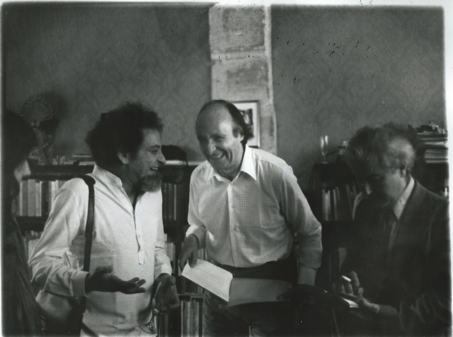
Georges Perec & Jacques Roubaud
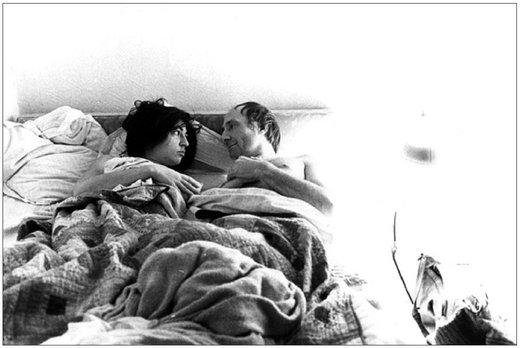
Alix Cléo & Jacques Roubaud
Jacques Roubaud & Jacques Derrida
Pierre Dumayet & Jacques Roubaud
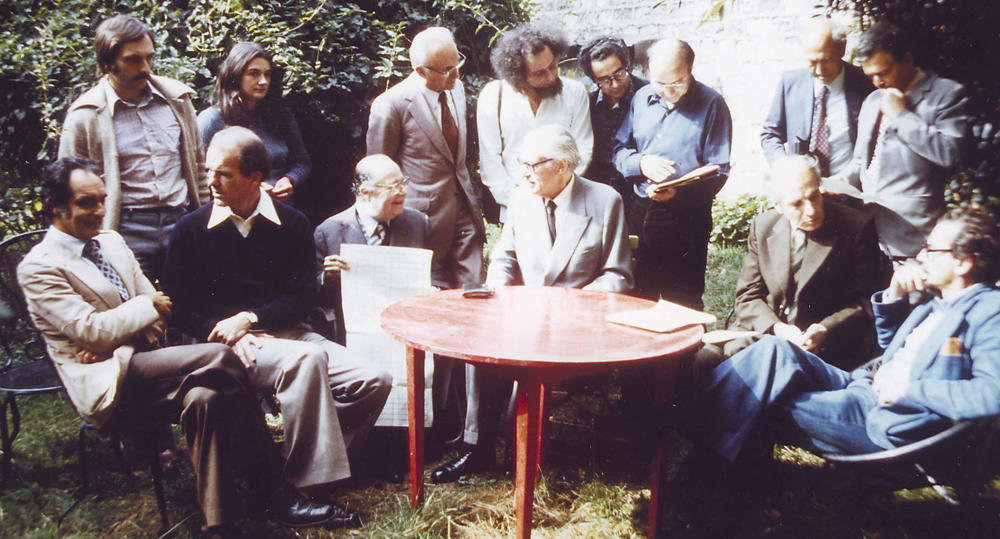
Members of Oulipo, 1975: Italo Calvino, Harry Mathews, Francois de Lionnais, Raymond Queneau, Jean Queval, Claude Berge, Jacques Roubaud, Paul Fournel, Michele Metail, Luc Etienne, Georges Perec, Marcel Benabou, Jacques Duchateau, Jean Lescure
_____
Further
Jacques Roubaud’s Wikipedia page
Some Jacques Roubaud resources
Jacques Roubaud page @ the Oulipo Resource
Jacques Roubaud @ goodreads
‘E’ by Jacques Roubaud
Excerpt from JR’s ‘Exchanges on Light’
M. Kitchell on JR’s ‘Mathematics’ @ HTMLGIANT
Ryan Ruby on JR’s ‘Mathematics’ @ Bookforum
Molly Gaudry on JR’s ‘Some Thing Black’ @ Big Other
Video: Lecture de Poète, filmed by François Sarhan, Paris, 2012
Audio: ‘Dialogue inédit entre Jacques Roubaud et Raymond Queneau’
‘Jacques Roubaud, un poète parisien amoureux de la ligne de bus 29’
‘Qui a peur de Jacques Roubaud?’
JR’s ‘The Great Fire of London’ @ The Complete Review
Book: ‘Jacques Roubaud and the Invention of Memory’
Buy ‘The Loop’ @ Dalkey Archive Press
_____
Extras
INTERVIEW PAR STEPHANE DUGOWSON le 20 mars 2014
Jacques Roubaud reads his poetry (in French)
Les dinosaures de Jacques Roubaud
2019.9.13 Jacques Roubaud, atelier Michael Woolworth, Paris
_______
Interview
from Bomb Magazine
What does the title of The Loop mean in terms of the structure of the book, its bifurcations and branches?
Jacques Roubaud: I write every night. I never correct, I never go back—I just go on and on. Everything I speak about is, in a way, linked to the old abandoned project. I want to say something about it, but I digress as soon as I start saying something, because I remember something else that I then begin to explain, and so on. So the structure is a bit meandering. I begin The Loop with a very old childhood image of snow in Carcassonne, where snow is very rare. I’m in my room and it’s very cold outside. At night there’s frost on the windowpane—I write and make pictures on it. So that’s the image: there’s an outer and an inner space, memory and the present. That’s the first image of the book, which at the end, returns to it.
I also thought of this book as extending the invitation in The Great Fire of London that the reader trust that events are true as they unfold in your writing.
JR: And if they’re not true (I make mistakes), at least the events are told truthfully, as I remember them.
There you talk about renku, an endless sequence of haikus—a perpetual form.
JR: The difference between The Loop and the haiku and the renku forms in the The Great Fire of London is that there the writing goes on and on, but it never goes back. In The Loop, my memory changes all the time, but from time to time it also goes back. But when I return to a memory, I do not come back to the same point—the memory has changed.
But the act of writing makes it true, no? You almost establish the past as a continuous present.
JR: Yes, it’s a kind of continuous present, but what’s important is that I speak about things I remember, essentially. However, as I go along, my memory gets worse. Now it’s getting worse very quickly—I don’t know how I’m going to go on. When I started, in 1985, I had forgotten many things, but I had a really good memory of the chronological framework. And for the last three or four years, I’ve been losing that. I phone old friends of mine and ask, for instance, “When were we working in Dijon?” And my friend will answer, “I have completely forgotten and I don’t care to remember at all!” But to know the dates is important because I’m moving chronologically and I have to be sure I’m not remembering things ten years off.
And what have you discovered about memory as you’ve written through it?
JR: When I was trying to write my big project, I read a lot about memory. I studied the school of scientists doing “ecological memory” and also . . . of course, I’ve forgotten the name . . . Ulric Neisser. These people were not interested in neuroscience or in introspection. Instead, they asked a lot of practical questions like, “What is your first memory?” They reflect on the answer and sometimes discover that it’s impossible to have such an early first memory. One scientist, Marjorie Linton, made an experiment that inspired me. She tried to transcribe all the different memories she had, which came to about 8,000. After that, she said, “When I tried to add another one, I found that it would be one I had already written down and remembered a bit differently. That’s when I stopped.”
What did you discover about your own memory?
JR: I tried to recover some very important memories of my childhood. When I found an isolated and condensed memory in my mind, I wrote it down—I discovered very quickly that as soon as I did that, I lost it. I didn’t lose it exactly, but when I tried to find it again, what I found was what I had written. You see, it’s exactly like when you are on the beach and you take a very pretty pebble that’s been in the water and it’s brilliant and then it dries up and there’s a film of salt over it and it’s not beautiful anymore—it’s finished. The gleam of it, the light of it, is gone! As for memories, it’s exactly the same. By working like this I destroy my memory.
So were there any memories you didn’t write down because you were afraid that—
JR: I wanted to destroy my memory, because of some sadness in it. I’m very different from Mr. Marcel Proust, because he wants to recover the past, but the past cannot be recovered.
___
Book
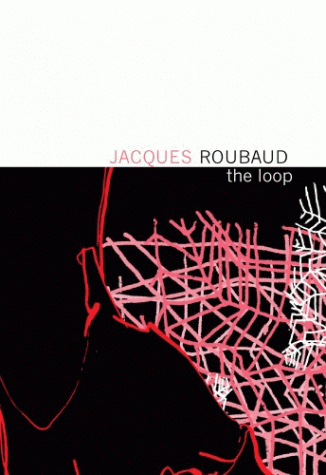 Jacques Roubaud The Loop
Dalkey Archive Press
‘Seventeen years after the publication of the first volume of Jacques Roubaud’s epic and moving The Great Fire of London, Dalkey Archive Press is proud to publish the first English translation of The Loop, the second novel in Roubaud’s Proustian series, which has in its capacity to astonish been compared to the compositions of Messiaen and the buildings of Antonio Gaudi. Devastated after the death of his young wife, Alix, the author conceives of a project that will allow him not only to continue writing, but continue living—writing a book that leads him to confront his terrible loss as well as examine the lonely world in which he now seems, more and more, to exist: that of Memory. The Loop finds Roubaud returning to his earliest recollections, as well as considering the nature of memory itself, and the process—both merciful and terrible—of forgetting. Neither memoir nor novel, by turns playful and despairing, The Loop is a masterpiece of contemporary prose.’ — Dalkey Archive
______
Excerpt
During the night, the mist on the window had turned to ice. I see that it was still night, six-thirty, seven o’clock; wintertime, then, and dark outside; no details, only darkness; the windowpane covered with the patterns of the frozen mist; on the lowest pane, on the lefthand side of the window, at eye level, in the light; this light from an electric bulb, yellow against the intense darkness outside, opaque and wintry, clouded by the mist; not a uniform mist, as when it rains, rather an almost transparent frost, forming patterns; a web of translucent patterns, with a certain thickness, the slight thickness of frost, but with variations, and because of these miniscule variations in thickness, the frost formed patterns on the glass, like a vegetal network, an entire system of nerves, a surface vegetation, a cluster of flat ferns; or a flower.
I scratched a fingernail against this snow, this fake snow: neither white nor powdery; nor melting snow, but a kind of fading snow, the dirty snow of springtime lingering on the sidewalks under the boxwood trees; or rather crushed snow, worn down, dusty and colorless, ephemeral; with my fingernail I traced a path on the glass, and the crystallized mist accumulated against my finger, turning to water from the warmth of my finger, quickly disappearing in tiny rivulets and evaporating into a damp coldness on my numb finger; or else I held my palm flat on the glass, and under its pressure the clump of frost became a sheet of glassy ice, so that suddenly the night showed through, almost watchful in its proximity; the whole vegetation of frozen traces, with its imaginary petals, stamens, and corollas, was erased; now it was smooth, like glass on glass: the map of the hand, the sensitive network of its lines, left no imprint. [–> I § 51]
Still using my fingernail, very carefully, I was able to slide these blades of ice over the surface of the glass, toward the bottom, placing them next to one another in polygonal figures, fractured rectangles; the upper half of the windowpane then seemed to be bare for a moment, immediately adjacent to the night, contiguous with this still impenetrable mass, blue and somber; but only for a moment, for it was soon covered in mist: a fine mist, impartial and isolating, this same mist that floated through the air in a cloud, born from respiration; at every moment this breath-turned-mist held the nocturnal exterior at bay; if I rubbed it with my elbow, with my pyjama sleeve, it reappeared immediately. From this thicket of images one could deduce that it was also cold inside the room, perhaps a little less cold than outside, so that the mist would stick to the window, but cold enough for the air to condense these frozen vocables (I see them), as though they had fallen from a silent voice.
But this would mean indulging in a superfluous exercise of deduction, since at the very moment of saying it, before saying it, I know it; my memory knows it, and it does not lie. I do not mean that a memory is, or is not, sincere, but only that, like a dog, it cannot lie (no doubt a lie is only an act of saying, an act of speech, turned outward). It really does appear this way, in this image; and every image is undeniable. Memory, my memory, knows that it was so: It was nighttime, and it was winter; it was cold; cold outside, cold inside the room; I scratched with my fingernail, I let accumulate against my nail the granite of foggy crystals from the mist, I lay my hand against the pane, I pressed it with my face, with my breath. And yet, every line in the story of this memory contains a great many implicit conclusions. And it is here that error, if there is any error, lies in wait for me at every turn. For in memory, in my memory (I am speaking only for myself), there is only seeing. Even touch is “colorless,” anesthetized. I have no other adjectives to identify this apprehension of material things by thought alone, without form or sensuous qualities, as they arise in their grey and pasty conceptual clay (as certain early theories from Antiquity pictured it). In the process of remembering, I do not feel that my finger is cold, nor do I feel the mild and already fading sharpness of the scraped and frozen dust. I know–because it is commonly and universally known that frost exists and that this mode of the physical existence of water is cold–I know, therefore, that the night was cold, and everything that follows from this. And I recall this knowledge based on experience, as one says. But the image that I reconstitute at this moment is numb to this knowledge, it is indifferent.
Writing on glass is like writing on water: regardless of what one tries to inscribe on these surfaces, such writing is also a metaphor for the ephemeral nature of everything. A mythifying fiction has sometimes tried to convert this into its opposite, by inventing a message engraved on eternal glaciers and in the deep polar snow, uniformly protected by its whiteness, a kind of immense graffiti–indeed, preferrably of colossal proportions–and preferrably in an incomprehensible and therefore immortal language, presenting a truth at once indispensible and indecipherable. From the moment one masters the gestures of writing, and probably for some people up until the hand ceases its movement, there is a desire, mixed with anguish, to write words and signs that can be immediately erased: in sand by a wave, in dust by footsteps, under the eraser with a pencil, or from water, rain, time, or tears smudging the ink.
It was winter, most likely a wartime winter: 1938-1939, at the earliest, 1944-1945 at the latest. I could not have been in this room before that, or after. It was toward the end of night, since the mist had frozen. A very cold night, which was a rare phenomenon. It doesn’t freeze much in the Aude region. I try to think of a very cold winter: 1940? 1942? There was at least one very cold winter during that war. It long remained in everyone’s memory, including my own, and was all the more memorable because people did not heat their houses, at least we didn’t. Our bedroom was not heated. If this image is correct, and pure, if it is not distorted or mixed with others, through resemblance, confusion, or mere repetition, if it is indeed the lower pane of the window that I see, then it must be the earliest, the first possible winter. But as soon as one breathes on any image, any memory, it is covered with mist, and reveals itself to be thoroughly imbued with imprecision. Around it is the past which, like the dark night of that winter, is impenetrable.
To the left of the window, I see my bed: this is another image, another moment, or the same? I don’t know. I feel the cube of the room around me, the bed square in the corner against two walls, lengthwise in relation to me, behind my head; a little farther, the door opens, is open (this “around” belongs to vision which, like light, is sometimes able to “turn corners”). Of certain bedrooms, certain beds, I can evoke only a single image that always remains the same, and everything that is not in this image remains hermetically sealed to me. But of this old room I have a multiple but unified vision, assembled like a collage, through the superimposition and then the fusion of numerous separate visions that have since become indiscernible, beginning from a particular point, the one from which “this” is seen, a central point, at the top of the bed, almost in the corner. There is a “top” and a “bottom” of the bed, as if while lying in it one imagined oneself as vertical, the “point” of vision being at the top of the “page.” It is there that, in a letter, one puts the address of the sender. No colors, no, there are no colors. To see gathered together in this way all the other images from this same place, the fingernail on the frost-covered window, the nighttime windowpanes, what the daylight will make visible through the window, all this assumes multiple eyes, innumerable hands. Whoever remembers is at once an Argos, a creature with a hundred eyes, and an octopus, a creature with a hundred arms.
In the cold, my bed was divided into different regions, warm and cold; the intense cold bordered sharply on the warmth; it pinched my ears, my nose. Here, then, is something truly “inevitable,” the very banality of temperature. In the evening one conquers as many territories of the cold as possible, waging battles analogous to a Russian campaign, which provided a strategic model for this game of conquest, renewed night after night (I’m not speaking of the historic one, the disastrous Napoleonic campaign, but of the one that unfolded at the time, and contemporaneously, in the immense bed of the Ukraine, which was unveiled for us every evening on the radio from London, with the “allied” victories confirmed, after a delay, when the radio from occupied Paris announced the new “elastic retreats” of the Germans). The Siberian regions of the three edges, bounded by the vertical sides of the mattress and the covers that were tucked in well underneath it, always remained impervious to comfort; in the morning, the diffuse warmth of the sleeping body had reduced the pockets of resistance, that Stalingrad with its armies of ice.
In that room there were two other beds that I see; on the other side of the window, my sister Denise’s; at the far end (still looking from the same point) my brother Pierre’s, to the left of the door; seen from the door, on the contrary, this layout, which was of parental origin (I mean it was decided by our parents), organized the space of the bedroom according to the age of its occupants (that is, if one grasps this space in the movement of sight, as I am in the habit of doing, and as if the flat surface of the world, and not only that of the bed, had become vertical, it too like a page: from left to right, and from top to bottom). It seems to me that the spartan light did indeed come from a naked bulb on the ceiling; just about all the rest has disappeared.
*
p.s. Hey. ** Sarah Palmer, Hi. You’re most welcome. I’m on the search for La Horde possibilities. Thank you. ‘Extra Life’ is post-my involvement. I haven’t even seen it yet. My favorite of Gisele’s and my works is ‘Kindertotenlieder’. ‘Jerk’, of which there is a quite good film, is also a fave. ‘This Is How You Will Disappear’ too. I saw the Palais de Tokyo show. I especially liked the Cathy de Monchaux work. It’s not the kind of work I’m generally into, but I was pretty impressed. The new season of gallery shows is finally opening, and I’m excited to go wander around the Marais and see what’s what. Very fine day to you! ** Dominik, Hi!!! I think my mother named Mr. Bun, but I don’t remember. It doesn’t seem like a very ‘me’ name, but then I was 8 years old, and who knows who I was then. The pile is a combination of to be read and read. It’s a mess. I’m dreading having to buy yet another bookshelf, but my desk is starting to look like a ‘crazy’ person’s, so no choice. Love’s taste in coffins is understandable. Love inviting thousands of people to his impending funeral, but only 3 stray cats show up, G. ** cmr, Hi. I might well read it, yes, maybe. I certainly could use a lot more input into what the occult manifests as. My fingers are crossed for your friend’s guitar restoration too. I hope it sounds haunting. Well, I hope everything sounds haunting, I guess. I haven’t read that Nietzsche, but I did step inside the little house in Switzerland where he wrote ‘Thus Spoke Zarathustra’. Not quite the same thing obviously. Wishes heavily in return. ** _Black_Acrylic, Nice about the lecture. I really like absorbing lectures, for much the same reasons as you, but I really hate giving them, again for much the same reasons. Odd. ** Adem Berbic, Okey doke. I wonder what Mexican place you hit up. The only Mexican place here that has been almost satisfactory to me (other than Chipotle) is Barrio Meschica in the 11th, but Zac says it’s gone downhill. When I see people dressed in latex, all I can think about is how they must be sweating profusely underneath. Which I suppose has its charm. ** Carsten, I always wanted to be buried in the ground, but I’m feeling less nazi about that as time goes on. I can relate in that when I was first staring out, that was consistently the case. Now, other than internet trolls and squeamish goodreads reviewers, I feel like I mostly encounter people who seem to understand me and what I’m doing. Haven’t seen ‘The Intruder’, no. I’ll look for opportunities. ** Bill, I do know a little about the Arse Elektronica, but I hadn’t connected it with Monochrom for some reason. Odd. ‘Masking Threshold’, I’ll see if I can find it. Thanks! I agree, dark synthetic orchestra arrangements are really Thirwell’s forte. ** laura w, That park sounds very exciting. But it is almost Halloween. I’m old enough to remember when the wannabe cool people in high school carried Vonnegut novels around with them. Doubt they ever cracked the covers. Thanks, yeah, we were thrilled when Destroyer let us use that song. If he hadn’t, it would have been a big crisis even. That Destroyer album, ‘Your Blues’, is my all-time favorite album, apropos of nothing. Happily I really liked the book that I agreed to blurb, so I could give them a glowing one. ** HaRpEr //, I went to Highgate once. It was nicely shabby and kind of spooky, and very, very British for some reason, at least to me. But, yeah, not as pretty/impressive as Pere Lachaise. ‘Castle Faggot’ is a great example. ‘Numero Deux’ is hard to see? Shame, it’s a good one. I wish you were here because they’re doing another super rare screening of the 3D ‘Adieu au language’ (with English subtitles!) this week. ** Uday, Right place, right time stuff. You reading ‘SPiaCM’, wonderful. Ashbery must be hard to read aloud. Although I guess just kind of mimicking his flat-ish way of reading his poems is the way to go because that works like a charm. Quite a story there: the bf -> gf @ gravestones. A bit hard to believe though. If it was a scene in a movie, I think I’d roll my eyes. But I haven’t rolled mine no doubt due to your fine presentation. Dan Quayle?! ** Thomas Moronic, Hey, buddy! Yes, indeed! How are you? How’s the novel unfolding? ** Okay. There was some conversation here recently about the brilliant Oulipian writer Jacques Roubaud, which led me to aim a spotlight at one of his best novels, and there you go. See you tomorrow.



 Now available in North America
Luz Verde in Pigalle, just down the road from where I used to live. Ring any bells? My extremely non-connoisseur tastebuds found it at least serviceable. Weirdly, there’s some excellent Mexican in Nice of all places.
Well, London is now. Melancholy Dolly cuts might not have been the best choice of soundtrack to mitigate the post-Paris comedown, but I guess one must pay their respects. At least the Eurostar accommodated a little more redrafting.
I think Roubaud would have been an excellent target for a Gibert crawl, but here we are. The extract reads to me like he’s plucked the kind of half-realised prose styling I want to achieve out of my brain and, uh, realised it. Thank you for the introduction.
Hi!
Thanks again for this post celebrating French-language literature — for once, I don’t feel frustrated knowing that I won’t be able to read or get hold of the books!
As for La Horde, one of their previous shows is available to watch on replay on France TV: “Room With a View”! Thanks so much for these recommendations; I’m going to look into finding a French copy of “Jerk”!
I completely agree with you about Cathy de Monchaux’s work. For once, I felt that this season at the Palais de Tokyo was quite consistent overall and had a real sense of coherence. I was particularly impressed by one of their previous exhibitions, which focused on the idea of the doppelgänger, reinterpreted by the duo JAKOB LENA KNEBL & ASHLEY HANS SCHEIRL.
One of the exhibitions that keeps coming up as an iconic one is, of course, Anne Imhof’s, as well as the one about dioramas (the exhibition catalogue is great); unfortunately, I missed both of them… Seeing an Anne Imhof performance in person must be quite an experience!
I’m also really looking forward to discovering this new gallery season! I stopped by the Galerie Gallimard, which is currently presenting a small research exhibition devoted to the figure of Nadja / Léona Delcourt.
Have a great day!
My publisher just reached out to get the editing process going on my book. Very exciting cherry to pop!
I really think you’d quite like “The Intruder”. Its stream of consciousness structure makes it one of Claire’s most experimental works. It’s “about” Michel Subor needing a heart transplant, but it does not operate on plot mechanics in the slightest. It drifts from Switzerland to Korea to Tahiti, in & out of what might be dreams, visions, memories. It has the fluidity of “Beau Travail” but is even more slippery. If you do watch it, beware of the shitty los resolution copies out there. This one’s crisp: https://m.vkvideo.ru/video-197265731_456241115
How’s the deck going?
Sent you an email by the way
Hey Dennis,
The wake/removal/whatever it’s called in different countries is tonight, and the funeral tomorrow. I don’t know the usual timeframe for funerals in the US, but I know in the UK it is normally a few weeks on, but in Ireland it follows that old Abrahamic-religion idea of the mourning period and process happening quickly. Not as fast as Judaism or Islam which I know tends to be within 24 hours, unless for legal reasons or family traveling, but it happens quickly here. I think I spoke a bit about my relationship with her and vague details about family history for privacy reasons, but she had made amends and had a nice relationship with all of them by the end, and any grievances or issues I might have had regarding her and my mam’s past is something that my mam has always wanted to keep separate from my relationship with her, and thus I only hold goodwill and love for her, especially growing up in 40s and 50s Ireland as a woman and her hard upbringing (losing two siblings in a week) that makes me understand she was doing the best she could. All my aunts and uncles are finally on okay terms again too, which is nice as there had been a lot of turmoil over the past few years.
Yeah I don’t know if Lana would be your type of music, her first album is this strange blend of cinematic strings and orchestral music blended with hip-hop and trap. The production is interesting with these constant samples of Rick James live performing Mary Jane throughout the songs (this clip of him shouting SING becomes a hip-hop motif in like half the album), and other samples from classical music or hiphop or 70s rock that probably shouldn’t blend together but really do. I’d say Born To Die is worth the listen through anyway as it’s almost like a foundational text in pop music and lead to the trap-pop of soundbites and “cinematic” sounds from people like Billie Eilish. You might like Ultraviolence, her second album which is far more rock-centric; a lot of psychedelic rock influences, desert rock, a bit of jazziness too. West Coast, the lead single is interesting, a dark beach rock song with a chorus that is half the tempo of the verses. And whilst she has about 9 (8 commercially available as her original self-titled debut was taken off iTunes after a few months and were never properly physically made) albums of songs, she has about 200+ leaked songs that were never released, which is also part of the mystique of her; some of those songs, through tiktok, are more famous now than singles from her actual albums. Some of them are rough, some of them are pop songs she was pitching to other singers around 2010-2011, and some are outtakes from her albums that are actually better than songs on those albums, but for one reason or another she just kept off. And she basically created a whole lyrical identity with just her first album, which is impressive, and she tends to reuse and utilize phrases, lines, and melodies from songs, both released and unreleased, in a very interesting way. Her last album is full of interesting samples (some literally her singing over another song), in-studio dialogue, this eerie interlude of a paster preaching recorded on her phone over a creepy piano, and demos of songs that are transitioned into the end of songs like A&W and Taco Truck x VB the VB stands for Venice Bitch, and includes the demo of the Norman Fucking Rockwell track. Norman Fucking Rockwell is great too, an album that is almost a love letter to California but also a record that has her stripping the sad girl “Lana Del Rey persona” whilst simultaneously showing that that persona was pretty true to who she actually is as Elizabeth Grant — something that all her releases post 2019 have continued to do, with her last album Ocean Boulevard almost being like this Jungian concept of her integrating both identities into one person. But if you’d like anything, it would probably be Ultraviolence or maybe Norman Fucking Rockwell.
Hi!!
I had a hamster around the same age, when I was maybe 10, and my parents named him “Muki,” which is roughly equivalent to “dude,” haha.
I love piles of books anywhere—on desks and bookshelves and the floor… It’s such a comforting thought that I have options to reach for. But, yeah, they do eat up one’s living space pretty easily…
Oh no. Poor love. Did he at least… like cats?
Love always expecting everything to take much longer than it eventually does, Od.
Thank you for today’s Spotlight. Had never heard of Roubaud before this post, and his seems a beautiful project.
The greatest lecture I ever did see would be Renée Ricard in Chicago 2002. Never to be forgotten, that one. Just an explosion of pure personal magnetism, however evil the guy may have been.
that’s funny. i just read my first perec and now here i am confronted with one of his cohorts. the perec was a man asleep and i loved it, predictably. between that and the malady of death i’ve been thinking in second person lately. an underutilized point of view, i think, even if it is sort of “baby’s first experimental novel”, and a lot of readers hate it because it requires thinking of yourself as someone who isn’t you. whatever.
good to know about that destroyer album! i’ll have to give the whole thing a listen. do you decorate for halloween or just admire decorations? i feel like you should own at least one plastic skeleton (or real skeleton i don’t know what you get up to). is it hard to find halloween decorations in france? i know it’s not a very culturally french holiday and they can get kind of weird about american imports, even stuff like halloween which is i suppose in its current form an american import…
I said recently here that I’ve been itching to read Roubaud. This whole novel sequence really intrigues me. The core constraint of this one is really fascinating: letting your memory fail you and loop around like that.
I’m still on the hunt for Alix’s journal too. Now that Dalkey is back I’m hoping that they stick to their name of creating an archive of books that are hard to find.
I’ve been thinking about trying Calvino again, because in my eyes he was sort of the least interesting of the most read oulipo members. Am I wrong? He always seemed too tied to metafiction and stuff in my head.
Sigh. I can only dream of 3D Godard. But luckily I spoke too soon on ‘Numero Deux’, I managed to download it from solidarity cinema! That thing has helped me out a lot lately if you don’t know it. Godard films are really addictive for me, like a band you can’t stop listening to. It helps that he has a huge oeuvre and that most of his films are about 90 minutes.
Jealous that you have a favourite album. I have a favourite book and a favourite film, but I for whatever reason have trouble with an album that I can definitively say is my favourite. There’s about five where if someone put a gun to my head I’d have to cycle between.
I am as certain that the graveyard thing happened as I am certain that it did not happen as it was told to me, because it was told to me by a theatre professor and, well. But even the core of the story has kept me thinking about it, I suppose. Adding this to the reading list. At this point I probably have half of the translated-from-French section of my college’s library checked out. The stacks of books in my room are beginning to become a bit of a problem. I have this unfounded worry/vision of bringing over a partner for the night and they make off with a book, leaving me to pay the library fees. I need to get more into stupid guys. Maybe I should make that a mid-year resolution and put it on my fridge, or whatever people do. Yes, Dan Quayle! There’s an enormous amount of revived interest in him amongst people my age (is it revived if there hasn’t been interest previously amongst any group of people at any time?). All the young people are quoting Quaylisms. It’s a sort of aged camp, I think. Unsure how it fits into the Bruce LaBruce classification.