DC's

The blog of author Dennis Cooper

Page 731 of 1130

Stalag Fiction Day *

* (restored)
—-

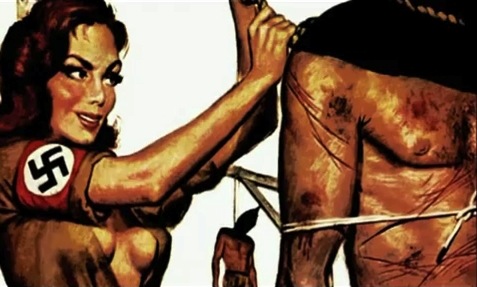
‘Stalag Fiction was an Israeli genre of erotic pulp fiction that employed Nazi characters. These books, which were very popular in the early 1960s, had graphic scenes of domination, torture and sadism between female SS guards and Allied soldiers in German POW camps. The readership of these Stalags were primarily teenage boys, a majority of whom were the children of Holocaust survivors. These pulp fictions are an example of the international post-war cultural trend of presenting Nazism as intrinsically decadent. The introduction of the genre coincided with the 1961 trial of Adolf Eichmann in Jerusalem. …
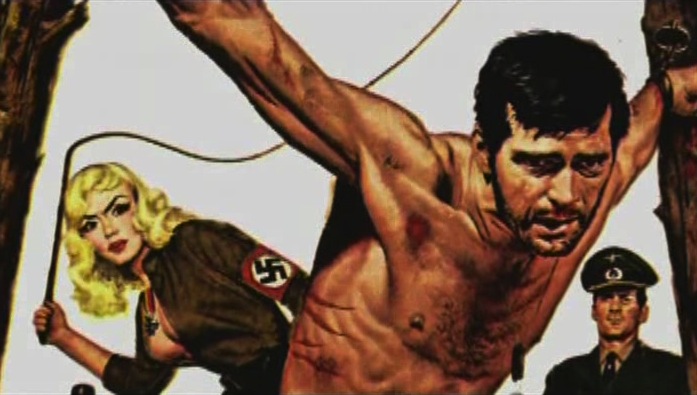
‘The first Stalag was Stalag 13. All of the Stalag books were promoted as translated fiction written by pseudonymous authors with “American” names. A name of a fictitious translator–alongside banners such as “For the first time in Hebrew…”–is added for “authenticity.” But all authors were Israeli and wrote in Hebrew. Stalag 13 tells the tale of Mike Baden, British pilot held prisoner in a POW camp. One day the camp’s SS staff is replaced by “Two platoons of female SS storm troopers, wearing tight pants, shining boots, and vests from cloth that stretched across tall and upright breasts.” …
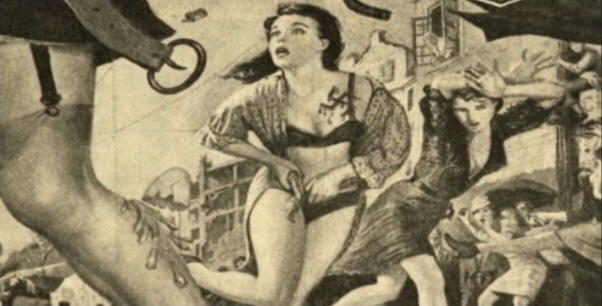
‘Ezra Narkis, the publisher of the first Stalags, had specialized in men’s magazines and porn pulp. He claims that Stalag 13 sold 70,000 copies. Another account says that producers of the TV show Hogan’s Heroes heard about the book’s success during a visit to Israel and decided to adapt it. The show also took place in Stalag 13. There were about 80 titles of Stalags in all, beginning in 1961 with one title published in 1965. …

‘A common plot device is a dominatrix in charge of a unit of female SS guards. Some were adapted from real life SS women such as Ilse Koch (the “Bitch of Buchenwald”) and Irma Grese (the “Beautiful Beast”) of Auschwitz. The brutality of these Nazi female characters has a price. In Stalag of Leaches, the dominatrix is tossed into a pit of leaches, while in Stalag 217 the female in charge is strangled by her ex-lover. Every Stalag ends with “settling the score.” …
‘Both the books of Ka-Tzetnik 135633 (House of Dolls and others) and the Stalags have had a lasting effect upon Israeli society. According to Israeli filmmaker Ari Libsker, whose 60-minute documentary Stalags: Holocaust and Pornography in Israel was released in 2008, it is a similar blend of “horror, sadism and pornography” that perpetuates the memory of the Holocaust throughout the Israeli consciousness into the 21st century.’ — Eric Brothers, Suite 101
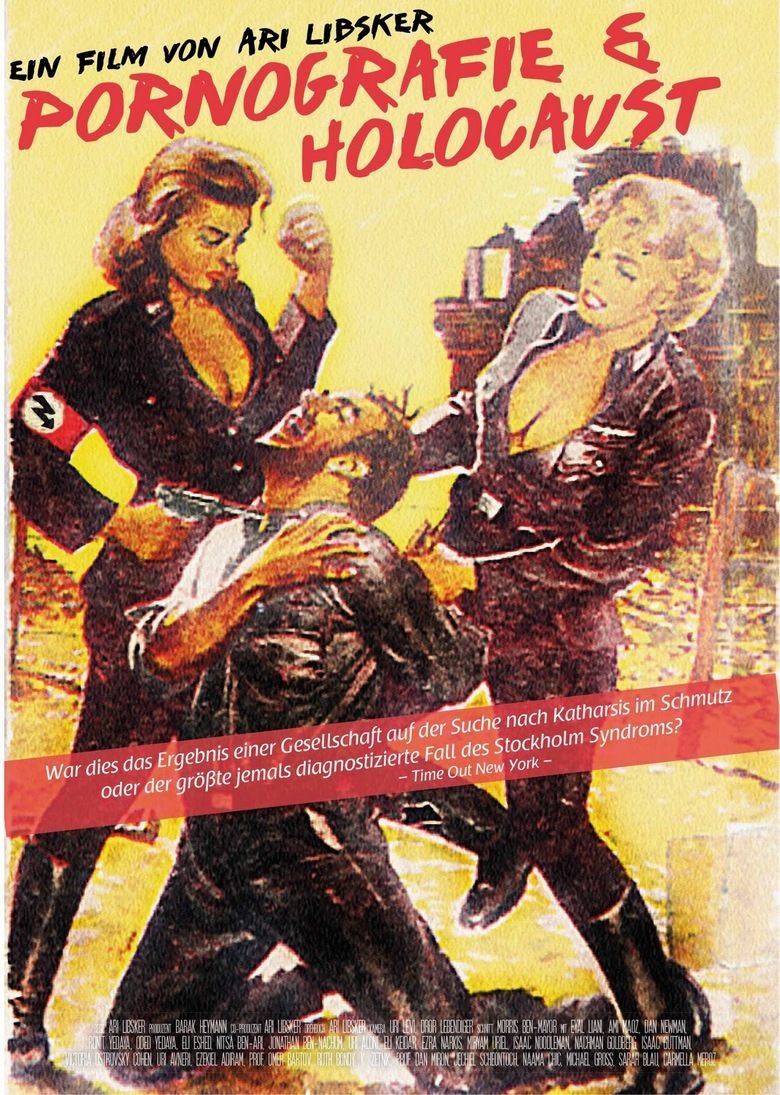
 

‘Many Americans have never heard about the Stalag fiction phenomenon; Ari Libsker‘s short but valuable documentary, simply titled Stalags, makes for a troubling, though thoughtful, introduction. Stalags constituted a genre of cheap exploitation novels that briefly thrived in Israel in the early Sixties during the period of the Adolf Eichmann trial, when the atrocities of the Holocaust were initially and tentatively broached in the public sphere. Stalags usually stuck to the same tried and true formula, pawning themselves off as translations of memoirs by American or British soldiers who had been imprisoned during World War II by the Nazis and subjected to sexual humiliation and violence by SS she-devils. In the end the soldier gets to turn the tables by raping and killing his inhuman torturers.’ — Michael Rowin

ON THE MEDIA: How do you think these books contribute to the young generation of the ’60s’ idea of what went on during the Holocaust?

ARI LIBSKER: First of all, at that time, we didn’t have information about what was happening. We had only read Anne Frank. And Anne Frank’s diary stops in the moment that the Nazis take her to the camp. And most of the parents, they were ashamed. And there was only one man who gave the information to the Israeli people. It was Ka-Tzetnik. He was the first Holocaust writer in the world. He was before Elie Wiesel. He was before Primo Levi. He published his first book in ’46.

OTM: His books were actually the precursors of these Stalag pulp novels.

AL: He was “Mr. Holocaust” of Israel, and his books were considered to be holy books. But when you analyze his way of writing, you realize that his book was completely pornography. House of Dolls talked about a pleasure block within Auschwitz, which was populated with Jewish girl prisoners who were there to serve the guards.

OTM: Sex and Nazism, a very potent combination.

AL: Yes. It’s easy to criticize low culture, but it’s hard to criticize a person that is considered to be high literature. Ka-Tzetnik made more damage than the Stalags because, if you were a child and you read the Stalags like two times, five times, you understood it was pornography. But they did not understand that Ka-Tzetnik was a pornographer too.

OTM: So the kids, the teenagers who read House of Dolls and the Stalags in their formative years, in the early ’60s, they’re now in their late fifties and early sixties themselves.

AL: Yes. They are the generation that controls Israel now. This is the age of Ehud Barak, the age of Ehud Olmert and the age of Binyamin Netanyahu.

OTM: And yet, House of Dolls continues to be taught in the curriculum, have been taught in the curriculum since 1992. Why?

AL: I don’t have any answer to this. To get more attention from the young generation, they’re given the hard core of death, violence, and, in the case of Ka-Tzetnik, sex. I think that we still deal with the Holocaust in a pornographic way. It’s the way that we repeat the horror again and again.

Download the film gratis here


Stalag fiction @ Wikipedia
‘Stalags’ @ Nazimedia
‘Horniness Meets Horror’ @ Village Voice
‘Israel’s Nazi-porn Problem’ @ Salon
‘Holocaust Porn’ @ NYPress
Ka-Tzetnik Profile @ Jewish Resistance
‘Ka-tzetnik’s Use of Paradox’
Book: ‘Stalag Fiction: Nazi Exploitation, The Holocaust, Sadomasochism’
Film: Ari Libsker ‘Stalags’ (2008)

 

‘The first ‘Stalag’ was not a Stalag, but was instrumental in bringing the short-lived genre to life. The pseudonymous author Ka-Tzetnik 135633 — concentration camp slang for “prisoner,” and his Auschwitz number — published his book House of Dolls in 1953. It was the first Israeli book to confront the Holocaust, a diary of a sexually abused 14-year-old Jewish girl who was forced to be a prostitute in Auschwitz. The girl was the author’s sister, who was put to work in the brothel of Block 24 in the notorious death camp.

‘House of Dolls is essentially the Israeli equivalent to The Diary of Anne Frank in the United States and Elie Wiesel’s Night in Western Europe. Ka-Tzetnik 135633 became Israel’s official literary witness to the Holocaust, similar to the role Elie Wiesel has in Europe and America. House of Dolls is required reading in the Israeli school curriculum, and gives students their first exposure to the Holocaust. But there is a problem. Considered a Holocaust classic for many years, scholars now consider House of Dolls to be pornography and made up.’ — Sandra Williams

Excerpt:

Joy Division.

Here, in the rose-tinted blocks, there was no flogging. Here they kept close watch over the girls’ bodies to keep them whole, undamaged. Here, when a girl was flogged she was not permitted to return to the Joy Division. She was immediately tossed on the van and- Off to the crematorium!

Here every girl got a new outfit. Every week- clean underwear. Compared to the food in the Labor Division it really was paradise here, as Renya Zeidner had said. But the girls who lapsed into sin in this paradise received a “report.” Just a “report.” Sinners with three such “reports” were led out, usually with teh arrival of a new transport, to the Execution Square, where Elsa, the Master-Kalefactress, cleansed the sin out of their bodies. Sin Purgation it was called. Upon which the purgated bodies were tossed on the van: Let the other maidens of paradise behold and beware of sin.

Here, every day, at two o’clock, German soldiers, on their way to the Russian front, came from the nearby transit depots to entertain themselves with the girls of the Doll House. The girls had to put their all into the satisfaction of their esteemed guests. If such a guest was not satisfied with the “enjoyment,” he had only to report it, on leaving, in the orderly room and give the girl’s breast number. After three such “reports” the girl was automatically doomed: She hadn’t duly appreciated the great honor bestowed upon her; she had made light of the honor of a German warrior!

*

Enjoyment Duty.

There is not a sound in the block. The girls sit, each on her bed, legs propped on the floor. Fifty beds, in two single files, with fifty girls seated backs to each other. No one had decreed this seating arrangement. They seem to be sitting this way deliberately, so their glances should not meet. Fear is contagious. Soon they will be called upon to smile. The smile is not optional. The smile attests to the girl’s attitude to Enjoyment. Her life depends on the smile. Soon they will be called upon to be happy.

There is not a sound in the block.

For a while yet they are permitted to commune with fear, with this thing about to take place here. Now they are still permitted to feel the horror of what awaits them. And they abandon themselves to the opean arms of fear, which any moment will have to give way to the Germans. Soon their faces will wear smiles. The noble German guest hasn’t come here to look at sad eyes. He has come to Enjoy! To get his bucketful of joy! That clear to the Doll? If not, he’ll make it clear to her! First of all, let’s have the number! He wants a copy of th enumber in his pocket. Just for the heck of it. Afterwards, when he passes by the orderly room, he’ll think it over. But just now, with her brand number already jotted down in his pocket, let the Doll be so good as to love him up! The way he likes it! With gusto! Gay does it! He wants to get his fill of her just the way he washes down a mug of Prussian bear, white foam and all.

Outside, the gong booms-

Two o’clock.

It’s time.

There is not a sound in the block. Fifty girls- as if they had nothing to say to each other. Fifty beds- like ffity stools arrayed on the Execution Square before the naked bodies are strapped to them.

Outside, German voices are approaching. Elsa is screeching final orders to the kalefactresses, drowning out the Germans’ ribaldry. Maybe that will help draw their attention and serve them notice just who and what she is here. Even Yaga lingers on the square in front of the blocks. They hustle and bustle and shout outside like stage directors before curtain time on opening night. Any moment now the block gate will open, and the Germans will come in.

Fifty beds- like fifty before the firing squad, standing motionless in a straight row, staring into the gun muzzles, waiting for the bullet to pierce the heart-silent. They have nothing to say to each other.

Every day. At exactly two o’clock.

[…]

Enjoyment Duty.

At Daniella’s bed, the German hangs his jacket in the closet. In the adjacent bed, the girl looks right into the German’s eyes. She smiles- but her smile weeps, as though she had drawn it out of a jar of tears where it had been soaking. The girl’s eyes rake through the German’s countenance, trying to divine as by face-reading: What does this face have in store for her today? Is there a human spark hidden behind it? She searches for the spark. She wants so to find it, hold on to it, reach out a hand to it like a drowner. Her life is now in his hands. She now belongs to him, all of her. He will express his opinion about her. His opinion- an irrevocable verdict. Will he sate himself, like the beast gorging down its prey, grunting and going on its way, or will he let her have a “report” just for kicks, so as not to miss out on this extra pleasure?

[…]

In a nearby bed, the German gets up, makes ready to leave. The girl’s arms, white and naked, cling to him. Her face twists into a smile as her lips whisper, “Please sir, was the gentleman satisfied?”

The German shoves her away, spits, walks off. The girl sits there, her naked white arms hanging spiritlessly from her knees. She looks to him. He is going away, carrying in his pocket the fate of her polluted life. The Execution Square looms before her eyes. She looks, looks. The German is already gone, and she is still looking to him-

Was he?…

*

Suddenly, he felt an awful pain around his eyes. From every limb of his body, from his skin, from the roots of his hair, the pain converged upon his eyes and all started beseeching him:

“A tear- a tear- please, just one…”

He rolled off the white sheet. The searing pain around the eyes grew more agonizing, more excruciating. A roaring blaze. The pupils of his eyes flared up like two seething volcanoes, and the pain erupted and streamed into his every bone. He dragged himself to the table, let himself into the Mussulman seat. Queer sounds started escaping from his throat. The weird cheeping of an ailing bird. His arms reached out to the empty chair opposite.

“A tear- Please, only one- just one…”

He lifted his gnarled, calcified hands and pointed to his eyelids: There….he…he feels something there, something he’s never felt before…He twittered and breathed his plea to the empty chair:

“…tear…only….only one…”

Hippocrates of Concentration Camp Universe! Prescribe this patient his cure!


‘Nazi She Wolf Beauties of The SS’ (trailer)


‘Werewolf Women of the S S’ (trailer)
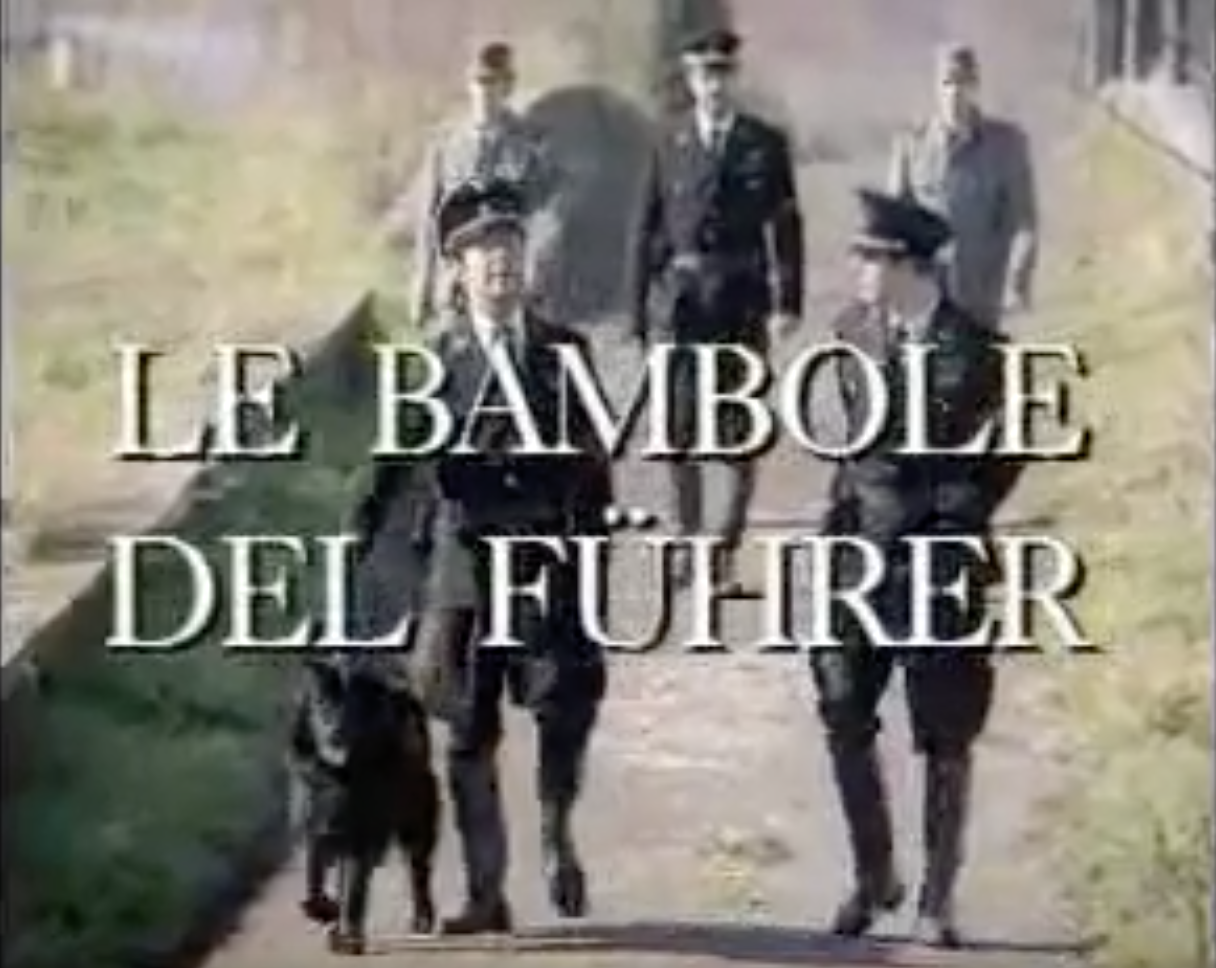

‘The Dolls of Fuhrer’
Watch it here


‘Nazi Love Camp 27’ (excerpt)


‘Gestapo’s Last Orgy’ (Trailer)


‘The Beast in Heat’ (entirety)


‘SS Experiment Love Camp’ (Trailer)

Fräulein Kitty (Excerpts)
—-


*

p.s. Hey. ** Misanthrope, Hi. The hacking thing is still happening full force, and it’s starting to effect the blog and making it quite sluggish and difficult to work with, and it’s driving me a bit nuts. The lack of exposition or backstory in ‘WfD’ is beautiful and way, way up my alley, obviously. I hope your mom’s health upswing is still the law of the land. ** Dominick, Hi, D! Yes, the hacking thing is super stressful, and, like I told Misanthrope, even though whoever hasn’t been successful in getting inside, it’s making the blog very slow and very hard to navigate. I’m starting to wonder if it’s ever going to stop. Urgh, anyway … I’ll see if I can see ‘It’s a Sin’ on one of my (whispering) illegal sites. Ha ha. Love as huge and impossible and stupid as hippies used to hallucinate about on acid, G. ** David Ehrenstein, My email box has been invaded by hundreds and hundreds of WordPress hacking notification emails with more arriving every minute, and it’s a big mess in there, but I’ll go try to find your email once I’m done here. Tom Wolfe wasn’t a hack back when he wrote his first couple of books, and the proof is in their pudding. ** _Black_Acrylic, Hi. I don’t know if you remember when Gisele and I co-curated that big exhibition and series of performances at the Pompidou called ‘Teenage Hallucination’, but we showed two of Bartlett’s dolls in it, and they’re really small in person, and, yes, very weird. Great, congrats on the transfer! Very happy to hear it! Here’s hoping it’s as homey as possible for as short a stint as possible. ** Bill, Hi, B. Yep. Oh, I have to go check what Carrington story it is. I haven’t looked yet. Hold on. It’s ‘The Debutante’. I recommend the book club type thing or something like it. It’s great fun both when talking writing and just shooting the surrounding shit generally. ** Jack Skelley, How many times have people refereed you as Jack Skeletor? Well, add me to the supposed hordes. Amazing that you could read on acid. Don’t think I ever managed that. Wrote on acid, although ‘wrote’ is being really kind to what I incoherently spewed through a Bic pen or whatever. Happy you liked ‘Alone’. Yeah, Mr. Moore knows how to getcha. Hugs, punk! ** Steve Erickson, It’s true, watching that Britney doc, it’s amazing how intensely things have changed since the days not actually very long ago when she was assaulted by the media unchecked. I like Eilish, but I think I’d need to hear the doc is something special to watch it. Curved Air, yes. I, like I think everybody back then, bought their first album, which I think was ‘Air Conditioning’ because it was one of the first LPS to be released only on picture disc. I hardly remember it other than thinking it wasn’t anywhere as exciting as the picture disc novelty aspect. Vague memories of thinking they were something kind of like if It’s A Beautiful Day had heard a Henry Cow album and tried to catch up or something. Maybe I’ll dip back in. ** Brian O’Connell, Hi, Brian. Strange dude, cool stuff, beautiful and weirdly fixated and kind of great, yeah. For me, the editing is where you make the film. Granted, after carefully doing the shooting and, of course, the casting and so on. But I feel the same way about writing fiction. When I’m writing I’m mostly thinking ‘hurry up so I can get to the editing’. Curious. I agree, Bogarde in ‘DiV’ is one of the great performances. Back in the day when I was young and naive and whatever enough to care what won the Oscars, I remember being completely outraged that neither he got nominated for best actor for ‘DiV’ nor did Malcolm McDowell get nominated for ‘A Clockwork Orange’. Those overlooks still seem outrageous even now when I don’t give a shit about the Oscars. Carrington’s prose is terrific, and will do about the Andersson. The next book club isn’t for a week and a half, but I’ll remember. I get you on Cassavetes. Me too, really. I admire his films, but I’ve never felt passionate about them like so many do. I’m more in the formalist/style camp, for sure. Or a perfect mix of form vs. naturalist like, oh, James Benning. It’s always interesting when one doesn’t love the films of a filmmmaker when pretty much everyone you know and respect loves them. For me, Tarkovsky is an example. I get why people love his films, but they don’t do anything for me and kind of irritate me if anything. Your scrawl was lovely and not remotely a scrawl, my friend. I hope Wednesday finds you to be an upbeat soulmate. ** John Newton, Hi, John. My pleasure. Ah, editing poems, nice. That sounds exciting. Take care. ** Right. Today I thought I would resurrect this old post about a most curious … literary (?) phenomenon of the past. Interested? See you tomorrow.

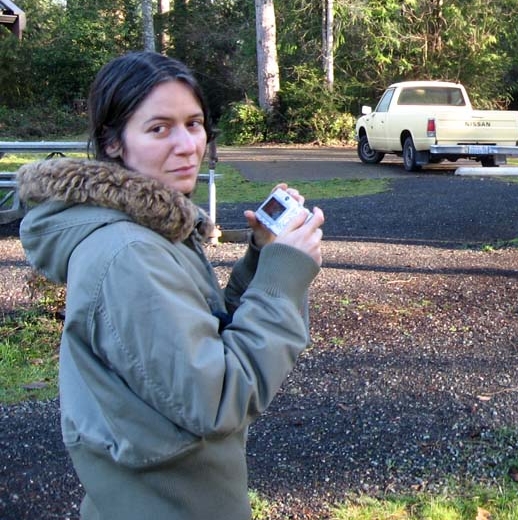
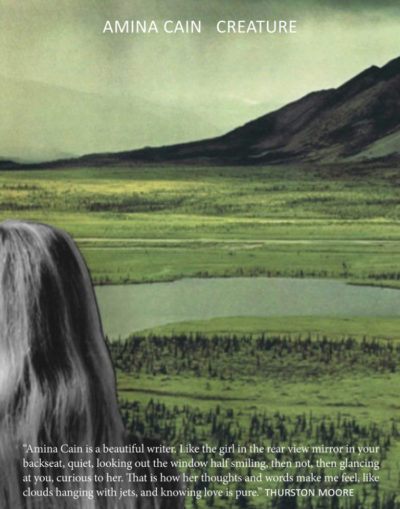
Spotlight on … Amina Cain Creature (2013)


‘The more computers infiltrate our lives, the more fucked and torn apart people become. Where dicks like Whitman went off and lived surrounded with the trees, now we disappear into web browsers. And while that’s starting to feel more and more natural, Twitter isn’t a lake, and ordering food off of Seamless doesn’t require any human interaction beyond opening the front door and grabbing a bag of food. Online, you can almost distract yourself enough with what you aren’t actually doing that you forget time is passing.

‘I imagine there’s some kind of new genre rapidly forming around the idea of the electronic self. Now it’s often not as much where someone is going or what they become, but more so the significance of what gets mentioned, collaged together, that makes the body of a work stand out: how it is said and in what order; what details recur and which do not.

‘I’m thinking about books like Sheila Heti’s How Should A Person Be?, Tao Lin’s Taipei, Sam Pink’s Person, David Foster Wallace’s The Pale King; and perhaps earlier, the writing and journals of Andy Warhol, Jean Rhys, and Alix Cleo Roubaud. In general these are works that, for lack of a better term, get called The New Sincerity, if often because what transpires is a product of the adaptation of a daily life in which almost nothing happens but the happening itself. These are books concerning the amorphously hellish feeling of being pressed continuously at nothing without ever knowing why besides the fact that you’re alive.

‘Though I don’t know enough about Amina Cain’s life to say how much of what appears in her writing is based on reality, the stories in her second collection, Creature, seem to share something of the sublime tone mentioned above. Nothing really happens in these stories: the narrators (whose voices frequently bleed together without being claimed as the same person) go about mostly quiet daily lives—working at a library, often interested in reading rather than interaction with other humans, constrained to awkward, quasi-philosophical conversation when they must, and above all continuously considering the silent nature of their surroundings.

‘Cain’s remarkable ability to render thoughts and observations simply and precisely carries the reader. Each scene accrues a rising sense of tension as it continues, without any sort of narrative twist or jut, and no reliance on internet memes or name brands for content. There’s not a sense of obsession with the self as much as there is a sense of the self unharbored, left living in a strangely ageless world somewhere between Emily Dickinson and David Lynch. At the same time, the book casually comments on its own creation, as if it is being generated right beneath the reader’s feet, like someone stranded in a haunted video game based on their own life: “Even though I don’t write stories I create them in my actions,” begins one story. “I create a feeling I don’t believe in and then I act on that feeling.”

‘That feeling of wanting something, waiting for something, floods through Creature, and in the waiting, there are hundreds of little corridors, and doors. Where many other creations would get trapped in their own ideas of pleasure, this one creepily shines.’ — Blake Butler


____
Further

Amina Cain Site
Witchcraft and Brattiness: An Interview with Amina Cain
THE SPACE OF WRITING: A CONVERSATION WITH AMINA CAIN
Amina Cain @ goodreads
‘A Trace of That Darker History’
Eternal Present
Notes on Craft: Amina Cain
An Artist of the Floating World
Indelicacy: An extraordinary feminist fable about women and art
Patty Yumi Cottrell by Amina Cain
Book: I GO TO SOME HOLLOW by AMINA CAIN
“UMBRELLAS” BY AMINA CAIN
Amina Cain on the Value of Art That Disorients You
Pattern and Forecast (Vol. 2)
5×5: Brian Evenson, by Amina Cain
Audio:’ I Will Force This’ by Amina Cain
LITERARY HAUNTINGS AND NAMELESS CITIES
Amina Cain recommends 6 books
Amina Cain on Authenticity and The Maids
Book: ‘PARROT 13 Tramps Everywhere’ by Amina Cain
Buy ‘Creature’ here


____
Extras


A Room With A View: Kate Zambreno & Amina Cain


Interview with Amina Cain at &Now Festival 2011


WRECKAGE OF REASON: Amina Cain


_____
Conversation: Amina Cain & Renee Gladman


Renee Gladman I want to begin by asking you about slowness. Very general, I know. But it’s something I think about when I read your narratives: the duration of a moment of perception. Or perhaps, the sense has more to do with a certain silence around perception, which I’m reading as speed, but which might have more to do with space. Where do words like “slowness” or “silence” land when you think about the nature of experience or subjectivity?

Amina Cain I do often see “duration” within perception as a kind of spaciousness (something I am always trying to find, both in my stories and in my life), but, interestingly, I just finished an essay on my relationship to writing and it’s called Slowness. In it, I talk about how drawn I am to films (like Chantal Akerman’s Jeanne Dielman) and books (like Clarice Lispector’s The Apple in the Dark) that seem to move slowly, or that when they do build up to something with some kind of energy, do so without the promise of “real” drama, not unlike what it is to prepare to meditate. In the Soto Zen tradition, which is the only one I really know, you go through a fairly momentous ceremony to simply stare at a blank wall, to arrive at something like spaciousness or slowness. On that blank wall is projected everything (after all, you can see your mind there) and also nothing. I like that relationship between drama and quiet, between moving towards something and then just sitting down upon arrival to experience what it’s like to be there. I like it in life and in writing.

I wrote another essay that thinks about the similarities between fiction and landscape painting (as well as character and landscape) because I’ve been realizing more and more how important image and setting are to me as a writer—in a way, even more so than language, and certainly more than plot or story. The question I am now asking myself, that I think I have always asked myself, perhaps without knowing it at first, is: can a story be like a painting, or a video or film, or can it allow for lapses into the space of one of these things for a little while? What happens when a narrative allows us to spend time with an image longer than we are “supposed” to, when it is just as arresting as the story being told?

But, in that second essay, I also talk a bit about Ana Patova Crosses a Bridge, about how the narrator “softens” (and what I mean by this word is that some kind of boundary breaks down) with not only the “architectured” landscape, but also with sentences, and with the physical act of writing. It feels to me as though everything in the book is passing through the narrator’s body or that the narrator’s body passes through everything. I wonder if these impressions mean anything in terms of the way you yourself see the book, if you thought at all about porousness or exchange.

RG Sometimes it’s difficult to separate a narrator from language or the idea of the body and text. I often think they are inextricable, but lately I think it’s more that the narrator (of most of my fictions) and the body (which people ask me about a lot) are sublimated figures. They belong to language; they are problems of language. The only reason there is a body is because there is a text, in this case a “bridge,” to make its form possible. I like when people talk about membranes in regard to writing, because it allows you to visualize a layer that potentially sits on top of language. Because, you see, I think the language of the book is passing through something as well, and it’s not the narrator’s body, rather some abstraction of itself. Language has a dream of itself and the book passes through the dream. The first part of the sentence forms the membrane and the second part of the sentence moves through it. In my mind, it looks like ribboning, but is colorless. Someone writes about language as a skin, which perhaps corresponds with your thoughts on porosity. I am interested in the idea that the skin is an organ, because skin is flat like landscape, like language. If we allow language to be skin in our imaginings then we can move immediately to all the processes happening below that level—so many systems at work with the skin (language) acting as protection, as boundary and container. I think about things entering that membrane and moving through the body beneath and try to imagine what that looks like, sounds like at the reading level. I want the language you see, particularly in Ana Patova, to be alive and in process.

Earlier, in talking about meditation, you mentioned going through “a fairly momentous ceremony to simply stare at a blank wall,” as a way to describe your relationship to narrative. This is really exciting to me, a series of elaborate acts to prepare for one prolonged gesture. (Though I have a problem with the word “one” there. I’m not sure it’s countable.) How does this translate in writing? You talked about the wall, but I’m interested in the ceremony. Where does it take place? Is it outside of the frame of the narrative?

AC I like so much of what you say here, especially about language—what belongs to it (not possessively); what’s just underneath, moving; its dream of itself; the second part of a sentence moving through the first. I often want to ignore language, but of course I owe it everything because I don’t ignore it when I write and, thought about in the ways you describe, how could I? Here (and in Ana Patova) it’s as alive as a character (is character alive?), but it’s not character. It doesn’t want or need to be alive like that. It makes me think of language as a stage, the thing we all show up to see. A character may walk across it, but that is not the important part. Not that I think the two are pitted against each other, or ranked. It’s more about possibility (and I think there’s possibility everywhere in fiction). And the language in Ana Patova is always in process, yes. If a house has burned down in the first part of a sentence it is not necessarily so in the second part, and yet it’s not as if the first part doesn’t still exist. Nothing is reversed. This is something I love about the book. Sometimes an event that seems final happens again. The ribboning, colorless, makes sense to me. I also think of the sentence here as a kind of animal, drawn lightly. Maybe it’s my image-driven mind, but I sometimes felt in reading Ana Patova as if I were seeing drawings that flickered in and out of visibility.

The ceremony takes place in the narrative. Maybe the narrative is the ceremony, there to usher in a setting or moment that can then be stayed with for a while. Sometimes I feel as if I am a selfish writer (though I also think it might be okay), and that I write stories to get to something else, not the actual story. I don’t think that I “use” narrative or story in a negative sense, just that it’s a medium that allows me to get to these places, these moments. I don’t think I could get to them through poetry, for instance (or even through another kind of story with its other concerns). I’ll probably fumble a bit in expressing this, because maybe I won’t quite get to it, but it’s interesting to me looking here at how we both talk about our books, our writing. I have already brought into the conversation words like “character,” “setting,” and “story,” these classic elements of fiction. You and I both do and don’t seem to come to narrative in very different ways, and these differences in how writers arrive at and to their texts is endlessly fascinating to me.

RG I’m drawn to this idea of language as a stage that we all show up to see. First of all, it’s exciting to think there are objects in the field of language, that there are actually things to see, because often I find we leave the object world behind when we speak or write. Language is so abstract and goes on about its business of deducing, connecting, naming, expressing, etc. with nothing tangibly in play. You know what I mean? Language uses our memory of objects and our desire for meaning to world-build. So, if I’m inside your metaphor, and I’ve arrived at this stage upon which I will see language, I’m giddy, because I think I’m looking at nothing. Nothing is happening in my eyes. Though, somewhere else (perhaps through some other kind of seeing) shapes emerge. Signals go off and meaning parades through our brains. How fantastic is that? When I teach poetry, I like to ask my students where does the poem exist? Is it that thing on the page? Is it the words lingering in our brain, some feeling in the body? Where is it? The nothing that happens when one writes “Danielle is sitting in that chair” is incredibly compelling to me. And I think this is something you’ve mastered beautifully in your work—a surface that acts as if it’s devoid of objects, so that it’s less what the words say than how they behave. In “Attached to a Self” you write, “Sometimes there is a great emptiness, like shaking a box nothing is inside of; sometimes the box becomes warm.” I get caught up in the mystery; it’s a sort of displacement of consequence. Things take on surprising qualities in your work. And even though it’s the language that relays these effects, I find it’s more what is absent, what is pulled into an invisible but no-less-felt tautness that I’m waiting to see.

I wonder if you can talk about recent evolutions in your thinking about narrative—what you want it to do, what it actually does—and how the narratives you create correspond to those you experience in the world.

AC That’s really nice—waiting to see what won’t show up alongside of what does, and then, through that absence, being able to see a shape. A seeing without eyes. This might be true for many writers, but the way I’m able to tell if a text is finished is when I’ve cleared out enough space. If it’s too cluttered, certain relationships won’t be able to exist or make themselves known. It’s like a table with too many things on it. In a situation like that even the table is unable to be seen. Something about abstraction is hard for me, at least within a text, partly because it seems there is very little space in it. My feeling is that it gathers too many things around itself without clearing any of it out. Maybe that’s why I am always trying to use this thing that can be so abstract—language—to get to something else.

I don’t know if my thinking about narrative has changed necessarily, but definitely my understanding of what I do through narrative has evolved and become more visible. Mostly I feel I operate in the dark (while actually in the act of writing) and that my subconscious mind knows much more than the conscious one. But I do know that I want narrative to reveal, to let certain things sit next to each other; to catch abjectness and transcendence; and closeness and distance. In many ways, the narratives I write reflect what my experience has been in the world, or what I have been drawn toward, or repelled from, or what I find funny or sad. And, self-indulgently perhaps, as a writer I tend to plunk myself down in a narrative or setting or situation I want to spend time in, either because there’s something in it I want to imagine my way through or recreate. In my life, place has always been really important. This might sound bratty, but there are certain towns or cities that can crush me even if I’m just passing through for a couple of days, and these are not necessarily unliked towns/cities I’m talking about. Los Angeles is a place many people dislike (of course there are people who love it too), and yet for me it is almost therapeutic to be here. In the same way, place (and I might extend this to atmosphere, which brings in psychic as well as physical qualities) often drives my narratives. I take a long time to set things next to each other in a way that will hopefully make them alive and reveal something about their relationships to each other and create the space of the narrative.

What about you? Earlier you talked about language (and sentences) in a way that turned my head around and I really appreciated that. How does narrative fit in? What is the relationship between language and narrative?

And before I forget, I want to set this passage from Ana Patova here, because I want it to be in the space of our conversation and because it struck me so much when I read it:

“I wrote sentences about space so that I could stand up and walk down that hill. I wrote them, because the hill was too steep to descend gracefully with your body upright and steady. Spaces moaned when you crossed them; they didn’t know how to hold you.”

It makes me think more about what language can do, in a text and otherwise.

RG In Ana Patova the city becomes a three-dimensional embodiment of writing, a world propelled by sentences. Sentences, thus, become both propellants and consequences of the events of Ravicka. Ana Patova writes so that she can act in the world. The writing is the site of that action. What happens in between, where she’s actually walking down the hill, is unmappable. I don’t believe that there is any language without narrative, but there seems to be (in Ravicka and in Providence, RI) plenty of language without events. In Ana Patova, I’m trying to follow the line of thinking, letting it pass through these sentence-corridors that are bridges, and I’m doing this because something is being produced through this particular shape. A crossing reverberates, something being crossed. One consciousness crossing another. One’s books crossing others’ books. One’s walking with another’s walking. One attempt to see the crisis with every other attempt, and not only by the one person but also every other person in the city. I think of narrative as the story of our thinking and of language as that material.

So, I’m in the process of writing a long statement on my poetics called The Eleven Calamities. This will be a series of eleven mini-essays on my eleven favorite words or compounds that organize my thinking about writing. The first six on that list are world-building, novel space, sentence, architecture, line, and time. What would be yours?

AC That sounds like a book I can’t wait to read, Renee. I think I would start with landscape, lightly, story-like, relationship.


__
Book

Amina Cain Creature
Dorothy, a publishing project

‘Amina Cain’s Creature brings together short fictions set in the space between action and reflection, edging at times toward the quiet and contemplative, at other times toward the grotesque or unsettling. Like the women in Jane Bowles’s work, Cain’s narrators seem always slightly displaced in the midst of their own experiences, carefully observing the effects of themselves on their surroundings and of their surroundings on themselves. Other literary precursors might include Raymond Carver and John Cage, some unlikely concoction of the two, with Carver’s lucid prose and instinct for the potency of small gestures and Cage’s ability to return the modern world to elementary principles. These stories offer not just a unique voice but a unique narrative space, a distinct and dramatic rendering of being-in-the-world.’ — D,aPP

Excerpt
from BOMB

There is a tone I want, but I don’t know how to get it. A TONE IN MUSIC. I go to concerts (there are always concerts in the summer), trying to find something I can copy down or emulate. When I was a child I avoided music, but I have a very close connection to it now. I own a farm, but it’s been a long time since I have DONE ANY WORK ON IT. I’m rich from my farm; I can do other things.

In the fields the crops grow almost too tall, their leaves reaching into the gentle air. This makes you question everything. What is air? What is gentle? Also, what is a child?

It is horrible to lose someone and yet that has happened to me. Now I’m alone, but I’m not unhappy. It is hot and beautiful enough on my farm that I feel okay about being rejected. I have tried to make other people reject me so I can relive my trauma in the way a person is supposed to live it. So far it hasn’t happened, but JUST TODAY I SAW SOMEONE, and I think I can make this person do it. When I see this person I feel sick and I think this means I am on the right track.

This is something I concern myself with only in a “side pocket” sort of way. My priorities are with my compositions. I have thought about writing a farming manual, but I will have to think even more before I attempt it. I do write about my farm, but in a different way. I allow myself to inhabit my FARM poetically.

In the evenings I’m calm; I am hardly ever calm at any other moment. I wear what you think I would—long, flowing pants and a button down shirt made out of jean material. My hair is either pulled back in a bun or pulled back with barrettes so that my hair hangs onto my shoulders. I used to be a dancer—you can see this in my posture and in the way I carry myself. I’m graceful. I know this and I’m not afraid to admit it for it is the great triumph of my life. Also, this helps me with music. Now that I no longer dance I WRITE MUSIC I think other dancers would enjoy. My compositions are complex and moody. They’re not pretty, but they allow the listener a deeper relationship to my farm. At the end of the summer I will hold my own concert in this place.

My talents extend in every direction: farmer, possible writer of a farming manual, composer, dancer, possible musician. Now you understand why there is no time for me to actually farm.

Dressed in the way I’ve told you, I stroll about the fields and often right off of them. The palm trees have their own relationship to air and it is exquisite to see. One can only imagine how their fronds take it in and change because of its presence. The movement is very slow. This slowness is good for me to witness. One part of a frond is pointing up, even while the rest of the points move to the left, or stay entirely still.

Then there is the river, moving in its own slow way. To watch the movement of the river sometimes means lying down next to it to GET CLOSE to the miniature swells and waves.

In the evenings when I am not strolling about I am in my house, cradled by the land. I sit down at my desk and work. I can’t tell you what I look like when I’m working because I don’t know. MY DESK IS HUGE AND BEAUTIFUL, very expensive, how could I not want to work there. The wood is unfinished, but in a particular kind of way. When it’s touched it’s smooth.

The compositions come easily, simply because I am cradled and I am able to express this through music. I am able to picture the dancers on the farm and compose songs that are right and true for them to dance to. I am waiting for the right time, for when I CAN HAVE A RECITAL HERE. I will have to work for months before this can happen, because I haven’t yet matured into my craft. I haven’t matured into any of them. But my relationship to everything I do is serious. You can’t imagine how close I get to my work.

This person, the one with whom I would like to relive my rejection, is always in town. This person must live here now or at least be on a very long vacation. Sitting for hours in the café, not working at all. Or sometimes sitting in the rocking chair on the porch of the post office. But also, riding a bike or running along a path. This person is more relaxed than I am, but not healthier. No one in this area is healthier than me.

Imagine trying to compose something at the beginning of summer. Tonight I am an insect, a book, a VERY LARGE PLANT. Do you know what that’s like? It means I am light, pensive, and then finally bigger than life. The one time I engaged in a sitting meditation my hands grew. They were huge. This was only a sensation. Here in this room I have enough love for everyone. Even the men (and the one woman) who work on my farm. There is something I want to get through to you, but I don’t know how to do it. There is something I want to communicate about MY LIFE.

I have not always lived on this farm. I grew up in a city where I was taken everywhere I wanted to go. As a young woman I went to see aberrant things and this upset my family. I went to dance classes, where I was introduced to music. On cold autumn mornings the rain beat upon the windows and I exulted in my position in the class. I loved to dance. I even loved to wait on the floor until it was my turn to move across it.

Sometimes it is sensual just to be here, taking in the land, letting it wash over me. In certain moments I am a wild boar. I barely NEED ANOTHER.

At the first concert of the summer season I lie in the grass. Those closer to the stage sit in seats, and though I can afford to sit with them I prefer it here. I have always loved grass. The musicians are far away on the stage, but there are things about them that stand out all the same. They wear dark SKIRTS OR PANTS AND LIGHT shirts. They hold their instruments close to their bodies, or, if the instrument is on the ground they draw near it, hovering just above. I haven’t yet put myself in the right proximity to an instrument. I have held a fiddle too far from my body.

The music is soft, then loud. Too loud. I look up at the sky. I had no idea it would be such a noisy concert and it hurts my ears. If I picture dancers now they are completely in crisis. They are violent criminals wearing costumes dyed a deep red. To picture this makes me nervous, as if I will be attacked before I get back to the farm. And of course there is nothing for me to copy down. When I hold a recital the music will be soft, so soft it will be hard to hear it. My talent lies in gentleness, even if I am not a gentle person.

Walking through the streets when the concert is over, the warm air pressing delicately against the night, I feel my future. The person I want to reject me is standing next to a palm.

“Hello,” I call gently.

“What?” the person answers. The shadow of the PALM IS DEEP.

“It’s so warm. And beautiful.”

“It’s always warm here.”

“That’s true. My farm is a bit farther down the road. Would you like to see it?”

This person takes so long to answer I’m afraid nothing will be said. But, finally, “I don’t visit the farms of strangers.”

I breathe out an audible sigh, like I have been taught to do in yoga, but I don’t think this person understands anything like that. This person is gone before I know what’s happened, leaving me completely alone. What I appreciate most about compositions, dance, and the air is what I appreciate about people. To go out and meet them you must go incredibly far.


*

p.s. Hey. ** John Newton, Hi. No, no interest in doing a ‘Sluts’ sequel. When I start a new novel, I need to feel like I’m starting from scratch and that everything about the novel is a challenge, otherwise I don’t feel interested enough to try, so I never return to my old things. The escort and slave posts are kind of an informal sequel to ‘The Sluts’ in a way, I think. But I’m happy you liked the novel, thank you. I wasn’t consciously on Tribe.net, no. I’ve heard of it, but that’s all. My social media involvement is super limited. I was on Friendster, and I switched to Facebook, and that’s it. I look at some sites to make some of the posts, but only as an anon lurker. That site sounds wild obviously. I hope your weekend rocked. ** Dominik, Hey, hey, D!!! ChooseMe was spooky, I’m with you on that. My weekend wasn’t a ton of fun. That hacking assault continued hour after hour the whole weekend and is still ongoing this morning. I get email notifications about the attempts every thirty seconds or so, so my email box is full of hundreds of those emails and ever more of them. It’s very stressful, and that kind of messed my head up and the weekend a consequence. But I had a great book club Zoom meeting with my US writer friends, and I finished a commissioned writing piece and sent it in, so it was all right under the circumstances. Did you get a lot of SCAB time in over your weekend? And/or exciting new outside work? Ha ha, I was pretty taken with the image of his face popping like a balloon, I will admit. Also the accidental beauty caused by the writer thinking ‘great’ is spelled ‘grate’. Love like a peaceful email box (sorry, but my love has that hacker on its brain), G. ** David Ehrenstein, Hi. Yeah, thanks, I can’t believe that hacker is still going at it. Sorry about the agent. But an agent who picks and chooses based on saleability is a toughie. As I’ve said, I’m bad about agenting. I’ve only had two in my whole life, and the first one retired, and I’m not happy with my current one. As my French remains very piss poor, I don’t know how the book would translate. If you mean would people here possibly be into it, sure, unless it’s ‘too American specific’, I don’t see why not. ** James Champagne, You’re you! No, I don’t like ‘NoE’ at all, but god knows shit happens. Well, you writing experimental fiction is certainly a highly intriguing idea, so I’ll be quite curious to read that. ** Bill, Hi. Yeah, the hacking fucker(s) hasn’t let up for a second. Wtf. Ha ha, I actual held off taking the extraterrestrial escort profile for about a week after I spotted it hoping some interstellar comments might show up, but no, sadly. ** Conrad, Hey! Ah, I see. Quitting sugar sounds smart. I barely eat sugar too ‘cos I’m in a vegan phase, but once in a while … I’ll look for Sébastien Dégardin. My ultra-favorite patisserie right now is La Pâtisserie du Meurice par Cédric Grolet, 6 Rue de Castiglione, 75001. This. Their pastries are pretty much edible artworks. Cool, let’s figure out a gallery day. I’ll see what’s up and especially tempting. ** The Black Prince, Hi! I’m starting to wonder if the hacker will ever eff off. I never do the lists with the slave posts, only with the escort posts where the potential customers want to know what they’ll get for their money. Oh, ‘Torn from Something’ is actually a piece from my novel ‘I Wished’, but it’s been revised some since the version you saw. I’m happy you liked it! Great about your new story and, especially, your excitement about it! Commissions can have a nice after-effect when you’re really lucky. Great! Nothing better in the world than writing something you’re extremely into. Thank you, I’m hanging in here, and I hope your week starts lustrously. Love, me. ** wolf, Whoop! (as opposed to ‘whoops!’). Got me about the hacking thing. All I know is it’s a not uncommon type — Brute Force. It might be doing its thing on hundreds of other WordPress blogs at the same time. I have no idea. I keep ‘praying’ that it gets exhausted and gives up, but do bots get exhausted? Yeah, they were slaves, guys whose fantasies aren’t influenced-to-driven by their monetary needs/wants, or not overtly. Nice to hear Ian MacKaye’s bellowing in my head while reading that quote. I think I need to pound some Fugazi into my brain to quash hacker stress. Ha ha, I did make a note about ‘geodesic asshole’, you know me well. How did your Monday differentiate itself from your Sunday? ** _Black_Acrylic, Hi. Ha ha, Yeah, I remember there’ve been certain times when I was visiting London where I couldn’t even access my own blog due to UK censorship. Did you get the hoped for news about the transfer today, I ask plaintively? Yay, about the board of trustees add! That sounds really impressive. Board of trustees, wow. ** Brian O’Connell, It is indeed March, Brian, and there ain’t nothing we can do about it. The hacker’s motivation is, and will likely remain, a total mystery. All WordPress can do is tell you (me) to get maximum security and wait it out, if I’m lucky, apparently. Nice weekend. What’s the mini-project? Is it interesting to you? Hope your week doesn’t get heavy. Other than getting the new film’s budget sorted and a consequent big Zoom powwow with the producers to work out the fundraising specifics, my week is pretty open. Hopefully work on writing stuff and get out and about while I still can. (Another threat of a possible lockdown is the air yet again.) Have a Monday of historic proportions if possible. ** Okay. I recently read this earlier book by the excellent writer Amina Cain and really liked it, so I thought I’d train my blog’s spotlight on it. Pretty simple. See you tomorrow.

« Older posts Newer posts »

© 2026 DC's

Theme by Anders Norén — Up ↑