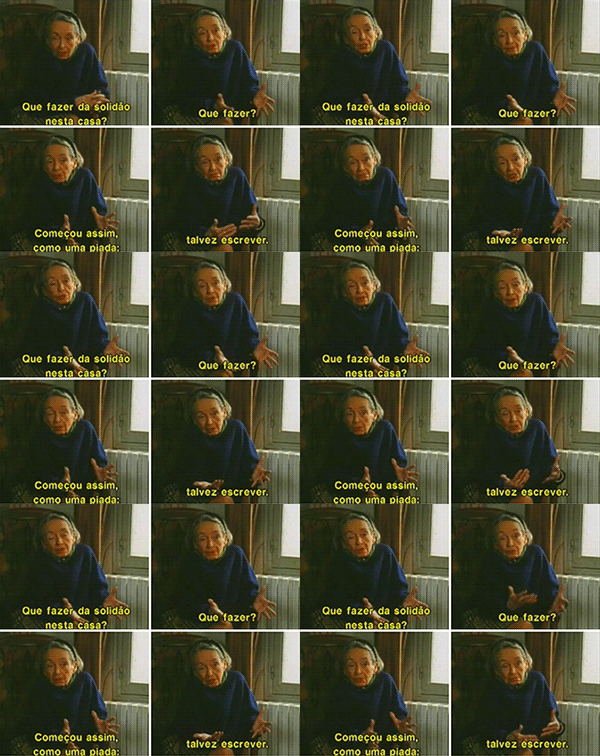
from Intense Vocalization: Marguerite Duras
by David Ehrenstein
‘ The Marguerite Duras retrospective at the Film Society of Lincoln Center this month—18 years after the celebrated auteur’s death—presents an ideal opportunity to contemplate her place in the history of cinema. For while Hiroshima Mon Amour, the screenplay she wrote for Alain Resnais to direct, became an international success in 1960 (and remains a touchstone of “art cinema” to this day), the films she subsequently created on her own, beginning in 1969 with Destroy, She Said, have been alas, for the happy few. …
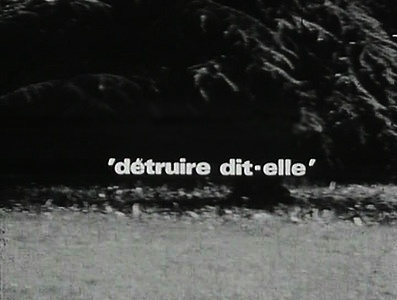
‘Destroy, She Said unfolds in the garden of a country hotel adjoining a forest that threatens the soigné guests (Michael Lonsdale, Henri Garcin, Nicole Hiss, Catherine Sellers) in some strange, difficult-to-define way comparable to to the “something” that so unsettles the upper-crust swells in Edward Albee’s A Delicate Balance. Low-key in tone, it does not seem like the sort of “art film” designed to break new ground. But it does so, and by explicit intention: Duras described her text as “a book that could either be read or acted or filmed or, I always add, simply thrown away.” The key word in this is “book,” as literature is always primary for Duras—even in the midst of the seemingly resolutely “cinematic.” It’s not by accident that Lonsdale—soon to emerge as a key Duras interpreter—plays a character called “Stein.” His name is derived from Duras’s novel The Ravishing of Lol V. Stein, the most crucial work of her entire oeuvre. …
‘Duras had no hope of replacing “real movies” with her conditionally tensed ones, but she went on making her sui generis works anyway—aided by a curious “real-life” character named Yann Andrea. A fan of India Song, Andrea entered Duras’s world in 1980 when he helped her through a “rest cure” designed to stem her alcoholism. His account of this, in a 1983 book entitled M.D., was met with some degree of critical interest. Duras’s own interest in Andrea quickly became an obsession. He appears with Bulle Ogier in Agatha et les lectures illimitées her 1981 reworking of elements that first appeared in her early biographical novel Un barrage contre le Pacifique (aka The Sea Wall), filmed by René Clément as This Angry Age in 1957. While Anthony Perkins and Sylvana Mangano play characters based on Duras and her brother in Clement’s version, their emotional conflict doesn’t go so far as incest, which is frankly discussed in Agatha. As nothing in the film is conventionally dramatized (Andrea and Ogier are seen wandering about the lobby of a hotel on the Normandy coast that also served as a setting for her India Song variation avant la lettre, La Femme du Gange, in 1974), no acting in the conventional sense was required. …
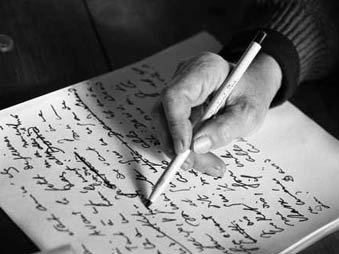
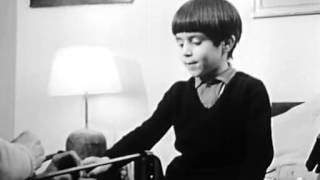
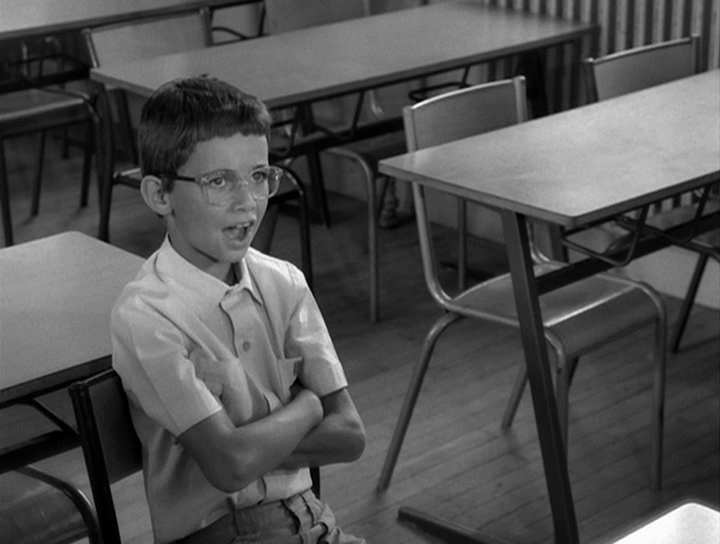
‘Curiously, Duras ended her filmmaking career with something resembling the conventional. Les Enfants began life as a 1970 book she wrote for children entitled Ah! Ernesto, later filmed by Jean-Marie Straub and Danièle Huillet in 1982 as En rachâchant (a rendition Duras disliked; also part of the retrospective’s shorts program). The story concerns a little boy who doesn’t want to go to school lest he learn things that he doesn’t already know. Les Enfants expands this slim tale to feature length with the novelty of having Ernesto played by an adult actor, Axel Bogousslavsky. It’s wryly amusing in a way quite unusual for Duras. More importantly, it’s shot in a more or less ordinary style, with actors playing actual characters and speaking words on screen in the usual manner.
‘That Duras would conclude her filmmaking career in this manner must be regarded in the context of a career that was devoted to textual elucidation. One suspects that the success of her novel The Lover in 1984—an overwhelming hit with both critics and the general public—put her off from filmmaking. Jean-Jacques Annaud’s 1992 adaptation of this tale, which was another derivation from the Un barrage contre le Pacifique cycle and which related how her family pimped her out to a wealthy Chinese man, was served up in the plush “high-class” erotic style of the Emmanuelle films. In what you might call anticipatory retaliation, Duras in 1991 wrote The North China Lover, a “remake” of The Lover adding details that the first version of Duras’s original novel didn’t include, all folded into an explicit critique of the film she suspected (with good reason) Annaud was putting together.’
____
Stills













____
Further
Marguerite Duras @ IMDb
Association Marguerite Duras
Société Internationale Marguerite Duras
Les Écrits de Marguerite Duras
‘La petite cuisine de Marguerite’
‘In Love with Duras’ by Edmund White
‘The obsessions of Marguerite Duras’
‘The Art of Fugue: on Marguerite Duras’s Film Aesthetics’
Interview avec Marguerite Duras
‘Yann Andréa, la dernière énigme de Marguerite Duras’
‘Initiales M.D. (Marguerite Duras) (+ DVD)’
‘Marguerite Duras, l’éternel retour’
Lettre de Marguerite Duras à Alain Resnais
Film: ‘Marguerite, A Reflection of Herself’
‘NOUVEAU ROMAN CINEMA: MARGUERITE DURAS’
‘The Film Society to Fete Marguerite Duras with October Retrospective’
____
Extras
Marguerite Duras – “Écrire” (ARTE)
MARGUERITE DURAS À PROPOS DE L’AN 2000
Jean Luc Godard – Marguerite Duras
_______
L’interview imaginaire
from Versatile Mag
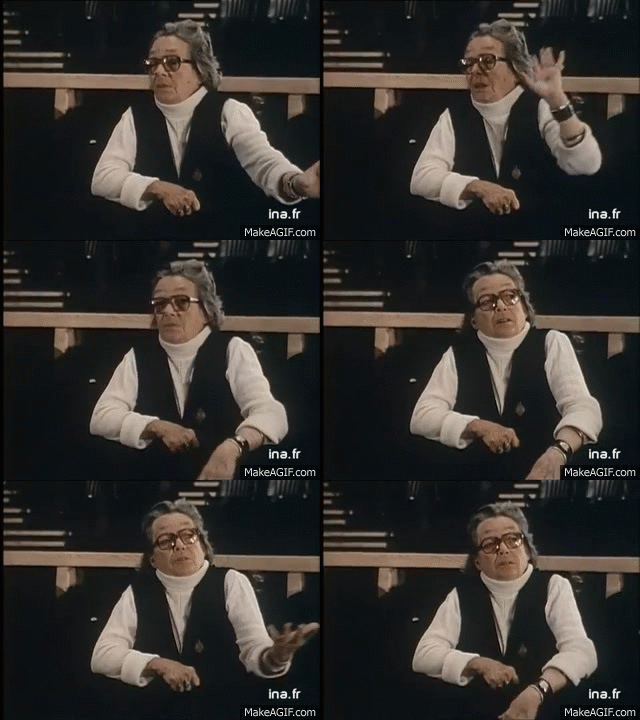
In 1996, you decide to stop everything, to not write a single line anymore. Do you feel like you’ve covered the subject, that you have nothing left to say?
Marguerite Duras: Sometimes you just get caught up in the game. Just before 1996, I had written a book called C’est tout. That’s it, there are events in life, kind of like a passion you can’t escape, and I could have kept writing, I could have kept reworking, making variations of my works, endlessly.
Few voices have spoken up about your writings, do you regret this lack of controversy?
M.D.: Nonsense! Bullshit! I’ve spent my life the target of controversies. I’ve always divided what they call ‘the literary world,’ I supposedly wore too many hats when the only one that suits me is being a writer. Writer, but not literature. Writer.
In 2014… 2014, the Pléiade… And otherwise, I’ve always been accused of self-indulgent gibberish, always, judged a limited vocabulary, people didn’t understand why Gallimard allowed one of my books to be published with so many grammar mistakes! And my stint in journalism, for Libération, that stirred up controversy. Like, for instance, over the Petit Grégory case. So, controversies: all the time.
These criticisms mainly concern your stage and film adaptations, which, on the other hand, have been challenged…
M.D.: So, there are two things. There are the films I made myself. That I wrote and directed myself. These are films that could now be called art-house films. It’s my way of talking about cinematic writing, of showing that it wasn’t necessarily narrative, that you could make films differently. After that, I did collaborate with cinema and it went very well: Alain Resnais’s Hiroshima mon amour is still a “classic,” after all. Then, there were certain adaptations that we all know about, like The Lover, which was adapted by Jean-Jacques Annaud. We didn’t agree, but he had obtained the rights… But it allowed me to make a book, and a good book, to revisit The Lover after a few years and release a book called The Lover from the North of China. A book where I wrote my film, that is to say, The Lover from the North of China is the film written of The Lover… which was much more successful than The Lover, the film.
Most of your stories are taken from your life, during the glory days of French colonialism. Is it a kind of nostalgia?
M.D.: Not nostalgia at all, it’s a setting. There was the setting of Indochina, what we called the Indochinese cycle, but afterward, there were other settings, other cycles in my work. There’s no question of nostalgia. I rather explain the flaws of colonialism. And otherwise, the themes of my work, the themes that supposedly I take up, modulate, and stretch, the relationship to the mother, the mother who necessarily is all-powerful, but who inevitably falls short. And then there is the romantic encounter, women, variations of women. I also talk a lot in my books about unique, humid, and hot seasons. I talk about social transgression. I often talk about colonialism, but not the flashy colonialism: I often talk about white people, the average little whites, and how they positioned themselves within colonialism. But I also talk a lot about the Holocaust.
Unlike your writings, which are decidedly focused on the past, you seem to appreciate youth, at least in your choice of companions. Is it a way of looking toward the future?
M.D.: The future? I don’t give a damn. Well, it’s easy to say that when you’re published in the Pléiade, but I’m more – and that’s why you’re asking me about the age of my companions – someone who is in the present. It’s not about the future at all; it’s about being in the present and about to soak up everything the present can contain.
What are you trying to forget?
M. D.: I write, so naturally, when you write, you don’t forget, you summon. It’s pretentious to say you’re alone in front of your sheet. I summon, and in a way, you could say I transcribe what I have summoned, so I’m not trying to forget: I drink more to face all those I summon, all those I can’t forget.
In your opinion, who could take up your torch?
M.D.: (Long pause) A torch to light what? Many people call themselves my heirs, but I think there are plenty of people who think they write, who think they write books, while they write nothing. You have to write as an absolute necessity, urgently: sure, why not? But the torch, no. I’m not a leader, contrary to what’s been said, I never belonged to the Nouveau Roman, I’m just Marguerite Duras, M.D. What would be the essential and eternal qualities.
About literature?
M.D.: As I said before, writing, writing with a purpose, with generosity, not pretending to write, but actually writing, convincing yourself that what you write is essential.
For you, what makes a good book?
M.D.: I don’t know.
If you were invited to dinner, what would be the ideal menu?
M.D.: Before talking about the content, let’s talk about the setting. It would be eating in Normandy, by the sea, at my hotel, Les Roches Noires. Or down near my place in Paris, in Saint-Germain-des-Prés. Peasant-style cooking. I cook myself like a peasant. In Saint-Germain-des-Prés, it could be at Les Prés aux Claires or Le Petit Saint-Benoît. I love peasant cuisine in Neauphle, in the house I bought with the money I made from Barrages contre le Pacifique… There, I really liked cooking, it took time. I would cook when my friends were either sleeping or out for a walk. I had the whole afternoon, I would cook in the kitchen, I used to make shopping lists. Shopping lists that were even found published in the Pléiade. You can’t mess around. That’s cooking that simmers a lot, that stews, as they say. If there’s no lemon in the kitchen, there’s nothing. And then, there’s the Vietnamese omelette. The Vietnamese omelette, along with peasant cooking, is what I love the most. After my death, my son published a cookbook: *The Cooking of Marguerite Duras*. Well, Yann Andréa had it banned. It’s true that it wasn’t very literary. With François Mitterrand, we talked a lot about food, even though I never saw him eat ortolans, hidden under his napkin.
During this meal, what topics of discussion should be avoided?
M.D.: None. None, except maybe literature or literary criticism, but otherwise, you have to talk. You have to stir ideas around.
What background sound would you like to hear?
M.D.: *Moderato Cantabile*. Moderate and singing. Music always connected to passion. What I especially love about these meals – and maybe what could be interesting about them – is that I love music when it disrupts the narrative flow, when you have to stop because you’re so intrigued or mesmerized by the music, and then you have to get back to the story. That’s what’s interesting. I love little songs: When the Lilacs Bloom, My Love… You know, all those pre-war things, or even more classical stuff like Bach’s The Art of Fugue, which I listened to a lot when my son was taking piano lessons. You’re aware. Aware of those stories where little boys take piano lessons while the mothers fall in love.
__________________
15 of Marguerite Duras’ 22 films
________
La musica (1967)
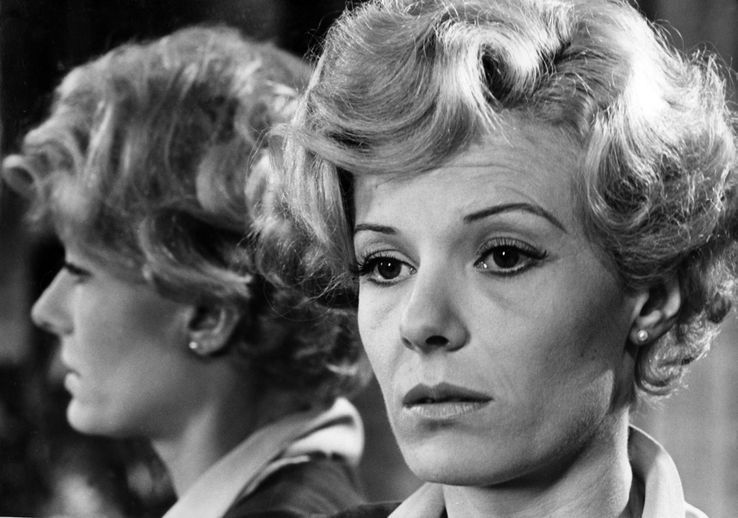
‘Marguerite Duras’ La Musica, which she adapted from her own short two-character play, is about a husband and wife who meet three years after their formal separation, when they return to the provincial town where they once lived to pick up their divorce decree. In the film’s longest sequence, which I suspect is pretty much the total of the play, He (Robert Hossein) and She (Delphine Seyrig) come together in the lobby of their hotel, at first acting like anxious, rueful ghosts. They circle each other in carefully choreographed movements; alternately each literally frames the other by his own person and by his mirror image. (Miss Duras loves to see things in and through glass—mirrors, windshields, windows). The revelations, though obliquely made, are quite specific. She was unfaithful. He once planned to murder her, She, unknown to him, once tried to commit suicide. La Musica is intellectually chic moviemaking of the sort that is quite entertaining while it is going on but practically ceases to exist, even as a memory, when it’s over. Hossein and Miss Seyrig read their lines with style and look marvelously unhappy, she, especially, in blond bob that evokes the 1930’s and the image of Lilyan Tashman.’ — New York Times
Trailer
__________________
Destroy She Said (Détruire dit-elle, 1969)
‘In a secluded hotel circumscribed by a dense forest Max and Alissa Thor meet Stein and Elisabeth. Max, a professor of future history and an aspiring author, is immediately attracted to the brooding wife of industrialist Bernard Alione, Elisabeth, who is recovering from a miscarriage. Stein, a German Jew and potential writer, is infatuated by Alissa, Max’s young wife and former student. During their sojourn the guests’ identities gradually meld. While playing cards, for example, each guest anticipates the others’ observations. Although her friends remain at the resort, the insecure Elisabeth leaves upon the arrival of her worldly husband. Destroy, She Said is a madhouse in its narrative and dialogue with contradictions within sentences. A triumph performance from Catherine Sellers sells the crazy with wonderful panics and confusion wayward bursts.’ — collaged
Excerpt
Excerpt
the entirety
________________
Yellow the Sun (1971)
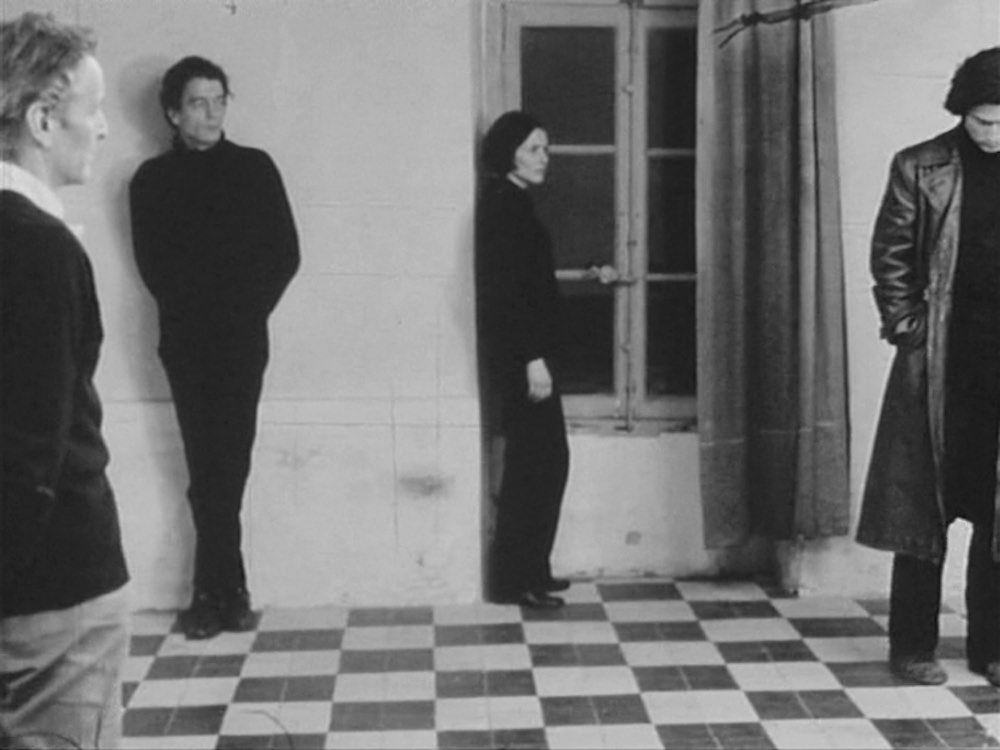
‘The whole film takes place in a single room where representatives of the two political forces and their enemy “the Jew” are gathered. A female character establishes the dialogue between these individuals and comments on the ideology of each, and then everyone seems to rally to a common idea.’ — MUBI
________________
Nathalie Granger (1972)
‘Nathalie Granger is aesthetico-philosophical opus-film. The strictest logic of its visual images step by step moves us, the viewers, to the feeling that we, while observing the still and harmonious life in a quiet and prosperous household, never expected to get – the feeling of the incompatibility between traditional (over-worldly) spirituality (as it exists and flowers in religious and/or ideological beliefs) and… children’s psychological needs. It is the one of the miracles of this film that the concept of traditional (above-worldly) spirituality is not defined but is impersonated by two profoundly intelligent actresses: Jeanne Moreau and Lucia Bose. They both incarnate over-worldliness with miraculous naturalness of complete immanency. They live eternity as if it is possible to breath when you are inside it. To watch Nathalie Granger is challenging as well as a stimulating and rewarding experience for all those who in their life and thinking don’t follow the authoritarian clichés and seductive songs of entertaining ads but are prone to try to make up their own minds about life and the world.’ — actingoutpolitics.com
the entire film
________________
India Song (1975)
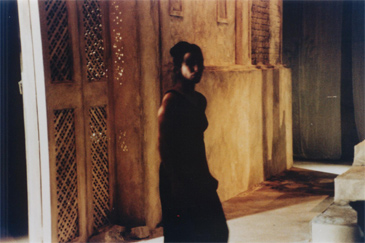
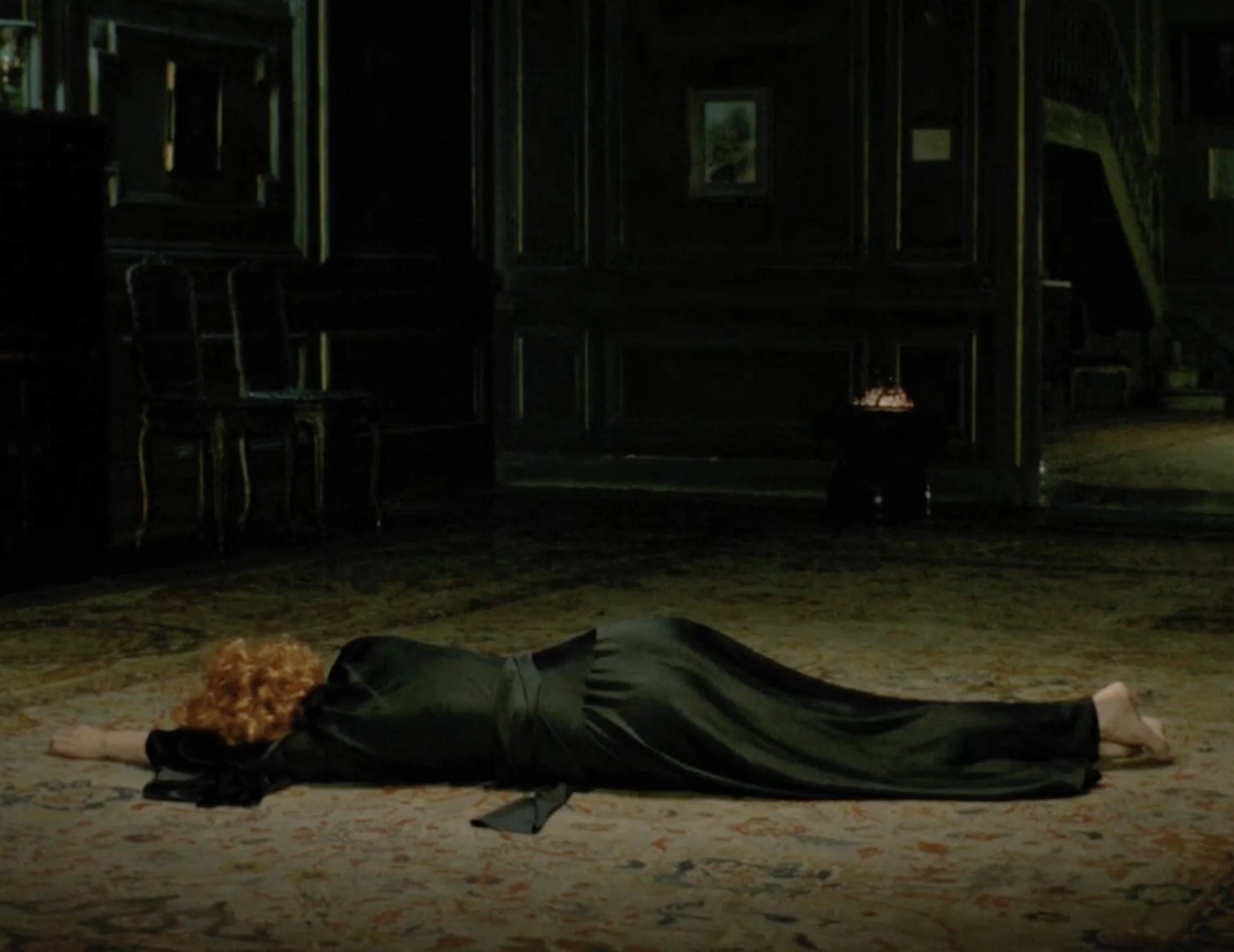
‘Marguerite Duras creates a sensual, yet abstract and enigmatic exposition on longing, isolation, haunted memory, and obsolescence in India Song. Duras integrates highly stylized, yet integrally personal (and relevant) impressionistic images of her youth in then-French Indochina and the radical nouveau roman structure that has come to define the novelist turned filmmaker’s mid-century avant-garde literature within the classical framework of tableaux imagery that redefines the syntax of traditional (and particularly cinematic) narrative. From the opening sequence of ambiguous, (but implicitly colonial) foreign landscapes, Duras establishes the dissociation between the visual and the aural through incongruous and aesthetically formalized tableaux juxtapositions that, in turn, reflect the film’s overarching themes of alienation and estrangement: exclusive use of non-diegetic sound to serve as a surrogate contextual (anti) narrative; visually distanced, non-confronting dialogue through mirrored angles (a technique similarly implemented in Alain Resnais’s Last Year at Marienbad); pervasive musicality through a slow rhythm waltz that conveys the film’s paradoxical sense of displacement and stasis through its languid pacing, recursiveness, and melancholic tone; repeated references to leprosy that ingeniously evoke an implicit association between isolation (through disease quarantining) and colonies (lepers and imperialism). Inextricably bound in the performance of the empty social rituals of their class, these aimless, privileged colonialists embody the adrift and inutile fleeting vestiges of a crumbling empire, reduced to the imperceptible glow of an anecdotal setting sun against an inherently sovereignless – and unconquerable – eternal landscape.’ — Strictly Film School
Excerpt
Excerpt
_______________
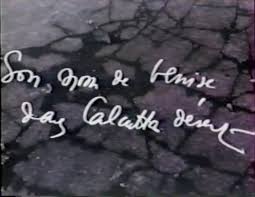
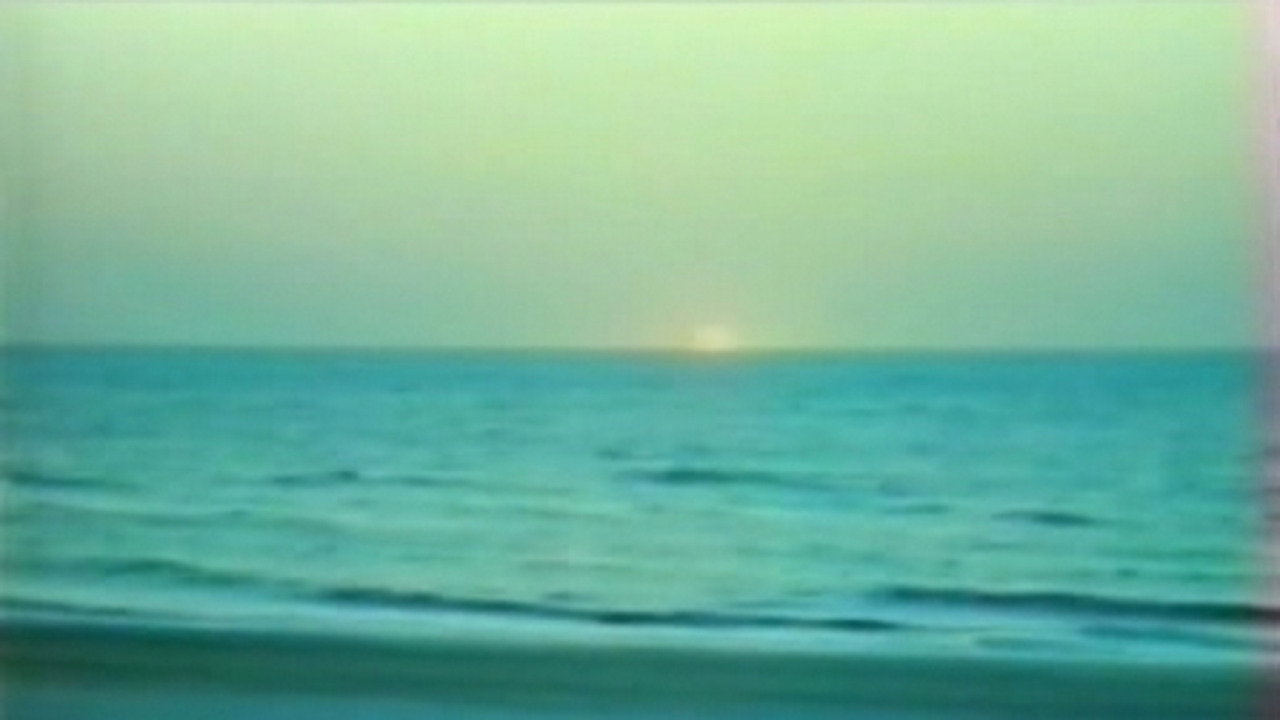
Son nom de Venise dans Calcutta désert (1976)
‘The film is a sequel to her 1975 film India Song and features Delphine Seyrig reprising her role as Anne-Marie Stretter. The film premiered at the 1976 Cannes Film Festival in Directors’ Fortnight. Duras demonstrates that the disease and suffering of the Indians symbolically infects the Europeans as well. Thus, she asserts: One of the external signs of the fissuring of the seemingly watertight compartmentalized colonial society is the deep sense of malaise and maladjustment which is wearing out its white inhabitants. In spite of the vast paraphernalia of protective artifices, the Europeans find their presence in the colony quite intolerable.’ — collaged
_________________
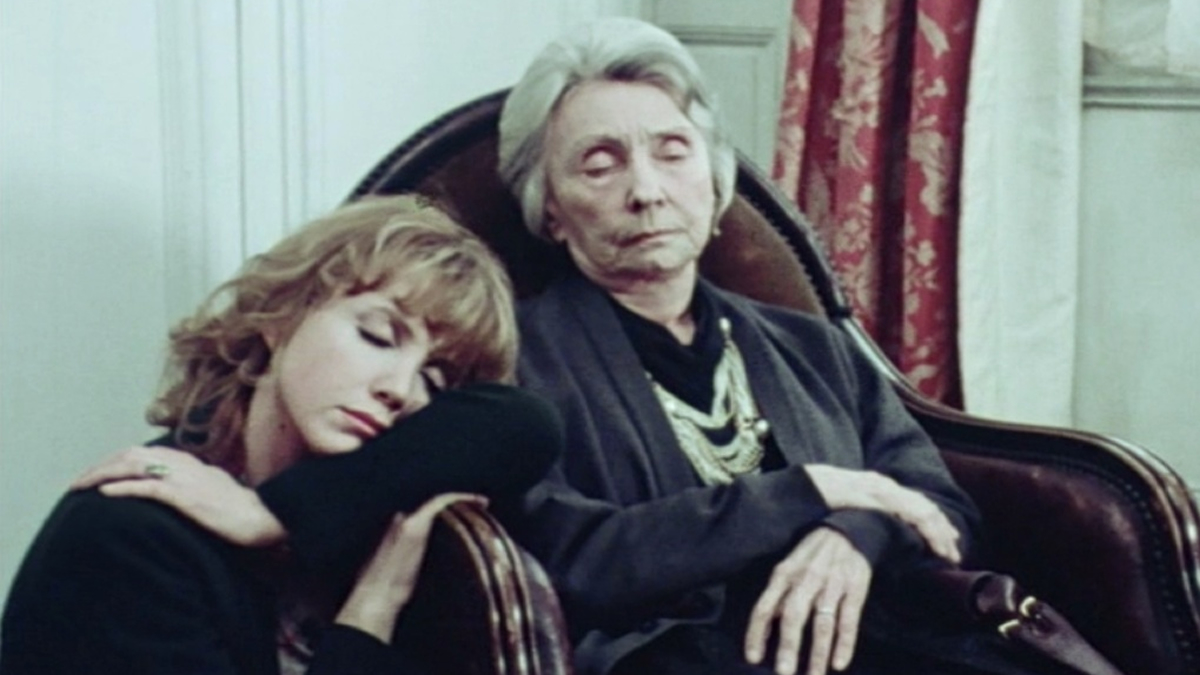
Entire Days Among the Trees (1976)
‘Des journées entières dans les arbres is a 1976 French film directed by Marguerite Duras, based on her novel. Prior to directing a film version of the novel, Duras had already modified it into a stageplay that had enjoyed a theatrical run.’ — found
________________
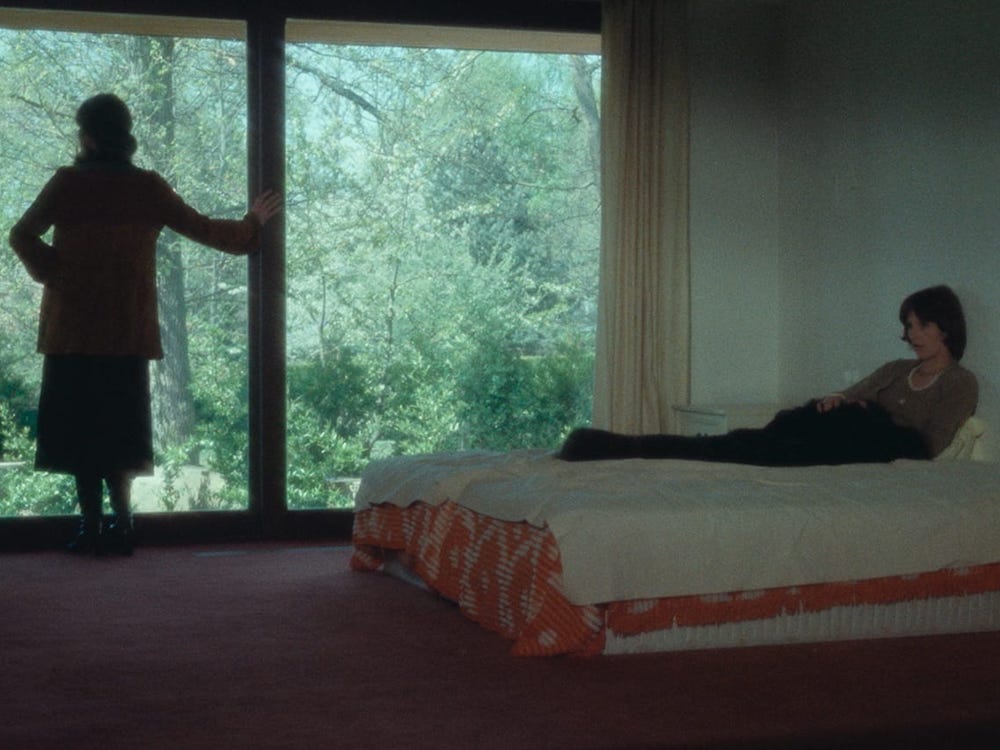
Baxter, Vera Baxter (1977)
‘Images of the seaside again at the beginning of the film, when Carlos d’Alessio’s music starts playing. This song will continue to play the entire 90 minutes of the film. It’s maddening! It’s exhilarating. Especially given the contrast between the catchy nature of the relentless music and the lethargy of the main character, a woman deciding whether to rent a very expensive villa with her cheating husband’s money. It’s supposedly the neighbours who are playing the music. But we never see them. A troubled testament to the eternity of love. Whatever happens, however many times we end affairs, we leave each other, we cheat, we lie, we abuse, love never ends. Part of us can never stop loving. Even if the rest of us is ill equipped to deal with it. And it is ultimately this discrepancy that causes us to hurt each other. Not the lack of love. But its eternal presence.’ — Tale of Tales
Excerpt
Excerpt
________________
Les mains négatives (1978)
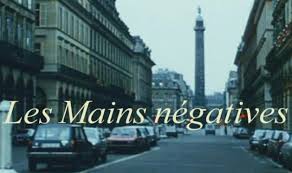
‘The images of the film are Paris at dusk. A city far too great to comprehend on any level other than the superficial, a city that leaves one reeling in Stendhalism. It’s a blank Paris, before the stories of the day play out, it mirrors the “mains negatives” of the title, presence by absence, the hand-print revealed by the blank left when the area round it is covered in paint. The beauty of the city is revealed by the traces that people have left behind, murals, avenues of trees, monuments. Marguerite spoke of these images as images passe-partout, images that allow the narration to infuse them with meaning. It’s good to watch the film without sound first to understand how fully the perception of the images is informed by the narration. The parallel images you don’t see are of pre-historic petroglyphs, stencilled scuplted hand-prints which Duras describes as being in a cave by the sea. These were, in her interpretation, people simply recording their existence, in front of the immutability of the sea and the granite. What they have in common is that all the hands look the same, there’s an equality to each person’s existence implied.’ — oOgiandujaOo, IMDb
the entire film
___________
Cesarée (1979)
‘Made up of stills of the Tuileries gardens and its statues by Maillol, Césarée is stamped with the memory of Berenice, queen of the Jews, and of her city of which nothing remains but the name, abandoned following her repudiation. There is this same confusion of time periods and resurgence of narratives in Les Mains négatives. Its dolly shots trace a slow advance through Paris, which is deepened by the reference to the drawings of hands found in many caves dating from the Magdalenian age. Thus comes to a head an ode to humanity, and to all its excluded ones, that daylight, only just risen over the city, has not yet forced into extinction. Its murmur resounds for a long time: “Everything is being crushed, I love you farther than you. I would love anyone hearing me shout that I love you.”‘ — Frac Lorraine
the entire film
________________
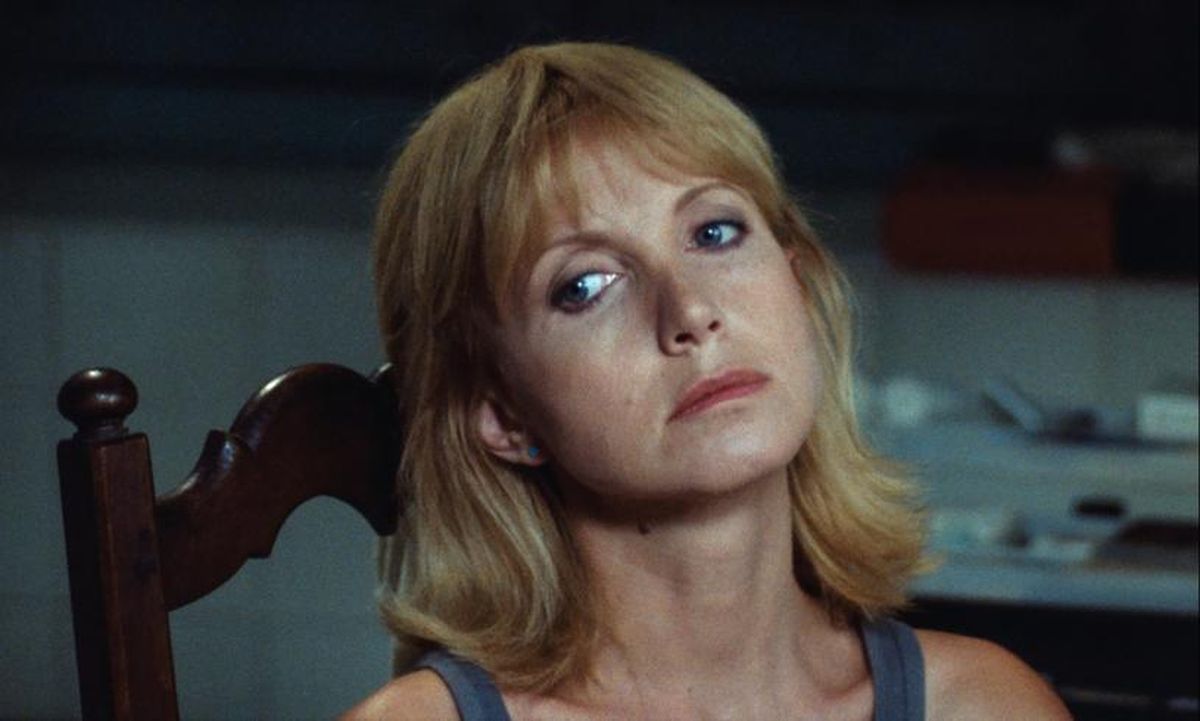
Le Navire Night (1979)
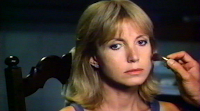
‘A huge let-down to audiences at the time, Marguerite Duras’ follow-up to her lush and flamboyant India Song is a very different film indeed. Telling the story of two tragic lovers who never meet (the girl is dying of leukemia and daren’t risk face-to-face contact) Duras sets out to communicate this ‘faceless’ relationship to her audience by – and you really won’t believe this unless you see it – barely even photographing the glamorous trio of actors she has hired to star. So if your notion of sheer cinematic bliss is gazing raptly at Mathieu Carriere or Dominique Sanda (OK, I admit it, mine is) then be warned that Le Navire Night may give you a nasty shock. Long motionless takes of the three actors having their make-up put on or wandering – barely visible – round shadowy rooms. For most of the film, the camera pans along deserted Parisian boulevards, or pores over a luscious red dress hanging on a wall. At the end, Duras announces in voiceover that “the story was never shot.” True, on a purely literal level. Yet the sense of frustrated longing that sustains both non-lovers through their passionate non-affair…if we don’t experience that through the methods Duras uses here, why not? Are we incapable of feeling unless we are prompted by the prescribed visual image? Or are we (as Susan Sontag feared) so saturated by images that we can no longer feel at all? To try and put it more simply, why is Marguerite Duras’ way of telling this story any less valid than the conventional techniques that we, as a film audience, expect and demand? Our answer to that question says little about Duras and her film, and everything about us. Why do we feel the need to reduce an emotional tragedy to a visual image? Is it morally acceptable for a film to do that? At once a negation of cinema as it is, and a reaffirmation of what cinema might be, Le Navire Night is a film to be watched with heart and mind and senses wide open. Or not watched at all.’ — David Melville
Excerpt
________________
Aurélia Steiner (Vancouver & Melbourne) (1979)
‘As is the case with other experimental shorts by Marguerite Duras, the images, although beautiful are almost mood-setters, the main images are evoked in the mind of the viewer by the words of Aurelia Steiner, sometimes, though by no means always, synchronising with the images. For example the shot traverses Notre Dame de Paris, which is actually a white building, but here the stone is yellowed by the late-evening sun, and Aurelia talks about voices (“they’re speaking”) telling her of palaces by streams with thickets of nettles and brambles between them, of island temples, and for a moment Notre Dame is on the Ganges. This reminded me the ideas of writer Italo Calvino and his book The Castle Of Crossed Destinies, in which stories are almost exclusively narrated by the placing of Tarot cards in sequences, the evocative symbols (forest, castle, well, mountain, gibbet) being generators of images that are particular to each reader, Calvino accepting how very much of the story rests in just these small kernels. Aurelia Steiner then, will be a unique experience for whoever watches it. In this way it’s almost anti-cinematic, the viewer isn’t forced to see the fixed images that make up the fantasies of standard commercial cinema. In a special edition of Cahiers du Cinema Duras wrote that she was aiming for an ideal, which was of the “image passe-partout”, to use shots that were neither beautiful nor ugly, which would be exchangeable between a series of texts, images that would take their direction from the narration. If she was aiming for images without beauty she would have been better off not using cinematographer Pierre Lhomme, who shot Army of Shadows, and worked with James Ivory and Ismail Merchant. The collaborators do however create a sense of vacuum with the images on-screen, a cavern that Aurelia’s words fill.’ — IMDb
the entire film
_________________
Agatha et les lectures illimitées (1981)
‘This film was recorded in Trouville-sur-Mer, in the lobby of the building where Duras lived. She reads the female part of the text and her much younger lover, Yann Andréa, reads the male part. The dry way of saying the words that express such passionate feelings has inspired much of the tone of Bientôt l’été. Not to mention the views of the sea, and the atmosphere of an abandoned resort town.’ — Tale of Tales
the entire film
_______________
L’homme atlantique (1981)
‘An autonomy of the soundtrack, giving back to writing and to the voice of the writer its importance. A black screen with few images from rushes of the previous “Agathe”.’ — MUBI
the entire film
_______________
Les enfants (1985)
‘7 year-old boy Ernesto intrigues people around him for several reasons. Despite such a young age, he looks like a man on his 40’s and also seems a little more intelligent than any of his peers – and the latter fact is what causes him to quit school, refusing to attend it because he doesn’t want to learn the things he does not know. His family is very supportive of his actions, even though they don’t have any clue of what’s to become of him; at the same time the school headmaster and a journalist are concerned about Ernesto’s real motivations for leaving school.’ — IMDb
*
p.s. Hey. ** Adem Berbic, Now that my world is relit, I’ll absorb ‘Reek of Putrefaction’, thanks. Being precise as a writer is probably more important than being talented, I think. You make the best mistakes when you’re hellbent on precision. I think music might be the most fruitfully studiable form for a writer. Of fiction at least. If you don’t feel the need to be conventionally successful. ** jay, Hi. Odds definitely are on fabrication in that case. I hope your forearms aren’t peeling. Unless you want them to, of course. I’m good, mostly just thrilled to have electricity, hot water, internet again and sooner than anticipated. ** _Black_Acrylic, He could be in a group show with Nicole Eisenman and Sue Williams. I believe England is still in the running? France too, but I guess duh on that. Derek Raymond, great stuff. ** Hugo, Maybe it could be argued that the more jerry rigged plot the better? Plot as roller coaster track? Deadpan can take the ick out of the lyrical, if you ask me. I think what you said makes sense, yes. ** Steve, Oh, I’ll go check. Bandcamp for his music offshoot, I mean. No, but someone knowing my interest in haunts and Halloween suggested to me that I should investigate forensic props if I hadn’t, and I did, and … voila. So much sympathy for your heat. I suspect NYC’s power grid is more prepared than Paris’s. There were more than 60 of those power blackouts I just went through in Paris this week. ** Carsten, Enjoy Zurich. I’ve never quite figured that city out. Or gotten past the impression that it’s very stiff and moneyed, I mean. ** Diesel Clementine, Hi. I only know Clavicular by what comes through my feed, but he seems very, very uninteresting. His reading Proust doesn’t dissuade me from that opinion, at least in theory. You’ve been busy. My power outage kept me from that possibility. I so hope that your best friend doesn’t relapse. Oil painting! Fancy! ** Charalampos, I’m still being force-fed Clavicular, but I can’t imagine that will last much longer. Gary was cruel to a lot of people. Even his good friends. My week sucked, but it’s bettering. In Amsterdam I’m also doing some kind of book-related event and our host is forcing Zac and me to be ‘special guests’ at a gallery opening/show by Gilbert and George, but I have no idea what that means. ** Bill, Outsider art projects perhaps, yes. ‘Rose of Nevada’ … do I know what that is? I’ll find out. Thanks, B. ** HaRpEr //, I hope so: the hot new fantasy. ‘Class Relations’, terrific. Zac’s very influenced by Straub-Huillet. That may account for that ‘PGL’ quality. A Bresson influence on them wouldn’t shock me either. Thank you! ** laura w, I’ve noticed that about the sky vs. hotness, but I haven’t in Paris, but it’s harder to look up and get a decent view here. They’re saying we might get another brutal heatwave starting next weekend. Luckily/hopefully weather forecasting here is almost always way off. I don’t get the Geese worship at all. I mean they’re okay and everything, but … ‘music for people who think that just kids by patti smith is the greatest book ever written’: haha, I think you nailed it. Thanks for the link to the maze store. I’ll go look around shortly. Stay as icy as you can. ** Dominik, Well, hi!!!! Welcome back! Fun: that festival. Wow, big names even. When my nephew was a little kid, he asked me to take him to his first rock concert for his birthday. I let him choose, and he chose The Offspring. That editing gig sounds scarier than it probably was. You’re out of the heatwave now, aren’t you, for a little while at least, like us? The weather is weirdly very pleasant here at the moment. Not for long. Other than the power blackout, which was kind of hell, things have been a little unremarkable but okay. I think we’re finally finishing the new film script today, the gods and Zac willing. jerking off from all the killyourself messages love’s getting, G. ** CS, Hi. I hope what’s keeping you away from here is bettering your life to the max. I’m always around. Enjoy everything. ** ⋆˚꩜。darbbzz⋆˚꩜。, Hi, pal. Are the donuts any good? I’m guessing the coffee probably isn’t. I do know. And it all sounds super sweet, honestly. I’m always incredibly shy when it comes to relationships. Or at least for quite a long time. I don’t really understand how you couldn’t be if it’s authentic. Heat here is down to actual pleasantness, but it won’t last long, that’s for sure. I don’t know Endless Dismal Moans. The name is very charismatic. And ‘psychotically unlistenable’ is attractive too. Have the best fucking time ever at Myrtle Beach!! ** nat, The power cables melted, but I didn’t. Well, as far I can tell. Thanks! ** Okay. Let’s see … oh, the films of Marguerite Duras! That’s a good one. Props to me. And to her most importantly. And to you just as importantly. See you tomorrow.



 Now available in North America
Glad you have your power back. Central Europe better get used to these conditions quickly & adjust, but judging from the political silence they won’t. Spain is used to the heat & the power grid’s fragile, but at least there’s AC & pools everywhere.
Oh yeah, Zurich definitely is stiff & moneyed. But based on the little tour I got yesterday from a local friend, there’s a bit more charm than I expected (the lake, the nearby hill with plenty of natural hiking paths). I would never have stopped in Switzerland on my own, but I dropped my family off here & our friends are kind enough to host me for a few days.
I’m flying out either Saturday or Sunday & currently deliberating whether to head straight home or squeeze in a couple of days in Marseille, which I always wanted to visit.
As for Paris, I definitely want to line my timing up with your schedule, like I said. How’s the rest of July & August looking for you?
Wishing you a great time & screening in Amsterdam!
Hi!!
I can’t say I listen to The Offspring every day of my life, but they were really fun live. They had a huge audience, and everybody knew all the lyrics to all their best-known songs, so the mood and energy were fantastic.
The weather is really pleasant here now as well—not something I expected to say a few days ago.
Oh! Did you? Finish the new film script? Congratulations, if so!!
Love snatched up one of my favorite lines! So I’m gonna go with this one: These love’s viable seeds do to him the ass on it once viable in your baggy jeans from him swam and wriggled win it so infinitely sorry because these viable seeds from him just as much as they would have wanted to live out of your baggy jeans, Od.
omg yay you’re back!! this was such a weird and cursed week, honestly…
i’m not familiar with duras’ films but i love her novels, and i’m always surprised by how many people hate her. maybe there’s a lot of weird morality bullshit surrounding the lover these days and people just project the lover onto her bibliography and then dismiss it entirely, i don’t know.
how have you been? at least the heat broke before the power did. no aircon and 105 degree heat would be inhumane. things are hot hot hot around here but i don’t mind being an inside kid this holiday weekend. got a big bind up of the moomin comics in the mail and am excited to look at them and pretend to be in finland. google tells me the average summer temperature is in the 70s!! had a mild anxiety/ocd crisis but i think the ships have righted themselves, hopefully.
missed you! this blog (and you!) are lights.
“India Song” is amazing. Since getting over my illness over the past three months, I have been purchasing Duras’s novels online and through my favorite local bookstore, Skylight Books. I plan to do a deep read of her work. And I’m also going through my Le Carré “George Smiley” box set. I’m not a disciplined reader, so I go with whatever mood I’m in.
Welcome back. That must have been stressful, unless it wasn’t, but I assume it was. To the best of my knowledge the friend I’m staying with isn’t electrically challenged right now. Up by Nation. I’ve pencilled in some coffees and things besides the wedding, but I should be able to sneak a lot of time with the pen. The pen hit it off with the Buttes Chaumont last time. Oh, and there’s that fog.
Precise, precise. Yes. I can work on precise. I want to, certainly. For whatever reason, I was looking at the Granta young writers list the other day, and below each headshot there was a little quote from their novel. I’d like to be able to write something where each sentence depends on each other sentence and the whole to such a degree that it’d be impossible to snip out some little line and flatten and neuter it like that.
I suppose one of the nice things about writing is that conventional success is a lot less sexy than in acting or music or whatever, so the shallow materialist in me can more-or-less be kept at bay.
I have a copy of the Malady of Death here on my bookshelf and never realised the lady was a filmmaker as well! Consider me in awe, well and truly.
Sometimes strike up conversation with my carers about literature on very rare occasion. I have the Davin Watne painting from the cover of JG Ballard – Crash on my wall and was asked about that. Did explain the book’s controversial nature and that there’s a 1996 film available of it. Not sure she ever checked it out but I did happen to watch the thing myself last week for the 1st time in literally decades. Must say it holds up really well though I’m not sure what the staff would make of it.
Hi Dennis.
A contrived plot works for me if only because you can go and poke holes in it and fuck around with other aspects of the text. I’ve spent more time on whatever it is I’m doing and I think Ann Quin’s Tripticks is getting into my own style, so I’ve moved that book to the back of my room when I write so I don’t refer to it. I worry that I’m still in the stage of imitating people, even when I know my voice is my own. I think I’ve reached a point in my life where I know I have a personal style, but I’m not confident enough to say what that style or method really “is” and it bothers me.
Sorry to hear about you getting force-fed Clavicular content. I don’t wish that upon anyone.
Hey there Dennis! I’m happy to see that the blog is back up again : 3
A lot has been going on for me since we last spoke, but last week I was up in Brussels to see Hugo with some friends. We did catch the worst of the heatwave, so it was troubling making our way to certain areas, but we had a lovely time regardless. We went to plenty of book stores, and I picked up different texts from writers like W.G Sebald, Chantal Akerman, Lyn Hejinian, Maurice Blanchot, and some others. Out of your recommendation, I picked up a copy of Tracy Lynn Oliver’s Magician. Need to read more, but I’m engaged with what I’ve read so far! Also, I picked up something of yours, too: My Loose Thread! It’s been my main read recently, and I’m really fond of the sparsity granted to the narrator’s mode of language. There’s this sense of uncertainty I see that comes from an absence of conclusion. I’ve been having that sentiment on my mind as I draft my own novel. Lately, I’ve been sketching out the first chapter, and I’m looking for ways to emphasise my narrator’s obsession with texture as it pertains to events happening in front of them. I need to respond to her, but Laura recently looked at an excerpt from my work, and she was very fond of it. Her articulation and the responses from my other friends have motivated me to keep going with this. I feel less self-doubt about my work than I used to. Recently, a short story of mine was selected for a university compilation, and before my trip, I received a physical copy of it. It’s amazing to see words that I’ve used printed for others to engage with. I think I’m onto something that I hope I can do justice to. I’m just very interested in how others perceive my work at its current stage.
I felt safe to be with my friends in contrast to the problems that are growing in the UK. Right now, it’s hard for me to find much motivation in wanting to continue living here, given the direction of surveillance and unchallenged prejudice going on here. Given the racist antics that keep developing in their severity, I think there should be more consideration about nationalist celebrations over here, but since it’s the World Cup, I doubt those notions will be considered. I’ve been keeping safe, though, even if the town I live in has a noticeable population of anti-immigrant types who will do anything but be challenged on their nonsensical worldviews. It’s something I’ve been intimate with since I was growing up, as my family upheld these outlooks. Currently, someone I grew up with has fallen deep into antisemitic nonsense, and it feels alienating to not be able to call out what it is when I interact with my family. I feel more confident to articulate the prejudice for how it functions, but translating that over to those who don’t want to hear it is something I have difficulty with.
In general, I’ve been feeling underwhelmed by what’s accessible in my hometown. Whilst I’ve been motivated to remain in a creative headspace, I keep hearing news about these venues I used to attend suddenly shutting down. I know I feel secure elsewhere, but I don’t have the financial means to move out to a place like London or elsewhere. I suppose what I mean is that I’m certain my future is elsewhere, but I’m at a point in my life where I don’t feel sure about how to get to that point. In a few days, I have a career meeting to talk about this uncertainty.
In the meantime, I have kept myself busy. Already touched on the development of my novel, but I’ve also been focusing on photography. I found some cheap film cameras being sold locally, and I’ve been taking them with me whenever I see friends or am up to something special. I’ve been having some fun with it. Been posting them on my Instagram, including a bunch I took during my Belgium trip. I remember feeling demotivated to pick up photography after my classes on the subject, but I feel motivated to experiment with it again.
Take care, Dennis! Hope you have a nice weekend :3
Hey! Glad you could come back briefly and hope the power is fully de-fried.
I still am yet to watch any of Duras’ films. I don’t know why. I’ve always been intrigued by ‘Le Camion’ due to the controversy surrounding it. It’s just that I find Gerard Depardieu hard to look at haha.
I think about her writing a lot, she’s a big influence. There’s still so many that I’m yet to read, but the framing in ‘The Ravishing of Lol Stein’ changed me forever I think.
The planning on the next novel is taking an awful lot of work. I’m actually a very improvisational writer, but I need some sort of rigid structure to build before I begin, and after that I can paint it any colour I like. Or rather, maybe it’s like I do all of this work in preparation, reminding myself ‘what’s important’, but the moment I sit down to write I make myself forget it all.
I’m reading the Joe Westmoreland book ‘Tramps Like Us’ and I like it a lot. It kicks ‘City of Night’ in the balls, that’s for sure. Its simplicity matched with its scope is really effective. Apparently Westmoreland’s partner is Charles Atlas. Wild.
I hope the film has a great life in Amsterdam. Until then, see ya!
Good to see your power is back on; I assume it’s weather-related? A friend is heading to Paris in a few days, and preparing for the heat.
I really have to check out some of Duras’ films.
Do you know the LA art collective ASCO? Just saw a new documentary on them, very interesting. Also saw Backrooms yesterday, great concept, some nice visuals, but all the attempts at explanations turned me off.
Bill
Looking forward to the retrospective at the Film Society of Lincoln Center. Duras’ unique narrative style always invites rich discussion about her influence. I can’t wait to see how the audience reacts to films like Hiroshima Mon Amour. For diving deeper into her work, I often explore insightful discussions from a local film club.
The retrospective at the Film Society of Lincoln Center sounds fascinating! I’ve always appreciated how Duras’ work challenges viewers to engage with complex emotional landscapes. It’ll be interesting to see how younger audiences respond to classics like Hiroshima Mon Amour. I often delve into film analysis resources to better understand her themes and techniques. Using a great online database really helps with my research on her films.
I’m excited to see the Marguerite Duras retrospective this month! Her work, particularly the exploration of memory and loss in Hiroshima Mon Amour, really challenges conventional storytelling, and I love that about her films. It’ll be fascinating to see how contemporary audiences engage with her narratives today. For deeper insights into her cinematic style, I often refer to articles and discussions in cinema journals that dive into her themes.
I’m particularly excited about the retrospective focusing on Duras’ work; her ability to weave complex emotional layers into her narratives is truly inspiring. Films like Hiroshima Mon Amour have always moved me, and I can only imagine the discussions that will arise during this event. It’s interesting to think about how her perspectives shaped modern storytelling in cinema. I often read analyses from film journals to dive deeper into these themes and appreciate the nuances in her work.