
‘Illusion arises when the perceptual system breaks down. Researchers study illusions to enhance their understanding of the otherwise hidden mechanisms responsible for accurate perception. Studying verbal illusions, therefore, may reveal something about the functioning of the language system. One such illusion is the verbal transformation effect, first reported by researchers in 1958. They found that listeners who were presented with a continuously repeating word or phrase began to perceive transformations — that is, changes in the repeating stimulus, relative to what the listener had perceived on preceding repetitions of the stimulus. Transformations ranged from one-phoneme alterations to drastic phonological distortions. For example, when presented with the word truce, participants reported hearing phonetically similar transformations, such as struce and truth, and the pseudoword struth, as well as dissimilar transformations, such as Esther.
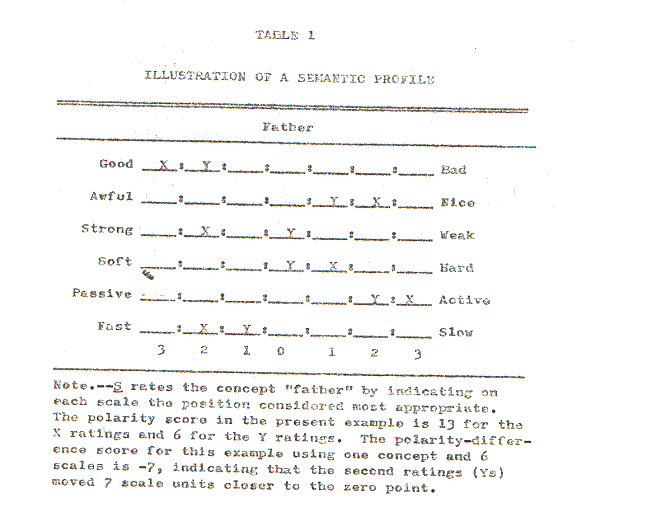
‘This transformation is also related to semantic satiation, a psychological phenomenon in which repetition causes a word or phrase to temporarily lose meaning for the listener, who then processes the speech as repeated meaningless sounds. The phrase “semantic satiation” was coined by Leon Jakobovits James in his doctoral dissertation at McGill University, Montreal, Canada awarded in 1962. The dissertation presents several experiments that demonstrate the operation of the semantic satiation effect in various cognitive tasks such as rating words and figures that are presented repeatedly in a short time, verbally repeating words then grouping them into concepts, adding numbers after repeating them out loud, and bilingual translations of words repeated in one of the two languages. In each case subjects would repeat a word or number for several seconds, then perform the cognitive task using that word. It was demonstrated that repeating a word prior to its use in a task made the task somewhat more difficult. The explanation for the phenomenon was that verbal repetition repeatedly aroused a specific neural pattern in the cortex which corresponds to the meaning of the word. Rapid repetition causes both the peripheral sensorimotor activity and the central neural activation to fire repeatedly, which is known to cause reactive inhibition, hence a reduction in the intensity of the activity with each repetition.
‘What causes verbal transformations? The most detailed accounts of the verbal transformation effect to date are derived from a broad theory of speech perception and production known as node structure theory. Node structure theory is instantiated as a localist network model, with nodes (representational units) hierarchically organized into three levels: the muscle movement level, the phonological level, and the sentential level. The muscle movement level contains nodes specifically for the production of speech. Nodes at the phonological level represent sublexical linguistic units, such as syllables, sub-syllabic segments (e.g., onset or rhyme), and phonetic features. The sentential level contains lexical nodes for words and phrases.
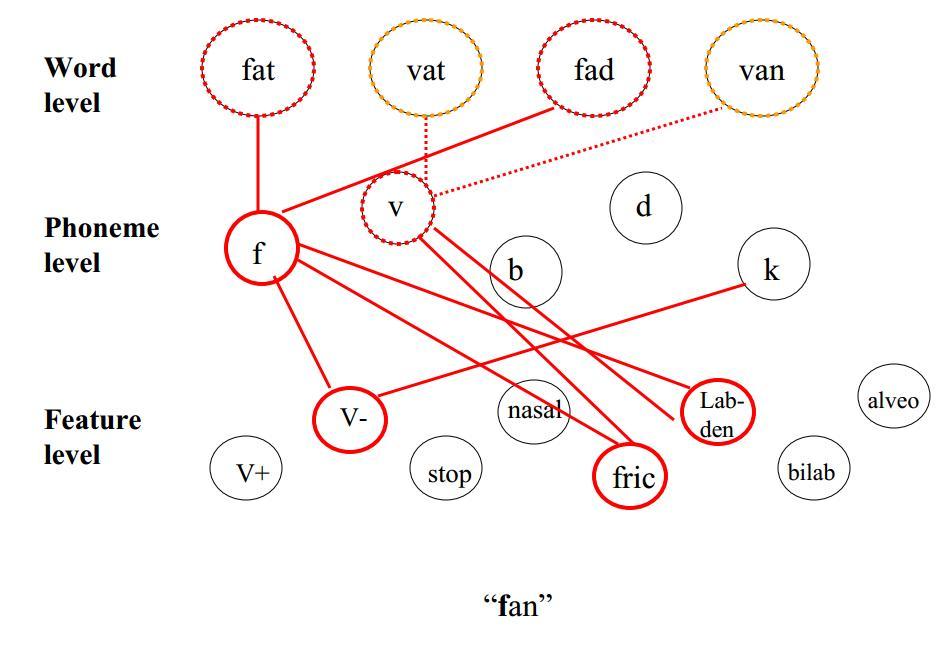
‘Both perception and production operate on the same nodes at the phonological and sentential levels. In perception, speech input first primes nodes at the feature level. Priming produces increased subthreshold activity (but not activation, as the term is generally used) in a node.It spreads in parallel across nodes, with its strength being positively related to how well it matches the input. In the same fashion, priming spreads to the phonological nodes and, finally, to the lexical nodes. At each level, priming strength is a function of the match to the input from the preceding level. Although several nodes may be primed at once, only the node that is primed to a higher degree than all the others becomes activated.
‘How pseudowords are recognized and new lexical entries are formed is also described by node structure theory. Connections from nodes in the phonological system converge to form temporary lexical nodes that represent pseudowords. These connections are initially weak, and without frequent activation, these newly formed and fragile connections will decay. Repeated use of the pseudoword will eventually “commit” the node to permanent status, at which point it will become a new entry in the lexicon.
‘Unique among models of speech perception, node structure theory provides a detailed account of the dynamics of representational units during repeated stimulation, which allows one to make precise predictions regarding the verbal transformation effect. In node structure theory, verbal transformations occur because of node satiation, which is a drop in the maximum attainable priming level of a node. Nodes at the lexical level or at the phonological level can become satiated. Satiation occurs because of repeated activation (not merely priming) of a node from continual repetition of the same utterance (e.g., the word cast). As satiation increases, the node’s priming level drops, eventually falling below that of a competitor node (e.g., the lexical node for fast) that is only moderately primed by the speech input, because of one or more mismatching phonological segments. Because the most primed node becomes activated in node structure theory, the competitor node (e.g., the lexical node for fast), which now has the highest priming level, will then become activated, resulting in the perception of a transformation (i.e., the word fast) by the listener.
‘As the preceding description suggests, the amount of priming a node receives greatly influences the transformations perceived. A node that is unable to attain a great deal of priming will rarely become activated. One other factor that influences transformations, according to node structure theory, is neighborhood density, which is the number of lexical entries (i.e., neighbors) that are phonetically similar to the repeating stimulus. The more neighbors there are, the greater the number of possible competitors there are to become activated, resulting in a greater number and a wider range of transformations. Researchers have reported data that confirm this prediction.

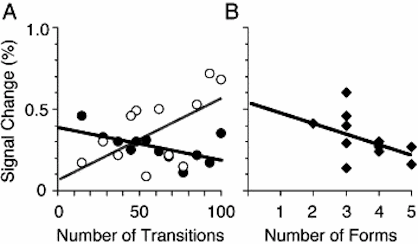
‘At the heart of node structure theory’s account of the verbal transformation effect is the concept of lexical node stability, which refers to the extent to which a node remains activated over its competitors. The more stable a node is, the less frequently it will lose out to other lexical competitors becoming activated. Stability is a function of a number of variables, such as the amount of priming transmitted to the lexical node from phonological nodes (i.e., acoustic–phonetic fit), neighborhood density, and strength of its connections, which is directly related to frequency of use. Thus, node stability should be inversely related to transformation frequency. In particular, nodes for words, which have strong and well-formed representations, should be more stable than nodes for pseudowords. Data from a few experiments partially support this prediction. In 1966, researchers recorded the number of transformations that listeners reported when hearing words and pseudowords repeat. He found that pseudowords elicited more transformations than did words, suggesting that nodes for pseudowords are less stable than nodes for words. In an analysis of the specific transformations (i.e., forms) that listeners reported, one researcher found a similar asymmetry, with pseudowords eliciting more forms than did words. Natsoulas also discussed the verbal transformation effect in terms of satiation and perceptual stability.
‘Construction of an accurate model of word perception requires specifying the operation of representational units. At present, knowledge about their operation is lacking, which is why decisions on how to implement them in computational models, such as TRACE and Merge, must be guided by intuitions and indirect evidence. The hypothesized mechanisms of satiation and recovery, as embodied in node structure theory, begin to fill this gap by describing how reactivation of representational units might occur. The verbal transformation effect is well suited for testing the validity of this proposal, because the frequent perception of transformations provides a means of measuring node stability and, thus, linking it to one or more of these mechanisms.’ — Lisa Contos Shoaf & Mark A. Pitt, Ohio State University

Auditory Demonstrations
The demonstrations were designed for headphone listening, and since some of the effects involve different signals delivered to each ear, stereo headphones are recommended. If you click on the link, a new window will open and begin playing the sound file. You should adjust the playback so that the narrative portions are at a comfortable listening level.
RESTORATION OF ABSENT SOUNDS
Homophonic Temporal Induction
Broadband Noise
Tone (Fixed Levels)
Tone (Changing Fainter Level)
Heterophonic Temporal Induction
Tones
Temporal Induction of Speech:
Single Phonemic Restoration
Restoration by Noise
Temporal Induction of Speech:
Multiple Phonemic Restorations
Restoration by Noise
PITCH AND INFRAPITCH
Repetition of Frozen Noise Segments
“Whooshing” Infrapitch (2 Hz)
“Motorboating” Infrapitch (6 Hz)
“Motorboating” Infrapitch (15 Hz)
Noisy Pitch (40 Hz)
Pure Melodic Pitch (120 Hz)
Pure Melodic Pitch (300 Hz)
CONTRALATERAL INDUCTION OF TONE
Contralateral Induction
PERCEPTION OF ACOUSTIC SEQUENCES
Identification of Order
Nonverbal and Verbal Sounds
Global Pattern Recognition of Permuted Orders
Brief Nonverbal Sounds
Brief Speech Sounds:
The Vowel Sequence Illusion
ILLUSORY CHANGES OF REPEATED WORDS:
THE VERBAL TRANSFORMATION EFFECT
Diotic “Flame”
Dichotic “Flame”
Diotic Bisyllabic Reversible Word “Farewell/Welfare”
Dichotic “Farewell/Welfare”
Diotic Monosyllabic Reversible Word “Ace/Say”
Dichotic “Ace/Say”
test

‘The philosopher and musicologist Theodor W. Adorno describes material as something which is a self-sedimented spirit, predetermined by society, in the minds of people. Based on this theory, the artist can only choose from a limited range of materials as dealing intensively with the material inevitably leads to a discussion with society. If an artist consciously tries to abandon this repressive paradigm he or she might only partly succeed since historical patterns will immediately be recalled. Adorno exemplifies the shabbiness and abrasion of the diminished seventh chord or certain chromatic passing notes in the Palm Court Music of the 19th century as musical taboos. According to him, these tones were not only outmoded but utterly wrong and did not fulfill their function any more. The truth or non-truth of a material is not decided on its isolated appearance but on its position within the prevailing standards of aesthetics.
‘In music there are only few compositions that consist of merely perseverative repetitions. The composers rather express themselves by gradual changes of certain individual notes or entire figures. Minimal Art produces several pieces which use repetitions whose components do not change. Initially the repetitive moment is the most striking feature of Minimalist music. At the beginning of their Minimalist-oriented period many Minimalist composers work with highly repetitive patterns, like Philip Glass, who concentrates basically on repetition and static harmony for the electrically amplified violin in his composition Strung Out (1967). While Glass tends to vary the repetitions, Steve Reich employs this musical technique for his audiotape compositions and his piece Piano Phase (1967) in a continually unaltered way.
‘The Englishman Michael Nyman and the founder of the Scratch Orchestra, Cornelius Cardew (born in Gloucester in 1939, died in London in 1981), are the most important European representatives of Minimalism. In his compositions Nyman primarily uses historic models and exposes them to never-ending repetitive procedures which vary only insignificantly. In Minimalism repetition does not mean an approximation to inartificiality in the sense of Popular music, but rather creates a visual rhythm or specific motion models. Repetition creates patterns either according to an exactly defined plan or by chance. The first way usually means employing mathematical logical processes and takes place in an environment of which the artist is fully aware, while the final result of the second way, a random process, is not directly predictable.
‘Repetition is seen as one of the central characteristics of Minimalism but at the same time it is defamed as monotony or a consequence of a lack of originality. Minimalists are commonly accused of only seeking to disguise the centripetal force in music that inclines towards monotony. By the end of the 1970s at the latest, the term Minimalist is used more frequently as a swearword than as an art term. Nevertheless, retrospectively it is the expressionism that is to a large extent held responsible for the cultural setbacks during the Reagan era, while Minimalism in the 1960s, despite its restrictivity, allows for various cultural flows to develop. By restricting the material and the possibility of its modification, the criticised repetition inevitably leads to a Minimalist principle, even if some artists regard repetition as an independent movement. The composer Louis Andriessen (born in Utrecht in 1939) argues that for him the repetitive moment is always more important than the so-called Minimalism.’ — Christian Schrei
Terry Riley ‘In C’ (1964)
Steve Reich ‘It’s Gonna Rain’ (1965)
Steve Reich ‘Come Out’ (1966)
Philip Glass ‘Music with Changing Parts’ (1970)
Gavin Bryars ‘Jesus’ Blood Never Failed Me Yet’ (1971)
Michael Nyman ‘Time Lapse’ (1985)
*
p.s. Hey. ** Dominik, Hi!!! I’m glad your brain saw the light. Holy shit, yes! Everyone, Big and important news! Dominik’s crucial and eternally mind-blowing zine SCAB has just issued its 19th edition! And it can be yours to use to luxuriate your internal world for free! And this issue includes all sorts of excellent wordsmiths including the blog’s very own Harper Springer! Go here to start reading it post-haste. So exciting and so needed! I’m good. Re: the new film, we’re about to enter the all important and very nerve-wracking fundraising phase. Knock on every example of wood in your vicinity when one of your hands is free. Love is the draft of a poem. He likes being polished and completed. Sometimes he is also a good friend, G. ** jay, Haha, oh right, of course, his Proust one. Haven’t seen it, no surprise. Although you are tempting me. Oh, no, dare I get that close to the forbidden one? Happy day, pal. ** Adem Berbic, Time is the great something-or-other. Will do re: the metro carwash. Yeah, I’m strangely excited. There’s also a tour you can take of the metro system’s dead tunnels and dead stations, but it’s at something like 3 am, so no go for me. What is an internal vacancy? If those words appeared in a blurb on a book, I’d be interested. ** Carsten, Very happy that de Hirsh’s work is connecting with you. Spread the word. I quite like writing the descriptive parts of a script. It’s like writing something that will dissolve in the visual and maybe bob on its surface in a particular way. No, I don’t put in the camera stuff. One, that’s more Zac’s area, and, two, we don’t really finalise that aspect until we find the DP we’re going to work with. Well, we can only hope that since the producer is enthusiastic about the deck that means she suspects that it will sway the money people. ** _Black_Acrylic, There’s no slut like a Glaswegian slut. Perhaps? So excited for your print workshop entrance. Go Leeds United. They have at least once French supporter. Well, okay, not French, but … ** Ilán Valdés, Hi. Was I more benevolent? I think the ‘scorts get all the credit. I just grab the best. But maybe there’s something in the air. ** James Bennett, I was curiously very into the WWE when I lived in Amsterdam in the 80s and then a bit after into the early 90s. I was very interested in how they build and use narrative. The trainwash thing is open to the public, but they only allow a limited number of people, so you have to sort of sign up and wait for an opening. I think Zac said he/we had been on the waiting list for a year. One would think Notre Dame would have the creme de la choirs, yes. ** laura w., Yeah, previous generations of your family dying is very weird. Both of my parents being dead still fucks with my brain. I interviewed Clive Barker once, and he had just published a not very good and very long, long-winded novel called ‘Coldheart Canyon’, and he asked me a couple of times during the interview how I managed to write such short novels because he said he had completely forgotten how to do that. I can think of a lot of favorite films that weren’t written by the director, although of course a good director is the script’s ultimate editor. Luca Guadagnino’s films suck. Although he has a new documentary about Bertolucci, and I’ll see that because I like Bertolucci. The trainwash tour was Zac’s burning idea, and when he proposed it to me, I got the itch too. ** Bill, In fairness to the commenters, I do tend to favor the mean ones because the non-mean ones don’t tend to be very interesting. To me. I hope the door flung itself wide open for you. ** HaRpEr //, I thought so too. Obviously, I guess. Oh, good, I’ll get the Lake book. Nightboat published it, I think, and I pretty much trust them. Yes, you’re in SCAB! And you’re the finale! I’m burning to read it. That Godard series is really nuts and great. See what you see. ** Okay. So what do you guys think, can node stability underlie the verbal transformation effect? See you tomorrow.



 Now available in North America
Hi!!
This post looked positively scary at first. Fascinating stuff though! Thank you!
And thank you so much for the SCAB shout-out too!
I’m knocking on every wood surface available and keeping my fingers crossed to boot! How exciting!
Love is so multifaceted. Love is a tight lipped distracted straight post-teen guy, unfriendly from the waist up, but whose dick seems to have a mind of its own, Od.
Remember my friend Oscar performing It’s Gonna Rain one time for the Yuck ‘n Yum AGK. Really was an unforgettable piece of karaoke right there. Cannot confirm whether node manipulation would have helped his endeavour, though.
Very interesting work today, Dennis, though my days of plowing through psychoacoustic texts are long past. Fascinating as it was to me at the time, I never got past p.100 of Bregman’s classic doorstop.
Good point about the guest curation. Of course.
Saw Mysterious Skin again, first time after the original release, new 4K restoration. Joseph Gordon Levitt is pretty perfect. I have to say, it’s not the best movie for me to rewatch. I keep anticipating the traumatic climactic assault, to the extent that I’m distracted from the many charming vignettes on the way. The screening was very well-attended for a Tuesday night. I’m guessing most of the relatively young audience were expecting a prequel of sorts to I Want Your Sex; the scattered applause at the end was decidedly uneasy.
More new restorations coming up soon! I don’t think I’ll get to the Ghost in the Shell screenings though. September is so packed with interesting cultural events, it’s not funny.
Bill
Catherine Ringer passed away sometime yesterday or the day before. She is such an amazing singer-songwriter and a perfect pop music maker. I really love her presence and music. It is odd, though not entirely surprising, that none of the English-language music websites or publications announced her death. For the English speaker, French is on another unknown planet.
this happened to me last weekend. I was at this fair. BBQ truck. I asked the lady there for pork chops and she kept repeating “porridge.” I think I said pork chops like 4 times. I had no idea how to say it differently. I’m freaking out, thinking about going to a mexican truck and asking for empanadas just to feel good about myself (I’m latino). She turned to this other guy and asked him, “do we have porridge?” and he went like what?? then she asked him “see if you can understand this guy.” He got closer, I repeated to him slowly, “pork chop”. “He’s saying porkchop,” the dude said, raising his hands like duh
fascinating post today even if it did chew up my brain. i was thinking of guadagnino both because i saw he has a new film coming out and i stumbled upon a copy of the new call me by your name graphic novel and wondered aloud “who is the audience for this”. i wonder whatever happened to that american psycho miniseries he was threatening to do…
everyone’s obsessed with that new marlon james novel, the disappearers. 640 pages!! the booker and national book award are going to all over that, at the very least. i’ve also been seeing a lot of buzz about leviticus, but the plot looks very well-trodden especially as far as, like, queer horror goes. cosmic horror is really hot right now, i think. i’m keeping good thoughts about your film getting funded!!
As someone who’s tried mantra-meditation a few times I know quite well how a single word endlessly repeated begins to morph into the strangest auditory shapes. It’s quite effective in shutting off the rational brain & facilitating the ego-less state you go for in meditation.
Well, from Storm de Hirsch to Rob Zombie of all people, haha, because I watched “The Devil’s Rejects” tonight. Believe it or not, it was the Raymond Pettibon sketch of the killer hippie chick that planted that seed. I must have a thing for knife-wielding Mansonite girls… (which checks out, as I think back now). It’s as much fun as I remember it being. This is how you do a modern-day sleazy B-movie.
Nice switch-up from yesterday!
I’ve tried writing a song using Steve Reich’s phase techniques. I created a loop, then edited it so that it was a few bpm slower, repeated that several times, and layered them over each other. It quickly became unlistenable.
After seeing NAZA today at a NYFF press screening, I felt like I’d been hit in the face when it ended. Not sure how much I can say about it without getting into politics far more than you like, but it’s a devastating indictment of Israel’s genocide in Gaza. I’ll be seeing Ira Sachs’ THE MAN I LOVE there tomorrow.
Wow, a fascinating post! I thought of Paul Sharits’ ‘T,O,U,C,H,I,N,G’ where the word ‘destroy’ repeated sounds like so many other words. Bryar’s ‘Jesus’ Blood…’ is an excellent example too.
Yep, the Bambi Lake book is Nightboat, who always prove with each new book that they’re worth trusting. It also has a wonderful forward by Brontez Purnell. Very him. The poems are really really good actually. I reread them today and feel crazed that they’re just coming to light now. It’s a perfect book if you’re tired of people who are good at everything and want to see some spontaneity and disregard.
Ha, Springer. It’s Stringer. A common mistake, I’ll admit, I have a very weird name. Harper Dee Ruscombe Stringer. Harper was a name of my own choosing that I changed legally, but Ruscombe has always been my middle name. It’s a family thing. When I transitioned at 18, my dad was like ‘Ruscombe is the family tradition as the middle name for the first born son, you can’t keep it now that you’re a woman!’, but I was like fuck you, im keeping it. I like its stench of fallen nobility. I used Ruscombe Stringer as my pen name all throughout my teens.
hi Dennis!
another one straight to the heart lol. i mean i’m a linguist but not a neurolinguist so this post is v exciting as it’s shrouded in like the less than half-known =) also i’m super fried rn (the beginnings and ends of days are so weird rn) so i’m probably about to sound like a moron, but.
‘All Sideways’ by Scarce is my fav verbal transformation effect situation i think! bc you know, ‘sad weasel’ lol. i want to believe they did that on purpose seeing as the song is all what’s up, what’s down and stuff. but i never hear the chorus right anymore w/o putting in significant effort.
know what i find p interesting about node priming vs node satiation theory… the potential impact on studying by rote, and specifically on learning foreign vocabulary. like ok, activate all that phonetic, lexical-semantic… shall we call it capacity, hopefully in context, and hopefully often, and meaning is thus built, duh. but satiate those nodes and foreign vocab becomes as flimsy and pseudo-wordy as anything else which likely won’t stick.
music is different ofc bc repetition = mantra, which clearly is the opposite of noise by being involving rather than deactivating and there’s smth super cool about that. a real communication W ^_^
ugh! In C by Riley is tooootally the most important (potentially) symphonic piece of postmodernity imo, and def my fav. like that’s sex music ^_^ obvi it wouldn’t exist w/o swana music and w/o psychedelia, but uh trance and even power electronics wouldn’t exist w/o it either. just pure euphoria — it also gets John Cale-ish around i don’t remember, minute 7-10…? which i appreciate a lot lol.
super weird to think he went off the C pulse at some point! like why do so many ppl become weird about their v best shit sometime down the line..? that pulse is so hypnotic i’ll sometimes impossibly hear it mutate into the supertotal tension of a B, and towards the v end i’ll literally hear a microtone there, which is clearly impossible on piano, and yet. nonverbal transformation effect >>>>
sort of hate how 60’s repetition music is called minimalist. such a chop imo, what matters is the beats, the canon opportunities, the intensity… i mean sure you’re sort of reducing the scope of what’s possible there, but you mostly create passion in restriction or whatever. physically too. i def like playing in that style bc it makes my hands feel good lol.
man… Adorno was dead wrong about everything diminished 7th, but he was an arsehole about jazz so that probably explains lol. like diminished 7th is super fucking great, it’s where the noirest intrigue lives in music… also there are only three such true chords, the rest are inversions so progressions are all halls of mirrors… uh take the harmonic minor scale, i’m thinking A but you know guitar right Dennis? so you’d pick smth comfier. anyway, create your dim7, which for me would mean G sharp & stacking notes in thirds — and that sound! try it if you can, it’s worth it. you play it and suddenly this… idk, discreet event of the utmost importance has taken place. and then you resolve to the tonic, yea? which for me would be A, and you’ve settled into burdened acceptance of like the foggiest tingliest ontological conspiracy. sigh ^_^
but ahh what else is up… still dying to write over here but when i write i’m usually locked in, and as of yet i’m not allowed that much mental exertion =( which is probably good bc i don’t think i’m capable of it w/o setting myself back a bunch. so only short bursts of activity for now.
feels super weird to be like ‘ok you’re working on tiny sequences or making notes or whatever and otherwise staring into the void a lot but it’s a medical investment in your ~art~’. inshallah it pays off soon…? actually think i know what i want to be doing =)
anyway! have you done all your not quite corporate writing by now..? hope the intended audience is cool fr. oh and also that the night remains mysterious, duh, like your dreams!
love love love
Oooh sweet post!
Hey friend been in a bit out of my typical state of focus. Dealin with a weird incident with a creepy older neighbor I though I trusted + other stuff making me feel a bit on edge blah blah. I guess the biggest proponent is my current sick state with congested nose and foggy motivation making dealing with current situations and tragic events much harder. I guess alot came at once, but im doing pretty good with it all.
There is good too, started working at the noodle (thats what I call it haha) its actually called noodles and co, it’s like a pasta restaurant chain that serves different pasta and noodles . Ive been hangin on
How are you? gosh, insomnia sucks, is there a reason? and Is that still a deterrent in your life at present? I hope you didnt take my absence as irratiation of your words in the last comment. Have a good one . This comment has quite a blandness. Its been a bit!
mucus mucus!
It can! I absolutely would return on on a post like this superb! Where were we cold sesame noodles of course where’s your favorite spot and how’s Chinese food in Paris? You have cold sesame noodles so ill master hot butter noodles it might always require fresh chopped garlic and onions and not powders and possibly veggies easy enough! I have a new name in mind ill think you’ll enjoy Neweverin. its less clever and more a memory honestly thats why it came up. Are you secretly always writing a book on the side or do you get your writing kicks out though all this writing and not books .yes I am trying to siphon your writing habits for productivity and longevity haha. Oh god my butts been so hungry it literally makes all the gay stuff make sense its hilarious and oh I signed up for backstage hopefully ill find the back page part and really blow up but its multiple steps to stardom right and different overlapping types if you do it right! it actually feels like im on a path sorta instead of floating so far above or its clicking into place when I do the right stuff but I can fly so Its not like ill fall. ill be back ttylxoxobrb!
Hey D. Cool post today; not dissimilar stylistically to the stuff I was just reading for class. Burnt my finger cooking today and I think it might be a light 2nd degree. But now that the pain has subsided somewhat I’m more fascinated by how it’s turning white and red at different spots. There’s something here for me to observe and tease out. But it also makes typing much harder. Sad 🙁
Huh, very fascinating stuff to dig into. I guess one encounters this kind of stuff throughout life without the theory… so thats cool to dig into. Cool how words alone can create a paychedelic ish effect, but im usually considering this from a written perspective. Yes…
Week is OK so far, but I just recieved that little book Fragile July, which seems so very up my alley! Dark Ride music is alright so far, first piece (TerrorRide at Lagoon in Utah) is sort of just synth drones/noise so far, but thats not bad or anything. As the project progresses maybe more little ideas for how the ride can function as a “score” will reveal themself to me…
Really rooting for the fundrasing stuff to go smooth over there! Really really cool to see the filmmaking turn, especially because the way your writing has transitioned to film (from what I’ve seen) is not neccesarily what people would expect, but exactly what I would want! Fuckin jonesin for RT hehe. Hope the extra pocket of summer over there isnt too bad… K Bye!!