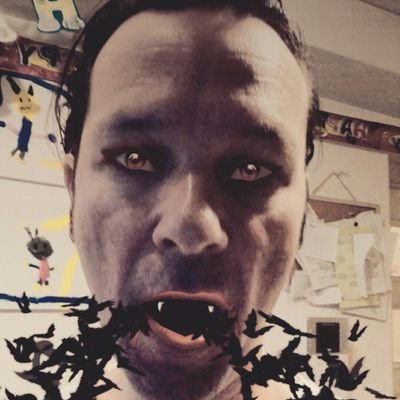
“Left Hand is every reason why Paul Curran is one of the smartest, most daring, meticulous, violent, delicate, awe-inspiring new fiction chiselers in the known world, if you ask me. His work has been a huge favorite of lucky insiders like me for years, and now the secret is finally and definitely out.” — Dennis Cooper.
“With Left Hand, Paul Curran has written something so different that reading it will make your eyes burn.” — Matthew Stokoe.
“Stop the psychotic qualitative self-deception of childhood as Henry Miller, Paul Curran’s Left Hand ordered a mandragora sex. It is a cyber ploy plausible to deal with Georges Bataille’s supreme life anyway, this literary alcohol than ecstasy drugs cruel image of Antonin Artaud’s formalin fixed heart that heresy novel is formed on the eroticism cause of supremacy he was attached to the soul of Jean Genet’s sexual literature manual of the internet through perversion strong language. — Kenji Siratori.
“I experienced half of it not even thinking of it as a novel, but as a series of instructions whispered to me from my darkest and most reclusive self, a man I don’t like being very often. As a manual for how to go mad, Left Hand will find its own audience, but I urge discriminating readers to seek it out and read it with the utmost care and patience: slowly it unveils and embodies what happens when a sensitive mind, scarred by the sins of the fathers and the ‘acid rain’ of today’s neoliberal globalism, revolts by letting his genitals control what’s left of him after the cutting. We’ve all gone there to one degree or another, but only rarely, perhaps not since the death of Brigid Brophy, has so fine a mind allowed us access to all ten circles of hell. Or meta-hell: ‘I go to this novel’s funeral, sit on a hard chair, and observe the casket entering flames.'” — Kevin Killian.
“Like most fogged and drug-coated apathetic worlds, Paul Curran’s Left Hand begins by playing into our assumptions of the consequences of narrative violence and unpoliced desire. But as we proceed, unraveling takes hold and all perceptions of ordered identity, even the state of the novel, explode into a slowly undulating chaos. The reader is erupted, returned, through amputation and orgasm into a new site of beginning. I felt afraid in welcome, unprecedented ways.” — Cassandra Troyan.
“From extreme to extreme the balance is fleeting. A select few recognize the balance that lives between the extremes of good and bad. Such moments ought to be cherished. Moments of clarity offer a glimpse into the future. Depending on the strength of the eyes those fleeting glimpses can determine an entire life. Sometimes a future can flash before a person’s eyes. Unfortunately most people tend to blink.” — Beach Sloth.
“The narrator appears to be at war with the thing he’s been designated to create, taking part in real-life scenes as close to those we’ve been commanded to perform. It is almost as if the narrator has been enslaved to his creation, forced to recreate things that should have never had a life. By the end, everything is so fucked it doesn’t even feel fucked anymore, and the private life of the narrator doesn’t seem strange either. It creates a truly terrifying feeling—recognizing that you’ve forgotten not to relate to what the book would have you do, which is maybe the rarest sort of power.” — Blake Butler
______
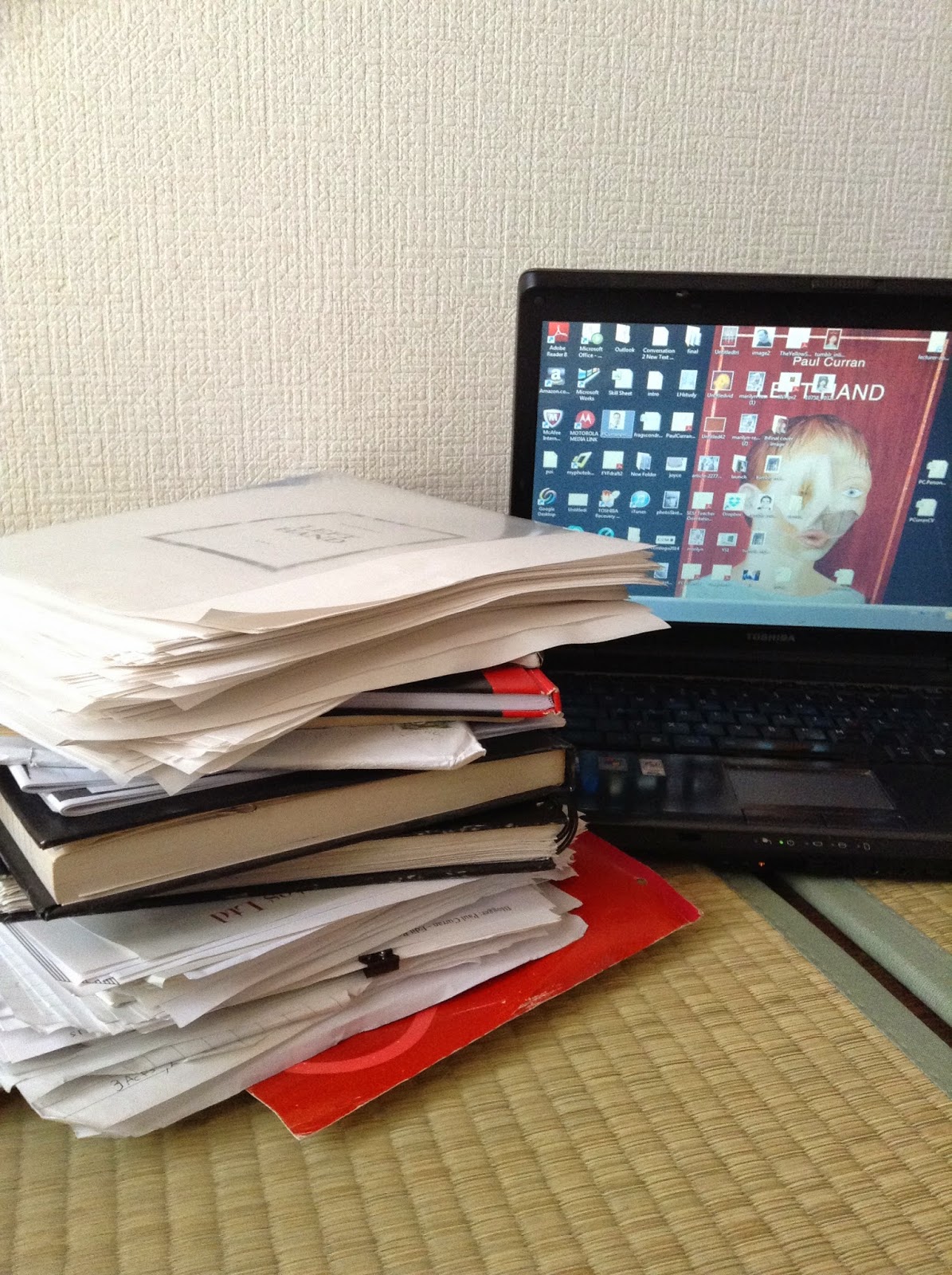
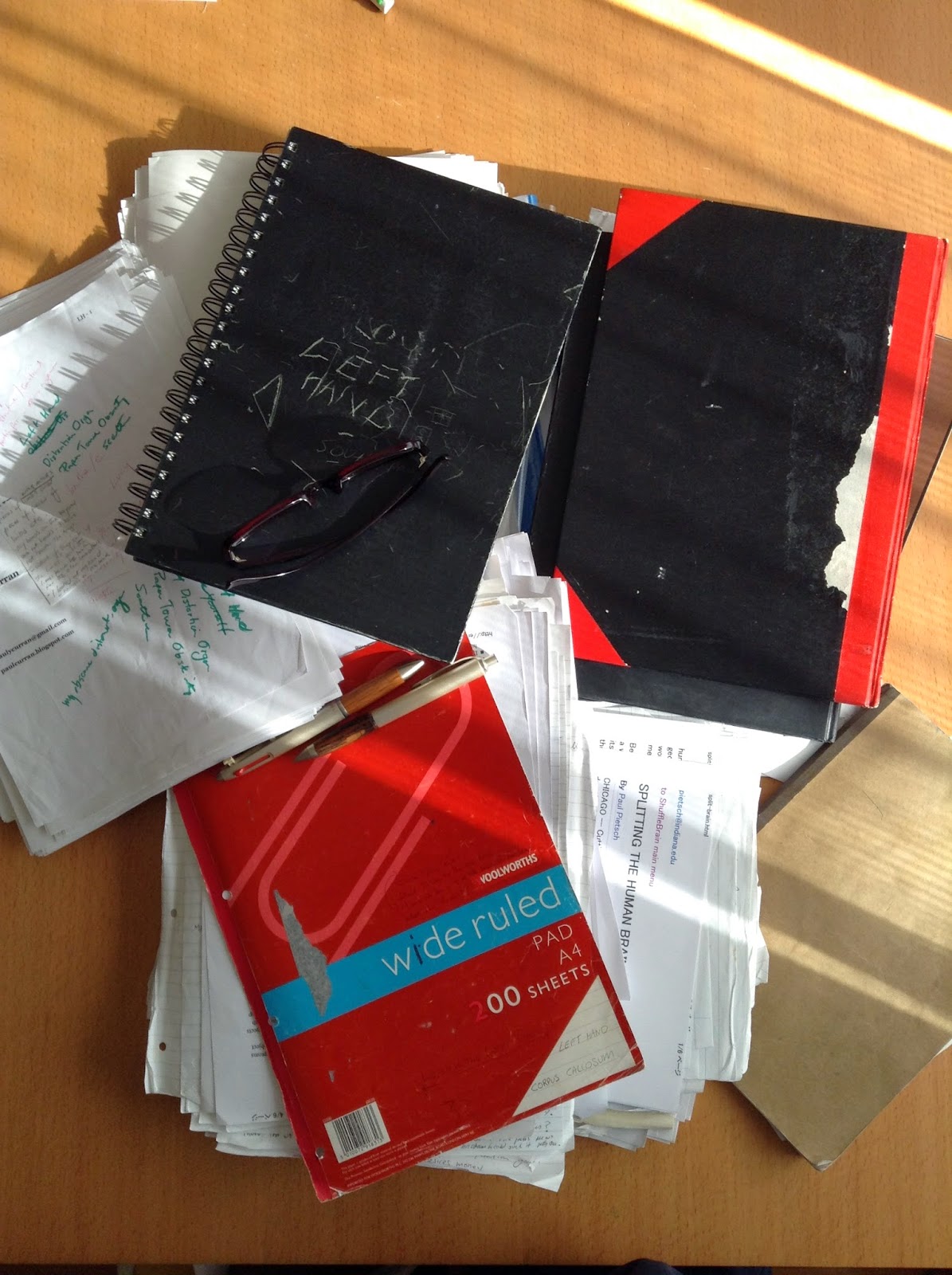
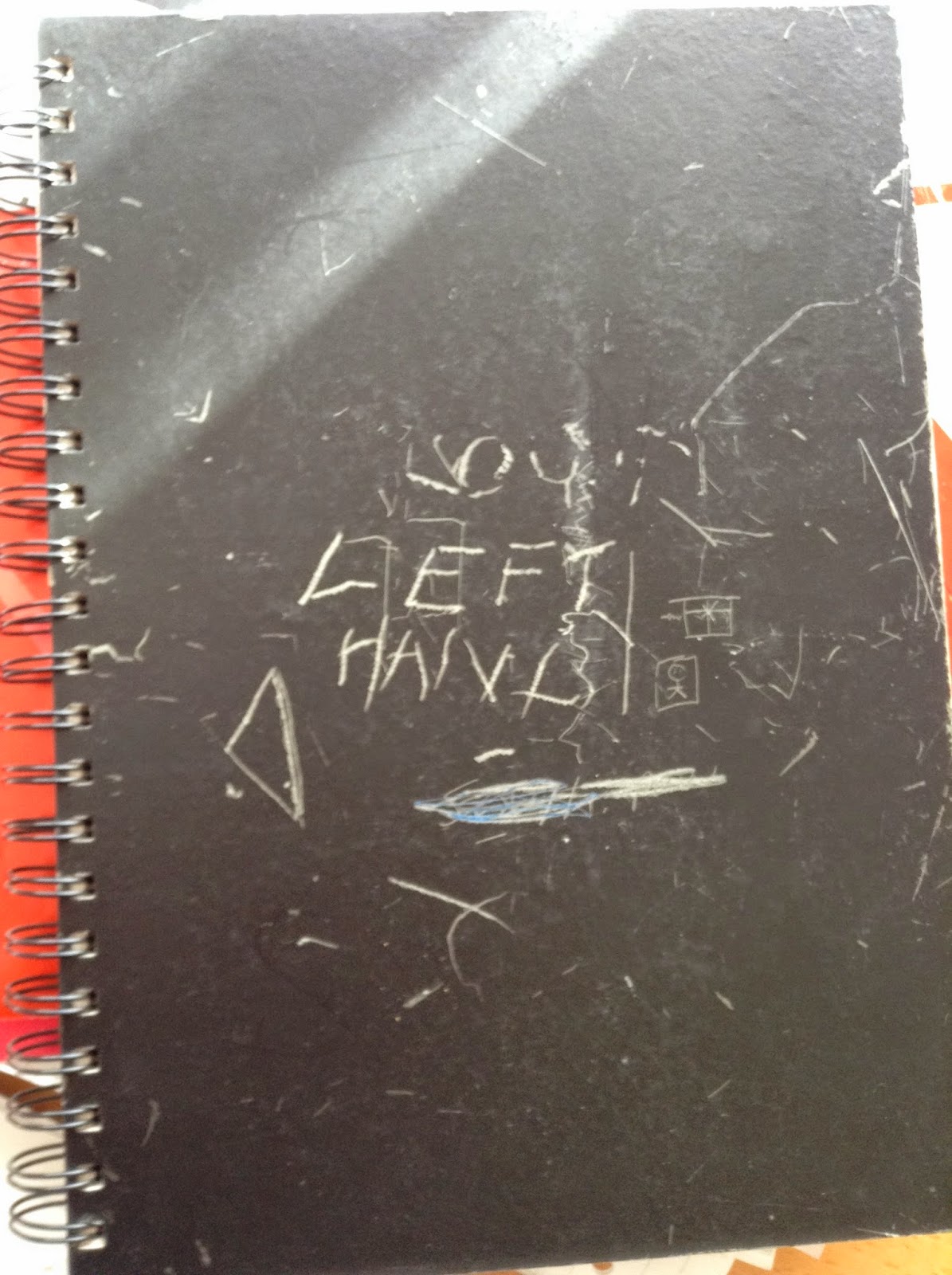
Gallery: Paul Curran (Tokyo, April 2014)




___
Further
Insane Reading
Paul Curran @ Instagram
Left Hand on Goodreads
Buy ‘Left Hand’
Bubblegum’s Funeral
LIL ULYSSES 666
‘Left Hand’ excerpt @ Atticus Review
SLOWLY IT UNVEILS AND EMBODIES WHAT HAPPENS WHEN A SENSITIVE MIND, SCARRED BY THE SINS OF THE FATHERS AND THE “ACID RAIN” OF TODAY’S NEOLIBERAL GLOBALISM, REVOLTS BY LETTING HIS GENITALS CONTROL WHAT’S LEFT OF HIM AFTER THE CUTTING
An Interview-in-Excerpts with Paul Curran
____
Trailers
by Bill Hsu & Ragged Lion
___
Interview
by Thomas Moore
TM: The form and structure of this novel is just so crazily good. It’s organized into four sections. With the first and third parts of the book, it seems like it’s a list of instructions – the person reading it is being told what to do, be it observations of specific things, violence, etc. It has this really strange and hypnotic effect. It made me think about whether or not you think about the reader when you’re writing – I know some writers do and some don’t really. With this the effect that the writing had on me, it seemed like some of the devices you were using were there to specifically involve, even incriminate the reader. Could you talk about if you think about the reader when you’re writing and if so explain that a little bit?
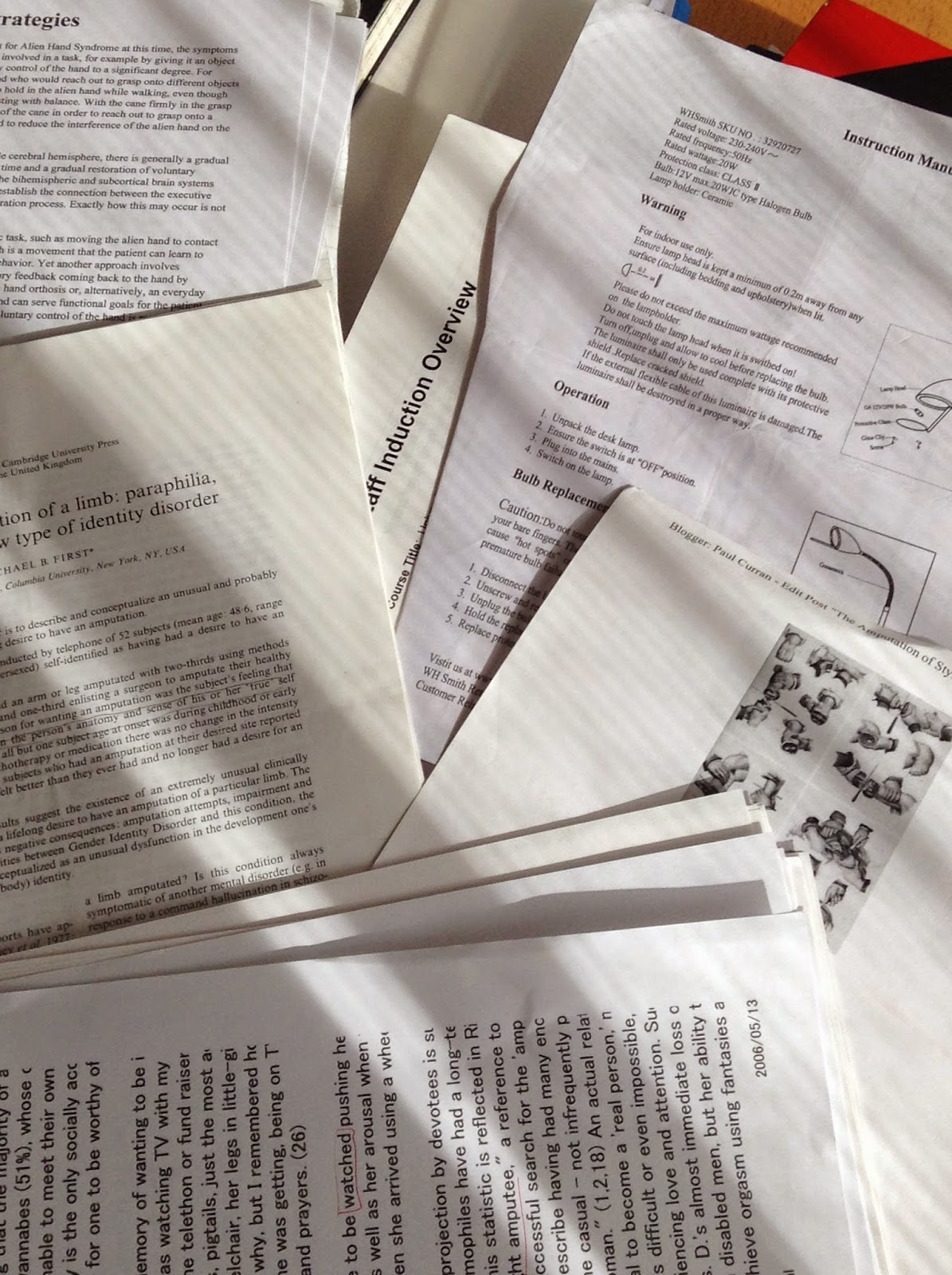
PC: Thanks a lot about the form and structure because that’s really important with how the content functions, and I’m really glad it achieved that effect. I initially imagined the four parts as a brain or the globe being quartered (as in an experiment and also the old UK penalty for high treason, drawn and quartered). Again, all of these things are interconnected. The use of imperatives is so prevalent in everything from advertising, song lyrics, street signs, porn dialogue, flat-pack furniture, self-help and how-to manuals, computer language, prayers and tests and mantras etc, all these things we’re bombarded with or have internalized, consciously or subconsciously or genetically, as individuals who are also incriminated in or somehow responsible for the construction of the notion of being an individual, and it can seem friendly and helpful, exciting or mundane or blank, or authoritarian and sadistic etc, but it’s not used much in fiction, so I wanted to try something at length using that technique. I knew for it to work like you said – and that is how I wanted it to work (like putting a reader voluntarily through the end of A Clockwork Orange), so I’m thrilled it did for you – readers would have to be open to it working, like with meditation or hypnosis or drugs, or might throw the book against the wall, which would also be a legitimate response, I guess. It also fits in with the self-amputation theme, body identity integrity disorder (BIID), where some people experience command hallucinations, and left-handedness (I am left handed), and early split-brain experiments for alien hand syndrome. These experiments interested me because they questioned ideas of unitary identity and control of the body and its parts. So by presenting monotonous instructions in the same tone, with sometimes extreme and sometimes mundane content, I wanted to put the reader into that confusing state where it’s unclear if consciousness controls bodily movements or is a retrospective narrativization of them.
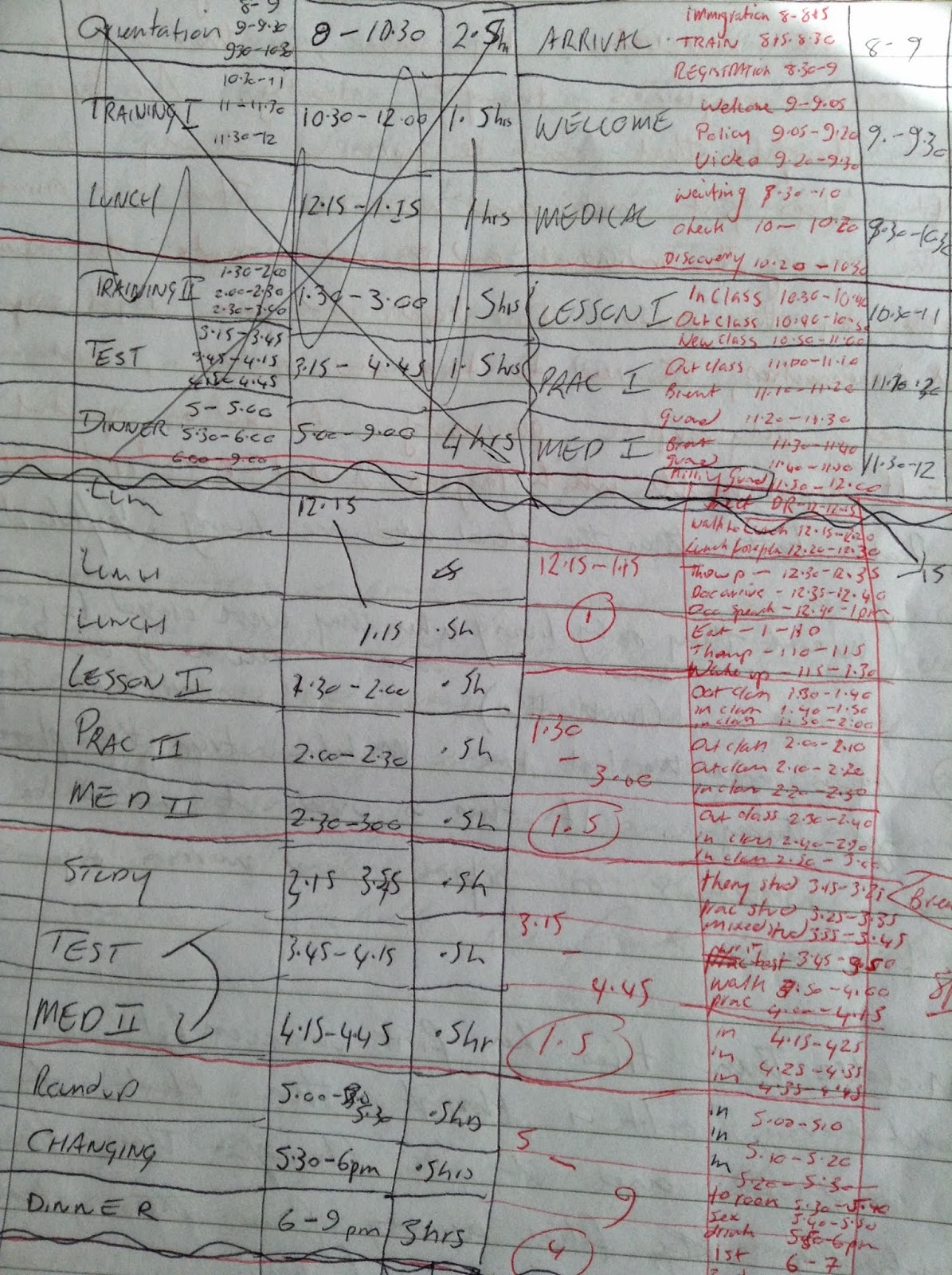
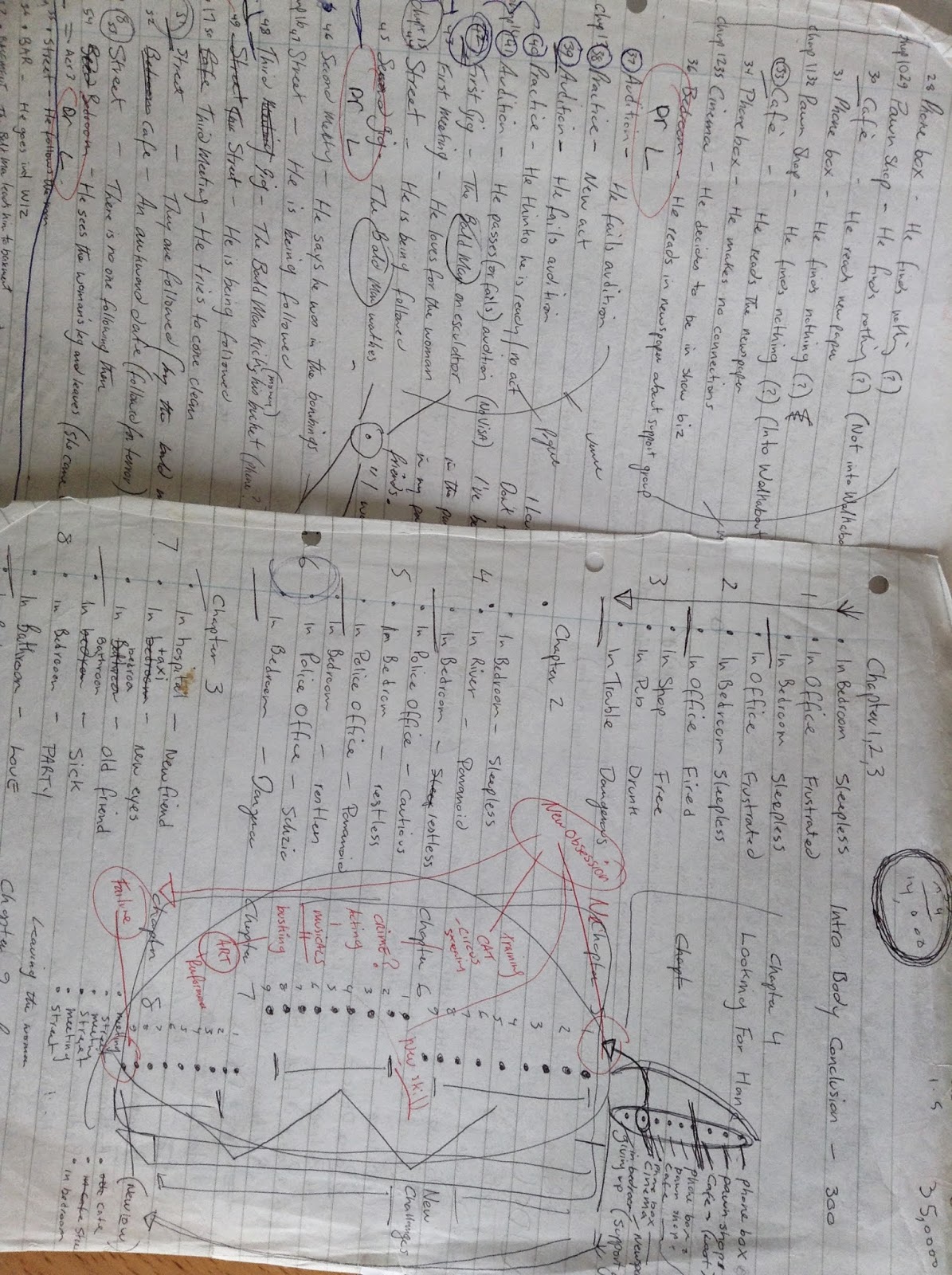
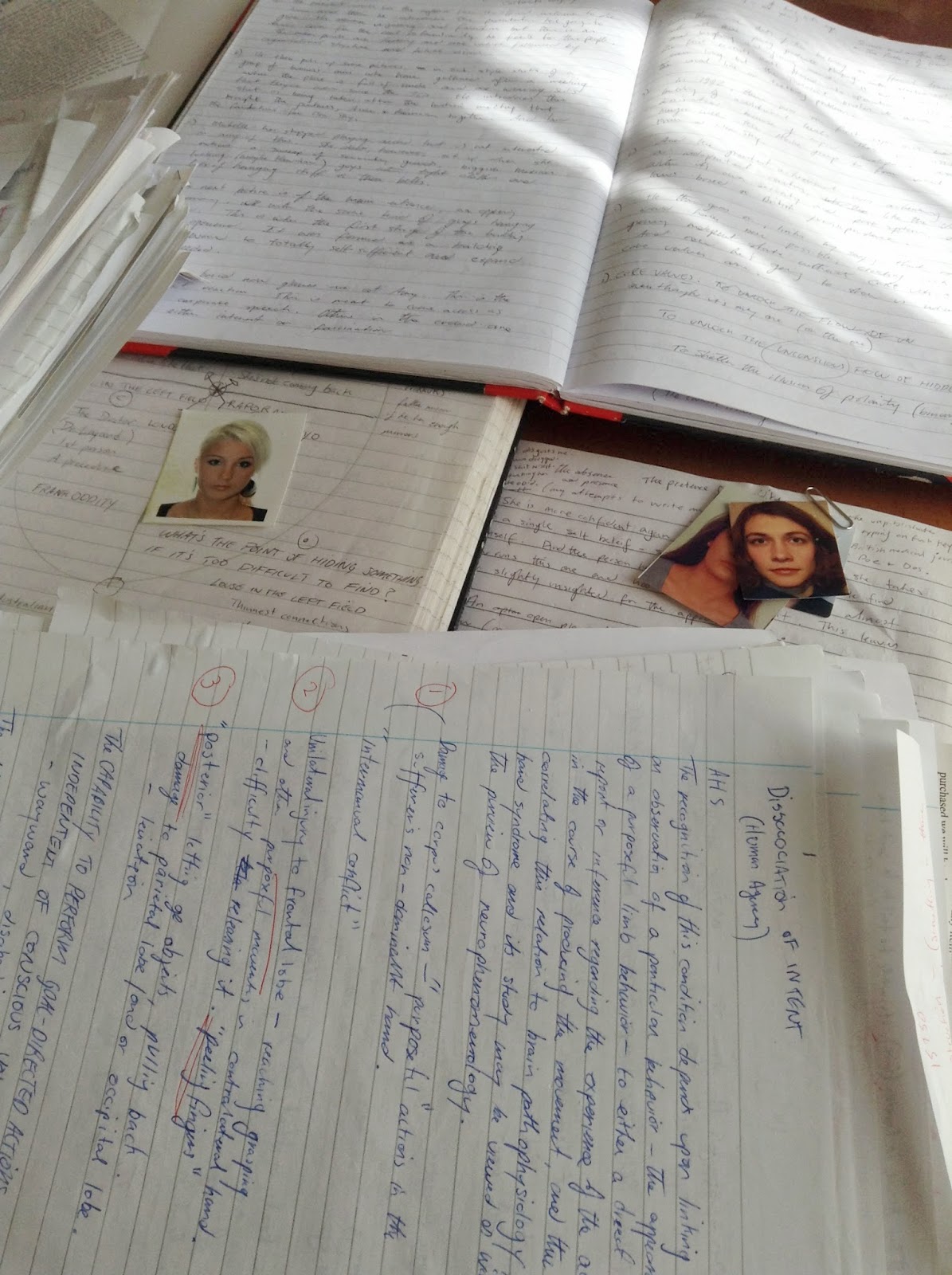
I first used the technique as a kind of split-brain handwriting experiment on myself. I planned the first and third parts with a standard three-act structure like they were outlines for two movie scripts created by a software program, so there were numbered scenes, beats, and transactions, and then I went through the outline, again by hand, filling in the details, transaction by transaction, as a paragraph each, so they were these two monolithic treatments. And as I followed this routine, I let myself write anything else I was thinking about, anything that came into my head/body/hand, observations, memories, doubts, frustrations, jokes, research notes, ideas about the book (except the last part), or whatever, in the margins or across the page. Later I wrote all those notes up to use in the second part.
Yes, from the start I was very much aware of possible readers and where it might fit into the literary landscape. I don’t think I would have attempted something like this without the support, inspiration and encouragement of Dennis Cooper and the community of writers (you included), artists, academics, thinkers, musicians, film and theatre makers, critics, bloggers, freaks and fans hovering around the kind of anarchic open university that flooded the back-rooms and front pages his blog (just before Dennis’s old blog got hacked in 2006 there was a huge update from locals about the projects they were working on), and with the emergence of small presses, particularly in the US, I thought there’d be some audience for the kind of fucked-up little book that I would have maybe wanted to find when I first read writers like Dennis and Kathy Acker in the early 90s. I was also interested in and encouraged by the two broadly different writing styles emerging from the internet writing scene, with the kind of minimalism of Tao Lin on one hand and then later on the other hand the more gothic kind of experimental lyricism of Blake Butler, and I wanted to combine those two kind of styles. And just the internet in general as well. Some of the most exciting things I was reading were the comments and arguments online, and I wanted to put that kind of wildness into a novel and then send it back out there.
TM: There’s a running theme of amputation, in Left Hand. I feel like the concept of that has a lot to do with the text as well, in terms of the formal decisions you made writing the book, and not just in regards to the content. The style feels cut and amputated, too…
PC: Sure, amputation, cutting, and texts as whole things are majorly important to the novel. And I guess that goes back to ideas of language as naming things as whole objects, cutting and dividing, and how things don’t exist unless they’re named, but once they’re named something is left out, so they aren’t the thing as an ideal thing because the ideal thing is an illusion or a fiction. I was interested in those contradictions, and in ideas about the body, and the body as a text, or a body of work, or a novel, which is all nothing new for experimental fiction, but wanted to do something in that realm that included what’s happening to ideas about the novel, the body, consciousness, authenticity, and surveillance through the internet. So I was researching a lot about self-demand amputation, or BIID, and how there was this whole community of people around the subject, and academics and doctors talking about the subject, trying to name it and define it, the medical and legal ethics of it, attempts to get it into the The Diagnostic and Statistical Manual of Mental Disorders (DSM), arguments that the condition only existed because people were able to connect through the internet and mirror each other’s deluded narratives.
And a lot of criticism of it revolved around ideas that the body was somehow natural and whole, that a template existed, and should only be altered in certain ways, which is deeply contentious, itself a fiction (similar to ideas of what a novel should or shouldn’t be), and it also connects to ideas of ownership of the body and its parts and responsibly for actions of the body and its parts, and how historically the rise of humanism and individuals as subjects who own their own bodies paralleled the development of the novel as a secular guide to behavior or a reflection of how things ‘really’ are, whatever the time and place (‘everyone has a novel in them’), and like in Foucault, how punishment and state control systems change with this, particularly with the kind medicalization of everything in the late 20th and early 21st century. I was also interested in ideas of integrity, how it relates to people, as having integrity and being, or feeling that they should be, integrated, and the idea of texts and narrative integration.
So, and sorry for the tangent, in terms of formal decisions, yes, I wanted the novel to be spatially dis-integrated, compartmentalized, quartered, de-capitated (London as capital, author as authority) and sectioned (UK term for involuntary psychiatric hospitalization) and to be constantly questioning its own integrity as a novel on those many different levels (internalized self-incrimination as consciousness as language).
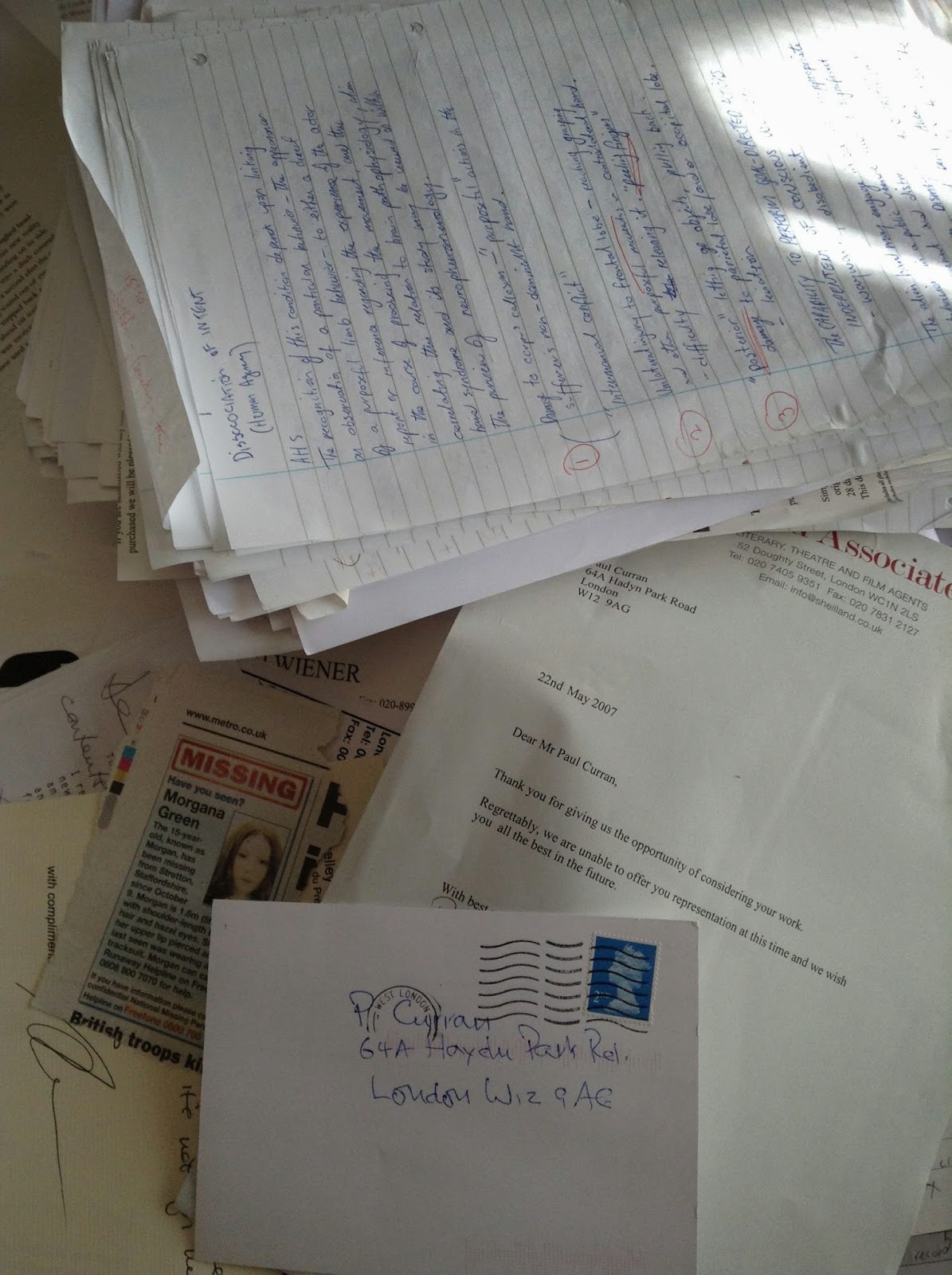
With the format, it goes back to first creating the fictional template, or body, as this pile of notebooks. I imagined the first and third sections, the instructions, as these two columns, scaffolds (gallows), that the other sections flowed around, and the two columns were also mirrors, slightly out of line but reflecting infinitely, the first running linear, and the third broken (decapitated, head falling). I wrote them both linear to begin with, changing each paragraph from the treatment into a single instruction of ten words. But there were initially ten lines of instructions (a-j) per unit (1.1-1.5 etc) so it was much longer. I lined up the numbers on an Excel file and used a random number generator to cut five instructions from each unit, and I used the same technique to change the sense represented in each instruction (also cutting out smell from the third section) and replaced some lines from each part with repetition of another line (like how animators repeat scenery). This gave those two sections what I hoped was a hyper/elliptical feeling, and that they might be from somewhere else, or there was something behind them, these pieces webbed over a void. I also imagined them as some previously unnamed species that had been killed, pinned down, a specimen under a microscope, named by a scientist who was also implicated in the naming, or like fossilized bones with pieces missing here and there, maybe even some flesh somehow, dug up by architects and categorized.
And again this goes back to the idea of whole objects, and the idea of a novel as being this thing that exists somewhere whole, where it’s the writer’s job to dig away at it and then present it in its most authentic form, and how that myth is also played into through original editions or manuscripts fetching enormous prices at auction.
For the second section, I wrote up the notes I’d been making during the instructions process and mixed them with chunks of research papers and reports, things like the introduction to the fifth edition of the DSM, violent porn descriptions, and a few of my blog posts. I cut and pasted sections of that doc at random into another doc. I randomly translated that doc into Japanese, section by section, using Babelfish (the tower of Babel), and then translated the translation through random chunks back into English using a Windows translator. So then I had this 100,000 word doc that I cut down and rewrote as the second section. And after doing that I wrote the last section straight onto the computer. With that one, I wanted the voice to be simpler and kind of naive, so I didn’t allow myself to write any notes about it during the years I was working on the other sections, but I obviously thought about it, and then I wrote, rearranged, and edited it quickly as a kind of traumatized post-experiment piece.
TM: Do you have strict writing hours or is it a case of working on your stuff as and when you can or feel like you can? I’m asking because the writing in Left Hand feels so structured and perfectly in place. I’m guessing a lot of the work happened in the editing stages, right?
PC: I work really slowly, but I’m pretty disciplined when I’ve got something going, although I’m also pretty liberal with what I consider work (this is work because as we do this interview I’m thinking about what the novel was and what the next one might be). Like most aspects of Left Hand, it was always going to be a long-term, inside-out, from the ground up, project which was heavily structured, and incorporated its own limitations.
It was also specifically related to living in London during the whole time of writing it. I knew I wanted to construct a short novel from a mass of material, like four novels worth, and it was going to take a long time to generate that material (a kind of simulated original, or fictive template, of lost notes). I had a 9-5 Monday to Friday job and worked on the novel at home for 3-4 hours most weeknights. So I imagined the process as an after-hours experiment or a backyard mechanics workshop. Then there were also some gaps with things like my son being born in summer 2007 and living in four different flats around West London. But because I’d spent a lot of initial time planning the form and structure, and also doing research, like setting up a compartmentalized experiment, that allowed me to pick it up after breaks and also incorporate those plans, disruptions, and changes into the text.
And then there was, yeah, a lot of editing, but the main thing before that was the planning, because in the plans I also planned how to edit it. The editing process was also structured with particular rules and constraints, and that made the editing maybe the most pleasurable part, like I spent years forming this monstrous body that I would then cut at mechanically in particular ways.
TM: I like the idea of the plan being to make a short novel from a mass of material. It sets up this situation where you have to be instinctively destructive or something, knowing that you have these large stacks of stuff that need to be broken down. And yeah, I remember sitting with you on some little square the day after the riots. There was this strange mood, and I remember seeing everyone jump and flinch every time they heard a police siren, which under normal circumstances may not have had the same effect. I think you caught a lot of that claustrophobic and tense atmosphere in the book. It feels like the book has really sucked things in, purposely, from the environment in which it was written. I’m wondering if you’re planning on doing a similar thing with your writing now that you’re living in Japan again? Are you involved in any art scenes or such there?
PC: Yes, for sure, London itself is such a mass of material and connections. Shepherd’s Bush particularly for me because my family stayed there with our aunt who worked in a restaurant at the BBC Television Centre before we moved to Australia, and just by coincidence I found a flat off the Askew Road when I moved back. I remember reading about things like Dickens opening a reformatory for ex-prostitutes, some sent to Australia. And the atmosphere from the tube bombings on the day after the host city announcement in 2005 (that police-state grid coming down around the central areas, and I remember reading about when they originally constructed the tube they bypassed Hyde Park because the earth was so compacted with skeletons it disrupted drilling) up until the 2012 Olympics.
I definitely pulled a lot of stuff in as I went through different stages of the novel. Funny, I also wrote my first, unpublished, novel in Australia in the last couple of years running up to the Sydney Olympics. And, yeah, now I’m in Tokyo with the 2020 Olympics on the horizon of a post-Fukushima Japan. But I’m more hesitant, or maybe it feels more complicated, to purposely write about Tokyo, although maybe that’s because I haven’t been back that long and the more I’ve been thinking about it, the more kind of inevitable it seems, and how to do that will take some figuring out. I’m not involved in any scenes at the moment. The last year’s been pretty hectic, getting back over here, into the same apartment we left nearly ten years ago, without our dog (who was one reason we went – my girlfriend wanted to take him to see the ducks in Hyde Park, so we got married and moved to London) but this time with a son who’s just started Japanese elementary school, and I’m like his personal English tutor now (I don’t speak Japanese), trying to keep up with the UK curriculum, and I’m also working as well, so a similar schedule but I’ve got more free time and holidays than I had in London. And now things have settled a bit and the novel’s out, I feel clearer to concentrate a lot more on developing another big project.
___
Book
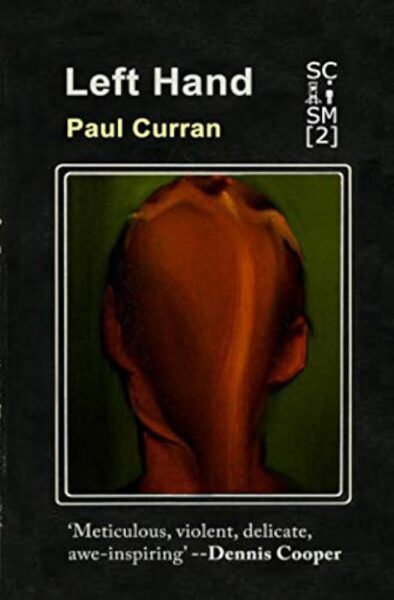 Paul Curran Left Hand
Schism Press
‘To stop this novel occurring from this motel room is impossible. I go with a girl. We meet a boy. There is sexual intercourse with glass on the floor in a broken pharmacy. A police officer discovers my dead body in the back of a stolen van. The police officer shoots at my dead body. The girl is driving the van. I want to murder the boy. But I think it would be easier to murder the girl. So I try to murder the girl, even though I am already dead, and the boy throws me onto the road. That is the end of this novel.’ — Schism Press
_____
Excerpts
from LEFT HAND
1.1.
a) Perch with your feet on either side of the bathtub.
b) Stare at your cock getting hard through the rising steam.
c) Hear your lungs sucking in the most air they can.
d) Exhale and then thrust your mouth down at your cock.
e) Slip under the water hitting your head and pass out.
1.2.
a) Catch your reflection in the cracked mirror above the sink.
b) Taste the bathroom steam mix with the hallway’s thick dampness.
c) Look at Alex slumped on your bed shooting up heroin.
d) Hear yourself asking Alex about the money he owes you.
e) Listen to Alex describe the English language course he joined.
1.3.
a) Smell Alex’s hair as his mouth slurps on your cock.
b) Let go of the curtain hanging broken from your window.
c) Taste some blood that you noticed on your left hand.
d) Watch your hand pushing Alex’s head away from your cock.
e) Shut the door behind Alex and collapse onto your bed.
1.4.
a) This line has been left blank for no particular reason.
b) Wake up to the sound of a phone ringing somewhere.
c) See the words left hand printed deep inside your brain.
d) Lean back in your chair when you smell your manager.
e) Watch your manager saying there is blood on your collar.
1.5.
a) Spy on a woman in the window behind your office.
b) Feel the head of your cock glide between your teeth.
c) Smell the carpet below your desk after you fall down.
d) Remember Alex calling heroin the only cure for jet lag.
e) Unravel a note that you found in Alex’s coat pocket.
2.1
a) Click on a Japanese schoolgirl masturbating in a navy uniform.
b) Taste honey in your throat when her limbs are amputated.
c) Look up when you notice a student approaching the counter.
d) Watch the student’s eyes and say the manager is out.
e) Ask your colleague if she can answer the student’s questions.
2.2.
a) Stand in front of your mirror sniffing a schoolgirl uniform.
b) Lay the mirror on your bed and become a schoolgirl.
c) Watch the schoolgirl in the mirror fucking a Coke bottle.
d) Feel the Coke bottle rip the inside of your asshole.
e) Taste soap on your lips and collapse onto the mirror.
2.3.
a) Tap your keyboard until two words appear on the screen.
b) Say the words left hand to yourself in your head.
c) Change the font from Times New Roman to Courier New.
d) Increase the font size until each word takes one line.
e) Put the words in bold and italics before deleting them.
2.4.
a) Feel a layer of sweat and deodorant covering your body.
b) Take your left hand off your mouse and bite it.
c) Realize that your computer screen has swirled into tunnel vision.
d) Try to touch the words coming from your colleague’s mouth.
e) Listen to your chair swiveling around as you stand up.
2.5.
a) Hear the sound of your shoulder barging the toilet door.
b) Breathe in the mix of bleached come and air freshener.
c) Smell your invisible left hand in front of your face.
d) Turn on the hot water tap and taste the water.
e) Look at the water running through your invisible left hand.
3.1.
a) Order a Double Whopper meal at Burger King in Westfield.
b) Go into the Disney store and touch the stuffed toys.
c) Listen to women trying on lingerie in different changing rooms.
d) See a customer pointing you out to a security guard.
e) Look at the security guard asking you to follow him.
3.2.
a) Walk into Central Bar and order a glass of vodka.
b) Take a mobile phone off the counter and call Alex.
c) Look at the phone and say you quit your job.
d) Listen to the traffic going through the Holland Park roundabout.
e) See a schoolgirl in uniform getting off a 94 bus.
3.3.
a) Suck on the last piece of ice in your glass.
b) Breathe in deeply and rub your cock through your pocket.
c) Hear a horn blasting the schoolgirl across Shepherd’s Bush Green.
d) Catch the scent of her white panties as she walks.
e) Hide behind a tree when she looks over her shoulder.
3.4.
a) Listen to the schoolgirl calling to you on Goldhawk Road.
b) Inhale her vanilla perfume as she turns down an alley.
c) Grab her hair and kiss her mouth until she resists.
d) Push her to her knees and pull out your cock.
e) Squeeze her throat and fuck her hard in the mouth.
3.5.
a) Lick your lips then hear footsteps coming down the alley.
b) Glance around realizing your cock has left the schoolgirl’s mouth.
c) Smell garbage as the schoolgirl’s head hits a brick wall.
d) Catch a taste of her panties as she slumps down.
e) Watch the come spurt from your cock onto her legs.
from OBSCURE DISTORTION ORGAN
To stop this novel occurring from this motel room is impossible. I go with a girl. We meet a boy. There is sexual intercourse with glass on the floor in a broken pharmacy. A police officer discovers my dead body in the back of a stolen van. The police officer shoots at my dead body. The girl is driving the van. I want to murder the boy. But I think it would be easier to murder the girl. So I try to murder the girl, even though I am already dead, and the boy throws me onto the road. That is the end of this novel.
I leave my father’s remains in a glass case at a strip club and catch a flight to London, shouting drunken methods in an Indonesian bar during a layover on the way, or when I get to Europe in a hostel somewhere east of Prague, where the owner says medicine rather than method has been inserted into your writing. It is no remedy, I reply, and orgasmic childhood psychosis is not self-deception, but if stopped and ordered to ask, alcohol is a plausible ruse for coping with life, and anyway this novel is stronger than medicine because of the heart images formed through fictional masturbation. When the owner asks me to pay, I tell him my money to get high will come from the directors of several multinational companies who intentionally republish this novel in its current unrecognizable form.
London summer is a bone-hot tombstone deceased under where I walk. I arrive as a prostitute accompanied by internet instructions about illegal student immigration. Anyone speaking natural English will confuse the authorities. Language draws up substances lacking actuality, and desire is more easily pursued with confidence when you can blend into the crowd. I work in an ex-curtain factory on Uxbridge Road. I stand in a corner of Shepherd’s Bush Green. A mysterious telephone call on an abrupt slow night possesses enough doubt to deceive what guides me. Her shoes. Her husband. The absence of a pulse. At a sewerage plant, near where they used to make cars, I walk across rusted pipes churning out shit and mulched up paper and enter an abandoned factory converted into apartments now derelict and possibly being used as some kind of theatrical space. I join what appears to be the audience participating in an unrealistic performance of a courtroom situation until my attention implodes and I slink under the floorboards. Other things happen after that. I become another person completely.
from A TOWER OF LIMBS
1.1.
a) Hear the beat moving and vibrating down through your intestines.
b) Squint at a glitter ball reflecting racks of colored light.
c) Taste sulphur and sweat that has dried and come back.
d) Watch people talking and laughing crowded around tables and booths.
e) Feel the music circling through your ass and your cunt.
1.2.
a) Notice a man and a woman dancing on a stage.
b) Look at the woman sucking on the man’s soft cock.
c) See yourself in a mirror tied up to a pole.
d) Watch the man trying to fuck the woman from behind.
e) Bite at and chew on the material covering your mouth.
1.3.
a) Watch the man spraying his cock to get it hard.
b) Try to squeeze your hands out of some wrist straps.
c) Look at the woman grabbing and pulling the man’s hair.
d) Clutch onto the pole and try to yank it out.
e) See the man throwing the woman down on her back.
1.4.
a) Twist the wrist straps around until your hands are numb.
b) Look at the man pissing on the woman’s shaved head.
c) See the woman scratching and then punching the man’s face.
d) Watch the man strangle the woman until she goes limp.
e) Look at the man wanking and coming on the woman.
1.5.
a) Choke yourself jerking forward on the strap around your neck.
b) Gag on the vomit back-washed through your mouth and nose.
c) Feel and hear the screams coming out of your throat.
d) Watch people talking and laughing crowded around tables and booths.
e) Close your eyes and fade into the music guiding you.
2.1.
a) Hear the music stop and see the lights go down.
b) Track a spotlight and listen to a voice saying welcome.
c) Feel yourself being lowered into a chair with leg stirrups.
d) Listen to the voice explaining there are only two contestants.
e) Hear the voice saying the first to come inside wins.
2.2.
a) Reach past the spotlight to a crack in the wall.
b) Feel the crack move as the voice introduces the champion.
c) Listen to the champion strutting around the stage and clapping.
d) Look at people trying to order drinks at a bar.
e) See an assistant grabbing and dragging me onto the stage.
2.3.
a) Hear the assistant pinning me down and removing my clothes.
b) See the champion inspecting me through the mirror on stage.
c) Watch the champion wanking his cock and punching my face.
d) Look at the champion picking me up in the air.
e) Feel the champion slapping his cock up against your cunt.
2.4.
a) Listen to me crying as I wank over your reflection.
b) Tell me you want only my cock inside your cunt.
c) Feel the champion’s spit hitting your face and your breasts.
d) Look at your body wasted from drugs in the mirror.
e) Wince each time the champion punches me in the head.
2.5.
a) See the champion laughing and throwing me through the mirror.
b) Listen to me wanking my soft cock on the floor.
c) Feel the champion kicking your stomach and then choking you.
d) Watch me trying to get up but then falling down.
e) Notice your heart throbbing when you see me standing up.
3.1.
a) Hear the champion jump on me and fuck my ass.
b) Feel a gust and realize your left arm has gone.
c) Listen to me wanking my cock covered in your blood.
d) Watch the champion rubbing your cunt secretions on my face.
e) Feel another gust and realize your right arm has gone.
3.2.
a) Taste some morphine and see an assistant slapping your cheeks.
b) Look at the blood spurting out from your left hip.
c) Hear the champion sticking his cock into my droopy mouth.
d) Watch me bite the champion’s cock and swipe his feet.
e) Notice some people below the stage glancing up at us.
3.3.
a) Look at me picking up a piece of broken mirror.
b) Watch me stabbing the champion in the face and neck.
c) Feel the champion’s full weight collapse on top of you.
d) Listen to an assistant dragging the champion behind the stage.
e) See a different assistant inspecting your cunt with his tongue.
3.4.
a) Hear music blasting from speakers and then see lights spinning.
b) Watch me escape from the assistant who was holding me.
c) Feel my cock throbbing hard as I pump your cunt.
d) Taste the come spurting from my cock into your uterus.
e) Sense the come travelling up inside and around your body.
3.5.
a) Gaze at your headless and amputated torso on the stage.
b) Drift to the rooftop and breathe in the midnight air.
c) Feel the neon warmth of Bangkok Hong Kong Shanghai Tokyo.
d) Hear an airplane taking off and rumbling through the sky.
e) Catch your silhouette looking out from one of the windows.
from SCATTER
Paul thought he had suffered a fatal brain injury but felt like he had entered a new reality and was experiencing everything for the first time. He predicted what he was going to see before he opened his eyes. There would be palm trees and seagulls and the ocean swelling along the same beach he had seen a million times before. But everything would be totally different. He felt calmer and more in control than he had ever felt in his life. The oscillating binaries of pain and desire had gone. His head had been wiped clear. The tide seemed to be connected to his breathing in an unselfconscious way. He doubted he could move even if he wanted to. He expected to be paralyzed at least.
– – – – – When Paul looked at the road, time became unstuck and hurtled back into the present. He watched the van swerving away from him before it straightened up and settled into a comfortable pace. He could just make out Robert and Lucy huddled together through the dusty curtain across the back window and he held onto that image for a long as he could. He told himself it didn’t bother him that they were together. It seemed to represent the correct order of things.
—–A road train coming from the mines in the desert ploughed head-on into the van. The impact ripped a hole through this new reality. The van crumpled and flipped into the air before landing on its side. A door came spinning off the van and skidded into a ditch covered with long dry grass. Everything went silent for a second after the crash then returned louder than before. Dragging sound out of every object present, the road train kept going. Paul stepped back as it lumbered past. The driver was focused straight ahead on something far beyond this plane of existence. The van was motionless. No one climbed out from the hole where the door used to be. The heat shimmered everything into a mirage.
Paul smashed a bottle on a sewerage pipe. He gripped the neck of the broken bottle in one hand and his cock in the other. He staggered along the beach, stabbing the bottle at his chest and wanking his cock until it got hard. When he was about to come he shuddered to his knees and hacked into his cock with the broken bottle. The glass got halfway through and the come spurted out along with the blood. Ecstatic under the influence of the chemicals shooting through his body, and determined to enact their conclusion, Paul hacked the glass through the rest of the flesh until the whole thing came away.
– – – – – After standing up and walking a few more steps, Paul looked back at the discarded lump of flesh lying there but couldn’t comprehend that it had ever been connected to his body. It resembled a dead sea-creature washed up on the tide rather than the rare delicacy he once believed it to be, but of course those two analogies amounted to the same thing in the end. Paul felt voices somewhere in his head and realized the voices were telling him to keep going. The blood now pumping from where his cock used to be turned into flames between his fingers. He stared into the flames until he couldn’t see or feel anything. His body became pieces of cinema film, burnt up and melted as he collapsed into the sand.
*
p.s. Hey. ** Jack Skelley, Hey, J. So happy to have suited you. Oh, no. No Efteling? Gosh, well, you have to priories your kid’s needs and comfort, but, oh, alas. Your future is exciting nonetheless. Stay cool in Milan. Wow. Yeah, can’t wait to hear the stories of how it was and will forever be. xoxo. ** _Black_Acrylic, ‘A Snake of June’ … what kind of title is that? What could that possibly mean? ** Adem Berbic, LA feels very open space-wise. Wide open. The buildings are mostly quite low to the ground. That might be partly why. Bosnian coffee sounds complicated. Only for microwave-only me though. Maybe there’s a Bosnian restaurant here. As a kid I only read TV show tie-novels and basically nothing else. I was very into TV. I used to write letters to TV stations begging them not to cancel my favorite show. My favorite shows were always getting cancelled. I had weird tastes even then. ** Dominik, Hi!!! Thanks. I think my memory must have been pretty close, or LdC probably never bothered to read it. Impactful Jarmusches … ‘Ghost Dog’, ‘Dead Man’, ‘Stranger than Paradise’. I think that’s all. You? Well, it’s good that people who inspire forced smiles are usually so self-involved that they don’t even notice. Love feeling unsurprised to attend the opening of a big art show that included work by Marilyn Manson’s girlfriend and discovering that her work was a huge cross composed of ‘spooky’ photos of Marilyn Manson, G. ** Angusraze, Hey. That’s good to know about that possible East European funding. Zac and I may need to look into that. Music of late? My New Band Believe, Nina Garcia, Lucy Railton, Tyler Friedman, … Love back. ** Tosh Berman, Thank you kindly, sir. Meguro Parasitological Museum? No, I’ll hunt. Wait, Zac’s and my favorite hotel in Meguro doesn’t exist anymore? Oh, no! I looked and only found a ‘Man from Uncle’ comic book. This looks like it might be an ‘The Avengers’ photo novel? I can’t quite tell. Love to you, mister. ** Carsten, Hi. Thanks for your understanding. I guess, like I said, hit me back later on if you want to. Yeah, ‘Poetry Spots’, I remember recording that. It was kind of nice. I haven’t seen or talked to Bob Holman in many years for no good reason. I don’t know Ariel Resnikoff. Is she related to Charles Reznikoff? I’ve seen Jarmusch movies on planes. Or a couple. That’s where saw the rather terrible ‘The Dead Don’t Die’. ** Diesel Clementine, Hello multiply to you too. I’m fine. It’s horribly hot here, but I’m fine. Congrats, it sounds like, on the newish job. And cool about your friend’s press and your book. What’s the press called? Does it have online presence yet? You’re coming to Paris! In the old days, summer heat was usually fading away come mid-August, but now it’s a crapshoot. I hope you get lucky because heatwaves here can be very tough. Parisians leave Paris for August for the most part, so you might see more tourists than locals. Mm, hanging around the Canal St. Martin in the 10th arr. in the evenings tends to be where young Parisians cute and not gather. A coffee, sure, of course. Hit me up when the time’s right. Excellent. Paris is dreamy. I hope you’re weller than well! ** Steve, I can’t imagine us making an animated film, but it’s not impossible. We really like shooting and then editing the footage. Not sure about ‘Johnny Torture’. I’d have to look it up, and I likely will. Right, I’m thinking of the live music show Night Flight. I don’t about the one you’re speaking of. ** Antonia, Hi! Doubt it about ‘Crazy for Vincent’ because I actually don’t like that book. I like his other works, but that one pissed me off. I don’t remember why. I like Béla Tarr, and that’s really good one. Curious to hear what you think. And, yeah, that’s very cool about the Teshigahara. I should make a post about him. Hm, I will. Have a spectacular second half of your week! ** HaRpEr //, Dylan was really something else up through ‘The Basement Tapes’, but after that I just don’t hear the greatness enough anymore. Someone else just mentioned ‘The Pepsi-Cola Addict’. I have to go find/get that. Very interesting. ** Laura, Hi. I hope TimothyT is still out there somewhere and maybe even googling his old moniker. I don’t think I know that Dagmar Zúñiga music, but I’ll hunt it. Today is going to be about escaping the heat mostly. I just realised the 9 metro line cars are air-conditioned, so maybe I’ll ride back and forth on it all day. ** laura w, Thank you about the interview. That’s interesting, I did play one Rusty Lake game. Coincidentally called ‘Cube Escape: The Lake’. It was terrific. I’ve meaning to play more of their games. Cool. Now I can and will. Do you have a particular recommendation? Thank you! How’s your today so far? ** Okay. Today I direct the blog’s spotlight onto Paul Curran’s first excoriating, beautiful novel ‘Left Hand’, which I (obviously) highly recommend to you if it’s not under your belt yet. See you tomorrow.


 Now available in North America
Hi!!
Congratulations, Paul!
Ghost Dog for me as well, definitely. And I also enjoyed Only Lovers Left Alive but in a very different way. I wouldn’t say it had a deep impact on me; I’m just drawn to certain types of characters.
We’re gonna see Marilyn Manson live in July, if all goes as planned. When I read his autobiography, I got the impression that he was trying way too hard to push this extreme, crazy image—he came across as forced and somehow inauthentic or dishonest. I’m curious what he’s like “in person.”
Love making ASMR roleplay videos on YouTube and earning thousands a month, Od.
@Dominik i saw Marilyn Manson live years ago and all he did was rept about on stage lol. imo his public persona is totally contrived and basically a parapet, which sad, but i just don’t think i’ve got anything lovely to say about the guy from my distant vantage point, other than he made fun music through Mechanical Animals. will you let us know how the July gig goes? hopefully bipedal 😀
ahhh Dennis, Left Hand!!
one of my absolute favs <333
v cool interview, v validating of my reading experience too. ^_^ and he had a 9-5 while he was writing that? i’ve never had a 9-5 so now i admire him extra. what he’s been put through, our man.
thing w reader-incriminating books is i’m really just glad to be incriminated lol, it doesn’t bother me at all. like there may be some self-reflection associated to the act, obvi, but that’s all good. Jung would be bored.
w this book in particular i hear a lot about how it’s confronting or whatever but what i don’t hear as much and find more interesting is how totally Platonic it really is, like, linguistically, which makes it a v hopeful book. bc yea, you give anything an strict identity and you’re necessarily excising smth from it, but at the end of the day that’s just a shadow that got amputated, right? the idea of the thing is still somewhere out there, unreachable, unnamable and thus safe from harm.
and then ofc there’s extra comfort to be found in the dissolution of characters and narratives, basically this semiotic reading that restores connectedness and wholeness to the fragments of story etc. anything so atomised can easily go back to pre-symbolic and poetic. idk i just really love the book. ^_^
had a super sweet religious experience earlier on which is enhancing my Eid festivities tho that’s clearly not the point, more of an 11th hour rescue sort of thing… i felt like i was floating while doing wudu and then lost track of how many rakats i’d prayed and it just fucked ^_^
should you hypnotically ride the metro today, and there are def worse things to do in the torrid this and that, pls spare a thought to how to prompt me a bit lol. i’m still v in need of chasers. other than spontaneously writing porn, tho that is promptable too.
i read your interview and enjoyed it! we got a cute little sartorial breakdown and everything, just what we (i) like. i’ve def told you before, but fictional George’s scat adventures and the Cliff kid perving in like he’s above whatever but then puking on or near (?) a random dog and going ‘fuck you!’ has highkey kept me in fun ever since i was like 14. but then Closer also goes hard and is v tender, so it deserves all of the renewed attention. i def read it way back when and teenage girl me was like huh i feel so at home.
<3
Left Hand is a canonical text and well deserving of today’s spotlight.
A Snake of June yeah, most definitely highly recommended! A Japanese cyberpunk S&M fantasy by Shin’ya Tsukamoto, director of Tetsuo. Like I say not the ideal date movie but one well worth seeking out. Back in 2002 it was way ahead of the game, and even now still is.
Afternoon to you Dennis!
The room I stay in is set up so that there are two huge windows that I can control. It helps to bring some breeze in, but lately there’s been a lack of that over here. Can’t really sleep with my sheets on at the moment, so I’m managing where I can with it. Better than the last place I lived, at least. It was so small in there that it was very easy for heat to be trapped inside.
The set piece of a theme park for a film location would be ideal. I’d love to explore what kind of environment that could translate into on camera. There were some famous examples of closed areas that are local to me, but are now defunct. One is a place called Blobbyland, which was made in the name of that franchise character, Mr Blobby. I don’t actually think it was open for that long, but it was split into different portions like a petting zoo and a make-shift house that Mr Blobby lives in. The former was refurbished for other reasons, but the house was left abandoned for a while. There are some interesting photos out there of the décor decaying over time, and other portions of it being destroyed by other means. The building no longer exists, but there’s a prominence of abandoned locations around here, including a Victorian garden that’s not hard to get to in Cornwall. At some point, some friends of mine want to travel there to complete a photo shoot. Honestly, I’ve not gone out of my way to visit many abandoned locations, but there is one that wraps around a house I used to live in. It was in a nature reserve that was managed on top of these bunkers used during the First World War. There are tons of see of them, and I was able to access a portion with some friends a few years ago. I remember there being tunnels filled with chairs to prevent people from exploring further, and one drop that we had to jump over to get into this large empty room. I was particularly excited to see an area like this just 5 minutes away from where I lived. Someday, though, I’d like to see more of what I could access in my travels. Do you have any abandoned locations in your mind that you may have seen or remember when you were younger?
Your description of that space ride in POP sounds wonderful. I think I love the idea of exploring a makeshift Mars background under your own discretion. Makes me wonder how they created those attractions within a seaside backdrop. There are some pier-based locations to see here, but I don’t think there are many places like POP that exist here. Only water parks have a large prominence here. On the topic of piers, I do enjoy visiting Paignton, and they have a nice, large pier that has some arcade machines and water gun attractions. If I remember correctly, there’s also this huge slide at the end of the pier where you can observe the ocean that surrounds you. Recently, I was talking with my partner and some friends about the idea of going to a theme park that we’re unfamiliar with. That hasn’t developed much beyond just a general thought, but I do miss visiting those attractions, and I’m particularly eager to see something more unique in what they present rather than the general popular experiences like Thorpe Park over here. I do wonder what is out there, and that excites me.
Hope your encounters with your friends and the film work go well for you! Today I’m visiting a friend’s place to have some drinks. I’m sure I’ll be out within the next few days, though I don’t have anything planned. Excitingly, my partner and some friends are visiting Hugo late next month, so I’m excited to see what Brussels will be like.
Take care Dennis! : 3
When I was working at Book Soup, Marilyn Manson would come in, and I remember some other customer was talking about Charles Bukowski and Marilyn overheard the conversation and jumped into the discussion. Kind of a cliché Bookstore landscape type of existence. Bukowski was or is a major influence or love for a lot of of “rebel” stars at the time – Sean Penn being the most famous fan at the time. But yeah one would think Manson would have no interest in chit-chatting (and nicely) with an unknown customer/book lover. One hears terrible things about a person, but then they act like a great human being, and join in a discussion at a bookstore. Ric Ocasek (The Cars) is another Bukowski fan who jumped into another’s conversation at the store. It is one of the perks at working in a busy bookstore. And congrats to Paul for his book!
Wild stuff there formally, congratulations Paul Curran!
Ariel Resnikoff’s a dude. And I had to google it, but yeah, apparently Charles Reznikoff was the cousin of Ariel’s grandfather. Ariel is a fellow Rothenbergian. They collaborated a bunch, & Ariel’s participated in many tributes to JR & “Technicians of the Sacred” specifically. A very fine poet himself, & obviously a kindred spirit. Here’s a short sampler of his work: https://brooklynrail.org/2022/10/poetry/Ariel-Resnikoff/
Also reached out to Charles Bernstein & Nicole Peyrafitte on FB. Just to make contact. I suck at networking but I know it needs to be done.
Yeah I don’t know what Jarmusch was thinking on “The Dead Don’t Die”. I love Romero’s zombie movies too, but I just don’t get the impulse to express that love through half-assed pastiche. Sums up my problem with Tarantino too. Well one of my maaaaaany problems with him…
How’s the heat? Homicidal yet? Did you end up riding that air-conditioned subway all day? It’s less brutal here in southern Spain, but enough to bring out the pool rat in me.
Hey Dennis. Fotoroman day yesterday was great, I remember googling that word when reading the Neapolitan Quartet and finding myself just as confused by the English word. The weird porn photonovels were very interesting, that seems like the most useful subject matter for that media form. Today’s book looks amazing, I love the way the structure forcibly gives order to these otherwise disordered events, as well as sort of punctuating them, or giving them a metronomic rhythm. Wow, will be ordering that ASAP, thank you for the recommendation.
The heat seems to be giving up a bit, in the UK at least. It’s been so hot I haven’t really been able to sleep at all the past few nights, so I’m looking forward to the heat breaking. Hopefully you’ve been staying air conditioned. See you!
P.S., laura w, I remember the Cube Escape games really well, I remember being spooked by them when I was a kid. Thank you for reminding me of them, do you know if they’re still accessible?
Hey Dennis! Sorry for my 2-days-late reply to you. Thank you very much for your best of wishes on my exam, it actually went pretty good! And as you figured out me and my friends are not in Spain yet, unfortunately. We’ll be in Gdansk in little more than a week, and in the beginning of August we’re flying all the way to Spain. I’ll talk my friends into flying to Paris next time we travel, new country and would be fun to meet up with you and Zac again. You traveling anywhere this summer?
Also: fell in love with this book just by this post and ordered it literally the second after I finished reading. It should be here in 3 days, so I’ll be sure to tell you what I think.
Puss och Kram!
Måns
Dennis, you called my name…? Thanks eternal! A total honour. I think your initial spotlight helped get it republished (thanks to Gary, too).
How’s things? Heading into summer here (or already there, as I hear you are over there). The kiddo’s in uni now… I’ve finished a couple of drafts of the J-novel and figuring out what to do with it. Taking a break from it and working on new stuff. Probably go back and tighten it up over summer.
[Sorry if this appears twice; some weird glitch with my windows…]
Great to see Paul’s novel again. And thanks for including the little trailer.
I’m old enough to remember fotonovels. But none of the ones I remember are as interesting as say Johnny Torture. Hmmm.
Hope your heatwave is history, Dennis. I just checked the weather in Berlin, and it looks shockingly pleasant and SF-like.
Bill
This looks great! I have a thing for lists and so I immediately took note, and that’s a stacked list of names all singing its praises!
It’s definitely cooling down in London. There was even a breeze today. And this evening I felt like putting on a jacket to smoke in the garden, and the fan in my room is currently off. Honestly, my favourite kind of weather is the kind that I don’t have to think about unless just to say ‘hey, this is nice’ in passing. I really like fall for that reason.
I’m typing up the edits I made on my printed out MS. It’s scary because I realize I’m getting closer and closer. It’s a frightening but exciting place to be. I really don’t know when I’ll be able to tell when I can do no more for it. I might have to steer clear of it for a week or something.
There’s no avoiding rejection, but I’m learning from the mistakes I made in the past. I can’t make myself write for what some imagined publisher wants though, so I really have to stick with my instincts and try to realize everything as well as I can. It’s really going to tear me up inside if I fuck this up so I’m really going to have to tread lightly over the final edits. It’s been so insular for so long that I should probably find someone receptive to show it to. Anyway, I know getting tied up in this kind of paranoia is bad, so I’m going to try and use that to level myself out.
Hi, Dennis. Glad to see another recommendation. I hope to have Left Hand in my hands soon (no pun intended). The excerpts you provided were riveting.
I collected some photos of mine and added them to an album on Flickr, since I thought you might want to take a peek at them. Here’s the link: https://www.flickr.com/photos/204606432@N05/albums/72177720333901248/
I’d love to hear your thoughts on them, but that’s clearly my ego talking, haha. Oh, and I spoke to the director of The Tempest, and she seems very fond of the idea of putting me into a minor role, so I suppose that’s what I’ll be doing. Thankfully, a lot of my friends in the department have told me they’re also working on the production, so I won’t be entirely alone. Still, eek. I’m getting nervous just imagining being onstage.