
‘Sublimity of a book in twelve songs on the wound [blessure]. I hear it as a blessing of the blessure, a great poetic treatise on the scar at the origin of literary writing—and no doubt of all writing.
‘I have often declared my admiration for Hélène Cixous, for the person and for the work: immense, powerful, so multiple but unique in this century. I have even written, I believe, that Hélène Cixous is in my eyes, today, the greatest writer in the French language. I shall only add two words for Stigmata—and about the said ‘French language’:
‘1. A weave of poetic narratives, this unprecedented book overflows our language, the ‘French language’, in every way, while nonetheless cultivating and illustrating it in a rare and incomparably new fashion. A practically untranslatable fashion. In order to speak of the wound, all wounds, some would say ‘traumatisms’, to name the scar in general, at the origin of Hélène Cixous’s writing and in her ‘primal scenes’, it overflows and scarifies the French language without sacrificing it, marking it while translating itself, in advance. It points poignantly in the direction of the stigma as scar, not far from pick, in the direction also of the stigma which comes from our Greek memory (stigmè: the point, the spike or the punctuality of the instant) with its sti resonating in English (stick and sting), no less than in German (Stechen), etc.
‘2. Stigmata is henceforth a great classic. It can be read as the best introduction to Hélène Cixous’s entire corpus whose strokes of genius it heralds and collects together as the becoming-literary of her life. But as her newest, most unforeseen book, its writing is also perfectly accomplished, its composition admirably orchestrated. One of her most recent masterpieces.’ — Jacques Derrida
‘The texts collected and stitched together sewn and resewn in this volume share the trace of a wound. They were caused by a blow, they are the transfiguration of a spilling of blood, be it real or translated into a haemorrhage of the soul.
‘Every character has been struck in a heart, one of our hearts. A letter stabs Bathsheba. My dog, an avatar of Job, lacerates my foot with his desperate teeth and forever prints his message of indignation in the flesh of my memory. None of the scenes that are played again here in painting, in language, in its several truths, avoids the cruel mark. At the same time, each of these scenes is a scene of flight in the face of the intolerable. But not only flight in order to ‘save one’s skin’ as French idiom says. In fleeing, the flight saves the trace of what it flees. This is why they flee: to maintain the horror unforgettable—the horror we would not live in the present although we want to keep its awful treasure, its proof, its testimony, its transfiguration.
‘Writing, like painting, engendering forms of art that lacerate the eyelids, writing at night to pierce it with lightning: this is my struggle to escape from and to face the terrifying thing, the spirit of crime that resides sometimes in you, sometimes in me. I write to conjure in all the meanings of this word in French and English, in a conjuration—a conspiracy of languages to produce tragic responses to the repetition of evil. Conjure(r) makes appear, makes fly, supplicates.
‘All these texts aim to flee the fatal nail, the sword, the knife, the axe which threatens to fix, to nail, to immobilize them in, by, death. Their first and best ally in the evasion is the poetic use of the languages of language. If only we listen, a language always speaks several languages at once, and runs with a single word in opposite directions.’ — Helene Cixous
___
Further
Hélène Cixous @ Wikipedia
Film: ‘Ever, Rêve, Hélène Cixous’
Hélène Cixous and the myth of Medusa
Hélène Cixous @ Twitter
A MEETING WITH HELENE CIXOUS
VERENA CONLEY | NOTES ON NIETZSCHE AND HÉLÈNE CIXOUS
Juliet Jacques on Hélène Cixous: The Medusa gets the last laugh
Who is Hélène Cixous ?
‘The rights of men and women are not safe in France’
“I don’t regret attending the school that is Algeria”
KENNETH BURKE DANCES WITH HELENE CIXOUS
Hélène Cixous @ goodreads
Si près, de Hélène Cixous Rencontre
HÉLÈNE CIXOUS, LE « CRI DE LA LITTÉRATURE »
Lettres et l’être du deuil chez Hélène Cixous
Hélène Cixous: écrire l’«encore», porte de sortie
HÉLÈNE CIXOUS – interview by OLIVIER ZAHM and DONATIEN GRAU
Hélène Cixous: ‘Conversations’
___
Extras
Helene Cixous Interview (English)
Helene Cixous: The Flying Manuscript (English)
La Masterclasse d’Hélène Cixous (French)
___
Interview
from Purple
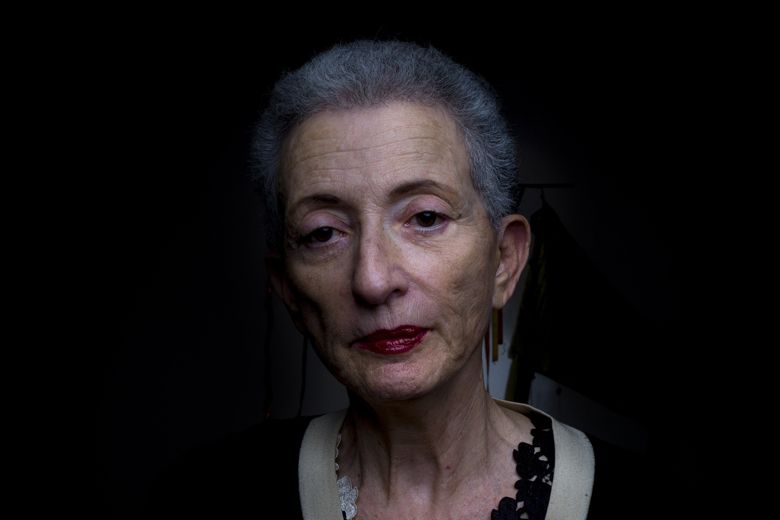
OLIVIER ZAHM — Your own history lies at the crossroads of all of European history, of colonialism.
HÉLÈNE CIXOUS — In 1939, my father was mobilized. He was a physician-lieutenant, stationed on the front in Tunisia. He had a small problem, signs of pulmonary trouble… In 1940 he was demobilized and stripped of his French citizenship. In a single stroke, with the anti-Jew laws, we who had been French much longer than most of the French in Algeria or in France lost our French citizenship. My father was forbidden to practice medicine: professions were forbidden us in North Africa, as they were in France. Under the anti-Jew laws, the sole difference between what happened to us and what happened to the Jews in France was that we were “liberated” first because the Americans landed in Algeria in 1942. I didn’t go to school; it was forbidden. My father was no longer practicing medicine. That’s when my mother started working. She was a cutter and seamstress. Later, when the Americans came, the Jews did not have their rights immediately restored. My mother instantly took up with the Americans, doing secretarial work. The first square meal I had was when the Americans came. We suddenly had tins of butter, white bread, jam. I fell in love with the jam-bearing, loud-laughing Americans, like all the people liberated by them. We were raised on Roosevelt. I cried when he died. It was terrible. It felt as if we were losing a kindly person. We followed politics. My father was an atheist and a socialist. His close friends took up with De Gaulle. The word “Allies” was warm and sweet.
OLIVIER ZAHM — We go from the army to statelessness.
HÉLÈNE CIXOUS — That was a wound from which my father never recovered. He had been a socialist in the time of Blum, an idealist. That was when he lost his faith in the French Republic. After the war, he started practicing medicine again, left Oran, and moved to Algiers, where he opened Algeria’s first radiology practice, ordering in the equipment from England. He died in February 1948. My mother found herself alone in a city she didn’t know, penniless, with no family or friends around. She toiled like mad to support us, first as a secretary, then seeking out a profession. She undertook to become a midwife. I was 14 and studied along with her. She was 40 at the time.
DONATIEN GRAU — And thus you made your first approach to literature and poetry, felt your first desire to write.
HÉLÈNE CIXOUS — The desire to write was a great help to me when my father died. I had already been shaped by literature as a little girl. For one thing, my father was a reader, a man of extraordinary talent. When we were young he immersed us in the French language. He had memorized the Larousse dictionary. I recall feeling a shock of delight when I was six, because he taught me the word extraordinary. It was, I thought, an extraordinary word. I was swimming in a world of languages. My mother spoke German with Omi, who spoke to me in German and French. My paternal grandmother spoke Spanish around the house. My paternal father’s family spoke Spanish. I started learning English very early on. When I was 13, my mother sent me to England. I had to go from Algiers to Marseilles, and from there by train to Paris. Then from Paris to Dieppe, and from Dieppe by boat to New Haven. And from there by train to London. In London, I was taken in by one of the formerly German families on my mother’s side; they were now English. I liked England. In 1950, London lay in ruins; it was much poorer and in much greater difficulty than France. We were given meal tickets when we arrived, for instance. I went hungry in England, whereas in France people were already well fed. So I straightaway got the story of wartime England, of England’s resistance, of a marvelous England that I loved. When I returned to Algeria, I was fluent in English. And I soon had only one thing in mind: to leave Algeria as soon as possible; it was an abominable place filled with violence, hatred, contempt for other human beings. I was sure the place would one day explode, and I eagerly awaited that day. I was completely in favor of the Algerian people. My father had worked in solidarity with clients that were referred to as “Arabs.” My mother’s clientele was also essentially “Arab.” She worked in the casbah. I knew from the time I was a little girl: this is a world of total alienation, a world of people blind to their fellow human beings. My mother had found a purpose for herself, bringing babies into the world. I recently took the register in which my mother recorded births to Karim, the Théâtre du Soleil’s cook, who was born in 1963 by my mother’s hand. It made sense for my mother to be in Algeria.
DONATIEN GRAU — Your father’s death hastened your entry into the world of writing.
HÉLÈNE CIXOUS — When I was little, I wanted to flee; I wanted to get out of that repugnant world. I found a solution: I would climb a tree, taking books up with me. I realized very late, when I discovered his high school notebooks, that the choice to do medicine was not at all my father’s. Unbeknownst to me, he had taken a first prize in philosophy. He was a man of letters. He had amassed a library in the Proustian manner. He was a subscriber to the Nelson library and had the whole collection. He also owned the first Gallimard editions of Proust. I was absolutely mad for books and would read them in alphabetical order. For me, they were all equal. I could vaguely sense a small difference between Dumas and Edgar Allan Poe, but my reading was scattershot. I lived, then, in the other world. The second world was literature, and I was also fortunate in that my grandmother, although she had not carried her studies very far, had a passion for German poetry. Omi would sing and recite poems to me by Goethe and Heine, and I loved it. I said to myself: “That’s the path for me.” Down the path of languages, literature, and books. I’d be a reader; I’d live in books. It was a brutal thing when my father died. It was the apocalypse; the world was gone; I couldn’t even walk; the ground had vanished beneath me. It was terrifying. I wasn’t yet 11, I was in sixth grade, and the world had gone. When my father was carried away — he’d suffered hemorrhages and died within a few days — I started writing for him. I saw him one last time, through a window. Our relations were already fairly phantasmal. Knowing he was seriously ill, my father was already keeping a certain distance between him and us. He avoided contact.
DONATIEN GRAU — Is that when you began writing in earnest?
HÉLÈNE CIXOUS — Right then, at that moment, is when I began living in that world. That’s where I settled. Relations with my French professors quickly soured. I was inventive. I was very daring at the time, I realize. Sometimes it was well received, sometimes not. I never hesitated over the path I ought to take. I had to live by books. I couldn’t do otherwise. It was the only thing that could tolerate me and that I could tolerate. The political world I already knew. I had seen it up close. I was good in history precisely for political reasons, because I kept track of the fate of all the peoples I knew. I was an expert in evil. I dreamed of books: we were poor, and my father had left us in dire straits. It wasn’t until much later that my mother began earning enough of a living to support us. We lived off what my father had planted in the garden. We sold the flowers, which was terribly painful for us. We walked everywhere. I was very careful with my expenses. “I must help my mother as soon as possible.” So I earned my agrégation in a flash. I was in hypokhâgne [first of two years of post-secondary study in letters] in Algeria, and I got married, partly in order to get out of there. I was 18.
DONATIEN GRAU — You speak of politics: you’ve made your literary life into a sort of political proposal.
HÉLÈNE CIXOUS — I’ve always thought so. I knew, also, that it was a rather elitist way to go about it. There had to be books. The Algerians had no books; they didn’t go to school. Since the house my father had rented was in an Arab neighborhood, I was living in a world where there were only a handful of “Europeans.” The Europeans never ventured into those neighborhoods; they didn’t know them. Next door to us was a shantytown with 50,000 Arabs and a single fountain for water. At our gate there were “little Zarabes,” as they were called, barefoot and dressed in rags, who would ask us for bread. I was living amid misery and pain. It was frightful. Never the twain could meet, save some rare exceptions. For the little Zarabes, we were “French people” — we who were not French.
DONATIEN GRAU — Your literary and political lives don’t seem all that elitist in light of the impact that écriture féminine [women’s writing] has had.
HÉLÈNE CIXOUS — When I began turning my attention to women I was 22, 23 years old. I was no longer fleeing into literature. By then literature could become the most democratic of the world’s possible tools. One needed only have access to it. But I was living among a proscribed, banned people, who had no access to the tools, who were not admitted to the schools. I arrived in France in 1955. We were then entering a period of decolonization. There was the Algerian War, the so-called “events” in Algeria. I was relieved; it changed my life. I emerged from the plague, from that monstrous nightmare, and found I could develop a thirst for my own life. But I didn’t have a life of my own. Algeria had alienated me from it. Once Algeria had set about liberating itself, I found I was liberated as well. Landing in France at 18, I was greeted with a surprise: when I entered rooms or lecture halls nobody yelled out “dirty Jew,” the daily insult in Algeria. I was surprised. For that brief period, France was not anti-Semitic: there were no Jews left in France. For a few years, until 1962, the givens of anti-Semitism were attenuated. The Jews of France had been deported. French people of my generation had never seen any Jews. They were all dead. But when I went to the university, I encountered something that I had never known in Algeria: misogyny, everywhere. I was from a world that liked women. The women of my family were strong; they carried the family. And in France I suddenly realized that the world was split in two and governed by the pretentious cretins who played at being university professors. I understood then that the chief battle was going to be to deconstruct a phallocracy.
DONATIEN GRAU — And to construct femininity. A central component of your work over the years is the notion that gender is not in any way a limit but, rather, a liberty.
HÉLÈNE CIXOUS — Yes, of course. But for everyone: men, women, animals. As it happened, I completed my studies very quickly, in tribute to my mother. And immediately thereafter I was taken in hand by some excellent men, some exceptional men. My thesis advisor, a marvelous man, a great man of letters, and a former member of the resistance, was so removed from misogyny that he chose to take me under his wing. His name was Jean-Jacques Mayoux. I was truly fostered and respected by men of a certain age who were great doyens at the Sorbonne, and themselves members of minorities and marginalized.
___
Book
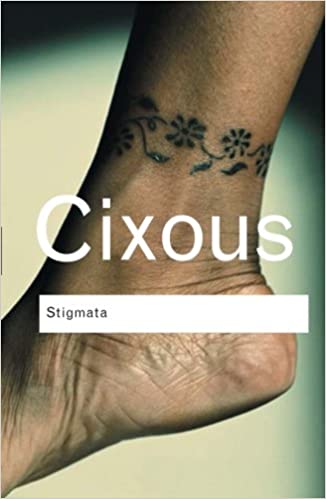 Hélène Cixous Stigmata
Routledge Classics
‘Stigmata is work that gets away: escaping reader, writer, and book… This is a collection of recent short texts by Helene Cixous, who is hailed as a foremost contemporary writer and thinker of our time. World-renowned for her brilliant contributions to French feminism and acclaimed by luminaries such as Jacques Derrida, her writing, and in particular her fictional texts which constitute by far the greatest part of her work, has nonetheless been misunderstood and misread, often simply avoided, to a surprising extent. Cixous is extremely attentive to what language has to say and her playful, boundary-bending, and innovative style is what makes her work so exciting, powerful, moving, and suspicious.
‘A ‘wilful extremist’ according to the London Times, Hélène Cixous is hailed as one of the most formidable writers and thinkers of our time. Acclaimed by luminaries such as Jacques Derrida, her writing has nonetheless been misunderstood and misread, to a surprising extent. With the inclusion of Stigmata, one of her greatest works into the Routledge Classics series, this is about to change. Questions that have long concerned her – the self and the other, autobiographies of writing, sexual difference, literary theory, post-colonial theory, death and life – are explored here, woven into a stunning narrative. Displaying a remarkable virtuosity, the work of Cixous is heady stuff indeed: exciting, powerful, moving, and dangerous.’ — Routledge Classics
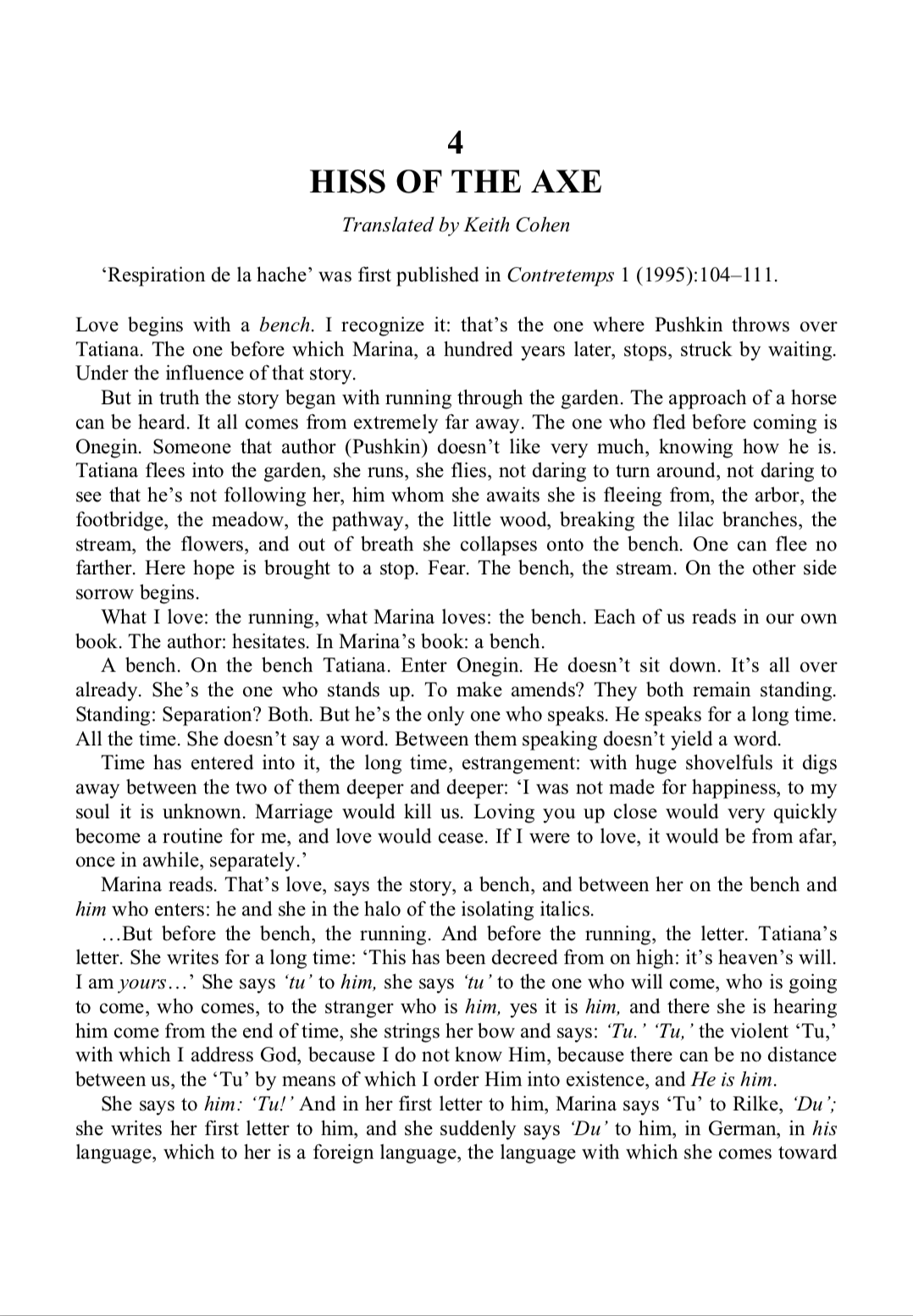
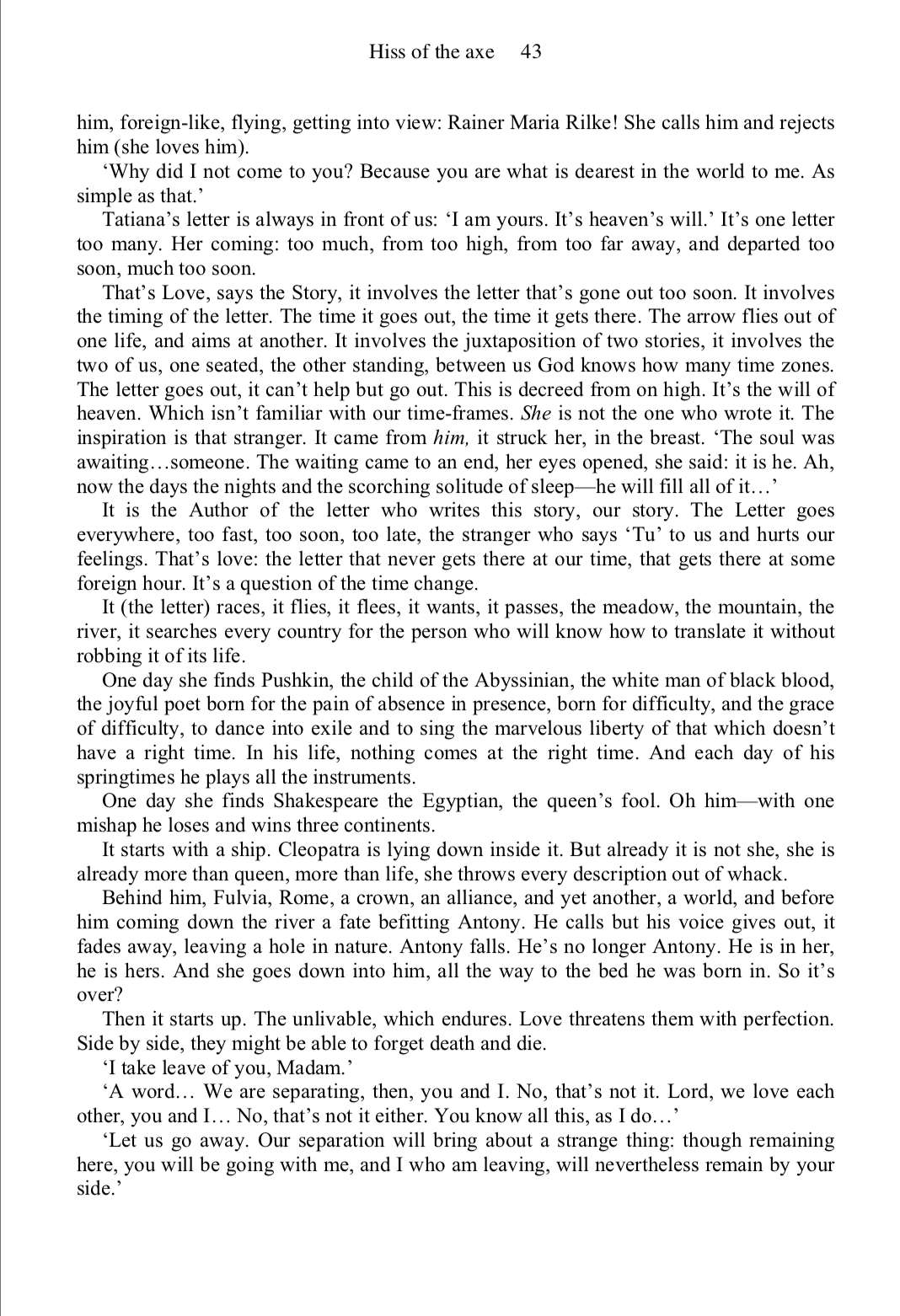
Excerpt
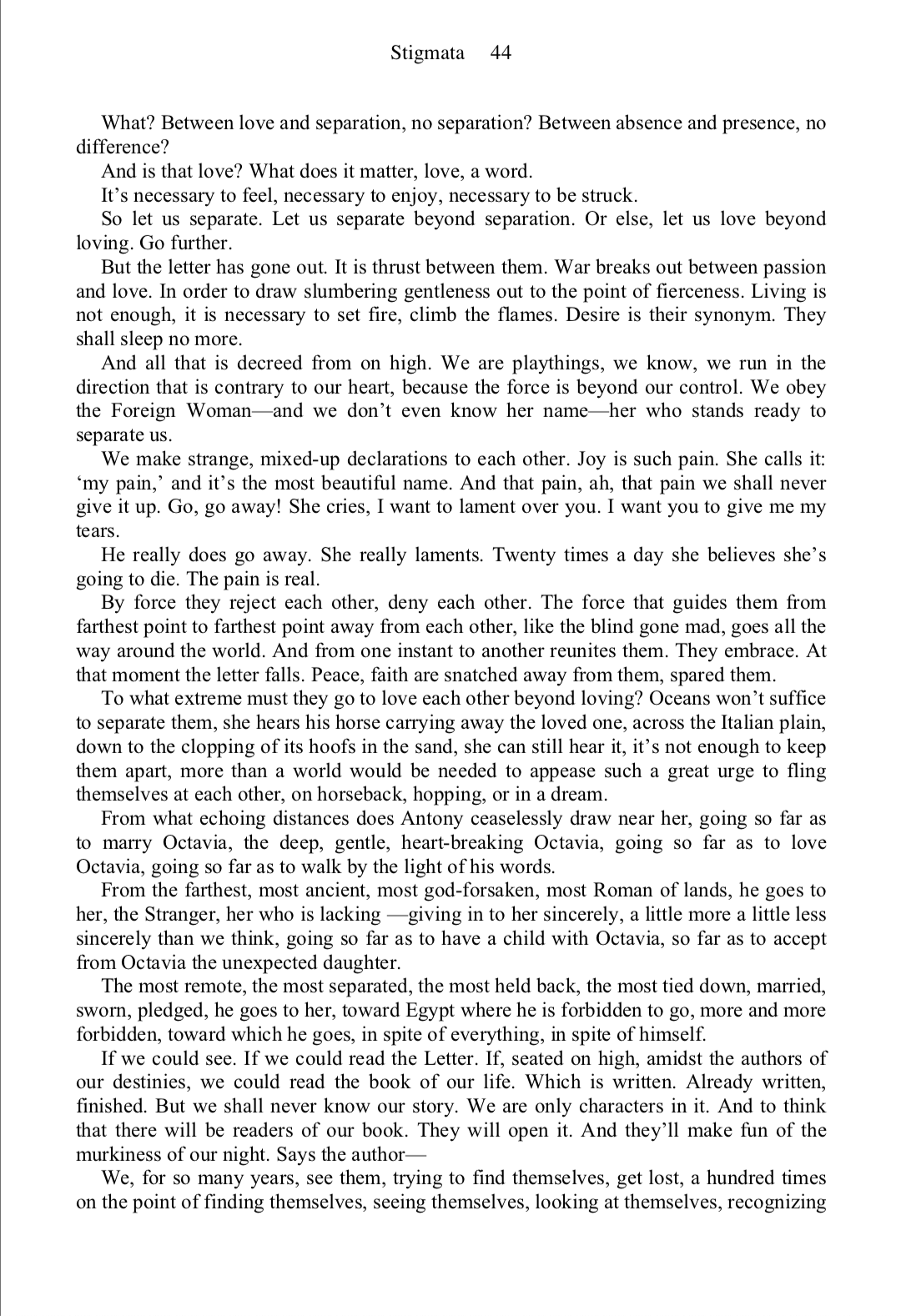
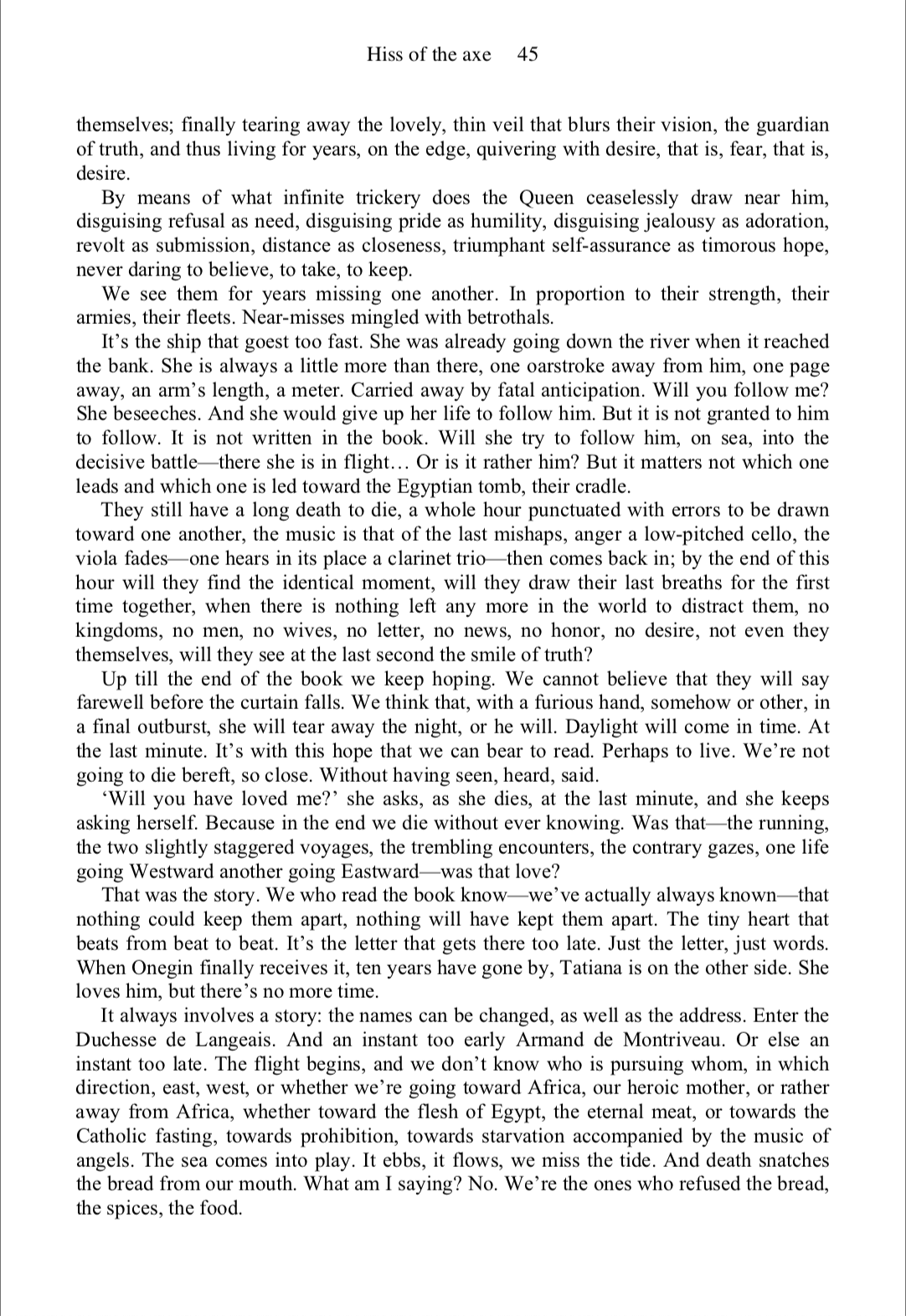
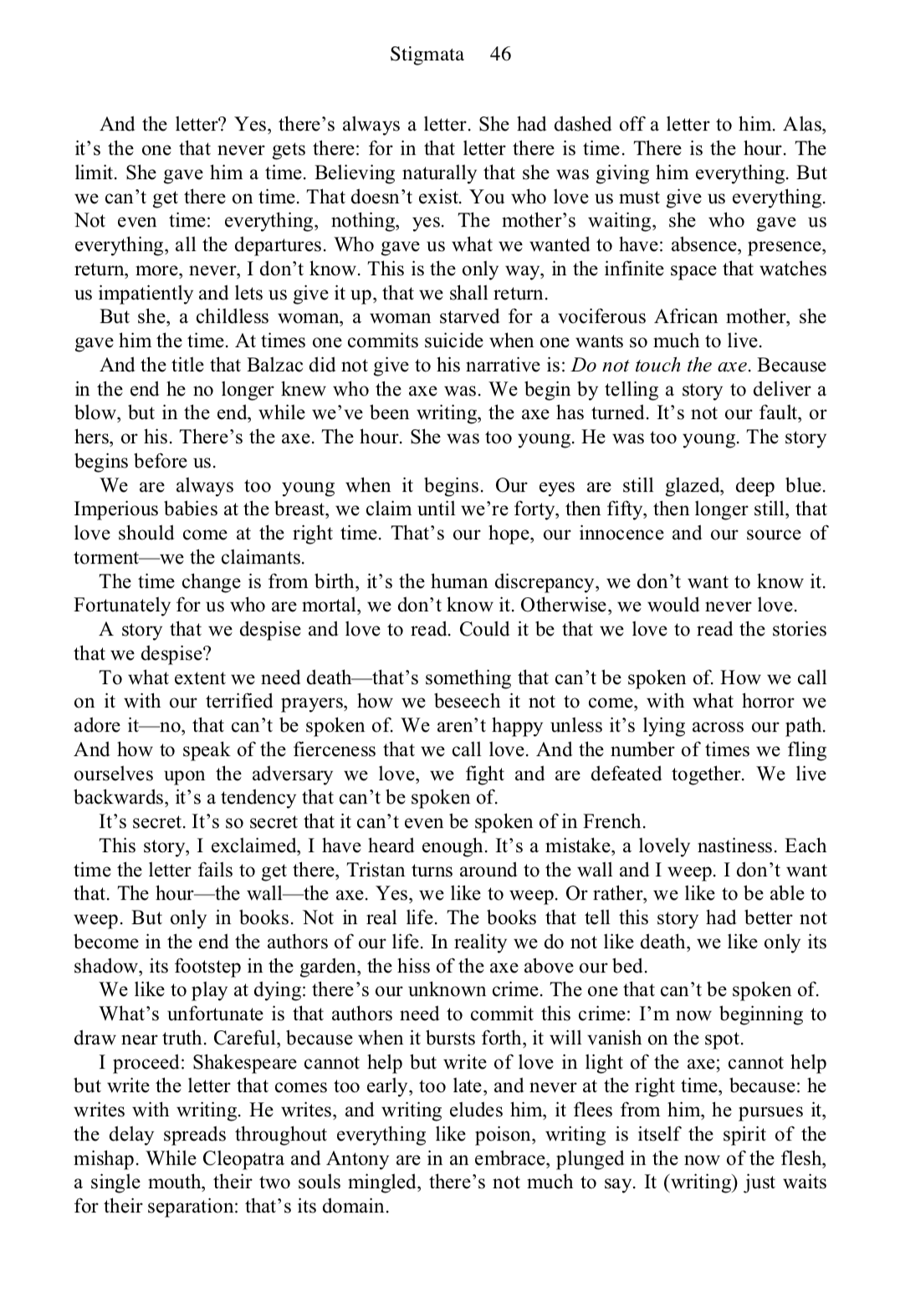
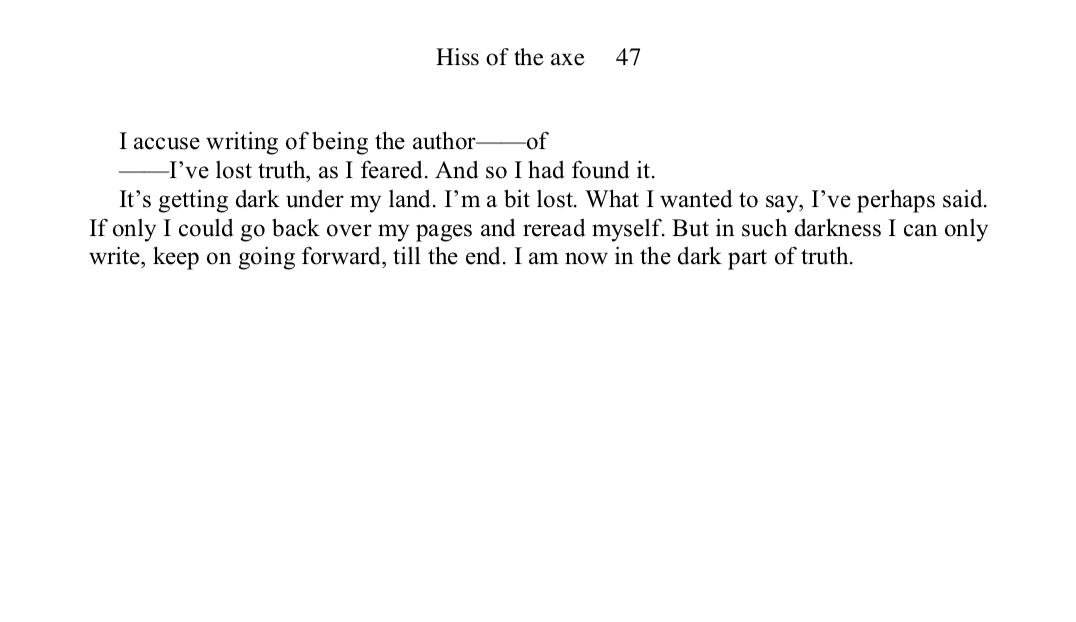
*
p.s. Hey. ** Adem Berbic, Hi. That English translation doesn’t do much for me, and there you go. But your explanation was good, tweaky. That music sounds pretty cool. My weekend? I re-saw Godard’s 3D film ‘Adieu au language’ which was just unspeakably great and saw friends and a producer who I approached about our next film asked to read the script, so that was all pretty okay plus the strangely beautiful temperature. Zac and I are going to Norway to show ‘RT’ at the end of August and we want to hit some theme parks up there, but I think we/I will probably be back here by then. I can let you know soonish. ** jay, Hi, jay, happy you liked it. How refreshing to hear your report on ‘The Odyssey’ given all the ‘masterpiece’ nonsense flooding everywhere. Inert is the perfect way to describe Nolan’s films in general, so I have no doubt. I appreciate your sacrificial service to my filmgoing future. ** _Black_Acrylic, He’s pretty ‘outsider’, yeah, and considered as such even in France. Zidane is the next France manager? Wow. I mentioned the other day that I had a coffee with my visiting nephew at this swank hotel here on the afternoon of the France/Spain match, and Zidane was sitting at the table next to ours. He seemed very nice. He had an itsy-bitsy expensive looking dog on his lap. ** Dominik, Hi!!! Today seems like a lovely one too. Very strange. The words Larry Clark and morally sound don’t really go together, but yeah. I guess at least here the heatwave encouraged lots of insect sexual organ outputting? Paleontologist, huh? That would come in handy. Love wondering as he so often does why the French are so piss-poor at making muffins, G. ** Carsten, Based on the voluminous research I did while developing my Cycle novels, I think serial killers have all kinds of motivations for what they do, but I never came across one whose reason why was as interesting as what I was imagining. I hear you: what I write has almost never been what literary magazines are looking for. C’est la. I think I saw pix of you celebrating the Spain victory, and you did look like you were having a helluva time. ** Laura, Hi. Cool. About 90% of my clothes shopping is online. Patagonia is one of the few stores that sell fully organic clothes, but mostly only t-shirts and underwear. I have a couple of Hüsker Dü cassettes in LA, but they aren’t worth the shipping costs. Day just started, so I don’t know yet. Weather is still perfect-adjacent so far. I want to write, but it’s not happening, and I could sing, but I don’t want to. ** Diesel Clementine, Hello there! Tom Scott’s voice is excessively emphatic, no? I’d probably eat ‘jail munch’ if it didn’t have pepperoni. Cool about the magazine. In the old days, summer started fading away in August, but summer can’t be trusted anymore. My characters are fully fictional, and I don’t think of them existing beyond the pages that they are inscribed upon, so I don’t know what would happen to them. They just disappear without a trace when the novels end. The reader makes up their future if they want to. Even if they were real, I don’t like to generalise, and I think of them as being distinct and individual, so they would grow up in all kinds of ways, good and bad. Not the answer you hoped for, I’m sorry, but I just don’t think of them as anything but serving their novels’ purposes. Where to start? Obviously it depends on your mood. You could read ‘My Loose Thread’ which is a favorite of mine and probably my least read/talked about novel maybe? Thank you for asking. xo. ** Alice, Hi, Alice. Busy is life. I’m glad that cool job has panned out interestingly. Little groups of friends are optimal. I have not read ‘Chaosmosis’. I’ve noted it for near future bookshop hunting. Great that people are being so high and supportive about your new writing. Obviously take that as impetus. I don’t know The Brave Little Abacus either, but I will. That’s surely easy. Yeah, I’m very happy you’re feeling excited about something that you yourself are making. Does it get better than that? No. It’s been a year, wow, time is so … weird. It’s been nothing but lovely to get to dialogue with you too, pal. ** Steve, I buy clothes almost entirely online and, as I said above, sometimes at Patagonia if there’s a store within reach, which there isn’t here in Paris. I read that Ian Thompson book. I remember it being very informative. You mean Gong aren’t just seen as goofy hippies even now? Do you think Debord’s view that real life ended in his youth as evinced in that book is pervasive throughout his work? I never picked up on that if it is. Huh. Food for thought. ** ⋆˚꩜。darbbzz⋆˚꩜。, Hi! That all sounds really heady, and not in a hampering way at all. Brains can absorb a lot of different and even conflicting things without losing their focus and drive. That’s my policy. Or wait, that is a little tricky about ‘Jay’ ‘Experiences are never completely retold in accuracy that encompasses all human emotion’: that’s about as true as it gets. Those Soviet oscillations are really cool. Thanks! I didn’t skip a chunk or even a word or maybe even a punctuation mark. ** laura w, All interesting things are mildly terrifying, aren’t they? I have a weird brain, mind you. When I was younger I never used to tan, and I got third degree burns from the sun twice, but now I seem to tan even in the most unlikely outdoors circumstances, it’s odd. I barely even know what the word relaxing means. Switch 2! I only have a Switch 1 and I don’t play it enough as it is. Sad. I’ll find you on Instagram and follow you own about, oh, ten minutes more or less? Maybe fifteen? ** HaRpEr //, Some place outside of France should really mount his ‘Cupidon’ mechanical opera. It’s fantastic. I’d be confused if I tried to use Instagram in a creative way too. I just share the blog and film stuff there. But doing so or doing something there really does make a large difference. Ever since I started announcing the blog posts there, traffic has increased notably. And lots of people seem to have discovered ‘Room Temperature’ that way. Worth the figuring out. ** DonW, Hi. I couldn’t find your playlist yesterday, but I’ll try again with the new info. Sure, write to me re: Paris whenever the time is right. So what do your students think is appropriately cool music, or do I even want to know. ** Right. Today I am spotlighting an excellent book by the great Hélène Cixous for you. Do what you’re going to do. See you tomorrow.



 Now available in North America
@Laura, you Zoomed me out of how I take French in — like, my brain locks in on the syntactic/vocabulary straitjacket quality it has and turns it into a tonal straitjacket as well, regardless of what tone is or isn’t actually there. I showed a French friend ‘Dans ma chambre’ recently, she read the first page and started laughing, and I thought, what’s so funny, it’s a bunch of guys arguing and jerking off, isn’t that heartbreaking? The chunk I just finished writing is in English but it probably tries to make itself a straitjacket as well. Not probably, definitely. Or, I think there must be some way of mixing the fluidity and the rigidity. So that they cancel each other out and then you can push through. And I always find idioms extremely violent but that’s probably just my brain being broken — I find full stops violent too, but not everyone can be Molly Bloom.
@DC, in the sentences’ defence, that translation was so workmanlike it just ate a ploughman sandwich. I think Dustan would have died another death if anyone had accused him of using a French word with the same colour as ‘truly.’ But, as above, I guess I impose a texture on it which might not necessarily be there. That sounds like scores across the board to me, weekend-wise. Sounds moderately promising on the September front, too. I think I’ll be doing a Saturday-Sunday-Monday manoeuvre again. I got some warm feedback on the pamphlet from people who clicked with it in various encouraging ways, and some people also seem to be pushing it onto their friends to read, which I find a very nice form of diffusion, although I guess James gets less money.
Did I mention before that I saw Cixous give a talk at the Cité universitaire in, hmm 2022-ish? It was definitely very weaving and ended in an audience-participation sing-along of an English folk tune from World War 2. But each discursive move she made did have a sort of weight of conviction behind it which I still remember now.
Yeah I heard/read you say that before somewhere, that you found most serial killers’ motivations intellectually disappointing (if that’s the right word, haha). Well in defense of my theory I’d say that in most cases it’s surely not a conscious rationale behind the act. I don’t think those who have the desire to kill usually come equipped with a deep justification for it. In fact, I’d assume most would be quite troubled and/or confused by their desire. But I am curious what some of the more articulate murderers would have to say about my theory.
The publishing world is strange, yes. I was honestly shocked to discover that many literary mags are still putting up this kind of faux-New Yorker “high culture” act, which I idealistically thought was dead as a doornail.
Ah so you saw the photos I posted on FB of our world cup festivities. Yeah, watched the game at a chiringuito (which is a beach bar/restaurant) with some friends & plenty of locals dressed in full Spain-support gear. The guy with the torch lit it up after Spain finally scored, ran through the bar & onto the beach, spreading red light & smoke everywhere. After plenty of cheering & jumping & ripping off shirts we all realized there were still 10 minutes left to play, haha, but Spain luckily prevailed. Good times for a change, in global events that is.
Hi!!
I’d never heard of Hélène Cixous; I really enjoyed this post. And both photos of her are fantastic. Thank you!
That’s a shame about French muffins. Do you have a favorite brand? Or what are the criteria for a good muffin?
Love getting ready to see Marilyn Manson tonight, Od.
oh what a great post! I was thinking the other day how when Im thru purchasing my Science fiction reads I’d like to delve into more French literature outside Genet so this is a great addition. Ive decided to eradicate the chains of money frugalness, at least in terms of books, as if its not at the library, or on a internet PDF, I’d very much like to read these books that having been floating in my mind these past 2 months. Have you ever read Izumi Suzuki’s Terminal Boredom? She was a very fascinating figure, and anyways, ive been wanting to read more science fiction from the 70s through the early 90s, and her body of science fiction work seems to be more an exploration of the innate absurdity encompassing humanity and society and metaphors relating to it.
Plenty of genres and sub-categories ive been wanting to explore in literature.
Hmmm..what else?
Big fan of Terminal Boredom ! Great story !
Hey Dennis, I think I posted my comment too late yesterday. But anyway, thank you so much for the trumpeting! Hope you enjoy the piece, me in my noise hat.
I love Gilbert Peyre’s work. Years ago I saw Cupidon in Paris on your recommendation. But it was quite an ordeal: I had to get bumped from my flight to make opening night, it was sold out and I had to sweat in line for cancellations. But definitely worth the drama!
I just discovered Bruce Woods’ abstract B&W shorts. Wow.
Bill
Literary criticism is a difficult thing for me to get on board with for much of the time, but Cixous’s book here would seem to transcend such issues. I do tend to like it when academics get all soppy on us.
Cool story about Zizou and the tiny dog! The guy has only gone up with my estimation.
Yeah, Gong were silly hippies, but that’s their charm. Anyway, the book introduced me to several interesting bands: Komintern, Moving Gelatine Plates.
I don’t think that nostalgia was a part of Debord’s writing as a whole or his thinking in the ’60s, but it sure comes across in WE SPIN AROUND THE NIGHT CONSUMED BY THE FIRE.
The heavy rain hasn’t begun yet, but it’s extremely humid outside.
Hey again, Dennis: Okay, I emailed you a link to my playlist. Hopefully you can access it? And oh, you know, way back when some students were (kindheartedly) making fun of my playlists that listed songs from Moana, Annie (the musical), Little Mermaid — you know, songs my girls liked at the time. So I hid myself. Whatever. Now I don’t know (or care) how to find out how to unhide. Anyway, now I’m dorkily tracking online Pavement’s different set lists during their tour. I always get like this after I see a band I love… I’ll mash their music into my skull until I’m sick of them and then need a reset / palate cleanser. Oh, and reading another Jean-Patrick Manchette novel, “The Mad and the Bad.” We’ll see. I liked “The Prone Gunman.” Both originally published by, I think, Gallimard? This one’s a NYRB book, which seems to be the only imprint I’m reading right now. Take care, Don
This is new to me. And it sounds sublime! It’s on the book list. Thanks, Dennis!
Hope you’re good. I arrive in Paris on Sunday evening! So excited to be back and have a change of scene!
Love,
Thomas xoxo
I wouldn’t worry lol, I’m aware it’s a fairly anodyne question –but feels kind of impossible for me not to think of as of late. I hope it didn’t come across insulting, I guess I wasn’t hoping for any answer in particular. I’m very staunchly “Ceci n’est pas une REAL LIFE PERSON” when it comes to fiction; I was repulsed by those AI generated pictures that ‘zoom out’ of starry night or whatever the fuck; ‘whats supposed to happen next here?’ is usually a fairly reactionary and anti intellectual question in and of itself. But, yeno, people who exist –and their discontents– find a way to wander into an experience of art.
I think I’m also considering this –more abstracted from the daily personal stake I find myself having in others recoveries– through a lens I once asked you about in regard to the relationship between the Cooper oeuvre and the ‘end of history’. I think I spend a lot of time in conversation with people about whether history’s back and whether anything’ll happen again. I suppose making the connection here feels gouache to make explicit because the lens Im employing is maybe a little gouache itself lmao.
Funnily enough, My Loose Thread was actually the first of yours I read! Barring the Dream Police I suppose.. the scenes in the bathroom and the bath are very present when I think about it. Thinking back, I feel there was something distinct about the boy’s flavour of agentic non-agency.
The sausage in the jail munch was kind of the British equivalent to a slim Jim (or what I understand of them from The Simpsons) — god I just looked slim jims up, the packaging looks like BBQ fire starters.
Are you away for a festival soon ? How did the last one go ! I hope well ! Can I get Room Temperature on DVD anywhere online (or IRL even) ? Id like to do a viewing party for my pals soon !
Hope you’re doing fabulous as always ! My husband says hi — and our ex also (they’re always saying to say hi whenever I send in a DC blog comment lol)
bisous !
Hey. I haven’t got to Cixous yet but will make sure to! I was reading recently about her novel ‘Angst’ that was just brought back into print in English this year, but I think this intrigues me more.
With the Godard talk I decided to finally watch the first two parts of ‘Histoire(s) du Cinema’ and was mesmerized throughout. The editing for a start is just so incredible. The kind of editing that if done well, I can go crazy for. I love the overlapping and flashing images, and there’s some great Kuleshov effect experiments with removing images from their original contexts and placing them alongside new ones. And the aphorisms! The aphorisms are so great, as is his signature use of words in general. Oblique but so sharp and affecting. And from what I’ve watched so far it’s really strangely moving.
Today I finally finished my project of listening to every officially released Autechre album and EP. I was thinking of doing the live sets as well but that would probably take years and before long I might turn into a piece of sheet metal or something. ‘Draft 7.30’ is my new obsession. I always loved their classics but I really wanted to do a deep dive, and I now have the opinion that they’re not nearly as cold and heartless as those who review them claim. The whole experience was really valuable because I’ve always thought about what a literary equivalence would be to that. How do you make prose glitch? I haven’t gotten there yet, but that’s something I want to properly try in the future.
huh that’s so funny- about a month ago, i saw a post about cixous on instagram and have since been seeing her everywhere. not stigmata, though- i think one of her feminist texts? the laugh of medusa, maybe?
all interesting things are! when i was a kid, i used to get really attached to things that scared me. i remember the movie coraline freaked me the fuck out and i became mildly obsessed with it even though it also gave me nightmares (one of the few movies that far outstrips the source material, i think, but i never was a gaiman fan anyway). it’s fun to pull apart things that freak you out or unsettle you and try to figure out why they have the effect they do on you.
maybe you burned so much your skin has given up? or maybe moving to a much less sunny climate made your skin desire the sun lol.
great news about godard and the producer! i did notice and accept your follow! the only odyssey i’m interested in right now is potentially replaying mario odyssey.
see you tomorrow!
Hi Dennis! The stigma discussion (stop me if I’m wrong,) seemed to miss the flower anatomy. Stigma being the female part through which the pollen tube grows, if I understand correctly. Anyway, Imma be in Paris Aug . 2 to 5 and would love to see you if you’re around. -Carter
I found your insights on the concept of the wound in Cixous’s work really fascinating! The idea that literary writing stems from the scar is so poignant and deeply resonates with the way we create meaning through our experiences. Also, it’s intriguing how she views the ‘blessure’ as a blessing rather than just a mark of pain. I usually explore similar themes in some academic journals that delve into feminine writing. It’s a great way to deepen the discussion!
I found your take on Cixous’s concept of the ‘blessure’ fascinating! It really brings to light how our wounds can shape not just literary writing but our very understanding of existence. The connection between scar and creativity is such a powerful theme! By the way, I often reference a helpful free resource for exploring these kinds of literary themes called a poetry analysis guide.
What an intriguing perspective on Cixous’s approach to the concept of the wound! I love the idea of viewing injury as a means of blessing rather than a purely negative experience—such a poetic way to articulate the origins of writing itself. It reminds me of how much pain influences art and expression. By the way, I often refer to some literary theory podcasts I find helpful for deepening my understanding of these concepts.
This is super helpful, thanks for the effort! see here