* (restored/expanded)

‘The term ‘post-internet art’ has emerged in recent years to acknowledge the profound impact hyper-connectedness, abundance of information and collective conversation has on our lives, subjectivities and art. It groups together artistic practices clearly influenced by the proliferation of the internet into everyday life. Although it is a contested term, little-loved by many artists associated with it, and a confusing one (at first suggesting art created after the end of the internet, rather than that ushered in by the arrival of web 2.0), it has a certain usefulness.
‘Of the many artists associated with post-internet art who are ‘digital natives’, Ryan Trecartin (born 1981, United States) is one of the most lauded. The narratives and editing of his moving-image works – which he refers to as ‘movies’, in defiance of the widely adopted terms ‘videos’ or ‘films’ – question traditional film and television programs and the ways such material is consumed and navigated by a generation raised with the internet, multiple screens and communication devices ever present. This is achieved in part by the aesthetic character of Trecartin’s movies, which often employ cacophony as a guiding and structural principle: the acting, editing, sound and sets are constantly in excess and operate at a high-pitched register echoing that of the information age. In this cacophony, digital natives see a representation of themselves and their everyday lives, while older ‘digital immigrants’ recognise the technological clamour that has come to surround them; Trecartin’s movies reflect each group’s experience to some degree.
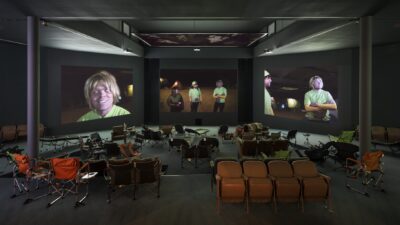
‘Other crucial aspects of Trecartin’s practice have contributed to his recognition within this conceptual milieu. The sheer ambition of his movies is immediately striking, but never feels driven by a sense of singular achievement. There is the sense of the ensemble at work in them, in the tradition, unconsciously or not, of filmmakers such as Rainer Werner Fassbinder, Paul Morrissey (at least while working with Andy Warhol), John Waters or Pedro Almodovar. While Trecartin writes the scripts (along with acting in, filming, editing and sometimes scoring the resultant movies), his creative practice is enfolded with that of artist Lizzie Fitch. Trecartin and Fitch have been collaborating since they were first-year students of Rhode Island School of Design in 2001, when Trecartin majored in Film/Animation/Video and Fitch in Painting. They formed a production studio together in Los Angeles and see their relationship as central to the creation of Trecartin’s movies. When exhibited as video installations, these ‘sculptural theatres’ are co-credited to both artists. Filled with bland carpet of the type found in cheap office renovations, and populated by quasi-designer flat pack furniture, the sculptural theatres mimic the bland ubiquity of the movies’ environments, complete with various props that appear in or are implied by them.
‘The Re’Search Wait’S series, 2009–10, for example, is one part of the project Any Ever, a diptych comprising seven autonomous but interrelated videos. The other part, Trill-ogy Comp., consists of the three works K-CoreaINC.K (section a), Sibling Topics (section a) and P.opular S.ky (section ish), while Re’Search Wait’S comprises four movies: Ready, The Re’Search, Roamie View : History Enhancement and Temp Stop. Whereas a certain visual mashup aesthetic characterises the montage technique employed by Trecartin in this series – similar to having multiple windows open on a computer, replete with computer effects, plug-ins and animated transitions – there exists a tension between the cut-and-paste, slapdash and disordered approach this connotes and the highly considered work required to create the sets, choreograph the scenes, direct the actors and crew and produce the scripts underpinning the seven movies.
‘The performances, too, provoke this tension, at first coming across as improvised due to their manic delivery and the mix of trained and untrained actors, but quickly recognisable as highly scripted in Trecartin’s very particular, punning language: a patois of text messages, ASCII art and corporate brand sloganeering. When viewed in written form4 the text’s link to concrete poetry is clear, about which Brian Droitcour has written persuasively in the journal Rhizome. Droitcour is at pains to point out the difference between Trecartin’s generative approach and the pure appropriation of found words and phrases:
Trecartin’s writing responds to the internet, but it defies an assertion made by Kenneth Goldsmith, poet and founder of UbuWeb, who wrote that flarf and conceptual poetry are the quintessential poetic responses to the digital age because they employ cut-and-paste techniques.
‘Droitcour asserts that this approach results in poetry by Goldsmith that, while often humorous, is ‘so sterile, it’s unreadable’, and that his technique of reconstituting nonsense phrases from found linguistic scraps ‘petrifies genre and meaning with it’.
‘Sterile is one thing Trecartin’s movies are not. Rather than the unordered (or randomly reconstituted) nature of the cut-and-paste aesthetic, his work engages a multiplicity that mimics and extends the sense of the internet as being an experience of information overload and noise, with various commentaries vying for the viewer’s attention. Flame wars in internet chatrooms, long-running hoaxes on multi-authored wikis, a teenage girl’s weekly YouTube program fictionalising her home-schooled life, endless viral attempts to remake the Harlem Shake dance style and performing tweens practising virtually anything in front webcams are now all very contemporary, narcissistic and neurotic phenomena. Re’Search Wait’S presents the legacy of such present-day activity, the movies’ gossiping, sniping discourse interspersed with karaoke-like performances to form a picture resembling the confessional, or talent-spruiking, personal webcam diaries of teens in ‘real life’ (with the intensity of a hyperactive child off their Ritalin).
‘Trecartin’s plotlines are not so much convoluted as they are polyphonic and fragmentary, embodying the nature of the internet itself. There can be multiple viewpoints, text and stock footage vying together on screen at the same time, cutting in and out in different rhythms. Characters’ voices from different scenes talk in unison, or in staccato counterpoint, at different speeds and pitches. Dramatically, we often do not see cause, only effect. When first encountering the movies, the plot can be difficult to grasp for these reasons, but they reward immersion and multiple viewing. Most of Trecartin’s movies are available on the internet, which allows them to be grazed by viewers in their own time, and the works’ spacious, immersive installation in the gallery offers a chance for non-contiguous viewing; the physical act of moving from one to the other acting as a form of editing. Rather than diminishing the experience of the work, dipping in and out of it in a non-linear way merely reaffirms its structural logic at odds with the traditional linear cinema experience.’ — Simon Maidment
____
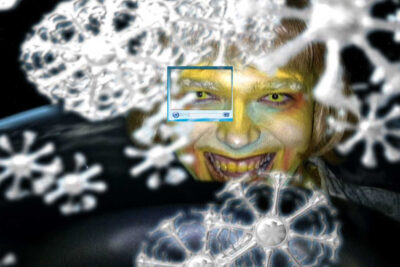
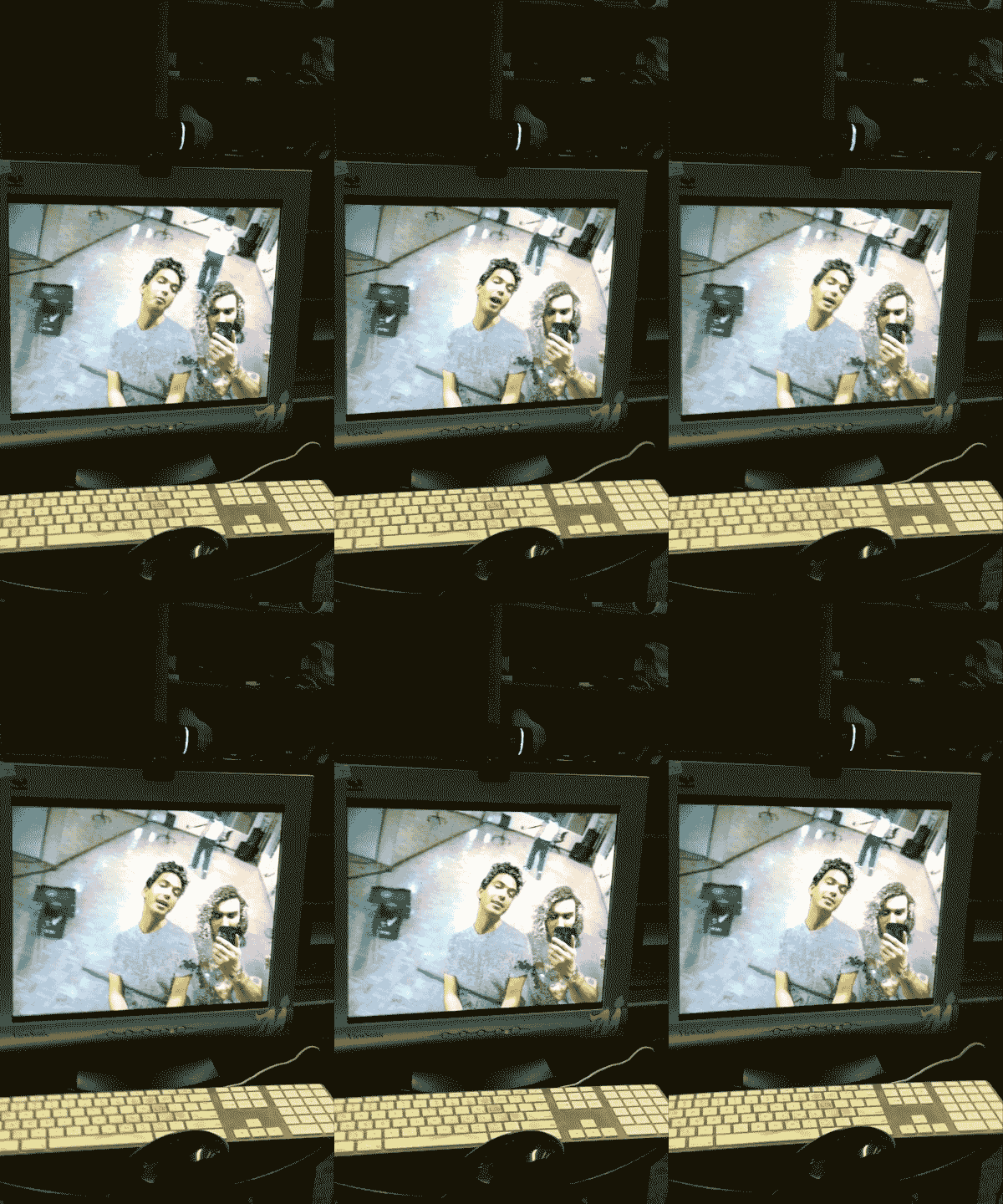
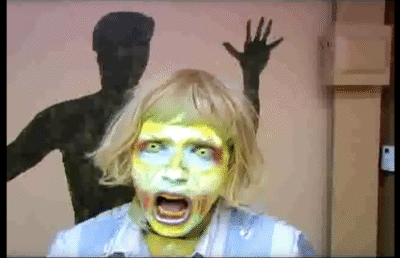
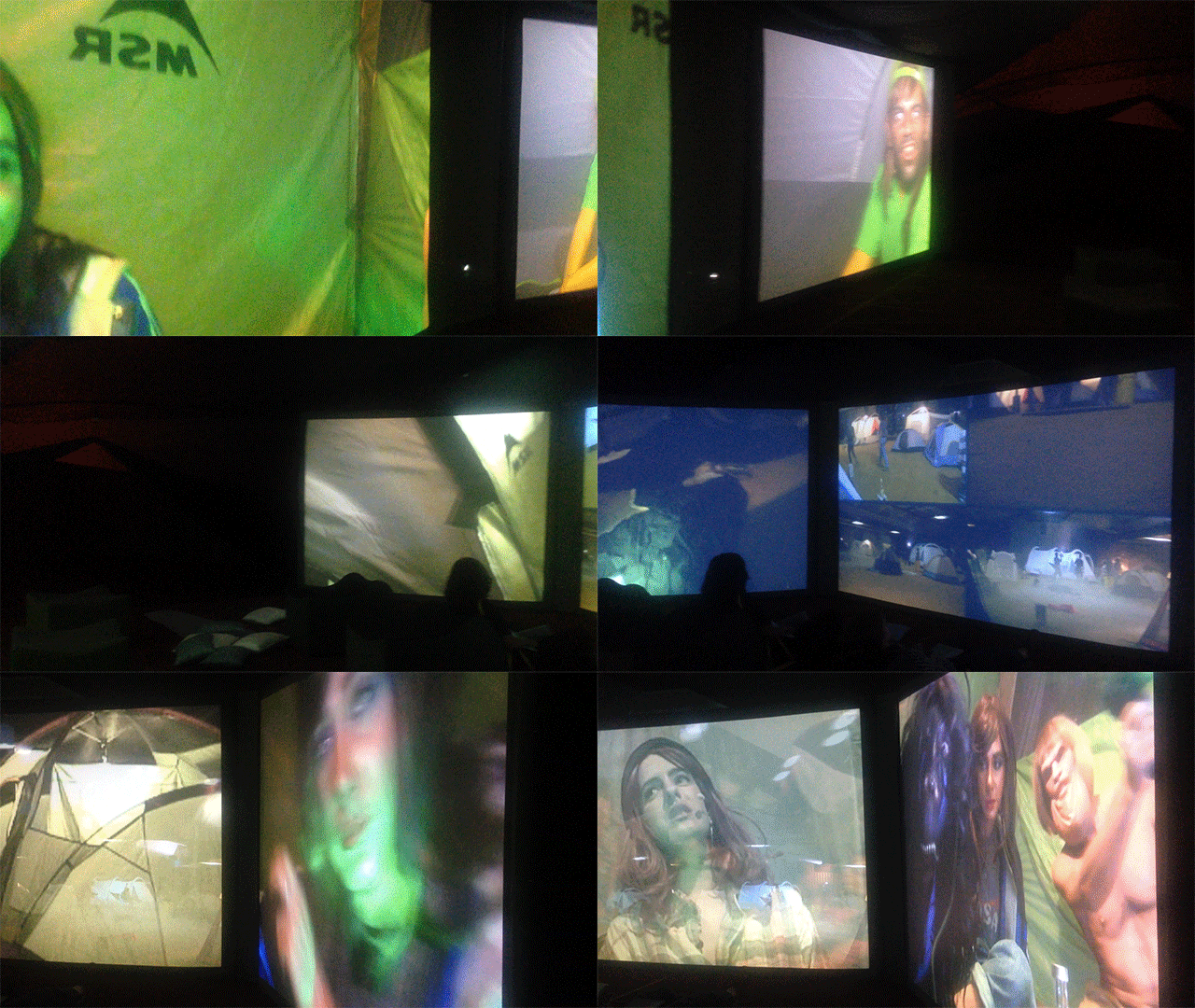
Stills


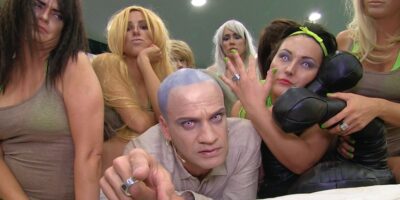
























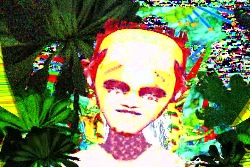

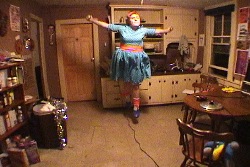







___
Further
Ryan Trecartin @ Vimeo
Ryan Trecartin @ Andrea Rosen Gallery
Ryan Trecartin @ Regen Projects
Ryan Trecartin @ instagram
Portrait of Ryan Trecartin
‘It’s Exciting to Be in a Swing State’: Why Artists Ryan Trecartin and Lizzie Fitch Moved to Ohio to Build a Rural Amusement Park
How Artists Ryan Trecartin and Lizzie Fitch Built a 32-Acre Queer Playground in Middle America
Neighborhood Watch: Lizzie Fitch and Ryan Trecartin
ROT THE MAP
Ryan’s Web 1.0
Lizzie Fitch and Ryan Trecartin’s B-horror version of America’s rural fantasy
RYAN TRECARTIN: THE REAL INTERNET IS INSIDE YOU
McMansion of media excess: Ryan Trecartin’s and Lizzie Fitch’s SITE VISIT
Ryan Trecartin – Metaphorical Puke
The Automedial Zaniness of Ryan Trecartin
Ryan Trecartin & Lizzie Fitch STAGE the 2.0 society
Decoding the Cinematic Cyberworld of Ryan Trecartin
Ryan Trecartin’s Night Vision Sweatshirt
Experimental People
Past and Future Camera: Lizzie Fitch and Ryan Trecartin’s New Movies
‘Sound Design Is Sort of Everything’: Ryan Trecartin on Making Music, Live and Otherwise
Exploding the Frame: Ryan Trecartin’s Bad Language
Meet Ryan Trecartin, Art’s First Genius Of The YouTube Age
On Ryan Trecartin
“We Had Our First Red Bulls Together”: Lizzie Fitch and Ryan Trecartin on Their Dusk-Till-Dawn Collaborative Process
Ghost of the future past: on the work of Ryan Trecartin
____
Extras
Dennis Cooper and Ryan Trecartin: Artists on Writers | Writers on Artists
Ryan Trecartin Interview: The Safe Space of Movies
Lizzie Fitch / Ryan Trecartin: Whether Line / Fondazione Prada Milano
Lizzie Fitch/Ryan Trecartin – Behind the scenes
Ryan Trecartin in conversation with Hans Ulrich Obrist
Ryan Trecartin Interview: Gender is Fluid
______
Interview

Sarah Lehrer-Graiwer: Last time we talked, in early 2013 or something, you were in the middle of editing a new piece, as you are now. It’s a strange time to talk about the work because so much happens in editing. And about a minute ago you were telling me how, this past year, you moved studios and your home.
Ryan Trecartin: Yeah, we did a ton of moving. We moved our house to Burbank, and then we moved our Burbank studio to Glassell Park. We originally rented our last house to double as a studio, but for the Venice Biennale project, we needed a studio to create those particular sets. We ended up liking having a studio in which we could build sculptures and different things that don’t work in a domestic setting. We go in and out of wanting a separate studio space. Right now we want one, but I can feel us already going back to wanting a house and getting rid of the studio. (laughter) Moving’s fun.
SLG: Moving’s fun? Who says that? (laughter) Moving’s the worst.
RT: I was getting depressed about the fact that I lived in that Los Feliz house for five years. Even growing up, I’ve never lived in a house longer than that. I don’t like making projects in the same places.
SLG: Like a new place is inspiring and exciting for ideas, even if it’s just an empty warehouse?
RT: Yeah, even if there’s nothing culturally different about it. It can be architecture that changes and that’s it. We’ve been talking about moving to a different city again.
SLG: This makes me think of your interest in people born in the mid–’80s and their relationship to media. Now that generation is growing up. Maybe it’s not yet happening in your circle, but these past couple years, a lot of friends are having babies, you know?
So I wonder, Can ways of living stay the same? Do you want them to? This settling down, employing people, having a staff—is it part of getting older and your interest in the generational?
RT: Well, I’m not really interested in things staying the same.
SLG: Even if your mode is constant change.
RT: It doesn’t yet feel like settling down, but if it did, I might not like it. We’re not interested in the same things as before—I say we meaning a lot of different things, but right now I’m talking about Lizzie and me primarily. When it comes to youth, I’ve always enjoyed it as a topic or a mode, and not necessarily as an age-related thing. It’s more about the relationship to self and culture, and negotiations of freedom.
Although I do think about when people were born in sort of an algorithmic way. It’s interesting that people born at different moments in time have different relationships to ideas. It doesn’t mean everyone in that age group has the same relationship—there’s the general flow and then the margins.
SLG: Youth as an attitude or a relationship to freedoms or self-formation makes sense. This is a side note, but I want to say that reimmersing myself in your work reminds me just how much it affects me on the level of permissiveness and what’s possible. It’s amazingly generative.
RT: K-Hole, who were in the Triennial, wrote something on the youth mode that’s like what you’re describing.
SLG: You’ve busied yourself with looking at a wide range of practices and artists, having co-curated the Triennial. I would imagine that is very different from being in the studio. What was that process like?
RT: I’m still digesting the experience. Working with Lauren was amazing. She traveled a lot, and did so many studio visits. Then she would present them all and we would talk about them. She really allowed me to continue being an artist. I got to glean all this amazing research and have a huge say in it, which was incredible. And that opportunity came at a moment when the artists we were researching were not that far from me generationally. But my mind is far from that right now …
SLG: If it’s too far away, we’ll move on.
RT: I think it’s important not to be too focused on past work when you’re creating new work, so I have purposely been trying to forget stuff temporarily. Like, I practice forgetting things, and then I have to try to remember them again later.
SLG: How does that work?
RT: Something’s a thought-loop, so I picture it and then I remove it.
SLG: Can you do that all in your head? Or do you keep a notebook?
RT: I do, but I don’t go back and read my notes much.
SLG: At least once you get an idea down, then you can let yourself forget, because it’s down somewhere.
RT: I mean, I love remembering, too—but sometimes you have to forget in order to grow. Or something will reemerge because you pushed it away, and it comes back in a different form. That’s a big part of the way we make movies. Things that we thought were over sneak back in a different form, even just words and phrases.
______________
16 of Ryan Trecartin’s 29 videos
______________
Valentines Day Girl (2001)
‘Trecartin crafts a fantastical narrative about a girl whose obsessive personal utopia is disrupted. Trecartin’s collaborator, Lizzie Fitch, plays a girl obsessed with Valentine’s Day. Everything in her hyperactive, sped-up world revolves around Valentine’s Day: red, white, and pink love-themed decorations cover every surface; heart shapes abound; Valentine’s Day treats are everywhere. Her private festivities suddenly go awry as a hoard of Christmas-themed intruders appear and take her hostage in her own apartment. Gagged and bound, she is forced to watch while her ecstatic but sinister captors stage a frenzied Christmas intervention.’ — Electronic Arts Intermix

______________
Wayne’s World (2003)
‘Trecartin and his collaborator/co-star Lizzie Fitch ponder the messages delivered by the most banal forms of mass media and pop culture in their own unique version of a music video. They voice questions in song and dance segments that feature a deliberately ill-fitting pastiche of discarded fashions of the past two decades and recycled pop-music clichés. Totally immersed in their meticulously crafted private universe, Trecartin and Fitch coyly point at the gaudy artifice surrounding us in our own.’ — Electronic Arts Intermix
Excerpt
______________
What’s The Love Making Babies For (2003)
‘In What’s the Love Making Babies For Trecartin employs digital manipulations, extreme editing, and chaotic dialogue in a way that is characteristic of his artistic style, creating a world that is “hyper-saturated with media.” More relevant to the concerns of this program, he also engages with ideas of authority, expertise, and the dissemination of information, as his characters forward their often warped and sometimes indecipherable ideas surrounding “reproduction, sexuality, and contemporary moralities” by engaging with traditional formats such as the TV commercial. However, Trecartin roots his movie in the digitized Internet landscape, thus evoking questions surrounding how modes of communication and information transmission transform and morph in the digital age.’ — Calvin Tomkins
the entirety
_______________
A Family Finds Entertainment (2004)
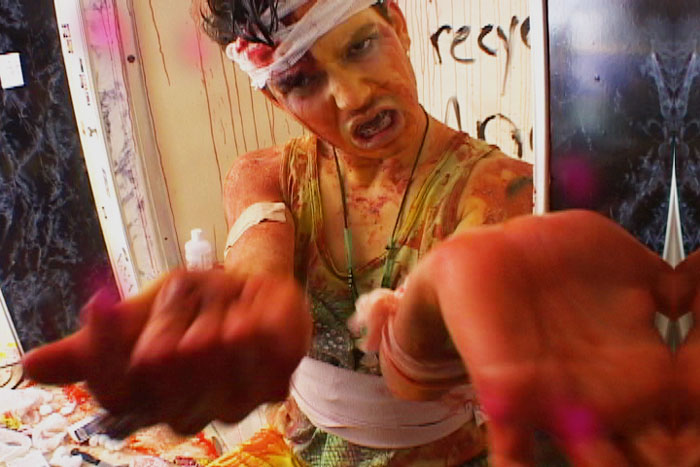
‘If A Family Finds Entertainment can be reduced to a thumbnail description, this might be it: Trecartin stars as Skippy, a clownish but terrifyingly psychopathic boy who has locked himself in the upstairs bathroom of his family home during a wild party. Ignoring his siblings’ and friends’ pleas that he come out, he paces the little room, cutting himself with a knife and musing opaquely on his existential dilemma in a kind of King Lear-style delirium. Downstairs, the partiers are experiencing wild mood-swings and having complex, disassociated conversations (mostly about him) that are constantly interrupted by bursts of visual effects and animated sequences that disorient the cast of characters like so many lightening strikes. Eventually Skippy emerges, borrows money from his creepy, sexually inappropriate parents, and heads outdoors, where he runs into a documentary filmmaker who decides to make a movie about him; but then Skippy is immediately hit by a car and, apparently, killed. Back inside the house, a hyperactive girl named Shin, also played by Trecartin, gets a call on her cell phone with the bad news. She spends twenty or so hysteria-filled minutes trying to focus and construct a sentence linear enough to tell her friends what has happened. When she finally does, a band plays music that seems to magically raise the young man from the dead, and everyone runs outside and sets off fireworks. Then everyone runs back inside before the police show up. A wonder of Trecartin’s videos is that his approach seems as intuitive and driven by a mad scientist-style tunnel vision as it is rigorous and sophisticated, grounded in his expert editing and inordinate gift for constructing complex avant-garde narratives.’ — Dennis Cooper, Artforum
_______________
(Tommy Chat Just E-mailed Me.) (2006)
‘Trecartin describes (Tommy Chat Just E-mailed Me.) as a “narrative video short that takes place inside and outside of an e-mail.” Trecartin’s intense visualization of electronic communication is inhabited by a cast of stylized characters: Pam, a lesbian librarian with a screaming baby in an ultra-modern hotel room; Tammy and Beth, who live in an apartment filled with installation art; and Tommy, who is seen in a secluded lake house in the woods. Pam, Tommy and Tammy are all played by Trecartin, who, wearing his signature make-up, jumps back and forth between male and female roles.’ — Electronic Arts Intermix
the entirety
______________
I-Be Area (2007)
‘The videos of Ryan Trecartin catapult viewers into a hallucinogenic alternate reality in which cybernetic avatars run amok, presenting themselves with gleeful sass as they play out a complex web of melodramatic fictions. I-Be Area (2007), a feature-length promenade through this universe, was written, directed, and edited by Trecartin, who also stars in no fewer than five roles alongside a troupe of friends and collaborators. The work’s elusive narrative, which revolves around the clone I-Be II and such cohorts as Jamie, RAmada Omar, and ONxy-Tonyah, is filtered through a distinctive do-it-yourself aesthetic that incorporates ramshackle sets, brightly colored homemade costumes, cheap off-the-shelf video and sound effects, and rapidly edited, jargon-filled dialogue. Through these means Trecartin creates a striking new vision of queer culture in America, wittily updating the carnivalesque style of avant-garde filmmakers like Jack Smith and Kenneth Anger for the era of YouTube and Second Life. Unlike Smith and Anger, however, Trecartin draws his audiences further into his virtual reality through sculptural objects and installations built from his sets, including Jamie’s Bedroom (2007), which is in the collection of the Guggenheim Museum. Over time, it becomes apparent how thin the line separating Trecartin’s world from our own truly is.’ — Nat Trotman
the entirety
_______________
Trill-ogy Comp (2009)
‘Trill-ogy Comp consists of three movies: K-CoreaINC.K (section a), Sibling Topics (section a), and P.opular S.ky (section ish). The title of this piece of the Any Ever diptych riffs on the words “trill”—as in the rapid alternation of two notes, or the sound produced by rolling “r”s—and “comp”— as in “complement,” “comprehension,” and, especially in regard to music and digital editing, “composition.” Each movie follows the structuralist unity of form and content, self-reflexively building and demonstrating formal logic through narrative abstractions.’ — MoCA
K-CoreaINC.K (section a)
Sibling Topics (section a)
P.OPULAR S.KY (section ish)
________________
Re’Search Wait’S (2010)
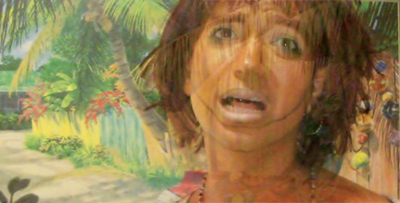
‘Through their form as well as their content, the Re’Search Wait’S movies directly engage some of the most noted effects of the internet and social media on our lives and ways of being: the changing relationship between the individual and the collective; the global advancement of corporate brand consolidation (at the expense of diversity); rampant commodification; and the fluidity of identity. The manner in which Trecartin, with his collaborators, has fused these in the Re’Search Wait’S series as a future projection of the information age marks it as a post-internet artwork par excellence, being ‘about’, ‘of’, and ‘meta-’ these effects (and affects) simultaneously. In it we encounter the mutated embodiment of tomorrow’s promise, today.’ — Simon Maidment
The Re’Search
Roamie View : History Enhancement
Temp Stop
________________
CENTER JENNY (2013)
‘CENTER JENNY is one of four movies completed in 2013 by Ryan Trecartin, first shown as part of an installation at the Arsenale during the 55th Venice Biennale. For this movie and its related works, Lizzie Fitch and Trecartin created a modular maze of sets on a soundstage with the help of commercial set builders. Designing with Google’s open source 3D modeling programSketchUP, the artists along with these tradespeople built a functional system of environments. The space is rigged to radically adapt for different purposes, but shifting as a narrative one as well, guiding action much in the way that a written script does. No pun intended, the set in its various manifestations is a central feature of CENTER JENNY, where Trecartin fixates on notions of location and proximity but continually eschews any concrete grasp of them.
‘The cast ranges from collaborators familiar from previous works dating as far back as to A Family Finds Entertainment (2004) to professional actors from popular television sitcoms. Most belong to one of several groups of uniformed girls who are all named Jenny. One duo of Jennys wears earmuffs and pink hoodies branded “AUDITION;” another posse dons khaki shorts and tank tops covering up greenscreen-green bikinis; other, grittier girls are in sweats that read “W4$T3;” a more womanly group in neutral tones identify themselves as nameless proto-Jennys, held in limbo as they await matriculation into “The University.”
‘The various Jennys belong to a caste system in which iterations of the same, basic, archetypal girl differentiate themselves from one another based on how powerfully they have evolved. The notion of being “basic”, in fact, is a flattening condemnation the girls hurl back and forth at one another. There is a quantitative basis for self-actualization here, and, as if in a video game or any other kind of entertainment simulation, a level-based logic propels the Jennys as they graduate from nothing – “I don’t have a name yet, we’re not even on a level” – to level one, to level two, and beyond. This guides the plot as well, which shifts abruptly from one vignette to the next in an arc that escalates without concern for scenes that have been surpassed by more evolved ones.’ — Kevin McGarry
the entirety
_______________
Comma Boat (2013)
‘In Comma Boat, we’re stuck in a mock-authoritarian fantasy–a power trip. The film centers around a director-character played by Trecartin who oscillates between feelings of omnipotence and self-doubt. As if a post-human, post-gendered reincarnation of the Fellini character in 8 ½, the director gloats and frets about professional and ethical transgressions. “I know I lied to get ahead,” he admits at one point. “I’ve made up so many different alphabets just to get ahead in my field.” The director is fancier now, but the fear nags that he might be “repeating” himself “like a dumb soldier ova and ova and ova and ova.” The meta-connection to the artist’s own career, while obvious, is also a decoy. All art, at some level, is about the artist. Here, reflexivity is the surface level, providing a decodable veneer that encases something more unsettling and complex.’ — Electronic Arts Intermix
the entirety
______________
Item Falls (2013)
‘In Item Falls, we are peaking. We start out at a casting call, but before long we’re firmly in the grip of hallucination, shedding our anxieties and evidently regressing to the animation era, a time when stunt chickens were mere chicklets. Friendly archetypes float in and out of what seems like our bedroom. The red-headed Jenny has returned, but this time she’s squeaky and trusting. Unlike in Center Jenny, here our perspective is literally centered. The camera seems to be the in middle of the room, which is good, because we’re too blissed out to move. Luckily, our hallucinations look directly at us.’ — EAI
the entirety
______________
Junior War (2013)
‘In Junior War, a throng of high schoolers congregates at night for a party in the woods sometime in the year 2000. A band plays, the kids get drunk, the boys and girls tepidly flirt, and groups deploy into cars for the purpose of destroying mailboxes, tee-peeing houses, breaking lawn ornaments, and sparring with the police. The film is composed entirely of footage Trecartin took during his senior year of high school in exurban Ohio; as such, it baits the viewer with genealogical significance. The film is incontrovertibly source material dangling the possibility that we’ve finally unearthed Sarah Source–but it’s also rigorously repurposed, just as any social media #tbt marks the present more reliably than it renders the past.
‘In the context of the tetralogy, Junior War looks like a time capsule from “the human era,” otherwise known as high school, where themes and phrases from the other three films–searching for keys, smashing, farting–uncannily recur. All of Trecartin’s trademarks are here–frenetic pacing, musical punctuation, carnivalesque destruction, adolescent dialect–but this time the Ryanverse is forged out of actual co-eds. “We found a golf ball, a tennis ball, and a baseball,” a boy proudly declares, underlining the male brain’s infinite capacity for pointless taxonomy. Other teens display aptitude for legalism, complaining about a policeman who was “wrongfully accusing” and “didn’t have probable cause to fucking pull us over.” Another boy at odds with law enforcement combatively declares, “I’ve been riding these woods since I was three years old. I know all these woods! If anything I’m going that way,” yielding a stream of teen poetry whose peculiarity might go unnoticed but for its resonance with the rest of Priority Innfield’s unruly syntax.
‘Are these the formative experiences that gave rise, a decade later, to the artist Ryan Trecartin? To the extent that Priority Infield is an exercise in retroflection–in revisiting the past and also reshaping it–Junior War looks more like the diary of a time-traveler who has re-entered a historical moment and turbulently restructured it.
‘All remembering is editing–an attempt to create what scholars call a ?usable past.? In Junior War, the editing is intentional and aggressive–but is the past it creates usable? Most of the footage is recorded in night vision, a style that recalls both The Blair Witch Project, which came out in 1999, a year before the footage was taken, and Zero Dark Thirty, which came out in 2012, a year before the footage was released. The youth in Junior War are expressly militarized, but they’re also innocents who venture into the woods in search of the supernatural.
‘The arrow of time–whichever direction it points–is fraught with guilt. To age is to decline: this we’re told. To trace is to blame: this we fear. To the extent that Priority Innfield confounds our understanding of sequencing, iteration, and cause and effect, it also lets us off the hook for crimes of chronology. By the end we may feel confused, exhausted, and epistemologically spent, but we also feel exonerated. “Nothing is documented.” We all believe that, don’t we?’ — Chris Glazek
the entirety
______________
Mark Trade (2016)
‘Distraction, of course, remains the mise en scène. In a time when millions of videos on the Internet vie for users’ attention, I get the feeling that Fitch and Trecartin’s characters would much rather be checking their phones than doing anything else—including appearing in a Fitch and Trecartin video. In Mark Trade (2016), the titular protagonist, a drunken and off-putting man with long hair and oddly colored contacts, says, “This used to be a lake, but I can’t get any fucking service anywhere now.” The artists’ faithfulness to the Internet’s hysterical diversion renders the characters mysteriously underdeveloped.’ — Alex Greenberger
the entirety
______________
placebo pets (2016)
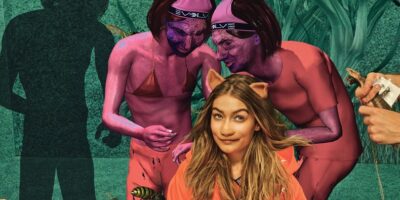
‘Every autumn, W Magazine dedicates one cover story to the world of contemporary art. The resulting imagery never falters in its ability to cause commotion, as the periodical succeeds in uniting the worlds of high-fashion, celebrity and art into one. Past covers have seen Angelina Jolie photographed by then-beau Brad Pitt and Linda Evangelista through the lens of Maurizio Cattelan. This year, W Magazine does it again, with Kendall Jenner and Gigi Hadid – arguably two of fashion’s most buzz-worthy figures – gracing the magazine for its 10th anniversary art issue. Working alongside video artists Lizzie Fitch and Ryan Trecartin, the supermodels have been transformed into human-animal hybrids through heavy digital altering. Entitled “Placebo Pets”, the editorial creates an alternate reality that asks us: “Who would survive if a superior alien humanoid species came to earth?” Dressed in the latest trends by Philipp Plein and Hood by Air, the royal heiresses of reality television each tackle the role of a post-gender, post-biracial being. The visuals are reminiscent of Snapchat’s ubiquitous face-altering filters, with Jenner’s features exaggerated to create a bunny-cat and Hadid’s amplified to morph her into a lion-fox. New identities in tow, both women live in an imaginary future created by Fitch and Trecartin. This new universe is not far from the one we inhabit now, with the creative duo hoping to offer a critical eye into our present-day human behaviour.’ — SLEEK
the entirety
_____________
Panderson Heights (2020)
‘Colony Panderson and Reverse Stacy take watch tower knocks.’ — Letterboxd
the entirety
_____________
Collected Songs [More Complete] (2022)
‘The experimental and fast-paced nature of his movies has gotten him the title of “video artist”, but Trecartin rejects the term, saying his films are nothing but films. For his films, Trecartin will usually make his own soundtrack. This compilation is a collection of nearly every original song he has made, either for his movies or just as music by itself. All the tracks were made in between 2001 and 2014.’ — iced out helix
the entirety
*
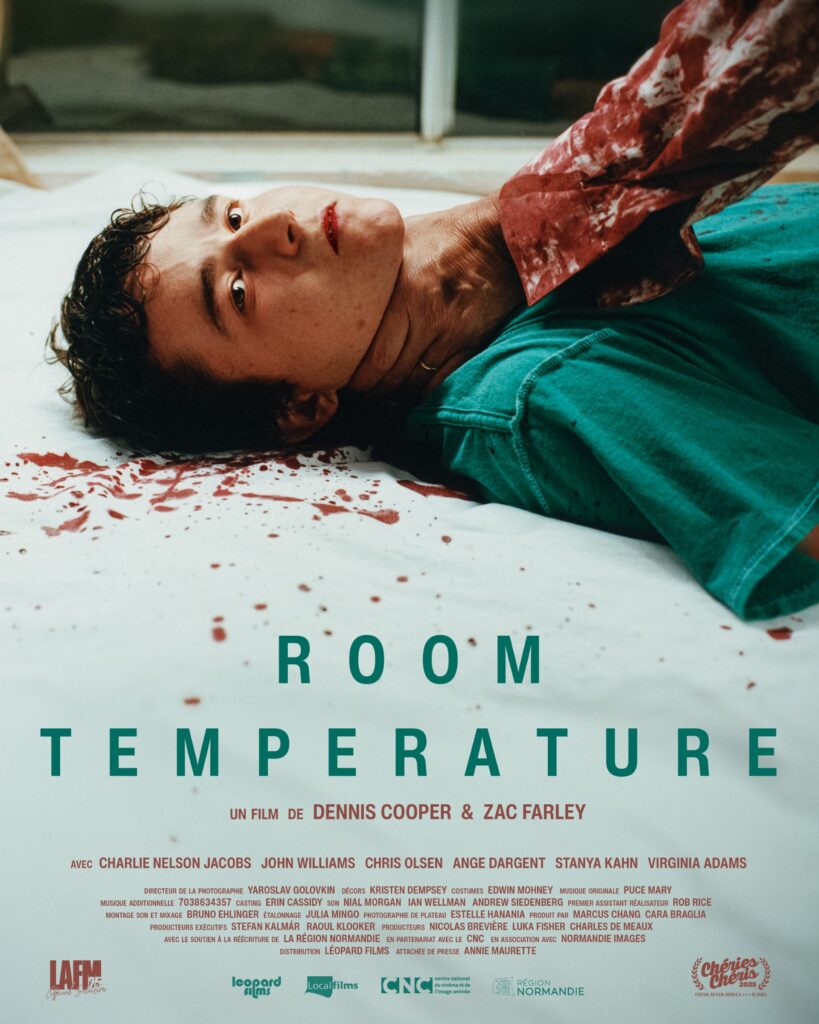
p.s. Hey. Starting tomorrow the blog will be on vacation for a week while I’m in Iowa City showing ‘Room Temperature’ and doing a reading there. It will return live on Friday, April 10th. I’ll catch up with any comments you leave between now and then upon the blog’s and my return. ** Dominik, Hi!!! Thanks, yes, I’ll be legal in France for another year at least. I don’t think I have any physical drawbacks that’ll change their mind, but, hey, we’ll see. Your love picked a fave of mine too. Have a great week! Keep talking, love, your mind is beautiful, G. ** jay, Hi. Drone is an increasingly popular identity among the slaves or at least an increasing aspiration. ⬡-8781 seems like a slave influencer, but let’s see. Exactly on publishers’ evolutions. There are plenty of newbies to pick up their slack, like I said. Lionising the past is just a way to get yourself stuck. Lots of love back and have a really fruitful week ahead. See you soon. ** Poecilia, Hey. Maybe the problem is thinking of publishing as an industry. Generalisations are always wrong in my opinion. There will always be people who publish books at different levels. It sounds like the naysayers are really saying you can’t make big bucks having your books published like one used to, but I don’t even think that’s true. Very few writers ever made big bucks. I don’t know. Philip Best is such a great, generous guy for all kinds of reasons. Cool. Thanks! ** DennisCooperSucks, No interest in engaging with your hostile bullshit. ** Hugo, I’m pretty sure Michael never got Pynchon on his show, but I’m certain he tried as hard as one could. Not impossible that a slave could make a second appearance. ** _Black_Acrylic, Hi, Ben. ‘Belle De Jour for the British’: I think I have to see what that’s about. Thanks! Have a lovely next days. ** Adem Berbic, Hey. There’s a remote new possibility for ‘RT’ in London, but it’s remote. Just keep me informed, yeah, launch-wise. And go all James Joyce on ‘penis’. It needs that, and I dare you. ** Carsten, Haha, yeah, it does seem like maybe good timing on the vacation. I can’t even remember the last time I hit the heartland. Chicago doesn’t count, right? Well, we’re showing the film and I’m doing a reading at the university and there’s a party/techno event in our honor and we’re doing interviews and stuff and I guess we’ll just be seeing what the place is like. Is it Easter or almost? I can’t keep up. Bon week, bud. ** Steve, Thanks! My physical is on the 15th. That is surprising about the new Laibach. I kind of wrote them off at a certain point. I’ll peek at it, thanks. And all pleasure for you this coming week. ** kenley, Thanks!!! Well, technically, I still have to pick up a residency card thing at the police station in the next month, so it’s real but it doesn’t feel totally real yet. So delayed celebration of some sort. You have glory in your week+ ahead, I hope? I want to hear all about it. ** HaRpEr //, Oh, yeah, butoh. I was kind of quite into butoh at a certain point. The butoh masters even did US performance tours. In the 90s, I think. I haven’t read the Big Toe interview. I need to do that. I guess I said something disparaging about ‘Salo’ in the interview, and I’ve seen that there are people who are really pissed off about that. I seem to be pissing people off at the moment for some reason. I’ll go see/remember what we said about interiority. I’m honored by how whatever it was inspired you. Yep, leaving early tomorrow morning. Hoping the vaunted TSA airport hell is over by then. I look forward to catching up with you in, what, 7 days, 8 days? Take care. ** Bernard Welt, Oh, good, I’m glad that you and Taylor connected. There are a whole bunch of really good young poets that I’ve seen/read. Yeah, strange and almost miraculous how rarely trolls decide to come in here. I think it’s been over a year since the last hater popped in and unleashed. Counting my lucky stars. Huh, I also have phases where I scribble down porn to sort of cleanse my writing’s palate and protect its content. Have that kind of fun. ** fish, Hi. Yes, the unabashedness is a big draw for me too. Or the combination of spilling and trying to be alluring at the same time. The writing can be really exciting because of that push/pull. Have a terrific week, and I hope to see you on the other side. ** Laura, Thanks, pal. Hm, I think I see extravagance as inherently opaque. A difficult to solve puzzle. But I’m not extravagant at all. Thanks so much about ‘ZDB’. I think it and ‘Zac’s Freight Elevator’ are my peak gif fiction works. Wow, did you make that gif stack/fiction? Impressive. Honored. As am I and theoretically the slaves if they weren’t composites by your reading of them. Your brain seems to be doing just fine. Don’t let your novel act all hoity-toity on you. Bring it down to size. You can if anyone can. Make the world (and your novel) your oyster until I see you next. <3 ** Okay. You lucky people get to spend whatever time you spend on this soon to be temporarily dormant blog in the company of the sublime genius of Ryan Trecartin. One of the greatest artists working in any medium these days in my opinion. But you might well feel differently. I’ll compare notes with you on the 10th. Take care until then. See you soonish.


 Now available in North America
d-
i miss you. life is hectic and mostly awful but i’m hanging in there. went to see mclusky last night. that was great. my cat missed me very much. i’m thinking she’s the only one who cares, but also i’m coming down from some doses and really having a time of things. been reading a lot. listening to loads of music. you know, the fucking usual. facebook gave me the boot and will probably not let me back so if you feel you need an update on my world beyond the rare times i pop in here (which i’m trying to be less sporadic about but i’m so unmotivated w/r/t everything lately) i guess follow my instagram. it’s @kitty_cats_and_schadenfreude (it took me all of 40 years to be comfy with people seeing my body and so now whenever i post a selfie, it’s pretty even odds that i’m in my undies or shirtless, but mostly i just post memes and a running tally of things i’m reading). i turned 40 a couple weeks ago, that’s… ugh. i hate getting old. i sometimes think i really fucked up when i moved back to reno. i kinda probably just need to get laid but there’s just no one who interests me (well, maybe someone but he’s a long ways away and i blew my chance with him ages ago anyway). so i bury myself in the same old porno clips and distract myself with new music and… fuck it, you don’t wanna hear this stuff.
how’s tricks? is room temp getting a physical release soon or can i bring it out to reno some time? because i need to see it.
i’m gonna try to get some sleep, i have a long shitty day at my job that i hate looming over me tomorrow. i hope this catches you before the new day goes live. love you. talk soon.
-c.
(i posted this on the slave day i guess literally as you were posting today’s post so instead i’ll be the first comment for today and we can catch up tomorrow where hopefully i will be in a better, less self-loathing-y headspace (did i ever tell you about the time my old shrink asked me about where all my internalized self-loathing comes from? because that was a whole thing i’m not gonna go into right now but let’s just say that i’m disappointed with myself first so i can beat everyone to the punch (i guess i shouldn’t even really call him my shrink since he mostly just kept me doped to the gills but it was also the longest i’ve gone without insomnia and i would kill to get the kind of sleep i did when he was croaking for me because all i can manage now is a couple hours at a time (and i used to love to sleep, it’s still my favorite thing to do when i can get it (besides masturbate, but i do that too much already)))))
petrified by the pattern of my own self-regard, yeah that’s me to a T.
I’ve only seen “Family Finds Entertainment”, but I will absolutely research the rest of this stuff over my extremely long weekend. I didn’t know about the upcoming bank holidays, so I’ve been blindsided by 4 consecutive days off starting Friday, which is excellent. I’m going to feel very Proust-y, i.e., wandering around aimlessly without thinking about work at all. One of the few advantages of a full-time job is how huge a relief time off is, particularly time off you’re not expecting, like Schopenhauer’s Pendulum or something. I’m probably going to take my parents out for a meal or something, or see a movie with them, something like that. It’s one of my friend’s birthdays on Saturday too, and he likes animals, so I might try and organise a zoo visit or something, but tickets to that are expensive and he flakes pretty easily, so I’ll have to figure out how generous I’m feeling, haha. Hope you’re well, love from here! Enjoy the huge weekend
P.S., let me know if you need any help getting rid of a certain character, I think WordPress has some quite good IP blocking functions – or you could turn on comment approval for a few days, or something.
Hi!!
Have a wonderful trip, Dennis! I hope the screening + reading + everything else will go just as planned! See you soon!
Love is looking for a father with a hurricane tongue that will suck the lining out of that ass, Od.