
‘Gretchen Bender moved to New York in 1978 and had her first solo show there in 1983, when she was thirty-two. She fast became a fixture of an East Village art scene centered on the Nature Morte gallery and the tireless publishing and curating efforts of Tricia Collins and Richard Milazzo, a milieu that featured artists such as Sarah Charlesworth, Jessica Diamond, Kevin Larmon, Peter Nagy, Steven Parrino, David Robbins, and Julia Wachtel. Perhaps not all of those names ring a bell, and it’s likely Bender’s wouldn’t have, either, only a few years ago. Which raises the question, Why was she almost lost? And why has she now been suddenly rediscovered?
‘As her posthumous retrospective at Red Bull Arts New York testifies, Bender pioneered new ways of using information management as an artistic medium. Starting out in Washington, DC, as a member of a Marxist-feminist printmaking collective, she quickly expanded her arsenal to include electronic as well as other types of screens. She worked hard to locate her art on the cutting edge of video technology, hanging around the labs at the New York Institute of Technology and researching the latest in vector graphics and computer animation. In her electronic works, she graduated quickly from single-channel, single-monitor video, as in Reality Fever, 1983, to pieces that deploy several channels across any number of screens. Bender’s most elaborate version of what she dubbed “electronic theater,” the eighteen-minute long Total Recall, 1987, not only spreads eight channels across twenty-four monitors but also includes projections onto three large screens.
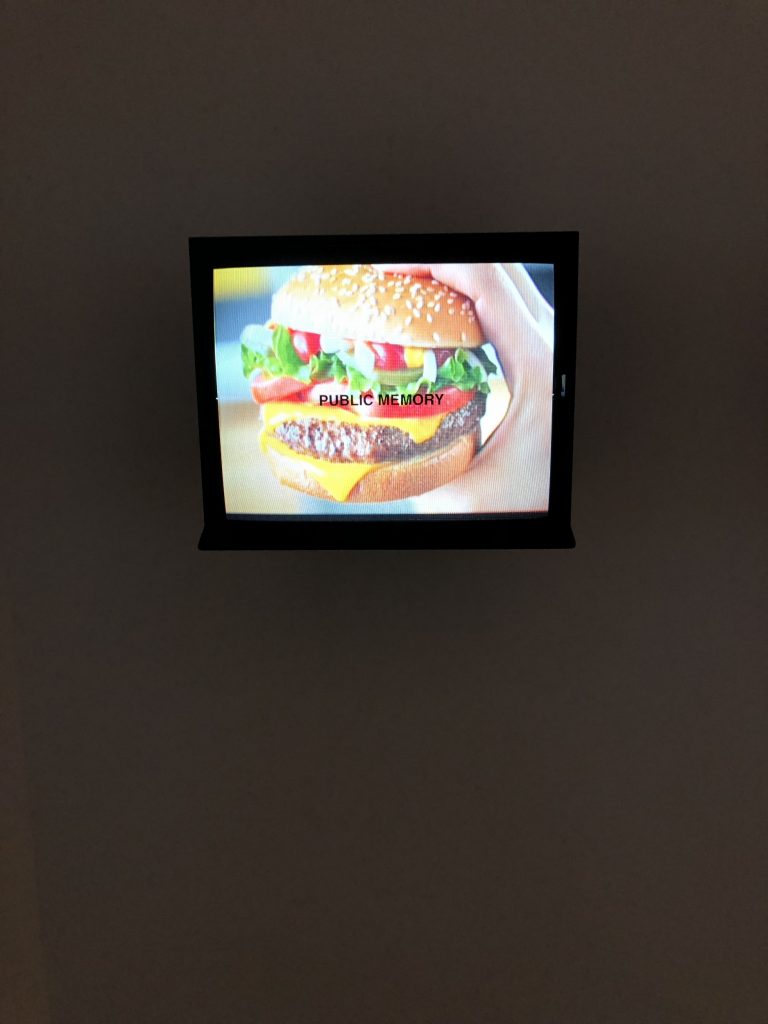
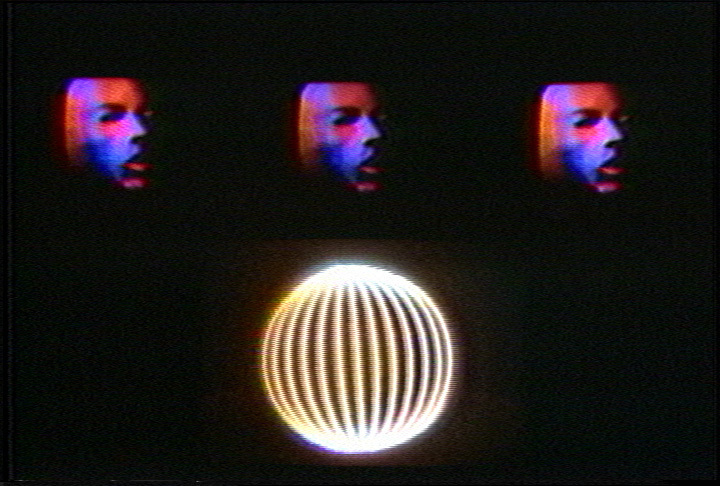
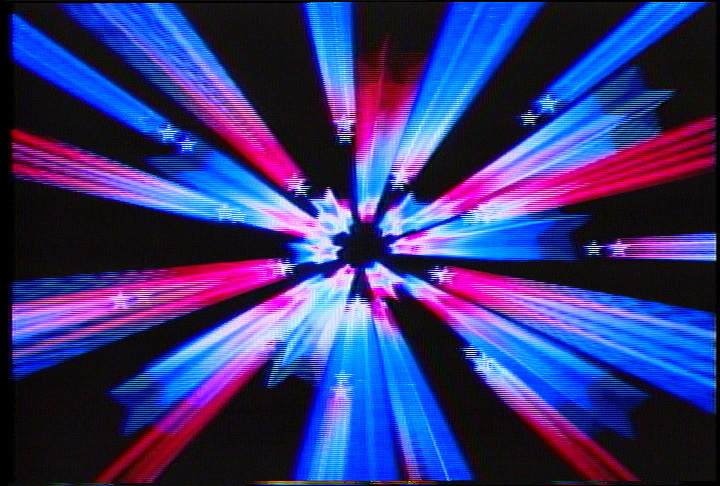
‘The Red Bull show is split roughly between static wall works and Bender’s progressively more expansive video pieces. Half the galleries are filled with laminated color photographs mounted on Masonite or tin and arranged in different groupings. Bender’s stark juxtapositions pit sci-fi movie stills against grisly war-correspondent photos and shots of advertising spokespeople next to notable artworks of the time (by the likes of Jonathan Borofsky, A. R. Penck, or David Salle). Most of the other rooms resemble televisual Laundromats, each lined with a phalanx of TV monitors on which tumble talking heads, narrative fragments, sales pitches, live news segments, athletic matches, ecstatic game-show revelations, and twirling computer graphics.
‘A riddle characterizes all of Bender’s output. If TV’s deluge of information flattens distinctions and evacuates meaning, folding everything from the most banal to the most urgent into its undifferentiated flow, how is it that this only strengthens, rather than diminishes, its relation to power? Bender was careful to temper desensitizing excess with regular injections of artificial exhilaration. Stupor is countered by hyperbole, courtesy of regularly unleashed attention-grabbing techniques: swooping and exploding visuals, music that alternates between the solemn and the frenetic. We see journalists comb battle sites and families celebrate their new breakfast cereal while animated corporate logos repeatedly perform flyovers. Everything is clichéd, yet—like the vitrine-style refrigerators, replete with Red Bull energy drinks, that dot the exhibition space—also seems geared to accelerate breathing and pulse rates.
‘Does Bender’s work overwhelm and incapacitate or does it spark critical consciousness? In an unsatisfying way, both. Viewers are definitely made hyperaware of just how underequipped they are in the face of torrential corporate-sponsored information. In Aggressive Witness—Active Participant, 1990, eight TV sets are lined up on the wall, each tuned to a different live broadcast. On the glass of each set, a phrase appears in vinyl lettering: DEATH SQUAD BUDGET, PEOPLE WITH AIDS, NO CRITICISM. The unmoving, all-caps seriousness of the phrases literally defies the nonstop parade of pedestrian programming underneath. But that’s the problem: While there are chance moments when the two seem to syntactically relate, mostly what the viewer confronts is a yawning disconnect between issues of monumental importance and the distraction induced by information’s tireless temporal undertow.
‘Which makes Bender’s oeuvre less about television per se than about being constantly targeted by multiple information sources at once. Sound familiar? Right now on my computer screen, there are several windows stacked one atop the other—Word documents, a couple of open folders, available tabs arrayed on my internet browser, some PDFs, my email. I pride myself on being a manager of information, and at the same time feel trapped in a permanent management crisis. In our attention economy of endless scanning and scrolling, information suspends subjects between vigilant attentiveness and numbing exhaustion, evoking the experience not so much of television as of a later invention: entertainment systems that combine game controllers with interactive video or computer displays.
‘In the end, this helps explain why Bender could have fallen off the art-world radar in the middle of the 1990s, only to resurface today. As her aesthetic became more high-tech, the art world moved instead toward the lower depths of abjection, scatter art, and slackerdom. Moreover, Bender’s view of corporate culture as a homogenizing onslaught was at odds with the premillennial interest in the cultural politics of difference as well as with the consensus view that VCRs, cable TV, and the internet equaled a dawning era of consumer empowerment. Today, of course, information culture is no longer greeted with such across-the-board optimism. Hence the renewed interest in Bender’s more blatantly corporate, dystopian vision.
‘Interesting, then, that it’s a corporate sponsor, Red Bull, that has enthusiastically stepped up to not only assemble Bender’s body of work but also make the substantial dollar investment in digitally restoring such a complex, multivideo Gesamtkunstwerk as Total Recall. (Credit for originally unearthing Bender goes not to Red Bull but to the artist Philip Vanderhyden, who in 2012 curated a survey of Bender’s all-but-lost video pieces that traveled from the Poor Farm in Little Wolf, Wisconsin, to the Kitchen in New York the following year.) Bender herself was not against working with corporate clients—quite the opposite: She directed music videos for bands like Babes in Toyland and also came up with the original opening credits for the Fox TV show America’s Most Wanted. “I’m glad if I get corporate support,” she told her friend Cindy Sherman in a 1987 Bomb magazine interview. “I’m trying to infiltrate and mimic the mainstream media.” That Red Bull in turn has been so welcoming of Bender’s infiltration perhaps reflects poorly on her work’s critical aspirations. More likely, though, it’s a testament to the corporate strategy of embracing critique as a way to accrue cultural capital and “edge.”
‘Sadly, Bender fell victim to cancer the same year that Google made its initial public offering and a year before TheFacebook became facebook.com. What’s most prescient about her art is the way it intuited how representation was coming under siege; how the time needed to reflect on the spatial and metaphoric relationship between the manifest signifier and its latent, hermeneutically obtained signified was being paved over by communication’s more lateral and metonymic temporality: the fast-paced attention and reaction to its unspooling ticker tape of information. Since then, pragmatics has seemingly overtaken semantics. Beyond readers and viewers, the subjects of culture today are media users. Media now constitutes a logistical system as well as a meaning system, allowing for not just the circulation of content but the organization and management of everyday activities: desktops, contacts, calendars, carts, bookmarks, playlists, wish lists, folders, filters, friends. Not just representing our world back to us, corporate media now seemingly license our actions within it. What one would give to see Bender parse such a state of affairs.’ — Lane Relyea, Artforum
_____
Further
Gretchen Bender @ Wikipedia
The New Gretchen Bender Survey Is a Triumph, Revealing a Visionary Artist
Who was Gretchen Bender?
Pioneering Video Artist Gretchen Bender Predicted Our Obsession with Screens
Gretchen Bender, by Dan Cameron
Gretchen Bender’s Video Art Predicted the Bleak Future of Mass Media
A Nod to Pioneering Artist Gretchen Bender in New York
Gretchen Bender’s ‘Visual Worlds at the Century’s End’
Disinformation and the Death Star: The Legacy of Gretchen Bender
GRETCHEN BENDER: STEPPING INTO THE PARTICLE UNIVERSE
Moving Target
GRETCHEN BENDER, by Sarah Nicole Prickett
A Finding Aid to the Gretchen Bender papers, 1980-2004
____
Extras
Salon | Artist Talk | On Gretchen Bender
Philip Vanderhyden on curating Gretchen Bender
Panel Discussion of “Gretchen Bender: Tracking the Thrill”
_____
Interviewed by Cindy Sherman
from BOMB

Cindy Sherman It seems as if your critical target is Corporate America because your work isolates and diffuses corporate logos and television advertising. How do you feel about a corporation buying one of your works?
Gretchen Bender I’d feel fine about it. I think it’s to their great credit that one corporation has bought my work. Didn’t Reagan say the corporate sector ought to support the arts? I’m trying to infiltrate and mimic the mainstream media. I’m glad if I get corporate support.
CS Do you think the work will enlighten them?
GB I think that maybe some of the people who work in the corporation might actually be surprised. But I am not that optimistic. I think, basically that by the time a corporation has decided to buy my work, that it is a carcass. The effectiveness of the work has already left it and only the structure remains. It’s already been neutralized. In general, I assume corporations buy work once it is politically neutralized.
CS How does it become neutralized? Time?
GB Time—like after ten minutes! I think that the time limit to media-oriented artwork is an element that many media involved artists are unwilling to confront: art as I practice it or develop my ideas or aesthetics, has to do with a temporal limit to its meaningfulness in the culture—and that’s real tough. It’s hard to make art through the use of guerrilla tactics, where the only constant to the style you develop is the necessity to change it. Style gets absorbed really fast by the culture, basically by absorbing the formal elements or the structure and then subverting the content. You have to make some kind of break or glitch in the media somewhere else with a different style and shove your content into it there. It’s constantly having to accept the fact that your work will lose its strength. You just go on, learning to vary strategies; to recognize when to go underground and when to emerge.
CS Second guessing.
GB Accepting the fact that your work is going to become neutralized—faster than you ever dreamed. It’s a really weird feeling but it’s a given, for me, at this point, so I’m just going with the given in that situation and trying to think on my feet.
CS I remember seeing the piece you did with all the movie titles on it.
GB None of the films had been released.
CS At the time, none of the titles made any sense to me. Later I saw the piece and it was, “Oh, yeah, I know every one of those movies!” At first viewing the titles sounded unbelievable, ridiculous.
GB There was a built in obsolescence to that work, a definite time limit. When I showed it afterthe films came out the reaction was already, “Did I see that movie? What is that title? Do I remember that?” Another level that sculpture was working on was the anticipatory quality—you’re going to learn something, or this movie is going to mean something … you want to know you have a desire—and the piece promotes these anticipations.
CS Just through the titles?
GB Yes, and I put special effect sparkles on it to heighten the anticipatory quality. The film industry has ad campaigns and gossip column items, to give you that anticipatory quality which I made more visually concise with the sparkles.
CS Did you randomly choose titles?
GB No, I got a list from Hollywood Reporter or Variety—the release dates for the next six months of all the films from the major film companies. We recognize the film industry as a very important part of our culture economically and aesthetically and I think it’s a whole area that should be provoked more. Film and its invocations are much more powerful instruments economically and politically in our lives than we seem aware of. We say we’re aware of it, but in a glib way.
CS Especially since most of the corporations who own movie companies also own TV stations and radio stations … and oil.
GB Own the world—the mechanisms that make the world run.
CS Do you choose the visual images for your work, for instance the strips from the TV printer that you used. Is that also arbitrary?
GB It’s not quite as arbitrary as is looks. I tend to want to depict all the computer graphics that are on the television because I think the next area of visual expansion and psychological repression is there. Also, Return of the Living Dead was a piece I did that included a video printout of the evening news the day Reagan visited Bitburg in 1985. The TV graphics on the newscast depicted stun gun torture by the police; child abuse by daycare center workers; Vietnam Memorial services and of course Reagan laying a wreath on the gravesite of German SS dead.
CS A storyboard.
GB Yes, it gave me pause.
CS When the space ship blew up about a year ago you were taping everything on television. Did you ever use that?
GB That happened when I had a TV piece up at Metro Pictures. There were 12 monitors on the wall, each tuned to a different channel and each stenciled with the name of an artist in the show. When the space shuttle blew up, the piece became a macabre choreography of each network’s depiction of the space shuttle disaster.
CS What timing.
GB Brought to you by all of the artists in the show.
CS In that piece you were running regular television. I thought you were taping …
GB I started taping when the bombing of Libya happened. It was after the show and I had all the TV’s in my studio and a couple of VCR’s. I was working in the studio one afternoon and all of a sudden Libya was happening on all the different networks. I started taping that—NBC came on first with the scoop—it was a weird sense of …
CS Being right there.
GB Weird.
CS Did you first start working with video out of dissatisfaction with the static works? Did they evolve together?
GB It was a natural evolution going from the magazines and photos of the news. It seemed obvious to me that the next area was television which is an incredible goldmine for the flow of the pulse, the permutations that happen daily, in the culture.
CS You were using it anyway, taking photographs off the screen.
GB Yes, I started taking stills, incorporating film positives of popular art over images from broadcasting. I thought in the early ’80s you guys [Cindy Sherman, Barbara Kruger, Sarah Charlesworth, Richard Prince etc.] had done such important work on the print media—the photograph. And it seemed like the next area to similarly deconstruct was television. I quickly got caught up in the way in which TV moves, the current. The movement, not even the sequence, but the movement that flattened content. From that equivalent flow I tried to force some kind of consciousness of underlying patterns of social control.
CS It’s so strange being on this side of the interview.
GB I know, I feel I should start asking what you think.
CS Maybe you’ve already answered this but would you want to see the media affected by your work?
GB I don’t think the media is something that listens in the way that we’re talking about. I think of the media as a cannibalistic river. A flow or current that absorbs everything. It’s not “about.” There is no consciousness or mind. It’s about absorbing and converting.
CS What if your video tapes were on TV, say PBS, would that be defeating your purpose?
GB There are some very fine video artists who work effectively on public television. I’m taking a different tact. I’m trying to create an overview of an environment and at this point I’m not able to do it on one channel so I create a theatrical exposition of it with multiple channels. In the past three years, I’ve surrounded myself and the audience with an environment and then turned up the voltage—to create a criticality. I’ll mimic the media—but I’ll turn up the voltage on the currents so high that hopefully it will blast criticality out there.
___
Show
Total Recall (1987)
Evocative of the effects of a highly coordinated, techno-military image industry, Total Recall takes the form of a kind of electronic theater, one using familiar icons and effects culled from mass culture. Bender borrowed the title for the work after reading in Variety magazine that a film was being made based on the Philip K. Dick short story. Viewers see appropriated clips from Oliver Stone’s film Salvador (1986), Olympic athletes, military fighter jets, and corporate logos from American companies like GE and CBS, among other things. The onslaught of images enacted through Bender’s pioneering use of quick editing—carried along by a soundscape composed by Stuart Argabright—gestures to deep structural patterns and belief systems that govern the image stream. Bender coined the term sense-around to describe the heightened responsiveness that she aimed to engender through her media installations. Like many of her peers in the 1980s, Bender was concerned with the media landscape, but rather than extract and distill, she chose to multiply and amplify.
People in Pain (1988)
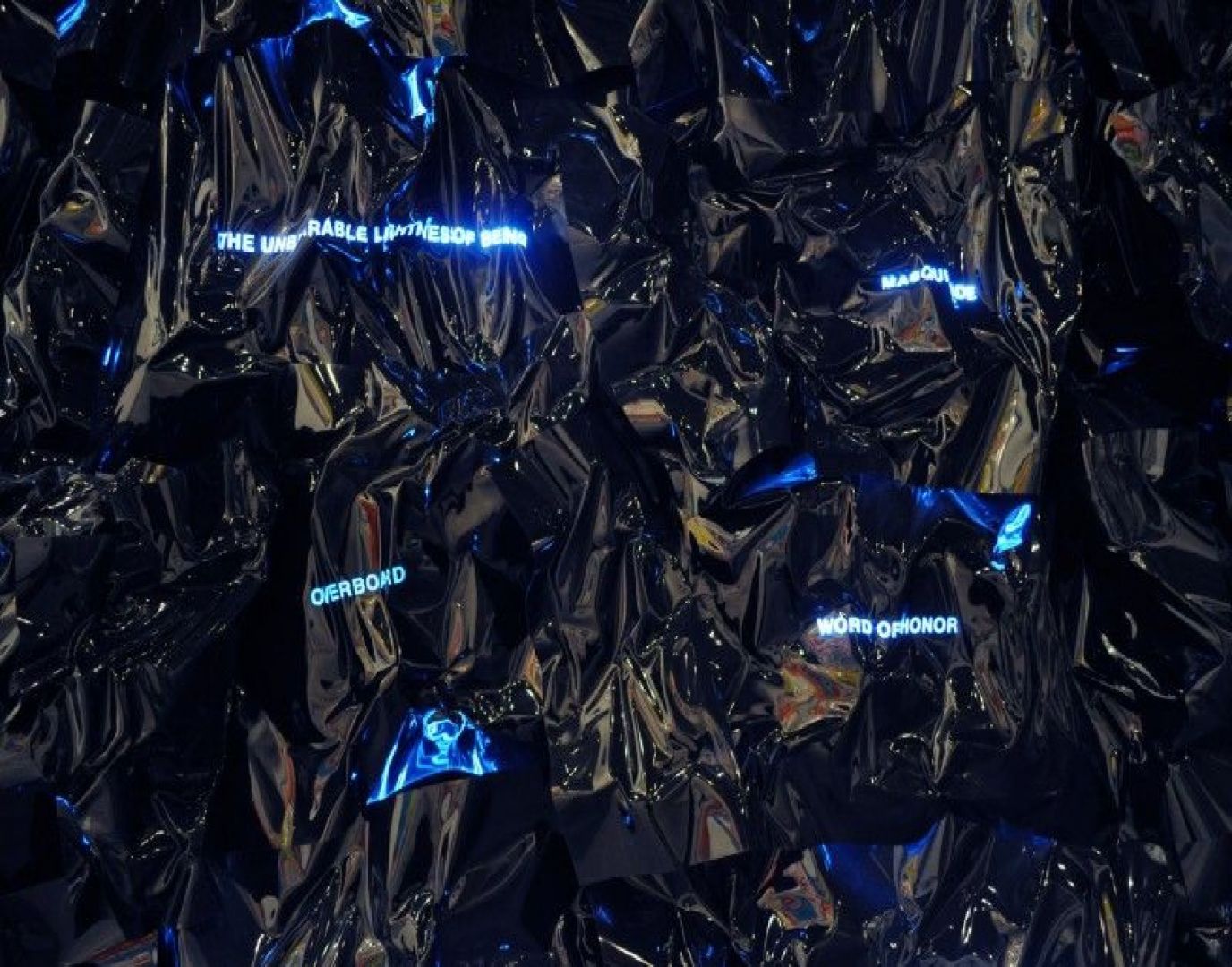
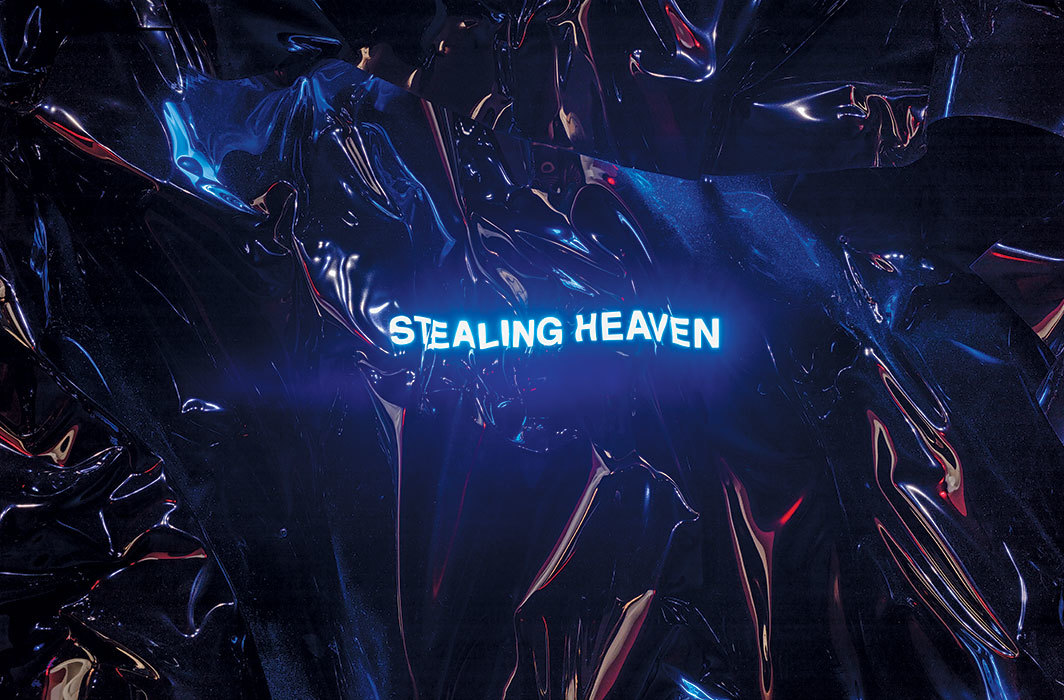
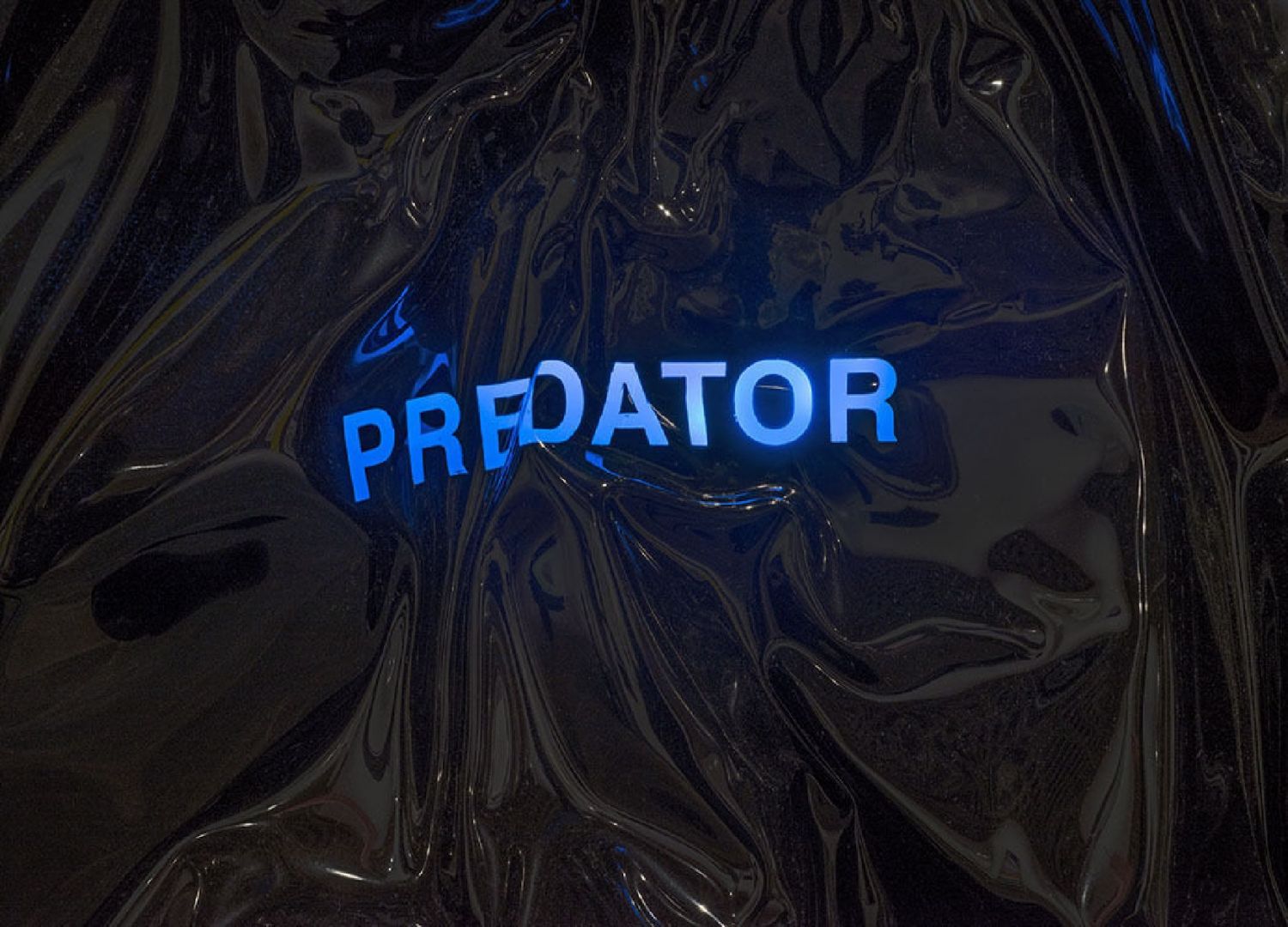
For the original work (which was unfortunately destroyed after Bender’s death), the artist began with a list of every Hollywood movie that was in production for a six-month period between 1987 and 1988. Bender then printed the titles in a uniform font onto hardened black vinyl that resembled the crumpled, glistening appearance of a trash bag. Some of the movies—Dirty Dancing, Fatal Attraction, Full Metal Jacket, and Predator, for instance—are remembered today. Most are forgotten. Others, such as Word of Honor and Cry Moon, were never released at all. The work comments on the non-stop flow of often mindless entertainment media that inundates American culture every year. The titles are flattened out in presentation so that no single film is privileged over another: they’re all just part of a metaphorical trash flow.




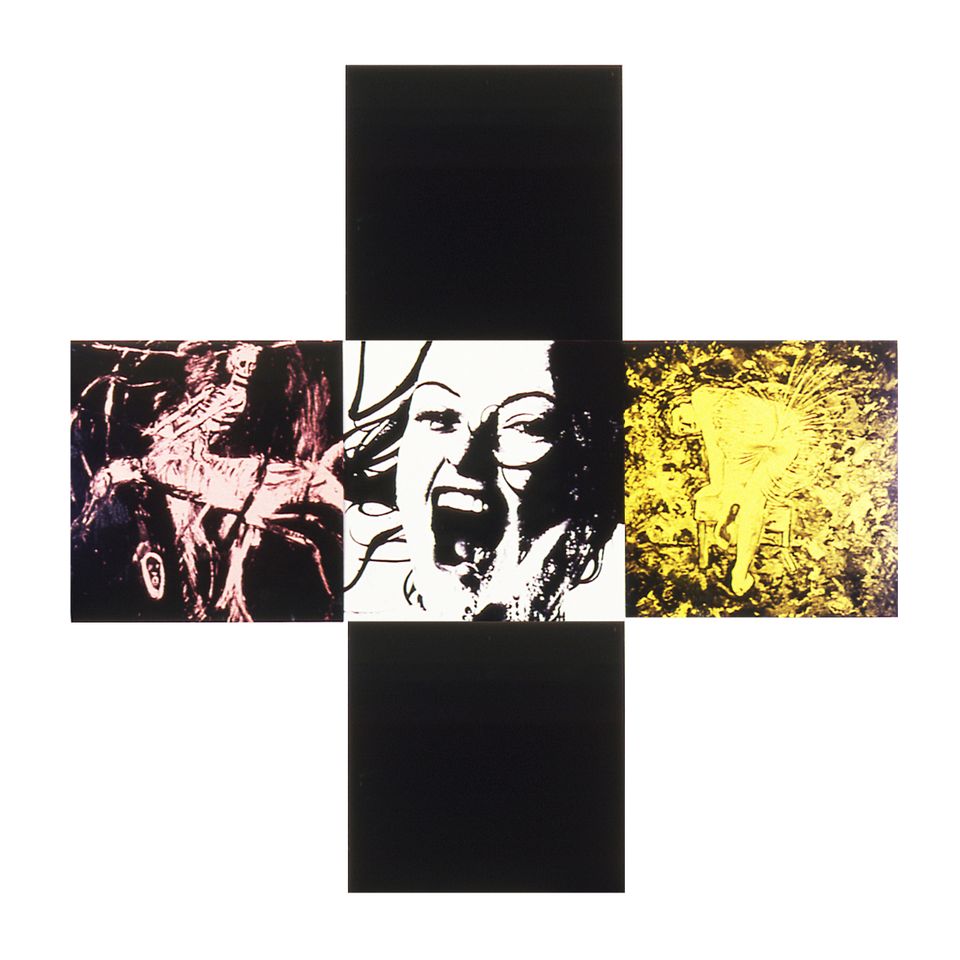
Untitled (the pleasure is back I) (1982)
Reality Fever (1983)
An early, single-channel version of Bender’s video collages, one with found, created, and manipulated imagery, including a Folgers coffee commercial, a children’s superhero cartoon, and Stanley Kubrick’s 2001: A Space Odyssey.
Wild Dead I, II, III (Danceteria Version) (1984)
An early stab at two-channel video shown in the exhibition, Wild Dead I, II, III (Danceteria Version), was produced in 1984, the same year AT&T was forced to start divesting its holdings after an antitrust lawsuit begun in the 1970s, and includes splices from David Cronenberg’s Videodrome (1983) with images of AT&T’s new Earth-shaped logo. In Cronenberg’s dystopian horror, TV viewers are unwittingly brainwashed by their sets, consuming seemingly banal broadcasts that later induce violent hallucinations and desires. Bender’s mashup presents Cronenberg’s fiction as reality, as scenes from the film are punctuated by menacing flashes of the AT&T globe—an indication of the company’s vast ambition and a symbol Bender derided as the “Death Star.” The ensemble, set to a frenetic, pulsating score by postpunk musicians Michael Diekmann and Stuart Argabright, comments on the outsize power of telecommunications companies over the American public—a power that is arguably greater today, in light of antitrust’s unraveling in the ’90s and new forms of Web monopoly.
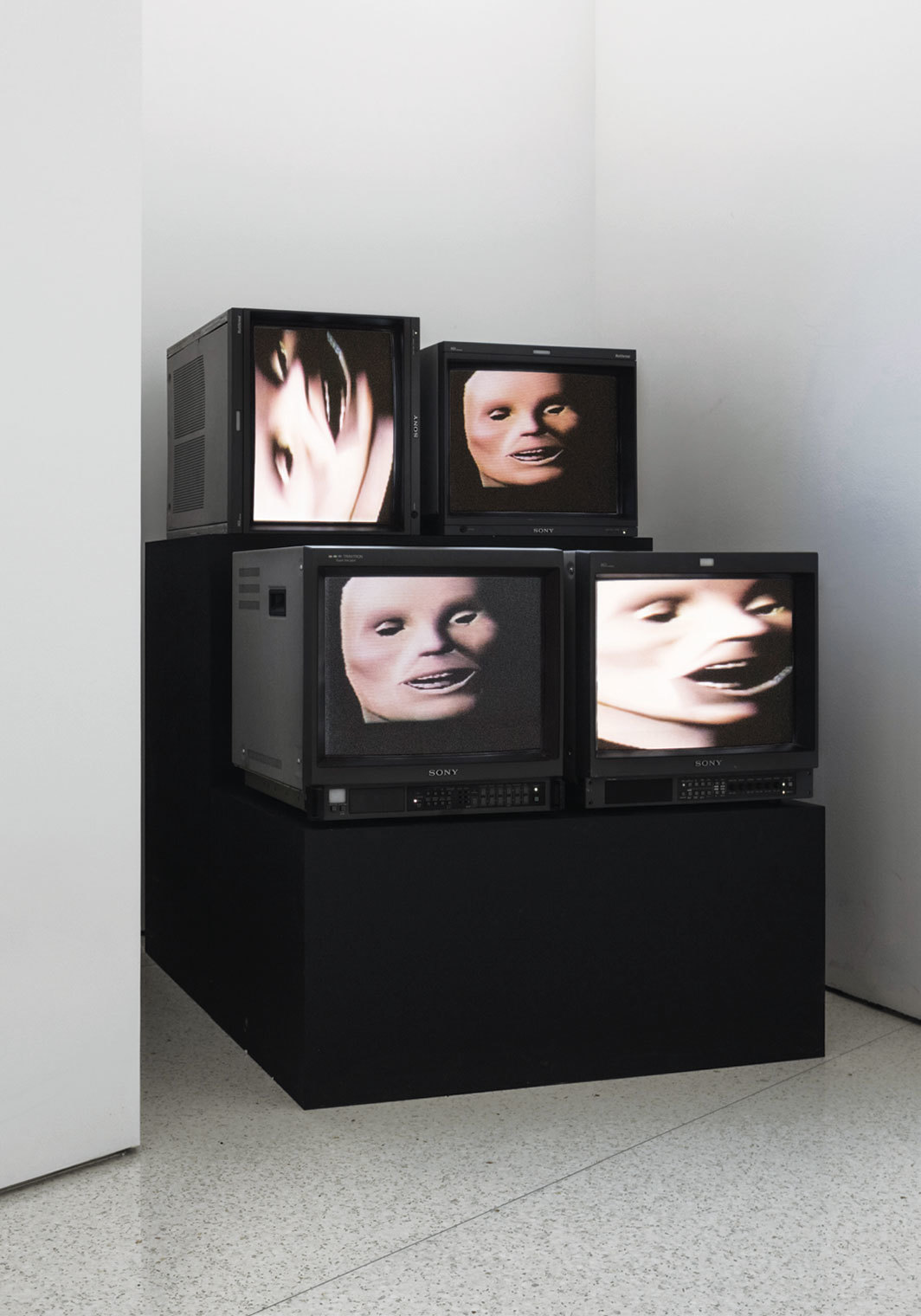
TV, Text, and Image (Metro Pictures Version) (1990)
Live television broadcast on nine monitors, vinyl lettering, and shelves.
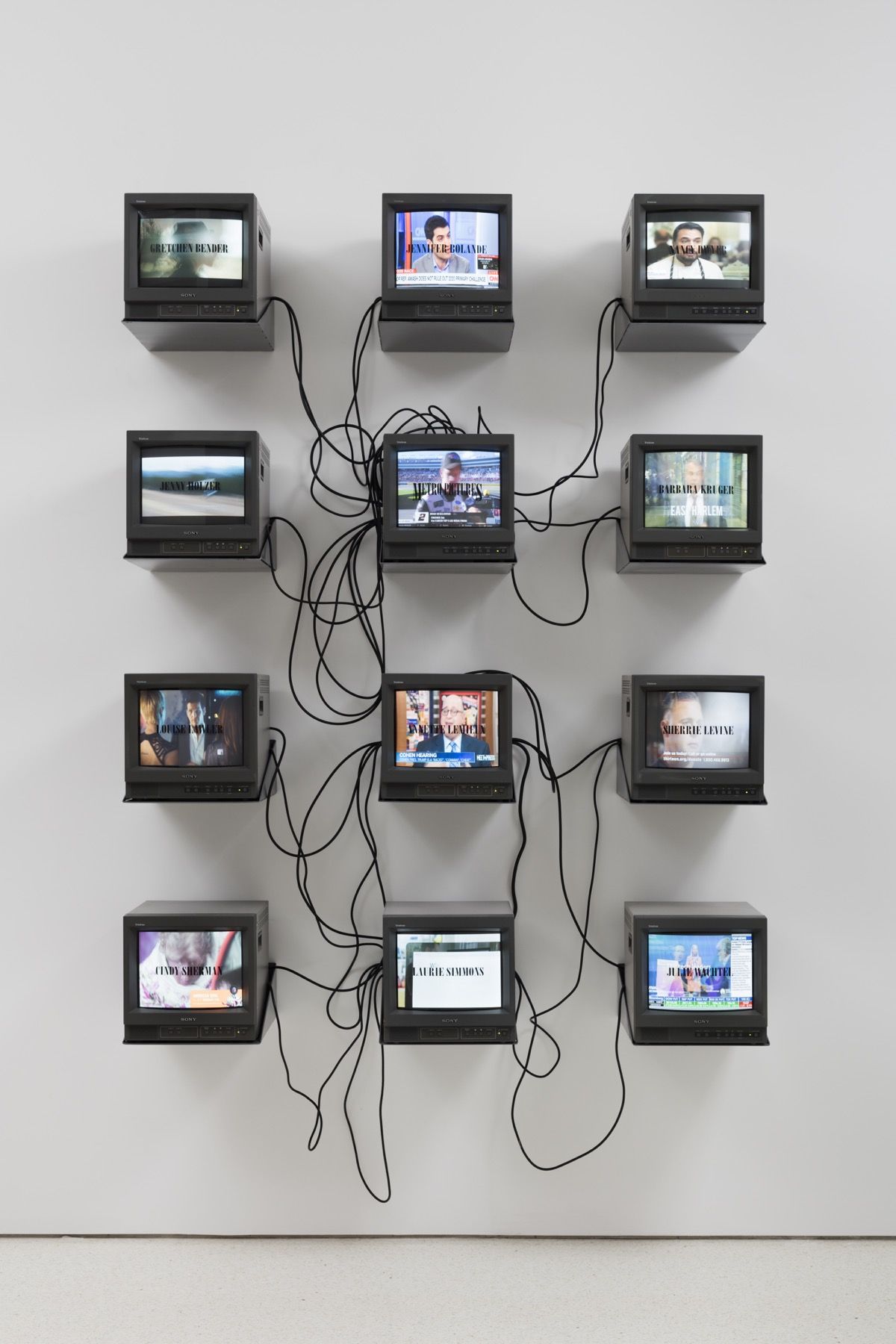
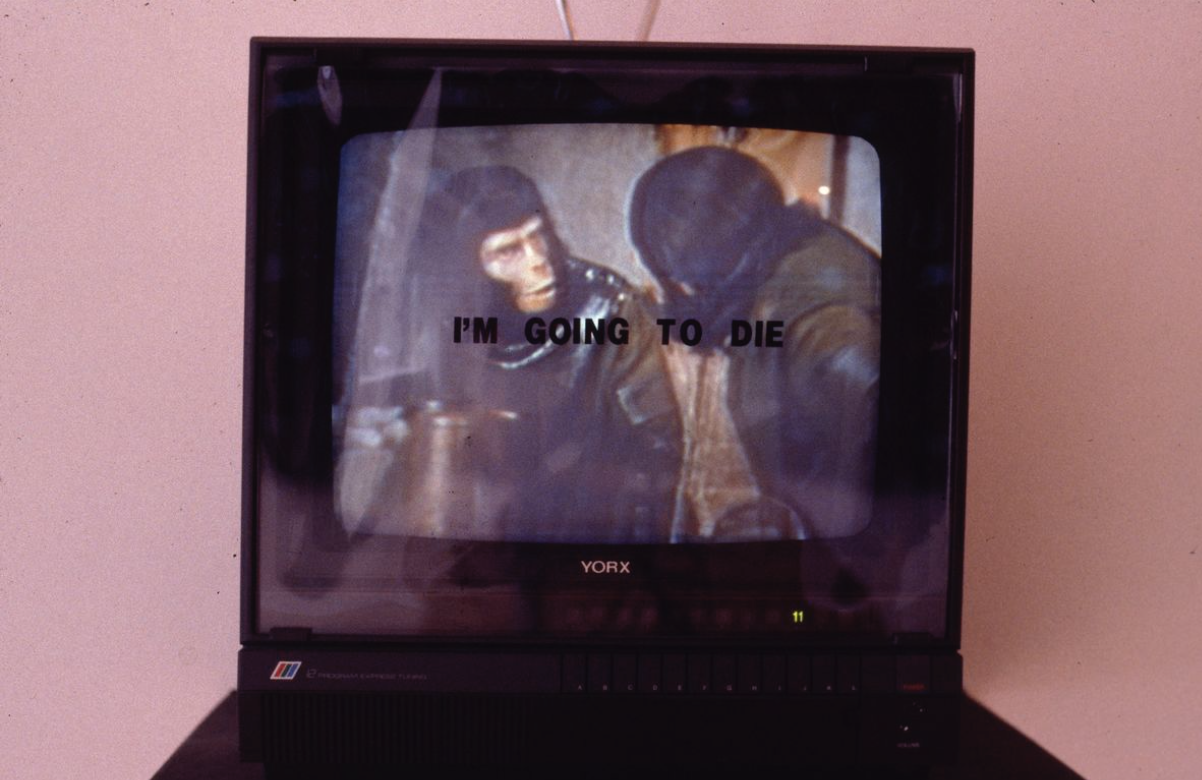
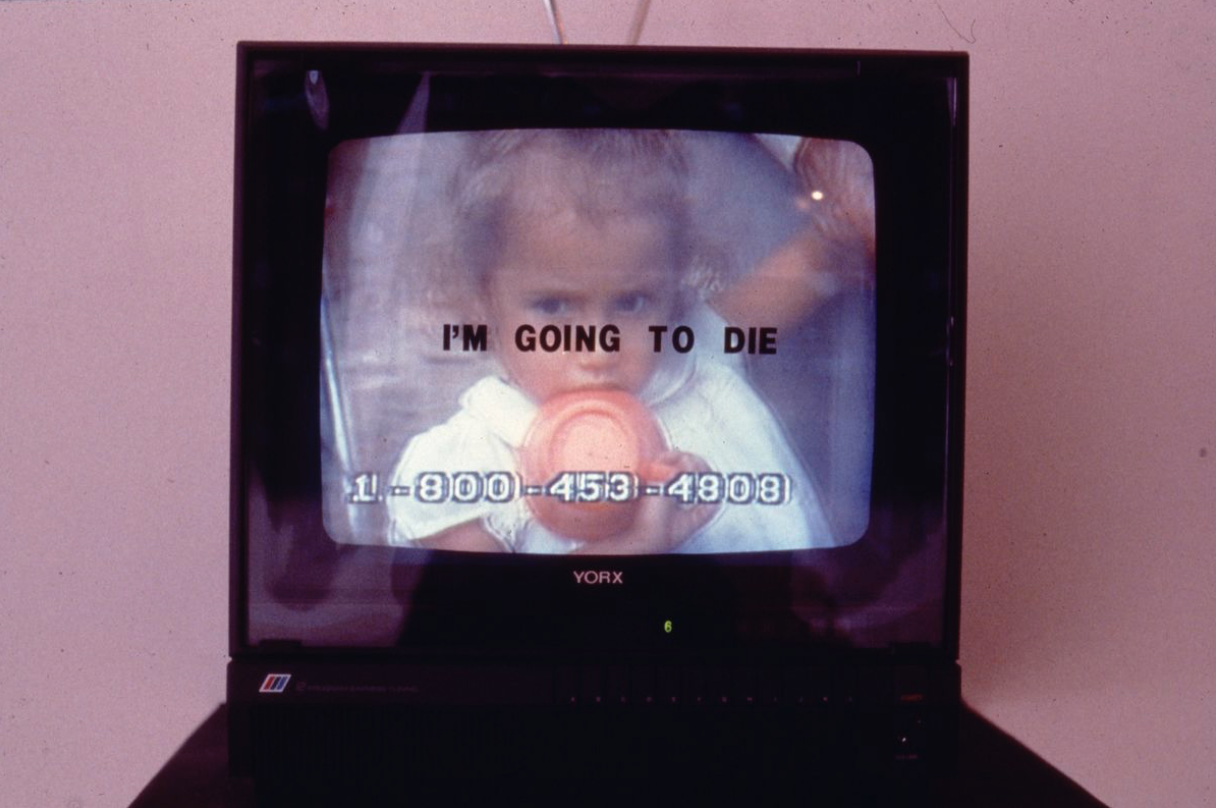
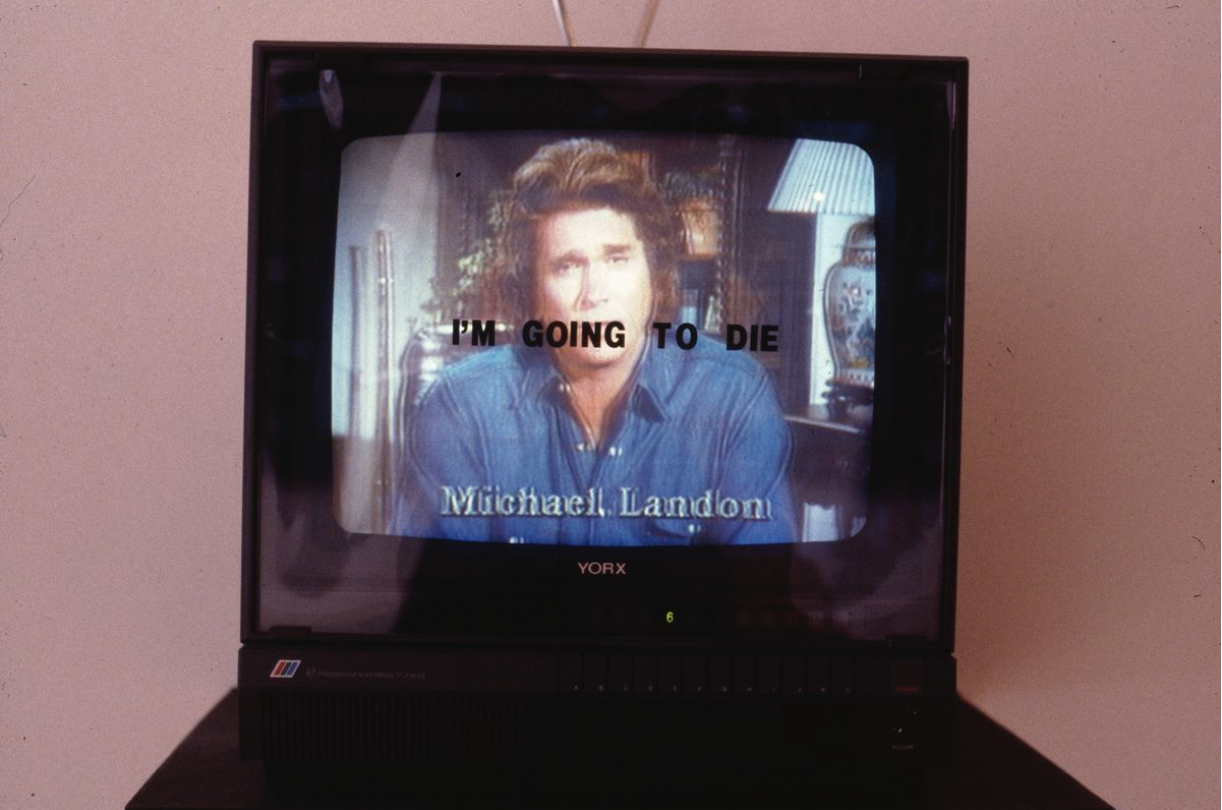
Megadeth Peace Sells But Who’s Buying? (1986)
In Megadeth’s ‘Peace Sells But Who’s Buying?’ (1986), Bender’s breakneck, potentially epilepsy-inducing editing technique complements Dave Mustaine’s high-strung thrashing. Images of the band on stage playing to a mass of head-banging burnouts are incessantly intercut and overlaid with close-ups of Mustaine’s sneering mouth, licking flames, rapidly pulsating images and logos (a dollar sign, a peace sign, Jesus, and so on) and news images recognizable to anyone who lived through the 1980s: bombed-out refugee camps, Ronald Reagan good-naturedly disregarding reporters’ questions at a press conference, hungry-eyed children in Africa. These only let up midway through, when we suddenly zoom out to an irate father, grabbing the remote control and haranguing his long-haired teenage son, who’s watching the video on TV, ‘What is this garbage? I want to watch the news!’ at which point the boy flips back the channel to Megadeth, scoffing: ‘This is the news!’
New Order Bizarre Love Triangle (1986)
This overloaded nowness was present in another video on display, New Order’s rather more cool-to-the-touch but, in its way, no less unrelenting ‘Bizarre Love Triangle’ (1986), which, like ‘Peace Sells’, was edited by Bender and directed by Longo. Alternating rapidly between images of the band and stock-media footage – flowers undergoing an accelerated blooming, commuters marching to work, exploding fireworks and babies’ faces, alongside Longo’s signature freefalling businessmen and some abstracted, pixilated frames – Bender’s editing can be described as almost sculptural, certainly textural. Even though these images create a single cosmology – simultaneously Utopian and apocalyptic – they still palpably chafe against each other as they are reshuffled in line with the music’s inexorable beat.
America’s Most Wanted (Opening Credits) (1988)
Bender designed the credits for the TV show America’s Most Wanted, which Roberta Smith of the New York Times suggested “may have originated the rapid-fire hyperediting now pervasive in film, television and video art.”
Untitled (“Nostalgia”) (1989)
Bender’s art was infused with Marxist-Feminist theory (Theodor Adorno, Michel Foucault, Hélène Cixous, Julia Kristeva, and Vilém Flusser) and she didn’t care if her barbed politics in her works kept the viewer at arm’s length. Indeed, she seemed to want the takeaway to be a heightened awareness of the conflicts and mediations they embodied.
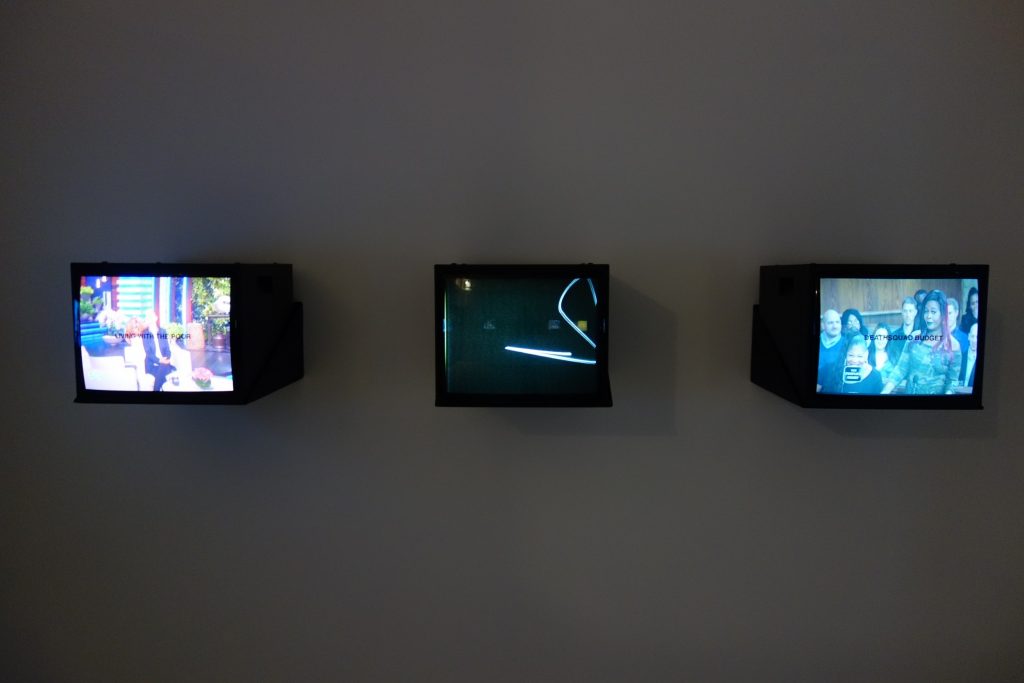
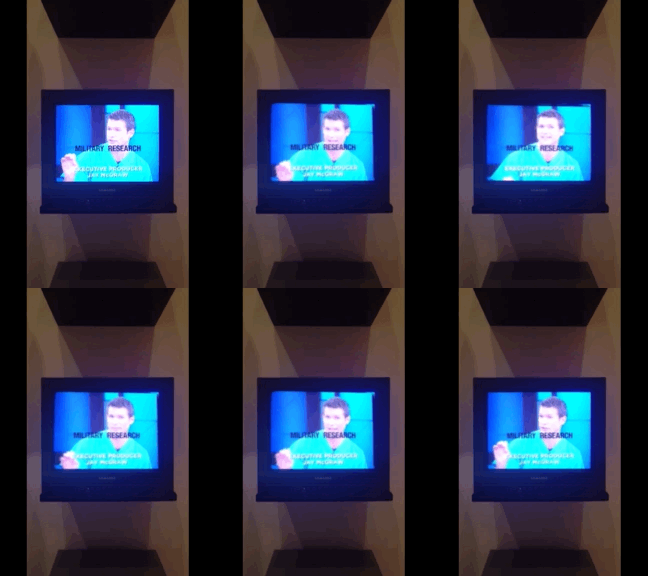
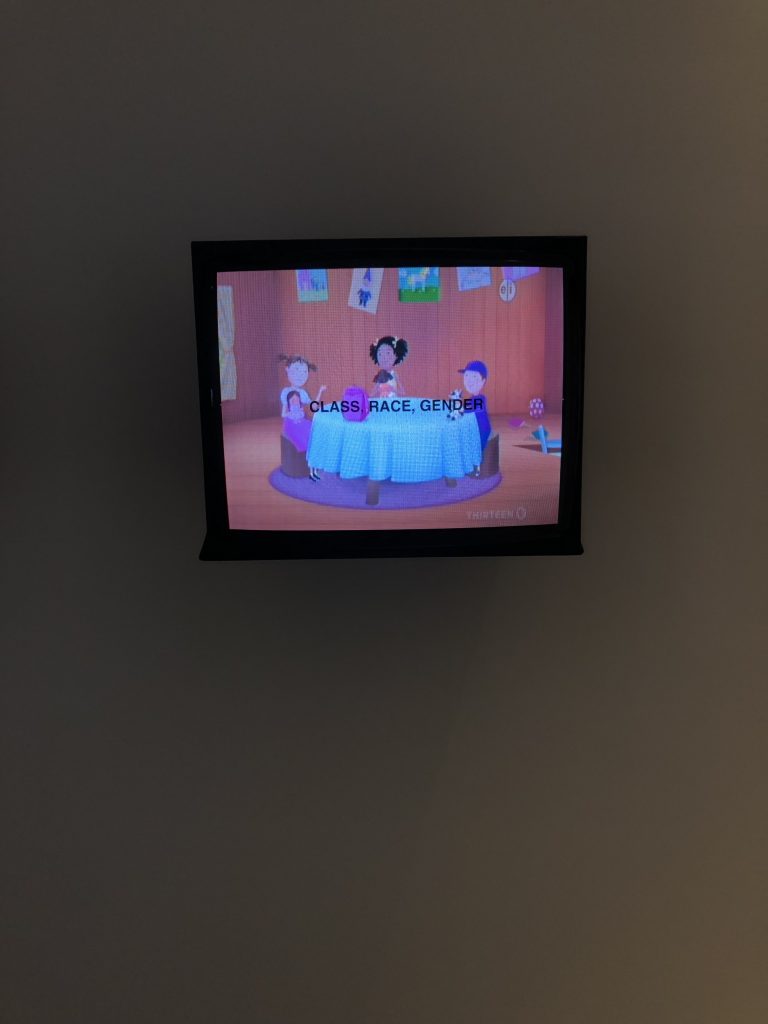
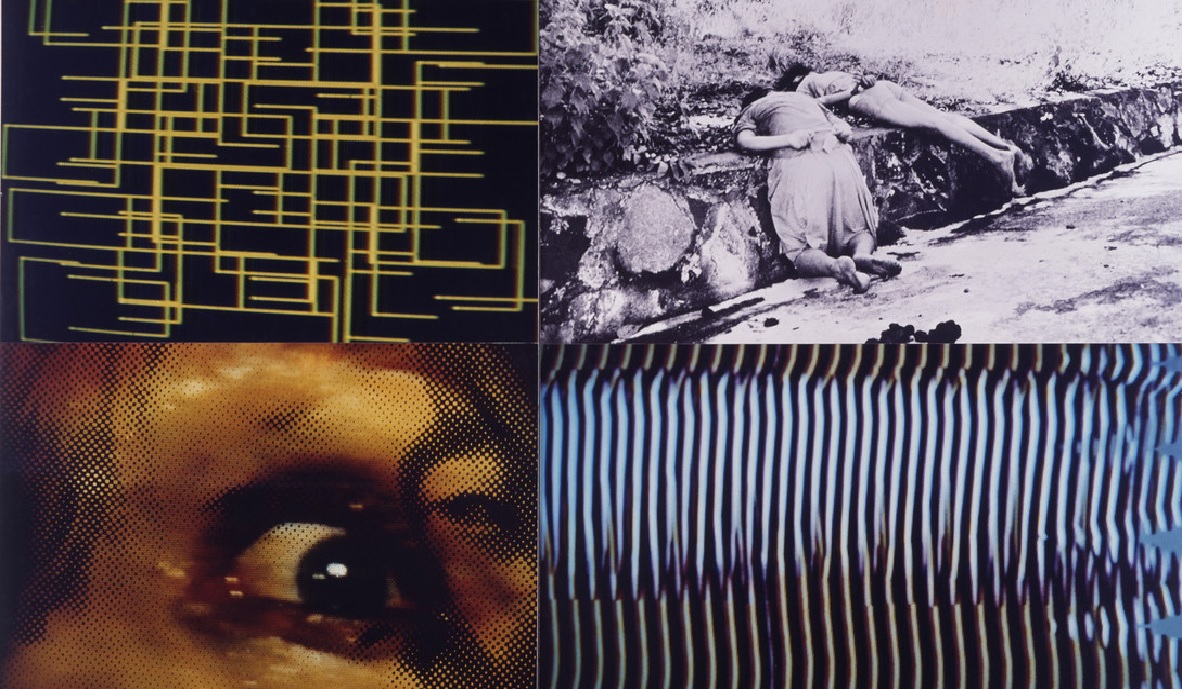
Gremlins (1984)
Four parts; laminated colour photographs, support: 660 x 838 mm, each panel displayed: 1321 x 1676 mm.
Artificial Treatment (1988)
From the Tellus audio cassette magazine, “Audio By Visual Artists” TELLUS 21
Untitled (“Daydream Nation”) (1989)
Photographs on Masonite mounted on wooden armature.
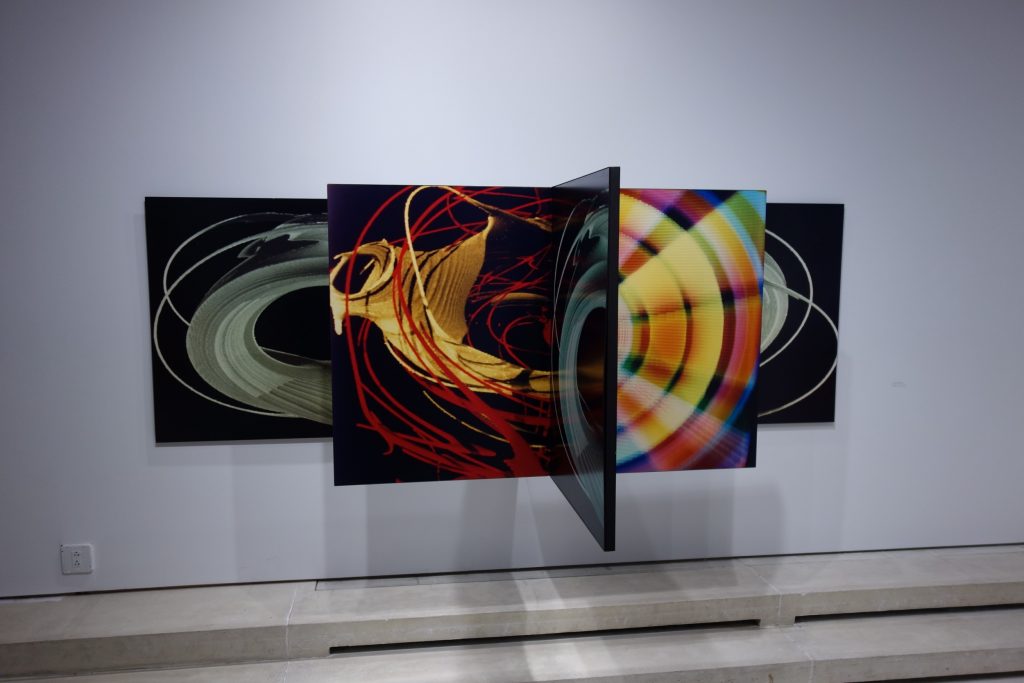
Dumping Core (1984)
Gretchen Bender’s Dumping Core (1984) is a rapid-fire, multi-channel video installation that plays out over 13 monitors arrayed throughout a black box gallery. The improbability of the existence of one of Bender’s major works was already next-level. MoMA apparently helped restore or recover the work, which had only been exhibited as an abbreviated documentation video as recently as 2013.
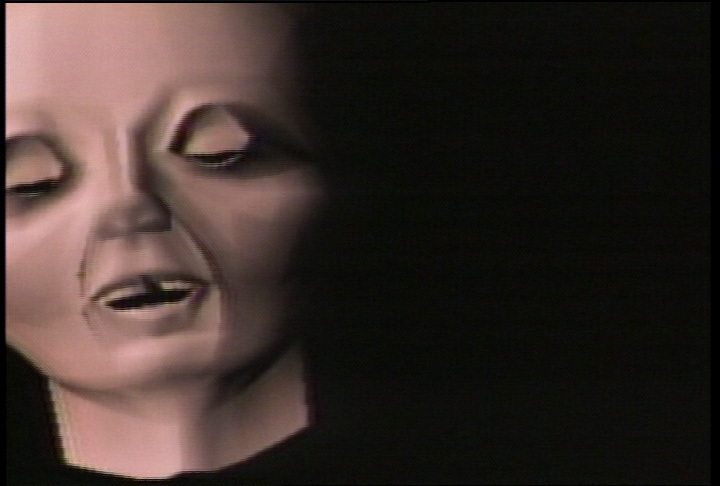

*
p.s. Hey. ** _Black_Acrylic, ‘TSoL’ is one of his big books, so why not. I tend to recommend that people start with his fiction for whatever reason. His novel ‘Death Sentence’ is my all-time favorite novel, for instance. At my first my eyes saw ‘A Prayer Before Dying’, which I did know, but not ‘… Dawn’. I’ll look for it. Thanks. ** Carsten, My guess is that you might get paired with another new poet/author or someone local to help pull in a crowd, but I’m not sure. I’m not even sure that Wilkie represents an oppressor in that film. The reference is very opaque and playful. Thanks for the fill-in about the nude beaches. That sounds so German, as wrongful as that is to say. ** kenley, Hi! No big. Anyway writing always takes priority over basically anything as far as I’m concerned. Where are you in the visa application thing? Are you applied or is the headache more about acing your approach? I’m always completely immersed in whatever I’m working on. It becomes everything. I always feel I have to max myself out in my work. With fiction, it’s total. With the films it’s different because it’s such a long process. First you’re immersed in the writing and then the casting/preproduction, then the shooting, then the editing, with gaps in between them. So it’s full commitment then having to take a break and then committing completely to it again, whereas with a novel, say, it’s a set period with nothing to pull you away or distract you, if that makes sense? How is writing versus making music to you in that way? Awesome about the March studio thing. Yeah, how do you keep your voice from fraying? Or do you just go for broke and whatever happens happens? ** Lucas, Yep, totally. Blanchot is my dude. As usual, you so nail what’s great about Blanchot. I wish I had your brain like a bird on my shoulder. Oh, god, canker sores. I used to get them constantly as a kid, but then hardly ever after I went vegetarian, although it might have just been aging and chilling out a bit instead of the diet. Ouch. ** Steve, I’ve always ignored jury duty summons, but one time years ago they called me, and I just said, ‘I’m an anarchist’, and that was enough. I think just the term scares them off. I’ll ask Zac about Kan when I talk to him today. ** Laura, Blanchot is my dude/god/whatever of language. Discovering him was equivalent to when I discovered Bresson. It reinvented me as a writer. In recent years I’ve gotten very into Deleuze, but the effect isn’t as thorough because I think I’m already invented. Yes, but saying you don’t exist and are saying nothing is saying something. Proof that anything can be said or attempted at least. Amazing idea about the exhibition/performance. I can’t imagine it, which is of course nothing but a lure. ‘Glad in Eindhoven’: that’s so lovely. I’ll watch the whole thing later. What a cheerful, sweet bunch. You should probably go do something else for a day, no? I don’t know what. ** HaRpEr //, Hey. Not the same thing, but I realised ages ago that my being gay was going to factor into every response to what I make, and that I had to stop thinking about it, and I did. But I still dream of a neutral reader, and I still think that, logically, they exist. Excellent description of Blanchot’s effect and the genius of that effect. On me, at least. I don’t think I’ve seen ‘Brand Upon the Brain!’ Or, hm, maybe. I’m happy you cracked his work. When he’s on top of things, which he often is, there’s nothing else like it. ** Uday, Auster was one of his translators. The great Lydia Davis did the best Blanchot translations. I always thought Auster was blah. Kind of brainy middlebrow. Shit, broken toe. And I do think of you as a walker and hiker, so, urgh, pain killers? Or numbing gel? I don’t know. Sorry, pal. ** Right. These days when people even know who Gretchen Bender is it’s usually cause of the music videos she directed for New Order and Megadeth and others, but her own video and installation work was really pioneering and exciting, and I’m a huge fan, so naturally I gave her a show in my galerie. See you tomorrow.


 Now available in North America
I’m into GB’s work a lot but then also into those music videos she did as well. Nice to be reminded of a time when MTV would play host to a cavalcade of avant garde art. Seems that audience of US slacker teens would have been really spoiled.
Interesting work up there. Isn’t it funny how a lot of avant-gardists either got pulled or somehow ended up working in music videos and/or credit sequences & similar montages? Their influence is all over it too. Sometimes I stumble upon a credit sequence that’s really wild & exciting only to find the subsequent show a schematic bore. But at the same time it pisses me off when very square directors recruit avant-gardists to jazz up their stale work. Didn’t Hitchcock do that with Dali? Anyway, thanks for today’s intro as always.
I will do some research on poetry reading possibilities in Paris from afar, but I definitely want to visit again some time soon. To scope out the scene on the ground of course, but also it’d be wonderful to see you again after all these years & grab a coffee if you’re down. I don’t have a set date in mind yet, but most likely spring/early summer. Do you know when you’ll be around, or is that too early to say?
There’s nothing wrong with using “that’s so German” as a descriptor in my book, haha. The thing to understand about nude beaches & FKK at least in Germany is that there’s nothing sexual about it. Germans who champion FKK get offended if you sexualize them or the freedom they practice. That’s tough to square especially for the prudish-but-sex-obsessed mainstream American mind. To them the term explains itself: free body culture. Meaning freedom to handle & use one’s body as one sees fit without having it relentlessly objectified.
Spain’s different. I haven’t been to their nude beaches, mainly because the ones in my area have been described to me as mostly gay meeting, displaying & pick-up grounds. But also very public & manicured beaches with rules practically violate everything I hold dear. On a nude beach swim wear is forbidden, on a regular one you can’t go nude: absurd to me.
What I like are the more rugged, hidden-away coves where each does as they please & no one bats an eye. That’s more my scene.
@Laura: I partially responded to your comment there already. I do get that yearning for full nude body under the skies liberation, absolutely, especially after being laid low. Felt that very acutely after my spinal surgery & recovery. I have gone nude on occasion, yes, but only briefly. The prudish social conditioning of “civilization” is sticky & I haven’t done it with the ease & comfort of those FKK grandpas yet.
hey. i think i’ve seen ‘total recall’ somewhere before but her entire body of work is so impressive to me. thank you for the post. that and ‘reality fever’ kind of give me the vibe of the really weird shit that would play on tv at night when i was a kid and sick and up late. i like it its really weird.
ive started this sort of project a few weeks ago mostly as a relaxation tool that i took a notebook decorated it and started writing down poems that i really like inside it. today i wrote this one down: https://poppyromanov.livejournal.com/708814.html
eileen myles rly does know how to end a poem.
i managed to not smoke today at all yippie!! i think the combination of me smoking less cigs and also having and following a proper meal plan has made me start to gain a little weight which makes me really happy. something i didnt notice about being underweight is how it had this like subconscious effect on me of feeling vulnerable all the time.
i used to get canker sores a lot more than i do now and it really is horrible… for me its probably just the stress. i made a plan for my week the first time at all and immediately had to throw it overboard bc of rojava getting attacked etc so i am just running around all the time. well not really (and thats the problem) but i am changing my immediate plans every day. what happened to me more last year when i got stressed and didnt sleep was get styes. but neither shall happen to me again in 2026 manifesting
Hey Dennis.
I actually meant to reply to yesterday’s post, but tiredness got to me before I could. Wump, but I’ll elaborate on why I was tired later. Anyway, I actually find this one quite interesting; it’s funny how so much work I recognize but didn’t really know about ends up here. I always feel like I’m finding some missing link when I see something on this blog. I think I’m too addicted to the feeling of the uncanny, which is why this kind of early low-res video graphic art appeals to me. I suppose something similar is happening to AI, where now that it’s losing its uncanny nature, it’s becoming quite banal.
Yesterday I got caught in something quite interesting. I don’t know if you remember, but I told you about that friend of mine who got sex trafficked a while back. Anyway, one of the people who helped facilitate that happening to them got busted for fabricating a letter from the FBI for attention online, and now that they’re being revealed as the scam artists that they are, they’re going on the offensive, complaining about how everyone is victimizing them and that everyone accusing them of rape, sexual slavery, extortion etc is just part of a wider conspiracy to tear down their dangerous voice online. My friend was going on a bit of an emotional bender because of it, so I spent a lot of time just hearing a whole bunch of newer horror stories about what was going on with them. My only real conclusion from it is that being a cum brained idiot goes well with being quite a piece of shit. The whole story was very “the sluts” like, but like, if everyone in your book was a sexually overactive Instagram activist who didn’t know how to string together coherent sentences without ChatGPT, kinda thing. y’know? One of the characters in this drama was a woman who used to run some sort of big tech company in Quebec, who dropped out of the company so she could go around and keep transgender men as “fuckholes” who she didn’t need to respect because she kept promising to pay them, she’s the matriarch of a whole “family” of girls who do all sorts of things while roleplaying as family members to each other for sexual purposes. Of course, all of this is “alleged” for legal reasons, but something is going on, and it publically it involves a whole lotta cum and diapers and open essays about the desire to rape and kill older transgender women, and it’s very hard to wade through, because there’s so much verbal diarrhea from the people involved, and most of the time its seemingly AI generated and full of sexual hangups and fantasies and paranoia about other “bad gays” that it becomes tiring quite fast. The story is still developing, and it seems that the girl who fabricated the FBI letter is realizing what it is they brought upon themselves and is trying to backtrack and insulate her own little cult of personality from it. Anyway, this is what had me taken in yesterday, and it all just built on itself.
I was gonna fit something about Blanchot or Deleuze in here, but I think the story I’ve just told has hijacked this, just like it hijacked my day yesterday.
Hope the coffee’s good when ya read this!
Hey. Do you recommend a place to start with Deleuze? I of course want to read ‘Anti-Oedipus’ but it’s quite an undertaking. I’ve heard that ‘Difference and Repetition’ is good. Should I just pick a topic that I’m interested in and go with that one?
I remember I heard someone say once that if you’re not a gay man then you won’t fully get your work, which really annoyed me.
I guess I did live as a gay boy until when I came out as trans when I was eighteen, because people sort of forced that label on me and I was okay with it for a while since I was trying to work it out. I think that’s pretty common among trans people. All my life I never felt all that comfortable in my body or my mind and I guess I also felt pretty alienated by the queer kids at school who thought I was too weird. But I felt an affinity with the confusion in your work while trying to figure it all out, and knowing that I’m trans hasn’t really reduced much of the confusion. Is my connection to the work invalid because I didn’t decide to stay living as a gay boy?
It was the style and form of your work which stuck with me which I think reading a specific text as just ‘gay fiction’ can neglect. I’ve always really liked the grey areas between things, when books refuse to just re-affirm something the reader already understands.
And I guess the bottom line is that being queer doesn’t explain why I am the way I am. That’s why I like the term ‘queer’, because to me it always felt ambiguous and rejecting what people impose on you.
really cool! ugh—i wish i knew more about bender when i was in high school. she wouldve gone triple platinum on my tumblr
ahhhhh i am in the “perfecting the final stage of my application” stage. canadian pr is a long and convoluted process. i just got back in my house after taking a little cigarette walk where i slipped on some ice and totally ate shit, and i was like “why am i working this hard to live in a country this cold?”
thats fair re: writing! tbh, im like…a day or two’s work away from finishing the first draft of my first ever longform fiction thing, and its like…nothing else exists at the moment, its so all-encompassing. but im forcing myself to wait a week between finishing the draft and going back in to start revising. having said that, any editing tips you can pass along? would super appreciate it!
and i find music so different from writing. its inherently collaborative and full of so many starts and stops based on everyone else’s schedules and commitment levels. and punk people are always in 5 different active bands at any given time, so that can get annoying if you only have one project that really revving to go on. kinda like how you describe filmmaking?
my voice! uhhhh i just kept trying different ways of screaming until i found one that wouldnt blow out my voice the next morning. i had some knowledge of singing technique to start, so i kinda just built off of that. and then once i locked in on a way of doing it that felt supported and healthy (lots of diaphragm!), i just kept tweaking it until i got to a sound i liked. tbh im still finding little things to adjust and discovering new things i wanna try. but…the process is what makes it fun, i guess!
I don’t know if I’m super into a lot of Bender’s work, but it making a galerie post will give me pause to reconsider. Ok yes, Lydia Davis feels like a much more apposite translator. I’m very fascinated by translation right now and might dedicate myself to it for a bit. Not worried about pain in the toe, don’t worry. Mostly put out about walking but even with that we have a snowstorm coming so I’d probably have stayed inside more anyway. Always a bright side! Found out that you’re visiting my class later in the semester. Not putting any details here about the college or professor so as not to dox myself but excited for you and Zac Farley to pop in.
Maybe I am a neutral reader in that literature can open up a passage to a part of me that in no way fits my identity(s) or what I think I am or any attribute you could label by watching me… a place of non-being where yet I exist. Lifesaving in my case. I don’t know how non-readers make it through the world.
Back to earth, my friend and I built a sauna to which we invite a rotating cast of characters in the little bohemia where we live in the States; freeing yet vulnerable being undressed with friends and new acquaintances in an intimate semi-darkness, a social equality I’ve never felt clothed. I’ve always found joy being naked with another, sex a means to that end. Getting dressed feels more than a little sad.
The beach is a tourist attraction.
Lights out — J