____________
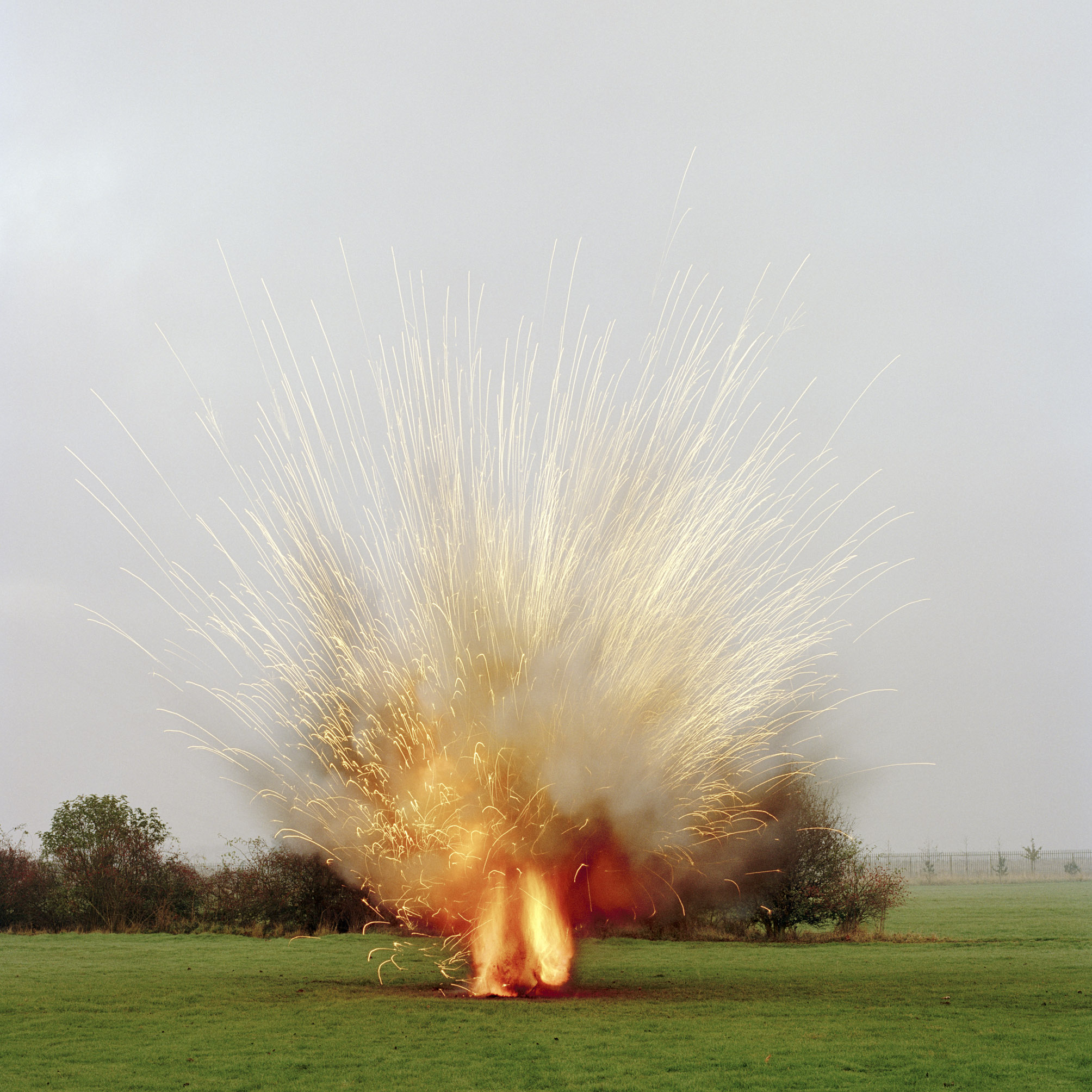
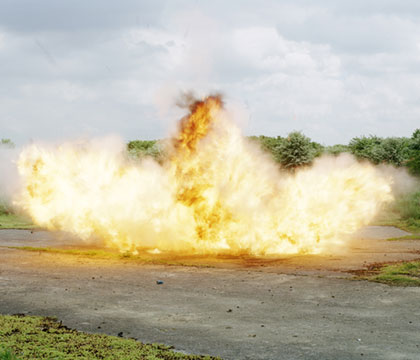
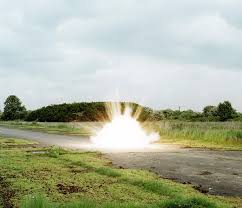
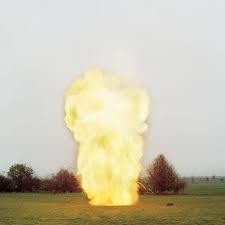
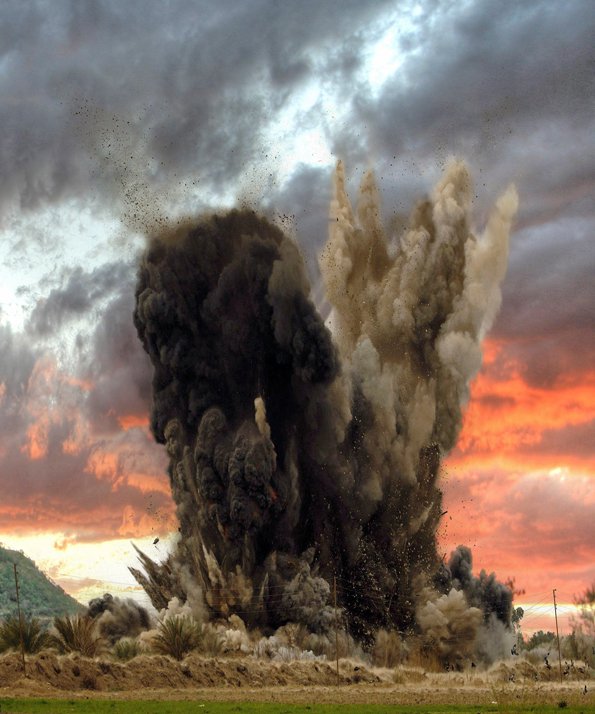
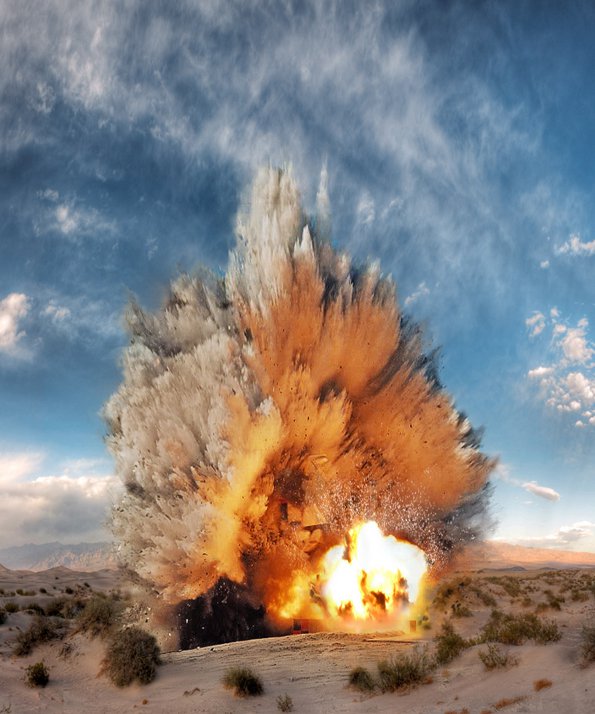
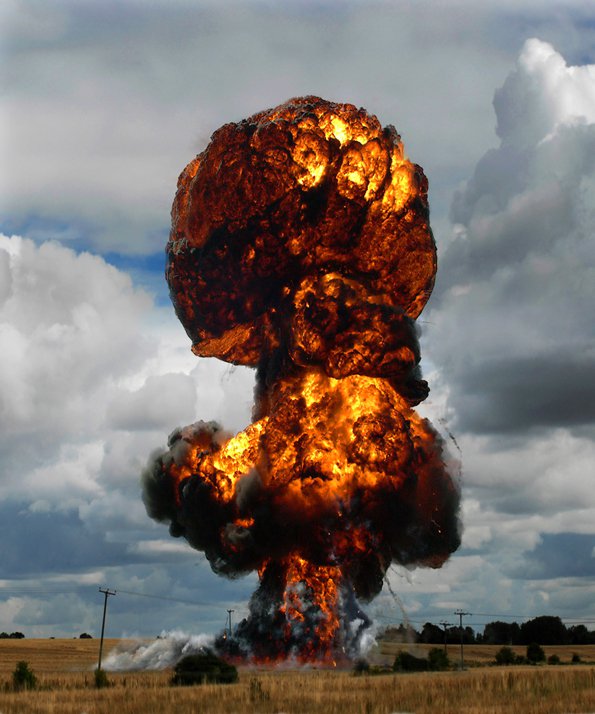
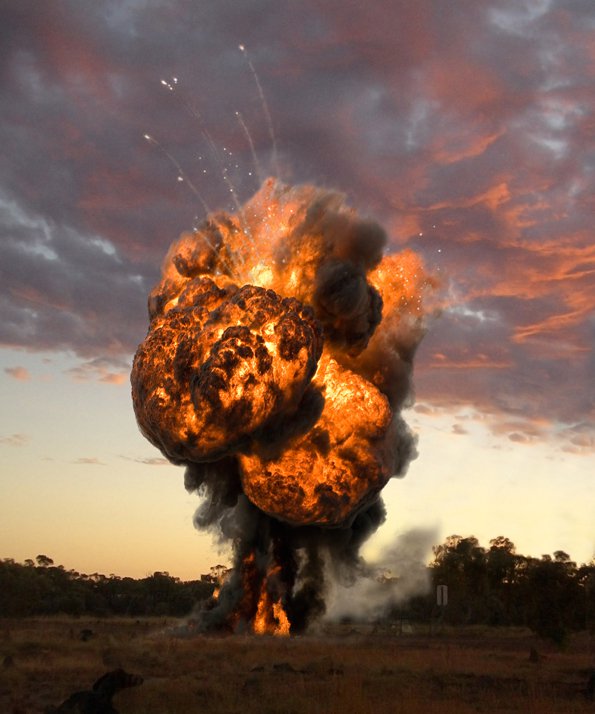
Sarah Pickering Explosions (2007)
‘The simulation pyrotechnic industry has rapidly expanded over the last few years: atrocious acts have happened in conflict throughout history, yet training in recent times has had to become more and more realistic to psychologically prepare our forces for the worst. Police and soldiers who have grown up playing computer games and seeing ever more spectacular special effects in films are simultaneously disconnected from and situated closer to the “real.” These photographs, which depict pyrotechnic explosions used by British police and military instructors to intensify the sense of drama and tension in training exercises, are part of a series taken at test sites in the English countryside where the bursts of light, flames, sparks, and smoke sit incongruously in the rural environment.
‘Whether real or artificial, we enjoy looking at explosions and, as an artist I’m of course fascinated by their visual seductiveness. I’m also interested in the forms of violence they represent, in our relationship to them, and in identifying the imaginative references they instantiate.
‘With names like “Artillery,” “Groundburst,” and “Napalm,” the pyrotechnics evoke not only violent and destructive events from wars and conflicts, but also the dramatic re-enactments of such events familiar from feature films or war documentaries. Witnesses to extreme situations often describe what they saw as being “like a film,” and modern filmmakers use CGI and special effects to conjure the most realistic possible disasters to entertain viewers. Indeed, one of the pyrotechnic manufacturers was also responsible for making explosive effects for James Bond and war films.’ — SP
____________
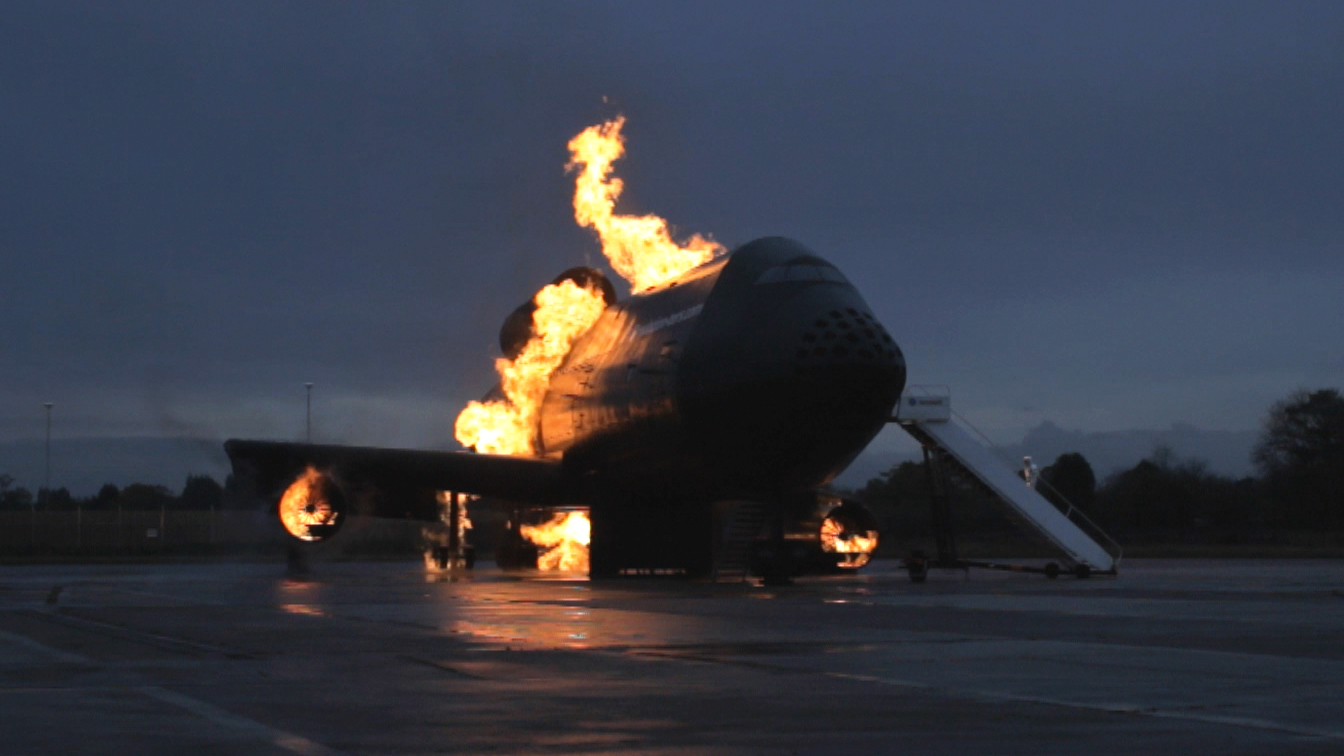
Simon Faithfull Reenactment for a Future Scenario #1: EZY1899 (2012)
‘Reenactment for a Future Scenario #1′ presents an action that is stranded in time and space – a state where the adrenalin of emergency has dissipated into the tedium of the everyday.’
_____________
GREGvisual quicksilver exploding floor VFX Cinema 4d +after effects (2017)
‘Its doable… It’s just just 70 hrs of recording and editing it takes a lot of time…’
_____________
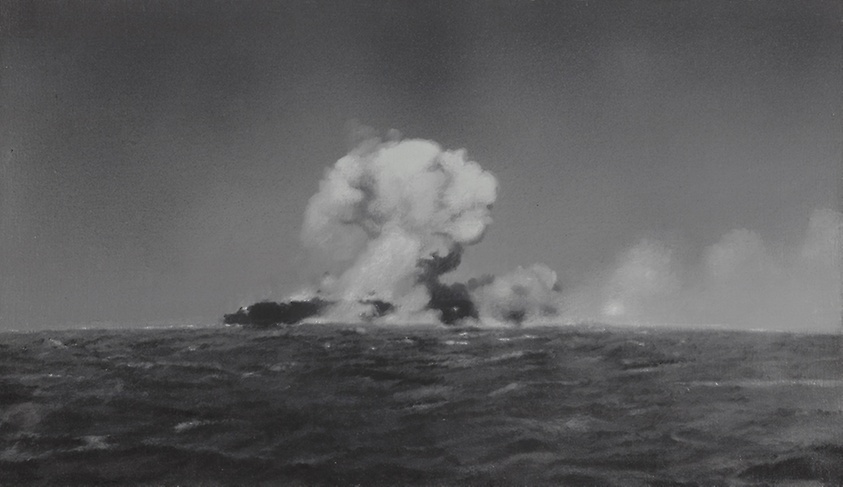
Vija Celmins Explosion at Sea (1966)
‘Explosion at Sea belongs to a group of paintings by Vija Celmins on the themes of war, technology, and devastation. In the mid-1960s, the artist began to use photographs from books, magazines, and newspapers found at secondhand stores and yard sales as the point of departure for her work. After locating a wealth of material on World War II—a conflict that was the backdrop of her childhood in Latvia—Celmins employed subtle layers of precise brushstrokes to construct a detailed image of an attack on an aircraft carrier. The resulting painting, like most of her works of this moment, creates a disturbing contrast between the intimacy of the format and brushwork and the haunting seriousness of the theme.’
_____________
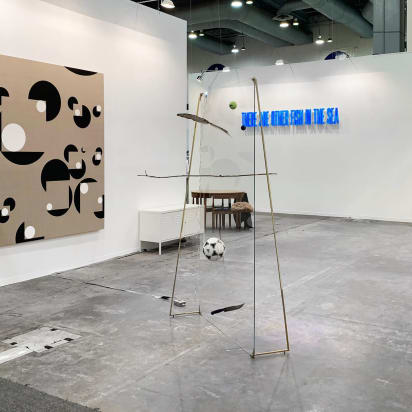
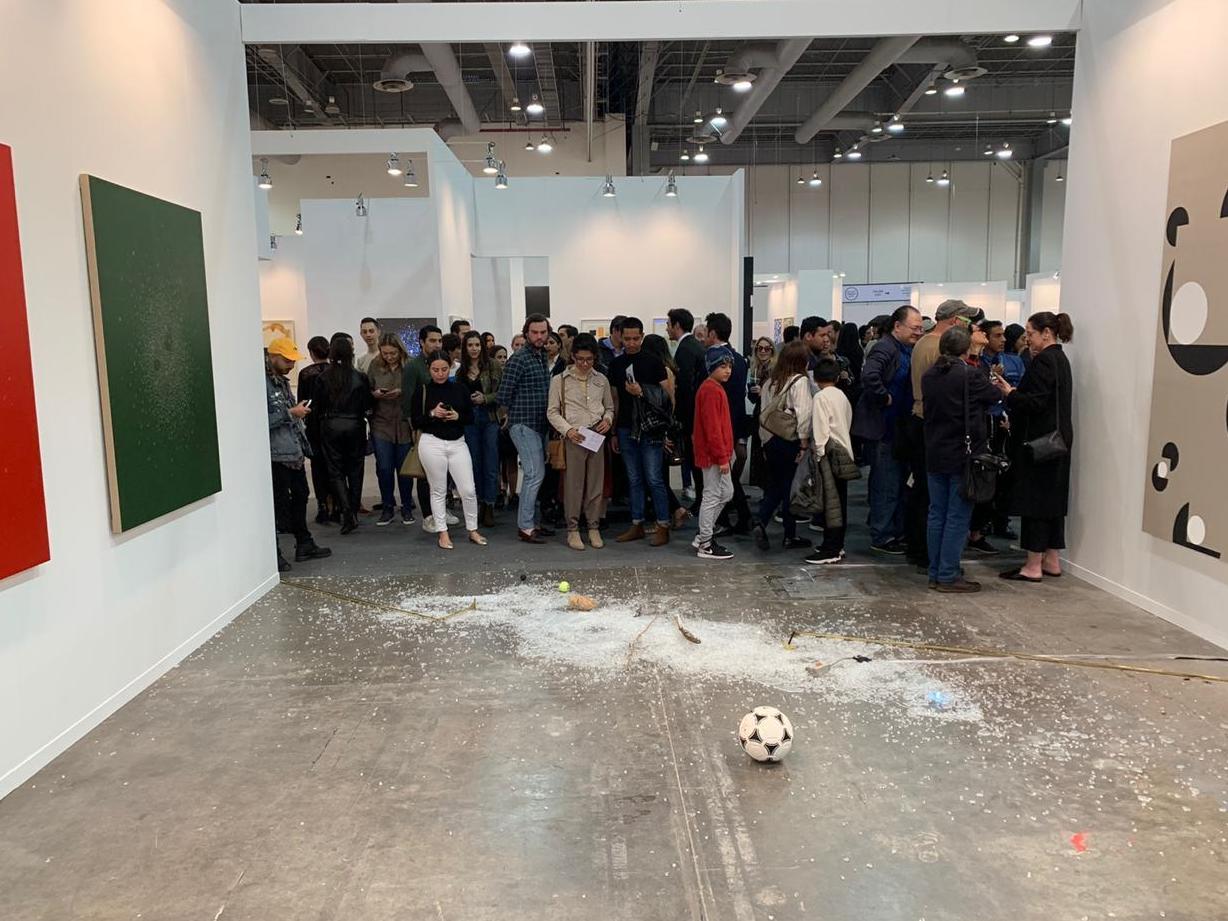
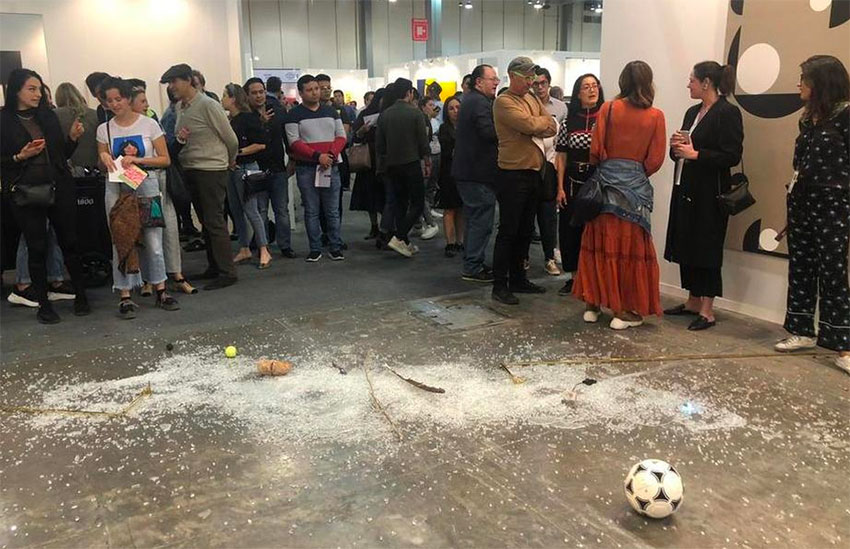
Gabriel Rico Untitled (2020)
‘Rico, who is based in Guadalajara, Mexico, “creates pieces that fragment the composition of the contemporary human and evidence the geometric imperfection in nature. … Rico’s sculptural works reflect on the nature of the materials used to produce them and their arrangement in the final composition,” according to a preview of the exhibit from his gallery.
‘An art critic named Avelina Lésper was at the fair, and she was decidedly unimpressed with the piece. As a critical commentary, she says, she set an empty can of Coca-Cola on the floor next to the work to convey that the meaning of the art would remain the same if the can were incorporated.
‘Lésper told the newspaper Milenio that as she moved the can near the artwork, it exploded suddenly, “as if the pieces had heard my commentary.” It could have happened to anyone, she says, including a collector or museum.’
_____________
Noboru Tsubaki Before Flower (2010)
‘Artist and professor in the space design department of Kyoto University of Art and Design, Noboru Tsubaki’s forty-foot high gymnospermous “Before Flower” involves rear projections on the eye controlled by TouchDesigner, changing colors and patterns based on the amount of carbon dioxide emitted by visitors as sensed by detectors on the sculpture’s eye.’
_____________
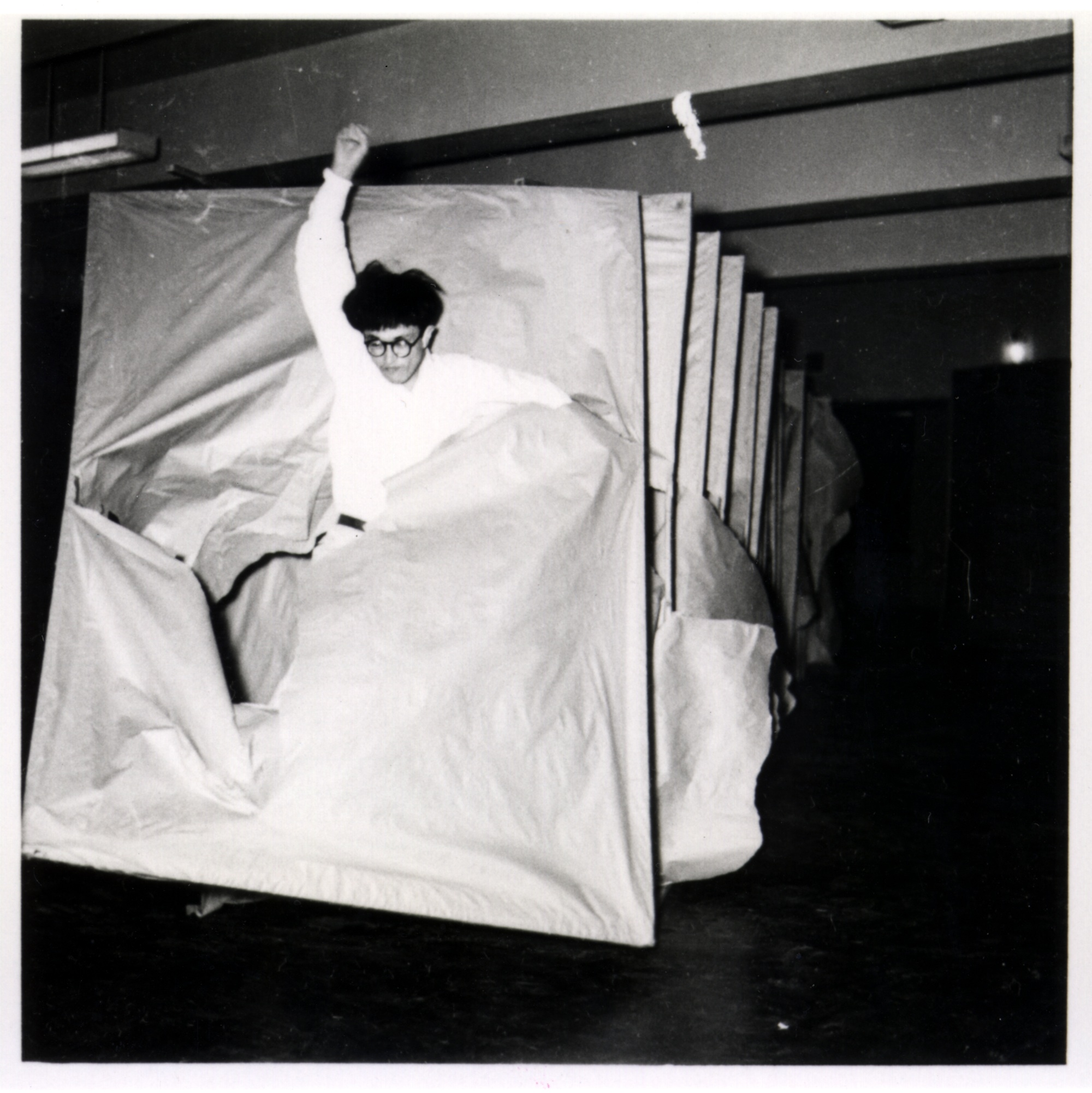
Saburo Murakami Passage (1956)
‘During the seminal Gutai outdoor exhibition ‘Experimental Outdoor Exhibition of Modern Art to Challenge the Midsummer Sun’ in 1956, an exhibition which went on for twenty-four hours a day for thirteen days, Murakami hurled himself repeatedly through numerous vertically erected paper screens.’
_____________
Kit Wise Explosion (Geranium) (2010)
‘Explosion (Geranium) combines found footage of a military test explosion in the Arizona desert with a moving image of a flower blossoming. “It’s like a macro and a micro explosion,” Wise says.’
_____________
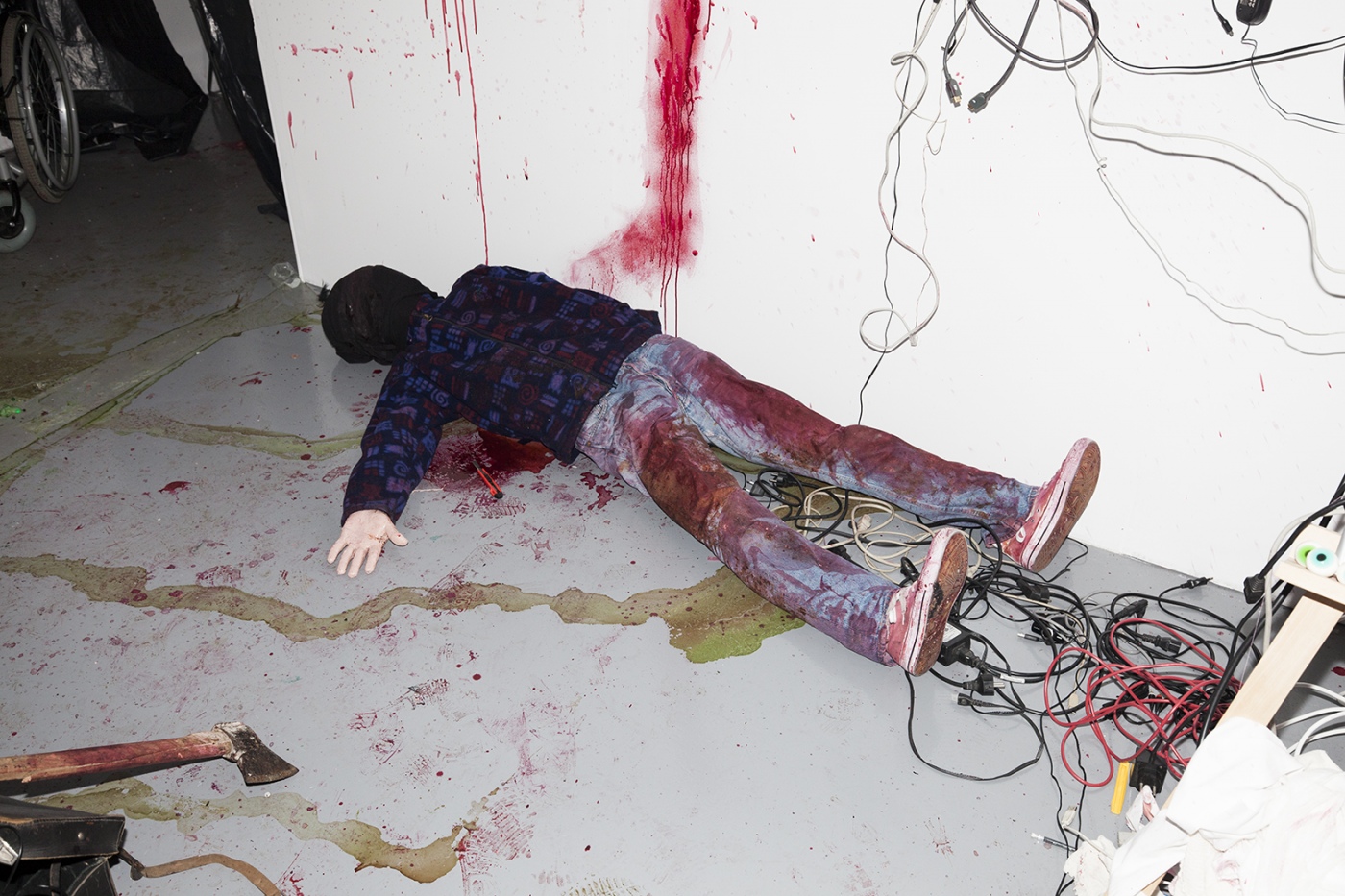
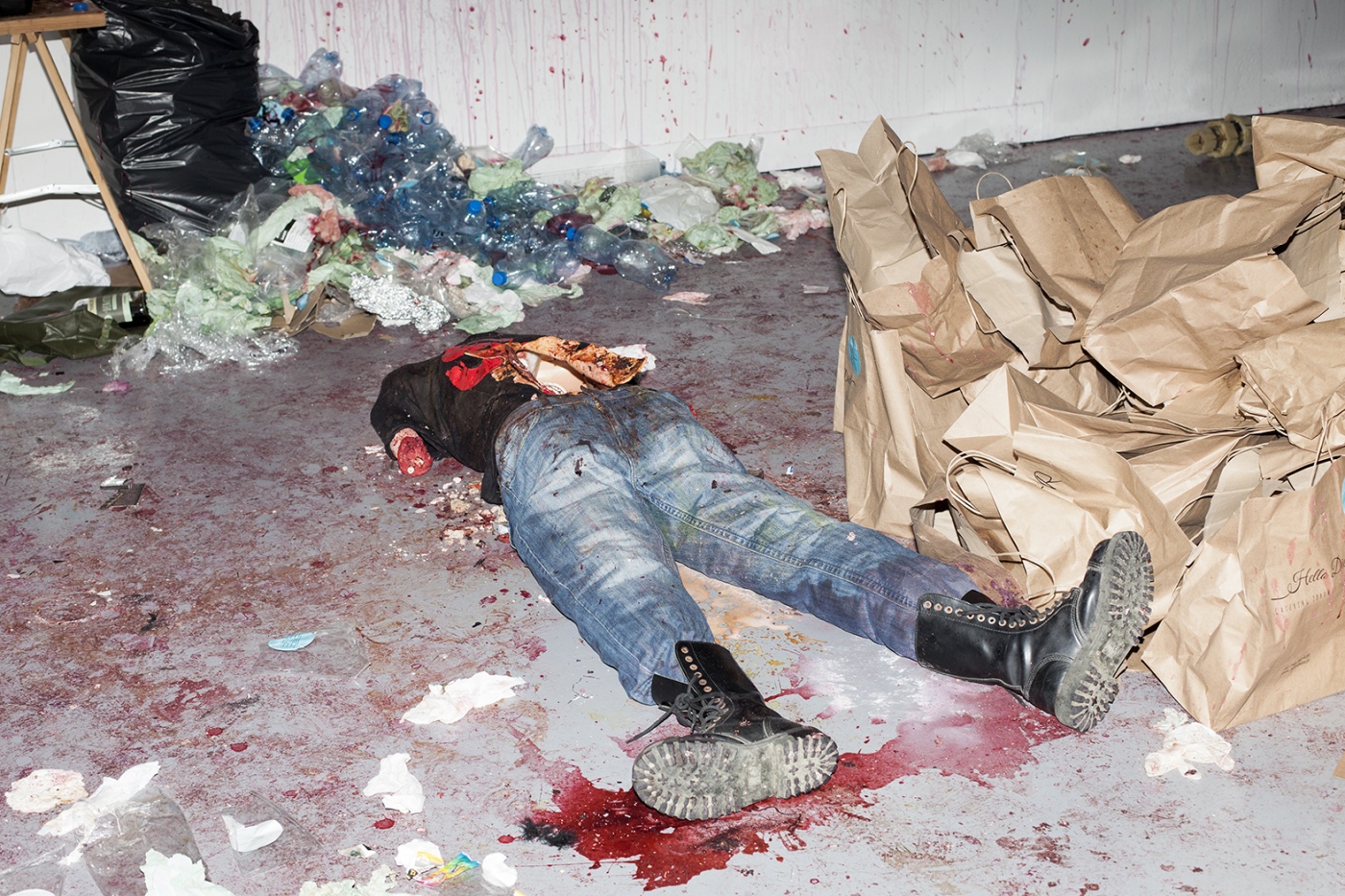
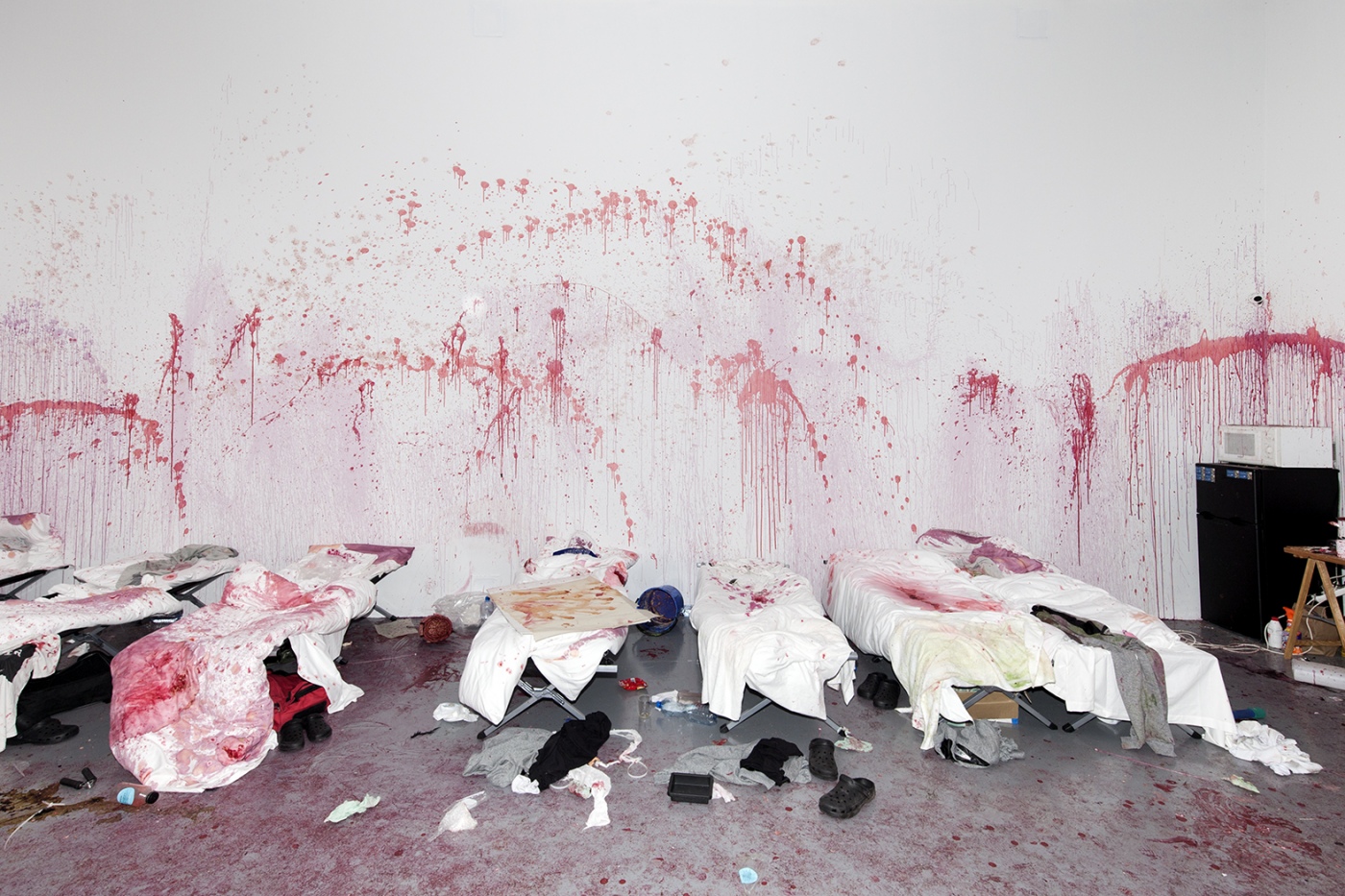
Horacy Muszyński ASS.DEATH.DICKS (read: aesthetics) (2019)
‘ASS.DEATH.DICKS (read: aesthetics), tells the story of six young artists invited to work on an exhibition. It is supposed to be their first major project, and the launch of their artistic careers. However, due to creative-block frustration, envy, or ruthless ambition, the young artists start killing each other, turning the gallery white-cube into a bloodbath.’
_____________
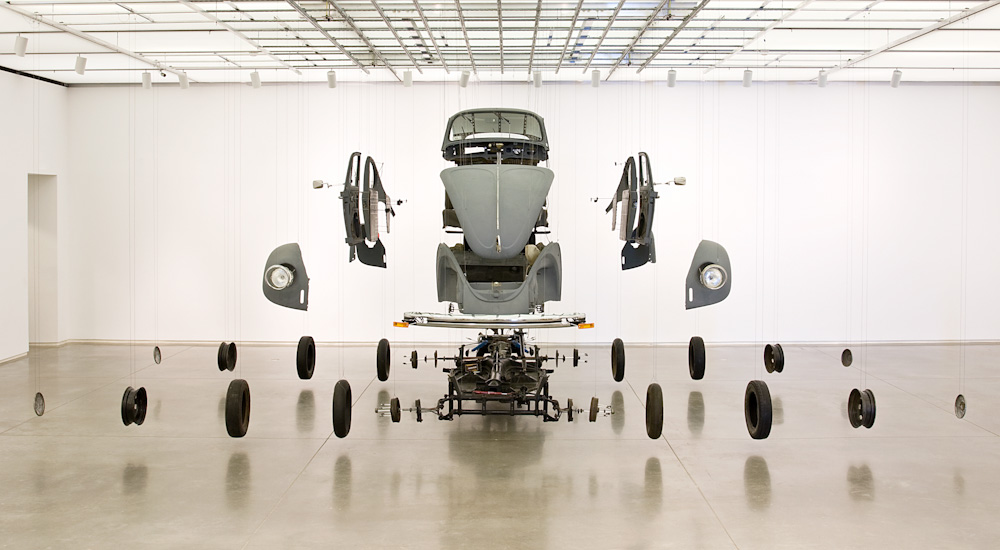
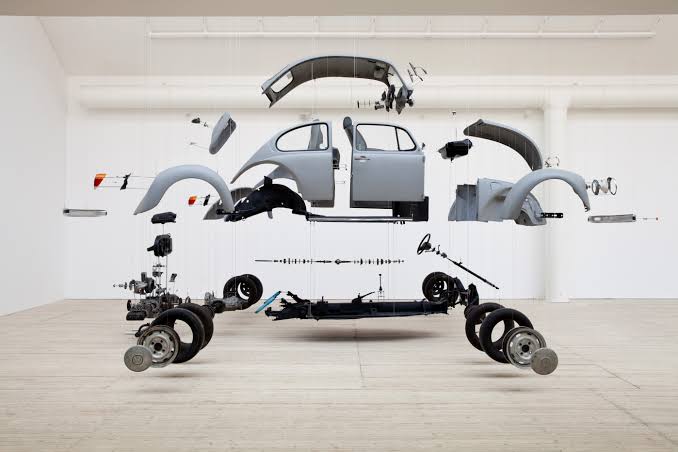
Damián Ortega Cosmic Thing (2002)
‘In “Cosmic Thing”, Ortega disassembled a Volkswagen Beetle and re-composed it piece by piece, suspended from wire in mid-air. The piece looked like an exploded diagram in a mechanic’s instruction manual.’
_____________
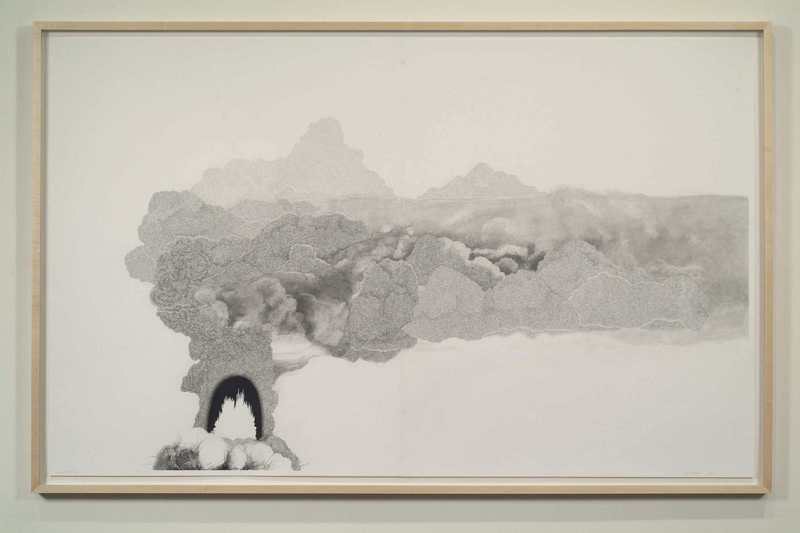
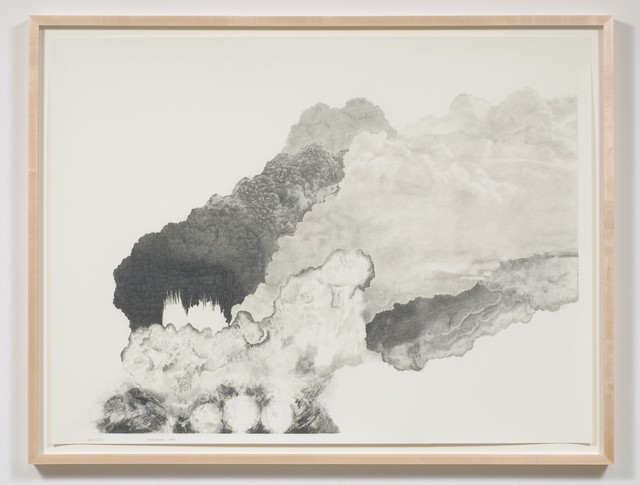
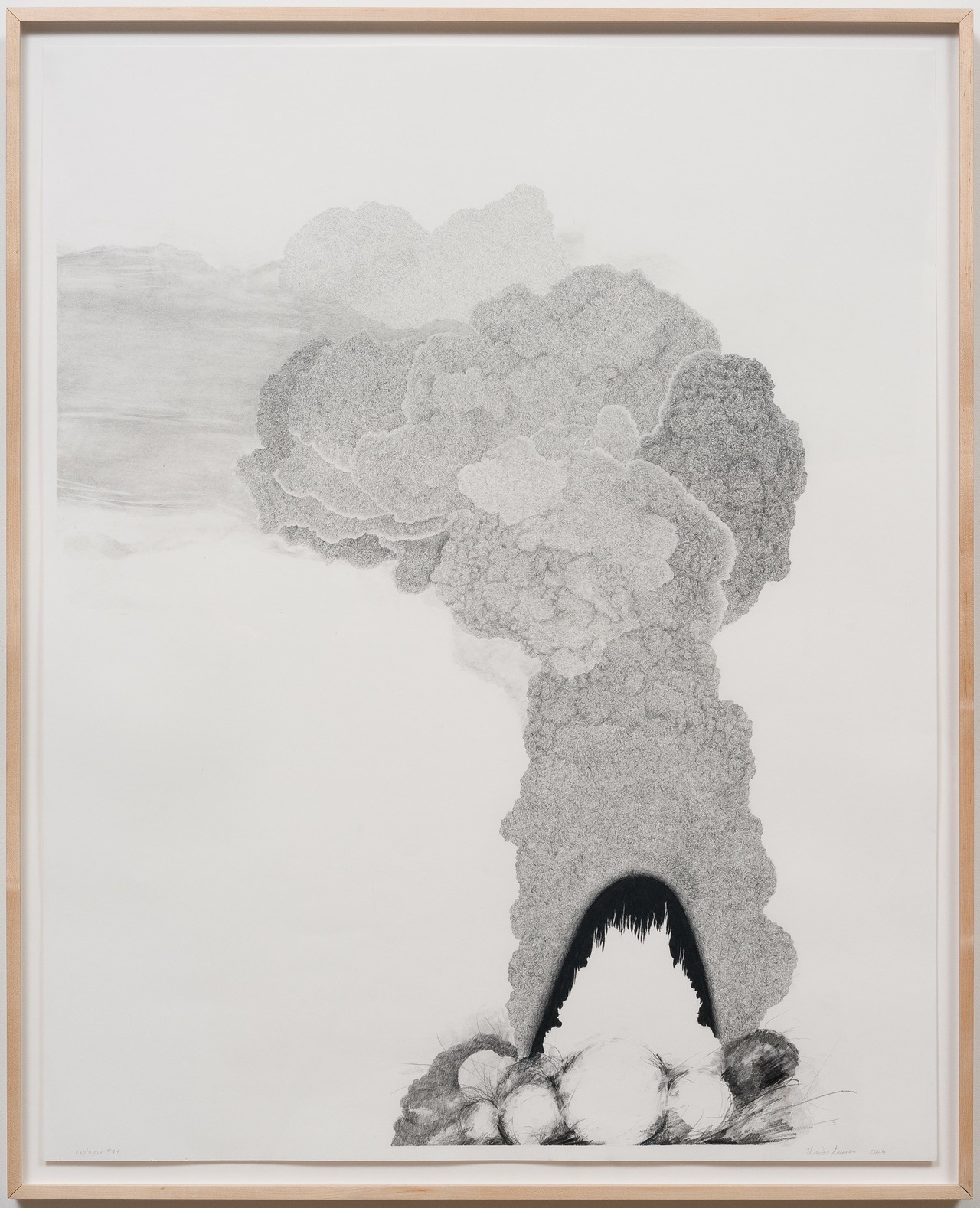
Charles Gaines Explosions (2008)
‘The idea for the Explosion Drawings series came to me after I made the machine-sculpture “Airplanecrashclock” in 1997. That work was a continuous repetition of an airline crash occurring as part of a construction of a downtown city scene. I got the idea of doing the drawings after constructing the crash scene. I noticed that that process of constructing the scene was a lot like painting and drawing. About 5 years later, I did two large drawings, Airplanecrash 1 and 2, where I first developed the technique for realizing the image of an explosion using graphite. These drawings were scenes of plane crashes at the point of impact, and the resultant explosions. I continued with this in another series in 2005 called Airplanecrash Drawings which included stylized graphite renderings of the explosions separated from the scene of an accident. The present series, “Explosion Drawings” was realized by focusing on the explosion itself without reference to a specific event or accident. My interest in the social context of the accident remained.’ — CG
_____________
Martin Klimas Sound Explosions (2013)
‘For Sound Explosions, Klimas asked several musicians to work on short sound sequences, so called patches, using analogue synthesizers made between 1930 and 1990. Klimas shows those synthesizers with all their wires and cables, to give people an idea of the complexity of the sounds he is working with. He then replays the patches on his set, using pigments in place of liquid colors this time. He puts up the volume and lets the colors explode.’
_____________
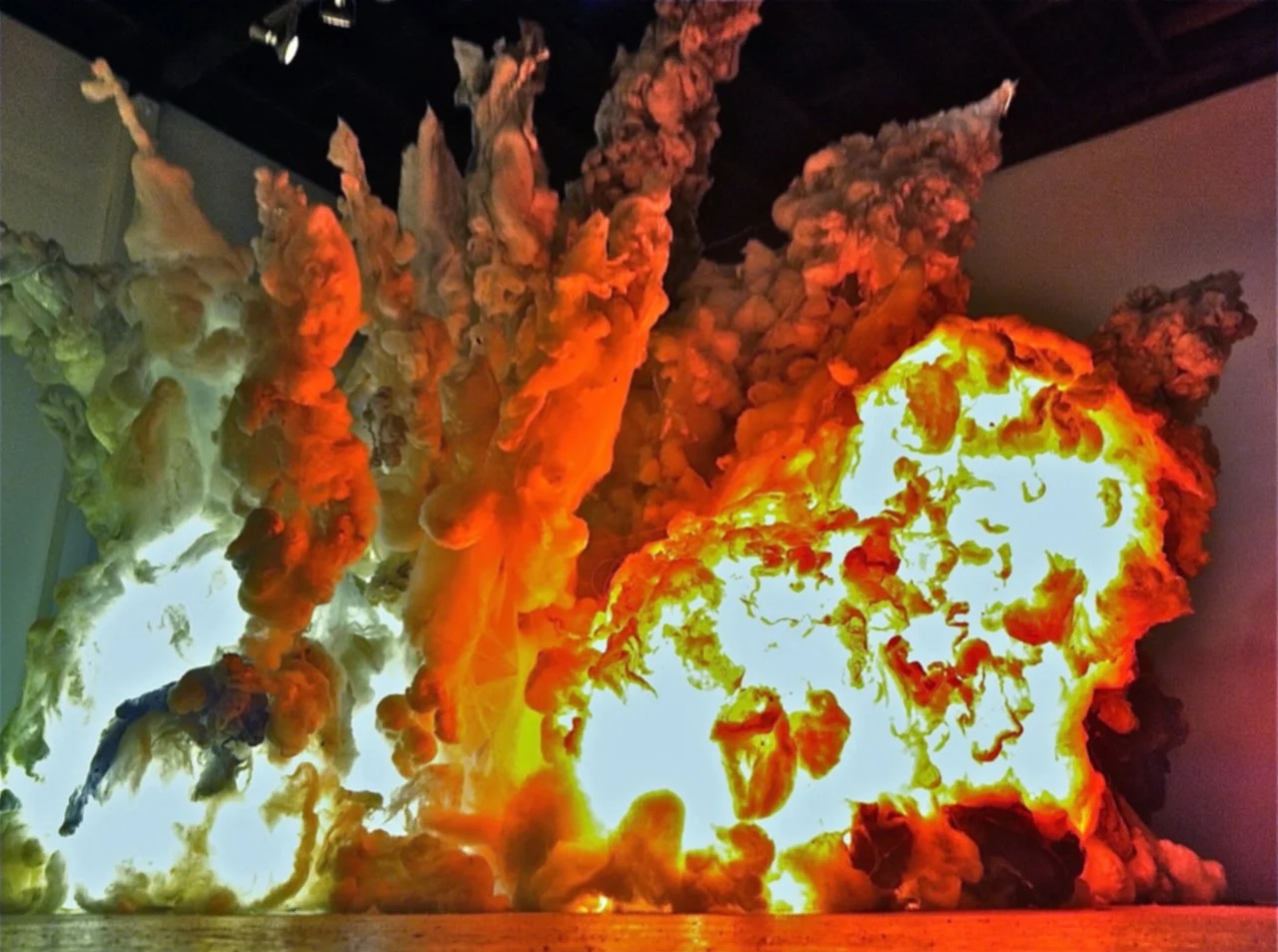
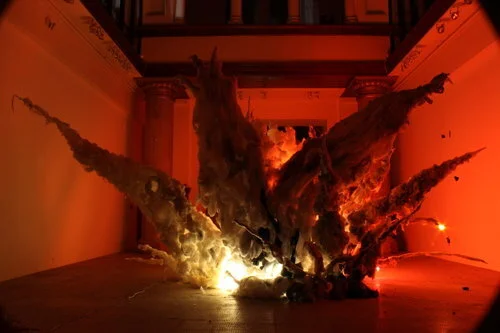
Pablo Garcia Lopez Silk explosion II (2013)
Natural silk, shrink fast plastic, CFL lightbulbs 9x8x8 feet
_____________
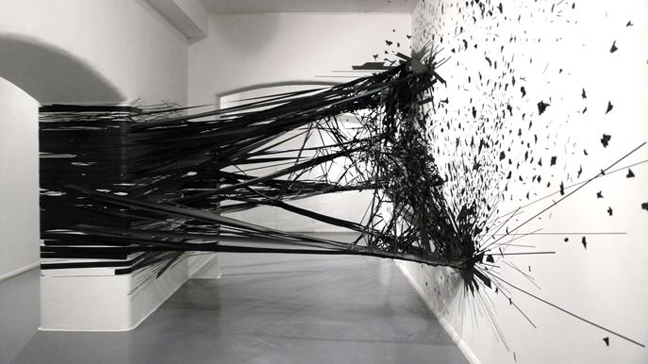
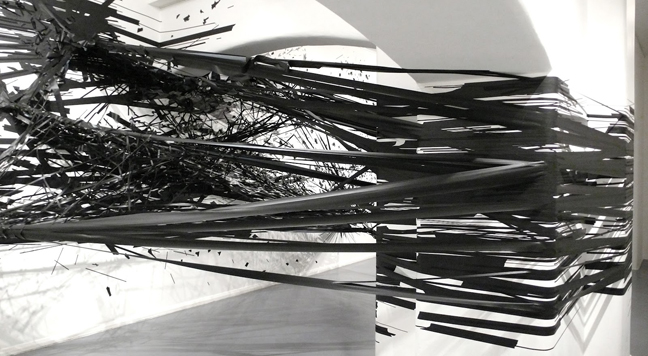
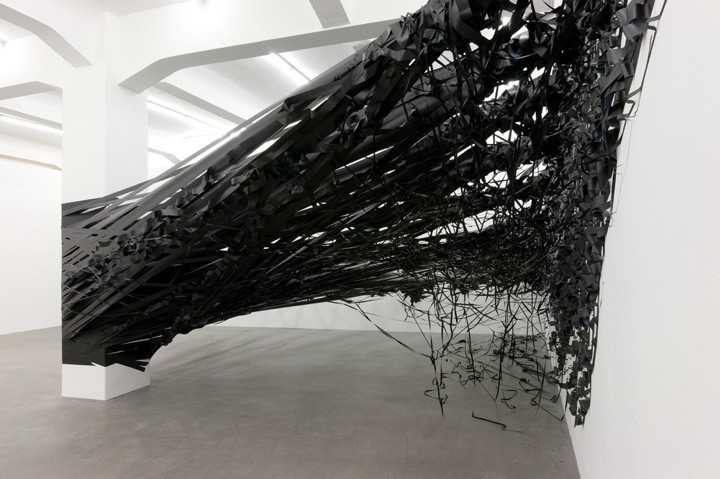
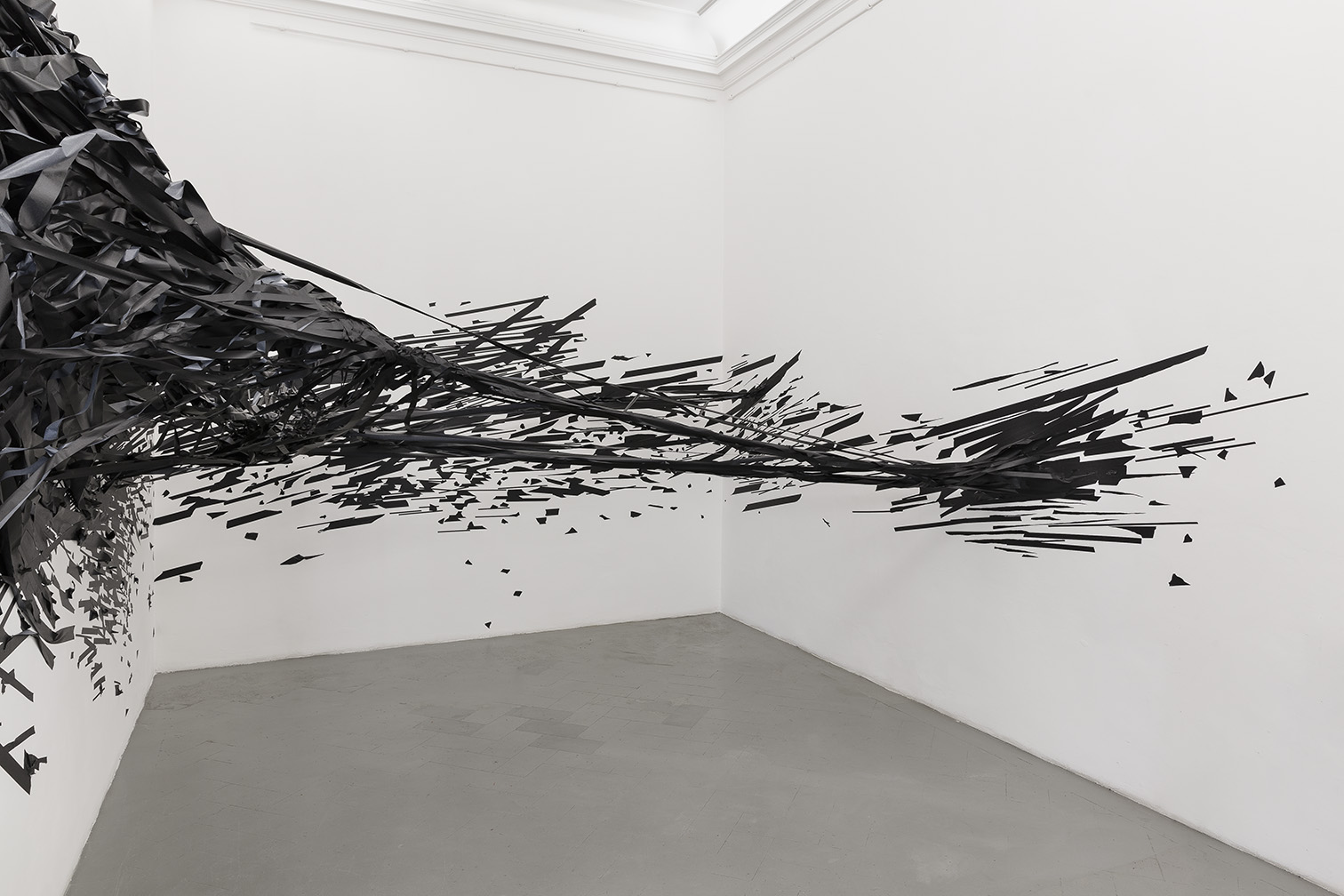
Monika Grzymala Various (2012 – 2017)
‘Grzymala works predominantly with tape, which she spins into vortexes, whirlpools, and scribbles that project out from walls and spill onto floors. The artist once used 27,000 feet of tape for a single exhibition. She records tape measurements in terms of distance, rather than weight or amount, to reflect the performance-like element of physical work that goes into every piece.’
_____________
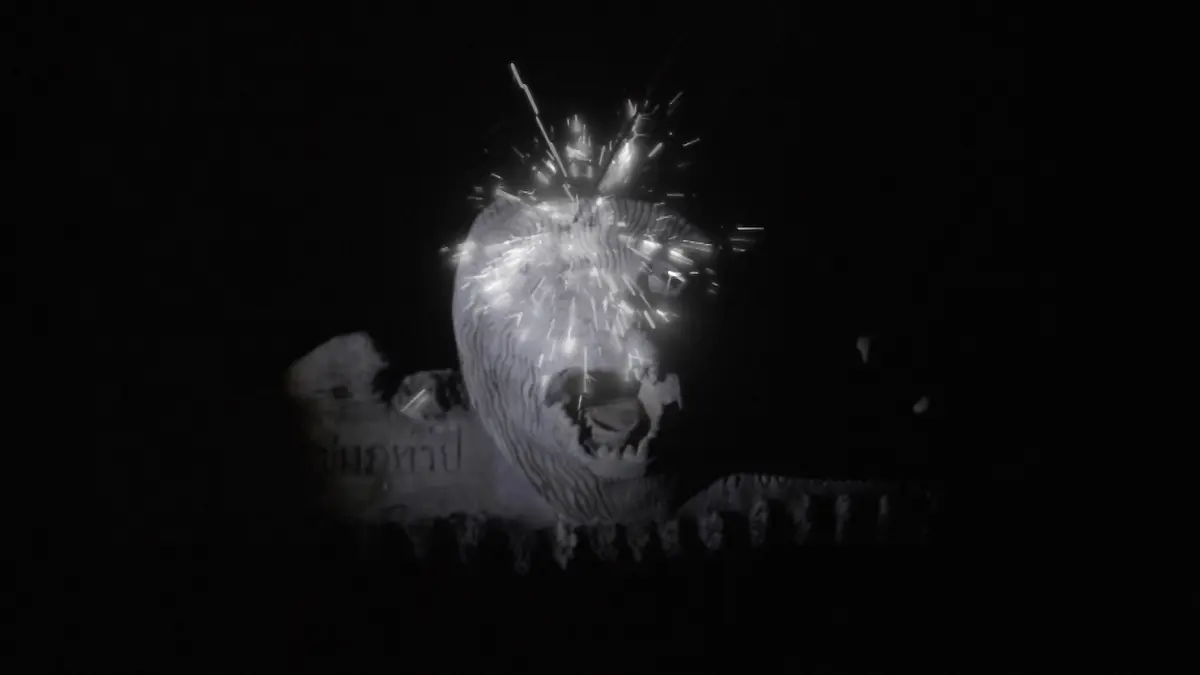
Apichatpong Weerasethakul Fireworks (Archives) (2015)
‘Shot at the Sala Keoku sculpture park in Nong Khai, Thailand, it uses sudden pyrotechnic flashes and digital camera lights in the dark to illuminate giant mythical animal statues, acting as a hallucinatory memory machine reflecting Thailand’s political oppression and spirit of revolt.’
_____________
Fabian Oefner Various (2019)
‘Mirage is Oefner`s latest exploration of our perception of reality. The series is a collection of short clips, that show the destruction of four well-known paintings of the western world.’
_____________
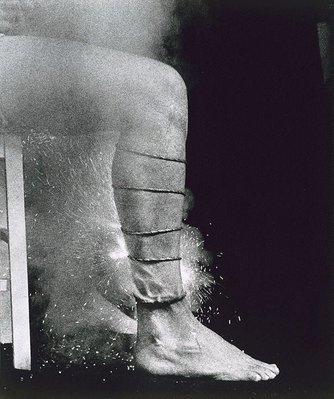
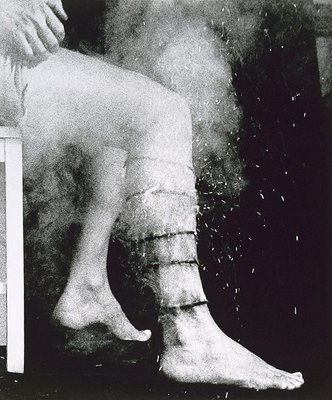
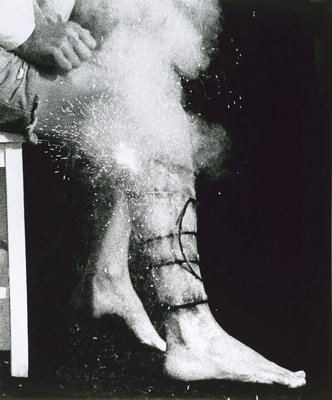
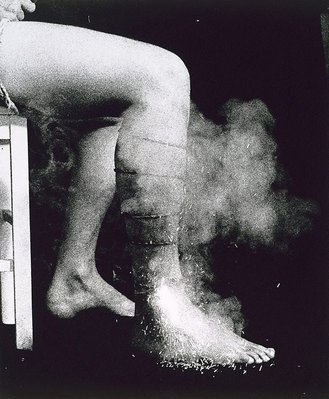
Mike Parr Integration 3 (Leg spiral) (1975)
4 gelatin silver photographs
_____________
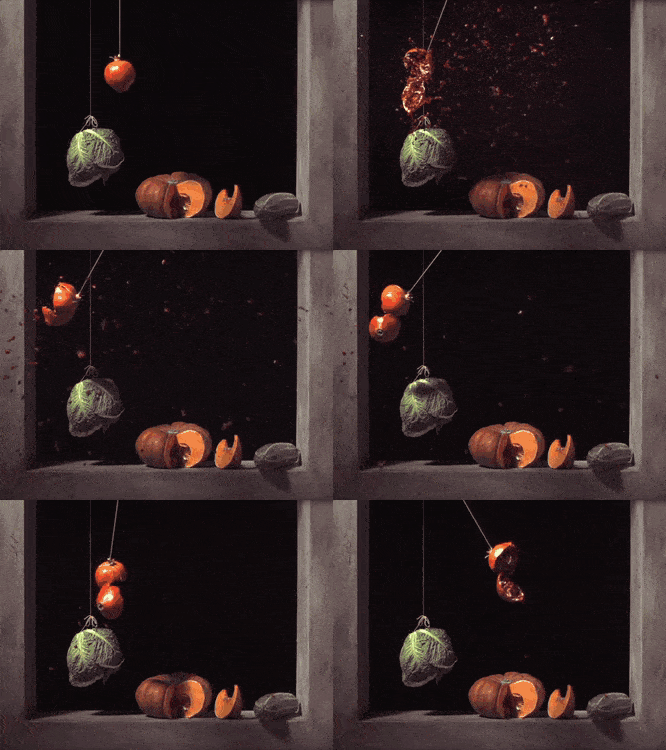
Ori Gersht Pomegranate (2006)
‘This image references a 1602 Baroque still life by Juan Sánchez Cotán titled Quince, Cabbage, Melon and Cucumber. It’s a very cerebral painting, because he was trying to create a sense of perfect static balance. It must have taken an awfully long time. My photograph was an act of destruction, taken at an unthinkable speed. I decided to use a pomegranate, instead of a quince, because a pomegranate would explode like a grenade.’ — OG
_____________
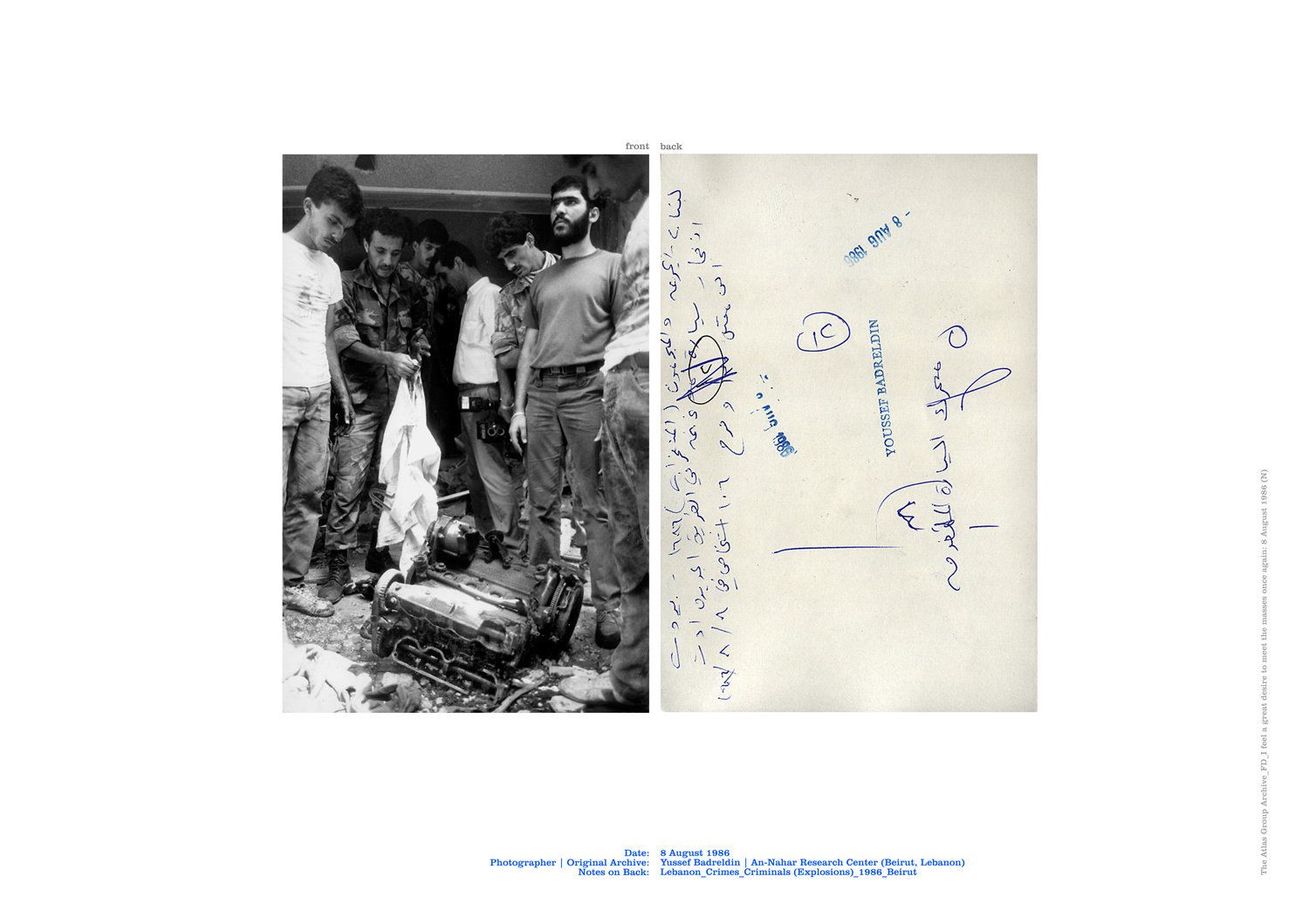
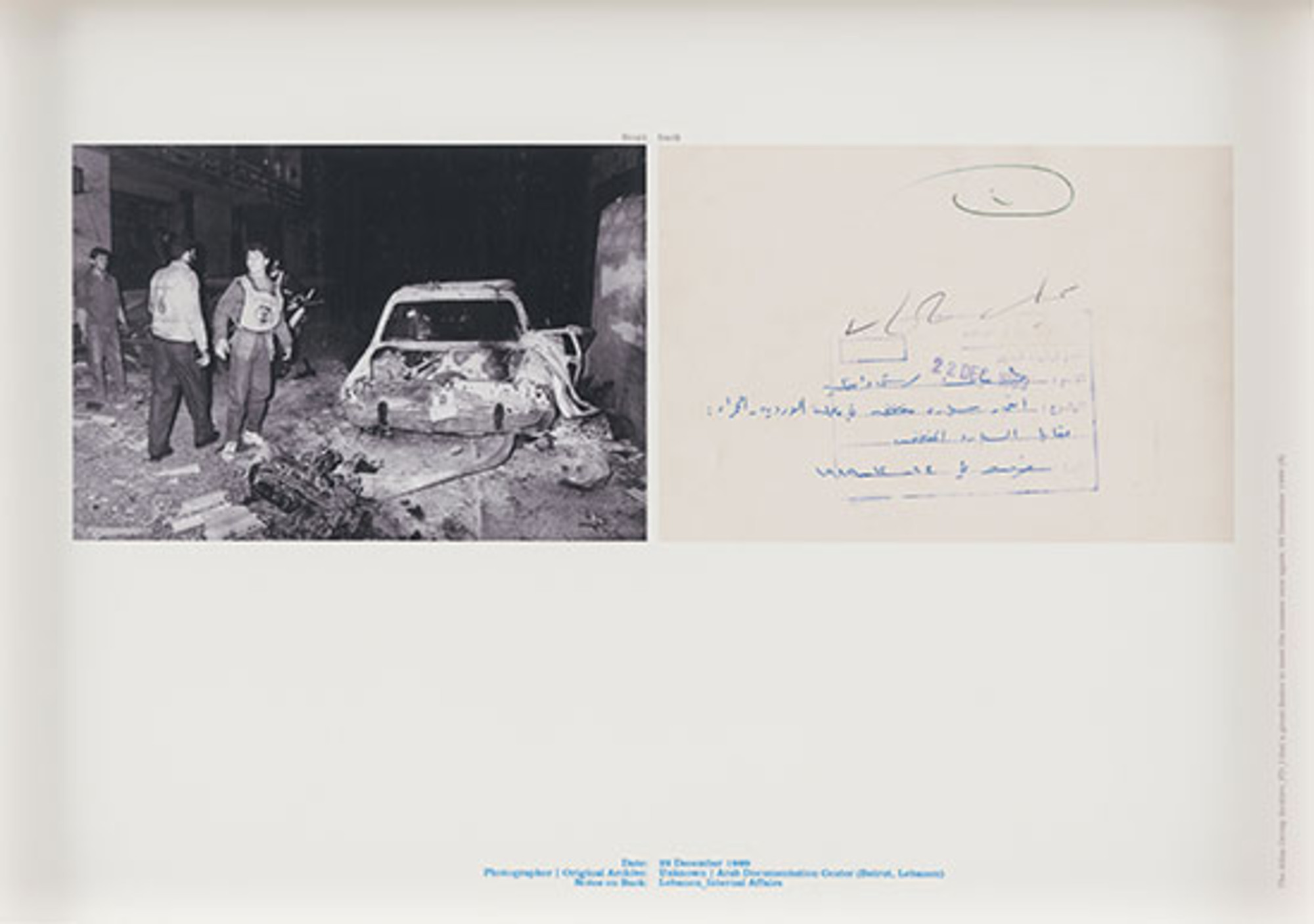
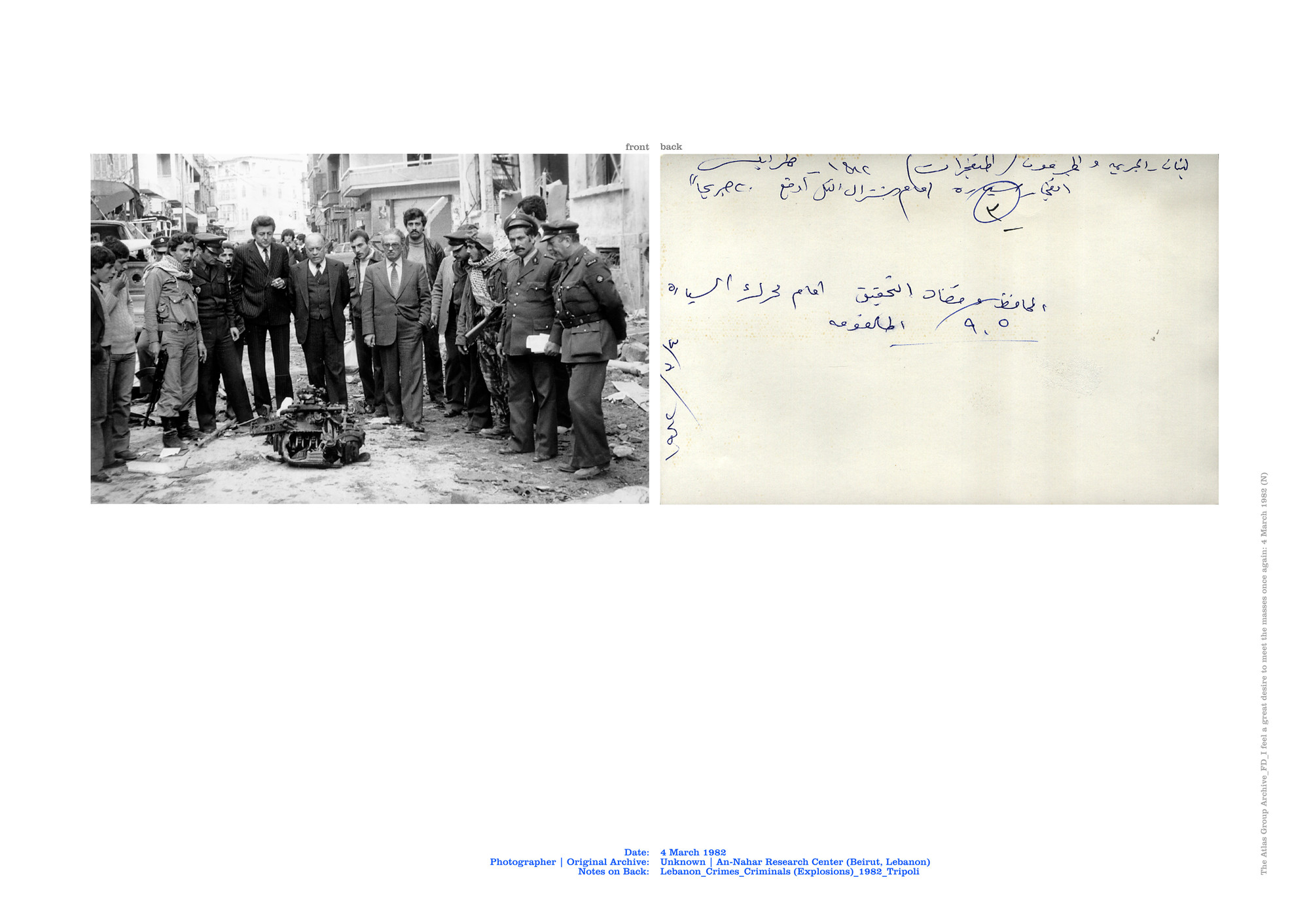
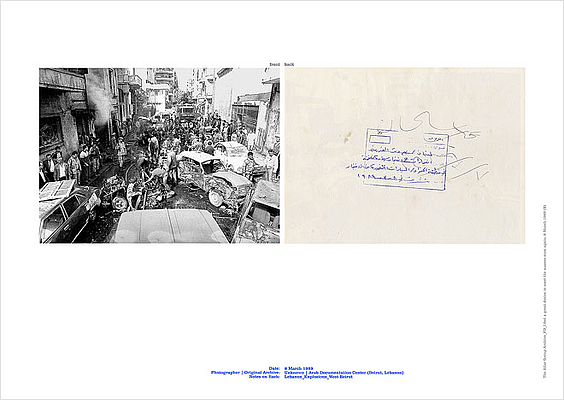
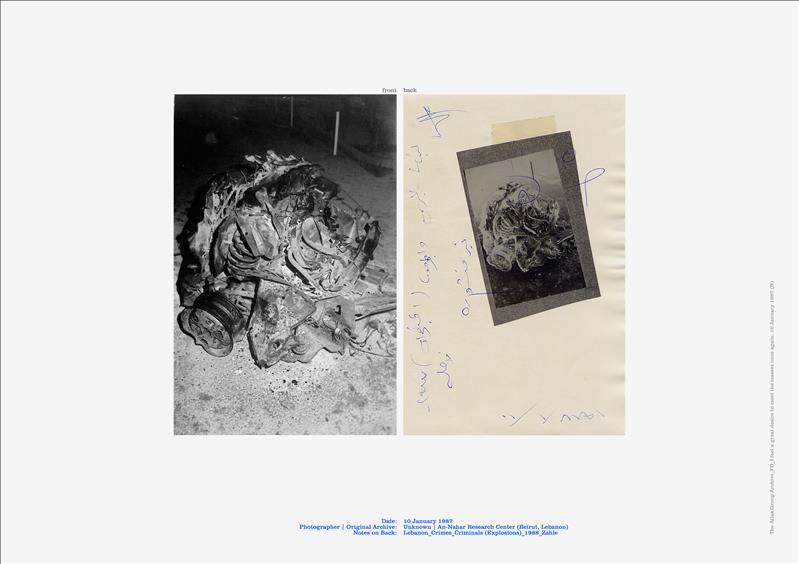
Walid Raad My Neck is Thinner than a Hair: Engines (1999)
‘My Neck is Thinner than a Hair: Engines looks at the aftermath of car bombs in Beirut during the Lebanese civil war (1975–91). It consists of one hundred framed inkjet prints, each featuring a black and white photo on the left and an equal-sized piece of paper with handwritten notes and date stamps on the right, placed one next to the other. These are scanned and printed renditions of the front and back of journalistic photos of car engines found scattered around the city of Beirut following bomb explosions during the war. The artist found the photos in the Lebanese press, such as the daily newspapers Annahar and As-Safir. The date of the explosion, the name of the photographer when known, and an English translation of the notes found at the back of the pictures are included at the bottom of each print. On the right hand edge of each of the prints, running vertically, is the name of the artist, the Atlas Group file that the work belongs to, the title of the file, and the date of production of the work. These framed prints, which the artist terms ‘dossiers’, are shown arranged in a rectangular grid on the wall.’
_____________
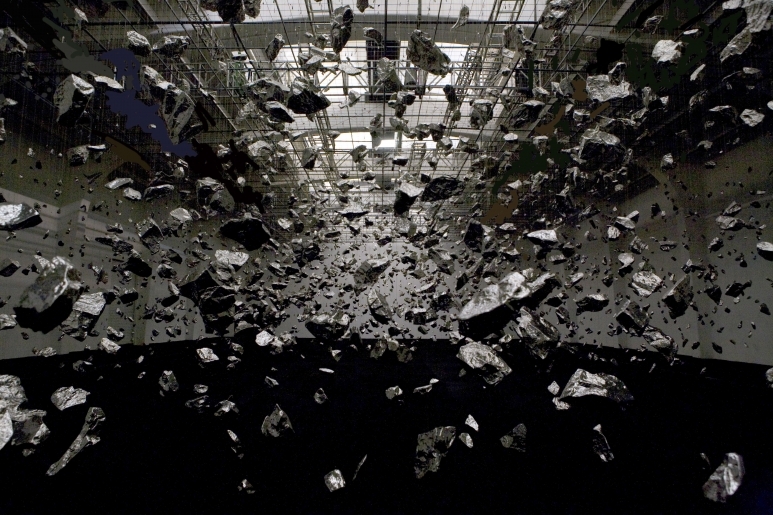
Zhan Wang My Personal Universe (2012)
“My Personal Universe” was created by blowing up a boulder, filming the explosion, collecting all 7,000 fragments of stone and making a stainless steel replica of each — consisted of six massive screens, including one on the floor and one on the ceiling. Thousands of stainless steel “rocks” were hung from invisible wires, shimmering and swaying in the light of a two-minute film of the explosion that played continuously in the gallery.’
______________
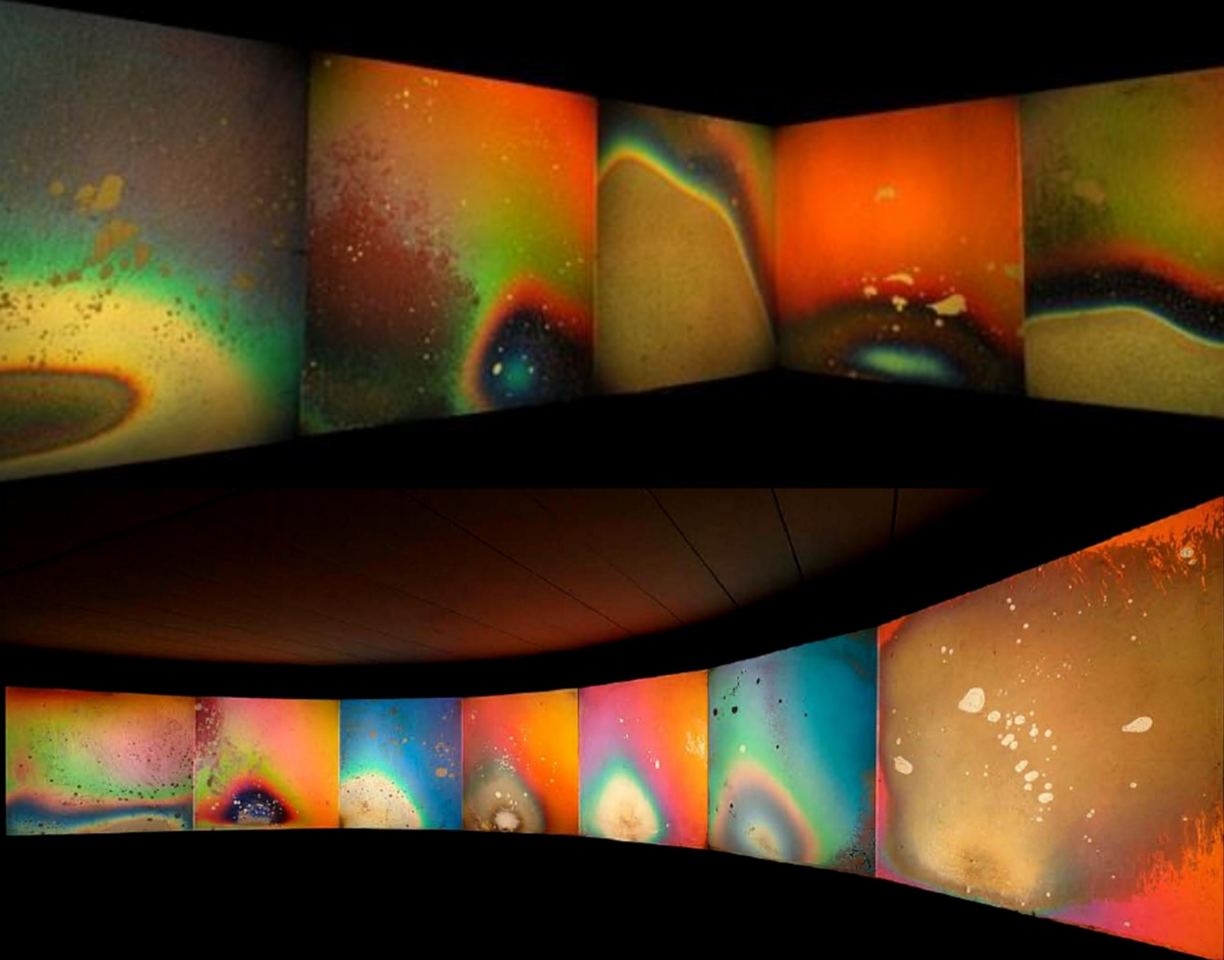
Gustav Metzger Liquid Crystal Environment (1965)
‘The colourful projections in this psychedelic installation are created by sending light through glass slides, which are filled with heat-sensitive liquid. As the slides move, so does the liquid, which changes temperature and then colour. Metzger aims to undermine the commodity status of art objects by making works that have auto-destruction or auto-creation as the creative principle.’
_______________
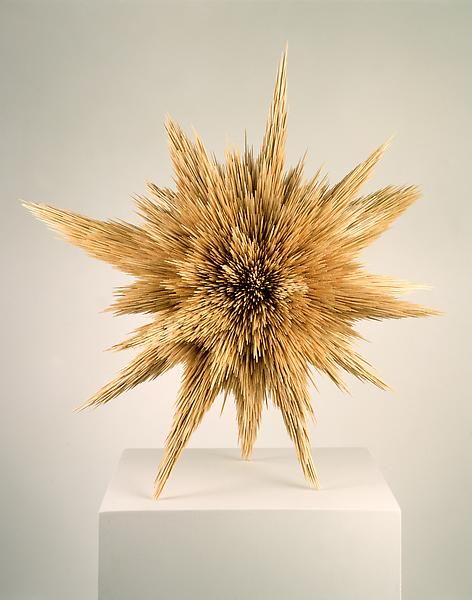
Tom Friedman Untitled (1995)
‘Friedman’s dazzling 1995 toothpick sculpture, in which thousands of toothpicks are jammed together in the shape of a starburst, is anything but delicate, but here the toothpicks seem to have reached a center of gravity in which their sheer density is causing them to explode outward, so that that sculpture seems at the point of violent dispersion. Complexity, for Friedman, always involves the limits of inundation and compression which point toward entropy.’
_______________
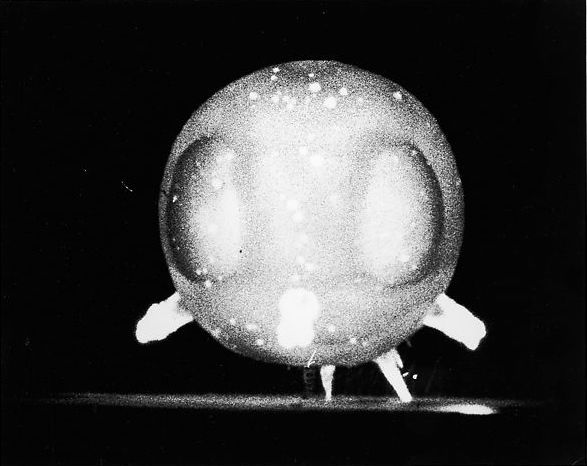
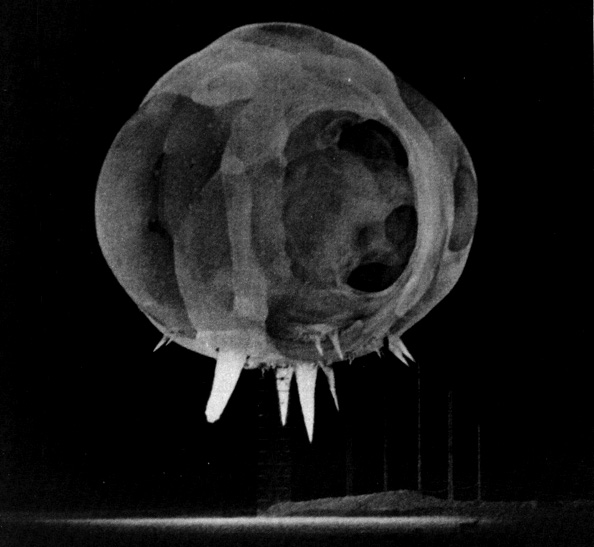
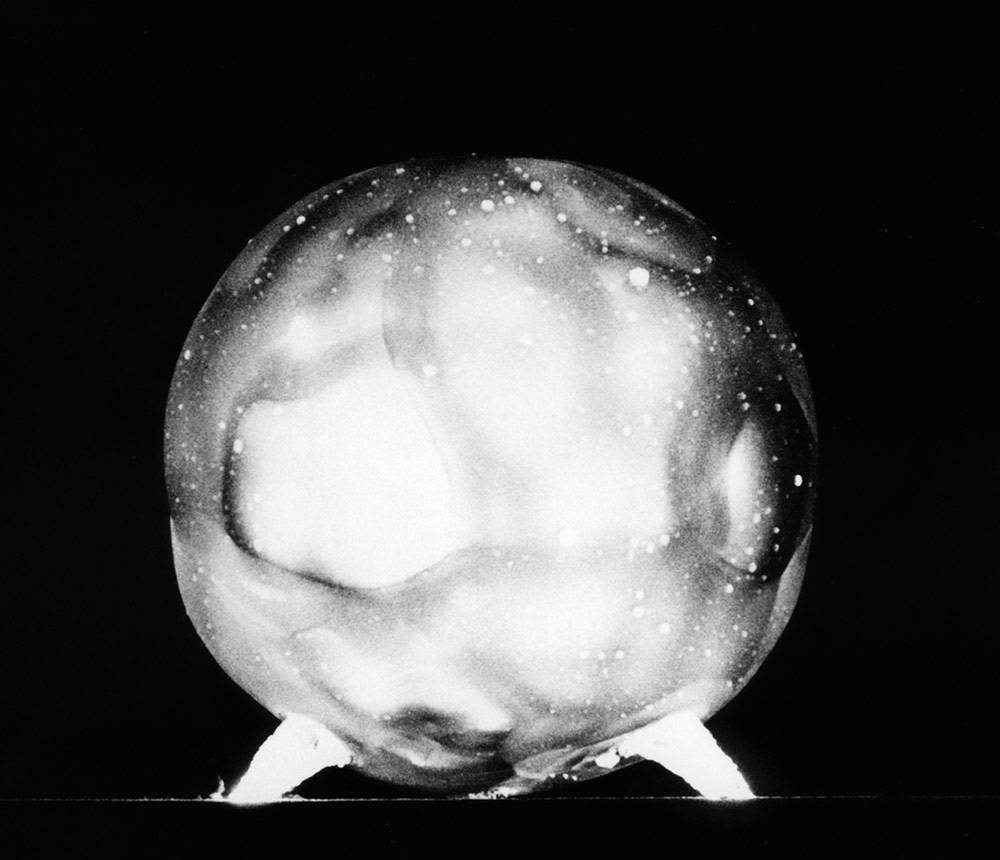
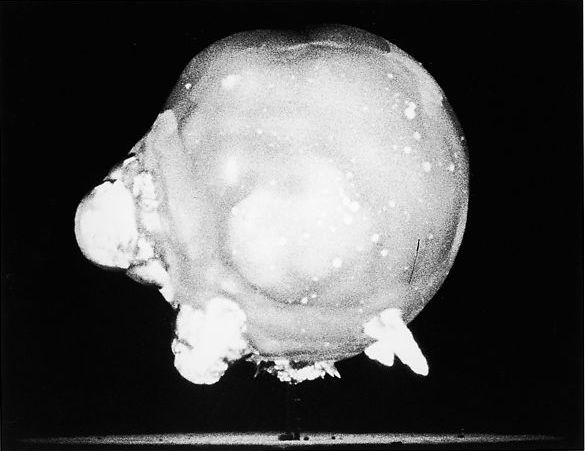
Harold Edgerton [Atomic Bomb Explosion] (1946 – 1952)
‘In the late 1930s Harold Edgerton, a professor of engineering at MIT, pioneered techniques of ultra-high-speed stroboscopic photography to reveal aspects of the moving world previously invisible to the naked eye-a speeding bullet eviscerating an apple, the graceful spiral of a golf stroke, the coronet formed by a falling drop of milk. During World War II, Edgerton worked with the Atomic Energy Commission to develop a camera, the Rapatronic, capable of capturing the fleeting incandescent flash of a nuclear explosion. Edgerton and his assistants set up their equipment on a tower seven miles from a nuclear test site and, using exposures as short as one-billionth of a second, recorded this ominous glowing shape hovering like an alien life-form or a colossal balloon. Made when the dream of technology threatened to turn into a nightmare, Edgerton’s haunting images of nuclear explosions help us visualize the inconceivable.’
_______________
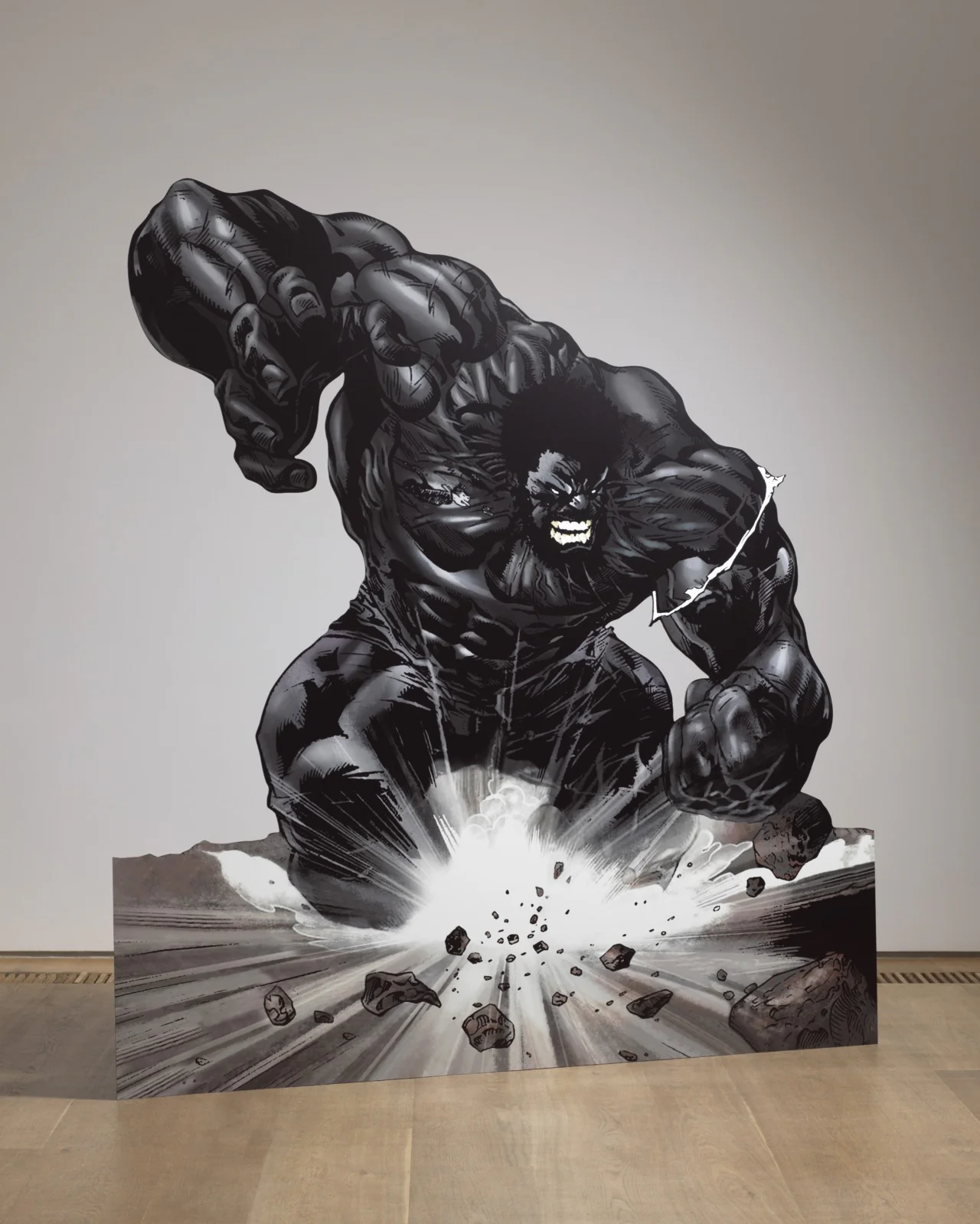
Arthur Jafa LeRage (2018)
chromogenic print on Dibond with aluminum plate stand
_______________
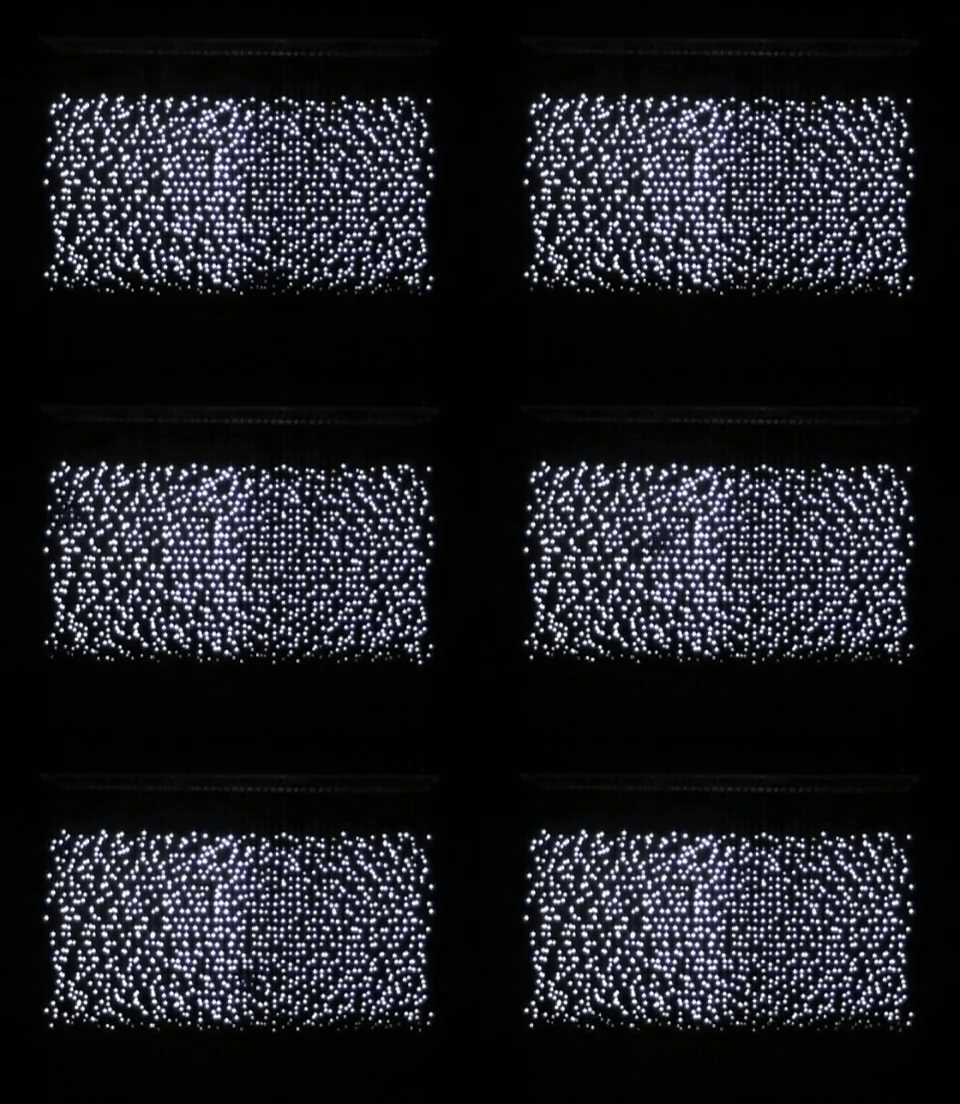
Jim Campbell Exploded View (Birds) (2010)
‘LEDs hang at the end of thin wires in a 3-dimensional grid. As the LEDs flicker, they create the image of birds. This work is part of Jim Campbell’s ongoing exploration to give a sculptural presence to light and the moving image. In this instance, Campbell has expanded his characteristic use of low-resolution LED panels into the third dimension. As you move around the hanging LEDs, absorbing but “meaningless” patterns are seen. From the vantage point of the front, the abstract patterns are seen as birds. The line between abstract digital information and recognizable movement depends on the viewers position in space. The birds are perceived where no lights shine; the negative spaces within the lighted grid give us clues to their idiosyncratic forms.’
_______________
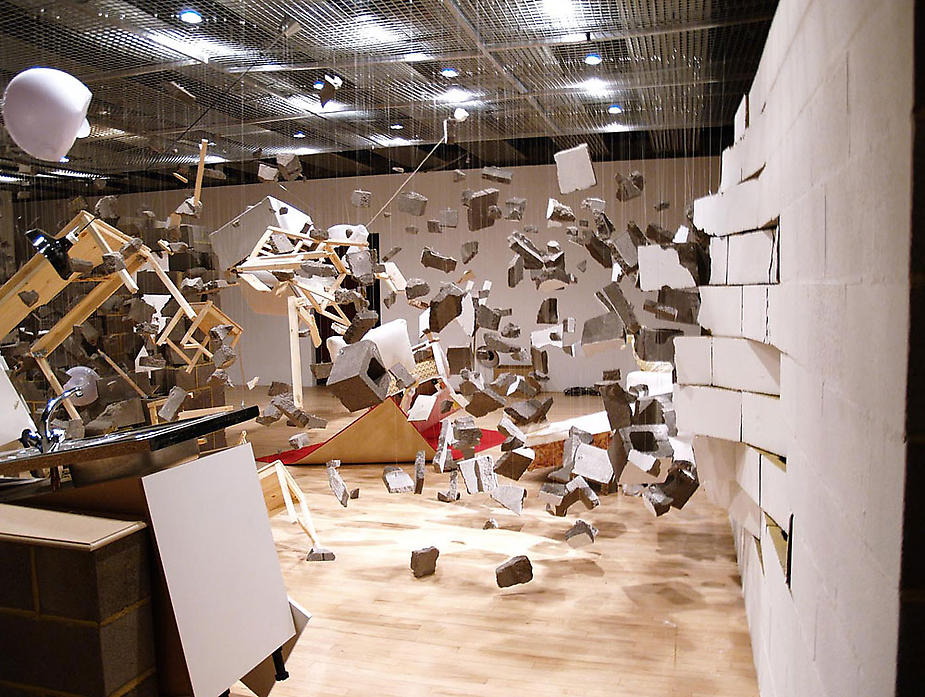
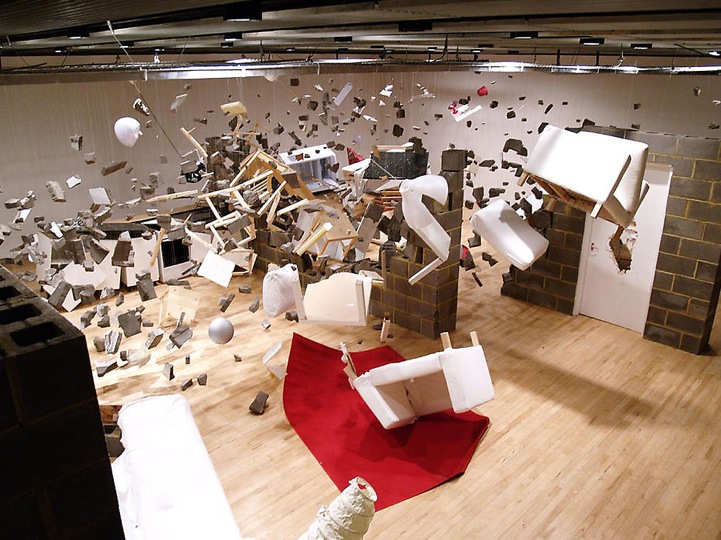
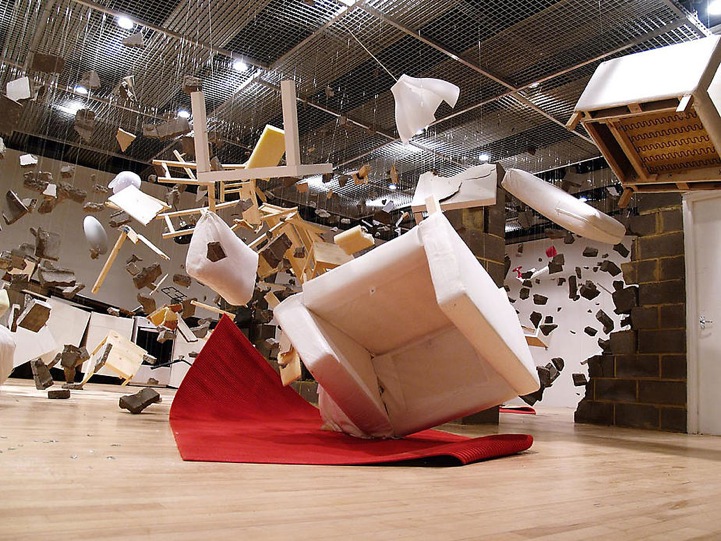
Los Carpinteros Exploding Room Frozen in Mid-Air (2011)
‘What does an exploding room actually look like? Havana-based artists Dagoberto Rodriguez and Marco Castillo, collaboratively known as Los Carpinteros, have constructed an installation depicting a room amidst an explosion. The imaginary blast rips through walls and furniture, leaving broken sculptures and debris suspended in the air. It’s as if time has stood still. Spectators of the exhibit are given the unique opportunity to view the effects and damage of an exploding room from all angles.’
_______________
DHBy Acura (2016)
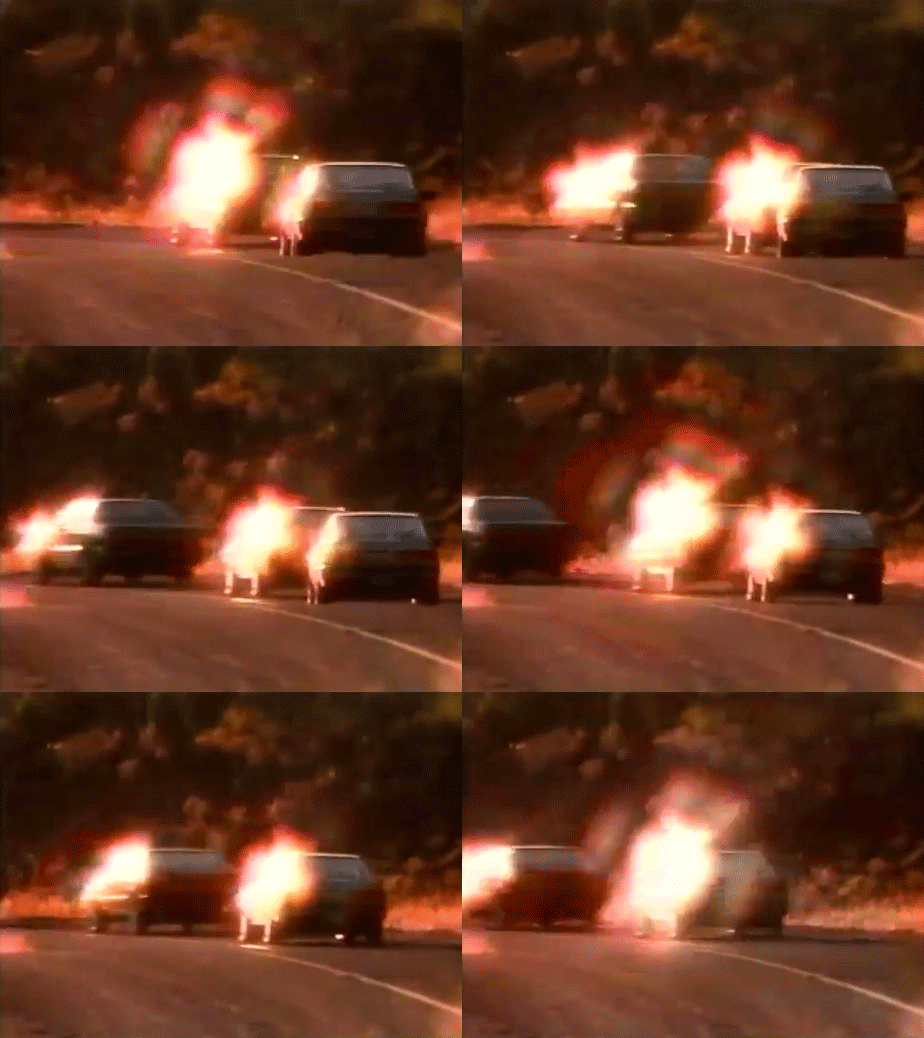
_______________
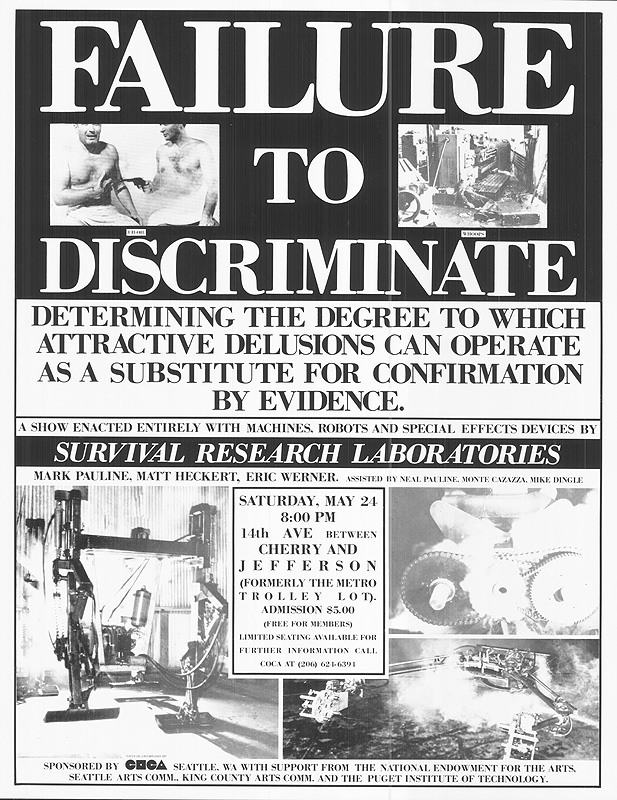
Survival Research Laboratories Failure to Discriminate (1986)
‘Failure to Discriminate: Determining the Degree to Which Attractive Delusions Can Operate As A Substitute For Confirmation by Evidence. Performed at the Seattle Transit Authority Lot, Seattle WA. Presented by COCA. May 26 1986.’
_______________
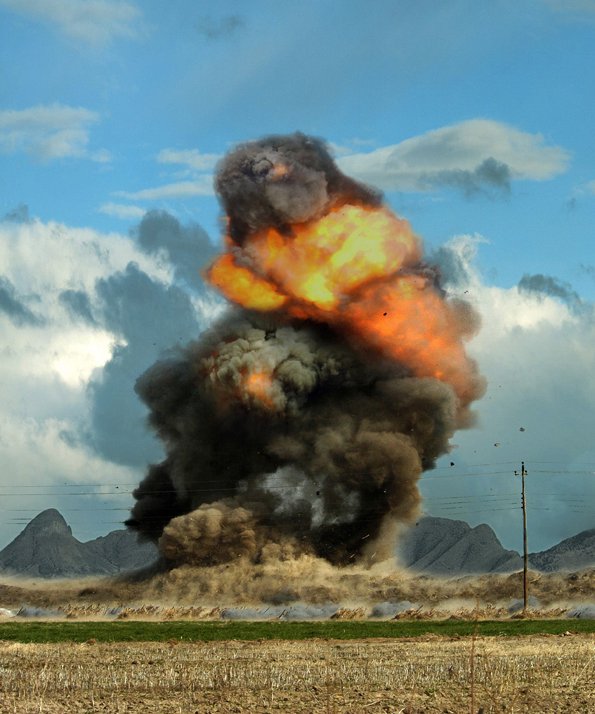
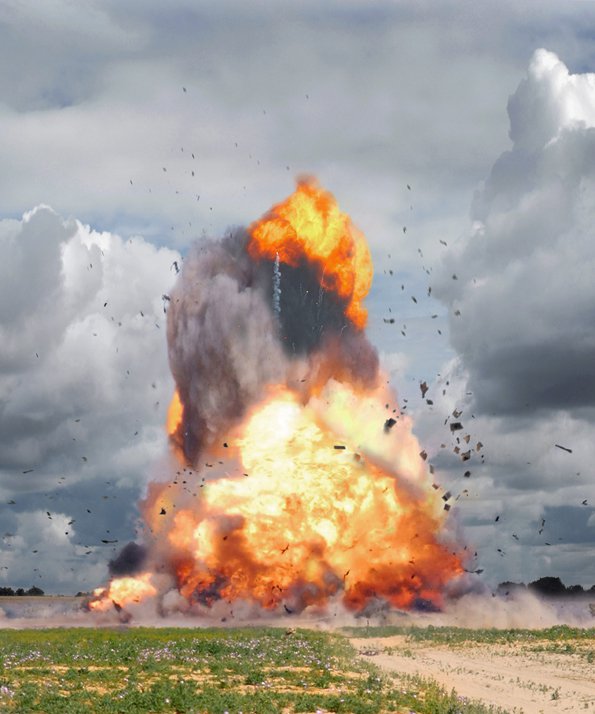
Ueli Alder Detonations (2012)
‘Created by Swiss artist Ueli Alder, the series is luckily made up of images found on the Internet. However, the Photoshopped collages of explosions still manage to be badass and terrifying. Adler’s inspiration for the series were war-themed video games, as he attempts to romanticize the cataclysmic detonations that go off during game play. The falsified images from the Ueli Alder Detonations series creates an important critique on the over-sensationalized and commonality of these graphic images found throughout popular culture. Our reactions to these images tend to demonstrate the hyperreality that has been created by explosive media, which can contribute to causing a problematic way of how humans filter through future events.’
*
p.s. Hey. ** jay, There was an extravagant playground near me when I was growing up. I’m sure it led me to my amusement park obsession and wound up heavily configuring me internally as a human. That book sounds increasingly fascinating. Eyes peeled over here. I hope all’s great w/ you. Oh, darbzzz responded to you if you didn’t see it. Mild skies! ** Adem Berbic, Our sky is being easygoing at the moment. I’m trying to eat it. No map of the Balkans at all, I don’t think, pathetically. It sounds very useable. I’ve heard that about Lacan. Me, people will characterise some writer as pessimistic, and then I’ll read them and see hopefulness. Weird. That sounds a little too neat and self-congratulatory to me, yes. ** _Black_Acrylic, I’ll go see if I can find images of the Mike Nelson. That linked page isn’t very forthcoming. Thanks for the tip, B. ** cmr, Hi. Nice, I’ve seen pix of playgrounds that are organised into a ship. They always look very secretive. Weirdly or not, that child couple image was my favorite too. Huh. Thanks, and big day on your end, what do you say? ** Joe, Hi. Cool, I’ll go find and open it. ** ⋆˚꩜。darbbzz⋆˚꩜。, Hi. Your writing is just inherently compelling. You’re a writer, dude. No two ways about it. Being a writer has kept me solid and outwardly gazing and fairly coherent. I suppose there were other factors too, but it’s the big, big one. I was a dj on my college radio station, so I’ve only been that kind of dj other than, you know, making mixtapes for friends back when passing cassettes around were like handshakes. You don’t need a degree to be a writer. In fact I think that’s more dangerous way to become a writer than not. Studying music makes much more sense. Writing teachers tend to have normalising young writers as their goal. Music teachers can’t really normalise young musicians who don’t want to be usual even if they try. You really do sound excited, and it’s for very obviously good sounding reasons. The future! I understand that the edm/rave scene in France is pretty good. Zac is somewhat into it. D.I.Y. scene for sure, mostly in the electronic music realm. Probably some guitar/punk stuff too. I need to educate myself. Happiest day! ** Deepstatespirits, Damn straight! ** Diesel Clementine, Hi. Yes, coffee. Unless I’m already in Norway, but I’m pretty sure I’ll still be here. Very cool. ** HaRpEr //, I know of Crystal Palace, but I thought the Palace itself didn’t exist anymore? I’m probably mistaking something for something else. I’ll hunt those dinosaurs, etc. No, those writers were operating in that white straight guy brain is the God brain thing. They thought their imaginations were blankets. Probably one of the major reasons why, except for Pynchon, the young don’t gravitate to them anymore. Anyway, I think I agree with you. ** laura w, Hi. Interesting that fiction of a certain past age becomes mostly useful as history. Yeah, it’s true. And paintings too, obviously. Paintings as personalised cameras before their time. Quin’s amazing, I think. And Compton-Burnett for totally sure. I recommend starting with ‘The Past and the Present’ which has been put back into print by, I think, NYRB. It’s one of my favorite novels. Brooke-Rose is highly worthy too. She’s always fantastic. ‘Textermination’ or ‘Life, End Of’ might be good starts. I’ve heard of ‘The Man Who Sleeps’. It must be findable somewhere. Congrats on the flooded out co-worker. Things are looking up? ** Bill, Where are you heading this time? For a gig possibly? ** Thom, Thanks, pal. Fuck, sorry you’re drafted into caretaker mode, but good for you, and for whoever, obviously. I need a perverse, interesting idea for a story. Can you osmosis one to me? You’re not off base, haha, no. The Burroughs comparison is just the height of lazy thinking. I’m resigned to the fact that people think writing itself is or should be a clear window into content, or, at times, a fancy window, but I’ll never like or fully accept it. But there’s nothing to be done about it. People should do more drugs and less alcohol? Or more psychedelic drugs and less coke and meth? Anyway, I mostly just shrug at that lack of interpretation at this point. Wishing your week has a big finale. ** Okay. Today’s post is surely a self-explanatory one. See you tomorrow.


 Now available in North America
Did you ever see a real explosion? I ain’t, I don’t think, but I want to. I wonder if there’s some public listing of imminent building demolitions. My friend from San Diego has sometimes gotten stacks of old crockery from Goodwill and smashed them up to see how the glass moves and interacts, plus let off anger.
What happened here in the 90s has a symbolic gravitational pull. Certain areas, like the one I’m in now, were essentially untouched. Others, it’s indissociable from every aspect of the place as it is now. There were certainly explosions. But yes, it’s charged. It’s complicated.
The sloppy slop is just about done, as in, the first draft is. This has come out more quickly and functionally than I can remember being the case with anything, for better or worse. Stylistically it’s not very good (yet), but that’s fine. I guess it’s a testing ground for some of what I want to do with the longer thing which I should really be using this holiday to focus on instead.
It irks me that the standard word count for readings and a lot of publication opportunities, in London if not everywhere, is around 2k words. There are practical reasons for it, I suppose, but I don’t have (or maybe don’t want to have) enough of a knack for concision to do much of anything in that length. And I get very uneasy about subdividing longer pieces of writing. So I feel a little hamstrung by that. But a friend has designs for a little get-together for sharing of homemade noise music and writing soon, so I could maybe road-test this there.
Hi again.
Companion short story for today’s post: Cunt Toward Enemy by Porpentine https://xrafstar.monster/blog/cunt-toward-enemy/
Couple weeks ago I was passing through Paris and popped into After8 books since it comes so highly recommended. Very cool place, the shelf where they have your stuff is literally like it was curated by this blog, so many authors I’ve found out about on here or that I’ve seen comment here. Very cool.
Might I add Johann Lurf’s “12 Explosionen” to this: https://www.johannlurf.net/12explosionen/
Always dig it when explosions are used by artists, and they should really be a medium like any other. I know that Roman Signer is fond of blowing stuff up.
I found a pic of that Mike Nelson show in Leeds. From the website: “Part of the point of these works is that each tyre, whether whole or in fragments, is unique. Not one of them is the same, although each one shares the same history of its manufacture, and each has gone through a violent — and creative — process of demise as a functional object.” Not the kind of stuff that I’m used to seeing by him, but fascinating all the same.
Oh how cool! It seems like I may love France, or its EDM scene, when I go there on my belated hyped soon to be desired Europe trip. (one day when. I get a job soon hopefully)
Its quite convenient the timing of this post considering a particular thing happening that makes me feel like I’ll explode.
(This is one of those comments you should feel no shame in skipping over section, apologies for verbosity)
There is something thats been eating me and I hope you dont mind me confiding since I trust your rational mind whereas my other close friend is telling me “Yeah most people in that faggot scene dont give a fuck and Jay probably wont give a fuck if they read that letter you write them”
I try to have a more loving approach of this, since I love this close friend, my friend “Jay” (unrelated to any Jay’s you may know) they helped me alot, but what they did deeply hurt me and im struggling to trust them lately. I know people can change.
I remember inviting Jay to “Melvins” vending gig in December because I wanted them to meet “Melvin” (the code name I give em) , this person who I so deeply adored. I had known them for two months by then, they even gave me a birthday gift and during a movie viewing of “MARTY SUPREME” one of the anxious parts of the movie, I offered them my stuffed animal and they gave me two crystals in that dark theater. I told Jay I really liked “M” before I even introduced them. I dont know if they wouldve meet if it weren’t for me, but I was so happy when they first got along.
I felt no envy.
But of course skipping alot, especially the time I sat in Jay’s home with brokenness written on my face before an attempt at confessing vulnerability at what was then currently perturbing me(a troubled mental state and unstable finances)—but I didnt, because they were on their phone texting “M” and I felt so stupid asking for help if they weren’t even listening. I burst into tears and had a panic attack in their bathroom. But im so stupid!! I didnt even suspect then that they were fixated on them and felt no envy in that moment, just shame that I am always a burden to the people around me, and that my words mean nothing. I wish I had felt envy, any emotion relating to anger then wouldve given me power instead of aching fragility.
By the time I came out what was initially tormenting me was diminished into what seemed like “me being upset because they were hanging out with other people” NO thats not what it was, but my true pain felt so pathetic in that moment, and that was just one thing that broke me after the other more damaging one.
Their “comfort” wasnt even “comfort” It was just “I know how weird is it to introduce someone to someone and not be invited…and then they start dating!.”I remember right as he said that his mom called him to her room. I wonder what she said, maybe just to ask to do some kind of house chore.
I know how rude this sounds, but it felt selfishly ignorant in retrospect, because I know for certain I would remember such a thing! Even my best friend I caught on to the fact that her and this guy were romantically attracted even before the signs showed!!
But I didnt even feel scared initially when Jay said that, I just thought it was a thoughtless comfort not even pertaining to the situation since it wasnt even that that upset me, just the fact that they weren’t even listening before I felt like I was going to emotionally break. My voice was broken, how didn’t they know? This was months ago. I got through it on my own like I always fucking do.
Yet now that I know that they forgot my vulnurable moment confessing my love for this person makes me upset that they felt comfortable giving this shallow attempt at reassurance.
The beginning of last month I went over to their house to ask for advice pertaining to “M”. Because I was so giddy too talk about love since Jay falls in love all the time and love is just a rarity for me, and this was something I was so excited to share since this “m” person in particular was a rare love I desired as in the past ive only been met with violent or callous hands. This love felt so special, which is why I told Jay this.
But he only had to tell me that “He forgot I told him that I liked M” no apologies, and that the only reason he stopped “Chasing” M was because they figured they wouldn’t handle their emotional needs and that “There is no one M loves more than the pursuit of knowledge”
but a part of me is being so selfish, clinging to the words like “They always fall in love” “Their durnkeness that night made them forgot my confession of love” as if that makes Jay a terrible person. A part of me wonders if Jay only saw “love” in M’s eyes when really, M is just a naturally kind human and I swear I saw signs that they are getting close to me—the way they smiled at me from the car as they drove me to watch their opera, oh I dont want to be delusional but I remember the night I introduced them to Jay, “M” were to be my ride and they spoke into my ear
“You know, I would really like for you to be my excuse to leave after this show.” Which made me feel so seen to know that someone else equally would rather leave the cacophony of superfluous sound around me. anyways I am glad to have “M” in my life and even if I find they dont romantically desire me, the thought of love not being a possibility doesnt harm me,
but these feelings of betrayal do.
The first week my love prevailed and I forgave Jay internally…but now the pain is simmering no matter how much I write or try to bury it with acceptance.
But the ONLY question I ASK for you (I apologize for this comments verbosity)
I wrote this letter essentially describing my feelings of hurt, how I felt my trust in them that night was marred by their forgetfulness, that I still love them and appreciate them as a friend, and do not wish to instill guilt, but rather to acknowledge this pain so I can fully regain this trust back, as I hold them dearly to me, and am not sure if they do aswell.
THE QUESTION >>>>>>Im going to make it more concise and organic to say in person, but do you think this is a bad idea to give them such letter?
I dont want to bring unnecessary shame, but they have a girlfriend now and either way I just want them to know what they did was a wound that still needs to be dressed, and its growing infected no matter how many times I cut away the dead skin.
YOUR RELIEF>>>>>Oh to ease u from this terribly miserable comment I give you one of my recent findings of frequency modulation fun!
https://youtu.be/ECLWihsF_PA?si=xx954JeZJyNK542P
I would delete some sections of this comment, but im afraid ive been going on to terribly long.
Oh I do plan to say it words over the phone rather than a letter 💌 I guess what I meant rather than a letter was a written framework for confrontation
Did that send
Hello Dennis,
For some reason, I needed to see explosions today. I’m feeling the dopamine crash after a week of more attention than I’m used to (the pub day, and really everything landing this week (local news in Ithaca, playlist at largeheartedboy, review at Zona Motel, trailer, Lit Chat interview w/ PeterBooks, book launch announcements (Baltimore w/ Sylvia Jones, Ithaca one too)) and I just feel a little terrible all around. I am an introvert and all of a sudden yesterday I just felt really exposed and it was a little overwhelming. I’m still feeling that way today. But ultimately what the hell am I complaining about? Maybe it was just such a high i’m not used to and it’s like… now what?
Anyway, why does it take destruction to really notice details? Not that it takes that, but the bug that’s ripped apart, the airplane on fire in , it just made me notice the wheels and the construction of the whole Cosmic Thing.
It’s so generous how you respond to everyone, I think/know there are folks on here that just need someone to talk to and perhaps even just a small connection here and there to stay sane. Thank you for that.
Working on something for Moral Crema now too, about an old French man, will share it when it’s up!
Also, went back in your archives to your favorite poetry books… that Bob Kaufman, I love him. My poetry quest continues (so far read PJ Lombardo and Sylvia Jones new books (both Baltimore folks and high recs: The Blue Cherub and Dope Calisthenics), Ahren Warner, Scott Laudati). If anyone here wants to give me more titles, please do (Laura hooked me up with a few too!).
Wow, I can start so crummy writing this post and then feel great right about here.
Look at that!
At 6 AM, I got woken up by a mouse squealing loudly after stepping into a trap. That was an awful start to the day. I had to put my clothes on immediately and take it outside.
Stylistically, “Detonations” and “Explosions” make great book-ends. Interesting how you can simulate something as enormous and physical as an explosion.
I’m writing an article on Lincoln Center’s series of new horror films. The programming is a leap up from last year. I just watched BODYHACKERS, which owes a huge debt to VIDEODROME & CRASH, but really casts a spell. I also enjoyed the J-horror ghost story NEVER AFTER DARK.
Time to mix my new ep so I can release it tomorrow!
Hey there, Dennis, Made it to London! Sleepless all night flight. C’est la vie. Is that Tom Friedman toothpick explosion on the cover of ‘Guide?’ Looks way similar. Sleep now, so fingers crossed. Take care!
things do seem to be looking up, i think (i hope, but hope is a scary thing).
specific recommendations for both where to start with compton-burnett and brooke-rose are incredibly appreciated. i’ve seen the house and its head (i think that’s what it’s called?) around more than the past and the present, but the past and the present intrigues me more.
i feel like genet is also a lazy comparison at this point. i’ve seen him used as shorthand for pretty much any gay novel slightly edgier (or with more sex) than your average coming of age. another observation about the french literary scene- i feel like there’s a lot more acceptable overlap between the literary scene and the cinema scene over there than there is here. in the us, it’s generally accepted that the writer sells his rights and then fucks off (and/or allowed some writing credits for a script that would end up doctored to death). in france, it seems like there’s a lot more collaboration or at least a writer-director would not be seen as such an usual thing. perhaps it goes back to cocteau, i don’t know.
the odyssey is still the biggest thing in the world or at least in the us. my lack of interest in the ancient greeks beyond anne carson (who makes me wish i loved them) is one of my great literary blindspots, but one i’m okay with having, i think. hopefully there’s a more interesting center of the universe on your end.
HEY DENNIS! (Exploding). Have always enjoyed explosions, and although I hide it better nowadays, I still really like them. I think as a kid I must’ve coerced my father into taking me to almost a half dozen demolitions, which was not at all easy for me, or convenient for him. Then, once I moved, I got really into cgi explosions, watching them and then making my own, things like that. My favourite movie explosion is probably the nuclear blast from the end of Dr. Strangelove. Amazing, cool day for me to pore over. I never had 9/11 to make explosions awful for me, so they’ve always been safe, or at least only dangerous in movies, in the same way as sharks or meteors.
Cool, Darbz (sorry, on my phone, so I can’t get ur full name down) that Silent Hill track is so fun. It sounds like you really like gothic stuff, otherwise I’d recommend the very first (very approachable) bit of Bachs Well Tempered Clavier, which is like Moonlight Sonata but less emo. Don’t stress about making mistakes, or you’ll never make progress. It’s way more important to be able to ignore mistakes than to play without making any, even the best concert pianists would agree. Please keep me updated!
Anyway, thanks for today Dennis et al. Sorry I’m a bit hyper haha, just had an amazing full playthrough of a piece I was struggling with and read an electrifying bit of my book. SEE YA (exploding).
Hey. The palace doesn’t exist anymore, no, but Crystal Palace is also the name of the area that it was in and where I grew up, and you can even see where it was in the park (just a kind of brick outline on the ground). No, I didn’t grow up in a glass palace haha. And speaking of, the day that thing fell down was quite an explosion I hear.
I think that park started my fascination with hidden, trapped spaces with secrets because there’s an abandoned railway line underground and all these fascinating things that were part of the original exhibition that you can’t get to, but are wonderful to think about.
The dinosaurs were like this effort to show modern scientific achievements but what was great was that they had all of these erroneous ideas of where the bones were supposed to be which they unfortunately changed over the years with new revelations. A famous blunder was that a thumb bone was placed on a head as a horn. But why not keep it that way?
I obviously don’t care that male writers in the 70s wanted to write in a manly way. I think my issue is that history has retrospectively sidelined many of those who didn’t. There’s also the fact that a lot of those American metafiction writers were still kind of married to trying to create some variation on the great American novel and that brings a certain latent conservatism to your whole project in a way. I mean, the whole idea is founded on American exceptionalism. To contemporary writers in say, the UK, like B.S. Johnson or Brophy, a national novel is obviously an embarrassing and stupid idea, but in America that romanticism is still alive somehow.
Hey Dennis,
Explosions, nice. Like the ending of Permanent Green Light. I’ve never experienced an explosion in person before, though I’d like to see one from a safe distance.
Technically my birthday as of the time I’m writing this (and when you wake up and respond), went to see the second part of the first Castration Movie, and I should try and maybe watch the first part soonish. Wasn’t my decision to only watch the second part, the small screening I was at (in this like Workers Union building) felt that the whole 4 and a half hours would probably be too much for people. I enjoyed it, feel a bit unsure if I found it self-indulgent and hollow or incredibly honest, possibly both. From what I’ve read online it seems to basically be creating very intense feelings in both directions, which is something I always enjoy and respect when it comes to art. That one scene where the main girl is blowing a John and the camera seems to be moving around on a remote control car: wow! I think I might have been the sole cis person at the screening, which obviously would make sense for a 3 hour film about a trans experience, but still it made me chuckle. Have you watched any of the Castration Movie chapters yet?
Celebrating my birthday with a family meal and then a small birthday thing at a bar, although this time of year always seems to be when a lot of people are gone away, and a lot of my friends are also either working or living abroad so i’m a bit nervous about the turnout and how the few there will be with each other; if it’ll be awkward and a weird clash of different personalities, or if I’m enough of a common ground to make it work…
ASS.DEATH.DICKS, ha. And that exploding pomegranate.
I’m just going to a wedding a short train/ferry ride away. Hoping to get some reading done on the way…
Bill
The way you tied the evolution of pyrotechnics to training for conflict really struck me. It’s mind-boggling how much realism plays into preparing our forces today. I can’t help but think about the psychological toll that must take. I often refer to a free online resource that has some comprehensive articles on simulation techniques. It’s fascinating stuff!
The mention of the psychological preparation through simulated explosions is quite striking. It’s fascinating how far training methods have evolved, especially in response to such horrific realities in conflict zones. I’ve always found that understanding the history behind these practices adds depth to the discussions we have about warfare. I often refer to a helpful free resource that dives deeper into military training techniques and their implications for soldiers’ mental health.
The psychological training aspect you mentioned really struck me. It’s fascinating how realism has to evolve to match the harsh realities service members might face. I’d love to hear more about how these simulations are actually developed. By the way, I often check out various military training resources to see what’s out there for more context.
The discussion on how realistic pyrotechnic training has evolved is fascinating. It’s so crucial to prepare for real conflict scenarios, but it also raises questions about the psychological toll on those involved. I wonder how they balance realism with mental well-being? I’ve found that utilizing crisis simulation software helps in understanding these complexities better.