* (restored)

I think it is only human nature to look back on our childhoods as a time of idyllic happiness. But that’s a sentiment I’ve never quite understood. To quote from an unpublished short story of mine, “Nostalgizing on one’s childhood memories is like handling a rose: while it is pretty to the eyes and often smells divine, one must be ever wary of the thorns prickling such recollections. For behind the radiance of nostalgia is a shadow that can never be forgotten” (yes, “Nostalgizing” is a word). Even though my childhood was normal and very non-traumatic (some might even say boring), for whatever reason I recall being a very anxious and easily frightened child. I saw the world as a big and scary place, an impression that I’ve never been able to shake as I’ve grown older. Like most children, I had a number of fairly commonplace phobias, such as a fear of death, a fear of bees, a fear of throwing up, a fear of being possessed by the Devil (these, incidentally, are phobias I’ve never been able to conquer). But at the same time, there were other more specific things from my youth that gave me “the howling fantods” (to cop a phrase from the oeuvre of Mr. David Foster Wallace). Overheard stories, stuff I saw on TV or in movies or video games, certain illustrations in books or things that I read, and so on. I’d like to briefly examine a few of these, and maybe in the comments section today you can share with me a few of your own.

Stories
The Rainbow Homily
As many of you know, when I was a child I was raised as a Roman Catholic. So every Sunday I went to Mass with my family at 8:00 AM. The church we went to was Our Lady Queen of Martyrs Church in Woonsocket, Rhode Island (O.L.Q.M. for short). Even though this was not the church I was baptized at (as my parents had been members of a different parish at the time of my birth), it was at O.L.Q.M. that I attended Mass once a week until maybe I was 18 or 19 years old: by then I had a part-time job at the local Super Stop & Shop supermarket (located across the street from O.L.Q.M.) where I often had to work on Sunday mornings, thus letting me off the hook when it came to going to church. I guess I would have liked going to church there more if O.L.Q.M. was a nicer-looking building, but I always thought that it was kind of bland, architecturally speaking, especially when compared to the pictures of the old European cathedrals from the Middle Ages that I would look at in my history textbooks at school. It had like, no stained glass windows or anything like that. It almost felt more like a Protestant church or something. Or a church built post-Vatican II, though O.L.Q.M. was actually built in the late 1950’s, so really, it had no excuse.
Anyway, there was this one priest I liked, Father Barry Gamache was his name. He was the assistant pastor. He wasn’t like most of the other priests at O.L.Q.M. He was like an actual human being, someone who I could relate to. He was a fat, jovial fellow; heck, his cheeks were practically rosy. I don’t think that I ever saw him without a smile on his face. He had his little vices, of course, like all of us: he smoked all the time, and was somewhat obsessed with his golf game, though he freely admitted that he was terrible at golf. He was really popular with the rest of the parishioners. At the start of each of his homilies, he would warm the crowd up, so to speak, with a little joke. Sadly, I’ve forgotten most of the jokes he told, but here’s one that I still recall, after all these years: a guy goes into his kitchen, opens up the freezer door of his refrigerator, and he sees a Bugs Bunny-like rabbit sleeping in his freezer. When the guy asks the rabbit what he’s doing in the freezer, the rabbit answers, ‘I thought it said Westing House!’
As I said, Father Barry wasn’t like some of the other priests at O.L.Q.M. The other priests there were, for the most part, grim old fossils with no sense of humor. I remember one summer when one of those pastors was away on a religious retreat for a week, leaving Father Barry in charge of the parish. That Sunday, when Father Barry stepped out from behind the lectern to deliver his homily, he simply said, ‘When the cat’s away, the mouse will play. You guys get the week off.’ Or words to that effect. And that was it. It was easily the shortest sermon I’ve ever heard in my life, lasting not even ten seconds. Needless to say, the congregation loved that: they laughed and even applauded. And yet, the irony is, it was one of Father Barry’s homilies that scared me more than any other homily that I’ve ever heard in my life.
I forget exactly what year it was, or how old I was… I think I was still in middle school at the time, so I want to say probably 1991, when I was 11 or so. The homily in question consisted of a story Father Barry told us, no doubt as a means of explaining that week’s Gospel reading. I forget if this story was something he had read in a book, or if it was a dream he had had, or just something he made up: the fact that I’ve never been able to track down the story to its original source is something that has haunted me throughout my life. I forget the exact details, but this is what I remember about the story he told us that day:
One day, a rainbow appears in the sky, a rainbow that can be seen at any point on Earth. As people look up at the rainbow in shock, burning letters begin to appear across the rainbow itself. The letters form the following message: that all people’s sins will be unveiled, and that the world will end in seven days. And sure enough, everyone’s sins begin to manifest as words on their faces. By that I mean, say you were guilty of the sin of lust: then the word “LUST” would appear on your face. People all over the Earth panic. They try to wash the words off their faces, but the words remain, despite their best effort. At one point in the story, Father Barry mentioned a couple, a husband and wife I think, who decide to remain married, even when they can plainly see that they’ve been unfaithful to each other. Then on the seventh day the rainbow reappears and the world ends. That’s the gist of the homily, as best as I can recall it.
For years afterwards, I had a bad fear of rainbows. I would get very nervous every time it would rain, and whenever I was outside I tried my best not to look up at the sky, for fear of seeing a rainbow that had words on it announcing the advent of the end of the world (plus, the idea of my sins appearing on my face for all the world to see was also a big part of that worry). I know it sounds silly, and eventually I outgrew it (hell, in college, I joined the campus gay/straight/bi/trans/questioning student group, which was called RAINBOW). A few years ago I began studying the fear of rainbows, and found that it was an actual phobia: iridophobia (incidentally, another phobia I had growing up was fear of buttons, the clinical name for which is koumpounophobia. It’s more common than you would assume. Steve Jobs, for example, suffered the same fear, which is one of the reasons why the elevator in Apple’s Tokyo store has no floor buttons. In my case it was so chronic that, when I was growing up, I would refuse to wear any type of clothing that had buttons on them. Just the act of touching a button would leave me feeling physically ill. Of course, with some people the phobia is so severe that the sight of a button is enough to induce vomiting. I wasn’t that bad though. I still find large buttons to be very disgusting, however).
The Bloody Mary Urban Legend
The following story occurred when I was in middle school, probably the 7th grade. There was this one day at school where all the kids seemed to be talking about the Bloody Mary urban myth. The way they were describing it was, if you stood in front of a mirror in a darkened room and said the words “Bloody Mary” ten times while staring into the mirror, then the bloody disembodied head of a dead witch would appear in the mirror and, if you did not escape from the room or turn the light on fast enough, then she would chop your head off or something. As I said, many of my classmates were talking about this on that day, and some were even saying that they had tried it out themselves and that it was true, that she had appeared in the mirror.
Now, there are two kinds of people in this world: those who make up bullshit stories, and the superstitious, easily-fooled poor souls who believe such bullshit stories. As you can probably have guessed by now, I fall into the latter category. I even asked this one girl who said she had tried it out if she was telling the truth and she looked into my eyes and swore to God that it was true, that she wasn’t lying (I should have known better: this girl really had it out for me that year, for whatever reason: she looked exactly like Anne Frank but she was pure evil, and she took a special delight in tormenting me: once in Home Ec class our assignment was to bake pancakes and after we had baked the pancakes we ate what we had baked and this girl’s hands got all covered in maple syrup and at one point as I walked by her she grabbed my arm and she wiped her hand over my arm, as if it were a napkin, so as a result it got all sticky with maple syrup. It was a very embarrassing situation for me. But years later, I happened to find out that she had gotten knocked up, so, you know, like, karma, but I digress). Long story short, I fell for the urban legend hook, line and sinker, and by the end of that school day I was very shaken up.
I suppose I must have been pale when my parents picked me up from school, because they asked me what was wrong with me. So I told them about how all the kids were talking about Bloody Mary. My parents assured me that it was all a hoax, but I didn’t believe them. To prove it to me, they took me into the bathroom of the first floor of our house. They closed the door and turned off the lights. My dad began chanting “Bloody Mary” at the mirror while I stood at the door, my hand gripped on the knob, beads of sweat popping out on my forehead, and with each utterance of the words “Bloody Mary” my terror seemed to keep rising at a feverish pitch. Finally, with the tenth “Bloody Mary” being uttered, I screamed and ran out of the room, and in the hallway outside the bathroom I (somewhat humiliatingly) burst into tears. Naturally, Bloody Mary did not appear in the mirror. And yet, I developed a phobia that day, not so much of mirrors, but mirrors at night. Even now, to this day, whenever I’m passing by a darkened room at night with a mirror in it, I keep my head down so that I won’t accidentally look into the mirror. I remember in 2011, we had a hurricane hit New England, and we lost power for a day. That night, I had to take a shower in the bathroom, but because we had no lights I had to bring a flashlight in with me, so I could see what I was doing. On the front of the medicine cabinet above the sink is a mirror, the same mirror that my parents chanted “Bloody Mary” into all those years ago. So I covered it up with a towel!
Books
The Man With The Blue Face
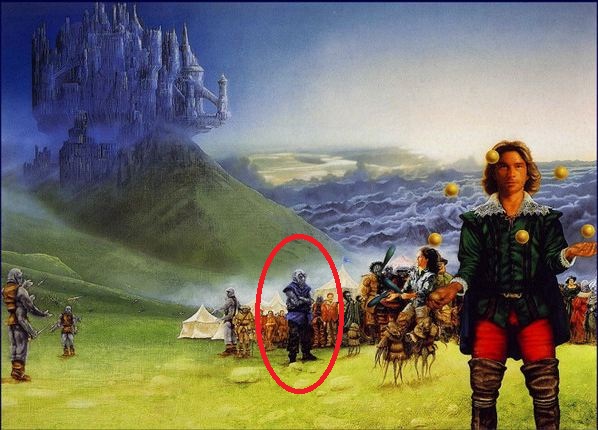
When I was a kid, my dad was really into reading fantasy novels, by writers such as J.R.R. Tolkien and Stephen R. Donaldson and Terry Brooks and so forth. He would often describe the plots of these books to me in great detail: I remember how, in trying to read Lord of the Rings myself when I was in middle school, I had found that I had liked my father’s description of the book more than the book itself. But my dad also owned a lot of fantasy novels by lesser known writers as well. Pictured above is the illustration that graces the front and back cover of Robert Silverberg’s 1980 fantasy novel Lord Valentine’s Castle. On the book’s spine there was this creepy-looking man with blue skin who I would always refer to as “The Man With the Blue Face” (my dad would tell me the character’s real name, but I could never remember it). I’ve circled this character in the above JPG, and below is a (somewhat blurry) close-up; my apologies for the poor picture quality…
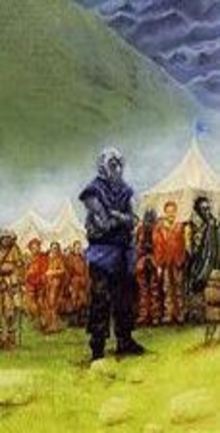
Anyway, this “Man With the Blue Face,” well, he terrified me, to the extent that my dad had to hide this book on his bookshelf behind another book. Although I don’t suffer nightmares much anymore, when I was a child I had many nightmares, and this Man With the Blue Face probably appeared in like 50% of them. This was one that occurred often: in the nightmare, I’d be lying in bed in my bedroom when I’d hear a voice call my name. Thinking it was my parents, I would go to the top of the stairs and look down. Every time, it would be the Man With the Blue Face standing at the bottom, waiting for me. I would find myself unable to run as he charged up the stairs. He’d grab my ankles and then yank me down the stairs. Then he would drag me along the hallways of the house until we came to the door that led to the basement (the basement of my parent’s old house was also the source of great childhood terror to me: the previous occupants of the house had painted sinister-looking people on the walls, and on one of the other walls there was a large black gaping hole that my parents told me never to stick my hand into: I used to fantasize that it led to Hell, or some alien parallel dimension). The Man With the Blue Face would swing open the basement door and start pulling me down the stairs. Then the basement door would slam shut and I would wake up, usually screaming for my mother.

The above illustration appears in The How and Why Wonder Book of Insects, which my parents had purchased for me at a Toys “Я” Us for $1.08. Written by Ronald N. Rood and illustrated by Cynthia and Alvin Koehler (and published by Price/Stern/Sloan Publishers, Inc. Los Angeles, 1983), it is basically a 48 page informational book about insects, with illustrations (some of which are in color, others in black and white). This drawing appears on page 28, which strikes me as ironic, seeing as I consider 28 to be one of my lucky numbers. At the bottom half of this page, as you can see, there is a black and white illustration of a startled-looking mouse that is surrounded on all sides by five honeybees, who seem to be readying themselves to sting the mouse to death. The text above the illustration says, “A warm beehive sometimes attracts mice and other animals. If a mouse finds the hive, it may eat some of the honey the bees have stored for food. It may build its nest in front of the entrance so that the bees cannot get out in the spring. Often the bees drive the mouse away with their stings. Sometimes they sting it so much that it dies. Then they have to leave the body there. But the bees often cover a dead mouse with their wax, sealing it up so that the air in the hive will stay fresh.” And beneath the illustration is this caption: “The mouse has a sweet tooth, especially for honey, but bees know how to defend their property from enemies.” Perhaps my fear of bees stems all the way back to seeing this picture at an early age?
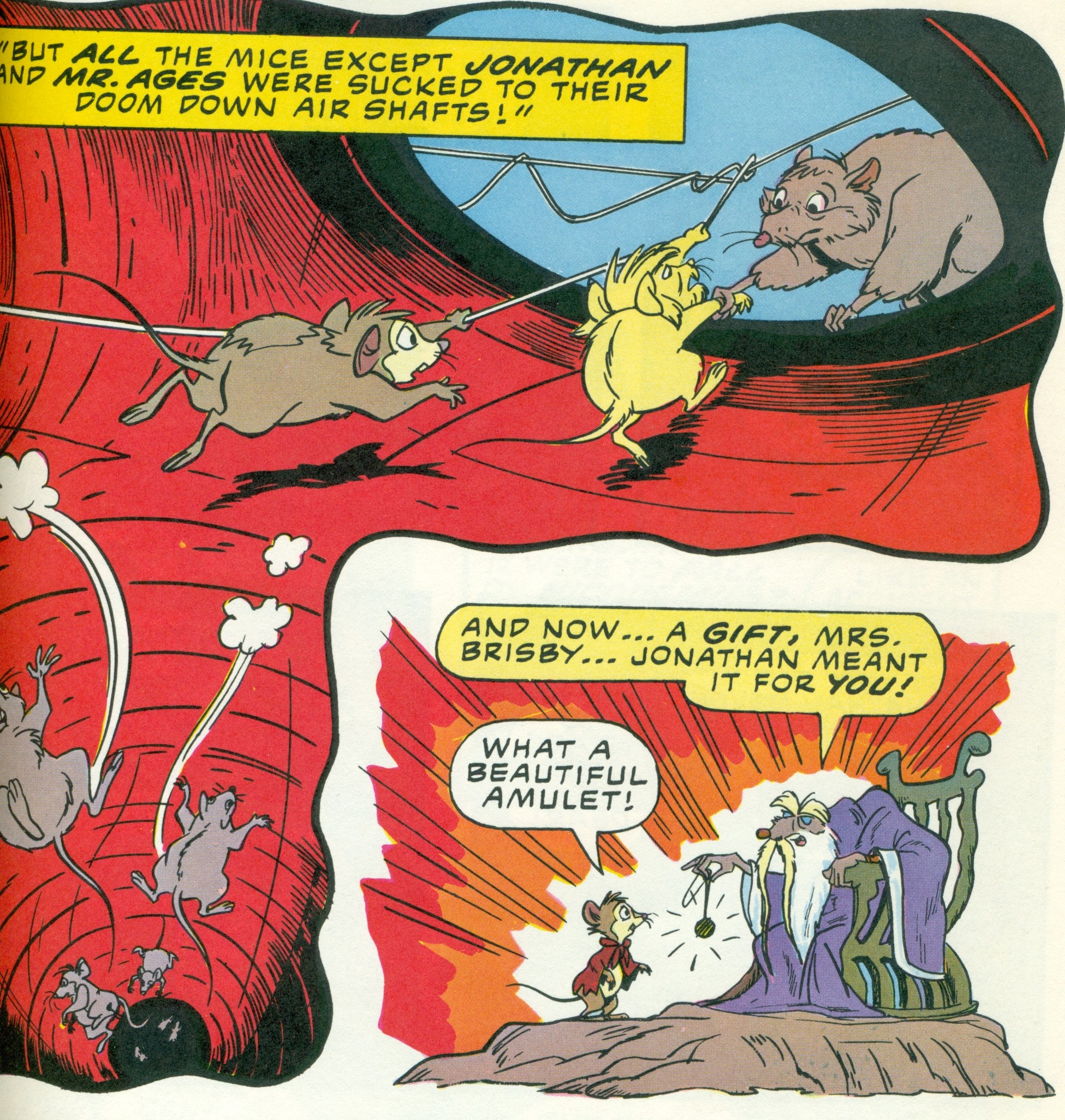
In the JPG above are some panels from the comic book adaptation of Don Bluth’s classic 1982 film The Secret of NIMH, which was itself an adaptation of Robert C. O’Brien’s Mrs. Frisby and the Rats of NIMH. I recall being quite fond of the movie when I was a child (in fact, I had had a crush on the animated version of Mrs. Brisby, who I thought was kind of hot). Anyway, this comic book adaptation was published by Golden Press in 1982, and though it was priced at $2.95 my parents had purchased it for $2.46 at Caldor. The illustration in this book that had scared me was on page 29, the portion of the book dealing with the rats and mice trying to escape from the NIMH research labs by fleeing through a ventilator system. At the top of this page in question there was a panel showing some of the rats crawling along a string that stretched like a tightrope at the top of the air shafts. The inside of this air shaft was red, with gaping black holes, making it look more like the interior arteries of the body of some horrific eldritch monster than the inside of an air shaft. I mean, at that point in my life, I had never seen the insides of an actual air shaft, but my gut feeling was that they didn’t look like that. Some of the rats are shown falling to their deaths as they got sucked down the air shafts, horrified expressions on their cartoony faces: at the top of the panel is a caption stating: “But all the mice except Jonathan and Mr. Ages were sucked to their doom down air shafts!” Incidentally, I would sometimes have nightmares in which I’d find myself getting sucked down similar air shafts.
The Johnny Dixon Mysteries of John Bellairs
“I write scary thrillers for kids because I have the imagination of a ten-year-old. I love haunted houses, ghosts, witches, mummies, incantations, secret rituals performed by the light of the waning moon, coffins, bones, cemeteries, and enchanted objects.”
-John Bellairs, Locus 1991
When I was young, I was a huge fan of the gothic novelist John Bellairs (January 17, 1938–March 8, 1991), who pretty much wrote books mainly for kids and teenagers, though he did a few adult novels as well (these adult novels of which I have not read). Not only were they my entryway to the world of Gothic/horror fiction, but also to the art of Edward Gorey, as his illustrations would usually grace the front cover, back cover, and frontispiece of the books of John Bellairs. When I was a kid, I was especially obsessed with his series of supernatural mystery/thriller novels featuring Johnny Dixon. His Johnny Dixon books take place in New England in the 1950’s, and concern Johnny Dixon, a lonely and quiet bespectacled boy who, though he likes nothing more in life than to read his books in peace and quiet, always finds himself being drawn into inexplicable adventures, often revolving around cursed objects, undead wizards, killer robots, time travel, and so forth. Usually accompanying him on these adventures are his best friend and classmate Fergie, his neighbor Prof. Childermass (an elderly man who is Johnny’s second best friend), and Father Higgins, the town priest. The titles of these books were quite evocative: there was The Curse of the Blue Figurine (1983), The Mummy, The Will and the Crypt (1983), The Spell of the Sorcerer’s Skull (1984), The Revenge of the Wizard’s Ghost (1985), The Eyes of the Killer Robot (1986), The Trolley to Yesterday (1989), The Chessmen of Doom (1989), and The Secret of the Underground Room (1990). Following Bellairs’ death in 1991, further Johnny Dixon mysteries were written by Brad Strickland, but I never read those. The first Dixon mystery I read was the third one in the series, The Spell of the Sorcerer’s Skull: I think I got it through my school’s Scholastic book club. I loved it so much that I began collecting the other ones in the series.
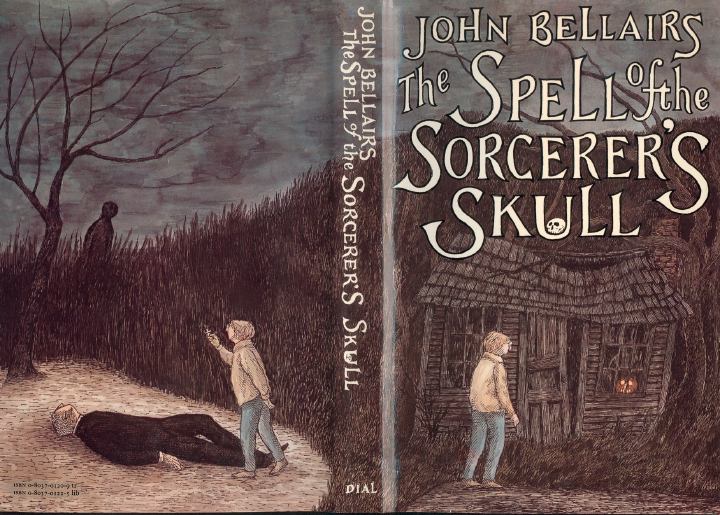
Having said that, I also found the books of John Bellairs to be very scary at times. Take The Spell of the Sorcerer’s Skull. In this novel, Johnny Dixon and Prof. Childermass visit an old inn in a little New Hampshire town. The owner of this inn just happens to have in his possession a clock that had been built years ago by Prof. Childermass’ father, a clock that is said to be haunted. In the bottom half of the clock there’s a small dollhouse room, decorated like the parlor of a Victorian house from the 1870’s. Inside this parlor are various objects, including a tiny skull and a doll of a man that’s supposed to represent Prof. Childermass’ granduncle, who was murdered by a sorcerer many years ago. That night, Johnny sleepwalks down to the inn’s basement, where he has a vision in which he sees the doll come to life, only to get smothered to death by a tall, gaunt shadow. That scene is creepy enough, but things get worse. When the Professor touches the skull, he unwittingly is cursed, and later on vanishes. When Johnny visits the house of his friend, he encounters this creepy scene (the fact that it involved a face in a mirror made it doubly nightmarish in my mind):
“Halfway to the window Johnny froze. He had seen something out of the corner of his eye, a sudden image in the small rectangular mirror that hung over the bureau. He turned and looked. In the mirror he saw the professor’s face, looking haggard and disheveled. His eyes pleaded and, as Johnny watched, his lips formed silent words. ‘Help me.’”
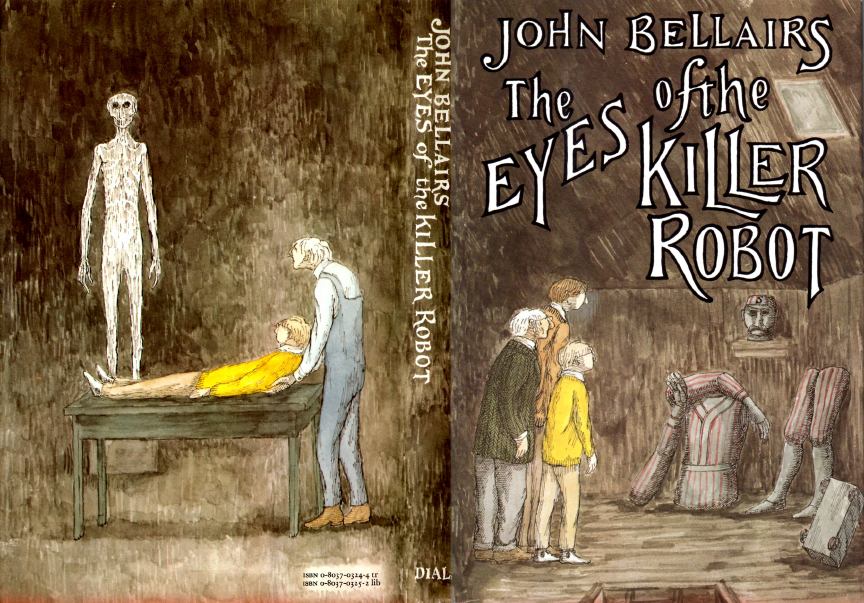
Another of the spookier Dixon mysteries is The Eyes of the Killer Robot. The plot for this one is pretty silly: it’s been years since I’ve read it, but I think the story revolved around this: the town that Johnny Dixon lived in was holding some kind of baseball contest where if you could strike out a major league batter, you’d win $10,000, and some evil inventor planned to win the contest by building a robot that resembled a man in a baseball uniform and using “an ancient magical formula” to bring it to life. The crux of the story was that the robot could only be brought to life when a pair of dead man’s eyes are placed within the robot’s head. The inventor had a grudge against Johnny’s grandfather, so to get back at him he plans on using Johnny’s eyes to bring the robot to life. As I said, pretty silly stuff. Still, there are some unsettling moments, such as this one, where Johnny spots a ghost lurking outside his bedroom window:
“But just as he was turning to pull down the bedspread, he froze. Out of the corner of his eye he had seen something.
There was a figure crouching on the porch roof outside his bedroom window.
An icy breath of fear blew across Johnny’s body. In a flash he knew that the creature was someone who shouldn’t be there, someone who couldn’t be there- it was a visitor from another world. Slowly, Johnny turned to face the thing. The flashlight’s beam cast a ghostly sheen on the window, and beyond the glass Johnny saw a fearfully thin shape shuffling forward on his knees. As Johnny watched, rigid with terror, the shadowy form groped at the window… and then Johnny blacked out, and he fell in a heap on the floor.”
By this point, one would think that Johnny should just stop looking at things he notices at the corner of his eye.
Here’s another of the spookier scenes:
“Not far from the back door of the house stood a bench covered with peeling white paint. It was a garden seat, the kind people used to make so they could sit outdoors on hot summer nights. The bench stood in a patch of wild rosebushes not far from the rugged wall of the mountain, which towered overhead. A man was sitting on the bench- a man Johnny had never seen before. He wore baggy, dusty overalls and a faded plaid shirt, and he had a big mop of straw-colored hair. The man sat hunched over with his face in his hands, and he seemed to be crying. Johnny stood dead still. The bunch of pieweed stalks fell from his numb fingers, and he took a couple of shuffling steps forward. And then, as Johnny watched, the man stood up. He took his hands away from his face and he stumbled. Johnny gasped in terror- the man had no eyes. Streaks of blood ran down from empty black sockets.
‘They took my eyes,’ the man moaned. ‘They took my eyes.’
Johnny opened and closed his mouth, and made little whimpering noises. He shut his eyes tight to block out this horrible vision, and when he opened them again a second later, the man was gone.”
Granted, that’s the kind of scene that, when I read it over now, makes me giggle, but when I was a kid, I thought that was pretty scary stuff.
More info on John Bellairs and his work can be found here:
Songs
“Aqualung” by Jethro Tull
Growing up, I would often listen to the same music that my parents listened to. They mostly listened to progressive rock, bands like Yes and King Crimson and Emerson, Lake & Palmer. My dad liked Jethro Tull as well, especially their album Aqualung. I hated the song “Aqualung,” though. For some reason, I misheard the lyric “feeling like a dead duck—spitting out pieces of his broken luck” as “spitting out pieces of his broken lung,” the visual image of which so disgusted me that, upon hearing it on the radio of my parent’s car one day as we drove to some parade, I went into a state of almost borderline hysterics as I demanded they switch to a different station before that lyric came up, even though they insisted I had misheard the lyric. I also found the artwork that accompanied the Aqualung album to be quite creepy and disgusting as well. Bottom line, I hated Aqualung: the song, the album, even the fucking artwork.
TV shows
Mummenschanz on the Muppet Show (1976)
I don’t think I need to comment much on this one. Let’s just say that while I loved The Muppet Show when I was little, the Mummenschanz characters would often manifest in my nightmares. How the audience could be laughing at this surrealistic nightmare, I have no idea!
Movies
Luke’s vision in Empire Strikes Back
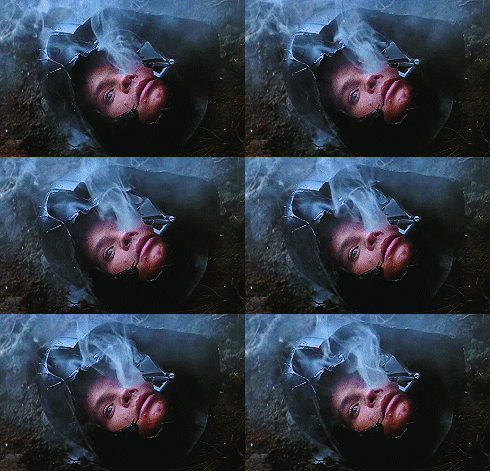
When I was a child, I was really obsessed with the Star Wars films (in fact, the first film I ever saw in theaters was Return of the Jedi, all the way back in 1983). I had all the toys and books and everything. However, there was one scene in the second film, where Luke Skywalker has a nightmarish vision involving himself battling Darth Vader, that always scared the hell out of me.
Video/Computer Games
Alien (Commodore 64)
This old computer game, first released for the Commodore 64 in 1984, was, of course, based on the classic Ridley Scott film. The game was designed and programmed by Paul Clansey, who also did the awesome music heard playing at the title screen (this was back in the days when all it took was one person to crank out a video or computer game). It’s mostly a menu-based game that is surprisingly faithful to the film and, through the use of subtle sound effects, really captures the tension and paranoia of the movie in question. All the characters who appear in the film appear in the game, as does the ship where the main action takes place… All that’s missing is the face hugger and the bursting chest (one presumes this happens off-stage, right before the game begins). The graphics are kind of dull and basic and the interface is a little clunky, but all-in-all, I’d say they made a good effort. I played this game A LOT when I was a kid, even though it scared the hell out of me. One thing that interests me about the game was how, in place of a soundtrack, all the game consists of in terms of sound is a steady beating sound as the clock ticks down (which I guess also stands in for the character’s heartbeat) and an annoying metallic hiss every 7-8 seconds. Every now and then you’ll hear a metallic scrapping sound which indicates the Alien is moving around the ship’s duct system (or maybe moving into the next room). This heightens the game’s creepiness and paranoia. The main goal of the game, like the film, is to destroy the Alien. There are a few ways to do this. One, you can use weapons on him and try to beat him in hand to hand combat, though I’ve never been able to do this (the weapons, most of which include laser pistols, harpoon guns, and incinerators, are very hard to come by)… The most I’ve ever been able to do is wound him, and when that happens his acidic blood damages the room he’s in. I have no idea what happens it the acid damages too much of the ship, and frankly, I don’t want to know. Another option is to entice him to enter an airlock, then shoot him into outer space, but odds are against that he’ll fall for this. The easiest way (and I mean the word “easy” in its most ironic sense) is to capture the cat Jones, set the ship to auto self-destruct, then get at least three crew members into the “Narcissus” escape pod to win. But try as hard as I could, I was never able to beat this game. One thing that added to the paranoia factor is that you can never actually see the Alien on the game’s map until it attacks you: then the game jarringly switches to a screen of the Alien itself.
Ikari Warrios 2: Victory Road intro (NES)
Ikari Warriors 2: Victory Road is a shoot-‘em-up action video game released for the Nintendo Entertainment System in April of 1988. My family never actually owned this game, but we did rent it once, and for some reason my brothers and I found the game’s intro scene to be terrifying. First off, it’s kind of creepy (to say nothing of irritating) how the text slowly appears on the screen one letter at the time, and when you get to the grand appearance of Zada at the 2:51 mark (he looks a bit like a Satanic Yoda), well…
The Ending to Monster Party (NES)
Monster Party is a fairly obscure game released for the Nintendo Entertainment System in 1989, though over the years it has built up something of a cult following. It’s basically about a boy named Mark who meets a gargoyle-like creature named Bert. Bert is from the “Dark World,” and this home of his has been attacked by monsters. It’s essentially your basic platformer game, just with a somewhat quirky and macabre sense of humor (as some of the bosses you fight in the game are quite outlandish). But the ending is pretty, well… see for yourself:
The Town of Yomi in Castlevania II: Simon’s Quest (NES)
Towards the end of Castlevania II, right before you reach Dracula’s Castle, there’s a town you have to go through called Yomi. What makes this town different than the game’s other towns is that it’s completely abandoned, utterly devoid of life, save for one crazy old woman hiding in her house who, when you speak with her, simply says “Let’s Live Here Together.”
The Death Scenes of Uninvited (NES)
All I have to say to this is: AAAAHHHHHH!!!!!!!!!!!!!!!!!!!!!!!
Shadow’s Dream in Final Fantasy VI (SNES)
When I was in high school, my favorite video game of all-time was Final Fantasy VI for the Super NES, though back then, when it was first released in the West, it was known as Final Fantasy III. One of my younger brothers and I were so obsessed with the game that we each created a trilogy of novels based on it (this was around 1995 or so). Like most of these Japanese role playing games, your party can sleep at inns to replenish lost health. Usually when you sleep at an inn in the game, you’ll see your party each climb onto a bed. The screen goes black, you hear a nice little sound effect, then the game fades back into the view of the inn as the party gets out of bed and you can control them again.
That’s what’s supposed to happen, anyway. However, if one of the characters you can play as in the game, Shadow the Ninja, is in your party, and you go to sleep at an inn, there’s always a chance that one of 4 different dream scenes will appear, these dreams being flashbacks into Shadow’s life, before he became a ninja. What made this so scary to me at the time was that I didn’t know about this: the strategy guide I owned for the game made no mention of it. So when I saw his first dream for the first time, it came as a real shock to me: not helping matters is that in this first dream scene, an incredibly loud and abrasive droning/air-siren-like sound effect plays in the background, adding to the “jump out of your seat” effect. I can at least take solace in one thought: quite a few other people who played the game when it first came out freaked out at that first dream scene as well!
* * * *
To make this fairly short day of mine a bit longer, here are a few more recent things that have creeped me out over the last few months:
Squidward’s Suicide:
http://creepypasta.wikia.com/wiki/Squidward’s_Suicide
Pokemon’s Lavender Town Syndrome:
http://creepypasta.wikia.com/wiki/Lavender_Town_Syndrome
Yume Nikki: Uboa (shit gets real at the 7:39 mark):
Well, I think that’s enough horror for one day!
*
p.s. Hey. ** David Ehrenstein, Hi. You’re in ‘It is not …’? I need to watch that again. Benjamin Britton is vastly preferable to James Taylor for me, yes. I’ve never found Viggo Mortensen to be physically attractive at all, and I’ve never been especially interested in his acting, and his poetry is well-meaning but so-so, but his decades-long strong support of Beyond Baroque makes me think he’s a cool guy. ** Bill, I didn’t realise he was still making films either until I made the post. Okay, you’re kind of selling me on those specific mermaids but … no others! I’ll see if that film is on one of my ‘illegal’ sites. Thanks! Excellent something great-filled weekend. ** Dominik, Hi! My brain cells are about half-working this morning, and I have no excuse unless the coffee I bought yesterday and am drinking now is accidentally decaf. Yeah, I get the feeling that just being admired for their prose would not be enough for most escorts. Sadly/ understandably. It’s the inability to travel until further notice that’s driving me the most crazy. And no cafes. Great, enjoy your imaginary wealth! Ha ha. I especially like that the paintings are miniature. Love strolling across Severn Bridge on the night of Feb. 7, 1995, noticing a forlorn looking young fella staring ominously into the water below and inviting him home for a nice cuppa tea, G. ** Misanthrope, My newness streak continues, yay! I thought that concept might give you the willies, and I apologise, although the willies can be instructive. Sounds like your health may very well be in the clear, tentative whew. Outdoors sounds smart. My outdoors is freezing cold and pounding rain, and I need to dash out and buy cigarettes, yuck. ** Steve Erickson, Only on vinyl?! That’s obnoxious. Maybe Tommy Gear is still trying to maintain The Screamers’ elusive thing, but that’s just counterproductive. Well, you’ve completely warded me off the Viggo Mortensen film, thank you. Yikes. No, no deadline on the script-cum-novella thing. I wish we had one, actually. I may have to pretend we do. Yes, Zac’s pretty much all better now. Just some headaches, he says. But he seems totally good. ** Brian O’Connell, Hi, Brian. von Praunheim’s films are all over the place. I prefer his kind of wacked out, super gay costume extravaganza ones to his more political ones, but that’s just me. Weirdly, the workers just stopped showing up a few days ago. Their equipment and ladders and stuff are still all over the floor, and the job isn’t finished, but … nothing. I hope they didn’t die. I feel like so far Biden seems to be doing what he should be doing. I’m still blissed that there hasn’t been even a tiny peep in the media that I’ve seen about the Ex and what he’s doing since he stepped on that plane. Man, so sorry to hear about your very down day. We seem to be at a point where everyone, or everyone I know, has hit the wall about the pandemic and the lockdown and stuff. Badly need a second wind. ‘Yi Yi’ … no, I don’t think I’ve seen it. I’ll find it. Sounds worth a view. I hope you get into the city. Mm, I had a couple of potentially fun plans for today, but they both fell apart, so I’m not sure what I’ll do. I really need to stop procrastinating about a couple of writing assignments I have, so hopefully I’ll do that. I’ll let you know if anything I did was shiny. Enjoy whatever the next couple of days puts in your path. ** Corey Heiferman, Hi. I hope your investigation of von Praunheim is a feeding type of situation. Thank you for the fill-in about the weedkend thing. I really should know that stuff. Religion gives off a bit of a stink for me. The first time I visited France in the mid-late 70s, all the stores closed from about noon to 3 pm every day, but that was just some kind of traditional French laziness or something. Guess I don’t think much about mythical creatures. I can’t think of any that actually bore me other than mermaids. It’s just a lack of excitement that seems to be a prerogative to finding, oh, dragons or giant cyclops or whatever else interesting to contemplate. Strange, I know. I should probably see a therapist or something. Why, do you have a thing of some heady sort for mythical beings? ** Okay. This weekend I have restored a post by the legendarily masterful DC’s guest-post maker Sypha aka author James Champagne. Perhaps you would like to respond by ponying up with some of your childhood fear inducers? That might be nice. But your response is completely your call, don’t get me wrong. Oh, and Sypha, apologies for inserting those two gifs in your Day, I just couldn’t seem to help myself. And with that I’ll see you on Monday.











































































 Now available in North America