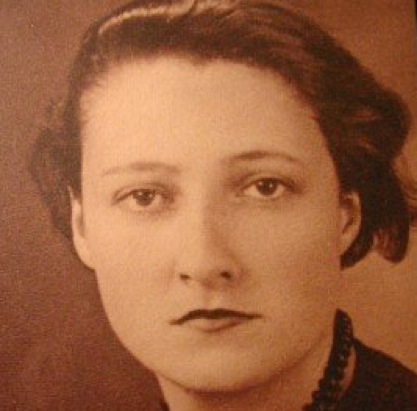
‘No one has ever struck me as so intractable
and pure, nor more definitely sovereign.’
— Georges Bataille
‘One of the most vehement existences [that]
ever lived, one of the most conflicted. Eager
for affection and for disaster, oscillating
between extreme audacity and the most
dreadful anguish, as inconceivable on a
scale of real beings as a mythical being, she
tore herself on the thorns with which she
surrounded herself until becoming nothing
but a wound, never allowing herself to be
confined by anything or anyone.’
— Michel Leiris
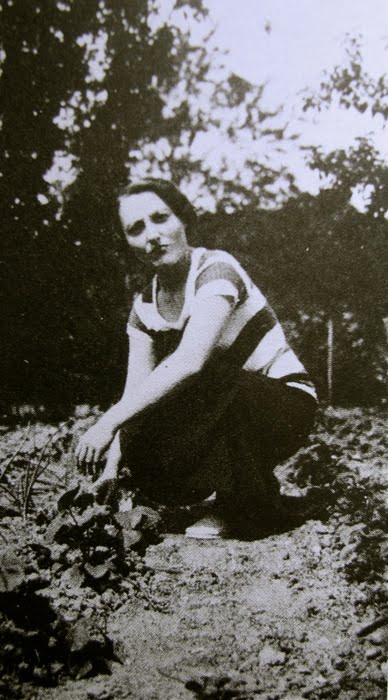
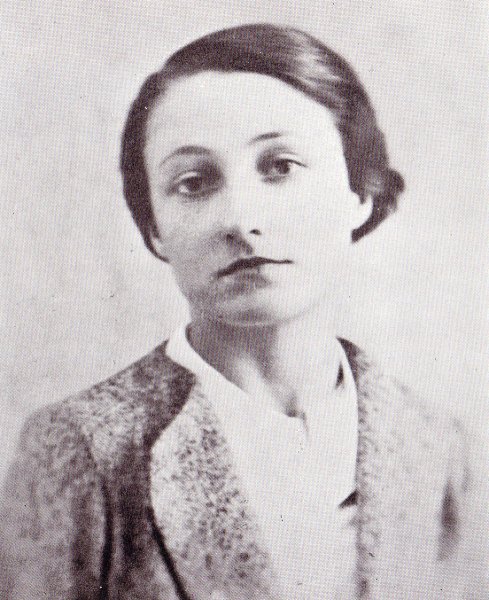
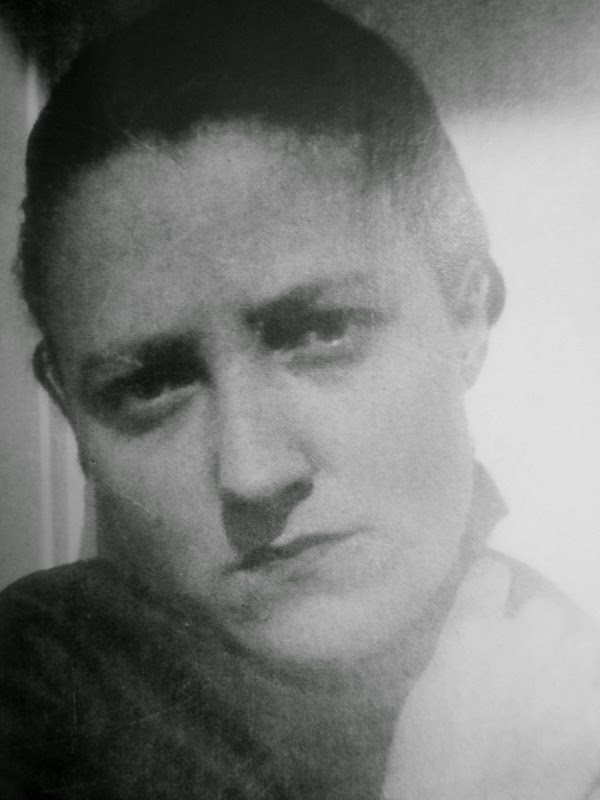
Colette Peignot (1903 – 1938) was a French author who wrote under the pseudonym Laure. She was a revolutionary poet, masochist Catholic rich girl, & world traveler. Toward the end of her life she became the lover of French writer Georges Bataille. She was a prominent member of Bataille’s secret society Acéphale, and his novel Blue of Noon is based on events in their relationship. Her writings and her real life story were remarkable in their violence and intensity, and her relationships with Bataille and Michel Leiris clearly influenced their works. Laure succumbed to tuberculosis at the age of thirty-five. For Laure’s funeral, her mother wanted a priest, but Bataille refused and threatened to shoot him at the altar. Her works were published posthumously against the will of her brother, Charles Peignot, by his nephew, the poet Jerome Peignot (who thought of Colette as a “diagonal mother”). Peignot’s work was a major inspiration for the American author Kathy Acker, whose early work Persian Poems is a cut-up and plagiarzing of Laure’s writing. Peignot’s love affair with Bataille also forms the central narrative conceit of Acker’s novel My Mother: Demonology. Perhaps most significantly, Peignot’s death inspired and is the subject of the great French author and philosopher Maurice Blanchot’s most significant novel, Death Sentence.
_______________
A brief biography (in French)
Laure’s Facebook Fan Page
Laure: The Collected Writings (City Lights Books)
Colette Peignot: A Laura for Our Times
@ Wikipedia
________________
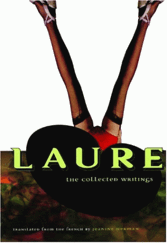 This complete collection of Laure (Colette) Peignot’s writings published for the first time in English includes “Story of a Little Girl,” about the Catholic priest who sexually molested her sister; “The Sacred,” a collection of poems and fragments on mysticism and eroticism; notes on her association with contr-attaque and acephale, and her involvement with the Spanish civil war and the early years of the Soviet Union; a compendium of correspondence with her beloved sister-in-law and tortured love letters to Bataille; and an essay by Bataille about Laure’s death of tuberculosis at the age of thirty-five.
Laure’s Fragments of a Notebook (1937)
Avoid contact with all people in whom there is no possible resonance with what touches you most deeply and toward whom you have obligations of “kindness,” of politeness. Since these obligations engage me strongly as soon as I find myself in the presence of such people and engage me through an ill-fated habit of patience and good-will, which in fact becomes will for humiliation (sometimes abject). Imagine a musician in an orchestra playing off-key because his neighbor is doing so, to be nice.
Flee — literally flee — those with whom you can exchange only absurd remarks about others who are just like them and whom you have seen the previous night exchanging the same remarks, or equally vain gossip, about the very person you are talking to. There are certain people who end up frequenting and even calling friends those they denigrate constantly. I hate “goodness” and “kindness,” which have only led me to humiliation.
Keep silent as before. It’s better.
Contempt for those whose conversation boils down to all that I hate and flee: to a certain spirit of vulgarity and pettiness. Farce is what they feel comfortable with. I cringe before certain laughter and smiles drawn forth on this terrain. Sometimes a laugh is enough to cause me to have, not aversion toward, but distrust of a human being. There is a point at which polite distrust is worse than aversion because it is more reserved, but I can’t confine myself to this, and everything in me shouts, screams aversion.
Lack of reserve and moral propriety shocks me all the time, due to certain nervous (physical) reactions I can neither hold back nor hide. Those who broaden the horizon, those who narrow it.
How I prefer a true whore.
Do not get stuck where the essential is lost, where everything turns vulgar, base, and petty. Through my own fault, through a will for humiliation. A feeling of abjection. “Defeated ahead of time.” So from now on “dust to dust” resembles dust. At those moments it is physically impossible to be clear and frank. Shame and false shame.
Easy: to accuse others of being superficial = brilliant = alive.
Return to simple beings, to childlike reactions, a difficult return.
from a letter from Laure to Georges Bataille (1935)
‘I believe in our life together . . . I believe in it the way I believe in everything that brought us together: in the most profound depths of your darkness and of mine. I revealed everything about myself to you. Now that it gives you pleasure to laugh at it, to soil it –– this leaves me as far away from anger as it is possible to be. Scatter, spoil, destroy, throw to the dogs all that you want: you will never affect me again. I will never be where you think you find me, where you think you’ve finally caught me in a chokehold that makes you come . . . As for me I am beyond words, I have seen too much, known too much, experienced too much for appearance to take on form. You can do anything you want, I will not be hurt.’
_______________
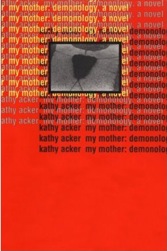 Based loosely on the relationship between Colette Peignot and Georges Bataille, Kathy Acker’s novel My Mother: Demonology is the powerful story of a woman’s struggle with the contradictory impulses for love and solitude. At the dawn of her adult life, Laure becomes involved in a passionate and all-consuming love affair with her companion, B. But this ultimately leaves her dissatisfied, as she acknowledges her need to establish an identity independent of her relationship with him. Yearning to better understand herself, Laure embarks on a journey of self-discovery, an odyssey that takes her into the territory of her past, into memories and fantasies of childhood, into wildness and witchcraft, into a world where the power of dreams can transcend the legacies of the past and confront the dilemmas of the present.
Kathy Acker: ‘My Mother: Demonology started out as my fascination with Laure’s work and with Bataille, and with wondering what that generation, two generations ago, was thinking. I was amazed reading her work that the same preoccupations I have are there too. The work Bataille and Laure were doing in the ’30s was model-building from the ground up. Neither the democratic nor the post-Leninist model was usable, so they turned to anthropological work and started looking into myth and sacrifice to come up with a new ground for a new social model. Whereas Breton settled for Stalinism after psychoanalysis, Bataille and Laure were looking for something else, where irrationality would not be just a matter of mental functions, and sexuality would be something more than just the repressed. We’re in a similar situation today with regard to Russian communism and democracy. In her search, Laure also looked consciously as a woman, which greatly interested me. So it was by chance (in other words by some determination that doesn’t have a name yet) that in the course of working through Laure’s texts I became interested in witchcraft. And this started my novel. The witchcraft material presented another history of women, or another history–one not written by and about dominant men.’ — (from an interview by Lawrence Rickels)
from My Mother, Demonology (1995)
I had to return home.
I didn’t want to escape my parents becuase I hated them but because I was wild. Wild children are honest. My mother wanted to command me to the point that I no longer existed. My father was so gentle, he didn’t exist. I remained uneducated or wild because I was imprisoned by my mother and had no father.
My body was all I had.
A a a I don’t know what language is. One one one one I shall never learn to count.
I remained selfish. There was only my mother and me.
Selfishness and curiosity are conjoint. I’d do anything to find out about my body, investigatged the stenches arising out of trenches and armpits, the tastes in every hole. No one taught me regret. I was wild to make my body’s imaginings actual.
And I knew that I couldn’t escape from my parents because I was female, not yet eighteen years old. Even if there waws work for a female minor, my parents, my educators, and my society had taught me I was powerless and needed either parents or a man to survfive. I couldn’t fight the whole world; I only hated.
So in order to escape my parents I needed a man. After I had escaped, I could and would hate the man who was imprisoning me. And after that, I would be anxious to annihilate my hatred, my double bind.
This personal and political state was the only one they had taught me. I’m always in the wrong so I’m a freak. I’m always destroying everything including myself, which is what I want to do.
Red was the color of wildness and of what is as yet unknown.
As my body, which my mother refused to recognize and thusn didn’t control, grew, it grew into sexuality. As if sexuality can occur without touching. Masturbated not only before I knew what the word masturbation meant, but before I could come. Physical time became a movement toward orgasm. I became sexually wilder. I wanted a man to help me escape my parents but not for sexual reasons. I didn’t need another sexual object. Mine was my own skin.
Longing equaled skin. Skin didn’t belong to anyone in my kingdom of untouchability.
I hadn’t decided to be a person. I was almost refusing to become a person, because the moment I was, I would have to be lonely. Conjunction with the entirety of the universe is one way to avoid suffering.”
________________
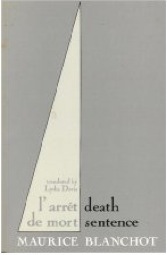 Maurice Blanchot’s great novel Death Sentence recounts the horrific drawn out death of writer Colette Laure Peignot, a close friend of Blanchot’s and the lover of his colleague the writer Georges Bataille. In the novel, the main character Anne recalls a correspondence she’d had with J., who, in her delirium on her deathbed, had visions of a rose incapable of wilting, “a perfect rose”. Anne imagines on her deathbed that she is being offered immortal or “artificial roses”. In this way, as well as in innumerable other cases within Blanchot’s novel, Anne’s death mirrors the death of Peignot, who famously uttered in her last breath, “la rose”.
from Death Sentence (1948)
She had fallen asleep, her face wet with tears. Far from being spoiled by it, her youth seemed dazzling: only the very young and healthy can bear such a flood of tears that way; her youth made such an extraordinary impression on me that I completely forgot her illness, her awakening and the danger she was still in. A little later, however, her expression changed. Almost under my eyes, the tears had dried and the tear stains had disappeared; she became severe, and her slightly raised lips showed the contraction of her jaw and her tightly clenched teeth, and gave her a rather mean and suspicious look: her hand moved in mine to free itself, I wanted to release it, but she seized me again right away with a savage quickness in which there was nothing human. When the nurse came to talk to me–in a low voice and about nothing important–J. immediately awoke and said in a cold way, “I have my secrets with her too.” She went back to sleep at once.
—-… As I listened without pause to her slight breathing, faced by the silence of the night, I felt extremely helpless and miserable just because of the miracle that I had brought about. Then for the first time, I had a thought that came back to me later and in the end won out. While I was still in that state of mind–it must have been about three o’clock–J. woke up without moving at all–that is, she looked at me. That look was very human: I don’t mean affectionate or kind, since it was neither; but it wasn’t cold or marked by the forces of this night. It seemed to understand me profoundly; that is why I found it terribly friendly, though it was at the same time terribly sad. “Well,” she said, “you’ve made a fine mess of things.” She looked at me again without smiling at all, as she might have smiled, as I afterwards hoped she had, but I think my expression did not invite a smile. Besides, that look did not last very long.
—-Even though her eyelids were lowered, I am convinced that from then on she lay awake; she lay awake because the danger was too great, or for some other reason; but she purposefully kept herself at the edge of consciousness, manifesting a calm, and an alertness in that calm, that was very unlike her tension of a short time before. What proved to me that she was not asleep — though she was unaware of what went on around her because something else held her interest — was that a little later she remembered what had happened nearly an hour before: the nurse, not sure whether or not she was asleep, had leaned over her and suggested she have another shot, a suggestion which she did not seem to be at all aware of. But a little later she said to the nurse, “No, no shot this evening,” and repeated insistently, “No more shots.” Words, which I have all the time in the world to remember now. Then she turned slightly towards the nurse and said in a tranquil tone, “Now then, take a good look at death,” and pointed her finger at me. She said this in a very tranquil and almost friendly way, but without smiling.
_______________
‘Life has always taken place in a tumult
without apparent cohesion, but it only
finds its grandeur and its reality
in ecstasy and in ecstatic love.’
— Georges Bataille
_______________
LAURE – Redécouverte en fragments (France Culture, 1977)
LAURE – Lecture de fragments choisis (France Culture, 1998)
Laure, LE SACRÉ
______________
my life will never be where you think you can find it–too bad for me
―- Laure
‘Despite the publication of her writings some 35 years ago, woman author and political activist Colette Peignot (1903-1938)–also known as Laure, “la sainte de l’ abime” – remains an obscure figure of the French avant-garde. The reasons for this are many; among them was her early death from tuberculosis at 35 and her relatively scant number of publications. Indeed, the greater part of her work might never have seen the light of day had it not been for her more visible friends, many of whom were among the most prominent French intellectuals of the inter-war period. In addition to Michel Leiris and Georges Bataille, who prepared her writings for posthumous publication, she was friend to philosopher-activist Simone Weil and intimate with Boris Souvarine of Le Cercle communiste democratique. Like them, she was politically engaged in the tumultuous interwar years, rejecting republicanism, Catholicism, fascism, and Stalinist Russia. In response to the growing fascist threat in the early 30s, she embraced Trotskyism and turned to anti-Stalinist Russia for political cause and inspiration, befriending these progressive contemporaries and sharing their political engagement. Her fervent dedication to the worker’s cause motivated her to learn Russian, visit the U.S.S.R., join Souvarine’s anti-Stalinist group, and write for many preeminent leftist journals, including Le Travailleur communiste syndical et cooperatif, La Critique sociale (in which Bataille published his famous “La Notion de depense”) and, later, Bataille’s own political journal Contre-attaque. Her fidelities to the politics of the French left would wane in the mid-1930s, however, when she would embrace an even more radical, if not entirely unwieldy position strongly influenced by her friends–principally Bataille–and her reading of William Blake, D.A.F. de Sade, and Friedrich Nietzsche. To be sure, she was not alone in this departure from normative politics; 1930s France fomented with diffuse and complex political attitudes of all kinds. The Spanish Civil War and the failure of the Front populaire in 1937 further intensified this trend. Figures like Louis Aragon called for the “crusade of poetry and art” while others like Georges Bernanos championed a gallic antifascist Catholicism. Disenchanted with the failures of both the Right and Left, many like Laure sought out a radically new politics beyond both sides of the political spectrum. Perhaps the earliest traces of this transformation are to be found in her highly revealing self-chosen pseudonym, “Claude d’Araxe,” which derives from a memorable phrase taken from the Virgil’s Aneid, Book VIII, later placed atop a private letter to paramour Bataille: “Pontem indlgnatus Araxes” (“Araxes, indignant of bridges”). The Araxes, dividing Iran and Turkey on the one side and the former Soviet Union on the other, is a legendarily rapid and vehement river, one that historically confounded all attempts to build a bridge over it. That Laure used this as a pseudonym in her political writings no doubt recalls the country that she admired, but it also illustrates a general virulence, rebelliousness, and recalcitrance, an obstinate refusal of all things stagnant, a denial of established limits, and an impassioned assent to transgress them. Her contempt for fixity–l’emmerdement d’etre fixe as she once termed it–is ironically quite fixed throughout her writing, actions, and thought from this period. Her polities were by no means exempt from this contempt; ultimately, they adhered neither to an orthodox Marxism nor to the more coherent agenda of Souvarine and le Cercle communists democratique. If her early political revolt first found its home in the more established communist movement, it would later resist this very movement, taking the form not of organized coalition or political essay, but of poetry, aphorism, and fragmentary flights of the pen. These fervent yet ultimately unallied political beliefs made her a remarkable albeit enigmatic figure to her fellow leftist contemporaries.’ — Sean E. Connolly
______________
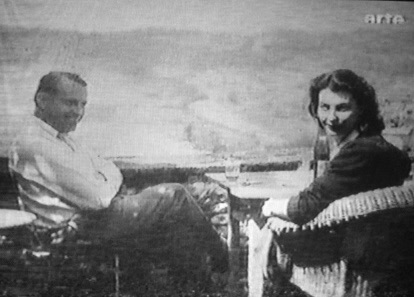
Georges Bataille & Laure, 1948
*
p.s. Hey. ** _Black_Acrylic, Hi. What’s not to like about ‘The Devil Wears Prada’? I think your faculties are fully functional. ** cmr, Hi! I’m sorry I’m taking so long to write back to you. My usual slowness has been compounded by heatwave-related bleariness, but I will. No, I don’t think I have seen ‘Eros + Massacre’. Huh. Okay, I’ll shortlist it and seek to locate it. As you probably know, Paris (and me too) would kill or worse for some rain, but I can vaguely remember what it was like to miss clear skies. Take care. ** Thom, California, where and why? And why not too, of course. To answer your question, oh my god, if only the ‘Frisk’ film had been directed by Haneke. In other words, very cogent thought there. The heat started lessening a bit technically over the weekend, but it’s so humid that it didn’t make much difference. Wednesday is when we’re supposed to start our delayed descent into fall, but I’ll believe it when it happens. Have a great trip down south. ** i🌙, Whoa! I haven’t seen you in way too long. Very cool. Very interesting about your return to womanhood. You sound really good, so it sounds like happy news. I mean seemingly relocating, dating, … so nice. I’ve been my usual okay, mostly quite okay. Film stuff a lot. That’s an imaginative AL spam scam thing. I am constantly getting ‘We are important people who loved your book ‘(fill in the blank’) and want to feature it on our very popular ‘fill in the blank’ project and make you famous.’ Yours is infinitely more interesting. So good to see you, pal. Please hang out whenever you feel like it. xo. ** Bill, Christopher Nolan could learn a billion things or two. Whenever I’ve been blown away by Butoh it’s really because it’s so pinpointed that you can see the stress of the human body’s inability to be completely cooperative. So, yeah. ** Ian, Hi, Ian! Wow, so nice to see you! It’s been yonks. Wonderful, congrats about the new kiddo. That must be a lot. I haven’t managed to stay cool to my satisfaction, but I’m still alive. You too obviously. Life is long but not as long as one had once hoped. Take care. All the extremely best! ** Diesel Clementine, So you’re here. It’s supposed to become quite civilised outdoors on Wednesday, and you missed the onslaught. Thanks for finishing the ‘Thread’. Oh, yeah, I remember it was a news story at least here in France that the Seagram Murals went to London. I think it was like pulling teeth to get them moved? Yes, coffee, when’s good? Are we hooked up on Instagram or something, or do you have my email. Let’s sort it. I think when coolness arrives I’ll just return to the usual outdoors portion of my day to day and go see stuff. I’m not sure. I’m still in the wary that it’ll happen phase. Welcome, welcome! What are your to-do’s? ** Carsten, One time I was walking into my neighborhood health food store, and out walked Nicholas Cage. A friend of mine was co-starring in a movie with him that was being filmed in Greece, and my friend was already there, and, without thinking, when I saw Cage, I said, ‘Aren’t you supposed to be in Greece?’ And his face filled with confusion and paranoia, which, he being Nicholas Cage, looked very comical. Favorite living filmmakers? Hm, totally off the top of my head, James Benning, Andersson, Malick, Pedro Costa, Ryan Trecartin (if he counts), and maybe in a pinch Harmony Korine, Guy Maddin, Wes Anderson? I’m sure I’m forgetting people. Nice: the Senegalese experience. Reminds me that I need to re-hit my favorite Ethiopian restaurant asap. ** laura w, I haven’t listened to ‘Illinois’ yet, but it’s cued up. He did the soundtrack to ‘CMbYN’? Eeek. I only made it through a very short stretch of that film, so I don’t remember its sonic background. Is there a Pixar or Disney or something animated movie where the lead protagonist is a guinea pig? That seems like it would make all the difference. ** HaRpEr //, I’ve had a number of gay guy friends over the years whose fetish was dumb guys. Or, if they couldn’t find a ‘hot’ dumb guy then a ‘hot’ ‘lower class’ guy. Super gross, although I guess fetishes should be a free zone. So weird that Delaney wrote ‘Hogg’ so early on. There was absolutely nothing like it in American lit at that time. It made Burroughs seem like a milk-fed puppy as people used to say. ** Okay. Today’s post concerns the legendary and fascinating and very non-prolific ‘Laure’. See what you think. See you tomorrow.



 Now available in North America
Very instructive, not least given I reopened ‘Death Sentence’ the other day. I found a PDF of the collected works (and can link if anyone needs) – reading ‘Story of a Little Girl’ made me think about what HaRpEr, if I remember right, was saying recently about so many ‘big’ writers of the last century having a total blind spot around gender. I have to cop to being fucking terrible at seeking out work that doesn’t reflect the workings of the cis male brain. It does me zero favours as a reader and writer.
Things got worse, then semi-better, but I’m still treading water. Anyway, “keep silent as before. It’s better.” The first part of the piece got a warm reception at the noise sharing (I think “it made me feel really sad” is an okay response), but it’s still miles away from expressing what I want. Maybe first person was a mistake, I find it so slippery. The core thing of it is just plumbing a headspace of revulsion at any kind of, hm, self-externalisation, articulation, constructive action, legibility, there’s no neat term for it that doesn’t overintellectualise it to death. Wherein lies the formal/recursive element, and also its being a pain to write. But in terms of what it ‘is,’ it’s just 10k words of someone asking older men to kick the shit out of him.
The noise was very good, not least from a débutante. I’m not normally big on field recordings, but it sold me.
I loved Blue of Noon and it’s great to be filled in on some of Laure’s background here. What a tragedy there’s not more of her work left to go round. TB was a bitch and I’m happy we’re just about rid of it.
Thanks a lot for this spotlight. Truly illuminating. How the hell had I not known of this woman until today? And I’ve read both “Death Sentence” & “Blue of Noon”. The bit from her “Fragments of a Notebook” struck an immediate chord. “Avoid contact with all people in whom there is no possible resonance with what touches you most deeply…”, yes on so many levels. I struggle with this daily. The soul-sucking trivialities (including certain people) we waste our time on out of politeness & social obligation… I’ll admit my patience with bullshit varies by mood swing, but on bad days (or maybe “purer” ones) I think snapping at fools is the only right thing to do—a bit of social revolt to both keep one’s soul intact & restore the general balance. And sometimes yes, flee, as Laure suggests. Only this I disagree with: “Keep silent as before. It’s better.” I believe in shouting at all costs, but that’s a temperamental matter. To be a dick & quote one of my own poems: “make a public ritual out of every mental breakdown”
Great anecdote. You managed to freak Nic Cage out, that’s no mean feat! Was there any follow-up or did he just walk away in paranoia?
Interesting lineup of favorite living filmmakers. I realize that Tian Zhuangzhuang is still alive, which ought to secure him a place on my list, but he hasn’t done anything noteworthy in ages, probably due to government censorship.
Hmm, never had Ethiopian food, unfortunately. What do you like to get there?
wow, I’m very touched by this one – i immediately started screencapping the excerpts to send to a friend of mine whose school of thought resembles Laure’s own, in many respects – vehemently independent, prioritizing only loyalty which is reciprocated, a love of “wild” thought and behavior. i look up to her immensely…
ironically i think some parts of Eros + Massacre touch on similar intersections as Laure, those involving freedom, leftism, and sexuality. guess i picked good timing? I’ve been meaning to see the rest of that director’s work forever, just never having the time – did see Farewell to the Summer Lights last night, which didn’t grab me as much (he filmed it two years prior) but still had a lot of interesting thoughts – i love his habit of filling the entire screen with negative space or structures, against which the humans struggle to be seen – feels very relatable
sorry about the heat wave, didn’t mean it to be a taunt. hope you can get some relief soon
I’m getting by enough, so no need to rush on writing back, i just appreciate you doing it at all
take care today Dennis!
Wow so cool. Have not heard of her before although I did have a lengthy Acephale moment where I read a bunch of Bataille’s lecture essays so weird I didn’t come across her there. Love Bataille! He once meant so much to me. And Wow, I must read that Blanchot!
Bonjour Dennis !
Laure seems very compelling! I kept seeing books today and getting excited when I recognise… Only to mind I don’t speak french.
It’s a very infectious vibe here ! This place is very fabulous. We don’t have much planned except a date with a grindr link on Thursday night. I’ve been asking guys on Grindr where to get good ‘boudin noir’ (not innuendo), punk/hardcore CDs or vintage men’s tailoring — but other than that we actually don’t have much of a to-do. Probably influenced by the things available ‘to do’ are actually mostly closed it seems (lol). Will most likely have a lot of picnics.
If you –or any other Dennis(cooperblog) Denizens– have any recs, throw em my way x
So ye: any time tomorrow, any time Wednesday and any time before like 5ish on Thurs? Sent you an email with my number and a message on insta for ease of organising.
I started typing more of a reply but my husband wants to show me stuff — bon journey !
Diesel Clementine
interesting post on an interesting person! i’m always fascinated by people who live on, like a ghost, through the work of other people, this literary lineage that doesn’t consist much if at all of anything they’ve done themselves. on one hand, it’s sad, on the other, at least they’re living somehow. and of course now there’s a sizable niche in publishing devoted to either bringing their small bibliographies back in print or translating them for the first time, which is admirable even if it’s almost never seemingly on their own merits and the back of the book synopsis always mentions their connections to their more famous friends/companions/lovers.
i actually can’t remember if it was the entire soundtrack or just like two songs? i never saw the movie. i read the book back when i was 17 or 18 and the scene where one of the characters fucks a peach and the other one eats it was like the most controversial and sexy thing i’d ever read and now my brain is so radioactive i set off geiger counters. nic cage!! he’s one of those actors who no matter how much dog shit he’s been in i will always love him at least a little bit because he was in moonstruck and that’s my cozy movie (do you have a cozy movie?) glad to see you’re still around lol.
Hi Dennis. I was very sick, like A Voice Through a Cloud sick. But then it went as quickly as it came and I find myself stateside again, sleeping on the floor while my box mattress inflates and waiting for orientation to begin tomorrow. I’ve lost so much weight that the other day I hit my hand on the inner curve of my pelvic bone while changing. Ah well, not much to be done. Lots of delirium and, through it all, little things to keep me sane: grateful dreams of friends; drawing inanely; Interior Motives with Ben Mora. This last one is also a good way of figuring out how to design my room on a budget, although it derives its primary watch-value from just how insane gay guy rooms can get. Sometimes you’ll look at a 22 year old with purple walls and a Good Vibes neon sign and think, ‘How did things devolve so far so quickly?’. But of course, with a great degree of affection. I’m very fond of gay guy insanity. You’ve shown up twice in the rooms, interestingly enough. But it’s been The Sluts both times, less interestingly. Do you have any theory for why that work in particular took off? It’s not even close to my favourite of your offerings (probably Try, I Wished, God Jr, Closer in that order). Well, I suppose I know at some level why The Sluts in particular. But still. Hope your week is going well and that you get good pancakes some time soon. Was thinking of maybe proposing a post for the blog soon once things settle but my last few proposals have fallen through. Maybe some sort of hand-drawn day? As in a day told entirely in the style of in-class doodles?
Yeah, I guess having a fetish for something like poverty or having power isn’t inherently destructive but can be when you refuse to see who you’re fucking as a human being once the sex is over. But hey, I know of many people who managed to stay afloat due to the aid of an insufferable sugar daddy.
I’m really fascinated by Laure and am desperate to read that book of her writings. It’s so interesting that there used to be these kinds of enigmatic characters who served as muses to multiple artists at once, even posthumously. I guess because the idea of artistic community was very incestuous and localized then.
Along similar lines, have you ever heard of the book ‘Alix’s Journal’ by Alix Cleo Roubaud? She was a photographer who was married to Jacques Roubaud and wrote what was apparently this wild and formally sporadic diary chronicling her life as a bored housewife. I’ve been trying to hunt it down for so long. It was brought out by Dalkey Archive but now there’s hardly any proof that it ever even existed.
Hey Dennis, Had no idea Laure was/is so central to Blanchot’s ‘Death Sentence,’ which I still haven’t read. Need to find! Also central to Acker? Whoa. Arrived in Annecy to a rain and thunderstorm, which chilled things, and then we jumped to 80% humidity. Thankfully there’s a lake to remove all this sweat. Take care, Don
Hey Dennis! Laurie is a major blind spot, seems like getting the complete works is a no-brainer. An ex said that Blue of Noon made them think of me, post-relationship, so whatever that means!
In Cali visiting my partners father, who works at a marina in a small town along the Sacramento river, so we’ve been crashing on a small boat. Great change of pace, despite the sorta strange vibes I guess? I was going to bring along Letters of Mina Harker, as we’re fairly close to the bay area, but I decided to take more relaxed easy books, and am reading Lord of the Flies, which I missed in school somehow. Some of the prose is actually really nice in pockets, so I’m having a good time. And I found this novel Bonjour Tristesse for a dollar at a thrift shop in town, so that MIGHT be up my alley, if I like the prose I guess…
Yeah, I kinda like some of the montage in the Frisk movie we did get, but the whole thing rang hollow for me. Im just imagining a guy like Hanake or something tackling the whole final letter portion in a long take scene where someone is just READING the letter… could have been powerful. Then approaching the windmill with the audience being just as in the dark as the characters recieving Dennis’s letters… anyway… I think Frisk maybe has my favourite closing sentence of any of your novels? of any novel? Spectacular stuff, my god.
Hope tommorow is still on schedule to be the start of a cooling down over there? Fingers and toes and the likes crossed on my end, byeee!!
Hey Dennis
Thanks for today, have acquired and am currently reading her collected. I dig it.
Where do you stand with Leiris’ writing? I liked his field diary Phantom Africa a lot, and was able to finish Manhood, but couldn’t really get on with much of the rest–Lydia Davis’ translations of his bizarre autobiographies.
Joe
Bataille’s description of Laure being both “intractable and pure” really struck me. It’s fascinating how her conflicts seem to mirror the turbulent nature of creativity itself. Makes me want to dive deeper into her writings and unpack that duality! Her audacity is intriguing—wonder how it influenced those around her. Looking forward to more insights! worth a look
Really intrigued by the juxtaposition of audacity and dread that Colette embodies. It’s interesting how Bataille captures her conflicting nature—definitely a complicated figure! I’d love to dig deeper into her work and see how it reflects those intense oscillations. Such an essential part of the literary conversation! REPLY worth a look
I’m really struck by the description of Laure oscillating between extreme audacity and dread—it’s such a vivid portrayal of her complexity! I feel like there’s so much more to uncover about her tumultuous existence and its reflection in her writing. It’s fascinating how she navigated her desires and fears, and I can’t help but wonder how that shaped her relationships with figures like Bataille. Definitely need to explore her work further! this one
Fascinating portrayal of Peignot’s complex character! The way she balanced her yearning for affection with her audacious nature is so striking. It’s a shame more of her story isn’t more widely known. I’m curious how her life acted as a canvas for her literary endeavors—such depth in her conflicts! Can’t wait to explore her works further. check this out
Fascinating to read about Laure’s intense contradictions—‘eager for affection and for disaster’ really sums up her tumultuous spirit! It makes me think about how such a conflicted existence shapes one’s creative output. I’m curious how her legacy has influenced contemporary writers. A deep dive into her lesser-known works could reveal so much more about those extreme oscillations. Would love to see more discussion on her impact! recommended
Fascinating to see how Colette’s complex persona reflects the extremes of desire and destruction—very Bataillean! I’m especially intrigued by the notion of her longing for affection intertwined with disaster. It makes me think of the paradoxes in her relationships. Those themes feel so relevant and resonate deeply within literature today! Can’t wait to explore her work further. recommended