
‘I translated this book over a year and a half, in at least four cities and inside more than ten rooms.
‘Having already absorbed the text, and passed it through my person to translate and then correct it, I am in danger of becoming its apologist or steward, for although it does not belong to me it did pass through me, and the desire to render it as I might have preferred it, and likewise to love it in spite of myself, were consequences of translation’s strange and painful surrogacy. Though in working on it I have come to love it, in my way, in spite of what it did to me.
‘I’d like to point out for the Anglophone reader that although the introduction asserts that the “Young-Girl is evidently not a gendered concept,” and that the term is applicable to young people, gays, and immigrants, French is a gendered language; and that, moreover, the genderedness of French is not the only way to account for the fact that this book, as it accumulates, does become—in some sections more than others—a book about women.
‘With everything biological and constructed the term women signifies. A book about us. It contains passages rife with heterosexist ressentiment and, occasionally, whiffs of (what seemed to me to be) female intellectual rage against the more vapid and conformist members of our sex.
‘In key passages, the question of whether to elide or to highlight the gender of certain pronouns gave me considerable trouble. I agonized alone over them for about a year, and was eventually illuminated by the suggestions and sympathies of Noura Wedell, Sarah Wang, and Jason E. Smith, without whose insights I might have floundered in limbo and in misery forever. I want to thank Semiotext(e)’s visionary editor Hedi El-Kholti for tasking me with this singularly difficult and fascinating project.
‘Right, OK, so aspects of the translation were difficult rhetorically while other sections sickened me; at times it was difficult to separate a language problem from a problem of ideology; in any case I think it took me about a year simply to read the book without reading mainly my own reactions to it. Look how formally I’m writing right now, as though I were afraid that without the prophylaxis of slightly snooty rarefied rhetoric this book would infect me all over again; fill me with enough loathing that I’d be back shitting rivers like it was 2011.
‘But actually when I read the book now, in English, it passes through me pretty pleasurably. I feel in effortless agreement with most of it; it’s fun to read. So I have either overcome something with the help of the others who worked on it with me, or the process of translating it has simply worn me down, beaten me into submission, as it were. Or, like something colonized, I’ve gotten used to my position vis-à-vis the master and what it expects from me; I’ve learned to whistle while I work.
‘So I’ve already said that translating this book made me sick. I mean it gave me migraines, made me puke; I couldn’t sleep at night, regressed into totally out-of-character sexual behavior. The way I’ve put it to my friends is that working on it was like being made to vomit up my first two books, eat the vomit, vomit again, etc., then pour the mess into ice trays and freeze it, and then pour liquor over the cubes … I don’t know why I’ve been hesitant to say this publicly. Something about wanting to perform like a normal translator, to honor the laws of hospitality, to be a good steward to this thing I worked hard on, to be dignified in only the most ordinary way. I mean, if we were cowboys, me and this book would be on the same side, fighting the sheriff, but totally not besties. If we were soccer players, I wouldn’t snap this book’s jockstrap in the locker room. Blah blah blah.’ — Ariana Reines
_________
____
Extras
Tiqqun featuring [ :: ] Endura – Gnostic Loops 1 – Lanta
Re: ‘The Theory of Bloom’ by Tiqqun
Imaginary Party aka Tiqqun ‘And The War Has Only Just Begun’
SHARMI BASU and LARA DURBACK ‘Investigation of Preliminary Materials For A Theory Of The Young-Girl by Tiqqun’
Carlos Ferrão ‘Introduction to a Theory of the Young Girl’
TIQQUN – Zone d’Opacités Offensives
Bureau de l’APA ‘La Jeune-Fille et la mort’ (d’après Tiqqun)
_____
Further
Tiqqun
Ariana Reines
‘Raw Materials for a Theory of the “Young-Girl”‘
‘She’s just not that into you’ @ Radical Philosophy
‘A Rebuttal to Nina Power’s Infuriating Review of Preliminary Materials For a Theory of the Young-Girl’ @ HTMLGIANT
‘Drone Warfare: Tiqqun, the Young-Girl and the Imperialism of the Trivial’ @ Los Angeles Review of Books
‘A LITTLE BROOKE OF VISIONS’ @ Bomb
‘(NOT) GIRLS AND (MAD)WOMEN’ @ Lemon Hound
‘The Becoming-Woman of the Young-Girls: Revisiting Riot Grrrl, Rethinking Girlhood’ @ Rhizomes
‘PRELIMINARY THOUGHTS ON MATERIALS FOR A YOUNG-GIRL’ @ Tremblings
‘Girl Swarm and The Soda Stream’ @ Cluster Mag
‘[The Anvil] A cartography of The Coming Insurrection, Tiqqun, and their Party’ @ Kersplebedeb
The ‘Theory of the Young-Girl’ tumblr
Buy ‘Preliminary Materials for a Theory of the Young-Girl’ @ Semiotext(e)
_____________________________
Interview: Alexander Galloway on Tiqqun
from Idiom Magazine
Let’s start with Tiqqun.
Alex Galloway: I learned about Tiqqun from a short translation of excerpts from Civil War that Jason Smith did for the Brooklyn ‘zine that he co-edited called Soft Targets, sadly now defunct. I was also living in France in 2008 and had a chance to learn a bit about Tiqqun and some of the new political and theoretical writings being produced over there. … Since then Tiqqun, the Invisible Committee, and other related groups have received a fair amount of attention, and today it is relatively easy to find bootleg translations of most of their texts online.
How would you characterize these works? What interests you about them?
AG: It would be easy to call these works “neo-situationist,” as I and others have admittedly been sometimes tempted to do. There is indeed some superficial similarity between some of the Tiqqun writings and those of the Situationist International. But Tiqqun is really quite different and this is most apparent in the attention they give to the historical period. In their piece on the “cybernetic hypothesis,” for example, they describe the political and social formation that took root at the beginning of the second half of the twentieth century. Or in their book on the figure of the “Bloom,” modeled loosely after Leopold Bloom of Joyce’s Ulysses, we find modern man lost in a sea of flexible networks and neo-liberal apparatuses. Tiqqun is certainly inspired by previous figures – including Giorgio Agamben and Guy Debord – but they have made their own contribution to an older political discourse by evolving existing concepts such as the “form-of-life” or the “whatever singularity,” in addition to developing new ones such as the “human strike.” Tiqqun also maintains a defiant streak that I really appreciate, particularly in their blanket hatred for all forms of academic and institutionalized discourse. They know what they think of the contemporary world and they know what they want to do about it.
What do they want to do?
AG: I mean that in a very straight forward manner. They know what they want to do and and what they want to say. Much of intellectual life today consists of timidly regurgitating existing theories and positions. Tiqqun is willing to experiment, both formally and substantively. So they are not uncomfortable talking about real political change or about how life ought to be lived. And they are not uncomfortable saying that something is a rotten stinking mess, if it is a rotten stinking mess.
The politics here are fascinating to me. On the one hand, Tiqqun is very clearly ‘political’ in the sense that they are addressing issues of power and its organization, and these reflections alone have been enough to attract the ill-will of the authorities. On the other hand, though, reading their work, its not typically political in the sense we understand it in this country. To what extent does the national context play in shaping both Tiqqun’s politics and our reception of it?
AG: Tiqqun does not follow the traditional identity of the left. They reject, for example, the notion that there should be political parties (vanguard or otherwise) to negotiate the relationship between the working and ruling classes. Indeed, they reject the entire tradition that designates the working class as the subject-object of history, capable of leading humanity to freedom. These are at best convenient myths, beastly traces of a bygone era. Empire has changed everything. Today the state functions differently, having proven itself entirely amenable to all hitherto constructions of identity, revolutionary or otherwise. Thus Tiqqun is engaged in reinventing many basic philosophical categories from the ground up. This is why, perhaps, their work may not appear ‘political’ in the traditional sense. By proposing new definitions of the person and of the community, they offer a wholesale rejection of contemporary “society” (a word dripping with scorn in Tiqqun). All this makes their work political.
How do you see Tiqqun fitting in to the contemporary constellation of French thought, some of which you are teaching this week at The Public School (disclosure: I sit on the committee for TPS -SS) ? Are there overlaps? Or are these currents pretty distinct?
AG: Tiqqun would certainly blanch at the suggestion that they are doing philosophy, and as you know “French Theory” is largely an American invention, applied somewhat retroactively. This is one of the reasons why I chose not to devote a session to Tiqqun in The Public School seminar. Though not anti-intellectual by any means, the Tiqqun group certainly does disdain organized scholarly pursuits in favor of more direct criticism and immediate action. I respect them for this. That said, there might be some overlaps, yes, even if quite remote. For example there seems to be a trend toward political withdrawal and the denuding of the self. Tiqqun is influenced by Gilles Deleuze and Agamben’s concept of the “whatever.” And they likewise share an interest in the “community of those who have nothing in common.” This has been on the lips of writers like Agamben, yes, but also Jean-Luc Nancy and Maurice Blanchot, as well as Michael Hardt and Antonio Negri. (Although Tiqqun are ultimately rather dismissive of the latter’s project, even if they import their concept of “empire” wholesale.) So we might say that the “fog” of the social is a target as much for Tiqqun as it is for François Laruelle (who would do away with the social entirely, as well as all perceiving beings in it) or even Quentin Meillassoux (who seeks out an absolute beyond the old Kantian contract forged between subject and object). But these are all rather flimsy comparisons at best. Tiqqun would have nothing to do with Meillassoux or Laruelle or, I would guess, any other professional philosopher. Theirs is a politics first and a philosophy second.
____
Book
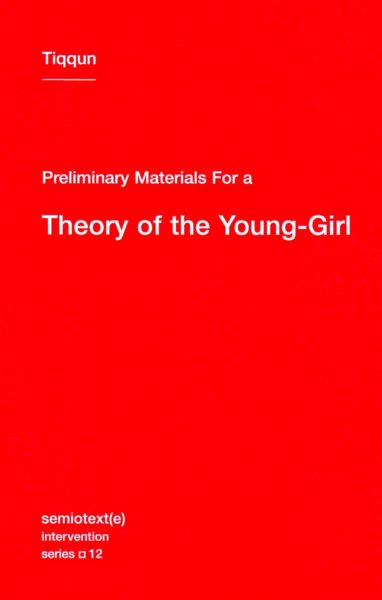 Tiqqun Preliminary Materials for a Theory of the Young-Girl
Semiotext(e)
‘First published in France in 1999, Preliminary Materials for a Theory of the Young-Girl dissects the impossibility of love under Empire. The Young-Girl is consumer society’s total product and model citizen: whatever “type” of Young-Girl she may embody, whether by whim or concerted performance, she can only seduce by consuming. Filled with the language of French women’s magazines, rooted in Proust’s figure of Albertine and the amusing misery of (teenage) romance in Witold Gombrowicz’s Ferdydurke, and informed by Pierre Klossowski’s notion of “living currency” and libidinal economy, Preliminary Materials for a Theory of the Young-Girl diagnoses—and makes visible—a phenomenon that is so ubiquitous as to have become transparent.’ — Semiotext(e)
Excerpt
III
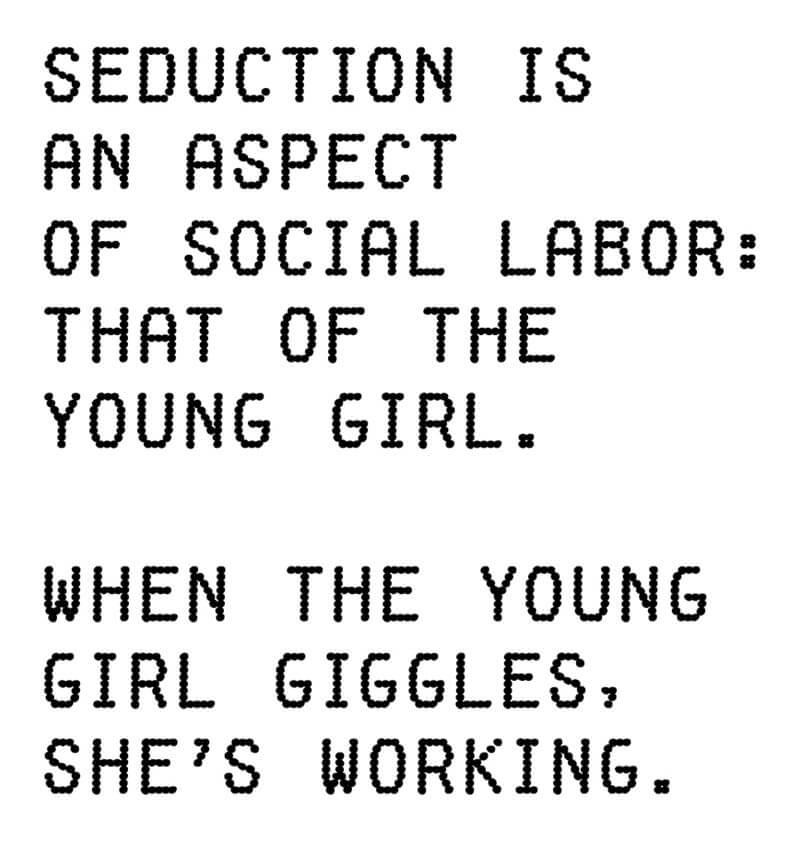
Listen: The Young-Girl is explicitly not a gendered concept. A hip-hop nightclub player is no less a Young-Girl than a beurette tarted up like a porn star. The resplendent corporate-advertising retiree who divides his leisure between the Cote d’Azur and his Paris offices, where he still likes to keep an eye on things, is no less a Young-Girl than the urban single lady too obsessed with her consulting career to notice she’s lost fifteen years of her life to it. And how could we account for the secret rapport between ultratrendy musclebound Marais homos and the Americanized petite bourgeoisie happily installed in the suburbs with their plastic families, if the Young-Girl were a gendered concept?
In reality, the Young-Girl is simply the model citizen as redefined by consumer society since World War I, in explicit response to revolutionary menace. As such, the Young-Girl is a polar figure, orienting, rather than dominating, outcomes.
At the beginning of the 1920s, capitalism realized that it could no longer maintain itself as the exploitation of human labor if it could not also colonize everything that is beyond the strict sphere of production. Faced with socialist menace, capital too would have to socialize. It had to create its own culture, its own leisure, medicine, urbanism, sentimental education, and mores, as well as a disposition toward their perpetual renewal. This was the Fordist compromise, the Welfare-State, family planning: social democratic capitalism. Under a somewhat limited submission to labor, since workers still distinguished themselves from their own work, we today substitute integration with subjective and existential conformity, which is to say, fundamentally, with consumption.
The formal domination of Capital has become more and more real. Consumer society has come to seek out its best supports from among the marginalized elements of traditional society—women and youth first, followed by homosexuals and immigrants.
To those who were minorities yesterday, and who had therefore been the most foreign, the most spontaneously hostile to consumer society, not having yet been bent to the dominant norms of integration, this gives an air of emancipation. “Young people and their mothers,” recognized Stuart Ewen, “had been the social principles of the consumer ethic.” Young people, because adolescence is the “period of time with none but a consumptive relation to civil society” (Stuart Ewen, Captains of Consciousness). And women, because it is the sphere of reproduction, over which they still reign and which must be colonized. Hypostasized Youth and Femininity, abstracted and recoded into Youthitude and Femininitude, find themselves elevated to the rank of ideal regulators of the integration of the Imperial citizenry. The figure of the Young-Girl combines these two determinations into one immediate, spontaneous, and perfectly desirable unit.
The tomboy would come to impose herself as a modernity more stunning than all the stars and starlets that so rapidly invaded the globalized imaginary. Albertine, encountered on the seawall of a resort town, arrives to infuse her casual and pansexual vitality into the crumbling universe of Marcel Proust’s In Search of Lost Time. The schoolgirl reigns down the law in Witold Gombrowicz’s Ferdydurke. A new figure of authority is born and she outclasses them all.
IV
At the present hour, humanity, by now reformatted into the Spectacle and biopolitically neutralized, still thinks it’s fooling someone, calling itself “citizen.” Women’s magazines breathe new life into a nearly hundred-year-old wrong by finally offering their equivalent to males. All the old figures of patriarchal authority, from statesmen to bosses to cops, have become Young-Girlified, every last one of them, even the pope.
V
The theory of the Young-Girl does not simply emerge fortuitously at the very moment that the genesis of the imperial order is complete and begins to be apprehended as such. Whatever emerges to the light of day is nearing the end of its term. In its turn the Young-Girl party will have to break up.
As we see, the very moment that the evidence of the Young-Girl attains the force of a cliché, the Young-Girl has already overcome it, at least in her primitive aspect of obscenely sophisticated mass production. It is into this juncture of critical transition that we throw our monkey wrench.
VI
Aside from speaking improperly—which could well be our intention—the jumble of fragments that follows does not in any way constitute a theory. These are materials accumulated by chance encounter, by frequenting and observing Young-Girls: pearls excerpted from their magazines, expressions gleaned out of order under sometimes doubtful circumstances. They are assembled here under approximate rubrics, just as they were published in Tiqqun 1; there was no doubt they needed to be put in order a little. The choice to expose these elements in all their incompleteness, in their contingent original state, in their ordinary excess, knowing that if polished, hollowed out, and given a good trim they might together constitute an altogether presentable doctrine, we have chosen—just this once—trash theory. The cardinal ruse of theoreticians resides, generally, in the presentation of the result of their deliberations such that the process of deliberation is no longer apparent. We wager that, faced with Bloomesque fragmentation of attention, this ruse no longer works. We have chosen a different one. Among these scattered things, spirits attracted to moral comfort or vice in need of condemning will find only roads that lead nowhere. Our task is less a matter of converting Young-Girls than to tracing all of the dark corners of the fractalized face of Young-Girlization. And to furnish arms for a struggle, step-by-step, blow-by-blow, wherever you may find yourself.
*
p.s. Hey. ** Nik, Hey, Nik, good to see you! Thanks for the b’day greetings. Oh, Roussel, dreamy. And thanks for the TV series hopes. Yeah, 4+ years ago when we proposed it, it was such a cool project, but it’s been mostly an albatross for most of the time since, and I’m hoping for the green light largely so I didn’t just waste all those years and work for nothing. That’s a bit sour. We’ll see. Oh, fence, very cool. I think Lynne Tillman used to be heavily involved in fence, if I’m remembering correctly. How are they? I mean to work with? Congrats, man! Awesome week to you! ** David Ehrenstein, Hi. Yes, we’ve been in touch through ‘the post’ about your post. I’ve never met Carax, but Gisele knows him fairly well. She says he’s cool, complicated but cool. Hopefully I’ll get to meet him at some point. ** Nicki Smith, Thank you, dear Nicki! All the very, very, very best to you! Love, me. ** Bernard, Hi. Paris is missable up the wazoo. Winter’s great here. The architecture and lights and so on really agree with cold weather and gray skies. Recommended. Uh, hm, well, I guess if those Poets and Critics people write to me, I’ll believe it. They sure have a standoffish way of being friendly, I’ll say that. But, yeah, cool. God knows that New York School poetry is a map to heaven on earth for me. You finally got that wtf thing re: the gays, eh? I’ve had that since I was about 13 years old. Oh, nice, the video, I’ll watch it asap. Cool. Everyone, The mighty Bernard Welt … well, I’ll let him explain: ‘Did you know I used to teach Birth of Cinema, 1895-1927? (It started with a great Muybridge show we did at the museum.) You may have seen a great documentary called Film Before Film, just a video record of everything in one German guy’s “archaic” or “proto-” cinema collection. I put a short excerpt up at YouTube for my class, which is still up here.’ I’m about to be all over that, and I recommend you take the same approach. I hope the Oregon things goes well. Well, of course it will. See you again soon, I hope. ** generator5, Hey, g! Oh, cool, I’m glad. Lovely LA. I do miss it. I’m with you on the exciting portents front, against all odds. Take care. ** Wolf, Thanks for that, Wolfster! Oh, wow, cool you made a Spotify list of my faves. That should be a weird or something listening experience, or I don’t know. No, I semi-pretended my birthday was any other day apart from breaking my vegan routine long enough to down some nachos that made my stomach pay for them. My weekend? Last fiddling work on the fucking TV script mostly. A meeting. Pretty quiet. The metro has started barely working again, and it was actually kind of exciting to ride the 8 line again even if I had to wait 20 minutes for the train to arrive. I think Kiefer is considered cool enough. I just personally can’t stand his stuff, but I think most people are in awe of it and all that. I like your resolution. I forgot to make one. I hope my playlist made Sunday at least interestingly weird or something. Bunch of love! ** Conrad, Hi, Conrad! Oh, my pleasure. I’m really glad you got to see ‘Daisies’ through the post. I think the gallery thing is just about to be announced. It’s a two person thing, some of my gif novels and also paintings by some artist. It’ll be at Balice Hertling Gallery, opens on January 23 and runs through February 29. Yes, Patric’s film opens in … March, I think? It’s premiering at the Berlin Film Festival, which is pretty cool. Really nice to see you! Thanks! ** _Black_Acrylic, Yeah, it’s even possible to forget that Collishaw was a YBA. I’m very wary of ‘Uncut Gems’. I really, really didn’t like their last film ‘Good Time’. So I don’t know. Glad it was something you dug in any case. Pleasure is good. ** Steve Erickson, Hi. That makes total sense about your anxiety source and its current quelling. Good news. And how terrific about your list. I’ll hit it today. Everyone, Mr. Steve Erickson with an awesome offer: ‘Late last night, I made a list of the Iranian films which are available to stream for free with English subtitles on YouTube and rarefilmm.com. It’s up here.’ ** Misanthrope, For one’s novel to get any visibility or traction in the US requires a publisher that promotes it by sending it to reviewers and talking it up and maybe announcing it in ads or whatever. A French publisher would no clue how to go about doing that in US. I had something of that problem with ‘My Loose Thread’, which published by Canongate, which was, at that point, just a Scottish publisher with the barest footprint in the US, and so that novel ended up barely existing as far as the US goes, which sucked since I think its one of my best. So that’s why a US publisher is needed. Don’t project into the future about your novel. You can’t know. You’ll end up just playing with your fears. ** Bill, Hi. Yeah, the gateau one is wild. Really, I’m mentioned in that book? Huh. I only went to the piers once when Tim Dlugos took me there. He went off and did what one did there, and I just wandered around and looked at the graffiti until I got bored. Big up on your return to laptop-dom. Although, yes, temporary ignorance can be bliss for sure. ** Okay. I spotlight an interesting book today. Check it out. See you tomorrow.



 Now available in North America