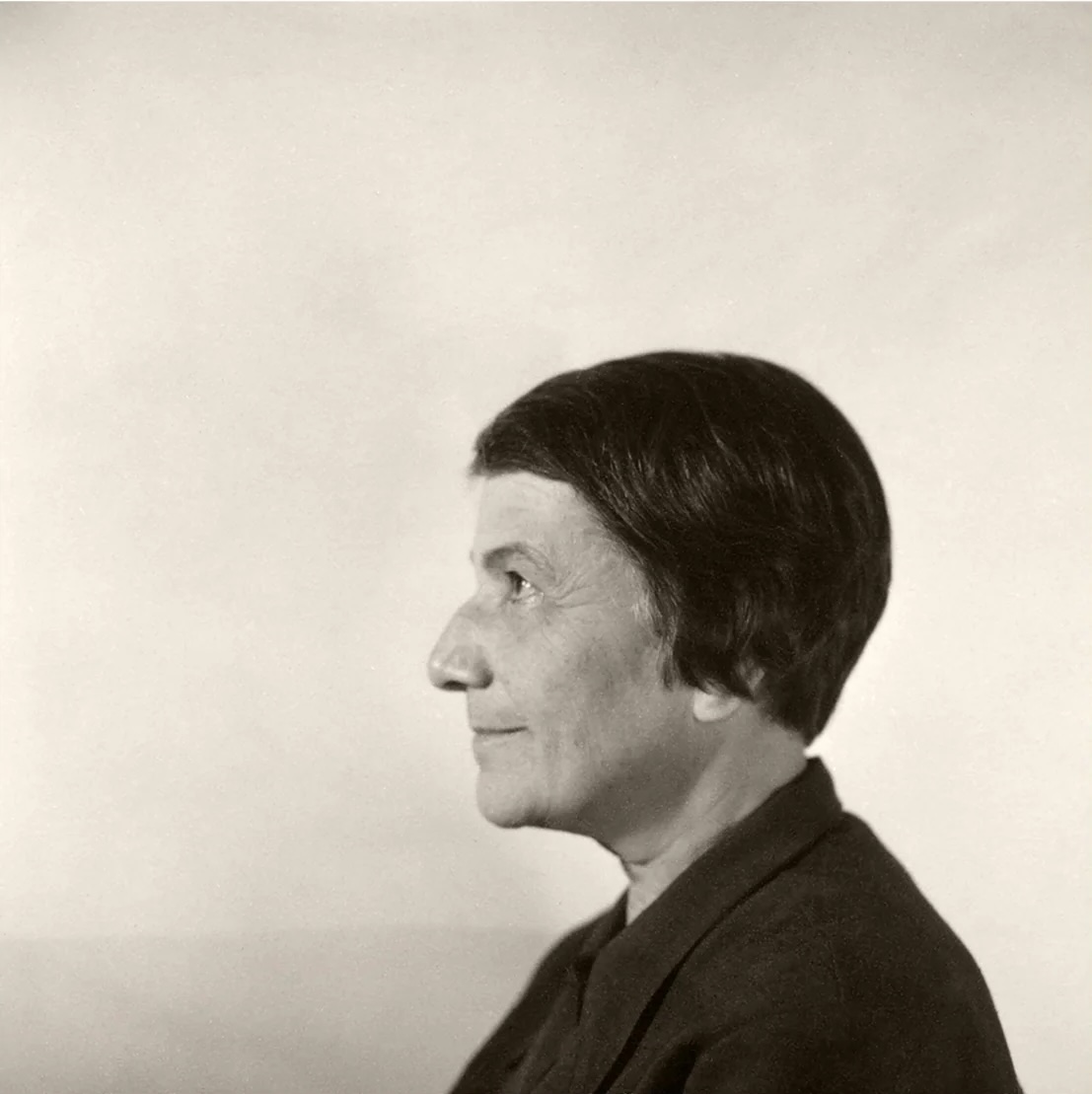
‘Sarraute’s fourth novel takes us back to the no plot, unnamed characters of her earlier novels. In this novel, there is not even a central narrator. Various people talk. The plot, such as it is, concerns a novel called, of course, Les Fruits d’or (The Golden Fruits). We know little about this book, as regards its author and contents, except that it is a novel by someone called Bréhier. What we do know is how it is received and this changing reception over a period of time. Sarraute takes a group of unnamed people, who comment on the novel. Not only does she satirise their attitudes, they have different views of what the work is, so that we are unable to determine what it really is about. At one point eighteen different people, who are not named and impossible to identify, give their differing views on the novel but their views tend to the vague – it’s funny, it’s a great work of fiction – without actually why it is great or, indeed, what it is about. Of course, there is little basis for their views, except to show how smart they are. When the novel becomes popular, these same critics turn on the author who clearly stole his ideas and that his work is certainly not ground-breaking. And then it is forgotten. Despite the disembodied voices it works well both as a satire on critics as well as a fascinating approach with a book as the hero.’ — The Modern Novel
‘When Nathalie Sarraute published her first novel, Portrait of a Man Unknown, in 1948, Sartre, in an Introduction, placed her with such authors of “entirely negative works” as Nabokov, Evelyn Waugh, and the Gide of Les Faux-Monnayeurs, and called the whole genre “anti-novel.” In the Fifties, the anti-novel became the New Novel and Sarraute its originator. All these classifications are somewhat artificial and, if applied to Mme. Sarraute, difficult to account for. She has herself pointed out her ancestors, Dostoevsky (especially the Notes from Underground) and Kafka in whom she sees Dostoevsky’s legitimate heir. But this much is true: She wrote at least her first pair of novels, the Portrait and Martereau (1953), against the assumptions of the classical novel of the nineteenth century, where author and reader move in a common world of well-known entities and where easily identifiable characters can be understood through the qualities and possessions bestowed upon them. “Since then,” she writes in her book of essays, The Age of Suspicion, “[this character] has lost everything; his ancestors, his carefully built house, filled from cellar to garret with a variety of objects, down to the tiniest gewgaw, his sources of income and his estates, his clothes, his body, his face…his personality and, frequently, even his name.” Man as such is or has become unknown so that it matters little to the novelist whom he chooses as his “hero” and less into what kind of surrounding he puts him. And since “the character occupied the place of honor between reader and novelist,” since he was “the object of their common devotion,” this arbitrariness of choice indicates a serious break-down in communication.
‘In order to recover some of this lost common ground, Nathalie Sarraute very ingeniously took the nineteenth-century novel, supposedly the common cultural heritage of author and reader, as her point of departure and began by choosing her “characters” from this richly populated world. She fished them right out of Balzac and Stendhal, stripped them of all those secondary qualities—customs, morals, possessions—by which they could be dated, and retained only those bare essentials by which we remember them: avarice—the stingy father living with his homely, penny-pinching spinster daughter, the plot turning about her numerous illnesses, fancied or real, as in Portrait; hatred and boredom—the closely-knit family unit which still survives in France, the “dark entirely closed world” of mother, father, daughter, and nephew in Martereau, where the plot turns about the “stranger” who swindles the father out of the money he had wanted to save from the income tax collector; even the hero of the later work, The Planetarium, personified ambition (the plot is a familiar one describing his ruthless “rise in social space”).
‘Sarraute has cracked open the “smooth and hard” surface of these traditional characters (“nothing but well-made dolls”) in order to discover the endless vibrations of moods and sentiments which, though hardly perceptible in the macrocosm of the outward world, are like the tremors of a never-ending series of earthquakes in the microcosm of the self. This inner life—what she calls “the psychological”—is no less hidden from “the surface world” of appearances than the physiological life process that goes on in the inner organs beneath the skin of bodily appearance. Neither shows itself of its own accord. And just as the physiological process announces itself naturally only through the symptoms of a disease (the tiny pimple, to use her own image, which is the sign of the plague), but needs a special instrument—the surgical knife or X rays—to become visible, so these psychological movements cause the outbreak of symptoms only in case of great disaster and need the novelist’s magnifying lenses of suspicion to be explored. To choose the intimacy of family life, this “semidarkness” behind closed curtains with its Strindbergian overtones, as a laboratory for this kind of psychological vivi-section, instead of the couch, was a sheer stroke of genius, for here “the fluctuating frontier that [ordinarily] separates conversation from sub-conversation” breaks down most frequently so that the inner life of the self can explode onto the surface in what is commonly called “scenes.” No doubt these scenes are the only distraction in the infinite boredom of a world entirely bent upon itself, and yet they also constitute the life-beat of a hell in which we are condemned to going “eternally round and round,” where all appearances are penetrated but no firm ground is ever reached. Behind the lies and the pretenses, there is nothing but the vibrations of an ever-present irritation—a “chaos in which a thousand possibilities clash,” a morass where every step makes you sink deeper into perdition.’ — Hannah Arendt
______
Further
Nathalie Sarraute @ Wikipedia
Novel and Reality: A Lecture by Nathalie Sarraute
‘The Golden Fruits’ @ goodreads
Books: Mayhem & Manners
Being Beside One’s Self
Drawing on the Work of Nathalie Sarraute
Sarraute, Nathalie (Vol. 4)
The relationship between Artistic Time and Space in Natalie Sarraute’s “Golden Fruits”
A Conversation With Nathalie Sarraute
LES FRUITS D’OR EST UN ROMAN EMBLÉMATIQUE ET FASCINANT
‘The Golden Fruits’ @ Internet Archive
‘The Golden Fruits’ @ Anna’s Archive
_____
Extras
Nathalie Sarraute “The text is always between life and death”
Nathalie Sarraute et le Nouveau roman en 1969
Un siècle d’écrivains N.SARRAUTE
________
Interview
from Exquisite Corpse
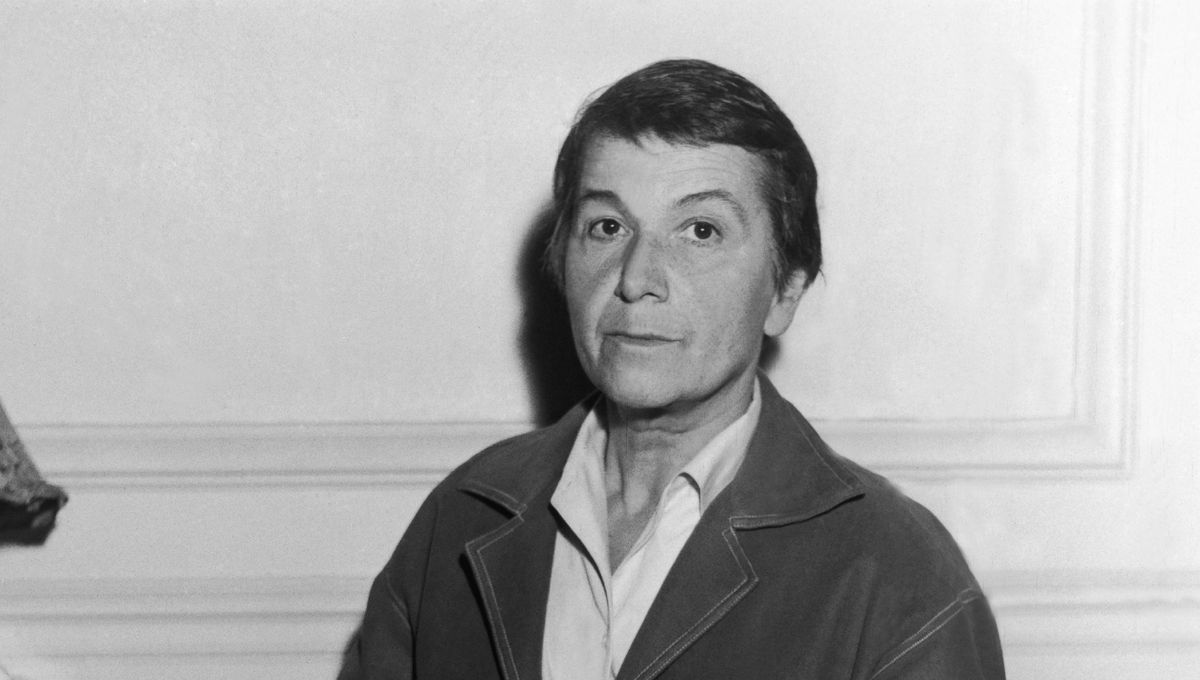
Do you see any sort of difference between women’s writing and that of men?
No, I don’t see any. I don’t feel that Emily Brontë is a woman’s writing, among women who truly wrote well. I don’t see the difference. One says first of all, “That’s what it is to be a woman,” and then after one decides that is feminine. Henry James was always working in the minute details, in his lacework; or Proust, much more still than most women. I think that if women like Emily Brontë wanted to keep a pseudonym, they were entirely right. One cannot find a manner of writing upon which it would be possible to stick the label of feminine or masculine; it’s writing pure and simple, an admirable writing, that’s all. There are subjects in writing that are very feminine, which are lived, the women who write on feminine subjects like maternity, that’s completely different.
Let’s talk about cigarettes. Have you always been a smoker?
Alas! I shouldn’t smoke, but I don’t smoke a lot. Six or seven cigarettes a day. That’s still too much. I have a very bad habit. So, in order not to smoke, I’ve taken to holding the cigarette in my mouth while I work. I don’t light it. That gives me the same effect. Because I forget. I feel something and I forget if it’s lit. Since I smoke very weak cigarettes, and I don’t swallow the smoke, I have just as much the impression of smoking even if it’s not for real.
As if it enters into the game, in effect.
That’s right. It’s a gesture, something one feels.
Could we speak about the conception of some of your books? The Golden Fruits (1963), for example, did that come out of an experience with the literary world?
Not at all. I take no part in the literary world, I’ve never gone to the literary cocktail parties. It has to do with an inner experience. It has to do with a kind of terrorism around a work of art that is lauded to the skies and which we cannot approach. Where there is a sort of curtain of stipulated opinions that separates you from that work. Either we adore it or else we detest it, it’s impossible to approach it; above all in the Parisian milieu, even without going to the cocktail parties, even in the press, there reigns a kind of terrorism of general adulation, and you don’t have the right to approach it and have a contrary opinion. And then it falls; at that moment you no longer have the right to say that it’s good. That’s what I wanted to show, this life of a work of art. And this work of art, what is it? I’d have to approach it, but that’s impossible. And then all that we find there, all that we look for in a book, and which has nothing to do with its literary value.
There is often a multitude of voices in that book.
It’s like that in most of my books that come later. There are all these voices, without our needing to take an interest in the characters that speak them. It doesn’t much matter.
Have there been processes that repeat themselves, either in the conception or in the elaboration of the novels?
Each time it didn’t interest me to continue doing the same thing. So, I would try to extend my domain to areas that were always at the same level of these interior movements, to go into regions where I hadn’t yet gone.
Have you ever been surprised by the fate of one of your books?
No. I was more pessimistic at the start. I really thought that it would not be at all understood.
You’ve said that the nouveau roman movement helped you as a means to get read. But did the idea of belonging to a movement, so-called, constrain you as well?
No. And none of those who belonged, who were classed in this movement, have written things that resemble each other, whatever it may be. They’ve remained completely different from each other, and have continued each one in his own path.
Your essays were among the first to speak of concerns common to the group. Have you ever felt any sort of responsibility to this movement?
Not at all. I had reflected upon these questions about the novel before the others, because the others were twenty years younger than me. I haven’t changed my way of thinking since my first books, I haven’t budged. I could repeat exactly the same things I said when I wrote The Age of Suspicion. It is a deep conviction that the forms of the novel must change, that it’s necessary there be a continual transformation of the forms, in all the arts—in painting, in music, in poetry, and in the novel. That we cannot return to the forms of the nineteenth century and set another society in them, it doesn’t matter which. So, that interested Alain Robbe-Grillet; he’s the one who did a lot to launch the nouveau roman. He was working at Les Editions de Minuit, he wanted to republish Tropisms, which had been out of print. It came out at the same time as Jealousy, and at that moment in Le Monde a critic had written, “That is what we can call the nouveau roman,” though he detested it. It was a name that suited Robbe-Grillet quite well. He said, “That’s magnificent, it’s what we needed.” He wanted to launch a movement. Me, I’m incapable of launching a movement; I’ve always been very solitary.
Were there ever any meetings of the group?
Never. Nor discussions. It had nothing in common with the surrealists, where there was a group, a leader, André Breton, nothing of the kind. We never saw each other.
How did he find all the writers to bring them together as a movement?
It was Les Editions de Minuit. Robbe-Grillet found Michel Butor, who had written Passage de Milan, which they published. He found Claude Simon. Robert Pinget as well. Robbe-Grillet and Jérôme Lindon, who is the director of Les Editions de Minuit, they worked together. Like that they formed a sort of group.
Have there been other experimental literary movements that have interested you?
No, I passed them by entirely. The surrealist movement, for example, that might have interested me, but it didn’t at all.
What about the Oulipo movement in the 1960s, which included Georges Perec, Raymond Queneau, Italo Calvino?
I liked what Queneau was doing a lot. My first book, Tropisms, appeared in the same collection as his book, The Bark Tree, with the publisher Robert Denoël. I quite liked The Bark Tree.
In Between Life and Death (1968), your novel on literary creation, you say that no work is useless, that sooner or later it must give fruit, that it suffices to pick it up again later at the right moment. Have you had that experience, of reworking a text you’d written?
No. I meant that every effort we make always serves for something, all the same. There are certain texts that were projected for Tropisms that I brought out later in Portrait of a Man Unknown.
Which of your books do you prefer?
That’s very difficult to say. I don’t reread them. And sometimes I tell myself, “But it seems to me I’ve already done something like that,” and I can’t recall where.
Has one of the books satisfied you more than the others?
It’s all very difficult. There are always doubts, in regard to what I wanted to do.
Even the doubts, have they played a constructive role sometimes?
I don’t know. I think it’s very painful, and that it’s better not to have any. I envy those who don’t have any, I envy them a lot. They are happy people.
___
Book
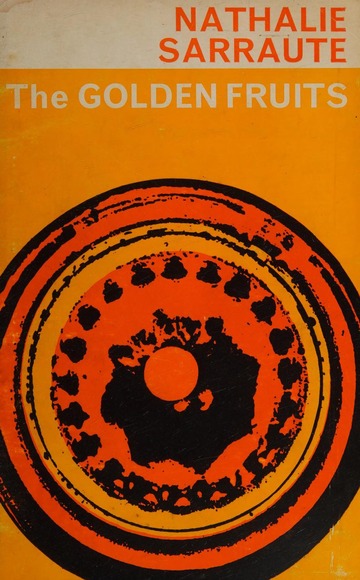 Nathalie Sarraute The Golden Fruits
Braziller
‘A novel about a new novel and its rites of initiation into the self-hallowed circles of the French literati. Recently published, The Golden Fruits must qualify for the waves of adulation, blind devotion and occasional heretical dissent that constitute the book-worship of a self-styled literary in-group. Not that the novel is the protagonist struggling to assert its worth in this high-spun story–it hasn’t the chance, as the literary vultures make it their own symbolic property, coveting the office of leading critic, whose judgment has only to be well-received by the group to be considered right and “”brilliant””. As the idol of the moment, the book rises and falls in the fluid esteem of its believers as, and all “”humble nostalgics”” must be crushed, perhaps just another novel, another faulty imitation of things past. The social struggle to be the one who really understands the “”imponderables, iridescences, and irisations”” in the novel becomes a satiric comment on literary values. In the end only one loner stands by the fallen God, claiming a resurrection in time and faddism. Mme. Sarraute, member of the French avant-garde, has created a brilliant contrapuntal exercise in conversation, judgment, and social uncertainty– and perhaps a slice at “”Littrachure”” itself. She has now to stand for the same critical nonsense she has so well exposed.’ — Kirkus Reviews
______
Excerpt
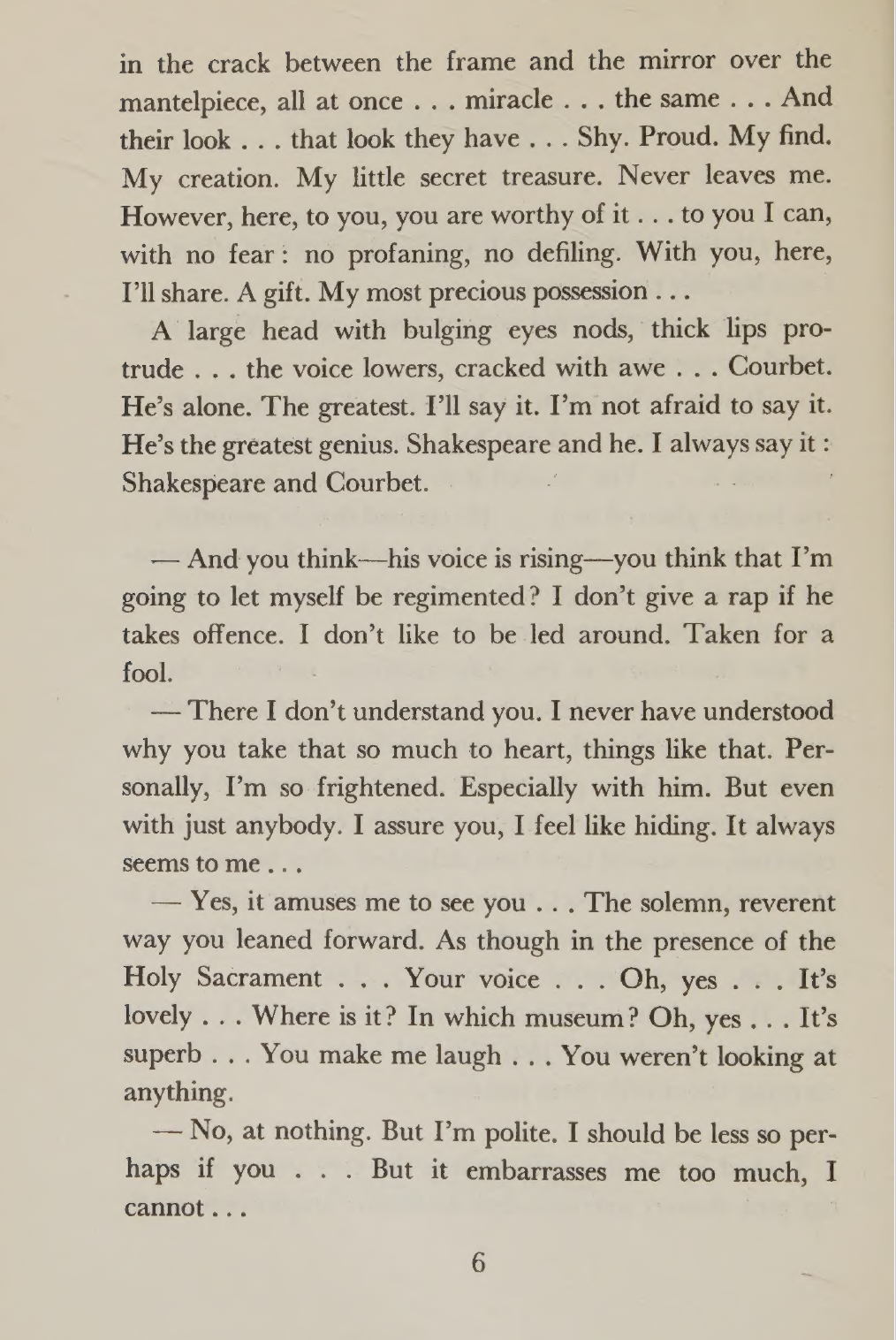
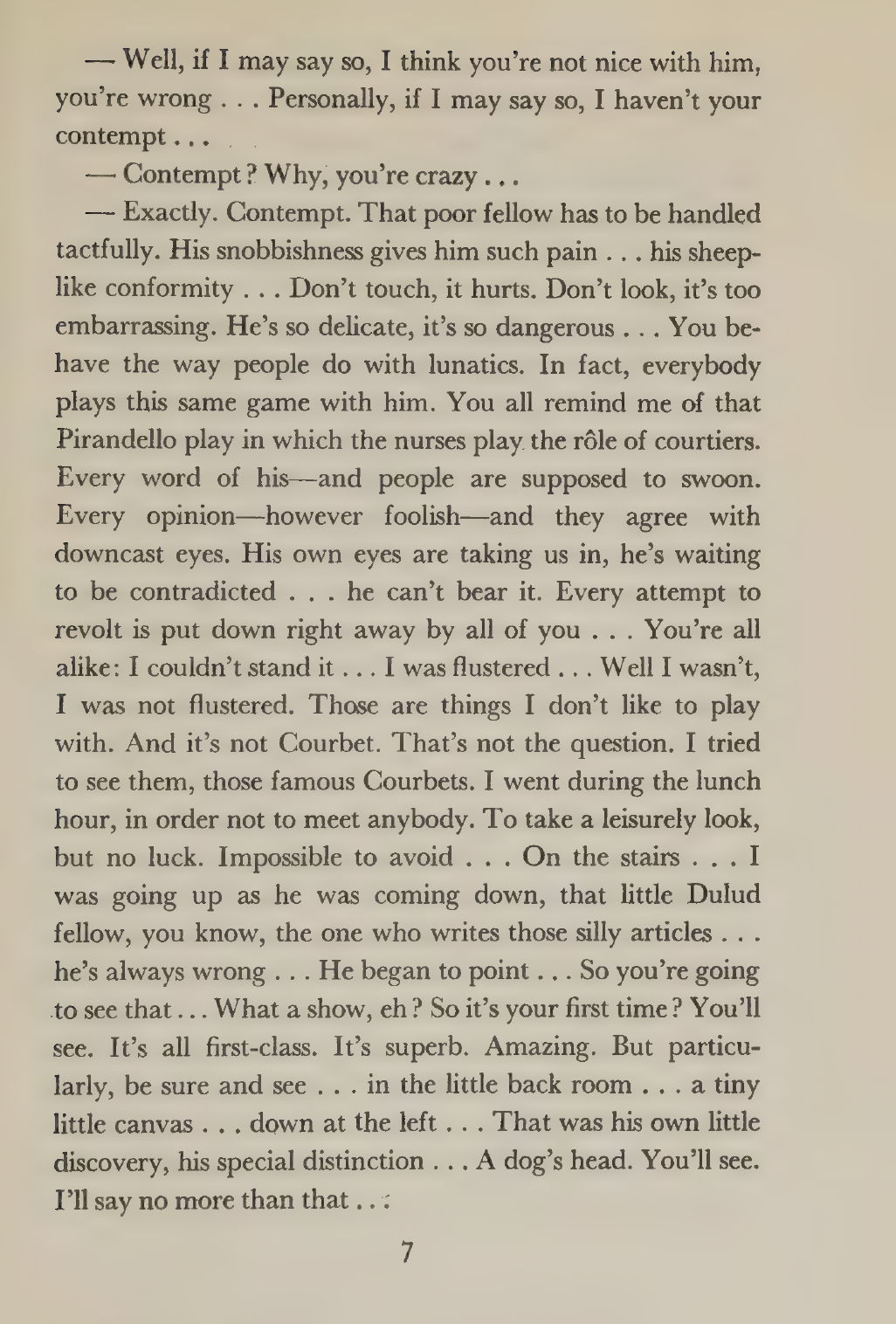
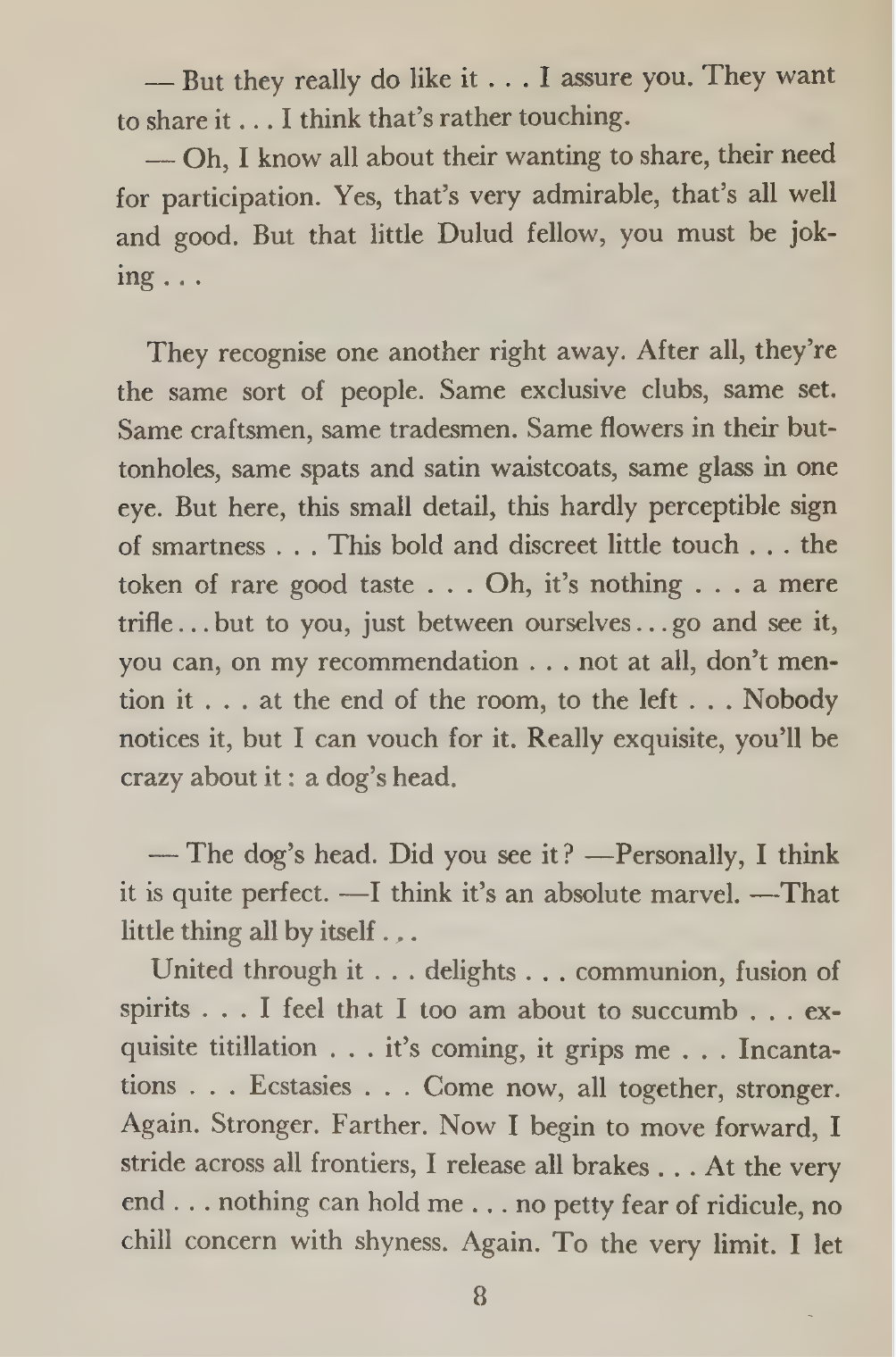
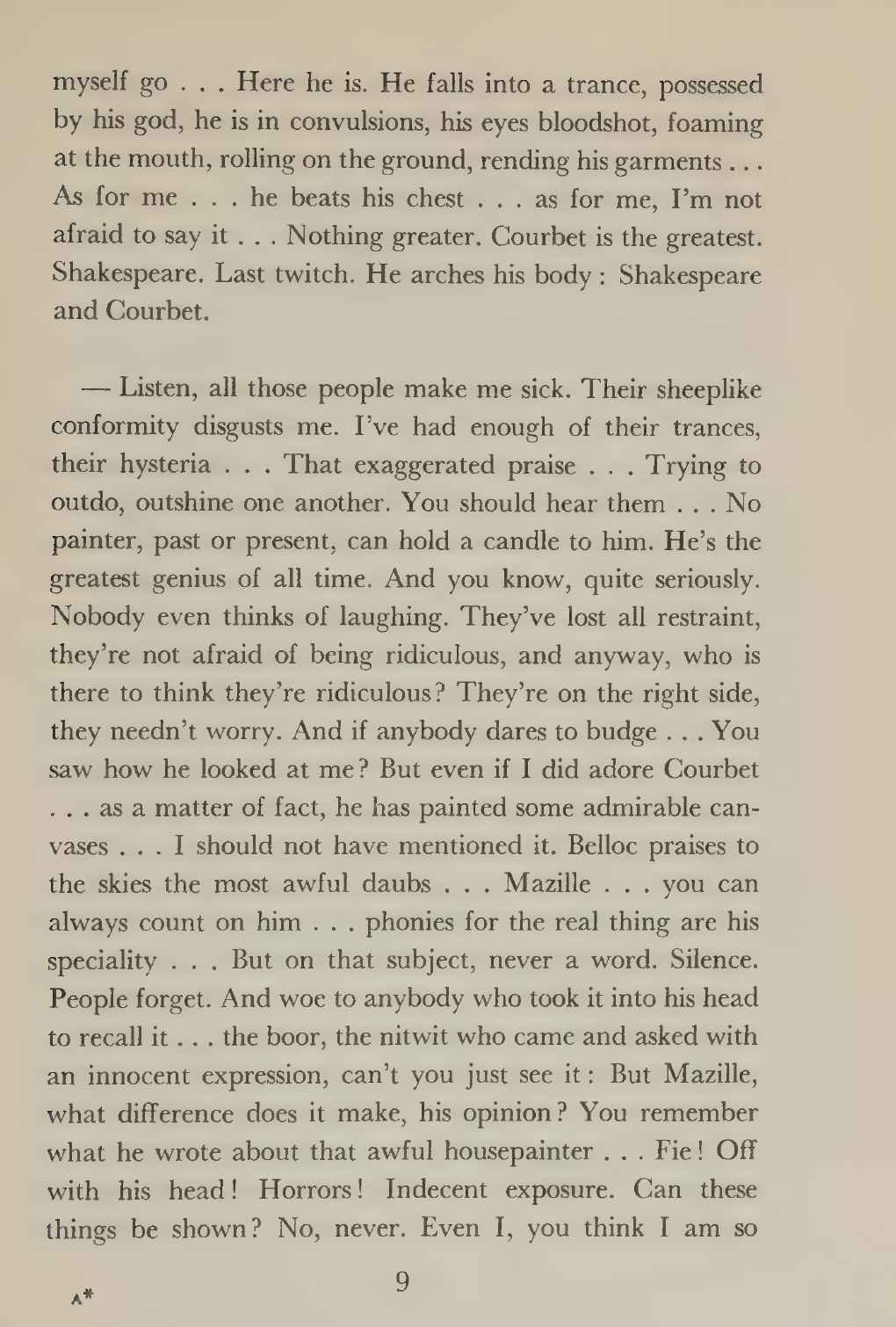
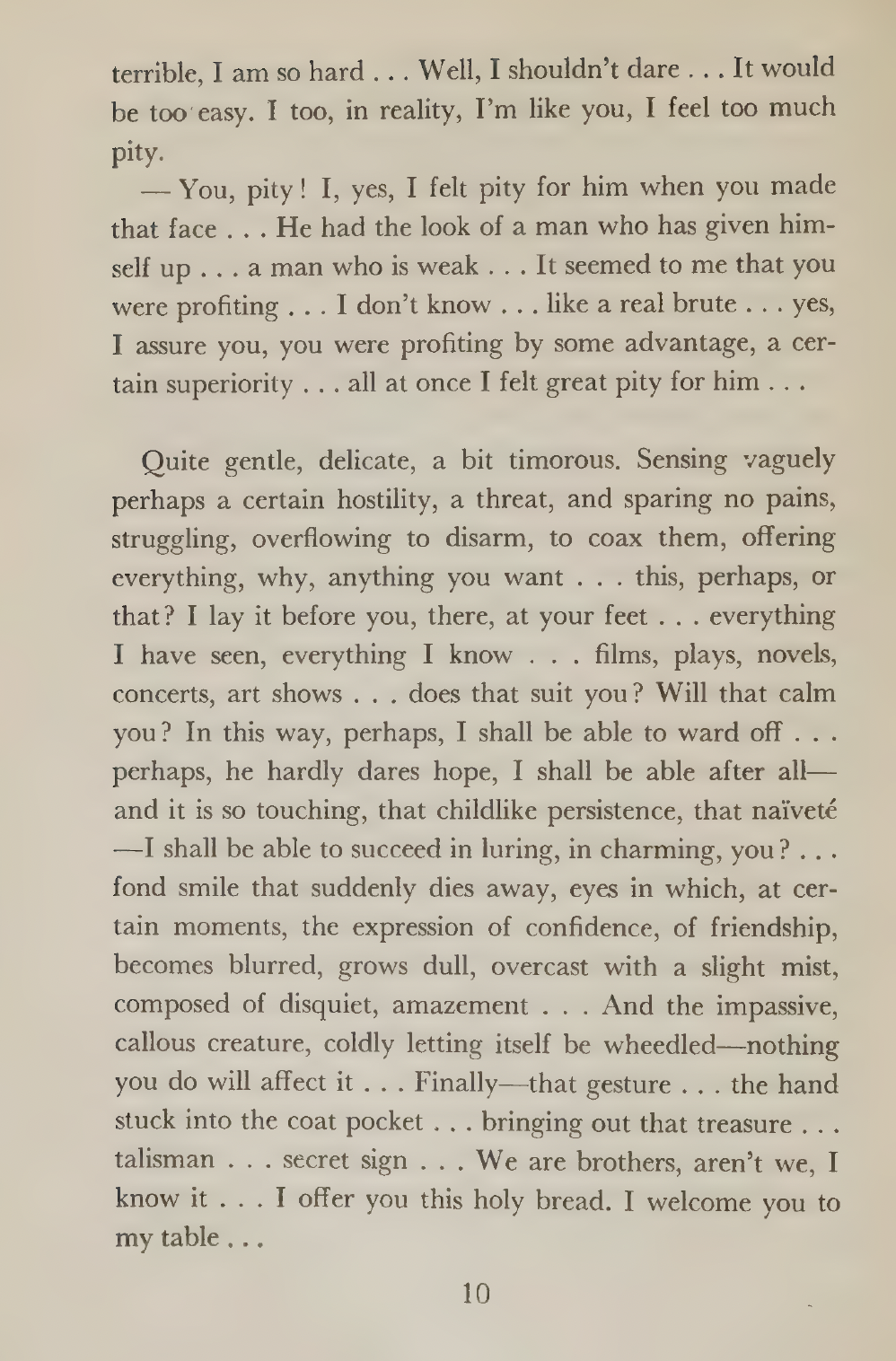
*
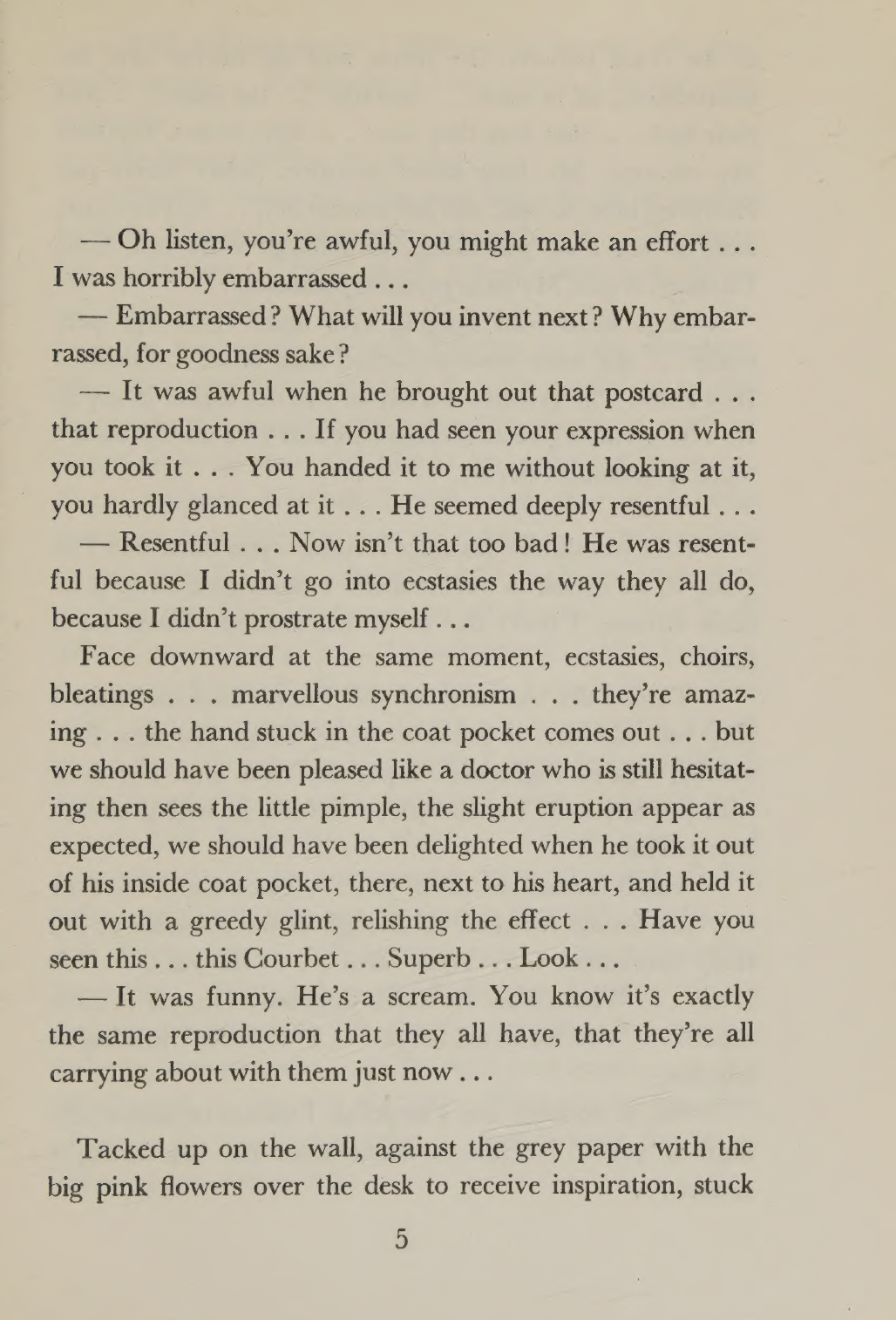
p.s. Hey. ** jay. Hi, jay. Thanks. I really liked seeing how many degrees by which a representation of someone can be inaccurate. I’m good, you too, I trust. ** _Black_Acrylic, Worth a trip to Vegas, for sure. ** Bernard Welt, ‘Z’ is quite powerful. I’d forgotten how brutal it is. I haven’t seen ‘Peter Hujar’s Day’ yet. Its theater time here was a blip, so I’m waiting for a stream that works over here. I’m not envious, strangely enough. The only thing I remember about ‘Caligula’ is the spa/baths scene. The baths scene in ‘Satyricon’ its pretty great too. ** Carsten, The anti-fascism in ‘Z’ makes the anti-fascism in ‘OBAA’ seem quite non-overt. We seem to be inured against storms here in mid-country Paris. I can’t remember us ever having one that qualifies as a storm. Growing up in LA with earthquakes and fires and so on, it’s interesting to live in a city that seems immune to natural calamities, other than the Seine overflowing maybe once every couple of decades. Guest-post will be most welcome whenever your time permits. ** Måns BT, Hi, Måns! Yes, indeed. I’ve been up to this and that and, as usual, lots of organizing ‘RT’ screenings, which will continue to swamp my days for another few months. I’m actually going to write to the Zita people today and try to get them to confirm that March date. We might be able to host a screening in Copenhagen if it’s around that time, so I hope I can get a confirmation. No, I don’t know Elis Monteverde Burrau. I’ll look for anything by him in English. I just looked him up, and I guess he’s an actor too? Sure, great if he wanted to be part of the Q&A. Thanks so much, pal. What are you up to these days? xo. ** Steve, Jedward were more -10s era. I think they had some pop hits. Here they are performing at Eurovision in 2011. It’s worth the look. I think they should’ve won haha. I’ve read about ‘The Blue Elephant’. Ok, I’ll pursue, thanks. ** darbz (⊙ _ ⊙ ), I’ve certainly been known to misconstrue. Misconstruing makes life interesting? Oh, ok, gotcha about your mom and the rich people. There’s this artist Sophie Calle who pretended to be a maid and took photos of rich people’s private stuff and exhibited them and got pretty famous. I’m not sure how she got away with it. Urgh, about the court date. There’s a cool video art piece by Bruce and Norman Yonemoto where the great artist Mike Kelley plays the ‘Kappa’. Here’s a piece of it. Never seen a statue of myself, no. Too bad there’s not a transgressive writers wax museum. ** Hugo, Hey, Hugo. Wow, thanks for watching ‘PGL’. It is funny. We wanted the humor to be kind of hidden in the general dark, sincere tone so people would have to find it. But if you read the script, it reads almost like a comedy. Anyway, thank you kindly, sir. Well, I’d certainly be interested to read that graphic novel if that’s any incentive. That does seem like a really good idea. All the best to you too! ** HaRpEr //, Fingers very crossed (about the TV possibility among other things). The definitive MJ depiction definitely has yet to be realised. Knausgaard is kind of Hemingway type, it’s true. There’s this writer I know who has recently gone to the dark Alt Right side who did this post on social media the other day where he was raving about that new Knausgaard novel and concluded with the statement ‘Could it be that the time of the straight white heterosexual writer has finally arrived?’ Like, whoa, as opposed to how it’s been in the past 15 centuries? ** Steeqhen, I had a short period of being kind of fascinated by Jedward. They were so insanely eager to please. Well, I’m glad you’re not stressed about going to work. Maybe the job structure and preoccupation will dispel the demons? ** Nicholas., Hey, big N! How’s it? My birthday passed with barely a mark left, which is how I like it. But thank you. When’s yours? Take care, buddy. ** Uday, I think it’s safe to say that will be EJ’s only appearance on this blog unless some guest-poster sneaks him in. Actually, I’ve seen every Gregg Araki film except for the last couple. He wanted me to play a role in one of his films, but I was too shy. And not just in movies for sure. ** Okay. I’ve been wanting to throw a spotlight on the book above for years because it’s one of my favorite novels and my favorite by the great Sarraute. But there was nothing online about it, and it was too o.o.p./pricey to afford. But I checked again the other day, and it’s now downloadable from Anna’s Archive and Internet Archive, so you could get it if you want, and I can/could finally turn on my spotlight. See you tomorrow.
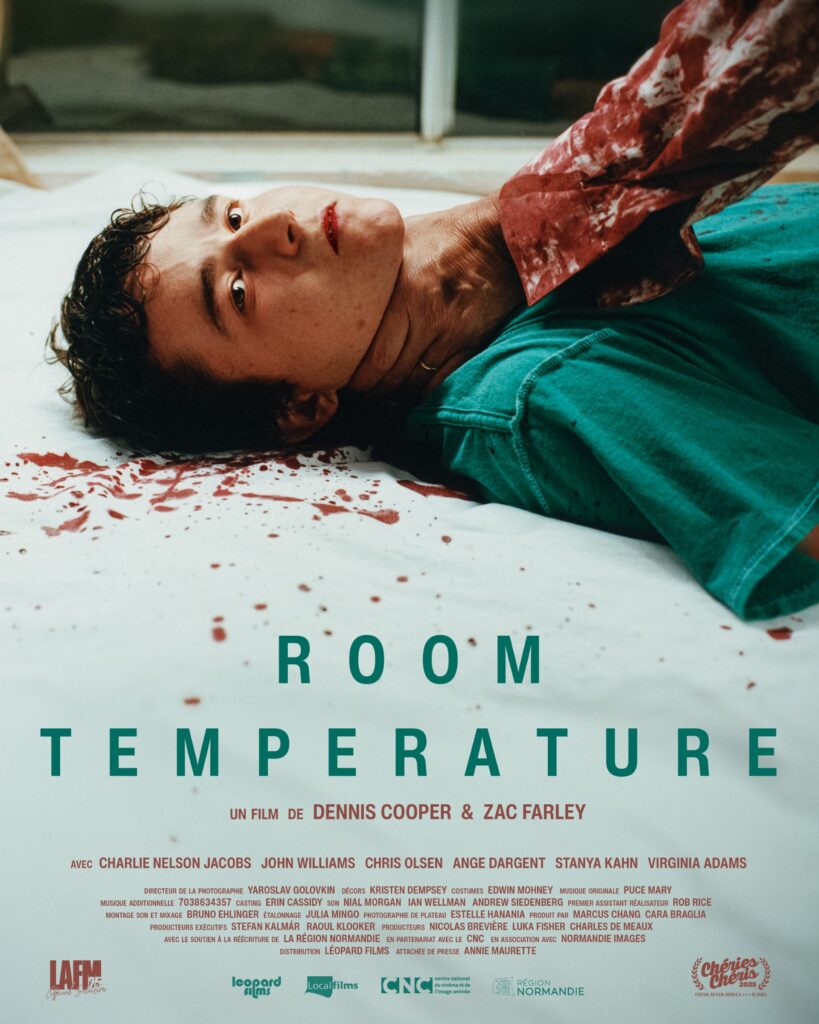


 Now available in North America
My YNY colleague Morgan is seeing room temperature tonight in Seattle and she is very much looking forward to it!
Nathalie Sarraute Is a new name for me and there is a lot to admire her for. Got to admire how pared-back to the verge of nothingness her writing is here.
Last night I saw this Netflix doc about the 1980s British Minors Strike and it was surprisingly good. My dad was always extremely left wing ie virtually communist and I think that even he would have largely approved. The Battle of Orgreave took place here in Yorkshire, and it really was a pivotal moment in the history of this country’s politics. Jeremy Deller won the 2004 Turner Prize with a recreation of that notorious episode.
Room Temperature should of course be capitalised, apologies for that.
Hi
I have her novel The Planetarium in French
I got it when I went to France
I can easily picture you in the film Totally Fucked Up
I am curious if his film Kaboom holds up?? I liked it when it was released but I wonder how it will feel now. I should rewatch to find out
Today night I will read the Marjorie Cameron biography Wormwood Star the new expanded edition of it that I got and I am happy to read this book again
Hi from Crete Chania :)))
hey! you’re not asking me but it holds up <3 i first saw it when it came out, had to drive to some unfamiliar part of LA which looked as retrofuture and pre-apocalyptic as the film, loved it, have watched it almost every year since and i sort of love it more now like 💘
Will def do a rewatch of this and Nowhere and maybe Splendor at some point
do it, those are super good ones and Splendor in particular will give you hope— not that exploding amongst friends and foes isn’t hopeful in its own weird way, but Nowhere just ends crushing lol
These two Nowhere and Splendor are my favourites of his 😉
I’ve never read any Sarraute. Not too late to start! What an odd and intriguing novel, or whatever people say it is.
Saw My Own Private Idaho again after 30+ years, on a big screen. So beautiful. The MC took a poll before the screening, and half the (pretty diverse) audience had never seen it before. I’d thought the success of Milk had put it on most people’s radar.
Bill
Sarraute passed me by back when I combed through the French & still read novels regularly. I can see why the style would appeal to you.
I think that’s one of the reasons “One Battle After Another” swayed so many folks: its allegiances aren’t rooted in overt political stances but character sympathy. It obviously sides with the lefties by portraying them as caring members of a healthy community, as opposed to the fascists who are depicted as unhinged lunatics. On the populist level of affecting the crowd that’s actually more effective. Still, if PTA wins an Oscar without saying a word about the glaring real-world parallels he’s a coward & a sell-out, no matter how charming the film.
Did you see “Sinners”? People are recommending that to me based on my love of the blues.
Today’s storm is unrelenting. Our thin glass doors are rattling non-stop & I’m surprised none of them broke yet. I love this area but the house I can’t wait to ditch in June.
hi Dennis!
glad you think they’re jewels and not this wtf string of whatever, hope the poring over was fun ^_^
today’s post is v apt for my purposes bc i spent yesterday reading Period— i had this hunch getting through it in one go (also while Guide is still fresh) would work best for me and it def did. think i get it quiiite well now. it contains (holds!) really really exceptional poetry but i already knew that. your writer alter ego (in whatever iteration) or you or both, say, in what world may i pay you guys for the experience, can’t be done. which means i should make smth cool myself, lol, might go a ways, but i def feel p indebted.
i want to say, Dennis, the self control it must have taken to collapse every version. man. i’m so proud of you w/o having had a hand in it at all lol. like, you imagined so much of it, the 2nd hand, 3rd hand takes etc, all of them so super pregnant w smth else further out or whatever, which was like catastrophising upwards, and then you had to like… kill verse after verse and potential meaning after meaning. obvi what remained were these unstable cartoons, right, which are v moving bc they’re almost nothing but whatever remained of you by that point got hardcore in there w whatever remained of him, and he got as together as one could hope for at that point, and the project had ultimately failed so hard it had, yea, def, gone soulful. so in soul fashion what you were looking for could finally disappear into its crappy container, make itself unfindable and as such be permanently kept, held, anything. it’s really beautiful.
you totally pulled this disappearing act on narrative and on meaning too, and now he’ll maybe never be lost. so yea. You worked.
there’s this v famous poem by Quevedo where he tries to figure out whether love belongs to the soul or to the body, and what happens to it after someone dies. he ends up deciding love belongs in the degrading, increasingly depersonalised tissues of a corpse, but once the corpse essentially disappears and is further downgraded to dust, that dust is in love. which in its meaninglessness means a bunch obvi.
i feel Nathalie Sarraute here did smth a bit similar, formally, but she didn’t eat nowhere near as much as you did in the end. like ok, you both peeled the first layer of identity, now whatever is left is this confused mess of indetermination, a hell dimension or whatever, so far so birds of a feather, but then what do we do with all of that? do we throw our hands up or do we well, keep watch indeed, in Blanchot fashion lol. that’s where you cooked and ate imo. <3
i did like Les Fruits d’Or a lot back when i first got my hands on it, would have def re-read by now if not for my international move debacle… she’s on the buy again list lol. i find it v badass how she kept herself informed but didn’t want to have a thing to do w anyone, wonder why (like fr).
i like Los Feliz! beyond the name itself which breaks my brain obvi. is the Vista Theater still going? so charming. tbf i like LA a lot, it’s like home but postapocalyptic, might have stayed if not for the visa. they also treat me weirdly famous over there which is like lmao o_O. i mean constantly ogled at and stopped down the street, thirsty celebrities, totally not what i thought it would be when i first arrived lol.
now if i get out of the worst of this i just sort want to spend time somewhere w car culture bc my long covid thing means super bad peripheral neuropathy so i can walk for maybe 10 minutes straight but that’s it, and i expect that will be one of the last symptoms to clear (alhamdulillah if it actually does)
on the other hand i can’t stop thinking about those fascist murderers in Minneapolis and hoping they’re not given the opportunity to spread. i know Somalis over there and they’re like yea, a spot of Hell. i def fear the window for people to do smth huge collectively may close before we even realise, so… idk, i’m Spanish, i can’t not see the places some things want to go. this must all suck for you, Dennis, even from Paris.
anyway, gory party it is, ty! def less preparation required for that one. i just have to feel p good about a bunch of ppl kicking it and come up w excuses for the rest.
hey, you’re not super into clothes, right? and yet they complete you or smth. i’m super into clothes, but i’m most myself in their absence. there’s smth there lol. idk what.
sigh. was listening to Hannah Fury earlier and have been fancying a smoke since, dunno if it’s the harmonies or ‘the thing that feels’ either lol. so i’m gonna go enlist the husband i reckon.
fr, i keep thinking of sacrificial multiverses now.
hope your night right here where we are is starry enough at the v least!
<3
Such an incredible writer and a brilliant book. This and Tropisms are just mind blowingly good. I remember how excited I was when I first read them.
hi dennis! just wrapped up some editing (thanks for your advice, again!) for the day, so will hop over and read some of golden fruits
and interesting! please let us know if you hunt down ira cohen’s cast of you. do you have any fave gallery spaces in paris/the world?
Dennis!
I saw the Zita people finally answered and now everything’s confirmed and set. BEEN JUMPING UP AND DOWN WITH HAPPINESS ALL DAY BECAUSE OF THAT!!! ITS GOING TO BE SO WONDERFUL!!! So cool to be meeting you and Zac soon, I’m sure everything will be very successful.
Yeah the Elis guy is an actor too. And a big fan of this blog, maybe he’s commented sometime. He actually wrote a piece in a Swedish magazine about it when it got shut down a couple of years ago, I think it was called ”Let Dennis Cooper google that for you”, if I recall correctly. I’m debating if I should invite him to host with me or not, since I’ve done some research on him lately. He seems like a cool guy, but maybe too eccentric and odd to help me host a QnA? I’ve never seen him out of character, and when he’s in character he overplays the part of a pretentious poet and spouts intellectual references that nobody catches while talking in riddles. I’ll suck on that caramel for a while (a rough translation of a Swedish expression called ”suga på den karamellen” which basically means you’ll think about something).
I’m up to a lot of school work and art things these days. Me and my buddy who I’m working with took some friends out to an old cabin in the middle of nowhere that my dead great grandmother used to own (which is now empty) and filmed a short film there. I think it actually turned out pretty cool, it’s this surreal thing with some hunter, a nervous guy, and strange people with blouses in the woods. I hope it’ll turn out cool ones we start editing it. We’ve created an insta account now called ’kollektivtarbt’ and are posting some stuff there. So far we’ve only posted pretty bad and uninteresting ”experiments” we’ve done, but I think it’ll climax into something interesting. So that’s fun!
See you tomorrow on here again and as I’m writing this just before midnight, I’m wishing you a very good night
Måns
Hey Dennis,
Haha I never expected you to have had a mild fascination with Jedward nevermind know them! But yeah they are fascinating, I think they apparently still live together, and there’s a bit of a twincest vibe going on with them, though maybe they just play into that? Idk, I’m not a twin and don’t know what they dynamic must be like; to be born and live with your identity eternally being half of a whole. The whole thing about twins feeling incomplete without the other, especially after one dies is something that intrigues me when I’m feeling a bit open-minded to the spiritual/mystical, though I’m sure it’s just a part of what I mentioned above: that your identity is linked to another, and you have always been considered ‘half’.
Went to see that movie Bulk today. I can’t decide if it was very smug and pretentious meta-millennial shit, or a great homage to 20th century low-budget sci-fi and geeky material like Doctor Who or Thunderbirds… it’s probably somewhere in the middle. Maybe leaning more towards liking it as it was a shoe-string budget film made of 4 actors playing different variations of themselves, and a lot of interesting practical effects. But I think I’m more of a nerd and not a geek — I’m not a fan of when things are meta to be comedic or point and nudge at the audience, nor references to make the audience say “I know this thing!” Whatever the case, it did its job as a piece of art as I’m probably going to be thinking about and contemplating its worth for the next few days!!
Work kind of did help me get over myself, though going to that aforementioned film at 8pm had me completely exhausted, and I found myself deeply sorrowful on my way home… like I was just sad for everyone and everything. Now granted that’s something that I tend to just experience anyway — ever since I was a child I’d have moments where I was just so sad and upset for other people, characters, inanimate objects etc. — but I can’t recall if I was experiencing it much when I was on that medication that I’ve stopped recently… maybe I will just feel always feel this when I’m exhausted, as I do get depressed-esque when I’m in need of rest. Sometimes I think I am burdened by excess empathy (which makes me sound very self-involved and obnoxious, like I’d be one to call myself an ‘empath’), just because I get so heartbroken for others, yet at the same time I’m able to recognize that I might just be using empathy and sympathy as a vessel to place my own sadness or emotions onto some other thing, like I’m vicariously living my emotions through another host for periods. Strange…
“The time of the straight white heterosexual writer has arrived?” Let me guess: this guy loves Houellbecq too. I’ve come across several YouTube channels with this aesthetic.
Only 12 hours and 15 minutes till I have to report for jury duty. You’re allowed to bring your laptop now, but I decided not to risk it. I have so much to do next week – including recording a podcast about Liz Pelly’s MOOD MACHINE – so I better get out of it in a day.
Costa-Gavras is still working. I’ve been tempted to give his 2010s films a shot on Solidarity Cinema, if only because they sound so unfashionable.
It’s funny to me that people think that being a conservative is counter-cultural now. I think a certain type of boring straight white male artists think that being victimised will make them interesting so they have to invent this narrative that they’re under attack. They should see what it’s like being pigeonholed into a loose category of people who only have their identity in common.
Maybe I will eventually read a digital version of this, though I’m beholden to the thrill of chasing down out of print books at a bargain, and I think if I just read everything online it would take a lot of the fun out of it. But still, I need to read this. I don’t know why Calder are so selective at the moment with what books they’re bringing back in print.
I actually wrote a story at uni that was a re-imagining of ‘Death in Venice’ but about Michael Jackson. There was no sex or overt child abuse or anything in it, but it landed me in a lot of hot water and gave me a reputation that I couldn’t shake. A certain professor kept sarcastically referring to me as an ‘outlaw writer’ from that point onwards which he thought was very funny.
Some people said the story was insensitive and ‘made light’ of bad things. I doubt it was a very good story anyway. The conversation got sidetracked and turned into whether Michael Jackson ‘did it’ or not, so I did manage to evade a lot of scrutiny there. If I remember rightly, the story ended with him falling on the beach while being cradled by Bubbles the chimp.
Wait yes; misremembered what you’d said about Araki. I shall commit to severe penance, and I mean it. That’s cool that you were almost in this movie. Thinking of what a Dennis Cooper and Charli XCX scene would be like. Shy! Just like Kevin Killian. Thank you for the Sarraute day/recommendation. Not only am I already on it, I’ve gotten through about a quarter of it today. Just what I needed, especially after my horrific literary criticism class. The professor’s great, and there’s some very smart people but everyone just refuses to bring themselves to the conversation. Hoping it’s first week jitters. I do so enjoy getting into good-natured brawls with people who respect you enough to take down what you think. Good bit from the Sarraute: ‘from their eyes where intelligence never crops out in little shiny drops with oily highlights, from their haughty brows crowned with tiaras sparkling with rubies, emeralds and diamonds … ‘