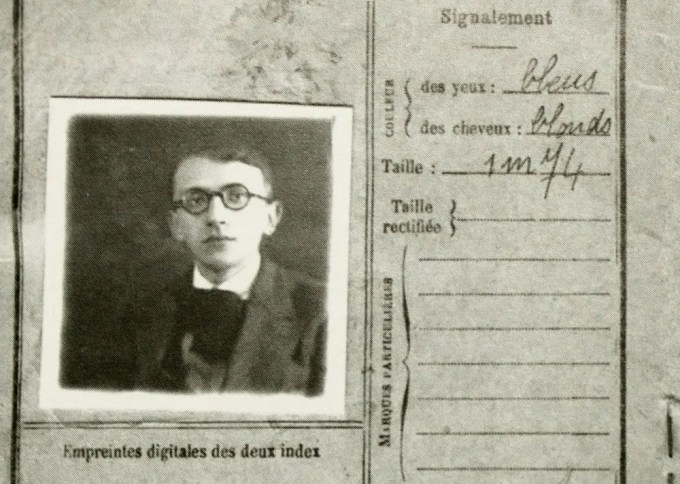
‘The first thing to say is that ‘criticism’ isn’t the right word for The Space of Literature, and, despite the many philosophical terms, allusions and adoptions, most notably from Heidegger, ‘philosophy’ isn’t either. What sets Blanchot apart from any definable genre is that his writing exposes itself to its own analysis, or, rather, the analysis exposes itself to writing lacking such a possessive pronoun.
‘The opening chapter asserts the ‘solitude’ of the written work: To write is to break the bond that unites the word with myself. The work is even separate from the book, which we might see as a vessel borne on the surface of a submarine current: Writing is the interminable, the incessant. This means that the space of the title is not a privileged realm for a few “great writers”; it does not have borders or features with rules to be learned but is at a remove from such power. Mallarmé felt the very disquieting symptoms caused by the sole act of writing.
‘Blanchot cites Kafka’s comment that he has entered literature when he replaces ‘I’ with ‘He’, but adds that this metamorphosis is more profound: In doing this, the writer belongs to a language which no one speaks, which is addressed to no one, which has no center, and which reveals nothing. Mastery over words puts the writer in contact with a fundamental passivity that cannot be grasped: To write is to make oneself the echo of what cannot cease speaking. Instead, in a stirring paradox, mastery consists in the power to stop writing, to interrupt what is being written. This a curious formulation. When we admire the tone of a particular writer, he says, it is not the writer’s voice we admire but the intimacy of the silence he imposes on the word. He compares this to classicism in which the calm of the regular form guarantees a language free from idiosyncrasy, where impersonal generality speaks and secures the writer a relation with truth. But such calm requires the stability of an aristocratic society in which a part of society concentrates the whole within itself by isolating itself well above what sustains it. We might say that genre fiction is an aristocratic form.
‘The imposition of silence is necessary because writing is an exposure to an outside – what might have been called the divine, the sublime or the infinite, and which Blanchot refers to the other night or the other of all worlds. And it is in incantatory prose and such hyperbolic phrases, otherwise unthinkable in literary criticism, that exposes us to how strange literature is in itself. Once you become accustomed to what at first appears as anachronistic and even absurd (certainly to English eyes – I remember a friend giggling as he read the opening pages), you might also recognise such excess defines us as human: in excess of body, in excess of world, akin to the internal perspective of language that Noam Chomsky has described and the excess of consciousness Mallarmé called this drop of nothingness. And if we are drawn to poetry and to the poets Blanchot writes about, it is their strange excess that sets their work apart and deserves to be addressed without being neutralised within the stability of a regular form. This is also why The Space of Literature appeared so vital to me upon re-reading; it does not stand aside from its subject.
‘The risk taken by such prose is in stark contrast to scholarly method that corrals prose into pens of reason isolated from the distress of the infinite. While it resists the temptations of fascination, which is necessary for its purpose, it does not assume the guarantees it expects. As Blanchot writes in a later book:
Reason … does not begin in the light of an evidency by which it would seize itself, but rather in an obscurity that itself is not manifest and whose discovery, seizure, and affirmation alone put thought to work, causing it to find and to extend its own light.
‘Blanchot turns the light off to reveal such obscurity. In a disconcerting move, reaffirming the unaccountability of literary space, he rejects the familiar priority of real-world over literature in which artistic activity is often portrayed as unrealistic, escapist and even in denial of the world, gaining acceptance only if it submits to the superiority of the physical world. For Blanchot, while the artist often seems a weak being who cringes within the closed sphere of his work where…he can take revenge for his failures in society, it is instead the artist who is exposed to the greatest threat: the loss of self and world in the space of literature:
It is then that Rimbaud flees into the desert from the responsibilities of the poetic decision. He buries his imagination and his glory. He says “adieu” to “the impossible” in the same way that Leonardo da Vinci does and almost in the same terms. He does not come back to the world; he takes refuge in it; and bit by bit his days, devoted henceforth to the aridity of gold, make a shelter for him of protective forgetfulness.
In later life, Rimbaud is said to have denounced his past work, refusing any further mention of it, which, for Blanchot, “shows the terror which he still felt and the force of the upheaval which he could not undergo to the limit. He is reproached with having sold out and deserted, but the reproach is easy for those who have not run the risk”. The bottomless abyss belongs to art.
‘So much for escapism.
‘Re-reading The Space of Literature has reminded me why so much fiction leaves me confused by indifference and why criticism and reviewing often seems beside the point. While a novel’s subject matter might be powerful and important, its story compelling, the prose style especially seductive and its sentences beautifully formed, such wealth often seems beside the point. The same goes for its social and political relevance, for a survey of its formal structures and for revelations provided by psychological analysis. They might seem very insightful and pressing, but essentially beside the point, which is itself unlocatable. But what other reasons can there be for reading a novel?
‘Blanchot recognises how such a question is ironed out in book culture, with the general reader who makes a livelihood in a world where the clear daytime truth is a necessity [and] believes that the work holds the moment of truth within it constantly translating the work into ordinary language, effective formulae, useful values while, on the other hand, the dilettante and the critic devote themselves to the ‘beauties’ of the work, to its aesthetic value. Everyone, it seems, is happy. And with the advent of the internet, these groups have become indistinguishable. Witness the routine use of the word ‘experimental’ to champion, mitigate or patronise anything that doesn’t quite meet either process, without any question of what ‘experimental’ might mean in in the first place.
‘To give an idea, Blanchot returns instead to the experience of writing before any of these ideas come into play. If the writer is devoted to the work, they are drawn by it toward the point where it undergoes impossibility. That is, when writing empties itself of the world and appears to writer as empty, without value. It is an experience Blanchot calls the very experience of night:
In the night, everything has disappeared. This is the first night. Here absence approaches – silence, repose, night. Here … the sleeper does not know he sleeps, and he who dies goes to meet real dying. Here language completes and fulfills itself in the silent profundity which vouches for it as its meaning.
‘This is not a negative however, as it is where craft and determination gets the writer through the night in order to produce books. We can recognise how night maintains itself in the popularity of, for example, Horror or Gothic fantasy, in which we are exposed to the darkness in human life and to the black-hole of a non-human world. Except, we all know it is only the thrill of a fairground ghost train. It is in this context that Blanchot divides night in two: When everything has disappeared in the night, ‘everything has disappeared’ appears. This is the other night.
We enter into the night and we rest there, sleeping and dying. But the other night does not welcome, does not open. In it one is still outside. It does not close either; it is not the great Castle, near but unapproachable, impenetrable because the door is guarded. Night is inaccessible because to have access to it is to accede to the outside, to remain outside the night and to lose forever the possibility of emerging from it.
‘Blanchot’s essay on Beckett’s trilogy is the most famous expression of this condition. Not even the best creative writing course can help. This might be why indifference stands before me and devouring novel after novel. Many might be impressively wrested from night but they are also recognisably resistant to the other; even the latest ‘experimental’ hit reaches for the same gifts of silent profundity. Despite this, I am still drawn to novels, many of which are not in the least avant garde, as my enthusiasm for In a Hotel Garden demonstrates. So what is going on there; have I fallen for sentimentality? My response would be that this also shows how novels might dwell in what Blanchot calls the torn intimacy of an alliance between the activity of book making and the passivity of writing, as the characters seek to bring to life what haunts them and yet do so only in the dissimulation of speech and stories. And not only the characters.
‘It is for this reason I am drawn to what is often called metafiction and invariably disparaged as writing about writing, which might still be a turning away from the world, yet only in search of an origin, for what haunts writing. Blanchot offers a genealogy of what has passed in literature:
The work was once the language of the gods, their absence’s speech; subsequently it was the just, the balanced language of men, and then the language of men in their diversity. Then again it was the language of disinherited men, of those who do not speak. And then it was the language of what does not speak in men, of the secret, of despair or ravishment.
What, he asks, does such a list tell us? Only this: that art is constantly invisible to us. What is invisible demands to be seen, and if this suggests a demand separate from literary criticism, it is entirely in keeping with our times, in which origins are strictly taboo. What is left now for the work to say? What has always eluded its language? Blanchot asks. Seventy years after its publication, the answer and challenge proposed by The Space of Literature remains: Itself.’ — Stephen Mitchelmore
________
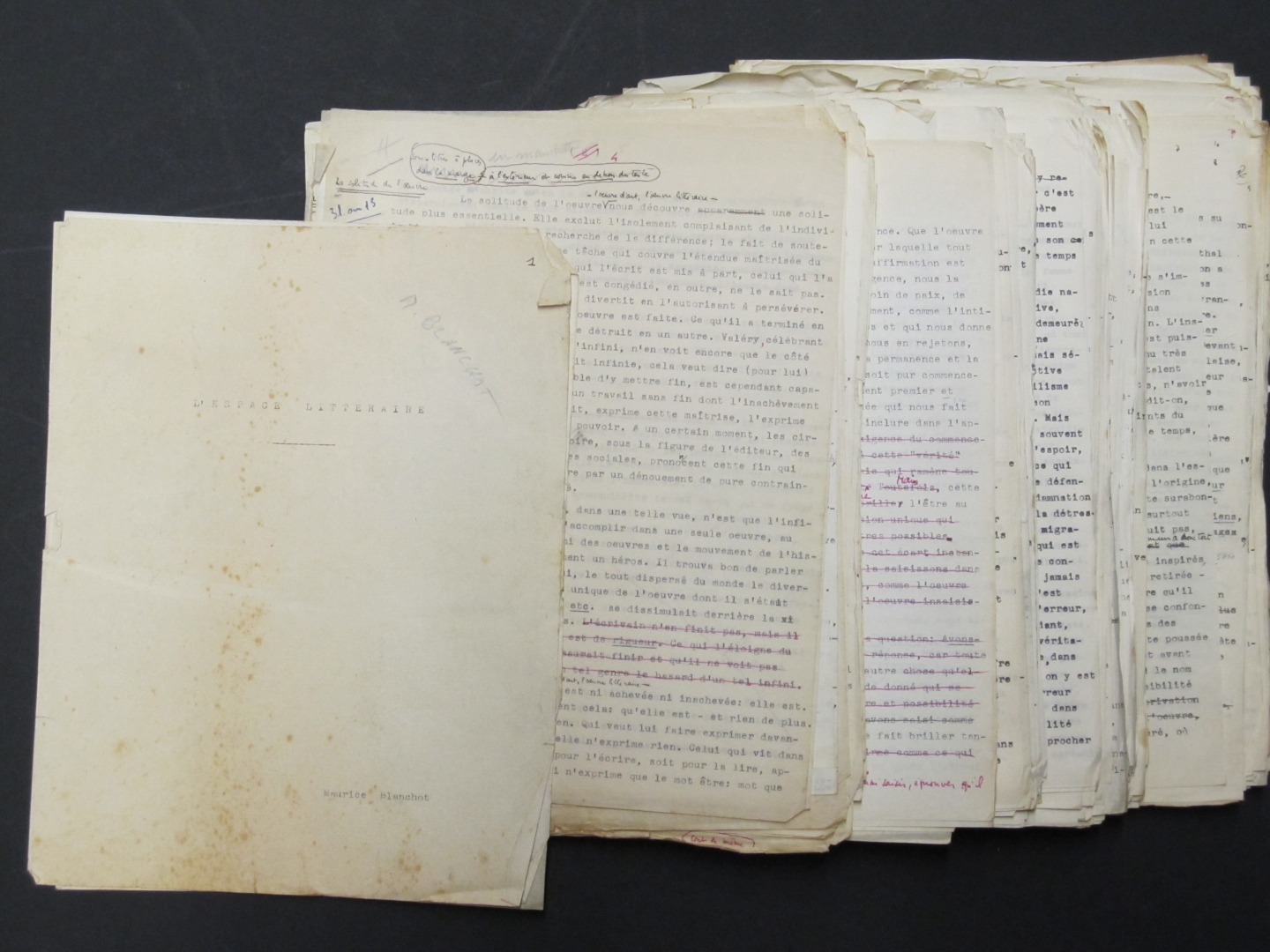
Typescript of The Space of Literature
____
Further
Espace Maurice Blanchot
‘The Space of Literature’ @ goodreads
Contradictory Passion: Inspiration in Blanchot’s “The Space of Literature”
‘Everything and Nothing’: Blanchot in the Space of Shakespeare”
Introduction: Blanchot’s Spaces
Analysis of the Space of Literature by Maurice Blanchot
Blanchot on the analogy between writing and suicide
I’m too dead to tell you: withdrawing rooms and other breathing spaces.
BLANCHOT AND THE RESONANT SPACES OF LITERATURE, SOUND, ART AND THOUGHT
Reading The Space of Literature (iii)
Nothing doing: Maurice Blanchot and the irreal
Introduction: Against Praise of Maurice Blanchot
(Re)Writing, (Re)Reading: Maurice Blanchot and The Space of Literature
The Negative Eschatology of Maurice Blanchot
Read the entirety for free online
Buy ‘The Space of Literature’
___
Extras
Christopher Fynsk. Blanchot, Language, Negation, Dialectics and Signification. 2012
MAURICE BLANCHOT – Un siècle d’écrivains [1998]
___
Extra
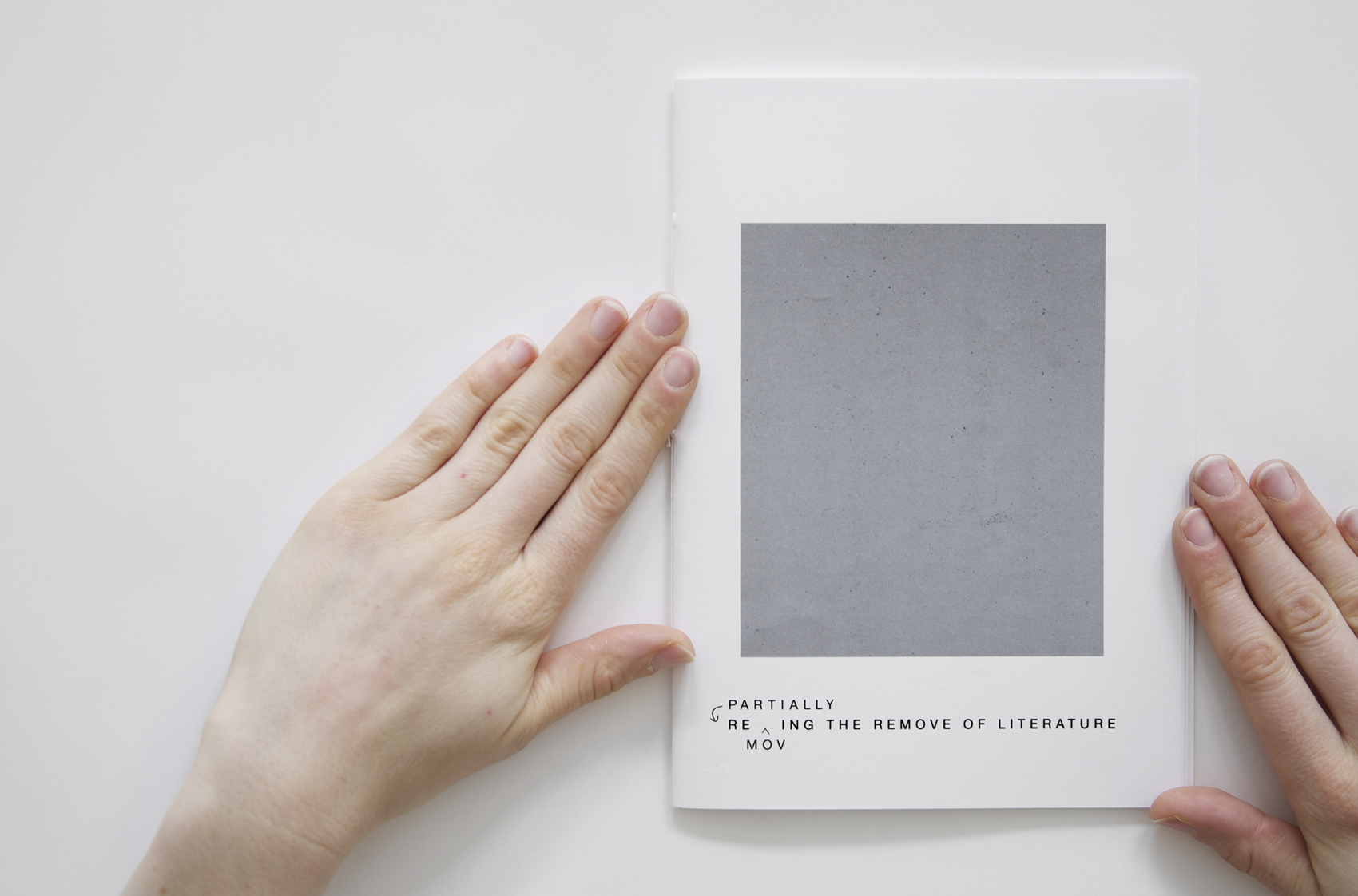
Partially Removing the Remove of Literature. Kristen Mueller. & So.
“A book, even a fragmentary one, has a center which attracts it. This center is not fixed, but is displaced by the pressure of the book and circumstances of its composition. Yet it is also a fixed center which, if it is genuine, displaces itself, while remaining the same and becoming always more central, more hidden, more uncertain and more imperious. He who writes the book writes it out of desire for this center and out of ignorance. The feeling of having touched it can very well be only the illusion of having reached it.” -Maurice Blanchot, The Space of Literature
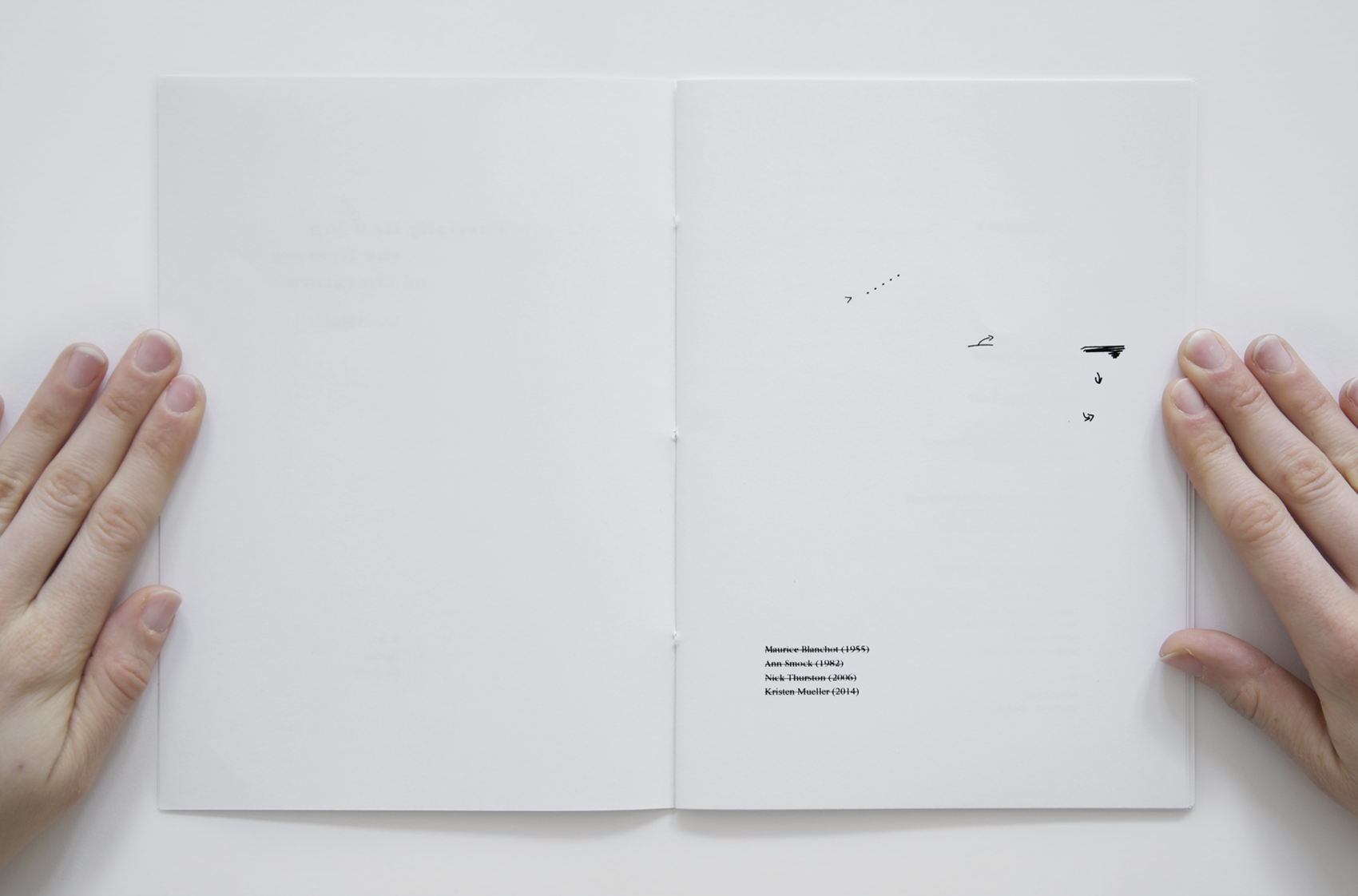
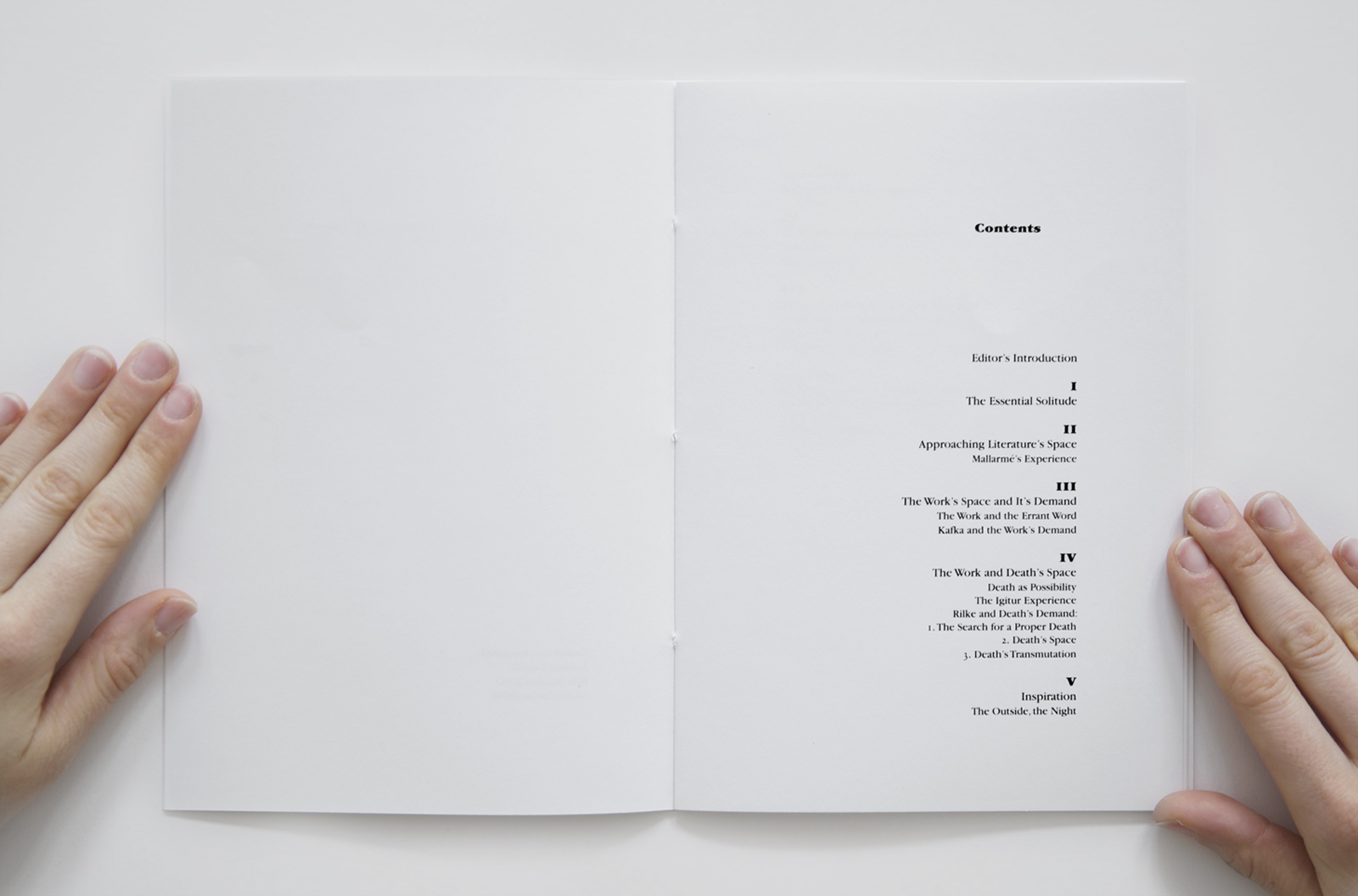
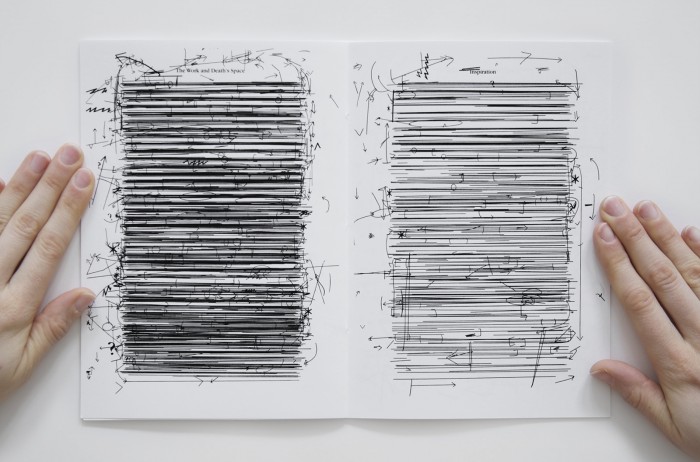
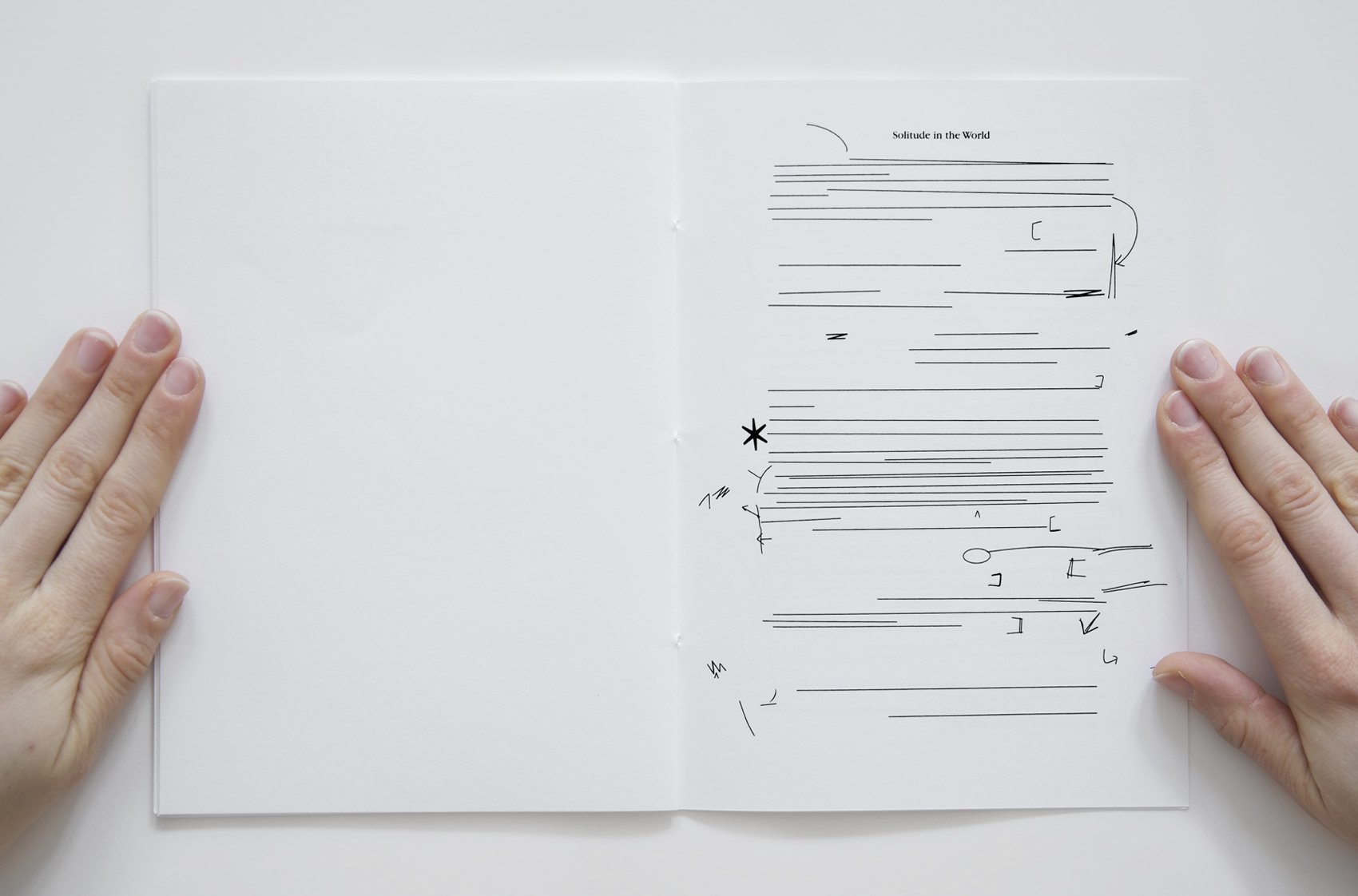
In Reading the Remove of Literature (Information as Material, 2006), Nick Thurston has erased the text of the English translation of Maurice Blanchot’s L’espace littéraire (The Space of Literature), while at the same time preserving his own marginalia, resetting them in almost the exact typeface of Blanchot’s text.
In Partially Removing the Remove of Literature, Thurston’s marginalia have been partially erased. Only the non-verbal, diagrammatic traces – the underlinings and arrows, circles and asterisks – remain, printed one atop another, collapsing each chapter into the space of a single page. The chapters’ running titles, reprinted at the top of each page, offer the sole clue as to what Blanchot once wrote, and Thurston once read and annotated.

____
Extras
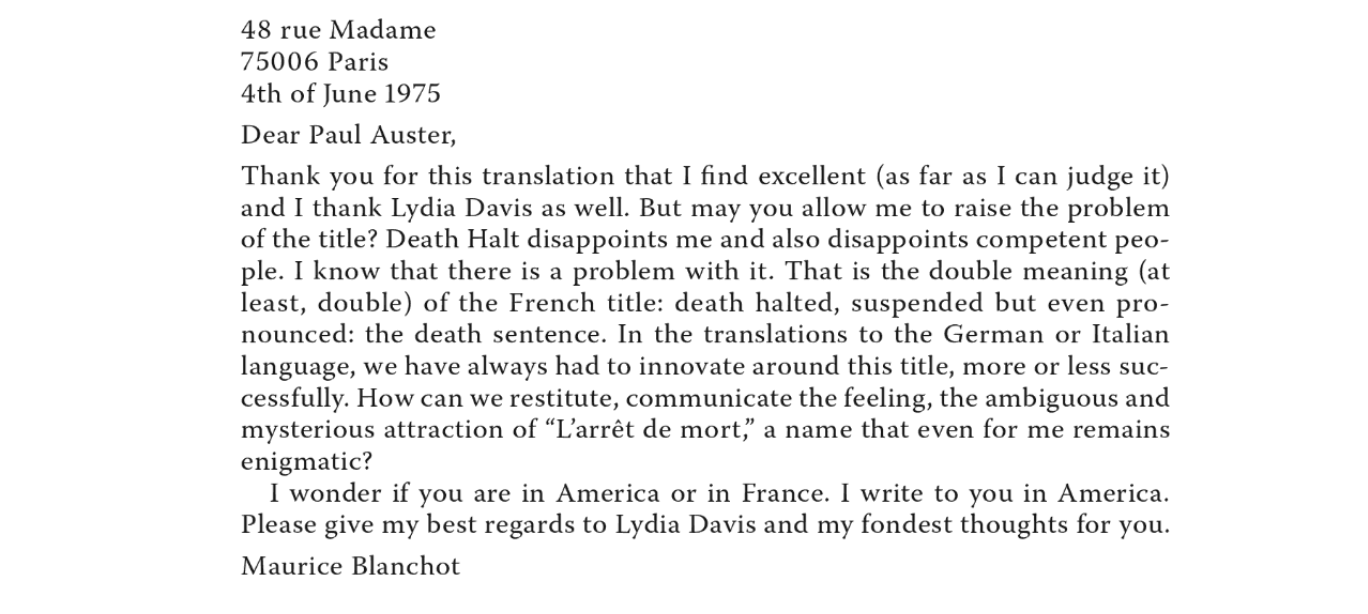
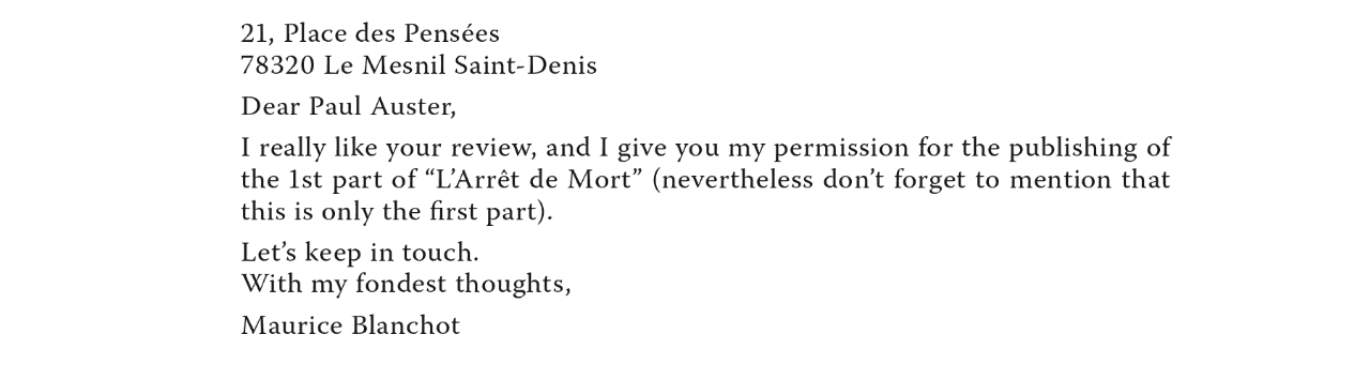
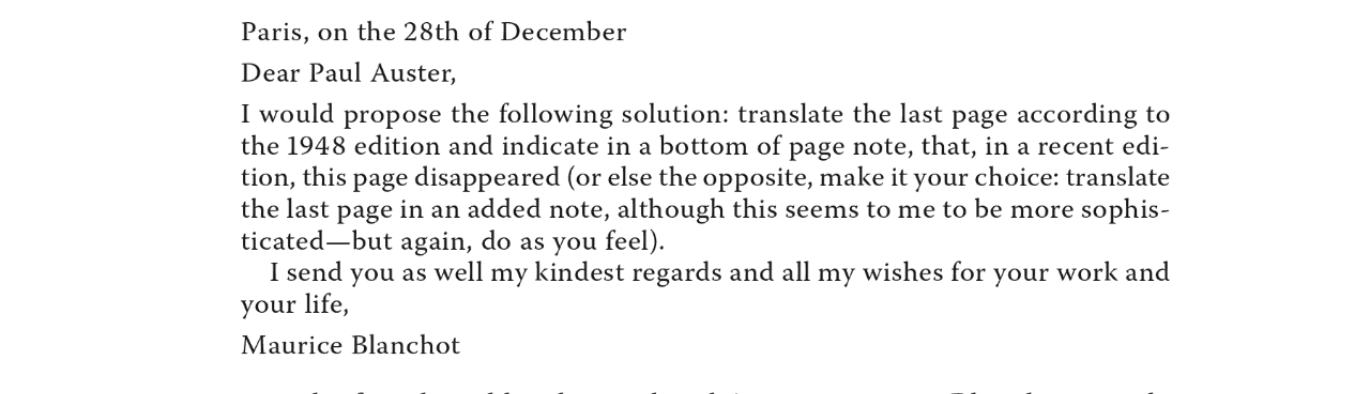
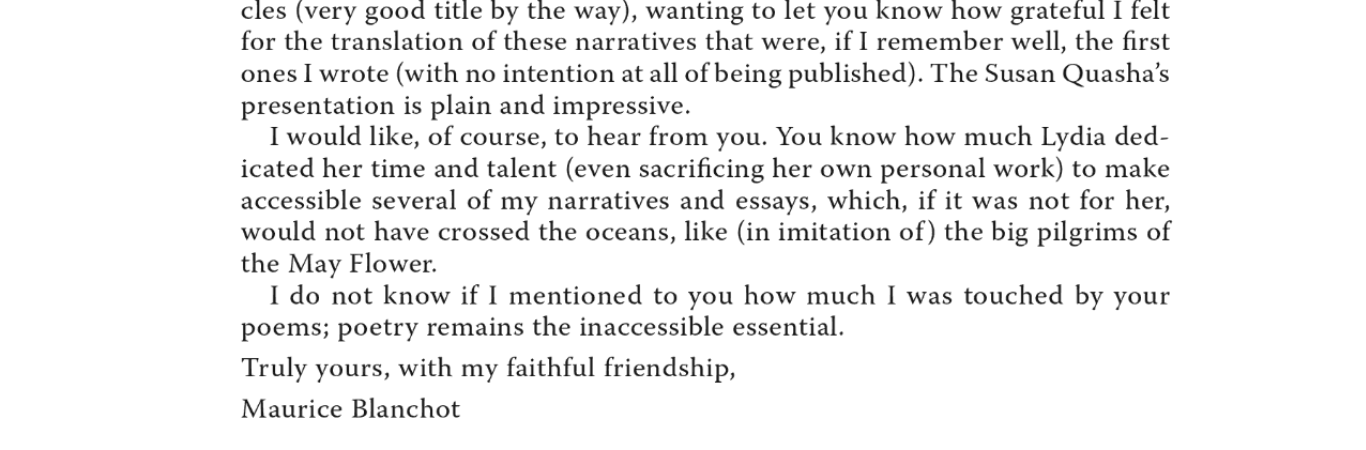
Four letters from Maurice Blanchot to his American translator Paul Auster

___
Book
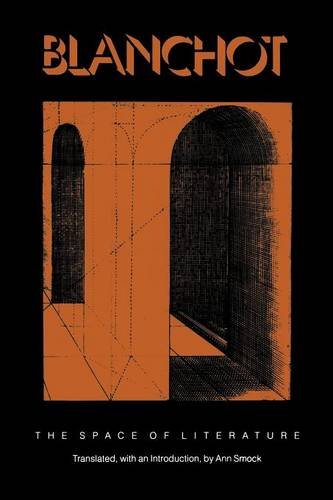 Maurice Blanchot The Space of Literature
University of Nebraska Press
‘Maurice Blanchot, the eminent literary and cultural critic, has had a vast influence on contemporary French writers—among them Jean Paul Sartre and Jacques Derrida. From the 1930s through the present day, his writings have been shaping the international literary consciousness.
‘The Space of Literature, first published in France in 1955, is central to the development of Blanchot’s thought. In it he reflects on literature and the unique demand it makes upon our attention. Thus he explores the process of reading as well as the nature of artistic creativity, all the while considering the relation of the literary work to time, to history, and to death. This book consists not so much in the application of a critical method or the demonstration of a theory of literature as in a patiently deliberate meditation upon the literary experience, informed most notably by studies of Mallarmé, Kafka, Rilke, and Hölderlin. Blanchot’s discussions of those writers are among the finest in any language.’ — UoNP
___
Excerpt
Tyrannical Prehension
Sometimes, when a man is holding a pencil, his hand won’t release it no matter how badly he wants to let it go. Instead, the hand tightens rather than open. The other hand intervenes more successfully, but then the hand which one might call sick makes a slow, tentative movement and tries to catch the departing object. The strange thing is the slowness of this movement. The hand moves in a tempo which is scarcely human: not that of viable action, not that of hope either, but rather the shadow of time, the hand being itself the shadow of a hand slipping ghostlike toward an object that has become its own shadow. This hand experiences, at certain moments, a very great need to seize: it must grasp the pencil, it has to. It receives an order, an imperious command. This phenomenon is known as “tyrannical prehension.”
The writer seems to be the master of his pen; he can become capable of great mastery over words and over what he wants to make them express. But his mastery only succeeds in putting him, keeping him in contact with the fundamental passivity where the word, no longer anything but its appearance — the shadow of a word — never can be mastered or even grasped. It remains the ungraspable which is also unreleasable: the indecisive moment of fascination.
The writer’s mastery is not in the hand that writes, the “sick” hand that never lets the pencil go — that can’t let it go because what it holds it doesn’t really hold; what it holds belongs to the realm of shadows, and it is itself a shade. Mastery always characterizes the other hand, the one that doesn’t write and is capable of intervening at the right moment to seize the pencil and put it aside. Thus mastery consists in the power to stop writing, to interrupt what is being written, thereby restoring to the present instant its rights, its decisive trenchancy.
We must start questioning again. We have said that the writer belongs to the work, but that what belongs to him, what he finishes by himself, is only a book: “by himself” corresponds to the restriction “only.” The writer is never face to face with the work, and when there is a work, he doesn’t know it; or, more precisely, even this ignorance is unknown to him, is only granted him in the impossibility of reading, the ambiguous experience that puts him back to work.
The writer goes back to work. Why doesn’t he cease writing? Why, if he breaks with the work, as Rimbaud did, does this break strike us as a mysterious impossibility? Does he just desire a perfect product, and if he does not cease to work at it, is it simply because perfection is never perfect enough? Does he even write in the expectation of a work? Does he bear it always in mind as that which would put an end to his task, as the goal worthy of so much effort? Not at all. The work is never that in anticipation of which one can write (in prospect of which one would relate to the process of writing as to the exercise of some power).
The fact that the writer’s task ends with his life hides another fact: that, through this task, his life slides into the distress of the infinite.
The Interminable, the Incessant
The solitude which the work visits on the writer reveals itself in this: that writing is now the interminable, the incessant. The writer no longer belongs to the magisterial realm where to express oneself means to express the exactitude and the certainty of things and values according to the sense of their limits. What he is to write delivers the one who has to write to an affirmation over which he has no authority, which is itself without substance, which affirms nothing, and yet is not repose, not the dignity of silence, for it is what still speaks when everything has been said. This affirmation doesn’t precede speech, because it prevents speech from beginning, just as it takes away from language the right and the power to interrupt itself. To write is to break the bond that unites the word with myself. It is to destroy the relation which, determining that I speak toward “you,” gives me room to speak within the understanding which my word receives from you (for my word summons you, and is the summons that begins in me because it finishes in you). To write is to break this bond. To write is, moreover, to withdraw language from the world, to detach it from what makes it a power according to which, when I speak, it is the world that declares itself, the clear light of day that develops through tasks undertaken, through action and time.
Writing is the interminable, the incessant. The writer, it is said, gives up saying “I.” Kafka remarks, with surprise, with enchantment, that he has entered into literature as soon as he can substitute “He” for “I.” This is true, but the transformation is much more profound. The writer belongs to a language which no one speaks, which is addressed to no one, which has no center, and which reveals nothing. He may believe that he affirms himself in this language, but what he affirms is altogether deprived of self. To the extent that, being a writer, he does justice to what requires writing, he can never again express himself, any more than he can appeal to you, or even introduce another’s speech. Where he is, only being speaks — which means that language doesn’t speak any more, but is. It devotes itself to the pure passivity of being.
If to write is to surrender to the interminable, the writer who consents to sustain writing’s essence loses the power to say “I.” And so he loses the power to make others say “I.” Thus he can by no means give life to characters whose liberty would be guaranteed by his creative power. The notion of characters, as the traditional form of the novel, is only one of the compromises by which the writer, drawn out of himself by literature in search of its essence, tries to salvage his relations with the world and himself.
To write is to make oneself the echo of what cannot cease speaking — and since it cannot, in order to become its echo I have, in a way, to silence it. I bring to this incessant speech the decisiveness, the authority of my own silence. I make perceptible, by my silent mediation, the uninterrupted affirmation, the giant murmuring upon which language opens and thus becomes image, becomes imaginary, becomes a speaking depth, an indistinct plenitude which is empty. This silence has its source in the effacement toward which the writer is drawn. Or else, it is the resource of his mastery, the right of intervention which the hand that doesn’t write retains — the part of the writer which can always say no and, when necessary, appeal to time, restore the future.
When we admire the tone of a work, when we respond to its tone as to its most authentic aspect, what are we referring to? Not to style, or to the interest and virtues of the language, but to this silence precisely, this vigorous force by which the writer, having been deprived of himself, having renounced himself, has in this effacement nevertheless maintained the authority of a certain power: the power decisively to be still, so that in this silence what speaks without beginning of end might take on form, coherence, and sense.
The tone is not the writer’s voice, but the intimacy of the silence he imposes upon the word. This implies that the silence is still his — what remains of him in the discretion that sets him aside. The tone makes great writers, but perhaps the work is indifferent to what makes them great.
In the effacement toward which he is summoned, the “great writer” still holds back; what speaks is no longer he himself, but neither is it the sheer slipping away of no one’s word. For he maintains the authoritative though silent affirmation of the effaced “I.” He keeps the cutting edge, the violent swiftness of active time, of the instant.
Thus he preserves himself within the work; where there is no more restraint, he contains himself. But the work also retains, because of this, a content. It is not altogether its own interior.
The writer we call classic — at least in France — sacrifices within himself the idiom which is proper to him, but he does so in order to give voice to the universal. The calm of a regular form, the certainty of a language free from idiosyncrasy, where impersonal generality speaks, secures him a relation with truth — with truth which is beyond the person and purports to be beyond time. Then literature has the glorious solitude of reason, that rarefied life at the heart of the whole which would require resolution and courage if this reason were not in fact the stability of an ordered aristocratic society; that is, the noble satisfaction of a part of society which concentrates the whole within itself by isolating itself well above what sustains it.
When to write is to discover the interminable, the writer who enters this region does not leave himself behind in order to approach the universal. He does not move toward a surer world, a finer or better justified world where everything would be ordered according to the clarity of the impartial light of day. He does not discover the admirable language which speaks honorably for all. What speaks in him is the fact that, in one way or another, he is no longer himself; he isn’t anyone any more. The third person substituting for the “I”: such is the solitude that comes to the writer on account of the work. It does not denote objective disinterestedness, creative detachment. It does not glorify consciousness in someone other than myself or the evolution of a human vitality which, in the imaginary space of the work of art, would retain the freedom to say “I.” The third person is myself become no one, my interlocutor turned alien; it is my no longer being able, where I am, to address myself and the inability of whoever addresses me to say “I”; it is his not being himself.
Recourse to the “Journal”
It is perhaps striking that from the moment the work becomes the search for art, from the moment it becomes literature, the writer increasingly feels the need to maintain a relation to himself. His feeling is one of extreme repugnance at losing his grasp upon himself in the interests of that neutral force, formless and bereft of any destiny, which is behind everything that gets written. This repugnance, or apprehension, is revealed by the concern, characteristic of so many authors, to compose what they call their “journal.” Such a preoccupation is far removed from the complacent attitudes usually described as Romantic. The journal is not essentially confessional; it is not one’s own story. It is a memorial. What must the writer remember? Himself: who he is when he isn’t writing, when he lives daily life, when he is alive and true, not dying and bereft of truth. But the tool he uses in order to recollect himself is, strangely, the very element of forgetfulness: writing. That is why, however, the truth of the journal lies not in the interesting, literary remarks to be found there, but in the insignificant details which attach it to daily reality. The journal represents the series of reference points which a writer establishes in order to keep track of himself when he begins to suspect the dangerous metamorphosis to which he is exposed. It is a route that remains viable; it is something like a watchman’s walkway upon ramparts: parallel to, overlooking, and sometimes skirting around the other path — the one where to stray is the endless task. Here true things are still spoken of. Here, whoever speaks retains his name and speaks in this name, and the dates he notes down belong in a shared time where what happens really happens. The journal — this book which is apparently altogether solitary — is often written out of fear and anguish at the solitude which comes to the writer on account of the work.
The recourse to the journal indicates that he who writes doesn’t want to break with contentment. He doesn’t want to interrupt the propriety of days which really are days and which really follow one upon the other. The journal roots the movement of writing in time, in the humble succession of days whose dates preserve this routine. Perhaps what is written there is already nothing but insincerity; perhaps it is said without regard for truth. But it is said in the security of the event. It belongs to occupations, incidents, the affairs of the world — to our active present. This continuity is nil and insignificant, but at least it is irreversible. It is a pursuit that goes beyond itself toward tomorrow, and proceeds there definitively.
The journal indicates that already the writer is no longer capable of belonging to time through the ordinary certainty of action, through the shared concerns of common tasks, of an occupation, through the simplicity of intimate speech, the force of unreflecting habit. He is no longer truly historical; but he doesn’t want to waste time either, and since he doesn’t know anymore how to do anything but write, at least he writes in response to his everyday history and in accord with the preoccupations of daily life. It happens that writers who keep a journal are the most literary of all, but perhaps this is precisely because they avoid, thus, the extreme of literature, if literature is ultimately the fascinating realm of time’s absence.
*
p.s. Hey. ** jay, Hi. Oh, yeah, I was really intrigued by the Schmitt piece too. Thanks, pal. You and everything good? ** Carsten, I’m always surprised when people say Paris is too hustle and bustle because it seems so chill to me, but, yeah, it’s all in one’s head, I guess. I hear there are some English language poetry readings here, but I haven’t been to many/any. After8 does book launches/readings for poetry. I’ve been to readings at the mostly English language poetry bookstore here The Red Wheelbarrow. There’s a big English language reading series here whose name escapes me at the moment, but I think it’s basically for writers who are fairly well known or have followings here. Maison de Poesie hosts English speakers sometimes, but, again, they’re usually established poets. Anyway, there’s probably a way/place here where that could be possible. Yes, the Smith is a mix of found footage and stuff he shot. It’s a stretch to say it’s political. His use of the Wendell Wilkie footage seems utterly mysterious, and maybe intended to be humorously so. No, m.vkvideo videos can’t be imbedded here. One has to link to them. If you notice in my posts about filmmakers, when there’s a link saying ‘Watch the film here’, the links often go to m.vkvideo videos. ** _Black_Acrylic, Huh, I’ll look into Ostalgie. That’s pretty interesting. ** Laura, Hi. Cool dioramas read. I only love ‘ah bon’ when it’s spoken with a question mark at the end for some reason. There’s a Dutch word I used to love when I lived in Holland, but I can’t remember what it was at the moment. Drat. I seem to be solidly myself so far today. You? ** Lucas, At the time that I saw Phil Ochs I didn’t know his stuff all that well. I remember he played ‘There But For Fortune’ because that was the song of his I most knew. I don’t remember so much about him or his performance. I was mostly concentrated on the crowd and how much more stylish they were than the hippie crowds in LA. I saw Bob Dylan a few times, but not super early. I saw him when he was touring with The Band. That was pretty great. He was pretty charismatic and sexy when he was young, I think. Not my type, but … Nice little passing feedback from your prof. My day was mostly trying to catch up on stuff. I’m still behind after that sickness bout of a couple of weeks ago. That you can get by on two or three puffs is mightily impressive indeed. ** Hugo, Oh, cool. That Baldessari show was great. He’s a huge fave of mine as you probably. We didn’t have time to do the Goya show. Just the Baldessari and the Nina Meier shows. Job needing is really stressful. I was lucky to be at the age when I could make enough money to survive writing journalism, but I don’t think that’s very possible now unless you’re employed by the upper echelon venues. I’ve never had an actual job, so I’m not very knowledgable about the wheres and hows unfortunately. Yes, Grove Press is republishing ‘Closer’. They’re going to do ‘Frisk’ next, but there’s been no talk as of yet anyway about republishing the other cycle novels. Hoping your today supplants your yesterday. ** Alice, And hey there to you! Friendships kind of equal sanity or can. Luck with the restarting classes. What classes are they? Haibane Renmei I will need to discover. Brightness ahead would be most welcome. Re: us both. ** Steve, I can see that parallel, but without the haunt’s moving parts. Those are the trickiest. Tell the jury duty proprietors that you’re an anarchist. Works like a charm. Well, the only ocean that German has lies on the north near Scandinavia, and I’m guessing it might be a little too chilly there for nude beach cavorting? I don’t think I know Alain Kan. Huh. I’ll ask my French friends and see if they know him. France has practically a billion ‘famous’ singers that barely anyone outside of France knows. ** HaRpEr //, Yes, that Ochs album, really nice, right? My collaborator Gisele Vienne is obsessed with dioramas. Two of our best collaborative works, ‘Kindertotenlieder’ and ‘This Is How You Will Disappear’ are basically dioramas with things occurring in them. I think people want a concrete answer for why someone is depressed so they won’t be confused by it. People are so scared of confusion. And they’re so enamored by the literal. It’s a very big problem. ** Uday, How Antarctica was would require a massively long answer, but, in brief, it was mind-blowing. Mm, I can’t remember the name of the potential NC theater. It’s in Charlotte. I’ll re-ask. Please do propose if it’s no trouble. Calm beloving day to you. ** Okay. Today the blog spotlights one of the seminal books by my all-time favorite writer and thinker Maurice Blanchot. That’s the scoop. See you tomorrow.



 Now available in North America
Blanchot is a writer I need to get with and the Space of Literature looks to be a good place to start. Suitable for MB neophytes, you think?
I saw a rather good film last night: A Prayer Before Dawn about a young strung-out Scouse boxer sentenced to a stretch in the notorious Klong Prem prison. It’s nasty and visceral with very little dialogue, which I just happened to be in the mood for. Had to admire how uncompromising this thing was.
Some of Blanchot’s terminology is so mystically appealing: the night, the other night, the infinite. But I have to say that I find his theoretical or critical writings quite hard to follow. The way his mind works is fascinating though. And his fiction of course. “Death Sentence” read at 16 or 17 based on your love for it made quite an impact.
Thanks for the input on Parisian readings in English. I will investigate all the places you name-dropped. Do you think my plan is realistic? To hit up bookstores as a first-time published poet for a reading from a chapbook? Seems reasonable to me to at least try, no?
You’re right, Jack Smith wasn’t really a political artist at all. It’s strange how that aspect crept into his work. Probably Ken Jacobs’s influence. But Jack lacked Ken’s razor-sharp understanding of corrupt power at work. I think—& I say this without having seen “No President”—that Jack’s was a delirious technicolor-Arabic dreamworld that had one primary obstruction: the landlord. So then figures like Wilkie function as stand-ins for that oppressor I guess.
Oh I saw the talk about East Germany’s nude beaches: yes that’s actually a thing. In formerly Soviet-controlled East Germany they had what they called Freikörperkultur, literally free body culture. Wherever that applied (mostly beaches) you could let it all hang. And many of those beaches were simply lakeshores & the like. FKK is still a thing around Germany, including the western part. But it was (expectedly) never popular with the young & gorgeous. I used to go to this lake as a kid that was split into FKK & regular sections. They were across from each other, but divided by the widest part of the lake. As kids we swam halfway across with great expectations & quickly turned around once we realized it was 90 per cent grandpa balls…
omg that’s super true, what is it about nude beaches that attracts so many sus types? [/rhetorical] like i’m v cool w grandpas but the thousand yard stares and the leering types not so much lol
i’m due in LA p much as soon as long covid eases off some, which hopefully will happen eventually, and i actually asked my fav local pornstar where he finds so much opportunity for public nudity w/o being swarmed by weirdos and he gave me the scoop lol. like if i get out of this i just fr want to get naked under the sky or whatever and be like we made it, kid. can’t have that ruined by scores of Benny Hills in the buff am i right
spanish nude beaches are a bit less bad but i still think there are way too many weekend-warrior-ish boomers ‘just trying to see what it’s all about wink wink’. have you been to any, tho? what’s yr idea?
hi dennis! sorry i missed you yesterday, had to lock in on some writing of my own. plus, still in canadian pr application hell. ah!!!! cool post on blanchot! ive been dying to read him, even more so after this.
hear you re: listening to music while creating. i think it prevents me from feeling fully immersed in the world im trying to access, even if that world is inspired by it. actually, id be curious to know if you feel a sense of full immersion in what youre making when you make it? like, especially for your novels + poetry and such…do you visualize things? is it different when you write scripts? would love to know!
halldor laxness! he is icelandic. i’ve only read the one book, but i found it to be a very funny realist satire of self-determination and rugged masculinity.
and yes, we are writing! we’re headed into the studio in march to knock out some new music. itll be fun, hopefully. screaming in a studio is kinda brutal tho hahaha. let us all pray for my vocal chords.
oh blanchot. his writing will always hold a special place in my heart, it always point to something inside of itself thats missing. it really gives me an aching feeling in my chest. i love it.
philosophically, i haven’t read these kinds of writings from him. i mean it really is impossible to ascribe that term to him i think because this sort of writing is so insular, i mean that seems to be the whole point to me, but to be this way so extremely that its opaque again and universal. i’m talking in broad generalizations i think. it’s really opposite to everything i would be interested in in theory but this focus on the writing isn’t on the writing itself but on alienation of the written word and so on. which i do like. on the one hand it’s selfish and boring to write about how much more special being a writer makes you how it’s the most special and thus only important thing in the world etc on the other it’s cool to write about it as a symbol for like well what i’ve just talked about.
i did manage to survive today only one like 5 drags of a cigarette that i sadly threw away. i think this reflects in the rambly way im writing. you have to imagine/realize that the main reason im not smoking (outside of my willpower) is that my tongue is still littered with many little very painful canker sores that make it impossible to smoke without immediately feeling how i’m slowly killing myself by doing just that.
Which Crass lyrics should I memorize to prove my credentials? Did being an anarchist get you out of jury duty when you lived in the U.S.?
The thought of naked East German senior citizens relaxing by a lake is oddly comforting.
I learned about Kan from the punk(-adjacent) rarities MP3 blog Old, Weak but Always a Wanker: https://disorderareyouexperienced.blogspot.com/.
hi Dennis!
ugh, Blanchot, love him. and i should read him way more often bc he helps me write. ^_^
his take on post-classical literature is interesting for loads of reasons, but rn i’m sort of hung up on the issue of accountability? like a lot of books i’m v into have this Blanchot-confirming voice imo, uh, his sort of anti-narrative thing, the poetic stream of consciousness, ‘mystery made me do it’, ‘i’m not me’ and all that. i really want to do smth else! like i’m sure there are a bunch of high-sounding passages in my progressing thing, but if i’m super lucky i want to have the baffled vision or whatever happen in a container that is prose and has the aesthetic of narrative and as such is totally accountable.
like you know how a lot of women apparently have these massive rape fantasies bc taking away consent and accountability makes them feel innocent which then frees them to want sex or whatever? i can’t w that lol. like, if i have a rape fantasy it’s bc i bloody well want to have it and so i should write like that too.
idk, i’m talking about books i really look up to here but i feel it’s maybe a tad easier to write about certain things under the cover of frenzy and like an altered state of mind, you don’t have to own it as much bc in Blanchot fashion you’re a writer, you don’t exist and are saying nothing. but i totally want to say smth! whether or not it lands lol. i want to be pinned down to, every word and to the silence too, whatever, and i want to be held super accountable. so even tho i basically agree on everything i think i in particular should, like, exist on that basic level at least.
also we talk a lot about the limits of communication and i think we could stand talking more about the ways it succeeds! like, the relationship between writer and reader is such a potentially comforting thing lol. my annotations on books i like are way more like sex talk than an attempt at theory for sure, so obvi smth is happening there that is linking ppl together, which is this major duh but i think we sort of collectively forget bc it doesn’t fit the discourse as much?
such a shame that writers can’t automatically get to view the stuff we write on the margins of their books or whatever, pleasure and irritation would be more mutual obvi, and stuff would def be accountable and probably super fun. way more than reading well thought-out reviews imo.
like, know what i’d totally like to see as sort of not quite performance art but def an exhibition? just someone reading a book which is new to them, in real time and being confused and angry and turned on and liking it a lot and making insensate notes and communicating back lol. the writer gets to watch and be put on the spot but maybe also be loved on whatever unusual or usual level? this isn’t said and done bc reading takes time, duh, observation may alter behaviour and no-one can guarantee anyone will love a book a priori, even by an author they’re into, although watching them hate it is interesting too. but i want to watch them love it! like be confronted and totally honest and still love it, so idk, i just think a writer and a reader w enough time on their hands and enough obliviousness to staring third parties should totally do this soon. i actually can’t believe it hasn’t been done yet, like, it totally must have, right?
wish you remembered your fav Dutch word! mine’s got to be not a word but this sentence from a comment section about this video here: https://youtu.be/DGWZ3QsIMLE
(really it’s too amazing, wouldn’t be half the thing were it fiction; and everyone is either dead or doing time for murder now)
some commenter goes like ‘gastjes die zitten te kutten’ (those kids fucking about) and it’s just peak Dutch to me lol, ‘gast’ means both ‘guest’ and ‘guy’, ‘the little guys’ are literally ‘cunting about’, idk man, i love it. ^_^
hope today has done stuff to you and you’ve done stuff to it too! me i’ve recently reached the point where i’m either so technical or so bored i can edit a chapter which used to make me sick like i’m looking at train schedules or whatever.
hugs!!
I understand the need for people to try and conceptualise things in ways that leave little room for doubt, but every time I’ve tried to pin my problems on a particular thing, I just feel like more of a stranger to myself and like I’m choosing to be defined by one thing, that I’m betraying every other thing that might be going on and dumbing myself down. It’s like, with writing I know that whatever I write, people will centre it around my transness, it happened at uni. I’ve made my peace with that, but if I actively chose to play into what other people are forcing onto me I’d be a worse writer for it.
I need to re-read this! When I read it all the way through first it was like waves were rushing over my head and I needed to get through it quick enough to understand the general overview, but now I want to take it slow. With Blanchot, what I hope to gain is not under the expectation that I can somehow understand all of it, because I think his theoretical work is pretty inexhaustible in its possibilities and there’s no one way of understanding him. Rather, I hope to get closer to understanding where I stand in relation to it all. Blanchot eludes clear discussion. When I read his theory I think I understand it and go away with a sort of idea but it’s impossible to explain what it even is that I took from it, but I can kind of feel it.
I watched ‘Brand Upon the Brain!’ this evening, my first Guy Maddin. And it was beautiful and absurdly funny, my sense of humor exactly, actually. The editing was incredible.
Apparently if you get the criterion dvd/blu-ray, you can choose between several different narrators such as John Ashbery! Original screenings of the film featured celebrities sitting in with a microphone to do the narration, just like an old silent film.
Blanchot, nice. Didn’t know Auster was his translator. I enjoyed City of Glass in middle school, and the graphic adaptation even better, but I revisited it lately and found I didn’t care much for it any more. Blanchot has the opposite trajectory, where I feel like every time I mature a little more intellectually (if at all), I get him better. I’d put together a more cogent answer today but I broke my toe yesterday and maybe again today so I’m kinda out of it. Sad because I can’t go on walks, which are a major lifeline.