
Michel Ciment: Do you like poets like Francis Ponge? Your films remind one of him, and his Le parti pris des choses.
Robert Bresson: Yes. I no longer see Ponge, unfortunately, as he has moved to the south. He wrote me some remarkable letters about my films and about cinema. I like his fondness for objects, for inanimate things.
‘Francis Ponge has been called “the poet of things” because simple objects like a plant, a shell, a cigarette, a pebble, or a piece of soap are the subjects of his prose poems. For Ponge, all objects “yearn to express themselves, and they mutely await the coming of the word so that they may reveal the hidden depths of their being,” as Richard Stamelman explained it in Books Abroad. David Gascoyne, a contributor to Reference Guide to World Literature, declared: “To transmute commonplace objects by a process of replacing inattention with contemplation was Ponge’s way of heeding Ezra Pound‘s edict: ‘Make it new.’ His ever-renewed attempts to celebrate objects of everyday experience in a language enlightened by puns and complex words, with onomatopoeia, and the calligrammatic, were not a restless search for novelty but rather a way of transcending ‘modernity’ and restoring a Wordsworthian appreciation of the simple things in life: slate, the Seine, asparagus, and tables.”
‘Throughout his forty-five year writing career, Ponge was faithful to his unique approach to poetic subject. Speaking of the poet’s collected works, Sarah N. Lawall in Contemporary Literature found that “what Ponge has to say remains quite consistent, and his collected works juxtapose texts from 1921 to 1967 without any contradiction whatsoever. He still goes to the ‘mute world’ of things for his peculiar dialectic, and he still celebrates the creative power of speech.” Lawall found, too, that Ponge’s work served as an “example of systematically individual perception and expression in a world threatened by group morality and intellectual totalitarianism.”
‘Michael Benedikt, writing in The Prose Poem: An International Anthology, concluded that Ponge’s poems are “as ‘objective’ as objects in the world themselves.” Robert W. Greene, in his book Six French Poets of Our Time: A Critical and Historical Study, argued that in many of his poems, Ponge tries “to create a verbal machine that will have as much local intricacy as its counterpart in the world of objects.” Stamelman went even further in analyzing this relationship. “In Ponge’s poetry,” he wrote, “the text refers to itself and to itself alone… The only thing the text ‘represents’ is its own surging into being through language, its own act of expression. Ultimately, the text signifies itself.”
‘Ponge’s prose poems follow no set formula. They develop instead in a seemingly spontaneous manner, following a meandering path to their completion. “Ponge may be the first poet,” James Merrill wrote in the New York Review of Books, “ever to expose so openly the machinery of a poem, to present his revisions, blind alleys, critical asides, and accidental felicities as part of a text perfected, as it were, without ‘finish’”. Greene acknowledged that Ponge’s “texts hardly conform to most conceptions of what poems, even prose poems, are or should be. They contain puns, false starts, repetitions, agendas, recapitulations, syllogistic overtones, a heavy ideological content, and other features that one normally associates with prose—and the prose of argumentation at that—rather than with poetry.”
‘Ponge spent the last thirty years of his life as a recluse at his country home, Mas des Vergers. He suffered from frequent bouts with nervous exhaustion and numerous psychosomatic illnesses. He continued to write, however, and the work he was involved with at the time of his death was published posthumously in 1981. Entitled La Table, it “reflects what was Ponge’s undying, and increasingly obsessional, quest for le mot juste,” mused Gascoyne. “Its final sentence reads: “O Table, ma console et ma consolatrice, table qui me console, ou je me consolide.” For Ponge, his final subject was his writing table, which had in fact by then become his entire world.”’ — Poetry Foundation
____
Extras
Francis Ponge et les surréalistes
“Le Pain” lu par Francis Ponge en 1962
la destruction des quartier Francis Ponge & Gaston Bachelard
Francis PONGE – Vers Francis Ponge (DOCUMENTAIRE, 1965)
_____
Further
Francis Ponge’s ‘Preface to a Bestiary’
FP’s ‘Soap’ @ Stanford University Press
Tom McCarthy on Francis Ponge
FP @ The PIP (Project for Innovative Poetry) Blog
‘Francis Ponge: Siding with things’
‘The Prefix of Prefixes:
Francis Ponge’s ‘Le Pré’ and La Fabrique du ’Pré’
Francis Ponge’s ‘l’Orange’ (bilingual)
Francis Ponge’s ‘Bread’
‘on Mute Objects of Expression by Francis Ponge
‘L’OBJET EN POESIE AU 20ème SIECLE : confrontation de quelques textes de Francis Ponge’
‘L’œuvre insupportable de Francis Ponge’
‘Commentaire hypertextuel du l’eau de Francis Ponge.
FP @ Writers No One Reads
‘THE LAST BOOK I LOVED: FRANCIS PONGE’S THE VOICE OF THINGS’
An appeciation of FP @ Lacanian Studies
Buy ‘Unfinished Ode to Mud’ @ CB Editions
____________
My Creative Effort
by Francis Ponge
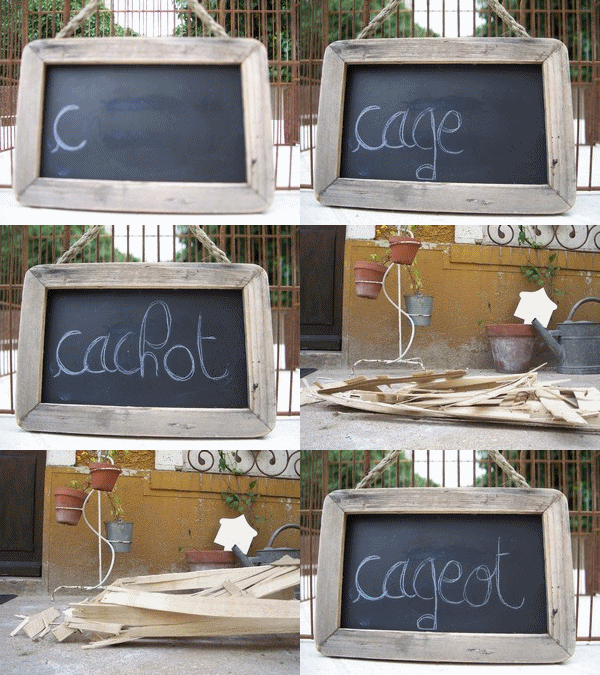
THURSDAY 18 DECEMBER 1947
No doubt I am not very intelligent: in any case ideas are not my strong point. I’ve always been disappointed by them. The most well-founded opinions, the most harmonious philosophical systems (the best constituted) have always seemed to me utterly fragile, caused a certain revulsion, a sense of the emptiness at the heart of things, a painful feeling of inconsistency. I do not feel in the least assured of the propositions that I sometimes have occasion to put forth in the course of a discussion. The opposing arguments almost always appear just as valid; let’s say, for the sake of exactness, neither more nor less valid. I am easily convinced, easily put down. And when I say I am convinced: it is, if not of some truth, at least of the fragility of my own opinion. Furthermore, the value of ideas appears to me most often in inverse proportion to the enthusiasm with which they are expressed. A tone of conviction (and even of sincerity) is adopted, it seems to me, as much in order to convince oneself as to convince one’s interlocutor, and even more, perhaps, to replace conviction. To replace, so to speak, the truth which is absent from the propositions put forth. This is something I feel very strongly.
Hence, ideas as such seem to me to be the thing I am least capable of, and they are of little interest to me. You will no doubt object that this in itself is an idea (an opinion), but: ideas, opinions seem to me controlled in each individual by something completely other than free will, or judgment. Nothing appears to me more subjective, more epiphenomenal. I really cannot understand why people boast of them. I would find it unbearable should someone try to impose them on us. Wanting to give one’s opinion as objectively valid, or in the absolute, seems to me as absurd as to state, for example, that curly blonde hair is truer than sleek black hair, the song of the nightingale closer to the truth than the neighing of a horse. (On the other hand I am quite given to formulation and may even have a certain gift in this direction. “This is what you mean . . .” and generally the speaker agrees with my formulation. Is this a writer’s gift? Perhaps.)
It is somewhat different for what I shall call observations; or shall we say experimental ideas. It has always seemed desirable to me to agree, if not about opinions, at least about well-established facts, and if this still seems pretentious, at least on some solid definitions.
It was perhaps natural that with such a disposition (disgust for ideas, a taste for definitions) I should devote myself to recording and defining the objects of the world around us, and particularly those which constitute the familiar universe of our society, in our time. And why, it will be objected, do something over which has been done several times already, and firmly established in dictionaries and encyclopedias?—But, I shall reply, why and wherefore is it that several dictionaries and encyclopedias co-exist in a given language, and for the same objects their definitions fail to correspond? Why, above all, why do they seem more concerned with the definition of words than with the definition of things? Where do I get this impression, which is all in all quite preposterous? What causes the difference, this inconceivable gap between the definition of a word and the description of the thing designated by the word? Why is it that dictionary definitions seem so lamentably lacking in concreteness, and that descriptions (in novels and poems, for example) seem so incomplete (or too particular and detailed, on the contrary), so arbitrary, so random? Could one not imagine a sort of writing (new) which, situating itself more or less between the two genres (definition and description), would take from the first its infallibility, its indubitability, its brevity also, from the second its respect for the sensory aspect of things …
SATURDAY 27 DECEMBER 1947
If ideas disappoint me, don’t agree with me, it is because I too willingly agree with them, since that’s what they want, what they are made for. Ideas demand my assent, insist on it and it’s too easy for me to give in: this gift, this agreeableness, gives me no pleasure, but rather a certain revulsion, nausea. Objects, landscapes, events, people around give me a great deal of pleasure on the other hand. They convince me. By the very fact they don’t need to. Their presence, their obvious solidity, their thickness, their three dimensions, their palpability, indubitability, their existence of which I am far more certain than of my own, their: “that’s not something you invent (but discover)” side, their: “it’s beautiful because I couldn’t have invented it, I would have been quite incapable of inventing it” side, all that is my sole reason to exist, my pretext, so to speak; and the variety of things is in reality what makes me what I am. That’s what I want to say: their variety makes me, gives me permission to exist in silence even. As the place around which they exist. But in relation to a single one of them, in relation to each one of them in particular, if I consider only one of them, I disappear: it annihilates me. And, if it is only my pretext, my raison d’être, if it is therefore necessary that I exist, from it, it will only be, it can only be by a certain creation of my own with it as subject.
What creation? The text.
And, to start off, how do I imagine it, how could I have imagined it, how do I conceive of it?
Through works of art (literary).
_____
Things
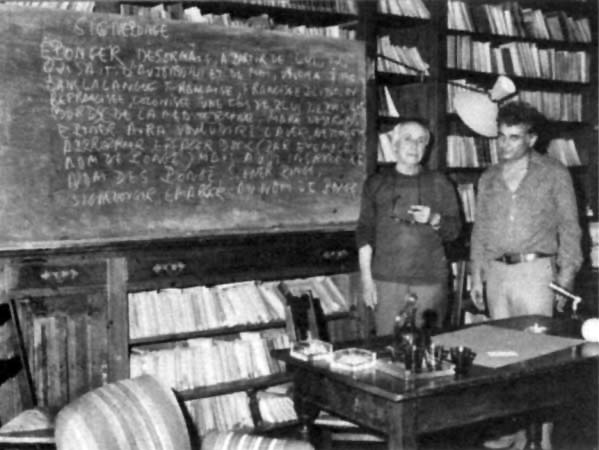
Francis Ponge and Jacques Derrida, 1975
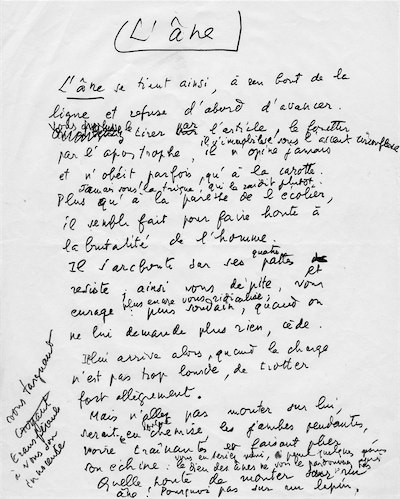
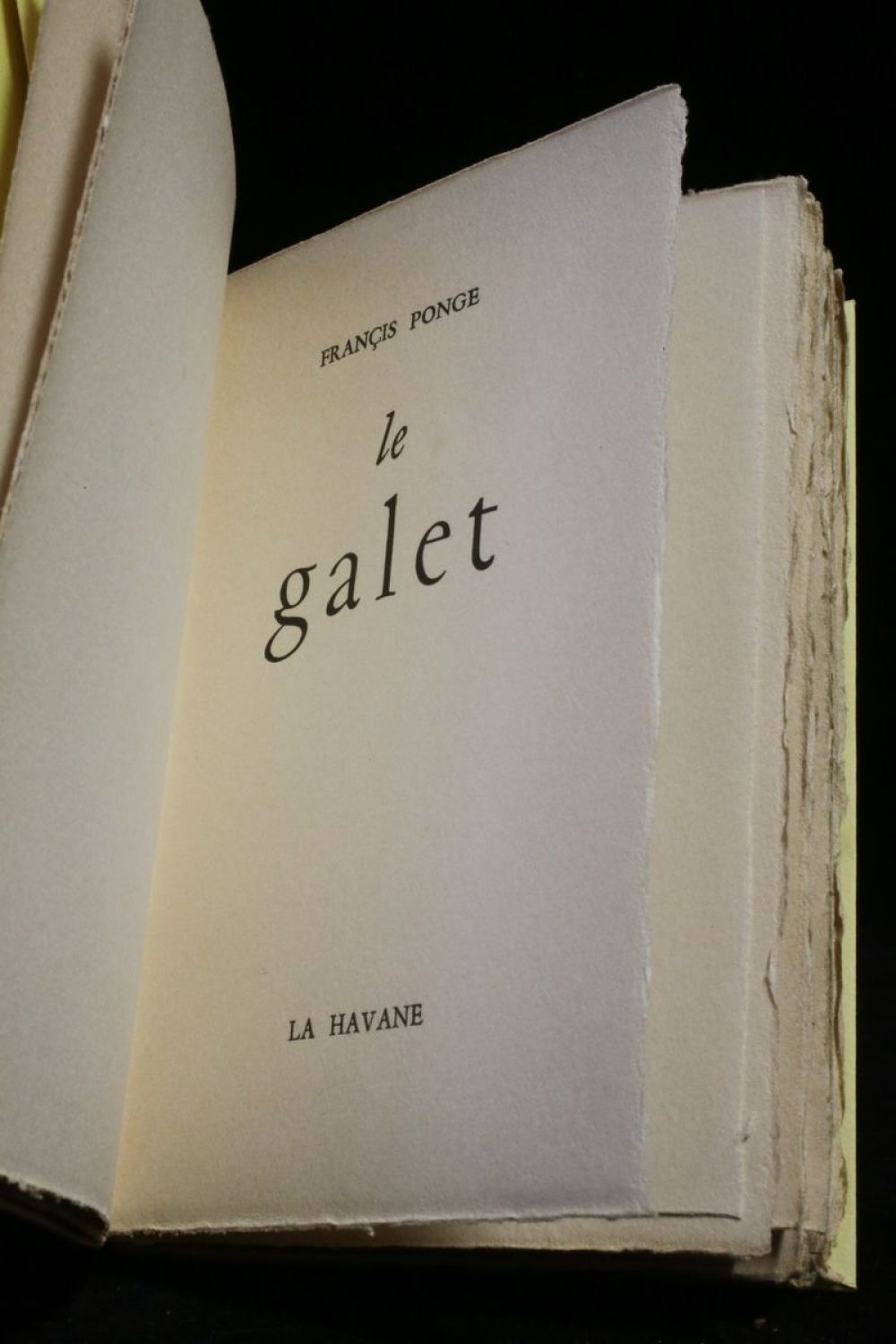
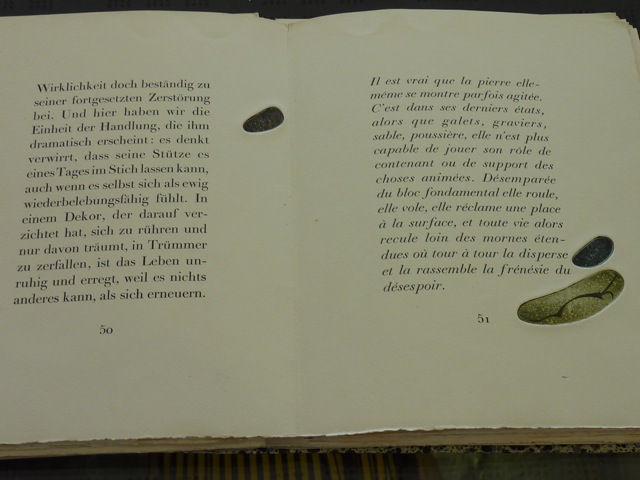
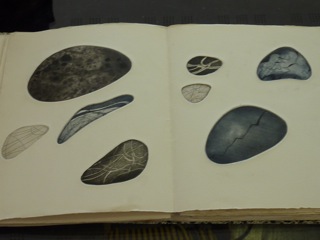
‘Le Galet’ by Francis Ponge & Man Ray
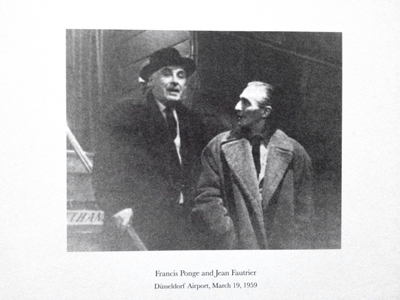
Ponge & Jean Fautrier
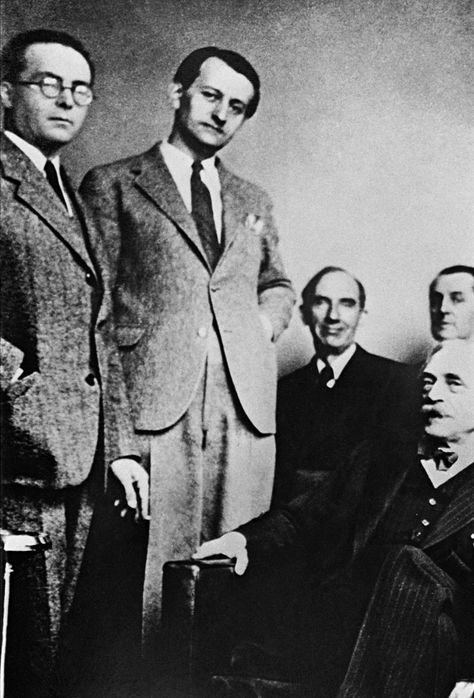
Francis Ponge, Andre Malraux, Paul Valery
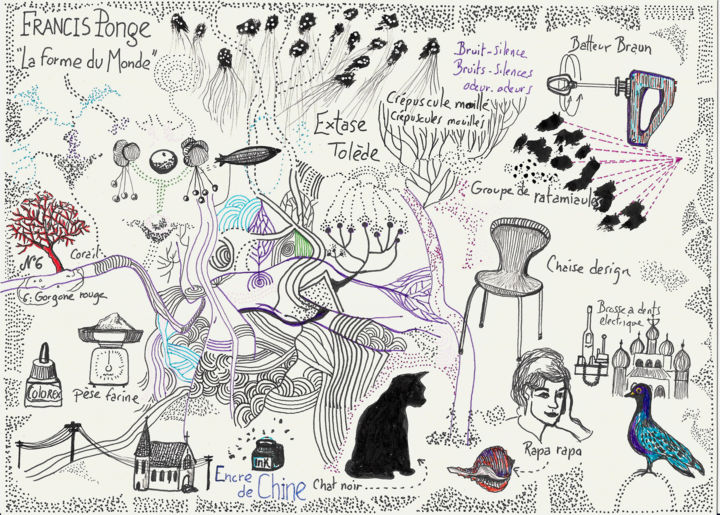
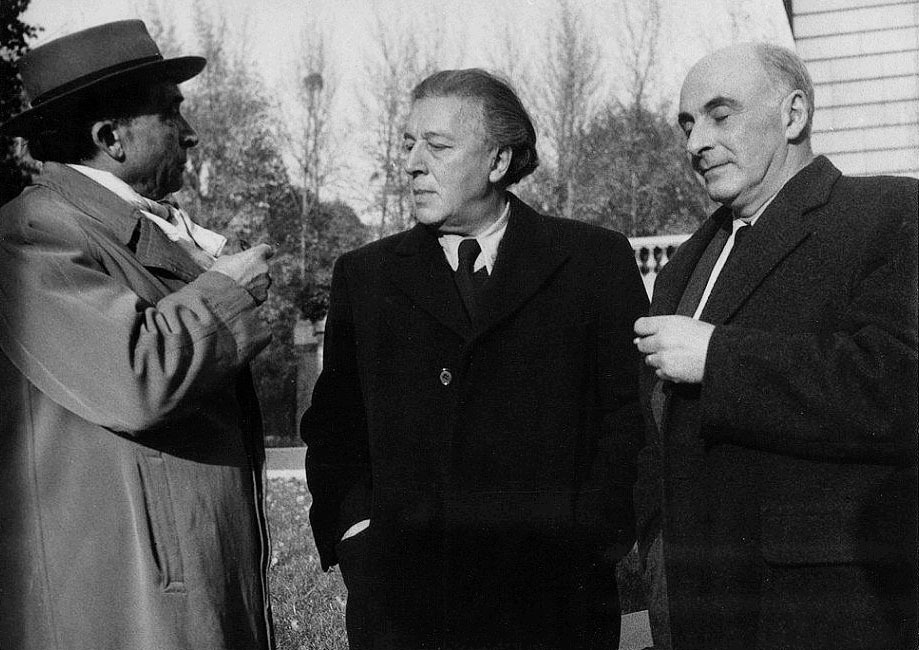
Pierre Reverdy, Andre Breton, Francis Ponge
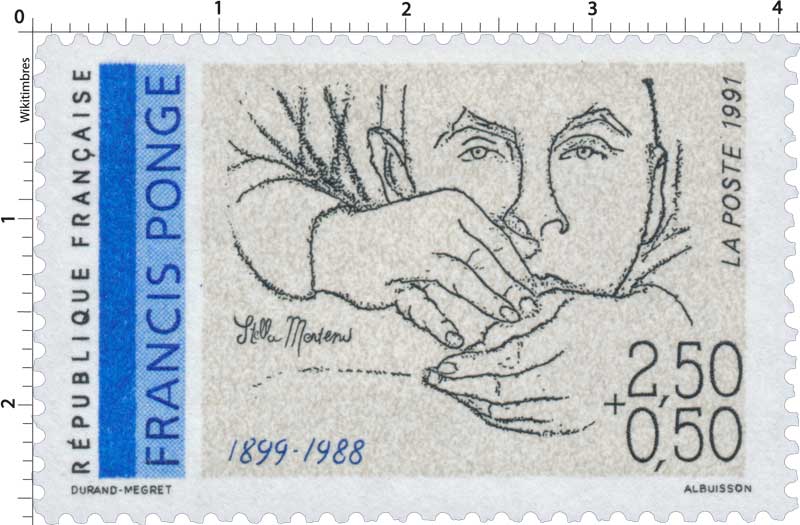
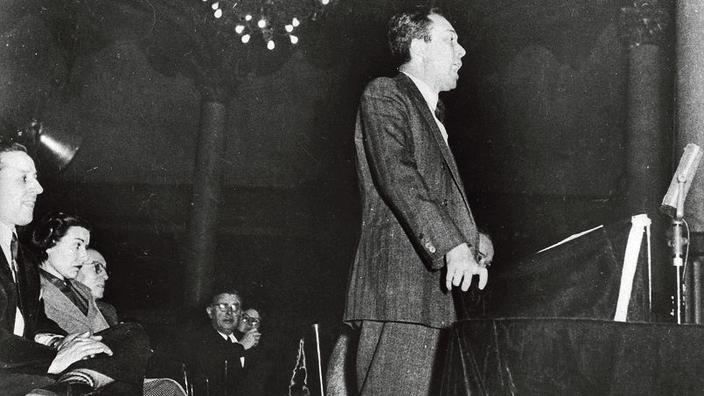
Simone DeBeauvoir, Francis Ponge, Jean Paul Sartre, Albert Camus
___
Book
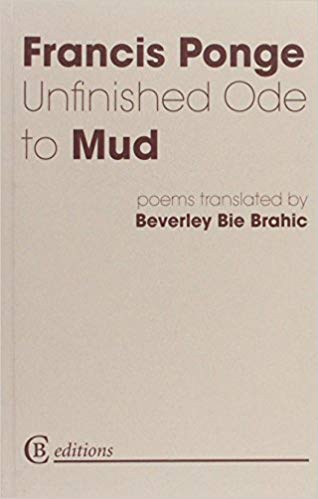 Francis Ponge Unfinished Ode to Mud
CB Editions
‘A bilingual French/English edition of new translations of prose poems by a writer praised by Italo Calvino as “a peerless master . . . I believe that he may be the Lucretius of our time, reconstructing the physical nature of the world by means of the impalpable, powderfine dust of words” (Six Memos for the Next Millennium).
‘Still radical, the poems of Francis Ponge seek to give the things of the world their due. Impatient with the usual baggage of literary description, Ponge attends to a pebble, a washpot, an eiderdown, a platter of fish, with lyrical precision; playing with sounds, rhythms and associations of words, he creates wholly new objects – “but which may be more touching, if possible, than natural objects, because human” (‘My Creative Method’).’ — CB Editions
Excerpts
Rain
The rain, in the courtyard where I watch it fall, comes down at very different speeds. In the centre, it is a fine discontinuous curtain (or mesh), falling implacably but relatively slowly, a drizzle, a never-ending languid precipitation, an intense dose of pure meteor. Not far from the right and left walls heavier drops fall more noisily, separately. Here they seem to be about the size of a grain of wheat, there of a pea, elsewhere nearly a marble. On the moulding, on the window ledges, the rain runs horizontally while on the undersides of these same obstacles it is suspended, plump as a humbug. It streams across the entire surface of a little zinc roof the peephole looks down on, in a thin moiré sheet due to the different currents set in motion by the imperceptible undulations and bumps in the roofing. From the adjoining gutter, where it runs with the restraint of a brook in a nearly level bed, it suddenly plunges in a perfectly vertical, coarsely braided stream to the ground, where it splatters and springs up again flashing like needles.
Each of its forms has a particular speed; each responds with a particular sound. The whole lives as intensely as a complicated mechanism, as precise as it is chancy, a clockwork whose spring is the weight of a given mass of precipitate vapour.
The chiming of the vertical streams on the ground, the gurgling of the gutters, the tiny gong beats multiply and resound all at once in a concert without monotony, not without delicacy.
When the spring is unwound, certain gears continue to function for a while, gradually slowing down, until the whole mechanism grinds to a halt. Then, if the sun comes out, everything is erased, the brilliant apparatus evaporates: it has rained.
The Young Mother
A few days after childbirth, the woman’s beauty is transformed.
Her face, often bent over her chest, grows slightly longer.
Her eyes, attentively peering down at a nearby object, occasionally look up, faintly distracted. Their gaze is filled with confidence, but seeking continuation. Her arms and hands bend together in a crescent, mutually sustaining. Her legs, grown thin and weakened, are gladly seated, knees drawn up high. The distended belly, livid, still very tender; the abdomen readjusts to rest, to nights under covers.
…But soon up and about, the tall body maneuvers through the bunting hung out conveniently high and low, which squares of wash, which from time to time are grasped by a free hand, are crinkled, tested knowledgeably, then folded or hung out again depending on the verdict.
The End of Autumn
In the end autumn is nothing but cold tea. All kinds of dead leaves macerate in the rain. No fermentation or distillation of alcohol: only spring will show the effect of compresses applied to a wooden leg.
The last returns are a mess. All the doors of the polling booths bang open and shut. Into the bin! Into the bin! Nature shreds her manuscripts, demolishes her library, furiously knocks down her final fruits.
Then she pushes herself up from her desk. At once she appears immense. Hair undone, head in the mist. Her arms hanging loose, delightfully she inhales the icy, thought-refreshing wind. Days are short, night falls quickly, comedy is uncalled for.
Up in the air among the other stars, the earth looks serious again. Its lit-up part is narrower, infiltrated with valleys of shadow. Its shoes, like those of a tramp, soak up water and make music.
In this frog pond, this salubrious amphibiguity, everything grows strong again, leaps from stone to stone and changes bog. Freshets multiply.
This is what you call a good clean-up, disrespectful of convention! Dressed in nothing, drenched to the bone.
And it goes on, and on, takes ages to dry out. Three months of salutary reflection in this state; without vascular incident, with neither peignoir nor horsehair mitt. Her strong constitution is up to it.
Then, when the little buds start to point again, they know what they are up to, what it’s all about – and if they peek out with precaution, swollen and ruddy, it is on good grounds.
But thereby hangs another tale, which may depend on but hasn’t the same smell as the black ruler I’m going to use to draw the line under this one.
The Blackberries
On the typographic bushes of the poem down a road leading neither out of things nor to the mind, certain fruits are composed of an agglomeration of spheres plumped with a drop of ink.
*
Black, rose and khaki together on the bunch, they are more like the sight of a rogue family at its different ages than a strong temptation to picking.
In view of the disproportion of seeds to pulp birds don’t think much of them, so little remains once from beak to anus they’ve been traversed.
*
But the poet in the course of his professional promenade takes the seed to task: ‘So,’ he tells himself, ‘the patient efforts of a fragile flower on a rebarbative tangle of brambles are by and large successful. Without much else to recommend them – ripe, indeed they are ripe – done, like my poem.’
The Crate
Midway from a cage to a dungeon, the French language has crate, a simple slatted case devoted to the transport of such fruits as at the least shortness of breath are bound to give up the ghost.
Knocked together so that once it is no longer needed it can be effortlessly crushed, it is not used twice. Which makes it even less durable than the melting or cloudlike produce within.
Then, at the corner of every street leading to the marketplace, it gleams with the modest sparkle of deal. Still spanking new and a little startled to find itself in the street in such an awkward position, cast off once and for all, this object is on the whole one of the most appealing – on whose destiny, however, there’s little point in dwelling.
*
p.s. Hey. ** Carsten, Hey. To answer your question accurately, I would need to do some research. I will say that I think it’s ridiculous and sadly telling that there are big fireworks displays virtually every night either at a sports event or music concert or an amusement park or elsewhere and very people have a problem with that, but when someone does something innovative and artistic with fireworks on rare occasions, people want to shut him down. I’ve heard very mixed things about the film of ‘Chronology of Water’, No one I know thinks it’s remotely as good as the novel. I hope your weekend ruled. ** Steve, Thanks. Her later works are odd, relative to her early works. I think ‘The Jester and the Queen’ is by far my favorite of the ones I’ve seen. My weekend … a lot of script work, coffee with a visiting curator from NY, my biweekly zoom film/book club, for which I had to watch ‘Train Dreams’, which seemed like the cinematographer wanted to make a Terrence Malick film but only half paid attention, and the director and writer wanted to make an episode of The Waltons but they took too many quaaludes. I found it unbearable. So that was my Sat/Sun in a nutshell. You finished your LP! Everyone, two big treats from Steve today. (1) He has dropped his new album HAVING A BLAST AT YOUR HUMILIATION RITUAL here, and (2) his latest “Radio Not Radio” episode featuring DJ Skaytah, Danpapa GTA, J. Cordova, De Schurrman, Iga, DJ Anderson do Paraiso, xavisphone, Kenjox & Natozie, Shadow Wizard Money Gang, Kavari, Grace Jones, the Revolutionaries, Ghost Dubs, Shackleton, Surface Access, Harriet Tubman & Georgia Anne Muldrow, Robert Grawi, Shane Parish, Hans Reichel, Tashi Dorji, Bjorn Meyer, Rachel Beetz, Aram Guleyzan, Redrose and Krone & Time is out. ** Bill, Ha, I assume he must doing quite alright. Marie Loisier did a doc on The Residents? She’s tireless. I’ll sink in if I can find it. Thanks. ** _Black_Acrylic, ‘Wolf Hole’ is interesting, much less wild than ‘Daisies’. ‘The Jester and the Queen’ is a bit more like ‘Daisies’. ** James Bennett, Hi. Is there a Gervais film prop market? Wouldn’t think so? Curious find. You’re really on the way, aren’t you? Book/film club was good. I like everything about ‘Magician’, how it’s fairytale-like like but disturbing, and maybe mostly the prose, which is crazy good. Ciao back! ** Alice, Ah, too bad about the no cinema job, but maybe it’s fate in the good way. Five Guys, wow. And what does that entail? You sound fully into what you’re working on in an engaged, confident way. You seem primed to nail it. Great about ‘Your Blues’. I think it might be all-time favorite album. Same to your week with bells on. ** Steeqhen, You’re on a roll. I haven’t seen any of those. ‘It Was Just An Accident’ is on my agenda. Yeah, we don’t qualify for that festival. Sad, oh well. We would love to show the film in Cork if you don’t making a query with that venue. Thanks. ** darbz (⊙ 0⊙ ), Hi! From the library no less! Interesting that schools still assign Salinger. That’s good, I guess. ‘Psychotic art’: sort of a nice title. Makes you want to read it. Might make you want to hate it afterwards. Sounds fun. You mean the photo of the wall? Yes, I saw it. I wanted to lie underneath it and gaze up and drift into some mental ether. No longer a crush? Well, that’s intriguing. Don’t be reluctant to be newsy about that. ** Jeff J, Hey, Jeff. As I said somewhere above, ‘The Jester and the Queen’ by my favorite of her later films. A bit of her wildness creeping back in there. Crazy amazing about the big Dorsky crowd and the reaction. Wow. You’re doing the Lord’s work there, sir. What’s next? ** HaRpEr //, Hi. My weekend was pretty good. Vain is a term that speaks to the imperfection of its user’s mental acuity. Or so says a guy who uses the word ‘great’ every ten seconds, which is a much worse offender. I don’t think you need permission to use a phrase from a lyric as a title? I’ve done it multiple times, and no artist or lawyer has ever piped up. ** Laura, Hi. I don’t know what a whole lot of my favorite films or books or art are about. If I can’t tell, that’s usually a plus. The script is hard work but going well, I think. Hm, I don’t think anything about the script writing is annoying me exactly. I’m enjoying the chasing. I suspect the blog is especial lycomfortable because you can’t see me squinting at the screen and then typing. You really did model. Wow. Thank you about ‘Closer’. Well, I did think of ‘Closer’ and ‘Period’ as bookends, so there was communing. I’m not yet zonked, but give me a few hours. ** Uday, ‘Daisies’ is a lot of fun. You’ll see one of these days. You can’t beat friendship indeed. No, I don’t care about Bad Bunny/NFL, but I see that it made Trump lose his shit, so I presume it did its job. Wingman … that means help you steer or … ? I know the word, but I don’t know what the ‘wing’ part is about. Oh, wait, I guess you just defined it. Nah, I’m not looking. I’m good. Thank you though. ** kenley, Howdy! My weekend was alright. I think I laid out its layout to Steve up above. That’s interesting: when Zac and I were in Toronto, I found myself very charmed by and comfortable with the people I met and talked to there. It’s like the LA of Canada? Happiest Monday on earth. ** Right. Do you know Francis Ponge? He’s wonderful, and the book up there is one of this best, I think. Maybe have at it? See you tomorrow.


 Now available in North America
Hi Dennis! Long time no comment.. Hope you’re well! I just ordered this book, thank you for the introduction. Will email you soon with some news, Joe x
hi Dennis – have there been any uk screenings of room temperature to date? or any planned?
Francis Ponge is a new name for me and Mud seems as good a subject as any to take its place in the literary canon. We’re now living with a surfeit of rain and mud around here and this will prompt me to pay close attention over the coming days.
Hey Dennis,
“It was Just an Accident” is surprisingly full of humour for a story about something so depressing. I really recommend it, especially for that final act.
Having my first “do nothing day” in a while, which feels strange. I know my own disposition makes me need more time than most people to ‘recover’, so I’m trying to figure out where the line between resting and rotting is. Did apply for that editorial assistant position though they posted about having an overwhelming amount of applicants so I’m a not getting too hopeful lest I get disappointed and defeated.
I’ll try get onto some friends/people I know, as someone will have easy access to the people at the Triskel who can make it happen.
hi Dennis!
ugh, Ponge and his console <3 i’m almost sad he was saddled w being such a good poet and not, like, an actual materialist or whatever bc i feel his talent weighed fuckloads on him.
ofc his self-referential poems were so great bc he wasn’t being self-referential about the poem as descriptor part, unless he was, in which case he had so much game my game doesn’t even know his lol. anyway subjectivity, unless we should call it vision, and after a certain point i want to say anything is everything, just kept coming through (rain is ‘languid’ it’s a ‘meteor’) and imo it was those bits he couldn’t escape and idek if he liked, that made everything worth it, tho they wouldn’t be much w/o the rest.
there’s obvi this communication style i’d associate w a bunch of East Asia which is v interesting, like, less heavy on sharing opinions and massive on describing observations, it can be v poetic and seems generally reassuring to people, meanwhile Ponge was so tied up in knots trying for smth quite similar… maybe he lacked a dose of silence, idk, that’s total conjecture. i love him v much for how confused objectivity made him. uh, idt objectivity is even possible w/o a bunch of contradictory shit in the mix, playing supporting parts lol. like, things have to hold bits of other things in order to be what they are, i think, in which case internal differences are maybe just a matter of how ingredients are measured up and combined? neuroscience might agree, like, male and female brains aren’t different, their specific mosaics just seem to have more of this and less of that. or maybe i’m just talking tosh =)
anyway, chase that script ya 3ami, uh, sniff out its trail, throw your spear at its horribly bulging carotid, the lot. as per this super primitive metaphor, it should be happy if you kill it, watch you w doe eyes lol.
you squint at the monitor! lol i squint at the tv lately, longterm condition causes hormonal upheaval causes blurry vision, nothing for it other than getting well, simple as! uh… so we’re both squints, that’s what we are, that’s alright. more interesting to squint at tbh ^_^
obvi i get you that Closer and Period are bookends… what gets to me is that Closer sometimes seems to anticipate Period, i won’t even qualify it, but there’s smth there. i’m finding David v moreish this time, such a weird mix of empty and full and surface and guts, reckon in the end they had to spill. poor mirror.
anyway, off to… not sure what lol. nothing maybe ^_^
oh, i finally watched Adolescence, it goes v hard. everyone is great and the kid did such a proper job. thanks for the tip! i hear there’s a second season coming up?
<3
Hey Dennis,
Well, the prop sign has been put up for sale online so I’ll let you know if such a market exists. Our hope is to find some Gervais super fan… I believe they’re out there.
Yes indeed I am on my way. Swinging many times daily between excitement and nerves. All part of the same deal.
I’ll keep my eye out for “Magician.” I read the blurb and it reminded me of this book I loved when I was a teenager – “Stone Junction” by Jim Dodge.
bye for now
xo James
hi dennis!
haha, you mustve talked to far cooler torontonians than i have! the awkwardness is charming tho, i suppose…we’re not as icy as montrealers or new yorkers. are you asking if toronto or van is the la of canada? there’s an argument for both…kind of.
sounds like a delightful weekend! meep…ive returned to pr application hell. hopefully this is the last leg…until i hear back (btw, if youll let me fawn for a second…i poked my head around my copy of closer yesterday as a writing reference, and i forgot how much alex’s chapter makes me weirdly emotional)
I hope my comment about Cai Guo-Qiang’s art & its environmental footprint didn’t make you think I’m one of those assholes who’d want to shut it down. Now I’m no great fireworks aficionado, but I’d take his madly ambitious gunpowder orgies over the routine commercial window-dressing fireworks you mentioned any day of the week. Actually it’s the latter I’d happily see shut down.
But what you said points to the root of the old frustration: how popular culture devalues art & genuine creativity in favor of empty spectacle & commerce. I’ve always argued that the sports section at the end of a newscast ought to be replaced by an art section.
Oh, re. the most environmentally damaging art in the world, I think I got the answer: the atomic bomb test footage. Maybe not meant to be art per se, but certainly used as such by the likes of Kubrick (“Dr. Strangelove”) & Conner (“Crossroads”)
Speaking of art, commerce & deliberate misuse, I got Schnabel’s “Basquiat” over with. I’ve always put it off, mainly because of how much I like Basquiat & how little I care for Schnabel. And those who knew Basquiat & criticized the film were right. One of the most energetic artists of his time gets a dead fish of a biopic. What you’d hope for in a film about an artist made by a fellow artist is some raw engagement with process. None of that here. It’s shopworn melodrama, practically a TV movie. But yeah, I wanted to see for myself. Some of the performances are fun.
Ponge was certainly onto something. He took it back to the base thing & attended to it with ritualistic devotion. The way to bring out the sacred charge in a thing is through deep, sustained attention. When you pare it back like that you suddenly begin to see the thing as if for the first time. The poet sings the origin again, goes back to name what really makes up his world. Ponge reminds me a lot of the Aztec definitions in the Florentine Codex:
“It becomes verdant, a fresh green. It becomes cold, icy. Ice forms and spreads; ice lies forming a surface. There is wind, a crashing wind; the wind crashes, spreads whistling, forms whirlwinds. Ice is blown by the wind; the wind glides”
Hey. That’s great news for me about song lyrics in book titles. I thought I was going to have to send Stephen Malkmus a fruit basket with a card that says ‘please don’t sue me’.
Vain people exist, but most people who use the word vain use it for the wrong reasons. I’d say most of my favourite books/films/albums/art have been described as self-indulgent at one point. Though, again, self indulgence is real but for me it shows itself in different ways.
Ah, I’ve still never read Ponge. ‘Soap’ is the one I’ve been meaning to get to.
These past few days I’ve been reading the Kevin Killian collected poems book and listening to ‘Impossible Princess’ by Kylie Minogue. I love ‘Action Kylie’ but I actually think I might like ‘Tweaky Village’ just as much. Kay Gabriel’s introduction is great. I think it’s really interesting what she said about the use of separate sections in his poetry books and how each poem isn’t supposed to exist just by itself but is just one voice in its own little neighbourhood.
Had a very bad confrontation today that sort of wiped me out. The whole thing is pretty pathetic. I hate getting in arguments and everyone just repeats themselves in circles and it could all go on forever. I had to listen to ‘Moon Pix’ by Cat Power with my eyes closed to try and turn my mind off. Everything in my head is going at one thousand miles an hour.
hi!
Oh, haha yes I can explain the crush thing, there is a good reason. Unfortunately I have been very busy and am tired as of this moment and my eyes and fingers only last to read this post,
Oh guess what as I was running for the bus as it came really early and as I approached It happened to close on me haha. Crushed my cigarette running there : (
Crushed cigarette, and crushed physically.
I suppose i was mentally crushing too, too until I found it all really funny 2 hours later.
got on for free. Maybe she felt bad haha
My friend gave me their criterion password and I have watched Both Araki’s Doom Generation + Totally fucked up while working on my drawing ,it was nice. Made me very happy and full-filled my dream to get my hands on Doom Generation since I saw mysterious skin.
Dennis. I feel like I’m going crazy. I thought you’d done an Unfinished Ode to Mud day on the blog before, or maybe mentioned it in a larger post. Then I went back and searched the blog using both Google and the internal search function and found nothing. Then I went through the records of the society I’m in and, sure enough, I’d read an extract there and I cannot think of another place where I’d have found it. Please help me out here. Do you remember talking about it elsewhere on the blog? Sent you an email!
Omg it’s been a minute but I was working in my mind palace the most important place to work! I am radically obsessed with Tim Dillon and his political comedic stylings and omg the LIST its so funny when I was 13 or so I was reading David Ike books about reptilian elites fucking kids and drinking blood and I believed it! So come to find out that all this dribble I filled my brain with is indeed trueish is hilarious and sad and scary mostly cause everyone is doing nothing about it! Whats been up and what was for dinner ttylxox brb with better stuff asap!
We are offering you a variety of pedicure treatments like kids massage; best places for couple massages for your beautiful feet Aira Spa and wellness center are providing you a different type of services like Massage Airdrie Spa Airdrie, is the best registered massage therapy near me. and also help them stay healthy all year long. We use the best beauty product for our customer’s glowing skin. Acupuncture Airdrie uses super-efficient nail salon in Airdrie mediceutical products to perform Threading Waxing in Airdrie, pedicure with its proven healing properties, and its intense relaxation qualities, Eyebrow Microblading in Airdrie, this fabulous range of products have been formulated with specific podiatry needs in mind. We also provide spa packages to your complete satisfaction with Facial Airdrie. We offer massage therapy with direct billing. You can contact us for your needs and requirements and also book our appointment for a better experience. Botox airdrie, airdrie laser hair removal is one of the services used by many women, it is an effective and amazing way to combat one of the most common signs of aging that is wrinkles. Varicose vein therapy is also offered by us. Best Botox Airdrie can be used to reduce your worry lines in the forehead, wrinkle between the eyebrows, smile and laugh lines and also crow’s feet. Bioflex laser Airdrie