—-
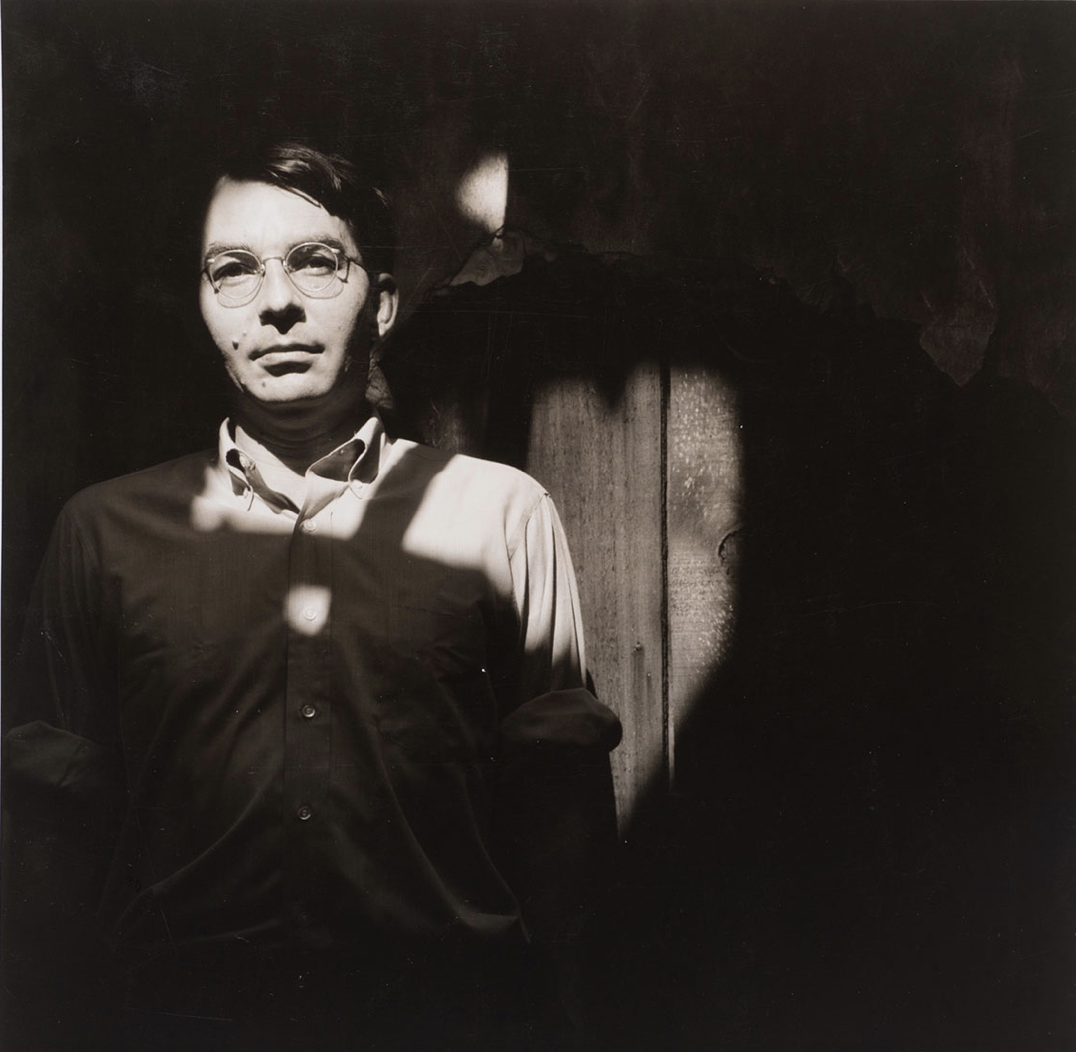
‘“Unless the work of art has wholly exhausted its maker’s attention, it fails,” Guy Mattison Davenport Jr., Ph.D. ’61, once advised. “This is why works of great significance are demanding and why they are infinitely rewarding.” The author, artist, and professor lived up to his own advice, producing works both deeply edifying and unclassifiable: nearly 50 books of fiction, essays, commentary, poetry, and translations. The arts, for him, were an attempt to explain the nature of things rather than, as science does, the “mechanics of everything.” In this sense, he considered himself a teacher foremost, and his writings “an extension of the classroom.”
‘He often joked that he had only 13 to 18 readers, but he also asserted he didn’t write “for scholars or fellow critics, but for people who like to read, to look at pictures, and to know things.” By one account, he traded mail—often including drawings and paintings—with more than 2,300 people, including John Updike, Cormac McCarthy, Joyce Carol Oates, and Dorothy Parker. Many who sought out his work considered him one of the greatest prose stylists of his generation. Erik Reece, a former student and friend, recalled experimental writer Donald Barthelme once greeting Davenport at an award ceremony with “I read you in hardback.”
‘The South Carolina-born Davenport, the son of a Railway Express shipping agent and a Baptist housewife, wrote that ambition was “unknown” to his family and his “childhood was far from bookish,” but his restless, singular mind emerged early. He left high school in tenth grade, heading north to attend Duke as a “desperately poor” undergraduate, “romantically and self-indulgently lonely,” focused on English and classics. Nevertheless, he landed a Rhodes scholarship—and would publish the first Oxford thesis on James Joyce.
‘Two years of military service and a teaching stint at Washington University intervened before he began a doctorate at Harvard, studying under literary critic Harry Levin and serving as a teaching assistant for poet Archibald MacLeish. In a 2002 Paris Review interview, Davenport recalled how Levin’s seminar on Melville greatly influenced his own thoughts on “iconography”—“how to read images in a text—that literature is as pictorial as painting or sculpture.” Otherwise, he said, he “learned early on that what I wanted to know wasn’t what I was being taught.”
‘Ezra Pound perhaps inspired him most. They met in the 1950s, while the poet was incarcerated for treason and Davenport, working on an article about Pound, wrote to him. Pound invited Davenport to visit, and they corresponded until Pound’s death. They didn’t share political beliefs, but Davenport wrote his dissertation on the poet’s Cantos and once said the best interpretation of his own work was that he was trying to do in prose what Pound did in poetry: make “ideographs.” He was enchanted by the idea that Pound and his contemporaries modernized the arts not by creating something new from scratch, but by bringing something ancient up to date: James Joyce reworking the Odyssey, for instance, or Picasso recasting African masks. Davenport’s aesthetics were akin. He called his writing style primitive and routinely referred to his stories as “assemblages”: collage-like vignettes where a page was “a texture of images” that he used to construct prose from his knowledge of philosophy, natural history, archaeology, and other subjects. “Art,” he once wrote, “is the attention we pay to the wholeness of the world.”
‘In 1963, Davenport settled in at the University of Kentucky and taught English until winning a MacArthur fellowship in 1990. In class, his student Paul Prather recalled, if an essay they were reading mentioned a bar of soap, “Davenport would stop in mid-sentence and launch into a 10-minute soliloquy on the significance of soap: its origins in the ancient world, how rarely various kings and queens of English history bathed, when the habit of daily baths caught on, the changes in soap’s ingredients over the centuries. Then, seamlessly, he’d resume reading.” On a broader level, Davenport often declared that the purpose of imaginative reading was “precisely to suspend one’s mind in the workings of another sensibility.”
‘When it came to fiction, the usually precocious writer bloomed late. Tatlin!, his first collection, appeared in his forties. Some of the stories blurred the line between fact and fiction: “The Richard Nixon Freischütz Rag,” for instance, has Nixon chatting with Mao Tse-tung; Leonardo da Vinci tinkering with a bicycle; and Gertrude Stein and Alice B. Toklas visiting Assisi. His nonfiction roamed as freely: one celebrated essay, “The Geography of the Imagination,” connects, among other things, Helen of Troy to Edgar Allan Poe, Gnosticism to Pinocchio, and an Athenian mime to Mark Twain.
‘Davenport wasn’t a political writer but had a radical idealistic streak: he was a devotee of the French utopian philosopher Charles Fourier, who believed the suppression of desire ruined civilization. In compiling his final book, The Death of Picasso, Davenport drew largely from his stories reflecting Fourier’s ideas. Characters in several of them seek ways to invent their lives as they see fit, just as he sought to do with his imagination. Indeed, for Davenport, the imagination was that vital key for unlocking the best bits of humanity. “For without desire, the imagination would atrophy,” he wrote in the essay “Eros, His Intelligence.” “And without imagination, the mind itself would atrophy, preferring regularity to turbulence, habit to risk, prejudice to reason, sameness to variety.”’ — Eric Allen Been
____
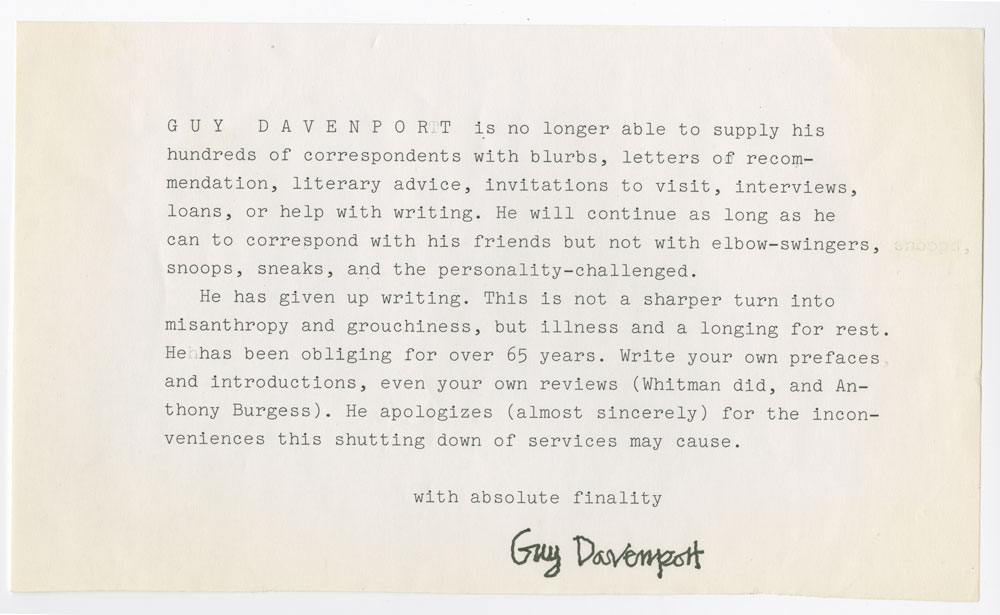
Letter
____
Further
The unlikely, energizing friendship of Hugh Kenner and Guy Davenport
A Mutual Bewitchment
COMING UP WITH GUY DAVENPORT
There Must I Begin to Be: Guy Davenport’s heretical fictions
Guy Davenport, 1927-2005
Learning from Guy Davenport
Guy Davenport: ‘As a stylist, he was breathtaking’
A Designer Remembers the Writer Guy Davenport
Matthew Stadler on Guy Davenport
____
Extras
Guy Davenport and James Laughlin – Selected Letters – Book Review
The printing and binding of Guy Davenport’s ‘Wo Es War, Soll Ich Werden’
______
Interview
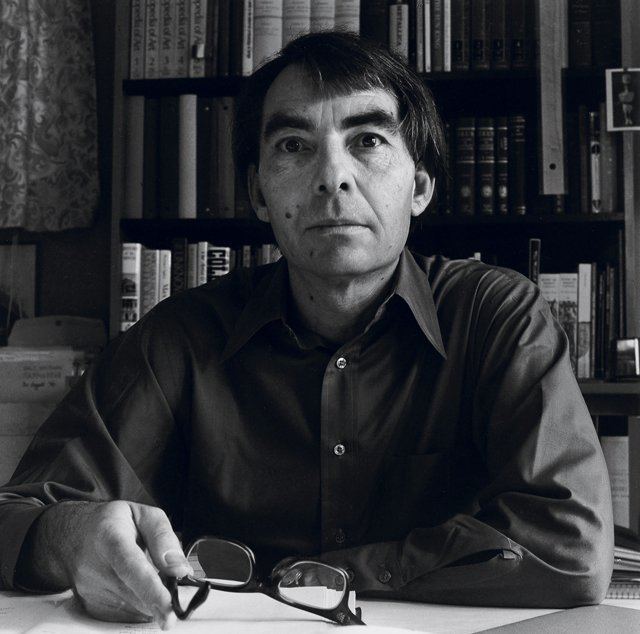
Bernard Hoepffner: A number of people in America, and some in other countries, are captivated by your short fictions and essays. I believe George Steiner wrote that you and William Gass were two of the most important contemporary writers in the States. How would you situate yourself in American (and other) literature?
Guy Davenport: As a minor prose stylist.
When you say you consider yourself as a «minor prose stylist», what difference do you make between a minor and a major writer?
Harold Bloom the Yale critic has changed major and minor to strong and weak. The terms should not apply to the author but to individual works. Many writers (e.g. Melville) wrote both major and minor works. A major work takes its art to a high perfection and is usually innovative (Dante and Shakespeare would be the great examples here). More importantly, the theme of a major work must be universal and time-defying. «Of inexhaustible interest,» said Pound.
Minor writers may have charm, a polished finish, and a kind of eccentric attraction. Thomas Love Peacock, Colette, Simenon, Michael Gilbert – fine fellows and impeccable stylists, but when compared to Tolstoy, Cervantes, Balzac, or Proust, minor. I would place Poe and Borges among the minors, splendid as they are. They are narrow. A Martian could not learn about human nature from either of them.
I am a minor writer because I deal in mere frissons and adventitious insights, and with things peripheral. Very few people are interested in what late Greek antiquity looked like to a traveller («The Antiquities of Elis») or what aeroplanes looked like to Kafka.
Do you say this because you usually write very short texts, and have never written a novel?
I’m not a novelist. Paul Klee was not a muralist. My ambition is to write as little as possible, in the smallest possible space.
All my discrete paragraphing is to force the reader to read. Most narrative prose can be read by running one’s eye down the page. If I’ve worked one hour on a sentence, I want the reader to pay attention to it. I hope there’s a web of symbols and themes running through all the stories.
Let us say that there are some readers who do not feel you as «minor» (although I heard Michael Hamburger say that «minor» writers are as important as «major» writers) who would you see as a «major» writer working in a context close to yours?
The major writers in whose shadows I grow my mushrooms are Osip Mandelstam, Donald Barthelme, Robert Walser, and Walter Savage Landor.
Your thesis was on Ezra Pound, and I suppose that you read classics and modern literature, how come your first published works (correct me if I’m wrong) were illustrations? And did you study drawing? How do you now share your time between painting-drawing and writing?
My first thesis, at Oxford, was on Ulysses; the second, on Pound, was at Harvard. I don’t know whether my first publication was drawing or writing, or where the bibliography formally begins. When I was twelve I published a daily newspaper, hectographed, The Franklin Street News (Anderson, South Carolina). It concerned itself with visits, birthdays, the birth of kittens and puppies. In Junior High School (grades seven and eight) I wrote and drew for the local city newspaper, and drew a series of sketches of old houses, with their histories.
I studied drawing and painting at Anderson College when I was in grammar school (private tuition. Clarence Brown, the biographer and translator of Osip Mandelstam, was also a pupil in these classes. A lifelong friend, he is now Professor of Comparative Literature and Slavic Languages at Princeton).
You once told me that you never sent your work to publishers but waited for them to approach you. How did you publish your first book?
My first book, The Intelligence of Louis Agassiz, was commissioned by Beacon Press, Boston. Tatlin! was the manuscript I sent to Scribner’s when they asked for a book on eroticism in Greek poetry. The only book I have sent off in search of a publisher was Da Vinci’s Bicycle. Scribner’s turned it down, as Tatlin! had sold so poorly (despite having more reviews than any book Scribner’s had published in a decade). While it was being looked at by Knopf and Athenaeum, Johns Hopkins accepted it, sight unseen, for their Fiction and Poetry Series.
Could we have a few details about your meetings with Pound and Zukofsky?
I met Pound in 1952, at St Elizabeths [no apostrophe] Hospital for the Criminally Insane, Washington. I was writing an article for the English Institute on Pound and Frobenius, and had written him asking about certain details. He invited me to visit him. I did. I saw him regularly, once or twice a year, until his release. I visited him in Rapallo in 1963 (as recounted in the story «Ithaka» in Da Vinci’s Bicycle).
Louis and Celia Zukofsky came to Lexington for a week in 1964, to participate in a seminar I was conducting. We corresponded thereafter until his death.
Did you also know Basil Bunting?
Did not meet Bunting.
What do you think of him as a poet? As an English poet (this because it seems to me that Bunting and David Jones – and Thom Gunn, but I believe he’s Americanized by now – are some of the few poets of interest in Britain in the last forty years – but I’m no specialist)?
I admire Bunting, but am not certain what he’s writing about. David Jones is a very great poet. Thom Gunn is a fine poet. His innovations come from tradition rather than nowhere.
How important are constraints (if any) you might give yourself in your writing; I’m here referring specifically to a text such as «On Some Lines of Virgil» where the paragraphs appear to have a specific length? Have you been using constraints such as those which were created for poetry when writing prose (there is, in your writing, a density that comes close to poetry)?
Constraints is not exactly the word. A style has its rules. I have used isometric paragraphs as a formal device exactly like the paragraph itself. Prose narrative has units (the chapter, areas of dialogue). Architecture may be behind much of this – «stanza» means «room». Each of my texts has its own architecture, as it has its own narrative rhythm.
By «constraint» you mean rules, order, formal devices. As in «O Gadgo Niglo», where there are no commas. Prose in blocks («Apple and Pears», «Tombeau de Charles Fourier»). Decasyllabic dialogue in «We Often Think of Lenin…», numbered and titled sections.
If not constraints in a formal sense, are there any constraints such as frame of mind, position, colour of pencil, type of typewriter, direction you are facing, etc.?
I have no superstitions about the act of writing.
Could you develop the expression «necessary fiction,» which you once used to describe your short stories; are you always aiming at reaching the tightest prose? (This description of your writing was told me by William S. Wilson.)
«Necessary fiction» means merely that if I am writing about an historical figure (Vladimir Tatlin, Kafka, Walser, Pausanias, C. Musonius Rufus) I supply weather, rooms, samovars, Greek dust, Italian waiters, and so on, not in the historical record but plausible. It does NOT mean that I give fictional accounts.
Prose: one writes, or is written. (Barthes’s great subject: that our phrases exist so extensively that an author merely arranges them).
I approach writing with the sense that my words must be chosen and arranged with care, as we live in a world of abused and meaningless words. I think it can be said that I write in order to use words in my way, for certain effects, rather than for any programmatic purpose (psychology, drama, politics, thematics).
What I write about is therefore all but gratuitous. I have enough sense of anecdote to make a narrative. But the narrative is the stage.
The prime use of words is for imagery: my writing is drawing.
Gerard Manley Hopkins said that if he could live long enough he could find a use in a poem for every word of English. Good writers can make words mean what they want them to. Henry James, for instance, works with the tones (and overtones) of ordinary words, controlling them with idioms. His style is completely colloquial, like Hawthorne’s.
I couldn’t write a novel: I’d use up all the words I would have for it by Chapter 3, and couldn’t go on.
You said you wrote two theses, one on Ulysses, one on Ezra Pound, you did not mention Greek literature. When I introduced your writing to the readers of the first issue of La Main de Singe, I mentioned Herakleitos and the fact that you were more interested in pre- than post-Socratic writers; you translated Herakleitos and Diogenes, Sappho, Herondas and a few others, you are preparing a new edition of all your translations. What are these writers, philosophers to you, the time they lived; also Holland and Scandinavia, Charles Fourier and various other themes, like flying for example, that keep cropping up in your writings? Or am I simply trying to say that, like in Borges’s short story, after a life drawing mountains, horses, etc. the artist discovers he has only drawn his face?
The Praesokratiker. I like the archaic, the dawn of things, before betrayals and downstream mud. Practically everything is hopeful at birth. The great enterprise of Confucius and Mencius was to discover and annotate a much earlier morality. I like Fourier, and the Dutch, and the Scandinavians because they are brave critics of civilization. Civilization can be lost in ten minutes, as in Germany.
Insofar as writing is essential to civilization, I am interested in how writing cooperates with other elements of civilization.
Talk about lugubrious and pompous!
Self-portraits: Hugh Kenner once pointed out that my Walser is one. Butler = professor.
What are the reasons behind your choosing a specific historical figure? Why Tatlin?
I chose Tatlin because very little was known about him, and because he seemed to me to be the archetypical victim of authoritarianism. I could also use the parallel form in Russian writing for my form (Shklovsky, Mandelstam as models).
Why Walser?
Walser is a prose Tatlin.
What are the links between your reading and your writing?
My reading is, I suppose, my chief source of material. Practically every story has a textual ancestor, but never quite alone. «On Some Lines…» is from Montaigne (with my translating his Latin and Greek examples of sexuality into action) + Bordes + a visit to Bordeaux (2 weeks) + Tati + a French sculpture of a legless boy with dog in a Beckett wheelchair that I saw at the Musée de la Ville de Paris + inventions (the uncle in the wall), and so on.
Another question would be about the use of the eye. Or the Anglo-Saxon attitude, clear in Darwin, in Doughty, Howells, Whitman, Bishop, Zukofsky, W.C. Williams, Davenport, Ronald Johnson and so many others, which implies detailed description of what is or was, letting the reader react in the way the writer did, or wants the reader to; attitude very different to the French, for example (I know the dangers of generalizing), who seem to have a preordained theory which they then apply. Induction and deduction in short. With the exception of a few writers like Fabre, the French do not seem to have produced many writers who can simply describe. What do you feel about my wooly ideas here?
L’oeil. This translates into imagery. Here I am guided by films and painters as well as texts. Max Ernst and Tchelitchev are constant guides. «O Gadgo Niglo» is a film by Bergman.
Joseph Cornell’s boxes.
Balthus.
«Christ Preaching…» is a painting by Stanley Spencer made of a collage of elements: Dufy, Mallarmé, et d’autres choses. (All the stories in Eclogues have a shepherd, and in this story He is invisible except in disguised outlines and Spencerian theology, though the story ends in a baptism.)
Fouriers’s imagery of the hordes and bands (already appropriated by Proust) I take to be some of the finest poetry in French writing of the nineteenth century. Also his verbal coinages. His psychology was vastly prophetic. I’ve had to add to his concerns Coubertin (play as sport: Fourier thought play would be absorbed into work) and the machine (he «invented» the steam locomotive, but had no notion of the airplane, not did he incorporate the hot-air balloon).
The art of description in English owes much to Flaubert (via Joyce and Pound). Théophile Gautier, RIMBAUD. (Looking for phrases from Rimbaud in my prose would render a neat little harvest, for scholars with nothing better to do.)
There’s a poem («Mosella») of Ausonius’s imbedded in «Wo es war…» translated into prose. A poem of Rimbaud’s ditto in «On Some Lines». Also bits of Cocteau here and there.
None of this is to the point, as all art is worth only the spirit of the artist. There is ultimately, no text, only the author (Bon jour, M. Derrida!). All 4 gospels are logically and even grammatically incoherent, but their spirit shines through with great brilliance. You have the advantage of the word esprit, which includes intelligence, wit, and spiritus. We dropped the old English ghost (except in Holy Ghost), which, like Geist, might have served us. A work of art is alive. That’s what art means. Inert matter (paint, words, stone) made kinetic.
No giver can know the value of the gift to the recipient. Hence the impossibility of the giver to assess, or comment on, the gift. The writer literally cannot know what he has written, just as no friend can know what his friendship means.
A reader completes a work of art. It is something «in between», a medium.
Why do you think French readers are taking so long to accept your writings?
I have always been doubtful of the French and their willingness to look at my pages. My American innocence is not refractable through the Gallic prism.
___
Book
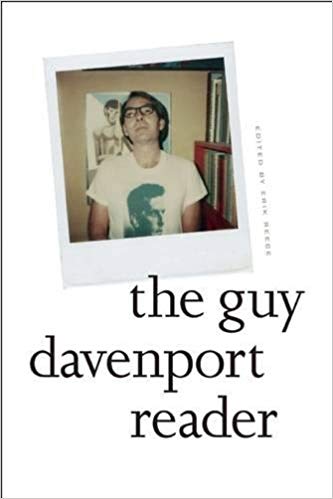 Guy Davenport The Guy Davenport Reader
Counterpoint Press
‘Modernism spawned the greatest explosion of art, architecture, literature, painting, music, and dance of any era since the Renaissance. In its long unfolding, from Yeats, Pound and Eliot to Picasso and Matisse, from Diaghilev and Balanchine to Cunningham and Stravinsky and Cage, the work of Modernism has provided the cultural vocabulary of our time.
‘One of the last pure Modernists, Guy Davenport was perhaps the finest stylist and most protean craftsman of his generation. Publishing more than two dozen books of fiction, essays, poetry and translations over a career of more than forty years, he was awarded a MacArthur Fellowship in 1990. In poetry and prose, Davenport drew upon the most archaic and the most modern of influences to create what he called “assemblages”—lush experiments that often defy classification. Woven throughout is a radical and coherent philosophy of desire, design and human happiness. But never before has Davenport’s fiction, nonfiction, poetry and translations been collected together in one compendium. Eight years after his death, The Guy Davenport Reader offers the first true introduction to the far-ranging work of this neglected genius.’ — Counterpoint
____
Excerpts
Pergolesi’s Dog
Some dozen years ago, in the middle of one of those conversations which are apt one minute to be about Proust’s asthma and the next about the size of chocolate bars in these depraved times, Stan Brakhage, the most advanced guard of filmmakers, asked me if I knew anything about Pergolesi’s dog.
Not a thing, I answered confidently, adding that I didn’t know he had one. What was there about Pergolesi’s dog to know? There, he replied, is the mystery. Just before this conversation, Brakhage had been shooting a film under the direction of Joseph Cornell, the eccentric artist who assembled choice objects in shallow box frames to achieve a hauntingly wonderful, partly surrealistic, partly homemade American kind of art. He lived all his adult life, more or less a recluse, on Utopia Parkway in Flushing, New York, sifting through his boxes of clippings and oddments to find the magic combination of things-a celluloid parrot from Woolworth’s, a star map, a clay pipe, a Greek postage stamp-to arrange in a shadow box.
He also made collages and what you could call sculpture, such as dolls in a bed of twigs; and films. For the films he needed a cameraman: thus Brakhage’s presence on Utopia Parkway. The two got along beautifully, two geniuses inventing a strange poetry of images (Victorian gingerbread fretwork, fan lights, somber rooms with melancholy windows). Brakhage was fascinated by the shy, erudite Cornell whose hobbies ran to vast dossiers on French ballerinas of the last century, the teachings of Mary Baker Eddy, and the bric-a-brac of all ages and continents.
In one of their talks Pergolesi’s dog came up. Brakhage asked what the significance might be of the Italian composer’s pet. Cornell bristled. He threw up his hands in profound shock. What! Not know Pergolesi’s dog! He had assumed, he said with some frost and disappointment, that he was conversing with a man of culture and sophistication. If Mr. Brakhage could not command an allusion like Pergolesi’s dog, would he have the goodness to leave forthwith, and not come back?
Brakhage left. So ended the collaboration of the Republic’s most poetic filmmaker and one of its most imaginative artists. The loss is enormous, and it was Pergolesi’s dog who caused the rift.
I did the best I could to help Brakhage find this elusive and important dog. He himself had asked everybody in the country who he thought might know. I asked. The people we asked, they in turn asked others. Biographies and histories were of no help. No one knew anything about a dog belonging to, or in the society of, Giovanni Battista Pergolesi. For ten years I asked likely people, and when my path crossed Brakhage’s I would shake my head, and he would shake his: no d. of P. yet found.
We never considered that Cornell was as ignorant of Pergolesi’s dog as we. In Samuel Butler II’s Notebooks there is this instructive entry: ‘Zeffirino Carestia, a sculptor, told me we had a great sculptor in England named Simpson. I demurred, and asked about his work. It seemed he had made a monument to Nelson in Westminster Abbey. Of course I saw he meant Stevens, who made a monument to Wellington in St. Paul’s. I cross-questioned him and found I was right.’
We are never so certain of our knowledge as when we’re dead wrong. The assurance with which Chaucer included Alcibiades in a list of beautiful women and with which Keats embedded the wrong discoverer of the Pacific in an immortal sonnet should be a lesson to us all.
Ignorance achieves wonders. The current Encyclopaedia Britannica informs us that Edmund Wilson’s Axel’s Castle is a novel (it is a book of essays), that Eudora Welty wrote Clock without Hands (by Carson McCullers), and that the photograph of Jules Verne accompanying the entry about him is of a Yellow-Headed Titmouse (Auriparus flaviceps). The New York Review of Books once referred to The Petrarch Papers of Dickens and a nodding proofreader for the TLS once let Margery Allingham create a detective named Albert Camus.
Vagueness has vernacular charm. A footnote in a Shaker hymnal identifies George Washington as one of our first presidents.
Cornell when he had his tizzy about Pergolesi’s dog was beyond vagueness and into the certainty of the dead wrong. Sooner or later I was bound to luck onto the right person, who, as it turned out, was wise to Cornell’s wayward-ness with bits of trivia. This was John Bernard Myers, art critic and dealer. What Cornell meant, he felt sure, was Borgese’s dog. I looked as blank as Brakhage had on the previous, fatal occasion. What! Not know Borgese’s dog!
Elisabeth Mann Borgese, daughter of Thomas, professor of political science at Dalhousie University, the distinguished ecologist and conservationist, had trained a dog in the 1940s to type answers to questions on a special machine that fitted its paws. The success of this undertaking is still dubious in scientific circles, but the spectacle it made at the keyboard of its machine stuck in Joseph Cornell’s mind as one of the events of the century, and he supposed that all well-informed people were familiar with it. La Borgese’s accomplished beast’s habit of typing BAD DOG when it had flubbed a right answer had brought tears to his eyes. He had a dossier of clippings about all this, and despite its sea-change in his transforming imagination, had no qualms about dismissing people tediously ignorant of such wonderful things.
Tough Buttons
A few months ago Gertrude Stein was at a Lexington, Kentucky, bookstore, promoting her latest. I learned this by overhearing one sorority sweetheart shouting to another on campus: “It was fab seeing her in person! I mean, you know, Gertrude Stein!”
It was Gloria Steinem at the bookstore, but what other American writer, forty-seven years dead, can claim a place in the sparse learning of the intrepidly illiterate? Gertrude Stein is firmly wedged in the American mind, together with Alice Babette Toklas. Her salon at 27 rue de Fleurus (between the Boulevard Raspail and the Luxembourg Gardens) is an echo of the eighteenth century. There, in a room as famous as any in our time, hung with Picassos, Cézannes, Matisses, and Derains, one might encounter Hemingway, Lipchitz, or Sherwood Anderson. Even Ezra Pound (he broke a chair, and was never invited again).
She is a vivid figure in the history of art, of writing, of the two world wars, of music, of popular culture, and of academic folklore. Yale printed all of her posthumous writing, six volumes of them. Periodically there are compendia, like this one, published in the thin hope that somebody will read her. Random House has kept a Selected Writings in print for decades. The general opinion is that The Autobiography of Alice B. Toklas (1933) is charming, that Three Lives (1908) is significant, that her operas (scores by Virgil Thomson) are great fun, but that the large part of her copious works is unreadable. It takes heroic effort to make one’s way through the thousand pages of The Making of Americans, and conscientious students who have read A Long Gay Book and Stanzas in Meditation and How to Write should be issued a medal by the American Academy.
The century will end with our having to admit that we have learned how to read some, but not all, of its writing. Joyce and Pound demanded a redefinition of the act of reading. It is still not clear what Gertrude Stein was trying to do. Where we can understand her, she repays attention in great measure. We can specify fairly accurately what of hers we can and can’t read, and to what degree her pages make sense. At one extreme is the easy, flexible style of the Autobiography, and at the other the “Cubist” nonsense of repetitions and agrammatical phrases of A Long Gay Book (whose title does not mean what you think). In between, we have the epic echolalia and logorrhea of The Making of Americans, and the plays and operas, which always make a kind of sense. We can understand The Mother of Us All in the same way that we understand Mother Goose and Edward Lear (and shall we add Wallace Stevens?). (cont.)
Master Taxonomist
Medicine in eighteenth-century Sweden had not yet caught up with that of Hippocrates (died 485 B.C.). Linnaeus once put two teenage virgins in bed with a sick old man (as per 1 Kings 1:3 and 15), though he did suspect that microscopic “mites” were the carriers of disease, anticipating Pasteur by a century. But he believed in the phoenix and unicorns, and that swallows wintered at the bottom of ponds.
He doubted the biblical account of the universe, as well as other parts of Scripture. He went to church out of a sense of duty to propriety, he and his dog. When he was ill, the dog went in his stead, leaving (like his master) as the sermon droned into its second tedious hour.
Linnaeus the man is harder to get into focus than his crackpot science. A recent discovery of his travel diary in Lapland shows that a segment of his famous journey to the Saami is fiction. He deferred his marriage until age twenty-eight, after a four-year-long engagement. The wife was something of a termagant and shrew. His emotional life centered around his students whom he called his apostles. He sent them on far-flung expeditions to bring back botanical and zoological specimens. Nothing was excluded from his curiosity: he had Peter Kalm write his doctoral thesis on the American birch-bark canoe. He wrote a prodigious number of books. (cont.)
On Balthus
Henry James’ “The Turn of the Screw” (which now that we have Balthus seems Balthusian) is a skirmish on the border between the inner worlds of child and adult. James follows with symbols the serious misunderstanding between the interiority of the two realms…
…..
Modern French writing has been interested in childhood and adolescence in a way that American and English writing has not. The French see not an innocent but an experienced mind in the child. [Henry de] Montherlant treats children as an endangered species needing protection from parents.
…..
Gide’s understanding runs parallel, except that he makes allowance for the transformation to maturity. The child in Alain-Fournier, Proust, Colette, Cocteau inhabits a realm imaginatively animated with a genius very like that of the artist. Children live in their minds.
…..
Baudelaire saw genius as childhood sustained and perfected. There is a sense among the French that adulthood is a falling away from the intelligence of children. We in the United States contrast child and adult as we contrast ignorance and knowledge, innocence and experience.
…..
We do not give our children credit for having arrived at anything. They have no driver’s license, no money, no sexual emotions (and are forbidden them), no real sports they can play, no power. Balthus’ children are as complacent as cats and as accomplished in stillness.
On Cormac McCarthy’s Outer Dark
Appalachian America has kept in the archaic courtesy of its speech and in the still uncompromised meanness of its ethnic jealousies an inviolable identity unmatched anywhere else in the United States. It is our Balkans. Appalachian speechways, uncorrupted by slang and impervious to innovation, put at the novelist’s disposal a timeless epic diction; and the wildness of Appalachia exhibits for him a range of seasoned and ingrained depravities the ancient universality of which allows a tragic terror more sobering than any the portrayer of sophisticated agonies can hope for.
There is a strange awfulness about Appalachia that quickens the imagination. Its traditions are unconscious and deep in the bone. It still believes in fate. The Calvinist still walks there in Bunyanesque starkness. The world is an allegory and no violence however sickening is ever quite unexpected in the course of a day. It bears its poverty with Celtic dignity and looks at life with the Celtic disbelief in its permanence. And in the Tennessee novelist Cormac McCarthy it has found a new storyteller to depict the darkness of its heart and its futile defiance of its luck.
Mr. McCarthy’s first novel, The Orchard Keeper, won the William Faulkner Foundation Award three years ago. This, his second, is even finer. Though it pays its homage to Faulkner’s rhetoric and imagery, it is not a Faulknerian novel. It is much leaner, closer in pace and spareness of line to the Gothic masters Gertrud Le Fort and her disciple Isak Dinesen, and lacks Faulkner’s sociological dimension. Mr. McCarthy is unashamedly an allegorist. His responsibility as a storyteller includes believing with his characters in the devil, or at least in the absolute destructiveness of evil. As in Chaucer’s “Pardoner’s Tale,” the moral symmetry of which is thoroughly Appalachian, you can hear mortality whetting its scythe behind every line. (cont.)
On Wittgenstein
Wittgenstein before he came to philosophy was a mathematician, an architect, a sculptor, a mechanical engineer, a grade-school teacher, a soldier, and an aviator. He could have followed any of these careers doubtless with brilliant success; just before he came to Cambridge (they gave him a doctorate at the door) he was strongly inclined to “be an aeronaut.” Every account of his strange life indicates that he tried to teach. He did not dine with the faculty, as the faculty in all its grandeur always dines in academic gowns, black shoes, and neck tie. Wittgenstein was forever tieless and wore a suede jacket that opened and closed with that marvelous invention: the zipper; and his shoes were brown. He held his lectures in his rooms, in the continental manner. As there was no furniture except an army cot, a folding chair, a safe (for the Zettel), and a card table, the students brought their own chairs. Philosophy classrooms in our century have frequently been as dramatic as stages: Santayana, Samuel Alexander, Bergson — men of passionate articulateness whose lectures fell on their students like wind and rain. But Wittgenstein, huddled in silence on his chair, stammered quietly from time to time. He was committed to absolute honesty. Nothing — nothing at all — was to escape analysis. He had nothing up his sleeve; he had nothing to teach. The world was an absolute puzzle, a great lump of opaque pig iron. Can we think about the lump? What is thought? What is the meaning of can, can we, of can we think? What is the meaning of we? If we answer these questions on Monday, are the answers valid on Tuesday? If I answer them at all, do I think the answer, believe the answer, know the answer, or imagine the answer?
It was apparently not of the least interest to Wittgenstein that Plato had answered certain questions that philosophers need to ask, or that Kant or Mencius had answered them. He sometimes liked other philosophers’ questions; he seems never to have paid any attention to their answers. Truth was stubborn; Wittgenstein was stubborn; and neither faced the other down. We have to look back to the stoic Musonius to find another man so nakedly himself, so pig-headedly single-minded. He actually taught for very little of his life. He was forever going off into the Norwegian forests, to Russia, to the west of Ireland where — and this is all we know of these solitudes — he taught the Connemara birds to come and sit in his hands. He mastered no convention other than speech, wearing clothes, and — grudgingly and with complaint — the symbols of mathematics. The daily chores of our life were wonders to him, and when he participated in them they became as strange as housekeeping among the Bantu. …
Wittgenstein did not argue; he merely thought himself into subtler and deeper problems The record which three of his students have made of his lectures and conversations at Cambridge discloses a man tragically honest and wonderfully, astoundingly absurd. In every memoir of him we meet a man we are hungry to know more about, for even if his every sentence remains opaque to us, it is clear that the archaic transparency of his thought is like nothing that philosophy has seen for thousands of years. It is also clear that he was trying to be wise and to make others wise. He lived in the world, and for the world. He came to believe that a normal, honest human being could not be a professor. It is the academy that gave him his reputation of impenetrable abstruseness; never has a man deserved a reputation less. Disciples who came to him expecting to find a man of incredibly deep learning found a man who saw mankind held together by suffering alone, and he invariably advised them to be as kind as possible to others. He read, like all inquisitive men, to multiply his experiences. He read Tolstoy (always getting bogged down) and the Gospels and bales of detective stories. He shook his head over Freud. When he died, he was reading Black Beauty. His last words were: “Tell them I’ve had a wonderful life.”
—-
*
p.s. Hey. ** David Ehrenstein, Hi. I still have the Lou Reed pic/flexi disc somewhere, I think. My one exchange with Nico at the Pyramid went like this: Nico (very strung out, sweating, a mess): ‘Do you have any heroin?’ Me: ‘No.’ Nico: ‘Do you knew where I can get some?’ Me: ‘No, sorry.’ Jim Fouratt, who’d brought her and Ari there to try to score heroin for her, was running around asking people if they had any, and he did eventually get her some, and they left. Everyone, Should you be interested in seeing a ‘partial reconstruction of Jerry Lewis’ never-released “The Day the Clown Cried” (1972) about 28 minutes of it in German with English subtitles’, Mr. Ehrenstein has hooked you up. Here. ** Misanthrope, I need a turntable too. I’ve been saying that to myself for years. Cool re: your novel progress, natch! ** _Black_Acrylic, I love picture discs too. Have a big bunch back in LA. And I don’t even mind that they tend to make their recordings sound crackly and squashed. Nice looking Ciccolina disc there. ** Jeff J, Thank you, Jeff. And especially happy that the Zulueta post was useful. Well, I must admit I’m glad JC don’t sound like the Oh Sees. Nothing against them, mind you. And I didn’t really think you guys would go in that direction. I must have been insufficiently caffeined. Yeah, Davis’s ‘Essays’ book is the gift that just keeps on giving. What an incredible trove. I do like Rae Armantrout’s work, yes. Mm, I tend to suggest the ‘Selected’ in situations like this, as an intro to help figure out if you’re more into a certain era or not. Hers is called ‘Partly’. I did do a post on Pierre Jean Jouve way back. It’s among the dead. I’ll look to restore it. I think it might’ve been a spotlight on the book Lydia translated, but I’m not sure. ** Damien Ark, Hi, Damien! Good to see you, pal. Wow, your novel’s being published! Holy shit, man, that’s really great news! A year lag time is pretty standard. It can take even longer, so that’s not too bad, and this coming summer is virtually in sight already. Hm, yeah, maybe queer transgressive lit will make a comeback. Centrist gay lit sure is making a big comeback (Garth Greenwell, Ocean Vuong, Alexander Chee, etc.), and rebellion seems likely. My new novel has French and German publishers so far. The US thing is taking for-fucking-ever for reasons too complicated to explain, but I’m really, really hoping that its US home will be cemented really soon. No release dates. Probably 2021 sometime. Yes, it’s my ‘autobiographical’ novel. Comparatively at least. Take care, sir, and, again, huge congrats re: your novel! ** Toniok, Hi! That sounds productive and pleasurable, cool! I … don’t think I know Mariana Enriquez’s work unless I’m forgetting. I’ll find out. Thanks. Little Walter is great! I haven’t his name in ages. Huh. Enjoy the concert. I’m hitting a three-night long Sunn0))) concert this weekend. ** Corey Heiferman, Hi. I couldn’t get into that first link. Its source might be blocked in Europe. Happens a lot. But I’ll watch the vid imminently. I saw a trailer for that new Jodorowsky in the theater the other week, and I have to say it looked so awful that I’ve been swearing off seeing the movie ever since. Not sure if I can take it. Although I do seem to have ended up seeing his more recent films eventually, for better and/or worse. ** Steve Erickson, Feel a lot better. I hope you are already. ** Okay. Are you guys familiars of the wonderful work of Guy Davenport? If not, if so, may I recommend you peruse today’s spotlit collection of his selected writings? See you tomorrow.


































































 Now available in North America