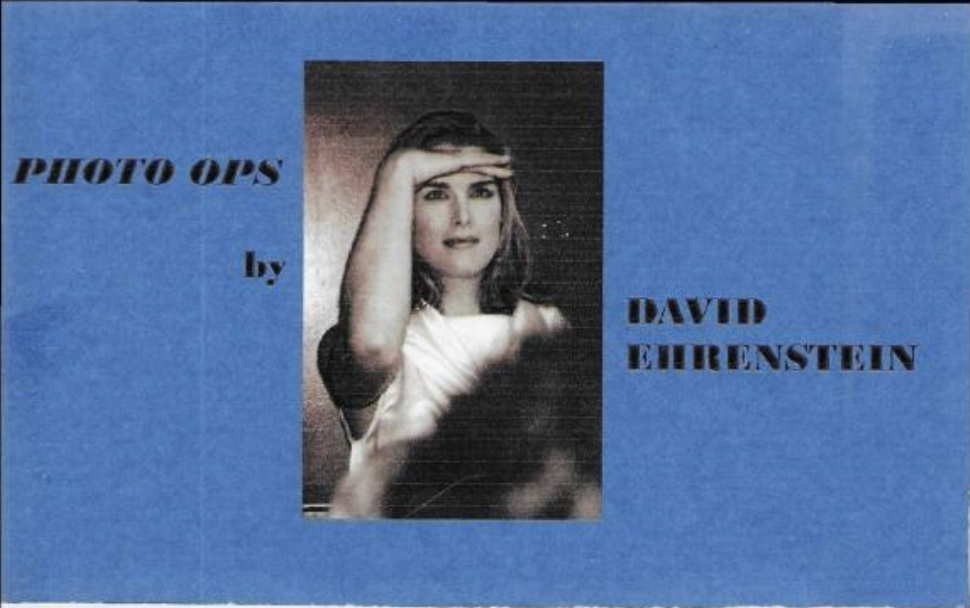
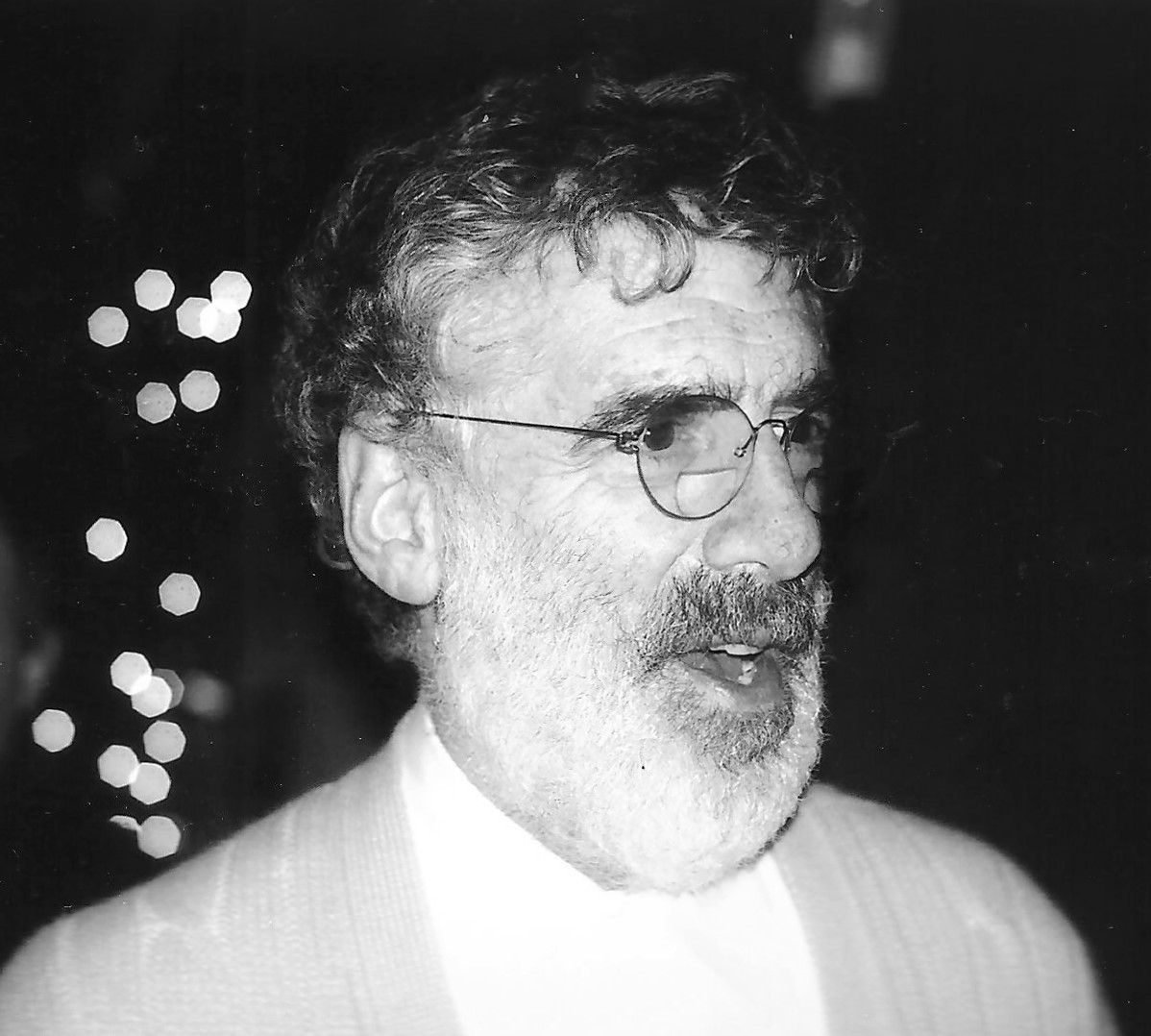
Photo-ops consists of photographs taken quite casually over a considerable number of years of sundry notables in the arts and culture. Among them: Barbara Steele, Tilda Swinton, George Clooney, Claudia Cardinale, Martin Scorsese, Terri Garr, Jacqueline Bissett. Michelangelo Antonioni, Gdal and Wong Kar Wai. None of these subjects were posed. Each image captured a random yet precise moment in space and time. To quote Susan Sontag: “Photographs really are experience captured, and the camera is the ideal arm of consciousness in its acquisitive mood.” She also notes “To photograph is to appropriate the thing photographed”
It all began rather inauspiciously back in 1989 when I was planning “The Scorsese Picture: The Art and Life of Martin Scorsese” and realized that as it was going to be heavily illustrated it would be a good idea to take some pictures of my own. So I bought a Minolta and used it to take shots of Marty and Thelma at work on “Cape Fear.” It grew from there to take in whatever or whoever passed before me.
Bill Reed is editing an annotation providing context for these images.
Here are Two Photographs not taken by me:
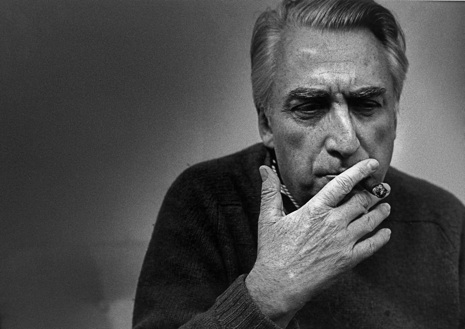
Roland Barthes
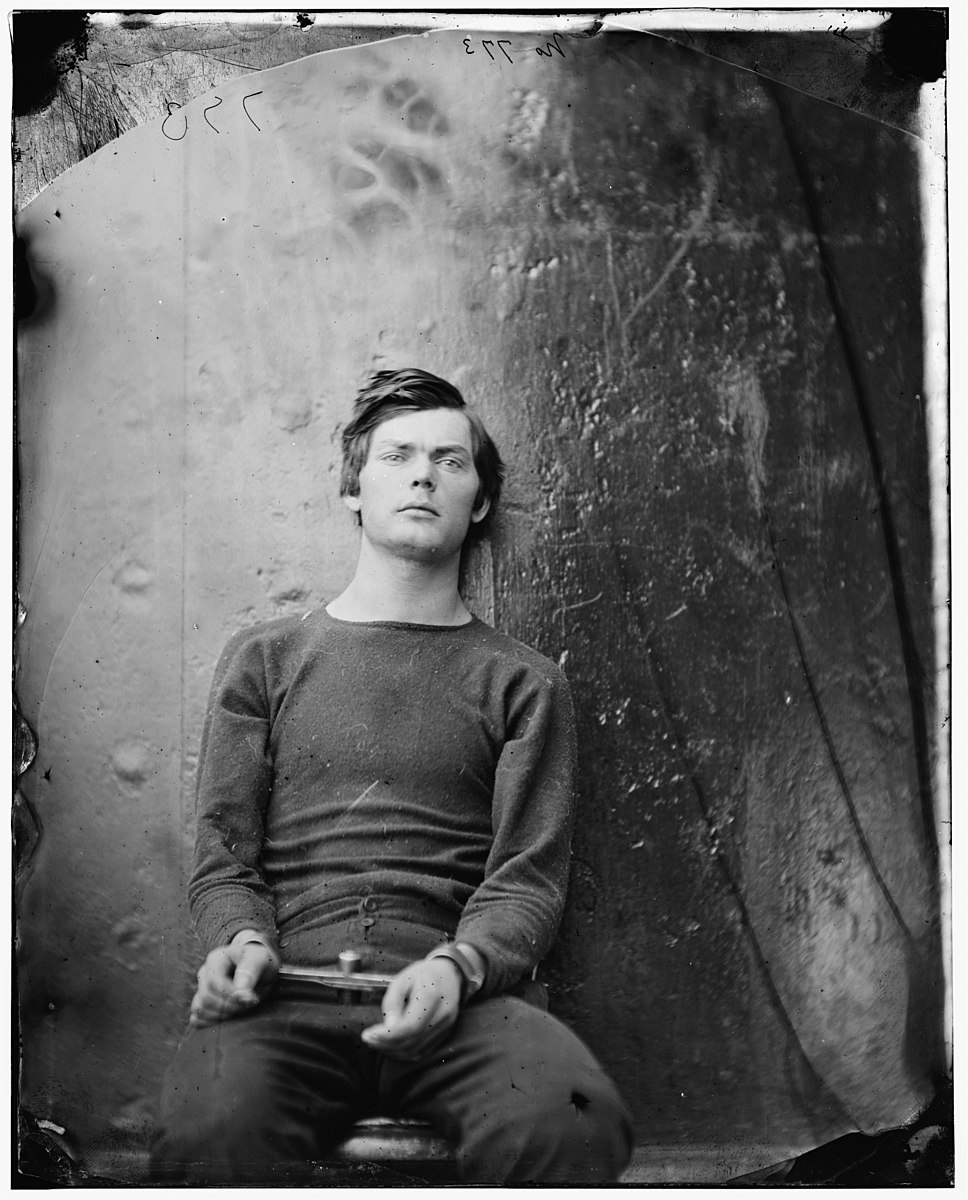
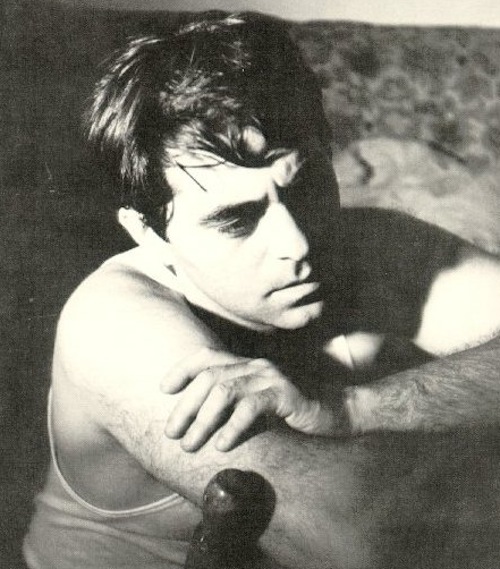
And Lewis Powell about whom Barthes said — “He is dead and he is going to die”. Photograph of Lincoln assassin Lewis Powell taken by Alexander Gardner in 1865
“The photograph is handsome, as is the boy: that is the studium. But the punctum is: he is going to die. I read at the same time: this will be and this has been; I observe with horror an anterior future of which death is the stake. By giving me the absolute past of the pose, the photograph tells me death in the future. What pricks me is the discovery of this equivalence.”
Powell was obviosly Roland’s “type”
“The Photograph is an extended, loaded evidence — as if it caricatured not the figure of what it represents (quite the converse) but its very existence … The Photograph then becomes a bizarre (i)medium(i), a new form of hallucination: false on the level of perception, true on the level of time: a temporal hallucination, so to speak, a modest (o)shared(i) hallucination (on the one hand ‘it is not there,’ on the other ‘but it has indeed been’): a mad image, chafed by reality.”
“Usually the amateur is defined as an immature state of the artist: someone who cannot — or will not — achieve the mastery of a profession. But in the field of photographic practice, it is the amateur, on the contrary, who is the assumption of the professional: for it is he who stands closer to the (i)noeme(i) of Photography.”
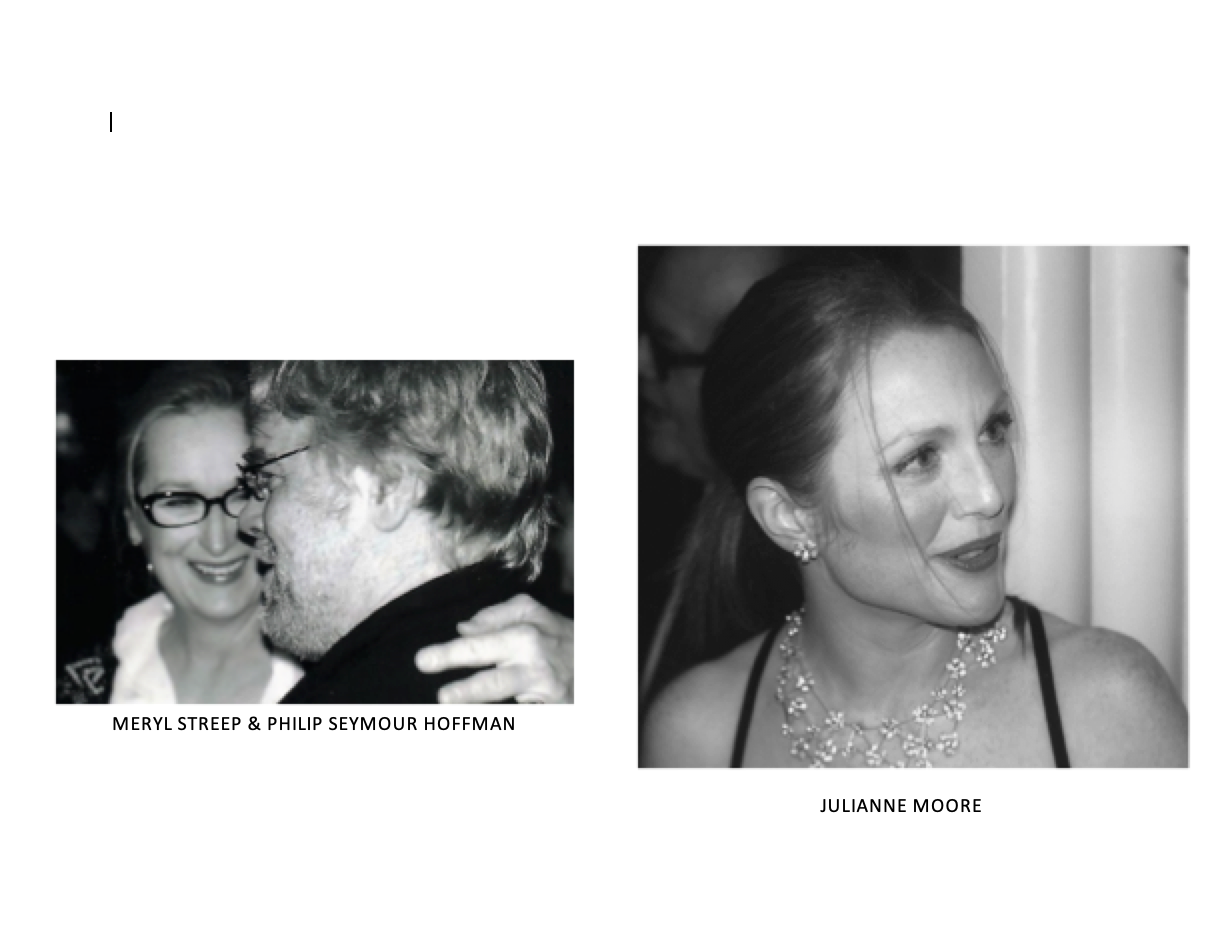
Both starred in the film Doubt (2008). Ehrenstein was free-lancing press coverage. He recalls that on the set Hoffman told him that when a take was over, his Method technique was still deep in his character, but Streep began hanging out with the crew, cracking jokes, etc. This was passed along by Hoffman with total respect and admiration for his co-star. Died of a drug overdose in 2014.
CLAUDIA CARDINALE
Star and Muse for Federico Fellini (81/2), Visconti (The Leopard), and Sergio Leone (Upon a Time in the West), this Photo Op was taken on the occasion of a tribute to Leone in Hollywood in 1998.
“The most offbeat star in the history of cinema,” avers Ehrenstein. Amply demonstrated by his lead in Robert Altman’s film version of Raymond Chandler’s The Long Goodbye (1973).
(Johnny Marvin “If I Had a Talking Picture of You”)
*
p.s. Hey. Today the blog transfigures itself into a red carpet of sorts so Mr. David Ehrenstein can walk his and Bill Reed’s new kindle/book of pix selected from David’s decades of snapping the famous and great into the theater that we call the world, and this post reveals an initial tiny array of its goodies. Please be attentive and, ideally, salivate or some equivalent. Thanks, and thank you, David. ** h (now j), Saint John is super singular and a plus for anyone’s memories, I think. I do of course remember your poetry scholarliness. I hope the rain held good things. I will be ready to kill for some starting tomorrow if our forecasters are correct. Best of luck with your deadlines! ** _Black_Acrylic, Oh, right! I totally spaced on the Kier interview! I would have housed it here in a heartbeat if I hadn’t. Damn. Everyone, the great artist Kier Cooke Sandvik submitted to an interview with the legendary and partly _Black_Acrylic-edited zine Yuck ‘n’ Yum on the topic of yesterday’s blog superstar Shaye Saint John a few years, and you can and really, really should read it for, like, a billion reasons. Here. Whoo-hoo on the Premier League qualification! ** David Ehrenstein, Enjoy today, I hope. Everyone, Mr. E has done a new thing on his FaBlog and, if you’re a USA person who even remotely follows the news, its title — “It Is What It Is” — will surely tell you exactly what it’s about. Here. ** Jeff J, Hi, Jeff. I didn’t know that about Lincoln Center thing either. Do, obviously, take that opportunity. Oh, Daniel Schmid Day is finally popping up here tomorrow. Fingers strangled on the screenplay, and fist pump on the Georgia retreat score! I love XTC and Andy Partridge in general. I was lucky to get to see XTC a few times before Partridge freaked out. To me, ‘Mummer’ and ‘The Big Express’ is where they start losing their adventurousness and their greatness begins to taper off, but I think there are some really great tracks on both of them. My favorites are kind of the obvious albums: ‘Drums and Wires’ and ‘Black Sea’. Also, if you can manage to get them, there’s this fantastic pair of LPs from 1982 that collect their singles and B-sides respectively: ‘Waxworks’ and ‘Beeswax’. XTC’s B-sides were often as great as — and more experimental than — their album tracks. No, the meta-intervention into the Walser piece turned out to be unnecessary. The piece needs to live or die on the Walser text. Zac and I did a pretty heavy edit on the overly verbose play while we were in Rennes, and I think that has hopefully solved a lot of the problems. Bon day, man. ** JoeM, I’m forced by being over here and my impatience to acquire books that I want to read to stick to mostly pdfs and eBooks. Less pleasurable but less cluttering, I guess. ** cal, Yes, I think that was Saint John’s intention. ‘Glamour that doesn’t really go anywhere’: I like that. That’s a lure. Enjoy family life. Nice that that’s nice. Nice family, I mean. I seem to be good. Dreading an imminent brutal heatwave, but good, working, the usual. Happy Wednesday! ** chris dankland, Hi, Chris! Oh, shit, I’ll go find it. Hold on. Okay, gotcha. I’m glad you’re already enjoying the teaching after only one day, and, obviously, I’m glad your school is one of the wise ones. What was I like in 5th grade? Hm. Quite nerdy. Not popular. Overly tall. (I grew too fast.) I was kind of best known at school for this handmade zine I made and sold to my schoolmates called ‘Flunker’. I’d handmake/ write/ draw, like, 7 or 8 identical copies of each issue and charge kids at school 50 cents or something to buy it. It was kind of notorious. It was very influenced by Mad Magazine because I was completely obsessed with Mad Magazine at that age. Sadly not a single copy exists anymore. Oh, and I can’t remember if I was in 5th or 6th grade when I got hit on the head with the axe ‘cos recovering from that occupied a lot of time. But I think it was 6th grade. I was 11, whatever year of school you’re in when you’re 11. What about you in 5th grade? Pony up, man. I’ve had some awesome dark coffee, and I intend to have a lot more before the day is through. xo ** Bill, Hi. The person Saint John reminds me most of is a kind of brain damaged Ryan Trecartin. But, yeah, I get the Johanna Went thing too. I, of course, say give the difficult route all you’ve got before you go simple, but then go simple without a care or trace of guilt if you do. ** Damien Ark, Hey. Oh, yeah, I do miss the comments that show up while I’m doing the p.s., and it’s only once in a blue moon that I remember to check back to see if I missed anything. Uh, figure out a way to de-shittify things around you ASAP. There’s always a way. You’re pretty resourceful, man. And enjoy the good stuff. The good stuff is all life has to give. xo. ** Okay. Please help make the birth of David’s book a pleasant one, whatever that entails. See you tomorrow.
‘Generally described as a second-generation member of the New York School of poets, American poet Joseph Ceravolo, born in 1934, is actually closer in age to the first generation. Ceravolo was born in a sort of middle-time, like Ted Berrigan (also born in 1934). Although his literary tropes and ideologies were not so different from those of the first generation, he did not continue to pursue that generation’s attention to verbal play in his later poems. His 1967 work Wild Flowers Out of Gas is intensely lyrical, as is 1965’s Fits of Dawn and the brilliant, award-winning volume, Spring in the World of Poor Mutts (1968), and these works were also verbally innovative Yet, like the second generation poets, Ceravolo eventually abandons youthful and playful poetics to create a more personal writing.
‘Moreover, there’s something unique about Ceravolo’s poetics, an outsider sensibility, as if he hadn’t fully dedicated himself to the literary innovations the first generation Manhattan and Long Island-based writers were attempting.
‘Ceravolo was neither a poetry teacher nor an editor of poetry journals, as were so many of his contemporaries. He worked for most of his life as a civil engineer. He lived not in Manhattan but in Bloomfield, New Jersey, with his wife and children, haunting the territory of William Carlos Williams in Paterson and Weehawken Park, and expressing his kinship with Williams and Walt Whitman, both unlikely influences for a New York School writer.
‘Born into a deeply religious Italian family, Ceravolo’s intensely romantic sensibility further distinguishes his work from the New York School poets (with the possible exception of Bernadette Mayer). The standard New York School influences — the art world, New York street life, and cartoons and pop culture and, later, postmodern transformations of these concerns — barely appear in Ceravolo’s poetry.
‘Even in the early experimentation of Fits of Dawn, in which he plays with sound and association, there is something different about Ceravolo’s tone. Prior to the experiments of the avant-garde Language poetry school in the late 1960s and early 1970s, his manipulation of language and word choices distance his work from standard New York School experiments:
Ache outsent insistment palm Papa
nothing jobular at vanim
Villain! Jabel violin
Of chaining reachness carvey kid
…..
Go! Run! Bay tacxico
rigor rubbing outset hapbel
queer carun kiakiha cheek
vine chain notion,
ruts who peyon
toxic anger catch
Beat tan fon reshuffle
rugged helical tone torture
……….
‘While this poetry may be difficult to interpret for many readers, the passion beneath it seethes like an emotional volcano. Where is the “ache” coming from, and who are the “villain” and the “carvey kid.”? Why are we told to “Go! Run!”? And who or what is the subject or object of the “queer carun kiahika cheek”? Why is there a “rugged helical tone torture” and from what does it emanate? And from whom is the “toxic anger” coming?
‘By the time he published his award-winning volume, Spring in the World of Poor Mutts, Ceravolo had turned his romanticism into complex love poems, such as “Ho Ho Ho Caribou,” a joyous celebration of his wife and children (dedicated to Rosemary):
I
Leaped at the caribou.
My son looked at the caribou.
The kangaroo leaped on the
fruit tree. I am a white
man and my children
are hungry
which is like paradise.
The doll is sleeping.
It lay down to creep into
the plate.
It was clean and lying.
VI
Caribou, what have I
done? See how her
heart moves like a little
bug…….under my thumb.
Throw me deeply.
I am the floes.
Ho ho ho caribou,
light brown and wetness
caribous. I stink and
I know it.
“Screw you!….you’re right!”
‘The joys he expresses earlier in the poem, however, are counterbalanced as he demonstrates his failures as a human being. And throughout this book he visits black bars and other places where he is seeking out something we can’t quite know but are encouraged to try to imagine, a world clearly outside of his more conventional life.
‘Despite his love of his wife and family, the poems in his later volumes of the 1980s reveal an equal sense of guilt, perhaps for other loves he can’t quite express or admit to, or perhaps simply as a narrative device. In “Road of Trials,” for example, again a poem dedicated to Rosemary, he writes:
I cry
yay test hell cry of
tubes like boiling
meat.
I want to touch
you but can’t
‘This sense of distance grows throughout his oeuvre as he appears to express“feminine” feelings, often casting himself in the female role in poetic descriptions of the sex act. Lines from “Nude Madness” from his 1982 collection, Millenium Dust, prefigure Pedro Almodóvar’s 1989 film, Tie Me Up, Tie Me Down:
Nail me to this rock!
Would it hurt too much?
Would it be a cushion
against reality
a self consciousness
of the human body
and human movement
a game of cheating sexuality?
It scares me more to think
of the nucleus of an atom
than to imagine a revolution.
‘The short poems that comprise the final sections of this new anthology, gathered as Mad Angels and Hellgate, show the poet looking to his children, their lives, nature, and the sociopolitical issues of his surrounding world, as source material. These poems are brimming with anger at US politics. Still, there are moments of deep self-doubt, and a fear of his personal appetites, expressed through radical disjunction in language:
Domination in creation
The stars are clear tonight
We live in a house
we dwell in a cave
deep in the dragon’s soul.
‘Ceravolo died of bile duct cancer in 1988 at the age of 54 in 1988. In much of his work, he seems to be on an almost religious pilgrimage, moving away from the center of his life and family, then back again. As readers, we want him to enjoy the pleasures of his life, but we realize that if he had, we would be denied the complexity of his poetry. One can only wish that he had lived longer to express more of what his incredible talent had promised.’ — Douglas Messerli
_____ Reading for the Collected Poems of Joseph Ceravolo With David Lehman, Charles North, Ron Padgett, Anselm Berrigan, Peter Gizzi, David Shapiro, John Perreault, Eileen Myles, Susie Timmons, Timothy Donnelly, Jordan Davis, Ariana Reines, Corina Copp, Corrine Fitzpatrick, John Coletti, Thurston Moore, Anita Ceravolo and Parker Smathers.
_______________________ Letter to David Shapiro, 6/29/65
Dear David,
I was so glad to get your letter. We never did meet at Weequahic Park for lunch but they’ll be other times for that. I used to go to the park every day and write. Each day I’d write a few lines of what I thought was a complete poem. Then I put them all together and called it The Green Lake Is Awake.
Anita is crying now. Paul is sleeping and Rosemary is getting ready for bed. She has it pretty rough being with them all day long. We seldom get out. Sunday we went to the movies of 8th St. N.Y. and saw The Red Desert by Antonioni. It’s a beautiful film about a woman or women in general, and how they are so confused in this world or the anti-nature world that man trys [sic] to make for himself. Sometimes it’s such an unnatural world where none of his real feelings come through. On the way out of the movie we met Ted Berrigan going in. He is publishing my long poem and it will probably be out next month. Rosemary made a beautiful cover for it. It’s called FITS OF DAWN. I’m starting to get nervous and excited about it.
I read your poems a number of times. Of the three little ones I liked “What do you say, bank named for a cripple” etc. best. Of the long one part I I liked better than part II. In fact I found something nice in all of them but sometimes a line or word brought me down and I couldn’t get with the reality that you must have felt. What I mean is at the sacrifice of making it a sure poem, you may have taken something from it. What I felt most was Part I.
I think I’m obsessed with reality, I don’t mean realism but that sense of reality, like “I’m really here and I feel it” even though I can’t explain it. Something like that. Which everyone feels and you recognize it when you see it in a poem.
As for my own poetry, I haven’t been writing much at all. Maybe it’s working inside me but who knows. Sometimes I think maybe I’ve done the best I could and everything [cut off in photocopy] through my head. I go to the clinic at 9:00 pm on tuesday night and talk to my psychiatrist for an hour. Many unsettled things. Who wants to transmit my neurosis to my children? or hold back love to my wife? I’ve had needed to go for a long time and finally I’ve done it.
I just can’t wait for my vacation. We are going down the shore. The Jersey shore is so beautiful. We went to North Wildwood last year and that water and sand and us playing in the sand is on my brain.
Tell me about where you are. Is Julie with you? I hope she’s all right. That was a pretty big experience she went through; and you too.
A Music & art form. It sounds great. Or is it — not as good as it sounds. That word I obliterated was “boring.” I didn’t want to give you any ideas. But I can’t really imagine it.
NEWS ITEMS
1. Newark reservoirs are very low. Everyone is walking around dirty.
2. Paul is always dirty but gets a bath every night and a shower.
3. Every time the weather is really hot the fish in the lake keep jumping out and you think you saw something but it was real.
4. Rosemary is almost finished with therapy. Her husband is just starting.
5. No amount of wisdom or learning can make a person live in the present. He just has to live.
6. The west does not understand the east.
7. Nor does the east “ the west.
8. They are both the same — naked.
9. Poetry is a flock of geese flying out of formation being in formation.
10. This news is bullshit. But it was real?
Regards to Julie. Love from Rosemary.
Joe
_____ Interview
____ Book
Joseph Ceravolo Collected Poems Wesleyan University Press
‘Like an underground river, the astonishing poems of Joseph Ceravolo have nurtured American poetry for fifty years, a presence deeply felt but largely invisible. Collected Poems offers the first full portrait of Ceravolo’s aesthetic trajectory, bringing to light the highly original voice that was operating at an increasing remove from the currents of the time. From a poetics associated with Frank O’Hara and John Ashbery to an ever more contemplative, deeply visionary poetics similar in sensibility to Zen and Dante, William Blake and St. John of the Cross, this collection shows how Ceravolo’s poetry takes on a direct, quiet lyricism: intensely dedicated to the natural and spiritual life of the individual. As Ron Silliman notes, Ceravolo’s later work reveals him to be “one of the most emotionally open, vulnerable and self-knowing poets of his generation.” Many new pieces, including the masterful long poem “The Hellgate,” are published here for the first time. This volume is a landmark edition for American poetry, and includes an introduction by David Lehman.’ — WUP
Excerpts
Lighthouse
All this summer fun.
The big waves, and waiting
(the moon is broken)
for the moon to come out
and revive the water. You look
and you want to watch as
men feel the beer breaking
on their lips, and women seem like
the sun on your little back.
Where are you closer to everything?
in the plants? on the photograph or
the little heart that’s not
used to beating like the waves’ foam?
A wasp is
looking for a hole in the screen.
No. There’s no man in the lighthouse.
There’s no woman there, but there is
a light there; it’s a bulb.
And I think how complete you are
in its light. Flash……… Flash…..
………………………………
And I think of how our own room
will smell; You lying on one bed
and we in the other,
facing the… flash…..
…………………Flash
Love Song
Like a punch in the face
planetary lights and stars,
do I see Spring.
The ground is frozen.
Dawn like the colors of an old fire
illuminates the south-east.
The ground is frozen solid,
yet not to permafrost,
yet not to this inner core
which glows like coals for you.
Overcast comes, overcast goes
the ground is frozen but not the core,
but not your eyes
which glow like coals
but not to permafrost.
Where Abstract Starts
I sit here it is 4:00
Should I say it?
Death occurred to me
And the fit over bounded
My physical thought
As I lie here
Great Plains
What, no one here? No one
around here? No buffalo?
Like sleeping on the toilet bowl…
Drifting toward love…
The dogs are out this morning
jumping on top of each other
Is there a real release with them?
But, no one here.
There’s no buffalo, only dogs,
this morning, where dawn
and a wild wild bird fly away.
Autumn Torches
Monday morning in the Americas
cloudy bright, cloudy bright,
cloudy bright, clouds to bright.
The earth people going to work.
So this is what it’s like
to be in a trance awakened by the fires
and silence in the cold
with soft voices disappearing.
The day coming on like an intoxication
with no control on the watery shore
of struggle in autumn.
Monday morning
the screech of my eyes
opening into dawn
My eyes speeding to the woman
standing over me;
In my ear
a mother and father returning
for an instant, the bread and coffee
on the hot stones
in the next room dream.
I have turned in my sleep.
Do I enter the deep?
Monday morning creation ascending
to celestial paradigm
in the conflagration
of dumped computers
and magnetic erasure of world data.
The coffee staining
the arms straining,
a ladle pouring
ingots in the noise.
The strength returning
to the center of the crossed body
Another kiss another sigh
Monday morning:
in the sky
a bird’s cry.
Nothing
Nothing exists that does no empty.
Who are you feeling?
Who do you bite in the morning?
Our health?
when we’re sick
is the body coming.
Our love,
a mountain fuming
in the ocean
like a graceful race such as
black. When the shores overtake
in the continent.
When the heroes are phony,
and our house less than rubble
will there be a bite, a memory still left?
*
p.s. Hey. ** David Ehrenstein, Hi. I wonder if he knew Jack Smith’s work? The first time I saw ‘Pomegranates’ was way back at a screening held by an Armenian activist group at the Los Feliz theater that was a benefit to raise awareness of his imprisonment and money to get him a retrial. Yeah, it’s a true masterpiece. Btw, I got everything fine via email, and we’re set to go. Everyone, FaBlog takes on the whole masks vs. no masks US-based deal in a little ditty entitled Mask-O-Phobia. ** Misanthrope, Kind of figured. So often do, ha ha. Same here on the sudden ups and downs, thank god. I guess it’s not a hurricane anymore? Suppose it’ll still bring a drenching. I guess because one walks to a lot of places where one is going here in this cozy big city, I’m out a lot. Well, did that prize car pan out? Lots o’ luck. My weekend was hardly glorious, but it did the trick. Yours? ** Bill, ‘Pomegranates’ is incredible. The two shorts he made just before it, ‘Kivski Freski’ and ‘Hakob Hovnatanyan’ are beautiful too, and his subsequent feature ‘The Legend of the Suram Fortress’ is pretty great as well. Did you sort the technical problems? Yeah, California seems to be a total fucking mess. So sorry. ** JoeM, Hi. Did you ever see images, or maybe video (?), of the collaborative performance piece Shane did with, I think, Martin Bladh where Shane played a Nilsen victim and Bladh played Nilsen, and Shane got symbolically ‘snuffed’ on stage? I think I was thinking of it more than of his writing. I could be wrong, but I think I read somewhere that Shane has another book coming out next year with Infinity Land Press? I’m not absolutely sure about that though. He is really prolific. Kind of amazingly so. I think moving to the UK, if he still lives there, is really suiting him. ** h (now j), Hi. ‘Pomegranates’ and the films from that period are stunning. His early films and the films he made post-prison aren’t as great, imo. In general, it’s been a lovely, mild summer with one horrendous day last week and apparently one or two horrendous days coming this weekend. Could be worse. My trip? You mean to Rennes? It was good, just working with Gisele on her upcoming theater piece, an adaptation of a play that Robert Walser wrote when he was a teenager. It still needs a fair amount of work, but there’s time. I hope you’re getting through the summer in one mega-piece. ** _Black_Acrylic, Very nice, that park. About half of the Parisians wear masks outdoors now, but the social distancing is quite good. I don’t do outdoor masks myself. Rumor is that we’ll be mandated to wear masks outdoors soon though, or if the cases keep rising a little bit as they currently are. Stay ultra-safe. Did you end up watching the Higgins doc, and was your dad swayed? ** Okay. If you don’t know the work of the wonderful and very strangely undervalued New York School poet Jospeh Ceravolo, you really should, and today offers you a chance. See you tomorrow.




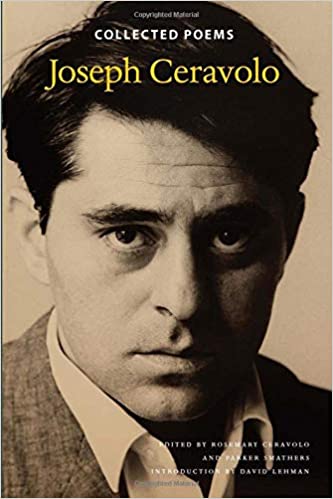 Joseph Ceravolo Collected Poems


 Now available in North America