‘Born in 1965, Morton Viskum is considered one of the most provocative and controversial contemporary artists from Scandinavia. The artist’s unconventional choice of materials, themes and artistic expressions often seduces and invites the viewers to experience a range of unexpected emotions, causing shock, amazement and uncontrollable curiosity.
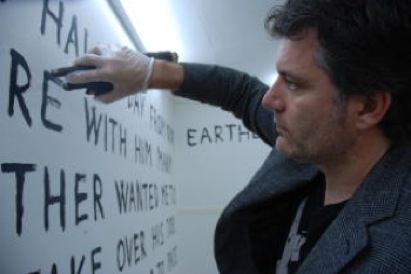
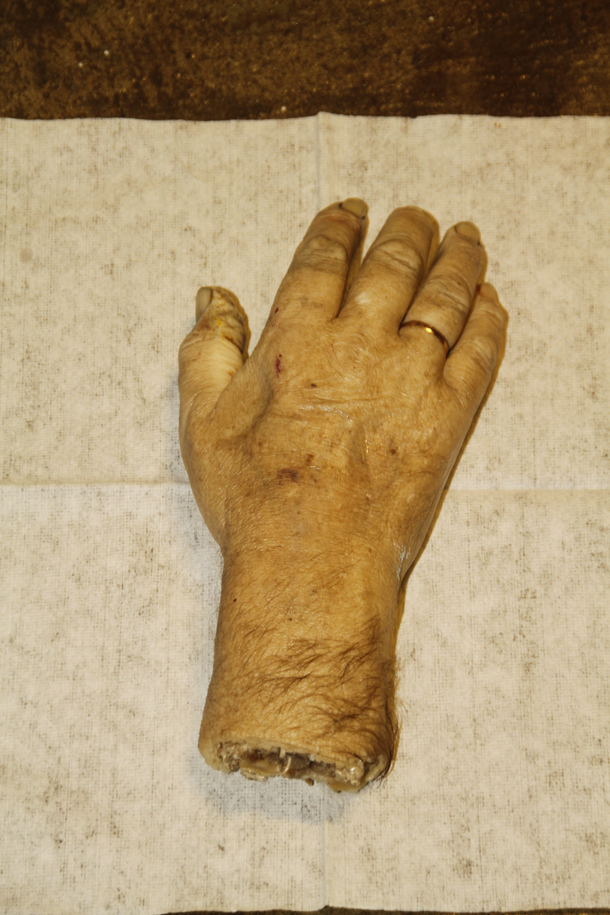
‘For his first London solo exhibition ‘The Hand with the Golden Ring’, the artist did a live performance during the evening of the private view; the thrill was caused by the fact a dead human hand was used live as a paintbrush, demonstrating how the new series of paintings were created. It was not the first time the artist made use of a severed human hand as a paintbrush to compose paintings; Viskum actually owns several hands, they are not merely tools; the idea of the hand being linked to an immortalized personality is absolute central to those occasions when Viskum paints with it.
‘Viskum gained notoriety in the art world when back in 1999 he showed at an exhibition in Copenhagen the very first series painted with a dead hand: ‘The Hand that Never Stopped Painting’. Carefully the hand used was placed in a metal box with a lid and the viewers decided for themselves if they wanted to see it or not. Over a decade later, the hand is still a strong and a significant part of his art projects; when painting with them each hand expresses a different style and the paintings embody a certain personality.
”The Hand with the Golden Ring’, unlike the others, evidences an aggregated object: the golden ring suggests vanity and affluence of the diseased; the golden ring acts as a counterfactual narrative; the object put contingency back into an obsequy, serving as a necessary antidote to traditional deterministic tendencies. The presence of the ring initiates an obituary and for the viewer it evidences a sense of the human futile materialism. Who the hands belonged to initially, is one of Viskum´s well kept secrets.
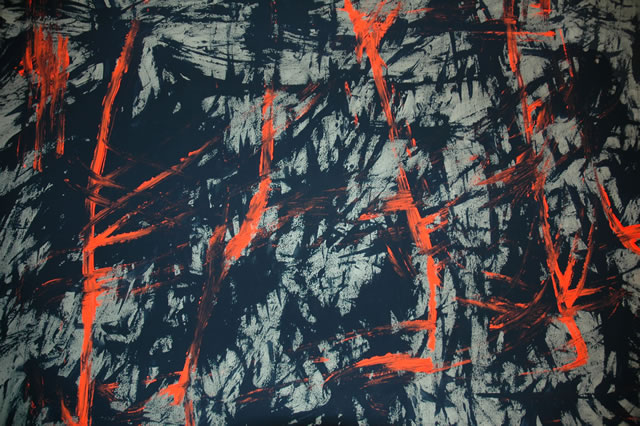
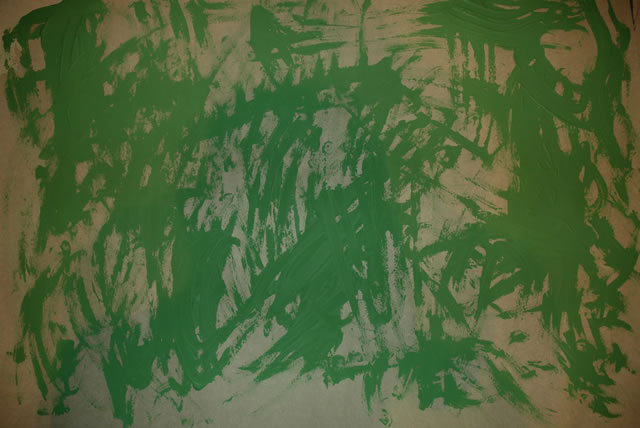
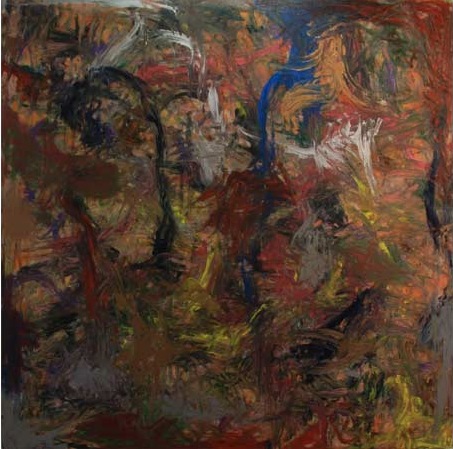
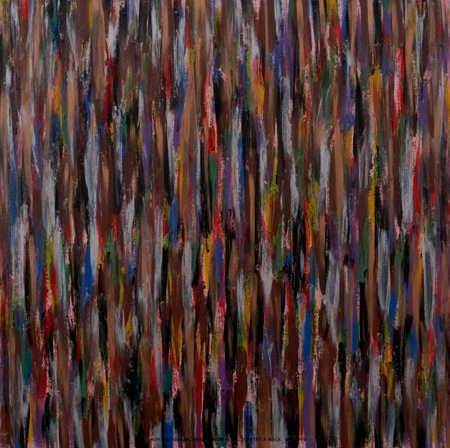
‘By this approach, the art appears performative, more as an action, and not as much as an object-related material presence. By using one hand from a dead human being as a paintbrush, Viskum draws attention towards the work process. One can easily recognize the patterns caused by the hand’s presence, formed by abrupt lines, applied vertically in many layers and in many colors, adding a vibrant feeling of rhythm to the surface of the scintillating painting. These paintings bring to mind American Action Painting, an art form where the painting finds no premeditated composition and the focus is set on the event that created the art rather than on the object itself.’ — Vegas Gallery
You are generally regarded as one of the most controversial contemporary artists in Norway. How do you describe what you do to people who don’t know you?
I usually start by describing my background as a veterinarian before I started at the Art Academy in Oslo. At the same time I tell people that a lot of the things said about me originates from the tabloid press. The projects written about here only make up a small portion of what I do as an artist. Many of my projects concern everyday phenomena within medicine and science, things that the public are not used to seeing and hearing about.
Is controversy an important and intentional part of your work?
No. To shock is not interesting in it self.
But the projects have lead up to a lot of interesting discussing that have made the projects worth seeing though. When the projects are exhibited for the first time, I sometimes get insecure if I have lost sight of the primary goals within the projects. And revealingly it seems that the projects get better over time. I take this as a good sign.
Can you tell us a bit about ‘The hand with the golden ring’?
The different Hand – projects develop, both concerning concept and technique, based on the background information I have.
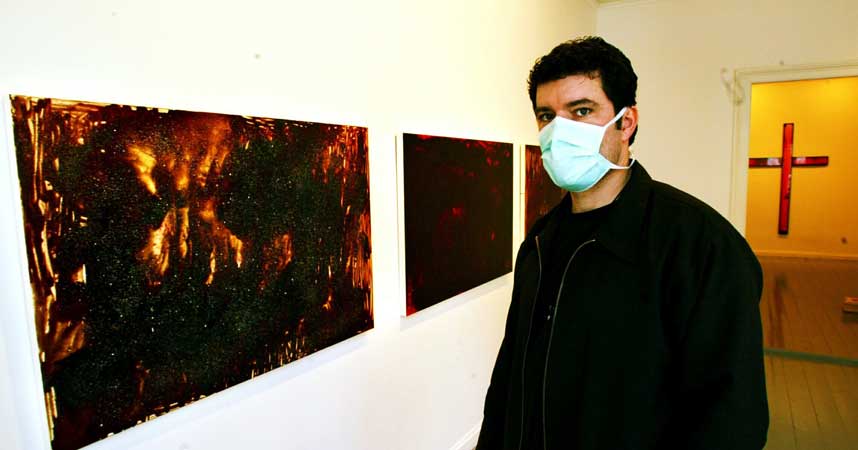
The hand with the golden ring is hand number 6. All the paintings are new and made for this exhibition. First the canvas is painted with animal blood, using the severed hand as a brush. Then I place some gold glitter in the palm of the severed hand. Then I blow the glitter over the blood. At the end I paint over the glitter again with different colours, again using the hand as a brush.
How easy is it to source dead people’s body parts for the work?
That is a part of the project’s secret.
The nature of your work inevitably is going to divide audiences. What is the most common criticism that you hear? How do you deal or react to it?
Most of the time the people that criticize my work are the people who do not come to see my exhibitions and who do not make an effort to enter into the problems the projects discuss. Other people fear death too much and therefore do not want to touch the subject. Others again think using the severed hands is just a cheap trick. Luckily, a large group of people, growing after each exhibition, are fascinated by and interested in the work just because they are not made in a traditional sort of way.
The people who have been following my work over time also know, of course, that most of the time the projects are concerned with what you can not see, more than what is actually there.
Throughout art history artist have visited mortuaries and autopsies to paint and draw the human anatomy. I extend this tradition a bit further. I remove the body parts from the morgue and use the body parts directly as tools. The performative aspect is therefore the most important part of the work and what happens when the audience encounters the remains of the performance.
____________
The instruments
The first hand
The black hand
The hand with the golden ring
The new hand
The female hand
_____________
The paintings
______
Extras
The Black Hand
Maler med død hånd
Morten Viskum Vernissage Absolut Viskum III Unplugged
13 Weirdest Works Of Art
*
p.s. Hey. Welcome to first of my three days away from the blog due to work in Bas Normandie preparing for Zac’s and my new film. Today’s star is the Scandinavian artist Morten Viskum and his unusual ‘Hands Project’. I hope you … enjoy?
___________ In The Mouth Of The WolfNeed of Angels ‘Two of industrial music’s most insatiable operators, Ancient Methods & Cindytalk, pay homage to the White Rose figurehead, Sophie Scholl – remembered for her role in the passive resistance to the Nazis during WWII – with a passionate and unflinching trio of noise/techno girders for Diagonal. For those aware of Cindytalk’s illustrious industrial heritage – she has collaborated with everyone from Cocteau Twins and This Mortal Coil to Revolting Cocks’ Chris Connolly and DJ Scud; this is nothing short of a momentous meeting of epochs, styles and mutual intent. And it’s f**king deadly wi’ it, too.’— boomkat
___________ France Jobin4.35 – R0 – 413 ‘The electronic music of composer France Jobin can be described as “sound-sculpture,” revealing a minimalist approach to complex sound environments where analog and digital methods intersect. While her music often makes use of restraint and limit, she isn’t one to shy away from extremes. Her skillful interplay between highs and lows, louds and softs, creates an intricate narrative, which stretches the listener’s perception and continually refocuses attention.’— EMPAC
___________ Age CoinDomestic I ‘Age Coin’s newest recording, Performance, drenches industrial-infused techno in high definition details, divining a cracked bump & flex from the condensation of a joyride. With a handful of tapes on Posh Isolation, as well as an album on Luke Younger’s Alter, Kristian Emdal and Simon Formann have developed a project whose momentum and reputation has steadily escalated, finding common ground between electro-acoustic methods and quantised club nights. Both Emdal and Formann are best known as members of Lower (RIP), and both have since continued to devote themselves to a series of projects in the band’s wake. Emdal has lately pivoted his time around Marching Church, a band comprised of some of Copenhagen’s finest, whilst Formann has been working under the guise of Yen Towers, releasing his debut 12″ on Posh Isolation earlier this year.’— PI
__________ EmptysetRetrieve ‘Emptyset is the innovative electronic duo of James Ginzburg and Paul Purgas. The pair shares a history in Bristol’s underground music scene as well as an impressive list of production credits. Ginzburg, now Berlin based, runs a network of record labels including electronic music label Subtext and Arc Light Editions, whose reissues include a work by Arthur Russell. He’s a prolific producer and remixer for both independent and major labels, with diverse projects such as Faint Wild Light, Ginz and more recently Bleed Turquoise. Purgas, now based in London, founded the We Elude Control label in 2009, a curated collection of rare experimental music. Purgas is an artist, writer and curator who has presented projects with Tate, Whitechapel and Serpentine Galleries, and he is also an active promoter of electronic music in eclectic spaces from a carpark to a Modernist pavilion. The duo composes within a complex set of self-imposed parameters or rule sets and the results of their expeditions on Borders are at once minimal and visceral. Focusing on shifting timbral changes over melody, Emptyset’s work is an exploration of the relationship between rhythm, texture and space.’— Thrill Jockey
__________ UniformTabloid ‘Wake in Fright, the second full-length by the New York City duo Uniform, is a harrowing exploration of self-medication, painted in the colors of war. Following the Ghosthouse 12″, whose A-side Pitchfork called “their most relentless track yet,” vocalist Michael Berdan and guitarist/producer Ben Greenberg return with a new batch of even more punishing songs that incorporate elements of industrial music, thrash metal, harsh noise, and power electronics.’— Sacred Bones
__________ Graham LambkinRobin Frog (Yuk Yo) ‘Like many of Lambkin’s solo and collaborative efforts, Community is a spiraling labyrinth of a record, with many a dank nook or dusty cranny or wayward path into which one can lose focus of reality. His is an inquisitive mind, at first seemingly anchored in musique concrète, but it quickly becomes clear that folk, jazz and drone all play key parts in his musical constructions, as evinced by his collaborative work with the likes of Michael Pisaro and Joe McPhee. Community is a significant work in his recent solo discography, however, as it sees Lambkin take a shift away from the abstraction and, in his words, “plunderphonic mechanics” of albums like Salmon Run and Amateur Doubles, returning instead to song form and “real” musicians playing “real” instruments. Of course, this being a Graham Lambkin album, there is much that still crosses the boundary between the two. This is not a return to noisy abstract song-based idiom of The Shadow Ring but a rigorous inspection of the very nature of music and song.’— Dusted
___________ Mind Over MirrorsRestore and Slip ‘Mind Over Mirrors, the ever-evolving project of Jaime Fennelly, deploys modest acoustic constituent materials—an Indian pedal harmonium and the human voice—to produce roiling, meditative music that both simulates the swells and troughs of synthesized electronics and conjures the ceaseless rhythms of tidal surges. While we can point out referential sonic compass points—G.I. Gurdjieff’s harmonium improvisations; certain particularly harmonically viscous recordings of Sacred Harp singers; Edward Artemiev’s soundtracks to Tarkovsky films—in its prayerful patience, its simultaneously formal and folk aspects, and its unabashed (if intermittently anxious) beauty, it doesn’t sound much like anything else being made today. There is an easy, and unusual, confluence of praise and play at work in Jaime’s music that catalyzes heady reverie.’— Paradise of Bachelors
___________ William BasinskiA Shadow In Time ‘“Some old rotten things that the cat in New York had chewed up.” That’s how William Basinski described the loops that form the backbone of his towering new album A Shadow In Time before its live debut last year. Basinski came across the damaged tape in his archives not expecting much, but from the moment he heard its starry strings, he knew he was onto something something special. That’s how many of Basinski’s albums have come together. He’s an artist who captures the sound of memory with gracefully decaying tape loops, serendipitously plucking them from his own archives and re-contextualizing his personal history. It’s as if he seals the sounds in amber, removing them from any temporal context and priming them for thoughtful investigation.’— Fact Magazine
____________ People Skills89¢ Public Render ‘Thurston Moore and Byron Coley likened the previous People Skills record to “South Island NZ pop played inside of an armored car”, and that description holds here: underneath the hoods of these wracked and weather-beaten recordings are melodies of disarming beauty and optimism, bordering on the (wilfully) mawkish, bubblegum ground underfoot. Each piece as time-stopping and evocative as an old photograph of someone who used to mean something.’— BEB
_____________ NaaahhhTheme 2 ‘Unlike the sometimes one-dimensional exponents of dark techno, Naaahhh’s approach to expressing desolation and despair sounds a lot less forced. There are multiple influences in these five tracks, with aspects of grime, musique concrète and bleep techno bent into abstraction. The standout is undoubtedly “Theme 2,” which evokes the chilling experience of Demdike Stare’s 2010 Tryptych of albums. There’s dread but also humour in those drawn-out, shlock-horror strings, pitch-shifted downwards and dragged through a morass of hollowed-out percussion and cavernous subs.’— Resident Advisor
_____________ Kurai KeshikiSamuke ‘Kurai Keshiki began in 2013 as a side-project to Black Mountains Chronicles, dealing with a type of industrial-ambient more focused on field recordings and experimental sounds.’— Chain DLK
______________ PharmakonTransmission ‘Margaret Chardiet explains her new album Contact, which marks Pharmakon’s 10th anniversary, came after a long reevaulation of the project’s central purpose: the exploration of what it means to be human. After exploring the physical body on 2014’s Bestial Burden, she describes Contact as an album about the mind and an attempt to capture the trancelike focus of her live performances. According to Chardiet, Contact is structured to follow the four stages of trances — preparation, onset, climax, and resolution — something we hear in progress on the album’s third track and noisily hypnotic first single ‘Transmission’.’— Fact Magazine
____________ Los LichisCrípticos videos encontrados en un negocio de renta de películas esotéricas abandonado. ‘With our crate-digger culture reaching peak levels, it’s always surprising to find an artist that has been making music for over 20 years and hasn’t already been anthologized. That’s what makes the surprise arrival of Los Lichis, a collective of experimental musicians and visual artists from Mexico City that first started working together in 1996, such a vital shock to the system. Chances are the recent reissue by Massachusetts-based Feeding Tube Records of Dog, a comp culling from the group’s self-released material, is the first time you’re hearing of them. The members of Los Lichis—José Luis Rojas, Gerardo Monsiváis, Manuel Mathar, and French sound artist Jean Baptiste Favory—are entirely responsible for keeping below the cultural radar. Until recently, their music was only available for purchase in art galleries in Mexico. They have been slow to embrace digital distribution; their Bandcamp is just a couple months old. But from the sounds of this fantastic collection of dessicated art rock, cracked electronic experiments, and AM radio intrusions, their emergence from the shadows feels long overdue.‘ — Robert Ham
_____________ SendaiApopads ‘Whilst their previous outings were impressive, if feels like they’ve really found a key into the next level of Sendai’s sound with Ground and Figure, putting a refined paucity of sounds thru their paces with the acrobatic dexterity of a modular-programmed and computer defined Simone Biles routine. They are in masterful control of rhythm, shape and space, utilising the full breadth of the soundfield to engulf the senses in a stunning exhibition of pure, modelled physics that swoops, vaults and carves between ten minutes of what sounds like Gabor LAzar doing backflips in 4D with 002 Archiefkwestie and Porter Swiss, to the near-beatless airlock pressure changes of Apopads, or $hit & $hine’s K-fiend sibling in Perfect Boulevard Exclusive, whilst the knotted metrics of W180215Yves-PVH-R could almost be one of Autechre’s semi-sentient organisms and the drily spherical subbass dimensions of 003 Archiefkwestie firmly build on deep-rooted traditions of Belgian experimental electronics found on the IPEM label – a perfect bridge between modern scientific and artistic researches.’— boomkat
_____________ Paul ChainMoonchild ‘Paul Chain is known for his fairly unique & distinctive mix of doom metal, psychedelic rock, and gothic flavoured experimentation, going from more dowse & bent blends of slapping percussion & church organ drone, through mangled blends of scuttling & seared guitar improv & synth freak-out. Onto more moody & slowly developing church & synth blends, that are best described as gothic ambience.’— Musique Machine
_______________ Porter Ricks Harbour Chart ‘Drum machines are run through maze-like circuits until nothing remains but the infrared signature they have left in their wake. Their commitment to conjuring whole worlds out of little more than crackle and echo cast a long shadow, even though they put the project on hold after three short years. Without Porter Ricks, it’s hard to imagine Pole, Shackleton, Burial, or any number of artists working in the most densely crosshatched corners of electronic music.’— Philip Sherburne
*
p.s. Hey. ** David Ehrenstein, Hi. Well, goodness, I definitely need to read that Graham Greene piece, and I will post-haste. Thanks for the link and tip. I used to be fascinated by these child actors, Keith and Kevin Schultz, identical twin brothers who were stars of this now-obscure mid-60s TV series ‘The Monroes’. I tracked them down later when they were in their late teens, interviewed them, wrote this long article about them and “the child actor”, which I remember being pretty good, but, just as I was about to submit it, believe it or not, my dog ate it, and back in the non-backed up typewriter days, that was end of that. ** Kiddiepunk, Ah, the child-man himself! I think your post has aged like a fine wine, and now that you’re a publicly acknowledged ‘bees knees’ artist, I think the insight it gives into your influences and methodology will prove invaluable to your forthcoming biographers. So, thank you and you’re welcome. And talk to you shortly. ** Dóra Grőber, Hi, Dóra! No, don’t be discouraged. The initial breaking in when what you’re writing is unique and special is often hard. Partly that’s due to the editors’ lack of imagination, but also, speaking as someone who’s been an editor, it can have a lot to do with how numbing it is to read through a lot of submissions, which can make editors get lazy, unfortunately. Persevere, and, yeah, let me know. Zac is contacting the actor we liked, and hopefully I’ll hear the news today. But, in very good news, we originally wrote that one hard-to-cast role thinking particularly of one of the performers in ‘Cattle’, and, just yesterday, he told us that he’s interested to talk to us about it, and we’ll see him on Monday. So maybe we’ll end up being able to cast the guy we wanted from the start, we’ll see. I’m happy that you at least got some hours in with your good friend. And of course I like your idea of starting a new blog on a new platform. I’m not on instagram, but my impression is that it’s mostly geared towards posting and looking at photos, isn’t it? My yesterday was okay. No news from the realtor, urgh. I applied for another apartment that I don’t like nearly so much, but it’s obvious that I can’t be choosy, so we’ll see about that. And I otherwise worked on the film, and I had to do some writing for Gisele’s new dance piece, for which I’m creating the underlying story/narrative, so I did that. What did Friday give you? ** Cal Graves, Hi, Cal! I got email/post, and I’ll write to you with the launch date, etc. today. Thank you! I wish apartment owners chose renters based on how cool they are, but it doesn’t seem like that’s the case. Their choices are all money driven. Maybe I’ll get lucky and find an owner who’s a fan of my stuff. Cool that you’re working on a novel. Why have you tended not to finish the ones before? Do you just lose interest before you get to the end, or … ? We’ve got bluer than blue skies here, strangely enough. I hope to wander beneath them before they darken. Best of luck with your day today. ** Steevee, Hi. How did you end up previewing the wrong films? Anyway, I look forward to your thoughts on the series. Everyone, Take a minute or more today and read Steevee’s article on the Film Society of Lincoln Center’s “Film Comment Selects” series, which — alert to you NYC folks — starts today. Well, let’s see, you could give your actor a monobrow? Or a pirate scar? Or … well, maybe not, ha ha. ** Jamie, J-j-j-j-jamie! There’s still a chance on the apartment, but I’m looking elsewhere too since that chance does not feel like an impending award. My day was pretty Cooperly, it’s true. Ha ha. My yesterday love was a success! Cool! Hooray for me, and, well, I guess for you too. More of that today but without a jittery illustration. What are you up to on this potentially fine, fine Friday? ** _Black_Acrylic, Hi. They sure don’t. Make ’em like Baby Burlesks anymore. Maybe Zac’s and my third film should be a Baby Burlesk. Hm, interesting. Do you feel, being at that crossroads as an artist, that you might go in a direction you haven’t or that you haven’t explored as much yet? ** Misanthrope, Hi, G. Gotcha, yeah, the eye trippiness weirded me out too, and getting that checked out is pretty much crucial. It was sad for me when I had to get reading glasses some years back since I had proudly always had better than 20/20 vision my whole life. And now when I do readings, I have to look some fucking professor up there, sucks. I can’t even spend, like, half an hour doing nothing. It’s impossible. I can’t even remember what I used to do to fill up empty space before the internet. I guess I watched TV or read or something. What’s Annapolis like? It’s such a promising name. ** H, Hi. I think introspective people don’t last too long in NYC. Or they stay in their apartments, so it’s hard to meet them. I think maybe they go out to poetry readings at St. Marks or at the 92nd Street Y and places like that. I think I remember seeing them there. Nothing back about the apartment yet. Fingers still crossed into fleshy origami. Enjoy your hibernation. Doing that can be very important. ** MANCY, Hi, Steven! ** Okay. I made another gig for you of new-to-newish stuff that I’m into hearing at the current time. See if your ears bear any resemblance to mine, if you like. See you tomorrow.













 Now available in North America
