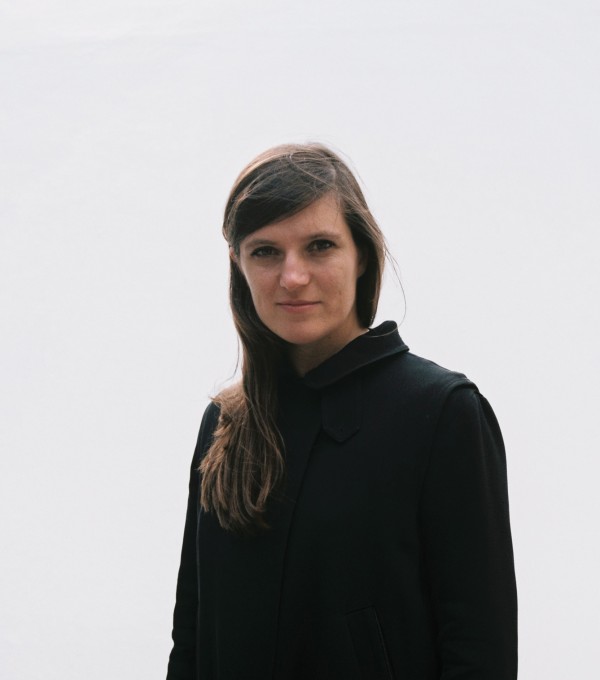
‘The day before, Gisèle Vienne was in Charleville-Mézières, at the World Puppet Festival, where The Ventriloquists Convention was played for the ninth and tenth time since its creation in August at the Puppentheater in Halle (see opposite). A play “that will surprise the spectators who follow my work,” she said straight away. No dancers as often in her stagings, but nine actors and nine puppets, and ventriloquism. And even a pinch of humor. “I’m not the queen of humor, I rather have the reputation of creating dark rooms,” she warns as well. These themes of predilection have actually not left the plateau: it talks about suicide, death, violence, strange sexual practices and various fantasies.
‘Ventriloquism does not come from nowhere. Jerk (2007), re-enactment of the crimes perpetrated by the American serial killer Dean Corl (aka “Candy Man”), ended on a virtuoso ventriloquism scene. Jonathan Capedevielle, his fetish actor, forgot the puppets of children martyred to interpret the six voices. Passionately eclectic, in search of all the blind spots that link the word to the body, Gisèle Vienne has seized in its own way this technique decommissioned and relegated to pure and hard entertainment: “It is a kind of acoustic magic trick. ”
‘Everything seems to inflame her. Almost a contrario of her wise and classical appearance, Gisèle Vienne speaks with animation of her work, of the textual power of Dennis Cooper, the American writer who accompanies her since 2004, of the love of the game of Jonathan Capdevielle, Necessity of the “unproductive expenditure” (from the cult of the accursed Part of Bataille) of the living spectacle. Blurring the tracks, Gisèle Vienne finds herself in all fields at once, even if she claims the choreography in which she founded her company in 1999.
‘A startling start has shaken it. “I was 23 when I started doing choreography in my productions. At 24 years old, I make a piece that packs everyone; At 25 and a half, I was beheaded. ” She nearly flinched. But there is an extraordinary energy in this frail artist, who transforms the macabre and perverse thoughts into aesthetic and sensitive weapons. A phenomenal spring, between fragility and steel. She remembers a show on France Culture, a dozen years ago. A child psychiatrist explained that one could be alarmed by children who had suicidal thoughts, but that one should not necessarily see it as an evil but as a driving force for action and creation. “For my first plays, I said to myself:” If it is not good, I commit suicide. “Like a joker. Death did not scare me. Not being scared gave me a lot of freedom. ”
‘One could find her bravado, but Gisèle Vienne plays her soul. This is the case when she created I Apologize, in 2005, with Dennis Cooper and electronic music composer Peter Rehberg. The play will be even given in diptych with A young, beautiful blonde girl at the Festival of Avignon, in the chapel of the White penitents. A turning point in her journey, she temporarily left the choreographic register in which she had ended up enthusiastically. Judged provocative with her beaten dolls covered with false blood, she again saw the tales of “pornographic” , “shocking” , “violent” that won this turn.
‘Since then, Gisèle Vienne has further refined her remarks, and does not always understand the outraged reactions. Clinically, on stage, there is never anything to whip a cat. This is true of the visible. Less of the invisible, essential touchstone of his work. It handles the power of suggestion, the one that leaves room for the mind of the spectator to put there what he feels. “I use strong fantastic stimuli, signs that make me react physically and intellectually.” She rolled her effects, weaving her canvas in precision, in lace, the enemy of artistic blur and improvisation. “I have to force the line because I like intense works. We also need to have a dialogue with inappropriate thoughts, immoral thoughts. ”
‘Her creativity seems to come from a broad synthesis of crosses. “One of the big activities at home was the construction of the doll house.” Her mother, a former student of Oskar Kokoschka at the Beaux-Arts in Vienna, initiated her and her girlfriend , the visual artist Vidya Gastaldon, to the pleasures of drawing, modeling. His taste for the theater comes perhaps from the “hysterical fever” that both of them lived when they spent the afternoon realizing costumes, accessories and sets.
‘Harpist from the age of 6 years, she spent her vacation in Austria with a grandfather musician and watercolorist who sent her to his sculptor of religious statues and to peasants to repeat his instrument. Born in philosophy, she opted for the Ensam contest in Charleville, renouncing that of Normale Sup. The puppeteers who interest her then, are the visual artists. “I’ve always been excited about moving sculpture, Paul McCarthy’s exhibitions, Mike Kelley, Hans Bellmer. For me, all this was puppetry! ” Despite or because of its atypical profile, Charleville welcomes it with open arms. By pure coincidence, she was born there in 1976, lived there only until the age of 3 years. The discovery of the bunraku, the traditional Japanese puppet theater, is a shock. May Be, by Maguy Marin, opens the way to choreography in connection with the puppet.
‘”At 39, I hope to start,” she laughs, thinking about the next twenty or forty years. And she ends the whirlwind confiding, with sparkling eyes, that next week she ” will teach [her] goddaughter Lotte, aged 5, to put on a wig.”‘ — Frédérique Roussel, Liberation
___
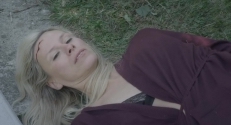
Stills



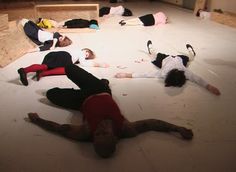
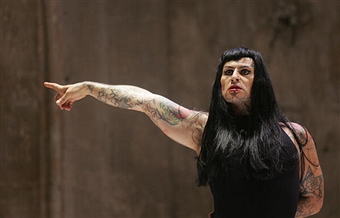


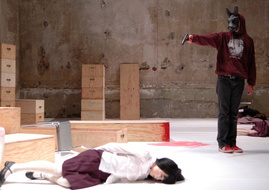

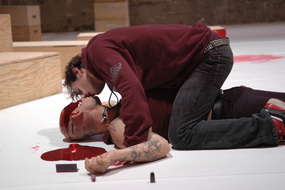








____
Further
Gisele Vienne Site
Compagnie Gisèle Vienne @ Facebook
GISÈLE VIENNE, LA FEMME ET LES PANTINS
Interview with the choreographer, visual artist, and puppeteer, Gisèle Vienne
Gisèle Vienne, ou quand la danse se fait magie noire
Gisèle Vienne, une artiste qui pèse ses maux
Les ventriloques, ces artistes suspects, mis en lumière par Gisèle Vienne
Gisèle Vienne: «Je voudrais que le spectateur ait l’impression de découvrir un nouveau pays»
The ambiguous world of today’s ventriloquists
Gisele Vienne: 10 Songs that Saved Your Life
ENTRETIEN AVEC GISÈLE VIENNE
Jerk, la bombe de Gisèle Vienne
Podcast: Gisele Vienne & Dennis Cooper on ‘Bookworm’
_______
Teenage Hallucination (Centre Pompidou, 2012)
In 2012, Gisele Vienne and I co-curated a three month-long festival at the Centre Pompidou as part of their annual event ‘Nouveau Festival’. Teenage Hallucination involved a large, unique exhibition of Gisele’s visual art and sculptures, a presentation of our installation work ‘Last Spring: A Prequel’, a group exhibition of works by 17 artists entitled ‘Read Into My Black Holes’, live performances by writers, musicians, and performers, a film and lecture series, a performance of my/Ishmael Houston-Jones/ Chris Cochrane’s dance piece ‘Them’, and a live concert featuring Fennesz, Bill Orcutt, and Florian Hecker.
___
Extras
Giséle Vienne & Dennis Cooper: Come Early Conversation
Alain Robbe-Grillet par Gisèle Vienne – Blow up
Memory Marathon 2012: Dennis Cooper, Gisèle Vienne & KTL (Stephen O’Malley and Peter Rehberg)
Interview décalée #3 Gisèle Vienne (French)
____________
Jonathan Capdevielle
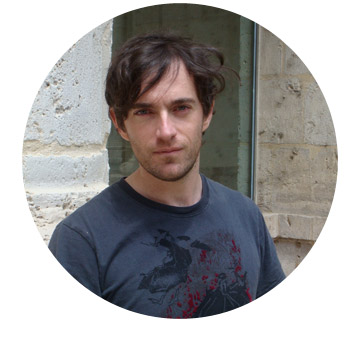
Performer, actor, dancer, singer, and director Jonathan Capdevielle has been the central performer in the vast majority of Gisele Vienne’s works beginning with her first piece, Showroomdummies (2001). He is the sole star of perhaps Vienne’s best known and most successful work Jerk, in which he gives a legendarily brilliant performance, and which has toured internationally. He has also performed in the works of many of France’s most daring theater directors, and, in 2014, co-starred in Patric Chia’s feature film Boys Like Us. In recent years, he has also begun creating and usually performing in his own works including Adishatz/Adieu (2014) and Saga (2015).
JC prepares for and speaks about ‘Jerk’ (French)
‘Adishatz/Adieu’ (Excerpts)
‘Saga’ (Excerpts with interview, French)
____
Interview
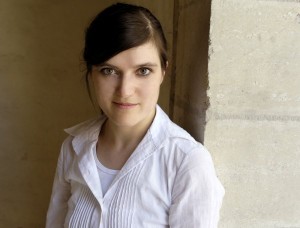
The Dance Enthusiast: Bonjour, Gisèle! You’re not the first puppeteer or choreographer I’ve interviewed, though certainly the first puppeteer-choreographer! While both art forms clearly involve movement, can you think of any other similarities between the two that escape the naked eye?
Gisèle Vienne: What led me to study puppetry was my strong interest in visual art and movement. What I’d imagined, in theory, was that puppetry would be the space where both worlds intersect. I saw puppetry as a branch of theater. In reality, I find the rules of puppetry actually closer to choreography. Both have a lot to do with rhythm and music and placing bodies or objects in space.
TDE: In Kindertotenlieder, the performers will share the stage with robots and puppets. Do these figurines fulfill a larger role than serving as mere props?
GV: Although they are technically props, the audience watches human-shaped objects in a totally different way. Kindertotenlieder brings you from the object to the animated object to the unanimated body to the animated body. All the dolls are human-sized and have the same outfits as the performers, so you see them as one group. It creates a theater that is very much about distorted perception.
The dolls represent characters who could be there but they also represent missing characters — they’re ambivalent. They look very much like 21st Century kids attending a Black Metal concert.
TDE: Why Black Metal?
GV: Black Metal concerts can be challenging because they are violent and loud, but people attend them because they are stimulating. It’s this experience that we’re trying to create. I like to stimulate the audience in a very jubilatory way. Sometimes I like to compare it to extreme sports!
I am also very touched by the type of tough clothes worn by super-emotional… romantic teenagers, which are a kind of costume saying something about their fantasies in this difficult world.
TDE: Sounds a bit goth!
GV: Totally. There is a new generation of *‘Lolita’ in the West Coast – androgynous, confused, beautiful, and dark characters. (*note Lolita is a fashion subculture with early roots in Japan..check out more by clicking the ‘Lolita’ link)
Kindertotenlieder is about the different ways societies organize the staging of our anxieties. So I wanted to present three types of ceremonies: a pagan Austrian ceremony, a funeral, and a Black Metal concert. I thought it’d be very interesting to parallel these theatrical representations of horror, death and blood.
TDE: The set for Kindertotenlieder is truly magnifique – beautiful and dreamy complete with falling snow. However, the underlying theme of work is somewhat maleficent. Kindertotenlieder is a study of death’s representation and the associated feeling of dread. Meanwhile, the stage serves as a setting to resuscitate the dead. Is this a chilling performance?
GV: I don’t think it’s scary; it’s more ‘uncanny.’ We are basically narrating the return of a ghost in dialogue with a boy. The dolls, the topic of death and life, the movements that are present yet ghostly… It’s strange.
The strangest feature comes from the music. We’re working with some very strong rhythmical distortions. The music puts the audience in a strange state, and that is the most confusing.
TDE: The performance draws inspiration from a pre-Christian Alpine tradition involving “perchten,” spirits indebted to a pagan goddess revered in South Germanic countries. What sparked your interest in this custom?
GV: I’m half-Austrian, so it’s something I’ve known since childhood. Almost equivalent to Halloween, it’s the time for haunting. The “Perchtenlauf” or “Perchten walk” happens around New Years. I was always at my grandmother’s in Austria for Christmas, so I would basically spend New Years there. As a child, I was super scared of them. So I guess I was super impressed!
TDE: Googling the “perchten” gave me nightmares! Tell me about creating the beast-like costumes and masks for your show.
GV: The “perchten” costumes are made out of sheep fur and acquired from a guy in Austria. Meanwhile, I commissioned the masks from a friend of my grandfather, a sculptor who specializes in “perchten” masks. So they are purely traditional costumes!
TDE: Describe some of the movements you choreographed for Kindertotenlieder.
GV: What’s interesting about Kindertotenlieder is that you have a range of movements that go from stillness to artificial body movement such as the video effect: slow motion. It can be very robotic, but it can be very fluid too. We go to the whole range.
______________
13 of Gisele Vienne’s 14 works
____________
w/ Etienne Bideau-Rey Showroomdummies (2001, 2009)
Music: Pita (Peter Rehberg). ‘Showroomdummies probes the border between animate and inanimate, as well as the relationship between real life and its representation. With this show, our aim is to highlight the chaos that a living body can trigger when it grazes the inanimate, and the passion it can ignite through its mere and unique presence, which can be at once immobile and provocative. Drawing on the character of Wanda von Dunajew from L. von Sacher-Masoch’s novel “Venus in Furs”, we are interested in the unsettling eroticism that can emerge from outer appearance and immobility. The body-language is chiefly shaped by the turmoil-dynamics that arises from eroticism and repulsion in face of inertia. The inertia of the figure portrayed by Wanda von Dunajew is expressed, in part, through her icy character. The Wanda figure exudes an unsettling ambiguity caused by her intimacy with both the mannequin and death. She disrupts and endures her environment; she is willingly manipulated by her director-lover, while acting out the role of manipulator.’ — Gisele Vienne
Excerpt
Excerpt
______________
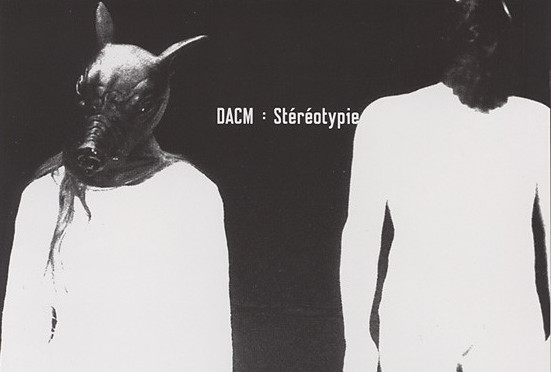
w/ Etienne Bideau-Rey Stéréotypie (2003)
Music: Peter Rehberg. ‘Stéréotypie. Art de stéréotyper. Atelier où l’on stéréotype… » De ShowRoomDummies, leur précédent spectacle, le groupe D.A.C.M. reprend la mise en doute du fantasme de perfection plastique, la gestuelle de marionnettes et la confrontation à des mannequins.’ — mouvement.net
______________
I Apologize (2004)
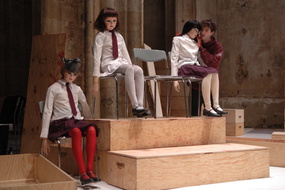
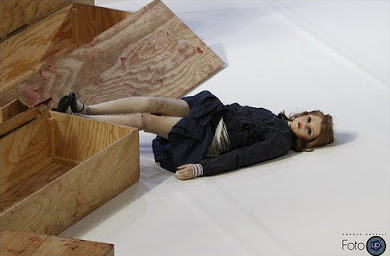
Words & Voice: Dennis Cooper. Music: Peter Rehberg. ‘Giselle Vienne’s first collaboration with iconic writer Dennis Cooper, I Apologize is a perfect marriage of dance, text, puppetry, music and sheer intelligence. A young man (Jonathan Capdevielle) paces listlessly on a brightly lit white stage among a large number of blood spattered plywood packing cases. He opens one and fetches out life-like mannequins of 12-year-old girls dressed in a fetishistic schoolgirl outfits. Dennis Cooper’s voice reads out a description of marital violence. Peter Rehberg’s soundtrack – a kind of distillation of terror into noise – builds to an appalling pitch of intensity. Anja Rötterkamp dressed in the same short skirt and heavy fringe as the schoolgirl dolls and wearing vertiginous shiny black S&M heels circles the stage, her movements suggesting permutations of violent sex; climbing the towers of packing crates, crawling on all fours, spreading and closing her legs with agonising slow-motion deliberation, arching her back as if in continual agony and ecstasy. Her counterpoint, Jean-Luc Verna – shaved head, red contact lenses, metal teeth and a body covered in tattoos – looks utterly terrifying and satanic. His stage presence, however, is strangely graceful, striking poses that quote Nijinsky combined with moments of jerky, intricate nightclub-dancing; at once menacing and magnificent.’ — Postcards from the Gods
Excerpts
_______________
Une Belle Enfant Blonde (2005)
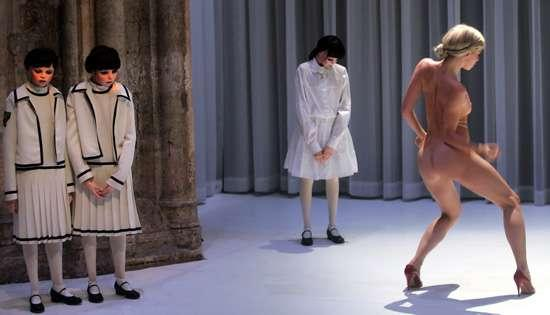
Words: Dennis Cooper & Catherine Robbe-Grillet. Music: Peter Rehberg. ‘Une belle enfant blonde / A young, beautiful blonde girl is the continuation of I Apologize. This new work, based on the link between fantasy and death, as the variations of an accident reconstruction, which question a univocal representation of reality and are part of an ambiguous slip between reality and fantasies. These shows both revolve around the relationship between natural and artificial bodies and the idea of disturbing strangeness. A young, beautiful blonde girl evolves, first linearly, from the concept of a crime, in the presence of an audience made of articulated dolls resembling young girls of around twelve years of age. The reconstruction of this crime, in which performers, dolls and absentees are neither entirely real nor ghost-like, disturbs the natural order of the narration of the crime. The characters all have their own experience, which makes them question their relationship with fantasy and the confusion that can arise – or not – with reality. This is a complex and infinite representation of a fantasy and the way it is repeated and modified. Several variations arise from the research done on the representation of an event and the expression of obsession and void. This show presents the relationship between three people, in which internal deviances appear all the more clearly as they manifest themselves in a rigid and organised environment.’ — Gisele Vienne
_______________
Kindertotenlieder (2007)
Words & Voice: Dennis Cooper. Music: KTL (Stephen O’Malley & Peter Rehberg). ‘Welcome to the nightmare factory of French theatre maker, performance and doll artist Gisèle Vienne! In “Kindertotenlieder”, a hyper-aestheticised performance-installation of a winter landscape, constructed from fantasies, obsessions and fears, she takes us on a journey into an emotional maze blurring the boundaries between reality and fiction. The plot alone defies standardised ideas on morality and sexuality: A group of teenagers get together for a death ritual in the form of a black metal concert. One of them is watching his own funeral; the other, his friend, is his murderer. Based on this plot, a trip with an indefinite outcome starts to unravel, subsequently showing the murder, in the form of a loop, from three different perspectives: from the perspective of the victim, the murderer and, ultimately, from the perspective of society. Gisèle Vienne’s installation toys with the black romanticism of an Alpine winter landscape. The perfect breeding ground for the birth of the uncanny in our imagination, of the eerie blend of something that is equally familiar and strange. Apart from the levels of past and future, all other parameters also begin to falter: The characters of the teenagers are constantly replaced by different performers, thus also changing their sexes. The game of deception even goes so far that they are during some parts played by dolls and robots: The choreography of movements is based on the constant change of a character from performer to performer, but also from human beings to still or moving artificial bodies. Artificial bodies pretend to be natural ones, while performing humans lead us to believe that they are actually machines. Life and death have ultimately become questions of perspective and definition in the teenagers’ dream world which, highly sexualised and emotionalised, is characterised by suicidal fantasies and a longing for death. In the further course of the excessive loss of a possible boundary between fiction and reality, the teenage funeral ritual turns into a death metal gig. The live soundtrack of Peter Rehberg and Stephen O’Malley (Kindertotenlieder is the beginning of the creation their band KTL) also acts in this world of images and symbols of pagan, Alpine Perchten culture and its contemporary equivalent in a strange, artificial “black” teenage subculture. The two masters of noise will create a hypnotic maelstrom that comes across like an enchanted, post-rock-like version of black metal.’ — Contemporary Performance
Excerpts
Excerpt
Excerpt
__________
Jerk (2008)
Words: Dennis Cooper. Music: Peter Rehberg. ‘Jerk is an imaginary reconstruction of the crimes perpetrated by American serial killer Dean Corll who, with the help of teenagers David Brooks and Wayne Henley, killed more than twenty boys in the state of Texas during the mid-1970s. The show sees David Brooks serving his life sentence. In prison, he learns the art of puppetry and writes a show that reconstructs the murders committed, performing it for a class of psychology students from a local university. Based on a novel written by Dennis Cooper and performed by Jonathan Capdevielle, the performance utilizes and masters, in a mesmerizing yet disturbing way, specific tools and skills drawn from puppetry and ventriloquism. The performance was presented for the first time in March 2008 and since then has toured all over the world, bringing Gisèle Vienne recognition as one of the most influential choreographer of her generation.’ — Flash Art
Excerpt (English)
Excerpt (French)
Excerpt (Spanish)
GV talks about ‘Jerk’ (English)
______________
Eternelle Idole (2009)
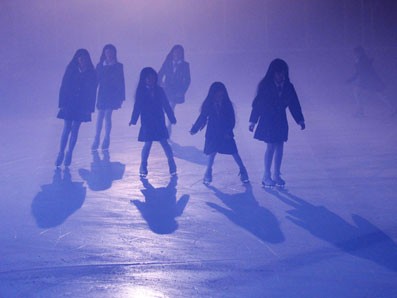
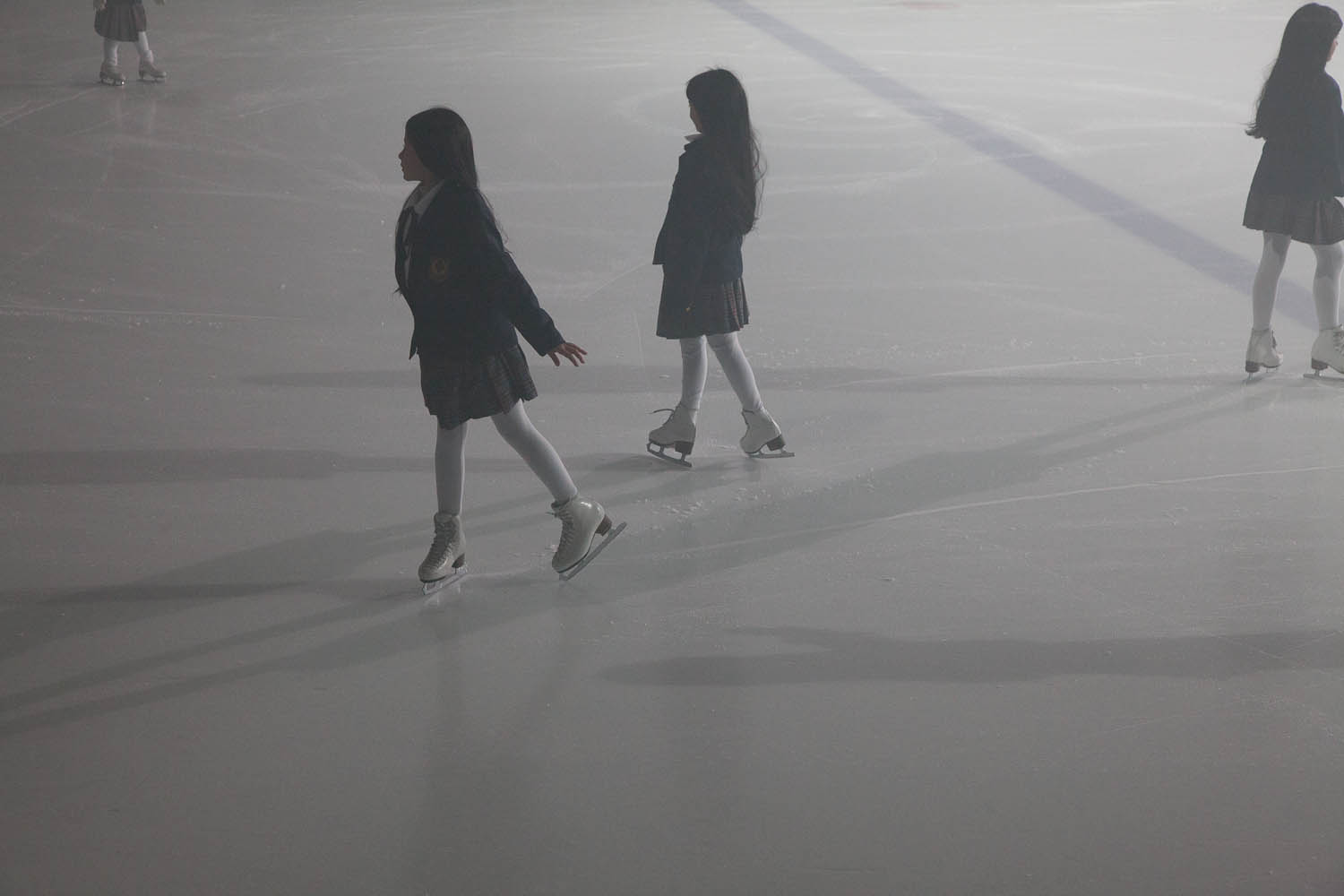
Music: Stephen O’Malley. ‘Eternelle Idole stages a 21-year-old figure skater whose teenage looks evoke the ghost of a murdered Lolita. A skating rink is one of those emotionally charged sites that, during adolescence, often impact our common experience. The awkward entanglement of feelings is emblematic of adolescence and indicative of transitory periods. This show has Aurore Ponomarenko in the role of a professional figure skater, wearing a cosmonaut costume that bears more resemblance to Japanese cosplay costumes than to a real cosmonaut outfit. This sublimated character might even be the ghost of a skater who once performed the role of a young female cosmonaut for a competition. Our recollection of this
character prompts us to reinterpret and idealize her, so that the memory is transformed into an image. By evoking adolescence, Eternelle Idole explores the link between acute fragility and sheer willpower, between a teenager and athletic prowess. Eternelle Idole elicits the fluctuation that happens between an individual’s fragility and aspirations. In this sense, characters performed in the realm of figure skating can compellingly embody the beauty of these intermediary spaces.’ — Gisele Vienne
________________
This Is How You Will Disappear (2010)
Words: Dennis Cooper. Music: KTL. Fog sculpture: Fujiko Nakaya. ‘In This is how you will disappear, the French theatre-maker Gisèle Vienne appears to be bringing the work of David Lynch, Alain Robbe-Grillet or Lewis Carroll to the stage. She is working on the boundary between dream and reality, and between appearance and reality. Nothing is what it seems, and everything is bursting with symbolism. The stage is transformed into a mystical forest of high trees, impenetrable wisps of mist amongst which fly birds of prey, and where three figures confront one another. They are three archetypes of the ideals of beauty found in pop culture: the tyrannical trainer represents discipline and authority, a young athlete represents physical beauty and the cool rock star to some extent already symbolises decline, as in the cases of Kurt Cobain and Goethe’s Werther. Vienne examines aesthetics and beauty, but in so doing inevitably also finds chaos, disorder and the dark side of the wood. On the basis of Nietzsche’s philosophy, she moves back and forth between inspired Dionysian splendour and the order and perfection of Apollonian beauty.’ — KAAI Theater
Excerpts
Gisele Vienne talks about ‘TIHYWD’
_______________
Last Spring: A Prequel (2011)
Words: Dennis Cooper. Voice: Jonathan Capdevielle. Music: KTL. ‘In 2011, Gisèle Vienne and Dennis Cooper created LAST SPRING: A Prequel, a theatrical installation articulated with LAST SPRING: (subtitle in progress) both part of a vast ongoing work entitled LAST SPRING. Both installations, conceived autonomously, will pave the way for the project’s identity. It is therefore crucial to develop both branches right from the start, in order to establish the work’s direction. LAST SPRING: A Prequel stages a teenager performed by an animated ventriloquist doll who is engaged in a schizophrenic dialogue with a glove puppet. This teenager evokes our second project, LAST SPRING: (subtitle in progress), an indeterminate space that exists either in the past, present or future, depending on when the installation takes place. In the installation LAST SPRING: A Prequel, the teenager obsessively tried to sketch the blueprint for the subsequent space, which is configured like a game. He also divulges the space’s architecture through the very structure of the text he is uttering, and thus ends up trapped in his own dialogue. This phony smooth-talker covertly provides us with clues about the main thrust of the game, while overtly revealing the psychosis that grips him.’ — NYT
Excerpts & interview with Gisele Vienne
_______________
The Pyre (2013)
Book: Dennis Cooper. Music: KTL. ‘Whereas only two seasons ago Vienne transformed the Kaaitheater stage into a large forest with real trees (This is how you will disappear), now she has opted for one big light installation, a moving set of LED lamps. Like a metropolis at night. In this setting we see two mute characters, a dancer (Anja Rötgerkamp) and a boy. A mother and son? They are part of a story written by Dennis Cooper. A story that is the third part of the performance, a part to read after the performance or to take home with you in the form of a novel. In The Pyre (the title refers to an ancient burning ritual) expression develops into abstract dance, a tableau vivant and a theatrical narration. A fascinating game that challenges our senses and sense of meaning, also thanks to the fascinating soundscape by her loyal musical partners KTL (Stephen O’Malley and Peter Rehberg).’ — KAAI Theater
Excerpts
GV talks about ‘The Pyre’ (French)
______________
Brando (2014)
Music: Scott Walker & Sunn0))). ‘Scott Walker and the members of Sunn O))) know the depths of darkness, and in their own ways wrest the sublime from it with violence and grace. In 2009, the latter (a drone-doom metal duo of the loudest pedigree) approached the ’60s pop icon turned avant composer and asked him to contribute vocals to the Monoliths & Dimensions track “Alice.” The timing wasn’t right, but it planted the seeds for what would become Soused, an inspired pairing that matches Walker’s spellbinding compositions and harrowing voice with Sunn O)))’s metallic abyss. For both artists, “Brando” is an unlikely yet perfect introduction to Soused. Imagine the scene: A crooner in crushed velvet opens the stage with dramatic synth strings and a riff that abstracts “Sweet Child O’ Mine.” The familiar, Sunn O)))-level feedback soon enters, but under the direction of Walker, it’s restrained in the face of the ridiculousness that’s just occurred. “Brando” comes with a stirring short film directed by French artist and choreographer Gisèle Vienne, who’s collaborated with Sunn O)))’s Stephen O’Malley on a number of performances. A teenage boy with tousled hair stares into the distance and locks himself in a dark room, dancer Anja Röttgerkamp (playing his mother, perhaps) moves with ache and acute horror in a cliffside house, and after long shots of fog blanketing the countryside, French actress Catherine Robbe-Grillet — a dominatrix and author of the 1957 sadomasochistic erotic novel L’Image — happens upon a scene of unknown violence. It’s bewildering, fraught with terror that’s unspoken. Vienne and the band chose not to comment on the meaning of the film, but it does visually echo Walker’s recent interview with The Quietus: “It’s a song of unfulfilled longing. A song of masochistic longing,” inspired by the actor Marlon Brando’s tendency “to get beaten up in the films he’s in.”‘ — NPR
_______________
The Ventriloquists Convention (2015)
Words: Dennis Cooper. ‘Ventriloquists and their dummies give us an ambiguous feeling. Just watch films like The Great Gabbo by James Cruze, The Unholy Three by Tod Browning or Magic by Richard Attenborough. Gisèle Vienne enjoys taking advantage of this feeling. It is impossible to categorise her work. As a choreographer, stage designer, artist and puppeteer she conjures up fascinating dream worlds where words are hardly spoken, or not at all. In this new production however, there is a lot of talking – but it is not so clear by whom. Vienne stages a fictional reconstruction of the largest annual gathering of ventriloquists in Kentucky. You can hear conversations between the dummies and between their ventriloquists. A disembodied voice joins in the discussions. A suspicion of the outside world plays a central role here. A polyphony of around 30 voices, performed by nine puppeteers and their dummies, draws you into a tangle of complex psychologies.’ — KAAI Theater
Trailer
Interview w/ GV and excerpts
__________
Crowd (2017)
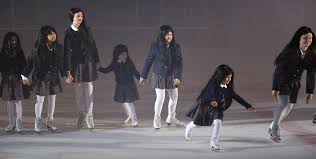
Narrative: Dennis Cooper. DJ: Peter Rehberg. ‘Evolving out of reflections on violence and the relationship that we can maintain with it, this project focuses on the various ways that a particular community can deal with (or not deal with) the way in which it is expressed. Drawing on different kinds of celebrations and rites, religious or secular, from the most archaic to the most contemporary, we intend to develop a piece that analyzes one potential model. By doing so, we will examine the need for violence as an integral part of civilized society as well as the possible and/or necessary venues for its expression. This project is in line with our existing body of work, which for many years has dealt with issues connected to violence and its representation. The context that we are taking as an example is a party spontaneously organized by a group of young people in 21st-century Europe. The intensity of the music and the excitement that brings these people together in this place create a situation conducive to a kind of emotional roller-coaster, or more precisely, a large number of interrelated upheavals. We are working with Dennis Cooper in devising a subtext for the 15 young people onstage, interpreted mainly through dance, in a piece where popular dance style is the main activity of the group and where no dialogue will be audible. The subtext offers as many stories as there are persons onstage, and the movements of each individual convey several simultaneous narratives, as do those of the group as a whole. The interrelationships and the articulation of the individual emotions that each person on stage experiences and those produced collectively by the group itself will be meticulously observed by the audience. Within the context of this dance party, the various expressions of violence will escalate. The central issue will be to reach an understanding as to which kinds of violence come into play, their necessity, their impact and the way in which the group and the party will stimulate them, handle them, integrate them, and reduce them – or not. This escalation of actions arouses an excitement that will stimulate the most diverse range of emotions. It is the sheer number and the ambiguity of the emotions themselves that will be depicted and thoroughly analyzed, both those that generate the violence and those that the violence generates. I am attempting to look at violence in its multifarious aspects – through a range of intensities and examples of the way in which it is expressed. The pleasures, the desires and the erotic tensions generated by these types of situations are the central elements of this piece; they determine the behaviors of the persons onstage. The relationship of these emotions to violence forms the central axis around which this group revolves. In complex ways, it is the exhilarating and potentially liberating aspect of violence that we will for the most part observe in this piece.’ — Gisele Vienne
GV talks about ‘Crowd’ (French)
*
p.s. Hey. ** Dóra Grőber, Hi! My pleasure, Dóra. She’s really great. So, so good to hear about your amazing visit with Anita. That sounds blissful. And your ‘free-style’ role playing re: your writing sounds fascinating and very cool. What an exciting way to build your writing, and how great that you have someone like-minded to do it with. Hooray! As for me, here, I’m just working randomly still. Last night I went to see this performance with today’s blog star Gisele. Kind of a super dark one-person show by a young guy who’s famous in France as a magician and is trying to making strange performances using his magic skills as a kind of … basis or something. It was kind of irritating, but very impressive. Otherwise, I had to gather some on-set images of our film to give to New York Magazine because they’re about to publish a piece about the making of ‘PGL’, so I did that with Michael/Kiddiepunk and hung out with him, Bene, and kiddo Milo at the same time. It was nice. What’s the plan re: your weekend? My weekend plans are still pretty vague, but I’m sure stuff will come up. Have a great two days! ** David Ehrenstein, Hi, thank you, I agree, of course. Oh, cool, now I can read your thoughts and opinion on Hockney in detail! Everyone, don’t let your weekend pass by without reading Mr. Ehrenstein’s take and thoughts on David Hockney. Head over here. ** Will VanDenBerg, Hi, Will! Thank you for coming here! I didn’t know about that current issue of Music and Literature, but I will scour Paris this weekend in hopes of finding a copy. Thank you very much that alert. A pleasure to get to speak/type with you. Please feel very free to come in for any reason anytime. Take care. ** Steevee, Hi. I never go to see movies for eye candy. Is that weird? Ha ha. So sorry t hear about your forced separation from your computer. If you can manage to enjoy the non-hooked-up-ness, please do. I personally don’t think your reviews are overly political or anything like that. You’re rightfully and helpfully writing from the perspective you have, and I know I learn a lot from your words in general and reviews, so that criticism seems just seems biased or something? That said, I do take great exception to your declaration that ‘we live in times when cinema is soaked in politics, and writing the kind of auteurist formal analysis my friend prefers seems like writing some kind of weird and alienated missive from an ivory tower right now’. Seriously? Maybe among your crowd, but not in the world I live in and pay attention to. Current cinema isn’t ‘soaked in politics’ in my opinion. It’s coming from all kinds of places with all kinds of intents and purposes just as it always has been. It’s some receptionists who are bent on soaking all cinema in politics. I mean, where does that statement leave this blog? I do long, serious posts about cinema, books, art, etc. without a political/social justice-based filter. I really don’t think I’m making this blog from an ivory tower. I think this trending idea that those who don’t analyze art without their own politics squarely on board are less clear-eyed or out of touch or elitist is absurd. I don’t think you or your reviews or comments are ‘woke’, but I do kind of think that declaration is. ** _Black_Acrylic, Hey hey, Ben. While I would say you could start anywhere with Quin, I would also say that ‘Berg’ might be the best way to start if you can get yourself a copy. Excellent about your successful driving lesson. Braking is a toughie. But then you’ll suddenly nail it, and you’ll be like a ballet dancer standing on his tiptoes. How does your weekend look, or, I guess, how did it look? ** Alistair, Hi, Alistair! So great that your book is getting such good advanced press. I’m good. I’m enjoying my mostly time off from the film, yes. Just catching on my neglected other things and putting my mind to ideas for our next film. Quite pleasant. Mm, I don’t think the NYC event I’m reading at via Skype for is going to be streaming, or at least no one has told me that it was. I do think I was told it’s being pro-videoed and that the doc will, or might, end up on youtube or Vimeo or somewhere at some point. Yes, yes, send me stuff, anything you want, so I can make the post! Word doc plus jpegs as email attachments is best. I’m already very excited to make the post, and of course, speaking of ‘post’, get your novel so I can dig and dive in! My new email is: denniscooper72@outlook.com. I haven’t read Kim Gordon’s book yet for no good reason at all. I should and will finally. Have a super great Venice-based and further flung weekend! xo, Dennis. ** MANCY, Hi, S. Oh, gosh, thank you. I did try to get intricate to some degree with the ‘Tunnel’ thing, although not enough for me to think of it as a work. But maybe I’ll rethink that. That’s super awesome of you to say, maestro, about it and about the gif work generally. Really, that means really a lot. I’m awfully glad that the mind-hampering day job has left you enough cells (brain) to work on a zine. If I were a man of power in the world where power makes a difference, I would make sure you got a gigantic, day job-murdering MacArthur Grant. ** Misanthrope, Hi, G. Pondering is the best. I can’t wait until pondering becomes trendy and au courant again. That ‘no news is good news’ thing is such a weird thing to say because it’s all about the people who dealing with someone ill and not about the ill person. But I guess that makes sense. That is an interesting story, which I greatly appreciate. Your ex-boyfriend was one of those hair trigger-jealous types. It’s a hard life being obsessively eagle-eyed for even the flimsiest evidence of partner indiscretions. Cool that you and Jullion are reconnecting and that you got to an understanding place with your ex. Gosh, it was like an urban fairytale, that story. Nice, man. Have the sweetest weekend! ** Okay. I realized to my surprise the other day that I have never made a full post/Day about my longtime collaborator and boss and friend, the great Gisele Vienne. Really strange. But I have now corrected that inexplicable problem. And, if you like, you can learn probably more of what there is to know about Gisele and her work than you had known until today, should you feel so inclined. In any case, I will see you bright and early on Monday.


 Now available in North America
