
The blog of author Dennis Cooper

Author: DC (Page 903 of 1132)

Spotlight on … Rene Crevel Putting My Foot in It (1933)

—-

“Crevel was born rebellious the way others are born with blue eyes.”
—Philippe Soupault


“Crevel actually wrote only a single sentence: the long sentence of a feverish monologue from the pen of a Proust who dipped his biscuit laced with LSD into his tea, instead of the unctuous madeleine.”
—Angelo Rinaldi, L’Express


“He will be read more and more as the wind carries away the ashes of the ‘great names’ that preceded him. “
—Ezra Pound


‘René Crevel (1900-35) was French Surrealist who initiated experiments with hypnotic sleep. His greatest contribution to the movement, however, was to demonstrate that Surrealism and the novel could be reconciled. Whether texts such as Détours (1924), La Mort difficile (1926), Babylone (1927), Êtes-vous fous? (1929), and Les Pieds dans le plat (1933) are called ‘romans’ or ‘fictions’, the role of language itself in their elaboration is arguably the key element. Mon corps et moi (1925) is a confessional monologue and L’Esprit contre la raison (1927) is his Surrealist manifesto.

‘Crevel was born in Paris to a family of Parisian bourgeoisie. He had a traumatic religious upbringing. At the age of fourteen, during a difficult stage of his life, his father committed suicide by hanging himself. Crevel studied English at the University of Paris. He met André Breton and joined the surrealist movement in 1921, from which he would be excluded in October 1923 due to Crevel’s homosexuality and Breton’s belief that the movement had been corrupted. During this period, Crevel wrote novels such as Mon corps et moi (“My Body and Me”). In 1926, he was diagnosed with tuberculosis which made him start using morphine. The 1929 exile of Léon Trotsky persuaded him to rejoin the surrealists. Remaining faithful to André Breton, he struggled to bring communists and surrealists closer together. Much of Crevel’s work deals with his inner turmoil at being bisexual.

‘Crevel killed himself by turning on the gas on his kitchen stove the night of June 18, 1935, several weeks before his 35th birthday. There were at least two direct reasons: (1) There was a conflict between Breton and Ilya Ehrenburg during the first “International Congress of Writers for the Defense of Culture” which opened in Paris in June 1935. Breton, who like all fellow surrealists, had been insulted by Ehrenburg in a pamphlet which said – among other things – that surrealists were pederasts, slapped Ehrenburg several times on the street, which led to surrealists being expelled from the Congress. Crevel, who according to Salvador Dalí, was “the only serious communist among surrealists” (and was facing more and more solitude as the real face of Soviet socialism started to occur), spent a whole day trying to persuade the other delegates to allow surrealists back, but he was not successful and left the Congress at 11pm, totally exhausted. (2) Crevel reportedly had learned that he suffered from renal tuberculosis right upon leaving the Congress. He left a note which read “Please cremate my body. Loathing.”‘ — Wikipedia



René Crevel, dandy révolutionnaire
“Si je ne réussis rien, je me tuerai”: René Crevel inédit
Rene Crevel @ goodreads
RENÉ CREVEL AU SOMMET DE SA MONTAGNE MAGIQUE
Elle ne suffit pas l’éloquence, René Crevel
Lettre de René Crevel à Gertrude Stein
Portrait of René Crevel by Salvador Dalí
Portrait de René Crevel (1900-1935), écrivain
SOLITUDE DE RENé CREVEL
The Paris of René Crevel
Podcast: Tours et détours de René Crevel
“La Mysticité Charnelle de René Crevel”
Prolégomènes À Un Suicide (La Mort Difficile, De René Crevel)
THE MAID DRINKS KEROSENE
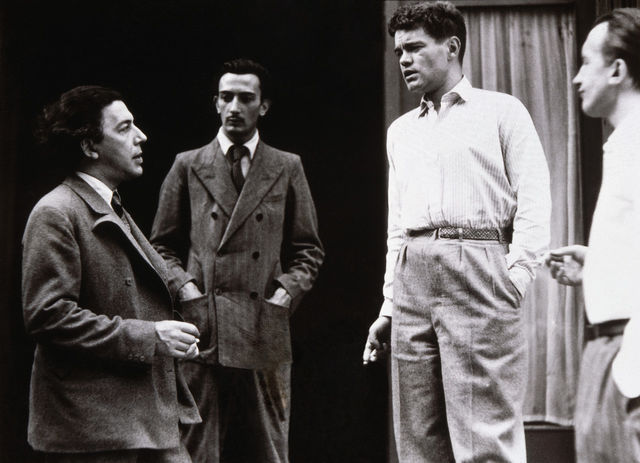


(l. to r.) André Breton, Salvador Dali, René Crevel and Paul Eluard


‘Rene Crevel’s 1933 novel Putting My Foot in It (Les Pieds dans le plat) has long been considered a classic of the surrealist period. Loosely structured around a luncheon attended by thirteen guests, the novel is a surrealistic critique of the intellectual corruption of post-World War I France, especially the capitalist bourgeoisie and its supporter, the Catholic Church. The novel begins with an account of the family of the major character, known as the “Prince of Journalists.” This bizarre family—the grandparents a soldier and a sodomized woman, the parents an orphaned epileptic and a hunchback—is matched by Crevel’s bizarre syntax and vocabulary: nouns that initially appear legitimate, intact, and respectable, soon decompose into obscene epithets, making other nouns, both common and proper, suspect.’ — DA
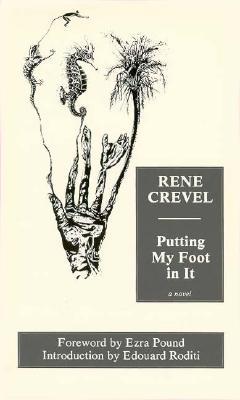


Excerpt:

Sun and tradition. A dazzling light and the firm intention not to let yourself be blinded, etc., etc.

Symbols need not limit their scope to this pendulum swing of images. But a well-balanced mind won’t try and roost on a swing of antithesis that, at the height of its arc, would only look down on treacherous metaphors and promenades strewn with wolf traps that snare innocent beige fawns in flight, rather than large carnivores.

Here, today, the herd of cavorting ideas would hardly seem threatened. Fog-toothed melancholy can only sink its teeth into moonlight. And presently, it is high noon. So much for time. As for place, the Roman Empire passed through. It even stayed, blended with the dirt on this hillside, disciplined it, militarized it, metamorphosing amorphous terrain into terraces.

One of the mighty of this earth, one of the opinion makers whose sense of order takes pleasure in evoking the grand classical past, not for vain regrets but for quite virile resolutions, is jaunting merrily along — although there is nothing merry about the thoroughfare in question—snuggly ensconced in a motorcar worthy of the Roman road. This brand-new car is French-made, for if the ear of the Caesars, including the subsequent period, was the age of hippic locomotion, it is important, when purchasing motor vehicles, to observe a certain solidarity which, if not specifically French, is Latin, or at the very least, European, but strictly European, for after all of the tricks they have played on us, those sons of Uncle Sam with their Bonus Armies, their gangsters, their crashing and crashed millionaires—they can go hang themselves elsewhere.

With a light breeze tickling the white hairs on his chest and those which serve as a nest for a certain bird and its septuagenarian eggs (fresh as a daisy, moreover, thanks to Voronoff), the man who rejoices in the title of the Prince of Journalists savors the joy of living.

Here, in the hollow of a small valley, is a ruin used to transport water before the birth of Christ. Thus, to the paradoxical and nearly imperceptible accompaniment of an almighty motor, thoughts can let themselves float along. It won’t be long before they reach the banks of reverie. They won’t, moreover, lose any of their moderation in the process. Mustn’t forget that, if Fragonard and Hubert Robert measured up to this landscape, then any French mind worthy of the name can and must, out of the greatest disorder, out of a certain shambles, indeed out of a complete mess, compose a garden, a French garden, to be exact.

And to think that the great redheaded barbarians sung (though not in earnest) by Verlaine dare to return to our countryside, to our beaches, to attack our spas, to talk about how old this country is, and even spend their money on the rags that insinuate, with each venture undertaken by the Prince of Journalists, that this time it could be his swan song. A Prince of Journalists’ song, if he is aware of his national rights and duties, can only come out as a cock’s crow. The Gallic cockerel’s. His head is bursting with bugles. He is always ready to sound the charge. Even his dreams are dedicated to his country—only last night, he dreamt he was the Unknown Soldier’s widow! Ah, that cadaveric stiffness!

But to be aware of one’s rights and duties as a Frenchman is first of all to be liberal. Thus, the Prince of Journalists agreed to have lunch today with an Austrian woman. An archduchess, of course. And if other compatriots of our former enemies should try to slip in behind the grand dame, he will take care of them. And above all, watch out for so-called philosophers, poets, and filmmakers from Central Europe. Each morning, the director of a large daily dutifully reminds the editor of his Arts and Letters column that an intellectual invasion never fails to foreshadow the other kind. So guard and watch all frontiers—the frontiers of the mind no less than those in the north and the east. Defend the moral heritage of France, French culture, the culture of French thought, French gardens, French-style gardens, the French woman’s gardens, with boxwood-lined paths, the wood itself being carved into a darning egg; for the owner, the Frenchwoman, the bourgeoisie Frenchwoman (any Frenchwoman worthy of the name being a bourgeoisie), even athletic or a touch brainy, is and will remain, until the end of time, thrifty enough to keep both the wooden stocking, wherein lies the family nest egg, and her own nylons from unraveling, mending them as soon as they begin to run.

Sitting at her window, with a song on her lips, a flower in her bosom, but never with a fire down below, this guardian of traditions, next to a table adorned with the tastiest fruits of her orchard—isn’t it something out of Chardin?

The Prince of Journalists is moved. He melts. And not only from the midsummer heat but from the warmth, far more touching, of memory. In his mind’s eye, he sees his father, his mother, the decent people who spent their lives growing old. By the time they procreated him they were in their twilight years, hoping that very solid experience would compensate for certain congenial and perhaps hereditary handicaps. The good souls had no reason to worry. Their son, although he is short and lively tempered, holds himself straight as a ruler, and, at bottom, always masters his reflexes. Actually he turned out well enough, both mentally and physically, to savor with his utmost gratitude, in the scene before him, the memory of the ruin which had been built, on his father’s orders, near a pond whose waters were confined by exquisite little banks. The wise old man, after having asked the valet who never left him for a second to set up his folding stool and cover his shoulders with a Scottish plaid, was ready to sit down, aim, shoot (wasn’t this firearmed fisherman an expert on refraction?) one, two, three, four times. He killed the father, the mother, the little boy, the little girl bleak-fish.

Only the most genuinely French virtues had caused this carbine fisherman to become an Olympian statue of warm fabrics at the edge of autumn’s waters. Beneath such majesty he was hiding a painful secret. Our firearmed fisherman’s mother, in the days when she was carrying him, had been assaulted on a dark night and, before she even had time to catch her breath, got hosed—and, what’s worse, from the flip side. How could the unborn child have possibly avoided the repercussion of this heinous violence? Expecting his offspring to bear a double original sin which no amount of baptism would wash away, the husband of the woman sodomized in spite of herself, a great friend of Cambronne, used his connections to get enlisted and heroically killed immediately, at the head of a small troop which had only recently bestowed upon him the proud title of commander.

Every sin, even unintentional, can be forgiven. Of course, the orphan paid for this forgiveness with congenital epilepsy. He was all but deprived of the joys of childhood. He can still remember his mother’s mustached nieces sitting in a circle all around her, the woman sodomized in spite of herself. These cousins, if distant memory serves him well, were neither fish nor foul, neither hide nor hair, but salt and pepper and more bitter than sweet. They were going to prevent a further accident at all costs, which is why they lived on the plains of Beauce.

On the horizon, there wasn’t a single grove that could conceal a satyr. As soon as the wheat reached a certain height, the young widow was confined to the house until the last row had been gleaned.

As a result of her adventure, she had become prone to melancholy. The sweet, desperate automatism of certain gestures which she repeated indefinitely made her guardians conclude that she was eccentric or even obsessed. For days upon end she would caress her hair, which was naturally wavy, but straightened each morning. She hardly ever opened her mouth. On one exceptional evening, however, she was talking a great deal when, perhaps, she was frightened by a reproving stare from one of the old women? In any event she jumped up and took off running. Since one of the jailers had just made sure that all the doors and windows were securely locked, none of them bothered to follow her. The young woman didn’t get far, of course, no farther than the dining room; but there, out of a Dutch candelabra she pulled a purplish candle (everything was mourning and half-mourning in her charming little interior) and, in pious kiss, brushed her lips against its wax, which was softer than the softest human skin.


teporingos bubonicos “Rene Crevel”


Une Vie, une œuvre : René Crevel (1900-1935)


Intervallo di Antonio Syxty: René Crevel


p.s. Hey. ** David Ehrenstein, Hi. I’ve heard about that ex-World’s Fair venue. It sounds dreamy. I think they mostly want the loud music adrenaline rush and to consequently lose their inhibitions and not think/worry about the shit in their lives? Why not more women? That’s a question I’ve been asking myself since I first started going to concerts in my early teens. ** Sypha, Hi, James. Aw, thank you, man. I’m so happy you liked PGL. It was filmed in a French city called Cherbourg, which I think is best known outside of France due to the famous film ‘Umbrellas of Cherbourg’. Seaside city, but we erased the ocean in our film to make the buildings seem more lost and purposeless. ** Count Reeshard, Hey, Count! Very good to see you! I’ve heard of/about Grande Ballroom. Its legend carries. I’m not sure why it isn’t in the post. I accidentally bypassed it, I guess. You good? I sure hope so. ** _Black_Acrylic, Hi, Ben. I actually went to Crobar once too on a Chicago visit. Nice. Exciting that you’re onto Issue 2. 404 Ink looks interesting. I don’t know about it. I’ll investigate. ** Kyler, Hi, K. I never managed to enter any of the Fillmores, which is strange. The kind of LA equivalent in the late 60s/early 70s was the Shrine Exposition Hall where I saw many of the best shows ever, and which still exists as a music venue, strangely enough. My Bloody Valentine played there just recently. ** Misanthrope, Yeah, it was such a good pic in general that I begrudgingly used it even with the Lizard King plunked down in the middle. Kidding. ‘Crowd’, oh, … yes, it’s playing in London and also in NYC at BAM. It’s a dance piece, about 14 dancers. Among them are Sylvain who plays ‘Guillaume’ in PGL and Katia who plays ‘Roman’s older sister’ in PGL. The stage is an after hours club, the dancers are people at the club. They enter, dance, do all kinds of shit, weird and cool, involving inebriation, lust, anger, blah blah, all of which is the stuff I devised, and all of which is kind of semi-hidden by the fact that they’re dancing. The club closes, almost everyone leaves. The score is mostly 90s techno/trance/ambient tracks. People seem to really like the piece. It’s been our biggest hit so far. You should see it, if you can, I think. Well, here’s hoping LPS gets the Taco Bell job. That would be a start. Hope you got what sleep you craved. ** Steve Erickson, Ah, you went to the Channel. That was legendary even outside of its turf. I see the Rammstein comparison, sure. But I guess I also see something cheesier in the works, early Ke$ha-like or something. I like Rammstein when they’re funny, albeit inadvertently seemingly. ** Corey Heiferman, Hey. C. Rav Hen Cinema has a really nice building there, yeah. Sad movie theaters. I think I did a dead movie theaters post. But I don’t think I managed to catch any of those. Sad. Yes, very interested to see your redeems re: Eurovision. I blame my own grump for my own experience. Wow, haha, that’s a novel looking way to adapt Blake. Your friend’s thing. I like it. I think the problem with the Blake adapts I’ve seen are they’re too fucking reverent. Same problem that happens with most bad film adaptations of, say, novels. Thanks for the three links. I’ll hit them in just a minute. Bon day! ** Right. I feel like people don’t talk or write much about Rene Crevel these days, and that’s kind of a shame because he’s quite interesting, for instance in the case of the novel I’m spotlighting today. See you tomorrow.


Thomas Moronic presents … Kevin Drumm/An introduction *

* (restored)


The reason I’m calling this day An Introduction could probably be best explained by linking to Kevin Drumm’s discography. At a quick glance it’s clear that Drumm is a prolific artist, and his work spans many areas that I probably wouldn’t be able to do justice if I were attempt to characterise and categorise them all. So, with that disclaimer out of the way, I’ll try and focus on certain points of his body of work that are specifically exciting to me, and the reasons why, and then … yeah, I guess if you’re into it you can go searching for more. In short: Kevin Drumm is a genius.

I think I first got into Kevin Drumm after reading this interview with Jim O’Rourke where he talks about giving up playing the guitar after realising that Kevin Drumm had already done or achieved everything that he would have wanted to do with the instrument. O’Rourke is one of my all time favourite artists, so it was high praise indeed.

And so I started digging …

—


One of my all time favourite records by Drumm is Imperial Distortion, which I have often turned to as a soundtrack for when I’m writing. It creates such a perfect, unique mood. Completely inspiring and singular. I just found an article from FACT that profiles that particular album:

IMPERIAL DISTORTION: KEVIN DRUMM’S MODERN MASTERPIECE TURNS FIVE


Chalked up on Hospital Productions’ release schedule before it was even finished, the album was originally planned as a balls-to-the-wall collection of primal fuzz pedal experiments, an idea that was quickly canned when Drumm came to the decision that the results simply wouldn’t “stand the test of time”. A subsequent creative block forced him to rifle through his archives, and in doing so he came across a handful of pieces that he since has slightly disparagingly passed off as being “go nowhere tracks”. The resulting collection of odds and sods, recorded over a thirteen-year period between 1995 and 2008, became Imperial Distortion, and, thanks to some warm persuasion from Hospital’s Dominick Fernow, Drumm even kept the original title despite the fresh set of material being very much at odds with it. So we have an ambient album on a noise label, compiled from mostly archival material and given a title that would make people assume, quite wrongly, that it would be along the same lines as Drumm’s career-defining Sheer Hellish Miasma. It shouldn’t have worked, but somehow it did.

It’s important at this point to think back to 2008, and while it doesn’t seem like very long ago, the sprawling U.S. noise scene was in flux. Wolf Eyes had hit their blood-belching high in ’06 with Human Animal, and Fernow himself had already begun to tip from the feedback-laden, barely-listenable aural oppression of Black Vase into the almost melodic synth-led electronics with ‘06’s pre-emptive Pleasure Ground and ‘07’s irrationally static Cave Depression set. It was in 2008 when the sun-starved basement dwellers who had pored over hand-sprayed (and probably unplayable) Hair Police CDRs in ’05 and saved their allowance for the hotwired Casio SK-1 they saw on Craigslist in ‘06, were looking for something a little different. You must remember that it was around this time too when a trio of Midwestern stoners known as Emeralds suddenly shot from being a band who sold a few tapes here and there at noise shows to being a worldwide sensation. Solar Bridge slipped out on the Hanson imprint in ’08 and helped shift the tides – the kids who used to be totally happy splicing their first tape loop, and screaming into the grubby cup on a broken pair of headphones now wanted to make new age music, and the same beardy dudes who had discovered how to break their hand-me-down synthesizers a few years earlier now wanted them repaired and spitting out arpeggios.

This instability could have been what caused Drumm to abandon his early attempts at Imperial Distortion. His comments that he was worried his tape noise experiments might not “stand the test of time” are telling indeed. Time was moving quickly, and the scene’s tolerance for his particular brand of harsh noise appeared to be waning. Certainly another crack at 2002’s Sheer Hellish Miasma would have been a mistake. It was a record that had pre-empted the general, if short lived, obsession with corrosive American noise, and to this day stands as one of its most successful sonic signifiers. Arriving notably early in the U.S. scene’s development, it emerged on Mego very much after the Austrian stable had cemented its legacy, feeling stylistically long way from the mischievous laptop hiccups of Pita’s Get Out or the well-pruned maximal experimentation of Hecker’s Sun Pandemonium. Fittingly then, when Imperial Distortion did finally see the light of day, it had a very similar effect on its listeners – it was the kind of album that we didn’t yet know we wanted. Drumm had been dabbling with minimalism for decades, but it hardly mattered – Second’s crystalline experiments and Comedy’s organ studies mostly fell on deaf ears compared with the near-universal acceptance of Imperial Distortion.

Taken from/continued here.

—


Another firm favourite is Sheer Hellish Miasma, which I don’t need to really describe too much, given the accuracy of the piece’s title. It has a cool, metal inspired cover and gets bonus points for being released on one of my very favourite record labels, MEGO. Beautifully noisy and noisily beautiful. Here’s a review from Pitchfork:


When Rhino decided to reissue the entire Mego back catalog in 2022, they came across notes for alternative titles to this particular disc, Kevin Drumm’s third solo release, and first for the electronic Viennese label. Some names scribbled down (and ultimately scratched out) included: Brain Scratch Avalanche, Tooth Filling Freebaser, and Demonic Wasabi Colonic. They were all in the running until the eleventh hour it seems, each brandishing the palpable sense of (dark) power coursing through them, as well as boldly proclaiming grievous bodily harm of a most agonizing sort. All of the vetoed names had their own je ne sais quoi, I’ll admit. And yet the decided upon title conveyed the sensation succinctly, as the vagaries of the “Miasma” in the final title somehow qualified this intense listening experience.

Back in the winter of ‘ought-two, when I first heard this Kevin Drumm disc (he was still into Norwegian death metal in those days), a blizzard had just hit the city and snow was flurrying and thick on the ground. It was my first time ever through such weather conditions and I was crazy enough to venture out into it for a few thrills, with this music strapped to my head. While familiar with Drumm’s earlier work, always the aural equivalent of a “Fisherman’s Friend” (be it by prepared guitar or synthesizer), Drumm was blasting the sinuses clean and viciously chapping the knuckles with a clarity and enhanced eucalyptus flavor unfelt before. The opening glitches were mere forbearer of the whiteout to come. What roar I presumed to be outside in the cold was already inside my cavities, and I was well beyond the turning point before even reaching the front door.

Hitting the pavement, every step was treacherous, uncertain. Thinking the storm already at its apex, it took only a minute or two before I realized it was just beginning. The snow was blowing about thick, obscuring the eyes, numbing all sense extremities, and making penetrating vision impossible beyond twenty feet. The wind was a two-by-four to the face, and it was coming from both left and right channels. I turned it up to keep my ears warm, as it had already blown off my earmuffs, and the headphones were suffering, crackling under the extreme frequencies.

Vast drifts of clean, pure snow were expanding everywhere, and the white noise that flossed through the cerebellum made perfect sense, flushing out my stuffiness in a fast-acting manner. Aside from the severe nasal drainage (in public no less), there was an underlying nastiness to it all. Drumm, hiding within all that white, was not merely packing together some frozen snowballs for further assault, but opening portals of treacherous black ice underfoot. Combined with the vociferous gales, it threatened to knock me on my ass at any moment. And with the slicks all leading to vast puddles of a most heinous slush, piss-pocked and tire-gray, it took all of my balance and willpower to hold steady throughout.

The meteorological climate was quickly turning into the frozen-solid core of “The Inferno”. Nearly a twenty-five minute journey to trudge through, I shuddered at the fact that I was barely halfway home, and the conditions were only growing more ferocious. All the chained tires on the street spun like reckless turntables and cars careened into brick buildings left, right and center. The snowplows were out in full force, but they were ungrounded, buzzing and crawling ever closer, crunching rock salt and scraping towards me. It was a sound very much like the Approach of the Valkyrie’s Vacuum, sucking and forever oncoming with this gritty, hairballed roar of eternal Norse vortices. I fell into it about eighteen minutes in, and it felt like certain death-metal doom. That’s when the dental-drill blizzard of the world around me peaked, revealing the Metal Machine Music axe at its black, bloodied valentine heart. All its cold, coiled, single-string essence was finally laid bare. I was alive and kicking in its eye, feeling the beautifully brutal essence of the storm emanating out of my head. The rush felt like Valhalla, with Vikings hacked into steaming chunks on the frozen battlefield. It rocked!

Taken from/continued here.

—

Kevin Drumm’s first album is amazing in that it’s solo guitar, but unlike any other solo guitar (or guitar solo for that matter) that you’re likely to hear. He doesn’t focus on guitar work anymore, having seemingly found all the logical conclusions of the instrument that he wanted to or perhaps could. This album crystallises some of the investigations into the guitar perfectly. It was recorded directly to tape in 1996 and released in 1997. It has been re-released by Thin Wrist Records.


“Looking back at Kevin through his formidably individual tunnel of works, it’s hard to remember that his first official recorded statement would be caught sneaking into bed alongside history’s milestones of “solo instrument improvisation.” Or that, in turn, it also would be caught trying to sneak out of the house built by Father Jazz, into a backyard that still hasn’t quite been fenced off yet. Those running around Chicago chasing down the sound in the mid-90’s should’ve already known about this guy and his contributions both in and out of the relative spotlight. For those far from the city winds, thankfully they might’ve gotten the message in the form of this missive. In the afterglow of later love letters titled “Sheer Hellish Miasma” and “Imperial Distortion”, it’s absolutely overdue that this first musty green postcard be dug out, polished off, and framed.

Judged by its understated title, “Self-Titled” aka “Guitar” is incredibly literal — what you hear is what you get. In the simplest considerations, the ensuing connotations and possibilities are wide open; the real-time velocity of urgent decision and movement are wrapped in a clearly-mapped compositional endurance that continues to stand firmly in the relative spotlights of this day. No surprise then, that even all these years later, we would still be trying to figure out exactly at which table Kevin should squarely sit.

They say that every kid who heard this record immediately went out and grabbed a busted guitar with a scratchy selector switch, ready to subject their friends to fuzzy pauses of amp hum. I know of at least four.”

– C. Spencer Yeh

Taken from/continued here.


—

Next is COMEDY, which was released on the aforementioned Jim O’Rourke’s Moikai label. I actually got this on CD when I was in Paris visiting Dennis and Kiddiepunk a few years ago. I picked it up at the awesome (and sadly dead) Bimbo Towers record store.


Finally reissued on Jim O’rourke’s Moikai imprint. Comedy is Drumm’s third album, recorded over two years ago. It floated around in a provisional version, entitled Organ, for quite a while and caused a genuine bidding war between labels, at least five of them, which caused our Kevin to retreat in his special endearing way, and ultimately decide not to do anything at all with it. During this hibernation, Organ underwent some changes, being dissected and bisected and now including three electronically generated magnifications, bookended by the original monolithic organ recording. The album opens and closes with this would be title track, and it’s awesome. ‘Organ’ is firmly in line with monster-minimalists Tony Conrad and Phil Niblock. The recording of this could honestly be heard over a block away from his apartment. The middle pieces are, like his album Second, extrapolations of microscopic detail and will be familiar terrain to fans of Bernhard Gunter and the Mego scene. But Drumm is so all-American, his sense of intuition over form is totally there, that classic intuition that got us all the patents.

Taken from/more here.


—

A prized possession is the Necro Acoustic set. Just amazing.


“Christ, where do I start with this one. I don’t for one minute claim to be a Drumm expert so there is no point reviewing this in reference to Drumm’s previous work. So I’ll simply review it as a noise fan. Necro Acoustic is a five CD box set of noise goodness released by Lasse Marhaug’s excellent Pica Disk label. As a package it is very nice indeed with the five separately titled discs a mix of old and new Drumm, noise and drone. In fact, to be fair, Necro Acoustic is five new Drumm records conveniently packaged together.

From the outset, I’ll nail my colours to the mast – Necro Acoustic is overwhelmingly brilliant. My problem is how to describe it to you with even a sliver of intelligence. Sure it is all about distortion and layers and blips but so is a Merzbow record and this, my friends, is a very different beast indeed. I don’t plan to write about all the discs but to give you a taste if what to expect my two favourite discs are Decrepit which includes tracks recorded between 1998 and 2009 and the single track record Organ from 1996.

Most tracks on Decripit are previously unreleased except for a couple at the end which appeared on vinyl in various guises. It runs the gamit from harsh noise, high-pitched drones to repetitive electronic nirvana (Totemic Saturation). What Drumm does on the majority of the track is produce sketches in manipulated and controlled distortion. It is some of the most intelligent and clever noise you may ever hear.

Organ was recorded by Jim O’Rourke in 1996 and made an appearance in an editted form on Drumm’s album Comedy. This is the first time the entire piece has made an appearance on any format. The track itself (all 50 + minutes of) shifts between mid-level drone and doom laden distortion all created with an organ and various filters and effects pedals. As a listening experience it is a strange one and the only words I can think of to describe it are it invokes a gentle malevolence. It’s the kind of drone track that begs to be played on the best equipment available.”

Taken from and continued at this rather cool blog.


—

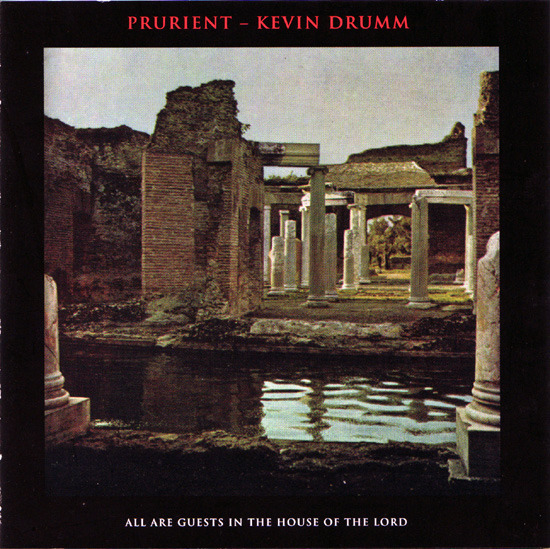
Kevin Drumm has also taken part in a load of collaborations. This one, with the always fantastic Prurient, is especially interesting to my ears.


“With so damn many records pouring out, there are precious few artists who strain against sagging shelves and actually merit the “must hear” designation. One of them for me is Kevin Drumm. Widely known “guitarist” and relentless disassembler of technique, expression, and expectation, Drumm has recorded seminal solo records (first on Perdition Plastics, then the epochal Sheer Hellish Miasma), tussled in some notable duos (with, for example, RLW with Ralf Wehowsky), and even shown up to upend some “jazz”-based sessions, with Weasel Walter and Ken Vandermark.

All Are Guests in the House of the Lord is a somewhat new trajectory for Drumm – a libretto. Paired up with Prurient (Dom Fernow), this six-part suite (once in circulation on a cassette) is moody, somber, and filled with detail. Throughout this recording, the music flirts with cheese via Hammer horror effects (Fernow’s screeching recitation of the disc’s title, or cornball synths), resulting in a sound that’s challenging in ways both successful and unsuccessful. There are passages where Drumm’s flinty musical personality – guttural feedback, metallic scrapings, and sine waves – doesn’t fit neatly with Prurient’s more cinematic, even narrative approach. But there are times when, as in “On This Slab,” it works very well indeed, drawing you into its distinct space.

I found myself rarely paying attention to the recitation (there is apparently an actual libretto, which has prompted innumerable – and to my ears somewhat sloppy – comparisons with Robert Ashley), and concentrating more on the sound of the vocals. The pieces work quite well on this level. The cavernous loops on “There Died Venus” sound like someone ripping a hole in the music. There’s very effective use of “field recordings” (kids shouting in play) on “Though the Apple is Rotten.” The rumbling setting of “In Long Rows” – with Fernow’s muffled, pitch-shifted voice – reminds of the Giant in Twin Peaks. The closing “Comes Another Brood” – what story is being told here? what slaughterhouse narrative are we being led through? – sounds like the innards of a charnel house, a voice resounding bleakly within the infernal machine. I like listening to this record without feeling compelled to answer questions about narrative, which would surely reduce its pleasures for me, though your mileage may vary.”

Taken from here.


—

So that’s an introduction to Drumm’s work for those who are unfamiliar, and perhaps a reinforcement of the guy’s magnificence for those who are up to speed with him. Now it’s time to take a listen.


—

Links

Kevin Drumm’s blog: http://recreationalpanick.blogspot.co.uk/.
Kevin Drumm’s Bandcamp page: http://kevindrumm.bandcamp.com/.


*

p.s. Hey. Surprise! Zac and I showed up to the theater in Marseilles last night to show PGL, but there was some huge screw up and the theater never received a file of the film, so the event was cancelled at the last second, and we took the next train back to Paris, which is why I’m here. ** David Ehrenstein, Hi. Mm, yeah, PS was kind of sleepy and mostly occupied by old retirees, as I recall, with only a mere hint that it would become a gay mecca sort of place. I guess it mostly struck me as a so-so small town in a great location. Yes, Alabama. If you guys lived in France, the cities would have been filled with protesting, rioting people long before this latest disaster, but it is not France. Quite clearly. FaBlog anew! Everyone, the FaBlog has new thing at its top as of now called ‘Hotel de Twink’, the title alone of which should get at least some of you over there. ** Armando, Hi. Well, I gathered those escorts in the last month, so I think they’re alive unless fake equals dead. Most escorts these days are negative and on PREP. Yes, Palm Springs does seem to be a very different place. So I should go look at it. Maybe in October. Maybe they’ll have a good haunted house attraction or two there. Oh, man, thank you so much for saying that about PGL. That’s super kind and wonderful to hear! Gosh, thank you a ton! ** Bill, Hi, B. No, really, in the past, oh, six or eight months or maybe a little more, the escorts’ guestbooks have become places where it is a popular thing to troll. Before then they were mostly just ‘he was hot’ or ‘he was not’ or ‘he is fake’. But now the guestbooks are like a medium for snark unto themselves. Lucky me, I guess? Ah, the old dog! The good old, reliable dog! Nice to hear he/she is still alive and kicking. ** _Black_Acrylic, Oh, I’m so sorry, Ben. Yeah, best of luck re: hanging onto the manager. ** JM, Hi back to you, JM! Thanks. Yes, if I manage to remember, I’ll try to find and save an escort who specialises in birthday dates. Pop out of a cake, strip, …. etc. They do exist. Wow, the ‘Boudica’ piece sounds super interesting. You had better document that thing, or at least a trailer’s worth. I hope it goes as excitingly it sure seems like it will. Thanks for talking up PGL. It’s only 90 minutes. Even I, the busiest of the bees, has 90 minutes here and there, but I digress, ha ha. I’ve heard a little about the James Benning exhibitions, but nearly enough. I’ll find out more. Ooh, that is exciting. Lovely to see you, pal. Really great luck with the theater piece, the reading, the academia, and everything else! xo ** Okay. Today I give you an old, restored post made by the honorable writer and human being Thomas ‘Moronic’ Moore introducing you to the killer work of the great Kevin Drumm. Enjoy, folks. See you tomorrow.

« Older posts Newer posts »

© 2026 DC's

Theme by Anders Norén — Up ↑