* (restored)
Buy me, buy me, or I will die torn to pieces, yesterday they seized me and sewed me inside the horsehair of a mattress, cutting a hole in the cloth at the place of my thighs and everyone could then fuck me choking inside the horsehair, eyes pricked by the sweat, and the cloth, around the hole, blackens and sticks to my belly; I can’t see them, I recognize them only by their cocks. Set me free, I’ll work for your living. — P.G., Tomb for 500,000 Soldiers
‘Most books demand solitude, this one screams for solitude, for you to take yourself away from any still pulsing, breathing encumbrance; so as to exist, in single file, as a witness to the death of humanity across turned pages.
‘No more than one witness at a time is necessary, efficacious.
‘Otherwise there’ll be a lack of continuation, propagation.
‘Like Marx, this book is an anti-aphrodisiac – a stark reminder that all was, in fact, has been, lost.
‘Not least paradise, space, place, corridors of even a bureaucratic beauty.
‘Converted too late, we defend symbols to then be symbolised.
‘Start again. The post-human rings out in its own absence.
‘The overman, or something more abstractly sexed, is here to be built-up from the miniscule moments of bleak poetic relief:
“dust runs in the folds of the curtains”
“a pink cloud passess in the frozen lake”
“a flock of cranes flees towards the border; the sun irradiates the radio antenna”
‘The edge extended turns into a ledge.
‘A membrane defended, a de-cathexis.
‘If de Sade was a forecalling for the dismemberment of God – as unifying principle, as psychic sop, as creative alienation – then this book reminds us, one at a time, to keep more than god dead: heads, civilization, culture, ever-declarative mouths, mirrors.
‘Apocalypse always.
‘Organised into seven chants across 378 pages the book charts the colonial wars within colonial wars within the interior of archipelago’d people colonised.
‘Only sphincters move. Shit on this.
‘Read it aloud? There would be a risk, in voicing the force of primordial massacres, in mouthing the ur-brutalities done to children and horses, of taking it on, in to some affectible inside, becoming it, being overheard, in single file, alone; becoming an emissary of more than auto-destruction: willing will-lessness overdetermined becomes a reflex of urge appeasement minus the pleasure.
‘Desire dies, is replaced by ash-grey doves and mouth foam.
‘Solidarity breaks-out via incest, pimp deals, slaver alliances.
‘Soldier vampires loll, fuck, prod, rape, shoot, sever, cut, burn, bleach, turn tail, ring noses, vultch, displace populations, wait for furniture…
‘Soldiers captured in their own barrack-blocks like boxed goods, free now but for the wire.
‘The overflow of horror, the Boschdom without narrational context, has left each and everyone on the verge of extinction: enter a character/exit a character, enter tenderness/murder tenderness. For now, in an excess of present unaccessible to hope, expecting, almost willing, the expenditure of the cheapest of all the economic variables, there is a kind of living hysteria, as if the permanent time here, throughout the centuries, is seven or less minutes to midnight.
‘It is this hysteria, its animal energy and, also, the fallback onto psychosis that spares the book the mass suicides that would end it *.
‘At this pitch of survival (“beyond the barrier of terror”) there can be no fear.
‘Fucking, a loveless valve. A time beating, a little prepatory death.
‘The human generates no affect. The affect always from outside, crossing in, as a vaguely veiled romanticism:
“over them hover large white and violet butterflies. The dust from their wings falls on the sentries’ dry lips”
‘Respite for the author? Recipes for the readers?’ — datacide
___
Further
Pierre Guyotat @ Wikipedia
The Multiplying Hells of Pierre Guyotat
Pierre Guyotat – His books stink of sperm and killing
into the zone: guyotat & film
A History of Reason
A Vital Aberration: Writings On Pierre Guyotat 1994-2010
Pierre Guyotat Reading Matter Pt. 1
Alain Badiou: Pierre Guyotat, Prince of Prose
Why Pierre Guyotat’s Work Is More Relevant Now Than Ever
PG interviewed @ BOMB
PG @ Semiotext(e)/MIT Press
PG interviewed @ Purple
‘Pornographic’ French writer Pierre Guyotat dies aged 80
Donatien Grau’s Homage to Pierre Guyotat’s Eden, Eden, Eden
;*)%,”””!@;,: Pierre Guyotat
PG @ Goodreads
2 X PIERRE GUYOTAT
Disparition: Pierre Guyotat, éternel éden
« JE NE PEUX PAS VOIR CE MONDE COMME UN MONDE INFERNAL, PARCE QUE J’Y SERAIS DÉJÀ RÔTI »
« Je suis un musicien, je suis un alphabétiseur. »
“Pierre Guyotat, la matière de nos oeuvres”
Read/download ‘Tomb for 500,000 Soldiers’ @ Internet Archive
____
Gallery
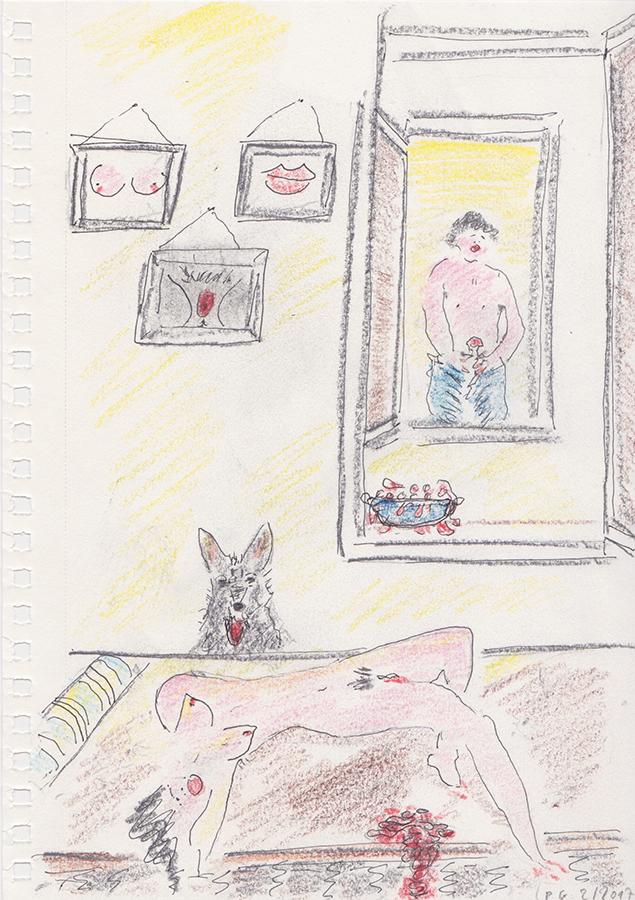
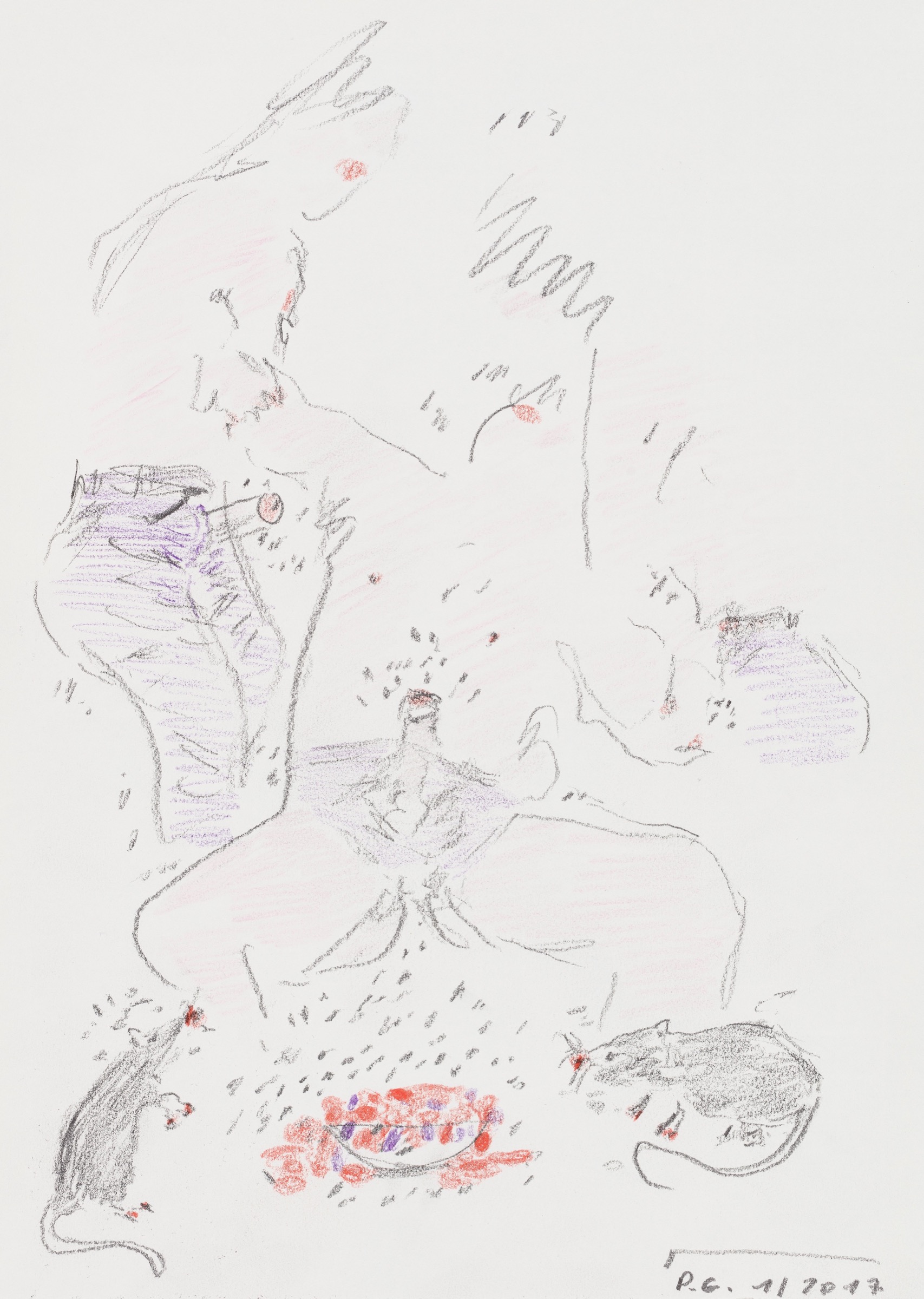
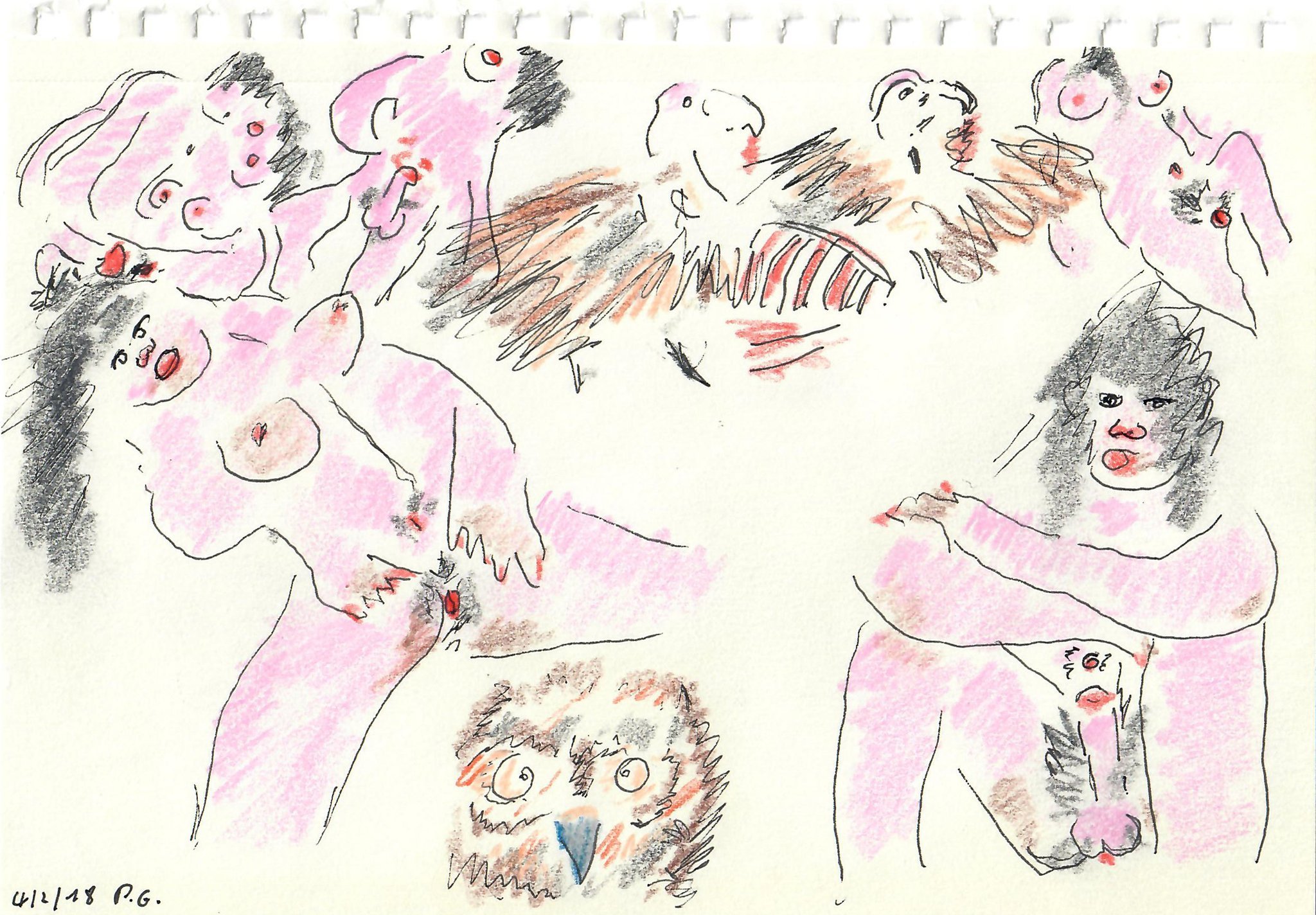
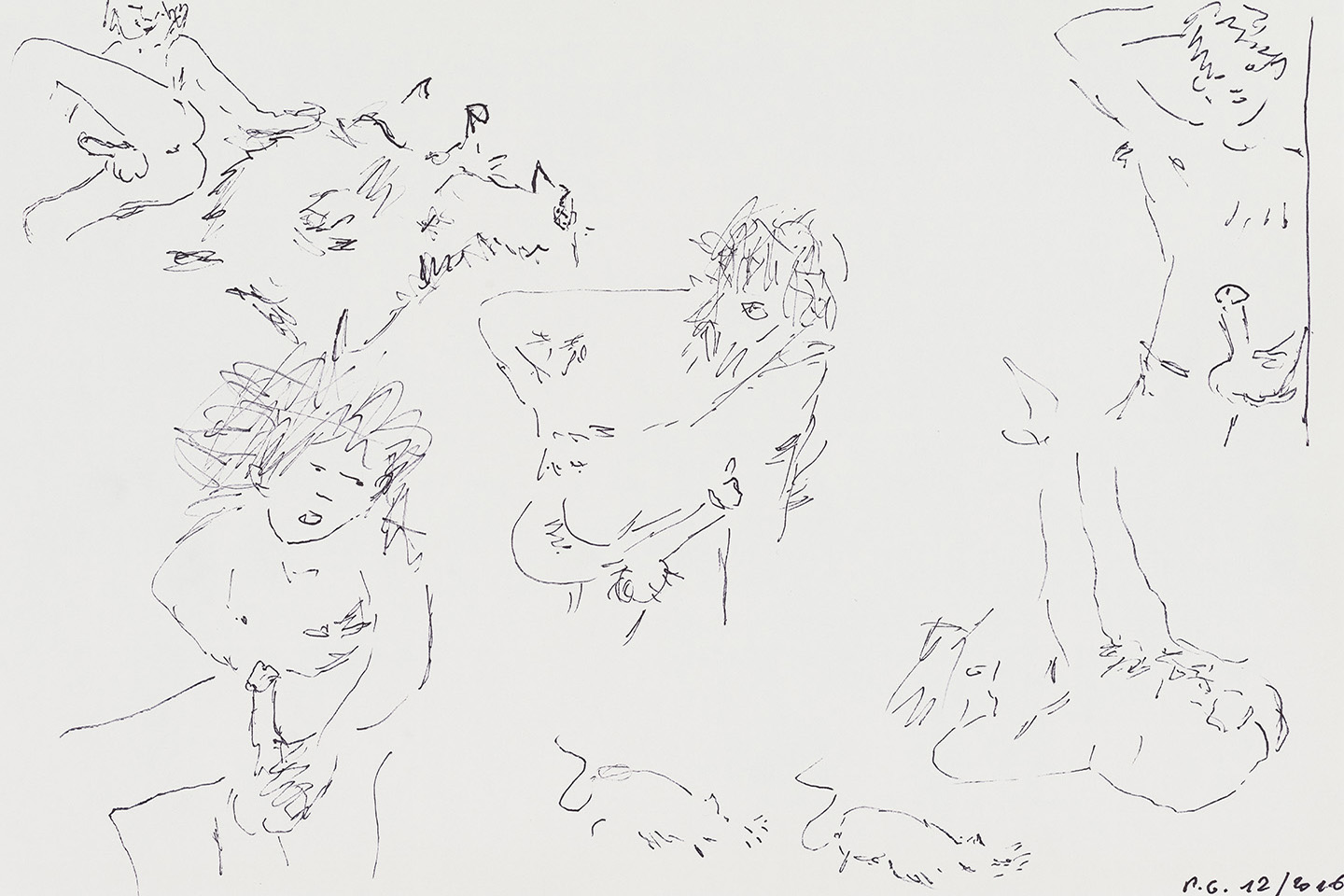
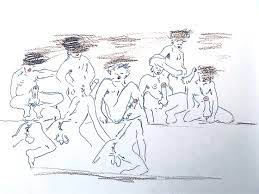
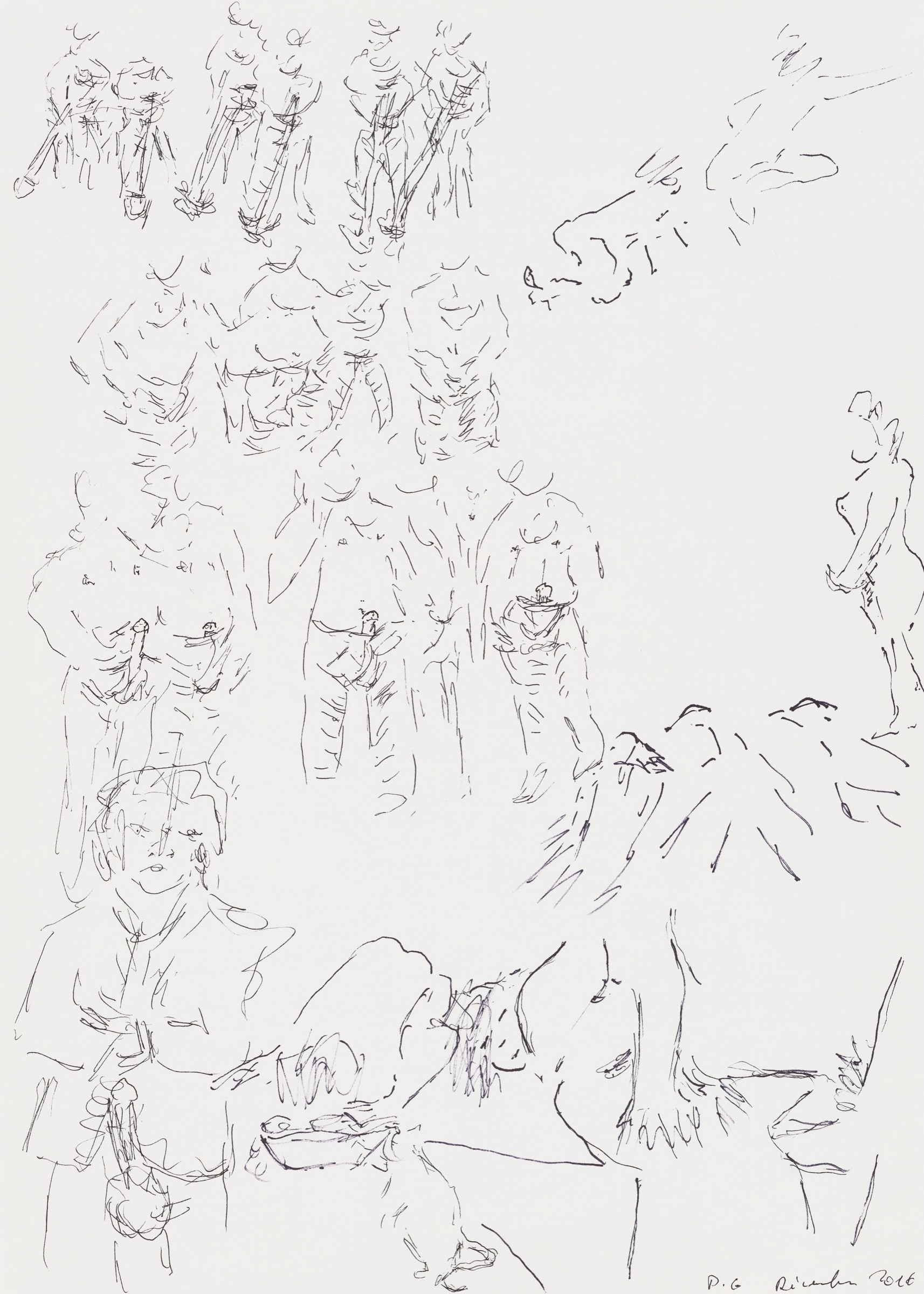
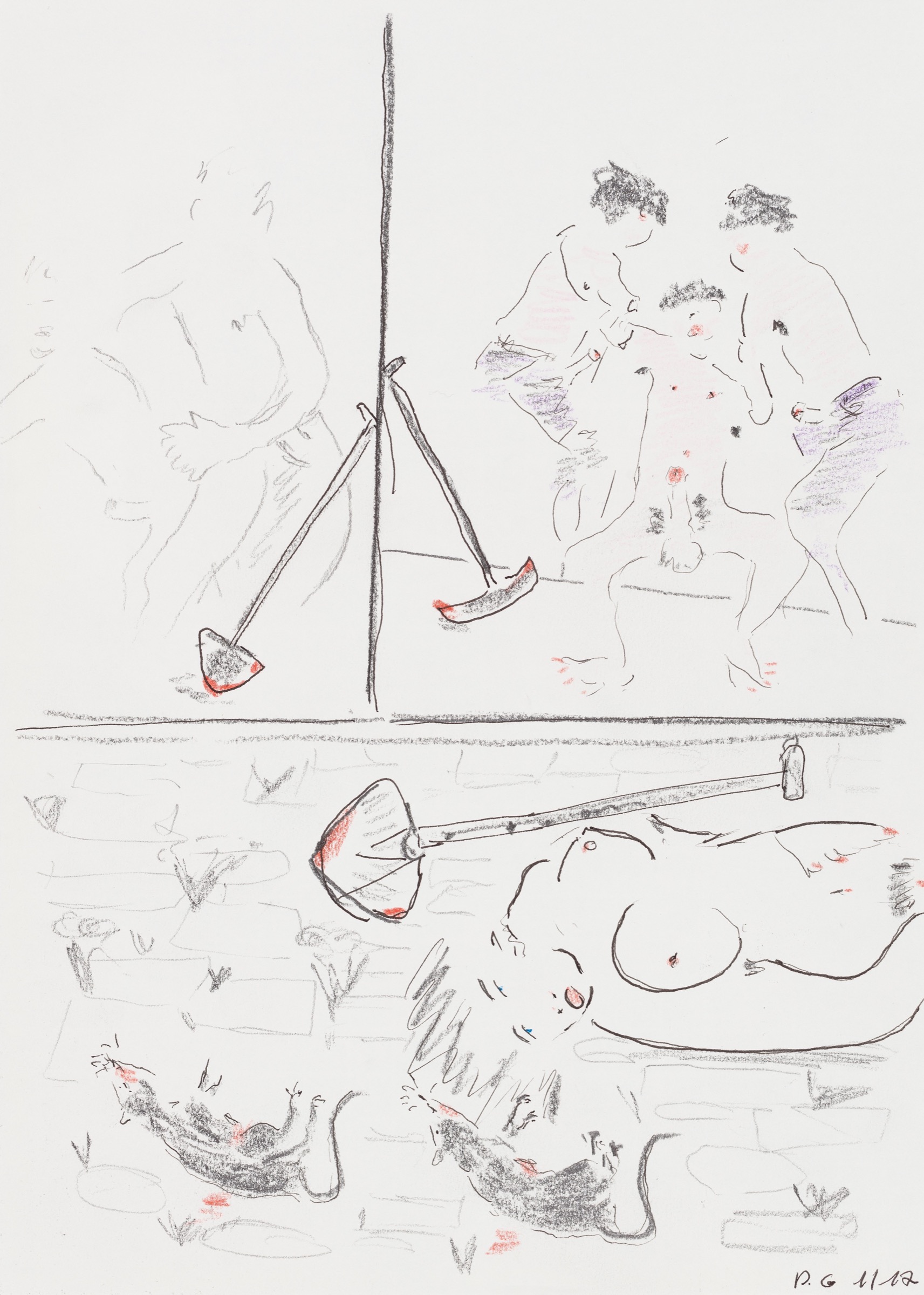
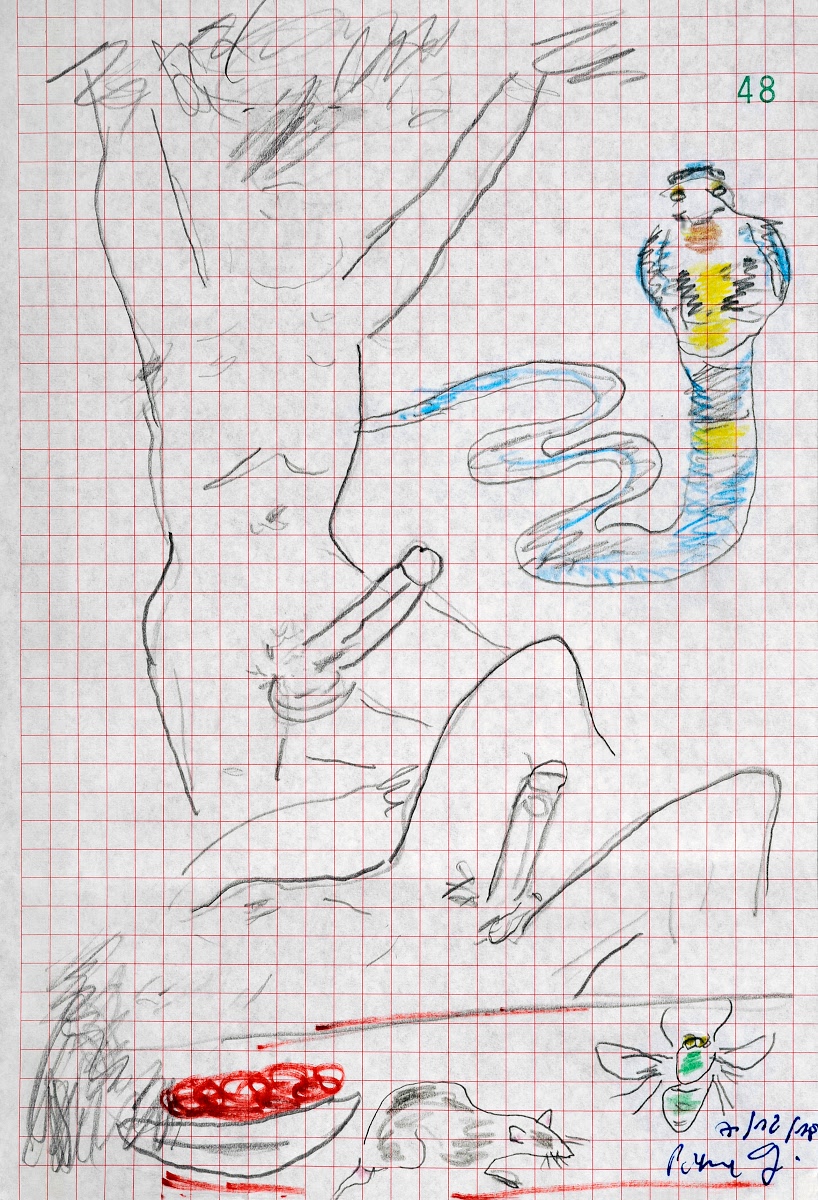
‘Pierre Guyotat’s experiences as a French soldier in the Algerian War of Independence led him to develop an entirely new kind of writing. The brutality he witnessed in North Africa compelled Guyotat to refuse the conflation of literature with civilisation. Instead, he treated language as physical matter through deformed words, verbal onslaughts and obscene imagery. This led him to the concept of the matière écrite, a sort of ‘secretion’ to be perceived orally, visually and architecturally. Of Le Livre, for example, he once explained: ‘I am aware that what I do in Le Livre cannot be readily understood without me speaking the text, pronouncing it publicly.’
‘But perhaps the most famous expression of Guyotat’s approach was the book Eden, Eden, Eden – a hallucinatory evocation of the horrors of sexual violence under colonialism – which was banned in France the same year it was published. For Guyotat, even the manuscript itself was a piece of visual art, and he did a special painting for the cover. Guyotat gave up drawing after a breakdown in the early 1980s and would only resume the practice in 2015. The artworks on view demonstrate his extremely complex yet direct language, which stems from memory and symbolism while presenting scenes of sexuality, freedom, joy and exploitation.’ — Manifesta 13


____
Extras
Pierre Guyotat, écrivain radical
Pierre Guyotat – “In bed” by Henri de Toulouse-Lautrec
Pierre Guyotat – Rencontre à la Librairie Les Cahiers de Colette
Life of Pierre Guyotat: New Social Environment #43
____
Interview

THE WHITE REVIEW — In 1960, at the age of 20, you were sent to Algeria with the French army, where you stayed for two years. In 1962, you were found guilty of encouraging desertion and possessing forbidden material and were imprisoned for three months.
PIERRE GUYOTAT — I went back to Algeria frequently after independence, particularly to the Sahara. Since then, I’ve only returned through my fictional characters, or at least those that can recognisably be identified as ‘Algerian’. As a soldier over there, and immediately afterwards, I’d reached saturation point with France. I was very anti-Europe and anti-West. It was the great era of thirdworldism and ethnology, a period that is very controversial today because some see it as an avatar of colonialism. One can read very surprising things about this period nowadays. Everything becomes neo-colonialism and it has become impossible to consider nations that were colonised as free – free to reject their dictators – and proud. Every time something bad happens to them, we see the hand of the ex-coloniser behind it and we continue to treat them like children.
No one is perfect: it’s worrying that there is today this desire for everything to be perfect. The fewer things that happen, the fewer things are possible – and still we want even more perfection. To be politically perfect, which means that you can no longer be anything. Someone taking an interest in an African tribe will be seen as a colonialist. No one knows what to do any longer. There are committees, charities, councils representing who knows what… it’s astonishing. All of these entities would be interesting if they had no vested interests, but the charities are generally supported by the state, which means they are accountable for their actions. A certain number of scandals and controversies justify this state support, just as policemen have to hand out a certain number of traffic fines.
I understand very well, I’ve always supported the idea that slavery should be recognised as a crime against humanity – and, as we know, the West is not the only guilty party with regards to this abomination. I’m not saying there should necessarily be legal recognition of this fact, but we should agree that it was a crime that was perpetrated continuously over the course of 300 years. Involving the law in something like this is very complex, but when people’s desire for publicity leads them to speak lies…
It is unbearable to live in this kind of environment. Someone trying to live an honest life can no longer live. He can be honest, he can watch everything he says, everything he thinks even – but he will be dead. One cannot live when one is constantly ordered. There is a contradiction at play here: people always talk about multiculturalism in France but at the same time you have to stay politically correct on every single topic… We have to accept some form of disorder. It’s impossible to control a population through interdiction, it’s impossible. On building sites, for instance, you sometimes hear terrible things and often people shout at each other in an incredibly rude but also funny manner, and things are settled in good humour. Things can go very well. We have to let people express themselves. Otherwise, they die. We are always facing language barriers built by ignorant people. We cannot let some societies make laws and create interdictions: there are enough interdictions as it is. It’s strange that people are so infantilised. We have to let them speak for themselves, to let them learn for themselves what not to say because it hurts others, history, a History, the honour of man. And we can say certain things and laugh at them up to a certain point, which time will decide.
THE WHITE REVIEW — In CARNETS DE BORD you wrote: ‘Great works (or great men) are those which bear the mark of the brutality of the world. Not those which conquer their serenity and gentleness on the most profound chaos and the most acute solitude. Otherwise, one does not feel civilisation (the moment of conquest) but already decadence (i.e. the habit of benefits conquered in the past).’ This idea still applies to your work, in which violence and gentleness are both present.
PIERRE GUYOTAT — I’ve always said that. The premise of my work is brutal, but it does become gentler.
THE WHITE REVIEW — But is cruelty its fundamental reality?
PIERRE GUYOTAT — It is one of its realities. Cruel acts don’t need to be shown explicitly. There are also implicit cruelties. Inequality is an implicit cruelty, the most terrible, the most violent cruelty. One might wish to abolish it, to abolish what makes a man not know he can do anything. One has to seize what lies close at hand, what is urgent. The transformation of humanity into ‘strata’ or ‘masses’ – an avatar of scientism that has done so much harm – can only inspire disgust. I’ve long thought that in every human being there is a sleeping genius and I endeavour to continue to believe this. I wrote something, long ago, along these lines: ‘So long as man has five fingers on each hand, we cannot do anything about it.’ Unless a great organic and bodily mutation occurred. Man isn’t everything, either. We need to look beyond the human too. It’s a necessity. I do it a lot. I force man outside of his humanity.
THE WHITE REVIEW — How important is working as a collective to your work? Does collective work have as much value as the work of an individual? You were part of the Tel Quel movement at one stage.
PIERRE GUYOTAT — Yes, Tel Quel was my generation’s collective. It remains the only time I have been part of a collective. It fitted me quite well at the time, especially in terms of the movement’s discourse. From an artistic standpoint, it was quite different. The overall discourse suited me at the time – that’s clear – and I think I suited them, too. Later, things changed, quite quickly. As always in the history of literature.
THE WHITE REVIEW — Was it an alliance of sorts?
PIERRE GUYOTAT — Yes, it was during the brief moment when – this was the high point of Tel Quel – there was a division between two sides, broadly speaking: those favouring convention, and fiction, and the avant-garde, who favoured anti-fiction. I was very much in the fiction camp, full of characters, places, and scenes. I was more aware of the constructive aspects of the movement: the future, a more material fiction which would be open to the world, a transformation of language to be effected immediately rather than to be vainly wished for…
As I have often said, I read very few nouveau roman books. I knew their authors, but I didn’t read them much. The important thing was to know that these books existed. That was enough. It was a kind of tabula rasa, a fresh beginning. That, I knew, but I almost felt like there was no need for me to actually go out and read the books. I got a sense of those books instantly by just looking at them. I’ve always had the eye of an illustrator, I can tell immediately whether something is right or not. If it’s not good enough, I can tell straight away. I should have read a lot more, as I had as a child and adolescent, before really starting to write like I do now. I read a lot of British and American authors, like everyone else. But I read the authors people like to match me with much, much later.
THE WHITE REVIEW — Do you see any proximity between your work and that of writers like Bernard Noël or Jean Genet?
PIERRE GUYOTAT — With Bernard Noël, none whatsoever. As for Genet, we’d known each other for a long time. I met him in the Gallimard offices on the day I met Antoine Gallimard for the first time, forty years ago. It was a very open first meeting, we laughed a lot. I met Genet several times afterwards, I ‘loaded’ him in the Volkswagen I had at the time. I felt very free with him, and I also witnessed his ordinary human suffering. But, you know – and I’ve explained this often – I read most of his work later. I read a lot of the books that were compared to my work after I had already produced a consistent oeuvre. I first read LEIRIS AND GENET only then, and SADE, much later. I would read someone’s work after I met them. For example, Leiris himself gave me his AFRIQUE FANTÔME, in the beautiful blue Gallimard edition of the time. When someone gave me their book, I would read it. Mascolo gave me his COMMUNISME, which I maybe would not have read otherwise. It doesn’t always work out like that, only sometimes. I like it when people give me their own works.
THE WHITE REVIEW — In terms of English-language authors, were you into Faulkner and Joyce?
PIERRE GUYOTAT — Yes, among others. DOS PASSOS was formally very interesting. In Faulkner’s work, there is a kind of matter, a kind of idiocy, it’s wonderful. His is a world that suits me perfectly. Joyce too, especially FINNEGANS WAKE, a wonderful book which bears little relation to what I do, but which has such freedom, such visual language! I’ve always felt a greater affinity for that kind of literature to modern French literature, where language is a matter of state. Shakespeare and Molière are the couple who educated me.
THE WHITE REVIEW — How attentive are your readers? Do you have any contact with them?
PIERRE GUYOTAT — Sometimes I bump into them on the street or on the metro. Some recognise me but don’t say anything. I also receive letters, from readers who have really read me properly. I trust that these readers exist – I think that an illusion is created in this regard by a certain section of the media. Beyond that, there are still readers, of course. There is no reason for that to change because there is this desire for fiction, for language. I saw this when I used to give readings. People would come without preconceptions. Preconceptions are a problem. People with preconceptions say: ‘It’s too complex for you.’ Those in the universities say that to their students. The press also plays a part in this – even if it is almost entirely discredited — because the printed form still has a little bit of prestige. The ‘illegibility’ reproach is an old classic, which reflects only consumers’ inability to read anything.
THE WHITE REVIEW — What is more important in your relationship to your work: your control over it, or its independence from you?
PIERRE GUYOTAT — One’s work, everything one does in life – it all overtakes you in the end. It’s particularly true of politics, for example. A lot of people, a lot of politicians, practically acted in total emptiness. Nowadays it’s not really the case anymore. Before people stepped out into the abyss without really knowing what would happen. Nowadays nothing like that happens because speech is so weak, so miserable, so controlled that it annihilates itself, and no one takes risks any more. Without being conscious of urgency, speech can no longer have the same strength. Acts have practically disappeared. Apart from in the civilised world where, day to day, those left behind by politics have to act day to day to survive. We are no longer ‘children of God’, but voters.
___
Book
 Pierre Guyotat Tomb for 500,000 Soldiers
Creation Books
‘This is the first English translation of French writer, Pierre Guyotat’s legendary novel, which was recently included in Le Monde’s “100 Greatest Novels of the 20th Century.” A violent collision of brutal warfare and sexual ecstasy, Guyotat is said to have hallucinated the subject matter as a young soldier during the Algerian war, where the novel is set.’ — Creation Books
___
Excerpt
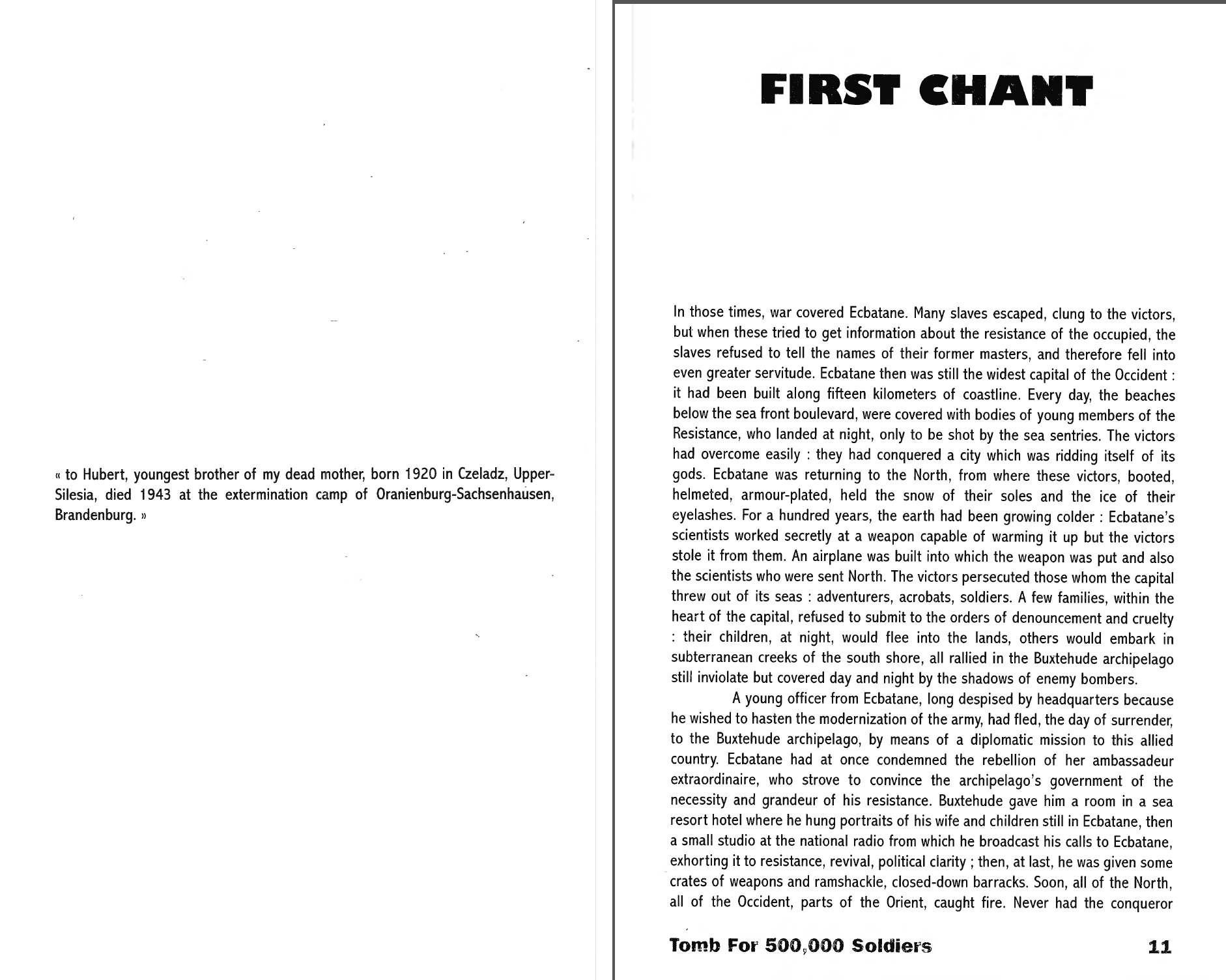
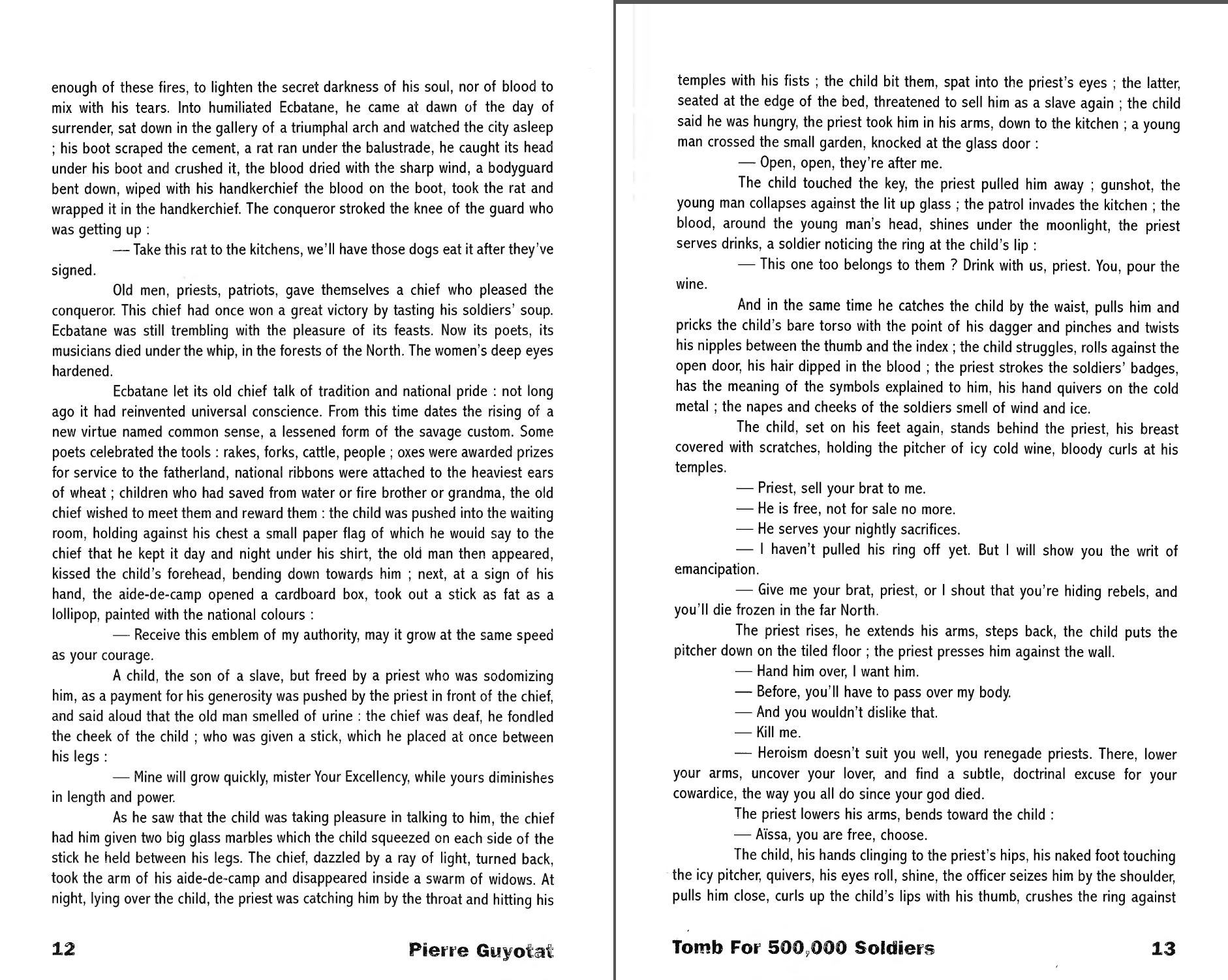
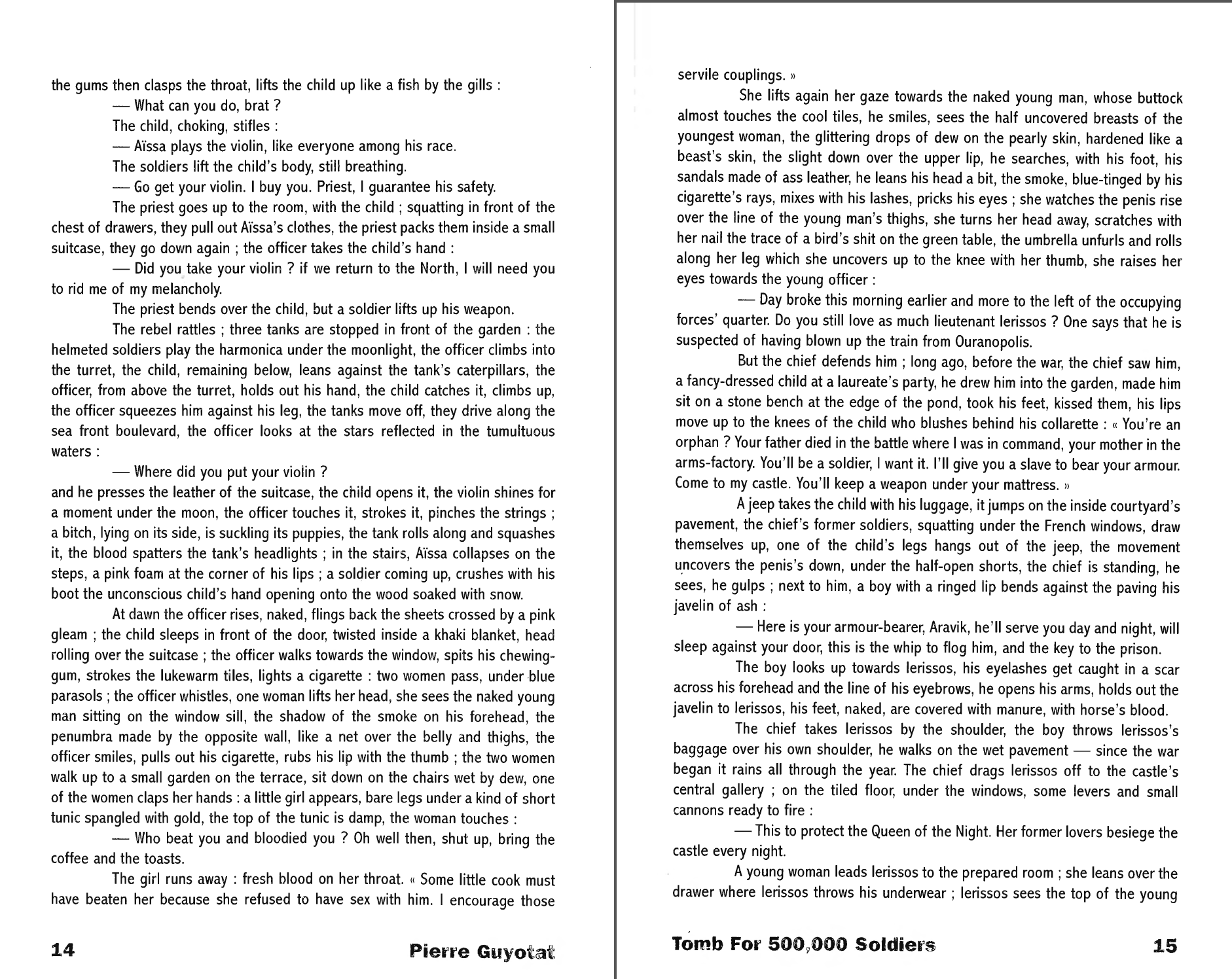
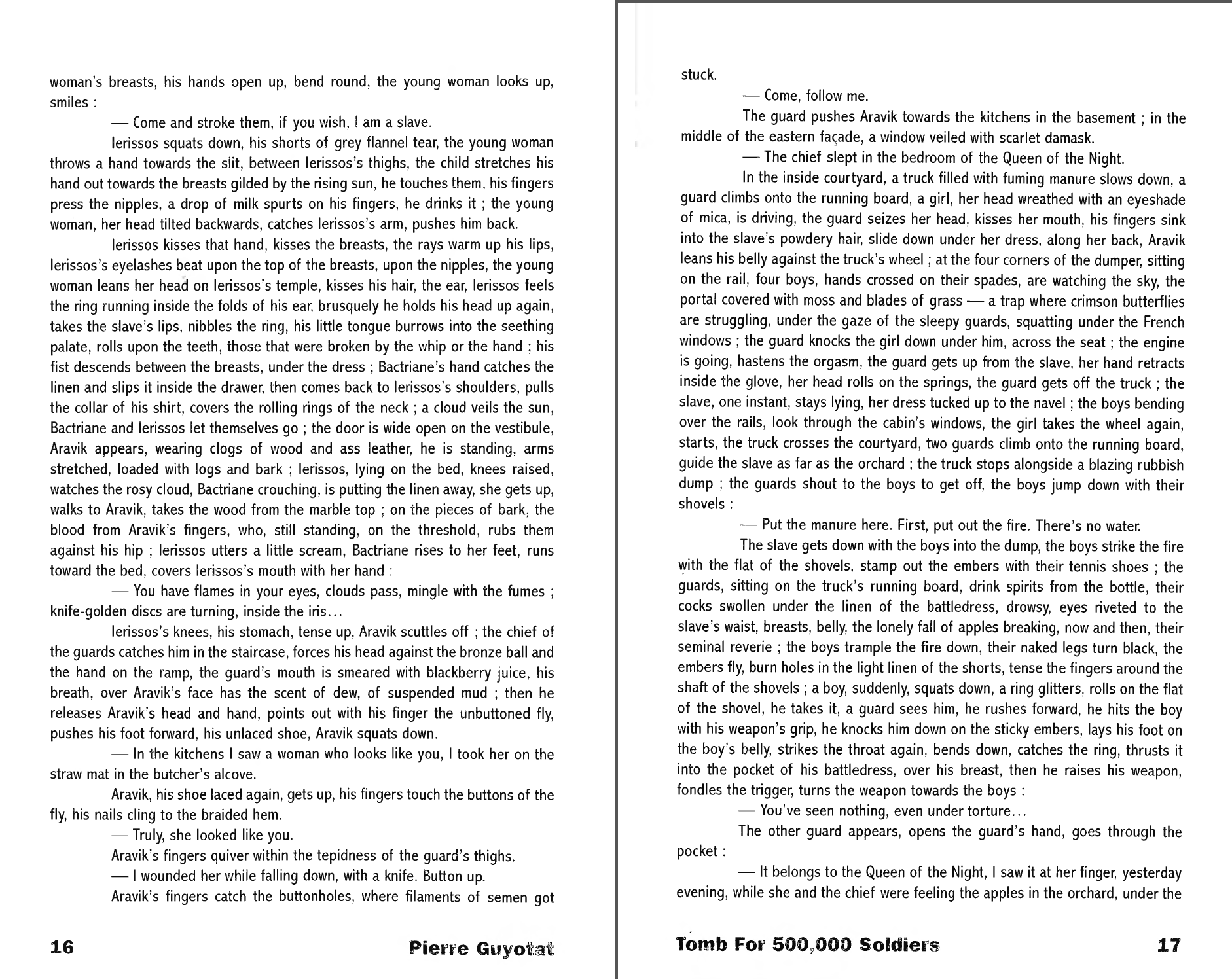
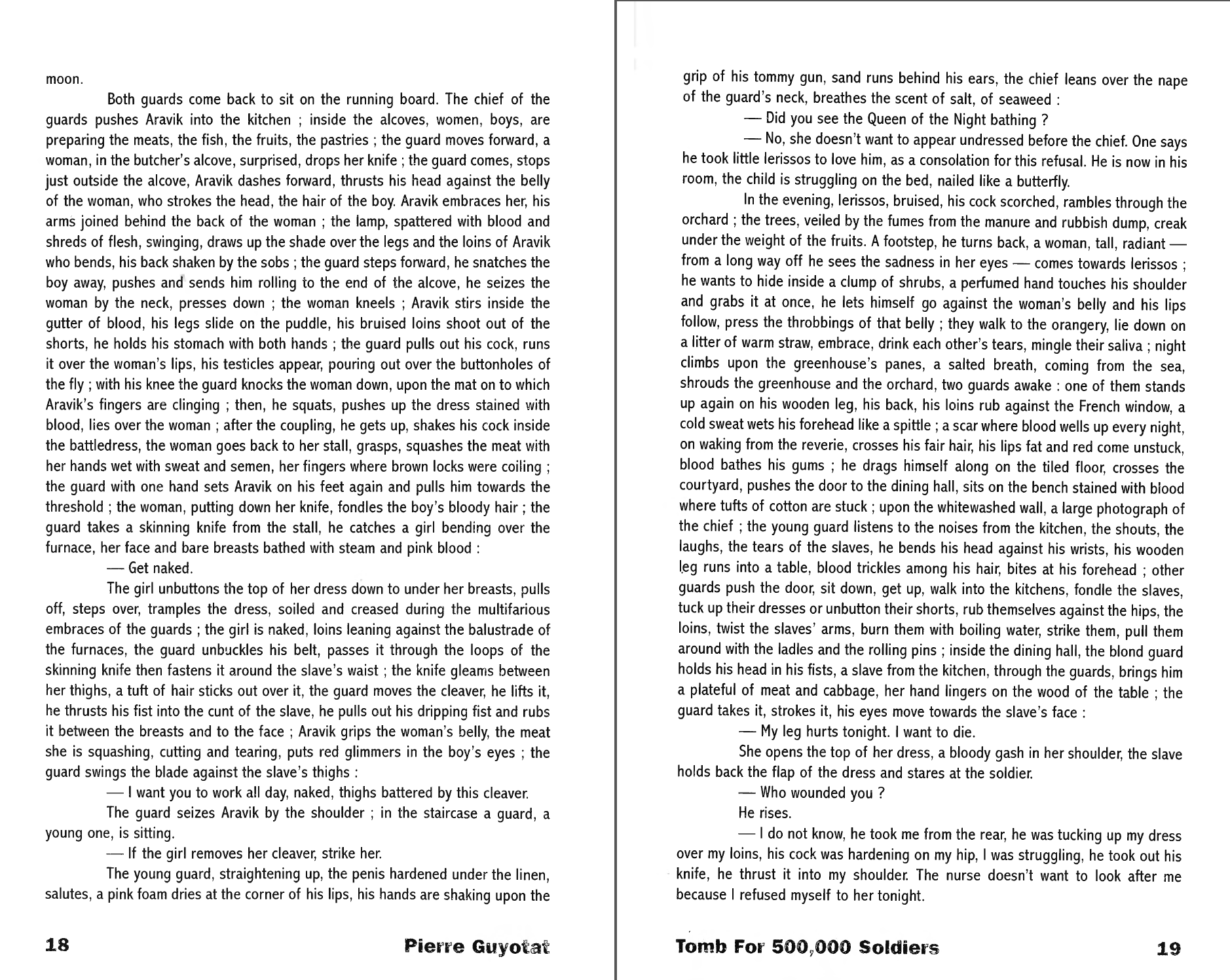
*
p.s. Hey. ** Adem Berbic, Hi. Parc Asterix has a designated bus that takes you there and back from/to Paris. Or you drive if you have a car. There might be other ways, but no metro or RER access, no. Happy that his films his films are penetrable and tweaked you. Give translating his methodology a shot, for sure, why not. ** _Black_Acrylic, My only problem with the Haynes VU doc is that it acts like Cale leaving was the end of their great period whereas the 3rd, post-Cale album is also great. But yeah, it’s nice. Ah, shit, the dreaded summer breaks. We’re about to go half-mast until September here culturally too. Grr. ** Dominik, Hi!!! I rode all the coasters at Fuji-Q, which were about 6 of them, and the ones in Tokyo and Osaka. That is curious: the Manson audience’s warmth. Theoretically he would hate that, I suppose, but he’s essentially a legacy act now, so I suppose love is all he really wants. Haha, I would guess love’s speculation is right? I’ll go take a look at him. Love vaguely wondering what people who are jogging imagine that people who are watching them jog think about them, G. ** Tosh Berman, Hi, Tosh. I have a few issues of ‘Film Culture’ amongst my stuff back in LA. It was a great magazine, yes, needless to say. Strange that some university press or somewhere haven’t gathered the issues and published them as a book, ideally in facsimile, no? ** DonW, Thanks, I love filling in blanks. As you probably know, Mark E Smith hated Pavement and thought they were just a rip-off of The Fall. When I interviewed Malkmus years ago, he was quite hurt by that while semi-acknowledging that that might be true. Yes, the Jardin d’Acclimatation is worth visiting, especially if you have kids young enough to want to do rides but not scary ones. It’s very charming. And it’s near the Louis Vuitton Foundation, so you can look at art while you’re over there. If your kiddo is an actual thrill seeker, Parc Asterix is highly recommended. Yeah, it’s the anticipation that’s the problem. In reality, going straight up isn’t as big a deal as it looks like from a distance. But then I like when my adrenaline wakes up. ** Carsten, You’re most welcome. Having been very disappointed by Denis’s most recent films, that new one is on my back burner. But not as far back on the burner as ‘The Odyssey’, obviously. ** HaRpEr //, I have quite a number of friends, all writers, who earn money by teaching kids English online, often kids in China for some reason. I’m not sure how one sets that up, but I could ask. I didn’t know Schoenbrun wrote. Huh. I’ll look for that. Well, the person who said that about Schoenbrun is just one person with their own possibly slanted viewpoint, so I wouldn’t take it too seriously. But, yeah, doing something for Netflix is a bit of a red flag, no? ** laura w, Libraries are among the rare places where you can actually see films like Emshwiller’s unless you live in a city with a film series that concentrates on experimental films, which I very luckily do. ‘Four Nights of a Dreamer’! Do cue that one up when the right time arrives. And the Errol Morris pet cemetery film is terrific. And the Darger one is mostly quite good. Yeah, fuck that guy with terrible taste in humans. He’ll burn in hell or something eventually. I’ll know the streaming platforms soon, but there be at least one big, easily accessible one. And speaking of libraries, it’ll definitely be on Kanopy. Norway is the last scheduled screening right now, but we’re open, and we’ll probably keep screening it once in a while in Europe. There are a handful of festivals we’re waiting to hear from, but the film is getting a little ‘old’ for festivals, so not much chance there. But mostly, hopefully, full speed towards finding a producer and making the next film. See you tomorrow too! What a coincidence! ** Bill, Glad you know his work. Living in San Francisco does help on the experimental film accessing front. Are you buffeting yourself against a monsoon? ** Okay. Today I have turned back on the spotlight that once fell upon the biggie amongst Pierre Guyotat’s early novels. See you tomorrow.



 Now available in North America
Here it is again. This book is so big for me, and I hate the English translation in direct proportion to its bigness. I really think it’s not very good. It totally kills the sense of rhythm and the dreamy repetitive quality of cycling through a strictly limited set of words and images. ‘Dreamlike’ is an overused word, sure, but the original really sells it at the prose level better than most things I’ve read. And Guyotat never uses the French equivalents of ‘cock’ or ‘cunt’ or anything, I’m pretty sure the most explicit word in the original is ‘le sperme,’ so I have no idea why the translator decided to raunch it up. I think the graphic-yet-smothered quality of how he handles the sexual content in French is a big part of its effect.
But yeah, this figures very prominently in my thinking about (or maybe ‘sitting with the notion of’ is more accurate) how a book might be able to warp the reader’s sense of having any agency in their relationship with it. There was the Whitehouse quote about ‘bludgeoning the listener into submission,’ here I think it’s more ‘seduce’ or ‘stun’ or ‘hypnotise.’ Which is probably more practical for writing. I tried reading ‘Coma’ recently, though – admittedly in translation – and I did not get on as well with that one. It has the stereotypical French writer thing of being so cockily assertive and declamatory and manifesto-like, I thought. Although maybe you’ve earned the right to be cocky after writing those two books.
I think I owe meeting you in the first place to Guyotat. I remember looking up the previous version of this post at 2am to find the English PDF it used to link to, and for whatever reason I realised for the first time that a) we were in the same city, b) I was within my rights to post a comment. So, thanks, Pierre.
@HaRpEr, also supposedly, a friend of a friend moved to whatever village it is that RDJ lives in and got into this weird love-hate friendship with him, where he’d veer between saying that he was the nicest guy ever and a total prick. But I don’t think the Pynchon-y mythmaking has done him any favours as an artist. Or maybe I’m just getting more cynical and coming to see any version of that as a form of very intentional marketing, rightly or wrongly.
Speaking of Schoenbrun, I saw TEENAGE SEX AND DEATH AT CAMP MIASMA. It struck me that they’re starting to repeat themselves, with another film about lives entirely defined by the media and pop culture. Nevertheless, this introduces a sense of humor to their work, and it’s extremely imaginative. This might be an odd point of comparison, but aspects of it made me think of FRISK: the protagonist’s life is shaped by a scene of a teenage girl having an orgasm as a killer approaches, which she watched in a slasher movie when she was 8. She becomes an artist to understand and transform the power of such images, which have dominated her experience of sex. (It’s likely that Schoenbrun has read your work, even if there’s no direct connection.)
Is it likely that ROOM TEMPERATURE will stream in the U.S.? (For some reason, the NY public library does not have access to Kanopy, which is rather frustrating.)
Are you doing anything over the weekend? I’m having brunch with a friend tomorrow, and I plan to see a documentary about Linton Kwesi Johnson on Sunday.
I’ll be releasing a new ep on the next Bandcamp Friday, August 7th.
Re Leeds Print Workshop, yeah it’s a shame how the summer kills any forward momentum stone dead. Still, I’m up for doing their Introduction to Screen Printing course starting 22nd September and hopefully that will bring me back to the world of positive thinking. Plus I have the Room Temperature Leeds premiere to look forward to next week, yay!
Was thinking about the upcoming BEE Shards TV show and am coming round to the idea that it might just be brilliant. Making the whole thing into a cheesy daytime whodunnit could be the perfect excuse for getting a Disney+ subscription? There’s a nice kind of symmetry to the concept.
Hi!!
I first heard about Pierre Guyotat through an earlier post of yours. His work is exceptional. Thank you for today!
Wow, that’s impressive! Are Japanese amusement parks generally larger than American and European ones? For some reason, I have that impression, but I might be completely mistaken.
He would probably hate *that* too—the assumption that he might want love more than whatever it was he used to want back in the day. (Which might’ve actually been love too, who knows.)
I know I would hate being perceived all sweaty and red-faced and struggling. Another reason not to go jogging, haha. Love finding a new door leading into his apartment building after living there for three years and feeling like the guy in Backrooms, Od.
Hey Dennis.
I thought I left a comment some days back, but it seems the blog swallowed it. Oh well — Anyway, I’m going to New York after my birthday on the 26th and will be hanging around Brooklyn with some soujourns over into Manhattan before heading up to Chicago to stay with a friend for a little bit. I’m down for any recommendations from you or anyone on the blog on what to see. I just came back from spending time in England – I’m moving into a place in London and had to console a friend about the death of his cat. I got the book “Time Remaining” by McCourt btw. Read the first part, and I quite liked what I found, but I’ll make up my mind once I get through the second part, which already seems like it’s more up my alley.
Weird to think I’ll be 23, weird to be anything at all. Love the Guyotat drawings, I haven’t seen them before.
Hi! Long time no comment, I’ve been busy. But I wanted to ask you something that seems to come up a lot in interviews, and which I’ve been thinking about as I read some of your poetry in The Dream Police: you say that being gay isn’t actually that big of a part of your identity, or your work. This confuses me a little, not just because it makes up so much of the subject matter of your stories, but also because your work does seem very influenced by the nature of gay attraction, of certain desires being forbidden and deviant in some way—do you just mean that you don’t identify strongly with being gay as a “movement”, so to speak, or an explicit label? Or is it something else?
As I type this, I realize I may have asked it a while ago, so I apologize if it’s a repeat but I’ve forgotten the answer.
Yes, maybe I need to take the plunge on Pierre Guyotat… seems like this kind of halucinatory war novel is up my alley, especially as a lifelong Bosch fanatic etc. Love in the interview how hes just like “I didnt really read the Nouveau Roman, but I looked at the books and understood it” haha. Seems like a pretty cool guy.
Speaking of Nouveau Roman, for our guitar-less set, we will be incorporating the text of Robbe-Grillet’s Jealousy in some kind of drone piece we have yet to figure out entirely… should be fun. I am very comfortable with guitars, but I always like to keep performance fresh and slightly scary, like using gear I dont fully know how to wrangle or something like that… stay on my roes I guess haha.
Need a chill weekend, (zine launch Sunday could be fun) worked fifteen hours yesterday, gonna crash hard after my (regular, single) shift today…
Hope the weekend is lookin good over there!
Hi Dennis, been lurking here a good while and now giving a comment a go
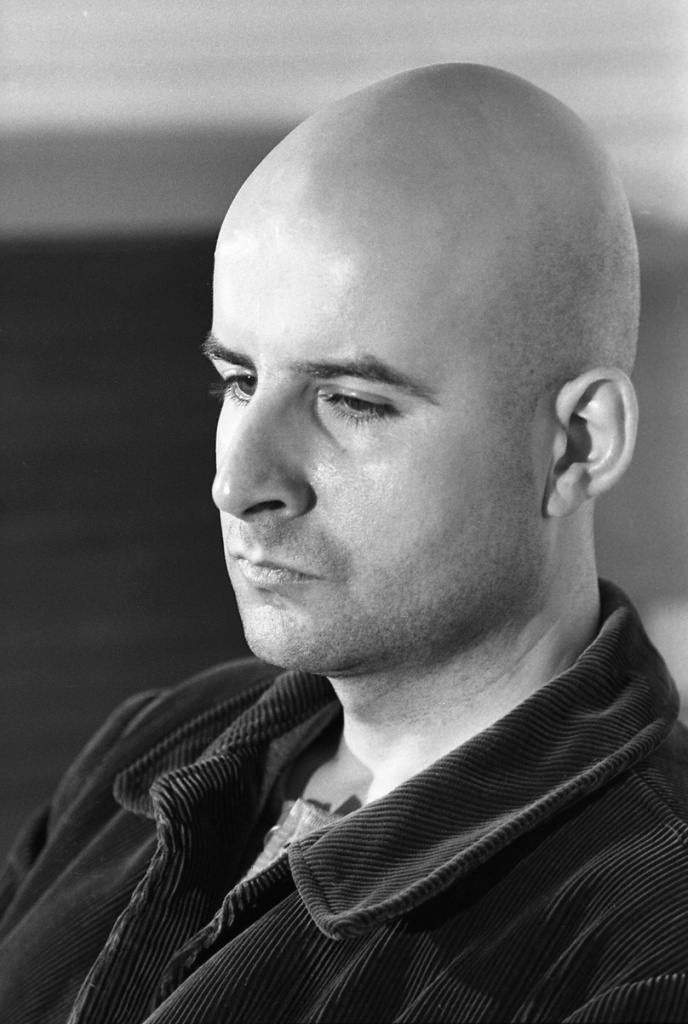
A lovely post, Eden Eden Eden has been in the back of my mind for years, and seeing his name again has at last got me starting it, it’s got kind of a sherberty quality I love already. Nice portrait of him up top too
I’ve been dipping into Jacques Nolot’s films lately, first with a rewatch of La Chatte à deux têtes… aka Porn Theatre. Perhaps you’re familiar? It suits this big thread of interest I have in the aesthetics of extremity and pornography I guess, and I learned there’s still one Cine X going in Paris – the Atlas, so I poked around there on Google Maps for a little while, lol.
pierre guyotat! i just got idiocy in the nyrb summer sale which is very exciting. i’ve had eden eden eden on my list for years but for some reason sometimes confuse it with 2666 which i don’t think it’s at all like?
the copy of gates of heaven (that’s the name!) i have (or rather, my library has) also has the documentary about that amputee town in florida, and that short of werner herzog eating his shoe. i also got really exited about four nights of a dreamer because that’s apparently a super hard movie to find? the uni i work for has like film screenings during the school year, but i haven’t been to one yet. we actually don’t have a theater at all in this city which is crazy. the last one we had was a bow tie cinema whose problem was that it didn’t know if it wanted to be a mainstream amc-type theater or a fancy indie theater, and the last film i saw there was, i think, the death of stalin?
i believe we do have kanopy? i know we have both like cattle towards glow and permanent green light on streaming… i guess it makes sense that film festivals do have restrictions about how “new” a film has to be. it’s like films/shows/books enter this weird limbo where they’re too old for festivals and screenings and active promotion but then they’re too young to be considered “classics” and are resigned to the “backlist”. it’s crazy how many people just read or watch either brand new things or things 50+ years old and hardly touch anything in between. but also as a creative i suppose it’s liberating to finally be able to let go of something and do something new!
i’ve got a long weekend ahead of me because monday is my birthday so i took that day off. i wanted to go shopping in new york but that’s looking like it’s not going to happen so i also might just stay home and do nothing. i hate having a birthday in late july because the weather is always miserable but this year it’s looking great so maybe god or whoever saw how bad a summer it’s been and is smiling down upon me specifically. hope he or it is also smiling down upon you for your weekend! i think european summer break has started by now, so it must be either nice and quiet in paris or not quiet at all…
hi dc!! realise i totally dropped out a week or two ago. long story short, i ended up in a&e that night until like 5am. all good, no worries — was an interesting experience, for people watching and note taking, if not one i fancy repeating anytime soon. but alas it’s left me with a persistent sleep deficit and my meantime has been spent sort of grossly drifting.
but my return is nicely timed, guyotat day! i’ve not read this one (though @Adem, sounds like i should be holding out for a new translation? or to learn some french?). i did, kind of accidentally, spend way too much on a signed copy of Eden Eden Eden a while back. i don’t think he’d jerked off into it, as appears to be his wont — maybe he only did that with his original manuscripts?
congrats on finishing the script!!! super super psyched duh. hope you can get a producer who is worth two shits this time. i’m manifesting for you. & the Norway trip and theme parks sound like a great august. god, it’s been so long since i’ve been to a theme park. every year i vaguely plan to go to one on like a tuesday, when schools are in and it’ll be nice and empty, and then i never follow through.
my impending narrative: the immediate future is a few days of retail work, hopefully quiet enough to get some reading done. i’m still doing corrections on the phd bc i have been procrastinating too much, but i’m going to try to tear through those in the next couple of weeks. then i need to fucking write. i have two big-ish ideas — one i can summarise to people and the other i very much can’t — so obv people are much more excited about the one i can summarise and i’m much more excited about the one i can’t summarise. what’s your weekend looking like??
p.s. have you listened to the new charli xcx album yet? i tried it this evening but… eh. i didn’t get much out of it, apart from the final track, maybe.
One of the best. Such an incredible book. Always nice to have a blast of Guyotat. I enjoyed seeing his drawings and written mss at a show at the Cabinet Gallery on London years ago.
Am I right in remembering that you saw PG do a reading once? I’m sure I recall you saying that and that his reading style was really something in the flesh.
Just about to call it a night here. And then tomorrow I’ll pack for Paris. I’ll arrive Sunday evening about 9/10pm I think. Hopefully gonna meet my friend David for a late night chat and soft drink when I arrive which will be a nice welcome to your beautiful city. So I’ll be around for hangs from Monday on.
Excited to see you!
Love
Thomas xoxo
Also, very interesting seeing Adam’s comment about the translation of PG. I wish my French was better. Argh!
Oh my God! hope you’ve been well. i am obligated to mention that I retypeset and sold bootlegs of Tomb and Eden… it was a lot of work! Gallimard didn’t just make me stop selling them but also took down the PDFs I was circulating for free on internet archive, and also took the opportunity to have the president of Editions de Minuit cease and desist me from distributing bootlegs of Tony Duvert’s Strange Landscape and When Johnathan died. I really gave them a piece of my fucking mind and continue to tag them on Instagram whenever I sell a copy under the table to be stocked somewhere. Worms.
please enjoy:
https://lo2.org/pdf/lit/pierre_guyotat/tomb500000.pdf
https://lo2.org/pdf/lit/pierre_guyotat/edenx3.pdf
be well!!
Hey! ‘Eden Eden Eden’ had a huge effect on me. The experience of reading it was like being in a lucid dream and trying to find my way out. I love how it deconstructs narrative. Obviously, there’s no plot, but there’s recurring objects and people that return and it achieves a hallucinatory effect when you’re not sure if you’re just imagining remembering them or not.
I’ve been meaning to read ‘Tomb…’ for a while, though I actually own a physical copy of ‘Idiocy’ so I reckon I’ll get to that first.
Yeah, I’ve heard that a lot of writers do online English teaching. Do you mean English as in English language or English as in English lit? Either way that’s definitely a viable path. Great, if you can ask any of your friends who do that how they got into it I would be very grateful. Thanks!
I’m going to London trans pride tomorrow. I’ve never been to a pride parade in my life because it’s not really my scene since the weirdos are marginalised there and it’s all so corporate and boring, but trans pride UK has a reputation for being very punk and grassroots with a lot of cool people. Corporations also aren’t allowed, not that they’d want to support it. Next month companies are going to decide if they’re going to allow trans women to use their bathrooms or not, so it’s a crazy time and I expect it’ll be full of rage.
The moment I finished this entry, I went and ordered a copy of Tomb for 500,000 Soldiers, because I am absolutely obsessed with Algeria. My husband and I have a long running debate over whether we will move to Algeria or Morocco when we retire.
This sounds like it was written specifically for me, the violence, the sex, Algeria, the visceral descriptive prose. I cannot wait!!
Hubby and I are getting ready for our housewarming party tonight. It’s going to be fantastic. A bunch of queer and trans activists, sex workers, and drug users/dealers/harm reduction workers, lots of alcohol, cocaine, ketamine, and meth, good music, and who knows what else!!! I can’t wait. I’m almost 41 and this is the first time I have ever thrown a party (I’ve had loads of people coming back after clubbing situations, but never a planned party where I have invited people and stuff!). I’m a bit sad cos my boyfriend can’t come, cos his husband has taken him away for the weekend for his birthday, so he won’t be here, but there is a very cute, very dumb, coke addict 20-something year old boy coming who I have a crush on (so hopefully I can win his heart or at least his libido with my generosity!)
Hope your Saturday is as good as mine is looking to be
Hiii Dennis,
A quickie here, although I’m definitely going to circle back because holy shit @ what I read in these first couple of quotes. I was just listening to old Coil at the moment and that really clicked with it too. Guyotat. Noted.
Laura is utterly bushed, wasted, wiped, drained after a long day (which was otherwise promising re: her recovery), but she’s letting you know she misses you. And she asks you to get that HüDü tape whenever you happen to be in LA.
She’s looking beautiful. The sky is out. My knee hurts.
Have a great last weekend of July & take er easy!
Shit, I just peeked at the cover of the Coil record I’m listening to and I realised the text on it (which I’d long forgot to acknowledge) is all about horses and horsehair and melds right into the topmost “buy me, buy me” paragraph.
What a lovely bit of serendipity.
The imagery in Guyotat’s work is so haunting; I can’t stop thinking about the idea of being trapped within the horsehair, almost like a physical representation of a soldier’s struggle. The visceral language really brings his experiences to life. Also, I often find myself looking up literary analyses on forums to deepen my understanding of such complex texts.
It’s fascinating how Guyotat uses visceral imagery to convey the agony of being trapped within the horsehair mattress. The combination of sexual and violent tones really underscores the theme of entrapment. I can’t help but think of the parallels this creates with other war literature, really heavy stuff. Also, I often find myself turning to online translation tools to help with understanding these dense texts better.
The visceral imagery in Guyotat’s work really struck me—especially the line about being trapped inside the horsehair. It’s such a haunting metaphor that evokes both vulnerability and the grotesque nature of that kind of existence. Makes me think about how trauma can warp our perceptions of shelter and safety. I often turn to literary theory forums for deeper insights on pieces like these.
The imagery in the excerpt is haunting and captures a visceral sense of despair intertwined with intimacy. I can’t help but think about how the juxtaposition of violence and vulnerability plays out across other art forms, especially in literature. It’s fascinating how Guyotat’s work evokes such strong emotions with just a few words. I often revisit older pieces through a free archive I found that helps explore similar themes.