—-
‘Our culture is experiencing a profound radiation of new species of media. The centralized, dinosaurian one-to-many media that roared and trampled through the 20th century are poorly adapted to the postmodern technological environment. The new media environment is aswarm with lumbering toothy digital mammals. It’s all lynxes here, and gophers there, plus big fat venomous webcrawlers, appearing in Pleistocene profusion.
‘Nothing gives me greater pleasure as a professional garage futurist than to ponder some weird new mutant medium and wonder how this squawking little monster is going to wriggle its way into the interstices between human beings. Still, there’s a difference between this pleasurable contemplation of the technological sublime and an actual coherent understanding of the life and death of media. We have no idea in hell what we are doing to ourselves with these new media technologies, and no consistent way even to discuss the subject. Something constructive ought to be done about this situation.
‘Plenty of wild wired promises are already being made for all the infant media. What we need is a somber, thoughtful, thorough, hype-free, even lugubrious book that honors the dead and resuscitates the spiritual ancestors of today’s mediated frenzy. A book to give its readership a deeper, paleontological perspective right in the dizzy midst of the digital revolution. We need a book about the failures of media, the collapses of media, the supercessions of media, the strangulations of media, a book detailing all the freakish and hideous media mistakes that we should know enough now not to repeat, a book about media that have died on the barbed wire of technological advance, media that didn’t make it, martyred media, dead media.
‘It’s a rather rare phenomenon for an established medium to die. If media make it past their Golden Vaporware stage, they usually expand wildly in their early days and then shrink back to some protective niche as they are challenged by later and more highly evolved competitors. Radio didn’t kill newspapers, TV didn’t kill radio or movies, video and cable didn’t kill broadcast network TV; they just all jostled around seeking a more perfect app.
‘But some media do, in fact, perish. Such as: the teleharmonium. The Edison wax cylinder. The stereopticon. The Panorama. Early 20th century electric searchlight spectacles. Morton Heilig’s early virtual reality. Telefon Hirmondo. The various species of magic lantern. The pneumatic transfer tubes that once riddled the underground of Chicago. Was the Antikythera Device a medium? Or take the zoetrope.’ — Bruce Sterling
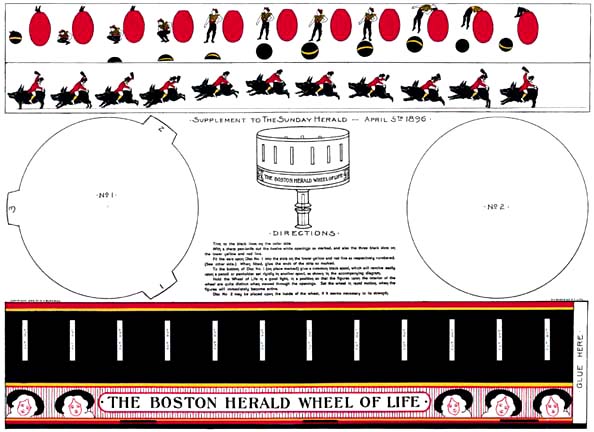
‘The earliest zoetrope was created in China around 180 AD by the inventor Ting Huan. Ting Huan’s device, driven by convection, hung over a lamp and was called chao hua chich kuan (the pipe which makes fantasies appear). The rising air turned vanes at the top, from which translucent paper or mica panels hung. When the device was spun at the right speed, pictures painted on the panels would appear to move.
‘The modern zoetrope was invented in 1833 by British mathematician William George Horner. He called it the “daedalum”, most likely as a reference to the Greek myth of Daedalus, though it was popularly referred to as “the wheel of the devil”. The daedalum failed to become popular until the 1860s, when it was patented by both English and American makers, including Milton Bradley. The American developer William F. Lincoln named his toy the “zoetrope”, meaning “wheel of life.” Almost simultaneously, similar inventions were made independently in Belgium by Joseph Antoine Ferdinand Plateau (the phenakistoscope) and in Austria by Simon von Stampfer (the stroboscope).
‘The zoetrope worked on the same principles as the phenakistiscope, but the pictures were drawn on a strip which could be set around the bottom third of a metal drum, with the slits now cut in the upper section of the drum.The drum was mounted on a spindle and spun; viewers looking through the slits would see the cartoon strip form a moving image. The faster the drum was spun, the smoother the animation appeared.’ — André Gaudreault
Mat Collishaw
‘Mat Collishaw’s interest in the Victorians is no coincidence: 19th century Britain viewed itself in the light of scientific progress and empirical soberness. An age inhabited by educated and prosaic people. In retrospect however, child prostitution, poverty, perversion and a collective blood-lust ran parallel to what was deemed an enlightened age. Collishaw references the Victorian period by simulating its elaborately decorative, romantic style, but he indirectly conjures up that society’s dark side, the corrupt underbelly so pertinent to the present day. He drags our darkest urges into the light – illustrating that humans will never overcome their baser instincts, regardless of aesthetic or scientific advancement.’ — Blain/Southern
Retchy
‘Retchy (aka Graeme Hawkins) is an animator, vj and sound designer based in Dundee, Scotland. He has worked on feature films (Sylvain Chomet’s Oscar nominated ‘The Illusionist’) and nationally broadcast TV adverts, and is now going freelance with his idiosyncratic, experimental approach to animation. He likes playing about with animation techniques, and is especially interested in the combination of old and new technologies and ideas, like hand drawn projection mapping and 3D Zoetropes.’ — retch.com
Aston Coles
‘Aston Coles is part of the independent art production body known as Planet Goatsucker, creators of art, film, and noise events. He plays an instrument called The Swamp Badger in the noise band Deaf Squab. “I am making machines which delineate movement in space. Specifically by animating my sculpture-making process. The machines are working models of the themselves. I find that mirrors are tools which propagate images of other things. Shadows are useful in the same way for looking at sculpture. These things are vision multipliers. My aim is to expand the parameters of the known world by the addition of new features.”‘ — Aston Coles
Jim Le Fevre
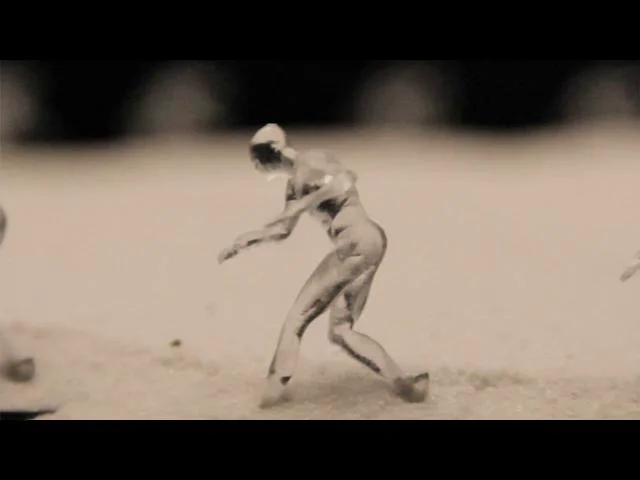
‘For a few years I have been playing around with a nice little technique using a record player and a camera to create a different kind of Zoetrope. It is one of those things that is more pleasurable watching in real-life however Malcolm Goldie has edited some of the footage from our night at the last ever Heavy Pencil at the ICA in May. Although the evening went well, it really was a testing ground for some of Malcolm and I’s thoughts and it threw up promise and mistakes in equal measure. Malcolm has re-cut a track for this edit and in typical inspired fashion used only (mostly) a box of old 45s he got handed from a retiring wedding DJ for the samples.’ — Jim Le Fevre
John Edmark
‘Blooms are 3-D printed sculptures designed to animate when spun under a strobe light. Unlike a 3D zoetrope, which animates a sequence of small changes to objects, a bloom animates as a single self-contained sculpture. The bloom’s animation effect is achieved by progressive rotations of the golden ratio, phi (ϕ), the same ratio that nature employs to generate the spiral patterns we see in pinecones and sunflowers. The rotational speed and strobe rate of the bloom are synchronized so that one flash occurs every time the bloom turns 137.5º (the angular version of phi).* Each bloom’s particular form and behavior is determined by a unique parametric seed I call a phi-nome (/fī nōm/).’ — John Edmark
Gregory Barsamian
‘A dream world often remains left to the realm of the unconscious, a separate world of its own. But Gregory Barsamian’s animated zoetrope sculptures bring this dream world into our waking perceptions. Rationality is left behind and we descend into a world of uncertainty. We enter the shadows, perceiving the fine line between real and imaginary. This dream world of Barsamian finds its inspiration from theories of the unconscious and its outlet in kinetic sculpture.’ — Kinetic Art Fair
Ernest Zacharevic
Ernest Zacharevic: For me animation as well as kinetic art is a media, which is capable of evoking the dialogue and interaction with its viewer and environment. The art of motion allows me to explore the shifting correlation of time and space. I try to redefine the boundaries between still and motion in my work. I intend to take animation out of its traditional dimensions and bring into confrontation with our everyday experience. The agency of my work comes from the combination of post-socialist upbringing in Lithuania and orthodox use of media mixed with ironic interpretations of the ongoing conflict between an individual and society. I never intend to represent the reality in my work; instead I attempt to absorb the surrounding I am living in and to express my personal relationship in the images I create.
Elliot Schultz
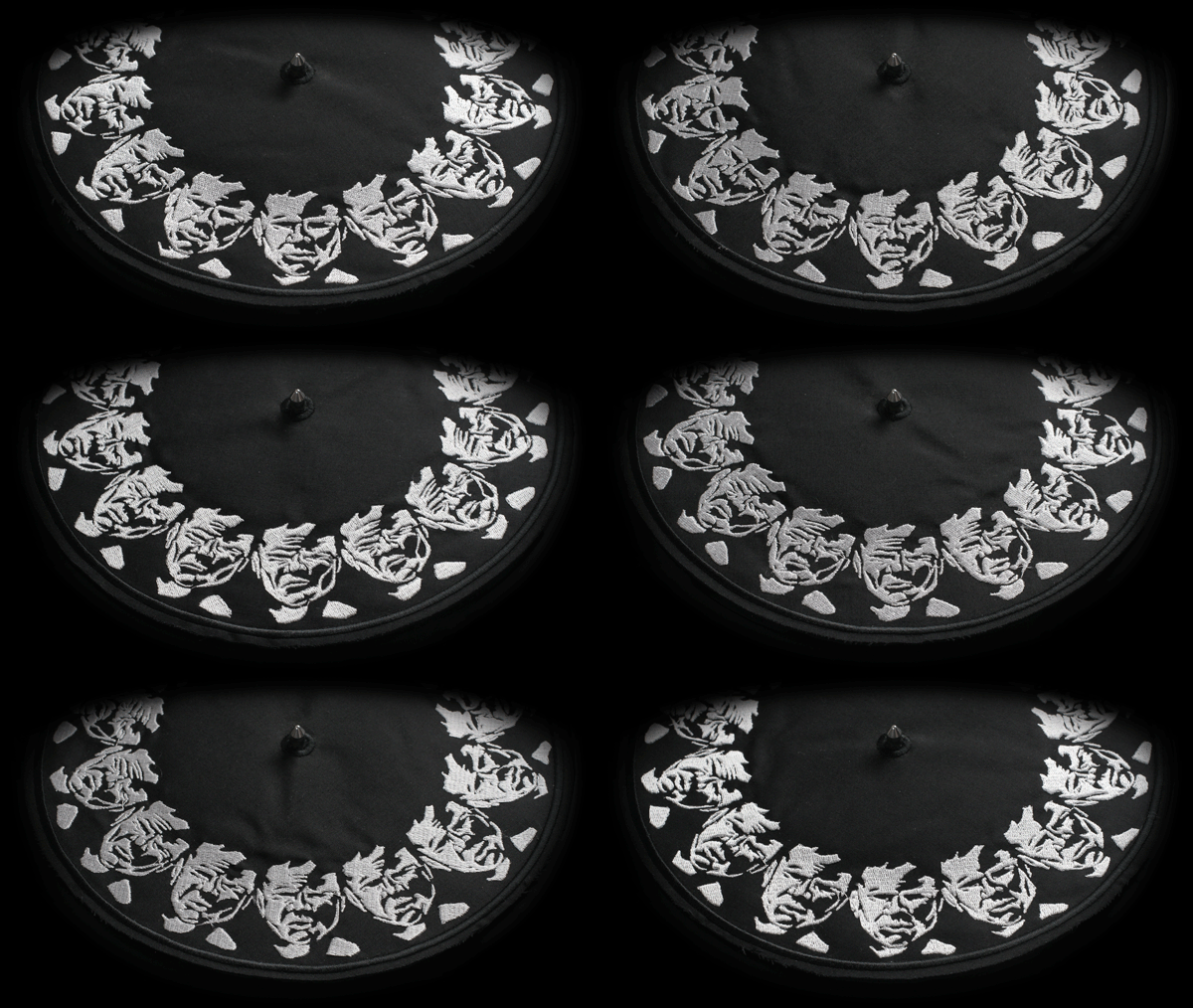
‘Inspired by the work of Alexandre Alexeieff and Claire Parker, I aimed to guide my production process indirectly through the limitations afforded by alternative media. Their invention, the pin screen, was used as the sole medium in the production of six short films, and shaped the outcome of their work. In response, I have designed and embroidered animated sequences onto discs, similar to the Phenakistokope, Zoopraxiscope and Stamfer Disc layouts. This repurposing of media introduced strict parameters, namely spatial, tonal and temporal, and has greatly informed all stages of my process.’ — Elliot Schultz
Dan Hayhurst
‘Dan Hayhurst plays digital media devices, reel to reel tape recorder, sampler, effectron and walkman. Reuben Sutherland plays video zoetrope record deck. Psychophonotropic picture discs printed with intricate visual patterns animate when videoed, beaming looping fragments of surreal, luridly coloured imagery into eyeballs and brains at 25 frames per second – Victorian mechanical imaging technology combined with digital video.’ — tape box.co.uk
ACMI
‘ACMI’s zoetrope, tucked away in Screen World’s ‘Sensation’ area, is deceptively dull when it is still. It looks like a bizarre wedding cake, with hundreds of creatures and objects suspended on a circular, tiered structure. But when the music kicks in, the carousel starts to revolve and the strobe lights flash furiously. The magic begins! In a spectacular 3D optical illusion, the characters appear to come alive.’ — acme
Woohun Lee, Jinha Seong
‘The authors have turned the Zoetrope, initially an optical toy from the pre-cinema era, into a three-dimensional (3D) animation display. “Crystal Zoetrope” is a new visual medium involving a glass disc with numerous engraved objects that displays a sophisticated 3D animation. It can be built in small sizes and even be embedded in everyday objects or environments. Using this new visual medium, the authors produced the 3D animation “Sea of Stars” that portrays the life cycle of planets in the universe.’ — Leonardo Journal
Alexandre Dubosc
‘French animator Alexandre Dubosc specializes in ‘caketropes’ or 3D zoetropes, spinning animation machines, that look like chocolate cakes. Freequences, his July 2019 creation, explores the repetition of sound waves, vibrations, patterns, and musical instruments.’ — The Kid Should See This
Eric Dyer
‘Eric Dyer is an artist, experimental animator, and educator whose work has shown at such events as the Sundance Film Festival, exhibited at the Smithsonian National Gallery of Art and the Venice Biennale. He currently uses spinning sculptures to create films and installations. He’s had music videos play on MTV, MTV Europe, The Box, and B.E.T. and animations aired on PBS, the Discovery Channel, and Fox International. “Copenhagen Cycles” is a fantastical, collaged bicycle tour through a zoetropic rendition of Denmarks capital. He uses sculptures, paper cut outs, and live footage to animate the hypnotizing ride.”‘ — barrabinfc
Fallon
‘Advertising agency Fallon built an enormous zoetrope in Venaria, a town near Turin in northern Italy. The zoetrope presents a series of still images of the footballer Kaká, which when rotated (at speeds up to 50km per hour) and viewed through small slits on the outside of the zoetrope, give the illusion of being animated. The purpose of the Bravia-drome is to show off Sony’s new Motionflow technology. MotionFlow allows BRAVIA televisions to insert transitional images into action sequences in order to increase smoothness at 240Hz that might otherwise be choppy.’ — Creative Review
Ghibli/Pixar
‘In 2005-ish Pixar created their own Toy Story-themed version of the famous Studio Ghibli Zoetrope in in the Ghibli Museum in Mitaka, Tokyo. It toured many science museums and galleries around the world.’ — Zoetrope Development
Jackson Holmes
‘Jet Engine/Zoetrope by Jackson Holmes. University of Brighton, 66-68 Grand Parade, Brighton, BN2 0JY. SHOW DATES: Friday 3rd June – Private View (tickets only), Saturday 4th June – 12 noon – 8pm, Sunday 5th June – 12 noon – 6pm, Monday 6th to Wednesday 8th June – 10am – 8pm, Thursday 9th June – 10am – 4pm’ — jacksonholmes.tumblr
Troika
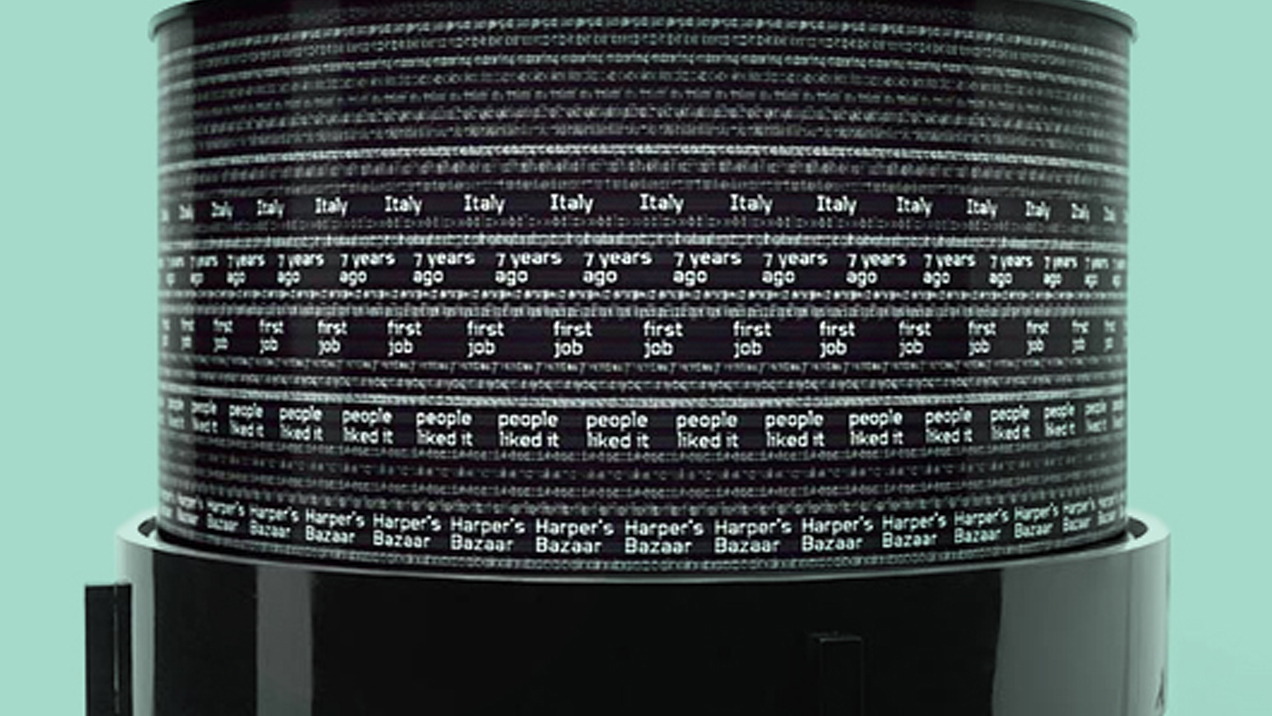
‘DIGITAL ZOETROPE is an installation which Troika created for onedotzero when commissioned to design a custom installation and visual identity around the theme of the festival ‘Citystates’. Opting to make an installation and identity that integrate into each other, Troika created a modern DIGITAL ZOETROPE as the cornerstone of the identity, which celebrates both the heritage of motion arts as well as its digital present.’ — troikalondon
Tee Ken Ng
‘Starting with a fascination for effects and optical illusions, artist and animator Tee Ken Ng combines stop motion with the zoetrope technique of yesteryear to create these incredible animations. Using simple illustrations and acetate discs, he brings these videos to life.’ — Domestika
Akinori Goto
‘In 2015, a young media artist named Akinori Goto created a fascinating device called toki, meaning “time” in Japanese. Goto explained that it was “a media installation born from a combination of modern technologies:” the age-old zoetrope meets 3D printing technology. Goto captured the movement of a person walking and translated it into a data series, which was then turned into a repeating loop. The result was then fed into a 3D printer. That object was then placed on a rotating turntable and a light was projected onto it to isolate the different movements and….you know what, better to just watch the videos.’ — Spoon & Tamago
—-
*
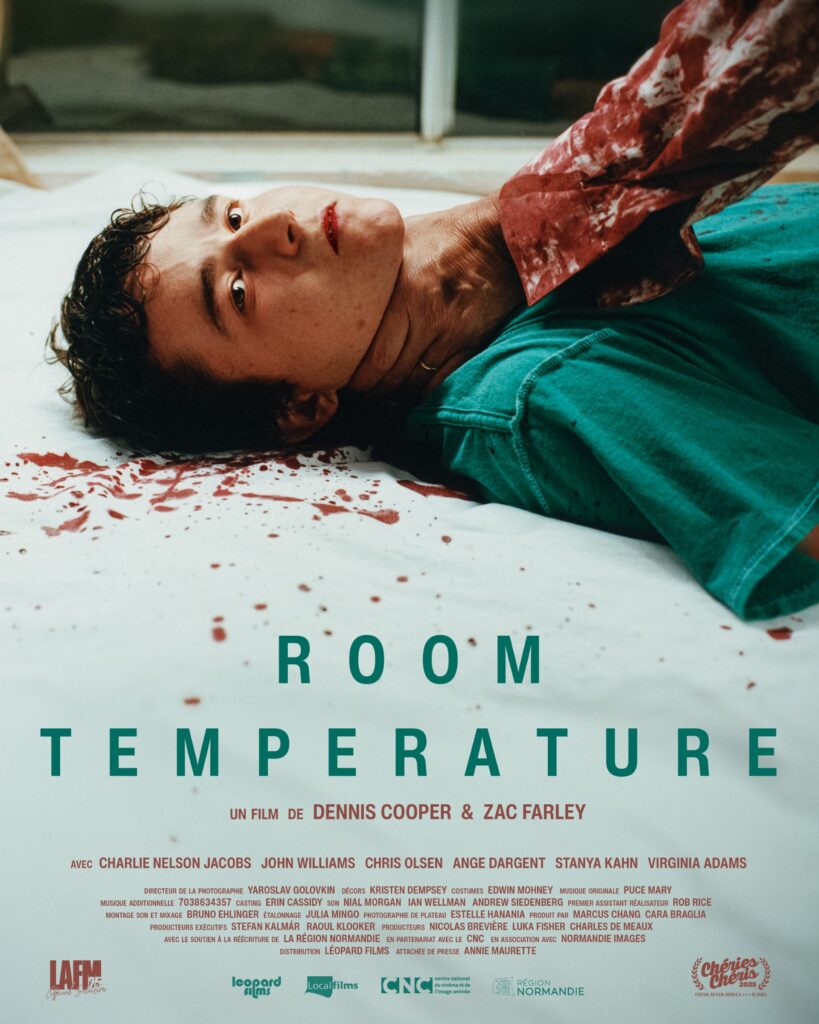
p.s. Hey. Tomorrow morning I have to get up early and go to the prefecture to get my French residency visa — or I certainly hope it’s that simple. Since I have no clue how long that will take, I’m going to give the blog a little vacation tomorrow, but both it and I will be back as per regular on Friday. ** Dominik, Hi!!! You made it inside again! Hopefully the spell is broken. I think/hope the script will be finished at last this week. Yeah, the rest of this month is pretty packed with screenings — Brussels, Berlin, Palermo (although I’m not 100% sure if we’ll go for that one), and Amsterdam. How are you? What were you doing with reality during the blog blackout? Love doubling down on your hope with all his mighty might too, G. ** _Black_Acrylic, The Scottish team is called Hearts? How loveable. If an ignoramus’s hopes will contribute to their victory, consider me a good neighbor. ** Ewan Morrison, Hi, Ewan. Very good to make your acquaintance. My pleasure on the WWD front. I think I used to know about the strong experimental film scene in Glasgow, or I mean I remember reading about that. Is it possible for you to get some likeminded chums together and start organising some screenings? I was lucky to grow up in LA where there’s always been an experimental film scene and contingent, even back when I was a young teenager, and that basically helped make me as an artist and person. Your project of contributing new sound/music to Peter Tscherkassky’s films is very interesting indeed. Yes, I’d be very curious and interested to see what you’ve made, if you feel like sharing. The would be a boon. Thanks a lot for thinking of me re: that work. Is sound manipulation a main focus of your work/interest in general? It’s a pleasure to get to talk with you. ** Carsten, Hey. The shooting script of ‘RT’, which of course got consolidated during the shooting and editing, is/was 22,440 words/90 pages. The shoot was a month (27 days). Your film idea sounds of course quite interesting. Seems like it would be a lot easier to make than ‘RT’ was. Because of my upcoming traveling and the traveling of another club member, the next Zoom meeting won’t be for a few weeks. I’m picking the film for that meeting, and I haven’t decided what it will be yet. ** Hugo, Yeah, it’s going to be a flash of a Brussels visit, but oh well. You’re making Tomodachi Life sound a whole lot more interesting than I had imagined. My clone has a lot broader romantic tastes than I do, that’s for sure. Um, hm, put GG Allin in the game and see what happens? ** Adem Berbic, I haven’t watched ‘Skin’ yet, but I will watch/report. It might be interesting for you to see what you look like externally when you freak out assuming your freak out reads believably. Well, ‘Trash Humpers’. ** Steeqhen, I would definitely not recommend psychedelics if you’re feeling even slightly fragile. I only did them when I felt solid as a rock. So sorry about the bad doc. But you sound like you found a proper antidote. I don’t know that French killer. I think I’d stopped researching those guys pretty much by the 80s. Huh. ** HaRpEr //, Dixon had very interesting film tastes in addition to his filmmaking prowess, yes. ‘The Masturbator’s Heart’, yes, really good. Seeing that is what made us cast Ange in ‘RT’ even though his performance in ‘RT’ couldn’t be more completely different. I hope that some venue in somewhere in London will eventually want ‘RT’ because that just seems logical, but nothing yet. So strange. A film series in Leeds wants it, so it might show there first. I like Claire Rousay’s work too. She knows and likes my work? Wow, that’s wild. Knowing something like that is so mind-blowing. Thanks! ** voskat, Hi. Indeed. Okay, thanks for the heads up about Laura’s thwarted comment. I will go read it, of course. Anarcho-futurist era: that’s kind of music to my ears at least if I don’t think too thoroughly about it. Take care yourself, and thank you again. ** Okay. Your optional assignment for today and tomorrow is to think about the zoetrope if you feel so inclined. See you on Friday.


 Now available in North America
Hi!!
Looks like the spell is indeed broken – at long last! I’m so happy to be back!
You’ll have a really busy month! I saw that the Brussels visit will be an in-and-out thing – what about the other cities? Do you get to (want to) spend a bit of time anywhere else?
I’m good. Last week, I met a friend I haven’t seen in years, which was very lovely. Otherwise, it’s just the usual – I’m working a lot and reading a lot. I’ve just finished Edmund White’s The Farewell Symphony. For whatever reason, his writing style just doesn’t move or touch me.
I think it’s safe to say that our loves’ double efforts worked!
Love making sure you get your visa without a hitch tomorrow, Od.
I love zoetropes. The good ones are just magic. I think I’ve seen Mat Collishaw’s work before. Really impressive, but I have to say finding out it’s done with 3D printing reduces the magic a tiny bit (old guy grumbling here). Love the Jim LeFevre, Greg Barsamian, and of course Gateau Gato.
I’m not familiar with Wheeler Winston Dixon’s work. Will definitely spend some time exploring. Palermo has Capuchin Catacombs, in case that might influence your decision to visit.
Good to hear you’re up for a dark animation post. Will start working on it soon.
Hope the visa procedure goes smoothly…
Bill
Hi Dennis – I left this comment on the Sarah Kane post, thinking it was today’s. Just so you’ll see it, this is what I said:
Hey Dennis, good to catch this on my newsfeed today. As you know, Sarah was my good friend. I was at the first performance of 4.48 in London. The great coup de theatre at the end of the play where the whole wall of the theatre opened up onto Sloane Square, they couldn’t replicate in New York because there was no wall to open up. But we all lost it at the end in London after the last line “Please Open the Curtains.” Sarah’s agent Mel told me after that Sarah wouldn’t have liked that ending because it was too optimistic; but I disagreed. I think Sarah would have loved the walls of the theatre opening up. So many Sarah stories (mystical ones too!) – but I’ll leave that for now. Thanks for posting this!
Been a min more coalesing on my end as 28 approaches haha I love growing sometimes you can really feel it and I store energy inanely well. Gee willie ive really just been walking around to various nice parks and getting high everyday and making the occasional very important flow based pivotal move for like years to suddenly straight edge how interesting a pendulum. But hum somethings actually coming this time not just another maybe because I learned gratitude and a lil less selfishness inbetween the loop making and running. The programming shifts so slightly you walk down roads that lead to old ones somehow and end up at a new park or figure out how your neighborhood loops around to everything things like that. I talk to the trees just hi and bye thank my upper management I have much to be grateful for some people go to work everyday while im literally learning some very lucky lux loving life idk man I think I get to clock in now Im actually old enough soon. Whats been up and where do you watch tv shows online all your old favorite weblinks dont work anymore and streaming is a nightmare ttylxoxo.
How did things go at the prefecture? Were you stuck there all day? Vive la France!
I watched MATADOR BOLERO, starring Yves Tumor, tonight. Shot on Super-8, it reminded me of No Wave NYC films mixed with Panos Cosmatos. Tumor doesn’t exactly act in it. They play an alien (typecasting!) who delivers some voice-over but mostly they’re just filmed lounging around (in a wig, silver lame jacket, stockings and studded leather boots), like Edie Sedgwick in a 1965 Warhol film. It’s best at its least narrative-oriented.
I’m quite curious about Patrick Wang’s A. RIMBAUD. He’s a gay indie director who’s self-financed/distributed all of his films. This one will play 3 days at the Roxy in May. He’s skipping the festival route, so no one has seen it yet. But it’s 3 hours long and features only one actor, portraying Rimbaud.
Speaking of psychedelics, have you read about the Lilliput mushroom, which grows in parts of Asia? It’s edible, but if eaten raw, it causes hallucinations of hundreds of tiny people dancing around the user. (Is that fun?) It doesn’t contain psilocybin, and the chemical that causes these visions hasn’t been discovered.
I was thinking today would be about Francis Ford Coppola’s Zoetrope thing. This actual post is better though, at least according to me. Happy to see Mat Collishaw working beyond the YBA confines. Back in the day he was always lumped in with the Freeze crowd, but there’s a whole other side to his practice that is good to see posted here.
Spoke to Nick this morning and he’ll be back in Dubai working this weekend. Must be a sign the warfare madness is lessening somewhat and I hope his company know what they are doing.
I guess I’ll try to ready myself psychologically. And I’ve never seen ‘Trash Humpers.’ Where does it sit on a scale from ‘stick it on a list’ to ‘cancel my evening plans?’
Excuse my snooping across the P.S., but keep me posted on the Leeds maybe-screening. Is there a ballpark date? Unless I’m not in the country, I’ll see to it that I’m correct and present.
My two favourites from above are next to each other. I want all of the John Edmark ones on my desk so I can ogle them and hope they draw me to some great epiphany about form, and I want a warehouse full of the Gregory Barsamian ones so I can disappear in there for hours and try to work out what deep buttons of mine they’re pushing.
Tomorrow I’m meeting with a guy from some other venue about the launch, so fingers crossed again. What about you, besides opulently fanning yourself with the new residency papers like they’re a wad of hundred-dollar bills?
Hello! I’ve actually read about a lot of electronic musicians who say they really admire your work. Maybe something about how language is rendered through those forms?
I was lucky growing up in London where there’s tons of old gadgets in the many strange museums.
I went to university in an area that was the birthplace of Edweard Muybridge who was an early progenitor of photography and invented the zoopraxiscope and everything was named after him on campus. He was a strange guy, changing his name from Edward to Edweard in the old English spelling. He also shot and killed the guy who his wife was cheating on him with and got away with it. With his photographic work he made a lot of videos of nudes writhing around and stuff. I wish there were still cool inventors, and not just Silicon Valley douches finding new ways for AI to wreak havoc.
I’ve re-started a diary as a warmup exercise and have found that it really helps a lot. I just write a lot of sludge about daily nuisances and stuff and then I get all of my bad ideas out of the way first. I’ve been sort of finicky and restless which can make writing a little difficult, but I’m never blocked or anything, the problem is more that I have an overactive imagination.
Anyway, this current draft is almost done and I’m going to try and print it out so that I can’t edit it while reading it, and instead just make notes alongside it. Pretend I’m a random reader.
Hey Dennis,
I am pretty interested in trying psychedelic-based therapy, just from the idea of being able to build new neurons and changing a thought pattern or way of thinking. I think my biggest issue and obstacle in my life is myself, and though it started from childhood stuff, i’m at the stage where i tend to just suffer from myself, leading me to make mistakes or fuck up due to my thoughts, which almost affirms those thoughts… I don’t know if psychedelic/drug therapy is even allowed in Ireland, and the thought of having to travel abroad for that would probably send me down a horrible trip hahahah.
I’m outwardly doing well, seeing people, functioning. Internally, I’m doing better than before, but it feels like I’m in a loop of highs and lows and I just would like to be grounded and stable. And like I said, it’s all my own brain torturing me and repeating mistakes from my past or fears that i’m some monster. Just shaken up constantly and half in reality and half in a distorted image of the past or a terrorizing vision of a potential future…
hi Dennis!
ughh man i don’t recommend my week, 1/5 on grindr maybe. your blog also ate my previous comment and then barfed it out at total random lol
anyway here i am now, let’s see if this one goes through
looove the zoetrope, such a phenomenological wtf. and how convoluted it is too, that’s just magical. wonder why cinema technology feels so relatively blah to me in comparison, maybe i’m just desesensitised? or maybe black horses are just black horses and nothing can be both successful and this cool for v long… efficiency kills smth emotional in the stuff it improves.
i wonder if zoetropes ever glitch and misanimate lol that could look so fucked up.
you’re getting your card today? hope you get to celebrate a bit ^_^
i’m currently surrounded by an unbelievable amount of ppl insisting A Little Life is a great book and man i lowkey want to cry from the affront to my sense of justice and aesthetics etc
i missed popping over here! love you!
huh it worked =D
well, P.S.
i was reading Ugly Man the other day after a super long time and how had i forgotten some of my fav bits in Like Cattle Towards Glow are in there already? maybe i’d been trying to forget the great Islamic festival of crater worshipping (if i give it enough mental spins you’re not v far off tho, however i must say body hair removal is much more mainstream practice across the board lol like it’s sunnah)
anyway you’ve got my email now!