* (restored)
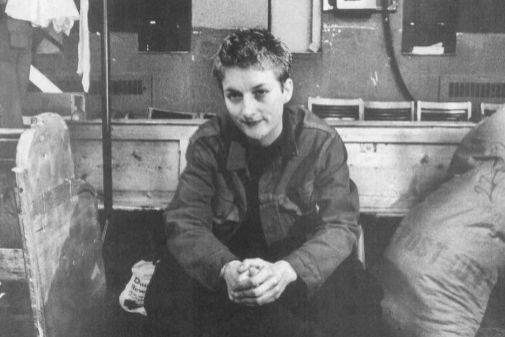
‘Sarah Kane slips easily into the mythic mould. She burst quickly on to the theatre scene: Blasted, in 1995, was an instant scandal. And, after writing four more plays – Phaedra’s Love, Cleansed, Crave and 4.48 Psychosis – over the next four years, she took her own life after a struggle with mental illness. Like the great Romantic poets, Kane was drawn to death. Like the 20th century’s icons – like Marilyn, like Jimmy – she died young. What greater end to the life of a young genius than suicide?
‘I suppose when a young artist commits suicide, leaving a relatively small body of work, it’s natural to want more. We know there are no more Sarah Kane plays to come, so people want more of her. We want to build up the myth. Her death leaves a vacuum that we want to fill. It’s an understandable instinct, but not a good one.
‘Kane’s plays have almost certainly achieved canonical status. All over the world, they are seen and admired. Almost since the arrival of Blasted, she has been regarded as the most important of the new British dramatists. No doubt some of the initial interest in her work was a wish to jump on the bandwagon of sensation that Blasted caused on its UK premiere, but with the passing of time Kane’s work has proved its significance.
‘There’s a danger that we see all of Kane’s work as one long preparation for suicide. We shouldn’t. Only the last play, 4.48 Psychosis, is a play written during her periods of depression and hospitalisation – and even there, the ending is ambiguous. There’s a glimmer of light – but in life or in death? Rather, I think we should look at the plays as the work of a writer of great anger, of sardonic humour, who saw the cruelties of the world but also the human capacity for love.’ — Mark Ravenhill, The Guardian
______________
4:48 Psychosis: Media
Trailer: UK/Royal Opera production
Turkish production
Excerpt: Russian production
Hong Kong production
Trailer: Finnish production
Georgian production
Trailer: German production
Excerpt: Italian production
_______
Further
A Sarah Kane site by Iain Fisher
Sarah Kane Discussion Forum
Sarah Kane Biography
Sarah Kane interviewed
‘4:48 Psychosis’ Facebook Page
Buy Sarah Kane’ The Complete Plays’
Sarah Kane @ In-Yer-Face Theater
‘Sarah Kane is my Kurt Cobain’
Sarah Kane’s obituary @ The Observer
______________
4:48 Psychosis
‘Much has been written about the troubles of Sarah Kane, starting with the controversy following her first play, Blasted and then continuing long after her sudden suicide at age twenty-eight. For many she has become the classic tortured artist – perhaps to a fault. In his introduction to Sarah Kane: Complete Plays, her friend and colleague David Greig encourages us to focus on the literary qualities of Kane’s work rather than on the “mythology of the author” which he terms “a pointlessly forensic act”. This may be difficult with regard to Kane’s final play, 4:48 Psychosis, an abstract work that presents the mindscape of an individual contemplating suicide and was written just prior to Kane’s own. But to what extent the two events are coincidental or a true example of life imitating art is largely a matter of conjecture.
‘One thing is for certain, life under the conditions of 4:48 Psychosis would be an almost non-stop chorus of pain. The play was written during a period of deep depression in Kane’s life, an achievement Greig calls “positively heroic…an act of generosity” but he cautions against looking for clues to someone’s personal history based on the drifting and artificial evidence of a play. The very word play implies something in motion or imagined, like games and pretending. Other authors such as Ken Urban, have pointed out the difficulty, if not impossibility, of separating Kane’s personal life from the themes explored in 4:48 and that in this final play the author and the work are structurally intertwined. Reflecting on comments made by Kane’s literary agent, Mel Kenyon, Urban writes, “Because it is the play that, Kane joked, ‘killed’ her to write, at this particular historical moment, it is hard to read the play outside of biography. Mel Kenyon recently said in an interview, ‘I pretend that [4:48 Psychosis] isn’t a suicide note but it is. It is both a suicide note and something greater than that.’”’ — Mustafa Sakarya, ‘A Controlled Detonation‘
_______
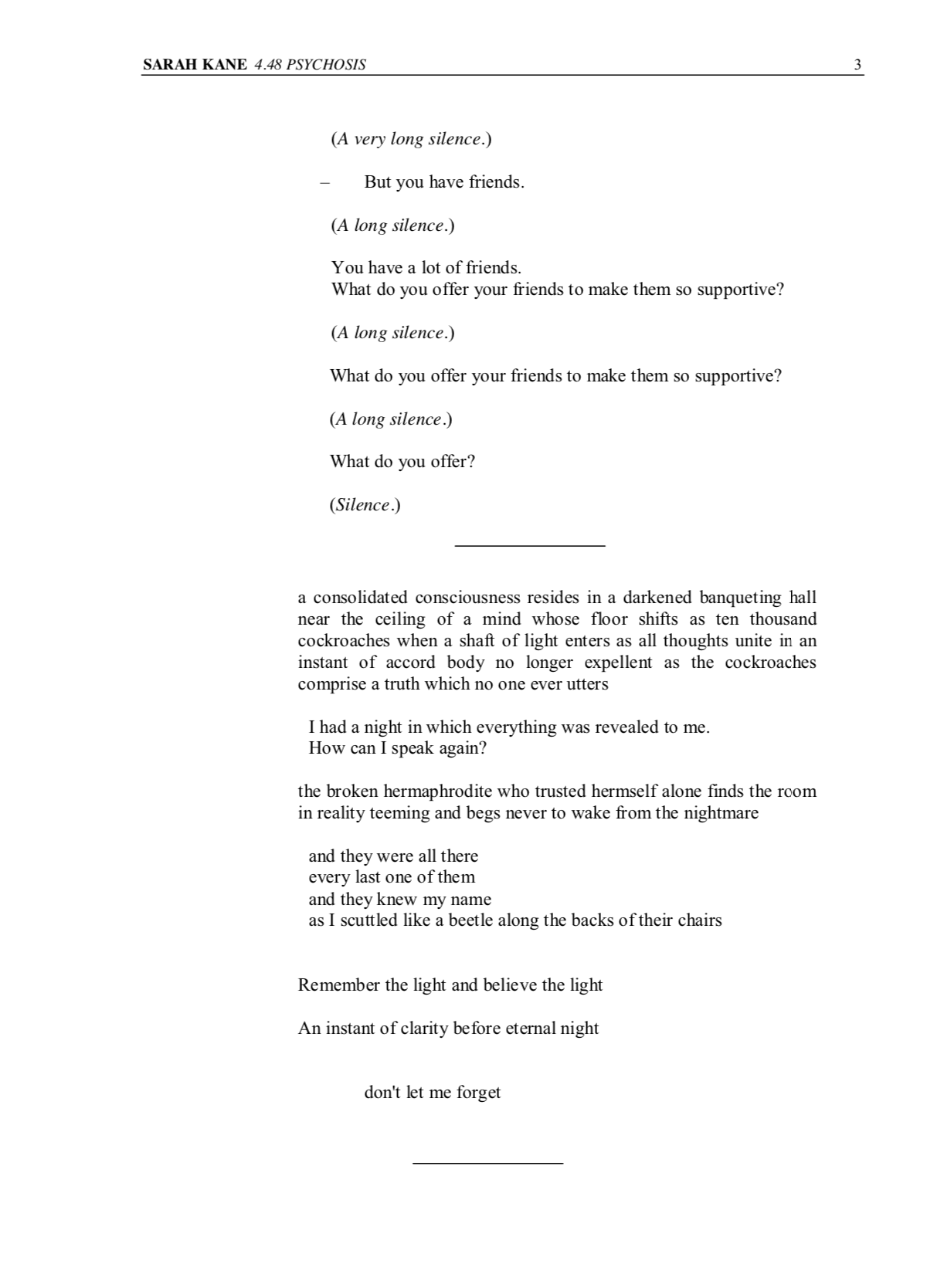
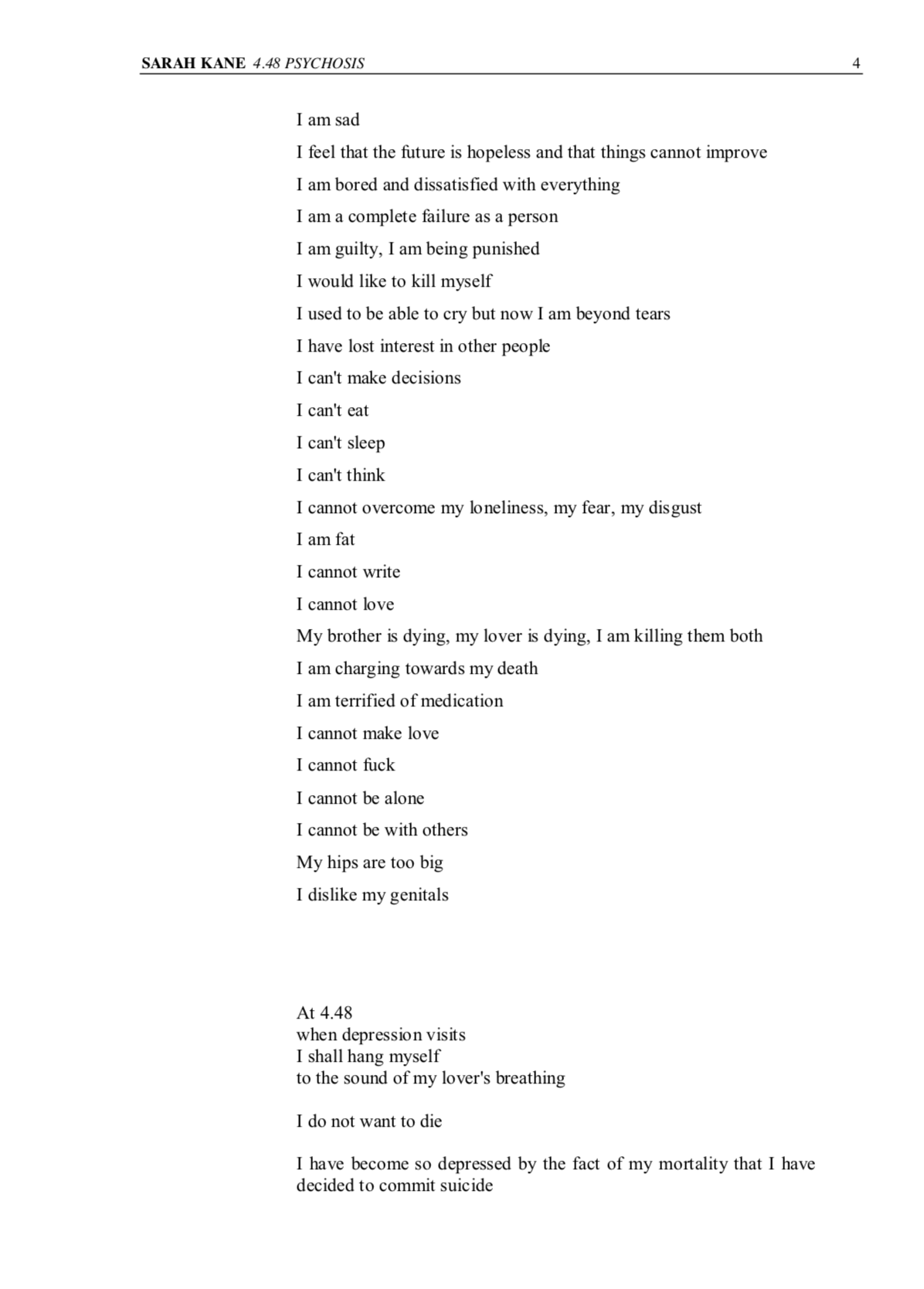
The play
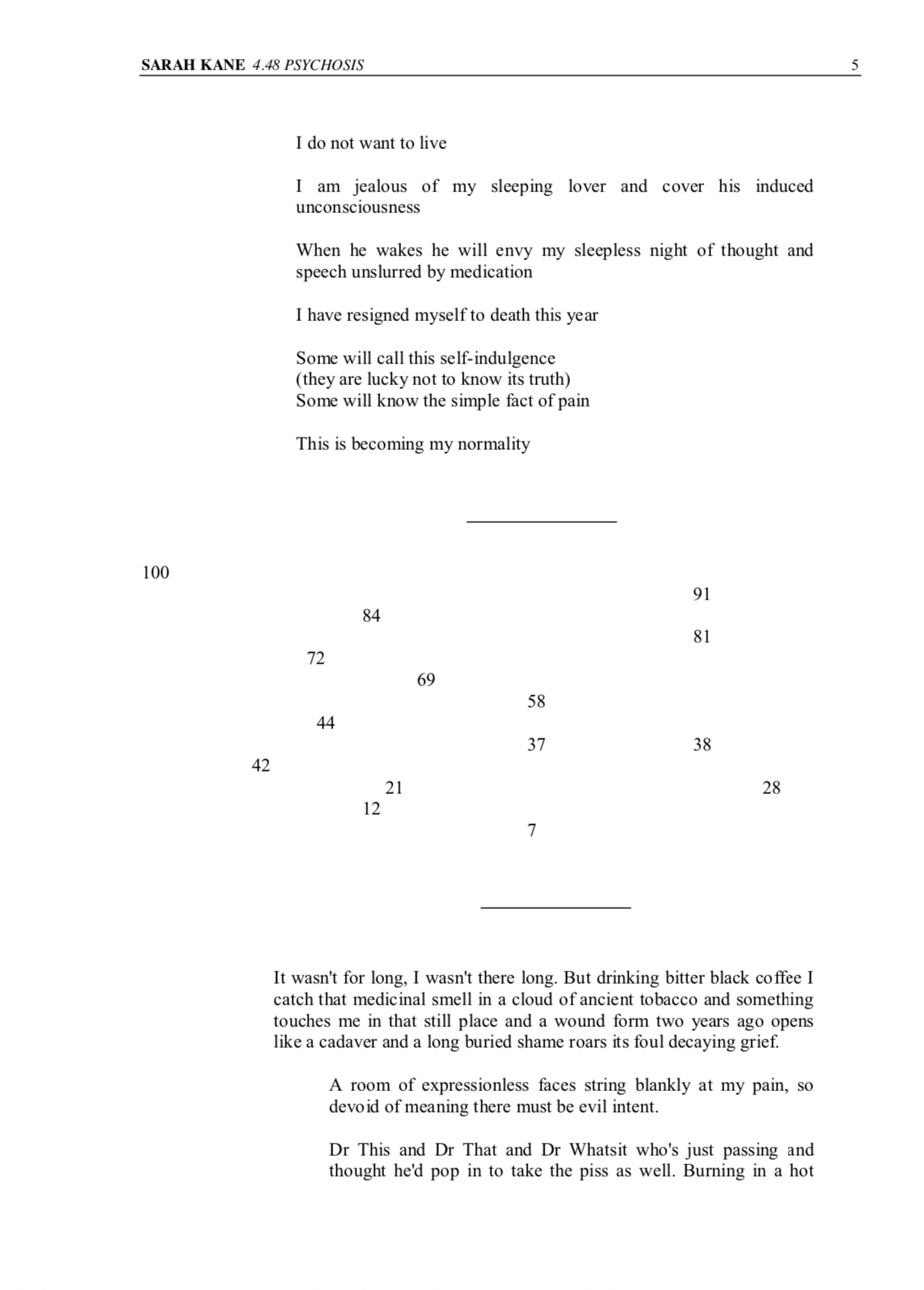
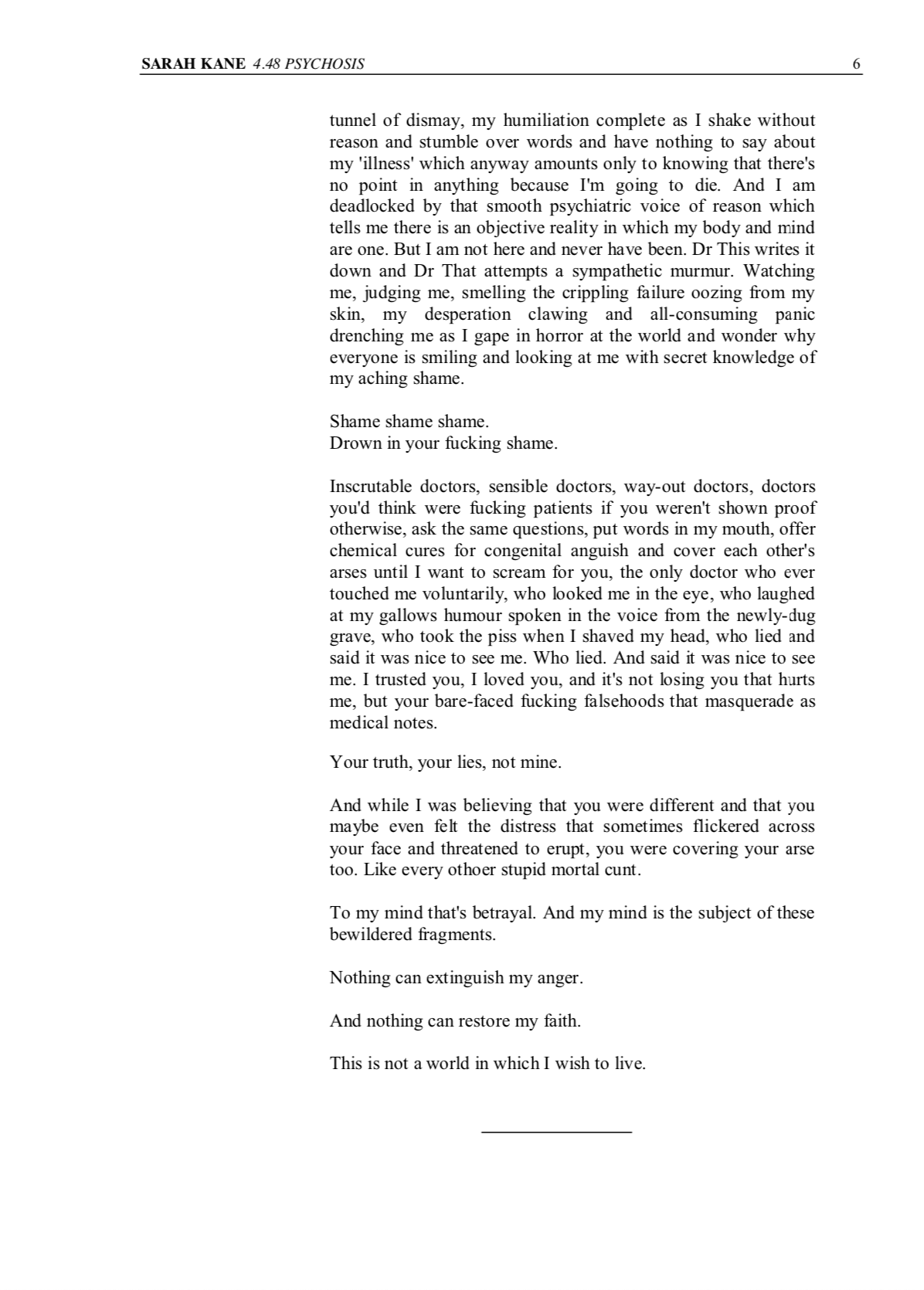
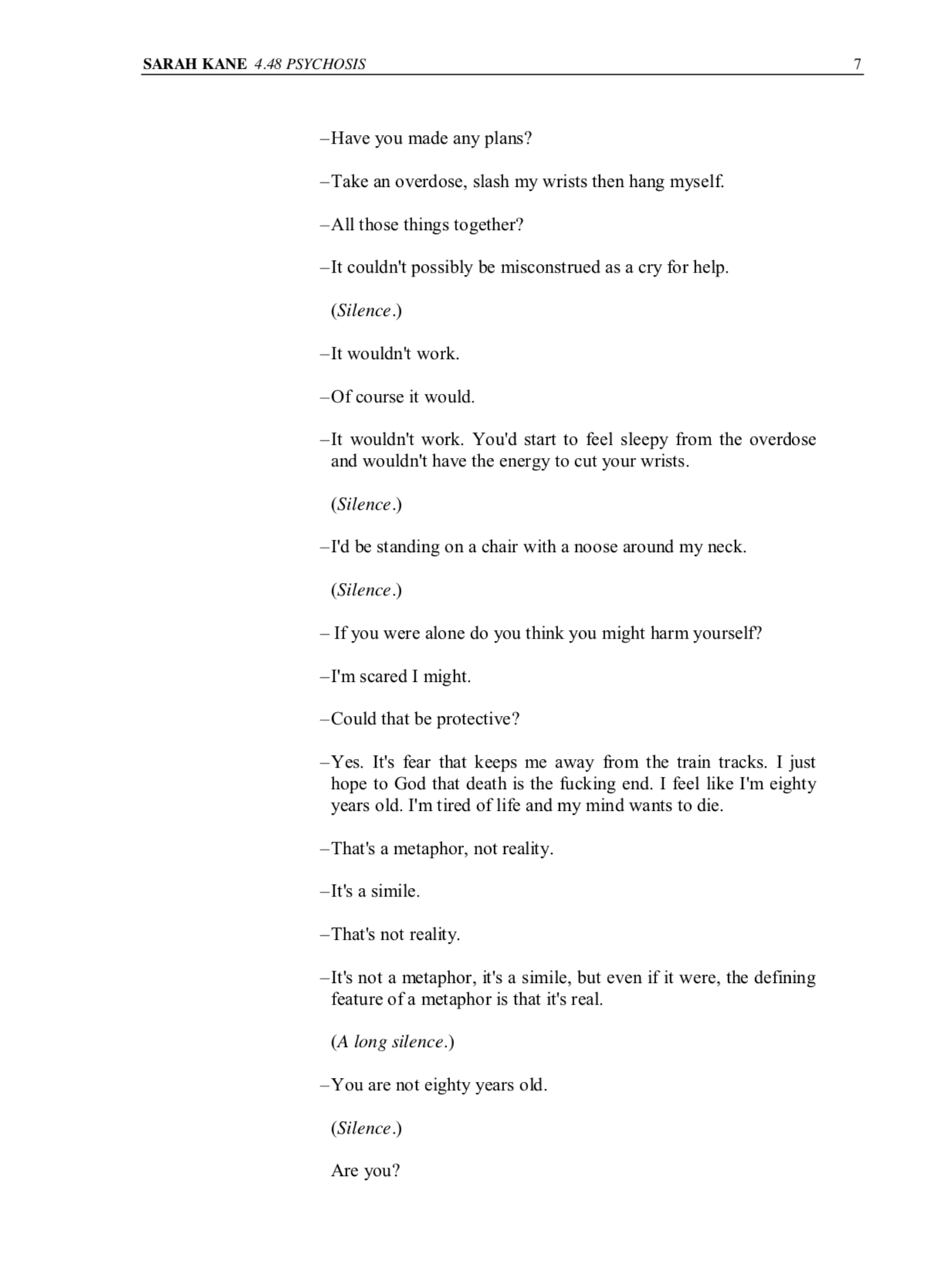
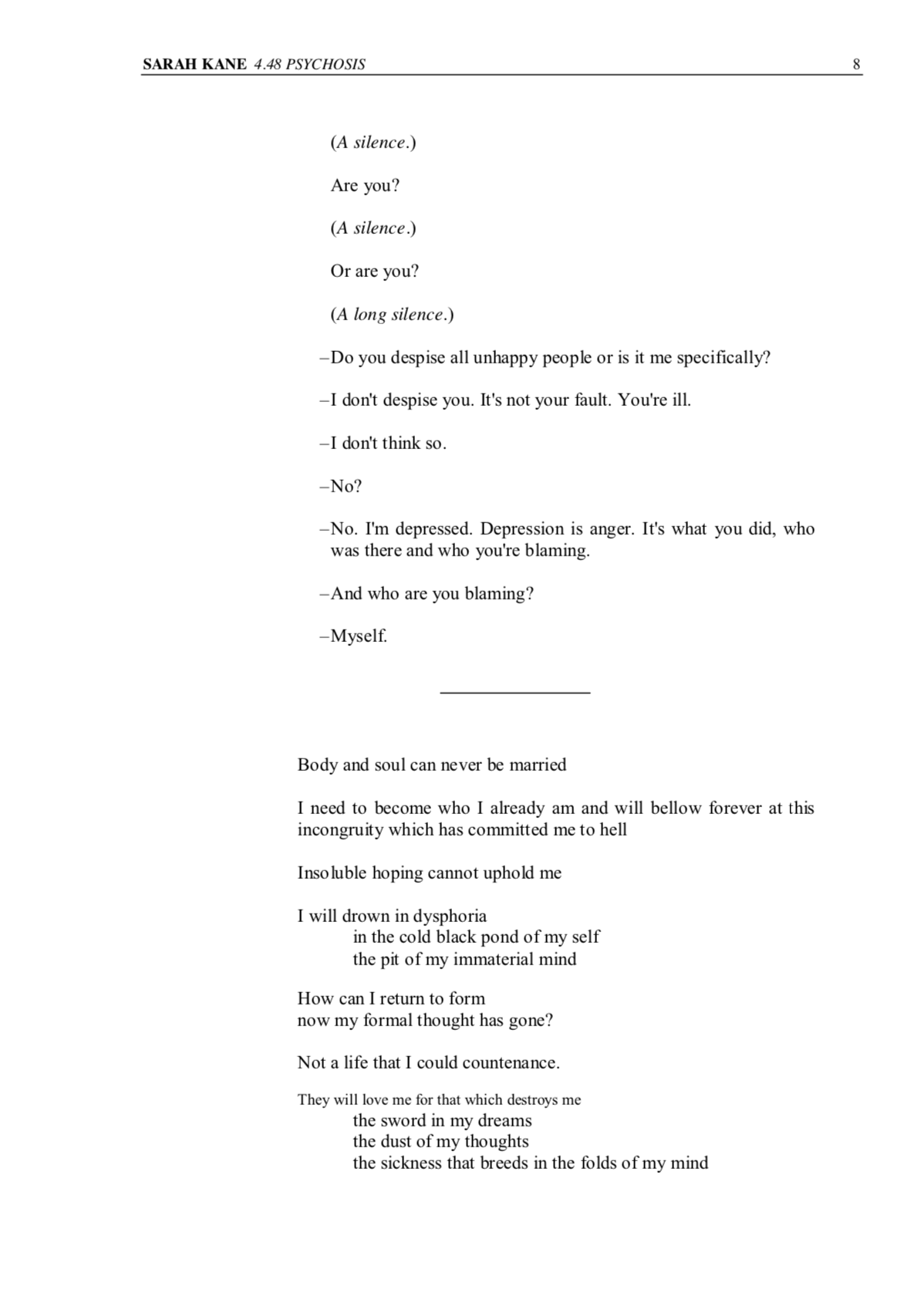
_______
Interview
by Aleks Sierz
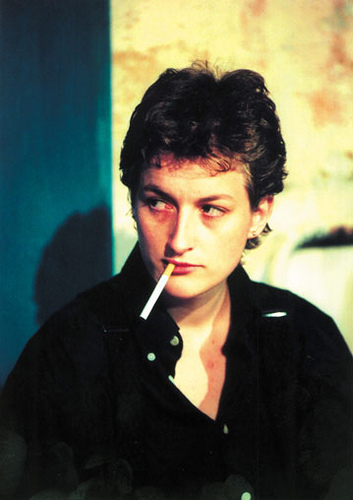
When Sarah Kane was still alive, it was vital to support her work — her style was so raw, so provocative and so innovative that many critics simply didn’t get it. Some even called for it to be censored. So it was important to support her, almost without question. But, when the 28-year-old playwright committed suicide on 20 February 1999, everything changed. Now, suddenly everyone loved her. Now, she was an icon. Now, she was a secular saint. Critics fell over each other to recant — it was like an episode from some religious war.
Wars breed anecdotes. And it soon emerged that everyone has a Sarah Kane anecdote. So here’s mine. It’s about the interview I did with her for the chapter on her work for my first book, In-Yer-Face Theatre: British Drama Today, and it may, or may not, be the last interview she ever gave. In my 1998 diary, there’s an entry for 14 September: Kane, 12 noon, SW9 (the name of a cafe in Brixton, south London, where we both lived at the time). The diary also shows that, in the previous week, I’d seen the Paines Plough production of Kane’s Crave (8 September), and soon afterwards I saw Mark Ravenhill’s Handbag (18 September). Oh heady days.
We met at SW9 because Kane lived just around the corner in a flat which she shared with her friend David Gibson at 6A Bellefields Road. I arrived early, and remember standing apprehensively at the bar — I was a bit tense, a bit nervous. After all, I was a fortysomething journalist and couldn’t help thinking that the character of Ian, also a fortysomething journalist, in her debut Blasted expressed her hatred of all middle-aged men. In fact, when I’d spoken to her on the phone to arrange the meeting, she laughed: “I seem to be meeting a lot of middle-aged men recently.”
I was worried that she’d be as aggressive as her work suggested. I suppose this is an example of the biographical fallacy in reverse. In fact, when she arrived, right on time, she was smiling. Wearing a black leather jacket, and hip black clothes, she could barely disguise her sleepy eyes, and the fact that she’d just got out of bed. “Oh, it’s early for me,” she said. “I’ve been up all night writing.” It was the way she liked to work.
We drank coffee at a corner table by the window. The moment she sat down, she got out her cigarettes. She offered me one. No thanks, I said, I’m too afraid of cancer. “You’ve got more chance of dying from a heart attack from worrying about it,” she joked, lighting up. When Kane smoked, she held her cigarette behind her back so that the smoke wouldn’t blow into my eyes. This considerate behaviour reminded me that although her plays have lashings of violence, they are also full of gentleness. After all, her main theme is love.
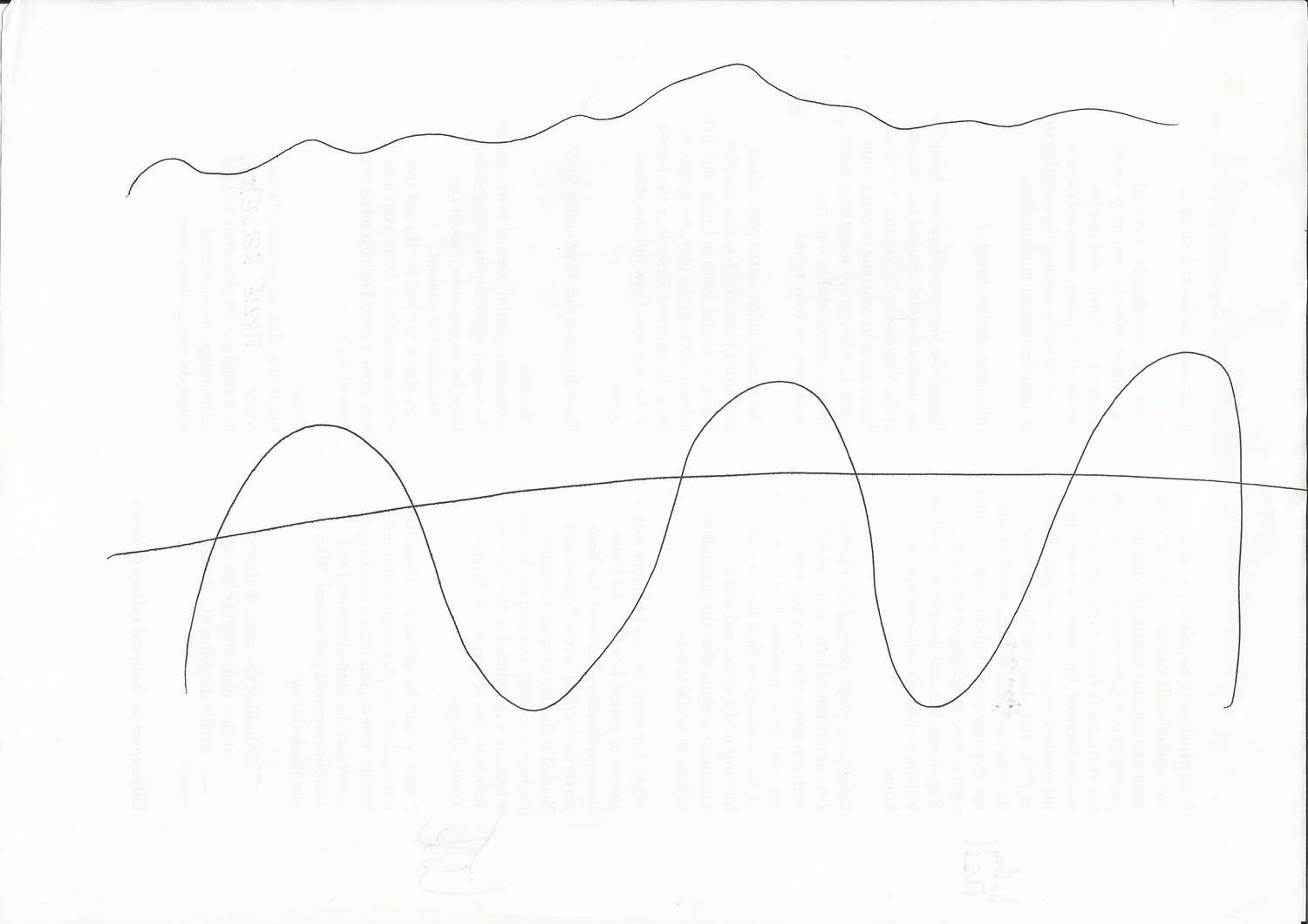
During the interview, to explain the difference between plot and story visually, Sarah grabbed my questions from me and drew a diagram on the back.
Then Kane gave me back a copy of an academic article I’d written about Blasted and the politics of the new censorship, where the media leads the call for banning plays rather than, as in the past, the state (whose censorship of theatre ended decades ago in 1968). In her delicate handwriting, she’d made a couple of corrections: where I had written, “Kane deliberately sets out to create a godless universe”, she wrote: “I don’t know. God does make an appearance [in Blasted]. And there is life after death.”
Kane talked some more about her first play, pointing out that the final scene takes place in a metaphorical “hell”. “Don’t forget the stage direction that says ‘He dies with relief’,” she said. “Ian dies, so you think that’s the worst thing that can happen — then it rains on him.” It’s a moment that sums her sense of humour, bleak perhaps, but humorous definitely. And she enjoyed the fact that directions like this present a real challenge to directors of her work.
Showing me a passage where I had misquoted her, Kane corrected my garbled version by stating succinctly: “Theatre will always be a minority interest, but the lack of a mass audience is compensated for by the lack of direct censorship.” At various points during our meeting, which lasted about two hours, she would consult a small notebook, pointing out which journalists had misquoted her.
It was clear that Kane thought of her character Ian with a mixture of horror and affection. When I said that, as a middle-aged man, I recognised his psychology, and the way he tried to manipulate Cate, she was pleased. “Yes,” she said, “when I was at Birmingham, there was a middle-aged man on the MA and he defended my portrayal of Ian when the other students attacked it. And I thought that was brave of him.”
Of course, Kane understood that you can feel a sexual or a violent desire without necessarily acting on it. “It’s one thing to have an idea, it’s quite another to act on it. We all have some control over our actions.” But what about Cate? Well, she stressed the fact that Cate is not retarded, and — much as she loved this character — she was also a bit exasperated with her: “I mean, what’s she doing in that hotel room with Ian?” Still, Cate’s resilience was as important to Kane as her naivety.
When I asked Kane what she thought of the label “in-yer-face theatre”, she shrugged as if to say: “That’s your problem, mate, not mine.” Then she said: “At least it’s fucking better than New Brutalism.” No writer likes to be labelled as part of a movement, and Kane was especially sensitive to being categorised as anything other than a “writer”.
We talked about the performance of Blasted that I’d seen at the Royal Court. It was the second press night, and she asked me how many people had walked out. I told her that only a couple had left, but that many people had giggled nervously during the evening. She was pleased that the play had had a powerful effect, and told me that she had seen most performances.
Why did the critics hate the play so much? Kane explained their reaction by pointing out that “a play about a middle-aged male journalist who rapes a young woman and is raped and mutilated himself can’t have endeared me to a theatre full of middle-aged male critics”. She also felt that she’d had a hard time from critics because she was a woman. I disagreed. I think that because Blasted is such a powerfully written piece, experimental in structure and provocative in its portrayal of a contemporary English civil war, it made audiences uncomfortable, made them feel they were experiencing the emotions shown on stage. And that discomfort and disorientation confused the critics (poor souls) — so they took the easy way out, which was to attack her.
Kane felt that the emotional content of her work had been misunderstood. “Blasted is a hopeful play,” she said. She didn’t recognise herself in negative descriptions of her work. “I don’t find my plays depressing or lacking in hope,” she said. “But I’m someone whose favourite band is Joy Division because I find their songs uplifting. To create something beautiful about despair is for me the most life-affirming thing a person can do.”
Despite the fact that love was so important to her, Kane was also constantly aware of violence. She told me two anecdotes about life in Brixton. In the first, she’d been shopping in Iceland supermarket, and bumped into a black woman, who went mad and abused her: “She called me ‘a white bitch’. You know, black people can be as racist as whites.” And the other story was from when she once lived in Josephine Avenue, and was about a gay man who been attacked and arrived on her front doorstep gasping, with his head streaming blood.
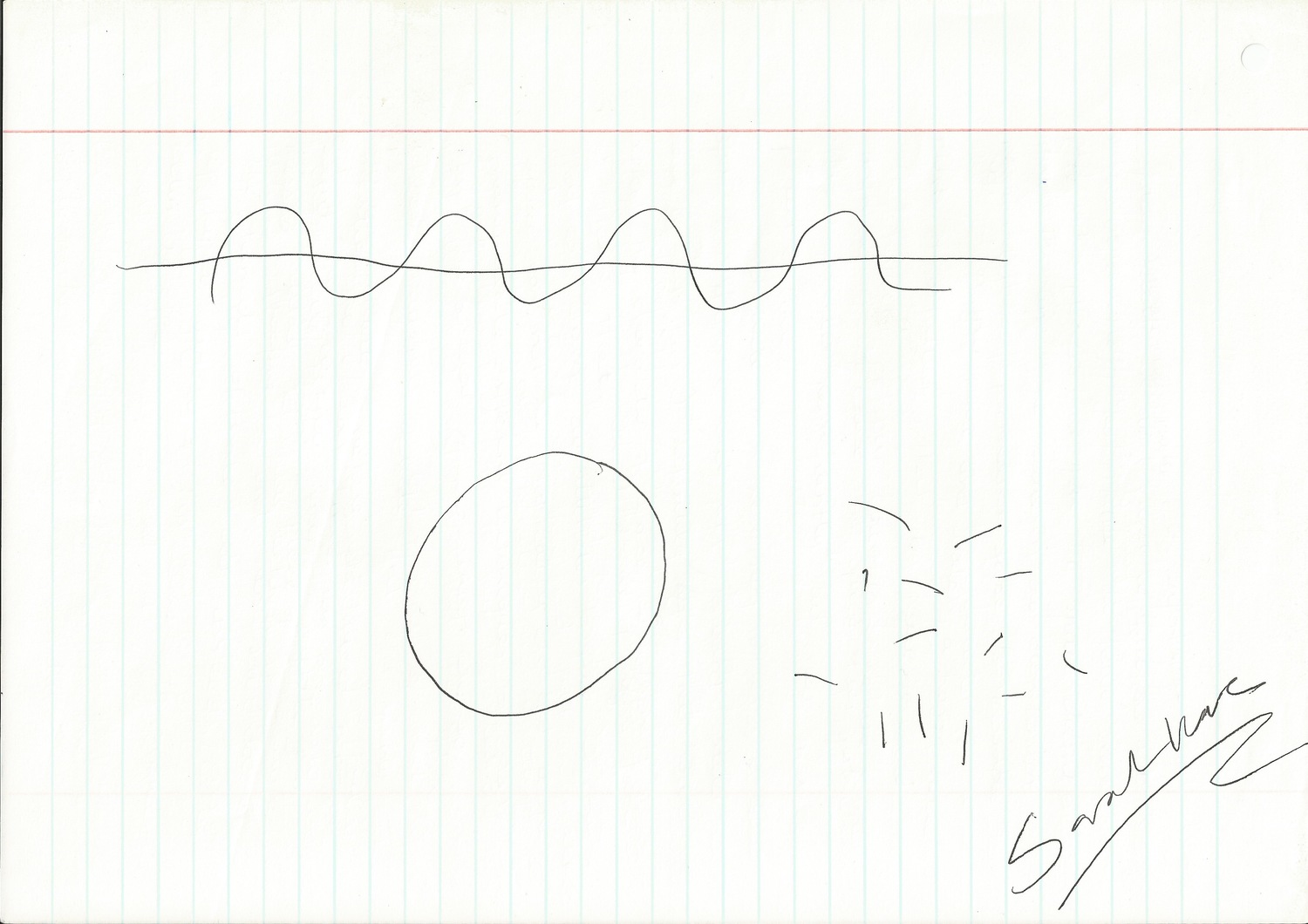
I asked her again about 4:48 Psychosis and the form she was striving to create. She grabbed a piece of file paper from my desk and drew another diagram.
Kane also told me a story from when she was at Bristol university. Planning to study playwriting at Birmingham, she was compelled to pay a small sum for private health insurance. She wrote on the back of the cheque something along the lines of finding it fucking outrageous that to enter an educational institution she should be required to pay for private health insurance, to which she was deeply opposed. I mention this because I now think that the most important thing about her life was not her suicide, but the fact that she got a First Class Honours degree and an MA in drama — she was an intellectual. She loved plays. She loved theatre.
Kane hated giving interviews. At the end of our meeting, she told me she didn’t want to do any more. “I’m a writer,” she said. “I’d much prefer if you could send me letters, and I’ll write my replies to your questions.” In the next couple of months, she sent me a couple of letters about her plays, then silence. I carried on writing my book and, just as I was finishing the first draft of my chapter about her, I heard she’d killed herself. For a while I was shocked and couldn’t write any more about her, and even wondered whether to put her chapter in the past tense. In the end, I left it in the present.
Looking back, our meeting seems to be a characteristic mix of helpful kindness and full-on violent imagination that, in my mind, is the essence of Kane. Yet what haunted me afterwards was the frankness and openness of her personality. “Go on,” she said, “ask me anything.” At the time, I didn’t ask half the questions I wanted to. I thought we’d have plenty of time to talk about her work — I was wrong. I didn’t realise she was already planning her suicide. In June 2000, I talked to Robert Gore-Langton, a Daily Express journalist who’d interviewed her father about her suicide. He told me that he’d expected him to be defensive, but that in fact he was totally open. “Go on,” he’d said, “ask me anything.”
Like most people, Kane was a complex and occasionally contradictory human being: equally capable of being polite and aggressive, of being an introverted garret writer and an extrovert fun-loving woman, of loving moody, doomy music and supporting Man United, a colourful club, a winner’s club, of talking about “sucking gash” and of longing for love and tenderness, by turns honest, perceptive, provocative, sentimental and, yes, quite in-yer-face. Sometimes.
—-
*
p.s. Hey. ** julian, ‘Mickey Mouse’ is probably my favorite Sparks song for some reason, so yes! I think I read that that song turned Morrissey into an ex-Sparks fan. No surprise, I suppose. Hm, my memory of the ‘ghost’ is that it looked like a human-esque column of thin smoke. Yes, your project sounds very different from Peter’s thing. I feel very curious to see what you end up with if it pans out and if you ever make it public. I’m way into your interest there. ** rewritedept, If you found ‘Kimono’ too art-rock and affected, it’s hard to imagine you’d like anything of theirs, but they evolved a lot aesthetically from that early point, and, if you want to try another, maybe try ‘Lil Beethoven’. If you’re into tarot, I guess you might have a chance at ghost belief. I don’t buy tarot, but I like how it’s like a magic trick but prog. ** Adem Berbic, Maybe your workmates would find you even more charismatic if you knew of your interest in the linguistic and visual aspirations of escorts and slaves. What’s the short film? It took me a long time to feel like I could make believable but densely layered dialogue. But then it was a strange second nature. I don’t know if I understand what you mean about point A to B, but that sounds like the way standard movies use dialogue. I think I think of dialogue as more like a script’s deep end or something. ** _Black_Acrylic, Whoever said that about Moroder was undoubtedly a rocker. Just roll your eyes. Mine rolled. ** Steve, Hi. My weekend was alright. I had my biweekly Zoom Book/Film club. For the film aspect we watched that documentary ‘Sherman’s March’. I thought it was tedious, but all of my fellow club members loved it, so huh. Haha, no, the Maels are very heterosexual. I don’t know of that doc series, but it sounds pretty interesting. I’ll see if it’s illegally available somewhere. Ah ha! Everyone, Here’s Steve. Listen up in every respect: ‘My latest “Radio Not Radio” show is up on Mixcloud. It starts with country, swerves left into metal, and takes several more turns. This one features Ashley McBryde, Adeem The Artist, Emmylou Harris, Ashley Monroe, Andrew Sa, H. C. McEntire, Deafkids, My Heart, An Inverted Flame, Warning, soulless, Bekor Qilish, Emaciate, DJ Massive 100% Dynamite & MC Lipex, Marta Sanchez, OOIOO, Aster, mui zyu, Little Annie, Anne Clark, Yasmine Hamdan, Takkak Takkak, the Last Poets and Tyshawn Sorey. Link here.’ ** Bill, Gotcha. No, it’s just that here there isn’t a peep of butoh work that I can see. I should be more attentive than I am to Paris’s version of Japan Society though. ‘The Hyperboreans’, nope, but I’ll hunt. I would absolutely love a Dark Animation post if you feel so inclined. That would be great! Thank you, Bill! ** Gustavo, Hi, good to see you. I don’t think I can narrow it down to just one favorite Sparks album, but I think my very favorites are ‘Indiscreet’, ‘Lil Beethoven’, ‘Propaganda’ and ‘Angst in My Pants’. The exact same wish for your week! ** Jay, Fun. Staying outside and protecting your dreams makes total sense. Mm, I think the playhouse in ‘TMS’ was inspired by the spaces I’d built in the novel and not by a specific external example. That I can remember right now. Enjoy the searching and finding of the sites. I think Bank Holiday is a UK-only holiday? Maybe France has a Banque Holiday, but it would be news to me. ** Carsten, Aw, man, thank you so much. I’m so happy you liked ‘RT’. It was a huge lucky break when we decided to shoot it in the desert even though it was initially a cost-cutting, problem solving decision. Now I can’t imagine how the film would have worked without that setting. We shot it in the early spring so it wasn’t brutally hot. It was however brutally cold at night. Whenever there’s a night scene, the performers are trying very hard not to look like they’re freezing to death. Anyway, thank you, thank you, I’m thrilled that you liked it. I didn’t know that Creeley poem, wow. Creeley on Bresson is a heavenly marriage. Thanks a ton for that. ** HaRpEr //, I hoped the Sparks post might sate you. I would put Mael and Malkmus in my favorite lyricist hierarchy along with Robert Pollard and Dan Bejar. I heard that about Sparks working with John Woo. Yeah, wow, I wonder what that’s going to be. Maybe they’ll wake Woo back up. Okay, I know ‘Moira Orfei in Aigues-Mortes’, and it’s excellent, yeah. Koestenbaum doing McCourt. Not sure I like the title change. No, I know nothing about that Sam Max play. I’ll see what I can find. Your novel-inspired excitement is of course Sparks to my ears! ** Steeqhen, Ghosts are slightly more believable than visiting aliens from outer space. Everyone has an inspiring air of mystery if you have the patience and interest to dwell on them. On the 33 1/3 book, there’s always tomorrow, as Annie chirps or screeches depending on one’s taste. ** Okay. Today I have relit the spotlight on Sarah Kane’s great play. See you tomorrow.


 Now available in North America
Hi!!
I’m just gonna keep trying ‘til it works. Maybe Monday will be the charm again – but hopefully for good this time.
Looks like the blog does this to me once per year. I remember it blocked me for about two weeks last year too and then, seemingly randomly, let me back in one day.
How have you been, Dennis?
Love’s life is insanely chaotic and he’s met some wonderful people here but going beyond just being a urinal is too much at the moment and he doesn’t want to drag other people into it, Od.
I always felt that theatre is something that I just don’t do for some reason. Sarah Kane’s work and her brief life story do seem very inspiring to me, though. A teenaged me would have been very attracted to this figure of a doomed rockstar-playwright.
I’m realizing lately that theater is kind of a massive blind spot for me. From the excerpt, this seems like it could be a good starting point. It can be fun to jump into the deep end of things and work your way back up. “Mickey Mouse” is just such a purely joyful and uplifting song and there’s probably some irony intended there, but I feel it all so sincerely whenever I listen. I read that Morrissey actually loved “Lighten Up Morrissey” and would play it before his shows. I did a three panel video installation last year where I had the actors read one of the transcripts out like a script, and it kind of turned out to be the weakest part of the piece. I might at some point try to publish the transcripts as a book. I’m glad you don’t think it seems too derivative of Pure Filth. Sometimes I worry that I wear my influences on my sleeve, but I think that’s probably a very common fear for artists.
So the desert wasn’t RT’s setting in the initial script? Sounds like what Lynch always called happy accidents, or the Fates deciding to play location scout. Either way, I totally agree that it was meant to be, & bless the movie gods for making it happen. And much respect to your actors: not just for braving the desert cold, but especially for their fine work. I feel like they really nailed your rhythms. What is it Extra says at one point about the dad’s designs, that the rhythm was off? Well your film’s isn’t. There’s a seamless pull from start to finish.
That industrial music in the beginning: was that actually pre-existing music or something you guys put together?
Yeah I had no idea Creeley was into film—specifically avant-garde & Bresson. But the initial surprise quickly turned into “of course he was”—great minds think alike, haha.
Who picks what’s on in your film/book club? I heard about “Sherman’s March”—but what I heard sounded like navel-gazing fluff.
hey dennis!
such a great post! makes me so emotional to see this it, after having worked on my thesis about Frisk and Cleansed two years ago.
i actually even got tattooed the diagram she drew for 4:48. in memory of that process.
anyways, thanks for restoring this post.
and see you soon in amsterdam <3
Kane gives me a stronger feeling than most writers of total awe at the writing and the fact that it works so well. I feel like every single one of her things must have been so brutally difficult to write, or maybe she found it easy, I dunno. I’ve never seen a production of her work, though. I guess I think it’s so high-stakes and her work is so strongly her own that any attempt at staging it is bound to disappoint (I mean, even the stage directions are magisterial). But I should test that assumption one of these days.
Have you seen the short film, Skin? It lives in my head most, and there’s something about the, I dunno, ineffability of the central dynamic and resulting actions that really sticks in my mind. https://www.youtube.com/watch?v=G2ZjplLullc
Speaking of, Victoria’s short is for her film course, it’s a response to some ‘young LGBT person makes up with their father’ doc which she thought was infuriatingly safe and self-serving. A lot of practical limitations to deal with during the shoot, but it was fun. I blew out my vocal chords doing a freakout in one scene. It was, hm, ‘cathartic’ isn’t the right word, but as someone who often feels very hemmed into the range of sounds and motions which they feel comfortable making, it felt good.
Okay, that’s reassuring for dialogue, I guess it’s probably a practice thing. By A to B, I think I mean that I struggle to see my dialogue as an end in itself, more just a vehicle for some idea, whether that idea is embedded in the dialogue or just requires the characters to be in a different space for it to be presented (I don’t mean physical space), and the dialogue gets them there. Or, there are chunks of dialogue which I know are ‘doing something’ in themselves, and threading those together with other bits of dialogue that I see in a more utilitarian ways ends up feeling horribly clunky. I think I got away with just five or six lines of direct speech in the pamphlet, and even that felt like pulling teeth.
Hey.
I have listened to Lil’ Beethoven, it’s a very different sound from their usual work, it’s pretty good. Still haven’t listened to Angst In My Pants and Indiscreet, gonna fix that this week. Propaganda is great, feels like is a “sister” album to Kimono My House. Mad! and A Steady Drip, Drip, Drip are pretty good too.
Sarah Kane’s 4.48 Psychosis seems very interesting. I am not very well-versed in theater outside of Shakespeare and some of Gisèle Vienne’s work, tho the latter is mostly from excerpts and the movie If It Were Love. Seeing Kane’s work here makes me wonder if there’s a bridge between them, stylistically speaking. Both seem very dark and intense. Definitely gonna check her out.
Recently I finished Peter Sotos’ Pure and Tool, I am now on Parasite as part of the collection Total Abuse, I have to say, it’s been a very good reading, it gave me a lot to think about, both the form and content wise. Don’t want to exaggerate but it may be a life change read for me. Anyway, I will try to track down some of his music, curious to see how he will handle that.
Hi Dennis.
I always wanted to write like Sarah Kane, at least on her level of attack. I think her, Buchner, Beckett and the early plays of Handke are some of my favourite plays (though I do need to get to Genet’s theatre stuff at some point!) – I find a lot of traditional theatre to be fine, but I’ve never felt inspired by it until I got into the more out there stuff, but I think thats true of most arts.
I see you’re gonna be in Brussels on the 11th. I dunno if I’ll see Room Temperature again, though a rewatch will undoubtedly bring out more of it to me. Where you gonna visit in town? I would be down to see you again or maybe offer a room for free. I suppose you got it all figured out tho.
Wish you the best!
Hey Dennis,
Sarah Kane! Studied Blasted in one of my modules in my last semester of college; I did my exam on Top Girls by Caryl Churchill, but kept Blasted as something I could just study for fulfillment. Was speaking to this one who’s doing the same module now and discussed how great that play is, and I need to read (or better yet experience a performance of) her other work.
Hahaha I think I disagree on aliens visiting earth being less realistic, but I grew up obsessed with alien movies, tv shows, video games, musical adaptations of War of the Worlds, that I just live in a fantasy of aliens both existing and not being something i’ll tangibly experience, if that makes sense? Like I believe in aliens the way Christians would believe in God: I may not get proof or come in contact or whatever, but it’s a strange comfort to believe nonetheless. But like I said, I just love the idea that something could change the perception of “reality”, and aliens are like to the future what ghosts are to the past.
The sun did not come out tomorrow, but in a way it did as I feel no pressure or shame that I didn’t finish that pitch. I think I’m just too depressed and in distress to commit to that. Getting my meds changed tomorrow, so hopefully that will help, but I’m in this state of freeze that leaves me paralyzed by the freedom of choice and the uncertainty of the future.
Thanks for this day. I keep returning to Kane’s work and its great to see some interpretations and this particular text. Was she at all an influence on the Ash Gray Proclamation? All I know is that piece (ash gray) and Sarah Kane definitely influenced one of the key sections of the novel I’m writing. So maybe i’ve connected them in my mind in a way that isn’t there but which makes sense to me?
Hope you’re well man. I’m in the midst of a desperate search for a job. It suuuucks. I really just want to work on this book which is maybe 3/4 done but needs a lot of stitching.
Happy to see this as a big Sarah Kane fan. I have her collected works, and flip through it every now and then for inspiration, only to end up just reading one of her pieces all over again. I’ve noticed that the UK and other nations outside of the US have more instances of pushing the limits of what can be done on a stage. American theatre is still very much in its infancy, or rather, attached to the idea that what they make has to be entertaining. I’d definitely want to find more that branches out.
It also reminds me of the time I asked forever ago if you had any favorite plays or stage works worthy of being a blog post. Come to think of it, even I don’t have that many in mind, lol. Nice to think about though.
Hope your week goes well!
Hello. I was actually looking into finally reading this play yesterday. Maybe the world is telling me I need to. She seems like a really interesting playwright to read on the page.
The Sam Max play ‘Double Serpent’ intrigues me because it’s published alongside a conversation with Derek McCormack, and I’ve seen a lot of other writers I like sing its praises. It also looks like a really beautiful book to own.
Yeah, I collect artefacts out of specific types of prose that would include McCourt and that Koestenbaum book. I wouldn’t know how to describe it exactly. Flamboyant and extroverted, but also caustic and humiliated. Fabulism, ultimately. And very crucially, not purple. I purposely had to force myself to go out of my way to not consciously write like that because the results were always bad. But I find that a certain quality present in those books is inherently living within me and that if I try to write as precisely as I am capable of being, then something comes out naturally.
I’ve actually been listening to a lot of Destroyer lately. ‘Destroyer’s Rubies’ is my favourite? Though the theatrics of ‘Your Blues’ is unmatched, and that’s for sure an album that gets better with every listen. How do you feel about ‘This Night’?
hi dennis! sorry been quiet. kind of in a personal hell but…big development coming!!!!!
just popping in cuz…sarah kane. blah blah blah changed my life blah blah blah read her collected plays late at night under my duvet when i was 16 blah blah blah other sappy nonsense. 448 is incredibly special to me…so special that ive never seen a staging of it that i ever felt “got” it. the “hatch opens / stark light” refrain has stayed with me for years
aaaaaanyway hope youre doing well!!!! lets catch up when my dust settles, lol
A better way for a young genuis to go than suicide…why did you say that?
Hey Dennis! It’s Michelangelo, Adrian’s boyfriend… I’ve never commented before, I guess I’m more of a lurker, but wow hey, Sarah Kane! So absolutely obsessed with her work, they’re actually showing an adaptation of 4:48 Psychosis here in The Netherlands at the moment that I really found quite good. It’s one of those plays that people usually fuck up majorly on stage and I was instead very much surprised at how well crafted this one was. Maybe it will still be showing when you’ll come to Amsterdam, perhaps check it out? It is in Dutch but they also show it with subtitles, and maybe you still remember enough to follow along the script, since you know it. I actually think the language adds something to it, to be honest.
Thank you again for the coffee! I’ll be in Paris again next weekend for a fanzine/print/self-publishers festival, it’s happening in Césure (in the V arr). But hey, I’ll see you for sure for your movie. Thanks for this post!
hi Dennis!
my man! Sarah Kane, what a treat. makes me super sad bc i love her, but what a treat, fundamentally ♥
i was highkey walking on clouds when i first finished Blasted ages ago, then i got my hands on everything else i could find and right away someone told me she’d died and it was such a blow. she’s v magnificent.
do i tell you? ok, i’ll tell you lol— so whenever i read her plays i actually straight up perform them, i mean like a glorified table reading of sorts. and now that i’m going through a particular ordeal and it’s not a piece of piss obvi i thought maybe i’d be a better Sarah Kane actress and that’d be a silver lining, uh, back against the wall etc, but idk. still too fiery i think. like she says a bunch if stuff I might say too, but out of me it comes diff. think i’m maybe not capable of actual depression, frenzy and whatnot, sure. but that’s not the same, right? when she talks about anger i get that, duh, but it’s also hard for me to reconcile it w the idk, consistently shrunken emotional bandwidth of someone who’s given up essentially… maybe i’m just talking bollocks. like clearly few people can say they’re totally immune to a particularly bad day and a fit of stupidity, but idt that’s even what she was dealing w.
anyway, she did love and violence almost better than anyone else, and hope too. i find her work v life-affirming when it’s all said and done, and funny. the way makes such fluid transitions between reality and hell, and the fact it’s in hell where hope, ease, shared humanity etc are found goes so super hard. reminds me a bit of your multiverses actually. man, wish it had been possible for her to stay.
remember the old poem i mentioned the other day? well i spent the weekend sure i’d lost it but false alarm lol. i’ll email you it it tonight. don’t really write like that anymore but i’m still trying to make the same point, in prose most excitingly lol. you’re obvi v allowed to hate it, but read it, ok? =D
on the Maels i can only say the stache was bloody awful but the lyrics made up for everything. your post made me listen to them again after a super long while. ^_^
ty for being sweet about my symptomy weekend, it comes and goes now which is better. still reading Try a bunch!
speaking of middle aged men, tho not like that lol, i was friends w this crusty in his 30s when i was like 14 and one night i ran into him at his usual spot on my way home from a party or smth and decided to hang for a while as usual. he got super vulnerable showing me pics of his kid back in Norway whom he wasn’t allowed to see but when i hugged him before leaving that mf groped me and whispered v frantically in my ear: ‘you smell like fresh meaaaaat’. lmao. obvi when you’re a kid and an adult comes on to you you’ve got this sixth sense about whether or not they respect you in their thirst and that guy totally didn’t so i was like ‘fuck you you’re sloshed’ and went home and wrote on the last page of my diary ‘jeeeeesus why do men have to be so fucking scary’. 😀
so like alt middle aged men too, obvi, but now i was thinking of your Calhoun who is like the polar opposite and also not middle aged lol, and it’s like… why either badly done or barely done lol. poor Ziggy deserves all that stuff that’s so hard for his babe to say lol fr. all that bait and switch… sexy but cmon kid.
what’s going on w you today? i’m watching this new show called Half Man and i think it’s v good so far, def keep keeping an eye on.
bc i’m writing prose sort of slowly i’m actually writing a lot of poetry lately, mostly not to feel lazy or whatever. feel free to give me a prompt if you feel like to, i like those. ♥
today i read an AI thing that said ‘i want a tattoo of a meadow on my tonsil’ and i cracked up and lowkey loved it, like, the shit language can do which we never would lol.
♥ —> you!
Hey Dennis, good to catch this on my newsfeed today. As you know, Sarah was my good friend. I was at the first performance of 4.48 in London. The great coup de theatre at the end of the play where the whole wall of the theatre opened up onto Sloane Square, they couldn’t replicate in New York because there was no wall to open up. But we all lost it at the end in London after the last line “Please Open the Curtains.” Sarah’s agent Mel told me after that Sarah wouldn’t have liked that ending because it was too optimistic; but I disagreed. I think Sarah would have loved the walls of the theatre opening up. So many Sarah stories (mystical ones too!) – but I’ll leave that for now. Thanks for posting this!