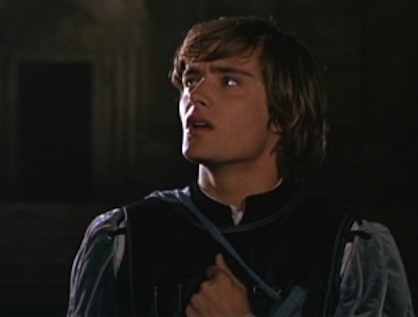
Juliet: Who are you? I know who you are. You’re my enemy.
Romeo: If you want me to, I’ll kill you.
Juliet: You’ve hurt me before but that doesn’t matter. How do I know anything? What does this language mean? I’ll have to trust nothing. I know I trust nothing too much, I will do anything for nothing. Tell me what’s true now. Tell me what’s true now.
Romeo: The Truth?
Juliet: Don’t leave me hanging.
Romeo: The only thing I believe in is nothingness.
(A gleam of light grey appears in the lower sky.)
— Kathy Acker
______________
‘The brain is constantly trying to make sense of the ambiguous information it is given to arrive at a stable and coherent interpretation. If the context and information provided to the senses are unfamiliar, odd and bizarre, then one should not be surprised if the resulting conscious experience is somewhat unfamiliar, odd and bizarre. This fits neatly with developments in cognitive psychology, cognitive science, and neuroscience that views neurocognition as an active model-building process. According to recent emerging scientific frameworks, even stable conscious experience is something of a fiction, but a far lesser fiction than other possible alternative realities.
‘By this account, stable perception and indeed consciousness itself can be viewed as a form of controlled hallucination. Once it is realised that normal perception itself can be viewed, to some degree, as a stable and successful hallucination, it is hardly a leap to view Near Death Experiences as an extension of this natural process. Of course false-memories show that we can remember the palpably untrue as a real memory, but these false memories are often based on illusory conjunctions between other encoded information represented in our memory systems. A false memory still requires an intact memory system, or at the very least, a partially intact one. In addition to this, survivalists have argued that a brain near-death is too unstable to support vivid hallucination, and so cannot be an explanation for NDE.
‘The logical problem, however, for these researchers is: if the brain is too unstable to support hallucination, how is it possible for it to be stable enough to ‘remember’ mystical experience? How can one memorise an event in the absence of a working and functioning memory system? If, as the survivalists claim, the brain is dead then surely, so is memory. If memory is dead, then how can individuals remember anything – even if the original experience was mystical? The Near Death Experience then is merely a greater fiction that serves a temporary purpose for consciousness in that, for a short while, it represents reality in the absence of the more usual and stable reality provided by the senses.’ — Jason J Braithwaite ‘Near death experiences (NDEs): The dying brain’
‘Nephews of international singing star Andy Williams, identical twins Andy and David looked set to conquer the pop world in 1973. They were like looking at pure sunlight – all that straight, golden blonde hair.’ — Nostalgia Central
______________
He pushed aside the magazine, his fingernail squeaking on the glossy page.
Then, moving his shoulders laboriously and wheezing on his short pipe, he went out onto the enormous enclosed veranda, where a chilled band was playing and people in bright scarves were drinking strong tea, ready to rush out again into the cold, onto the slopes that shone with a humming shimmer through the wide windowpanes. With searching eyes, he scanned the veranda. Somebody’s curious gaze pricked him like a needle touching the nerve of a tooth. He turned back abruptly.
In the billiard room, which he had entered sidewise as the oak door yielded to his push, Monfiori, a pale, red-haired little fellow who recognized only the Bible and the carom, was bent over the emerald cloth, sliding his cue back and forth as he aimed at a ball. Kern had made his acquaintance recently, and the man had promptly showered him with citations from the Holy Scriptures. . . But Kern had stopped listening, for his attention had suddenly been caught by his interlocutor’s ears– pointed ears, packed with canary-colored dust, with reddish fluff on their tips.
The balls clicked and scattered. Raising his eyebrows, Monfiori proposed a game. He had melancholy, slightly bulbous, caprine eyes.
Kern had already accepted, and had even rubbed some chalk on the tip of his cue, but, suddenly sensing a wave of dreadful ennui that made the pit of his stomach ache and his ears ring, said he had a pain in his elbow, glanced out as he passed a window at the mountains’ sugary sheen, and returned to the reading room.
There, with his legs intertwined and one patent-leather shoe twitching, he again examined the pearl-gray photograph, the childlike eyes and shaded lips of the London beauty who had been his wife. The first night after her self-inflicted death he followed a woman who smiled at him on a foggy street corner, taking revenge on God, love, and fate.
And now came this Isabel with that red smear for a mouth. If one could only …
Kern sensed that he was rocking back and forth, and that some pale girl with pink eyebrows was looking at him from behind a magazine. He took a Times from the table and opened the giant sheets. Paper bedspread across the chasm. People invent crimes, museums, games, only to escape from the unknown, from the vertiginous sky. And now this Isabel. . .
He tossed the paper aside, rubbed his forehead with an enormous fist, and again felt someone’s wondering gaze on him. Then he slowly walked out of the room, past the reading feet, past the fireplace’s orange jaw. He lost his way in the resounding corridors, found himself in some hallway, where the white legs of a bowed chair were reflected by the parquet and a broad painting hung on the wall of William Tell piercing the apple on his son’s head; then he examined at length his clean-shaven, heavy face, the blood streaks on the whites of his eyes, his checked bow tie in the glistening mirror of a bright bathroom where water gurgled musically and a golden cigarette butt discarded by someone floated in the porcelain depths.
— Vladimir Nabokov
_____________
_______________
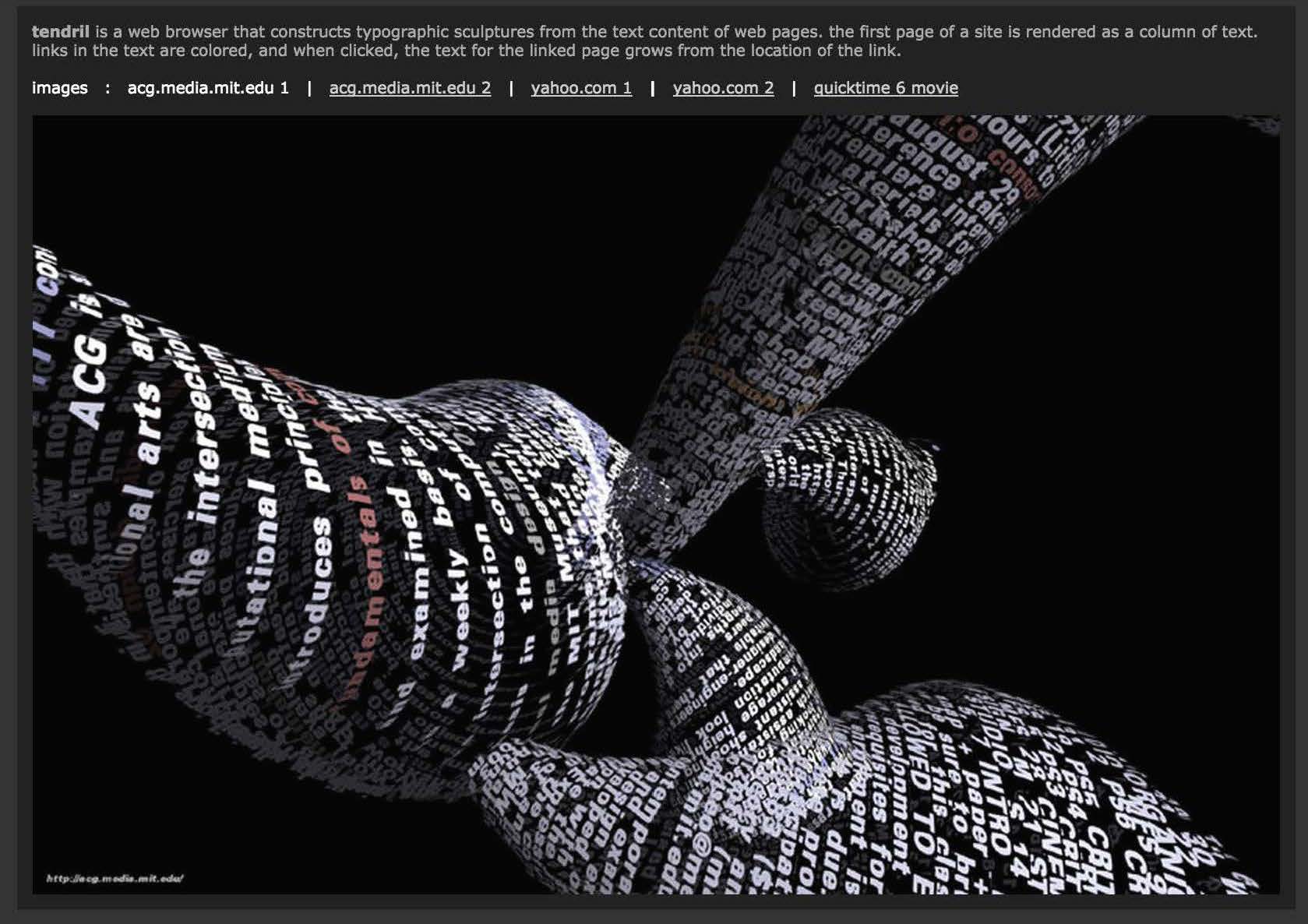
‘Tendril is a web browser that constructs typographic sculptures from the text content of web pages. The first page of a site is rendered as a column of text. Links in the text are colored, and when clicked, the text for the linked page grows from the location of the link.
‘As Tendril’s text dynamically grows it is woven into bulbous 3D threads that evolve over time into spinning bloated rhizomatic tubers. The surface of these structures is visually composed of text. These are now visual objects, hybrids or chimeras: data-mining refuse (conceptual probes into knowledge and reading), modulated geometric primitives (abstract visual art), and animated organisms (information visualization of biological memes). Tendril is a quasi organism and a hybrid cultural entity, it feeds on text, digesting it into rhizomatic skin. Tendril automates appropriation; it is like Flarf exponential: reconfiguring what it retrieves into a format that is readable as tumescent infinities.
‘Obviously, legibility is not the key pleasure involved in most typographic sculptures. These redolent forms, undulant in black space, swollen with language, are unreadable. The reading machine process programmed by Fry operates unseen behind the screen, engorging itself on text that stretch into curves that ripple as they excrete networks. This is sculptural animation that occurs in an on-screen ecosystem. And since it is no longer visible live it is also a fossilized excretion (the residue of Tendril is a few movies and jpgs and probably a snarl of code rendered inoperative by shifts in network protocols). So what the documentation provides is evidence (but not the actuality) of the passage of an incipient text-eating network-organism, a progenitor of creatures that will roam the net eating words and shitting pulsating rhizomes.’ — Ben Fry
_______________
Kyle McDonald
Annika Hippler
Martin Hesselmeier
Dan Marker-Moore
______________
‘The Watery Grave’
______________
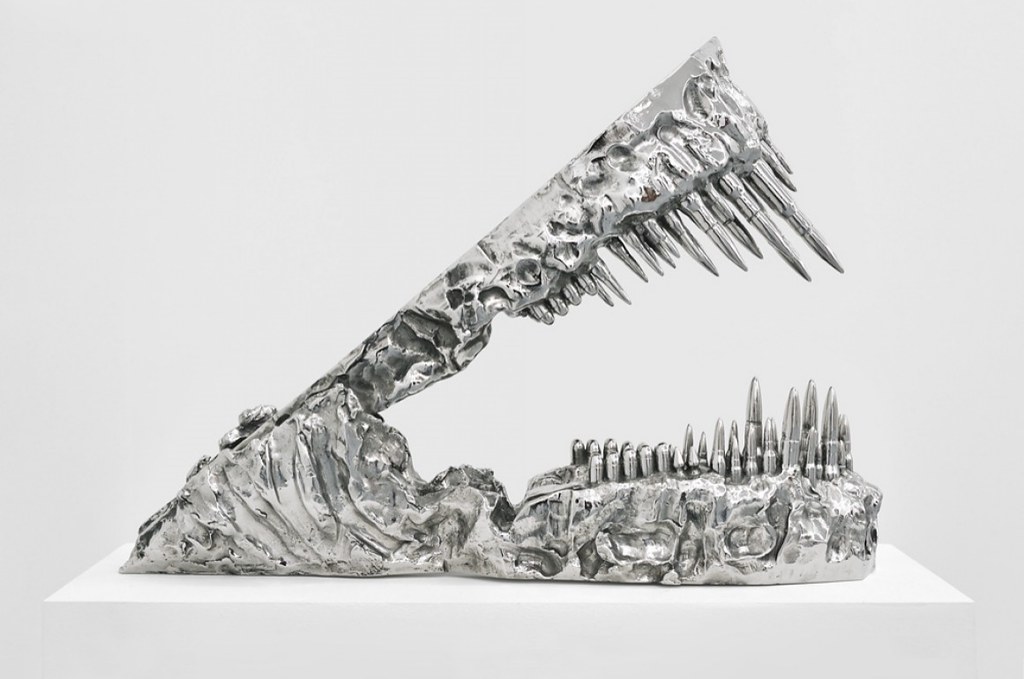
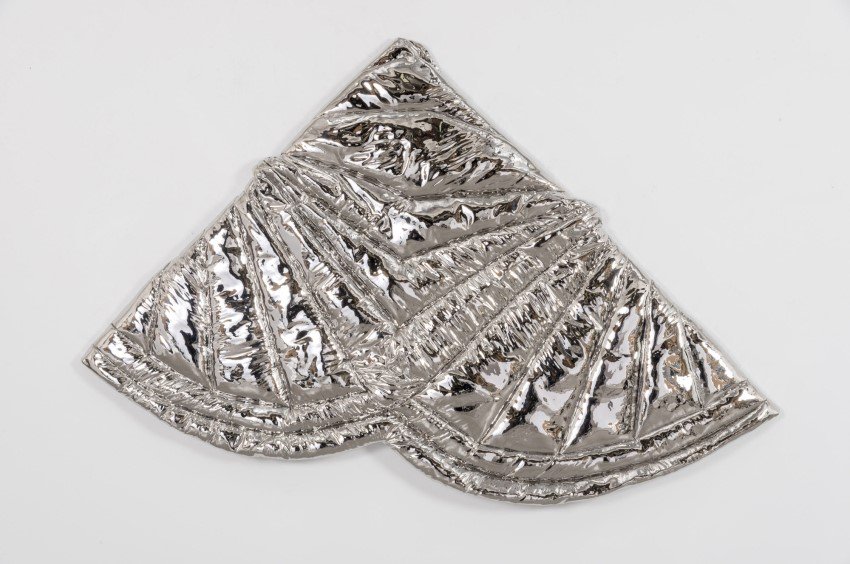
‘Joel Morrison’s materials usually consist of discarded objects – casualties of excessive consumerism and waste – that the artist recovers from around his studio and neighborhood in Los Angeles. The found objects undergo the laborious process of mold and lost wax casting – what the artist calls “the simplest and oldest method or replicating objects into metal.” The sculptures take reference from classical Greek sculpture to L.A.’s “Finish Fetish” movement of the 1960s and ’70s. Adding a special dynamic to these works, the mirrored surface of the steel reflects and distorts colors and shapes with each passing viewer.’
______________
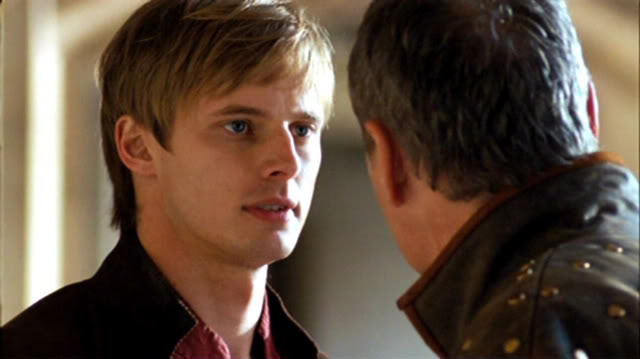
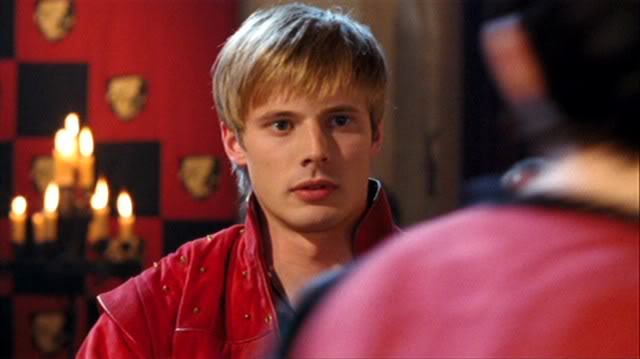
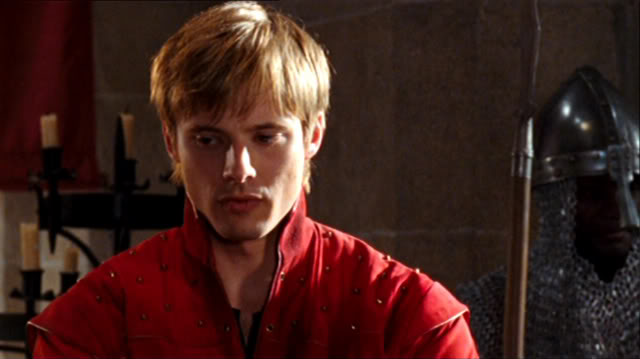
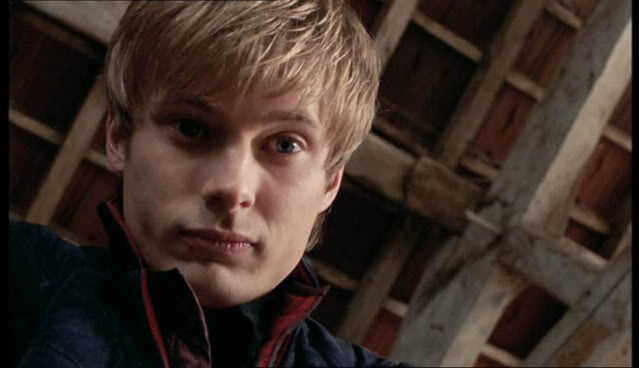
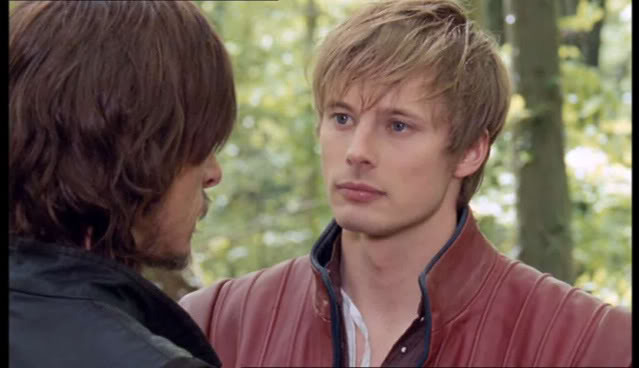
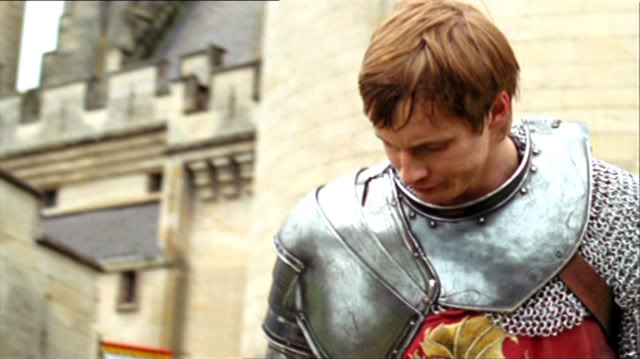
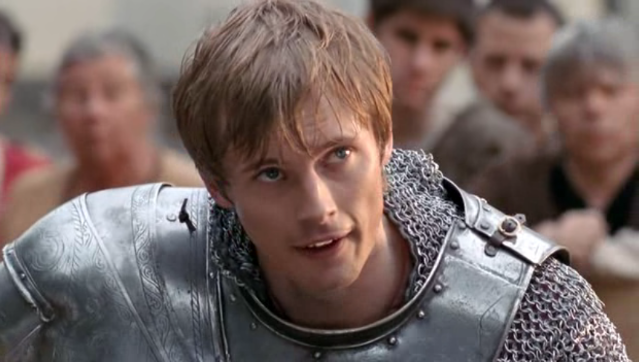
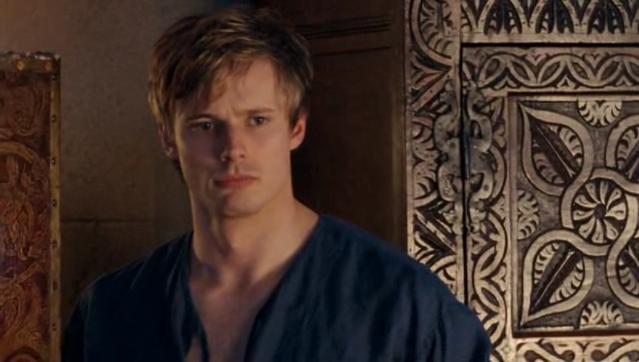
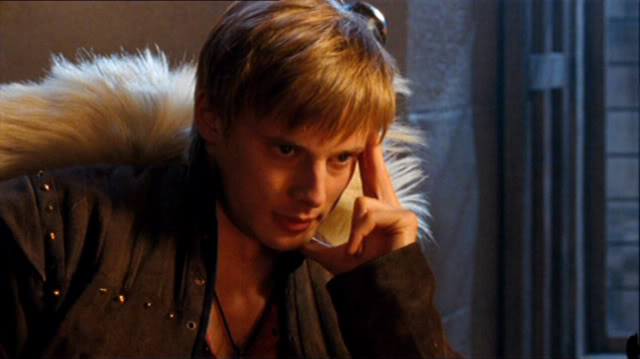
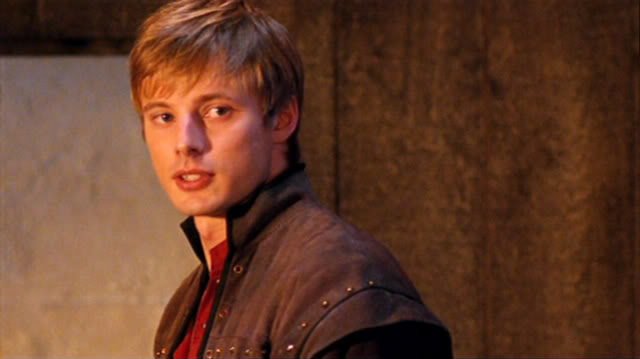
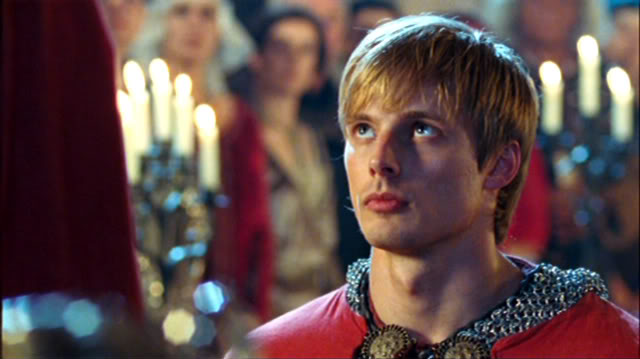
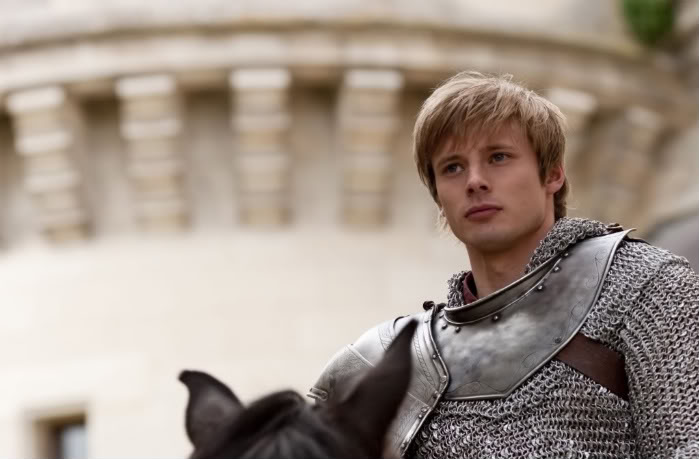
Bradley James really does have the shiniest hair in all the land by cherrybina
OKAY. So, the other day I said that it would be totally okay if anyone dared to disagree with my claim that Bradley’s hair is the shiniest thing ever. After some further reflection I would like to revise my statement. Bradley’s hair is the shiniest thing ever FULLSTOP. It’s really not up for debate.
LET US BEGIN. The first thing you need to know about Bradley’s hair is that IT GLOWS.
Really, it does.
A LOT.
Like a fucking glow worm.
It’s pretty much a major theme.
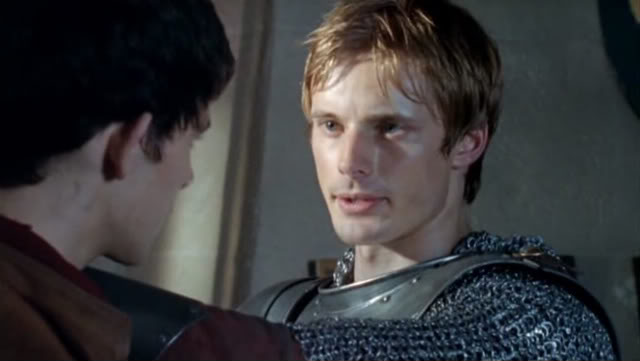
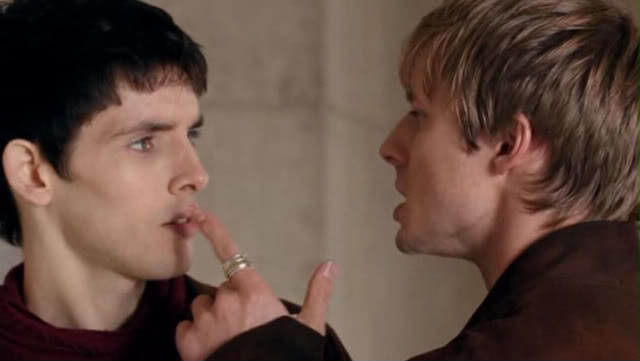
This… is rather distracting, because there are times when Arthur is trying to tell Merlin something important, but the hair is RIGHT THERE doing its glowy thing.
I mean, yes, this was a lovely moving speech and all, but if Arthur had wanted to be sure Merlin could focus on something besides the shiny magnificence atop his head he really should have moved into some less flattering lighting. I am just saying.
I am including this shot only so that you might get a closer look at the way Bradley’s hair curls just perfectly around his ear.
And when he works the hairs all at once, it’s like a fucking force of nature.
I cannot mention the hair without talking about how sometimes it gets a bit, well, SWEATY.
This, my friends, is A Very Good Thing.
OH YES.
VERY VERY GOOD.
Not even post-shag bedhead can mar the perfection.
Thing is, it’s hard to be Bradley. Think about it – never a quiet moment as long as he’s flashing his hair all over the place. Sometimes he tries to distract us BY TURNING THE HAIR A DIFFERENT COLOR ENTIRELY. THIS DOES NOT WORK. WE SEE YOUR SHINY HAIR, BRADLEY.
So, if you’re into THINGS THAT GLOW
I think at this point it’s safe to say that Bradley James really does have the shiniest hair ever.
‘Weak eyes are fondest of glittering objects.’ — Thomas Carlyle
‘I love the constancy of shine of the edges of moving objects. Even propellers or desk fans will glint steadily in certain places in the greyness of their rotation.’ — Nicholson Baker
‘First thing in the morning, when I take out the trash, I see it: syringe on the lawn. Still bloody. Surreal, isn’t it. First memory like a shot in the vein. Four long years of youth sliding cold silver glint into waiting blue.’ — Lidia Yuknavitch
‘Life is not significant details, illuminated by a flash, fixed forever. Photographs are.’ — Susan Sontag
‘Let me go to hell, that’s all I ask, and go on cursing them there, and them look down and hear me, that might take some of the shine off their bliss.’ — Samuel Beckett
‘When in the slightest doubt, shoot over sundry bridges while the bay doth glint. Or smiling jump off same.’ — Gilbert Sorrentino
I have been photographing our toilet, that glossy enameled receptacle of extraordinary beauty. Never did the Greeks reach a more significant consummation to their culture than the glory of its chaste convulsions and its swelling, sweeping, forward movement of finely progressing contours.’ — Edward Weston
‘Broken glass. It’s just like glitter, isn’t it?’ — Pete Doherty
‘I made a circle with a smile for a mouth on yellow paper, because it was sunshiny and bright.’ — Harvey Ball
‘They can catch a straight line, but they can’t catch a circle. I mean, all you have to do is look at the way the sun shines on a leaf, and it’s round. They proved that light goes in a circle. So, I imagine as long as I’m light, I’m in a circle.’ — Don Van Vliet
‘Like ultraviolet rays memory shows to each man in the book of life a script that invisibly and prophetically glosses the text.’ — Walter Benjamin
‘The blue glint that connects the lumberjack’s axe-blows.’ — Andre Breton
‘Time, which runs through the world like an endless tinsel thread, seemed to pass through the centre of this room and through the centre of these people and suddenly to pause and petrify, stiff, still and glittering… and the objects in the room drew a little closer together.’ — Robert Musil
____________
____________
‘Astronomers have spotted an exotic planet that seems to be made of diamond racing around a tiny star in our galactic backyard. The new planet is far denser than any other known so far and consists largely of carbon. Because it is so dense, scientists calculate the carbon must be crystalline, so a large part of this strange world will effectively be diamond.
‘”The evolutionary history and amazing density of the planet all suggest it is comprised of carbon — i.e. a massive diamond orbiting a neutron star every two hours in an orbit so tight it would fit inside our own Sun,” said Matthew Bailes of Swinburne University of Technology in Melbourne.
‘Just what this weird diamond world is actually like close up, however, is a mystery. “In terms of what it would look like, I don’t know I could even speculate,” said Ben Stappers of the University of Manchester.’ — Reuters
____________
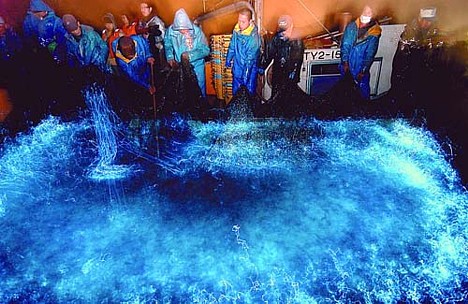
‘Toyama Bay is the habitat of the world-famous glowing firefly squid, which surface in large numbers every spring in a phenomenon that has been designated a special natural monument. Peak firefly squid season means brisk business for sightseeing boats that provide close-up views of the magical action. Early in the morning, after 3 AM, sightseeing boats depart the Namerikawa fishing port (Namerikawa is also home to the world’s only museum dedicated to the firefly squid) in Toyama prefecture, making a short journey to fixed nets located about 1 to 2 km offshore. As the fishermen haul in their nets, the light emitted by the firefly squid causes the sea surface to glow a cobalt blue, evoking squeals.’ — Pink Tentacle
________________
____________
Once the words begin to settle into their circumstance in a sentence and decide to make the most of their predicament, they look around and take notice of their neighbors. They seek out affinities, they adapt to each other, they begin to make adjustments in their appearance to try to blend in with each other better and enhance any resemblance. Pretty soon in the writer’s eyes the words in the sentence are all vibrating and destabilizing themselves: no longer solid and immutable, they start to flutter this way and that in playful receptivity, taking into themselves parts of neighboring words, or shedding parts of themselves into the gutter of the page or screen; and in this process of intimate mutation and transformation, the words swap alphabetary vitals and viscera, tiny bits and dabs of their languagey inner and outer natures; the words intermingle and blend and smear and recompose themselves. They begin to take on a similar typographical physique. The phrasing now feels literally all of a piece. The lonely space of the sentence feels colonized. There’s a sumptuousness, a roundedness, a dimensionality to what has emerged. The sentence feels filled in from end to end; there are no vacant segments along its length, no pockets of unperforming or underperforming verbal matter. The words of the sentence have in fact formed a united community.
— Gary Lutz
______________
______________
‘Valentina Berthelon’s “Dark Energy – Dark Matter” is made by mixing hundreds of old, black and white images of stars and galaxies. It is a poetical trip to the dark side of the universe. It plays with the idea of Dark Matter and Dark energy, both concepts stretch the limits of science and mathematics by changing radically our conception of the Universe. In the past it was thought that the hole universe was made out of atoms or subatomic particles but this is wrong. New discoveries have proven the existence of an invisible particle “Dark Matter” that has only been indirectly observed but never captured and whose properties are inferred from its various gravitational effects.This hypothetical substance is believed by most astronomers to account for around five-sixths of the matter in the universe and it´s considered responsible for holding all the normal matter in the universe together.’ — VB
_______________
Opium Den Automaton
____________
‘Text of Light was formed in 2001 with the idea to perform improvised music to the films of Stan Brakhage and other members of the American Cinema avante garde of the 1950s-60s (Brakhage’s film ‘Text of Light’ was the premiere performance and namesake of the group). The original premise was to improvise (not ‘illustrate’) to films from the American Avante-Garde (50s-60s etc), an under-known period of American filmic poetics. Members of the group include Lee Ranaldo and Alan Licht (gtrs/devices), Christian Marclay and DJ Olive (turntables), William Hooker (drums/perc), Ulrich Krieger (sax/electronics), and most recently Tim Barnes (drums/perc).Various combinations of these players attend ‘Text’ gigs, depending on individual schedules, so the group takes on various permutations—sometimes all members participate, sometimes not.’ — sonicurbs.com
Text of Light/Stan Brakhage (live) 1
Text of LIght/Stan Brakhage (live) 2
_______________
‘After searching for rocks in northern Minnesota and, finally, in Massachusetts, artist Jim Hodges selected a set of four stones, each weighing between eight and thirteen tons and standing more than six feet high. According to a worker at the Massachusetts quarry where the artist found the boulders, each stone is approximately 400 million years old. Body putty was applied to each boulder to create a smooth exterior; then, after a mold was made from that, the stainless steel was cast. The rock surface was chipped away to accept the stainless steel veneers, arriving at a perfect fit between skin and stone. The thin steel sheets, which were painted with clear-coat mixed with a dye typically used on motorcycles, were adhered with pins and epoxy.’
_______________
—-
*
p.s. Hey. ** kier, k-k-k-kier! Granted, it’s rare that I meet a theme park I don’t really enjoy, but, yeah, Disneyland Paris is very good assuming you don’t hate Disney. I think it’s up there with the best Disney parks. Hollywood Studios is an adjunct park, much less good but it has several excellent rides, and if you buy a two-park ticket, your day is made. I trust, hope that you’re feeling pretty much up to speed now? Votive candle and so on if not. Okay, yeah, I just have to check with G and see what can be done, and you’ll know in plenty of time. Margret retired from performing some years back, so this newer dancer Nuria does her part, but Capdevielle and Schatz are still on board. There’s a falcon and an owl. Uh, I have no idea if the falcon is the same. We always employ the same falconer so it’s possible depending on how long falcons live, I guess. It’s been ten years. It’s not the same owl. I think we’ve been through a handful. The first one tragically died backstage during the premiere in Avignon. Any luck with the apartment hunt, I hope, I hope? My day was pretty un-headlit. Met with the gallery people to coordinate the upcoming PGL screening. I guess a bunch of curators are excited by the GIF works and want to curate them, which is exciting. Made a couple of blog posts, bought some food, … Not a lot. Today I have to sit around waiting for the plumber, but Michael Kiddiepunk might come and hang and wait with me, and then I’m going to see this writer Lyn Hejinian do a reading tonight. And … and … you? Love, me. ** David Ehrenstein, The Lance Olsen is indeed fun. Conrad was an amazing filmmaker, for sure, and his music is just as stellar. And it turns out he’s quite good with words as well. ** Tosh Berman, Hi, Tosh. I think you had an event at Hauser & Wirth re: that book, or am I daydreaming? I missed that episode of your show. Great, I’ll stream it while killing time waiting for the plumber today. Everyone, Here’s Tosh Berman with an ‘in’ to something I think you’ll want to hear. Tosh: ‘My friend Kimley and I have a podcast called Book Musik, where we talk about books on or about music. We did an episode on Tony Conrad’s ‘Writings’: here.’ ** Bill, Yeah, I had to check twice to make sure that was actually a photo of him. I did, I did (enjoy). No, I’ll pair hitting the Apple thing with some other reason to go to the Left Bank. Shakespeare & Co. or pastry gathering or something. ** Steve Erickson, Very, very best of luck with that situation! ** Nick Toti, Hi, Nick! Cool, thank you for the hook up to the video. Sounds sweet. I like Jordan Castro’s stuff. I’ll hit it today. Everyone, Very fine filmmaker Nick Toti has a very cool share for us. Take it away, Nick … ‘I also wanted to share a quick little video I made. It’s sort of an attempt to do the equivalent of a music video but with an author’s writing instead of a band’s music. Does that make sense? The footage was shot the same night as Megan Boyle’s 25-hour marathon reading of Liveblog. Jordan Castro was one of her opening acts that I just happened to also record. His reading was short and sweet and seemed to merit its own video. Anyway, here it is.’ Take care, man. ** Right. A gleaming restored post for you intended to put gleams in your eyes if not even elsewhere, one might say. See you tomorrow.
Suleika Jaouad: You’ve had an unusual path when it comes to school and education. How important was it for you to study writing in a classroom setting?
Lidia Yuknavitch: Oh, this is a terrible answer! In some ways, it wasn’t important at all for me to study writing in a classroom. Since I teach writing in classrooms, that’s a weird thing to say, but I flunked out of college, I’ll just say, more than two times. It wasn’t anything to do with college — it was me. It was an inability to sit still and to have a reason to be there. Until I had a reason, I really wasn’t listening or engaged in any way. I just thought it was something people made you do when you hit a certain age. What brought me back to college was feeling engaged by literature and realizing it was a world I could inhabit. From that day forward, I was hungry, and I loved everything about being in college.
I think if you want to write, you should write. What path or what form that takes is incredibly individual. If you’re an artist and you’re searching for forms of self-expression, you have to invent your own path. My life experiences, if you wrote them down on a list, look a little crooked, and who cares?
SJ: When did you first consider yourself a writer?
LY: I think compared to some people it was kind of late. I didn’t consider myself a writer until my writing came back and bit me in the ass. I experienced some serious grief and trauma and even psychosis when my daughter died in 1986. One of the things that came out of me during that period of time was a bunch of gibberish writing in notepads, written in really tiny letters, Ted Kaczynski–style. Later, when I got help and some more stability in my life, I looked back in the notebooks, and embedded within the gibberish was some storytelling. I could see it, and I liked it. [Later this would become the material for The Chronology of Water.]
I really didn’t stand up and say, “I’m doing this thing. I like this. It’s good,” until I was somewhere between 26 and 30, but maybe stories always lived in me. My mother was very good at telling “fictions,” so maybe it was already genetically coded in me. I have no idea. I was not a person who dreamed of being a writer in the same way that people say when they were little they did. I didn’t have that. It emerged for me during a period of crisis. I do feel grateful that I was awake enough to see it and step into it, because I’m really not very good at anything else.
‘Lidia Yuknavitch is a writer of rare insight into the jagged boundaries between pain and survival. Her characters are scarred by the unchecked hungers of others and themselves, yet determined to find salvation within lives that can feel beyond their control. In novels such as The Small Backs of Children and The Book of Joan, she has captivated readers with stories of visceral power. Now, in Verge, she offers a shard-sharp mosaic portrait of human resilience on the margins.
‘The landscape of Verge is peopled with characters who are innocent and imperfect, wise and endangered: an eight-year-old black-market medical courier, a restless lover haunted by memories of his mother, a teenage girl gazing out her attic window at a nearby prison, all of them wounded but grasping toward transcendence. Clear-eyed yet inspiring, Verge challenges us with moments of uncomfortable truth, even as it urges us to place our faith not in the flimsy guardrails of society but in the memories held—and told—by our own individual bodies.’ — Riverhead Books
Excerpt from BOMB
Goddamn it to motherfucking hell, she says.
I think that ought to cover it, he says. He asks her why she feels the need to swear so much, so deliberately, what depends on it, why it’s so important to her. Why, after so long, she hasn’t grown tired. Worn out in the mouth.
She looks straight into his eyes, straight into his skull, says, Fuck you.
It’s curious, he says, because now when she uses profanity, it sounds like everyone else’s ordinary speech. Like when she says, Goddamn it, she may as well be saying, can you let the dog out? or I’m going to check the mail. She wouldn’t say she’s angry, but her eyes flash hard at him for saying this, as if her language did not disrupt, did not slice open the air and slash him across his goddamn stupid too beautiful face. She knows he is lying. The simple truth is, he was raised Baptist in some shitty little West Texas town, and she was raised in a fucked‑up place called Father. His hands are beautiful. Her mouth is potty. They are lovers.
The real reason she’s swearing is that they’re on their way to an evening art party. He knows how they make her feel. The art parties they attend together are full of falseness. He is a white male genius artist in San Francisco, and there is nothing real about white male genius artists in San Francisco: not the art, not the women who live with them, not the men who live with them, not the galleries, not the critics—My god, the art critics, can’t we just shoot them?—not even San Francisco. Everything is filmy, filmy as bay fog.
All of them together make one big pile of shit, she declares, grabbing his hand as they approach the neighborhood of this evening’s party. He squeezes her hand. She squeezes back, thinking, How meaningless, wondering, Where is the risk in squeezing a lover’s hand while walking to an art party?
They pass rows of colored houses, staring forward like so many faces. Her descriptions: the fucking amazing view, the goddamn little rows of windows stretching for fucking miles. His: more azure evening light, warm glow from the inside out, houses alive. Doors, windows, roofs speaking. They make a good pair, or rather their mouths do: hers pushing out, exploding, his soaking everything in, slow and sweet.
When they’re almost there, she suggests, wild, Why don’t they run back down the hill, past the doors and windows and faces into the evening. She starts to unbutton her blouse. The light is dim; he can barely see her. She tugs at his arm, and he half believes her, as always. But just then someone sees him from the party house and calls out his name, so they turn around and go in after all. She leaves her excitement standing in the yard, leaning toward the night, eyes wide, chest heaving, naked.
Inside, everyone calls him Pater. His name is Peter, she corrects them, but she is the only one who calls him this. Finally some man with a mostly bald head except for some styled and sculpted gray on the sides explains to her that Pater sounds more like the name of an artist, that more people will buy from a Pater than a Peter. She is astounded that he thinks he must tell her this. The paintings: What is being bought? Sometimes she can’t remember his name at all, simply his paintings.
At the art party she does what angry women do. She drinks. A lot. Language in the rooms of the party suddenly turns liquid. Animals begin crawling out. One man be‑ comes a lizard, his belly scraping the shag carpet, his arms and legs sticking out stiff from his body. Another man who has been pinching the asses of women all night turns into a crab with one huge red claw, so heavy he cannot lift it anymore. A woman with big lips becomes a blowfish, bubbles rising from her face now and then; her eyes, moved to the sides of her head, look magnified. Peter, Pater, becomes a bird with extravagant colored plumage, terribly magnificent: His back sways, his chest protrudes.
She drinks wine she drinks whiskey she drinks beer she drinks tequila shots. She still feels like a fucking person. She goes into the bathroom and removes her bra and underwear from beneath her clothing and stuffs them into the medicine cabinet. She emerges from the bathroom some new animal that no one has ever seen before. Everyone notices her. She pretends they all see her as a magnificent exploding poppy but knows they likely see her as a stain. In her head she names herself something between the color red and the word “devour.” She looks for him.
Some small man who might be a ferret or a weasel is talking to Pater/Peter, the rooster or the peacock. Everything swims. She watches her lover shrink. She moves closer. The ferret/weasel’s mouth is making sharp, jerky movements. Closer still she hears words like “ridiculous” and “no talent” and “not a chance in hell.” Her lover is shrinking before the weasel into a small bird, then into a chick, peeping uselessly. The ferret‑man’s tongue looks long and dangerous; his lips are knives moving together, slicing and clicking.
She hates. She hates the ferret, she hates the smallness of the chick. She hates the alcohol, she hates the art party, the animals, the body who came into the house. The ferret’s mouth becomes the only thing she can focus on, even as a crowd is gathering—because by now of course she has started swearing, a mighty swear swarm, like starlings murmuring. Even as the fish‑woman swims up and blows diplomatic bubbles between them, even as the giant red pincher drags itself near, the ferret’s mouth clicks and slices and becomes more clear than is possible, so that finally she has a direction for her hate to aim at, and she punches his mouth right off his face. Everyone is a person again, humanly stunned.
A man rests on the floor. Her knuckles ache. Some quiet hands lead her away, a man whose name she cannot remember. He is saying, It’s all right, it’s all right. She suddenly realizes this is how she feels every goddamn night of her fucking life. His hands are on her face, her shoulders; he tries to sculpt her back into being okay. Her own hands hang useless. This love cannot live unless she fights him every day of her life. He paints, will paint. She aches for it all to be over: the years, the relationship, the waiting. She aches to summer over into a different life. She runs toward summer with no hands. All mouth. All mouth. Her mouth.
Extra
Trailer: Verge
Trailer: The Chronology of Water
Lidia Yuknavitch speaks at the 2017 Portland Creative Conference
______________
‘We need to create a fearless moral inventory of ourselves. A mild cigarette or a mild bout of biting one’s nails is like a mild Declaration of Independence or a mild God who’s now the same person as his evil brother. No, the inventory must contain strong cigarettes, strong nails, strong shits as if we were riding out a strong road with strong friends who were also creating inventories.
‘The next step is to admit to the power higher than ourselves the exact nature of our wrongs. No, admit the exact nature in which we wish to live, transcending the shit-stained economy with our liberal dyspeptic tummies, no longer cured with painting it over, covering it up with TUMS, covering it up with SMUT. A detained body is no different from a detonated body. When it is not free, it is at war. When it is not free, it is stray. It isn’t able to create homes for its senses in the sun’s path. There must be a bridge a bridgement of the apathy we’ve slept ourselves into.
‘Transcending our public shits to a higher power may be the way to feed new life, but the process can go astray. “Higher,” to some, is synonymous with bigger and more powerful, but the chandelier is not bigger or more powerful than someone’s lifted strawberry-dress two stalls down. It can be used as entertainment for a baby or as a weapon, but not as light. We give it power by feeling entirely ready to have it remove the dystopic within us, the dystopia we’ve created outside of us. To get there, we have to meditate on a baby’s shit reversing its direction and returning back into the baby’s body through a higher power. In that way, the baby becomes a reversible sweater.
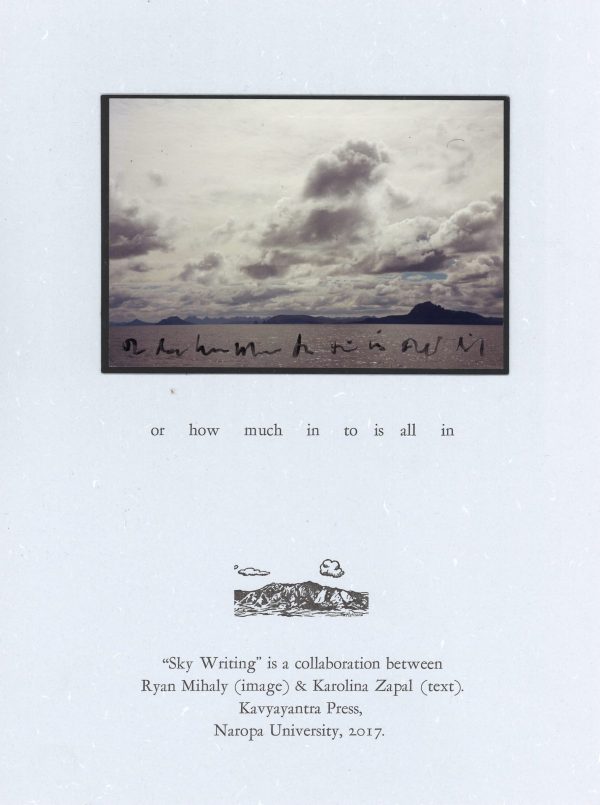
‘We humbly ask the chandelier, which now lives inside us and our babies, taking over the appearance and function of alveoli—for rapid gas exchange—to remove our shortcomings. To first remove the soft but noisy shits, the easily breakable shells littered over our stone, and the recyclable within us. Then, to dispose the wasting of food, paper, water, and electricity before improperly disposing of it. Finally, to take care of car and air travel, so that all fumes are organic fumes.’ — Karolina Zapal
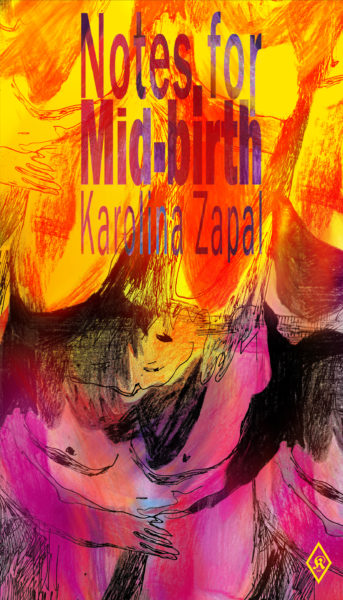
Karolina Zapal Notes for Mid-Birth Inside the Castle
‘In Zapal’s stunning second book, a fevered momentum towards life beyond a womb of lukewarm freedom is suspended mid-birth as the landscape of borders rises to meet us— east/& west, woman/& womb, art/& artist. War breaks out at an intersection flung on the female form. People cross there. In this profound meditation on the borders of a body and the powers allowed to govern, Zapal contemplates the identity of a border, the ground it divides and the who that writes (rights) representation. Who gets to cross? Sometimes all you want to do in a poem is take a walk. Zapal is an insightful guide as she walks in tandem with her reader, examining with keen poetic brilliance the dilation of a country over generations, the churning of Poland’s abortion laws, of protests, of histories and personal narratives. She leads us to the apex of a movement towards, never demanding we fall to one side or the other, but simply illuminating the profound space of in-between—how will we choose to deliver ourselves, our neighbors, the other, the other’s body? Who even has choices?’ — Marie Conlan
Excerpt
Extra
_____________
John Madera: I’m thinking that while it’s important to find innovative structures and forms, it’s also important to reinforce and repeat forms, to develop traditions within the experimental mode. In this sense, experimentation and tradition may not always be in opposition. What are your thoughts about this?
Lance Olsen: It’s a remarkably difficult issue. Essentially, we’re discussing how one might define “innovative,” “experimental,” “avant-garde,” and how that idea, whatever we choose to call it, exists in history—both public and private. I think of the sort of fiction we’re discussing as that which asks the questions: What is fiction? What can it do? How? Why? And I think we know it by realizing we are standing before something we can’t quite figure out how to talk about—standing before something that asks us to develop a new language to converse about it. In other words, in some profound way, the “innovative,” “experimental,” or whatever troubled and troubling word we’d like to use to refer to it, invites us to return to the awe we had as children before something utterly new and strange, and invites us to learn how to see and think and speak again.
The problem, though, is that what feels “innovative” for one person doesn’t feel innovative for another. And what feels “innovative” to us at one point in our lives might not feel “innovative” at another. And, more complex still, what feels “innovative” at one moment in our culture (1922, say) might not feel “innovative” at another (2011, say).
So the relationship between experimentation and tradition is a hideously complicated affair. The only thing we can be sure of is that one can’t claim to be “experimental” without a strong sense of tradition against which one is creating. Otherwise, chances are one will unconsciously just reinvent the wheel over and over again. Still, that assumes we can in fact define the idea of tradition in any meaningful way, and the problem there is that the notion of “tradition” itself is a slippery one.
Of course, contemplating these things is precisely what makes engaging the “innovative” so exciting.
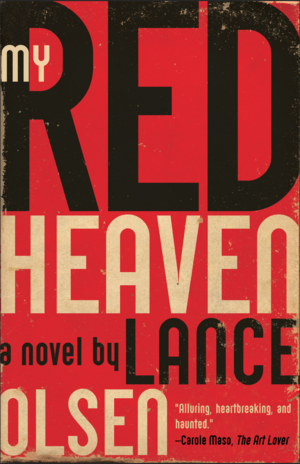
‘In this twenty-four-hour novel, Olsen explores new subjectivities and new histories both after and before the moments directly written about. It’s fascinating and wonderfully readable. Kafka, Nabokov, and Ludwig Mies van der Rohe all make their appearances…and strange lists of newsworthy events cascade down before us now and again. It’s a fitting follow-up to Calendar of Regrets and beautifully written.’ — Samuel R. Delany
‘The fleeting encounters of the famous and not-so-famous dead, in their own voices, sketch out a vanishing moment in a Berlin on the brink. Lance Olsen’s My Red Heaven is a work of necromantic dazzlement.’ — Shelley Jackson
‘Where to stand in this original novel as History that unspeakably painfully hurts while montaging all our astonishing, poignant, and gross ironies. Between lives, even our own, that are less here than nearby or elsewhere; between Dietrich and Heisenberg; between, on one hand (literally), Arendt and Heidegger showering and thinking about thinking, and deaths there perhaps are no words for; between what is actually, terribly being evoked and, dissolve after dissolve, an exquisite narrative prose risking again and again an incorrigible lightness. At random, I thought of Wittgenstein in Duffy’s The World as I Found It; dictatorship in Spufford’s Red Plenty; the sculptural work of Joseph Beuys; and, where fact seems all the more fact in a context of fictive documentation, the great Sebald.’ — Joseph McElroy
Excerpt
Hannah Arendt and Martin Heidegger step arm-in-arm through the main doors of the Arnhold Villa on the shore of Lake Wannsee into the salon’s fuss, where they catch a glimpse, above the heads of the other guests, of the scarlet traces threading the sky over Lake Wannsee through the large windows on the far end of the room. Hannah instinctively presses Martin’s arm tighter.
Down the block a train bedlams through the Wannsee Station on its way into the city. Johann Pfeiffer, en route to enroll at the university, shuts Passionate Journey, Frans Masereel’s wordless novel in woodcuts, and looks out the window the very instant Berlin’s trashed backsides start rushing past.
Across from him sits the no-longer-thin, no-longer-hirsute Walter Gropius, making notes for the party he will throw upon his return to Weimar next week. Whenever the regularly smoldering tensions among his Bauhaus faculty spark into conflagration, Walter always throws a party. In his leather-bound journal, he writes: 2 naked women / 1 naked man = painted silver to slither. Eerie music / flashing lights. Silver paper to cover walls + large chute from ground floor to basement to end in — rubber mats? pillow mountain? Many white pellets to be thrown.
Walter doesn’t notice out the window a young woman, Anna Handke, gently lay her infant down in the middle of the street and depart. Anna will refuse to pick it up again, telling the two policemen who materialize she can no longer figure out how to feed it.
[[ a radiant system ]]
Max Liebermann, the eighty-year-old Impressionist painter, scrooches down in the back row of the packed Marmorhaus theater, glaring at the newsreels before the feature begins, sorely aware this is what the last pterodactyl must have felt like — forlorn, hopelessly out of step with its time, dead in some absolute sense years before the reaper actually visits. I think I’ve heard of Max Liebermann — I wonder who he was, people in fifty years, Max knows, won’t ever say.
[[ bounding for birds ]]
In town from Paris to visit Hannah Höch’s new exhibition and catch up with old friends, Otto Freundlich steps off the U-Bahn into the ruckus of the Kurfürstenstraße platform. The idea for his next painting gyres in. Its title, he comprehends without warning, will be My Red Heaven, and it will consist of an abstract flurry of quadrilateral shapes forging three color-strata down a large canvas: reds at the top; grays, greens, whites, and blues in the middle; blacks at the bottom. Otto doesn’t know it will take another half decade before he can plunge in. Other ambitions will broil into his life first, including the vision for what he believes (although this isn’t the case) to be his masterwork: a highway lined with non-figurative sculptures stretching from Paris to Moscow that shows what peace and brotherhood could look like. A decade, and another work of his will be featured on the cover of the catalogue for The Degenerate Art Exhibition staged in Munich. A sculpture called The New Man, it will stand nearly one and a half meters tall and resemble a modernist rendition of one of those stone heads on Easter Island. Four years later it will disappear, as will most of Otto’s art, as will Otto himself. First, though, he will go into hiding in the Pyrenees, be denounced and arrested in Saint Martin de Fenouillet, a tiny mountain village about two hundred kilometers southeast of Montpellier, having with a misconstrued sense of faith in reason written a personal letter of protest to the highest local authorities when told he must register as a Jew under the Vichy regulations. On 9 March, 1943, sixty-four, with achy feet and bum knee, Otto will hoist himself up into train No. 907, which will babel him to the Lublin-Majdanek extermination camp in southeastern Poland, the first to be discovered by the Soviet troops eighteen months later. The last thing Otto will see before the cattle-car door slams shut and bolts is a little buttery-blond boy with slingshot launching a frail white paper glider into the bluewhite dawn. Exhaustion, not Zyklon B, will claim Otto before the sun sets on his first day at his new home, yet now, walking up the stairs from the U-Bahn onto the nattering street, nothing exists in his head except one question: Did I just take the wrong exit again?
[[ skin waving goodbye ]]
Standing at her kitchen table, aproned Adina Kleid takes in her husband, Chaim, and two boys, Amir and Alim, with affectionate pride tinctured with churning resentment as she leans forward to light the candles and welcome Shabbat into their home. Baruch atah, Adonai, Eloheinu, she commences, deciding this might be a good night to trim her toenails.
In the flat across the hall from Adina Kleid’s, Stanisław and Halina Banaszynski sit stiffly at the foot of Krystyna’s — their fifteen-year-old daughter’s — bed, looking on while the doctor searches the girl’s wrist for a pulse, but less and less, Krystyna’s shiny eyes slitted open, the muscles in her face relaxed beyond life, her mouth wide and startled by what has pounced her fewer than five days after that sickly man in the U-Bahn sneezed, sharing with Krystyna influenza’s coughs, sweats, shaking chills, and dry heaves, how if she had stepped into a different car, or into the same car through the other door, or decided to walk rather than train home from school, or stayed behind with friends that afternoon to struggle through a few more lines of Latin in a nearby café, or been born on a Thursday rather than a Monday, or turned her head away from that man a second earlier, or believed more firmly in God, or less firmly in the devil, or planned to be a nurse rather than a teacher, a teacher rather than a baker’s assistant, something else might have come to pass, who could say what, a nice handsome soldier in a crisp uniform walking into her hopefulness, a simple happy marriage, a complicated unhappy one, an uneventful union where she never quite followed through with the plans she made, although she was always making them, one after another after another, yet it didn’t matter because Krystyna came to believe everything occurred for a reason — except this storm that tore through her flat adolescence.
[[ twenty-seven seconds ago ]]
Robert Musil strolls cheerfully down a gravel path in the Tiergarten, light ashing everywhere, past a man in threadbare blazer sans tie propelling himself quickly in the opposite direction (a journalist? a young professor?), past a meadow circulating with baby prams, chuffing dogs, cuddling couples, and a late game of football. Robert was in town just a few months ago for Rilke’s memorial service. Now he is here from Vienna six days to continue research on his novel-in-progress, tentatively titled The Man Without Qualities, which he has been buffeting against for six years, and whose end — a point of light no bigger than a match specking the midnight horizon — he has seriously started worrying may never draw nearer. The more he pens, the more characters and ideas surge up around him and it all gets unconscionably out of control, like the simple act of beheading a chicken sometimes can. Robert has never made a steady income, has thrown his family into financial crisis more than once … yet right now he believes more than anything (taking a deep breath of candied night air flowing into the city from the west) it isn’t we who do the thinking. It is life that does the thinking all around us. Let life think. Let morality be a profusion of life’s possibilities.
Extra
Trailer: My Red Heaven
Lance Olsen reads from ‘Nietzsche’s Kisses’
Lance Olsen – Theories of Forgetting: An Historiographic Metafictional Reading
_______________
‘Estelle Hoy’s brilliant novel is a deja vu…..similar to Jean-Jacques Schul’s novel Dusty Rose, a story of the 60s composed entirely of phrases that he lifted from magazine copy; a bricolage of cultural detritus. Whole phrases are lifted from other texts and woven seamlessly into the narrative. Which is to say, Hoy’s book is completely original.’ — Chris Kraus
‘It is about time that someone want to pick up Michelle Bernstein’s habit of writing thinly veiled marxist horoscopes for horses. Pisti, 80 Rue de Belleville is a wild ride through the passionate yet caustic escapades of a new, yet already exhausted left, plotting the ultimate revolutionary gesture. An utterly brilliant attack on the pieties of the liberal life-style. En route to cult classic.’ — Anna Gritz
‘Fairy dusted in the narrative beliefs of a Chris Kraus-generation, Estelle Hoy’s Pisti takes flight to a place beyond the moon that all Baudelaire-loving revolutionary teens dreamed of: Paris(!)—or, a version of it clouded in cigarette smoke and loud complaints, where desire, dissociation, partial-psychosis, day-drinking, endless idling and ennui are all implied, because, quite simply, they’re chic as hell and come with the kind of cultural clout that’s bound to get you hella laid. Hoy’s is a Paris collaged of dreamy pleasures that meet their bathetic end in run-down flats and disappointing fucks. It’s a Never-Never Land for the leftist cultural imaginary that refuses to let go of its dilettantish, devil-may-care love for discourse, radical action, and, bien sûr, rosé o’clock.’ — Sabrina Tarasoff, Artforum
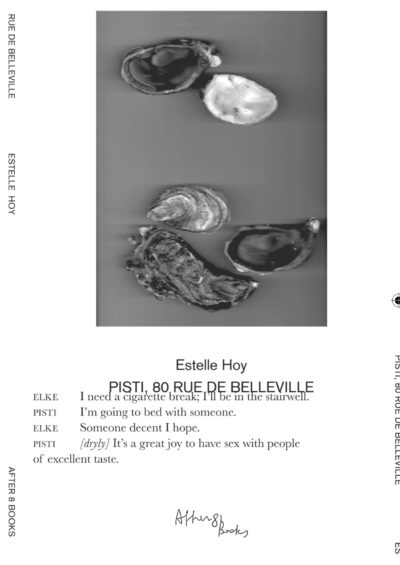
Estelle Hoy Pisti,80 rue de Belleville After8 Books
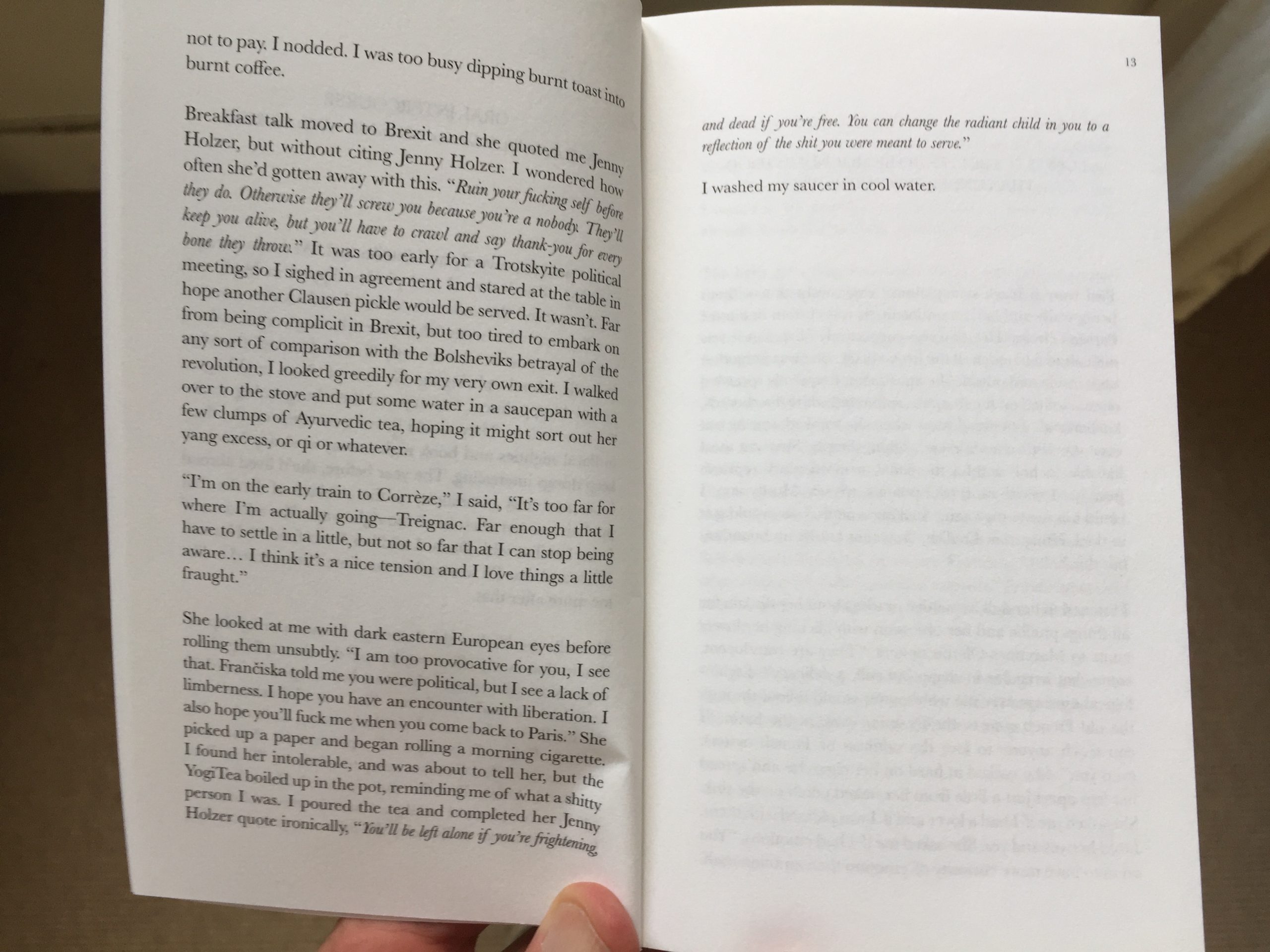
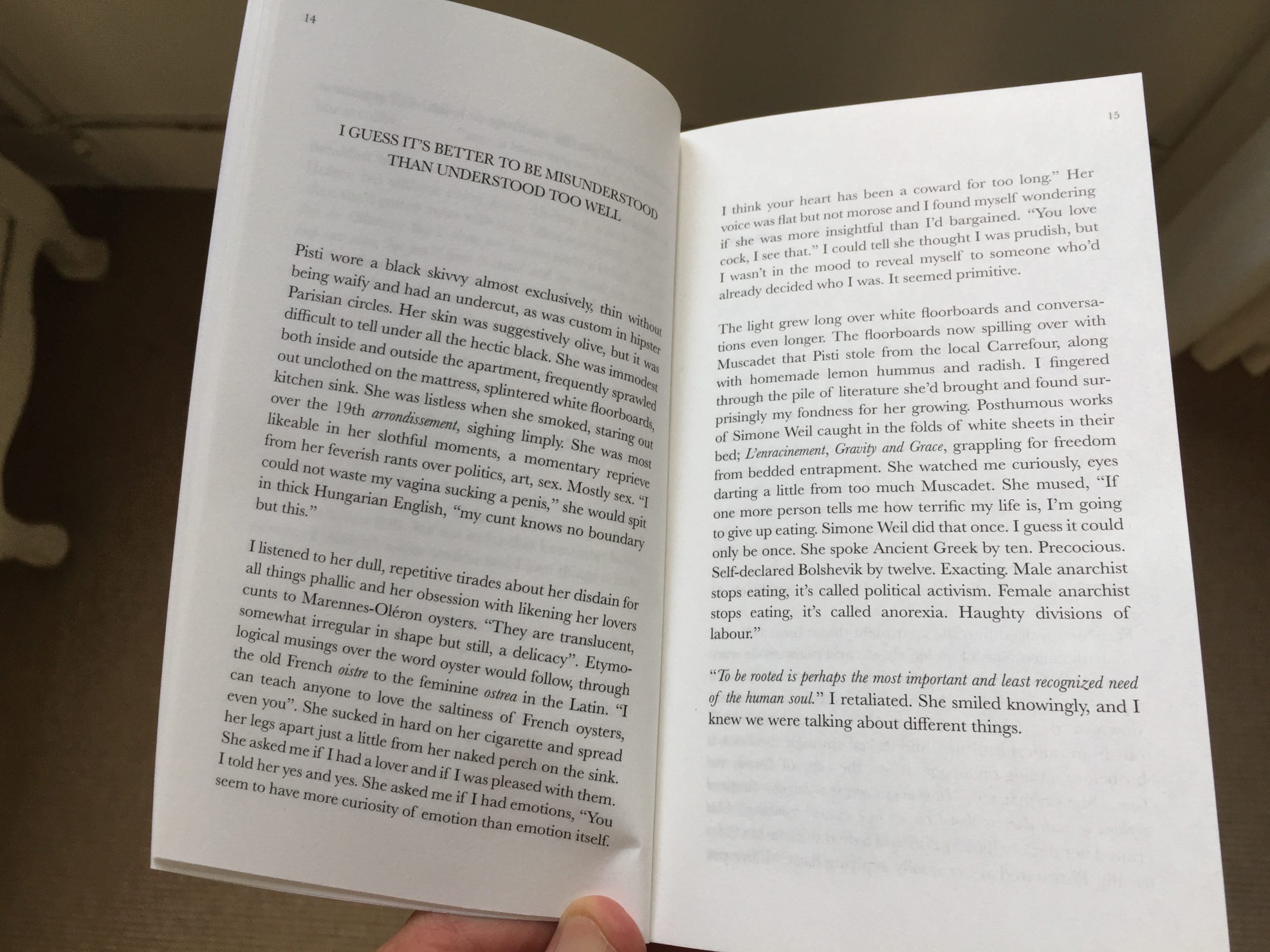
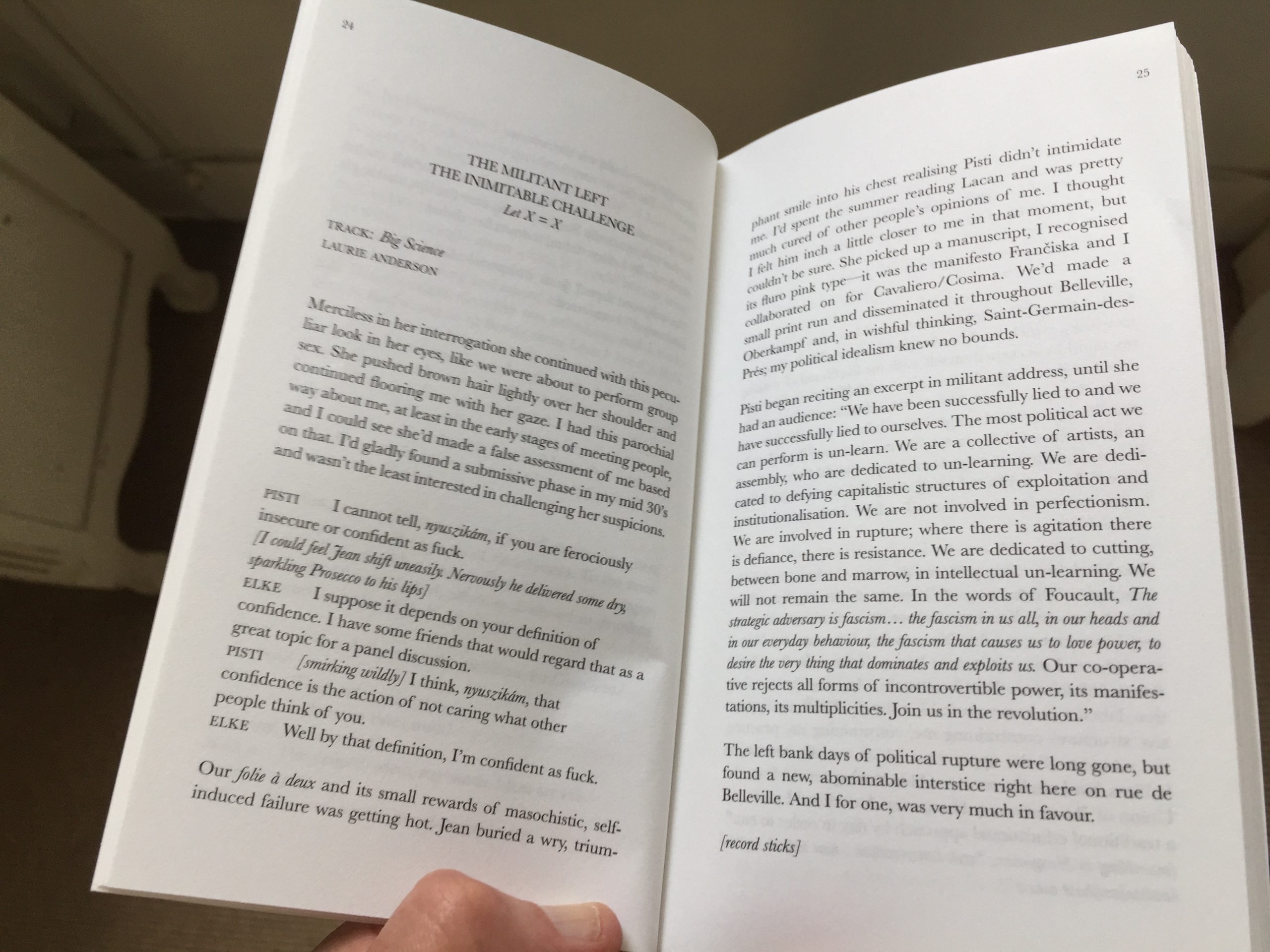
‘There she goes ! Pisti, 80 rue de Belleville is Estelle Hoy’s latest novel.
Elke is a young academic with a troubled past that keeps spilling onto her present. Just as she is about to leave town for a writing retreat, she meets Pisti, a charismatic, hard-boiled but luscious Hungarian left activist, who runs an anarchist collective in Paris. Over one night in a Belleville apartment, old friends and new lovers discuss–and act–polyamory, politics, and the art of conversation.
A wry exploration of the seductive allure of tropes and cliché in the art world and politics, Pisti is also an experiment in writing, shamelessly flirting with namedropping and appropriation. The character of Pisti was appropriated from Chris Kraus’ novel Torpor.’ — After8
Excerpt
Extra
_______________
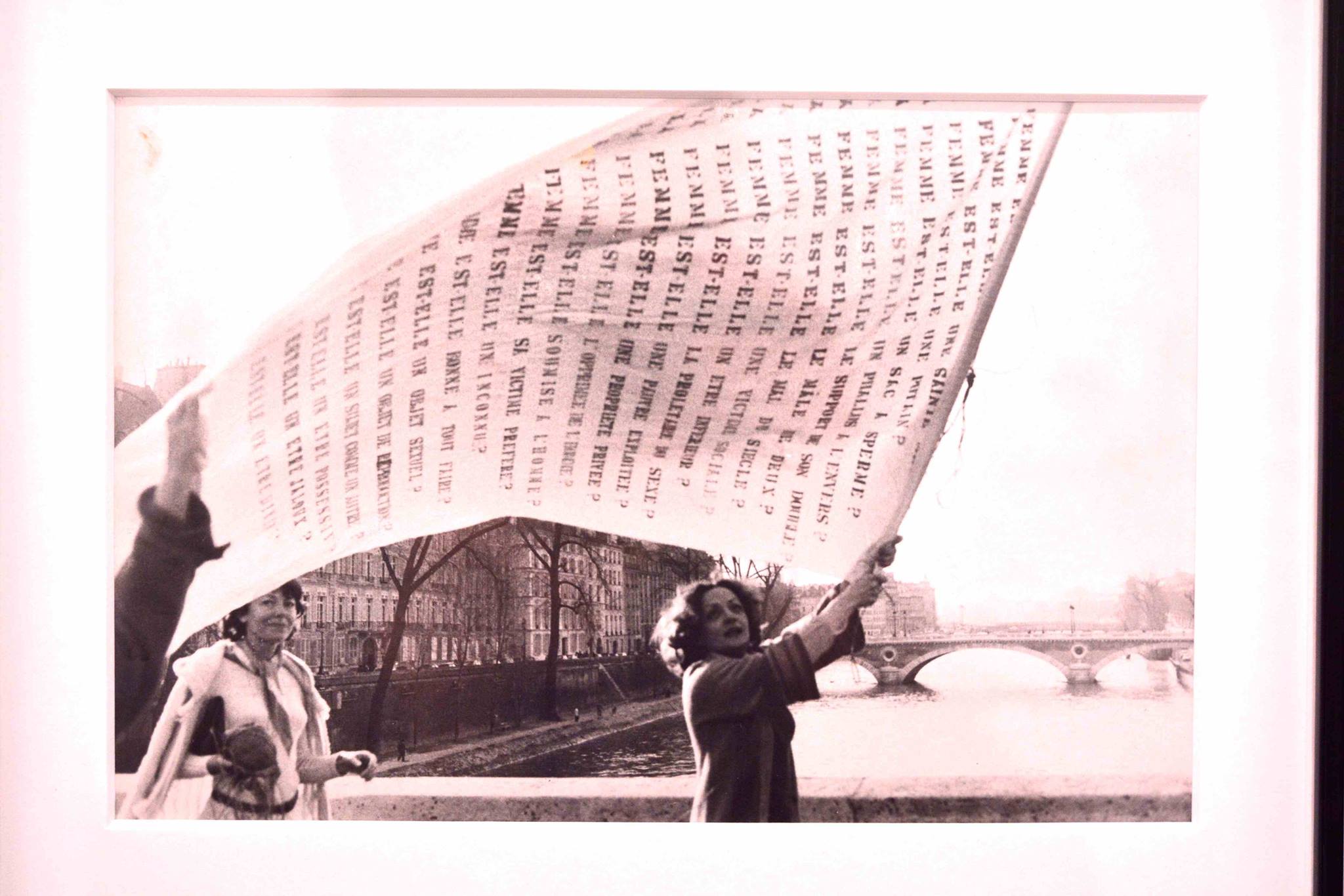
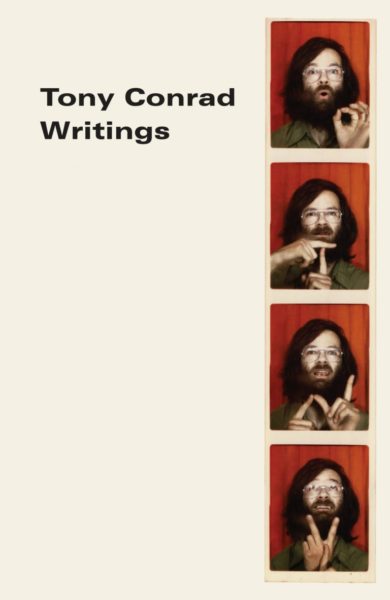
‘When the towering artist, filmmaker, and composer Tony Conrad died in 2016, he left behind a colossal amount of work, spanning six decades, in his home in Buffalo. There were films, videos, paintings, writings, documentation, drawings, scores, audio recordings, and a pickled Bible on a mantelpiece. Shortly before his death, his friend Andrew Lampert had begun filling hundreds of boxes with Conrad’s work, in the hopes of eventually archiving everything. “He has 16mm, Super 8 films, as well as works in other very fugitive film formats, such as films that he electrocuted, films that he curried, films that he pickled,” Lampert told me when I wrote Conrad’s obituary for frieze in 2016. “He has reams and reams and reams of writing; he has made sculpture, drawings, musical scores, paintings. If there is a mode of artistic expression, he expressed in it. . . . We’re talking about thousands of audio recordings, hundreds of film reels.” One of the many things that Conrad left behind, Lampert said, was a hugely ambitious book in progress called What Music Did.
‘What Music Did has not yet been published, but a major hidden cache of text has now emerged: Tony Conrad: Writings, nearly six hundred densely packed pages of Conrad’s essays from 1961 to 2012, edited by Lampert and Constance DeJong. It is a heady read—as eccentric, cerebral, quick-witted, and occasionally baffling as its creator. The book encompasses everything from Conrad’s theories on art and music to abstruse mathematical equations, anti-establishment treatises, hilarious asides, and voluminous notes on the development of his own work.
‘Conrad always seemed ageless, charged with youthful exuberance until his death at seventy-six. The book is suffused with that same spirited energy. In one essay, he writes that he told Film Culture in 1966 that he was thirty seconds old. “That was my best way to describe my internal condition of being, in terms of continuity of perception,” he explains. “I thought that people would read me out from that as a sincere human like themselves who had the integrity to characterize his immediate terms of existence.”
‘The book offers a tantalizing window into the thinking behind Conrad’s most famous works—including his debut experimental film The Flicker (1966), an intense rush of elegantly arranged stroboscopic pulse patterns, and his radical series of paintings as slow-moving films, Yellow Movies (1972–73). He also recounts the antiauthoritarian sentiment underlining his initial interest in filmmaking. “By the mid-1960s,” he remembers, “I had been drawn to film because of its hopelessly shabby integrity, and also because of its restive and anarchic aspects, which implicitly challenged the progressivism of the art market.” But the world of experimental filmmaking could be constraining, too. On Yellow Movies, he argues: “In seeking to dismantle the authoritarian boundaries of film culture during 1972–74, I turned to extended duration as a conceptual armature.”
Conrad was uncompromising in his beliefs until the end, sticking to his ideals with tenacious fervor. His music—which often involved vast extended drones and noisy explorations of minimalism—defied mainstream popularity. He taunted fellow New York composers who, he felt, had sold out: “[Steve] Reich and [Philip] Glass, far from combating the autocratic tradition of the Western score, carefully inscribed themselves within careerist authorial postures.” He especially didn’t mince words when it came to composer and former Theater of Eternal Music bandmate La Monte Young, and their unending feud regarding the group’s recordings, which Young has not fully released. “By 1991,” he quips, “even Richard Nixon’s secret tapes are out, but La Monte Young is still afraid to let anyone listen to the original Theater of Eternal Music—and who did start the sound?” Conrad didn’t even have time for labels like “free jazz” and “free improvising”—these, he writes, are “frozen clichés … the exhaustion of these terms has gone unnoticed, because they have been shielded by nostalgia for the slack-jawed utopianism of the 1960s, when ‘free speech,’ ‘free love,’ and ‘freedom’ assumed their ‘countercultural’ aura.” …
‘Conrad still seems very much alive as you turn the pages, and in reading the book, I felt a deep connection. Conrad studied math at Harvard and I studied science at MIT; both of us are unlikely fits in the art world. I chuckled as I read his equations, mining my memories of calculus to decode some of his goofball calculations. At one point he surmises that “the cultural work of the critic and the artist might be said to be identical: to ‘change minds’ about things.” As a critic, part of me hopes that this is true. His ideas still have a burning intensity to them—an exhilarating idealism that inspires all of us to forge ahead.’ — Geeta Dayal, 4columns
‘Writings is the first collection to widely survey this singular polymath’s prolific activity as a writer. Edited by artists Constance DeJong and Andrew Lampert, the book spans the years 1961 – 2012 and includes fifty-seven pieces: essays originally published in small press magazines, exhibition catalogs, anthologies, and album liner notes, along with other previously unpublished texts. Conrad writes about his own work, with substantial contributions on The Flicker, Loose Connection, Four Violins, Articulation of Boolean Algebra for Film Opticals, Early Minimalism, Yellow Movies, Slapping Pythagoras, and Music and the Mind of the World, as well as that of his peers: Tony Oursler, Jack Smith, Rhys Chatham, and Henry Flynt, among others. He devotes critical essays both to grand subjects—horology, neurolinguistics, and the historical development of Western music—and more quotidian topics, such as television advertising and camouflage. He also writes on media activism, network communications, censorship, and the political and cultural implications of corporate and global media. No matter the topic or theme, Conrad always approaches his subjects with erudition, precision, and a healthy twist of humor.’ — Primary Information
Excerpt
On Duration (2004)
There is a persistent and stable metaphor for time, as a line , as linear; it is so ingrained in us to model time as a line that the idea of time and duration as distinct entities, with different geometries, scarcely arises. I would like to discriminate between two temporal models by speaking of the socially referenced system of temporal measurement as time , and using duration for temporal intervals that are referenced to the subjective “present.” This is to clarify the ordinary usage when one speaks of “what time it is,” while on the other hand saying that a particular event will last for some duration . Time , in this regard, corresponds to the linear system of physics, clocks, and the calendar; duration addresses the subjective sense of extension over temporal intervals of greater or lesser size, referenced to the present moment.
Of course, we use the units of time to measure duration. Then, in the ordinary cycle of daily events, there is little difference between time and duration. It’s when we consider extremely short or extremely long durations that the maps of duration and time clearly diverge. For example, there is no such thing as a duration longer than about a hundred years, to say the least, since nobody lives longer than that. And if it were appropriate to speak of a duration shorter than a nanosecond, this too would correspond to no experience that could be differentiated from that of a picosecond or a microsecond. That is, duration has the geometry of a line segment , while time is measured as extending infinitely into the past and future, and as being infinitely divisible.
What are the experiences of various durations like? Since experience is referenced to perception, the first problem is to find the link between time and perception, if we are to use time units to measure duration. Perception takes time; different sensory modalities have different latencies; and the interpretation or comprehension of a present event occupies a duration that is notoriously irregular. So let’s simplify matters by assuming that we are alert, and that we are regarding an event that is to be perceived acoustically. Then the shortest durations perceivable, if a number of them are presented end-to-end, will begin to seem indistinguishable from one another; and events lasting for very much shorter times will not “exist” as durations at all. The character of perception is that it depends upon the response time of neurons, and it takes about a tenth of a second for anything at all to happen in the nervous system. Short events may be perceived, but the registering of these events itself takes time. This means that a sequence of short durations, of very short events, will not be registered as such, but as a single duration that is indeterminately longer than the duration of each individual event. In mathematical terms, then, durations are non-linear.
Very long durations, too, are virtually indistinguishable from one another; this has much to do with the variability of subjective experience. We may have a pretty good idea of how long a minute is, or an hour, or even a day; but the experience of a five-year duration is hard to discriminate from the experience of a six-year duration.
Phenomenologically, duration is the inverse of memory: duration bespeaks continuing presence. The “idea” of duration is an attempt to objectify the condition of being “always already.” Duration also invokes an expectation of future experience; to endure is to last , and the root of ‘duration’ means the same in ‘durable,’ hard. There is something etymologically perverse in speaking of short durations. In the material world, if duration is measured by timekeeping, it must consequently be seen as linked inextricably to the emergence of Western industrial technology. The clock, from its artisanal and (subsequent) bourgeois origins in the renaissance onward, has functioned politically as the primary instrument of social discipline and control.
Both time and one’s experience of it, in pre-industrial agrarian societies, had most to do with the quotidian cycle of sleeping, rising, eating, and working. With more complex social structures there came an extended imposition of temporality: reproductive cycles, ceremonial and religious cycles, annual events. The discovery of the calendar, of astronomy, and proper time keeping was always an aspect of state control. The subject’s experience of duration was linked, in these societies, to the social machinery of time keeping, but not in the degree to which in more recent centuries industrialization and the invention of jobs has imposed state time-keeping on the subject. Until the nineteenth century, it sufficed for most people to have their hours regulated by a few bells here or there during the day. Duration related largely to one’s experience of day-to-day happenings; times of day were allotted to the regulatory functions of religious observances. Then, with the introduction of a labor market, and pay-per-hour, it was necessary for capital to impose calendrical and horological regularity upon the work force.
As an instrument of social discipline and control, timekeeping was rapidly and effectively internalized by state subjects as an ethical principle linked to the self-discipline of the workplace. From its social point of origin, that is, time measurement became conflated with the subjective quality of duration . Internalized, time measurements found their place in the libidinal economy of the subject. In its relation to desire, duration mobilizes the wishes and memories of the individual subject. So, in the wake of industrialization, duration was transfigured into a bourgeois preoccupation with individual experience, introspection, and the desire for social mobility, where it was subsumed by romantic literature, fixations on personal and family memory (photography), and the idealization of leisure (“vacations,” and escapism in music and theater).
Further, industrialization led to a need for coordinated transportation schedules, particularly railroad schedules, to organize the traffic flow. Still, throughout most of the nineteenth century the regulation of time down to the hour or minute commonly varied substantially from city to city; until 1883, noon in Washington DC was 12:02 in Baltimore, 12:12 in New York, 12:24 in Boston, etc. Transportation by sea exacted even more stringent requirements than the railroads for accurate calendrical timekeeping–not to avoid collisions but because longitudinal distances, and consequently the accuracy of maritime charts, could be calculated in only one way–by measuring exact clock times at two different points on the earth. Inevitably, this meant that precise astronomical observations presided over the regulatory system of clock time.
The social footprints of duration and of science trace a meaningful historical intersection. From earliest times, even preceding the ancient Pythagorean invention of the phrase “harmony of the spheres”–the concept that empowered harmonia to colonize the cosmos — astronomy was the science most avidly inclined to occupy and dominate the subject; the regulation of our lives by astronomical signs lent vast authority to sages who studied the stars. The invention of clocks during the renaissance expanded the capacity for time measurements from the calendrical realm of astronomy progressively toward shorter time measurements, and finally (with Maelzel’s metronome) into the musical territory of the heartbeat. So began a reverse colonization of harmony by the cosmos.
p.s. Hey. ** David Ehrenstein, Ha. ** kier, Hey, bud! Yes, Transdemonium is still in Asterix, although I have a feeling it might be on the future chopping block as it’s not popular. It’s cool, it’s not amazing. It tries, and the trying is fun. Oh, I have to put in a vote for the very goodness of Disneyland Paris. I like it a lot, and there’s Hollywood Studios next door so it’s like two parks in one. Asterix is great. I love it. I’ll go along if you guys go and want, and I’m virtually certain Zac would too. No other big parks near Paris, except Futurescope, which is about an hour by train. Never done it, but Zac and I have been talking about going for ages. We almost went on my birthday. I’m glad you’re feeling better, and, yeah, costuming makes parties much more tolerable, but I’m no a big party fan. Oh, man, I hope it’s not tough to find a new place in your area. Finding a new place is so stressful. Or can be. Or is for me. Did you manage to get Zeus to exit your imagination without the coaxing of headphones? Headlights: nice, I like that. I’m going to a couple of readings (Lyn Hejinian, Lisa Robertson). There’ll be the third attempt to have a plumber show up tomorrow. Hopefully Zac’ll get back to Paris finally. Re: TIHYWD … I have to wait until Gisele’s back from Japan, I think this weekend, to find out about possible comps. Are there nights you can/can’t go? For comps, I’ll need to know how many you are. I don’t know how many comps can be got, I’ll have to find out from Gisele. Hopefully it’ll be easy. May your day have had headlights aimed the most beauteous aspects! ** Bill, My pleasure. It was great. I really like how stable but fuzzy/stretchy the space you guys were working in was. And of course I loved it when you got assertive. It was weird ‘cos I was listening and there was just this non-changing signage as the visual, so I didn’t think to look for a while, but then I glanced over and you guys were suddenly on camera. I liked your muted head banging at one point. Anyway, it was lovely. Oh, huh. Damn, they’re doing the Apple art show thing at the St. Germain store rather than the main store at Opera which is five minutes walk from me, but I’ll go over there and see what’s what, why not? Thanks. I had no idea. ** _Black_Acrylic, Man, sorry about Leeds’ instability. When I used to follow the Dodgers, they always, always would start great and then just poop out after you had already emotionally invested in them winning. ** Misanthrope, Giant M! Thank you for the good words. I appreciate it. Mm … no, I don’t think I’ve ever read Peter Matthiessen. From his rep, I think it never seemed like something I would be into. I’ll peek. First thought best thought? Oh, God, quoting fucking Allen Ginsberg there, ugh. ** Steve Erickson, Exciting about the new Benning! I hope he’ll come over and show it here. He does that sometimes with his new works. Houellbecq’s influence on French writing has waned a lot since people figured out that his racism and misogyny and so on are not in fact just a critique of those things. ** Right. Today I present five, count them, five books I’ve recently read, loved, and recommend to you. Please look them over and give them your consideration, thank you. See you tomorrow.




























 Lidia Yuknavitch Verge: Stories
 Karolina Zapal Notes for Mid-Birth
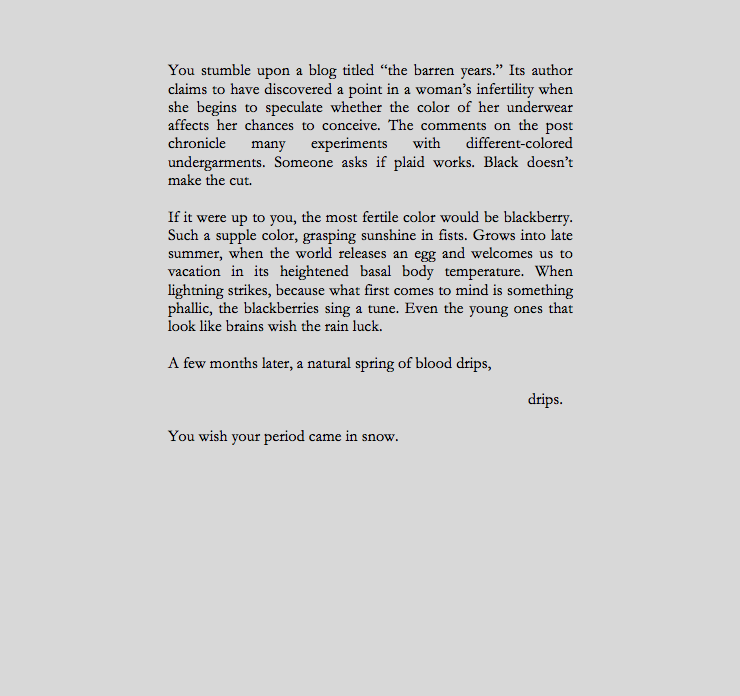
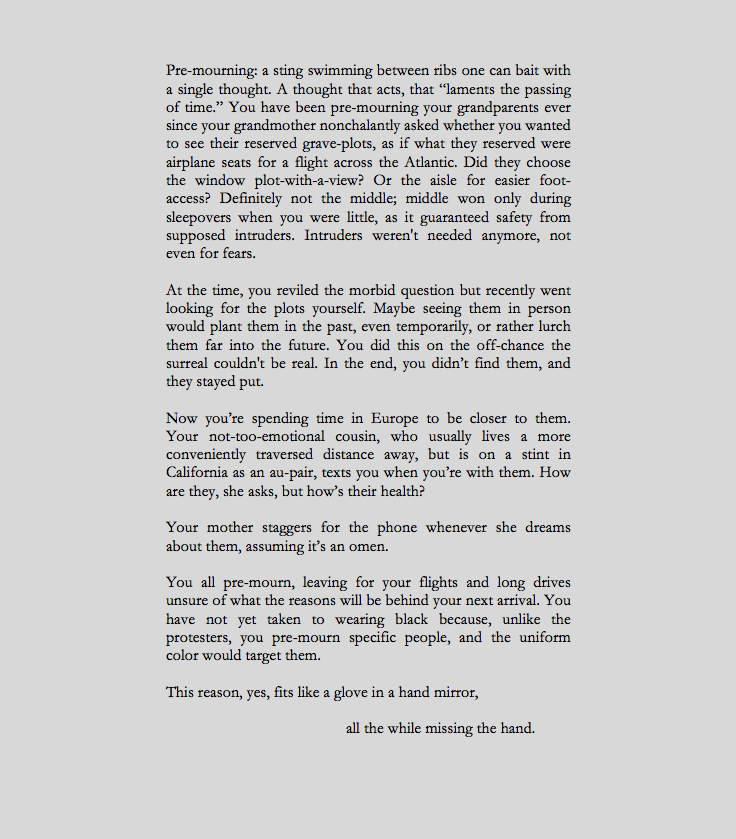
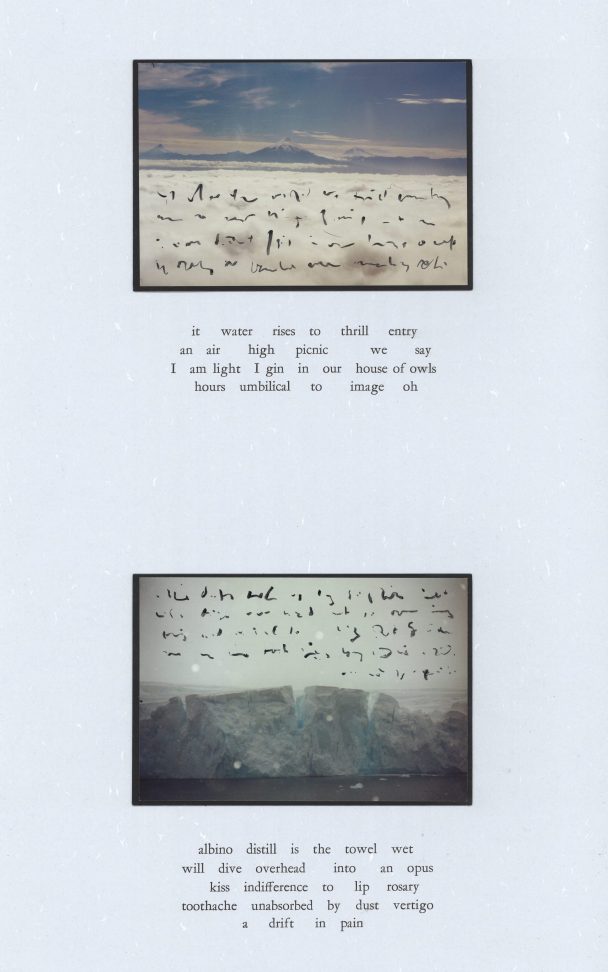
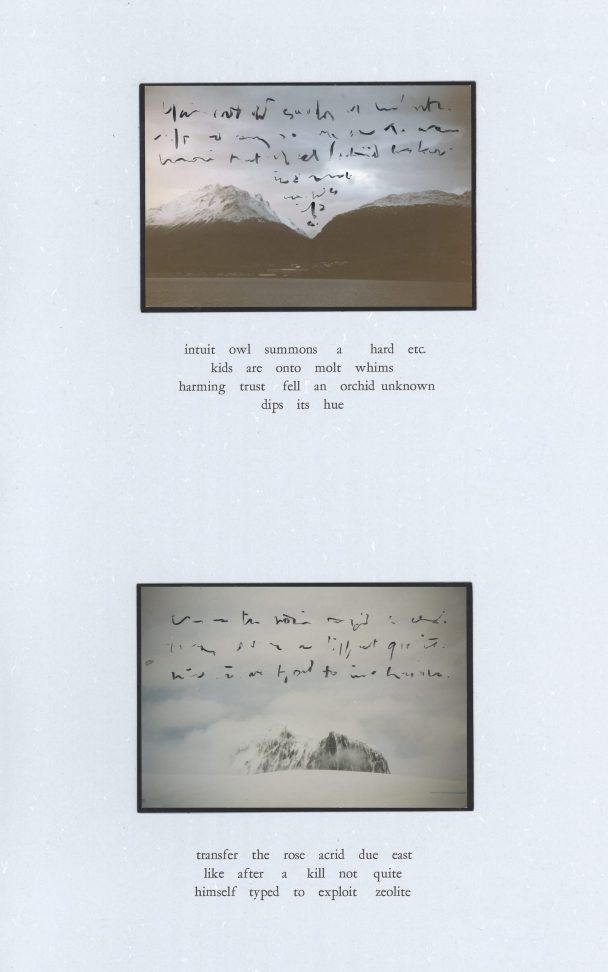

 Lance Olsen My Red Heaven
 Estelle Hoy Pisti, 80 rue de Belleville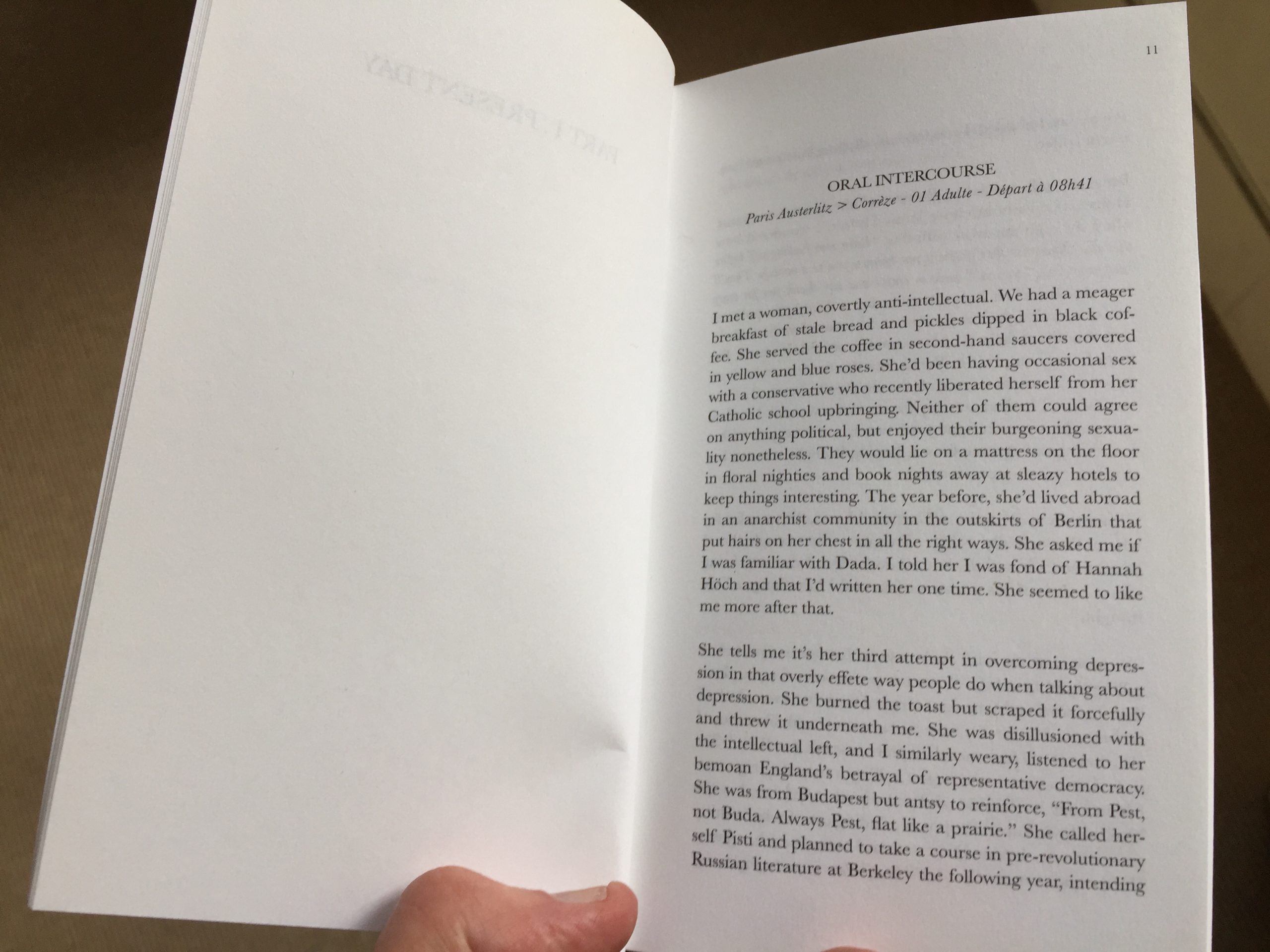
 Tony Conrad Writings


 Now available in North America