
‘The 65-year-old filmmaker Errol Morris is sitting in his East Cambridge offices, a cleanly designed floor-length warren of cubicles, editing bays, bookshelves, and objets d’art. His personal office is shaded against the afternoon sun, a cool oasis of eccentricity. A stuffed baby penguin stands on a side table and a horse’s head protrudes from the wall. On his desk, in a glass case, is a monkey’s head — a Hanukkah present from his wife. The office, like the mind of the man who presides over it, is a cabinet of curiosities.
‘That mind is more restless than it has ever been. Morris is a Boston institution and a national treasure for the nine documentaries he has made during the past 30 years. 1988’s The Thin Blue Line freed an innocent man from prison. 2003’s The Fog of War, in which Robert McNamara broods over his part in the Vietnam War, won an Oscar. And 2008’s Standard Operating Procedure probed the nature of photography and the sins of Abu Ghraib. Gates of Heaven (1978) remains the greatest film about pet cemeteries ever made.
‘Yet at the moment Morris is busier than he has ever been — active not just in film but on all fronts. He has published two books in the last three years; the most recent, A Wilderness of Error, opens up the 1970 Jeffrey MacDonald murder case for reappraisal. He is putting the finishing touches on “The Unknown Known,” a documentary on former Secretary of Defense Donald Rumsfeld, to meet the fall film festival season, after which it should go into theatrical release. “Inevitably, there will be comparisons to The Fog of War,” the director says, “but it’s a very different kind of story. It’s a story about someone absolutely convinced of their own rectitude.”
‘His essays on history, imagery, evidence, and the knowability of facts spill onto the New York Times website and Slate.com. He’s an active, if not obsessive, tweeter (@errolmorris). Morris has also signed up to direct not one, but two fictional feature films; the one about cryonics, Freezing People is Easy, is set to star Paul Rudd and Owen Wilson, while Holland, Michigan is a “Hitchcock-like movie” set at a tulip festival. And his second career making commercials — he has shot more than 1,000 spots for everything from Target to Cisco — would be enough of a first career for many people.
‘Alfred Guzzetti, a filmmaker, professor, and former head of Harvard’s Visual and Environmental Studies program, says his students see Morris “as a major figure, because he was very influential in documentaries coming back into theaters.” Guzzetti befriended the director when Morris relocated from New York to Boston 25 years ago, and the two men still meet weekly to play chamber music together, Guzzetti on piano, Morris on cello.
‘“He’s patented a certain style,” Guzzetti says, “and that style is widely imitated: the combination of these very ironic interludes and comparisons, the way in which he edits sync-sound talking heads, the driving minimalist music — I don’t know whether he agrees with this, but I’ve always told him that I think that the films are kind of oratorios.”’ — Boston Globe
____
Stills




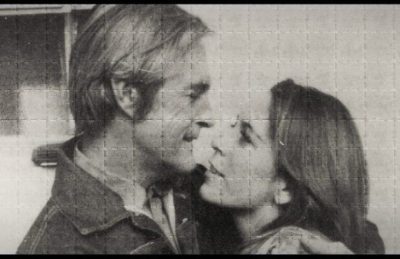
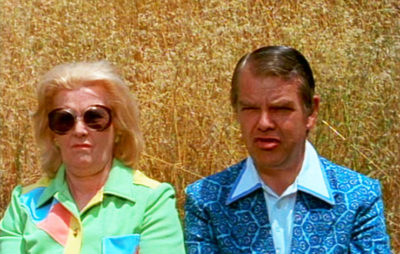
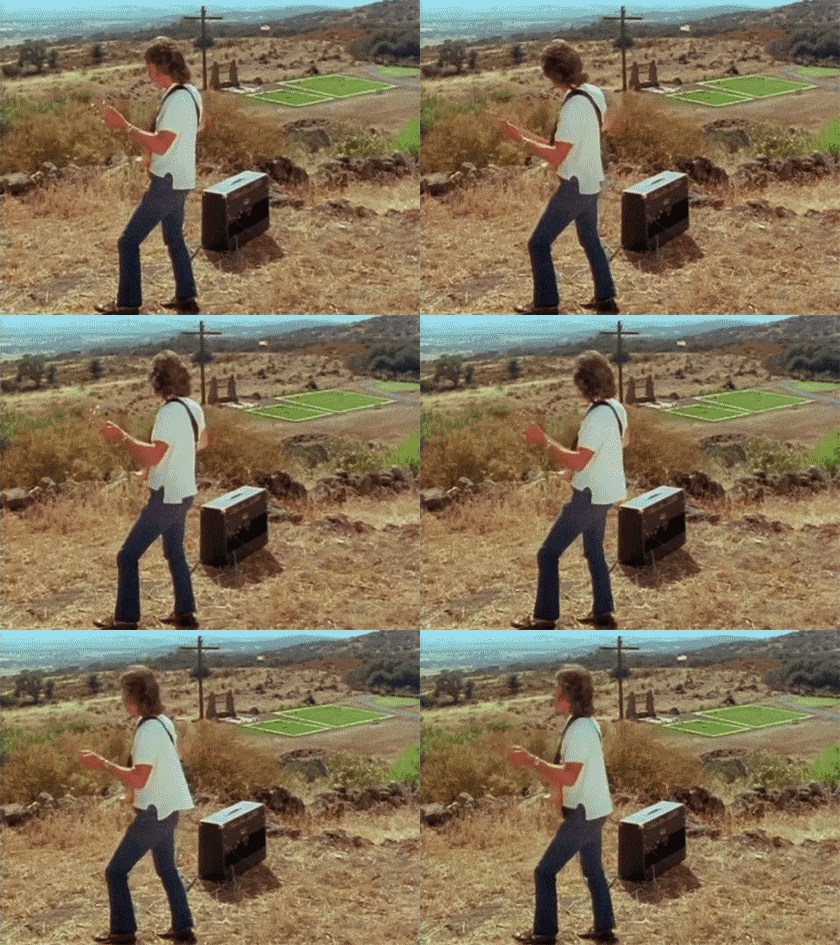
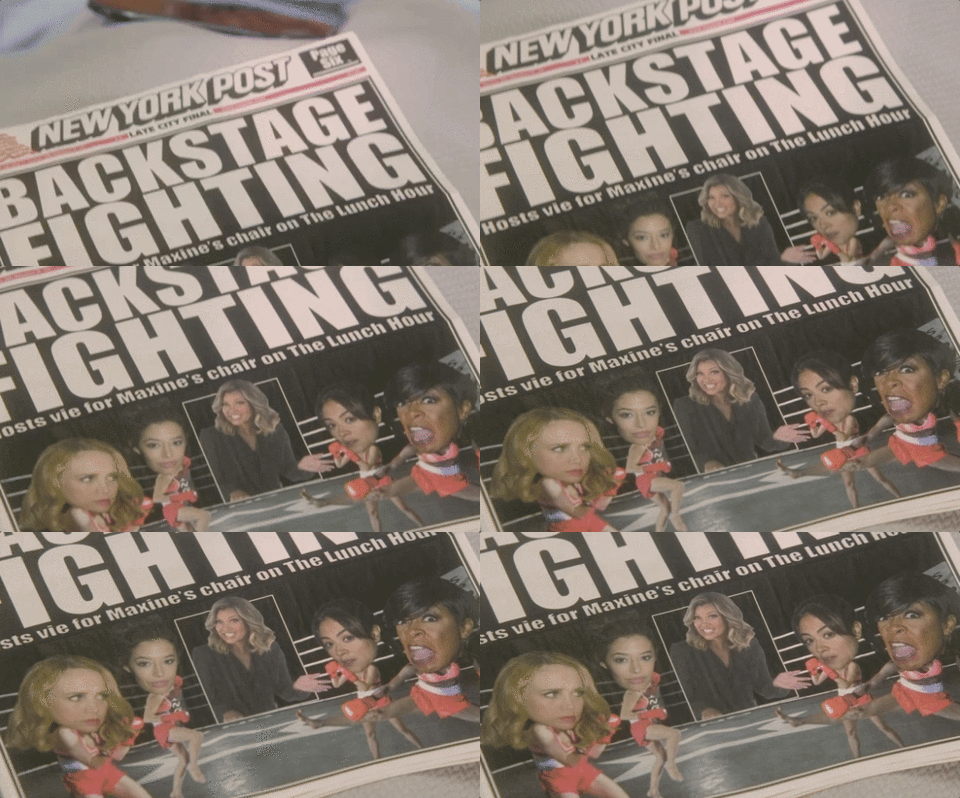

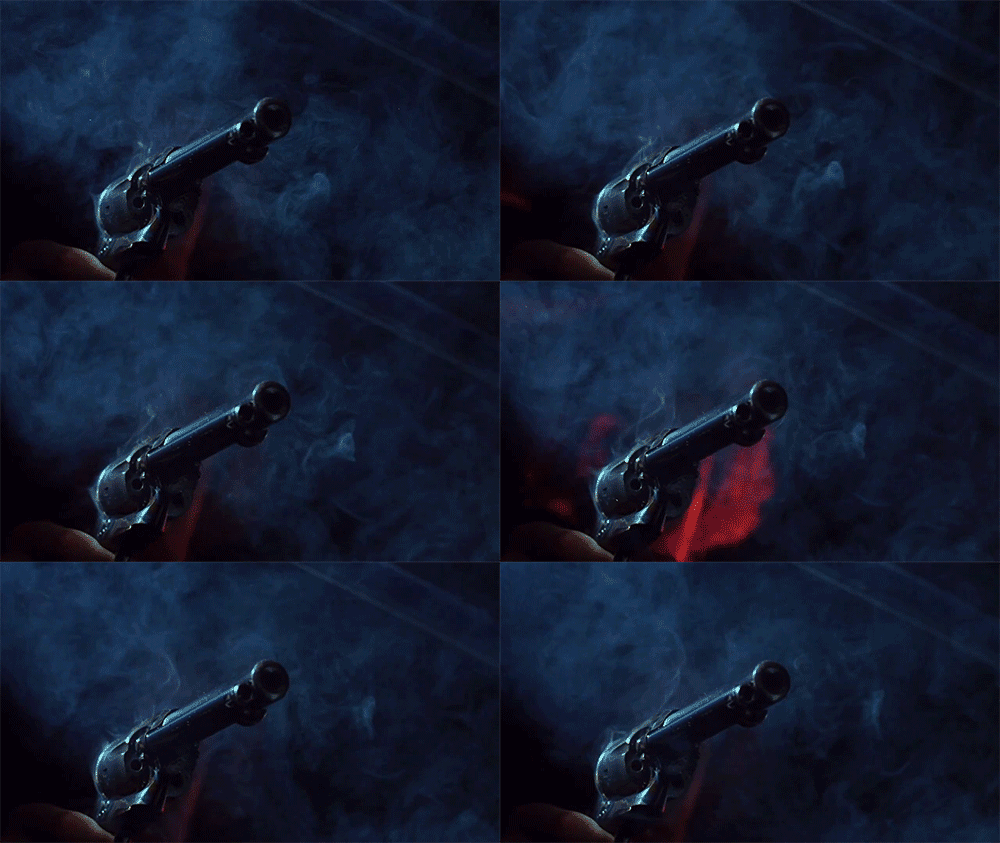
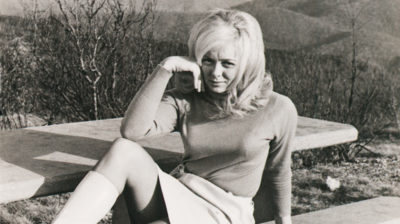
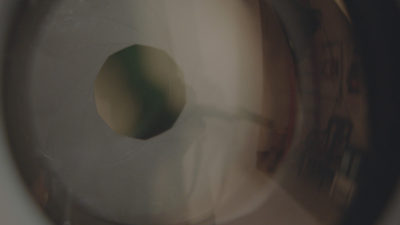

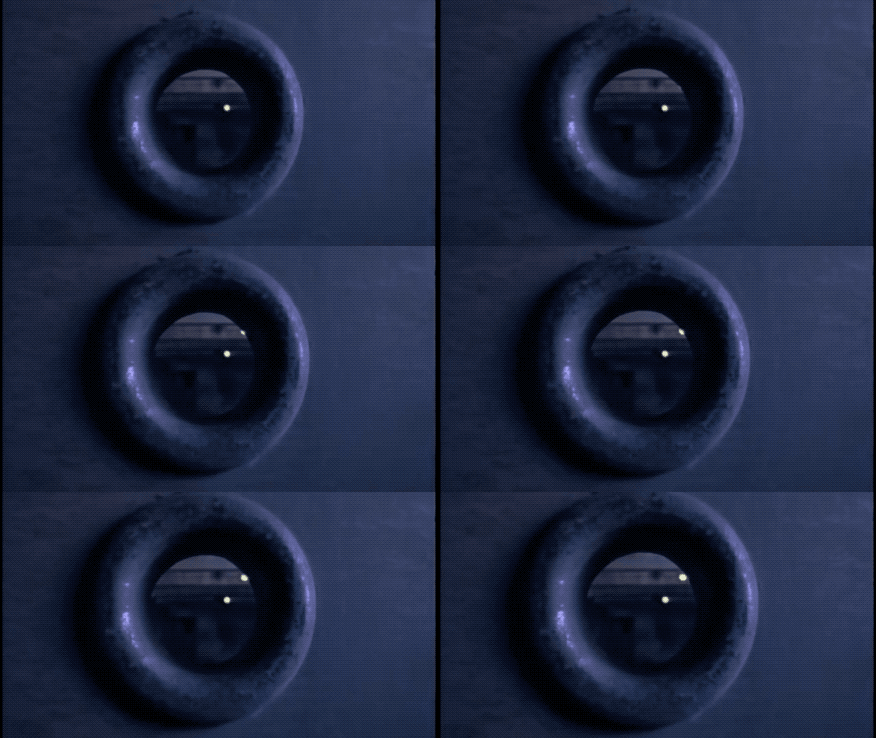



_____
Further
Errol Morris Website
Errol Morris @ IMDb
Errol Morris & Werner Herzog in conversation
Errol Morris @ Twitter
‘The Murders of Gonzago’ by EM @ Slate
Errol Morris: The Thinking Man’s Detective’
‘Errol Morris Lets Loose’
Video: Errol Morris on The Colbert Report
Errol Morris interviewed @ BOMB
Errol Morris @ mubi
‘Scandal and Subjective Reality in Errol Morris’s Tabloid’
‘Elusive Truths: The Cinema of Errol Morris’
‘The Devil’s in the Details’
‘Errol Morris, in Five Takes’
Errol Morris’ A Wilderness of Error Site
Video: ‘Errol Morris: Two Essential Truths About Photography’
’59 Minutes With Errol Morris’
_________
First Person
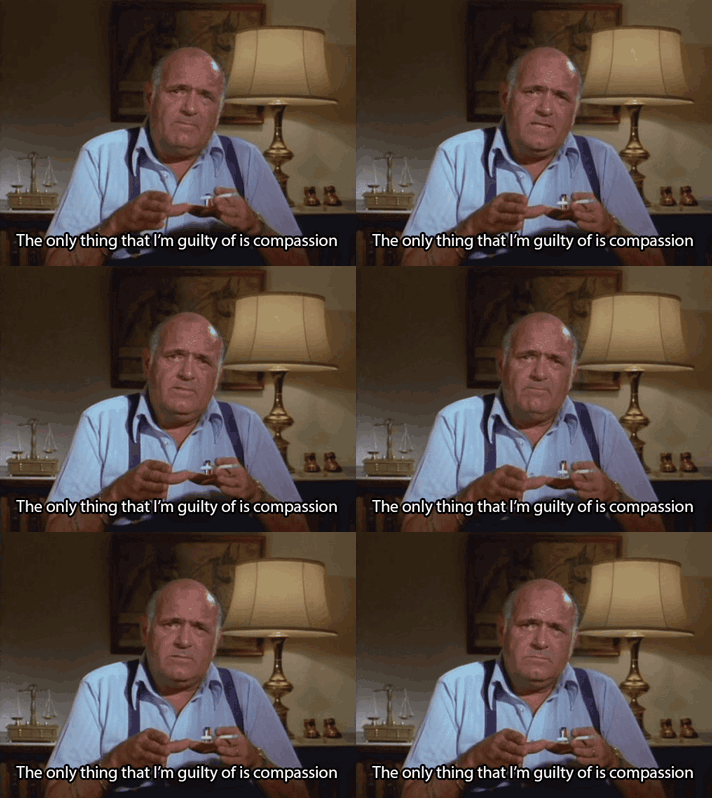
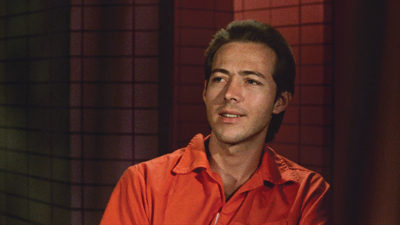
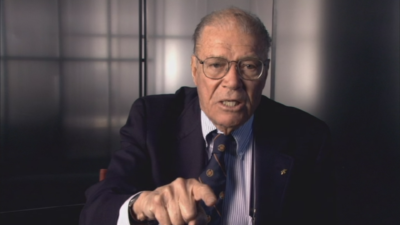
‘First Person was an American TV series produced and directed by Errol Morris. The show engaged a varied group of individuals from civil advocates to criminals. Interviews were conducted with “The Interrotron”, a device similar to a teleprompter: Errol and his subject each sit facing a camera. The image of each person’s face is then projected onto a two-way mirror positioned in front of the lens of the other’s camera. Instead of looking at a blank lens, then, both Morris and his subject are looking directly at a human face. (Diagram) Morris believes that the machine encourages monologue in the interview process, while also encouraging the interviewees to “express themselves to camera”. The name “Interrotron” was coined by Morris’s wife, who, according to Morris, “liked the name because it combined two important concepts — terror and interview.”‘ — collaged
Serial Killer Groupie Sondra London Part 1
In The Kingdom Of The Unabomber
Stairway to Heaven — Temple Grandin Part 1
The Parrot
Joan Dougherty – Crime Scene Cleaner Part 1
I Dismember Mama – Saul Kent, promoter of cryogenic immortality Part 1
____________________
How to Interview Someone
by Errol Morris

My advice to all interviewers is: Shut up and listen. It’s harder than it sounds. Most interviewers feel like they’ve got to be Mike Wallace, laying out booby traps and gotcha questions in what amounts to verbal combat. I think an interview, properly considered, should be an investigation. You shouldn’t know what the interview will yield. Otherwise, why do it at all?
I started developing the shut-up-and-listen school of interviewing in the 1970s. I was in my late 20s and traveling around the country interviewing murderers and the families of their victims for a book. I spent hours in high-security and psychiatric prisons with people like Ed Gein, the Wisconsin serial killer who inspired the movie Psycho. I always used two Sony (SNE) cassette recorders, and at some point I started playing a game with myself: Speak as little as possible. The cassette tapes got longer and longer—first 30 minutes, then 60, then 120—and the number of words I spoke became fewer and fewer. I was really proud of the interviews where my voice wasn’t on the tape at all.
Be well prepared, though. I’m surprised at how many people don’t prepare. When I interviewed Robert McNamara, he said he was shocked I’d read his books and actually thought about them. But I never go into an interview with a preconceived set of questions. I almost always start the same way: By saying, I don’t know where to start. Maybe it’s a nervous habit. But it’s also the truth. You fumble around for a beginning, and then suddenly you’re off and exploring.
As I was arranging an interview with First Lady Laura Bush for a short film that would air on the 2002 Academy Awards, her aide asked me for my list of questions. I told her I don’t prepare a list. She pressed, and we went back and forth on this several times. When I showed up for the interview, it was clear I wasn’t going to provide a list—so the aide handed me a typewritten sheet with not only the five questions I was supposed to ask but also the First Lady’s responses! When I sat down with the First Lady, I immediately went off script. The first question the aide had provided for me was, “What’s your favorite movie?” The sheet said The Wizard of Oz. So I asked, incredulously, is The Wizard of Oz really your favorite movie? She said, in fact, it’s Giant, the 1956 Western. As a young girl in Texas she’d stood in line for hours to be an extra in the film, which was shooting in her town, and it’s been her favorite ever since. That’s a story I never would have gotten had I been guided by a grocery list of questions.
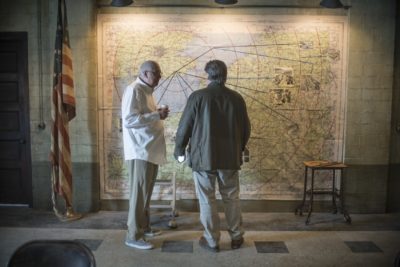
A final tip: Don’t be afraid of technology. We think of technology as limiting intimacy. But think about the telephone. Certain kinds of intimacy emerge on a phone call that might never occur if you were sitting right next to the other person. Technology limits things, but it makes other things possible. In all my interviews for film, I use a setup I call the Interrotron. Basically, it’s a teleprompter in front of a camera. I stand in a different room, out of sight of my interviewee, who interacts with my image on the teleprompter—and effectively stares directly into the camera. When Robert McNamara is talking about the Cuban missile crisis in The Fog of War, about how close we came to nuclear war, it’s not me interviewing him. It’s him talking directly to the audience.
____
Extras
Errol Morris on Confirmation Bias
Errol Morris & Werner Herzog in conversation
11 Excellent Reasons Not to Vote? – A Film by Errol Morris
Recovering Reality: A Conversation with Errol Morris
___________
Secret Weapon
by Jon Pavlus
Oscar-winning documentary filmmaker Errol Morris has a signature style that’s as instantly recognizable as Martin Scorsese’s or Wes Anderson’s: namely, showing his interviewees talking right into the camera lens. But I’ve always wondered – unless he has a video tap from his eyeball going right into the camera, how does he actually shoot that way? Here’s an example of the direct-to-lens style, from his Oscar-winning The Fog of War:
And from the Apple commercials:
Think about it: How does Morris get such penetrating interviews if the interviewee is just looking at a camera? If they’re looking into the lens and not at Morris, it would be hard for Morris to get anything like the unsettling, revealing, startlingly personal interviews that are Morris’s bread and butter. Would you tell a flat piece of glass about the biggest mistake you ever made in your life?
Morris solved that problem with the Interrotron, an ingenious bit of camera-rig design:
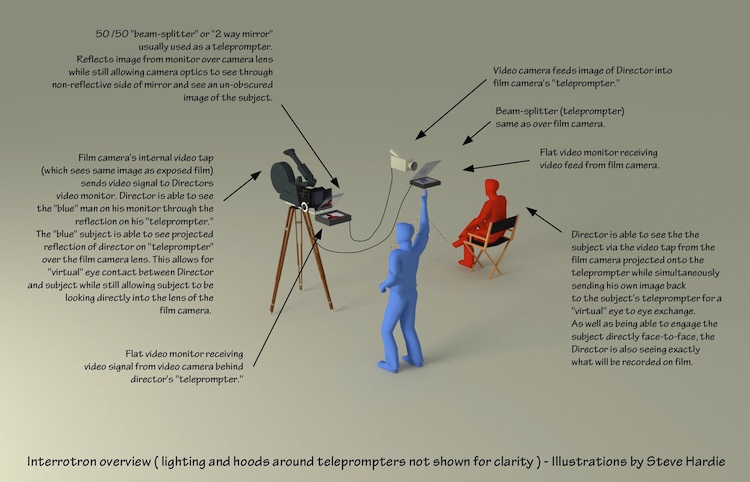
By shooting through a simple two-way mirror with a video monitor mounted under the camera lens, Morris can film his subject and make eye contact with him/her from the exact same angle. But that’s only half of it. The real genius of the Interrotron is that it’s a two-way street: the same mechanism gives the interviewee continuous eye contact with Morris, as well. No hiding behind a monitor while lobbing awkward questions for this director; Morris, who’s known to interview people for literally dozens of hours, doesn’t fake the intimacy you see on camera. It’s the real outcome of an intensely human process — and the Interrotron’s subtle design genius humanizes the filmmaking process enough to break down the subject’s emotional barriers.
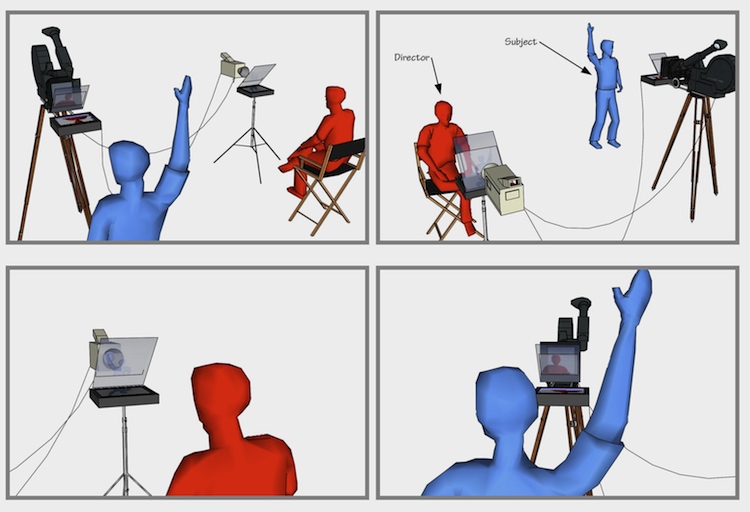
Morris didn’t invent this camera angle — nor was he the only one to devise this clever system. Production designer and frequent Morris collaborator Steve Hardie (who also made these illustrations) independently invented a nearly identical system a few years before Morris started using his. But thanks to a slew of riveting, Oscar-winning films, both the technique and system have become forever associated with (and usually attributed to) Morris.
Luckily, the basic idea is simple enough that any enterprising filmmaker could probably build her own if she really wanted to.
______________
13 of Errol Morris’s 27 films
_______________
Gates of Heaven (1978)
‘Gates of Heaven is the story of two California pet cemeteries transformed into an eccentric portrait of the American dream. Errol Morris began this, his first non-fiction feature, in 1978 after reading a headline in the San Francisco Chronicle: “450 Dead Pets To Go To Napa.” “Gates of Heaven” follows the stories behind two pet cemeteries — one that fails (set up by innocent Floyd McClure at the intersection of two superhighways) and the Harbert family, who apply the latest marketing concepts to the pet cemetery profession. Alan Berger in the Boston Herald wrote, “The appearance of an original talent in the arts frequently conforms to a pattern. Simply put, the newcomer presents us with a work which defies nearly every criterion in the established canon of taste. The new work — like a new theory of light or matter — abruptly makes its predecessors appear inelegant, clumsy and misguided. This is precisely what Errol Morris has done with his first feature, Gates of Heaven.” Roger Ebert of the Chicago Sun-Times has called Gates of Heaven “a masterpiece” and “one of the ten best movies of all time.”‘ — collaged
the entire film
_________________
Vernon, Florida (1981)
‘Vernon, Florida is an odd-ball survey of the inhabitants of a remote swamp-town in the Florida panhandle. Henry Shipes, Albert Bitterling, Roscoe Collins and others discuss turkey-hunting, gator-grunting and the meaning of life. This second effort by Errol Morris, originally titled Nub City, was about the inhabitants of a small Florida town who lop off their limbs for insurance money (“They literally became a fraction of themselves to become whole financially,” Morris commented.) but had to be retooled when his subjects threatened to murder him. Forced to come up with a new concept Morris created Vernon, Florida (1981) about the eccentric residents of a Southern swamp town. David Ansen in Newsweek wrote, “Errol Morris makes films unlike any other filmmaker. Vernon, Florida, like his earlier study of pet cemeteries, Gates of Heaven, is the work of a true original. On the surface, it is simply a portrait of several somewhat eccentric residents of a slow backwater town… There’s a taste of Samuel Beckett in the film’s tone of droll, forlorn hopefulness, and something of Buster Keaton in the spacious frames and exquisitely deadpan comic timing. Vernon, Florida isn’t sociology at all, it’s philosophical slapstick, a film as odd and mysterious as its subjects, and quite unforgettable.”‘ — collaged
Excerpt
Excerpt
the entirety
_________________
The Thin Blue Line (1988)
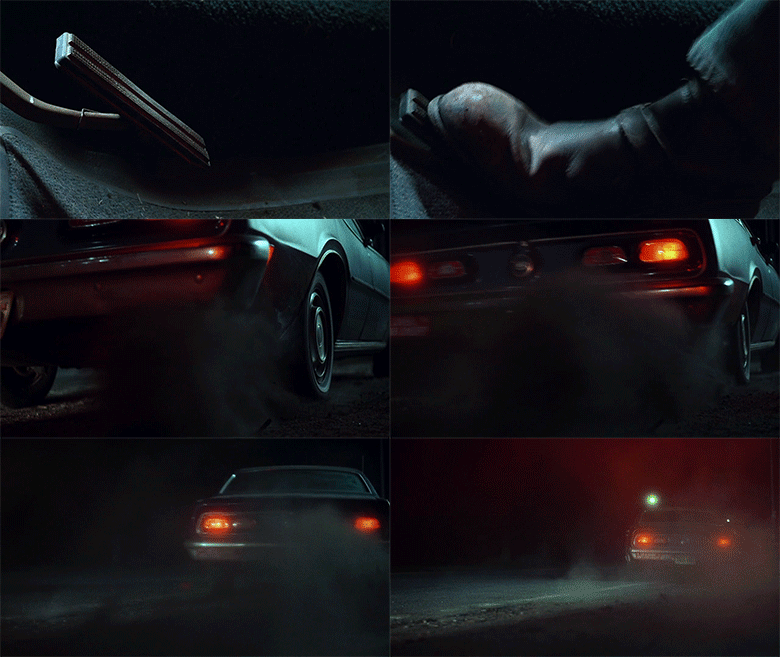
‘The Thin Blue Line is the fascinating, controversial true story of the arrest and conviction of Randall Adams for the murder of a Dallas policeman in 1976. Billed as “the first movie mystery to actually solve a murder,” the film is credited with overturning the conviction of Randall Dale Adams for the murder of Dallas police officer Robert Wood, a crime for which Adams was sentenced to death. With its use of expressionistic reenactments, interview material and music by Philip Glass, it pioneered a new kind of non-fiction filmmaking. Its style has been copied in countless reality-based television programs and feature films. Terrence Rafferty in The New Yorker has called it “a powerful and thrillingly strange movie. Morris seems to want to bring us to the point at which our apprehension of the real world reaches a pitch of paranoia — to induce in us the state of mind of a detective whose scrutiny of the evidence has begun to take on the feverish clarity of hallucination.”‘ –– collaged
Trailer
Excerpt
The Making of ‘The Thin Blue Line’
________________
A Brief History of Time (1992)
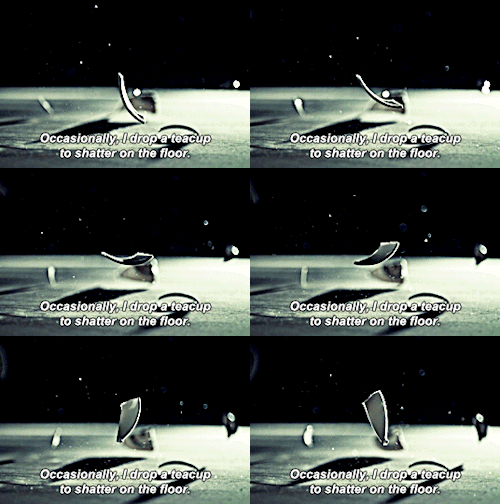
‘In 1992, Errol Morris finished A Brief History of Time, about the life and work of Stephen Hawking, the physicist who is often compared to Einstein and who is paralyzed and has spent much of his life in a wheelchair. In this film adaptation of Hawking’s book about the origins of the universe, Morris has woven together graphics, interviews and archival material in a story about both Hawking’s life and science. David Ansen in Newsweek has called it, “an elegant, inspirational and mysterious movie. Morris turns abstract ideas into haunting images, and keeps them spinning in the air with the finesse, and playfulness, of a master juggler”. Morris’ interviews for the film have been incorporated into a book, A Reader’s Companion, published by Bantam Books. The film appeared on many “top ten” lists for 1992, including Time, The Los Angeles Times and The San Francisco Chronicle.’ — collaged
the entire film
___________________
Fast, Cheap and Out of Control (1997)
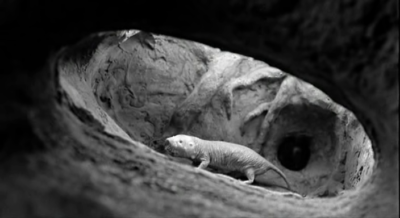
‘Fast, Cheap & Out of Control may be Errol Morris’ most unusual work yet. Morris himself calls it “the ultimate low-concept movie–a film that utterly resists the possibility of a one-line summary.” The film interweaves the stories of four obsessive men, each driven to create eccentric worlds of their dreams, all involving animals: Dave Hoover, a lion tamer who idolizes the late Clyde Beatty, and who shares his theories on the mind of wild animals; George Mendonça, a topiary gardener who has devoted a lifetime to painstakingly shaping bears and giraffes out of hedges and trees; Ray Mendez, who is fascinated with hairless mole-rats, tiny buck-toothed mammals who behave like insects; and Rodney Brooks, an M.I.T. scientist who has designed complex, autonomous robots that can crawl like bugs without specific instructions from a human controller. As the film proceeds, thematic connections between the four protagonists begin to emerge. The lion tamer and the topiary gardener look back at ways of life which are slowly disappearing; the mole-rat specialist and the robot scientist eye the future, envisioning creatures that may someday replace the human race.’ –errolmorris.com
Excerpt
2 excerpts
Excerpt
___________
Mr. Death (1999)
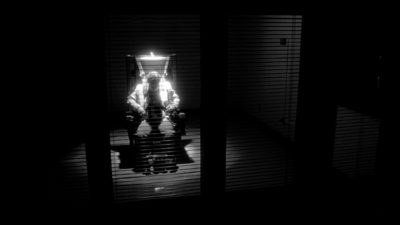
‘Fred A. Leuchter, Jr., an engineer from Malden, Mass. decided to become the Florence Nightengale of Death Row — a humanitarian whose mission was to design and repair, electric chairs, lethal injection systems, gallows and gas chambers, . In 1988, Ernst Zundel, publisher of Did Six Million Really Die? and The Hitler We Loved and Why commissioned Leuchter to conduct a forensic investigation into the use of poison gas in WWII Nazi concentration camps. Leuchter traveled to Auschwitz and illegally took brick and mortar samples for analysis in order to “prove” that the Holocaust never happened. Leuchter fully expected his involvement with Ernst Zundel to be the crowning achievement of his career, but instead it ruined him. Reopening the doors to this century’s keystone atrocity. Morris bypasses a more obvious discourse on bigotry to examine instead the origins of evil in vanity and self-deception.’ — collaged
Trailer
Excerpt
Excerpt
________________
The Fog of War (2003)
‘It is the story of America as seen through the eyes of the former Secretary of Defense, Robert S. McNamara. One of the most controversial and influential figures in world politics, he takes us on an insider’s view of the seminal events of the 20th Century. Why was this past Century the most destructive and deadly in all of human history? Are we doomed to repeat our mistakes? Are we free to make choices, or are we at the mercy of inexorable historical forces and ideologies? From the firebombing of 100,000 Japanese civilians in Tokyo in 1945 to the brink of nuclear catastrophe during the Cuban missile crisis to the devastating effects of the Vietnam War, The Fog of War examines the psychology and reasoning of the government decision-makers who send men to war. How were decisions made and for what reason? What can we learn from these historical events?’ — collaged
Trailer
the entirety
___________________
Standard Operating Procedure (2008)
‘The story of Abu Ghraib is still shrouded in moral ambiguity, but it is clear what happened there. The Abu Ghraib photographs serve as both an expose and a coverup. An expose, because the photographs offer us a glimpse of the horror of Abu Ghraib; and a coverup because they convinced journalists and readers they had seen everything, that there was no need to look further. In recent news reports, we have learned about the destruction of the Abu Zubaydah interrogation tapes. A coverup. It has been front page news. But the coverup at Abu Ghraib involved thousands of prisoners and hundreds of soldiers. We are still learning about the extent of it. Many journalists have asked about “the smoking gun” of Abu Ghraib. It is the wrong question. As Philip Gourevitch has commented, Abu Ghraib is the smoking gun. The underlying question that we still have not resolved, four years after the scandal: how could American values become so compromised that Abu Ghraib—and the subsequent coverup—could happen?’ — Errol Morris
Trailer
Excerpt
Deleted scene
__________
Tabloid (2011)
‘Thirty years before the antics of Lindsay, Paris and Britney, Joyce McKinney made her mark as a peerless tabloid queen. In TABLOID, Academy Award(R)-winning filmmaker Errol Morris (THE FOG OF WAR) follows the salacious adventures of this beauty queen with an IQ of 168, whose single-minded devotion to the man of her dreams leads her on a labyrinthine crusade for love. Down a surreal rabbit hole of kidnapping, masochistic Mormons, risque photography, magic underwear, celestial sex, jail time and a cloning laboratory in South Korea, Joyce’s fantastic exploits were constant headlines. Morris, interviewing the Fleet Street reporters and photographers who covered the events at the time, wants to deconstruct the addictive, almost metastasizing power of how tabloid news stories work on us. At 88 minutes, Tabloid is short and sweet (it’s pure movie candy), but by the end we’ve forged an emotional connection to Joyce McKinney at the deep core of her unapologetic fearless/nutty valor. And that’s what really makes a great tabloid story: It’s a vortex that’s also a mirror.’ — collaged
Trailer
Errol Morris interviewed about ‘Tabloid’
_______________
The Unknown Known (2013)
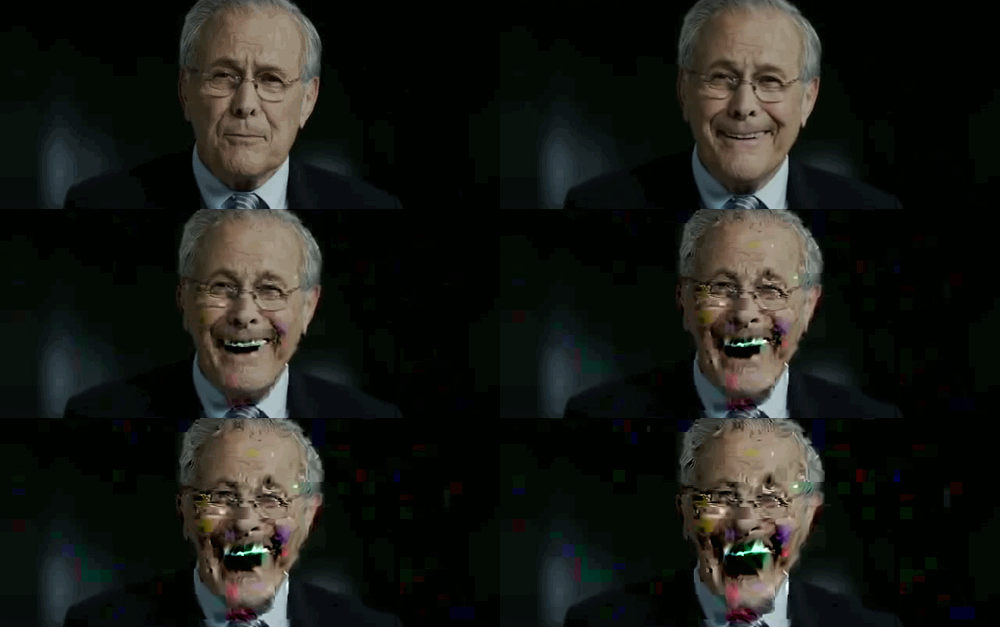
‘Donald Rumsfeld stares straight at the camera and smiles a lot in “The Unknown Known: The Life and Times of Donald Rumsfeld,” the latest single-interview documentary from Errol Morris, but his cheery demeanor never manages to convince. Revisiting turf he last explored with another portrait of a disgraced former defense secretary, the Oscar-winning “The Fog of War,” Morris also retreads some of the same murky ground of military corruption as his Abu Ghraib portrait “Standard Operating Procedure.” In this case, however, the feature-length interview is largely dominated by his eccentric subject’s meandering convictions, tenuous regrets and bureaucratic doublespeak, resulting in a peculiar movie seemingly at war with itself.
‘There’s no doubting Morris’ presence in “The Unknown Known,” both as the aggressive interrogator behind the lens and through the darkly witty aura of mystery he uses to enshroud Rumsfeld’s testimonies. Aided by a typically first-rate score by Danny Elfman, the documentary creates an ominous atmosphere to frame Rumsfeld’s unsurprisingly disingenuous and frequently digressive anecdotes as the aging government official recounts his final days in the Bush Administration with a mixture of pragmatism and naïveté.’ — Indiewire
Trailer
Excerpt
_______________
The B-Side: Elsa Dorfman’s Portrait Photography (2016)
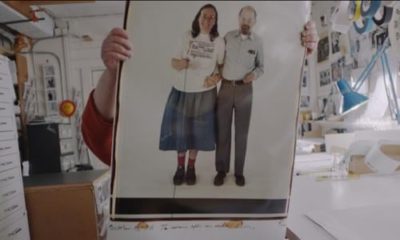
‘Errol Morris’s quietly passionate and inspiring new film, “The B-Side,” is a work of echoes and reflections. It’s a documentary portrait of Elsa Dorfman, a photographer who does mainly portraits and whose photography is inseparable from the details of her daily life. Her life and work illuminate the very essence of her medium. In the process of telling Dorfman’s life story, Morris also gathers hints about the nature of moviemaking, and about his own art.
‘Dorfman’s photographs are shown copiously but briefly throughout the film; it is Dorfman herself—with whom Morris speaks in her studio and in her darkroom—who is the center of the film, and she’s a remarkable presence, a cinematic character whose comments distill a lifetime of wisdom, self-awareness, frustration, and survivor’s pride. The etched profundity of her phrases (spoken in an undiluted Boston accent) lingers weightily long after they’ve passed by in the calm, conversational breeze. If they were collected in a chapbook, they’d form a version of “Notes on Photography,” a companion to Robert Bresson’s aphorisms, which apply only to his own films but can enlighten any filmmaker and, for that matter, any reader.’ — Richard Brody
Trailer
Q&A | Errol Morris & Elsa Dorfman | NYFF54
_______________
American Dharma (2018)
‘Morris’ latest film, “American Dharma,” is a conversation between him and Steve Bannon. It takes place in a Quonset hut, built for the movie, that is a replica of the flight crew’s headquarters from “Twelve O’Clock High.” Bannon was the CEO for Trump’s political campaign and later served as one of his chief strategists in the White House until 2017. Bannon views himself as a champion for working people, intent on tearing down an American political elite he believes has held power for too long. But, as made very evident by the tension throughout the film, Morris doesn’t see him that way.’ — wbur
Trailer
________________
My Psychedelic Love Story (2020)
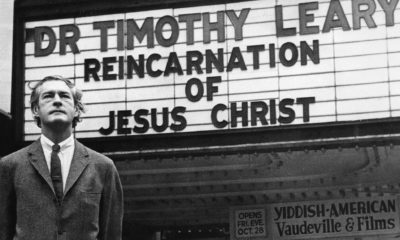
‘A psychedelic head trip crossed with a possible CIA conspiracy and wrapped in a fascinating love story, Errol Morris’ latest documentary takes us on an Alice in Wonderland adventure deep inside a largely forgotten episode of the early ‘70s. Told through the lens of Timothy Leary’s lover, the Swiss-born, Paris-raised free spirit Joanna Harcourt-Smith, MY PSYCHEDELIC LOVE STORY examines the twists and turns that led Leary, the High Priest of LSD, to seemingly sell out the millions he urged to “turn on, tune in and drop out” and become a narc in 1974. At the heart of the story is the woman Leary described as his “perfect love.” Was she a government pawn, a Mata Hari, or simply a beautiful, young, intelligent woman on the trip of a lifetime?’ — Ken Jacobson
Trailer
*
p.s. Hey. ** Ian, Hi, Ian. Yeah, sending one’s mss. to publishers or agents is the punishment part of being a writer, but do it, for our sake too. I did have a publishing imprint until about 10 years ago, but unfortunately I don’t have a time machine. Baseball is meditative. It’s been called ‘the poet’s sport’ for reasons I can’t explain but that make sense. Plus I was (am?) a Dodgers fan, and the Dodgers had until recently the sublime voiced Vin Scully as their announcer, and he pretty much was a poet without the paper and pen part. Good day to you, sir. ** Misanthrope, Problem is if you gave David a dummy, he’d probably turn it into a bong (which is actually a joke I just borrowed from my ill-fated ARTE TV series script). Well, then, a moderate whoo-hoo re: you and the Super Bowl. I like rain generally, but, boy, am I over it. We’re rain central. To the point that the Seine is overflowing, and they’re having to rescue the art in the Louvre’s basement. ** David Ehrenstein, Hi. I intend to avoid everything to do with that doomed impeachment trial like the plague, but good luck. And, look, it’s your ‘favorite’ guy in the blog’s spotlight today, ha ha, sorry. ** Tosh Berman, My pleasure, naturally, Mr. T. ** _Black_Acrylic, Hi, Ben. Everyone, Possible boon alert from _Black_Acrylic: ‘Anyone liking this sort of thing, there’s a Memphis Rap Mix here by the mighty Legowelt from 2012 that’s really good and may be of interest.’ ** Dominik, Hi!!! I have vague memories of the ultra-boringness of my elementary school sex ed class and all the graphs we were shown of how babies are conceived as being the occasion that I decided, ‘You know, I think I’m gay.’ t.A.T.u.! I love them, even though they turned out be horrible homophobes. A love that sings Drive Like Jehu’s ‘Here Come The Rome Plows’ as he cums, G. ** Sypha, Hi. Oh, yeah, ‘Ape of Naples’, that’s a great one. I totally spaced on that one. Need to get those ‘Unnatural History’ comps. Thanks, bud. ** Jack Skelley, I’m trying, Jack. I’m trying to low ball you guys, I swear. What up, man? Tuesday being like a lamb you’re leading to slaughter? The Seine is overflowing its banks and flooding a swipe of Paris, so I’m going to go trudge through the rain and have a look at that. Whoop! ** politekid, Hey, big O! How’s it hanging, or the British equivalent of that phrase? think this is the first opportunity I have had to tell how much I loved your audio piece for that art show. It was beautiful and clever and hypnotic and heart wrenching. Big kudos! Do more! Your description of the early part of your sex ed class sounds a lot like my memory of mine. They may even have used the same outdated tech, although maybe there wasn’t VHS yet when I was 11 years old. It must have been a slide projector? Luckily my school had a separation of church and state kind of policy, I think. Your school sounds more … fun? I guess that’s pushing it. More colorful. Yeah, once again, how’s it, fine sir? ** Steve Erickson, No, as I understand it, he thought I was too hardcore in the sense of being a bit too knowledgeable and serious about the dark side and that would use the article to call him out as phoney. Which is quite possibly what I would have done, ha ha. Clark said no because he thought I would say he was gay even after I talked him on the phone and told him I didn’t give a shit if he was gay or not and that wasn’t my angle. Haynes: I was asked to write a big feature on him around the time ‘Safe’ was about to be released. Spin set up a screening. I thought the first 2/3 of ‘Safe’ were great and that the last part at the New Age retreat was weaker. I told someone my opinion who happened to be a mutual friend of Haynes’ and mine, and he told Haynes what I said, and Haynes cancelled me as the article’s writer. I called him and said that, yeah, I did feel that way about ‘Safe’ but that I had no intention of criticising the film or him in any way in the article, and that it would be very positive. He didn’t believe me. Having an article in Spin about him was a big deal to him at that point, and he was afraid to possibly fuck up his big chance, basically. I was kind of mostly kidding about actually watching ‘Hannibal’, mostly because I just don’t watch TV series in general. I watched the doc about Other Music last night. It wasn’t a particularly good doc, but it sure made me miss that place. ** Nik, Hi, Nik! Really good to see you! How are you? Everything good and even exciting? Yeah, my novel comes out in early/mid September. Very cool about the John Olson event! It probably is happening in the middle of the night here, drat. Archive it? Everyone, This is a potentially great thing for you to hone in on, news and it courtesy of Nik. Nik: ‘I wanted to stop by and invite you and anyone else perusing the comments to a Zoom event I organized with a club at Bard called the Meme Lab. We’re going to have a talk with John Olson, one of the musicians behind the great Wolf Eyes, about his meme page Inzane Johnny and how his interest in avant-garde media intersects on his page. If anyone here is interested in attending, they can follow us at brdmeme on Instagram or register for the event on our site: memelab.bard.edu.’ Excellent news about the Mark Baumer book! Who’s publishing it, do you know? Look forward to catching up once you get some time. Awesome luck with everything! ** Okay. I hereby give you a Day about one of my very favorite American filmmakers, Mr. Errol Morris. And I guess that’s all that needs be said. See you tomorrow.








 Now available in North America