p.s. Hey. So, this is the last, lingering post for the duration of the blog’s and my little summer vacation. The blog’s exact return date is uncertain at the moment, but it will be sometime in the 20s of July, and I’ll give you an advance notice of the return date when I know it. In the meantime, there is a lot up there for you to theoretically explore with excellent results while I’m gone if you like. Feel free to leave any comments you want here, and I will interact with them/you immediately upon the blog’s and my return. ** G, Hi, G! Thanks, I’m ever if slowly improving. Thanks very much about ‘Jerk’. Hopefully you’ll get see the film Gisele Vienne and I made of the theater piece incarnation at some point. It’ll be ‘released’ this fall. Gladman is wonderful, highly recommended. Take good care ion yourself. xo. ** Dominik, Hi!!! My pleasure, of course. Thanks about my mouth. It’s at a seemingly tolerable point now, and hopefully riding roller coasters, etc. for three days will speed that up (or, I guess, send me to the hospital, ha ha). Thank you for the intense love. Greatly appreciated, and I’ll count on it. Love transforming Budapest into a giant amusement park and giving you a Fast Pass for every store/ride, G. And have a lovely net couple of weeks, my dear pal. ** _Black_Acrylic, Hi, Ben. I highly recommend a delivery into her books. And her art. Thank you about my trip, and, especially, m about my gums, which appear to be accepting thatchy must behave. Have a lovely next days, and I will look forward to pumping up my vacation’s jam with Play Therapy’s help. ** Bill, Hi, Bill. Thanks. I’m just about ready to split, I think. I would, if you can, start with the first Ravicka book and then read the in order. Bu you can start with the spotlit one if need be. Glad you got some sleep. I hope your life is eventful and not too TL;DR until I get to see you next. xo. ** Misanthrope, Thanks, G. I’ll start getting ready now. And I’ll alert my fellow Parisians. Well, as best I can on my way to the airport. Get that tooth looked at, man. Seriously, take it from me. One’s mouth doesn’t mess around when it feels like hurting one. Take care, bud. ** Dalton, Hi, Dalton. Thank you, kind sir. Will do. And you make more than the best of your next couple of weeks whatever they entail, okay? ** Right. Off I go. See you guys soon. Enjoy everything. Tell me anything you want to tell me. And I’ll see you and catch up with you ere long.
‘Getting lost is a dying art. Now that technology has mimeographed and streamlined our city surroundings, we’ve become too confident in the permanence of locales. As a result, we’ve begun to forget that buildings and streets only seem to be fixed in place, when in fact places shift in our memory, cities alter in the day and dreams reconfigure it by night. To read Renee Gladman’s Ravicka books—which began in 2010 with Event Factory and have just reached their apotheosis with the fourth installment, Houses of Ravicka (Dorothy)—is to regain the sense of the city as a thing in flux, a way of thinking about the body that begins in language, gradually populating and chartering a city of the imagination not beholden to crude geographic borders.
‘Throughout the installments, Ravicka is of obscure location and almost-indecipherable ritual, mainly populated by luminary writers and translators who fret their way across its bridges and avenues, and whose names—Zàoter Limici, Ana Patova, Luswage Amini—are caressed like fetishes, though we don’t learn much about them. In fact, what we don’t know about the city vastly outnumbers what we do. Of apparent Eastern European designation, Ravika has been subject to a mysterious exodus, wracked by an unspecified catastrophe referred to as “the despair,” and is said by the visitor-narrator of Event Factory to be possessed of yellow air, though the Ravickian novelist Luswage Amini, the narrator of its sequel The Ravikians, gently chides that “yellow” doesn’t capture the color of its atmosphere; the word is dahar.
‘We get accustomed to its nebulous geography through observations like “it is difficult to remain stationary. The landmarks call out” and “it seems something can be placed so far away that it actually comes to exist somewhere else.” Of the city’s bizarre culture we are told, “one’s date of birth was celebrated irregularly—three or five times over one’s life” and to be born there ”is to say you have been hungry.” Of architecture, the narrator of Event Factory says that “I can never get inside it.” Ravicka is seemingly changed by every sentence that is spoken about it, yet its denizens cling to its history, because “This is no time to erase things.”
‘In Houses of Ravicka, the tension between cartographical exactitude and spatial disorientation is ecstatically problematized. In the book’s first half, the city comptroller, an excitable man named Jakobi, discovers that two houses within his jurisdiction, no. 96 and no. 32, have become spontaneously unmoored from their address. He prides himself on his spatial lucidity and his maddening quest to account for the missing house simulates the task of the reader who is likewise engaged in puzzling out the ornate, elusive logic with which Gladman has endowed her city of ideas—a disobedient city that refuses to be simply the sum of its parameters.
‘The Ravicka books—flagships of the elegant small press Dorothy— are what usually get classified as “poet’s novels,” like Anne Carson’s Autobiography of Red or My Life by Lyn Hejinian, but in this case, that’s a cop-out. Gladman writes and publishes poetry, nonfiction, and novels with the same frequency. I doubt she makes much distinction between disciplines (and in fact she resembles a visual artist in her staunch pursuit of a theme through varied layers of form and abstraction).
‘What Gladman’s work does have in common with the aforementioned works is a faith that language creates the thing it describes. As opposed to the commercial novel, which gestures at the consensual reality beyond the page, Gladman begins with the internal and constructs her world from the ground up, finding meaning in negative spaces. Jakobi proposes that streets should be built according to “qualified voids” and muses that “You can design a flag and name a country, then design another flag and name another country, years before you have to bring that country into existence,” which might have been Gladman’s process with Ravicka—a coherent imaginary place, slowly solidified book to book.’ — J.W. McCormack
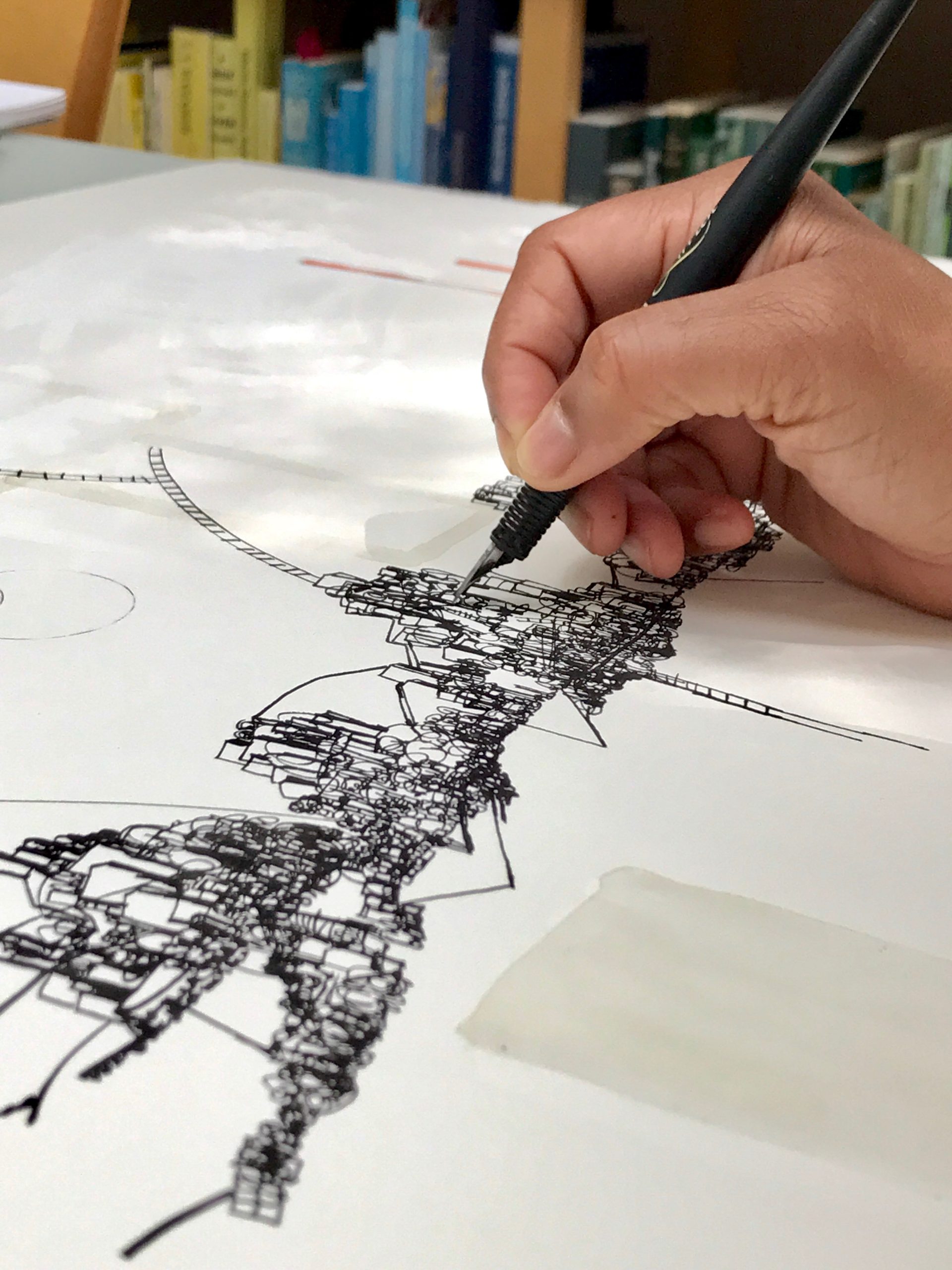
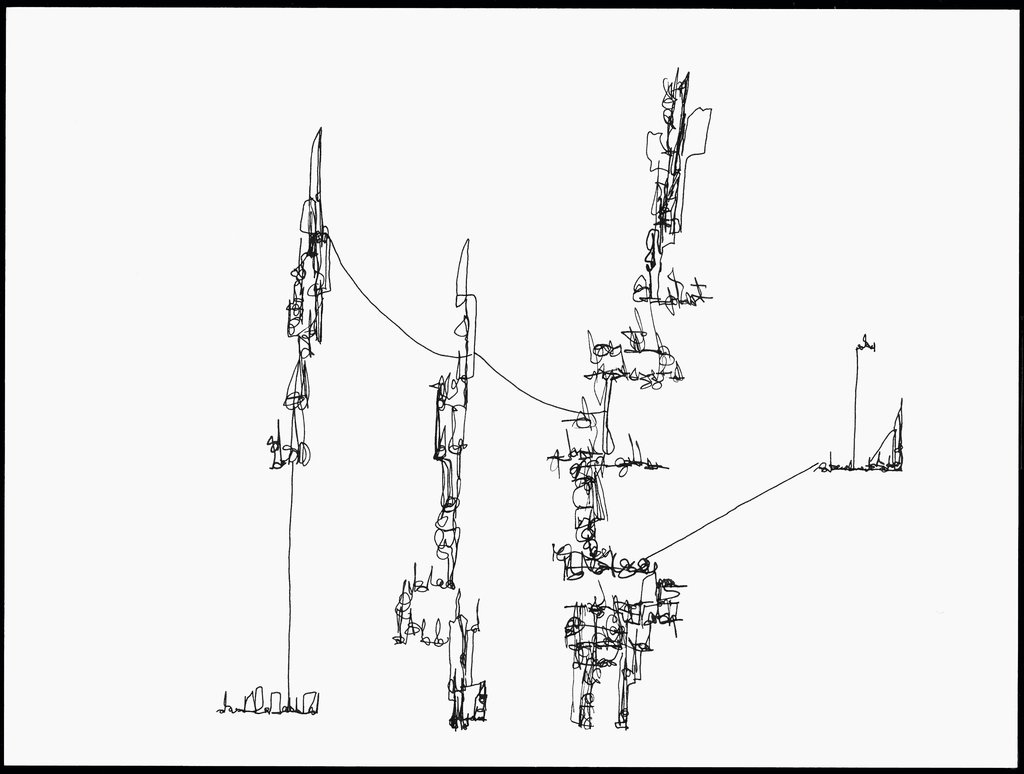
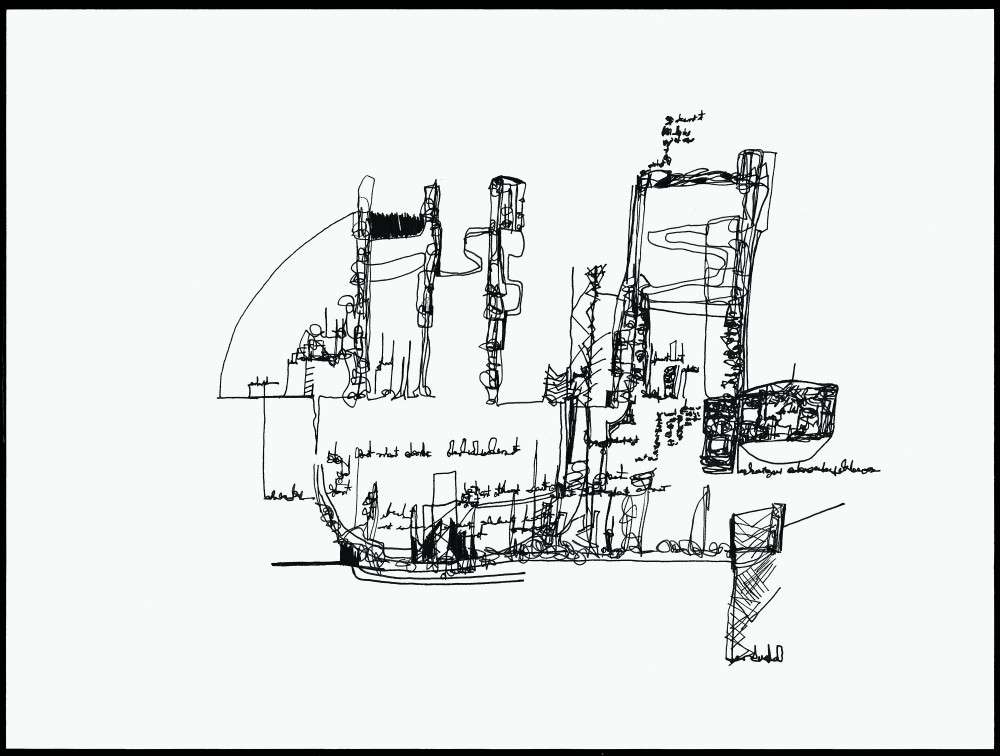
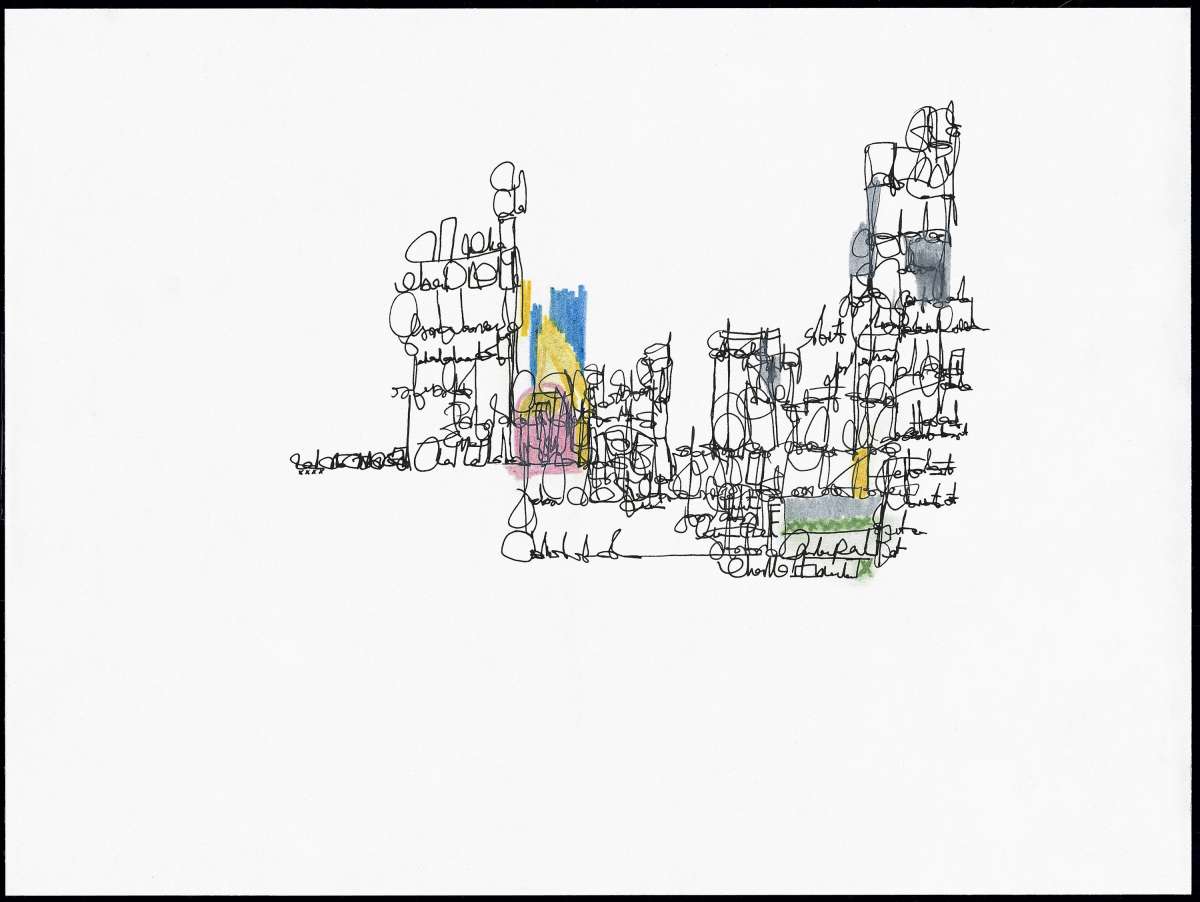
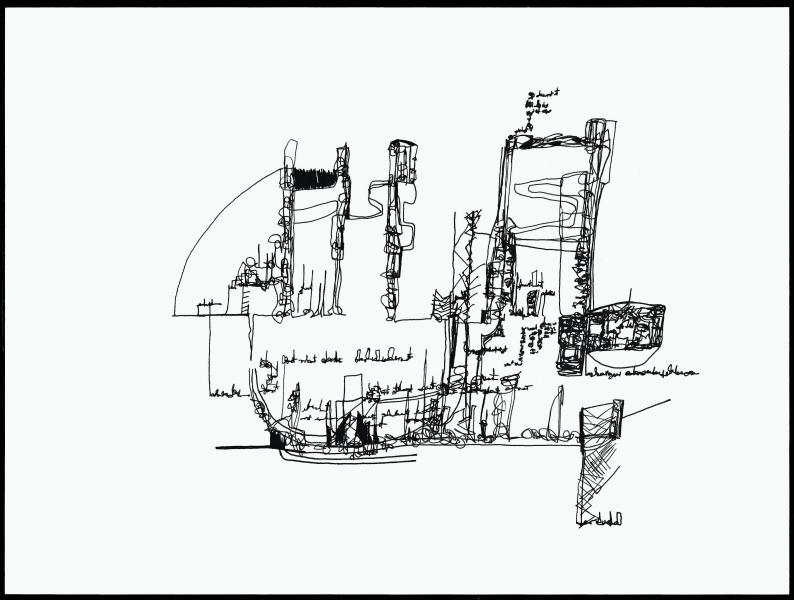
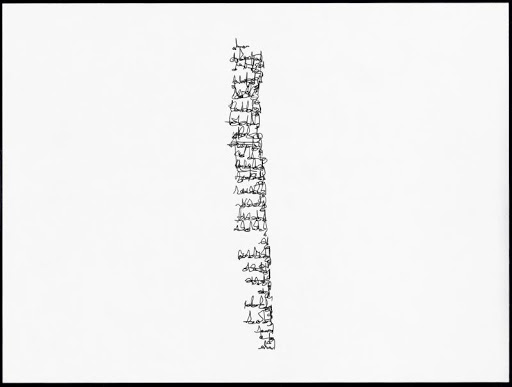
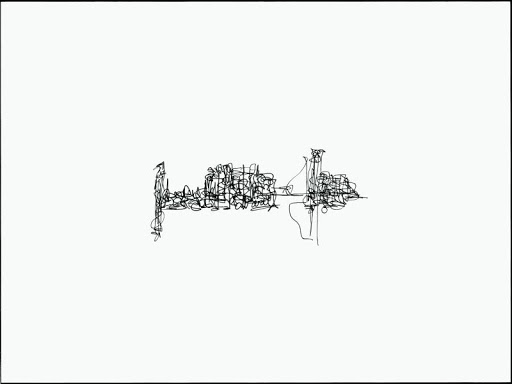
‘To encounter Gladman’s drawings is to encounter the phenomenon of description at its most fundamental level. The imaginative complexity of what her drawings describe is what gives them their thought-invoking power. Many of the pieces resemble not-quite-legible script, thus referencing urgent acts of writing, registering somewhere on the visual spectrum between image and language. As the book’s title indicates, architecture — especially the structure and function of urban space — is a primary concern for this work, and is of central interest to Gladman. In addition to handwriting, many of Gladman’s drawings suggest city landscapes — blocks, buildings, bridges, roads. But over the course of these 107 wildly diverse pages, conventions of visual description and representation are blown wide-open. Just as a descriptive writer may “draw” a scene using words, Gladman’s drawings seem to trace the contours of her thinking — notes without syntax, maps without scale, blueprints without measurement.
‘Gladman considers her drawing practice, in which she’s had no formal training, as importantly concurrent with her practice as a writer. Her stories bring readers into a world in which the linear and spatial limits of the urban environment are drastically altered; its transformation, in turn, serves as a metaphor for the mutability of familiar social and political structures. In Gladman’s trilogy of novels about the fictional nation-state of Ravika, for example, characters use an invented language called Ravic. The protagonists’ words have direct impact on physical spaces in Ravicka, as well as the events that transpire there. To write “I set my house on fire” in Ravicka is synonymous and simultaneous with one’s house burning down, just as writing “my house did not burn down” allows the same house to remain standing. This power negates the well-worn dichotomy between words and actions that haunts late capitalism. Gladman’s fictional system carries over into her drawings, where the act of mark-making — an act analagous to writing — results in a completely singular visual structure, an image that hovers somewhere between diagram and utterance.’ — Iris Cushing
___ Extras
This Side of Real: Renee Gladman’s New Narrative
Prose Architectures Flipthrough
Renee Gladman @ Small Press Traffic
Renee Gladman at Georgetown University
Handselling from Home: Renee Gladman’s Ravicka Novels
____ Interview from BOMB
Zack Friedman I’ll start things off with some comments based on Event Factory. To me, a central theme of this book was fluency. The narrator has a formal intellectual understanding of the language and culture of Ravicka, but lacks the practical understanding that comes from lived experience within the city and its traditions or the native speaker’s true facility with natural speech. I was struck by the detail that went into this—the slightly awkward or clumsy phrasing of the narrator is rendered perfectly. What elements of your own personal background with language learning, teaching, and translating (not to mention iffy tourism) went into these books? Are there certain ideas about language and culture that influenced you or that you find coming through in the books?
Renee Gladman I wrote the first two books of the series without ever having left the North American continent. At the time of the writing, I experienced a kind of paradox. It had something to do with the filmmaker Béla Tarr. I’m not sure how to explain this. Seeing his work, in particular the 7.5-hour Satantango—as well as the work of the Polish filmmaker Kieslowski, and the Russians Tarkovsky and Sokurov—created in me some instinct of belonging. It made no sense, but at a gut level I felt that those dreary, silent, beautiful landscapes, that sense of exhaustion and isolation, were my own. I wanted to place a narrative within a possibility or convergence of those spaces. I also—and I don’t have a rational explanation for this—wanted to push it farther east. A desire began to form for places like Latvia, Croatia, Slovenia. I dropped Ravicka down, perhaps in pieces, over this entire region. Though, at the same time, not really. Something entirely different had happened. I had wanted to escape my monolinguism, so I began to make up a language that I spoke with my lover on the streets of San Francisco. I would say some words of this language and she would respond with other words, apparently also of this language. Within that exchange was the space of the city, questions of the built environment, of community, occupancy. You think long enough about something and it comes to life in some alterity adjacent to your own. Those alterities have been my fictions.
ZF What about the presence of, for lack of a better word, genre elements in the Ravicka books? There’s a bit of a sci-fi or fantasy feel (who else writes trilogies these days?), including an invented language (although I’m going to guess you didn’t go the full Tolkien on that) and you mention Samuel Delany in the acknowledgments. I almost want to call Event Factory a social science fiction book, with the sciences being linguistics and anthropology. But you seem very rooted in literary fiction and poetry, with an emphasis on what can be done with the individual sentence. What traditions do you see yourself working with when you write about an imagined city?
RG I definitely would prefer social science fiction to science fiction, as I really didn’t intend these books to ask deep questions about technology or bioengineering or inter-galaxy relations. Instead, they wonder about city living, architecture, language and communication, desire, and community—the same things I wonder about in my own life. It is true that the air there is yellow, but, equally true is the fact that Luswage Amini, the great Ravickian novelist, argues that “yellow” is a mistranslation of the word “dahar,” so we really don’t know what color the air is. And yes, there is an underground ancient city, but so are there underground cities in Atlanta and Montreal. I guess my resistance is that I don’t know what people mean when they say sci-fi, what it is they wish to qualify. Maybe EF is sci-fi because a black lesbian poet wrote it. That’s pretty otherworldly. My concern, the more I think about this, is that “sci-fi” or “fantasy” are applied to assuage the deep confusion and disorientation experienced by the characters of the two books EF and The Ravickians or to justify why someone might have to do a backbend in order to eat. For me, it needs to stay on this side of reality, and it needs to be pushing for physical space in this world.
As far as traditions or influences go, the emptied-out city of Delany’s Dhalgren was a portal into Ravicka. But, aesthetically, these books are more aligned with novels like Cortázar’s 62: A Model Kit, Handke’s On a Dark Night I Left My Silent House, Gail Scott’s Heroine and My Paris, Michal Ajvaz’s The Other City—city novels or novels of walking. But not stories that happen to take place in cities, rather stories where “city” is an idea toward which the author or characters reach, a kind of reflective space that leads to questions about subjectivity or time. I love these questions regardless of the atmosphere in which they’re formulated, but inside urban space, alongside buildings, traffic, transport, the encroaching crowd, the desolate part of the city, they take on dimension. I can move “the problem of the person” around as though it were a thing. Also, as a writer of the English sentence, I am very conscious of the assertion of subjectivity. You can’t get very far in the sentence without having to make a big gesture of identity. “I,” “The man,” “She”—these solids inside which a certainty is assumed to exist. I like to think of moving through the sentence (as writer or reader) as moving through a kind of terrain. The sentence is at once a map of where we have gone and where we wish to go. You can see how dropping a city over this “map” might allow one to work on a figurative level. Your question about progression can become a character itself.
ZF I’m fascinated by your parallel between the sentence and physical space. Is the disorientation and excitement an individual sentence, made slightly “off,” can produce, like moving through a city? Does a sentence have architecture, or is there a kind of urban planning that goes into writing? What makes it physical?
RG Beautiful questions. In a way, I feel that most of the fun is in the asking rather than the answering. Like, what happens to your mind after you think those things? But, I will venture a response. On one hand what I’m talking about is syntax, how words are ordered to create meaning, how moving through that order is a kind of unfolding, each word being a “sign” of sorts that tell us about where we are and where we are going. Punctuation affecting our pace. A few years ago, I wanted to draw a parallel between the duration of maintaining self (the always-unraveling thread of experience) as one moves through a diverse city and the becoming of “subjectivity,” particularly as one navigates difficult sentences. Now, it is more trying to see the architecture of a sentence or group of sentences, and getting from there into a drawing space, where I’m thinking of the line as translation/conversation of thought.
ZF It’s difficult to raise and disentangle these identity-based questions, but how do you think your “otherworldly” identity—a black lesbian poet—relates to your interest in the sentence, its confusions and disorientations? Are there dominant ideas about language you want to call into question?
RG Bhanu Kapil and I were talking about this just yesterday. Experimentation, we were saying, is an ideal mode of engagement for marginalized people, and we couldn’t understand, we continued to say, why so many people still believe that the “transparency” of conventional storytelling somehow allows one to capture what it is to exist in the world more authentically. Of course, this question has been debated within the arts for decades now, but it is no less pertinent and divisive today. As a “black lesbian poet” you enter language from a place of disorientation. Your grasp of the authority of the subject is slippery. You feel deviant. You feel the need to fuck with things. As you gaze into words, into their relation, you see things that are not there to people who have never had to prove that they should be counted among the living. You see jungle spaces, geometric spaces inside which it is possible to point, to unfold something about the silences, the loneliness of being in the world. Really though, this opportunity exists for anyone who looks deeply into language and the moment of utterance with his mouth or body all open.
ZF You say you want to escape your monolingualism. Regarding the importance of translation and its inherent imprecision in The Ravickians, are there translations you’ve encountered, or alternate philosophies of translation, that have struck you as interesting escape attempts? The idea of inventing a language as a kind of flight, or an act of intimacy, is really lovely.
RG Well, I should be more proactive and say I want to rid myself of monolinguism rather than escape it. Translation is not about escape at all but nor is translation about ridding oneself of monolinguism. So, we’ve got two things on the table: one is being able to operate inside a language that exists outside of the way you’ve been taught to think and conduct your body in the world, being able to meet people in their own native forms, and two is what happens when the untranslatability of another language enters your own—how it bends, erodes, how gaps form, doubling occurs, how ghosts are born. Then when you go about saying, yes I thought I’d climb a tree yesterday you’re not (in your head) just saying, yes I thought I’d climb that tree.
ZF In Event Factory, an outsider struggles to make sense of a city; in The Ravickians a novelist, someone who is both an insider and an outsider, struggles to convey that city. What made you settle on these perspectives? And may I ask who the protagonist of the third volume will be?
RG My narrators always seem to be these marginal beings, drawn to central spaces, but full of ambivalence when inhabiting them. So, where they are is not usually where they want to be. There is some inner space they need to reach, some person who comes along and understands everything. Translators, I find, occupy a special position with regard to the place of their found language(s) that is excellent for fiction. They have the tools to navigate comfortably, or at least functionally, within that non-native space, but because they are moving from the second language back into the first, or the third language into the first (or whatever the configuration) they’ve got to stay a bit outside. There is a space there, where things fall out, that is lovely. And, when you’re reading translations, don’t you sometimes feel the racing heartbeat of the translator trying to get shit right? It’s just all very good for writing.
Yes, the third volume. The questions of what I owe to the city-country Ravicka seems to be important for this next volume, which I am in the process of re-visioning. I’ve been going around saying I’m writing a trilogy but the truth is that there are more books than three. At this point, there are four, and I think I’m about to start a fifth one. The manuscript that I’ve been calling “the third in the trilogy” is called Houses of Ravicka, and a person Jakobi is the protagonist. He’s a top city official for Ravicka, its Comptroller. He goes around conducting geoscogs of houses in all of the city’s neighborhoods, as houses in Ravicka shift dramatically over time, and someone must be in charge of keeping track of them. But this book is very much a fiction. It has suspense that needs to be drawn out and developed in a particular way. Writing it makes me uncomfortable, like I don’t know what I’m doing.
___ Book
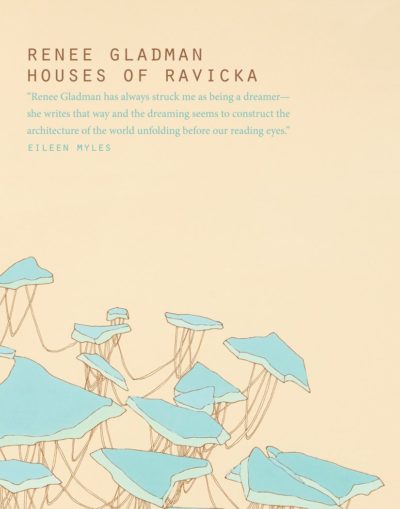
Renee Gladman Houses of Ravicka Dorothy, a Publishing Project
‘Since 2010 writer and artist Renee Gladman has placed fantastic and philosophical stories in the invented city-state of Ravicka, a Ruritanian everyplace with its own gestural language, poetic architecture, and inexplicable physics. As Ravicka has grown, so has Gladman’s project, spilling out from her fiction—Event Factory, The Ravickians, and Ana Patova Crosses a Bridge—into her nonfiction (Calamities) and even visual art (Prose Architectures).
‘The result is a project unlike any other in American letters today, a fictional world that spans not only multiple books but different genres, even different art forms.
‘In Houses of Ravicka, the city’s comptroller, author of Regulating the Book of Regulations, seems to have lost a house. It is not where it’s supposed to be, though an invisible house on the far side of town, which corresponds to the missing house, remains appropriately invisible. Inside the invisible house, a nameless Ravickian considers how she came to the life she is living, and investigates the deep history of Ravicka—that mysterious city-country born of Renee Gladman’s philosophical, funny, audacious, extraordinary imagination.’ — Dorothy, a publishing project
Excerpt
I live here, and have done so for at least a decade, and have furnished brightly this spacious top-floor flat of seven rooms, this wall-less, invisible flat, and in all that time, I’ve gotten up, made coffee, dressed, and walked out the door. To leave an invisible structure is just as difficult as returning to one. I’d like to try to explain what it’s like: first, how you leave, and then, how you return. Probably, before all that, I should describe the events that led to my occupying 32 Bravashbinder, events belonging to an even larger system of events and weather that are so in situ it’s hard to gather them. But I do know that if I’m to tell a story about how I live, I’m also to tell about work and sex and how the city breathes, and this requires me to back all the way up to the Barbaras Wall, which long ago used to divide the upper and lower parts of the city on the east side, or back even further up to the emergence of the old city, unfolding, literally, beneath this one — born both of it and before it — and the new laws of motion it introduced into the science of the land (something always changing beneath you changes your chemistry, historians now say). No, perhaps I should begin by saying what it means to see or how measurements occur in time, because first you have to let go of the notion that sights enter the eyes, or merely the eyes. I like to travel far out of the city center, stand in some improbable place, and describe the things obstructed from my view. I try to see them even though they are behind me or are blocked by the buildings of ciut centali, cast in shadows by the trees atop cit Ramtala. You see something by calling its name and doing a pondü with the body. I go to the dirtiest part of the city, the old dilapidated docks, and I dream of the hafshahs; I see the grasses and tij. I stand against the north-side wall of the National Library and press my face into the grooved concrete of its facade and I write a letter about what people are reading inside. I send the letter to the building and try to erase it from my mind: I don’t read, I try to tell myself. Books don’t exist. I’m lying in the woods that run along the a5 with my face against the moist ground, reading the last book. Some hum extends from the city, and the walls of every home creak: a single electrical bend that divides time. Only a third of the residents bear a record of the break, only half of that third had actually heard it, only a third of that half of a third reflected on it, and just a few of these tired, still deeply dreaming souls, a sixteenth of the third of that half of a third, connect this minuscule eruption to those from previous nights and previous residences. I don’t see anything in the ground of the forest, but I hear pages turning in the book. The book, these creaks in the walls of houses, the hum of the city, the lines in the asphalt, have backed me up to the forest, my face against the ground. I was trying to tell you what it means to see a city that itself sees, that looks out of its structures toward some imagined place, some activating force. We have a whole science that says the buildings of Ravicka are on the move — the houses, the buildings — and although the science doesn’t say it’s because the houses see that they move, it’s clear that they move because they see. Otherwise, we wouldn’t be studying the migration of buildings but rather the behavior of some further exterior force. For example, if experts believed the migrations were due to wind or erosion, then we’d be looking more deeply at the properties of wind, the effects of erosion; and perhaps some group is studying one or the other of those things, because the Balsha winds are strong and erosion occurs wherever there is ground; but when it comes to what sets a house in motion, science seems to look primarily at the subjectivity of houses, not going so far as to say they have psychology but definitely allowing for instinct or bewilderment. Houses have creaked for a long time. Long before the first house got up and walked off, the walls of houses creaked, and not just in Ravicka. Nearly every ghostly tale has something that creaks. Wouldn’t it be logical to argue this as the first evidence of buildings seeing? As I said earlier, seeing does not extend foremost from the eyes. I get my face dirty in the forest, but I don’t come here when it rains. I don’t want any trouble with drowning or suffocating; I want to lie down and see what’s happening on my street. Understanding what’s happening in the houses that surround my house — noting the schedules people keep, which neighbors commingle, which keep to themselves, what books they read, whether or not they work, what the clocks on their walls say — helps me to define my own house, to give it shape, to know how to enter it today. To be clear, though, 32 Bravashbinder is not in motion. That is not one of its characteristics. It’s not off somewhere touring the city or the outskirts wreaking havoc on stationary structures; despite its invisibility, it is not a mystery. It doesn’t go on Brunza’s list; people are not talking about it behind closed doors. No. 32 bears the condition of many other houses in Ravicka; it exists on a degree nth parallel to some other house, usually on the opposite side of the city, and, for reasons laid out in The Book of Regulations — oblique to a layman like me — that other house relies on the invisibility of these houses in order to exist. But how do you know the place where you live is invisible, and how did you come to live there? It’s not only visitors from faraway countries who ask me these questions; some of my friends from the oldest families in Ravicka grow flustered when it comes to the question of Rah’s houses, many setting themselves up in the heavier homes (granite walls, deep foundations), hoping to stay grounded. However, I would argue: for any one house to be in motion every other house must be as well. It would be different were this open country, where miles separated one living structure from another; in that scenario, houses could do whatever they wanted — probably for centuries — before any other house knew about it. And that would be an entirely different science we’d be crafting, having no need to take propinquity into account. However, except for the forest, the grasses, and the outskirts, this is a densely built city; even bodies alter environments when they move through them. And for a long time, we seemed to understand how to read these changes. We knew how to adjust our thinking when we came upon a protest at the city’s center, a crowd of bodies standing in a U formation or bodies in a moving, furious cluster, pushing toward a gate or a door, a stage. There is a pareis for throngs; there’s a pareis for one body sprinting through the train station; a pareis for an excited family running up or down steps toward a park or carnival; a pareis for a couple in a fight, where one of the two storms away, or where they both storm away but in opposite directions; a pareis for when they make up and embrace and stay still for an hour (though stillness is another kind of movement; it affects the ground, even if not the wind). Most Ravickians are excited when the environment changes. The more awkward the situation one is observing, the more elaborate the response; but also, the more subtle its performance, the more public. Many people who seem to be in motion are most likely just in the middle of a response to something else. It’s hard to know: somehow the elders didn’t account for this. We exist in a society of complex gestures, all running along their own time; we are all interrupting, witnessing, performing simultaneously, and this was much easier to accept and discern when it was believed that all of our movement happened upon an unmoving ground, when it was believed that the ground itself was a dense impaction of dirt and sediment, when we didn’t think about the ground. Now as I move along the streets of Ravicka I think how odd it must have been to have this sort of geographic numbness I’m talking about, where your sense of the planet is on one hand a picture of a green and blue sphere rotating in a lonely vast darkness and on the other hand that indisputable flat, one-dimensional ground upon which we built our houses or took off in our planes. We have always acted as if we understood the space between the ground and sky, because this is primarily where we place our bodies, this was our living space, where we could most understand breath and language and light and contour. Someone at some point in our history said it was safe to walk across the ground, to walk without thinking about the ground; we were free to study the sky, to figure out how to build in empty space; birds were our mentors. We laughed at things that burrowed underground; we left them to the dark. Our understanding of space became implicit, complex, ornate, but always extending from the body, which began at our feet or at our crown and returned to the body. We would have sworn the environment was complete — not quite closed or sealed but unchanging enough that we all had access to the pattern: we shared memory, language; in the depths of our homes we shared our bodies; we touched our breasts to one another, we pulled our limbs through, we drank each other’s fluids. Living comprised all these movements, all these collectivities, and while it seemed to be transpiring on top of a silent, crystallized ground, among glued-down props, you could drop your books while you were running for the bus and I could jump back twice, then slowly forward in a somersault, and grab a leaf from a tree and a rock from my pocket (hand you the book you neglected to retrieve, the one under the tire of the parked car), and if we walked away from this scene without exchanging names or other means of contact, it would have seemed strange but not conspiratorial. I would have made a small notation later in my notebook, and that would have been the day. But the ground opened or lifted, and an ancient city began to carve itself beneath us, talking to our structures, setting them in motion — a city most of us can’t reach. I have never seen the door, which awaits the traveler many kilometers underground, nor have I found the vaunted gate at the bottom of the stairs inside Shadow of Courts Park. I have read about these portals in Amini novels; I’ve seen them drawn and mapped out and passed around at the Cartographer’s café, but I don’t know whether these stories and maps actually lead to the ancient city or whether they merely take one along the elaborate roads and sentences of fiction.
*
p.s. Hey. So, tomorrow’s post will be the last one before the blog and I take a shortish vacation. I think I’ll be able to do the p.s. tomorrow as usual, but I’ll probably need to be a little quick. ** rewritedept, Hey, man. I was hoping you’d see it. Thanks again very belatedly. Yeah, doing a long awaited US trip now that I can again. I read that you moved to Reno. Interesting. Never been there, I don’t think. Sounds like you’re being fruitful, excellently. Good to see you! ** Dominik, Hi!!! Nice you have an apartment that big. Mine isn’t that small, but his paintings are giants. Ugh, my mouth is a mess. I have infected gums, and I spent the weekend taking antibiotics and painkillers and in rather awful pain, so it sucked big time. Still not feeling great, but it’s getting better. But, yeah, no fun, to say the least. Ha ha, thank you for the timely and strangely beautiful love. Very hazy love that says ‘ouch’ very frequently but is curiously sympathetic, G. ** Misanthrope, You ain’t seen nothing yet. I wish I was an android this morning. Paris awaits you and yours, open ‘armed’. ** T, Hi, T. Really glad you liked it. Your goodies matched mine pretty much. Nah, the dentist did his best, but the weekend was hell on earth. But hey. Thank you! ** _Black_Acrylic, Thanks, Ben. I’m not good, but I’m better-ish. My guess is that coffee machine is heavily reliant on raze dazzle and psychological effect. ** Steve Erickson, Hey. I feel shitty but better than I did yesterday, thank you for asking. I think crack pipe vending machine must be a prank, no? ** Jamie, Hi, Jamie. Hopefully the dentist knew his shit and I’m gradually heading towards being a pain-free me again, but I’m not quite there yet. I don’t recommend infected gums. Good question about the machines. I ask it too. Glad you got out and about and even added some Dodie to your future. My weekend completely sucked, just pain management and trying to pack my bags. Oh well. Weightless, blissed out love, me. ** James, Hi, James. Thank you, me too. I had SRL in a recent post, so I avoided them to avoid repetition. Thanks for the vid. I’ll share. Everyone, The fine writer James Nulick has something for you: ‘Below is a video link of This Machine Eats Everything, which I dramatized in Body by Drake as the TMEE 1000. The creepy / cheesy music and the cloyingly chipper voiceover that accompanies this video reminds me of the narrator of Faces of Death, for some reason… Here. Love to you too. ** Bill, Oh, wow. Are the hydraulophones interesting to hear/see in person? I couldn’t tell from the video. I know Mack Heckert’s post-SRL work a little, but not enough, so thank you. An old pyromaniac friend of mine does the San Francisco fireworks displays. He used to be a d.l. here ages ago. I hope he was kind to you. ** Right. I haven’t spotlit a book by Renee Gladman in a while, and she’s one of my very favorite younger US based writers, so I thought I’d place one of her novels before you today. See you tomorrow.











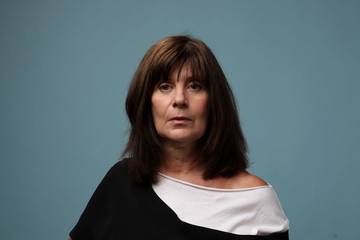





















 Renee Gladman Houses of Ravicka


 Now available in North America