DC's

The blog of author Dennis Cooper

Page 1056 of 1128

Gig #105: Drag City Showcase: Derek Bailey, William Basinski, Bonnie ‘Prince’ Billy, Dirty Three, Kevin Drumm, Flying Saucer Attack, Ghost, David Grubbs, The High Llamas, Bert Jansch, Magik Markers, Joanna Newsom, Nurse with Wound, Jim O’Rourke, Pavement, Pita, Stephen Prina, The Red Krayola, Royal Trux, Laetitia Sadier, Silver Jews, Stereolab, Sun Araw, Scott Walker, Wand

63492-popular-misconceptions-of-hypnosis-vikramjeet-sinha


Derek Bailey
William Basinski
Bonnie ‘Prince’ Billy
Dirty Three
Kevin Drumm
Flying Saucer Attack
Ghost
David Grubbs
The High Llamas
Bert Jansch
Magik Markers
Joanna Newsom
Nurse with Wound
Jim O’Rourke
Pavement
Pita
Stephen PrinaThe Red Krayola
Royal Trux
Laetitia Sadier
Silver Jews
Stereolab
Sun Araw
Scott Walker
Wand


__________
Derek Bailey Paris [Pt. 2]
‘Aida, consisting of two live recordings from 1980, captures Derek Bailey on the cusp between his early-career thorny and more drastic explorations of the outer limits of guitar playing and the subtler, softer (though no less idiosyncratic) approaches he would often employ later on. Throughout his career, Bailey has championed what he calls “non-idiomatic improvisation,” an attempt to improvise without reference to any pre-existing musical styles. While perhaps impossible to achieve 100 percent, he has certainly made it difficult to describe his work with the normal allusions and comparisons to that of others. The first track on Aida, “Paris,” is a gorgeous and relatively smooth excursion in Bailey’s sound-world. One imagines that if England had a tradition of koto accompaniment for Noh plays, it might sound something like this. Not that there is an overt Asian influence, but the sparseness and careful choice of notes gives one a slight sense of both Eastern asceticism and luxury within that asceticism.’ — Brian Olewnick


_____________
William Basinski A Red Score in Tile [Part 1]
‘While certain passages foster an immersive, surface beauty, this is not ambience. The composerly patience of Basinski’s work is often trumpeted but his is an approach infused with subversive tension. Shorn of the metaphysical baggage attached to later releases, A Red Score In Tile must instead be addressed on its own, elementally harsh terms. It poses much more difficult and uncomfortable questions about the transient nature of the present than Basinski’s later work. These tapes sound tired, old rather than decaying. The entropic nature of the sound is less pronounced, yielding to an aura of fretful infirmity, worry for the future. The cruelty of time is an ever present theme and here it informs his approach to sound in the most unsettling of ways. In another notable work, 2003’s Melancholia, a genuflection towards Arcadian serenity is stalled by repetition. There is little inclination toward pastoralism for the younger composer, rather an eerily dissociative drift towards unconsciousness.’ — Daniel Baker


_____________
Bonnie ‘Prince’ Billy New Tibet
‘Oldham’s music is deeply attuned to the past and to the people we imagine inhabited it, yet his actorly approach separates him from the mainstream Americana crowd, who tend to favor a more autobiographical approach, or at least some sense of direct confessionalism. Oldham’s songs are only obliquely about himself, and they rarely reveal much about the man singing them. “As boys, we fucked each other,” he sings at the beginning of “New Tibet”. “As men, we lie and smile.” In other hands, such a line might deliver a shock to interrupt the lull of the music, but Oldham never breaks character. That f-bomb becomes part of the lull, and is not so much sung as ruefully breathed. The song possesses all the ruminative gravity of “I See a Darkness” and in tone and character could be interpreted as a sequel.’ — Stephen M. Deusner


____________
Bill Callahan Thank Dub
‘Whatever the word dub means to you, chances are Bill Callahan’s version won’t match it. Have Fun With God is dub in the root sense of a double: essentially, it’s a cubist remix of his 2013 album Dream River, fracturing the surface of each song the more strikingly to communicate the emotion at its core. Thank Dub inhabits an eerie parallel universe to Dream River’s opening track The Sing, itself a song about a man trapped within a lonely parallel universe of hotel bars and sleeping strangers. Lyrics are elided, the guitar slides around icily, while the ghost of a mandolin blows in on a breeze. Where Javelin Unlanding is playful, sweet even, its remix, Expanding Dub, is more choppy and enervated, with hints of Ry Cooder in its spaciousness. In the shift from Summer Painter to Summer Dub, Callahan whips up a guitar-and-cymbal storm so crashingly fraught, you believe the song’s narrator actually is a sorcerer with weather at his command. As a standalone album, Have Fun With God doesn’t totally compel – but as a companion to its source material, it’s fascinating.’ — Maddy Costa


____________
Dirty Three You Greet Her Ghost
‘A genre rife with hollow oversaturation, instrumental rock runs the risk of sounding either stunningly frank or wantonly pretentious. On Toward The Low Sun, Aussie post-rockers Dirty Three have yet again achieved a beautiful post-rock sound both ingenuously carefree and wisely tempered, an impressive feat this far into their careers. Painting with their usual diverse palette of folk harmonies and jazz grooves, the Melbourne trio continue to show that they’re not afraid to add a little noise to their canvas. Jim White, Mick Turner, and Warren Ellis play with a focused spontaneity akin to Do Make Say Think, as on tumultuous opener “Furnace Skies”, an aptly-titled prog-rock storm similar to what defined the group in their earlier days. However, as Toward The Low Sun evolves, these clouds constantly part, making room for welcome warmth.’ — David Dilillo


____________
Kevin Drumm Organ
‘Minimalism has come to mean so many different things that it’s nearly meaningless; what do Charlemagne Palestine’s keyboard-battering sound clouds and Philip Glass’s densely layered, remorselessly rhythmic operas really have in common besides a name? On Comedy, Kevin Drumm resurrects the genre’s seminal impulse by extracting rich musical ore from limited veins of sound. The CD splits into three parts. “Organ” and “Organ Returns (Slight Difference)” open and close the disc with 15-minute blasts of foundation-crumbling noise obtained by shifting between two unequally distorted organ chords. Their effect is paradoxically meditative, like being lulled into a trance by the roar of an unmuffled internal combustion engine. In between lie four investigations of electronically generated sine waves that would warm the heart of any Pan Sonic fan. Whether they’re composed of piercing tones, like “Second,” or serene pulses, like “Just Like a Parvenu,” each mesmerizing piece teems with microscopically variant details.’ –– Bill Meyer


____________
Flying Saucer Attack Respect
‘Flying Saucer Attack was at the forefront of Bristol, England’s fertile mid-‘90s scene that included Massive Attack, Portishead and Amp. FSA mainman Dave Pearce indulged his love of krautrock, traditional British folk music and a post-shoegaze ambient aesthetic to forge records of uncommon beauty and passion. Nowhere near as fuzzed-out and lo-fi as its four predecessors (Pearce, who’d been wrestling with depression, claimed it marked his “second phase”), New Lands was still unmistakably FSA, from pulsing waves of treated and feedback guitar to massive, cresting dynamics to Pearce’s hushed vocals. New Lands is also fantastically vertiginous in the best, most My Bloody Valentine-esque sense.’ — Magnet


_____________
Ghost Caledonia
‘Masaki Batoh, vocalist and spiritual leader of Japan’s enigmatic collective Ghost, has a stated aversion to such mundane activities as recording and touring, with his interest in music almost entirely limited to the moment of creation itself. As a consequence, the increasingly infrequent arrival of a new Ghost album has begun to feel like a monumental event. Such is certainly the case for In Stormy Nights, the group’s first collection of new material since its majestic 2004 prog-epic Hypnotic Underworld. Throughout their mystery-steeped, two decade-plus career, the members of Ghost have steadfastly refused to acknowledge divisions between their seemingly incompatible styles of psych-folk, Krautrock, free jazz, and a limitless variety of indigenous Japanese and world musics. On their latest tablet from the mount, Batoh and a core sextet that includes veteran psych guitarist Michio Kurihara, multi-instrumentalist Kazuo Ogino, and percussionist Junzo Tateiwa have again decided to move their sound outward in all directions at once. In Stormy Night progresses with a solemn yet utterly savage authority, with its turbulent mixture of organic stoner-folk, cumbrous experimentation and near-martial rhythms sounding like an invocation to counteract the government-led turmoil of its times.’ — Matthew Murphy


_____________
David Grubbs Ornamental Hermit
‘There is something endearingly cheeky about the way Drag City describes David Grubbs’ releases for the label as his pop albums. Little on Grubbs’ latest release will likely register as pop music, at least for any listeners who might reasonably expect that description to mean hooks, choruses, or hummable melodies. At the same time, Grubbs’ overall body of work is so expansive and unwieldy — bridging as it does various streams of avant-rock, multi-media art, and academia– that it would be a challenge to find any particular box to squeeze him into. On his first solo album since 2008’s An Optimist Notes the Dusk, there are guitars, some song-based material, vocals, and recognizable lyrics, so perhaps pop music is as good a description as any, eccentric and deconstructed though it may be.’ — Matthew Murphy


____________
The High Llamas Jackie
‘Now that Sean O’Hagan and his baroque indie pop cohort are thirteen albums deep, it’s a couple spins shy of disorienting to revisit the Crowded House-isms of their 1992 breakthrough, Santa Barbara. The High Llamas we’ve known since then essentially re-booted with their 1995 follow-up, Gideon Gaye, and, autumnal and reflective as their music can be, they haven’t done much looking back since. On the surface, Here Come the Rattling Trees is easier than a Sunday morning, but O’Hagan arranged a unique set of guidelines for himself en route to its creation. Specifically, he decided that before he could release anything new, the material would first have to come to life in theatre. Here Come the Rattling Trees is not a stand-alone album, but ‘music from the original stage production’, which was performed in 2014 at both the Tristan Bates Theatre in Covent Garden and the Montpelier Theatre pub in O’Hagan’s stomping ground, Peckham. Briskly brushed drums, cobblestone-stepping guitar strokes, and pastel keyboard and vibraphone accents fill in the story of Peckham-based publicist Amy, who learns about the history and character of the district through interactions with five of its citizens.’ — Ian King


____________
Bert Jansch Katie Cruel
‘In an inebriated interview with Rick McGrath in 1970, Bert Jansch, a 26-year-old guitarist busy with British folk compatriots Pentangle, reclaimed folk dogma: “We never talk about music, never. You talk about everything else, but never music. The only time we ever talk about music is to say, ‘Let’s have a rehearsal’ and that’s it. We get together and play.” Recorded some 40 years after his first two brilliant albums on England’s Transatlantic Records, The Black Swan isn’t exactly a comeback. Jansch has been working all along, releasing nearly a dozen albums since 1990. For this generation, however, it is Jansch’s popular come-out: From Devendra Banhart to Ben Chasny, many principles of the indie roots resurgence have credited his complex playing and artless vocals as touchstones. That it’s his Drag City debut and his first new material to see proper U.S. release since 2002’s Edge of a Dream only increases its marquee billing and possible importance.’ — Grayson Currin


____________
Magik Markers Crebs
‘After four years away from action (save for Pete Nolan’s fabulously underrated Spectre Folk side project), Magik Markers return with Surrender To The Fantasy, a sprawling distillation of folk noise and unhinged verse over the course of nine disparate songs. Neu! fuzz-groove? Sunkissed anti-folk? Truxian curled lip, bummer vibes? Settle in, fellow traveller. The first blush of many past encounters (over the course of 40-some singles, cassettes, and burns) with Magik Markers has been one of sheer onslaught, a cathartic dive into the depths of Elisa Ambrogio’s quest towards the real — which always seemed to aim for confrontation vs. establishing any sort of connection. At worst, their basement rumblings seemed unfocused, or worse, uncaring, a hastily assembled, end-of-semester MFA project. With Surrender, the obfuscation and intimidation gives way to beauty, and confrontation transforms into liberation, bringing forth the most focused, coherent work of their existence.’ — Jerry Dannemiller


______________
Joanna Newsom Sapokanikan
‘Joanna Newsom’s Divers is an album about a profound love, but it hardly features any love songs. The singer/songwriter recently explained to Uncut that her marriage in 2013 had invited death into her life, “because there is someone you can’t bear to lose,” she said. “When it registers as true, it’s like a little shade of grief comes in when love is its most real version. Then it contains death inside of it, and then that death contains love inside of it.” There is only one domestic vignette on the record, towards the end of “Leaving the City”, where Newsom and her love go running on a beautiful day. Immediately, though, her high dims: “The spirit bends beneath knowing it must end.” 2010’s Have One on Me traced the death of a relationship as Newsom tried and failed to defeat a proud man’s human nature. On Divers, she attempts to defeat time to stave off death.’ — Laura Snapes


_____________
Nurse With Wound Cold
‘This album really isn’t for all tastes, and those coming to the world of Nurse With Wound from the more popular world of industrial music (á la Ministry or Nine Inch Nails) will find it puzzling at best. Fans of soundscape will find this far more entertaining, with drones punctuated by random staccato busts of percussion, origins uncertain, bleeps, and bloops thrown in for good effect, and the occasional hooting and hollering.’ — Sean Carruthers


______________
Jim O Rourke Insignificance
‘While generally less envelope-pushing then his more difficult-to-find work, O’Rourke’s string of Drag City releases have always served as an opportunity to try on an assortment of masks. Bad Timing was the John Fahey tribute; Eureka the ode to the lost days of grand Bacharachian orchestration; Halfway to a Threeway a short but pleasant acoustic interlude; and now– judging from the opening moments of Insignificance– we’d reached Jim O’Rourke’s rock n’ roll phase. The lyrics on Insignifigance initially seemed to be those of a man overestimating his own importance, even as the album title suggests otherwise. Pleas to the public to “get off my case” may work for Thom Yorke, but Jim O’Rourke, talented as he might be, hardly carries the kind of cache for distressed-woe-is-me-rockstar-anthems. Maybe labeling the package Insignificance is intended as a signifier that O’Rourke is in on this joke. Maybe the title is intended to suggest that we’ve been taking the music, the lyrics, and the bold statements a bit too seriously. But, self-aware or not, lyrics like these come across as more than a bit self-indulgent, which makes the music, at times, that much more difficult to embrace.’ — David M. Pecoraro


_______________
Pavement Baptiss Blacktick
‘Prior to Pavement signing with Matador and releasing Slanted and Enchanted the band recorded three EPs: Slay Tracks (1933-1969), released on the band’s own Treble Kicker label in 1989, Demolition Plot J-7, and Perfect Sound Forever, both released in 1990 through Drag City. With the success of S&E on Matador Records, Drag City compiled the band’s first three EPs along with the “Summer Babe” single, “My Radio” from the Chemical Imbalance compilation, and “My First Time”, originally a flexidisc in the fanzine Ablaze!, releasing it under the title Westing (By Musket and Sextant). Preserving the integrity of the original EPs, Westing features all the songs in the same order with the first two EPs on Side A and the remaining recordings on the flip side.’ — Len Comaratta


____________
Pita 3 (Get Out)
‘The second album from laptop noise pioneer and Mego co-curator Peter Rehberg saw the producer in a very weird place indeed. After the worldwide success of his debut record ‘Seven Tons for Free’, which won the ARS Electronica Prize for innovation in new music he spent the years after its 1996 release touring the world, laptop in hand and splitting the ears of innocent bystanders everywhere. It became harder than ever then for Rehberg to find the time to sit down in a studio and make music, so ‘Get Out’ was mostly pieced together on the road, in friends’ houses, on the train, on the plane, in airports or in hotel rooms. The focus then is rather different than the debut album and sees our protagonist take us on an occasionally torturous, occasionally beautiful and always intriguing journey through deftly manipulated electronic sound. For many noise artists ‘Get Out’ would become the blueprint for their musical development – Rehberg’s collision of harmony, structure and improvised crushing power electronics left the experimental world heaving and gasping in its wake, and since its release in 1999 hasn’t dated even a little. I guess it’s true to say that genuinely experimental music rarely dates, but the seismic impact that ‘Get Out’ had on electronic music can still be felt now.’ — Boomkat


____________
Stephen Prina The Achiever
‘Produced by David Grubbs and Jim O’Rourke, Stephen Prina’s solo debut falls somewhere between the experimental sound of latter-day Gastr del Sol efforts and classic West Coast pop. Featuring collaborations with diverse figures ranging from writers Dennis Cooper and Lynne Tillman to the Sea & Cake’s John McEntire and Sam Prekop, Push Comes to Love is both smart and breezy, although it’s occasionally a little too self-conscious for its own good.’ — Jason Ankeny


______________
The Red Krayola Stil de Grain Brun
‘The Red Krayola were one of the greatest psychedelic bands of the 1960s and probably of all times. They played extremely wild and cacophonous music that was decades ahead of its time. They predated Germany’s expressionistic rock (Faust) and the American new wave (Pere Ubu). Their “freak outs” were closer to John Coltrane’s free-jazz and to Jackson Pollock’s abstract paintings than to rock and roll. Their leader, Mayo Thompson, is a composer who ranks among the greatest living musicians (classical, jazz, rock). His revolutionary compositional style had few stable coordinates. His pieces float not because they are ethereal but because melody and rhythm are left “loose”. They are organisms that rely on supporting skeletons that are falling apart as they move. Thompson placed his art firmly in the iconoclastic tradition that Frank Zappa had just founded, and simply increased the amount and the speed of noise. Parable Of Arable Land (1967) is one of the milestones of rock music, a carousel of savage harmonic inventions/sabotages. God Bless (1968) was even closer (in spirit if not in sound) to the likes of Edgar Varese and John Cage. It is not a coincidence that Thompson was rediscovered by the new wave ten years later: his Soldier Talk (1979) could have well been the album of the Pere Ubu (the band he eventually joined). As of 1997, none of the major encyclopedias and histories of rock music published in Anglosaxon countries mentioned them.’ — Scaruffi


______________
Royal Trux Sickazz Dog
‘In many ways Veterans of Disorder is the Trux more streamlined version of seminal albums like the Clash’s London Calling or the Beatles’ White Album because with each song the band hits on a different aspect of its sound. “The Exception” and “Lunch Money” raga as well as the Clash at their best. Meanwhile, “Sickazz Dog” is the Trux getting their “Revolution 9” on, replacing collage experimentation with strange instrumental passages that run right in to each other. “Sickazz Dog” can be interesting and some parts sound similar to Piper At the Gates of Dawn-era Pink Floyd but it mostly feels like experimentation merely for the sake of experimentation instead of in service of making a good song as interesting and weird as possible. This type of thing would work better on a longer album but since Veterans of Disorder is a lean ten songs; the Trux would’ve been better served to work out a genuine song here instead.’ — Eric Goldberg


_____________
Laetitia Sadier One Million Year Trip
‘For almost 20 years, Laetitia Sadier has been fronting the dazzlingly retro-futuristic Stereolab, and she’s also made room to indulge in a playful dream-pop side project, Monade. But The Trip, her first album under her own name, still feels like a coming-out party. Following Stereolab’s recently announced hiatus (the band’s upcoming Not Music was culled from the sessions for 2008’s Chemical Chords) and the disbanding of Monade, Sadier is finally on her own. She didn’t waste the opportunity: The Trip is breathtaking, a rich collection of torch songs and subtle, meandering melodies that clear away the distracting frenzy and Byzantine flourishes of her past groups to expose the humane beauty of her voice.’ — Rebecca Raber


_____________
Silver Jews I Remember Me
‘The Silver Jews have just released Bright Flight, the follow-up to 1998’s great American Water. Berman moved to Nashville to record Bright Flight, and the influence is apparent throughout the entire album. He’s absorbed the local country and alt-country scene, and integrated it with his own wry, lo-fi aesthetic to kick out ten new tracks of intelligent backwoods swagger. Stephen Malkmus doesn’t appear on the album so the sense of comradery that gave American Water so much life isn’t here, and consequently, Bright Flight sounds like more of a personal statement, mixing the cathartic grandeur of “Tonight’s the Night” with the striking imagery of early modernist poetry. Berman is a writer, first and foremost, who happens to write music, but doesn’t enjoy touring to promote it. As a result, the Jews don’t go out of their way to impress anyone. It’s this easy-going amiability combined with their frontman’s erudition that makes them so affecting.’ — Nathan Rooney


_____________
Stereolab The Long Hair Of Death
‘Rarely is a band as aptly named as Stereolab. Like a bunch of mad scientists mixing together their favorite musical ingredients, Stereolab has been producing avant-pop with such remarkable consistency and frequency that it raises the question of whether its members have lives outside the studio. Inevitably, any band as acclaimed and prolific as Stereolab is bound to attract its share of occasionally justified criticism: Some deride the band’s wholesale and unabashed appropriation of Neu!’s chugging riffs and the liberally borrowed exotica of lounge icons Juan Garcia Esquivel and Burt Bacharach. But Stereolab puts all these elements together in songs novel enough to serve as their own defense. More frustrating is the group’s tendency to release dozens of singles and collectibles in as many different hard-to-find forms as possible. After all, Stereolab has only been around since 1991, yet Aluminum Tunes is its third “Switched On” rarities collection, and a 25-track double-album at that. Surely the fact that Stereolab even deigns to compile its audio arcana shows that the band cares about fans who can’t otherwise find much of its music. The downside is that these albums inspire a frenzied rush to buy up the original issue of everything the band even breathes on, but the obvious upside is that, hey, there’s more Stereolab to go around. Aluminum Tunes brings together the whole of the 1995 Amorphous Body Study Centre installation piece, a handful of tour seven-inches, and a couple of remixes, as well as songs from the Emperor Tomato Ketchup, Mars Audiac Quintet, and Dots And Loops sessions.’ — Joshua Klein


_____________
Sun Araw Belomancie
‘The back cover of Belomancie reads “COMPOSED, PERFORMED, & PRODUCED BY CAMERON STALLONES.” A few years ago, that information would’ve been redundant, as Sun Araw began in the late 00’s clearly as Stallones solo project. But lately it’s been an expanding universe, incorporating various musicians into both studio and concert settings; he’s even referred to it as the Sun Araw Band. This ensemble has morphed so much that some iterations took on new names—Turban Chopsticks, Duppy Gun, The Celebrate Music Synthesizer Group—suggesting Stallones is increasingly interested in subsuming his personality into a larger collective. So, suddenly, it’s surprising that he would make a Sun Araw record by himself.‘ –– Marc Masters


_____________
Scott Walker Tilt
‘Combining elements of industrial music (most prominently on “The Cockfighter”) with minimalist and avant-garde forms, Walker’s reverb drenched, other worldly voice takes centre stage-much as it did on his early records-but instead of being backed by lush orchestral arrangements, it hovers precariously over carefully constructed blocks of sound that somehow manage to turn their repetitive nature into a highly positive aspect of the album’s nine compositions. Songs that, though generally dark and brooding in nature, assume a dream-like quality that captivates listeners and binds them into a transient state. Moods rise and fall with the most subtle changes in instrumentation, as out of discord and despair, hope arises like a phoenix before plummeting back down into the depths once more. The compositions feel fragile, human, as though the slightest touch could knock them off balance at any moment, but listeners await a disaster that never comes with bated breath. Walker has created something as vicarious as it is beautiful, and it simply must be experienced by any serious music lover.’ — James Paton


_____________
Wand Stolen Footsteps
‘1000 Days is a heartening record, a record that sees a young band picking up steam, playing with their influences more deftly than on their prior LPs, and bringing a thoughtful approach to old and well-traveled sounds. There’s enough interesting moments on 1000 Days to hold onto these songs, go back to them, and explore within them. That’s more than many of their cohorts within the cluttered and long-trendy field of psychedelic garage—there are hundreds of disposable tape-label bands with little to say out there, and it’s wearying to search through all that crud for the occasional gem, which does exist—have to offer.’ — Jes Skolnik


*

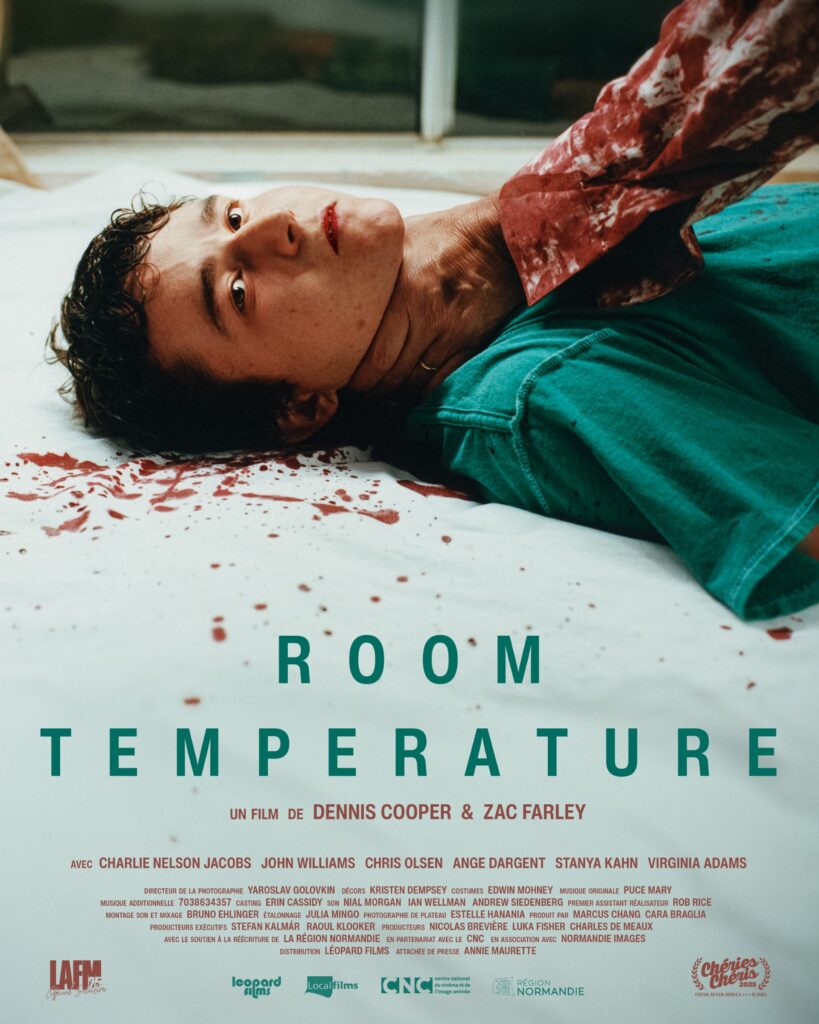
p.s. Hey. I guess it’s Thanksgiving in the land where I was born, so, if you’re there, do enjoy fulfilling its duties or avoiding them as the case may be, and, if you’re elsewhere like me, hey as usual. ** Dóra Grőber, Hi, Dóra! Yes, patience. I’m pretty good at that, relatively speaking, once I get over the initial ugh, which I’m starting to be. Precisely re: the acceptance and acknowledgement and representing of trans as an identity finally, so, yeah, fingers very crossed that interesting occasions will arise for your entry into acting, and do let me know what happens and what happens before anything happens even. If you’e a cake slut (like me), you will enjoy the buche beauty pageant post for sure. No, there’s no exhibition of them, just announcements and photos online and then trips around the city to shops and hotel restaurants and so on to see what they look like in person. It’s a treasure hunt. They’re usually made in limited editions of, like, 100 or less, and they’re often quite expensive, so it’s not like you can stock up an on a bunch of them. For instance, I saw a photo of one, and I thought, Ooh, that’s the one I want, but then I looked at the price: 280 Euros! So, definitely not. I hope you had fun with your friend yesterday. I mostly worked, and I went to SACD, which is this organization that handles the royalties for writers in France who work in theater and film and stuff, because there was some kind of glitch in my case, and now everything’s cool, and I’ll be getting a bunch of royalties for my work with Gisele Vienne that have been clogged up for a long time, so that’s obviously good! Have a lovely, lovely day! What happened? ** David Ehrenstein, Hi. Hm, I wonder what the Bresson article is. It’s locked, at least for me. Does Skolimowski not live in LA anymore? Right, I forgot that he’s in ‘Mars Attacks!’ I love that film. ‘Barrier’ is great, yeah, and ‘Le Depart’ too. Thank you for your wisdom! I didn’t know there’s a new Mike Mills film. And I didn’t realize that Annette Bening is still acting. Huh. ** Jamie, Happy day, sir! My day was productive. I guess that’s the best word for it. Lacking exciting headlines, but not bad. Your meeting is today, isn’t it? Am I remembering right? If so, incredible great luck with that, and let me know how it went or how it felt if you don’t know how it went for sure yet. Fingers crossed onto a brutalist sculpture over here. I think ‘Deep End’ is a really good place to start with Skolimowski. I think you’ll like it. It’s very of its time and partly really good because of that. I’ll be rehearsing ‘Jerk’ pretty much all day, so that should be … well, maybe not fun but memorable or something. I hope the sun sets today on a happy you! Big love, Dennis. ** Tomk, Hey! Your story is up on Entropy! That’s so exciting, man! I can’t wait to read it, and I’ll do that either today or as soon as I’m finished with the ‘Jerk’ rehearsals that will eat mot of my today. Huge congrats, and I hope that’s the first of many, many contexts falling like dominoes before your awesome work. Everyone, D.l. Tomk aka the extraordinary and super original writer Thomas Kendall has a new story called ‘The Last Assignment’ just up on the great Entropy site, and getting to see Thomas’s work is a rare pleasure, so whatever else you do today, make the time to click this and read or at least bookmark his piece because it’s utterly guaranteed to be killer and a thing that you will be weaker without. ** Steevee, Hi. Those Skolimowskis plus ‘The Shout’ are probably my faves of his too. Okay, the language rewriting the brain thing is clearly enough to get me to watch ‘Arrival’ at the soonest opportunity. Thank you, sir, and I hope you enjoy your turkey or whatever the big table today holds. ** _Black_Acrylic, Hi, Ben. Amazing news indeed. That is one cheap flight, wow. Cool. Man, you should definitely go if it’s even remotely possible. It’ll be fun, and I think I can say from traveling with Zac’s and my film that there’s something really … I don’t know … legitimizing about being there to see your work shown in that kind of context and in being treated as its representative, its artist. Anyway, great, all except for being forced back into a collaboration with Andrew’s procrastinations or whatever his problem is. I hope he ponies up quickly and smoothly. ** H, Hi. I don’t think I’m good at taking care of plants. I never have them, and, if memory serves, I think when I had plants, they seemed to meet untimely deaths despite my best efforts to preserve them. No Thanksgiving here, no. Just another day. Which is perfectly fine with me. Have a good one. ** Right. Maybe you would like to escape or accompany your Thanksgiving, if that applies, or your normal day, if not, by attending this gig I made featuring select artists from the roster of the great American record label Drag City. Sound good? See you tomorrow.
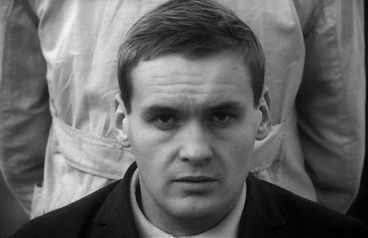
Jerzy Skolimowski Day

critique-walkover-skolimowski7-1

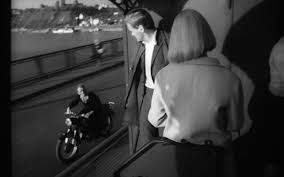
‘Jerzy Skolimowski has said that he makes films to please himself. Between 1964 and 1984 he completed six semi-autobiographical features (Rysopis, Walkover, Barrier, Hands Up!, Moonlighting and Success is the Best Revenge), a segment (in Dialóg) and two other features (Le Départ and Deep End) based on his original screenplays. Given his filmmaking origins it was always likely that he would have difficulty reconciling the intuitions so central to his filmmaking with the demands of international production. While living and working in as many countries, however, he also completed another six relatively big budget productions, including four international co-productions, between 1970 and 1992 (The Adventures of Gerard, King, Queen, Knave, The Shout, The Lightship, Torrents of Spring and Ferdydurke), all literary adaptations to which he applied a range of strategies while leaving a distinctive signature on each.

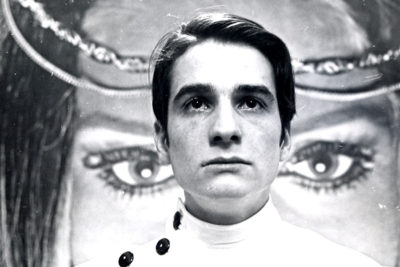
‘His first feature film Walkover has often been described as Godardian, although up to that time Skolimowski had not seen any of Godard’s work. The Czech new wave of Forman, Kardar, Passer, Schorm et al, was a clearer influence. By the time he came to make Le Départ Skolimowski had seen Godard films, most notably Pierrot le Fou and Masculin-Féminin. After Barrier he left Poland to make Le Départ in Belgium in French (which he did not speak) with the two leads (Jean-Pierre Leaud and Catherine Duport) and the cameraman (Willy Kurant) from Masculin-Féminin but cast “because they were simply available”. A light film rather than a comedy, Le Départ, for Skolimowski, “does not have the serious layers that I like in my work”. There is not a great deal of substance in the satire on consumerism. The flamboyant visual style and the percussively jazzy score by Komeda keep the play on surfaces rather than evoking layers of meaning. It is, however, not without autobiographical elements, Skolimowski drawing upon some youthful experiences in the theme of the hero’s coming to maturity as he pursues his dream of becoming a champion rally driver. His obsessive drive for a high-powered car to play the ‘game’ masks his romantic feelings.

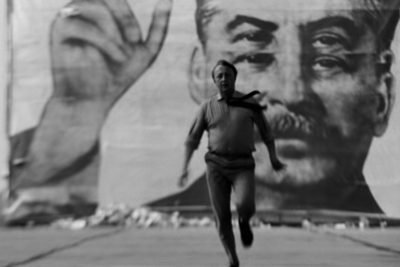
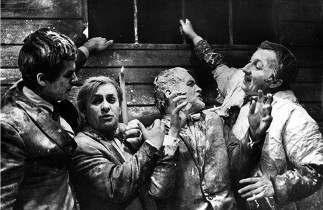
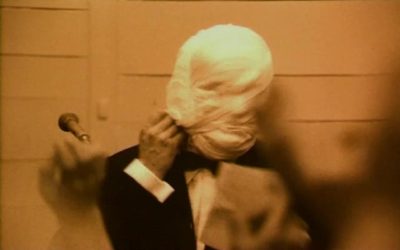
‘Skolimowski returned to Poland to make Hands Up!, the third film of the Andrzej trilogy and the fourth of his Polish sextet. A psychodrama following an ex-student reunion, it comes across something like a performance piece. The ‘happening’, as Skolimowski calls it, is staged in a railway cattle truck by four ex-students, now doctors in the grip of middle-aged conformity, with Skolimowski (as Andrzej, although continuity with Andrzej in the previous film is by no means exact) acting as a kind of master of ceremonies. If Barrier was a ‘polemic’ Hands Up! was, in the director’s words, “a silent scream…a provocation delivered to 32 million Poles about what is wrong” and, by implication, a ‘shout’ for change accusingly directed at Skolimowski’s generation. The strange ritual in the cattle truck, a location with obvious past associations and an uncertain destination, is filmed in sepia. Flashbacks to the participants’ student days are tinted green, signifying the contrast between early idealism and current disillusionment. Their conformity is a measure of how, in the Spring of 1967, the effects of Stalinism had seeped into their psyches.

‘After deploying relatively conventional shot duration in Barrier and Le Départ, Skolimowski here returned to the long take but, as appropriate for a theatrical ‘happening’, filmed in medium shot and close-up with a mostly stationary camera, movement confined to the panning camera and the shifting perspectives of the zoom lens.

‘Skolimowski has said that he was “fully aware that he was digging a hole in the system” when he made Hands Up! and knew that he was going too far. He was allowed to complete his film without any interference but then it was promptly banned. In 1980, at the height of Solidarity, Skolimowski was invited back to Poland to bring Hands Up! ‘more up-to-date’ with a view to releasing it. He removed more than a third of the footage and replaced it with film he had shot in London and Beirut (where he had been acting in Volker Schlöndorff’s Circle of Deceit) with intimations of a future military takeover in Poland. But the added footage does not particularly illuminate a film full of allusions, many of which would not be properly understood outside Poland. One can see, however, that a filmmaker’s normal reluctance to explain his film, combined with the poet in Skolimowski, meant that he would not likely have been satisfied with something so prosaic as an explanatory preamble locating the film in its time as an allegory on the effects of Stalinism.

‘In this form Hands Up! was shown at Cannes in 1981 reportedly running 90 minutes. It then disappeared from circulation to finally emerge in 1985 cut to 79 minutes including the new prologue of 25 minutes. What is left is a hybrid of 54 minutes of the historically resonant original and a prologue of fragments resembling a film diary combined with staged footage. This ‘political pamphlet’ (as a Variety reviewer called it) does not really live up to Skolimowski’s repeated claim that it is his best film. But, taking everything into account, it has strong claims, even in its present form, to be the most politically audacious film of a filmmaker given to risk taking and a key link in the chain that forms his Polish sextet.

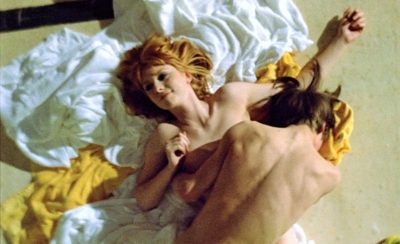
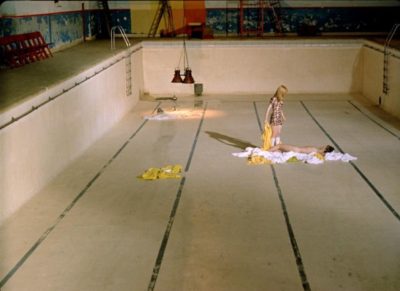
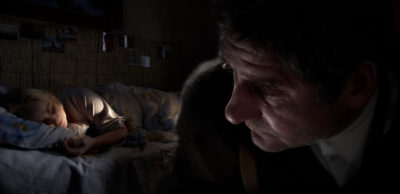
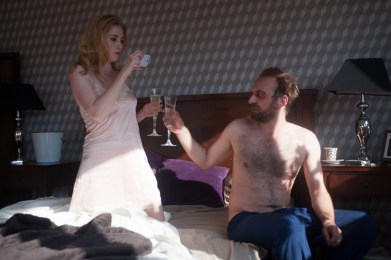
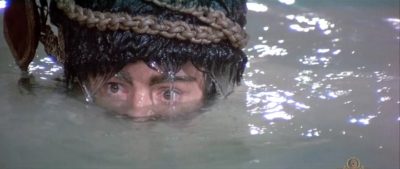
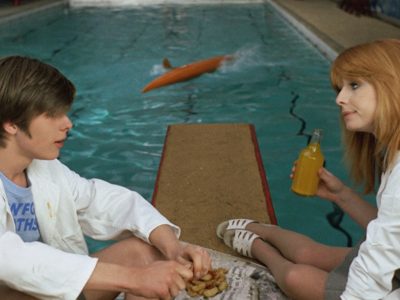
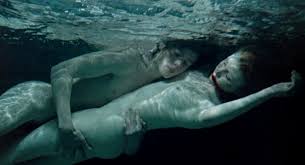
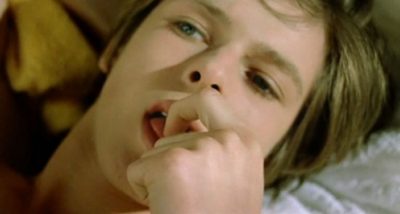
‘Deep End (1970) was Skolimowski’s second non-Polish feature to be based on his own original screenplay. This connects it more to his personal Polish films than to his literary adaptations. Like those films the scenario was largely improvised on the set and the free use of the handheld camera adds further to the improvisatory feel. The coming of age storyline bears thematic similarities to Le Départ although the characters are quite different. Skolimowski’s blend of romanticism and a detachment bordering on cynicism, found especially in his first two features, coalesces around the figure of the naïve, questing adolescent hero (John Moulder-Brown), sexually obsessed with fellow employee (Jane Asher). Set in a run-down public swimming baths in London, it was actually filmed in Munich. The feeling of unreal impersonality is heightened to a surreal ambience, the comic edginess of frustrated sexual fantasy spilling over into unexpected tragedy as irrationality takes hold like the red liquid that washes across the frame arbitrarily at the beginning, precipitously at the end.

‘Of all Skolimowski’s films, Deep End most had the ingredients for a modest, or at least cult, success at the box office but was poorly handled by the studio. Frequently consigned to the bottom half of double bills, it soon disappeared from view. Coming on top of the failure of The Adventures of Gerard and the subsequent King, Queen, Knave (1972), both with mainstream budgets and stars, Skolimowski’s career as an international filmmaker went into eclipse until the critical success of The Shout (1978) then Moonlighting (1982), the fifth of his Polish sextet and critically and commercially his most successful film.

‘To look at Skolimowski’s work as a whole is to become aware of the limitations of applying labels to any or all of his films. Michel Ciment has compared him to a jazz musician, “all rhythm and improvisation”. He has most often described himself as a poet. As Skolimowski has acknowledged, the film that comes closest to ‘poetic’ is Barrier, narratively his most fragmented work and also his most symbolic. Yet he claims that he never thinks in symbols and that “everything emerges concretely and spontaneously without conscious interpretation”.

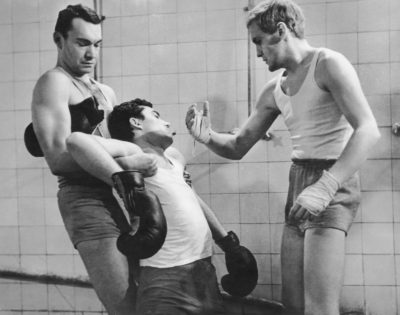
‘With the restlessness and resourcefulness of an accidental tourist that also brings Raul Ruiz to mind, Skolimowski has produced a body of work located on the margins between the surreal and the absurd. He evokes the often unsettling ambivalence of objects and, through improvisation and poetic association, seeks a layering of mood and meaning. His is a cinema of irony ambiguously played out, often in simulated performance spaces—a deserted boxing ring, an empty cattle truck, a drained swimming pool, a London bus, the claustrophobic lightship and a baroque city of Venice—located between reality and fantasy where the real shades into metaphor. Yet if the sense of paradox—of passive engagement and aggressive reticence—most often prevails, to adapt one of the key lines from his poetry, romantic impulses also manifest themselves, a measure of the continuing strength of his Polish inheritance.

‘Skolimowski’s place in the canon of Great Directors rests centrally on Walkover, Deep End, The Shout and Moonlighting. Of these, Walkover remains his most defiantly original work, resistant to labels other than perhaps the contemporaneous one of ‘new’ or ‘second wave’ cinema. In this it shares a seminal place with the likes of Before the Revolution (Bernardo Bertolucci, 1962), Yesterday Girl (Alexander Kluge, 1966) and The Tragedy of a Switchboard Operator (Dusan Makavejev, 1967), films that ‘opened our eyes wider’ in a state of sublime surprise.’ — Bruce Hodsdon


____
Stills

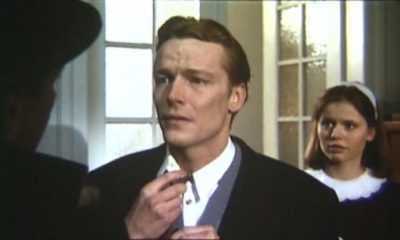
deep-end-1971-3
deep-end
deep-end4
01-erotyk-erotique-jerzy-skolimowski
01-start-depart-le-departure-the-jerzy-skolimowski
01-walkower-walkover-jerzy-skolimowski-licencja-sf-kadr
02-cztery-noce-z-anna-four-nights-with-anna-jerzy-skolimowski
03-fucha-moonlightning-jerzy-skolimowski
04-cztery-noce-z-anna-four-nights-with-anna-jerzy-skolimowski
04-erotyk-erotique-jerzy-skolimowski
07-cztery-noce-z-anna-four-nights-with-anna-jerzy-skolimowski
11_minut_skolimowski_11
11-minutes-1
fot. Robert Jaworski tel. +48 501 37 22 40
101_392x221
233_2048x1152
651_2048x1152
698ce6dcba331f80ba6a1c70181fe3c5_xl
915_392x221
992fa3a743a71ed2bbd037409ee6a60c
6018
132043b
8253315
1456098117303
barrier-1-polishfilmarchive_lowres-detail-main
big_1409269907_1382467067_image
cfd0629-shout-g006_large
crd4zdkwsaqyni5
critique-walkover-skolimowski8
Deep End
descarga-2
essential_killing
essential-killing-movie-photo-01-550x297_1301947397_crop_550x297
essentialkilling1
ferdyduke
ferdydurke1
four-nights-with-anna
g65
g126
hands-up
images-1
images-2
images
innocent-sorcerers
jerzy-skolimowski-two1
l-ours-sort-du-boism51439
le-depart-1967-1
le-depart-1967-2
maxresdefault
rece-do-gory-1981-2
rysopis-skolimowski-fn-7
rysopis-skolimowski-fn-9
skolimowski-bariera1966
success-is-the-best-revenge-1984-001-boy-corner
the-shout-2
theshout4
theshout6
travail-au-noir-jeremy-irons-2-png
tumblr_n76sbwmlk61ql8b6oo1_500
tumblr_nw8hwsqor81r7ixnko1_1280
tumblr_o3v0vqlps41tfb1vyo1_1280
vincent-gallo-dans-essential-killing-de-jerzy-skolimowski
walkover


____
Further

Jerzy Skolimowski @ IMDb
Where to begin with Jerzy Skolimowski
Polish/English JS Website
To Be Aesthetic and Not Boring: An Interview with Jerzy Skolimowski
The Radical Visions of Jerzy Skolimowski
‘I had a wild life’
Jerzy Skolimowski: The Cinema of a Nonconformist
‘This Killing was nearly the death of me’
Diamonds in the snow: the bizarre beauty of Polish director Jerzy Skolimowski’s films
Jerzy Skolimowski’s Output as Essential Viewing
Le cinéma de Jerzy Skolimowski : l’art du plaquage polonais
21 Ridiculous Truths Of Jerzy Skolimowski
Ideology and the western in Jerzy Skolimowski’s Essential Killing and Jim Jarmusch’s Dead Man
THE VISUAL SONORITY OF FRANCIS BACON’S PAINTING IN JERZY SKOLIMOWSKI’S “THE SHOUT”


_____
Extras


Roman Polanski and Jerzy Skolimowski discuss getting KNIFE IN THE WATER past the Polish censors


Interview – Jerzy Skolimowski (WALKOVER, 1975)


Jerzy Skolimowski in ‘The Avengers’


London Film Festival chat with Skolimowski about his film 11 Minutes


Jerzy Skolimowski Asks For More Films On Immigrants


_______
Interview

6a30df4f-7641-4cc5-9a83-407fe1b26b16_900x

NOTEBOOK: Where are you right now?

JERZY SKOLIMOWSKI: I’m at my retreat in the wild forests of Masuria, which is the northern part of Poland… Hopefully, I’ll finally be able to paint something. Painting is my other passion. For two years now, I did not paint a single painting.

NOTEBOOK: We thought that Essential Killing felt more like paintings than any of your other films did. Was that a conscious decision on your part?

SKOLIMOWSKI: Actually, I believe those are two completely different matters… Making a movie is kind of like working in a factory, with an ensemble of people, and everybody having some input. The director coordinates the efforts and takes what’s best from other people… And I feel responsible for the budget, for the return of the investors’ money. When I’m painting it’s more of a “Zen” experience… Here, I’m the real artist.

NOTEBOOK: You wrote poetry before you made films. We were wondering whether poetry was an influence on your early work and whether there were any poets in particular that you admired.

SKOLIMOWSKI: I’ve always admired T.S. Eliot. He is my favorite poet of the whole history of poetry. The poetry which I was writing in my youth taught me the use of metaphor. That’s visible in my films, and in my paintings as well.

NOTEBOOK: The idea that you mentioned earlier, about having complete creative control in painting, reminded me of Hands Up. In the prologue of that movie [shot in 1981 —ed.], painting seems to offer you a sense of liberty that you can’t get from politics. Is that something you still feel?

SKOLIMOWSKI: Yes, but as I said before, somehow I separate painting from the filmmaking. It’s a completely different process. I wouldn’t say that my framing in films is mirroring my images in painting.

NOTEBOOK: How long does it take you to paint a picture?

SKOLIMOWSKI: Sometimes the work goes very fast. My way of painting is that I improvise all the time. When I wake up in the morning and I feel like I have an appetite for painting, an appetite for a certain color or technique, I simply go for it. I start throwing some colors on the canvas and get submerged in the process. I’m not trying to fulfill any rigors, any pre-conceptions. It’s all happening in real time. And it’s actually almost out of the control of my consciousness. The only important thing is knowing when to stop…. When I film, I know exactly what I want and I am executing it to my best knowledge. When I’m painting, I let it go.

NOTEBOOK: Do you prefer painting to filmmaking?

SKOLIMOWSKI: Painting suits my psychological needs better. I don’t like to command people. I don’t like to execute my privileged position as a director. I don’t like to manipulate people, and, unfortunately, when you’re making a movie, you often have to manipulate people. You have to find a way to get the best from them.

NOTEBOOK: If you’ve found that you prefer painting to filmmaking, then why make films?

SKOLIMOWSKI: It’s difficult to make a living out of painting, and since I paint large-sized [canvases], there are not too many of them. Working on a film is economically much more rewarding. And also, I know that I have a certain talent for filmmaking, and I shouldn’t be wasting it. [jokingly] I prefer painting, but from time to time I have to suffer and go make a movie.

NOTEBOOK: I’m curious as to what’s drawn you to the subjects of your films. Because your focus seems to shift over the course of your career. In the films you made in Poland in the Sixties, they seemed to be tapping into your experience as a young man… Later on, you start adapting novels, and your stories don’t seem as autobiographical.

SKOLIMOWSKI: That’s true. Usually, my best films are based on original scripts. I must say I’m not particularly fond of my adaptations, which were always work for hire.

NOTEBOOK: Which ones aren’t you fond of?

SKOLIMOWSKI: My adaptation of a Turgenev’s story, Torrents of Spring (1989) for example, or Nabokov’s novel King Queen Knave (1972). I’m not fond of the film I made nearly twenty years ago, which actually stopped me from making films for another 17 years, a film called Ferdydurke (1991). It was an adaptation of the Polish writer [Witold] Gombrowicz. I was making too many compromises. This film was a Euro-pudding: a linguistically complex Polish novel shot in English with a cast of French ladies, English men, Scottish men, even one American actor, Crispin Glover. It isn’t a bad movie, but it didn’t really satisfy me artistically. I decided I had to take a break and devoted my time entirely to painting. I thought it would take me three or four years, but it ended up taking 17 years, because I started to make a career as a painter. My work started to be exhibited all around the world; some museums were buying my paintings, as well as some private collectors. It was quite satisfying and it kind of allowed me to regain ground as an artist. With that feeling I was able to come back to filmmaking, and I returned to Poland to make a film called Four Nights with Anna (2008).

NOTEBOOK: I like that film very much.

SKOLIMOWSKI: I like it, too. What was quite peculiar about this film was that I shot it all around my house. I [had] spent nearly twenty years in Malibu. I had a very beautiful house there which I decided to sell a couple of years ago to buy this 19th century hunting lodge deep in the forest in the north of Poland. I’m completely isolated from civilization here.

NOTEBOOK: Are you enjoying that?

SKOLIMOWSKI: Yes! Can you hear the silence? I’m sitting on the porch outside, and you can’t hear anything but wild birds! The nearest town is more than 40 kilometers away. Anyway, I managed to shoot Four Nights with Anna around the house, and it was very convenient because I could spend the nights in my own bed. I didn’t need to be driven a couple of hours in the early morning to reach the location where we were shooting—I was just stepping out of the house and making a movie. I really don’t like hotels, or wasting time in traffic, so I was looking for a subject that would be suitable for another film in the forest around my house.

NOTEBOOK: That’s where Essential Killing came from?

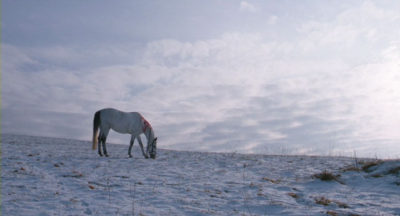
SKOLIMOWSKI: I knew about the CIA planes landing in a nearby military airport from the press, and that prisoners from the Middle East were allegedly being brought into this secret base not very far away from my house. Instinctively, I refused to think of this as a subject of my next film because of its political context, as I don’t consider myself a political activist. Until one night in the winter, when I was driving back home on a forest road—very slippery—and I nearly fell into a kind of ravine. I stopped at the very last moment, and I realized that I was right next to the airport, and on the only road connecting the airport with the secret base. And I thought, “Damn, this is the road! If the prisoners were really here, they would’ve been traveling this exact way.” And since I nearly fell into the ravine, it could just as well happen to a vehicle in the convoy. And if that happened, there would be a great possibility that a prisoner could have escaped. At that moment, I thought, “This is it. This is the story I want to tell.” A man who has no idea which part of the world he’s been thrown into, who is facing the snow for the first time in his life, handcuffed and shackled, wearing a thin orange uniform fit for the desert, trying to escape into this wild, desolate landscape which he doesn’t know anything about. So everything that’s before that moment, the political context which is compressed to about 10 minutes in the film, I treat as a background for the story. It doesn’t matter if it’s this or that war, if it takes place in Afghanistan or Iraq or on the border of Pakistan. And it doesn’t even matter if this guy is a terrorist or a completely innocent man, because if you watch carefully [at] the beginning of the film, you will find a possibility that he is just a wrong man in a wrong place at the wrong time. What interests me is that this guy gets caught in these dramatic circumstances and is brought into this snowy landscape that is as far away from all he’s known as possible. By a strange turn of luck—or rather ultimate misfortune, as he will soon find out—he manages to escape. The film is about his struggle to survive.

NOTEBOOK: At this point, you’ve made more films outside of Poland than in Poland. You talked about being able to separate filmmaking from painting: are you able separate countries the same way? Or are you always Polish, regardless of where you are?

SKOLIMOWSKI: [With] my British films, especially Deep End (1971)…some critics wrote that it’s one of the most acute portraits of London of the time. Perhaps the eye of an outsider can sometimes see clearer. In fact, I’ve always had difficulties in belonging to any groups, organizations or movements. I’ve never felt an urge to become part of any herd.

NOTEBOOK: There’s something similar going on in Hands Up, where the 1967 footage feels pointedly from 1967 since you make it clear that you’re looking at them from the point-of-view of 1981. How do you feel about it now that even more time has passed since 1967?

SKOLIMOWSKI: The film was stopped by the censorship for many, many years—from 1967 to 1981, when Solidarity came to power. In 1981, when I had a chance to finally show the film to the public, I decided to shoot a prologue, half-an-hour long, which explains what happened in between, what were the reasons the release of the film was cancelled, how I was interrogated by the Communist secret service in Poland, and how I was forced to emigrate and lead a Gypsy life, going from one country to the other, trying to make films in Italy, Germany, England and eventually in Hollywood. I didn’t speak any language besides Polish when I left. My English at the time was non-existent. [jokingly] It’s still not good enough, as you can hear, but at least I can somehow express myself… In the prologue I wanted to show that process of alienation, and the frustration over having your creative work result in such a dramatic way on your entire life.

NOTEBOOK: Which films of yours do you feel most positively about today?

SKOLIMOWSKI: I feel very positively about Essential Killing, because I feel I managed to execute all of my skills, all my experiences [in it]—and also the fact that I took a risk of working with Vincent Gallo, and that the result of our work was so successful. I was the producer, I was the director, the screenwriter… Every choice was my own. Of course I owe a lot to my collaborators—my wife Ewa, who is my co-writer and co-producer; my D.P., my composer, my editors—but I think I kept it very strongly in my hands.


__________
14 of Jerzy Skolimowski’s 23 films

____________
The Menacing Eye (1960)
‘A man proves his masculinity at the cost of a woman. An important motif in the work of Skolimowski is born. Somewhere in a funfair, a man enters a small caravan wielding a knife. In the next scene, a man is practising throwing knives at a woman from a rocking horse. This short is no more than a student’s exercise or joke, but it reveals an important motif of Skolimowski’s work: a man demonstrating his maleness at the expense of a woman.’ — iffr


the entire film


_____________
Erotique (1960)
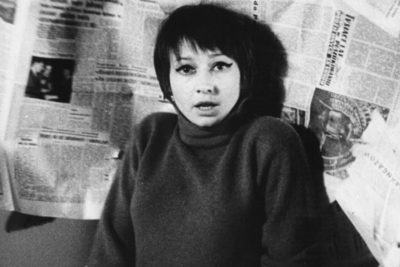
‘Although the promise of the Nouvelle vague was never fulfilled in Poland, the early features of Jerzy Skolimowski showed how to cut the umbilical cord to literature-based cinema. While still a rookie at the Łódź Film School, Skolimowski was an amateur pugilist and a published poet, but it’s almost impossible to find any traces of literature even in his short student films. His first student film, Erotyk, is three minutes long and set in an anonymous space festooned with newspapers, seeming like a denigration of the art of literature. The news sheets used to make up the labyrinthine set are a mere obstacle to the stalker (Gustaw Holoubek) and his victim (Elżbieta Czyżewska). Described by the author as a cinematic divertissement, Erotyk intrigues with a surrealistic verve that is highly reminiscent of several Polański shorts.’ — Krakow Post


the entire film


_____________
Walkover (1965)
‘While The New York Times critic Bosley Crowther criticised Walkover as “distractingly random and incoherent”, Michel Ciment, more sympathetic to Skolimowski’s love of jazz, argues that his films are made “in a manner very much like a jazz musician – all rhythm and improvisation”. The film’s use of cinematographic disjunctions, which are traditionally seen to encourage a critical awareness rather than a facile consumption of a narrative, is reminiscent of much European New Wave cinema. The crossing of the 180 degree line, the confusion between diegetic and non-diegetic sound created through Andrzej’s radio, and the setting of characters against abstract surfaces, is reminiscent of Godard, although Skolimowski has claimed that he had not seen any Godard films at the time of making his two first features. The long shots used to show Andrzej and Teresa, emphasising their disconnection from each other and alienation in industrial outskirts, recall Antonioni. According to Skolimowski, to see the film is to “open one’s eyes wider” to, presumably, not only the moral problems of contemporary Polish society, but also to the possibilities created through cinematic form for a filmmaker willing to “fight back” against artistic conformity.’ — Matilda Mroz


Trailer


Excerpt


_____________
Le Départ (1967)
‘Leave it to Jerzy Skolimowski, an evocative young Polish outsider at the time, to royally skewer and subvert Truffaut’s aesthetic while also celebrating its lasting impact on cinema. Skolimowski’s masterful absurdist comedy Le Départ utilizes the manic hysteria and volatile outbursts of Jean-Pierre Léaud (Antoine Doinel himself) to burn down the formal artifice of a contradictory social system. Léaud plays Mark, a hyperactive automobile nut working at a high-end hair-salon to make ends meet, flirting with wealthy older women so he can drive their luxury cars. When Mark isn’t committing petty crimes to raise money for a high-profile racing competition, a process that often falls short because of chance or incompetence, he’s driving wildly down the Parisian streets like a man escaped. But what exactly is he so relentlessly seeking? Skolimowski is a filmmaker obsessed with extremes, and Le Départ initiates a heightened trajectory of opposing forces still evident in his latest film Essential Killing some four decades later. Mark’s need to continually depart situations for seemingly no rational reason becomes a thrilling wrinkle to the French New Wave’s canonical treatment of youth in flux. Truffaut gave these essential concerns a stunning humanism via a potent mug shot of a failing establishment. For Skolimowski, the same iconic face represents all the confusion, potential, and yearning that’s followed. Like Mark’s fruitless pursuit of happiness, social (and cinematic) evolution is a neverending departure from the norm.’ — Glenn Heath Jr.


Trailer


Beginning


Excerpt


_____________
Deep End (1971)
‘It’s not uncommon for movies to drop out of circulation and simply disappear, as fans of Deep End will attest. Barely seen since its release in 1971, the film concerns Mike (played by John Moulder-Brown), a floppy-fringed 15-year-old who becomes dangerously infatuated with Susan (Jane Asher), his co-worker at the public baths. What’s unusual about this prolonged absence is that it should have befallen a film so passionately admired. The influential critic Andrew Sarris thought it measured up to the best of Godard, Truffaut and Polanski. The New Yorker’s Penelope Gilliatt called it “a work of peculiar, cock-a-hoop gifts”. If something as venerated as Deep End can sink, what hope for the rest of cinema? After years of being mired in rights issues, this vivid, rapturous film is about to return in a restored print. It’s appropriate that such an elusive picture should transpire to not be quite what it seems. What could have been just another coming-of-age story is transformed by an absurdist sensibility, uninhibited performances and a heightened use of colour. Although considered a defining British work, as well as one of the most acute screen portraits of London, Deep End is actually a US/German co-production, written and directed by a Pole (Jerzy Skolimowski, best known then for co-scripting Polanski’s Knife in the Water), and shot largely in Munich.’ — Ryan Gilbey


UK trailer


Excerpt


Excerpt


the entire film


_____________
The Shout (1978)
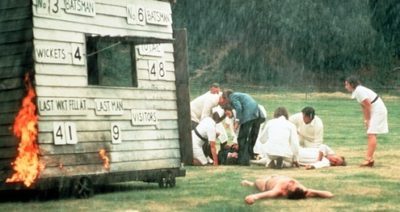
‘A supernatural thriller shot with a non-linear narrative, “The Shout” uses a cricket match at a mental institution as its framing device. In the eerily scenic yards of the institution, we have Crossley (Alan Bates) a newly arrived mental patient who sits in a small shack besides a foppish, coiffed man named Robert (Tim Curry) who Crossley assists in scoring the match that features a team of loons. Shortly after Crossley’s ranting, we soon meet the charming young couple, Rachel and Anthony Fielding (Susannah York and John Hurt) who have domesticated themselves into an almost brother and sister relationship, devoid of any carnality. We first meet them at the nearby beach where they vividly imagine a man armed only with a sharp bone, coming towards him in a threatening manner. Somewhat flustered, the Fieldings saunter back to their idyllic country home in Devon, England where Richard composes experimental music by mostly capturing the sounds of nature and distorting them as he sees fit. Though Richard composes secular music, he is also the local church’s organist and despite his vicar’s plea for a resurgence of faith during Sunday services, Richard will leave the church for an illicit tryst with the wife of the local cobbler, but before he does, he will encounter Crossley.’ — Lily & Generous 4 Ever!


Trailer


Excerpt


Excerpt


____________
Hands Up! (1981)
‘Ręce do góry (known in its subitled English version as Hands Up!) is a Polish drama film directed by Jerzy Skolimowski. It is the fourth of a series of semi-autobiographical films in which Skolimowski himself plays his alter ego, Andrzej Leszczyc. At the time it was banned in Poland, under the Communist regime, for 18 years because it depicted the Stalinist past. The film was originally made in 1967 in monochrome by pl:Zespół Filmowy Syrena studio. In a twenty-minute section (filmed in colour) added by Skolimowski in 1981 he explains how the original was withheld by Polish censors of the time, and that this was a principal cause of his leaving his country; however following liberalisation in Poland, he was invited to resuscitate it. The introduction includes, apart from some fictional apocalyptic passages, shots of Beirut ruined by the civil wars of the 1970s, where Skolimowski is working as an actor on Volker Schloendorff’s German film Die Fälschung (Circle of Deceit), and also shots of London featuring demonstrations in favour of Solidarnosc, Speaker’s Corner, and an exhibition of Skolimowski’s own paintings. These sections include cameo roles by Bruno Ganz, David Essex, Mike Sarne and others. Some of the music in this introduction is from the 1970 choral work Kosmogonia by the Polish composer Krzysztof Penderecki.’ — collaged


the entire film


_____________
Moonlighting (1982)
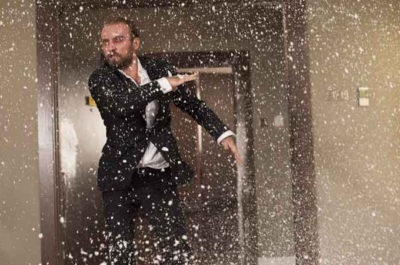
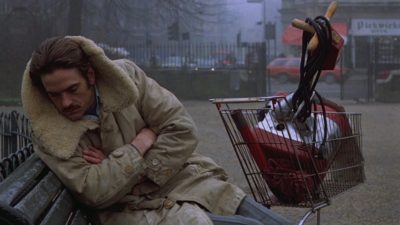
‘Moonlighting was mainly made by the exiled Jerzy Skolimowski in his house in West London. It is a film both prosaic and political but also savagely funny. As usual, autobiographical elements intrude. His house was in the process of renovation at the time, and three of the Polish builders featured in the film actually worked on it. Meanwhile Skolimowski makes a brief appearance as the shady house-owning diplomat who has hired the workers on a month’s starvation wages. (In flashback he appears sitting next to them and the foreman’s wife at a Tina Turner concert in Warsaw.) The Kensington home is thus a “character” in the film that saved studio costs and cut down on locations, a prime consideration for a director with little money who was responding immediately to the sudden imposition of Martial Law in Poland. A bigger expense was the inspired casting of Jeremy Irons as the foreman who has to react to this sudden catastrophe and the suppression of Polish Solidarity.’ — John Orr


Trailer


_____________
Success Is The Best Revenge (1985)
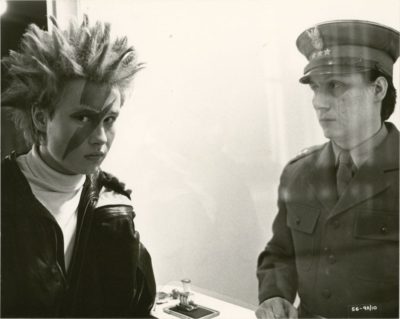
‘Success Is the Best Revenge was Skolimowski’s follow-up and companion-piece to Moonlighting. Both films are London-set (indeed, both use Skolimowski’s own house as a major setting); both are explicit reactions to the political crisis in Poland and General Jaruzelski’s declaration of martial law; and both feature quintessentially English actors playing Poles: whereas in Moonlighting it was Jeremy Irons playing construction foreman Nowak, here we have Michael York as exiled theatre director Alexander Rodak. In other respects, however, no two Skolimowski films could be further apart. You could say that on Moonlighting Skolimowski was on his best behaviour: it’s a perfectly controlled, evenly toned gem that achieves its aims with the minimum of effects and the maximum of effectiveness. Success is another beast entirely. It’s the one film of his international career that, stylistically and thematically, is fully in the spirit of his Polish films of the 1960s. This is Wild Jerzy, ready to run off the rails at any moment as a multitude of ideas, images, sounds, stories, and characters fizz and spark off one another. Chronology gets shuffled, any coherent driving narrative is deliberately fragmented, individual scenes can appear abstracted and disconnected from the film as a whole, and distorted and ambient sounds will be brought in and out to obscure snatches of explanatory dialogue. Because of this plenty of critics have complained that the film is a stylistic mess or even a failure—but don’t believe a word of it: Success Is the Best Revenge is thrilling cinema.’ — Ian Johnston


Trailer


Beginning


____________
The Lightship (1985)
‘Taken from Siegfried Lenz’s dour allegorical novella about what you might do if Hitler arrived on your ship, Skolimowski’s adaptation mercifully junks the more overt political dimension, and concentrates successfully on the suspense element, with sufficient metaphysical undercurrent for those who want it. Brandauer is the pacifist captain of a rusting lightship, anchored off the coast of Norfolk, Virginia in the ’50s. When they rescue a drifting boat, the trio that come aboard prove to be a set of psychos, on the run to a rendezvous with their pickup boat. Their leader, a menacing dandy played by Duvall at his most wilfully extravagant, threatens to set the ship adrift, and backs it up with the cool logic that the devil always presents. Brandauer, however, continues in a kind of dumb, passive resistance. Fortunately, Skolimowski keeps the schematic struggle between good and evil sufficiently well submerged beneath an atmosphere of menace and increasing hostility, as the crew bicker and fall apart under ill-fated attempts at heroism, and Duvall enacts his increasingly bizarre übermensch tactics. If it puts you in mind of Key Largo, that is no bad thing.’ — CPea.


Trailer


Excerpt


____________
Ferdydurke (1991)
‘Little seen, Ferdydurke is the film that led to Jerzy Skolimowski’s seventeen-year silence as a director—a disappointed Skolimowski withdrew to his house in Malibu and devoted himself to painting1 and the occasional acting role (Mars Attacks!, Eastern Promises). You could say the film is doubly obscure. Firstly, its distribution was very different from Skolimowski’s other films. An essential film like Success Is the Best Revenge might be hard to see today, but in its day was widely seen, noted and written about on the international festival and arthouse circuit. This is very unlike the fate of Ferdydurke, which was only seen in Poland, France and Latin America. The second level of obscurity lies in the film’s source, a 1937 novel by Witold Gombrowicz. Gombrowicz (1904-1969) is regarded by many Poles as one of the greatest writers of his century but, viewed from outside Poland, “probably the most important twentieth-century novelist most Western readers have never heard of”3 seems a fair summation. (I confess: I’ve barely registered his name and never read anything by him.) The obscurity carries through right to the film’s very title, a meaningless nonsense word; even the alternative English title 30 Door Key – that’s what appears in the credits of the version I’ve seen – hardly seems that much clearer, although it is in fact a reference to the thirty years of age of the main character Joey. In any case, Skolimowski’s cinematic return to his homeland, an adaptation of a beloved and admired modern classic and at the same time his first film shot in Poland since the sixties, seems to have been a way for him to connect with Poland and the Poles that he had lived for so long in exile from. It’s an assertion of his own Polish identity but it’s an assertion which, in characteristic Skolimowskian style and in the spirit of Gombrowicz, he ironises, mocks, and calls into question. Still, it has to be said that the return-to-the-homeland nature of the enterprise is rather undermined by Skolimowski’s casting the film with a mixture of British, American, French and Polish actors and dubbing the non-native speakers into English.’ — Ian Johnston


Excerpt


Excerpt


___________
Four nights with Anna (2008)
‘On the surface, the story of Four Nights with Anna seems familiar and straightforward, but Skolimowski is constantly working to slyly disrupt and undermine the narrative. There are the little surrealist touches — the severed hand, the floating cow, a shoe left in the fridge — that are eventually explained but that disconcert us when they appear. There are the odd incidents, such as the juxtaposition of Leon hiding his axe in his jacket with men pushing a broken-down car in the background, or the pedestrian he calmly observes from the attic window being knocked over by a car. Not germane to the plot, they create the sense of a story that’s never quite explicable, that at any time is subject to random shifts in direction. And above all there’s Skolimowski’s mixing of tone, the way the intense psychological study keeps slipping in and out of black comedy, principally in Leon’s pratfalls — he falls on his back in the mud outside Anna’s room, loses the ring he wants to leave for her in a crack between the floorboards, crashes onto the floor as he climbs through her window, gets caught up in her net curtains, and so on. All of this keeps us at a distance from Leon despite our perspective being only his. Leon is an obsessive, and there’s never a chance of this romance being anything more than one-sided. Skolimowski is no Kieslowski; he refuses to offer Leon any kind of release or redemption. In the final sequence, now out of prison for the second time, he again crosses the same field that separates his house from Anna’s — only now Anna’s building is gone. Skolimowski’s final image of Leon has him standing stock-still before an empty brick wall, locked into his obsession as he has been from the beginning, but now confronted in that wall with his unending solitude and pain.’ — Ian Johnston


the entire film


___________
Essential Killing (2010)
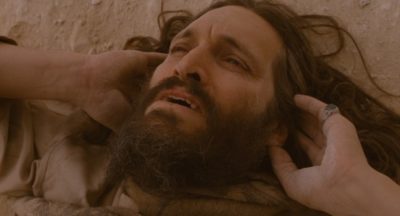
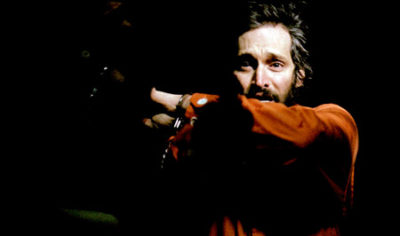
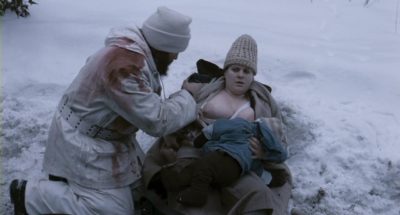
‘Essential Killing is intriguing and disturbing, made with tremendous confidence and conviction. What is so startling about Essential Killing is that it is almost entirely silent. Vincent Gallo’s Mohammed does not say a single word throughout his ordeal, except some muffled, garbled phrases during flashback sequences. All we have is Gallo’s vivid presence and that extraordinary, hawk-like face, blazing with the determination to stay alive. Of course, in strict realist terms, his escape is not quite plausible, and the manner in which he appears to break the single chain connecting the cuffs on his wrists is not entirely believable. But Skolimowski’s sheer confidence, and the expertise with which he shapes the contours of this movie, are hypnotic. There is something compellingly real in Mohammed’s increasing cold and hunger, driving him almost insane, and leading him to an extraordinary scene when he chances upon a peasant woman nursing a baby. In these extraordinary moments, Essential Killing looks a like a forgotten chapter from the end of the second world war. The film is on the verge of delirium: a gripping metaphysical drama.’ — Peter Bradshaw


Trailer


__________
11 Minutes (2015)
‘Jerzy Skolimowski’s 11 Minutes belongs to the tradition of puzzle thriller that was briefly in vogue in the late 1990s and early 2000s, which offered a swath of narratives to the audience, requiring them to discern a common thread that would be confirmed at the climax. Mike Figgis’s formal experimentations appear to be a significant inspiration for Skolimowski, and there are bits and pieces of 11 Minutes that recall everything from Go to Run Lola Run to the Final Destination series. The hopeless, virtuosic punchline steals from, and damn near equals, the climax of Brian De Palma’s extraordinary Femme Fatale. But the references or signal points or thefts, whatever they truly are to the veteran filmmaker, never bog down 11 Minutes. Skolimowski’s formal control over the material is so masterful that the textual particulars are revealed to be beside the point, as this film is so intensely, confidently an “exercise” as to ironically transcend the superficial connotations of that term.’ — Chuck Bowen


Trailer


Excerpt


Excerpt


*

p.s. Hey. ** Tomk, Hi, Tom! Awesome to see you as always. Thanks a bunch about the terrariums. I do highly recommend the Gladman novel and the trilogy its part of. Marie N’diaye … no, I haven’t read her. I just did a quick search to make sure, and, yes, she and her work look very interesting. I’ll find something of hers and get started. Much gratitude for the tip, man. I hope all is as great as possible with you. ** Dóra Grőber, Hi! Yes, it’s quite annoying to have to wait and wait for an answer on that TV series project since it’s kind of a whopper of a project, but our producer keeps saying they’re very into it, so we just have to be patient and keep hopeful smiles on our faces, I guess. Oh, cool that you have a friend who’s in the film biz and can give you advice. Hopefully your interest in playing male roles will only be a plus. I mean it would seem to be a good time what with the old, strict ideas about gender finally being revolutionized, and it’s kind of even trendy to play with the representation of what constitutes maleness or femaleness in films and music and media and stuff. Let me know what your friend says and how that quest goes in general, if you don’t mind. I’m interested and very supportive, of course. I will seek out ‘Eyewitness’ wherever I can find it. Yesterday was pretty uneventful on my end too, mostly just work. Oh, I’m not sure how long you’ve been looking at the blog, but every year come Xmas there’s this awesome thing in Paris where most of the top chefs and patisseries design and sell these super stylized and sometimes really crazy looking buches de noel (Xmas cakes). I get annually excited by that, and I make a yearly beauty pageant post featuring the most exciting looking cakes. Yesterday I started hunting for this year’s cakes both for the post and for possible purchase and eating, and there are some very cool ones, so that was fun. Otherwise, I met with Gisele to talk about projects and … not much else. Was your Wednesday more telling than your Tuesday? Have a great one! ** Tosh Berman, Hi, Tosh. Oh, that’s funny that you’ve never even been upstairs. It’s nice up there. The event I saw was a collab. between Jamie Stewart (Xiu Xiu) and the artist and book maker David Horvitz, and it was one of those things that probably wouldn’t have been able to work in a bookstore context. Oh, wow, about ‘Tea with Tosh’ having been digitized. I would love to see those episodes! Well, you could obviously put them on youtube or Vimeo. That would be swell for us out here. I would love to do a post featuring them if that’s any incentive to upload them. Man, that’s great news about their ‘salvaging’. Oh, and thank you again for mentioning Crevel the other day, I did just a post about one of his books that’s coming up on Monday that wouldn’t exist were it not for you. ** David Ehrenstein, Yeah, like a cross between a buche and a salad, ha ha. ** Bill, Hey, B-ster. Thank you re: terraria. I hope the nibbles pan out, obviously. Yeah, pray tell if they do. ** Jamie, Hi Jamie! Trying to act normal and seem so is basically the thing to do in a nutshell. Obviously, let me know what happens. Tenterhooks beneath me on your behalf. The delay in the decision on the TV series is supposedly something about them (ARTE) currently finalizing another TV series that was proposed before ours and them not wanting to do both finalizations at the same time. Which I don’t really understand, but that’s their reason. ‘Jerk’ is Gisele’s and my most successful piece. It was touring all over the world constantly for about five years, and then the solo performer in it, Jonathan Capdevielle, said he could take it anymore, and we reluctantly retired the piece, but he recently said he would do it again, so we’re back! It’s the one piece of ours that has played a fair amount in the UK, so I don’t know, but it’s the piece that venues are always asking for because, one, it’s really good if I don’t say so myself, ha ha, and, two, it’s our cheapeast piece to import since it’s just one performer and a chair whereas our other pieces tend to be pretty big, expensive things. So, anyway, blah blah, yeah, it might. Cool that the terrariums made you want to make one. Me too, man. High five. But I won’t, I’m sure. My Tuesday was kind of all right but not, like, great shakes or anything, but, yeah, all right. Try not to stress yourself out about the agent meeting. Just ready yourself, you know? How did that prep and everything else go? Love maxxed, Dennis ** H, Hi. I had that exact same dream when I made the post. Or almost. But then I realized terrariums are a lot of work to maintain, and then my books started looking really good again, ha ha. ** _Black_Acrylic, Ben, that is really, really great and very exciting news, my friend! All your hard and fantastic work is starting to pay off! That’s the thing, right, and you know this, but the best works very often begin their lives strangely and with difficulty, but you have to have faith, and to understand that works that are truly unique need to forge a unique path to acceptance, and, thus, Art101 is now securely on its special path, and hooray! And you get to travel to the festival! Man, that is the best and warmest news I’ve heard in ages! Congratulations, Ben, maestro! Whoo-hoo! I’m going to treat myself to some wacky French chocolate something or other today to celebrate! ** Steevee, Hi, Steve. I hope you’re enjoying your time at your folks’ place. I know of ‘At Swim, Two Boys’, and I’ve heard good things, but I haven’t read it. You recommend it? Zac did say that ‘Arrival’ is the best Villeneuve film in a while. He liked things about it. He said he thought it started really well, but he was disappointed that it ultimately dove into blockbuster/ genre tropes, and he said that pissed him off and made him turn on the film. I might still try it, though. ** Misanthrope, M! As in the Man! I’m an optimist too, and kind of a diehard, but shit looks pretty dangerous to me, and I think we all need to be very attentive to what that piece of shit is trying to implement from the top and remain as radical and combative in what we do as we can. Ha, funny jokes. Most of them. I still tell people that ‘how do you wake up Lady Gaga’ joke that I think you posted here ages ago. ** Jeff Jackson, Hi, Jeff. Yeah, the election’s horror is very tough to try to work through, for sure. Hm, it’s been long enough since I read ‘The Compassion Protocol’ that I think I’d need to revisit it to remember what it was in particular that impressed me so much. And I think my copy’s in LA. I’d like to. Are you managing to get work done? ** Hyperbolic_plain, Hey! Awesome! I’m glad you liked the Findleys. Yeah, right? You haven’t seen Huyghe’s work? It can be really, really good. I guess you must’ve missed his retrospective at the Pompidou. Let’s do coffee, maybe see some art? What’s your schedule? Do you have my email? I think you do, but it’s: denniscooper72@outlook.com. ** Marc Vallée, Hi, Marc! Great to see you, man. You’re coming to the big P? Whoa! Cool. Interesting gig. I haven’t seen that film yet, no. Gosh, I would love to hook up for dinner on Friday. The only problem might be that I’ll be rehearsing a piece with Gisele Friday in the late afternoon. I’ll know tomorrow what my exact work hours are. But, yeah, I’d love to. Do you have new email address? If not, it’s just above these words at the end of my comment to Hyperbolic_plain. Let’s figure it out. ** Okay. The other day a friend of mine said he’d just seen Jerzy Skolimowski’s ‘The Shout’ and thought it was amazing, and that reminded me that I liked that film a lot too, which led to thoughts of Skolimowski in general, which lead to me making this post. And there you go. See you tomorrow.
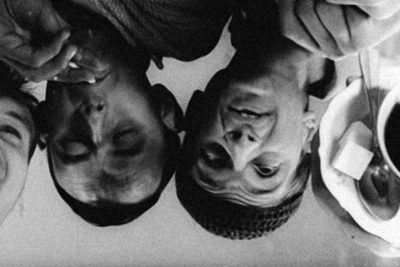
« Older posts Newer posts »

© 2026 DC's

Theme by Anders Norén — Up ↑