The blog of author Dennis Cooper

Category: Uncategorized (Page 871 of 1119)

Jax presents … Samuel Beckett’s Radio Plays *

* (restored)


“The farther he goes the more good it does me. I don’t want philosophies, tracts, dogmas, creeds, ways out, truths, answers, nothing from the bargain basement. He is the most courageous, remorseless writer going and the more he grinds my nose in the shit the more I am grateful to him.
He’s not fucking me about, he’s not leading me up any garden path, he’s not slipping me a wink, he’s not flogging me a remedy or a path or a revelation or a basinful of breadcrumbs, he’s not selling me anything I don’t want to buy — he doesn’t give a bollock whether I buy or not — he hasn’t got his hand over his heart. Well, I’ll buy his goods, hook, line and sinker, because he leaves no stone unturned and no maggot lonely. He brings forth a body of beauty.
His work is beautiful.” – Harold Pinter on Beckett

We all know Beckett’s work for stage and his novels. Few of us know his radio drama. Until recently, I didn’t even know he wrote any. But in 1955 the BBC, intrigued by the international attention being given to the Paris production of Waiting for Godot, invited the author to write a play for radio. Beckett was initially hesitant, but wrote to his friend the shipping heiress and political activist Nancy Cunard:-

“Never thought about radio play technique but in the dead of t’other night got a nice gruesome idea full of cartwheels and dragging of feet and puffing and panting which may or may not lead to something.”

That ‘nice gruesome idea’ led to All That Fall—and four other plays specifically written for the radio medium between 1957 and 1962. There’s also a sixth – From an Abandoned Work, which I haven’t heard – and a French play, translated as The Old Tune, which comes bundled with the downloads below.

Neither Beckett’s work for stage or his novels, he’d be the first to agree, are exactly big on narrative and his radio drama is no different. Here’s a short synopsis of what does – or doesn’t – happen in those five plays:-

All that Fall: Maddy Rooney, seventy years old, “two hundred pounds of unhealty fat,” makes her laborious way to the Boghill railroad station to meet her blind husband, Dan, as a surprise for him on his birthday.

Embers: Henry sits on the strand, tormented by the sound of the sea. He talks to his drowned father, who doesn’t answer, and to his wife, Ada, who does. Throughout it all the sound of the sea weaves in and out, almost like a third character.

Words and Music: Words, called Bob and Music, called Joe are forced to collaborate by the club-wielding Croak. Under duress they produce two of the most exquisite lyric poems ever written by Samuel Beckett. The play is often understood as as being “about” the agonizing difficulties of the creative process itself.

Cascando: an Opener “opens” and “closes” two characters: Voice, who desperately promises “this time” to tell a story he can finish; and Music, who equally struggles to create a finished composition.

Rough for Radio I: the grumpy MacGillycuddy gets a female visitor then makes a phone-call, receives two in return, finally securing – or perhaps admitting – the information ‘tomorrow…noon’.

Rough for Radio II: an Animator assisted by a Stenographer and the whip wielding mute character, Dick, has the task of eliciting from Fox some unknown testimony of unknown significance. If it could but be achieved then “tomorrow, who knows, we may be free!”


Samuel Beckett’s radio plays available online:

All That Fall (1957)

Embers (1959)

Words and Music (1962)

Cascando (1963)

Listen to it on Ubuweb here


‘All that Fall’ and ‘Embers’ are probably the most accessible, unless you’re a total Beckett freak, but I really like Rough for Radio II and Cascando – not because I understand them in particular, but because they’re really beguiling in an aural sense. Maybe he’s not big on conventional narrative but Beckett uses structure to poetic effect like no-one else, both in his other works and his radio drama.

So what’s the deal with radio plays, I hear you ask? English-language-wise, both the US and UK have a rich history of radio drama, spanning the first ‘soaps’ on commercial radio in the US and Orson Welles’ seminal adaptation of HG Wells’ “War of the Worlds” (which used the medium so well, a nation was raised to the edge of panic). And by the mid-1940s, the BBC was producing over 400 radio plays each year. These days, radio drama has a minimal presence on terrestrial radio in the US, but the BBC’s commitment to this most idiosyncratic of media remains strong. In the UK, Radio 4’s daily ‘Afternoon Drama’ attracts an average audience of 500,000. That’s half a million. Five days a week. Fifty two weeks a year. And most of these are not adaptations of novels, short stories or stage plays: they are works written specifically for radio – that is, they take full advantage of the medium.



So again, what’s the deal with radio plays? For me, a good radio play is the next best thing to music, in that the content bypasses the eye and mainlines itself straight into your brain. Cos radio plays are all sound. So far, so obvious, right?

But what does ‘all sound’ actually mean? For the listener, compared with say watching TV drama or films, it means YOU get to create your own version of the characters and story in your own head because sound has to be, after smell, the most connotative of the senses.

What’s the first thing we become aware of, in the womb? Our mother’s heart. One could argue, therefore, that our ears are of primary way of engaging with our environment.

What differentiates homo sapiens from other animals? Speech – and how do we receive speech? Through our ears.

Sound is primal. Sound is personal and thus both subjective and infinitely ambiguous: the same sound will have as many connotations as it has listeners. Sound is intimate: the lover’s whisper, the bully’s hissed threat, the child’s cry, the dog’s howl. Yeah, I’m rambling a bit here, but that’s purely because of the very special and unique relationship each of us has with any given collection of sounds, which in turn renders the aural experience difficult to describe.

Okay, I’ll admit it: there’s something very unnatural feeling about sitting down and listening to radio drama as it is broadcast, whether it’s on an actual radio or via a website. There’s nothing to look at. You (well, I do) start to fidget after the first five minutes. Worse still, I close my eyes in the hope this will let me focus – and I fall asleep. We’re so visually oriented these days, we don’t know what to do with our eyes when we’re not using ‘em to take in information.

Listening is defo a skill. What I do – thanks my digital radio and its sd card – is record plays then transfer ’em over to my mp3 player and take ’em out with me. On walks. On train journeys. On the bus. With my eyes actively engaged in looking at nothing in particular, my ears are freed up to allow the drama to unfold somewhere deep in my brain. And if you’ve never listened to radio drama I urge you to take the plunge, cos at its best? There’s nothing like it.


Other Notable People Who You Might Not Know Have Written Radio Plays

Mr. Pinter : http://en.wikipedia.org/wiki/A_Slight_Ache

Mr. Orton: http://en.wikipedia.org/wiki/The_Ruffian_on_the_Stair

Mr. Behan: http://en.wikipedia.org/wiki/Brendan_Behan#Plays

Mr. Minghella: http://en.wikipedia.org/wiki/Anthony_Minghella#Selected_plays

Mr. Adams: http://en.wikipedia.org/wiki/The_Hitchhiker%27s_Guide_to_the_Galaxy

Ms. Carter: http://en.wikipedia.org/wiki/Angela_Carter#Radio_plays


More recently, one of my fav radio plays is Matthew Broughton’s wonderfully eerie The Rain Maker. Due to copyright issues, you can’t download it, but I have an mp3of it, if anyone wants to send me a flash drive. Here’s a link to the writer talking about The Rain maker process:-

http://matthewbroughton.wordpress.com/2012/06/28/the-rain-maker/


Another amazing piece of writing for radio is Jack Thorne’s People Snogging in Public Places. Again, due to copyright issues, this isn’t available to listen to right now, but keep an eye on the radio schedules cos it may be repeated.

Finally, in true Becketian tradition, let me end where I began, with himself. There’s been a recent vogue for ‘staging’ his radio plays: here’s a trailer for one:-


Here’s a Mexican version of Embers, in Spanish:-


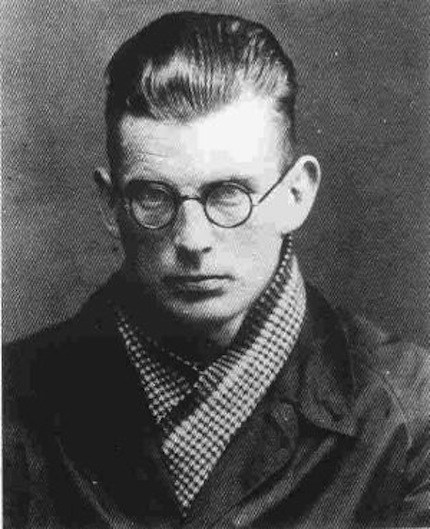
Here’s the original 1957 BBC recording of All That Fall – as a bonus, you get to stare at a particularly craggy Sam as you listen.


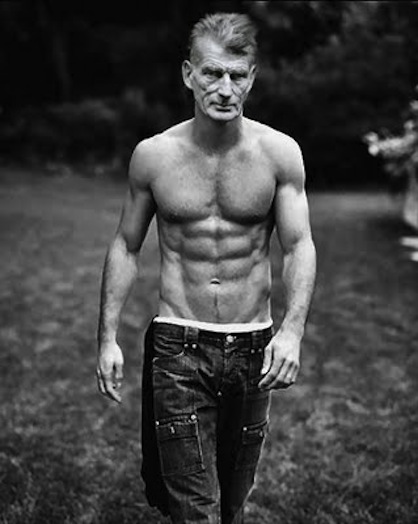
And here’s a photo from his little known ‘buff’ period.


*

p.s. Hey. ** David Ehrenstein, Hi. Well, I’ve never thought of you as a Tarantino fan. I am a fan of most of his films, and I’ve also heard quite good things about this new one, so I’m very curious to see it for myself. ** _Black_Acrylic, Hi, B. Ah, of course that’s the best news — that you’re writing something and into it! Keep the muse close. ** Steve Erickson, Hi. Yeah, it sounds hot in NYC from everything I hear. Sorry. We’re on the mellow side of hot right now. I hadn’t heard of that Rodney Evans film. Curious. Ha ha, when I saw ‘Hostel’ gay porn was the first thing that sprang to mind. ** Jeff J, Glad you dug it. Yeah, I’m mega-grateful for the currently tolerable heat. Just hoping it hangs out until summer bites the dust. I’ve had the Woosters and Reverdy in group round-up posts, but they haven’t been individually spotlit. I love Reverdy, so let me see what I can sort out, and doing a full-fledged post on the Woosters is a no brainer, now that you mention it. I’ll need to see how much evidence of their shows is online. I think I would want to concentrate on the early to mid-80s period. I’ll check. Good to hear about the new Zambreno and Rose Etter. I’m obviously looking forward to them. ‘Sentimental Education’ is so, so great, right? Yeah, the prose, wow. I’ll look for your email and write you back straight away. ** Misanthrope, I have a feeling I’ll like it. I can’t think of a Tarantino film I haven’t liked to one degree for another. Oh, I didn’t like ‘Death Proof’. But Kurt Russell was great in it. ** Corey Heiferman, Hey there, Corey. Yeah, those posters are sweethearts. Well, technically I’m not a Parisian, I’m just an extremely extended visitor. Fingers remain crossed about film school and that you’ll hear as pronto as possible. No, I’ve never personally been into Tarot. I’m not so very mystically inclined. I’ve had readings done for me. And I’ve even found a couple of them pretty eerie. Mm, hard to have a complex knee-jerk reaction to your film idea as I can’t really picture the place, but I do have a knee-jerk reaction to encourage you to give that idea every chance in the world. I do like Stefan Zweig, yes. I can’t remember if I’ve done a post about him. I’ll check. Enjoy the memoir, man. ** Okay. Today’s restored post is another one that comes quite a long time ago. It was made for this place d.l. Jax aka the writer/ performer/ director Jack Dickson who was one the blog’s most true blue, valuable and beloved community members way back when. I hope you enjoy it, and thank you so much from the future to Jack if you’re out there. See y’all tomorrow.
Kevin Killian presents … Fran Herndon Day *

* (restored)


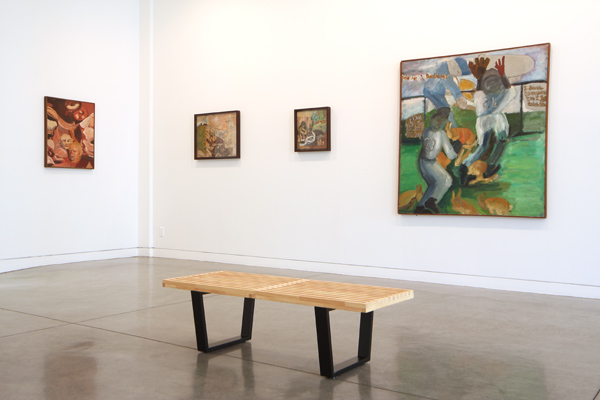
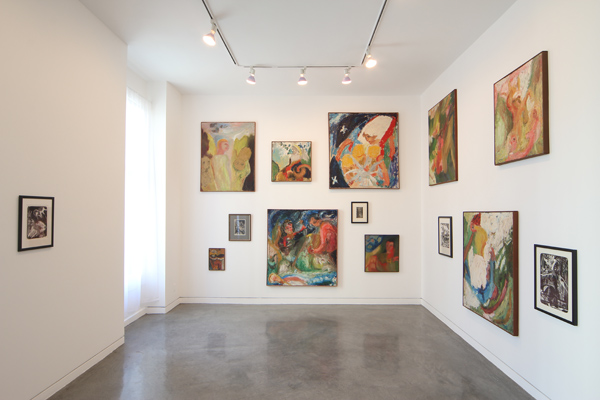
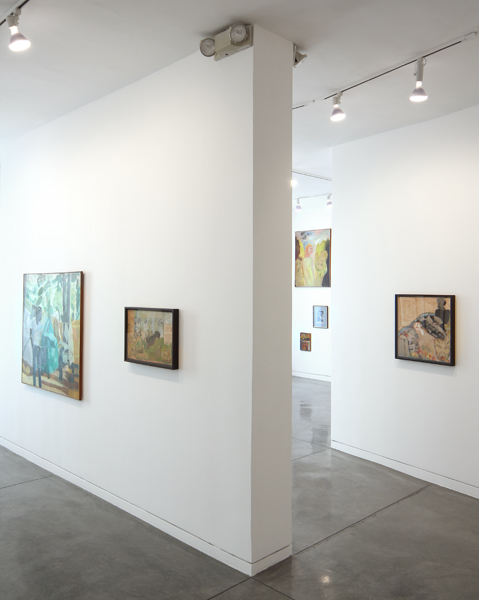
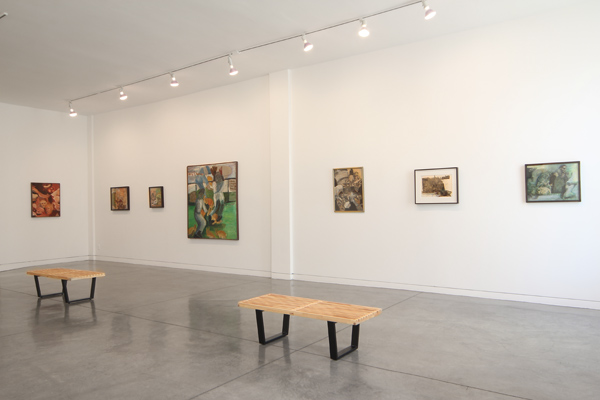
Dear Dennis, let this post introduce you to Fran Herndon, the Beat-era California painter I’ve admired and loved for the past 20 years or more. This month and next a gallery in San Francisco, Altman Siegel, is running a retrospective exhibition of her work, so I want to urge San Franciscans and visitors to come on down and take a look at it. The show has been organized by the young Canadian curator Lee Plested, assisted by myself. Maybe some of your readers will take a look at this post here, and come and see for themselves, in person, the things I like most about this strange and disquieting work.


I became acquainted with Fran Herndon through my work on Jack Spicer, the poet whose biography Lew Ellingham and I worked on in the 80s and 90s. Eventually our book, Poet Be Like God: Jack Spicer and the San Francisco Renaissance, appeared in 1998 (Wesleyan University Press). When I met Lew in the early 80s, I asked him, did Spicer really know about art? (He had founded, with five of his former students at the San Francisco Art Institute, an exhibition space they called the “6 Gallery,” but you know how sometimes you do things just to go along with a pushy crowd? Maybe, I thought, maybe Spicer was weak like I am in this one regard.) Lew advised me to look at Fran Herndon’s work and then make up my mind for she, Lew said, was the visual artist with whom he was closest.


When I met her I remember feeling that strange thrill that I had when introducing myself to the redoubtable Elaine Sturtevant, or when grabbing the hand of Marianne Faithfull as she stormed into “Why D’Ya Do It” onstage at the Fillmore. Each had been there (“there” in some ultimate, Platonic sense) at the beginning, and done something unique, bizarre, beautiful and misunderstood. Fran Herndon showed me into her place in the unfashionable Richmond district of San Francisco—on an avenue totally off my route!—and it would be hard to describe what an Angela Carter-esque experience this was, but in fairy tales one is often taken offguard because one is on wholly new territory, without most of the rules one lives by, unable to cling to familiar landmarks. I wasn’t there long, but I asked her to sign my copy of Everything as Expected, and she concurred. She had been asked about Jack Spicer, I expect, many times before, but I thought if I took the high road, and approached him through her own art work, I might come up with a different angle than all those other bozos. Thus began a long engagement.


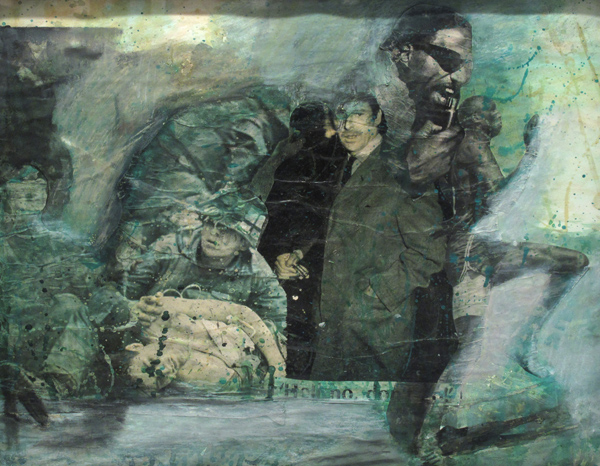
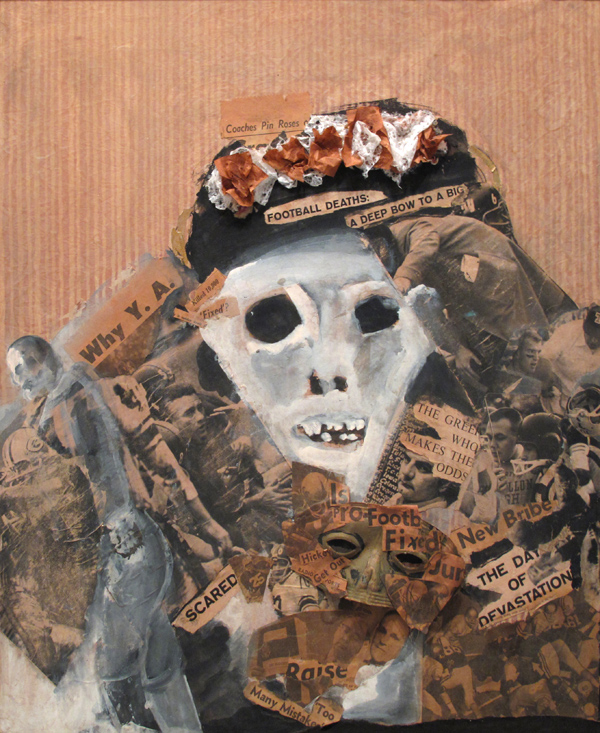
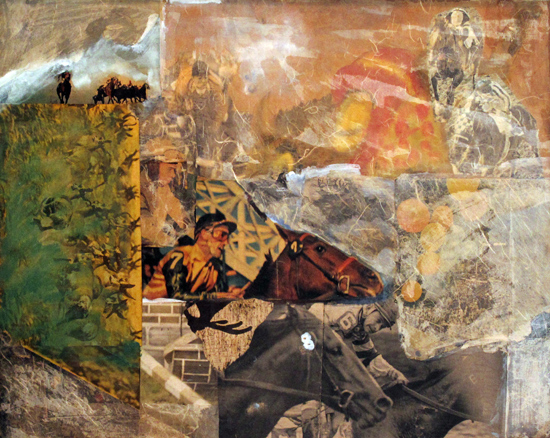
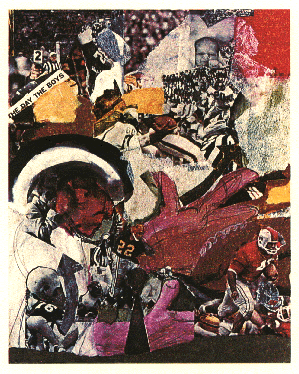
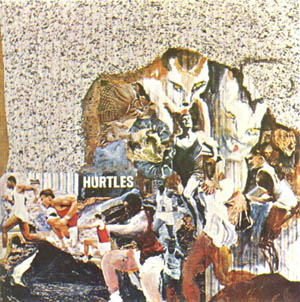
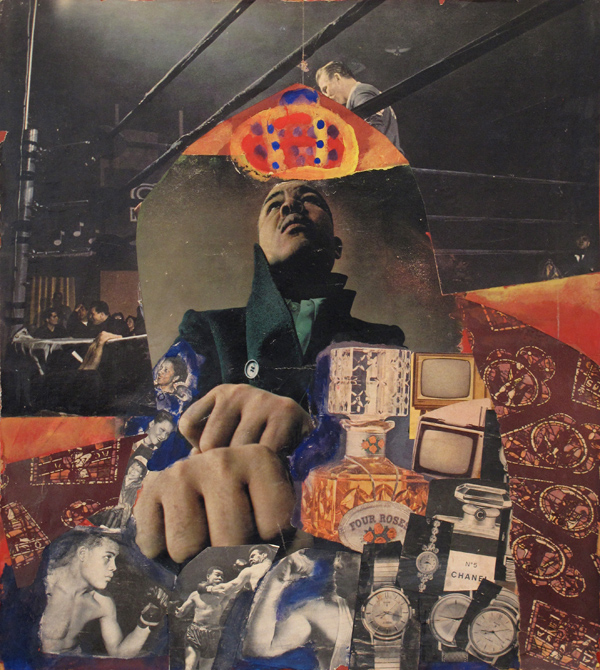
Everything As Expected is a peculiar book, written by Fran’s then-husband, the late Jim Herndon in the early 1970s. James Herndon was once quite a famous author, a schoolteacher who has written up his experiences teaching in the inner city schools of the Bay Area and made a pair of amazing books about them, works of radical pedagogy that had enormous infuence in their day. The Way It Spozed to Be came out in 1968, and its successor, How to Survive in Your Native Land, in 1971. Remember the season of The Wire that focused on public school systems and its built-in wiring for failure? Total Jim Herndon knockoff. In Everything As Expected, Herndon wrote of the summer of 1962, when Fran Herndon had embarked on a complicated series of “sports collages” under the tutelary spirit of Jack Spicer (1925-1965). Fran worked from sports magazines, tearing out illustrations that caught her eye, and making a new picture each week by arranging the found elements and then treating them with watercolor, gouache, sculptural ornamentation, mounting them on masonite, cardboard, sometimes adding homemade frames. Herndon’s book reproduces almost all of the collages finished that spring, summer and fall, adding some wry, even caustic anecdotes in the Vonnegut manner. The text becomes an extended meditation on magic—the magic of bringing something to our world, from what Spicer called the “Invisible World.” Here in San Francisco it’s easy to feel magic all around one every day, but to find its source is a sometimes terrifying avon.


Years later, last October in fact, the curator and writer Scott Watson came to visit San Francisco from Vancouver, where he directs the Morris and Helen Belkin Art Gallery at the University of British Columbia. Scott came to attend the opening of SFMOMA’s exhibition “New Work: R.H. Quaytman,” but we organized a trip to the Richmond so Scott could pay a studio visit on Fran Herndon. We brought a second curator with us Lee Plested, who had worked with Scott at UBC and with me at CCA, the art school in San Francisco where I sometimes teach. Scott asked Fran to show us not only her most recent work, but to take us back to the beginning, to her garage, where in a stable of flat files she had miraculously kept her large paintings from the earliest days of work. I hadn’t seen but the tiniest number of these pictures before, and Lee, whose first meeting with Fran this was, was as blown away as I. He hit on the idea of somehow organizing a show to exhibit this early work, and within a week or two after our visit announced to me that he and I were going to curate it together, and that he had secured the participation of the gallerist Claudia Altman Siegel, and the thing was practically was for the fall. Well, that was around the New Year, and now months and months later the show is up.


Fran has always maintained the respect of coterie of experimental poets; from Spicer, Blaser, Duncan, George Stanley and Jess in the early days, to the very young of today. In recent years the poet Avery Burns and his wife, Andrea Koehler, have organized several shows of Fran’s work at the North Beach gallery Canessa Park: beautiful shows, vivid, wildly ornate and personal. Altman Siegel is a very different sort of art space, clean, uncluttered, with a clientele of international artists, curators and collectors, what my dad would have admiringly called a “blue chip” gallery. At 82 or 83 this was a different sort of opening for Fran Herndon, but she was there, still somehow as young as she was the day I met her, very radiant and composed under this new, somewhat bewildering barrage of attention. (Dennis, even Christian Marclay poked his head in.) Here’s the essay I wrote for the catalogue of the present show, which closes at the end of October, please go in and take a look if you’re in town.


Fran Herndon
prepared for exhibition, “Fran Herndon,” at Altman Siegel Gallery, September 8, 2011


Born in Oklahoma in 1929, of Native American origin, Fran Herndon escaped to Europe just as Senator Joseph McCarthy turned this country upside down. The US, she told us recently, was then “no place for a brown face.” In France she met and married the teacher and writer James Herndon, and the couple moved to San Francisco in 1957. (The first of their two sons, Jay, was born the same year.) Shortly after arriving in the Bay Area she met four old friends of her husband’s: Jack Spicer, Robin Blaser, Robert Duncan and Jess—the brilliant crew that had invented the Berkeley Renaissance ten years earlier, artists now all working at the height of their poetic powers in a highly charged urban bohemia.


Fran Herndon became most deeply involved with to the most irascible of them all. From the very first evening that they had spent time together, Jack Spicer (1925-1965) seemed to see something unusual, something vivid in Fran that she had not seen herself. It was as if he were establishing a person, the way he created a poem, out of the raw materials she presented, and for a long time she did not know what it was he wanted her to be. Fran was mystified but elated by a power that Jack saw hidden inside her demure, polite social persona. He knew before she did that she would never be completely satisfied with the roles of mother and housewife.


—-When Spicer scrutinized her, as if envisioning in his mind’s eye a new and somehow different person, she began thinking: there must be some off-moments from being a mother—and during those moments what would she do? “I remember clearly discussing school with him. And out of the alternatives I mentioned, he zeroed in on the Art Institute.”


She began to drop off two-year-old Jay at a nursery school in North Beach, and walk up the hill to the Art Institute on Chestnut. She was quietly astonished at this turn of events, but already Jack was “a very powerful figure in my life. His opinions were crucial.


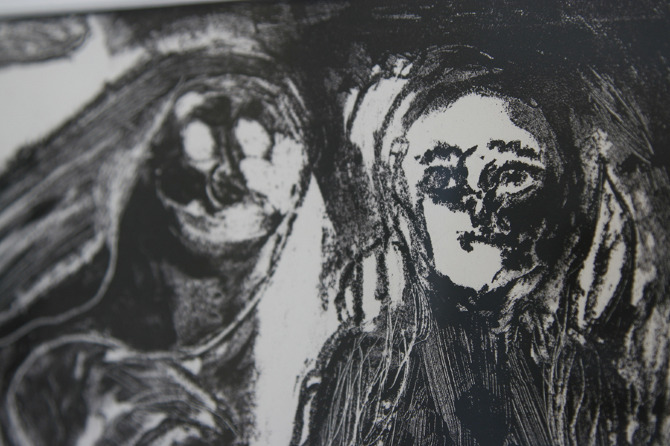
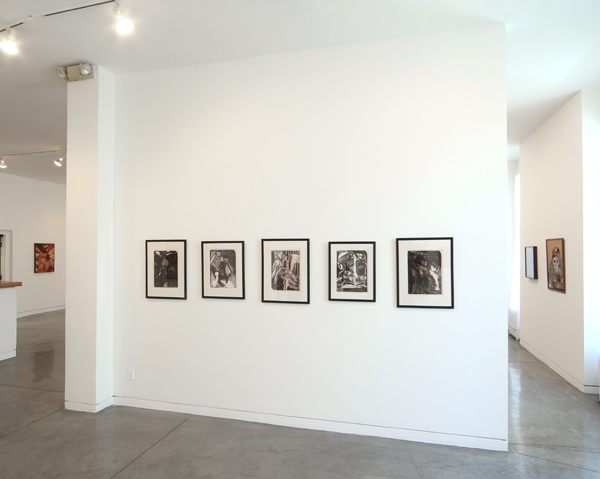
“He saw in me,” she recalls, “something greater than I saw in myself.” In 1959 she and Spicer inaugurated a series of joint projects, beginning with their editorial work on the mimeo magazine “J.” Simultaneously they collaborated on Spicer’s poem “Homage to Creeley,” each working independently and meeting weekly to share results. “J” was devised as a reply to the Beat magazine “Beatitude,” recently launched in San Francisco by Spicer’s rival, poet Bob Kaufman. Spicer and Herndon launched an open letter, saying what they wanted and more importantly, what they didn’t want. Submissions were to be left in a box behind the bar at The Place, a promiment poetry/ jazz/ performance space in North Beach. Fran took charge of the artwork, requiring her artists to work in stencil or typewriter font or a combination of both. Under the constraints of DIY was born what has been called “in many ways the most beautiful of all the mimeo magazines” (Steven Clay and Rodney Phillips, in A Secret Location on the Lower East Side: Adventures in Writing, 1960-1980, their 1998 survey of mimeographed poetry journals and ephemera.)


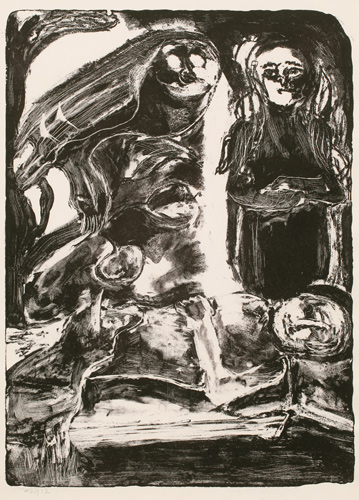
—-Simultaneously, Spicer’s “Creeley” poems and Herndon’s lithographs startled and enchanted them both.


In the evenings Spicer came by the Herndons’—sometimes three or four times a week, sometimes every night. Fran felt herself waiting for his visit, convinced of the link between the lithographs she was creating and the poems that were pouring out of him. He was never present while she worked on her graphics, and she never saw him writing, but somehow the results of their private endeavor meshed in a way that seemed perfect to them both. Jim Herndon later wrote about the experience. “Jack would show up at his certain night with his new poem and Fran would have a new litho. Jack would point out a correspondence between the two. He would show how Fran couldn’t have known about the content of the poem. He would show that he couldn’t have known about the image in the litho.” Fran said, “Sometimes it was reaching, but he knew that there was some connection in [my] work and what he was writing. It was as if at times it was prophetic (I mean, he would never have expected that to happen)—and he was just ecstatic when he could see that connection. At times it surprised me, because I had no inkling of the poems that were preceding or coming after those lithos. He saw it as not in any way illustrating the poems, but just an interaction of some kind.”


She was skeptical, but wavering. She wasn’t sure what to believe. Herndon wrote, “She wanted to forget it. She wanted to have it. She didn’t want ghosts drawing her lithos. She hoped they were. She wanted the visible. She loved the litho-stone, apparently firmly connected to the invisible. One night Jack produced a poem about a white rabbit absolutely outlined in whiteness/ upon a black background and Fran produced her litho of a white rabbit absolutely outlined in whiteness upon a black background, and the correspondence between the two was thus exact, as if the ghosts had gotten tired of just hinting about it.” This experience lasted no longer than four or five months. “It was a magic process.” She loved the litho stone she used, its perfect smoothness and porousness, its absorption of acid. Never again, she recollected, did she achieve the singularity she achieved with the lithos for “Homage to Creeley.” “Somehow when the poems were finished, that’s when it was over, really.”


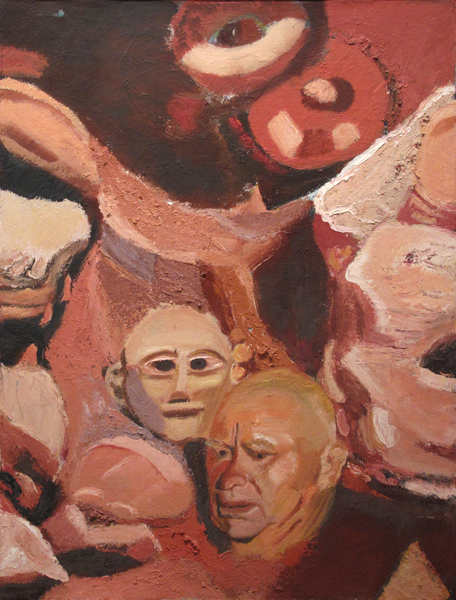
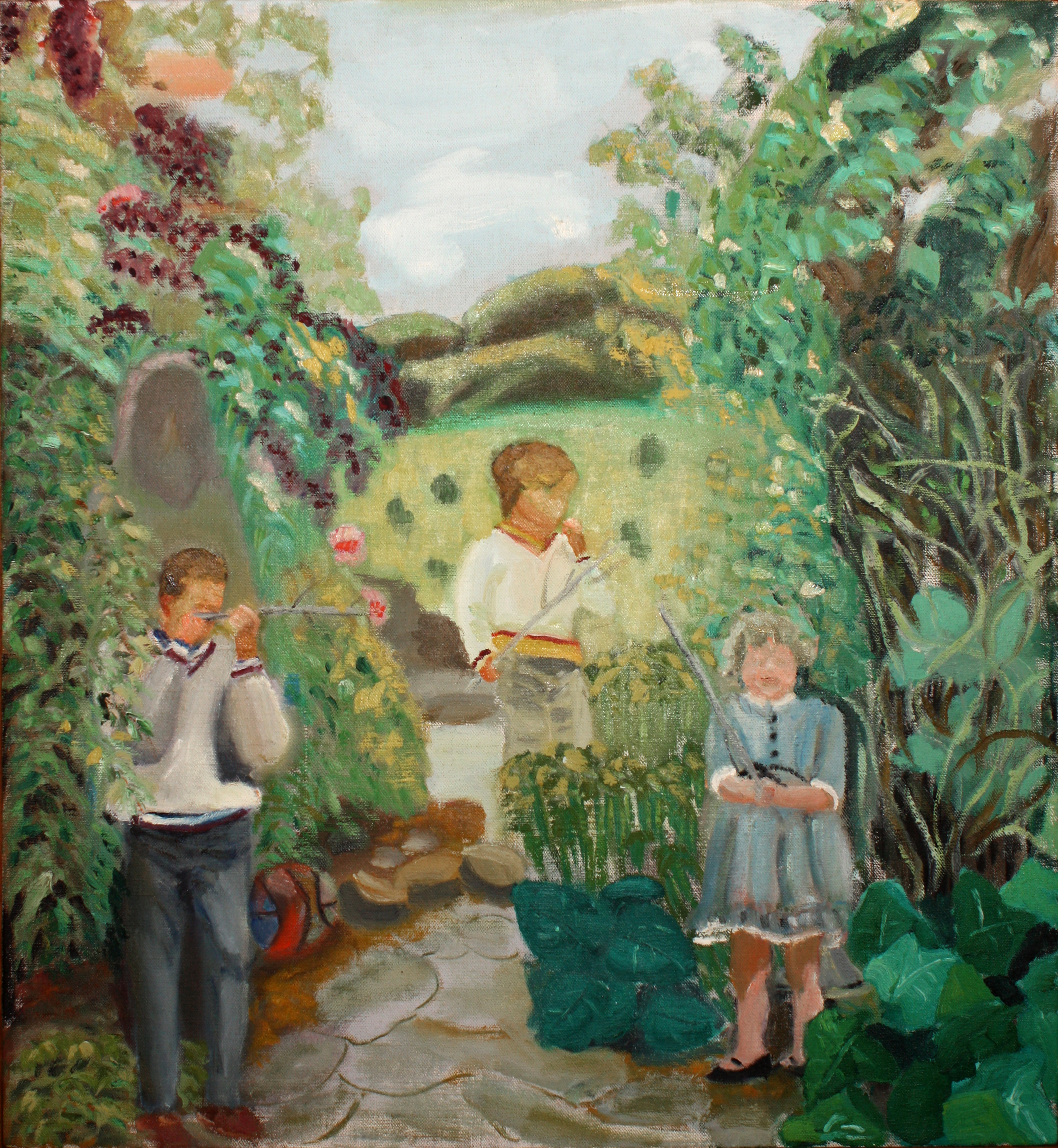
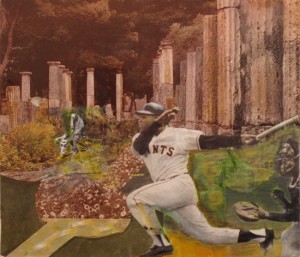
In the meantime Fran turned to painting, and never really looked back. (Her second son, Jack, was born in 1960). The work in the present exhibition is largely drawn from a furiously concentrated period of time, where she painted as though her life depended on it. In these pictures all of American painting seems drawn into the vortex: the social realism of such predecessors as Grant Wood, Thomas Benton; the furious blend of abstraction and figuration that flowed into De Kooning’s brand of “action painting”; the canny, mystic attention to details of nature and landscape of Marsden Hartley and Georgia O’Keeffe. Pop art, too, figuress into the mix, and the mixed media suspensions of Rauschenberg, Bruce Conner and Jess. Not here, buit in the library at Special Collections of SUNY Buffalo, hangs Fran’s portrait of Robert Duncan, festooned with spakrly cloth to represent his shirt of many colors. In the present exhibition note the thickness and the sculptural mass of the paint, writhing and byzantine, as though trying to p[ry itself loose of the canvas. In “Opening Day,” the exuberant, rabbit-filled picture of Willie Mays, number 24, Mays’ famous words float in medieval gold. “I don’t compare ‘em,” he told a sportswriter in 1959, on being awarded his third Golden Glove award. “I just catch ‘em.” Similarly Spicer never took credit for his own poems; they didn’t really belong to him, he said, he hadn’t written them, he had just received them from an outside force he called the “Invisible World.”


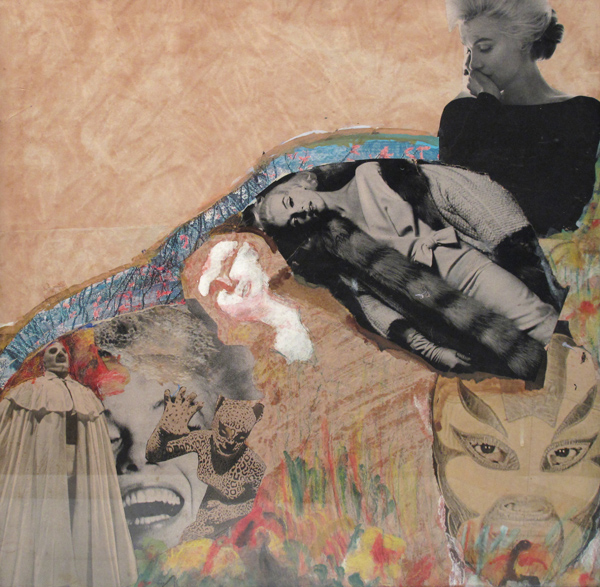
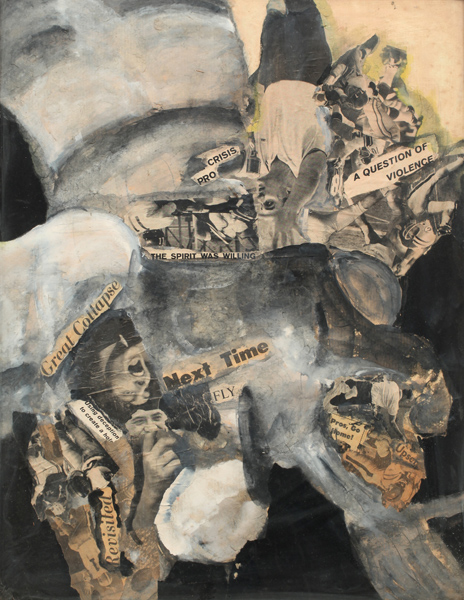
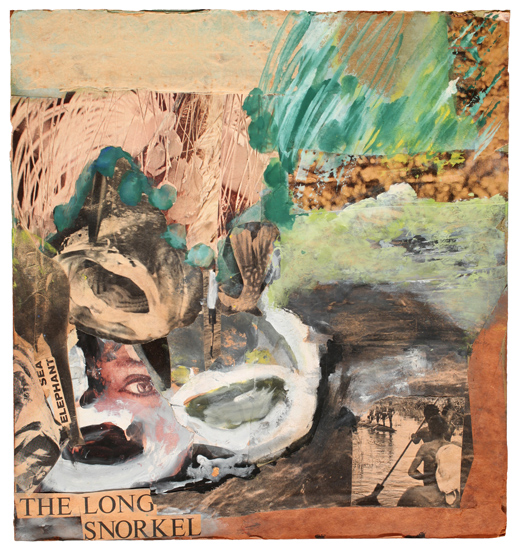
Spicer couldn’t type, and entrusted the manuscripts of his new book-length projects to Fran’s secretarial skill. She typed The Holy Grail for him, as it appeared to him little by little, in 1962, and created a series of lithographs centering on the figures in the Arthurian legend. (“Percival” 2 and 3 appear in the present exhibition.) At the same time, Fran completed the “sports” collages that make up her most intriguing achievement in art. The lithographs for Spicer’s “Homage to Creeley” were, of course, black and white; in the collages she burst into color as though entering a paradise of revealed myth and truth. Across town Jess was creating a similar series of “paste-ups,” like Herndon ripping and slicing up visual images and rearranging them onto canvas. Spicer assigned Herndon the humble pages of Life and Sports Illustrated for her materials, and she painted over and under these images and achieving a rich, often misty glaze. The subjects of this series were sports-world versions of betrayal, tragedy, and loss, such as the trade of Y. A. Tittle for Lou Cordelione by the San Francisco 49ers—“King Football”— the first Liston-Patterson heavyweight fight; the scandalous death of the boxer Benny “the Kid” Paret. “The Devil and Archie Moore.” “Collage for Jim Brown.” Take the haunting “Catch Me if You Can”: Herndon;’s brushtrokes transformed the photographed horses straining for the finish line into wraithlike creatures, like Kandinsky’s horses, not “real” beasts but expressionistic, ephemeral, alert animals, closer to unicorns. Perspective is flattened: foreground and background keep switching, giving the collages a watery, dreamlike quality removed from Jess’ ornate, precise surrealism. The “sports collages” also are very direct about race subjects; in the throes of the civil rights struggle, America was ripe for the sort of rich, dazzling imagery Herndon brought to her athletic subjects; there’s tragedy and anger here—as in the later anti-draft, anti-war collages—but there’s also a glorification of black and Latino athletes that anticipates the work, forty-years later, of a later SFAI graduate, Kehinde Wiley. Even Marilyn Monroe pointedly becomes The White Angel, in Herndon’s memorial collage of the same name; we see first Bert Stern’s memorable Vogue image of a fretful Monroe, then her whiteness collapses into a mad sprawl of faces, body parts, skull, wraith and animal imagery as she sinks underground into the dark.


—-These pictures were made by a kind of given chance structure, whatever was featured on the cover of Sports Illustrated from week to week dictated the image stucture of the work. That was the magic part; the rest was up to Fran Herndon, and into art history through a very long circuitous route.


All the artists in the Spicer circle vacillated between trying to get their work shown, and another, queasy feeling that art was over. In addition, Spicer was intently contemptuous of those who tried to make money from art or writing. His own books were issued without copyright. Anyone who published a poem in a magazine outside of San Francisco was labelled a “sell out” to the larger, eat-em-up consumer culture. Or they were part of what he called the “Fix.” It would have been enormously difficult to move out from beneath that psychic plane, that heavy disapproval. In Secret Exhibition, her 1990 survey of Bay Area art, that focusses on “six California artists in the Cold War era,” critic Rebecca Solnit employs a cultural studies approach to analyze the propensity of many San Francisco artists to make art in secret. On the one hand, such propensity stems from occulted traditions, including that of the hermeticism of the artist; in another light, as Solnit shows, San Francisco was so far off the art map that the artists she describes felt curiously free to invent their own, tiny, freakishly distorted art world, and a new kind of art to show in it: the funk-junk assemblage rag bag thing we all know well now. Few artists took any precautions to preserve their work, taking a Darwinist view, “sink or swim,” or perhaps yielding to an Existentialist urge to cast one’s fates to the wind. Documentation was unheard of. The scene was thus rather nihilistic. And gave birth to a lot of artists-run spaces, from the King Ubu Gallery of 1952 to the Batman Gallery later in the 60s. Spicer and five of his students from the California School of Fina Arts established the “6” Gallery in 1953. But Solnit’s book omits discussion of the galleries run by this group of artists, Borregaard’s Museum of 1960; the Peacock Gallery of 1963; and Buzz, the gallery organized by Paul Alexander, Bill Brodecky and Larry Fagin in 1964. The outsiders and rebels of Solnit’s world, whose work was shown in the big Whitney show of 1995, “Beat Culture and the New America,” had only a very distant interest in this group, who were beyond the pale in many ways, even to the outsiders of Secret Exhibition.


—-The problem with artists-run spaces is, of course, that though they deliver the means of distribution back to the producer—which has a beauty of its own, an exhilarating freedom—they depend on continued enthusiasm, and enthusiasm comes easy at first but quickly slows to a trickle. Thus Borregaard’s Museum, the Peacock Gallery, Buzz lasted only a few seasons at most. The present exhibition gathers together a representative sampling of Herndon’s portion of the grand November 1963 Peacock Gallery show organized by the poet Robin Blaser (1926-2009). If you squint and look at the splendors of “Ophelia,” “Tile Rats,” “Will the Circle Be Unbroken?” or the sublime “Doodlebug,” it might almost be 1963 over again.


In the 1970s, as contemporaries like Jess, Bruce Conner, Jay DeFeo began finding fame, Herndon put aside art for personal reasons, and when she returned to painting she did so in a deliberately lowkey, unheralded way. But in that period a coterie of admirers from many disciplines has grown vocal, and through a sprinkling of small but important exhibitions, interest in her work has reached a new height. Fran Herndon continues to make paintings and collage in her home studio in the Sunset district of San Francisco.


—-


*

p.s. Hey. My dear friend and literary comrade/hero, the late and very great writer Kevin Killian, guest-hosted several posts for my blog over the course of the years.  I will be restoring them for the obvious reason that the excellent and generous work he did for this place should be available to all. This, the first restoration, is his introduction and homage to the little known Beat era, San Francisco-based painter Fran Herndon. I hope you enjoy it. ** Shane Christmass, Hi. No, I haven’t seen that film. That conclusion you speak of is enough to get me hunting for it, of course, and the clip looks fun enough. Thank you. Nope, haven’t heard the Freddie Gibbs / Madlib album. I’m guessing you think I should? Assuming I’ve guessed right, I’ll check it out. And I have been following that news story, but only since finding that article you linked to. That gave it the extra spin my interests needed. Thanks again and overall, man. ** David Ehrenstein, Indeed they are. Your sale is still on? Did you ever see Steve Erickson’s question as to whether people in other locations can purchase things through the post? Everyone, Mr. Ehrenstein’s big house sale is still ongoing. And today he asks if anyone is interested in back issues of “Cahiers du Cinema”. Hit him up, if so. ** _Black_Acrylic, Hi. Yes, based on those photos, the failure of that particular park is vastly understandable. Yesterday was unspeakably brutal here. Jesus. Today the temperature is lower but the humidity is sky high, so it’s much better but no picnic. Enjoy your surrounding pleasantness. ** Bill, Hi. Well, the building that housed Planete Magique is now Gaite Lyrique, a prominent Paris venue for experimental music and multi-media art shows. Recently Tim Hecker, Keiji Haino, Oren Ambarchi, and Sunn0))) have played there, for example. There isn’t the slightest trace of the amusement park. It was gutted and reformed. But Gisele tells me that, during the transition when the place was a ruin and looked exactly like the photos, it was a hot spot for illegal raves. I haven’t been able to find any video evidence of them, sadly. The other park is just a giant empty swamp now. Yes, Spreepark. I was going to go visit its remains the last time I was in Berlin, but it was too much a trek given the time limits. Dude, it was 108 degrees yesterday! The hell it was is unimaginable even to me who barely lived through it. ** Steve Erickson, You’re going to be a beats maestro! Now that’s interesting. Link us up. Oh, man, it was really fucking brutal yesterday. The air was so hot and thick it was hard to breathe. It was still 106 degrees when I went to bed last night. I live across the street from an IKEA, and, when I briefly ventured out yesterday to buy cigarettes, I saw that, due to its air-conditioning, the police had commandeered the store, and they were directing old people and homeless people inside where there nurses and stretchers and things to treat people. Never seen anything like that before. Just crazy. I have followed Ka5sh a bit, and, like you, I haven’t found any of his recent stuff to be very interesting at all. Seems like he might have shot the exciting part of this wad in the initial burst. ** Right. Be with the wit and wisdom and knowledge-sharing of the much missed Kevin Killian today. See you tomorrow.

« Older posts Newer posts »

© 2026 DC's

Theme by Anders NorénUp ↑