The blog of author Dennis Cooper

Author: DC (Page 882 of 1131)

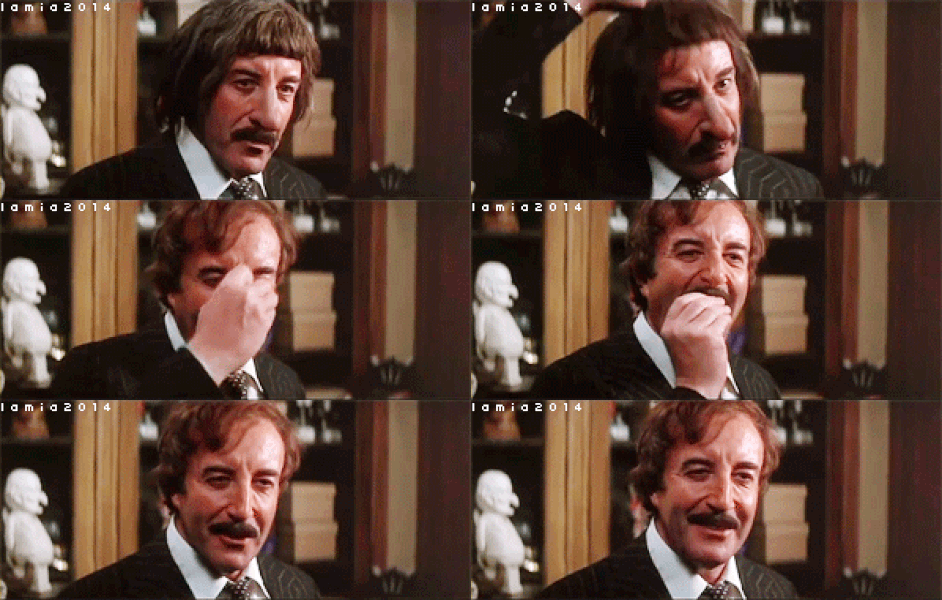
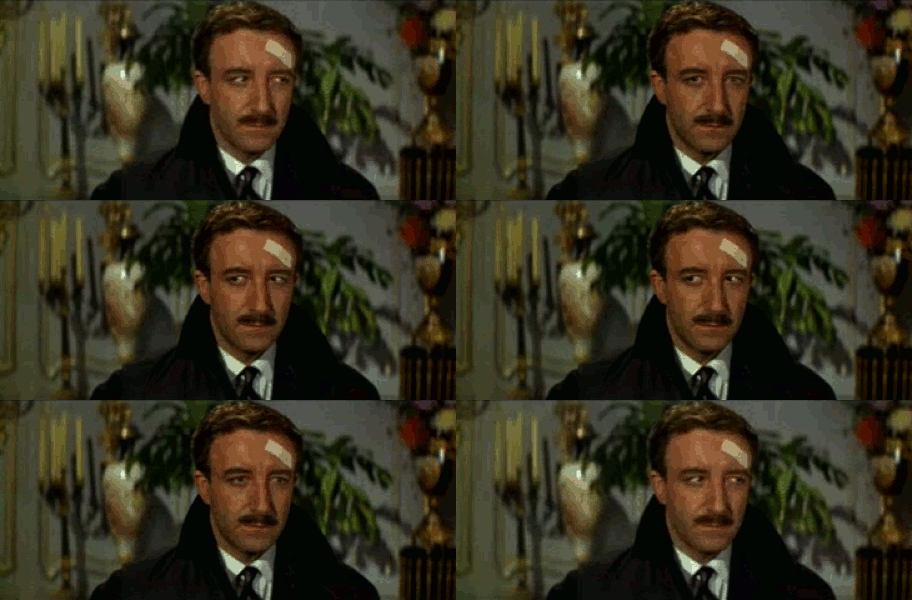
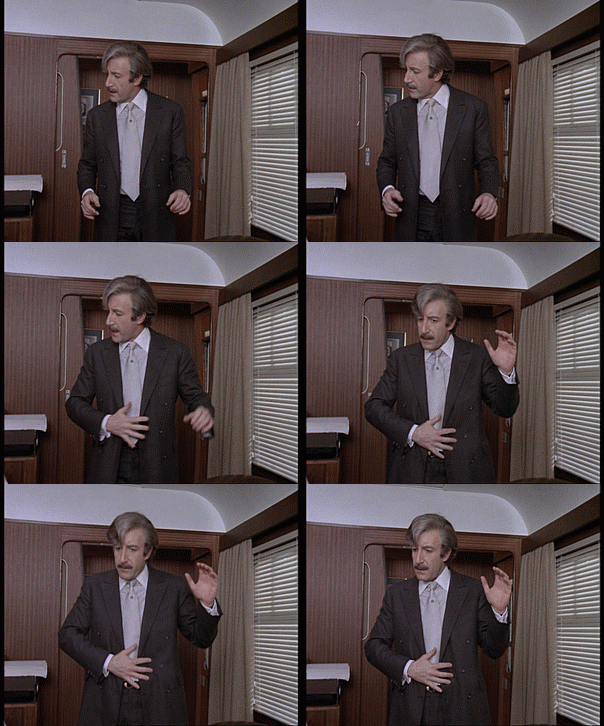
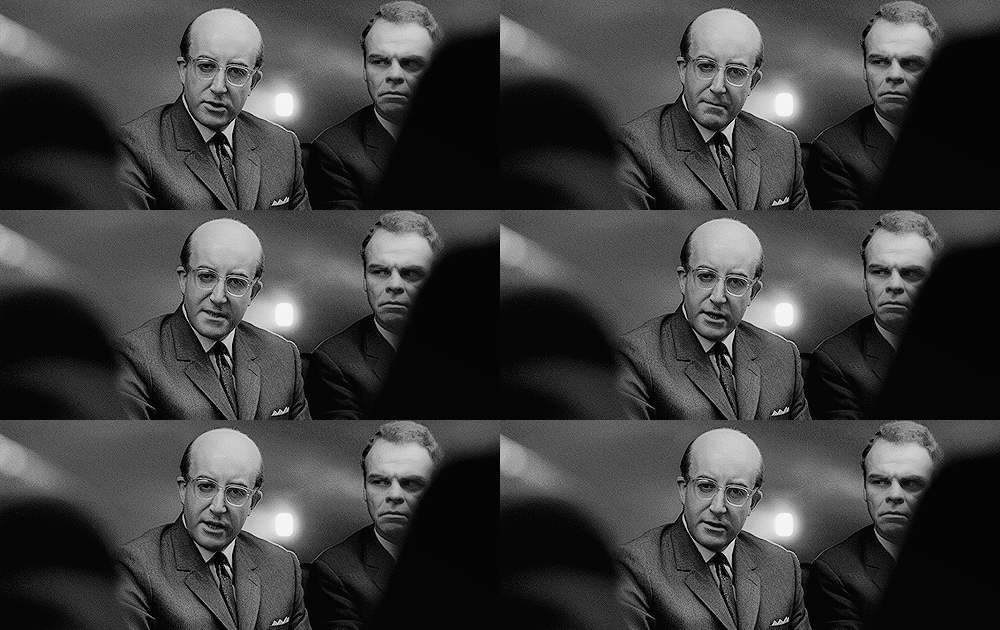
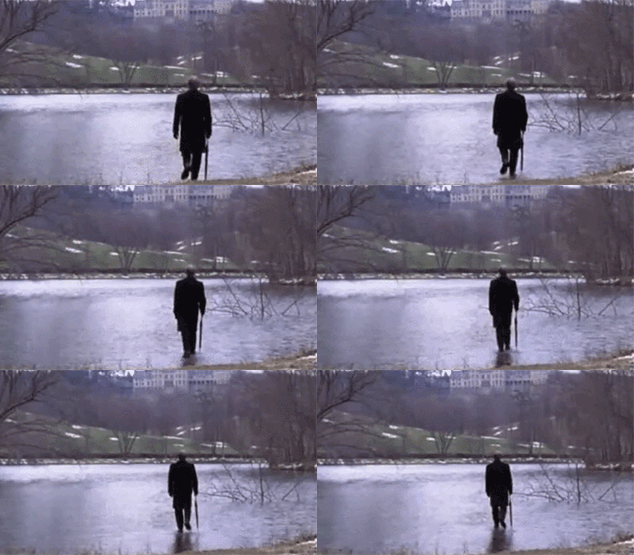
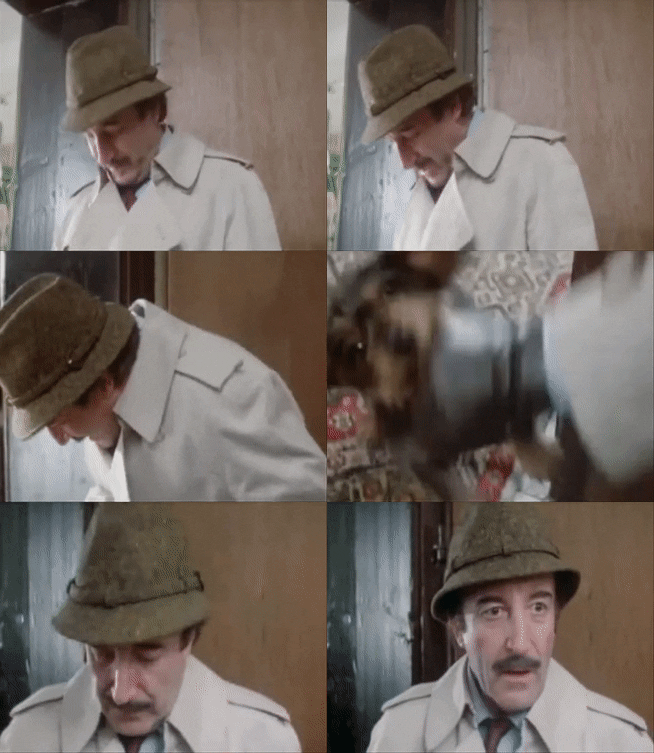
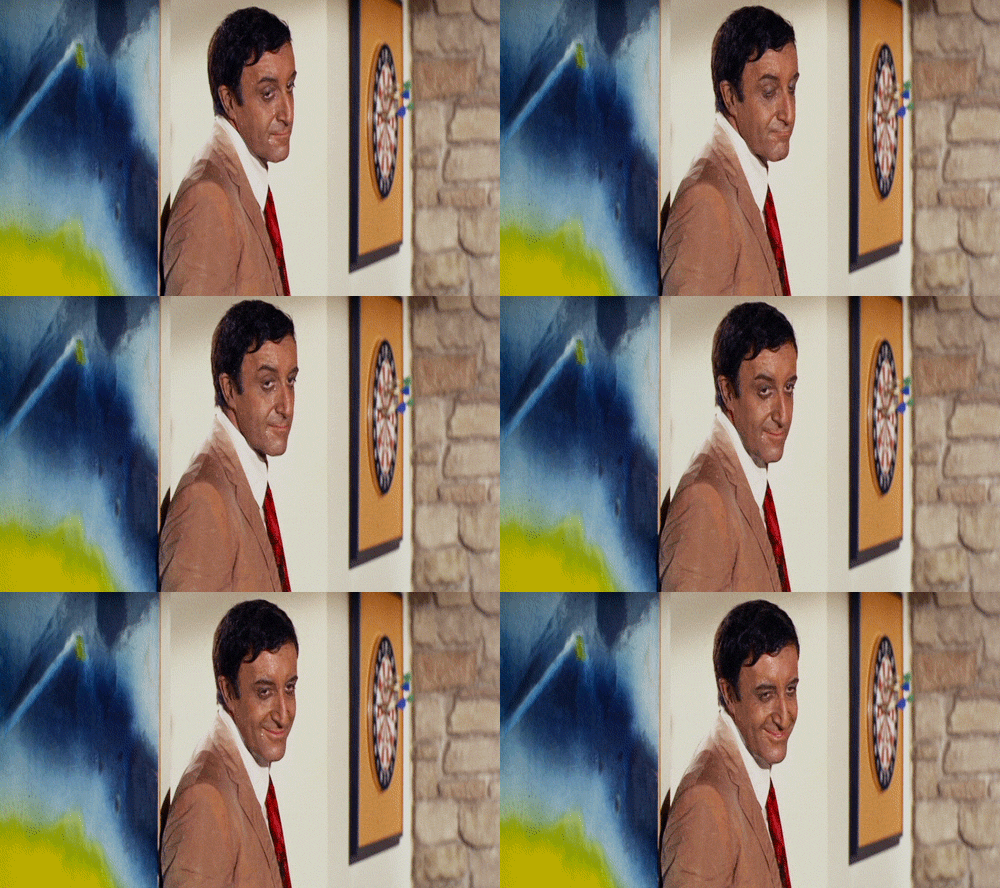
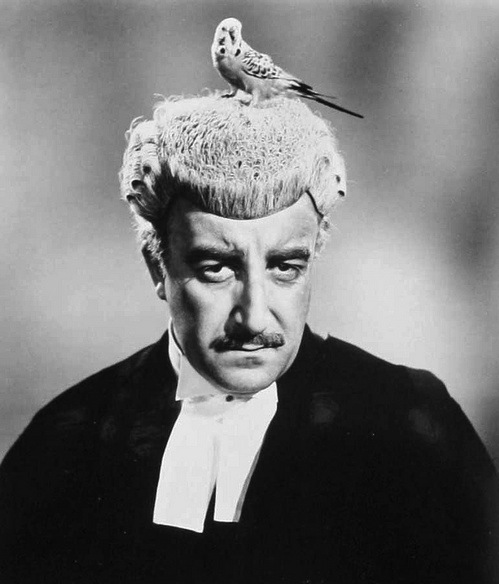
Peter Sellers Day


‘Peter Sellers, born into a touring theatrical family, became a “drummer, pianist and general funnyman” for RAF Gang Shows during the war. After demobilisation, he worked on radio as an impressionist, exhibiting the extraordinary vocal inventiveness that became one of his trademarks and was a cornerstone of radio’s highly popular The Goon Show (1952-60). Sellers made two Goon Show spin-off films, Down Among the Z Men (1952) and The Case of the Mukkinese Battlehorn (1956).

‘His other 1950s film parts were bewilderingly varied: timorous Teddy Boy in The Ladykillers (1955), fly Petty Officer in Up the Creek (1958), aged, obfuscating Scottish accountant in The Battle of the Sexes (1959), or Brummie villain in Never Let Go (1960), complemented by multiple roles in The Naked Truth (1957) and The Mouse that Roared (1960).

‘The role that confirmed his acting ability was Fred Kite, the Communist shop steward in I’m All Right Jack (1959), where his brilliant performance captured both the vanity and poignancy of this ideologue and intellectual manqué. It was this mixture of sharp observation and pathos that characterised Sellers’ ordinary men with aspirations: the provincial librarian in Only Two Can Play (1961), the idealistic vicar in Heavens Above! (1963).

‘These qualities infused his most popular achievement, Inspector Clouseau, in five films beginning with The Pink Panther (1963) through to Revenge of the Pink Panther (1978). In Clouseau, Sellers combined his vocal ingenuity and skill as a slapstick comedian, yet always retained an essential humanity through the inspector’s indefatigable dignity in the face of a hostile universe.

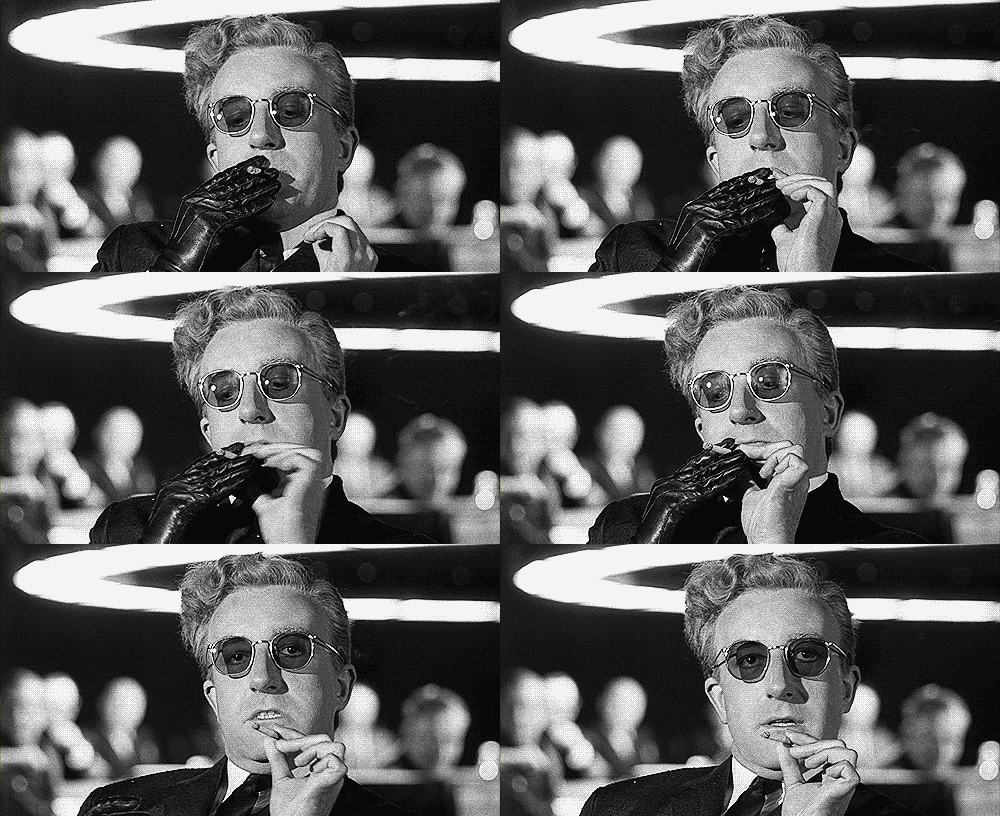
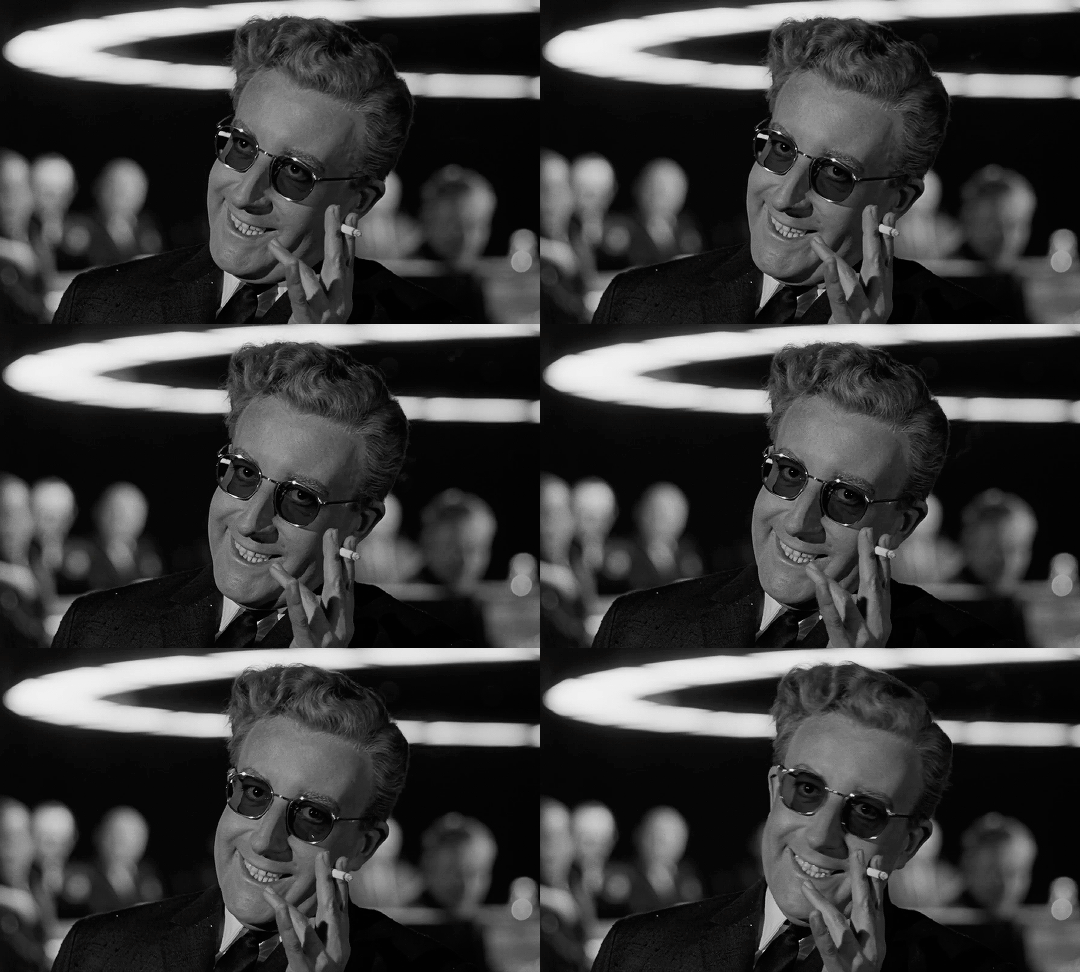
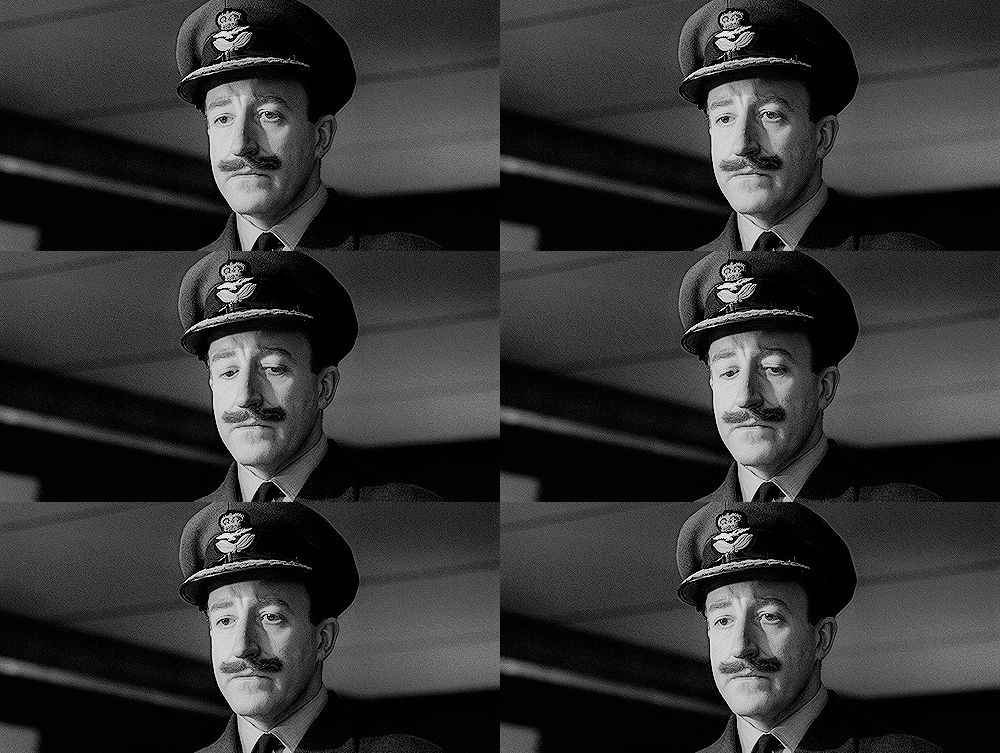
‘His other performance which endures in the memory was the triple role in Dr Strangelove (1963), as the well-meaning US President, unflappable RAF group-captain and the nightmarish Dr Strangelove himself, the government’s adviser on nuclear warfare, who is unable to control his own body, the black gloved hand always trying to make a Nazi salute, expressing an ineradicable desire to dominate and destroy.

‘Always restless, insecure and self-critical, Sellers sought to play romantic roles as in The Bobo (1967) or Hoffman (1970), but was always more successful in parts that sent up his own vanities and pretensions, as with the TV presenter and narcissistic lothario in There’s a Girl in My Soup (1970). Sellers’ career meandered in the 1970s; only his role as the humble gardener turned guru in Being There (1979) showed the range of his talent.

‘Sellers died in 1980 at age 54 of a massive heart attack, a victim of the heart disease that first struck him in 1964 and continued to haunt him during his most productive years as an international star. Mr. Sellers was in London at the time to work on the screenplay of Romance of the Pink Panther, which was to have been his sixth film in the role of the bumbling Inspector Clouseau, his most famous comic creation. He was still basking in the acclaim for his starring role in the previous year’s Being There, which won him an Academy Award nomination.

‘Filmmaker Blake Edwards, who directed the Clouseau movies, said, “One lived with the realization that Peter could go at any time. But he was a very courageous man who refused to let his heart problems interfere with his personal life.” Mr. Sellers gave evidence of that during the 1978 Pink Panther press conference. A reporter asked if he would mind answering a personal question. “Of course not,” Mr. Sellers said. “I understand you’ve had some heart attacks . . .” the reporter began, before Mr. Sellers interrupted him with gallows humor: “Yes, but I plan to give them up. I’m down to two a day.”‘ — collaged


__
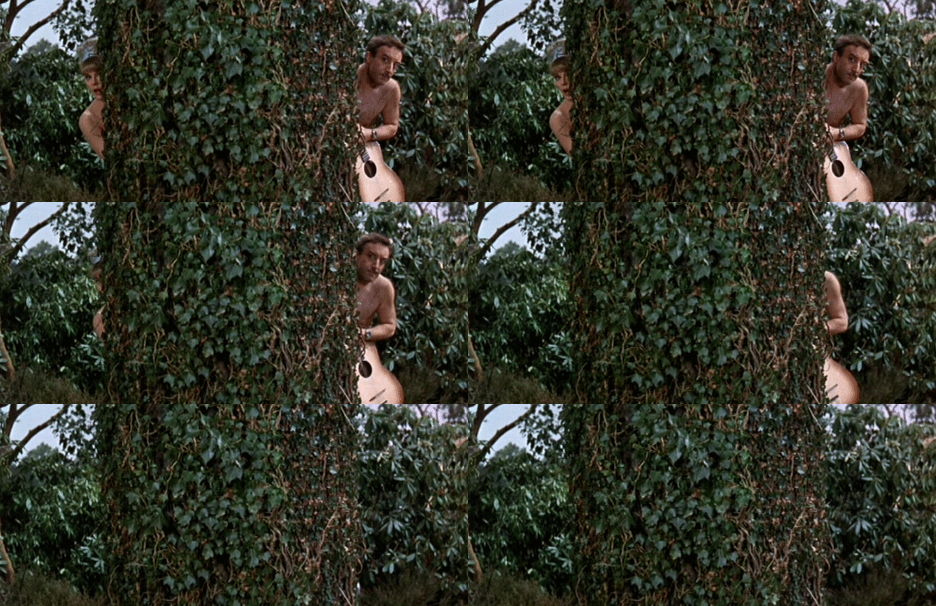
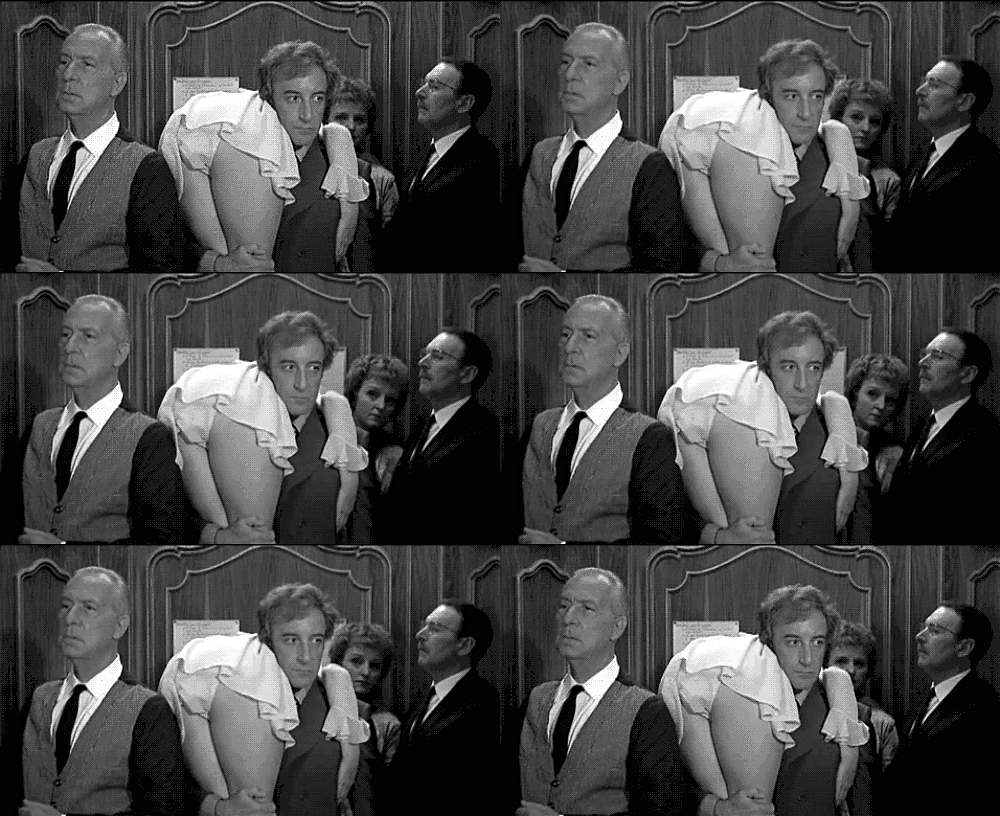
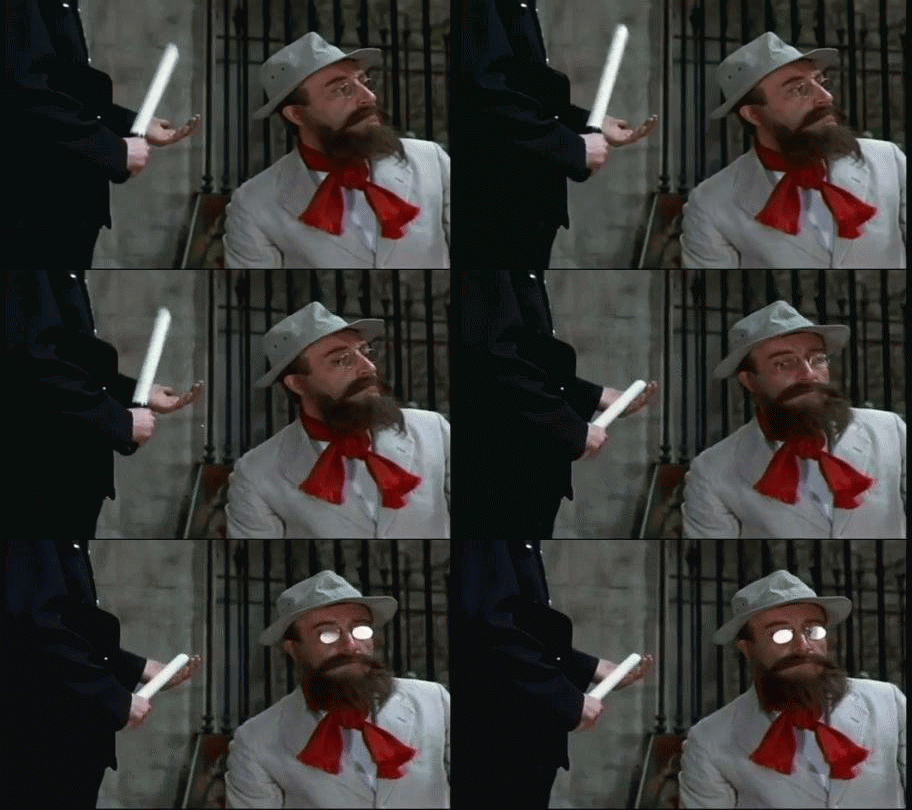
Stills


_____
Further

Peter Sellers Official Website
Peter Sellers Fan Site
Peter Sellers Appreciation Society
Peter Sellers @ IMDb
‘The Paranormal Peter Sellers’
‘Forgotten film of Goons restored by BFI’
‘For Pete’s sake, spare us another account of Sellers’ life and death’
‘Biopic’s many strange faces of Peter Sellers incense the actor’s son’
‘Here, there and everywhere’
Peter Sellers discography @ Discogs
‘Peter Sellers Dies at 54’
‘THE PARTY THAT IS PETER SELLERS’
‘The Lost Roles of Peter Sellers’
‘A Cocktail Recipe For Disaster: Peter Sellers And Orson Welles On The Making Of Casino Royale’
’10 Things You Might Not Know About Peter Sellers’


____
Extras


Peter Sellers – RARE interview – ’74


Peter Sellers on the Muppet Show


Peter Sellers performs ‘A Hard Day’s Night’


PETER SELLERS – ‘Balham – Gateway To The South’ – 1958


PETER SELLERS & SOPHIA LOREN – ‘Bangers And Mash’ – 45rpm 1961


Peter Sellers: Complete Guide To Accents of The British Isles


Peter Sellers – Barclays Commercials 1980


______
Interview


Within a short period of time you have progressed from being an English radio comedian to international star status. Do you regard yourself as a star?

Sellers: No, I’m not a star. I’m a character actor. The character actor must tailor his talent to the parts that are offered. If I were a leading man, a tall, good-looking sort of chap, you know, a chap who has a way with him, who gets parts tailored for his personality, like Cary Grant, then I could regard myself as a star. I’m not a star, because I have no personality of my own.

Hasn’t success enabled you to find your personality?

Sellers: Success hasn’t enabled me to find out anything about myself. I just know I can do certain things. If you go too deep into yourself, if you analyze yourself too closely, it’s no good for the job. You can either act or you can’t. If you analyze your own emotions all the time, and every doorknob you handle, you know, you’re up the spout.

But supposing you were asked to play a character called Peter Sellers, how would you play him?

Sellers: What I would do, I’d go to see all my friends, I’d go to see my acquaintances, and ask them how they see me, ask for their impressions of Peter Sellers. And then I would sift these characterizations. That’s all I can do, because I am quite unaware of what I am. A politician can see himself, can see what sort of an impact he is making. I can’t. I know I’m a bad conversationalist. Often I’m at parties, and people think Peter Sellers is going to do an act, and they wait, and when nothing is forthcoming, they’re disappointed.

Don’t you see a concrete personality when you look in the mirror?

Sellers: It’s difficult but — er — I suppose what I’d see is someone who has never grown up, a wild sentimentalist, capable of great heights and black, black depths — a person who has no real voice of his own. I’m like a mike. I have no set sound of my own. I pick it up from my surroundings. At the moment I’ve got a South African architect working on my new flat in Hampstead, and so I tend to speak in a South African accent all the time. As for the face in the mirror, well — my appearance is fattish, a more refined-looking Pierre Laval, sometimes happy, but always trying to achieve a peace of mind that doesn’t seem possible in this business. This business breeds a tension that is difficult to live with.

Does this make you sad?

Sellers: They say all comedians are sad. I wonder if that’s true? Still, I’m not really a comedian. I don’t know what I am.

You’re certainly a star.

Sellers: To be a star means coming out from under the cover of the character, the work, the celebrated anonymity of the featured player. I’ve stepped into the spotlight, looked behind myself and see I cast no shadow. Stanley Kubrick famously said of me, “There is no such person as Peter Sellers.” Spike Milligan, my fellow Goon, said of me, “Peter’s not a genius. He’s something more. He’s a freak.” Blake Edwards said of me, “I think he lives a great part of his life in hell.” These people who know me, you understand. I writhe when I see myself on the screen. I’m such a dreadfully clumsy hulking image. I say to myself, “Why doesn’t he get off? Why doesn’t he get off?” I mean I look like such an idiot. Some fat awkward thing dredged up from some third-rate drama company. I must stop thinking about it, otherwise I shan’t be able to go on working.

And so you work.

Sellers: Here’s my credo — “What is to be will be even if it never happens.”


_____________________
20 of Peter Sellers’s 60 films

__________________
Alan Cullimore Let’s Go Crazy (1951)
‘Peter Sellers and Spike Milligan shine in a series of sketches and multiple roles, in this madcap mixture of music-hall and anarchic comedy. Filmed in just a single week at the same time as Adelphi Films’ feature-length Penny Points to Paradise, Let’s Go Crazy was clearly intended as the subordinate picture of the two films. But Sellers and Milligan’s anarchic goofing here is more characteristic of the Goons style than in the more conventional Penny Points. Both performers take on a number of different roles, with Sellers’ characters including an exasperated Italian head waiter Giuseppe, frustrated Crystal Jollibottom, and a convincing impression of Groucho Marx that was later edited into re-release prints of Penny Points at the height of Sellers’ popularity.’ — bfi


Trailer


_____________________
Alexander Mackendrick The Ladykillers (1955)
‘The fable of The Ladykillers is a comic and ironic joke about the condition of postwar England. After the war, the country was going through a kind of quiet, typically British but nevertheless historically fundamental revolution. Though few people were prepared to face up to it, the great days of the Empire were gone forever. British society was shattered with the same kind of conflicts appearing in many other countries: an impoverished and disillusioned upper class, a brutalised working class, juvenile delinquency among the Mods and Rockers, an influx of foreign and potentially criminal elements, and a collapse of ‘intellectual’ leadership. All of these threatened the stability of the national character. Though at no time did Bill Rose or I ever spell this out, look at the characters in the film. The Major (played by Cecil Parker), a conman, is a caricature of the decadent military ruling class. One Round (Danny Green) is the oafish representative of the British masses. Harry (Peter Sellers) is the spiv, the worthless younger generation. Louis (Herbert Lorn) is the dangerously unassimilated foreigner. They are a composite cartoon of Britain’s corruption.’ — Alexander Mackendrick


Trailer


Excerpt


_____________________
Mario Zampi The Naked Truth (1957)
‘A different twist on the Peter-Sellers-plays-a-bunch of roles, whereas he only plays someone who plays a bunch of roles. Of course we all know it is Peter Sellers no matter which twist is being used, this one clearly makes it’s game part of the story. I don’t think there is even a sense that he’s supposed to be a master of disguise, as few of his fellow characters seem to fall for it – only the most important one – or incidental bumpings into. The Naked Truth is a scandal rag that never seems to get published, as the publisher uses its contents for blackmail, which is supposedly just as lucrative as publishing it. Save the trees! A couple of other familiar faces contribute to the cast, Terry Thomas and Dennis Price.’ — The Pirate Bay


Trailer


Excerpt


_____________________
Jack Arnold The Mouse that Roared (1959)
‘The economy of the teeny-tiny European duchy of Grand Fenwick is threatened when an American manufacturer comes up with an imitation of Fenwick’s sole export, its fabled wine. Crafty prime minister Count Mountjoy (Peter Sellers) comes up with a plan: Grand Fenwick will declare war on the United States. Grand Duchess Gloriana (Peter Sellers again) is hesitant: how can meek little Grand Fenwick win such a conflict? Mountjoy explains that the plan is to lose the war, then rely upon American foreign aid to replenish Grand Fenwick’s treasury. Bumbling military officer Tully Bascombe (Peter Sellers yet again) leads his country’s ragtag army into battle. They cross the Atlantic in an ancient wooden vessel, then set foot on Manhattan Island, fully prepared to down weapons and surrender. But New York City is deserted, due to an air raid drill. While wandering around, Sellers comes upon atomic scientist David Kossoff and the scientist’s pretty daughter Jean Seberg.’ — Sony Pictures


Trailer


Excerpt


_______________________
Richard Lester The Running Jumping and Standing Still Film (1960)
‘Director Richard Lester first worked with Peter Sellers and Spike Milligan on three television series, The Idiot Weekly Price 2d, A Show Called Fred and Son of Fred (all ITV, 1956), each of them an early attempt to transfer the surreal humour of radio’s The Goon Show to a visual medium. The Running, Jumping and Standing Still Film, itself entirely shot in a field, can be viewed as an extension of these inserts. Lester later acknowledged that even some of the sketches were variations on those filmed for the television series. Following some earlier shooting by Sellers and Milligan, the majority of the film was shot over one or two Sundays (accounts vary) using Sellers’ own 16mm camera, and edited by Lester and Sellers in the latter’s bedroom. The sound effects and music score were added by Lester shortly afterwards. The film’s lasting legacy was its influence on British comedy in general, and on Monty Python’s Flying Circus in particular. This is evident not only in its surreal humour, but in the way that elements of one routine are threaded through subsequent scenes, transcending the stand-alone sketch form – a tactic subsequently favoured by the Python team.’ — BFI


the entire film


____________________
John Guillermin Waltz of the Toreadors (1962)
‘Sellers was just on the cusp of emerging as an international box office phenomenon, but his comic skills had already been well noted in a number of productions, and he had recently won the Best Actor Award from the British Academy for I’m All Right Jack (1959). While filming Waltz of the Toreadors, a comedy of romantic and marital upset, the actor was undergoing his own marriage woes. He and first wife Anne Howe were bitterly nearing the end of their relationship, a crisis fueled largely by his philandering, and Sellers sought relief from this distress with near-constant work. Even that, however, wasn’t always enough. During production on Waltz of the Toreadors, he held up production for many costly hours while he called his friend David Lodge to the Thames valley location shoot, begging him to talk to Anne and apologize for him, in the hopes he could patch things up one last time. The gesture ultimately proved to be in vain. Unfortunately, the completed film version of Waltz of the Toreadors did little to raise Sellers’s spirits. It was not a box office success, and he thought “the whole thing looks terrible.”‘ — TCM


Excerpt


___________________
Stanley Kubrick Lolita (1962)
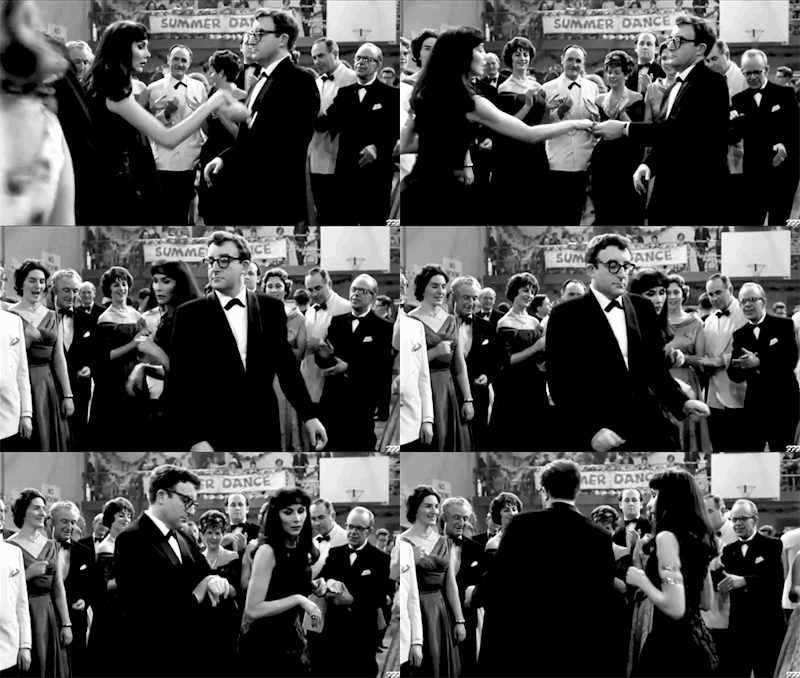
‘From the beginning, British-comedy fans loved the work of Peter Sellers for its wit and sure attack and for its fillip of emotion. But it took a brilliant young American director with a hip, cosmopolitan temperament to exploit Sellers’ talent fully. As Quilty, Sellers is quicksilver-changeable — a portrait of the artist as a phony. He’s ostentatiously high style. At a summer dance in a high school gym, he manages to look good even though he bops only from the chest up. As he haunts Humbert, he takes on diverse flaky disguises; at one point he impersonates a suspiciously ingratiating state cop — the kind of weirdo turn Norman Mailer once reveled in. When Quilty poses as a German psychologist, the dagger-glint in his eyes lets Humbert know that the pseudo shrink has his number. Sellers’ Quilty sees through the weakness and hypocrisy in Humbert. In the film’s daring narrative frame, you feel that the ultra-civilized Humbert is able to kill Quilty because the victim starts his death scene under a sheet and finishes it hiding behind a painting. In the end, Humbert doesn’t have to look at him.’ — Baltimore Sun


Excerpt


Excerpt


Excerpt


_____________________
Blake Edwards The Pink Panther (1964)
‘The Pink Panther of the title is a diamond supposedly containing a flaw which forms the image of a “leaping panther”, which can be seen if held up to light in a certain way. This is explained in the beginning of the first film, and the camera zooms in on the diamond to reveal the blurry flaw, which focuses into the Panther (albeit not actually leaping) to start the opening credits sequence (this is also done in Return). The plot of the first film is based on the theft of this diamond. The diamond reappears in several later films in the series. In the original Pink Panther movie, the main focus was on David Niven’s role as Sir Charles Litton, the infamous jewel thief nicknamed “the Phantom”, and his plan to steal the Pink Panther. The Inspector Clouseau character plays only a supporting role as Litton’s incompetent antagonist, and provided slapstick comic relief to a movie that was otherwise a subtle, lighthearted crime drama, a somewhat jarring contrast of styles which is typical of Edwards’ films. The popularity of Clouseau caused him to become the main character in subsequent Pink Panther films, which were more straightforward slapstick comedies.’ — collaged


Excerpt


Excerpts


Outtakes


_____________________
Stanley Kubrick Dr. Strangelove (1964)
‘Peter Sellers is quite literally all over the picture–he plays three parts: an RAF group captain attached to the air base, the President of the United States and Dr. Strangelove himself. In the first of these roles, Sellers establishes a tone of British disdain that by itself could alienate a good part of the American audience. We have become a big country since Mrs. Trollope put us across her knee, but the curled British lip is still intolerable anywhere in the United States outside the Anglophile lecture circuit. Sellers’s President, on the other hand, is a work of such persuasive art that, although he in no way resembles any of our Chief Executives, you can scarcely believe that he is not an inspired piece of mimicry. President Muffley is the embodiment of the American executive ideal–a man whose sole quality is a talent for deciding what other men should do–and the fiendish notion here is to project such a man into a moment of ultimate crisis where any decision is irrelevant.’ — The Nation


Excerpt


Excerpt


Excerpt


______________________
Clive Donner What’s New Pussycat? (1965)
‘The swinging ’60s got a new catchphrase and Woody Allen got a box-office hit that put him on the road to directing his own films when What’s New, Pussycat? hit the screen in 1965. With an all-star international cast including Allen, Peter O’Toole, Peter Sellers, Romy Schneider, Paula Prentiss and Ursula Andress – highlighted with the tag line “Together Again (For the First Time),” and a hit title song recorded by Tom Jones – it seemed like a surefire hit. But if a film’s success was measured by what went on behind the scenes during production, this frenetic sex farce would have been one of the biggest flops of all time. Peter Sellers, who was recovering from a heart attack, agreed to play the psychiatrist, a small role that would help him get back into the swing of filmmaking. But once he got on the set, he started improvising his own lines and suggesting added scenes. Even more damaging, he and Allen developed a rivalry that wasn’t helped by their resemblance to each other. Sellers resented people’s mistaking him for the neophyte actor-writer. And it got worse when an executive producer on the film, thinking he was Allen, reassured him that he wouldn’t let Sellers damage his picture. Sellers began improvising more and even got the producer to give him lines and scenes Allen had written for himself. Suddenly Sellers was the film’s star, and Allen was reduced to a supporting role.’ — TCM


Excerpt


Excerpt


___________________
Vittorio De Sica After the Fox (1966)
‘This represents an insane collection of talent, Vittorio De Sica directing a Neil Simon screenplay with a Burt Bacharach score, a Maurice Binder title sequence, a Peter Sellers in his prime lead performance, Martin Balsam, Britt Eckland, Akim Tamiroff, Victor Mature – not knowing anything at all about this going in, the excitement of seeing all these names in that title sequence alone was worth the price of a ticket. The fact that it actually is quite funny and charming almost seems wrong, somehow.’ — Joe


Intro


Excerpt


___________________
Val Guest, Ken Hughes, John Huston Casino Royale (1967)
‘At one time or another, “Casino Royale” undoubtedly had a shooting schedule, a script and a plot. If any one of the three ever turns up, it might be the making of a good movie. In the meantime, the present version is a definitive example of what can happen when everybody working on a film goes simultaneously berserk. Lines and scenes are improvised before our very eyes. Skillful cutting builds up the suspense between two parallel plots — but, alas, the parallel plots never converge. No matter; they are forgotten, Visitors from Peter O’Toole to Jean-Paul Belmondo are pressed into service. Peter Sellers, free at last from every vestige of’ discipline goes absolutely gaga. This is possibly the most indulgent film ever made. Anything goes. Consistency and planning must have seemed the merest whimsy. One imagines the directors (there were five, all working independently) waking in the morning and wondering what they’d shoot today. How could they lose? They had bundles of money, because this film was blessed with the magic name of James Bond.’ — Roger Ebert


Excerpt


_____________________
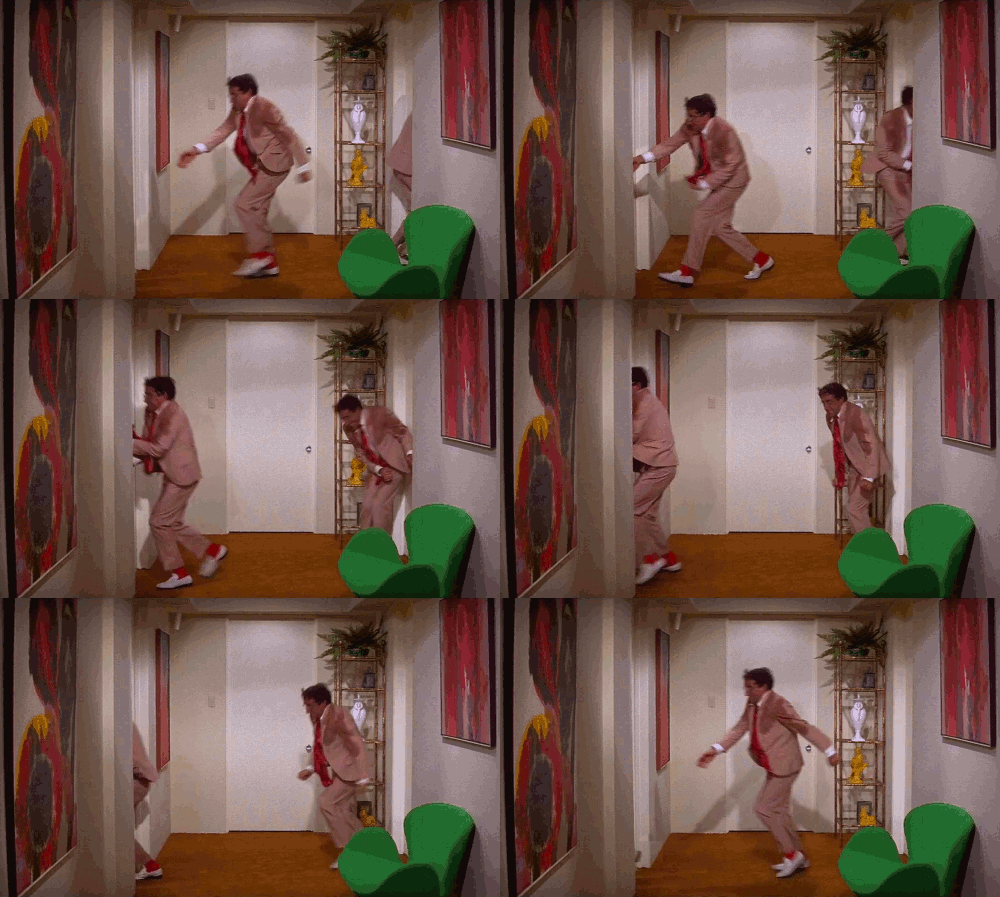
Blake Edwards The Party (1968)
‘Blake Edwards’s The Party is the most maddeningly inconsistent of Hollywood comedies. Its hero is one Hrundi V. Bakshi, an incompetent Indian actor played with exquisite politeness and a touch of preening self-satisfaction—and in brownface—by Peter Sellers. Almost the entire movie takes place at a party of Hollywood swells to which Bakshi mistakenly gets invited; needless to say, the actor, hoping only to fit in, winds up destroying the house, which is an amazing piece of sixties fantasy, with its pools, sliding panels, and acres of Formica. Some of Edwards’s work with Sellers, including long, virtually silent passages of physical comedy (set to Henry Mancini’s music), comes within hailing distance of Chaplin—for instance, a scene of exquisite anguish in which Bakshi has to pee and can’t move because a French starlet (Claudine Longet) is singing an interminable chanson. Other jokes, however, are just routine, and the movie collapses into chaos.’ — The New Yorker


Excerpt


Excerpt


___________________
Hy Averback I Love You, Alice B. Toklas (1968)
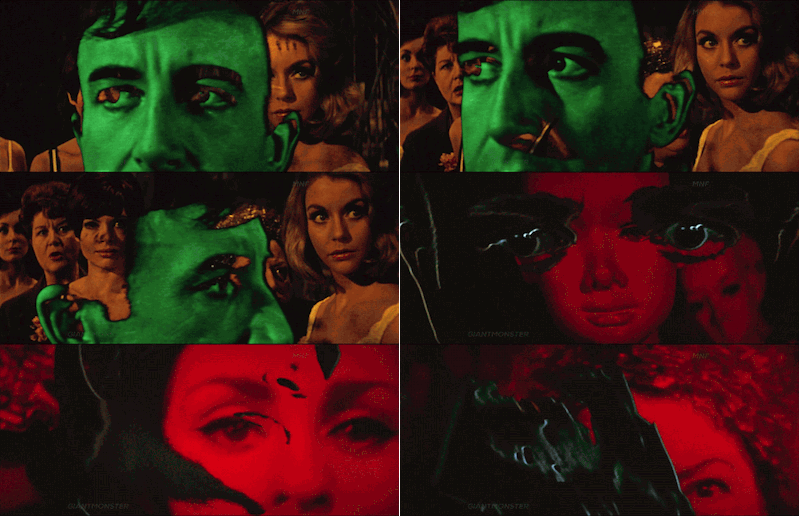
‘One of the few 1960s satires of the hippie culture that doesn’t appear to be concocted by grumpy old men, I Love You, Alice B. Toklas stars Peter Sellers as Harold Fine, a staid Jewish attorney. Engaged to the equally straitlaced Joyce (Joyce Van Patten), Harold wistfully dreams of having a more exciting lifestyle. Through a fluke, Harold is obliged to drive a station wagon emblazoned with “psychedelic” imagery; it is with this vehicle that he picks up his flower-child brother Herbie (David Arkin), and Herbie’s groovy chick Nancy (Leigh Taylor-Young). Rather enjoying the company of people outside of his establishment orbit, Harold lets Nancy stay over at her place, and she plies him with marijuana-spiked brownies. His inhibitions released by the spiked pastries, Harold kicks over the traces, grows his hair to shoulder length, and embarks upon an affair with Nancy. But when the effects of the brownies wear off, Harold suddenly feels like the rather foolish middle-aged man that he is. The beauty of I Love You, Alice B. Toklas is that it patronizes neither the hippies nor the Establishment characters; both groups are shown as human beings rather than agit-prop stereotypes.’ — Rovi


Trailer


Excerpt


______________________
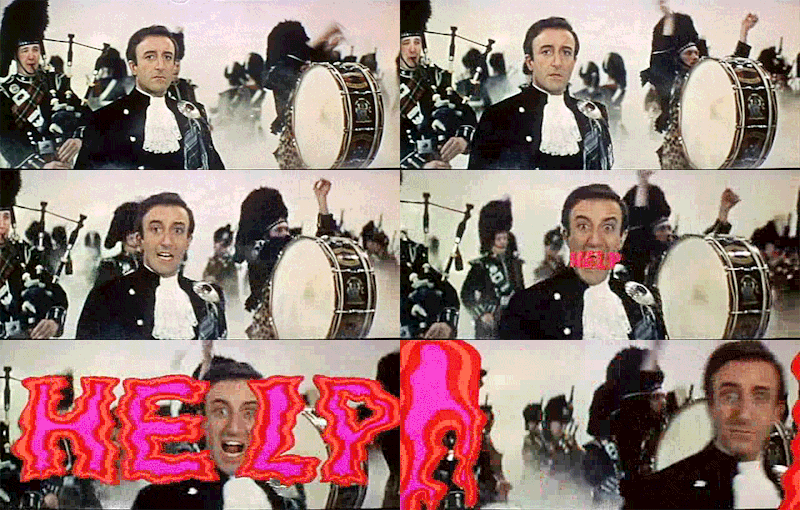
Joseph McGrath The Magic Christian (1969)
‘The Magic Christian, Terry Southern’s best book, is not so much a novel as collection of episodes in the life of the eccentric, incalculably wealthy Guy Grand, who constructs elaborate and immensely practical jokes designed to upset his fellow men and sometimes himself as well. His usual targets are greed and conventional values, but he also attacks good sportsmanship, good living and rudimentary business ethics. The Magic Christian is funny, uncomfortable and without an ounce of benevolence. The meeting of McGrath with his material produces not so much a tension as a revaluation—and the results turn out to be a mixed bag. The episodes have been shuffled around, so that Terry Southern’s bitter beginning (a put-on of a poor hot dog vender) and enigmatic ending (a disappearing chain of super-bargain grocery stores) have been lost in the middle of the film to no good effect. Guy Grand, a middle-aged American tycoon in the book, becomes a British business baronet (Peter Sellers) in the film. And he adopts a son (Ringo Starr), whom he names Youngman Grand, and who serves no reasonable purpose except to give Peter Sellers somebody to talk and relate to. Ringo is fine, and Sellers is finer—in a performance, that vastly enriches and normalizes the archly enthusiastic Porky Pig of Terry Southern’s imagination.’ — NYT


Excerpt


Excerpt


___________________
Alvin Rakoff Hoffman (1970)
‘Hoffman is the satirical tale of an older man, played by Peter Sellers, who invites a female employee to his flat in London. As the film progresses, it is revealed that Sellers’ character has caught one of his workers dealing in a scam against his company, and has decided to blackmail the man’s lovely fiancée away for a full week to convince her to fall in love with him instead. A witty drama rather than a comedy, the film has an almost terrifying performance by Sellers, involved in intricate mind games with the other protagonists. Reportedly, Sellers despised Hoffman because the lead character too closely reflected his own personality. According to Bryan Forbes, who was head of the studio that financed the film, Sellers went through a depressive phase after filming completed and he asked to buy back the negative and remake the movie. He also gave an interview where he said the film was a disaster. It was not a success at the box office.’ — collaged


Excerpt


Excerpt


_______________________
William Sterling Alice’s Adventures in Wonderland (1972)
‘A star-studded cast highlights this musical adaptation of the classic fantasy tales of Lewis Carroll. One day young Alice (Fiona Fullerton) takes a nasty spill down the rabbit-hole and finds herself in the bizarre kingdom of Wonderland, where she encounters a number of strange and enchanted characters, including the playful White Rabbit (Michael Crawford), the manic March Hare (Peter Sellers), the mysterious Caterpillar (Ralph Richardson), the Doormouse (Dudley Moore), the imperious Queen of Hearts (Flora Robson), and the quizzical Mad Hatter (Robert Helpmann). The cast also includes Spike Milligan, Peter Bull, Roy Kinnear, and Michael Jayston as Lewis Carroll. Alice’s Adventures In Wonderland won two prizes at the 1973 British Academy of Film and Theatre Awards — for Georfrey Unsworth’s photography and Anthony Mendelson’s costume design.’ — Rovi


Excerpt


Excerpt


_____________________
Joseph McGrath The Great McGonagall (1974)
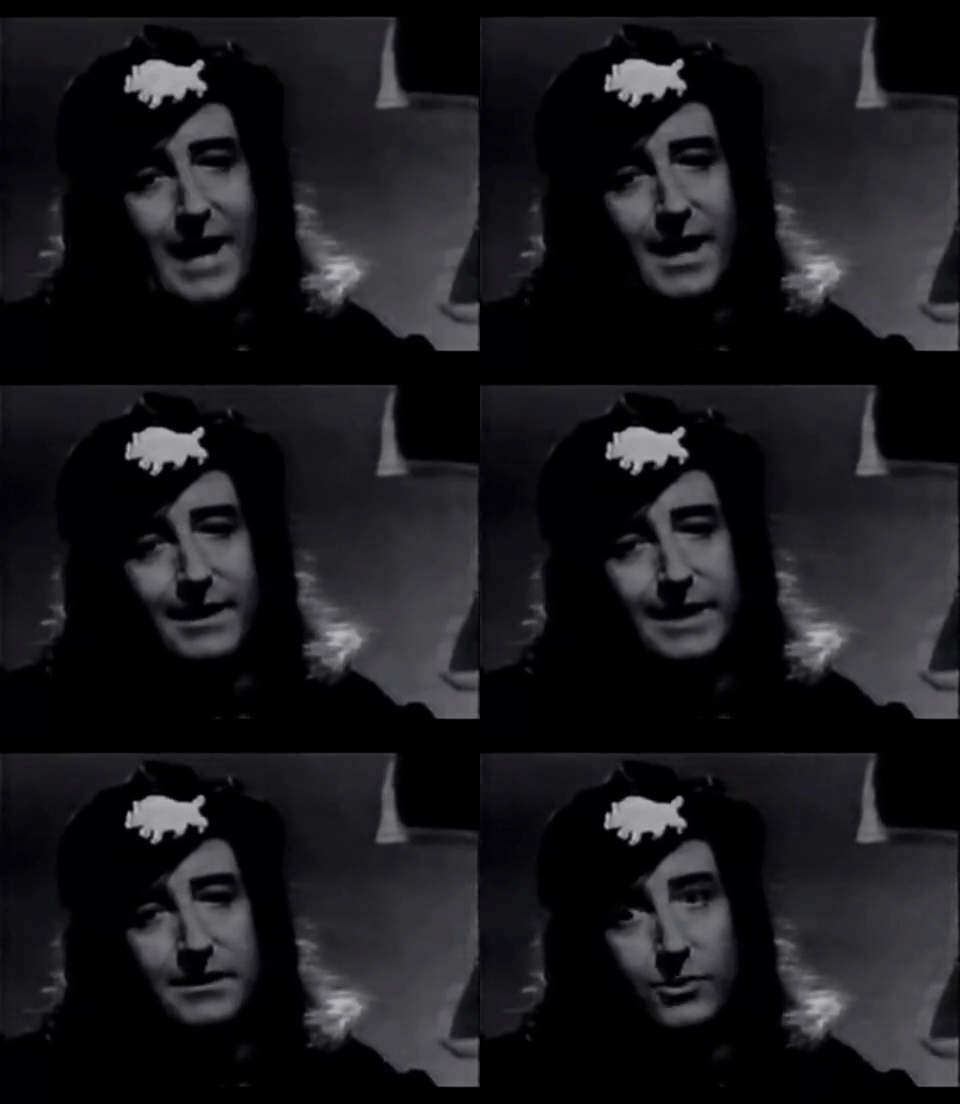
‘That matchless British farceur Spike Milligan stars in The Great McGonagall. The story concerns indigent Scotsman William McGonagall, who aspires to become Poet Laureate of Great Britain. McGonagall might have a better chance of accomplishing this if he had any talent, but he is hilariously inept. The plot is abandoned somewhere in the middle of the film in favor of a series of virtually unrelated comic episodes. Peter Sellers, Spike Milligan’s onetime Goon Show cohort, steals the show in drag as a sexually voracious Queen Victoria!’ — Rovi


Excerpt


____________________
Robert Moore Murder by Death (1976)
‘It was one of the top 10 grossing films of 1976, but Murder By Death has the feel of something Neil Simon and his brother Danny might have cooked up for Sid Caesar during their days writing for Your Show of Shows in the ’50s: Assemble a group of well-known literary sleuths (winking versions of everyone from Sam Spade to Hercule Poirot to Nick and Nora Charles), throw them in a rambling gothic mansion for the weekend and let the whodunit spoofing commence. The cast is an embarrassment of riches that includes Maggie Smith and David Niven. Alec Guinness. Nancy Walker (Mrs. Morgenstern!). Peter Falk. Truman Capote, of all people. James Coco (a Simon regular). Brennan, who died last month. James Cromwell, in his first movie role. And Peter Sellers as a pseudo-Charlie Chan in one of the weirder examples of cinematic yellow face since Mickey Rooney went faux Asian in Breakfast at Tiffany’s.’ — Chicago Tribune


Excerpt


Excerpt


___________________
Hal Ashby Being There (1979)
‘In 1971, Jerzy Kosinski published the novel Being There. Soon afterwards he received a telegram from its lead character, Chance the Gardener: “Available in my garden or outside of it.” A telephone number followed and when Kosinski dialed it Peter Sellers answered. For years afterwards, Sellers would try to get this film made. “That’s me!” he would tell people of the Chance character. He hawked the idea of a film to whomever he could find. Finally, in 1979, with the clout he had gained from the Pink Panther series, he was able to fulfill his dream. What followed was the culmination of Peter Sellers’ career: a masterpiece of double-edged satire on politics and television. But Kosinki’s screenplay goes deeper than that. What he and director Hal Ashby expose is a self-serving and self-deceived society. Through the innocence of the Chance character, all the schemes and manipulations of the world are laid bare for what they are: pure folly. For those who hunger for the truths in life, this is a film that will satisfy your appetite.’ — sarcasmalley


Excerpt


Excerpt


Excerpt


*

p.s. Hey. ** Thomas Moronic, Hi, buddy! Great to see you, man! She’s fantastic. There was a big retrospective of her work at Red Bull in NYC recently that really should travel, and, if it does, London, at least, seems like a natural stop. Yes, I saw a selfie coupling of you and Bernard side by side on Facebook the other week. He’s a gem, I agree. Thanks a bunch, man, about the anthology excerpt. I’m headlong into the novel that it belongs in, and, so far so good, and I even hope to finish it ere too long whenever that may be. I’m excited to hear you’re working on your novel. I think us digging in simultaneously must be good luck. Know exactly what you mean about that backwards domino effect, or I feel like I do. I’ll at least be here for a bit of your visit and maybe the entirety. Zac and I are waiting to hear when the Berlin screening of PGL will be, and we only know it’s during the first week of October so far. So I’ll get to see you! Fantastic! Take good care and enjoy the novel work-filled break. xoxo, me. ** David Ehrenstein, Hi. The Taylor doc is not that kind of overview thing. It’s a fly on the wall-style thing that shows him living, working, making music, eating, talking on the phone, etc. with no narration or authorial input. Jeez, Facebook is getting really antsy and weird. That’s nuts. I can’t get in to the Washington Post at the moment as I’ve used up my handful of free visiting opportunities for the month, but I’ll read that piece once September dawns, thank you. ** Bernard, Hi, B! How did I not know (or maybe remember) that you knew Gretchen Bender, wow. I didn’t, but I saw her at openings in the ’80s. She was so mis-appreciated and overshadowed back then by her relationship with Longo, which is strange, in retrospect, since she’s a 1000 times better artist than him. But that happens. Yes, yes, about Kevin. His memorial at SFMoMa is soon. So wishing I could be there. Asheville the Paris of the South, really? Or ha ha? I need to visit it in any case. Trump does seem to be his most unglued ever, or … what comes after unglued? And yet the powers that be among you guys just let it happen. Psychotic. If I’ve ever read Quentin Meillassoux the memory escapes me. I’ll check him out and find out and rectify if not. Thanks, pal. Enjoy Asheparisville! ** Steve Erickson, There was just a big retrospective of her work at Red Bull. I wish I’d thought to alert you. Ouch: tooth. Well, I had as tooth pulled a couple of months ago, and it was super easy peasy and the pain killers both worked and were hardly noticeable and it didn’t effect my thinking or doing at all, so may yours work similarly. ** Bill, Hi, Bill. Yeah, she’s fantastic. I can only think that, what with the little renaissance around her work going on, some will get to SF. Like I told David, the Taylor doc is an observing Taylor day-to-day thing without any external input. It’s very good. ** Misanthrope, I am usually grinning when I say things that aren’t just simple as pie. Right, right, I remember now that you edit along the way. I do too, but it never ends up being enough in my case. Notes, yeah, interesting. I don’t do that, but my stuff, and especially the new one, doesn’t have the kinds of characters and stories and things that need tracking. Or else I’m just lazy. ** Okay. The other day I thought, Peter Sellers sure was exciting. Then I started looking at clips and found out that he indeed could be really exciting and then much less exciting depending on the vehicle, and, at some point, I decided to make a post out of my journey so you could do the same kind of hunt and assess thing or however you want to use this post. See you tomorrow.
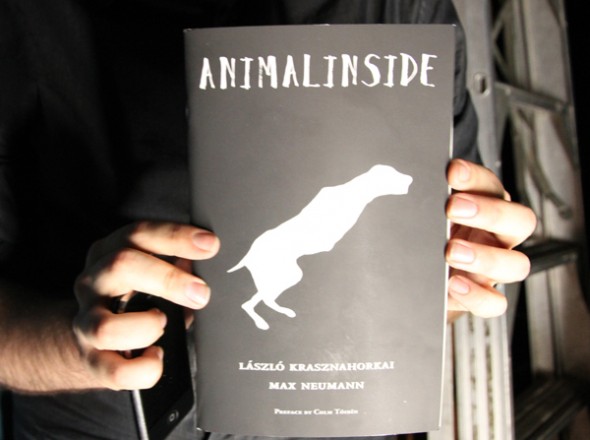
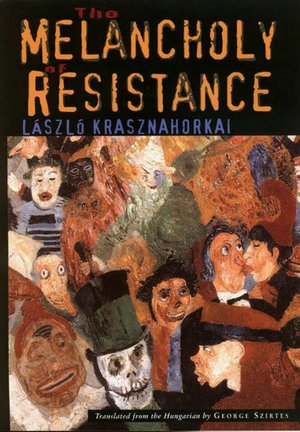
Spotlight on … Laszlo Krasznahorkai The Melancholy of Resistance (1993)

 

‘So-called high literature will disappear. I don’t trust such partial hopes that there will always be islands where literature will be important and survive. … Could it be that people will once again begin to think for themselves? By thinking, I mean original thinking, without someone holding their hand. If I read the works of thinking people, they inspire me to think, but at the same time they give me categories and don’t set me free. Between them and Heraclitus’s riplling stream, they interpose a book. Maybe at some point in the future, there will be nothing between them and the rippling stream. And they’ll get nice and soaked.’ — László Krasznahorkai

‘“Reality examined to the point of madness.” What would this look like, in contemporary writing? It might look like the fiction of László Krasznahorkai, the difficult, peculiar, obsessive, visionary Hungarian author of six novels, only two of which are available in English, The Melancholy of Resistance and War and War, both published by New Directions.

‘Postwar avant-garde fiction has tended to move between augmentation and subtraction. Think of Claude Simon, Thomas Bernhard, José Saramago, W. G. Sebald, Roberto Bolaño, and David Foster Wallace. Of all these novelists, Krasznahorkai is perhaps the strangest. His tireless, tiring sentences feel potentially endless, and are presented without paragraph breaks.

‘Krasznahorkai’s brilliant translator, the poet George Szirtes, refers to his prose as a “slow lava-flow of narrative.” It’s often hard to know exactly what Krasznahorkai’s characters are thinking, because his fictional world teeters on the edge of a revelation that never quite comes.

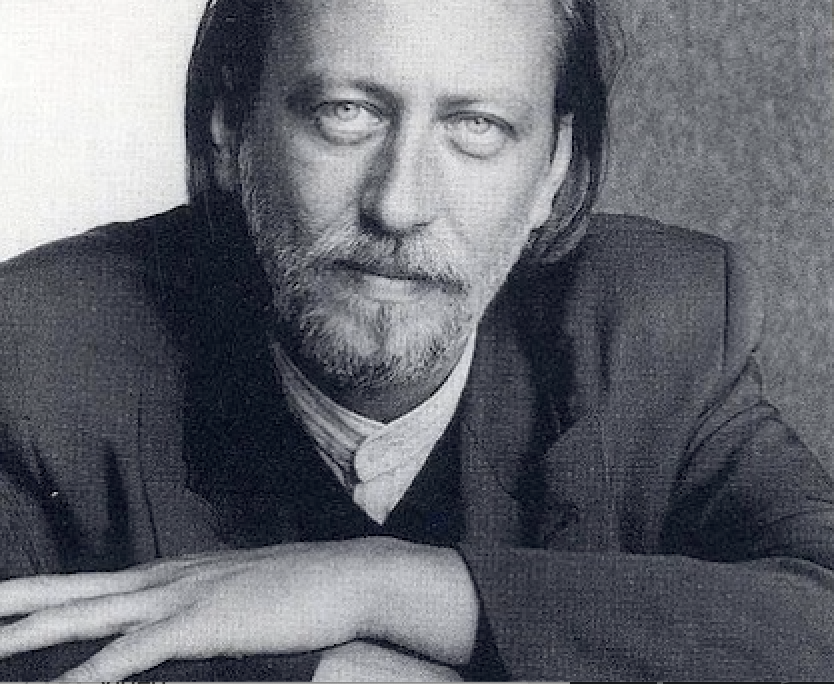
‘László Krasznahorkai was born in Gyula, in southeast Hungary, in 1954. He is probably best known through the oeuvre of the director Béla Tarr, who has collaborated with him on several movies, including Werckmeister Harmonies which is based on his novel The Melancholy of Resistance.

‘Krasznahorkai is clearly fascinated by apocalypse, by broken revelation, indecipherable messages. His demanding novel The Melancholy of Resistance is a comedy of apocalypse, a book about a God that not only failed but didn’t even turn up for the exam. The pleasure of the book flows from its extraordinary, stretched, self-recoiling sentences, which are marvels of a loosely punctuated stream of consciousness.’ — The New Yorker

‘Laszlo Krasznahorkai is the contemporary Hungarian master of apocalypse, and his work is comparable to that of Herman Melville and Nikolai Gogol.’ — Susan Sontag

‘Krasznahorkai’s vision far surpasses all the lesser concerns of contemporary writing.’ — WG Sebald


____
László Krasznahorkai & Bela Tarr


Extract: Bela Tarr’s ‘Werckmeister Harmonies’ (screenplay by László Krasznahorkai)


Extract: Bela Tarr’s ‘Satantango’ (screenplay by László Krasznahorkai)


Extract: Bela Tarr’s ‘Damnation’ (screenplay by László Krasznahorkai)


Krasznahorkai László és Tarr Béla nyilatkoznak …


László Krasznahorkai at City Lights


______
Further

* László Krasznahorkai Website
* László Krasznahorkai profiled @ Hungarian Literature Online
* David Auerbach ‘The Mythology of Laszlo Krasznahorkai’
* László Krasznahorkai @ The Private Library
* ‘Bela Tarr and Laszlo Krasznahorkai’s artful pairing’
* ‘Something Is Burning Outside’ by Laszlo Krasznahorkai
* Podcast: LK’s translator George Szirtes interviewed
* French interview with LK @ Litterature Hongroise
* Andrew Ervin on ‘The Melancholy of Resistance’
* LK’s ‘Satantango’ reviewed @ The Coffin Factory
* Buy ‘The Melancholy of Resistance’ @ Powell’s


____
Extra


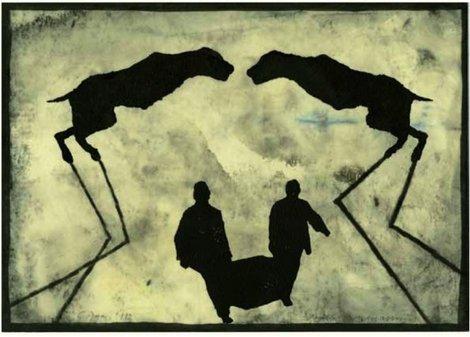
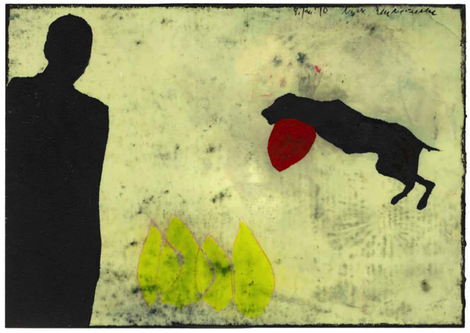
‘It is fascinating to watch the work of Laszlo Krasznahorkai as though in action, spurred into sentences by the suggestive images of the German artist Max Neumann. The writer worked first from one of Neumanns images and then Neumann, spurred on in turn by the words, made the rest of the images to which Krasznahorkai, his mind let loose by the captured visuals, responded by writing more texts. What follows are two excerpts from the book, Animalinside (2011), that resulted from their collaboration. — Colm Toibin


Withdraw into protection and safeguard all that is important to you, take it down to below the earth, all that you have, take down the jewelry, the food, the childrens photographs, the armchair where you like to sit with a book in your hand, the curtain, behind which you feel yourselves to be safe, from the window; gather together all that was dear to you, gather together the identity cards and baptismal certificates, take the money out of the bank and hide it in the cellar behind the wall, but really every piece of jewelry, every scrap of food, every photograph of the child, every armchair and every beloved book, every curtain and every document, and really all! of the money down to the very last cent, and really hide all of these things well, but really well, under the earth, so that at least you will be able to believe until then that there was some sense to it all, until we get there, seek out protection at least until then, while you are still able to believe that we havent got there yet, believe and hope, hope and believe very much that it is rational to prepare for our arrival, just move away and pack up, take the chests stuffed full of pilfered loot, take them one after the other, down below the earth, at least until then do not think about how it is not necessary to wait for us, that it is not necessary to be afraid of us, that we are coming and that there is no need to worry about us, that the day is coming and we are coming, and seeing as its already here, seeing as that day has come, and you didnt notice that it has come, here we are, we see it all, we see what youre doing with your little chests, we see what youre doing with your little possessions, and we see what youre doing with the child, we see everything already from up here, because we are watching you, if you look up you can also see how the light sparkles in our eyes, but you dont look up, and that is how the day ends for you, and that is how life ends for you, because it is impossible to hide away from us, there is no depth within the earth that could be a refuge for you, we are here, above, here, look were watching from up here what youre doing down there, but we dont have to watch everything, because we already know everything about you, because the judgment has been brought upon you, and you do not merit the earth, that is what it says in the judgment, because you have gambled away your luck upon the earth, that is what it says in the judgment, because you have become unworthy of the earth belonging to you, all you lot will clear out of here now and someone else is coming, someone else shall live upon the earth, its the end of you lot, not even a trace of you all shall remain here, that is what! it says in the judgment, so that now you might as well put down that last chest, that too is written in the judgment, and that is why we came here, to execute that judgment upon you.


You are my master, Im inside you, just like that, inside you, you who are standing here, your hands clasped behind your back, you lean forward attentively and look, but really where do you think you are, in the zoo? a blossoming meadow? in an orchard!? Well no, no, not in the zoo and not in the blossoming meadow and not in an orchard but within your own self, you are completely alone, there where between you and me there isnt any distance at all, because Im not out there but Im in here, because I was always inside you, at first just as a kind of cell, or rather something like a mistake in a cell, but then suddenly I grew and now I exist within you with all my force, you carry me everywhere with yourself, your bearing is nice, your clothes are nice, your coat is nice, your shoes are nice, nice and shiny and not even a speck of dust on them, not even a drop of mud, not even a speck of grimy slush, nothing, you are elegant, you went, you strolled, and now something stopped you, or rather you thought oh Ill stop here, Ill clasp my hands behind my back, and Ill look at something, I will look and see what this thing is in front of me, thats what you thought and thats what you did, the only thing is, I am there inside, you carry me within your own self, its of no help at all, not the nice bearing with the head nicely tilted to one side, not the nice clothes, not the nice coat, not the two nice shoes neatly shining, nothing, and now youre still thinking about nice things, thinking for example well lets have a look at whats over there, that looks pretty ghastly lets admit it, you say good-naturedly and unsuspectingly, you clasp your hands behind your back, you put your t! wo nice clean shoes next to each other, and you lean to the left and you look at me, erroneously, because its not me that youre looking at, even if you think you are, because I, that thing that looks so ghastly, is within you, because I am within you, and I am watching all of your nice thoughts, as you think to yourself how pleasant it is here in the orchard, how marvelous it is here in this blossoming meadow, how enchanting it is to stroll a little now here in the zoo, and I look at all of these nice thoughts, and Im watching how nicely you look and you think, but here I am inside, and Im extending outwards, here I am inside, and Im straining more and more, and always forwards, and always in an outward direction, and at one point I will break out, and that will put an end to all the nice thoughts, an end to the nice looks, and an end to the nice clothes and the nice coat and to how nicely you hold your head, and you look, because then you wont be looking anywhere at all, you wont even have any eyes, because I shall begin by corroding both of them, because my coming is violent, just a few moments now, and I shall break out of you, and you will be that which I am, and that which I always have been.


_______
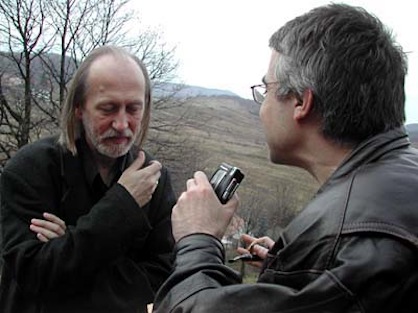
Interview


Many people have the impression that your books are hard to read and to understand. That’s a myth, but don’t you think you’ve got some bad PR?

László Krasznahorkai: You know, the problem is that anything that’s the least bit serious gets bad PR. Kafka got bad PR, and so does the Bible. The Old Testament is a pretty hard text to read; anyone who finds my writing difficult must have trouble with the Bible, too. Our consumer culture aims at putting your mind to sleep, and you’re not even aware of it. It costs a lot of money to keep this singular procedure going, and there’s an insane global operation in place for that very purpose. This state of lost awareness creates the illusion of stability in a constantly changing world, suggesting at least a hypothetical security that doesn’t exist. I see the role of the tabloid press somewhat differently. I can’t just shrug it off and say to hell with it. The tabloid press is there for a serious reason, and that reason is both tragic and delicate.

Is it not possible that the best minds of any given age have felt exactly the same way as you feel, since time immemorial? Is it not possible that the milieu is always like this, and it is only in retrospect that certain ages seem more attractive than others?

LK: I am not saying that the past is brilliant – the recent past, for instance, almost killed me. But those people, living under oppression, had that something about them that gave you hope that the democratic ideals we envisaged at the time could build us a country which is more tolerable when measured by the moral and aesthetic expectations we held. But let me repeat – I would in no way like to idealise what we had at the time. How could I? I would much rather say that we have now lost by the wayside even what little we had – all that once prevented people from becoming blinded by their situation. We have lost whatever used to stop people from selling their dignity for a spoonful of gold or a spoonful of free soup – whatever they have in their spoons. And, to return to your question, I am sure it is true. I am sure all independent spirits felt in their own age that the society they had been granted was intolerable and that this could easily lead to the conclusion that all human societies are intolerable unless they exist by the highest moral and aesthetical standards. This seems true not only with regard to Western civilisations. It seems to hold true for Oriental cultures, too. Confucian himself repeatedly refers his readers to the early Zhou period, directly preceding his own, as an ideal age which his contemporaries should set their standards by. And Confucian, who created the poetic vision of the most elevated moral system in the world, lived in the sixth and fifth centuries before Christ.

In a situation like this, what do writing and literature give you? What do books mean? Obviously, not the way out. Nor does writing function as a form of personal salvation for you. Then, shall we say it is the gentlest form of rebellion? Or does it play the role of issuing certain signals?

LK: Whenever I manage to state my view in its full extent, my partner in conversation, anywhere in the world, invariably reminds me, “If you paint such a gloomy picture of the world, then why write?” This is a subtle way of asking why I don’t shoot myself in the head right there and then, and indeed, why I hadn’t done so a long while ago. My critical remarks do not mean that I think or have ever thought that literature could directly interfere with the workings of the society it criticises or rejects. The impact that a writer can exert over his or her own society is far more subtle, almost indecipherably complex and indirect, working through a number of transformations. I even doubt whether at such a degree of remoteness you can still call this an impact and an influence. In Oriental cultures, this question has found an almost radical solution: art had absolutely nothing to do with the direct, palpable reality of its own age. On the contrary, real artists were not “members” of their own society, in the same way that saints never are. This way, the art they produced did not exist as an integrated, definable, graspable part of society. Instead, it found its place in an emphatically spiritual space which nonetheless was still perceived as a part of reality.


____
Book

Laszlo Krasznahorkai The Melancholy of Resistance
New Directions

‘A powerful, surreal novel, in the tradition of Gogol, about the chaotic events surrounding the arrival of a circus in a small Hungarian town. The Melancholy of Resistance, László Krasznahorkai’s magisterial, surreal novel, depicts a chain of mysterious events in a small Hungarian town. A circus, promising to display the stuffed body of the largest whale in the world, arrives in the dead of winter, prompting bizarre rumors. Word spreads that the circus folk have a sinister purpose in mind, and the frightened citizens cling to any manifestation of order they can find music, cosmology, fascism. The novel’s characters are unforgettable: the evil Mrs. Eszter, plotting her takeover of the town; her weakling husband; and Valuska, our hapless hero with his head in the clouds, who is the tender center of the book, the only pure and noble soul to be found. Compact, powerful and intense, The Melancholy of Resistance, as its enormously gifted translator George Szirtes puts it, “is a slow lava flow of narrative, a vast black river of type.” And yet, miraculously, the novel, in the words of The Guardian, “lifts the reader along in lunar leaps and bounds.”‘ — New Directions

_____
Excerpt

Since the passenger train connecting the icebound estates of the southern lowlands, which extend from the banks of the Tisza almost as far as the foot of the Carpathians, had, despite the garbled explanations of a haplessly stumbling guard and the promises of the stationmaster rushing nervously on and off the platform, failed to arrive (‘Well, squire, it seems to have disappeared into thin air again …’ the guard shrugged, pulling a sour face), the only two serviceable old wooden-seated coaches maintained for just such an ’emergency’ were coupled to an obsolete and unreliable 424, used only as a last resort, and put to work, albeit a good hour and a half late, according to a timetable to which they were not bound and which was only an approximation anyway; so that the locals who were waiting in vain for the eastbound service, and had accepted its delay with what appeared to be a combination of indifference and helpless resignation, might eventually arrive at their destination some fifty kilometres further along the branch line. To tell the truth, none of this really surprised anyone any more since rail travel, like everything else, was subject to the prevailing conditions: all normal expectations went by the board and one’s daily habits were disrupted by a sense of ever-spreading all-consuming chaos which rendered the future unpredictable, the past unrecallable and ordinary life so haphazard that people simply assumed that whatever could be imagined might come to pass, that if there were only one door in a building it would no longer open, that wheat would grow head downwards into the earth not out of it, and that, since one could only note the symptoms of disintegration, the reasons for it remaining unfathomable and inconceivable, there was nothing anyone could do except to get a tenacious grip on anything that was still tangible; which is precisely what people at the village station continued to do when, in hope of taking possession of the essentially limited seating to which they were entitled, they stormed the carriage doors, which being frozen up proved very difficult to open. Mrs Plauf, who happened to be on her way home from one of her customary winter visits to relatives, took full part in the pointless struggle (pointless since, as they soon discovered, no one actually remained standing), and by the time she had shoved aside those who stood in her way and used her tiny frame to hold up the crowd pressing behind her in order to assure herself of a rear-facing window seat, she could no longer distinguish between her sense of indignation at the intolerable jostling she had just endured and a different feeling, oscillating between fury and anguish, occasioned by the awareness that she, with her first-class ticket, which was quite worthless in this stench of garlic sausage blended with the aroma of mixed-fruit brandy and cheap pungent tobacco, surrounded as she was by an almost menacing ring of loud-mouthed, belching ‘common peasants’, would be faced by the acute uncertainty faced by all those engaged in what was in any case the risky business of travelling nowadays, in other words not knowing whether she would arrive home at all. Her sisters, who had lived in complete isolation ever since age had rendered them immobile, would never have forgiven her if she had neglected to pay them her regular early-winter visit and it was only on their account that she refused to abandon this dangerous enterprise even though she was as certain as everyone else that something around her had changed so radically that the wisest course under the circumstances would have been to take no risks at all. To be wise, however, soberly to anticipate what might lie in store, was truly no easy task, for it was as if some vital yet undetectable modification had taken place in the eternally stable composition of the air, in the very remoteness of that hitherto faultless mechanism or unnamed principle—which, it is often remarked, makes the world go round and of which the most imposing evidence is the sheer phenomenon of the world’s existence—which had suddenly lost some of its power, and it was because of this that the troubling knowledge of the probability of danger was in fact less unbearable than the common sense of foreboding that soon anything at all might happen and that this ‘anything’—the law governing its likelihood becoming apparent in the process of disintegration—was leading to greater anxiety than the thought of any personal misfortune, thereby increasingly depriving people of the possibility of coolly appraising the facts. To establish one’s bearings among the ever more frightening events of the past months had become impossible, not only because there was little coherence in the mixture of news, gossip, rumour and personal experience (examples of which might include the sharp and much too early cold snap at the beginning of November, the mysterious family disasters, the rapid succession of railway accidents and those terrifying rumours of gangs of criminal children defacing public monuments in the distant capital, between any of which it was hard to find any rational connection), but also because not one of these items of news meant anything in itself, all seeming to be merely omens of what was referred to by a growing number of people as ‘the coming catastrophe’. Mrs Plauf had even heard that some people had started to talk of peculiar changes in the behaviour of animals, and while this—for the time being at least, though who knows what might happen later—could be dismissed as irresponsible and harmful gossip, one thing was certain, that unlike those to whom this signified a state of utter chaos, Mrs Plauf was convinced that, on the contrary, it was perfectly appropriate in its timing since a respectable person hardly dared set foot outside her house any more, and in a place where a train can disappear ‘just like that’ there was, or so her thoughts ran on, ‘no sense left in anything’. And this was how she prepared herself mentally for the ride home, which was bound to be far less smooth than the outward journey, cushioned as she had then been by her nominal status as a first-class passenger, since, as she pondered nervously, ‘anything might happen on these dreadful branch-lines’ and it was best to steel oneself for the worst; so she sat like one who would happily make herself invisible, straight-backed, her knees schoolgirlishly clamped together, wearing a chilly, somewhat contemptuous expression, among the slowly diminishing huddle of people still tussling for seats, and while she kept a suspicious eye on the terrifying gallery of undefined faces reflected in the window, her feelings swung between anxiety and yearning, thinking now of the ominous distances ahead and now of the warmth of the house she had had to leave behind; those pleasant afternoons with Mrs Mádai and Mrs Nuszbeck, those old Sunday walks along the tree-lined avenue of Friars’ Walk, and finally the soft carpets and delicate furniture of home, that radiantly calm order of carefully tended flowers and all her little possessions, which, as she well knew, was not only an island in a wholly unpredictable world where afternoons and Sundays had become merely a memory but the one refuge and consolation of a lonely woman the orderliness of whose life was calculated to produce peace and calm. Uncomprehendingly, and with a certain degree of envious contempt, she realized that her noisy fellow travellers—most likely coarse peasants from the darkest nooks and corners of distant villages—were quickly adapting themselves even to such straitened circumstances: to them it was as if nothing unusual had happened, everywhere there was the rustling of greaseproof paper being unwrapped and food being doled out, corks were popping, beer-can lids were dropping to the greasy floor, and here and there she could already hear that noise ‘so calculated to offend all one’s finer feelings’ but, in her opinion, ‘perfectly common among common people’ of munching and crunching; and what was more, the party of four directly opposite her, who were among the loudest, had already started dealing a deck of cards—till only she was left, solitary; sitting even more stiffly among the increasingly loud human hubbub, silent, her head determinedly turned to the window, her fur coat protected from the seat by a sheet of newspaper, clutching her clipped handbag to her with such terrified and resolute suspicion that she hardly noticed the engine up ahead, its two red lights probing the frozen darkness, drawing uncertainly out into the winter evening. A discreet sigh was her only contribution to the noises of general relief (grunts of satisfaction, whoops of joy) that after such a long and chilly period of waiting something at last was happening; though this did not last long, since, having travelled barely a hundred metres from the now silent village platform and after a few clumsy jerks—as if the order permitting them to start had been unexpectedly revoked—the train came judderingly to a stop; and though the cries of frustration soon gave way to puzzled and angry laughter, once people realized that this state of affairs was likely to continue and were forced to admit that their journey—possibly because of the extended chaos owing to the employment of an off-timetable train—was sadly destined to vacillate between lurching forward and lurching to a halt, they all relapsed into a jokey indifference, the dull insensibility that ensues when one has been forced to accept certain facts, which simply goes to show how people behave when, having failed, infuriatingly, to understand something, they try to suppress the fear caused by genuine shock to a system which seems to have been overtaken by chaos, the nerve-rackingly repeated instances of which may be met with nothing but withering sarcasm. Although their crude incessant joking (‘I should take so much care when I’m in bed with the missus …!’) naturally outraged her delicate sensibilities, the stream of ever ruder cracks with which each hoped to trump the one before—jokes, in any case, now dying away—had a relaxing effect, even on Mrs Plauf, and, every so often, on hearing one of the better ones—and there was no real escape from the coarse laughter that followed in each case—she herself couldn’t entirely suppress a shy little smile. Slyly and carefully, she even ventured a few momentary glances, not at her immediate neighbours but at those who were sitting further off, and in the peculiar atmosphere of daft good humour—since, while the occupants of the carriage (those men slapping their thighs, those women of nondescript age cackling with their mouths full) remained rather fearsome, they seemed less threatening than they had been—she tried to keep her anxious imagination in check and tell herself that she might not actually have to face the lurking terrors of the ugly and unfriendly mob by which, her instincts told her, she was surrounded, and that it might only be because of her keen susceptibility to omens of ill-fortune and her exaggerated sense of isolation in such a cold and alien environment, that she might arrive home, unharmed it may be, but exhausted by her state of constant vigilance. To tell the truth, there was very little real basis for hope of such a happy resolution but Mrs Plauf simply couldn’t resist the false enticements of optimism: though the train was once again stalled nowhere, waiting minutes on end for a signal, she calmly concluded that they were making ‘some kind of progress’, and she controlled the nervous impatience occasioned by the regular—alas too frequent—squealing of brakes and periods of unavoidable immobility, since the pleasant warmth that had resulted from the heating being switched on when the engine started had encouraged her to divest herself of her coat, so she no longer had to fear that she might catch a cold on stepping out into the icy wind on arrival home. She adjusted the creases in the stole behind her, spread the fake-fur wrap over her legs, locked her fingers round the handbag swollen by the woollen scarf she had stuffed inside it, and, with an unchangingly straight back, was just looking out again through the window when there, in the filthy glass, she suddenly found herself face to face with a ‘peculiarly silent’ unshaven man, swigging from a bottle of stinking brandy, who, now that she was clad only in a blouse and the little jacket of her suit, was staring (‘Lustfully!!’) at her perhaps too prominent, powerful breasts. ‘I knew it!’—quick as lightning, despite a hot flush running right through her, she turned her head away, pretending she hadn’t noticed. For several minutes she didn’t move a muscle, but stared blindly into the darkness outside, and tried, vainly, to recall the man’s appearance (conjuring up only the unshaven face, the ‘somehow so dirty’ broadcloth coat and the uncouth, sly yet shameless gaze which she was to find so disturbing …), then, very slowly, trusting that she ran no risk in doing so, she allowed her eyes to slide across the glass, withdrawing immediately when she discovered not only that ‘the creature in question’ was persisting in his ‘impudence’, but that their eyes had met. Her shoulders, neck and nape were all aching because of the rigid posture of her head, but by now she couldn’t have torn her eyes away even if she had wanted to, because she felt that whichever way she turned beyond the narrow darkness of the window, his terrifyingly steady gaze would easily commandeer every nook of the carriage and ‘snap her up’. ‘How long has he been looking at me?’—the question cut Mrs Plauf like a knife, and the possibility that the man’s dirty raking eye had been ‘on her’ from the very start of the journey made the gaze, whose meaning she had understood in a flash in the very second of contact, appear even more terrifying than before. These two eyes, after all, spoke of sickeningly ‘foul desires’—’worse still!’ she trembled—it was as if some sort of dry contempt burned within them. While she couldn’t think of herself as an old woman, not precisely, she knew she was past the age when this kind of attention—not uncommon when paid to others—was still natural, and so, as well as regarding the, man with a certain horror (what kind of person is it, after all, who is capable of lusting after elderly women?), she was frightened to realize that this fellow stinking of cheap brandy wanted nothing more perhaps than to make her ridiculous, to mock and humiliate her, then laughingly toss her aside ‘like an old rag’. After a few violent jolts the train now began to pick up speed, wheels clattered furiously on rails, and a long-forgotten feeling of confusion and acute embarrassment took hold of her as her full, heavy breasts started to throb and burn under the man’s fixed, uncontrollable and threatening gaze. Her arms, with which she could at least have covered them, simply refused to obey her: it was as if she had been specially selected, helpless to cover the shame of her exposure, and as a consequence she felt ever more vulnerable, ever more naked, ever more conscious of the fact that the more she yearned to conceal her thrusting womanhood the more it drew attention to itself. The card players ended another round with an outburst of crude bickering which broke across the hostile and paralysing hum—cutting, as it were, the bands that tightly bound her and prevented her escaping—and she would almost certainly have succeeded in overcoming her unfortunate torpor had not something even worse suddenly happened, the sole purpose of which, she realized in despair, was to crown her suffering. Driven as she was by her instinctive embarrassment and in an act of unconscious defiance, she was just trying to hide her breasts by tactfully inclining her head, when her back bent awkwardly, her shoulders slumped forward and she realized in a moment of terror that her bra—perhaps due to her unusual physical exertion—had come unclipped behind her. She looked up aghast, and was not at all surprised to see the two male eyes still fixed steadily on her, eyes that winked at her with an air of complicity, as if aware of her ridiculous ill-fortune. Mrs Plauf knew all too well what would happen next, but this almost fatal accident so disturbed her that she only sat stiffer than ever in the accelerating train, helpless once more, her cheeks burning with embarrassment, having to suffer the malicious look of glee in those contemptuously self-confident eyes which were now glued to her breasts, breasts which, freed from the encumbrance of the bra, jogged merrily up and down with the jolting of the carriage.


*

p.s. Hey. ** Dominik, Hi! Yeah, I’m pretty much headlong into the new novel now. I like being there. It’s been a while. It’s definitely very different from working on the films or even the gif fiction, super concentrated and absorbing in this way I always liked. Mm, it’s hard to describe. It’s very personal. It seems autobiographical but it isn’t completely. It’s very un-novel-like, it doesn’t have a narrative. It moves around formally a lot. There’s a section about Santa Claus. There’s a fairytale. There’s a lot of talking/digressing. We’ll see. I’m excited by it, but I’m not yet sure it’s going to work. The TV project starts up again in about a week. I’m feeling nothing but dread about it at the moment. Zac is away on vacation. He’s supposed to be finishing the detail work on the translation while he’s gone, and I’m hoping he is so, when he gets back, we can hand it over to our producer and start fundraising. You sound so jazzed up and invigorated by the performance experience! That’s so great to hear! It’s palpable. Obviously, I totally encourage you to develop and use your own ideas in the next performance, not that you need encouragement. Do you think you’ll keep working with your friend as a duo? Would you be interested in doing solo performances or in gathering someone or someones to help you realise your ideas? So great! Really happy for you! And excited to see any evidence if there is any. The Stooges were pretty fucking great, yeah, you bet. I hope you had a really good weekend. I just worked on the novel the entirety of mine  pretty much. And since Paris is devoid of all of my friends right now, that seemed the best time use. Much love back to you! ** David Ehrenstein, Well, LARB should get wise. Do link us up to your piece on Mark Dery’s book. Here’s hoping for the best and soonest berth possible. ** Sypha, Hi, James. I played a little of Looking Glass Studios’ stuff, a bit, and I thought the stuff I played was terrific too. Wow, Kyte Lockett. He … wait, I think he’s they now … they were on Facebook for a while, and I kept up, but I don’t think they’re active on there anymore. Any news on Kyte? ** Steve Erickson, Thanks. I wish someone would do good avant-garde video games list. I had to do a bunch of hunting around to find those in the post. Ah, I’m just putting together a post about Su Friedrich right now. Hope you get the dentist thing over with tomorrow. And that the music video director nails it down. ** Bill, Hey. Man, you travel so much. Welcome home again. Some of those games in the post look pretty curious. I’ve only played a few. How was Mark Dresser’s concert and … dinner? Thanks much for the Hoan Kiem Chess Team hook up. I don’t know that project, and I’ll listen today. Bon Monday. ** _Black_Acrylic, Hi, Ben. Welcome back to Leeds from afar. I hope Leeds wins, duh. You’re going too the Lake District. I’ve never been there but it sounds awfully pretty. And one supposes the marriage will be touching and all of that. Cool beans about #3! Ooh, anticipation. Great, Ben. ** Nick Toti, Hi, Nick! Thanks, bud. Oh, yes, definitely and absolutely, I would love this place to host the online premiere of your movie! And thanks a ton for wanting to use this place to do that. So, yeah, 100%, and just send me the materials, and we’ll do it when you want. Take care. ** Misanthrope, Avant-garde games are fun too. Well, some of them. Probably the same ratio of fun to unfun as in usual games. Great about your great weekend! Mucho deserved. George the child sedater. Who’d have thunk? Well, me, if I’d thought about it. ** Right. Laszlo Krasznahorkai is probably best known for having written some of Bela Tarr’s greatest films, but his books are also knockouts, the one featured today being one of the especially great ones, I would say. See you tomorrow.

« Older posts Newer posts »

© 2026 DC's

Theme by Anders Norén — Up ↑